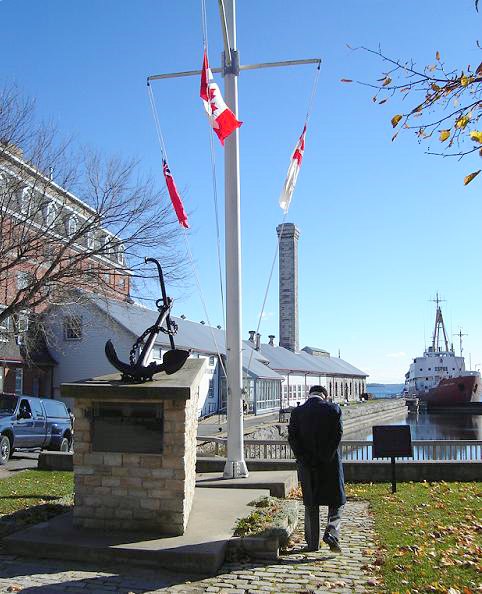
The Mid-November Shock Of The First Real Freeze Runs Through These Beery News Notes

Remember all those sunny garden shots? Just a week ago?  The wonderful colours?  The ripening fruit?  Well, it’s now sky shit season and looks to stay that way for another four if not five months. Snow, winds off the lake, freezing rains. Commisserations welcome in the comments. It was also Remembrance Day on Tuesday so plenty to be solemn about for a stretch before the holiday season really begins. I took and posted that photo twenty years ago now,* of a Second World War RCN officer waiting for the service at Navy Memorial Park here by our waterfront.

We start with a look to the past. Boak and Bailey showed their stuff again this week with an excellent post seeking out the source of the beer with the branding “Rustic Ale“:

A slight surprise there might be that ‘rustic’ clearly did not indicate that the beer would be strong or rough, like Spingo. But at about 3.5% ABV, Rustic Ale would be considered at the lower end of session strength even today, never mind before the First World War. Elsewhere there are instances of the phrase ‘rustic ale’ being used not as a brand name but to describe the type of beer drunk in country inns, by country folk. The earliest of these references we could find is from 1855. Another, from 1909, suggests that healthy country girls (think Honoria Glossop) “will face her glass of rustic ale like a young farmer”.

Excellent. And Breandán Kearney wrote about lost Belgian styles for The Brussels Times Sunday magazine and the steps which have been taken to revive them:

Seef or Seefbier, for example, once the pride of Antwerp, vanished with the collapse of small urban breweries during the First World War. A decade ago, Johan Van Dyck claimed to have uncovered an old recipe for a seef beer which he reincarnated with a barley, wheat, and oat grainbill and a creamy, unfiltered profile. In recreating it, Van Dyck reignited city pride with a new generation of drinkers. In Lier, the brown-amber ale caves was revived by a local heritage guild, which commissioned it to be recreated from archival recipes (but only for serving in cafés within the town walls). And then there’s uitzet, a mixed fermentation brown ale from East Flanders that local brewers such as DOK Brewing Co, have tried to recreate in Ghent.

You know, I’ve been told I have a creamy unfiltered profile. Speaking of diligent research, Ron has pulled back the curtain and shared an update on his methodology:

I finally bit the bullet yesterday. Adding an extra column to my main beer gravity spreadsheet.  I’d been planning on doing it for a couple of years. And had started using a new format table for any gravities I harvest. But it was getting out of hand. It was over 2,000 lines. And when I wanted to look up beers from a specific brewery, I had to search in both tables. Time to merge the two. It itself, that wasn’t particularly difficult. Just add the column to the main table and tack the entries from the temporary table on the end. Except, most of the entries now had a blank column. Which I’ll have to add. Quite a palaver, in a table of 25,000 entries. I started the work yesterday. And have completed maybe 25%. It’s dull, tedious work. But it will be worth it, when I’m done. In case you’re wondering, the column is the town where the brewery is located…

A-HAH!! I knew it. I knew all these beers were from places. And, I understand, they are made… in ways. On that point, here we have first The Beer Nut  and then Stan noticing The Beer Nut on the effect of Thornbridge’s conservation of one part of Marston’s Burton Union brewing set.

TBN: “With luck, one of England’s many fine beer writers will be able to explain what difference the equipment actually makes to the product, beyond the press releases and collaborations.”

SH: “I’m inclined to believe the claims that using the system changes the beer. You might even be able to run a study which compares otherwise identical beers fermented in stainless steel and in the union. Or wood versus the union.”

Two of the best sets of tastebuds in the scribbling set right there. Perhaps the point is simply to continue the use of the way. Interesting notes from one commentator: “notoriously laborious to clean and have higher racking losses than other systems” but “they help in the maintenance of a healthy and regular pitching yeast.” So there may well be value in the way even if it isn’t necessarily translated to the glass.

Pellicle‘s feature this week sent shivers. Not because the piece by Joel Hart about the Mort Subite in Altrincham, a Manchester suburb, was anything but a great portrait of a well loved tavern. But because I had one of the worst drunks ever – followed by a two day hangover – drinking in a place by that name in Paris when I was young and stupid in 1986. Fortunately for me, the five guys from Gascony (spoilers) offering to throttle me did not realize I was with the pack of very large gents in the corner. Events ensued. To the contrary, on Manchester’s version we read:

…it’s quieter, broodier, and more intimate. “I’ve lost hours of time in there,” says Chris Bardsley, who runs Altrincham beer spots The Beacon on Shaw’s Road and Batch Bottlestore in King’s Court. “You’re in there, you don’t see the outside world, you’re just caught in it.”

Glad I wasn’t caught in it, if I am being honest. Back to the question of the tasty, photographer Sean McEmerson provided us with an fabulously detailed essay on the making of green hop beer from Hukins Hops in Tenterden, Kent:

At Hukins Hops, the team carefully assesses each variety across their sprawling, 50-acre farm, checking the hops’ ripeness before deciding when to harvest. Over the last few years, that process has only become more difficult as the UK’s climate has grown more unpredictable. This summer, Kent—one of the country’s key hop-growing regions—experienced record-breaking temperatures during a rolling series of heatwaves. The result was an earlier-than-expected harvest. “Lots of factors contribute to how long harvest takes—machine breakdowns, picking weather, staff, and drying capacity”, Glenn Whatman from Hukins tells me. “This year we had an average crop due to the drought in June, but the machine ran as smoothly as ever and the picking team persevered through torrid weather”.

I had no idea hop pickers’ hands became tarred with resin. Speaking of photo essays, Martin has returned to his winter quarters in Rye, England and took a stroll to see Jeff at the Ypres Castle Inn:

Jeff greets me at the bar, where I sit and watch the magic of a great pub unfold over the next hour. Louie (sp. ?) is the star today, another of Jeff’s great staff team, but all the customers seem lovely too. Not serving food helps. Children bring their empty glasses back to the bar and say “Thank you“. Their proud parents say “Well done“. I say “Well done“, too, perhaps a little enthusiastically. I’m not normally comfortable sitting at the bar, but watching a great pub like the Ypres in full flow on a Saturday evening is a thing of wonder.

Somewhat to the contrary – or perhaps in ignorance of the above – the stomp on craft continues. Auto scene reporter Ben Shimkus was in the The Daily Mail with his autopsy of US craft beer under a “hipster” inclusive headline, dipping heavily into the finger-pointy zingers bucket as he did:

America’s craft beer phase seems to be fizzling out. Expensive beers flavored with ‘notes of citrus and pine’ or brewed with an extra batch of hops are losing favor in US grocery stores and bars. Instead, giant beer brands featuring utilitarian flavors and low prices are all the rage. There might be a charming reason why: Millennial-aged craft beer fans have grown up… the lower-cost seeking has had a damaging impact on America’s microbrewery industry, which dominated younger parts of the US and attracted cornhole players. Dozens of sites have permanently shut down.

Is that tone really necessary? Well, besides “cornhole players” which has always been a self-inflicted wound as far as I can tell. No, the pile on is getting to feel like, you know, making fun of people who just really like their cats.** Perhaps the trade friendly euphemisms like “consolidation” and “mature market” are usefully kinder descriptors for the slump.

A saner explanation of the current situation has been provided by Ron Emler in The Drinks Business – with an particular focus on China:

For the past couple of years, it has been the group mantra from big booze bosses that the current downturn in sales is cyclical rather than structural. But the cracks in that corporate front are widening. No longer can the combined effects of squeezed wallets, the rise of cannabis-infused offerings, the increasing uptake of weight loss drugs which reduce the desire for alcohol and the lifestyle choices being taken by Gen Z be dismissed out of hand as inconsequential in the longer term… According to Morningstar senior analyst Jennifer Song, China’s younger generation rejects the “intense sensation of high-alcohol baijiu”. She said: “We believe expanding low-alcohol baijiu offerings is a long-term trend, driven by demographic change and rising health awareness.”

Jason Wilson takes the broader issue from another angle, the problem posed to premium categories when there is common access to things which have been formerly accepted as luxuries:

The problem right now is that “fancy goods are everywhere,” according to The Economist… I wonder if wine needs to try so hard to present itself as more of an experience than a thing. After all, simply opening a bottle of wine—on a sunny day in the park, during a late night conversation on a roof deck, on a lazy, decadent afternoon in bed—is the prelude to experience. The drinking of the wine in a place with people is the experience. We would do well to remember that. Perhaps it’s more a matter of shifting perspective, framing, and being open to more possibilities.

So do we need to – or should we – buy as much booze to still be interested in the stuff? If you’ve read the stuff posted around here very much over the years you will know that has been always been a question in my head. Do we consumers ally ourselves with producers at all costs? Or are we wanting a decent pint at a decent price? Or both? Should alcohol to play a smaller but healthier role in life or does one root for a business rebound back to the irrational exuberence of craft beer a decade ago? Or even further back even to the 1980s when understanding hard to find beer conveyed a certain status, as Boak and Bailey recently considered. Sometimes the enthusiasts’ approach to beer writing strikes me as similar to the unrequited yearning for the experience of being young again. Were there longings for Rustic Ale in the years after it faded, too?

Speaking of longings, Jeff is looking for an explanation of the price of NA beer building on last week’s note from hereabouts on the update from BMI on the price of the stuff:

In the past decade, non-alcoholic beer has gone through an important upgrade over the old Clausthaler era. Breweries started taking it seriously, and the quality, while still not as good as regular beer, is vastly better than it used to be. Athletic demonstrated that there was a market out there for N/A beer made in modern craft styles. The big question is how big that market will become in the U.S. Here I am a lot more bearish than the industry, for these reasons. It’s a premium-priced product that is inferior in taste to regular beer or other non-alc alternatives. The proliferation of N/A brands is hurting rather than helping, too. With the flood into the market, people are exposed to more of the poor examples. A novelty factor in being able to buy a N/A hazy buoyed the industry, but I have a real question if that’s sustainable.

Is any of it sustainable? And… what is it that would be sustained? Not a small question so we can leave it there for now. Until next week, I will be focusing all my energy at the Grey Cup game and shouting at the sky… and once again thanking my luck for the pack of gents in that corner of that bar. As I do, please also check out, Boak and Bailey on this and every Saturday and then sign up for their entertaining footnotes, too. Look out for Stan when he feels the urge now that he’s retired from Monday slot… maybe … maybe not. Then listen to a few of Lew’s podcasts and get your emailed issue of Episodes of my Pub Life by David Jesudason on certain Fridays. And Phil Mellows is at the BritishBeerBreaks. Once a month, as noted, Will Hawkes issues his London Beer City newsletter and do sign up for Katie’s wonderful self-governing totes autonomous website featuring The Gulp, too.  Ben’s Beer and Badword has returned from his break since April so you can embrace the sweary Mary! There is reading at The Glass which is going back to being a blog. Any more? We have Ontario’s own A Quick Beer and All About Beer is still offering a range of podcasts – and there’s also Mike Seay’s The Perfect Pour. Plus follow the venerable Full Pint podcast! And there’s the Craft Beer Channel on Youtube. Check out the archives of the Beer Ladies Podcast. That’s quite good and after a break they may well be are back every month!

*Lordy…
**By the way, ours finally killed a goddamn mouse after over ten years so there was a smidge of respect – but it wasn’t like I ran to the grocery to buy kitty treats or anything. I have standarrds. I still keep a portrait of the late great slayer of mice Mrs. Beaton (1999-2012) on my office desk. Frobie got all the attention but Beaon was the killer.

The Beery News Notes For The November Lull Marking The Five-Sixths Mark of 2025

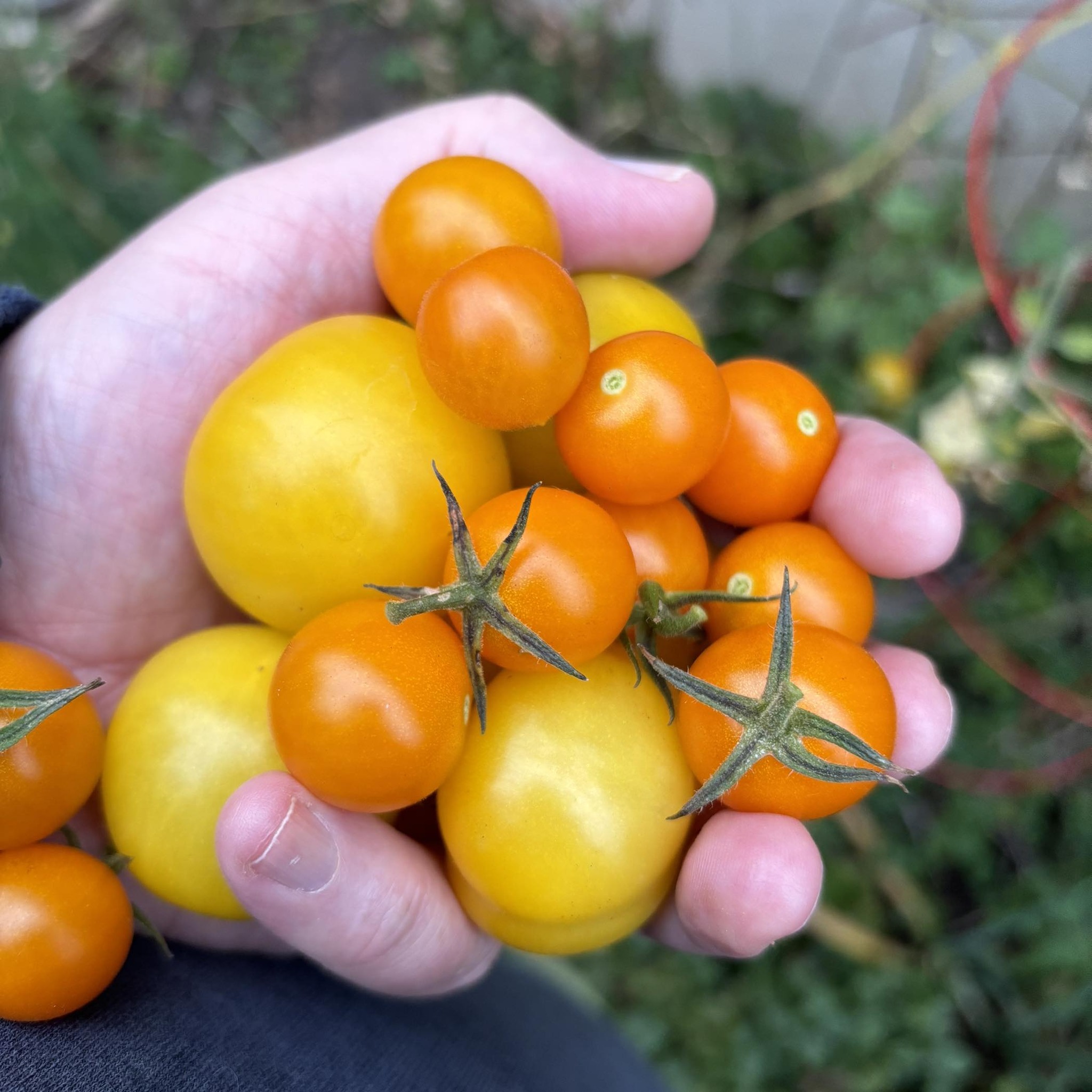
It’s Canada up here and I gotta tell you we have entered the lull.  Pals who work in the hospitality trade in these parts know that between Halloween last week and Remembrance Day next week there is a bit of a drop as we perhaps contemplate some bigger things. Like tightening up the house before the snow flies. Like those final chores to put the garden to bed. Like finding about 35 pounds of tomatoes under just one frikkin’ tarp. Holy smokes. Any recipe suggestions for green tomato chutney can be left in the comments and will be seriously considered… given the circumstances.

First up, I liked this recent brief New Yorker review of Barcade, a joint video game and craft beer bar:

If you play it right, a visit to the new, FiDi outpost of Barcade—the hybrid arcade and craft-beer bar that originated in Williamsburg twenty-one years ago—leads to a quasi-inter-dimensional portal. Your first move, after entering, is to advance to the stone countertop on your left. Survey the chalkboard menu, rich in I.P.A.s, and choose according to your mettle. If that means the Evil Twin Pink Pineapple, prepare for a goblet of roseate brew whose tartness zaps the mouth like a laser. Explore your surroundings. 

I particularly like how the intergallactic laser theme is the tie between the beer and the games. Ten years ago, the same bar was featured in a Jack Black vignette in the same mag but the only the food was mentioned:

He took a bite of his burger, and his eyebrows soared imperatively: “Dude, this Barcade burger? Awesome!” 

Reaching even further back, Liam shared the results of some recent research on efforts by Guinness in 1896 to exert control over the Irish stout market:

This appears to be a damning (if clunkily written*) indictment of a new policy by the Guinness brewery to force those who choose to use the Guinness label to only bottle their stout porter and no other. These days this might be dismissed by many with a shrug and a comment about Guinness just being Guinness but it appears that at the time the other breweries in the city were rather incensed by this behaviour to the point where they issued what could be seen as a full page proclamation under the title ‘Protest of the Dublin brewing Trade Against the New Guinness Label’ where they called out Guinness on what the claimed to be its attempt to establish a monopoly under the guise of wishing to stop adulteration, plus the mislabelling of others’ product as their own.

And The Beer Nut was also sharing this week, this from BlueSky: “What psychopath thought jackfruit Maibock was a good idea?” Indeed. The perils of judging. Possibly relatedly but quite possibly not, David Jesudason pointed me to another peril related to beer scribbling under UK law that I had not been aware of – the taxman cometh:

In news that will have seen some beer writers crying into their gifted Fuller’s Vintage Ales, HMRC has recently clarified that content creators must declare all donations as income on their self-assessment tax return. That’s right. Those crates of beer, jets to foreign breweries and VIP festival passes will now have to be taxed at their market value. (Disclaimer: this is HMRC so some of the guidelines are as muddy as a drain pour smoothie IPA.) It’s caused a few privileged writers to heroically proclaim that they are now refusing unpaid press trips and goodie bags. These virtuous announcements can only mean that a period of austerity will have to be endured; if you see a downtrodden freelance scribe at the bar, maybe buy them a half.

Yup, tax dodging is a serious thing as the makers of Campari have recently found out:

The Italian authorities allege that the holding company, Lagfin, which is controlled by the Garavoglia family, committed tax fraud. The value of the shares seized equates to the tax in question. They will be held until the case is resolved. Lagfin controls 51.3% of the shares in Campari and 38.8% of the voting rights of Davide Campari Milano NV, which is now registered in the Netherlands. The drinks group moved its formal registration to Amsterdam in 2020 to benefit from advantageous tax laws and to exercise tighter control of the company through Dutch company law.

Oopsies!! I have to admit, this next story has me a bit confused. It appears to be an assertion that the British Beer and Pubs Association (BBPA) that the sum total of Britons’ feelings of loneliness relate to the closure of pubs, relying on numbers which appear to exceed perceptions of societal isolation during the pandemic lockdowns:

Research, gathered from new polling by the British Beer and Pubs Association (BBPA) has shown that two out of three (67%) people see pubs as “vital” in the fight against isolation. According to the results, one in three (33%) revealed that they, or someone they know, have experienced increased loneliness as a direct result of losing their local pub… According to the most recent Office of National Statistics (ONS) figures from October 2025, it was discovered that 26% of Brits report feeling lonely at least some of the time, a figure that has remained consistently high since records began in 2020, during the Covid pandemic.

CAMRA presented the same line. I suppose the pandemic is far enough in the past now that co-opting it for commercial purposes isn’t seen as an appropriation of, you know… death. What an odd way to present the poll. Surely, then, it was just coincidence that the NYT had a story on the dangers of placing trust in single issue poll results:

Policy proposals very often overperform in issue polls, according to a recent study that looked at available polling and ballot measure data across 11 topics from 1958 to 2020. The findings apply to both liberal and conservative causes. The more popular a policy is in polls, data showed, the more likely it is to underperform on Election Day. These polls distort our democracy in important ways. Political parties shape their agendas and priorities based on polls that appear to overestimate support for these ideas in the real world. This can make politicians more extreme; if they believe their causes have public support, they will be less likely to moderate.

[You know, I should quote from “a recent study” more often. They’re great.] Still… loneliness for the pub of youth? Makes sense. Was all this the reason that Matty L came out of cryo-hiberation (literarily speaking) and wrote a portrait of a particular Preston pub in peril? Probably not:

The sole survivor of a Victorian terrace, it’s on the side of of a Y-junction, surrounded by sketchy-to-cross roads and large retail units,  There’s very little chance a bog-standard pub with a bog standard drink selection would survive long there, and indeed the vast majority of pubs in the area have closed down in the last 30 years.  Luckily, at this time the whole “craft beer” thing was taking off.  Rich duly installed microbrewed cask ales on the pump, and probably Preston’s first ever “craft keg” selection on the taps.  It duly opened in May 2014, to so much local publicity that even I went there for the opening… I assume keeping all these balls in the air must get exhausting after a decade or so, and a couple of days ago Rich announced he was moving on from The Moorbrook in January.  As such, the future of the pub is up in the air…  

And Boak and Bailey also had a honest evaluation of – and even a yearning for – one former favourite pub near them in Bristol, the Swan with Two Necks:

The bogs at the Swan aren’t its best feature (soap and water on this visit, but no dryer) and the roast potatoes aren’t exhibition quality. But who cares when (a) the atmosphere and (b) the beer list are so bloody good? We think there was certainly a wobble over the summer when punters were thin on the ground and the management was having to disentangle itself from a reliance on beers from Moor. But, yeah, it’s still a great pub, and it’s definitely going to be in our 2026 Bristol pub guide.

No dryer? Me, I take an old fashioned handkerchief for such moments. Because I am old. On a similar theme in terms of noticing the details, ATJ also wrote of a moment at anthother pub past:

The fluffy cockerpoo wagged its tail as it looked at me, while I noticed a couple sitting at the bar; meanwhile a bulky man in Irish rugby shirt rushed past to the gents, disturbing the dog. The music had changed and it was now an almost electro version of (Don’t Fear) The Reaper. Outside the light continued its fall from grace and it was time for me to go to the Albion.

I could quite easily be lonely for those sorts of things, too, I suppose. Maybe. The cockerpoo. A bulky man?!? Speaking of one’s local, Jeff shared a recollection of running into both Evan and diacetyl in Prague:

Typical for any immigrant who lives in an adopted city long enough, Evan long ago absorbed the preferences of Czech drinkers. One of these was an indifference to diacetyl. Or perhaps more accurately, an agnosticism to it. He explained it to me as we sipped buttery pale lagers at his local. Czechs don’t take a position on diacetyl. Like any drinking public, Czechs have certain considerations about what makes a good beer. It should have some meat on its bones, some hop bite in the finish. It should be crystal clear. Above all, it should encourage another sip, another half-liter, and another after that. Diacetyl is just not one of the things it must have or must exclude.

Exactly. What is accepted is real but real is such a cultural construct. For example, we see that Pellicle published a set of top tips for the English pub goer from the good crew that gathers at the magazine – but a few of these have me scratching the old brain bucket. First, the intro in which the scene is set:

….a certain level of pub decorum must also be preserved. All good pubs have unwritten codes of conduct that, over time, become instilled in the people who use them regularly. It is the responsibility of those who live by these codes to pass them on to others. Pubs are for everyone—but not everyone who visits a pub is aware of the particulars that make it hospitable for patrons and staff alike.

I think it is important that we are talking about “codes” rather than a code as a few of the rules the article suggest seem to be particularly placed – and some even may contradict each other. We see that it is important not to shush (“…what possesses people to enter lively social spaces and insist on monastic silence?“) yet don’t take that lively noise too far (“…put your device on silent…“)  Also, know what you want to drink based on the menu (“…the majority of your questions may be dispensed by the clearly legible and reasonably sized board directly in your line of sight…“) but don’t order a cocktail even if it’s on the menu (“…but some pubs have a cocktail menu,” I hear you whimper. It doesn’t matter…“) . Further, I’ve worked in pubs and, yes, dropped many glasses and even a full case of beer bottles and still clap a little bit when a glass smashes. Sorry David. The article is very helpful in many ways, including a warning that there is a minefield awaiting just past the pub door for those unlucky enough to be unfamiliar with the particular local variant of the code.

See, we each have all our ways, we tribes. For further example of this, I would suggest that “fake wine” is such a dirty phrase for that regulatory cultural wonder that is “Canadian wine“:

Free Trade? California, Washington and Oregon are out of the wine business in Canada. They were taken off the shelves because of President Trump’s trade war.  Yet becuase of a series of past trade agreements, more than fifty million gallons of quote, “Canadian wine” is shipped into the U.S. each year that isn’t made with grapes – it’s made with grain alcohol at a cost of $1.08 a gallon. This so-called ‘Canadian wine’ is shipped into the U.S. and is blended into spirits products. It’s a cheap alcohol base used with vermouth, some port-style wines, wine-based cocktails, wine-based margaritas, and wine-based spirits replacements. It’s blended into distilled spirits products “with natural flavors.”

What is it? Seems to be the base for RTD alcopops and crap like Fireball and Southern Comfort. The stuff my kids snuck and chugged in high school. Also seems to fit right in with “Canadian bacon” and “Canadian tuxedo.” Bulk base booze. Vino del Norte! Viva!!

Speaking of “what is it?” Beer Marketers’ Insights has an interesting observation on the NA* beer market – the price at retail is dropping:

…it’s notable that biggest change is in hottest segment. Avg NA beer prices down 72 cents, almost 2% for 4 weeks, while category $$ sales still up 15% and volume up 17% in this data set. That includes a nearly $1 per case drop for Athletic and almost a $4 per case drop for Heineken 0.0. Athletic is still almost $42 per case and Heineken NA is at almost $39 per case. So they ain’t exactly cheap. Corona NA down a couple bucks per case too. Some of that’s due to mix shifts toward larger pack sizes. Some due to recent promo activity on brands like Heineken 0.0. But could some of these price cuts also be because of pressure created by Michelob Ultra Zero, avg price of $32.36 in last 4 weeks?

Finally, an update on a story I posted in 2010.** A story wherein I included these very quoted words: “Allsopp. That name will live for ages in the recollection of all Polars…” Recollect no more, Polars:

A brewer plans to open up a 150-year-old bottle of beer, made for an Arctic expedition, so a modern version can be created. The original Allsopp’s Arctic Ale was bottled in Burton-upon-Trent for Sir George Nares, when he set out to reach the North Pole in 1875. It was later discovered in a box in a garage in Gobowen, Shropshire, and sold at auction for £3,300 in 2015. The buyer was Dougal Gunn Sharp, founder and master brewer of Edinburgh-based Innis & Gunn, and he now plans to use the ale to seed a new limited-edition beer.

What will it be? Will they also rely on their Sylvester warming apparatus as part of the brewing process? Merryn noted another attempted recreation has already occurred. One may have to wait to find out this time to learn if it is reasonably authentic or “inspired by.” God save us from the beers labled  as “inspired by.

That is it. Next time, the post-lull madness begins. In the meantime, please also check out, Boak and Bailey on this and every Saturday and then sign up for their entertaining footnotes, too. Look out for Stan when he feels the urge now that he’s retired from Monday slot… maybe … maybe not. Then listen to a few of Lew’s podcasts and get your emailed issue of Episodes of my Pub Life by David Jesudason on certain Fridays. And Phil Mellows is at the BritishBeerBreaks. Once a month, as noted, Will Hawkes issues his London Beer City newsletter and do sign up for Katie’s wonderful self-governing totes autonomous website featuring The Gulp, too.  Ben’s Beer and Badword has returned from his break since April so you can embrace the sweary Mary! There is reading at The Glass which is going back to being a blog. Any more? We have Ontario’s own A Quick Beer and All About Beer is still offering a range of podcasts – and there’s also Mike Seay’s The Perfect Pour. Plus follow the venerable Full Pint podcast! And there’s the Craft Beer Channel on Youtube. Check out the archives of the Beer Ladies Podcast. That’s quite good and after a break they may well be are back every month!

*Not Actually?
**Notable also was this recent news item about 1890s brewing in Margate that pairs well with my 2016 story of Margage brewing in the 17th and 18th centuries: “This town much consists of brewers of a certain heady ale, and they deal much in malt…

Your Super (Not All That Scary) Boo-tastic (But Without Any Fake Blood Splatters) Halloween Week Beery New Notes

Frosts? Yup. Green tomatoes brought in? Check. Furnace? On. It’s that time of year. Darker beers. Browner liquors. Higher natural gas bills. I feel a bit like the unnamed gent in the painting, “A Man with a Pint” from 1932 by Fred Elwell. Layered clothes. Sitting in a lower light. Pointing at things in newspapers and telling the person across the table about it. I feel badly for the lad. He just missed out on the first wave of beer blogging by about seventy years so, given that, all he could do was sit in pubs, pointing at things in newspapers and telling the folk who were with him about it.

Before we get into the newsy news, perhaps speaking of him… and even maybe me, The Guardian shared a story this week on hangovers and aging and what’s going on:

The liver breaks down alcohol with the help of enzymes, but as we get older it produces fewer of them, meaning toxic byproducts such as acetaldehyde – the compound responsible for many hangover symptoms – linger in the body. It’s not just the liver. The body’s water content drops by about 5% after the age of 55, partly because levels of muscle, where a lot of it is stored, decrease. Less water means alcohol is more concentrated in the bloodstream, and dehydration caused by its diuretic qualities – a key culprit behind hangover headaches and grogginess – hits harder. Kidney function also declines with age, slowing the removal of waste products. “You get this buildup of waste products in the body that have a longer circulating time to exert their effects…”

Tell me about it! Scary. Getting back to with the ghosts and ghouls theme, The Beer Nut has put on his STASH KILLER! costume this week and has put together an exploding can special post:

I don’t know why I even had these. It certainly wasn’t with the intention of seeing if they improved with age: the styles involved aren’t really built for that. This summer’s warm weather resulted in some warped cans, and I lost a few which ruptured, so I took that as a signal to try these out before they explode completely… For the most part, these were better than I expected. While of course I don’t recommend that anyone age pale ales or hoppy lagers in the hope of improving them, not least because of the risk of explosion, it seems it takes a lot to properly ruin a beer once it’s in its aluminium jacket.

BREAKING PERRY NEWS!!! A solid rebuttal from Barry Masterson this week in Cider Review on a statement by cidermakers Westons declaring that perry is dead!! and using the term “pear cider” instead:

One would think it is incumbent upon established (and let’s admit, pretty large) producers like Westons to protect and promote the uniqueness of perry, not wash it away for the sake of a quick sales boost. The move is especially troubling coming from a company that touts its family history and traditional production methods. You cannot claim authenticity while simultaneously erasing the very tradition that underpins your reputation. Rather than declare perry “dead,” Westons should lead the way in educating new drinkers about its heritage and distinctiveness. Younger consumers are curious, discerning, and increasingly interested in authenticity and provenance.

Quite right. We can’t even get perry in Ontario – but I wouldn’t be buying anything called “pear cider” if it was for sale here. Strikes me, like “Canadian Sherry” or “California Burgundy”, as a sign… and a sign that says “beware!“* By the way, James Beeson wrote the story in The Grocer about Weston’s decision to change the name and dumbdown the drink – and is now getting grief from a key trade association which seems to be a bit confused about the difference between publishing a story and being the topic of a story:

In response to the article “Perry is ‘dead’ declares cidermaker Westons” published by The Grocer on the 21st October 2025, the Three Counties Cider and Perry Association (TCCPA) launch their Perry is Alive campaign. Westons’ justification for their removal of perry from their labelling is to increase their sales figures. The TCCPA believe this dismissal and removal of language to be damaging and a danger to the relationship drinkers have with the rich history and heritage of perry, pears and the land they come from.

And it’s all about the orchards this week as Pellicle‘s feature is a portrait of Virginia’s Diane Flynt of Foggy Ridge Orchards penned by my fellow Tartan Army follower, Alistair Reece:**

Sitting on the patio overlooking the lush verdant slopes of the orchards, the creek—from which mist rises in the morning, the inspiration for the cidery’s name—in the distance, Diane and I talk about apples, farming, and the making of cider. “It’s not just apple cider varieties—that’s one thing—it’s apples grown for cider,” she tells me. “When I bought Goldrush, I paid in advance for my apples and said ‘I will buy every apple on that tree, but I do not want you to pick them until they are falling off the tree.’ That’s growing apples for cider—they have to be dead ripe on the tree.”

That right there is a nice nugget of knowledge. And, speaking of the sensible, there was a measurably more reasonable response*** to that NYT item was this by Tom Dietrich in Craft Brewing Business on the four steps to “save” craft including one approach to improving the branding:

A big reason “wacky” beer names exist is because the beer trademark landscape is more crazy and crowded than a New Found Glory mosh pit (millennial reference alert!). If you’re applying to register a beer mark, your mark can’t be the same as or similar to any other mark for (a) beers and breweries, (b) wine and wineries, (c) any other spirits or alcoholic beverages or mixers, and (d) bar and restaurant services… In a crowded industry where creative names are increasingly hard to come by, understanding how to lawfully identify, clear, and acquire abandoned trademarks can be a competitive edge. 

Another sensible nugget of knowledge. And, continuing the theme, while the periodic column from Pete Brown in The Times can be a bit structured given its tight bit of space some weeks, this time his theme of twelve great London pubs with £5 pints provided for a bit more leeway for neatly balanced comment:

This reinvention of the happy hour is surprisingly widespread. Every pub in the Brewhouse & Kitchen chain has its own on-site brewery. The two currently open in London, at Hoxton and Highbury Corner, fill up in the evenings, when pints cost £6-8. But to get people in during the day, the pubs sell their own cask ales — usually a best bitter and a session IPA — for £3.50 before 6pm…  “We have to recognise what session drinkers can afford.” Most pubs aren’t trying to rip you off. They know that cheaper pints mean more customers. It’s far easier to find the £5-ish pint in north, east, and southeast London than in the west… But if you explore, especially via Overground rather than Tube, you’ll find pints in London at prices that make even a Yorkshireman happy.

Good advice. See also Ruvani at Beer Professor and her sensible recommendations for everyday beers. Exercise your right to choose when to drink. And what! Or where!! Like Martin who enjoyed himself at the posh confines of Ye Olde Bell in Nottinghamshire: “You need to walk past several interception points where you feel you might be asked “Can I HELP you Sir…” Or like Katie who was in Koblenz, studying the scenery:

I stare into the shiny window of a cigar cellar for quite a while before turning down a side street to find Spritz Atelier, a brand new bar specialising in fancy cocktails. I order one made with a local quince liquor called Kowelenzer Schängelche and watch from the window as a man finishes his workday with a take-out spritz of his own. He sips from the straw as he pushes his bike down the cobbled street, before disappearing out of sight.

You don’t even have to be there to choose whether you would want to be there. Consider Boak and Bailey‘s thoughts on the Prospect of Whitby as genius loci:

A few weeks ago, Ray visited The Prospect of Whitby with friends and had the usual experience of too many tourists crammed sharing a generally uninspiring chain pub atmosphere. Even in that context, though, there’s something magical about drinking a pint of Old Peculier while looking out over the water while the novelty noose set up for the amusement of visitors swings in your peripheral vision. It gets better again when you detour up the side of the pub, pass through a gate, down some hazardous steps, and onto the beach at low tide. There, the full power of The Prospect really hits you. Not least because you’ve seen this view a thousand times.

Changing themes with wanton abandon, I am enjoying this year’s continuing strained arguments about youth today. Like this in The Morning Adverstiser, taking the “drinking differently” approach:

While younger consumers remain less likely to drink than older age groups Lumina’s data shows more 18- to 24- year olds now describe themselves as drinking ‘often’ or ‘sometimes’ and fewer arre opting out completely. The long term fall in alcohol participation has plateaued.

The article goes on to then describe how younger people are, you know, still less drinking of alcohol. Don’t get me wrong. It’s obvious that turning social settings like pubs and tavs into something other than boozers is healthier and economically beneficial. I am all for skittles. But drinking low to no alcohol beers is not maintaining “alcohol participation.“**** It’s reducing it while maintaining social participation which, as I say, is really good. Anyone who actually believe the clinky-clinky is a fundamental social bond or, you know, builds community as the wise said in 2014 is fantasizing.

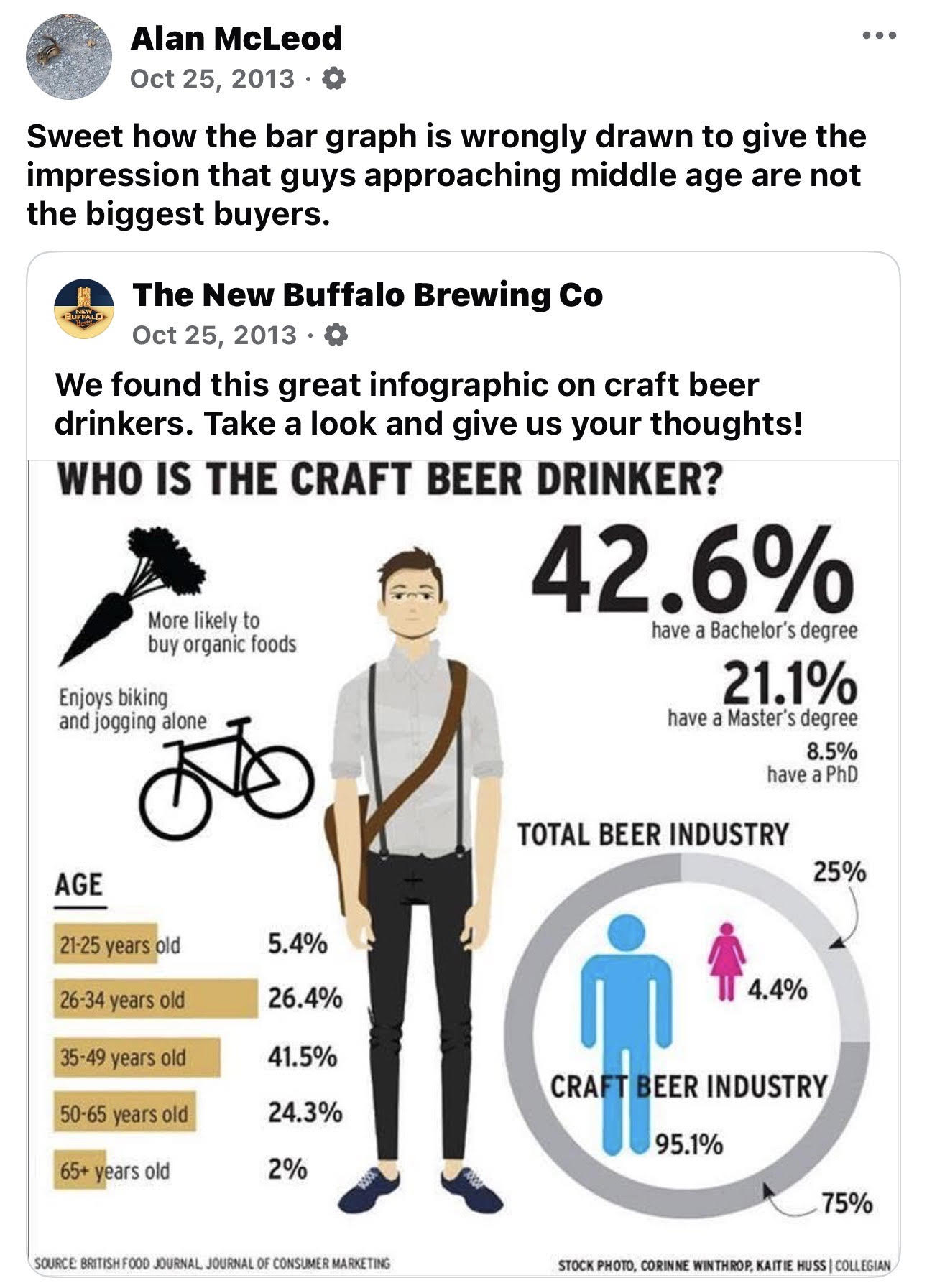
Which reminds me of something else. Over on FB, a memory from twelve whole years popped up in my feed this week and it gave me some perspective on that whole “the young folk ain’t drinking craft no more” story. Look at the brown graph in the lower left. It was created with data from the British food and marketing trade associations. In 2013 I was irritated by the incompetent bar lengths in the graph. In 2025, I am more interested in the percentages.  Keeping in mind these are UK figures, they indicated that two-thirds of craft beer drinkers at the time were over 35. Those people are all over 47 now.  Only just over 5% of people who were 21 to 25 at the time admitted to drinking craft beer. So when was this time when “the young folk drinking craft“?***** (This diagram from 2014 might suggest the same was not the case in the New York of the very next year. Maybe.)****** But whatever it was then, Stan is wondering if a key aspect of what made craft interesting back then has disappeared:

Will Curtin said the brewing landscape has changed significantly over the years, and believes that the traditional “garage brewery” model may be waning. “I think sort of the age of a garage brewery is sort of, if not gone, going,” he said.

I wonder if the cause of the going is not so much the loss as the lack of a compelling replacement. Whatever happened to the shock of the new? Well, unless you are in Spain next year, when drivers may get a shock:

Tourists, be warned:  Spain is proposing stricter drink-driving laws, and they could be enforced by the end of the year. The country’s Dirección General de Tráfico (DGT) wants to introduce new alcohol rules for all drivers — including those on bicycles and e-scooters — by the end of the year. The aim is for a universal alcohol limit of 0.2g per litre in the blood or 0.1mg per litre in breath. That would mean almost zero alcohol consumption before getting behind the wheel. Even a small glass of wine or beer could put you over the threshold.

That’d be one-quarter of the limit we face here in Canada. Be prepared. You can practice the pronunciation of these handy phrases for your next trip to Spain: “Propietario! ¿Duermo en tu cobertizo? Hmm ¿Tal vez debajo de tu árbol?

One last thing before we go. There was a call for papers from the people of Beeronomics:

The 2026 Beeronomics Conference will take place at ESSCA School of Management, Bordeaux, France, 24-27 June. Main panels and sessions will be held at the ESSCA Bordeaux Campus. The Conference Organising Committee, led by Gabriel Weber and Maik Huettinger, welcomes all high-quality research on the economics of beer and brewing. With a strong interest in interdisciplinary research, we are looking for submissions covering topics including…*******

Check it out, people. And with that, we are done. Adios and farewell to October! Next week the World Series will be over, Halloween will be in the past and I probably will have ripped up and rammed all the tomato plants in the compost bin. In the meantime, please also check out, Boak and Bailey on this and every Saturday and then sign up for their entertaining footnotes, too. Look out for Stan when he feels the urge now that he’s retired from Monday slot… maybe … maybe not. Then listen to a few of Lew’s podcasts and get your emailed issue of Episodes of my Pub Life by David Jesudason on certain Fridays. And Phil Mellows is at the BritishBeerBreaks. Once a month, as noted, Will Hawkes issues his London Beer City newsletter and do sign up for Katie’s wonderful self-governing totes autonomous website featuring The Gulp, too.  Ben’s Beer and Badword has returned from his break since April so you can embrace the sweary Mary! There is reading at The Glass which is going back to being a blog. Any more? We have Ontario’s own A Quick Beer and All About Beer is still offering a range of podcasts – and there’s also Mike Seay’s The Perfect Pour. Plus follow the venerable Full Pint podcast! And there’s the Craft Beer Channel on Youtube. Check out the archives of the Beer Ladies Podcast. That’s quite good and after a break they may well be are back every month!

*See: Perth Pink.
**Note: not aka Alice DuRiz!
***Just for example, see same publication in 2023 making the pretty much the same point but in 2025: “HOW DARE THEY!!!
****Customer: “I’d like to participate in some alcohol please” Bartender: “I shall be delighted to perloin you said chemical…” (Mutual winkies) CURTAIN!!!
*****By the way, New Buffalo seems to have stopped brewing a year after they published the diagram before getting caught into a legal dispute.
******You know, sometimes a parenthetical sentence is a good as a footnote. No, it really is.
*******… topics including (i) trends and driving forces in local and global beer production, consumption, and distribution; (ii) management, marketing, market structure and industrial dynamics, individual beer choice, health and well-being; (iii) policy and regulations related to the beer brewing industry; (iv) impact of beer on society and culture (v) environmental issues affecting beer and brewing and (vi) other stuff like food industry and alternatives to beer. You could write something about one of those. Birdeaux is nice in June. Why not? Give it a go.

Your Beery News Notes That Entirely Capitivate… Yet Offer No Real Clues To Get Outta Here… Not Even A Key Or Nuttin’

August planting is underway. With any luck there will be peas in late September and October. And maybe baby carrots. You always think that the plantin’ is done once you are in full pickin’ mode… but no. No way. Still ten weeks to a frost that kills. Or more. Plenty of time for peas. By the way, I learned something through the month and a half of drought, humidity and heat that now seem to have finally broken. Tomatoes do not turn colour until it cools a bit. So while the peas are doing there bit it’s now also time to hit the sauce… no, not that sort of sauce. Sauce sauce!

OK – fine. What else is going on around here. Oh, yes – one of the main differentiations between beer drinking cultures found in nation to nation is the local tipping habit. Here in Canada we tip but we are left to our own decision as to how much. But, more generally, it’s not just the tip but the markups added on. I could be a tax or two, a mandatory service tip but… an administrative fee? That’s what seems to have started in the UK where, as reported in The Times, one pub is adding 4% to the price of a beer for the premium service of giving the beer to you:

The Well & Boot is banking on customers not noticing the difference between £7.65 for a pint of beer and £7.96 for a pint of beer, and it’s a safe bet. Once you’ve paid £7.65 for a pint your subconscious is already doing everything it can to suppress the pain, just to allow you to enjoy it…  Is it a rip-off? I don’t know. Pint number two — all in the name of research, obviously, was a Guinness — and that one was brought to the table, at which point a 4 per cent charge for table service is quite good value. All the other customers were having a lunchtime meal, ordered and brought to the table, so 4 per cent for that sort of service is extremely cheap.

The pub is in London as I understand in a transit hub Waterloo Station. So you are already dealing with captive audience pricing of a sort. But that base price is nuts.* You know, if I were you… I would walk a few steps to Mamuska! which, yes I disclose, is run by a college pal but also the beer is a little cheaper – but you can order a Placki Ziemniaczane to go with it!  Ask for Ian, say you know Big Al and you may get a slap on the back, too. There. You’re set.

What else… well, some bad news for those of you rootin’ for booze. The NYT reports that US drinking has hit an all time low – and its not just the kiddies this time:

The Gallup poll found an especially pronounced drop in drinking among middle-aged respondents: Just 56 percent of respondents 35 to 54 said they drank alcohol, falling from 70 percent in 2024. That “suggests the message is sinking in across the board, not just with young people,” said Johannes Thrul, an associate professor at the Johns Hopkins Bloomberg School of Public Health. The share of adults 55 and older who said they consumed alcohol increased slightly from 2024 to 2025, but is still lower than in 2023. Only 50 percent of those aged 18 to 34 said they drank alcohol, the same as in 2024 and down from 59 percent in 2023.

Jeff has his own thoughts but clearly people are not doing their part. Perhaps relatedly, Mr. Mudge wrote about the planned drop in acceptable blood alcohol limit from .08 to .05 in England and he argues against it:

Whatever the safety implications, such a policy would inevitably have a significant effect on the pub trade. While those who inhabit an urban bubble may be reluctant to acknowledge it, nationwide there are a very large number of pubs to which a majority of customers travel by car. There will be several thousand where that accounts for over 90% of their trade. Every week, hundreds of thousands of people drive to pubs and consume alcohol within the legal limit. Yes. a few customers do break the law, as people still will with a lower limit. But, given the severe potential consequences, the vast majority of drivers abide by it, and indeed generally leave a wide margin below it. 

Sadly, having practiced criminal law including as duty counsel, I can report that deaths from drunk drivers aren’t statistical matters. Neither is crime. We can as easily say “every week, hundreds of thousands of people go about and and all aspects of their lives within legal limits.” In all cases, crime is perpetrated by the few and upon the not quite so few but in each case the act and loss is a singular event. As a result, deterrence is one of the greatest benefits of criminal law. So making driving under the influence itself a crime deters many – indeed by a wide margin – from taking the step that, yes, only sometimes leads to tragedy just because some asshole decided to take the chance.

And, as reported in the Morning Advertiser, BrewDog has pushed back on the story that is has lost access to customers at about 2,000 pubs with industry voices speaking out from both sides of the fence:

“Wetherspoon trades with Brewdog on the basis of a long-term contract, which is the normal case for our regular suppliers. “BrewDog has always been a reliable trading partner and draught Punk IPA, available in almost all of our pubs, continues to be a popular craft beer, as do their bottled products; Hazy Jane, Elvis Juice and Punk AF.” All pubs within the Tim Martin-chaired business serve one BrewDog product on draught and a number of BrewDog bottled drinks too. Meanwhile, a spokesperson for Star Pubs said: “We have not supplied BrewDog products to our pubs since the end of 2023.”

PR v PR. On this side of the Atlantic but not dissimilarly, there were two interesting stories last week from Beer Marketers’ Insights, the first one being about an outreach from a group of AM distributors saying without at all be coaxed that AB is great. Then, in summary from the weekly newsletters, the response from other AB distributors:

None echoed the endorsements so pervasive on the call. Most saw this as an AB-directed initiative. “This has AB written all over it,” said one AB distrib. Another remarked: “This reminds me of the current state of politics. Everyone is scared to say something negative, knowing they will be attacked by a party at some point. If you praise your allegiance to the party, then you will be rewarded.” Some responses were angry and disbelieving that so many distribs espoused a party line. “I can’t believe what’s occurring,” said one long-term observer. “I was just appalled.”  

A free press is a wonderful thing. Speaking of appalled, have you seen the prices of things?  Sam Tierney wrote this very week thusly:

Mexican 2-row seemed mildly interesting until I saw that it was 30% more expensive than domestic or Canadian. In this economy!?! I can get German pils for that price.

And aluminum is, again, a topic at the check out this week. The Brewers Association issued a notice on the addition of beer can tops to the list of things subject to US tariffs this week noting “The Brewers Association continues to monitor developments around aluminum trade policy…” Hurrah! My two cents were these:

Consider us. Canada exports 88% of bulk aluminum the US uses. It’s sent south, gets hit with a 50% US tariff, turned into packaging, cans come back north and get another 25% tariff from Canada. So the 75% tariff will see us redevelop our can factories. Not sure the US can replace our bulk aluminum.

So, US consumers should not expect any relief soon unless someone gets into the bauxite smelting game and can replicate Quebec’s cheap hydro power to fuel the industrial process at scale. Up here, we just need to retool the manufacturing line.**

Speaking about shopping, Lew Bryson has announced that this week’s offering at Seen Through a Glass is going to be about…

Next episode will be about the great local grocery stores in central PA, everything from four aisle markets to ten-store chains with full-service butcher shops and fresh seafood. They aren’t Whole Foods or Wegmans, but they’re not 7-11s either, and they’re out here where central PA actually lives. Let’s go shopping!

Excitement reigns! Back when people published (and bought) books about beer, Lew’s guides were great support of family trips when the kids were little. Not because I would drink my face off but he included shopping and side trip hints that kept everyone happy. How else would I have learned about the garbage plate?

Note: traditional German naked ass wine. Not sure I want naked ass wine but now I know I could if I would even if I won’t.

Luxembourg! How many of you have clamoured in the comments and emails for more Luxembourgian news. Well, Jessica M found a way this week to fill that need:

Brasserie Nationale de Luxembourg, the country’s largest brewing company, has told bar operators that they will soon be able to stock beers from craft brewers without violating their contracts. While leading breweries Brasserie Nationale de Luxembourg and the AB InBev-owned Diekirch currently own many of the venues and the attached alcohol licences, it gives them exclusivity rights for stock, but things may change in the coming months. According to Finance Ministry, the country’s two largest breweries hold about a third of the nearly 3,300 bar licences and 40% of the alcohol licenses in use.

Freedom!!! Sorta. For the double, Jeff raised an eyebrow to the first list of entrants into the Craft Beer Hall of Fame:

I dunno. A “landmark” anything is always going to be a semantic/definitional category. If I were to consider American brewing in the past half century, I’d be looking at where we are and how we got here. Only one of the beers on this list played a role in that. Steam beer is a basically defunct 19th century style. Witbier is a commercial success, no thanks to Celis (Blue Moon and Allagash get the credit there.) Boston Lager was another commercial success, but the beer was also just an all-malt European-style lager (as the brewery has always proudly proclaimed).

I would add backdating to any lucid notion of “craft”, a term only widely adopted a bit over 20 years ago. If it is anything, Boston Lager is a micro… even if it’s now a macro micro.  It reflects the 1980s intention to mimic imports, not to take on big beer. But, also, where is Pete’s Wicked Ale, a top seller until it wasn’t? Does “fame” in this case really speak more to the identifiability of the brewery owners who survived?  If so, that’s craft for you.

Finally, in the weekly feature, Rachel Hendry brings it all back to where it matters, the individual experience. And she frames it with one of the most humble aspects of the beer fan’s joys – the beer mat:

A small pile sits on my desk whilst I write: vintage Double Diamond and Babycham given to me as gifts by friends—‘I saw these and thought of you’—a Beamish emblem from a trip to see family in Ireland; another of a brewery I associate with a recent romantic encounter. When I am nervous I trace their cardboard circumferences with my finger. They punctuate the bar I work in, propping up tables, ripped into shreds by skittish or destructive hands, knocked to the floor, stolen as mementos. They see so much, these beer mats. They suffer for it. It wasn’t always like this.

What a lovely bit of writing. For more of that, please also check out Boak and Bailey every Saturday and sign up for their entertaining footnotes, too. Look out for Stan when he feels the urge now that he’s retired from Monday slot… maybe … maybe not. Then listen to a few of that now newly refreshed Lew’s podcasts and get your emailed issue of Episodes of my Pub Life by David Jesudason on certain Fridays. And Phil Mellows is at the BritishBeerBreaks. Once a month, Will Hawkes issues his London Beer City newsletter and do sign up for Katie’s wonderful self-governing totes autonomous website featuring The Gulp, too.  Ben’s Beer and Badword is out there with the all the sweary Mary! And check out the Atlantic Canada Beer Blog‘s weekly roundup. There is new reading at The Glass which is going back to being a blog. Any more? We have Ontario’s own A Quick Beer featuring visits to places like… MichiganAll About Beer offers a range of podcasts and there’s also The Perfect Pour. Plus follow the venerable Full Pint podcast! And there’s the Craft Beer Channel on Youtube. Check out the archives of the Beer Ladies Podcast. That’s quite good and after a break they may well be are back every month! Such is life. Such is beer podcasting and newslettering… which, as Ray says, are blogs! And he’s right.

*Yet, I wouldn’t notice at all if the pint was served at this gem Martin visited in Edinburgh.
**Did you know that 25% of the world’s bauxite comes from Guinea? Me neither. Trump has, it is worth noting, not tariffed Guinea. 15% for New Guinea. 15% for Equitorial Guinea. None for Guinea. Perhaps he thinks he did.

Are These Beery News Notes About The Here And Now Or The There And Then?

Summer shouldn’t be when peas take off around here but a regular dousing of cold watering plus seed stock bought from further south than usual seems to have done the trick. That’s a purple velvet Magnolia Blossom pea tip just about to burst. I really don’t concern myself whether it’s going to be tasty or not if it all looks that good. Rabbits? You ask about the rabbits? Well, suffice to say the foxes that moved into the neighbourhood have culled the squirrels… but rabbits? Some radical chicken wire applications have been applied. Treatments which offer fewer treats. Rabbits? Hah!!

Speaking of me and mine, I can’t let the week pass without mentioning a visit by ferry to a really great bar restaurant called Spicer’s Dockside Grill on Wolfe Island just off of my fair city. The place even have a cabana style bar on a dock right where the Great Lakes meet the great St. Lawrence River. A fabulous spot. I’m sharing below a few thumbnails circa 2011 style. I hope they render for you as they render for me… which is essentially the Bloggers’ Prayer, innit. Click for bigger and clearer views.


Back in the basement, on Monday Stan got me thinking. It’s not often that I admit to thinking but Stan did it. He went and got me thinking this very week about times gone by.  Because he quoted a piece about the beginning of blogging that diverged from my understanding. It wasn’t gatekeepers and curators. It was hawkers, carnies even shouting “hey look at this… I have no idea what it is but it’s all free!” But these things happen. Time shapes the past. And the beginnings of blogging are events from over thirty years ago, half my life ago. It was 9/11 that really caused the broader introspection on display that fed the hobby I kept up with this here site, now about twenty-two and a half years in operation. That is a bit of a thing.  So as we move forward again through the beery news note trust me on this one point: not curated, just gathered and dumped at your feet.

Next up, I came across this excellent explanation of the role and the value of a sommilier by Michele Garguilo that I am not sure quite entirely translates to beer given the scale of markups – except perhaps at the taproom:

The myth persists that a beverage director is a high-ticket hire, a luxury reserved for Michelin stars and major market darlings. But what if I told you that a skilled somm can turn your backstock into liquid gold? That we can reduce spoilage, increase check average, and train your servers to sell smarter in under a month? That our average salary is less than your linen bill, but our impact reaches every guest, every night? We manage theft, negotiate prices, find off-label steals that taste like first growths. We’re part strategist, part magician. But because we don’t always wear chef coats or burn ourselves on the line, we’re treated as “nice to have.” Meanwhile, we’re making you 10–30% in beverage profit on every ticket. You don’t need to afford a sommelier. You need to afford not having one.

I mention that about taprooms given, as I hope you know, the 1987 article in The Atlantic called “A Glass of Handmade” by William Least Heat Moon. It was, personally speaking, a highly influential take on the contemporary micro brewing scene which can be now found at page 31 in the compilation of his essays Here, There, Everywhere. Therein at page 51, Bill Owens of Buffalo Bill’s Brewpub is quoted as saying:

My cost to make a glass of lager – and that’s all I brew now – that lager cost seven cents. I sell it for a dollar and a half.

Screen shot of a portion of a beer review column by Laura Hadland in The Telegraph with a one star review for Beavertown Cosmic Drop Watermelon Punch Beer Speaking of value, Laura has had another fine set of reviews published in The Telegraph and, once again, provided clear guidance on the value proposition:

The light red beer looks attractive but I found the flavour sickly like melted down gummy bears. It suggests watermelon but is too sweet to be refreshing. No thanks.

Fabulous. If someone never tells you what is bad, you really can’t trust their opinion on what is good.

Still… I do get pushed around.  All the time. I’m used to it so it’s no big whoop but this week the powers that be behind DC Beerrecommended” that I consider share this tale by Andy MacWilliams on the 60 hours he and herself spent in Italy:

Having been to more than 80 countries and having sought out craft beer in all of them, the Italian scene seems dialed in. Sure, I avoided the obvious potholes, like the one or two smoothie sours I saw on menus. As I reflect on everything I sampled, only one item was bad. Everything else was either true to style or uniquely Italian. Most offerings honored tradition, even the new school traditions. Those that didn’t felt like they embraced the unique agricultural ingredients Italy has to offer. I suppose I’m slightly impressed. Very few things are truly worth the wait, but Fortunata is. Deirdre has the classic ragu while I get one of the dishes they are known for, carbonara. Savoring a bite of mine, Deirdre wonders what makes the carbonara so creamy, which I assume is roughly 17 egg yolks.

That is a lotta yolk. A whole lotta yolk. Conversely, somethings are less. I’ve mentioned before how Canada has cut US wine imports as a “thanks but no thanks” to the orange glow to the south  – now looking like a mind boggling 97.2% drop from May 2024 to May 2025 – but what does that looks like in terms of the internal market? Robyn Miller of the CBC reports:

“Ontarians are increasingly committed to buying local and Canadian products,” an LCBO spokesperson said in a statement. “VQA wine (made from 100% Ontario-grown grapes) has seen a sales increase of over 60%, with VQA reds and whites seeing growth of 71% and 67% respectively, and VQA sparkling wine growing by +28%.” From the beginning of March until early June, total wine sales dropped by 13 per cent, the LCBO added.

Which is nice. No jingoism is better than clinky drinky jingoism.

And Matty C cleared himself for takeoff in this week’s feature at Pellicle with a portrait of the White Peak Distillery in Ambergate, Derbyshire – yes, English whiskey makers! Check it out:

As of May 2025, around 2,700 barrels are in-situ at White Peak Distillery. It has since added a second core bottling, a full maturation ex-bourbon barrel English single malt, alongside its Shining Cliff Gin and White Peak Rum. It also regularly releases limited, often more experimental whisky bottlings, from a full port barrel finish, to showcasing heritage barley varieties, and even collaborations with local breweries for which barrels have been swapped and shared. It was on hearing about the latter that I decided to visit White Peak and meet Max and Claire, before leaving with a sense this might be one of the most exciting distilling projects in the country—full stop.

I would note that the “e” should only be dropped for Scotch… and maybe Canadian rye. But I won’t because that wouldn’t be nice. (Maybe even incorrect. But I will not be moved.) I would also note – and actually will note – that Derbyshire should be an excellent spot for this sort of thing as 350 years ago it was the hot spot in England for malt production and strong ale brewing, as careful readers of the archives will recall.

What else? As noted by B+B in their handy dandy footnotes, Mike Seay has shared a bit of slang that is worth remembering:

I ordered a couple of light lagers at Out Of The Barrel the other evening. I didn’t really want to, but they were near 4% and that is what I was after – keeping my wits about me while still enjoying a beer. It’s harder to find low ABV Ales than it is Lagers, which sucks for me. But I will manage. That brings me to this, something I like to call: slow roasting a beer. This is one of the new things I am learning as a single dude sitting at the bar. A guy with nowhere to be and not enough money to keep drinking whatever I want. I have to become better at milking a beer. You get to stay longer without spending more money. It’s camping at the bar.

In my day, that was called rotting. Rotting in a tav. Somewhat connected is the trepedation felt by at the US wholesale beer buying market, even in the lead up to last week’s Fourth of July, as reported by Beer Marketers’ Insights:

…looking ahead to the “last week of pre-holiday” data (thru Jun 29), Circana evp of bev alc Scott Scanlon “would expect to see at a minimum stability across [alc bev] categories with potential build as we head into holiday week data results,” he wrote in latest update. Gotta note, beer’s going up against particularly easy comps in Circana MULC for the last week of Jun due to calendar timing of last yr’s stock-up for July 4 holiday shifting into Jul: beer $$ slipped 11% with volume down 13% for 1 wk thru 06-30-24 vs yr ago. “Given poor Memorial Day performance all eyes will be on the 4th of July to see if we can recapture lost sales,” Scott underscored.

Recapturing lost sales is never going to happen. Doubling up on the second national binge when the first was a dud requires a doubled binge. Perhaps a replication of the “FESTIVAL!!!” on Star Trek’s “Return of the Archons“! A pop culture reference no doubt drilled into each of your minds. Which, given the times, is not outside the realm of the possible now that I think of it.

Speaking of flops, consider this article in VinePair on Enigma a long lost beer produced by Guinness from 1995 to 1998. The TV ads that ran for it for the first few months could well be one of the reasons it was no great success:

To promote the release, Guinness tapped Parisian advertising agency Publicis Groupe, and the resulting campaign featured a dream-like, surrealist TV ad depicting a man walking through a shapeshifting desert before being offered “a glass of the unusual” by a dapper server. The drinker remarks that the beer is “very smooth,” and then the server turns into a Dali-esque piano and vanishes in a burst of flames. Lastly, the words “a lager born of genius” slide onto the screen in the final few frames… Rather than spend more money on advertising or reformulating the product, Guinness simply dropped the price of the beer, making it more affordable, but also damaging its image as a premium offering. 

As an interesting juxtaposition – purely for educational purposes – here is a bit of current writing in the trade pep rally style that really got my head shaking this week:

A couple weeks ago, I laid out how Japanese culture is influencing a wide range of U.S. beverage categories, from beer to canned cocktails, and more than a few things in between. Since then, the pace of new launches and collaborations hasn’t slowed, it’s accelerated. What started as a snapshot is now beginning to feel like a full-blown movement. So here’s a fresh batch of recent releases and observations that continue to borrow from Japan, whether through ingredients or origin stories. Some are subtle nods, while others are straight-up love letters.

Wowsers. I’ve often wondered how this sort of thing and its kin damage the understanding of the actual factors facing brewers in this downturn. Irrational exhuberance.  Isn’t this sort of reporting out of the Adnams Annual General Meeting (AGM) by Jessica Mason ultimately more helpful even if the message is a bit of a tough one?

As confirmed in the Southwold-based pub, beer and spirit company’s statement ahead of its AGM, Adnams was able to reduce its level of debt over the previous 12 months and has lowered its borrowings by a further £7 million compared to June 2024. Despite these accomplishments its current debt, however, still stands at £11.5 million… db has contacted Adnams urging the business to offer more information on its proposed route out of the situation it finds itself in and how it will navigate the debt pile… Hanlon insisted that “the board of Adnams, and those who work throughout our business, are focused on delivering with openness and transparency as we move ahead in the second half of 2025″. Despite these claims, the company has remained silent on questions over how it is reducing costs and also how it will secure funds to avoid either sale or closure.

No exhuberance there, rational or irrational.  Like the discussion of sommeliers as value proposition, the drilling into a brewery’s financial statements is a great way to get past the spin to find out where things actually stand.

And that’s it for now. If I cast my eyes up, I see that there was a lot about veracity and value. I trust my own part in this bears some resemblance to both. Until we meet again, please check out Boak and Bailey every Saturday. Look out for Stan when he feels the urge now that he’s retired from Monday slot… maybe. Then listen to a few of the now rarely refreshed Lew’s podcasts and get your emailed issue of Episodes of my Pub Life by David Jesudason on the (sometimes even but never) odd Fridays. And maybe The British Food History Podcast. Maybe? And Phil Mellows is at the BritishBeerBreaks. Once a month, Will Hawkes issues his London Beer City newsletter and do sign up for Katie’s wonderful newsletterThe Gulp, too.  Ben’s Beer and Badword is out there with the all the sweary Mary! And check out the Atlantic Canada Beer Blog‘s weekly roundup. There is new reading at The Glass which is going back to being a blog. Any more? We have Ontario’s own A Quick Beer featuring visits to places like… MichiganAll About Beer has given space to some trade possy podcasts and there’s also The Perfect Pour. Plus follow the venerable Full Pint podcast with an episode just last month!. And there’s the Craft Beer Channel on Youtube. Check out the archives of the Beer Ladies Podcast. That’s quite good and after a break they are back every month! The rest of these are largely dead. And the long standing Beervana podcast …except they have now stood down.  As has We Are Beer People. The Share looked to be back with a revival but now its gone quiet. And the Boys Are From Märzen podcast appears suspended as does BeerEdge, too. VinePair packed in Taplines as well. All dead and gone.  There is more from the DaftAboutCraft podcast, too. Nope – that ended a year ago.   The Moon Under Water is gone – which is not surprising as the ask was $10 a month. Pete Brown’s one cost a fifth of that – but only had the one post. Such is life. Such is beer podcasting and newlettering!

Your Thursday Beery News Notes For The Best Week Of The Year

Yup. The weather this spring has been good so far, thanks for asking.  The air has stayed cool. And a wobbly fence has been replaced and a basement corner refit turned into the revelation that we owned a cast iron heritage sink needing keeping after all. The bugs have yet to hit and I bought that new lawn mower. One that isn’t powered by me. It still feels very twentieth century if I am honest. Power tools always do. This week, Barry has taken us in another direction, pulling some lovely old examples of scythes out of his barn:

I’ve been thinking about scythes again. I think it’s about time I got one, though we have a collection of old handles in the barn, and a fancy metal snath (that’s what the shaft is called, and I only know that because I just searched it). The stems (the bit that sticks out of the snath that the grip is attached to) on two of these are quite wobbly and worm-eaten. Actually, I guess these broke fairly often, as I found a little stack of them on top of a beam in the barn years ago. The third one is rather fancy looking.

I start with this for a few reasons. It illustrates that sort of curiosity about the knowledge that imbues the best sort of worthwhile yet somewhat idle writing. In troubled times access to good idle writing is vital. And focused knowledge drawn from idleness is usually more interesting that personal experience. Not unlike your photos of your meal or child, a lot of the personal is most often best kept personal as, believe it or not, we are all already persons. By contrast, the knowledge gained that leads to a “who knew?” needs sharing.

As a helpful illustration, David’s latest Desi Food Guide piece on Indian food in Britain as exemplifed by the beginnings of Jay Patel’s shop Budgens describes a key moment in any meeting of cultures:

…it’s this food that makes the shop so special in 2025. It’s cooked by Meghana, the wife of Jay’s eldest son, Pratik… “People were wondering ‘how do you eat Indian food?’,” says Pratik. The answer was to show them at a few tastings and this blossomed into holding stalls at local fetes. The clamour was huge but so was the generosity with the family (and its loyal workers) even dropping off free samosas at parents’ evenings and school quizzes. “It snowballed and because the public wanted it we did it more,” says Pratik. “Now people will go for a walk and have a samosa.”

Yes. Samosas came into my life at a very clear point in 1988 when I went back to university to study law. The Grad House at Dalhousie, a side benefit pub near the law school, got a fresh delivery every morning from a home kitchen. Even though my family had a particular connection to a sort of curry going back to the late 1800s, these samosas were the first things I had which were so laced with that much cumin. Who knew peas and potatoes with cumin were that good? There are lots of things I want to learn, a lot of them about what to eat and drink. But that’s about me, isn’t it. Or is that the knowledge. Hmm.

But did I really need to know that Rick Astley was in business with Mikkeller, now seemingly fully excused? Not sure. Did I need an impenetrably indulgent fog of words? Pretty sure on that one. Nope. Let’s face it: much of beer has lost that bit of thrill that can’t compare to a samosa in 1988 or a barn full of antique scythes today. Stan provided a particularly helpful if really sad example this week of how bad it’s gotten:

I did not receive the press release about how Sam Calagione (Dogfish Head), Bill Covaleski (Victory Brewing), and Greg Koch (Stone Brewing, now retired) are “bringing their legendary friendship, their boundary-busting brews, and a rock-and-roll spirit that can’t be tamed” to Manhattan later this month. But… I’m sorry, but although these are founders of breweries that make really good beer who have spent decades in the trenches (and, full disclosure, Sam Calagione wrote the foreword for “Brewing Local”) I won’t be booking a flight to be there June 26. For one thing, that poster is, well, I have no words …

That there’s a bit of a pathetic display – especially given that sort of “rock star” shit was, you know, shit back in the day, too. Fortunately, Stan also gave us a hopeful glimpse of the opposite that may soon be found at the Carnivale Brettanomyces fest coming up at Utrech in the Netherlands:

“Take a sip of beer and you will notice aromas and flavors that remind you of the world around you. Some of these play crucial roles in our physical environment by interacting with the atmosphere, oceans, and geology. We will explore some of the ways common compounds in beer reflect natural processes in our environment and climate, and how life could have evolved to use those compounds to regulate the environment to its benefit in Gaian ways.”

A bit freaky and maybe not entirely my thing but at least it’s actually promising to be about something interesting. Something you and/or I didn’t know much about yet. What else is there to learn about? BrewDog (ie “who cares”) is claiming its changing its brand and vision – as if Martin Dickie hasn’t been there all along:

“2025 marks a new era for BrewDog,” the site states. “A fresh look for our beers. Fresh faces at the heart of the company.” The erstwhile Caledonian revolutionaries are now the official beer suppliers to Lord’s, the home of English cricket, where blazers rather than baseball caps are de rigueur. Lauren Carrol, the newly-installed chief operating officer, confirmed that the UK’s most unruly company has been tamed. “When people hear the name BrewDog they expect us to shock, disrupt and, let’s be honest, probably offend,” she said. “But we wanted to do something even more radical.

Yawn. Didn’t need to know that. Much more interesting was watching the family of a contestant for Britain’s best pub pianist of over four decades ago, one Peggy Fullerton:

It was absolutely mind blowing. The family of Peggy Fullerton spoke to #BBCBreakfast after watching footage found by BBC Archive of her playing the piano and being interviewed by BBC Look North in 1981…

Watch the video under that link: “There’s Grannie Peg!” Fabulous. Speaking of fabulous, there has been actual jostling to get a place as the host for the June edititon The Session, thanks to the whipping up of frenzy by Boak and Bailey:

@morrighani.bsky.social has bagged this month but you should definitely get lined up for next month, or the month after. @beerinthecity.bsky.social is also interested in hosting a future session.

And I liked Jeff’s complaint about the cacophony of styles being pushed by the Brewers Association for the 2025 Great American Beer Festival:

No one needs 108 categories! No one needs 108 categories that balloons to around 200 styles with sub categories! The ever-finer slicing and dicing does not result in clarity, it results in six (!) types of smoked beers… Style fragmentation also leads to an inevitable auroboros exemplified by a category like “international amber lagers” in which Mexican amber lagers will be judged with polotmavý and Franconian rotbier. What?

Remember, as Stan recently reminded us, when folk said styles were important to help consumers understand what they were buying? Not so much now. Elsewhere, someone wrap Jessica Mason in asbestos* as she has been on fire this week asking all sorts of clear questions. Like “why have Belgians stopped drinking as much beer?” and “why have the Irish stopped drinking as much beer?” and “why are UK drinks makers enjoying a rise in profits?“:

“Anecdotally, what we’re hearing from some of our customers is that Q1 brought welcome windfalls. Some tariff-affected international customers have turned to UK firms to do business, while others raced to order more before tariff pauses came off. That’s delivered a shot in the arm for some firms, but more importantly we’re hearing that steadily falling bank rates are starting to stimulate the economy, which obviously is very welcome to UK manufacturers who’ve posted a really strong start to the year.” The data has also highlighted how profitability is improving as manufacturers have held off from buying new stock, instead preferring to use up inventory reserves where possible.

That’s interesting. And David, also in TDB, has added his own question – “what’s wrong with cheap beer?“:

… with my honest hat on, most beer drinkers under retirement age know there’s better options at the bar. And I really wished that those who write about problematic drinking in the media showed the same discernment. Because it isn’t sessionable pints that are the issue here but how pub chains profit from alcoholism. That substance abuse might be from excess beer drinking but it’s also more likely from much higher ABV drinks. Especially because I see morning drinkers drinking their Bells but I rarely see them ‘enjoying’ it.

That’s also a bit of clear observation right there. I like how TDB has been exploring all angles of the trade – the good news and the not so good news – without necessarily making a lot of noise about how that they doing just that. What else is going on? I really liked this observation by Steve of Beer Nouveau in reponse to Katie on gastropubs:

It’s fair to say I don’t like them. But my 81 year old dad does. And his new 82 year old wife (yeah, they got married last year!) does… They know when they go in that there’ll be a menu with favourites like cod and chips, beef wellington, steak, roast chicken and maybe a sticky toffee pudding to follow. They know they won’t be confronted and bamboozled by “dirty fries” whatever the frag they are. They know they won’t need a spoon to help them eat a burger. And they know that they can order a pint of “bitter” and not be interrogated as to which variety of yeast they want that fermented with. Oh, and they’ll also sell Chardonnay as a standard. These are not places for us. These are places for them.

Yup. It’s OK that people don’t like the same things. I like how “it’s not for me” can mean a quick judgement or, more usefully, a realization. Knowing that makes life easier. For example, I had a bit of a moment realizing I wasn’t warming to the tale told by Will Hawkes this week in Pellicle about the brewery German Kraft at London’s  Elephant and Castle food hall called Mercato Metropolitano. Was it phrases like “a no-holds-barred business” and “this is our USP” that reminded me a bit of something I didn’t like? I really don’t think so. I think it’s just a good description of a place that’s probably just not for me. Which is fine.

Speaking of fine, there was some plain speaking over in one corner of the wine world that could equally apply to good beer:

There is no question that wine faces significant issues. I was talking to a leading port producer, who is in a state of near panic (not without good reason, I’d be panicking if I made port!). He was convinced that the anti-alcohol lobby would put him out of business. I suppose that’s easier than admitting you make something that nobody seems to wants to drink any more, but there is no question that the health lobby is reducing wine sales, especially with young professionals, where, if they don’t stay alcohol free they are often turning to cocktails.

And, finally, the details of memorial services for the late Martyn Cornell were posted at his website by his brother David:

For those that wish to attend his funeral it will be held at: Hanworth Crematorium (TW13 5JH) Monday 30th June 2025 @ 12.20 with a small wake at a local pub afterwards to celebrate Martyn’s life. For those that can’t make it we will be having a small wake at Poppyland Brewery, Cromer on Sunday 06 July between 13.30 – 16.30. The family request no flowers.

Still… being that I was raised by a florist and worked in the shop myself perhaps I will still plant something good looking out in the yard in remembrance, something nearby when I need to have a shady sitting spot to sip a beer this summer.

Next week I am on the road so who knows what will be please check out Boak and Bailey every Saturday. Look out for Stan when he feels the urge now that he’s retired from Monday slot. Then listen to a few of the now rarely refreshed Lew’s podcasts and get your emailed issue of Episodes of my Pub Life by David Jesudason on the (sometimes even but never) odd Fridays. And maybe The British Food History Podcast. Maybe? And Phil Mellows is at the BritishBeerBreaks. Once a month, Will Hawkes issues his London Beer City newsletter and do sign up for Katie’s wonderful newsletterThe Gulp, too.  Ben’s Beer and Badword is out there with the all the sweary Mary! And check out the Atlantic Canada Beer Blog‘s weekly roundup. There is new reading at The Glass which is going back to being a blog. Any more? We have Ontario’s own A Quick Beer featuring visits to places like… MichiganAll About Beer has given space to some trade possy podcasts and there’s also The Perfect Pour. Plus follow the venerable Full Pint podcast with an episode just last month!. And there’s the Craft Beer Channel on Youtube. Check out the archives of the Beer Ladies Podcast. That’s quite good but, hmm, they’ve also gone quiet this year. The rest of these are largely dead. And the long standing Beervana podcast …except they have now stood down.  As has We Are Beer People. The Share looked to be back with a revival but now its gone quiet. And the Boys Are From Märzen podcast appears suspended as does BeerEdge, too. VinePair packed in Taplines as well. All dead and gone.  There is more from the DaftAboutCraft podcast, too. Nope – that ended a year ago.   The Moon Under Water is gone – which is not surprising as the ask was $10 a month. Pete Brown’s one cost a fifth of that – but only had the one post. Such is life. Such is beer podcasting and newlettering!

*Please don’t. It’s actually not very good for you. Though, to be fair, neither is actually being on fire. So perhaps we can agree that you will deal with the situation as necessary should the occassion arise. 

Session #146: On Value

I used to go on and on about many things but one of my biggest beefs in years past was the broader beer discussion not only ignoring but rejecting much of the normal considerations of value. Especially relative value. You look at any critical discussion in wine, info tech, cars, pop music, clothes, food… anything… and there is someone telling you X is pretty much the same as Y but it only costs 78% as much. That’s the entire basis of consumer focused writing. Except with beer.

So it was with a large helping of interest that I read that our host Ding’s subject for this month’s edititon of The Session was value:

On the whole, I have found value in most of my purchases. That isn’t to say that all of the purchases have represented value for money, they haven’t, but I can still find tremendous value in what many people would categorize as ‘ridiculously expensive beer’. Value most certainly does not necessarily correlate with cheap either (although it could), rather it means when I part with the cash, no matter how large or small the amount, does what I receive in return meet or exceed the value of said cash? Subjective? Sure, but we all have our own sense of value.

Eighteen years ago, when this blog was a bit of a thingier thing, I wrote a piece with the title “Are Craft Beer Prices Too Low? No, They Are Not Too Low” which got a lot of attention in the comments from a lot of interesting people. It is an artifact of the era. The era of “Hooray!!!” As with the best of public and, like the psalms, responsive readings of that time I learned a lot from what was shared in the comments.  Unfortunately, I lost the ability to link to specific comments from way back when the platform for this here blog got shifted but suffice it to say that there was a range of ideas from:

Do I ask my Quebecois cheesemaker to justify the price of his or her cheese? No.

and on to:

…distillers do get asked to justify the high prices on whiskies (and even whiskeys) these days. They have a simple answer: it’s really good, it’s really rare, and we had to keep it a long time before we made any money on it.

plus:

It would be great to see more actual brewers chime in on this forum, because I think some of this talk is just absolutely ridiculous.

It all looks a bit charming from almost two decades on. I think if we consider (i) what has happened in recent years to the previously irrationally exuberant fine wine market as well as, obviously, to the whole  craft beer industry and (ii) the greater acceptance about the role of manufactured scarcity and, in a few cases, straight up avarice from those plumping the brewery for resale along with (iii) (as also seen in the comments) the genuinely held dreams of brewers fully convinced that they were making art not beer then, well, we can agree that a great rebalancing shift has occurred in the market. And it is one which allows drinks consumers to assert a greater and saner role in determining the relative value of what they buy. We are in a new era, one that pre-Obama era drinks trade might never have imagined.

So where are we now in terms of appreciating value in 2025? First, there is actual consumer generated response which creates downward pressure on price points for beer at home and in the taverns. I look to no higher authority* than The Tand on this point who wrote this very week:

If you charge an outrageous £7 a pint for @TimothyTaylors Landlord, it should be toppest of notches, not poor. (Hoop and Grapes, Aldgate.) You really shouldn’t be doing this. Get a cellar services team in to check procedures and temperature. Shocking. Started off peeved about this is. Now as I struggle through this pint, I’m hopping mad about it. And no, the beer isn’t off, just totally badly presented and the price – words fail me.

The tone! None of the “let’s get out there and raise all boats, lads!” talk circa 2009 in those fighting words. That’s raw reporting, that is.  And it didn’t stop there. The Mudge ripped back:

The average British adult only drinks about 1¼ pints of beer in a pub each week, which really isn’t very much. Drinking a lot of beer in pubs, such that it has a significant impact on your personal budget, is very much a minority pursuit. Many pubgoers are there primarily to have a meal, and if you’re happily spending £17.95 on a braised lamb shank, whether your pint of Landlord is £4.75 or £5.50 is neither here nor there. 

What the hell has he got against lamb shanks?!?  Whatever it is, I think we can agree that lamb shanks merely stand in for the consumption of all other forms of entertainment. Clearly. Which leads us to the observation that the recognition of relative value’s role goes beyond whether this beer is as good as that beer but can be had for half the price and lands squarely on the reality that the question of whether this night on the beer is as good as going to that concert or that game – or to that park or for that nap for that matter.

We still need to beware. There are still forces of anti-valutarianism about trying to grab every penny from us that they can. Just this very week, Jeff** witnessed two flailing attempts to pump desperate transfusions into the bloated corpse of IPA:

Northern IPA, an idea apparently concocted by the Lallemand Marketing Department to sell a new yeast strain, “incorporates the clean drinkability of the modern West Coast IPA with a more prominent yeast aroma profile.” Meanwhile, Matthew Curtis forwards Savo(u)ry IPA to describe a single beer from Norfolk—that’s in East Anglia—using MSG for the purpose of “stimulating your umami receptors.” All right, then!

Chemistry. BAH!! Nothing thoughtlessly opens the badly battered wallet like claims to better chemistry. Consumers take heed!  This is the sort of thing you are up against in your quest for a decent drink at a decent price. We must protect the innocence of our precious umami receptors while we can.

What is value? Freedom. That’s what.***

*I can’t apologize to The Beer Nut on this hierarchical point, given he too wears the “the” of authority, but certainly note that he wrote this very week “It’s not unpleasant, but it is extremely basic. Is it an effective substitute for the price-conscious Madrí drinker? Sure, why not?” by which we can infer his sensitivity to the combined effect climatic, inflationary and authoritarian imposition of tariffs all weighing down upon the lowly consumers’ shoulders,  pushing the mind towards critical marketplace analysis and away from happy lappy advocacy. 
**Not “The Jeff” I would note. Not yet. Oh, and here‘s what The Mattyman wrote.
***Finis. Amplifer fluens. (Applause!) Te relinquo.

Your Beery News Notes For Finally… Finally… Settling Into 2025

Lordy. Is all the holiday cheese finally gone? Is 2024 gone? Really? Check the back of the bottom shelf. Me, I finished off the holidays with a Covid needle in my left arm and a flu shot in my right. I’d rather have had the cheese. So perhaps a short post today, given me with the low grade fever and insomnia and all you all getting over eating the Yuletide cheeses. We should declare this International Solid Dairy Hangover Week. Whatever it is, it’s all going to be OK as it’s just twenty-five days to Truck Day! Yup. Gonna be OK.

So… The Session. The toe in the water revival edition of The Session. Hmm… there has been a  wave of tremendous excitement over the experimental revival of The Session, as announced last week, after a seven year break. Stan, Maureen and Matthew are among the tremendously excited. What does it mean to you? Well, it is actually all about you – as you do all the work, you scribblers. You write, I list. That’s it! To aid you  in your thoughts, I offer this simple graph from 2021, an example of my excellent in thought organization. It was last featured in late 2021 and is an update of one from 2016 but, still, it is very much in the now. Clarity. That’s what it sets out. Clarity. Hopefully this will give you that extra push to set out your thoughts on 31 January on the question of the month: “What is the best thing to happen in good beer since 2018?“* Most any medium accepted. Subject to arbitrarty post-facto interventions, of course.

What else is going on? Just after the deadline last week, Jordan shared his thoughts on the brewing of beers under license and just how much, at least in Ontario, the beer that is licensed is the beer that is brewed:

It happened gradually. I can’t tell you the date, but I know that it was Jamie Drummond that brought it to my attention. He had been a lifelong Lowenbrau drinker, and a dedicated one at that. He got in touch one day to point out that it didn’t taste right. Of course it didn’t. It was being brewed in London, Ontario at Labatt.  Now, this was nothing new. They’d been brewing Stella Artois in London, Ontario for a while… Over time, I began to get the sense that the walls were pushing in on the import section. One year, maybe 2019, I added Spaten to the beer styles course at George Brown as the ur-example of Munich Helles, but as soon as I opened the can it was wrong. I hadn’t noticed that it was 473 ml, but I surely noticed the difference in aroma within seconds. You guessed it: London, Ontario.

Speaking of things not being what they were… is Facebook going the way of Twitter. I caught this mention of the uselessness of FB ads now for local audiences:

At least in the US, ads used to be excellent for small, local bars/restaurants. Affordable and very effective. I actually liked a lot of the ads I saw. Then they raised the prices and showed them to people from thousands of miles away. So now only shady crap merchants see any value in using them.

No shady crap in The Guardian‘s a great piece this week on getting snowed in, storm stayed, at Britian’s highest pub in most northern Yorkshire:

…the team are well prepared. Their electric power comes from a generator and there is enough food for about a month, “but hopefully it won’t come to that” says Nicole Hayes, one of the bar staff, who has done a number of phone interviews with local and national media in the run-up to the weather warning, such is the reputation of the pub… Word came through that the snow gates on the nearby A66 were being closed at 10.30pm, which meant anyone hoping to leave needed to make their attempt very soon or they were likely to be here for a couple of days, as the snow was forecast to only get worse.

Less placid is the battle being wage for the beer buck of America. Kathleen Willcox wrote these words that really one couldn’t imaging being puslished not that long ago:

…  lagers and traditional styles are often priced a dollar or two cheaper than competing styles,” Varda notes. “In a world of inflation and particularly among younger consumers who may have less financial stability, those dollars make a real difference.” Amid rising inflation, craft beer just doesn’t seem like a priority. Especially as brewers themselves grapple with ever-increasing prices for goods like packaging and transportation, and are forced to pass the increases on to customers….  Some brewers even wonder if craft beer is settling into a new, more permanent rut.

Permanent Rut!! Jings. But at least things are reasonably civil, right? What’s that?  How about the beer trade dispute, discussed in TDB, occurring in one of the new year’s potential hot spots:

Lawmakers have accused Chinese brewers exporting their products to Taiwan of engaging in unfair trade practices by receiving subsidies from the Chinese government, according to the Taipei Times. The Taiwan Brewers Association, made up of the country’s six biggest brewers, called on the government to launch an investigation into cheap beer imports from Mainland China. Finance Minister Chuang announced this week that the government is set to launch a probe into low-priced Chinese beer. The proportion of the Taiwanese beer market made up of Chinese beer brands has increased from just 8% in 2015 to a current market share of 34%.

Ron had an interesting post at the end of last week on the role of used beer in the 1970s. Used beer?

…pretty much everyone was up to blending in various types of rubbish. Even when brewing the beers I loved, like Tetley’s Mild. Which, according to the brewery’s Specifications Manual, could be up to 12.5% “stabilised beer”. Let’s not kid ourselves. There was a lot of recycled beer in the pints we so happily slurped back in the 1970s. Whether it happened at the pub or in the brewery, you were lucky if it was the first time around for all of the beer in your glass. In a Tetley’s pub with handpumps, it might be as little as 80%. And still I loved it.

Note #1: on the US Surgeon General’s advice, actually you can be advised to eat ice cream by medical specialists as one family member was so… not the same… at all. I mean I get that it’s those in the drinks trade posing as medical experts who doth protest but, let’s be honest, if you are going to mention alcohol’s positives of social interaction and relaxation and not weigh that against the negative like the social ills of drunk driving, violence and squandered family budgets you’re not really doing actual analysis. What is that sort of writing called?** Less suspect is this piece called “Why Drink?” by Matt Gross:

It’s not, of course, that alcohol has suddenly become dangerous. The scientific consensus, however, has evolved over the last several years, away from the idea that moderate drinking is harmless or can even have some health benefits, and toward the understanding that no amount of alcohol is helpful. This, too, is not necessarily new. As far back as I can remember, I’ve known alcohol was a poison: After all, that’s how it was described in 1980s X-Men comics by Wolverine, who drank copiously to almost no effect. And poison, as we all know, is bad for you.

Note #2: Matt still drinks regardless. And Kate Bernot forecasts much of the same sort of  non-decision decision making: “I don’t think we’re going to see population-level dramatic shifts in alcohol consumption.” But we read beer is on the decline in the US, even turning unpopular… though not in France. Still, CNN is projecting major alcohol firms will be betting otherwise, taking evasive action:

A December report from IWSR, a leading drinks analysis firm, said that the non-alcoholic drinks global market is “experiencing a transformative period of growth, driven by evolving consumer behaviors and the momentum of no-alcohol.” The trend, to be led by the United States, is expected to grow by $4 billion by 2028 in the firm’s forecast. Non-alcoholic drinks are even “skewing younger than the core buyer demographic across markets, and demonstrate higher frequency and intensity of consumption,” signaling that there’s a sustained thirst for booze-less beverages.

So how do we unpack all that up there. We enter 2025 to a cacophany of contrasting complaint. How does one sort through it all? I came across an interesting concept this week: “the asymmetry of journalism.” It was in an article in The Times about columnist Fraser Nelson in his early days as a business reporter:

Every day, companies release financial results and reporters write a report, perhaps interview them. Smaller firms are lucky to be sent anyone at all, so even a 22-year-old dogsbody is treated like a VIP. The CEO meets you; it’s his job to sell his story, yours to be sceptical.*** Yes, he runs a £100 million company and you’re a chancer with no expertise, but that’s the asymmetry of journalism.

So we need to rely on those voices who provide informed skepticism. Chancer or otherwise. Ms. Mather recommended a new writer to me, something I am also always going to follow up upon and take the chance. In Drinking in Strange Places at the and of last week,  Charlotte Cook wrote about Zoigling including this fundamental fact:

In these Zoigl towns, however, you can still turn up to a strangers house, sit in his living room, and for the very reasonable price of €2,40 per beer, have as many pints as you care to imbibe, often with the whole family chipping in to serve beer and small snacks

Never the chancer, Martin posted an interesting and rather old school set of thoughts on his blog’s stats:

844 posts last year, just a series of diary entries with a pub visit and a rummage around an unsung UK town, with the odd bit of tourism and weird stuff during lockdown. Despite COVID, the conclusion to the quest to complete the Beer Guide that dominated the diary, and a general sense that blogging is past its peak, visitor numbers have been oddly consistent.

Which means this. Blogging? Not in a permanent rut. Unless A.I. takes over. Maybe it has already. How can you be sure I am actual me? Is this “Al” or “A.I.”? The Beer Nut, still calling in from Brazil, can always tell:

I’ll spare you my usual rant about the bad AI-generated artwork on Third Barrel’s cans. Suffice it to say, they’re still at it, and it still looks cheap and terrible. I had built up quite a collection of their beers late last year, through no particular reason, and got to work on them last month.

And in Pellicle, we read that there is more stout going on in Ireland than we are reading about in the medias. In fact, there is cult stout as  Eoghan Walsh explains:

With less than 100 independent breweries now active in Ireland, it’s easy to forget the significance of this achievement, and just how different the beer scene was that leann Folláin debuted into in the late 2000s. John and Liam remember. They remember when spotting the bright green glow of an O’Hara’s tap badge through the window of a pub was like a lighthouse beacon in a storm. It’s too easy to underestimate the impact of that kind of durability in an industry where attention spans are increasingly short, and business plans not much longer. To paraphrase Stalin, sometimes longevity has a quality of its own.

Finally, in 2050 I will be 83… err… 87 years old so I do not give one shit as to what the beer trade will look like then.  I’ll just want to know that there will be Red Sox game on my screen and plenty of oxygen in the tank I wheel around behind me. Jeff, however, took up the challenge and postulated… sorta:

The title of this post is slightly misleading, I confess, because in thinking 25 years ahead, I immediately had to consider 25 years ago. What has changed? Depending on how you look at it, twenty-five years is both a huge amount of time and not much at all. We went from fighting wars with horses to dropping nuclear bombs in 25 years (more or less). On the other hand, Snoop Dogg released an album 25 years ago, and he’s still on 73% of the ads I see during football games. In other words, some things change a lot more than we think, and others far less.

I am not going to say that is a tremendouly robust analysis… but I am sitting in a chair next to a stack of my CDs and LPs so maybe there’s a point to where he’s going.

That big picture or the long game, for me, sums up the opportunity of any writer whether news, history or even poetry. But the key word up there is still “skeptical” as the quality of the good writing will be defined by something like Keats’ negative capability. Be neither booster or bland. That’s it. Maybe. Let’s see you roll some of that out for The Session, wudja?

There. Done. Now, please check out Boak and Bailey every Saturday and Stan going strong again each and every Monday. Then listen to Lew’s podcast and get your emailed issue of Episodes of my Pub Life by David Jesudason on the (sometimes even but never) odd Fridays. And Phil Mellows is at the BritishBeerBreaks. Once a month, Will Hawkes issues his London Beer City newsletter and do sign up for Katie’s wonderful newsletterThe Gulp, too. The Share looks to be back with a revival. Ben’s Beer and Badword is out there with the all the sweary Mary! And check out the Atlantic Canada Beer Blog‘s weekly roundup. There is new reading at The Glass which is going back to being a blog. Any more? Check out the Beer Ladies Podcast. That’s quite good and they are revving up for a new year. And the BOAS podcast for the bro-ly. And the long standing Beervana podcast …except they have now stood down.  Plus We Are Beer People. The Boys Are From Märzen podcast appears suspended as does BeerEdge, too. VinePair packed in Taplines as well. All gone. But not Ontario’s own A Quick Beer. There is more from the DaftAboutCraft podcast, too.  All About Beer has sponsored trade possy podcasts and there’s also The Perfect Pour. Plus follow the venerable Full Pint podcast. And the Craft Beer Channel on Youtube.  The Moon Under Water is gone which is not surprising as the ask was $10 a month. Pete Brown’s one cost a fifth of that but only had the one post. Such is life.

*Find a sunny happy tale even if, as Beer Marketers’s Insights noted, 2024 was unkind to craft: “Volume declined for the 3d year in a row and 4th year outta 5, CBN estimates, on track to finish ~4 mil bbls below its peak in 2019. This also marks the 6th straight year of share loss in off-premise scans. Craft beer held nearly 12 share of $$ in 2018 Circana multi-outlet + convenience channels. This year it’s down to just 10 share of $$ YTD thru Dec 1. The category’s taking hits from every angle. Distribs continue to shift attention toward other categories. Craft bottle sales remain one of the biggest drags on segment sales, down double digits again in 2024. Craft can growth slowed tho continues to gobble up share. Keg volume is declining again this year, disproportionately impacting craft. Taproom volume is on track to decline for the 2d year in a row, TTB data suggests. More breweries closed than opened this yr, Brewers Assn estimates.” Yikes.
**Up there with the scoffing while basically affirming sort of response.
***As opposed to kissing up to your commissioning editor… again!

Your Beery News Notes For Turning The Calendar Page From Zeptember to Rocktober

Happy autumn!  Did you find any September Ale yet? Nope, me neither. But as I probably say this time every year – it was a thing! Whatever it was.  Defo. A certain thing for a certain time:

Season of mists and mellow fruitfulness,
Close bosom-friend of the maturing sun;
Conspiring with him how to load and bless
With fruit the vines that round the thatch-eves run;
To bend with apples the moss’d cottage-trees,
And fill all fruit with ripeness to the core…

Ah, poetry. Autumn wasn’t all about Halloween candies and scaring the kiddies. It was the harvest – as Big Johnny K told us right there. To the core, baby! Just look at my meaty paw loaded with tamayddies. And just look at this bit of harvest Pr0n from Barry. And speaking of the arts poetic, I was listening to NPR’s Mountain Stage on Sunday as I usually do and heard a bit of a band by the name of The Brothers Comatose and these their lyrics:

You look at me like I’m crazy
But that stuff is bitter and gross (So gross)
I just wanna enjoy myself
I don’t wanna be comatose
Well, after a day of working hard
I’ll belly up at the bar
You can keep your hoppy IPA’s
I’ll be sipping on my PBR

The title of the song is “The IPA Song” which has some pretty clear messaging. The concerns are plainly stated: “When I drink a half dozen, I’ll be winking at my cousin…” And the ecomomics is addressed: “…you can keep your bitter brew / That costs you twice as much…” On that last point, Ron found a similar theory on why certain beers are trendy in an article from over fifty years ago:

Mr. Claude Smith, President of the Incorporated Brewers’ Guild, puts it down to cash. “It all down to people having more money,” he says. “At the bottom of the pile you get mild drinkers. When they get paid more, they drink bitter. When they get paid even more, they drink lager, It’s sort of fashionable and up-market. They want to prove they can afford it.”

All reasonable points. So, when people want to be seen they get that IPA.  While still on vacation Stan, however, argued to the contrary and even made the news as reported in Bloomberg praising that “bitter brew” with a focus on what really makes the most popular US hop so… popular:

“The popularity of Citra is directly linked to the popularity of IPA, and the proliferation of IPAs that were brewed with more hops than in the past, notably dry-hopped beers,” says Hieronymus, referencing the process by which even more hops are added late in brewing to boost aroma and flavor without increasing bitterness. “Citra thrived because it works well on its own, but also both compliments and complements the character of other varieties… IPAs are becoming less bitter,” says Hieronymus. “There are three types of hops: aroma hops, high-alpha hops that add bitterness, and now dual-purpose hops that can do both. Citra is the latter. The shift from the qualities of Cascade to those of Citra has led to interest in more expressive hops with higher impact.”

Still… there are so many stories out there about how to avoid beer when having beer. Is an “give me even less than a PBR!” movement? We’ve waded through the zero alcohol stories for a while now but the zero pints stuff is a new twist on how to get less for your beer buying bucks. In The Guardian Eleni Mantzari, a senior research associate from the Behaviour and Health Research Unit at the University of Cambridge, explained the logic behind the study that experimented with smaller portions to capture the reaction:

She explains that there is not a lot of evidence about the impact of serving sizes when it comes to alcohol, but there is lots of research into food portions. “Larger portion sizes are linked to obesity. When portion sizes are smaller, consumption is lower,” she says. Regarding beer, “we just wanted to get the evidence. It’s up to the people in charge what they do with it.” Mantzari spoke to managers and owners from the participating pubs at the end of the study to find out how customers had reacted. “People didn’t tend to order two halves on the spot,” she says. “Some venues got complaints – mostly those outside London and mostly from older men. The complaints subsided over time, whether because people got used to the two-thirds, or because they knew the pints were coming back.”

Yup, there’s a certain sensitivity there. [Was the loss of the Canadian stubby in the 1980s our cultural equivalent? They never really came back. Gary’s been checking for them in Owen Sound. None there. (But there used to be bootleggers.)] And, you know as I get back to the point, it’s not just the ability to have that pint, it’s about where to have one as the number of pubs keeps shrinking, as Jessica Mason summarized:

The analysis showed that number of pubs in England and Wales fell to 39,096 at the end of June with industry experts warning that tax rises in 2025 could result in further closures across the industry. The data additionally highlighted how the total figure also included pubs that currently stood vacant and were being offered to let, which meant that the number of operational pubs was in fact even lower… In the first half of 2023, 383 pubs also closed, the equivalent to 64 pubs closing every month, showing that the situation is dire.

And it is not about how much or where you have one – it’s also about when and how the pint is even pictured. There is a fixation with British beer writers about certain photos being used for certain purposes. David J. picked up the theme for CAMRA’s What’s Brewing but added an insider’s view:

Working as a sub editor at the Guardian around the time web stories started to become very popular – and the newspaper was losing £1m a week as print sales started to fade – was a quick education. The volume of work we had to publish was so punishing that very little attention was given to details that were vital to make a story appeal to a reader. Captions, headlines, and, crucially, photos were slapped on quickly because senior editors would shout and curse for us taking too long… Now 15 years later, I’d like to hope that things have changed, but when I read national health stories about alcohol abuse, I doubt it. This is because nearly every time a sub publishes a story that looks at the harm alcohol causes, or the impact abuse can have on our society… a photo of a pint is used.

He calls it “lazy caricaturing” which is fair enough but is beer really more beautiful to the eye than wine or spirits? Could the average British beer drinking person in an slightly, err, obsessive relationship? I am pretty sure that it is no more healthy or less heathy than other booze. They are just different outfits for the same paper dolls. But, yes, they could get about four more stock images to add to the three that get heavy rotation.*

Not unrelatedly in terms of how and why the beer is presented, The Conversation published an interview with Dr. Jordanna Matlon of American University on what is described as the exploitation of lower income men in Africa by Guinness through leveraged advertising:

Guinness needed to speak to the experiences of real consumers: men who had long abandoned the prospect of a job that would have required a tie and a briefcase… I borrow this idea of the “bottom billion” from the business world, where emerging markets are a final frontier for corporate profits. It is supposed to celebrate the wealth potential of the poorest people on Earth: as the argument goes, the minuscule “wealth” of a billion people is really a fortune. Of course if we pick this apart just a bit it is clear that the wealth belongs not to the poor but to the corporations that sell them things. There is no real “Africa Rising” in this vision, no plan for enlarging an African middle class. Reflecting a longer colonial legacy, wealth here is something to be extracted.

It’s the whole bonding thing. Does beer and other bonding agents get taken advantage of?  For example, I like this analysis, as discussed in TDB, of the cost of being an English football fan which not only compared the price of a pint at a game but added another six factors to come up with a more wholistic sense of how the fan is squeezed:

Ipswich Town came out top, with an average beer costing just £3.50. In second were Wolves and Brentford, where the average cost of a beer was £4 – although the overall second cheapest team including tickets and other goods was Southampton, where the price of a pint was £4.55. At the same time, bitter North London rivals Arsenal and Tottenham were the two most expensive teams to follow. A pint at Arsenal cost £6.30 and pies cost almost a fiver (£4.80). Spurs pint was considerably cheaper, at £5.10, but it performed poorly in other goods and ticket prices, with shirts costing £85.

I always like me a good methodology. Brings out considerations of integrity. In Pellicle, Anna Sulan Masing wrote about another sort of integrity, transparency in spirit making:

Are sustainable changes happening because of consumer demand, or because businesses think it is the right thing to do? I believe it should be a combination of political structure, business desire and consumers wanting to drink better. Wong thinks there is real change happening. “Since lockdown people have had a bit more time to think, consider what they buy, invest (time and money) as well as what they put into their bodies.” She says it is akin to eating organic, sustainable foods. “People are more curious.”  She sees a correlation with the growth in agave spirits—people are coming to the category with an interest and understanding about the growing process, and the farming and the farming community is very much a part of the narrative of understanding the quality of the liquid.

Are these things, as she wrote, “rich, white person’s badge of honour”? Why do we associate so strongly about these things? Speaking of which, Boak’s and Bailey’s emailed monthly newsletter is a goodie this time, with the interesting results of questions they had posed about the effect of change of management in pubs as well as this line which sort of summarizes the arc of their last twenty years of beer writing:

It’s easy to romanticise pubs. This makes clear how crap they can be while still, somehow, being enchanting…

Is that it? You’ve been enchanted?

In the health section this week, we revisit whether there is any aspect of alcohol drinking that legitimately is a boost to your health? Did I ever mention my 2012 kidney stone? What fun. Well, there may have been a reason it was not as bad as it might have been:

In a study that included 29,684 participants in the National Health and Nutrition Examination Survey 2007-2018, mean alcohol intake was significantly higher among non-stone formers compared with stone formers (42.7 vs 37.0 g/day). Beer-only and wine-only drinkers had significant 24% and 25% reduced odds of kidney stones compared with never drinkers or current drinkers who did not report alcohol intake by dietary recall, after adjusting for multiple variables, Jie Tang, MD, MPH, of Alpert Medical School of Brown University in Providence, Rhode Island, and colleagues reported in Nutrients. The investigators found no association with liquor-only intake.

Finally, if kidney stones weren’t uncomfortable enough for you to add to your worries of the week, Jeff posted an excellent and extended consideration of the implications of arguments made by a lobbyist group advocating for increased beer taxation in Oregon – with some interesting candor:

Beer tax proponents should be honest about their goals, which mirror anti-tobacco efforts to marginalize smoking by making it so expensive. That’s a fine goal! I would be completely happy to see cigarettes completely vanish from the earth, and I’ve supported taxes that make it so expensive that people have to be really committed to continue. Not everyone agrees with the position, but that’s the way of politics. Oregon Recovers wants to cripple the beer industry much as I wanted to cripple Philip Morris. I’d be happy to put it out of business and I’m willing to own that.

But if that is the case, if you have a certain understanding that alcohol is detrimental to health and to society… should we be listening or opposing?  Do you associate so deeply with the booze you drink that it is a political platform?

As you think about that… until next week for more beery news, check out Boak and Bailey every Saturday and let’s see if Stan cheats on his declared autumnal break on Mondays. Then listen to Lew’s podcast and get your emailed issue of Episodes of my Pub Life by David Jesudason on the odd Fridays. And Phil Mellows is at the BritishBeerBreaks. Once a month, Will Hawkes issues his London Beer City newsletter and do sign up for Katie’s wonderful newsletterThe Gulp, too. Ben’s Beer and Badword is thereback with the sweary Mary! And check out the Atlantic Canada Beer Blog‘s weekly roundup. There is new reading at The Glass which is going back to being a blog. Any more? Check out the Beer Ladies Podcast. That’s quite good. And the BOAS podcast for the bro-ly. And the long standing Beervana podcast …except they have now stood down.  Plus We Are Beer People. The Boys Are From Märzen podcast appears suspended as does BeerEdge, too. But not Ontario’s own A Quick Beer. There is more from DaftAboutCraft‘s podcast, too.  All About Beer has podcasts and there’s also The Perfect Pour. Plus follow the venerable Full Pint podcast. And the Craft Beer Channel on Youtube.  The Moon Under Water is gone which is not surprising as the ask was $10 a month. Pete Brown’s costs a fifth of that but is writing for 47 readers over there.

*Just click on that zero pints link up there for one of them.
*Just consider this on the two-third portion in their footnotes this week: “But what problem are they solving that half-pint glasses don’t? Well, half-a-pint does feel a bit too small sometimes – especially if the glassware is really nasty, like something you might find in a hotel bathroom. We used to love drinking Brooklyn Lager out of branded glass that was about two-thirds-of-a-pint. It felt nice in the hand, swiggable but not over facing. Again, more choice, by all means. Let’s have options.” I now want a t-shirt that says “swiggable but not over facing”! I don’t really know what it means – but I like it.
***Me, I’m all about the social medias. Facebook still in first (given especially as it is focused on my 300 closest friends and family) then we have BlueSky (185) rising up to maybe… probably… likely pass Mastodon (931) in value… then the seemingly doomed trashy Twex (4,455) hovering somewhere well above my largely ignored Instagram (153), crap Threads (52) with Substack Notes (1) really dragging up the rear.

A Most Thoroughly August Edition Of Your Beery News Notes

What can you say about August that we each haven’t thought in our hearts of hearts? We are now well into the downside of the year, four months and three weeks and a bit until Christmas. It’s always struck me as odd that the first half of the year has seven months while the second only has five. August. Hmm. Plus it all gets a bit endtimesy around now. The garden gets weedy and a bit tired in the corners. We even got forest fire smoke from Pennsylvania this week, for God’s sake! Looks!! Good thing there’s all those fit folk at the Olympics in Paris, over there throwing themselves against the track, against the ball, against ocean waves and against each others fists to give us all at home cheering on the sofa an endorphin boost. Speaking of the Olympics, how’s the beer?

Anyone who was planning on heading over to Paris for the 2024 Olympics and expected to be having a boozy jaunt in a stadium is going to be sorely disappointed. Almost everyone who has got tickets to see bits of the 2024 Olympics will not be allowed to buy alcohol at the venues where the sporting competitions are taking place… if you must drink beer inside the venues then you’ll have to stick with the non-alcoholic stuff. For half a litre of non-alcoholic beer you’ll need to be spending €8 (£6.74), while if you want a 400ml drink of zero alcohol beer with some lemon juice in it that’ll cost €6 (£5.05).

Whhhaaaaat?!?!? Really? I’d be tempted to get me a robot but I suppose that makes sense in the keeping the eye on the ball sense for spectators but, more importantly, what is the point of cutting NA beer with juice? Don’t worry, however, as the rich in catered VIP zones will be able to drink… because… France… or the Olympics… or…

Same as it ever was? Things go around and around. Consider this piece from Jessica Mason in TDB on salting your beer:

According to the reports via Parade, the trendsetters claimed that “adding a bit of salt to your inexpensive brew will enhance the flavour” and described how “some people add salt to certain beers, like sours or IPAs, to enhance the fruity notes and reduce the bitterness” and suggested that “for those ‘cheaper’ beers, it’s supposed to make the brew taste a bit more highbrow”. The report emphasised how “Texans take beer salt so seriously” and said that drinkers were “likely to find lots of flavoured beer salt options when you want to crack open a cold one”.

Taverns when I was a lad in Halifax, Nova Scotia in the 1980s had shakers of salt on the tables. It was an old guy thing even back then, used by the hard cases in the back corners, but soon a little rattle of the shaker was a habit at the Seahorse or the Lower Deck when the unpasturized generic draft was a little off. Definitely done at the Midtown.

More information has been released on experimentation with the hotest new brewing grain in town, fonio. Interesting news even if this was a rather silly statement from Carlsberg director of brewing science and technology Zoran Gojkovic apparently (but I hope incorrectly) recalling a past discussion with Garrett Oliver:

“The internet says it is millet, but there are lots of millet grains and this one comes from Africa. But, back then, I misunderstood was what it really was all about. If someone tells you something is beef, but really it is like a variety, like wagyu steak, then it can be more easily understood. What I didn’t know was that fonio, compared to other kinds of millet, is like the wagyu steak of grains. Millet, as a cereal could be quite boring, but this in its pure formula is not boring. It is elegant.”

I’m more comfortable with it being the warp drive of millets – but only because that is obviously even more silly. Or is it the warp drives of wagyu? Or the wagyu of warp? That’s the fonio beer name I want to see: Wagyu of Warp!

And, speaking of silly, we have yet another study that resulted from the study of studies that studied booze and, again, it has been determined that there has been a lack of studiouness about that J-Curve fibbery:

…a new analysis challenges the thinking and blames the rosy message on flawed research that compares drinkers with people who are sick and sober. Scientists in Canada delved into 107 published studies on people’s drinking habits and how long they lived. In most cases, they found that drinkers were compared with people who abstained or consumed very little alcohol, without taking into account that some had cut down or quit through ill health. The finding means that amid the abstainers and occasional drinkers are a significant number of sick people, bringing the group’s average health down, and making light to moderate drinkers look better off in comparison.

I mentioned how dodgy the concept was at least as far back in 2018 but this newer focus on the problem of including “people who had stopped or cut down their drinking for health reasons in the comparison group” is critical. Note: not drinking because you are sick is different that being sick due to not drinking.

Note too: “golloping beer with zest” was a thing. Gary explains.

In Pellicle, David Jesuason wrote about one of the the tougher aspects, the mental health implications, that can go along with setting out to run a small brewery. This is how he set the scene at McColl’s Brewery of Evenwood, County Durham before help arrived:

“I came here thinking all I have to do is 150 casks a week and it didn’t happen,” Danny says. “Because I did it [before] I thought I was capable of doing it and not even knowing it was the wrong [thing to do] as well.” Danny’s mental health suffered because there was no long-term strategy, just day-to-day drudgery. Graft instead of focus. “I couldn’t make good decisions,” he tells me. He was running the entire operation by himself: brewing, selling and even delivering the beer to customers. It was far too much to take on, his mental health suffered and Gemma, his wife, became worried about him having suffered from depression herself.

That piece reminded me of the life of a farmer, alone with their business subject to the whims of nature and the trade. Should brewing trade associations provide mental health support programs similar to those being set up for agriculture?

Also on the ag beat, Stan has given us something to chew on with his July 2024 edition of Hop Queries, Vol. 8, No. 3 for those who are trying to collect a full set. He mentions that harvest time has begun, triggering images of golden light on hedgerow graced horse plowed scenes, perhaps mixing with Beethoven’s 6th wafting quietly in from somewhere then – WHAMMO – the invasion of the lab-coated eggheads begins:

Scientists at Sapporo in Japan used headband sensors to measure the brainwaves of participants… The subjects reported feeling relaxed by the aromas of linalool and geraniol because they provided floral and green impressions… An increasing tendency in the rhythm regularities of the frequency fluctuations of the right frontal alpha-waves while drinking a European pilsner-type beer with aromas characterized by hops. 

HEADBAND SENSORS!!! And, for the double, Stan pointed to this number crunching post from Phil Cook on Monday but (even though I may risk breaking an unwritten weekly updating rule) I want to unpack this point in more detail – one key difference between Australian and other beer judging events:

Because there’s a list of every beer entered, not just those that win medals, we can calculate some ‘batting averages’ to better compare how each brewery fared. So, I’ve worked out each entrant’s medal percentage (MPC: how many of their beers won a medal, of any kind) and their points per entry (PPE: adding 3 for gold, 2 for silver, 1 for bronze, then dividing by number of entries submitted). Bigger numbers are better in both cases; overall about 74% of beers entered earned a medal,2 and if your PPE was 1.00 or higher your brewery was in the top half of the competition. 

This would be a huge step towards making the results of these events more meaningful that those of the moveable buffet of the international circle of they who judge. Being able to figure out brewery top rankings as well as those surprising disappointments would be a great benefit to consumers. But who in beer puts the buyer first?

Perhaps connected, Jeff shared his thoughts on the financial perils of being a freelancer writing about the brewing trade without separate income:

Writing is a terrible way to make a living. It’s why people end up going into marketing. You could spend your days scrambling after $600 articles, or you could get a job for $60k with benefits. This is why we bleed great writers, who take their services to companies who will pay what their work is worth. It’s not just that the money’s bad—it’s also hard to get. If you could somehow stack up your articles and get a couple in every week, you could make a decent living, maybe fifty, sixty grand a year before taxes… Trying to pitch stories, and then research, report, and write a hundred of them in a year? I’m not saying it’s impossible, but again, you’d be barely making more than working at McDonald’s if you somehow enjoyed that level of “success,” which perhaps 2-3% of working freelancers enjoy.

The best line was near the end: “If you have any other choice, don’t write.” What he means (of course… or rather I hope!) is don’t write for money but this isn’t news.* Still… write. Writing a free, joyful and easy experience of expression. Scribble, jot, draft, forget and rediscover – and, yes, even submit. Just don’t think you’re going to be buying the kiddies shoes with the income.

Joyful, too, is Dave “Still No Relation” Bailey’s cartooning, also in Pellicle, which this month explored the notion of perfection.  And if you want an example of writing for joy, ATJ has been working on one particular theme quite a bit over at his Substack, that being ATJ sitting in a pub and looking at the details of the scene around him. Second or third time I read one of his I thought “hmm…now, that sounds familiarBUT as this week’s edition testifies its his process being worked out before our eyes:

My eye was caught by a faded photo of the pub, sometime before World War I. Outside it, there stood a line of long dead regulars, mainly men, standing still, a couple smiling, the rest sombre and holding themselves stiffly as if on parade, which several years later many of them would be, ready to march off to war. A long ago day, the sun shining maybe, though given the quality of the photo it was hard to say. Bowler hats, cloth caps, none of them bareheaded for that was not how they presented themselves to the world then. I’d like to think that once the photographer finished, off the men went into the pub, glasses of ale and cider purchased and amid the hubbub there would have been little time for reflection.

Sharp stuff. And it sure beats the sort of cash-focused writing that has recently given us such gems as “deepest echelons of the industry” and “with demand being high, the category has continued to thrive, despite the sector struggling” and the astoundingly poorly thought out alleged expression of expertise “Liquids within the same ‘competitive set’ are not distinctive from one another as liquids.” Bring on the robots of A.I.! Viva Robots!!

No, I didn’t mean that. There are no robots of joy. It’s actually all around us already now if you look for joy. We see it in a long wandering piece about wandering at length. And we also see it at home as when Rachel Hendry in her emailed newsletter J’Adore Le Plonk shared some thoughts on the role and value of the leftover bottle of wine there in the kitchen that was opened a few days ago… and may have lost whatever finesse it had:

Service work should neither be seen nor paid, tends to be the general consensus and when my wine joins me in a position of domestic work I attach the same framework to it. Why add this beautiful, evocative glass of wine to my dish when I can reach for something leftover, or looked down on, fuck it, why not just add water instead? The recipe provides a role for a wine that is past its best, that may otherwise be retired down the drain and into the bin. It doesn’t, however, mean the wine isn’t important. Wine has many roles in our lives and contributor in the kitchen can be one of them. As I work through my hesitation and add a splash of my wine to the courgettes slowly melting into butter I notice I have not lost anything in the process. The wine is still mine to enjoy, I have placed value on an ingredient as I would like to be valued myself and the meal tastes better for it.

And I should have mentioned that Katie wrote a few weeks ago about trying Italian wines with any sorts of unexpected flavours to see what works for you. My tip? Chianti with roast turkey. It can have a swell cranberry vibe going on. Try a turkey and blue cheese sandwich with slices of pear and a cold glass of Chianti. Could sound weird but it works. Not this weird, mind you, but there that gets a lot going on.

That is it. Enough! Here are the credits, the stats the recommends and the footnotes and the many ways to find good reading about beer and similar stuff via any number of social media and other forms of comms connections.**** Want to keep up with the news before next Thursday? Check out Boak and Bailey every Saturday and Stan back each Monday… with a top drawer effort this week. Elsewhere go look at then listen to Lew’s podcast. And get your emailed issue of Episodes of my Pub Life by this year’s model citizen David Jesudason on the odd Fridays. And Phil Mellows is at the BritishBeerBreaks. Once a month, Will Hawkes issues his London Beer City newsletter and do sign up for Katie’s now revitalised and wonderful newsletterThe Gulp, too. Ben’s Beer and Badword is back with all the sweary Mary he can think of! And check out the Atlantic Canada Beer Blog‘s weekly roundup. There is new reading at The Glass which is going back to being a blog in this weeks best medium as message news. Any more? Yes! Check to see the highly recommended Beer Ladies Podcast. That’s quite good. And the BOAS podcast for the bro-ly. And the long standing Beervana podcast …except they have now stood down.  Plus We Are Beer People. The Boys Are From Märzen podcast appears suspended as does BeerEdge, too. But not Ontario’s own A Quick Beer. There is more from DaftAboutCraft‘s podcast, too.  All About Beer has introduced a few podcasts… but some may be losing steam… until… Lew’s interview! And there’s also The Perfect Pour. Plus follow the venerable Full Pint podcast. And the Craft Beer Channel on Youtube.  The Moon Under Water… is gone which is not surprising as the ask was $10 a month. Pete Brown’s costs a fifth of that but is writing for 47 readers over there. There was also the Beer O’clock Show but that was gone after a ten year run but returned renewed and here is the link! Errr… nope, it is gone again.

*My full sympathies (though I might have used the phrase “good writers” to convey a sense of realism.) I wrote this in an email to Max, now eleven years ago: “It is tough. There is no money in beer writing so if that is all you have to go on… I have met with pro writers over beer and always find them bagged out and drained from the nights of PR work in pubs to keep the wolf from the door. I complained once somewhere about how craft brewers should be supporting good beer writers directly without expectation of return and this was met with howls – even from writers. Earn your way as a freelancer, said the freelancers. Suck it up and take the junkets, said those on the junkets.” Is that the macho forehead + wall thinking part of the freelancing problem?
**This week’s update on my own emotional rankings? Facebook still in first (given especially as it is focused on my 300 closest friends and family) then we have BlueSky (132) rising up to maybe… probably… likely pass Mastodon (930) in value… then the seemingly doomed trashy Twex (4,483) hovering somewhere well above my largely ignored Instagram (160), crap Threads (52) with Substack Notes (1) really dragging up the rear.