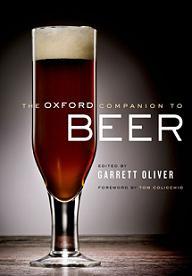
++++++++++The Oxford Companion to Beer
First, a statement. As I mentioned in the preface to “The Oxford Companion to Beer” (OCB), no work of this scale can be, has ever been, or will ever be published without errata, and I look forward to working with the beer community to strengthen this work and other works over time. In the meantime, a book of this size, scope and reach can be and should be debated and questioned. The OCB has been met with overwhelmingly positive reviews from the press, and the comments from beer enthusiasts, homebrewers, professional brewers and brewing professors have been very kind indeed.
However, last week I was pointed to a blog post in which the blogger Martyn Cornell suggested that the OCB was a “dreadful disaster”, owing to “errors” which he claims to have found in various entries as he scanned through them on Amazon. He says that I and my 166 colleagues simply “made things up”. In this post, Mr. Cornell, in essence, refers to me as a dupe, a cretin and a liar, piloting a project populated by lazy idiots. All this about a person whom he has not met or had so much as a conversation with, and about a book that he has not actually seen. In my 22 years in brewing, this most convivial of professions, it is the most intemperate and inconsiderate thing I have ever seen a member of the beer community say about any of his peers. I do not agree with or believe everything I read in Mr. Cornell’s books either, but it would never have occurred to me to vilify him in public.
No one who reads his post will be surprised that I take extreme exception to it. In deference to Mr. McLeod’s decency and courteousness, I will not be bothering to play that out fully here. I will, however, point out that many of Mr. Cornell’s historical “facts” are incorrect, speciously derived, or under scholarly dispute. He says, for example, “the Angles, Saxons and Jutes arrived in Britain in the 5th century AD, not the fourth.” Actually, the vast majority of scholars, up until this day, note numerous incursions by Anglo-Saxons well before the 5th century AD.
Regarding the subject “Bottles”, Mr. Cornell rails about a comment that the UK pint bottle is still on shelves, however just yesterday one of the UK’s top beer writers wrote me to say that “I see them (pint bottles) every time I go to the supermarket, which would suggest they’re still ‘popular’.”
In another bit, he says “This is, again, just made up. In fact there’s very little or no evidence of cider-making in pre-Anglo-Saxon Britain, (“cider” itself was a word introduced by the Normans) and evidence for mead-making is mostly or all post-Roman.” Not only is his outlook on this question a minority view among historians, but we all are perfectly aware that people everywhere on earth have fermented pretty much whatever is at hand into alcoholic drinks, from honey, to dates, to apples, to palm sap, milk, and even drinks containing blood. Saying that “evidence for mead-making is mostly or all post-Roman”, even if that statement could be determined to be correct, is rather like saying “there is no direct evidence that Neolithic peoples breathed oxygen.” “Foaming at the mouth” – these his own words – he even goes on to complain about the use of the word “unlikely” to describe the rise of India pale ale, saying that such use is “unsubstantiated and unexplained assertion-making.” No doubt Mr. Cornell, having been there personally in the late 1700s, found the rise of IPA to be very likely indeed. In fact, by now I feel certain that he predicted it himself in the broadsheets.
And it goes on, reminding me of nothing so much as McCarthy’s House Committee on UnAmerican Activities. I refer interested parties to the list of contributors, who have not even listed nearly the entireties of their bona fides in their small OCB biographies. Please do read it. As you will see below, “The Oxford Companion to Beer” is a peer-reviewed work, and 166 learned people from 24 countries expended many, many thousands of hours, for virtually no remuneration, to bring it about. I can assure you that neither I nor any of the OCB contributors have “made anything up”. All the negative comments I have seen so far are about historical matters. Well, even though Mr. Cornell has surely done yeoman’s work digging up old brewing records, the reading of a historical record and the interpretation of it are two different things.
History, far from being pure science, is a thing in constant motion, with much or it arguable or interpretable in various ways. People still argue about the precise make-up of George Washington’s false teeth, and he was the founding president of the United States, spoke before thousands and sat for portraits barely more than two centuries ago. I feel very confident that the OCB’s percentage of errata, though it must surely be more than zero, is probably as good as that of The British Museum, and no one is speaking of tearing that down. No one is more interested in the factual accuracy of the OCB than I am. However, it is famously said that “the perfect is the enemy of the good”. Well, I have not, in my time on this earth, seen perfect yet. I do not expect to, either, and any wise person will approach attempts at perfection with at least an ounce of humility. Beer is a human thing, and one does well to remember that. We have made, I think, a very good start, and no one, least of all me, has claimed that the work is or will be finished any time soon. As you will see below, many of the entries in “The Oxford Companion to Wine” have undergone substantial revisions between the three editions. This is entirely normal. All I ask, if anyone here is moved to acquire a copy of the OCB, is to actually sit down with it for a few hours, browse through the 1,110+ subjects (not just the ones that you have specifically had big arguments about), and then come back here and tell us what you think. We will be very happy to hear from you.
1. I understand that The Oxford Companion to Beer was a project that you spent four years working on. Can you provide some insight into the origins and development of the book, including the process of gathering 166 people involved with the world of beer?
In late 2006, I received an email from Benjamin Keene, who was then an editor in the Reference Division of the American office of Oxford University Press. He said that the time has come for an “Oxford Companion to Beer”, and asked whether I would be interested in originating the book as editor-in-chief. I told him that I was flattered by the question, but I said “no way”. I have a copy of “The Oxford Companion to Wine”, and basically thought “no one in their right mind would take on something like this.” I did, however, end up going out for a pint with Ben Keene. He convinced me that there was much missing from the public literature of beer. And as I looked around, I found that it was true. There was nothing to be read on professional dry-hopping, for example. I had lots of technical brewing books, but they covered dry-hopping in a sentence or two. Almost nothing on bottle-conditioning. Or barrel aging. Very little, except for one recent book, on recent developments in wild and sour beers. There was not even so much about the actual production techniques for mass-market beers, although technical journals have covered certain aspects very well over the decades. There was not enough, at least in English, about the rest of the world outside the U.S. and certain parts of Europe. So eventually Ben convinced me that the book needed doing, and that I should take it on. I formally signed on as editor-in-chief in August of 2007. It is not an overstatement to say that the prospect of taking on the OCB was terrifying, and for good reason.
The start of the project was the assembly of the “headword list”. This is the list of subjects that will appear in the book in alphabetical order, rather like an encyclopedia. I put together a list of several hundred headwords. After I ran out of things I could think up on my own, I combed the indexes of many dozens of books, looking for subjects that the OCB should cover. Once I had a large, credible list, I posted the first of many requests on the Brewers Association daily Forum, asking for help in assembling a more complete headword list. The Forum is read by over 1,000 people in the brewing industry and some journalists, amateur brewers, industry affiliates, and writers, not only in the U.S. but in other countries as well.
I got a very vigorous response from the community. Probably 100 people offered to help, and I sent them my original headword list. They added their own headwords to it in another color or font so that I could easily tell what had been added. Sometimes, as expected (and hoped), there would be a term with which I was entirely unfamiliar (stuykmanden, for example). I’d do a little research and decide whether the term seemed to merit inclusion. One by one, I went through everyone’s lists and incorporated terms that I though would interest people. When the first round was done, we had about 1,000 headwords and were ready for the second phase.
The second phase was the assignment of word-lengths to each of the 1,000 headwords. Without assigned word-lengths, the writers could have no idea how to approach their subjects, and Oxford University Press (OUP) would have no idea how large a book they were planning to produce. Of course, assigning a pre-determined length to a subject you haven’t even begun to explore is a very difficult task, especially when there are so many of them. Fortunately, OUP had a system for this, wherein each entry was set at one of five lengths – 250 words, 500 words, 1,000 words, 2500 words, etc. If this seems random, it is not – it actually does make sense; you cannot have an infinite number of different lengths for the assignments. However, later on, when we approached writers, we made it known that the word lengths were targets, not edicts, and we would make room for any crucial information.
From here, we assembled an Advisory Board. They would receive all entries first, before the editor-in-chief (EIC). The Advisory Board is a group of peer reviewers who are tasked with reading through the entries, looking for inconsistencies, errors of fact, incompleteness, or other problems. Only after passing review by the Advisory Board would EIC begin work on the entries. I was asked to assign each entry to one of the members of the Advisory Board, based in many cases on their particular area of expertise. When entries came in to OUP, members of the Advisory Board would sometimes send entries back to writers, asking them to do further work. Even when entries were passed to EIC, they would often come with notes from the Advisory board member attached regarding something that needed curing. The Advisory Board was:
Dr. Charles Bamforth, who needs little introduction. He is, among other things, the Anheuser-Busch endowed professor of Brewing Science at U.C. Davis, and has spent his career in brewing research, brewery quality control, and many other pursuits, and is the author of several books.
Dr. George Philliskirk, before becoming the Co-Director of the Beer Academy, was head of the Technical Department for Carlsberg UK. He is a past Chairman of the Board of Examiners of the Institute of Brewing and an external examiner for the Brewing degrees at Heriot-Watt University.
Dr. Patrick Hayes is professor of Crop and Soil Science at Oregon State University in Covallis, which is in one of the centers of American hop farming, but also focuses on grain science. Most entries involving agronomy went through him.
Dr. Keith Villa is Master Brewer of MillerCoors, inventor of their Blue Moon brand among many others, a well-experienced judge of international competitions and a graduate of the brewing school at the Catholic University of Leuven. His career has focused on brewing innovations.
Dr. Wolfgang Stempfl is CEO of Doemens Academy of Germany, which also needs no introduction to those assembled here.
Dr. Val Peacock, before becoming president of Hop Solutions, was well-known within brewing circles as Anheuser-Busch’s Manager of Hop Technology. He is one of the most experienced hop researchers in the world-wide brewing industry. While he is not technically listed on the Advisory Board, he went through every hop entry and helped organize, verify and catalogue a huge amount of hop information.
EIC makes all assignments of entries. In some cases I reached out to people who I knew to have specific knowledge of a subject. So Vinnie Cilurzo was asked to write about “sour beers” and “oak”, Pete Brown to write about India Pale Ale, Steve Parkes of American Brewers Guild to write some technical brewing entries, Chad Yakobson (whose Masters-degree work on brett is a sight to behold) wrote about Brettanomyces, etc. Some people suggested I reached out to specific other experts, and then we would check out their bona fides and reach out to them as well. Others wrote and offered to help. I put out the word through various forums, and I think I can say that there are very few people who write about beer who would say that they didn’t know we were looking for writers on a wide range of subjects. Eventually, the vast majority of subjects were assigned and people got to work. All contributors were sent a set of guidelines as to what was expected, what the scope and writing style was, what sorts of sources would be accepted as references, etc.
Aside from writing my own entries, my job as EIC was to make sure that each entry was properly written, in what might loosely be termed the “Oxford style” (though without squelching the individual voices of the contributors). EIC also assures that entries contain the information that they need to have, that this information has been properly researched, and that the information is not unduly parochial. Almost anyone who wrote a piece for the OCB got questions back from me, was asked for additional information, and had some changes made to their copy, etc. Some pieces were able to go through with very little work – we had some great writers. Many others needed substantial additional work, from simple editing to complete re-writes.
This is not unusual, but I had no real idea how much work this would involve. Many very bright people, who have lots of excellent information to impart, are not natural writers. Some may not speak English as their first languages. However, if you want the best possible range of information, you cannot rely entirely on people who write all the time, nor solely upon English-speakers. In some cases, I added an international perspective – for example, someone in Germany writing about “dunkel” might not be aware how prevalent the style is among craft brewers in South America. As a result of all these roles, I had some part in virtually every entry. In any event, if you do not like the writing style of the OCB, the full blame falls upon me. If you do like it, then credit may well lie with the original writer, or with some combination. However, in every instance, writers signed off on final edits after they came back from OUP’s copy-editing and before they went off for typesetting. If a writer objected to the editing or thought something was wrong, it went back through the process until the matter was resolved. In a very small number of cases, an entry was rejected and later written by someone else.
In some cases, I would send certain pieces, especially my own, to other writers whose knowledge I respected. So, for example, I sent my own pieces on “barrel-aging” and “bottle-conditioning” to Vinnie Cilurzo and Will Meyer for vetting, not only of the info present, but also so they could check them for completeness. Sometimes I would send pieces out to independent experts. For example, before finishing my editing on the piece “beechwood chips”, I sent it out to two former employees of Anheuser-Busch so that they could confirm that this was indeed correct information from top to bottom. Oxford editors also combed through everything, looking for problems, inconsistencies, plagiarisms, and all sorts of other possible difficulties that occur with all projects of this scale.
In the last few months of the project, Horst Dornbusch joined the OCB as associate editor. He has been a Fulbright scholar, a brewer, a brewing consultant, a writer, a translator, and spent 10 years in magazine editing. His main job was to “rough cut” some of the remaining entries, some of which did not arrive in wonderful condition. After his work, he would pass them to me (with all of his changes visible), and I would work them into final form.
Before we move on, let me emphasize that this is a very hard style of writing to master. It is meant to appeal to a wide range of possible readers, from the casual enthusiast to the beverage professional, to the technical brewer. And it is intended to be interesting and engaging, not to simply be a dry textbook. That is one reason the book series is called “Companion”. In the preface to “The Oxford Companion to Wine”, Jancis Robinson writes that the book is meant to be “a comprehensive work, with attitude, aimed at curious, intelligent wine drinkers and wine students who want to understand more of the background to the delicious liquid they find in their glasses and bottles.” Well put, and though I would obviously change “wine” to “beer” and add a few more areas of possible readers, that was very much the goal of the OCB.
A final thing here – I have read posts by some writers, who were among the very few who rejected assignments, who have said that they were annoyed at the tiny remuneration offered to them by OUP. One very prominent beer writer said to me, right to my face, “I wouldn’t take a sh*t for that kind of money.” Okay, well, fortunately, I had not asked him to. His own book will be out soon, and I hope it provides him the money he requires.
Of course, there is nothing I can do about the pay. Everyone here should realize that (1) academic presses never pay much – in fact, they often don’t even pay advances, and (2) OUP is a not-for-profit organization. Much of any surplus that may be generated by book sales goes back into education, including scholarships, other books and educational material, and the subsidization of massive works such as the Oxford English Dictionary. No one is getting rich here – everyone, myself included, has made far below minimum wage, and all the OCB writers I spoke to said that they did this partially to give something back to the brewing community. The fact that so many were willing to do so says something about that community. I understand that not everyone can afford to do this work, but I’m grateful to those who did.
2. The OCB comes to us eight years after the publication in 2003 of your marvelous book, The Brewmaster’s Table. The two books are very different. It might be said that The Brewmaster’s Table is an exercise in expressing the subjective experience of beer from the perspective of eloquent and comprehensive passion that might even butt up against the obsessive. The OCB, by comparison, is almost by definition objective in its approach. Is there something about beer that favours one route to good beer over the other or are they two necessary paths to full appreciation?
Thanks for the kind words. “The Brewmaster’s Table” (BT) won the International Association of Culinary Professionals Book Award in 2004 and was a finalist for the James Beard Award. Having never won any prize for anything but making beer, that was very gratifying. And I think that people did react to BT exactly as I meant them to. It was a very subjective work, and a work of passion. That was a book that was burning a hole in my pocket – I had something to say, and I needed to say it. The fact that so many people have enjoyed it and have made some use of it is wonderful. These days I’m meeting young brewers who tell me that BT was their inspiration to get into homebrewing and then professional brewing. That’s very cool, though it makes me feel rather old!
The OCB is entirely different. While I did not entirely put a lid on my opinions (note Robinson’s “with attitude”, above) or those of others, this was meant to be a largely objective work. This meant that I needed to turn off my “partisan craft brewer brain” and put myself in a different mental space. It also meant, and I am very grateful for this, that writers and advisors who came from the mass-market brewers needed to trust that I was not here to sack them or their products. I know that they have read “The Brewmaster’s Table” and many of them were not thrilled with my characterizations of mass-market beer. It was a mark of true character on their part that so many people from the world of mass-market brewing were willing to trust me and pitch in on the OCB, and I worked hard to try and earn that trust.
After all, if you come to this book and look up “light beer”, it would be incorrect for me to say to you “well, you shouldn’t want light beer.” That wasn’t the question that was asked. OCB is there to answer the question, and such a piece will have been written by someone who knows precisely how light beer is made, where it comes from, its development over the years, and its societal context. So in a certain way, I had to become a different person, beer-wise, to do this work. And other people had to forget certain things about me.
In the end, I think and hope that craft brewers and mass-market brewers will be equally happy with the OCB. As for the bits of opinion, I quote again from the OCW, which says that it is “laced with the editorial opinion which is such a crucial ingredient of all Oxford Companions across a range of equally worthy subjects.” And so it is with the OCB.
To answer your question, I think both the subjective and objective roads to beer appreciation are valid, and there are probably one or two other roads besides those. If Michael Jackson taught us all anything, it was that good beer should engage both halves of your mind. And both BT and OCB have subjective and objective aspects, but the balance is very different between them.
3. Was there anything in the difference between being primarily the writer of The Brewmaster’s Table compared to the editor of the OCB that taught you something new about the pleasures of beer?
It made me realize how much there was to know and to think about. It showed me how much I already knew, which felt good (keeping up with Charlie Bamforth, for example, is not for the faint-hearted), but also opened up whole other worlds of thinking. I also learned a lot about the beer histories of other countries and how their path through the world of beer is the same as ours, different than ours, and entwined with ours. I tried hard not only to avoid thinking only as a craft brewer, but also to avoid thinking only as an American, only as a professional brewer, only as a beer geek. I tried to understand the point of view of a beverage manager for a restaurant, for example, and what he or she needs to know in order to bring beer alive for the restaurant’s guests. I hope that we did it – I think we did.
4. The discussion of beer both on-line and in the traditional media has changed significantly since 2003. While beer forums existed, blogs were in their infancy and there were few beer columns in newspapers. How has the reception of the OCB differed from The Brewmaster’s Table? Is there a greater noise to signal ratio or has the discourse truly advanced with the volume of discussion?
The noise to signal ratio has increased drastically. Sometimes it seems that there is almost nothing but noise. That said, at the same time, there is also much more real information available. Not only are there actually many more good writers, but facilities such as Google Books, whatever one may think of them, would allow me to look at some book from 1820 that’s sitting in a small library in Scotland and read the scanned book. And, in many cases, the book had only been scanned in months or weeks before I looked at it. There is so much more info that’s coming available, and that’s very exciting. Which is why, as I’ve mentioned above, the OCB had crowd-sourced elements to it. There is virtually no one who writes about beer that did not know that the OCB was underway, so people reached out to me from around the world.
It is worth noting, I think, that in the preface of the 3rd addition of “The Oxford Companion to Wine”, EIC Jancis Robinson writes “These are new entries [referring to the more than 300 new subjects in the 3rd edition], but of the old ones roughly three-quarters have been changed in some way, and a good 40% of the total, about 1,600 entries in all, have been revised quite radically.” She goes on to say that the world of wine is a rapidly moving target requiring frequent revision and updating. 40% revised quite radically? Yes, actually, of course they have been. That’s because the first OCW was excellent yet imperfect. The important part is that OUP and Jancis have continued to do the work.
Those who are wary of this first edition of OCB might take note of this. We worked exceedingly hard, but there is no way that I or any other EIC could possibly hope to personally verify ever single asserted fact in a book containing this much information. That said, I am certain that the first OCW was an extremely valuable resource, and I feel confident that this first edition of the OCB is as well – and we now have the benefit of better, faster checking of information than we once did. In the future, the best comprehensive works will involve a lot of crowd-sourced elements and expanded digital sourcing capabilities combined with solid editing work.
5. What would you wish for the commentary wiki on the OCB and other forms of on-line response? How can they best serve your intention for the book as a centrepiece for the continuing elaboration of the meaning of beer and the passion people have for beer?
That’s a good question and will require further thought. I would love to see a wiki like this somehow connected to formal Oxford research teams. Perhaps some of the larger breweries and mid-sized breweries could even help fund such things. The wine world has plenty of people paid to do pure research into elements of flavor, history, etc. We have no idea how far behind we are in the world of beer. Mondavi has teams – teams – of people who study nothing but wine and food interactions. Think of that. I’ve met these people and they’re doing fascinating work. Can we do that? If not, why not?
A few quick things as I close:
People wonder how the featured breweries – and there are not very many – were chosen. I decided from the beginning that trying to cover thousands of breweries was not only impossible, but largely useless. There are plenty of other resources for that. So I stuck to breweries that I thought had a particular cultural relevance that went beyond their sheer size or popularity. I also paid attention to the many people who suggested headwords – certain breweries popped up over and over again, which struck me as a sign that they were touchstones of some sort for people. This is the reason for something of a bias in the direction of the older European breweries; they have been highly influential all over the world. For example, Brasserie Dupont is important not only because Saison Dupont is delicious, but also because Saison Dupont resides somewhere in the mind of almost every modern brewer who brews saison. The fact that they are tiny is not as relevant as the fact of their influence.
Is the list subjective? Yes – how could it be otherwise? Is it random? No. Do I think that other breweries, possibly many, deserve inclusion? Yes, absolutely.
BTW: “Leipsiger Gose” was written for the OCB, but came in too late to make it into typesetting. I’m sorry about that too, but it’s hard to have everything. Next edition.
Also: It has been noted that there is no listing for the hop Centennial. I use Centennial myself, as do a great many brewers, especially in the U.S.. I hate to say it, but the omission was inadvertent. The omission got past me, our hop editing team, and the OUP editors. Centennial is actually referenced elsewhere, and how it skated past is a mystery we shall track down. In any event, an actual error – sorry for that.
Some people have been a bit annoyed by what are called “blind references”. These are used when the editors feel that people will look for a subject under a different headword – it is meant to direct them. So “Calagione, Sam” has a “blind ref” to “Dogfish Head Craft Brewery.” Sam is one of the most famous brewers in the world, so some people will search for his name. Similarly “Magazines” has a blind ref to “Beer Writing”, and so on.
Going back to “The Oxford Companion to Wine”, the second edition had 650 more entries than the first, and the third edition had more than 300 new entries, but had to cut some existing entries to make room. All these things evolve – this is the way it’s done. As I said, we’ve made a start, not a finish. I hope to help out, and I hope many others here will help too. And I also hope that we will sit down and drink fine beers together, leaving “foaming at the mouth” to unfortunate animals against which we will barricade the doors of the pub, leaving the rest of us to enjoy our conviviality in peace and fellowship. That, let’s not forget, is what beer is for. Thanks for listening.
– Garrett Oliver
 Well, I didn’t expect to be called out – or, rather, have my suspicions confirmed – by the east coast media establishment. I did say that I expect this to be a slow project
  The ad is from