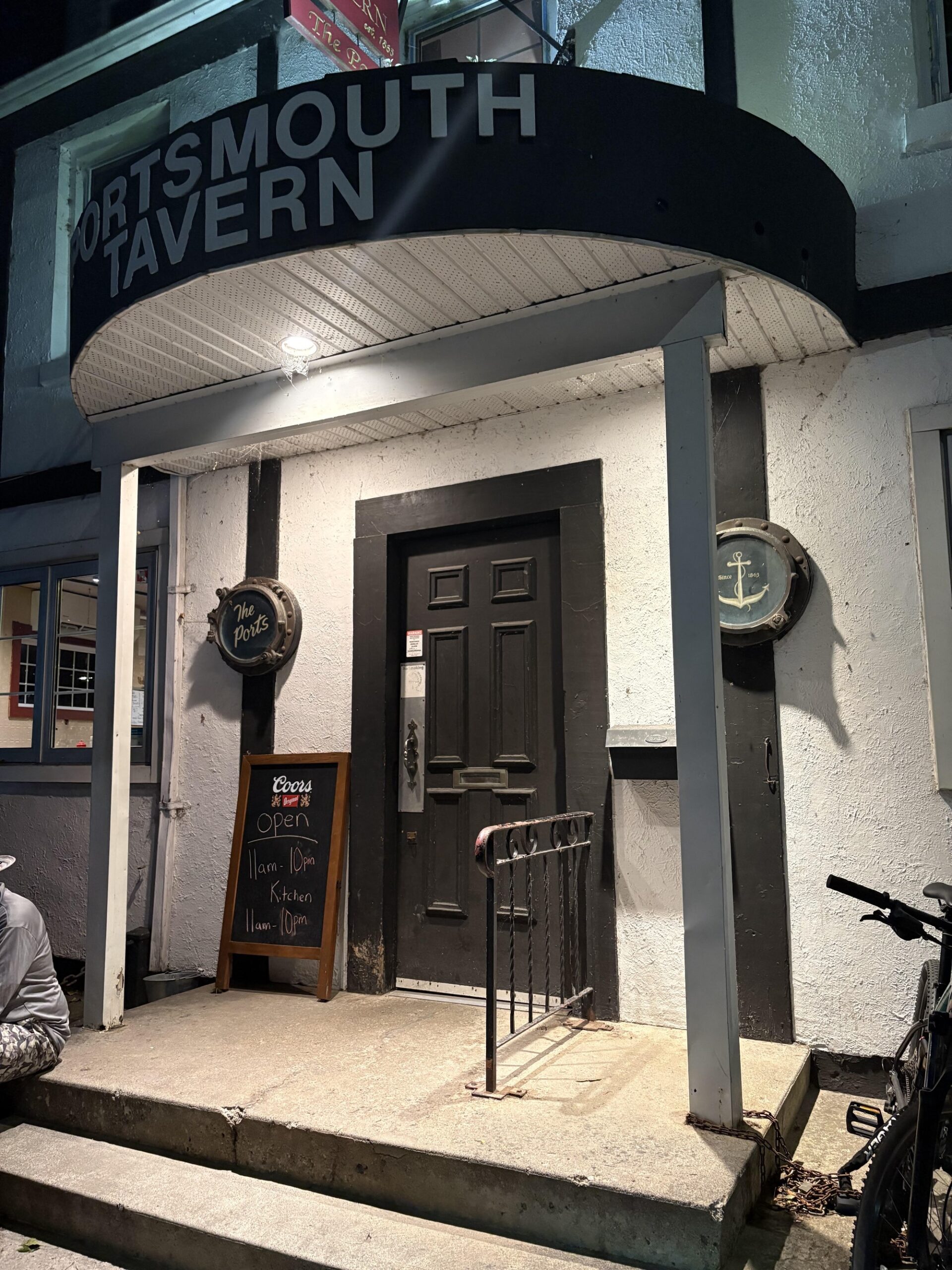
 An old friend from work is joining me in the ranks of we, the gratefully unemployed and idle pensioners. To mark the event, I was invited on a small pubcrawl the other day playing my role as, I suppose, the ghost of retirement to come. A happy time out sat at long tables filled with glasses and pitchers of beer beside friends and former co-workers. We ended up at the Portsmouth Tavern, established circa 1863… which is pretty early for Ontario. Pre-Confederation. Once upon a time, I wrote about the drinking spots in my fair city including the older Queens Inn (est 1839) and Royal Tavern (est 1851) both of which have had breaks in operations in recent years. “The Ports” continues to serve beer after 163 years.
Me, I grew up in Nova Scotia, that eastern province that is almost entirely encircled by the Atlantic. The common word for public house back there back then was tavern or “tav” for short. Like the old Midtown Tavern in Halifax. Tavern is the same word used by Thomas Raddall in his 1965 portraint of the city Halifax: Warden of the North. The word originally was supposed to indicate a better sort of establishment – with tables and wine – to distingushing taverns from, as Raddall describes in the 1760s:
…the other side of Halifax, the brothels, the drinking dens, the underworld which nourished itself on the vices of the troops and the fleet.*
Kingston was established as a military town up after the American Revolution on the site of French Fort Frontenac (1673-1759) as something of a bookend to Halifax, serving as the westernmost military bastion of British North America deep inland here at the eastern tip of Lake Ontario. When I moved here in 2003 I was expecting a similar tavern culture but modernity had intervened. There were plenty of drinking spots but instead there were mainly bar restaurants called roadhouses, big screen sports bars, ditto band dance bars, swell cocktail bars and even the first brewpub in Ontario. Not a lot of the same sort of beer pounding taverns that I was familiar with back in Nova Scotia – or even up in the lumber towns of the Ottawa Valley where we had also lived. Places with communal tables, cheap beer, cheap food and a clientel that reached across all strata – college students, military, business folk. Young and old. Tavs.
That night earlier this week, the Ports was clearly a tav. I had been there before when we lived nearer. Even once after a college football game when the Queens University bagpipe band led fans in, pipes a’blaring. That was loud. But this was loud as well. Not with music, just the happy talking… err… shouting I suppose. My ear were actually ringing the next morning it was so pretty loud. Still, not nuts. It was only 9 pm. A tav should be loud. It was also very well staffed. Packed but clean, well lit with empty glasses cleared away quickly. We had had dinner at another place earlier, where the bar was stacked with dirty glasses and the cans were rank. It was justifiably dead.
When I paid my bill on the way out, I got called “hon'” by someone less than half my age. “We good” she said with a thumbs up. The beer was a buck cheaper too. We good.
*Raddall, T.H. (1965) Halifax: Warden of the North, (Doubleday, New York), p.64.