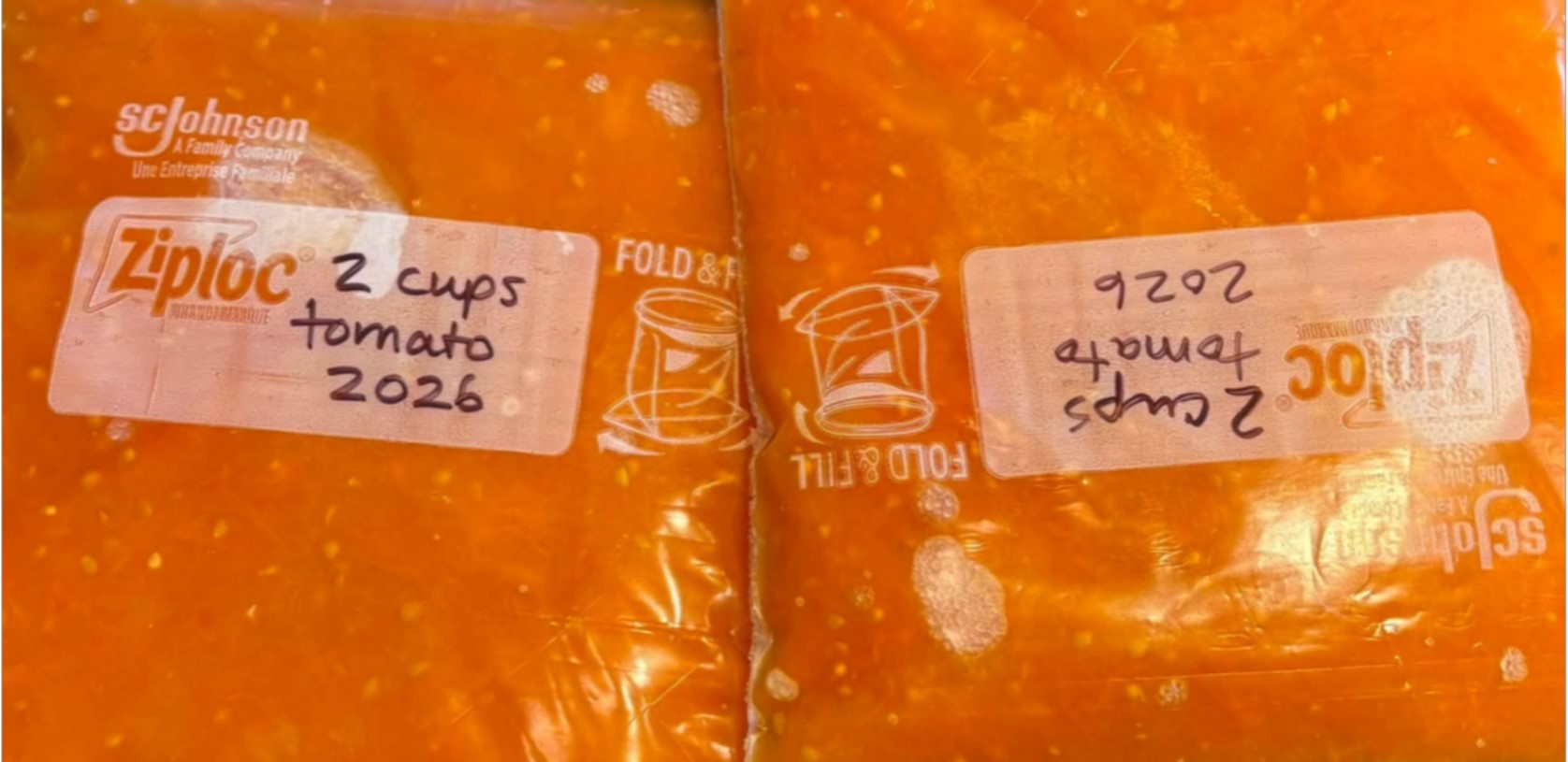
 The end of summer. The last stragglers back from holidays. Yellowjackets everywhere. Tired sweetpeas starting to show their age. Tomatoes ripening faster on the vine, some going soft before I get to them in the sauce pot, then into ziplock bags destined for a spot deep into the freezer. I’m even starting to think about getting the garlic ready to plant before the first frost. It all starts to move pretty fast right around now.
Speaking of fast, as Canada is suddenly accused of nuzzling up to the EU, asking if we can spend the weekend – or is it the other way around – it’s funny to see a politician in France castigated for doing the one thing even a t-total conservative candidate here must always do if they hope to have a hope:
A French presidential hopeful has been accused by leftwingers of encouraging alcoholism after he released a campaign video showing him with a beer. In the video, Gabriel Attal, 37, who was President Macron’s prime minister in 2024, announced plans to hold debates with voters in bistrots across the country. He said he wanted to revive tradition: Enlightenment philosophy had emerged in France’s small dining establishments in the 18th century, he said, as had the call to storm the Bastille in 1789…. The launch of Attal’s “1,000 Bistrots” initiative, as he is calling it, seems unlikely to boost his standing among voters, according to commentators. They noted that it had been widely mocked on social media, with one user saying that the candidate looked more like a spritz than a beer drinker.
Not to worry. He’s way behind in the polls. Speaking of not doing so well, let’s get these interesting numbers from BMI out of the way early this week:
Close to $120 mil in craft $$ tracked by NielsenIQ thru Aug 8 came from 138 craft brands with at least $150K in sales this yr and no sales this time last yr. But it’s top heavy, natch. The top 25 new craft brands generated about 2/3 of that total, each racking up around $1 mil in retail sales. With total craft $$, including craft non-alc, down 4.2% yr to date, existing brands are off over 6% as a group.
Yikes. So has US craft beer – which told us it came into being to defeat the monoglot of macro – become what it abhored? Fewer and fewer brands, limited in difference hogging more and more of the shelf space? Apparently, not only have fruit flavoured beers chased the tail of coolers but apparently New Belgium’s 11% ABV Voodoo Ranger is the top new beer. Taking on the “electric soup” RTD competition. As Knut notes:
Most Norwegians buy their beer at a supermarket, but the range available has dwindled over the years, with fake cider, hard seltzer and ready mixed drinks taking over much of the shelves.
Tomorrow belong to the gak. Not everyone has noticed. Ontario’s Peterborough Examiner published an opinion piece by apparently self-published author Bruce Gravel that reads like it was defrosted from a glacier that formed around the good beer conversation around 2006 to 2012:
He finally took a sip. He didn’t swallow. Instead, he held the beer in his mouth, churning it around his gums like mouthwash. He made a loud, wet aerating sound — slurrrrp — that caused people at the next table to look over in disgust. He swallowed, closed his eyes, and performed a full 60 seconds of silent contemplation to measure the “finish.” The ultimate annoyance of the beer snob is their complete inability to let anyone else enjoy their drink. When our friend Sarah arrived and ordered a cider, Sebastian spent 10 minutes explaining why her choice was a sugary insult to fermented beverages.
You know, that New Yorker cover is now twelve years old. I thought news editors by definition were up to date on the booze scene, you know, from personal experience. Speaking of which, here’s some notes with the first one on the better approach in such matters.
Note #1: Advice to journalists.
Note #2: Don’t most people at cricket matches drink beer?
Note #3: Belgium… “if it isn’t poison, it goes into the beer.”
Note #4: All you need to know… twenty something words…

Speaking of simplification, here’s a central European leaning timeline of brewing history. It’s a pretty good effort but, again, pale malt was not first made upon the adoption of coke. Straw fired pale malt drying was common well before coke. Conversely, Katie Mather won a writing prize. And she wrote about winning a prize. And thanked her editor:
Last year, Claire Bullen edited a story I wrote for Pellicle about wine in Tenerife and the Orotava region. It started as an off-the-cuff idea borne from sheer enthusiasm—I had just visited the island and fallen in love with Mount Teide. I have a thing for tall, brooding guys. Most of my best stories come from a small, sharp inkling that I’ve seen or tasted something life changing, and that little feeling gets worked into every thought. Working out the story is part of the fun. Why do I want to tell this tale? How would I even begin? Editors get the hardest job and the least credit. I worked away on my story, did the research, painstakingly rewrote the drafts, but were it not for the editorial process, it wouldn’t be half as good as I think it is now. And I happen to think it’s the best thing I’ve ever written, still, over a year later.
You know what’s not the best thing? The price of beer at Oktoberfest according to German broadcaster Deutsche Welle:
A Mass, the traditional 1-liter (2.1-pint) serving at Oktoberfest, will cost an average of €15.61 ($18.50) this year. In 1985, it cost about 6.25 Deutschmarks, equivalent to €3.20 after conversion at the fixed euro exchange rate. The figures were analyzed by UniCredit economist Andreas Rees ahead of the opening of the world’s largest beer festival on Saturday. Beer prices at Oktoberfest have increased by around 400% since 1985, according to Rees, using data from Munich’s statistical office. Consumer prices across Germany, by comparison, have risen by around 120% over the same period.
Next, we were off to New Zealand this week with Pellicle‘s feature by Martin Bridges on the Garage Project:
…the plain white box—adorned with nothing but the word “BEER” in a bold, black font—stands out. This classic pale lager, which has been a mainstay of Garage Project’s core range since 2014, is an ode to the power of subtlety and simplicity. Pilsner malt, Saaz hops, Czech yeast. No more, no less. Does exactly what it says on the tin… “It was a bit of a ‘screw you!’ to the big breweries to show that yes, we can do a lot of progressive beers with a lot of adjuncts and flavours and spice and unusual techniques—like hot rocks and making our own cryo hops from liquid nitrogen—but we can also do a fantastic, straight, Czech-inspired lager,” he says.
And, once we’ve had all that, there are the consequnces to be endured. Joan Fitzpatrick at The Conversation wrote aabout the ancient, medieval and early modern ethics and cures for over drinking:
Classical authorities were regularly cited as recommending the consumption of certain foods before a drinking session, with almonds, cabbage, baked quinces, wormwood (absinthe) and even the lungs of a goat being thought beneficial. They had tips on how to feel better after a surfeit of food and drink. Dietary authors recommended the benefits of moderate exercise, specifically walking, and sleep, with purging by vomit as a last resort. The medieval dietary authors had praised cloves as restorative and good for stomach trouble. But perhaps any notion of a “cure” for a hangover is based upon the questionable premise that one can undo the self-induced damage to body and mind caused by a bout of heavy drinking.
Perhaps some Korean hangover soup would suit you better. David Jesudason shared another sort of tough story in The Greenwich Wire this week, one about Stacey Ayeh of the Bouldr Bar taproom in southeast London and the struggle to get the doors open… and keep them open:
Bouldr Bar’s launch faced delays with wrangling over planning issues, such as increasing the number of toilets. The biggest headache was finding a way for a bar, planned brewery and food offering to meet Bexley Council’s requirements, because it is housed at ground level under new-build flats… The unit next door to Bouldr Bar remains empty. Stacey believes this was going to be occupied by Starbucks. Stacey believes that to create more food options, Peabody needs to build a tower vent system to keep the council happy. Bouldr Bar is in a state of flux until it can be installed – a new wall has been built but not painted.
At the other end of the economic scale, Heineken is making a claim to an “A.I.” powered beer tap… which might be the fibberfibberony of the year so far:
According to a statement from the brewer, the technology uses “a combination of tastes, moods, and occasions to create more than 100 tailored beers”. Most intriguingly, the new technology means that, from a single tap, drinkers can now choose from 135 different Heineken expressions, each shaped by a combination of traditional brewing characteristics, such as strength, intensity, with options ranging from 0.0% to 5% ABV. Consumers simply need to scan a QR code, customise your taste preferences on their phones, and then the kit blends their perfect brew using its “integrated barrels”.
Who buys into this sorta guff? Drunk computer sci frosh? The falsification of beer continues with the rise of “protein beer” as reviewed by Adam Campbell-Schmitt at The Food Network:
The protein drink is actually a nonalcoholic beer boasting 10 grams of plant protein (sourced from pea and rice) per 16-ounce can. That’s about five to ten times as much protein as a regular, alcoholic brew. (If you’re counting carbs and calories, each can of ChampionSips contains 90 calories and 11 grams of carbohydrates.) However, like many NA beers, it should be noted that ChampionSips “contains less than 0.5% ABV.”… As someone who has tried a lot of protein products, I could detect a bit of the pea protein. But largely what I tasted was a very malty pilsner, heavy on the caramel and toasted notes. While it may not pass as your favorite beer, it does its job of swapping some pretty palatable protein into a pleasant beer drinking experience.
Grim. What would the Senators of New York State circa 1835 who gathered in committee to respond to public alarm about the adulteration of beer think about such things. Me, I find that a rib steak or a smash burger injects some pretty palatable protein into my beer drinking experience.
Finally and speaking of falsification, Boak and Bailey took a comment on A.I. writing that I made last week and then, at their Patreon newsletter, made more of it:
… we think we can see the tell-tale signs. For example, a sudden change in writing style, with entire paragraphs adopting a strangely flowery, elaborate tone of voice while, at the same time, being devoid of any real substance. While both of us broadly subscribe to the idea that “if you can’t be bothered to write it, I can’t be bothered to read it” we’re not going to take a totally hard line. It’s also difficult for us to know for sure whether someone has used AI to write some or all of a blog post, even if we suspect it. We don’t want to write people off because we get a vibe. (This unfortunate ambiguity is, of course, how AI ends up worming its way into our lives.) It’s especially tricky with writers who are new to us and whom we haven’t been following for years. We don’t know how they usually write and so can’t spot when their style changes.
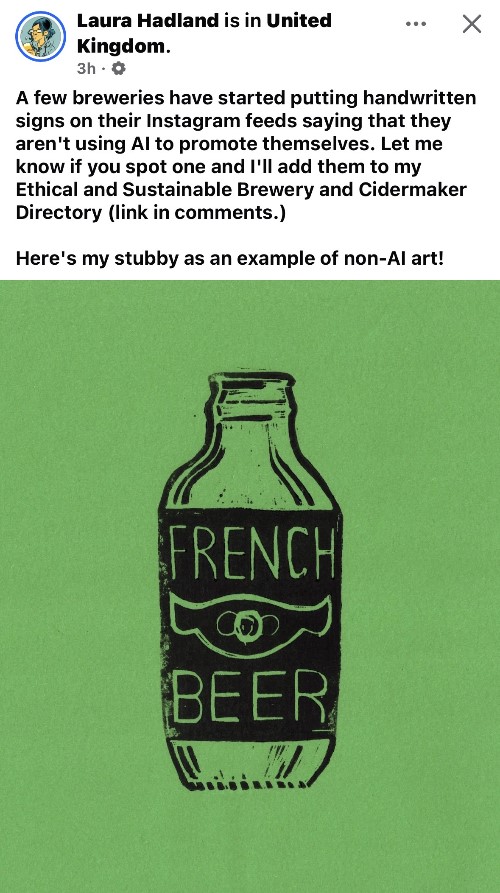 I commented* but… but… what I didn’t mention is related to what they wrote: “if you can’t be bothered to write…” I know someone who has found a niche that may make him a bit of side cash that relies almost entirely on innoquous A.I. use. It’s a form of design creativity that results in absolutely throw away content. So who cares? It’s just about the extra cash for him. But look at what Laura wrote over on FB. Because it’s good to care. So if you really do care, if you want to put your name on something? Well, you are drinking out of the dog’s water dish if what you put out relies on crap A.I. tech. “Relies” carries a lot of work in that sentence for sure… but if that’s what you’ve done your name bears the shame.
That’s it for now. I gotta get back out to the garden. While I do, please look to Boak and Bailey’s postings on each and every Saturday along with the coincidenal and fabulously entertaining footnotes week after week at Patreon. They do put in the effort. And do look out for more of Stan’s “One Link, One Paragraph” format. Then it’s your turn. Read and recommend, please. Scour the world for news tips – then let me know. Then hunt out something in someone’s archives! Leave oblique comments on someone’s post from 2009!! Listen to a few of Lew’s podcasts and get your emailed issue of Episodes of my Pub Life by David Jesudason on certain Fridays. And Phil Mellows is at the BritishBeerBreaks. Once a month, Will Hawkes issues his London Beer City newsletter. Do sign up for Katie’s wonderful self-governing totes autonomous website featuring The Gulp, too. Ben’s Beer and Badword remains on pause but there is reading at The Glass which is going back to being a blog. Any more? We have Ontario’s own A Quick Beer and All About Beer is still offering a range of podcasts – and there’s also Mike Seay’s The Perfect Pour. Plus follow the venerable Full Pint podcast! And there’s the Craft Beer Channel on Youtube as well as the archives of the Beer Ladies Podcast. What else?
*Fine, this was my comment: “I am afraid that A.I. is a bit like men’s cologne. You think you will just use a little, no one will really notice but it makes someone feel better about oneself. To the contrary, it’s like wearing some bit of orange clothing. It does stand out, it never really works and it usually ruins whatever effect you were going for. It’s also lazy because it’s unnecessary. If you are going to pretend you are a writer then do the frigging writing. Put in the time. Like any effort, you improve by error and succeed through the individual quirk of personal expression. A.I. editing is like claiming you cooked the meal when you got take away.”