The League Of Diastatic Brown Kilnfolk

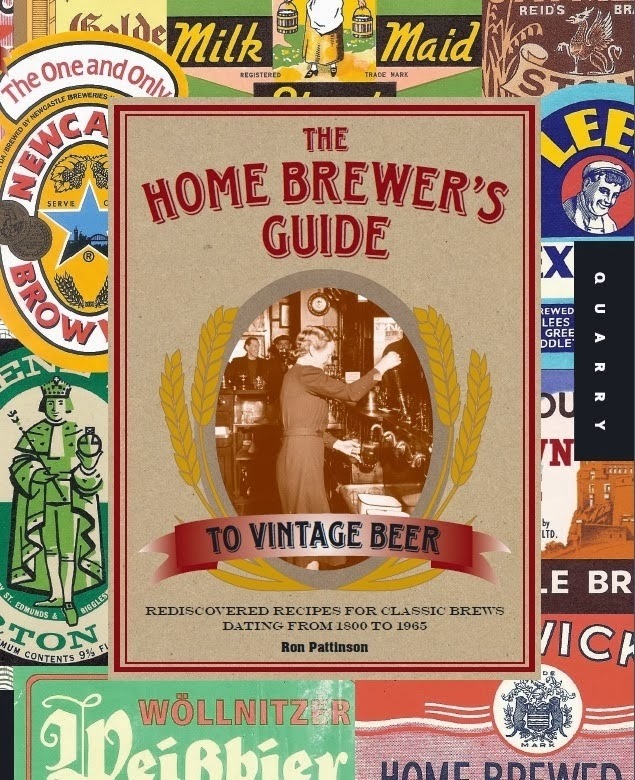
I need a new project. The writing and working and new kitten stuff is simply not enough. So when I was reading Ron Pattinson‘s new book The Home Brewers Guide To Vintage Beer yesterday as the six year old did not do much during a kids’ basketball practice at the Y, I was struck by this passage on page 11:

The earliest porters and stouts were brewed from 100 percent brown malt… It was custom to use straw as a fuel in the final stage of the kilning, where the temperature was increased dramatically.

See, in these hop-crazed times we worship a false idol, a flavouring agent. That error has spawned a thousand flavoured beers posing as craft. But we know that adding watermelon or lye or New Zealand hops to a beer only succeeds in making the beer taste of the adulteration. It is time that the focus of brewing returned to the making of better beer. And that means paying attention to the malt.

Which is the point of the LDBK. See, when I was a bad home brewer I liked to manipulate the malt, I would toast it immediately before mashing to make the oils more volatile and available. I used to let some malts soak for days in cold water in the fridge and pour the resulting tea into the boil right at the end. It worked. It was easy. But ever since I tried the 1855 collaboration porter brewed by Pretty Things and Ron, I have wanted to taste what should be considered the holy grail of brewing: pre-1800s beer made with proper diastatic brown malts.

That is where the LDBK comes in. See, what needs to be determined is how diastatic brown malt is made. What we know is that it was made of malt and that it was made by kilning. What has been forgotten is how the malt got darkened without destroying the enzymic properties of pale malt that allows the grains’ natural starches to convert to fermentable sugars. This conversion is something that can and should happen in every home every second week. Through collective experimentation and statistical analysis of results, it may be possible to establish the practical point at which pale malt may be toasted and darkened to create brown malt as well as the manner in which it might be done to protect the enzymic action. That in fact is the motto of the LDBK. Protect the Enzymic Action. What is the Latin for that?

So, start kilning and mashing. It takes a kilo of pale malt, pots and pans, graph paper and curiosity. While it may be that the critical feature is pre-kiln, that mention of the use of straw and flash heating may be key. The trick might be to darken the outside so fast that the inside is not fully heated. Then mash it in small batches to see if the resulting 66C porridge goes sweet. Like a rare steak on the grill, the point might be to preserve both characteristics through the process. Just a theory. But that’s where all great advances in human understanding begin. With a theory. And some graph paper. You in?
Best thing is that others are trying.

The Many Friends Of John D. Aikens

image195Coming to the end of the first draft of the Ontario beer history Jordan and I are writing, I find myself in the spring of 1927 at the Toronto hearings of the Federal Royal Commission on Customs and Excise. Officials from every major brewery in the province are being grilled under cross examination on their business smuggling beer into the United States. The glimpses of honesty through the lies are just good clean fun. When the manager of Carling was asked if they couldn’t make a profit at $1.75 a case, he replied “well, you can’t make a large profit.”

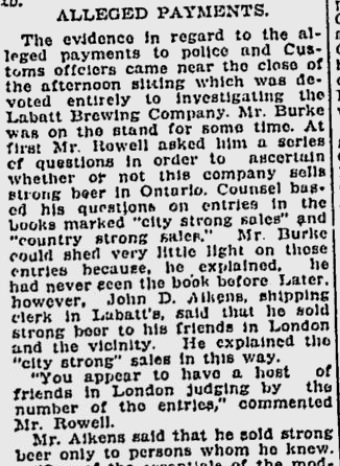
But of all the people in the witness box, I like John D. Aikens best. A shipping clerk, he appeared in the middle of row upon row of owners and business managers. While he cannot claim to be like Washington who never told a lie… he couldn’t tell a good lie. See, while all the others were crafting their tales to place all sales beyond the border and therefore beyond excise taxation, young Aikens tried to make everything better by letting the Royal Commission know he only sold illegal beer to his friends. That’d be OK, right? By the time the legal inquiries and hearings were done, the Supreme Court of Canada found it likely that O’Keefe bootlegged 17% of its production for cash within Ontario. That’s a heck of a lot of friends. And over $420,000 in back taxes.

‘Tis The Time Of The Canadian Goat

image193Is it just me or does the expression on Beau’s Hogan’s Goat bear a slight resemblance to the brewery’s co-founder Tim Beauchesne? A sample arrived a few days ago and, while I am pretty sure I have had the beer before, “spiced” beer of any sort is not something I hunt out. Same with weizenbocks like the sample of Burly Goat sent by British Columbia’s Granville Island Brewing. Yet, given how often I am wrong, I really should check in on my prejudices. Besides, Tim-Goat is giving me a mean death stare from that label. Better do something.
Hogan’s Goat pours a bright caramel under a slightly orange cream head. The almond malty aroma leans slightly to gingersnap. A very pleasant first foamy gulp: rich nutty malt with a late showing of herbal hops. Sweet with nods in the malt to apple, raisin and even old fashioned brandy butter sauce. What spicing there is gets neatly placed. The overall effect is a bit barley candy, a bit herbal lozenge and more than that in beer. You particularly notice the orange peel when you burp. At 6.9%, strong but not over the top. BAers have the love.

Burly Goat is a beer in the style of Aventinus and a respectable homage. It has that spiced weizen yeast in common with its mentor and displays how wheat, when stronger, starts to move from simply grassiness to something itself rustic and spiced in the way that rye is. It has that beefy gravel hue that would be a turn off in any other sort of beer. Green grass, marigold, pumpernickel, a bit of almond in a drying brew. Herbal leathery aromas. You could soak a pork shoulder in this very nicely. Just one rating by a happy BAer.

What did I learn? I was reminded that I like beers like this and that domestic craft can make them with verve. Or is it panache?

The Love Song Of J. Alfred Sixpack

A rather swell personal essay about one man’s love of a beer in today’s Globe and Mail:

Then one weekend last spring I was told they were out of Export in six-packs. I tried again the next week. Same story. The third time, the guy they call Red shook his head and said, “Sorry, they are not making it in six-packs anymore. I guess the six-packs aren’t selling very well.” I ordered two six-packs of something else and made my way home. I think I left the store paraphrasing T.S. Eliot’s The Love Song of J. Alfred Prufrock in my mind, “I grow old, I grow old, I still like my beer cold.” I was brooding over whether to switch brands or throw away my aversion to drinks packaged in aluminum. Neither option appealed to a man set in his ways.

I think I am developing a soft spot for big industrial brewing. Maybe not like the guy in the essay but not so far off. See, I am hitting the mid-1900s in the Ontario brewing history that I am writing with Jordan. And I am writing today about how, as might be expected, EP Taylor looked out into the world at the outset of the 1950s and saw nothing but markets and opportunities. In 1952, he buys Quebec’s National Breweries, the company born of consolidations which had first inspired Taylor’s initial plans in 1928. In the same year, Carling Black Label was first brewed under contract in the United Kingdom. In the years that followed he expands operations in the US and buys breweries in Canada’s western provinces. Taking on the challenge, competitor Labatt bought breweries in Manitoba and British Columbia while building a new brewery in Montreal. Their original location in London Ontario also underwent large scale expansion. With the move by Molson into the Ontario market in 1955 with the building of new 300,000 barrel a year brewery on Totonto’s waterfront, the province’s big three brewers which would dominate the next thirty years were established. Whammo.

It’s all so positive and happy. Ontario’s population expands by 20% over the 1940s and the 1950s are pure economic boom. I may not want to drink the stuff that they are brewing but it’s all quite the rush.

Ti-Jos: Something That Won’t Make The Beer Book

itta1

Somethings just won’t make the book on Ontario’s beery history that I am writing with Jordan. I am working my way these days through the period after our version of prohibition ends in 1927 until, roughly, the beginning of microbrews in 1985. Jordan is back there somewhere untangling the Victorians.

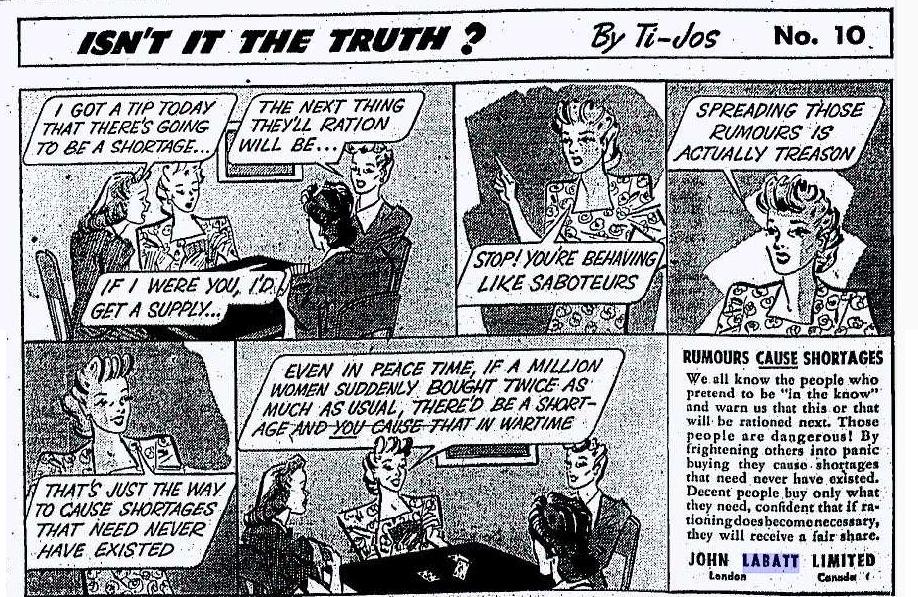
This image is one from a regular series of serial cartoons placed in Ontario newspapers by Labatt during WWII under the pen name Ti-Jos. They are obviously patriotic but there is a theme of moral economics that flows through the set. They are set largely in the home or shops but the message is about what citizens need to do on the home front to aid the war effort. In this edition, you better damn well not be spreading rumours if you don’t want shortages.

Which is my message for each of you today, too.

The Best Christmas Present For Ontario Ever?

I hadn’t thought of an attack on Ontario’s beer retailing weirdness from the Federal level but that may be just what is lining up for 2014:

A spokesperson for the Competition Bureau confirmed Friday that it’s “currently examining the differences between the beer industries in Ontario and Quebec and exploring the effect that these differences have on competition in each province….” “The bureau chose to focus on the beer industry as there have been a number of conflicting reports as to why the price of beer varies between Ontario and Quebec,” Phil Norris, a spokesperson for the Competiton Bureau, said via email. Sources told Global News Beer Store officials and others have been interviewed by the bureau. Regulators were “collecting information from industry participants,” Norris said.

Collecting information? I suppose if the mandate is limited to assessing a nutty regulatory system’s effect on pricing one must make a study of the obvious. As Jordan has detailed, the pricing arguments may not be all they appear but for me that is not the point. I have no interest in limiting my choice when it comes to my shopping whether for beer, cheese, shoes or books or anything. I buy at least half my beer ever the course of the year in Quebec or the USA. I’ve gotten the occasional wee lectures from overly eager border guards telling me I should not buy in the States but, really, when you allow yourself to take consumer product advice with folk with sidearms where are we?

I am happy to pay full freight. I am happy to declare purchases at the border, support local and support actual well crafted just about anything. But, when it is all boiled down, what I am most happy with is the idea of reducing the intermediaries. I prefer two parties to a transaction, the maker and me. Add a third as retailer and I am not upset but getting into wholesaler, bonding firms, distributors, importers and clearance certificate issuing laboratories and you start seeing not only why a simple product like beer is over priced but over wrought. As in what hath this system wrought?

At the moment – as it has since 1927 in Ontario – it hath wrought market constriction to the point one cannot be sure of value or even preference. We get what we are given and are expected to line up and praise the short shelves of selected goods. No thanks. I’ll continue to take much of my money elsewhere until that changes. If that takes a prosecution of the provincially regulated monopoly by Federal officials, so be it.

Day 2: Our Christmas Ice Storm 2013

4459

Happy we are that the stove top and basement fireplace both run on natural gas. We still have electricity but if and when we don’t it’ll be days and days of grilled cheese then porridge, grilled cheese then porridge. We can hold out on that for a week. Week two? Beans on rice? The back step will be our freezer, the cold room under the front step our fridge. For suburbanites, we have it good – or at least the house was built in ’64 with an awareness of nature. Wine is expected to still operate in an extended blackout. As with banjos. Very Christmassy so far… sitting here early on a Saturday evening, four days before the day. Best image of the first day of the ice storm? Street skating.

Ontario: In 1998 Did “IPA” Mean Macro Gak Or…?

image60This in interesting… well, to me at least. It is from the 1998 debate in the Ontario legislature on the imposition of regulation on the Brew On Premises trade. BOPs do not exist everywhere. In Ontario, they are sort of a hybrid between home brewing and macro brewing where you can go to a business and order a batch of beer from a menu, participate to a certain degree with the person running the place but get to use proper brewing set ups. In 1998, they fell under government regulation. But that’s not the interesting thing. This bit of the statement by MPP Mike Colle from 2 November 1998 is:

The appreciation of fine beer and fine Ontario wine has really exploded in Ontario in the last couple of decades. At one time, it was rare that you would go into a restaurant and see a bottle of wine on a table; you would see people having everything but wine. Now you can see Ontarians of all stripes enjoying good Ontario wine, and also they’re enjoying good beer. At one time it was just your basic beer that Ontarians were drinking. You remember the ones drinking old IPA? I call them the old IPA drinkers. Well, we’ve gone beyond the old IPA and we see people now appreciating fine-brewed micro-brews or speciality beers by the major manufacturers and brewers. It’s part of Ontario’s socioeconomic fibre that drinking beer and wine as part of your meal, in moderate, controlled fashion, is quite acceptable, It’s an industry that employs a lot of good, taxpaying Ontarians.

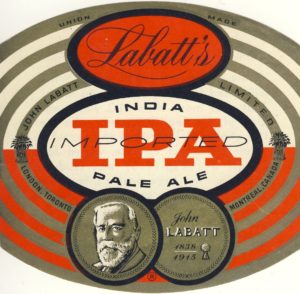
Apart from the weird idea that beer and wine are for mealtime, notice that reference to IPA. Likely what’s being referenced is a beer like Labatt IPA and that IPA from a point in our collective memory at its final days of popularity – before the lighter beers we all bear a certain responsibility apparently to dislike now, beers like Labatt Blue and 50. So, like now recalling the reputation of disco dancing in the age of New Wave, we are a few times removed from the beer in hand, the beer in the slur. In 1998, Colle is 53 so may be recalling the IPAs of the late 40s and early 50s. This could, in fact, be him visiting the brewery’s cask room in the 1940s. A beer with Victorian roots. The ales of his uncles perhaps.

Even just fifteen years on, it much be hard to fully appreciate the slur. What did IPA represent that was so different from “fine-brewed micro-brews”? Like Ten Penny to a Maritime kid, was it musty? Too grainy? It must have meant something to him as he referenced it three times in quick succession.