Not So Much A Bursting As A Great Dissipation

monkey4Ah, Mr. Chimphead. A serious point must be about to be made. But being August, there is not much out there to read, not much worth writing about. People rightly have other things to do. But Bryan Roth has posted a useful examination of the use of the word “bubble” that gets the juices flowing. He did so hard upon Stan posting a piece pleading (maybe rhetorically) for the cause of “craft” based on its persistent use. And he did so perhaps not coincidentally after Lew was quoted extensively on the need to kill off the word. For Stan, the mere fact of use conveys a certainty of some meaning. For Lew, there is simply no need for the word: “I’m holding a smart phone in my hand. If I want to know, I just thumb it in.” To be honest, I find these sorts of conversations appear amongst the All About Beer set rather regularly and I usually assume they are fillers until a real topic comes along. Quantity sometimes is a quality. What we have at this moment, however, is an opportunity to discuss how words are used to see if we can see what might actually be going on. So… let’s do just that.
I have looked back into this blog’s archives and those of others to see what can be found of assistance – not to mention making sure I did not write something entirely contrary to what I am suggesting here. It is easy to trace to way that “craft” was thrown away. It’s illustrated in one sentence from 2012 that I discussed here:

The large, multinational brewers appear to be deliberately attempting to blur the lines between their crafty, craft-like beers and true craft beers from today’s small and independent brewers.

“Craft” was botched by the Brewers Association in two main ways. First, it was made mutable. It could be uniquely redefined by their sole higher authority – and then was redefined regularly. Second, as we see above, like the man who lends his rake to the new neighbour never to see it again the BA extended “craft” to big beer by attaching a mere “y” to it. And the BA did not just give large multinational brewers the gift of “crafty” but they reinforced the point by creating the concept of “craft-like” too. Prior to that point no legitimate voice on the small brewer side was admitting that big beer was making a product similar to the beers of BA members. Then their very voice of authority confirmed that some of the Evil Empire’s beers were like craft. No one remembered the underlying intention of drawing a line. As Jordan wrote two years ago there is no such thing as an evil milkshake. All that the BA achieved with “crafty” was bringing macro into the club. Way to go.

Since then, we have seen “craft” not only extend to include these beers of big brewers but also things which were not considered well-crafted beer just a few years ago. Beers with facile fruit flavours to attracts folk who have no interest in beer. Beers made so poorly that the question is now legitimately discussed as to whether “murk” is now a style. The concept of “craft” takes in such a wide range of beverages now – even casually invading the distinct realms of cider and sake by times – that its meaning has been diluted and dissipated. It now includes so much meaning – so many meanings – that it no longer has little specific meaning. If you doubt that such a thing is possible, look up the word “jack” in the dictionary.

“Bubble” is starting to reach “craft”-like meaninglessness. Look again at Bryan’s post. In it he discusses, quite acceptably, that the measure against which the posited “craft beer bubble” is to be judged is the growth in the number of craft breweries in the United States and their ability to sell expensive beer. He does not mention the ability of most of those brewers to sell and actually rely upon revenues from relatively inexpensively priced good beer. He also quotes from the BA’s Tweeter-in-Chief, Bart, for whom I have a growing fondness largely based on his intelligent responsiveness to inquiries. When he was discussing bubbles last week, I asked a few questions to narrow exactly what he meant when he used the word “bubble” in this context. His answer was that “most common usage in econ is an asset price bubble” in relation to “collective brewery equipment” as it covers both number of breweries, their capacity and level of investment. He indicated his understanding was that lots of breweries [were] using equipment as collateral for loans.

We can see that “bubble” is being used in two very different ways by Bryan and Bart. And they are not mutually incompatible. The increase in the number of small entrants to the good beer market should be expected to be a pre-condition to a later “asset price bubble” in relation to “collective brewery equipment.” There may be other meanings. Retail price collapse is one. We have seen a form of that with the slowing or even halting of inflation. Craft beer prices hikes five to eight years ago would not be accepted today. But that was a time when people could suggest with a straight face that value was not to be a consumer’s consideration when approaching craft beer. “Bubble” can also mean a conceptual collapse. Craft’s bubble could burst were the sector to splinter along the faults seen now: macro crafty, big, craft, actual local micro continue to have less and less in common. The word would burst in the sense that it no longer had a center upon which the all these different forms could latch onto and hold.

For me, “craft” has suffered a conceptual dilution in the same way that “IPA” has. I wrote about this three years ago. The success of the word as a word is in large part due to its failure in maintaining precision. Has the same thing happened to “bubble”? In the rush to set up straw man arguments “bubble” gets trotted out, defined to the proponent’s convenience and then knocked down in yet another moment of triumph for craft… whatever that is… too? Think about it. Isn’t discussing the bubbles in the craft beer market about as precise as a discussion of positives in politics? How useful is that? You know, in many contexts and for a number of purposes – very.

The Dreary Reality Of Those Disclosures

Even starting to type this post initially weighs upon me in my pre-coffee haze.* Really? Has it come to this? Thinking about beer writing again? I suppose I am somewhat insulated from the quandary by being well past it. Few people consider the comfy role of the post-popular writer. Sure, it is as much a self-imposed circumstance as one caused by market forces but I am decidedly not as interested or interesting as I once thought. Yet… does this not also free me up? I mean, I actually like to think about ethics, having written codes of conduct and advised regularly on how to keep on the right side of many lines. Actually, you know, working with the stuff. Still, I’ve liked to keep away of such things around here… at least since around 2008. Haven’t I? But, then, Jessica and Ray today sent out a newsletter this morning which contains this:

A couple of newsletters ago we wrote about disclosure, advertorials and so on, suggesting among other things that beer writers and bloggers ought to make a statement of ethics on their websites so that readers know where they stand. We’re pleased to say (though we take no credit for it) that a few such pieces have shown up since… You might not personally agree with the positions those writers or organisations take in each case but setting out a position is in itself an ethical act. Good stuff.

First ethical question. I am under the simmering impression that what happens in a newsletter is supposed to stay in a newsletter. While publicly shared with subscribers, it’s not pasted on the front page of a blog. But their newsletter isn’t like.. those other newsletters. It’s actually interesting. And anyway I take comfort in Canadian law that lets me post the content of others for matter of review and, especially, given I am citing and quoting for purposes of exploring an idea I am also comfortable that I could not be giving offense. But I did not ask permission. Out of a principle founded on the marketplace of ideas.

Which is an interesting turn of phrase. The marketplace of ideas. There has always been a sort of an Edwardian Olympics aspect to writing about beer – particularly since the advent of blogging over a decade ago. It has gurgled beneath this topic without the manhole covers ever being lifted. Because good beer is an accessible joy juice topic it invites amateur hobby writing interest. Because it is pleasant and compelling it drives the dreams of frustrated careerists. And because beer generates great gobs of money, it’s as ripe for allegation that the left pocket has been as directly sewn up next to the right pocket as any topic this side of knitting blogs – those hellholes of graft and corruption. Which is the core of the second ethical challenge: great opportunity lays all about us. And – given great names in beer writing have accepted exclusive sponsorship and content creation contacts from large breweries – not a hypothetical.

So, they often write disclosure statements as Ray and J’ rightly encourage. Great. If you had subscribed to the B+B newsletter you’d even know which great examples of these statements they linked to. I pass on spilling the beans on that. Not because they are not good examples but because they are just the start of your job as reader. What is great about these disclosures is they are big red flags with the words “Start a’Judging NOW!!!” pasted upon them. See, once you know who took the Carlsberg money or the flight to an personal attendance with Jim Koch then you know why the articles that follow are so often plump, dull and somewhat smarmy. Honestly, nothing is as bad as the post-disclosure post. As enthused as the plagiarist who lifted his text from Peter just back from Damascus. Laced with horrible conceits like “the colors in the morning were orange and magenta like a sherbet” – all combined with an earnest hope that somehow transparency creates nobility. It doesn’t really, does it. Just a bit more honesty. Like that honest dot of marmalade on the tie of the man who was just at the hotel’s breakfast buffet. The mark is upon it.

Me? I think of reading this sort of writing like I think of drinking a brewer’s beer. I don’t need to know the samey opinions and self-reverences of the brewery owner. Some see it as wizardry to cut and paste what’s offered but the fact is their either beer sucks or it doesn’t. It speaks for itself. Same with writing. I’ve seen economic development webinars which include Asheville consulto panelists so, having heard them, I now assume every story pitch on that town’s beer scene comes with a flight and a hotel booking. Similarly, once these disclosures are made – once the ever thin argument that “journalism has changed” is trotted out – from there on out the presumption that each post offers invention gets replaced with the expectation that somewhere a PR strategist munching on his morning’s toast is pleased. Another job well done.

Remember: there is nothing wrong with this. These days dabbling in boosterism for one sort of benefit or another is pretty much within the range called norm. Until this era too has passed** I say “Viva the Freelance PR Apprentice!” Welcome to the marketplace of ideas. Somebody has to do it, its a reasonable step to something else and not everyone can actually be original. Has my understanding of good beer ever been increased by a post-junket essay? Can’t think of when or how. But thanks to the disclosure statement I can place my expectations in the appropriate context as I start my reading. And it is all about me – we the readers get to judge, not the writer. Gotta be careful. Think of this, too. Will the opposite lift its head one day soon, a bit of benefit flowing to slag a competitor? Does it happen now? Bet the knitting bloggers do it.*** Now, that would be interesting. And to much the same effect. Just directed messaging.

*I picked this up, half written up after work. Edited it for niceness.

**Please let it pass so that the promised silver age of beer writing may begin.

***Knitting bastards.

Avoiding The Call Of The Content Control Clique

This is one of the sadder passages I have read about exploring brewing history in a long time. It’s in an excellent article by Joe Stange in which he is kind enough to have mentioned me:

At the recent Craft Brewers Conference in Philadelphia, there was an unusual morning roundtable totally devoted to historical beer styles. New Belgium brewmaster Peter Bouckaert moderated the panel, which included Brewers Association president Charlie Papazian, Colonial Williamsburg brewmaster Frank Clark, and Brasserie de la Senne brewer-historian Yvan de Baets. Audience members participated in the conversation, including several brewers and author Randy Mosher. Suggestions ranged from an open yeast bank devoted to ancient strains to an online depository for primary documents, including guidance on things like obsolete weights and measures, heirloom ingredients and historical method. “Make sure that everyone knows what the standards are for what qualifies as history,” Mosher said, “because we’re all just sort of winging it. … Some of it’s real history. And some of it’s just stories.”

The passage is not sad because of who was there or who said what. It’s because of the word “we” sitting there in the last bit there. The gathered folk – as I had feared and when voicing that fear was told by an eminent beer writer to “GFY” in an utter lapse of self control – had adopted a conversation control standard. People of standing were placed in a room with a topic that needed to be addressed but in a way that didn’t let the content get out of control. Can’t have that.

In his article Joe deftly compares the phenomenon with organic historical research: “just think of the many people willing to research and write about niche historical topics, often on their own blogs, for little or no money.” Who does that remind you of? How about all the new small brewers who don’t need to look to big craft for the authority to do what they want, to succeed as they want. Read Michael Kiser’s second last paragraph in his submission for this month’s version of The Session again:

If you think, even secretly, that your success in craft beer had anything to do with how wide open the shelf was at the time you started, I sincerely hope you’re listening for a ticking clock. The people coming up behind you are entering the most diverse and competitive beer market in the history of beer in this country. And they’re not complaining about it. They’re shaping their ideas into sharper, more precise weapons. They’re finding smarter financial models they can sustain. They’re brewing for audiences that are perpetually turning 21 even as we get older and older. And when they look across the tap lineup at their neighborhood bar, they don’t see AB or MillerCoors. They see you.

Let’s be honest. Beer writing is a small field packed with plenty of jostling. The pie is only so big but people have appetites. Folk of little imagination but plenty of ambition will gladly let you know their opinion about who should be writing about beer. And folk will gladly step in front of you in the buffet line up. Take your work, drop it in their book and not cite you. And brewers will lift research and brew with it without so much as a mention let alone a proper payment. My second or third question to Ron is always “and did they pay you for that?” So, be alert. When someone who is not particularly involved with researching beer history suggests “we” need to make sure that everyone knows what the standards are for what qualifies as history ask yourself whether or not it’s the same thing as the newbie nano not much interested in what the old farts of big craft think.

“We”? Hardly. “Them” and “they” more like it. The people doing the work who don’t bother with the keynote speech or junket. The people with better things to do, too busy down at the library with their nose in the books.

Review: Ontario Craft Beer Guide, Leblanc And St. John

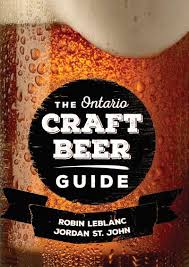
ocbg1I have been remiss. Well, late. Not lazy. Late. Distracted? Distracted. Jordan and Robin sent me a digital copy of this book weeks ago and I have only gotten to writing my review now. There’s been taxes to do at the last minute. Children to take to sports or hover over as math gets the best effort we can expect. Evenings like tonight at City Hall giving my best advice to council. I got a hair cut Sunday. At 11 am if you are wondering. But all the while I have kept dipping into this book. I like this book. I like this book for a few reasons. Let’s be honest. I have secondary skin in the game. I co-wrote the history of Ontario beer with Jordan. It’d be nice to think that everyone who buys this book might buy our book, too. But that’s not why I like this book. I like this book because this is the book that got me interested in the beer over the next horizon over a decade ago.

Well, not this book. This form of book. A regional guide. Like the ones Lew used to write. In 2004, I read Lew’s New York Breweries and ever since I have tried to ensure that there were NY beers in the stash – and NY hot dogs in the freezer. He not only told you where to buy the beer but also where to stay, what to get the kids into and what snacks to buy. See, there have been a number of sorts of beer books over the years. Sure, there are the global style guides as well as the food and beer pairing books. But there have been the Brewers Association style guides that started with Terry Foster on pale ale, the History Press histories including the two I helped write, those annual Good Beer Guides from CAMRA and all the home brewing guides, too, back to the Amateur Winemaker books of the 1960s written by C.J.J. Berry and Ken Shales as well as the fabulous David Line. Then there are the wonders like Unger‘s histories of the Baltic and North Sea facing lands from 1000 to 1900. There is Boak and Bailey’s remarkable Brew Britannia and Pete’s wonderful books of a recent and yet some how lost era ago. Before I liked all these and the rest that sit in piles around the house – I liked regional beer guides. Like this one.

Regional guides contextualize beer to a place and time. They have a level of comprehensive detail that is hard to capture in any other sort of beer book. They are as useful as Peterson Field Guides: Eastern Birds, the granddaddy of this entire class of writing. Ontario Craft Beer Guide follows in that tradition with a particular exactness. Exactitude. See, unlike even many regional beer guides, Ms. Leblanc and Mr. St. John tell you exactly what to expect. They explain which breweries are doing the brewing and which are really wholesalers hiring others under contract to a specification. They have a numerical rating guide which – wait for it – does not range all the way from 72/100 to 94/100. Not everyone wins a participation ribbon in this universe. In their system poor beers can earn a 1.5/5 and come with a resulting warning and great ones can be rewarded with a truly rare 5/5. I am having a Rhyme and Reason from Collective Arts right now solely due to the 4.5 they gave it. And they were right.

Do I have quibbles? How could I have quibbles? They were on the road for months seeking out every beer they could! Have I? No. And I actually know a thing or two. Do I like some beers a bit better than they do? Sure, I do – but that’s not often the case and where it is I have reasons. Like I am an older guy who likes slightly maltier beers. Save me the loser facile tropical hops. I can open a can of fruit cocktail, too. But with this level of detail I can transpose my palate to their recommendations and still trust their recommendations. Trust. That’s it. I can trust a book like this. So can you. Mainly because I don’t need to trust it. It’s so reliable. It’s got facts. It’s full of facts. Facts about good beer are actually really hard to find. You want facts about good beer in Ontario? Here you go.

If I didn’t live in Ontario I might say that it’s too bad they didn’t add local context like Lew’s regional rules of boiled and fried wieners but let’s be honest about this, too. Snack food is not what made Ontario. Natural produce? We got it. Local wines and fine wild meats and fish? Sure thing. Local snack shacks? We live on rumours of such things beyond the borders. It might tell me some other reasons I might want to go to North Bay or Sarnia, too. Maybe in the next edition. Or not. When Lew wrote those first guides 12 years ago, the internets weren’t telling me what they are now. We can actually luxuriate in the focus as much as those other facts. That’s good.

Wonder not. Make the call. Buy it.

Rebus Drinking In Scotland and England

bow1

Something very odd has happened to me over these last two months, August and September. I am reading novels. Rebus novels. I haven’t read novels for years. Decades. For some reason, I was driven off fiction by being an usher at a playhouse in undergrad. Perhaps watching plays repeatedly had the same effect as watching sausages getting made. Don’t know. Then a career in reading and writing masses of pages every week put me off pleasure reading of any sort for a long time. I’d browse through histories, graze upon articles and essays and write plenty. Hunting for clues in newspapers of the Georgians to Edwardians took a big part of my time. But undisrupted cover to cover novel reading? Never.

Then we traveled to Scotland twice in a year, spending time with family, looking out the windows of pubs. I’ve since added BBC Scotland to the regular radio playing in the background as life goes on around the house. Followed the news. And then one of the Rebus books came as a gift. Detective fiction set near to the Firth of Forth. I was little worried about it when I unwrapped it. I work with police so I was thinking it wouldn’t be much of a break from working life so it sat from spring to summer. I am now on my sixth novel in seven weeks. Consider this:

In a large pub near the tube station, a barn of a place with walls painted torrid red, Rebus remembered that he had not tried the local brews since coming south. He’d gone for a drink with George Flight, but had stuck to whisky. He looked at the row of pumps, while the barman watched him, a proprietorial hand resting on one pump. Rebus nodded towards this resting hand.
‘Is it any good.’
The man snorted. ‘It’s bloody Fuller’s, mate, of course it’s good.’
‘A pint of that then, please.’
The stuff turned out to have a watery look, like cold tea, but tasted smooth and malty. The barman was still watching him, so Rebus nodded approval, then took his glass to a distant corner where the public telephone stood.

That passage up there is from an early novel, 1992’s Tooth and Nail. Even though it’s from the one book in England, it’s typical of the tone. Plain. Observational. Often a dark corner. Always menace. Always drink. My cousins kept telling me to get to the Oxford Bar when I was in Edinburgh, the favourite of the stories’ main character. Haven’t made it there yet. Plenty of other good pubs saw me crossing the doorstep. Plenty that show up in the Rebus stories, too, both high and low. Well written recognizable realistic descriptions of unadorned pub life. Not always pretty.

It’s the sort of writing that gives you hope. So much that is written about the ordinary course of things – and especially about beer and pubs – is either pumped and puffed up or made stark to attract an audience. And certainly the Rebus stories do the latter through their narrative and pace. But not the setting. The fresh baked baps glow warm in the hands of the officer returning home after a night shift. The pubs have smells. The streets chatter. One hint. I’ve spent reasonable lengths of time in Edinburgh on five or six occasions so far in life so I have a sense of some of its parts. But not others. Bob Steel’s Edinburgh Pub Walks – with its photos, maps and pub descriptions – places a lot of the action in the Rebus novels directly into context. As good a companion guide as I might want even if unintentional.

Cream Ale: I Hate Records Revisited…

Adjectives from another time. How irritating. I mentioned this the other day somewhere folk were discussing steam beer. One theory of the meaning is it’s a reference to the vapor from opening the bottle. Another says something else. Me, I think it’s the trendy word of the year of some point in the latter half of the 1800s. Don’t believe me? Just as there were steam trains and steamships, there were steam publishers. In 1870 there was a steam printer in New Bedford, Massachusetts. A steam printer was progress. Steam for a while there just meant “technologically advanced” or “the latest thing” in the Gilded Age. So steam beer is just neato beer. At a point in time. In a place. And the name stuck. That’s my theory.

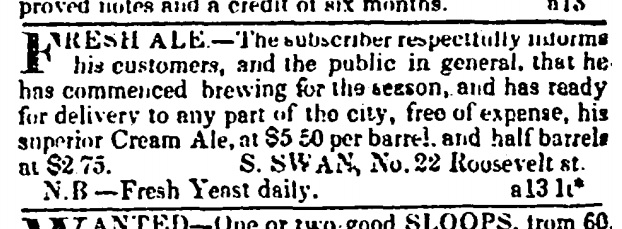
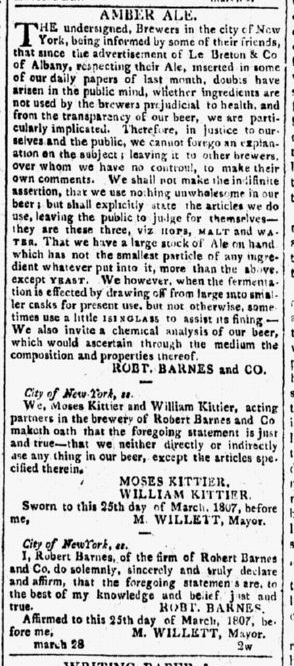
Cream is like that. Folk think it has a specific meaning. Static in time. The general theory is that cream ales started as top-fermented ales that receive an extended period of cold-conditioning or lagering. Another source closer to the ground tells me that cream ales are now just blends of basic pale ales and basic light lagers. Could be. But that up there is an ad from 1830. It’s from New York Evening Post from 13 August 1830, well before lager was a twinkle in an Empire State brewer’s eye. Mr. Swan of Roosevelt Street had some for sale. So other than the seemingly odd juxtaposition of street name and date – what does it mean? There are two obvious first choice. Cream is rich and it also rises to the top. Hmm.

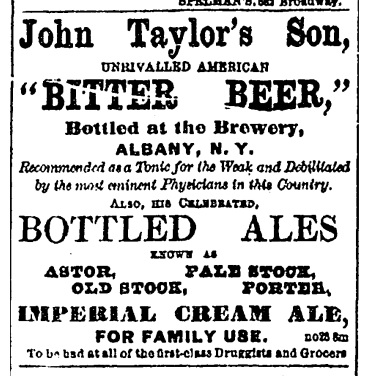
Six years later, the first or perhaps just leading American brewing industrialist John Taylor was placing ads for his Albany Cream Ale. Here is an ad that was placed in The Ulster Republican of Poughkeepsie, New York from 25 May 1836. Three years later, Taylor is advertising his Imperial Cream Ale and add the tag line “No mistake as to its superior quality.” Here is an example from the Albany Evening Journal of 4 April 1839. Which is interesting. Not a call to strength. A call to finesse. Ten years later, in an article about a new sarsaparilla works, Taylor’s Cream Ale is mentioned in the 21 July 1849 edition of the Plattsburgh Republican as an example of something the new sarsaparilla maker exceeds in production. It’s become common parlance for quantity as well as quality. Half a decade after John passes away, his sons are still prominently advertising their Imperial Cream Ale, now fit “for family use” as you can see was stated in the Albany Argus of 20 January 1869.

These are just snippets but they do show something of either an arc of meaning or perhaps a versatility. A claim more than a descriptor. Superior stuff. Was it creamy? I have no idea. I hate records.

Thoughts On The Introduction To The Anthology

4913Maybe I am a morning person after all. Again, I am up, wanting to write. The niggling thought in my head about how too much beer writing is sadly like what’s found in the auto section, to quote a newspaper editor I know. I was thinking about this as well as the wee hidden essay I found in the e-book… ebook… “Eeee! Book!!” Boak and Bailey put out. No, I have written them back and forth enough that by now we should be on a first name basis. So it’s Jessica and Ray’s new wee ebook. [Ressica? Maybe.] It’s just a compendium of old blog posts [“Just!” tisked Ressica] but its got this new introduction. Not unlike the “best of” records with that one new hit. Hittish thing. Bonus track? Extra content, perhaps. It’s just 12 paragraphs long but in it they consider the “why” of thinking a lot about beer and then, extraordinarily, writing about it.

The suggestion is that drinking is an experience diminished by involving the brain, or perhaps even that the very point of drinking is to shut the blasted thing down for a couple of hour. Maybe sometimes, that’s true – no-one wants to be the plum on a hen or stag party asking for tasters of ale and taking notes later – but surely the two activities, thinking and drinking, are not always mutually exclusive?

Aside from the questions of punctuation that I as a minimalist would spot, it’s an interesting question. Are they? I wonder. Alcohol briefly might heighten the senses and open the mind but with any extended experience both those effects rapidly crash as the door to the outside closes and the mind takes over with its newsreel of past associations, the recollections of things past. Are you fully thinking when even on a semi-lash? One half-sentence alludes to the experience: “[t]here is also something special about walking down a street and seeing a vision of a long-gone pub, or even the ghost of a vast but vanished brewery.” I might argue that there are somethings special about that experience which may be fairly distinct depending on a number of variables including how many pints you’ve downed to that point. A dentist pal used to have a modest amount of beer when studying and then one before the exam. He knew how to leverage alcohol’s power of ripening the recollection.

But then there is the other problem. Is the experience transferable? In addition to exploring historical context, BB asks us to consider the examples of greater mindfulness and even meditation as answers to the “why write about beer” they pose at the outset. While awareness of one’s beer a part of one’s life is rightly considered a good thing – if only due to the dangers it also carries – does this person’s appreciation of this sort of experience have anything to offer that person over there… keeping in mind that person is concurrently going through a grab bag of subjective experience of their own already. Again, another hint: ‘[t]hey are the posts on which we worked the hardest and cared most about.” An excellent and honest observation. We write to tell. Admittedly, many write mainly to sell but that’s not always the most thoughtful stuff. The human need to fill a fridge has left much on the cutting room floor. Finding those who write to actually tell regardless of return is key. They will be most honest in the endeavor, no?

But, lastly, have they skill enough? Once the author has observed and, then, observed honestly, does the writing convey the observation well? As you might expect, Jessica and Ray demure. They thank and hope at the introduction’s end. They hope the reader will enjoy. They hope other writings will be explored next. This is good. I have noticed an ugly trend recently in the tightening pack of beer writers jostling for attention. The use of the words “trust me” – surely an admission of guilt. The writer who asks you to “trust” them has just told you that they are incapable of expressing something compelling enough for your to actually read. Fortunately, Ray and J. need not worry. Their writing entertains and expresses themselves inherently. Not only are their observations keen but the slightly reserved style they employ hints to their own nature. English reticence balanced with… perhaps even struggling with a touch of hypomania. Likely minds irritated by those seeking to stick them with nicknames yet minds that are, as they say, perhaps prone to causing trouble. Too rare a thing.

“Back of a Beer Mat: Bits from the Blog” can be found here and, tah-dah, it’s free. Worth exploring.

A Week Off In April To Get Things Done

colonie

It’s either a sign of a well organized life or one with not enough in it. The spring holiday to get the taxes done, straighten out the gardening, fix the step and have some naps. And opening week baseball. Maybe some first round playoff hockey, too. The one thing I am not doing is writing a book. This time last year I was in the middle of writing three books each of which has turned out to be, err, cult classics. Happy readers. Low sellers. Good reviews. Niche huggers. I should have known. Beer writers are either fat or thin. Both from the same cause – anxtity yips. Told a pal once his mistake was doing for a job what I do for a hobby. Beer may still pay for itself. It just doesn’t take me all that far anymore when it does. That’s fine. Been since 2010 that the prospect of a truly idle summer lay before me. I was reading about brainy books back then five years ago today. Probably gave me ideas. Planting some carrot and lettuce seeds will help with that. Tiny seeds in the cold early spring soil don’t give you ideas. Just salad.

Soon Men In Vans Will Be Rounding Up The Bloggers

monkey4Boak and/or Bailey tweeted the news from the UK:

Publicans are being urged to share their views on the use of online review websites like TripAdvisor as part of a government backed probe on the impact of the sites. The Competition and Markets Authority (CMA) – the government’s business watchdog – has launched a consultation on the sites as a result of concerns regarding their trustworthiness and impartiality. The CMA will investigate specialist review sites, web blogs, video blogs, social media, trusted trader sites, retail platforms and retailers’ own websites. It will also look at the roles media companies, online reputation managers and search engine optimizers play in helping businesses promote themselves and manage their image in relation to blogs and review sites.

I typed that quote out by hand to make sure we were reading the same thing. See, the Morning Advertiser has this widget that blocks copying but here in Canada – being a freer more confident land even if laden with poorer marmalade – we have rights to quote bits of copyright work for criticism or review which seems quite apt with this article. So let’s have a bit of a critique and review, shall we?

Let’s be honest. What isn’t stated and should be equally followed up if the media are going to advocate for resorting to the use law to inquire about such things, is what role the well funded pub owners and breweries themselves play. Having had masses of beer delivered to my house over the last decade along with masses of invites to clinky drinky events as well as the odd junket – as any decent beer writer has – one is well aware of the keen interest bar owners and breweries have in building and maintaining a happy and even merry relationship with those in the media who discuss their beers positively. Many a free beer has also been passed across the bar to me once someone spills the beans, sometimes not even me. I often decline and lay down the sordid lucre – but actually understand the accepting soul may be then offered something called collaboration which sounds far too earth for a Dudley Do-right like me. An actual news source that was giving the reading public a full 360 degree description of the situation might mention that. So why are only publicans being reported as being urged to comment but not beer writers or others aware of these common pub and brewery incentives? Takes two to tango, no? Sometimes apparently more if we use all our fingers and toes and include the distracted press.

4859This is the point where I claim purity. Fully. Fundamentally. Every good beer blogger knows the line. I may have received these gifts by FedEx but, as with Christ’s beneficence offered through the holy sacrament of communion, I approach each chalice with pure intent and leave fully pardoned. To celebrate this, I am sipping a glass of La Formidable, a juicy 6.9% beer recently couriered to my house by Beau’s All Natural, operators of “B-Side Brewing” which is an interesting portfolio of beers they are brewing here under license and with participation of brewers from outside of Ontario. I even can identify the lovely lass who directed the beer my way. The thugs in vans won’t get the name, though… not immediately at least. [Run!] Jordan gave the beer a review, too. I can’t match his sense of 1980s TV sci-fi cartoon-isme but suffice it to say that when I consider this a lot like Headstock but different, too, that is a fine thing. A very fine thing. Maybe with a bit more of this and a little of that but it’s like comparing Jimmy Cowan to Paul Coffey in a way, no? Where Jordan notes clove, I get a bit of minerality like a Urzinger. But that is him. And me. I mean some one person has to actually taste the stuff, right? Of course each view will differ. As long as, you know, the blogger doesn’t just cut and paste the PR content emailed along.

Morning Advertiser by comparison? One has to acknowledge that the full of the publication begins “The Publican’s…” so there is a choir to be sung to, isn’t there. There are denominations and congregations. God’s house has many rooms. Does that make excuses? Perhaps. But does it also open up the question of the role of trade publications in “trustworthiness and impartiality” within the beery discourse? Why not? If we are going to go about investigating things, why not? Glass houses.

Oh, What A Loverly Word Usage Graphing Tool…

hoppes

See that? Click on the image and you will see it better. That is a word search for the word hop[pe]s in English language texts from a site called Early Modern Print: Text Mining Early Printed English which explains itself as follows:

Early Print offers a range of tools for the computational exploration and analysis of English print culture before 1700. Early Print offers a range of tools for the computational exploration and analysis of English print culture before 1700. The site was designed to help scholars make sense of the incomparable textual archive produced by the EEBO Text Creation Partnership, consisting of a set of transcriptions of the first two centuries of English print. While EEBO-TCP provides access to a massive collection of texts that promises to transform the way scholars approach this period, it also presents significant technical and conceptual challenges. The relative accuracy (given its scale) of the EEBO-TCP corpus that makes it such a valuable resource for scholars also makes it complex for computational analysis.

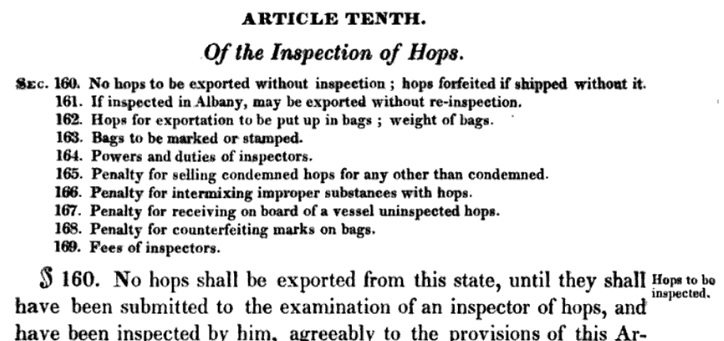
Got it? Yikes. It appears to be a far more complex version of the New York Times search tool that is so useful in confirming how late “craft” beer came into accepted usage. Except, this fun widget focuses on texts from 1480 to 1700. I am still having some problem figuring out how to properly run searches given all the swell code that can be used to run searches. But when you do, you get wonderful – even if possibly misleading – results like this one confirming that “hops” or “hoppes” came into far more common use on a very particular date roughly around 1518. Look at “ale“! I am sure folk more clever than I may make more interesting use of it so let me know what you find. Be careful. Remember that around 1577 “biere” was a common spelling. Have a go. Meanwhile, I wonder if anyone mentioned “craft beer” during that era…