So What Was Northdown Ale In The Later 1600s?

Before the curse that is social media was thrust upon us, one key promise of beer blogging was collective research. With the most welcome news that Lew is back into the beer blog game, he reminds us of the point of doing this day after day:

A bit over two years ago, I stopped writing this blog. It wasn’t because blogs are dead — I refuse to believe that — and it wasn’t because I got bored, and it certainly wasn’t because I was running out of things to say. Blogs, good blogs, relevant blogs still are vital, and they don’t have to be on Tumblr, or run through a microplane grater and splattered onto Twitter, or covered in kitties and posted on Facebook. Blogs are the place to do long-form writing, and I like to think I was able to balance somewhere between a tweet and tl;dr.

Even though I shared in the publication of two histories the year before, 2015 was the year I think I took my interest in brewing history most seriously. That few care about the state of brewing and porter selling in New York City in the decades around the Revolution is no concern of mine. It’s important just to write about it. Same with the centuries of brewing on Golden Lane and life in London, England’s district St. Giles’s Cripplegate. These things are interesting because they are true.

We are children of the Enlightenment. Three things we depend on for understanding were all invented and popularized in the 1700s: the application of science in practical matters, mass communications and commercial branding of products. Each is a means to create a lasting record, each a self-archiving activity. People are led to believe, as a result, that things prior to the advent of these phenomena were unlike today. No scientific brewing? No pale ale. No newspaper? No news. Folk actually believe these things. They believe folk didn’t know how to make fine things with available resources. We are slaves to records. We need to distrust them more even as we dive more deeply into them. Which leads us today’s new topic: Northdown ale. Never noticed the stuff until Jay tweeted this quotation from Pepys yesterday. Which got me looking for more information and found an excellent blog post from November 2014 posted on the excellently titled blog Things turned up by Sally Jeffery while looking for something else as well as this passage from a travel guide called All About Margate and Herne Bay reviewed an 1865 magazine named The Athenaeum:

Quoting largely from the Rev. John Lewis’s account of Margate, written in 1723, he notices the once famous beverage, known to Charles the Second’s thirsty subjects by the names of “Northdown Ale” and “Margate Ale” of which drink Lewis says, “About forty years ago, one Prince of this place drove a great trade here in brewing a particular sort of ale, which, from its being brewed at a place called Northdown in this parish, went by the name of Northdown Ale, and afterwards was called Margate Ale. But whether it’s owing to the art of brewing this liquor dying with the inventor of it, or the humour of the people altering to the liking the pale north-country ale better, the present brewers send little or none of what they call by the name of Margate ale, which is a great disadvantage to their trade.” This was the beer which Evelyn calls “a certain heady ale ” ; and it is probable that its popularity with London beer-drinkers influenced the generation of brewers who fixed the immutable properties of “stout.”

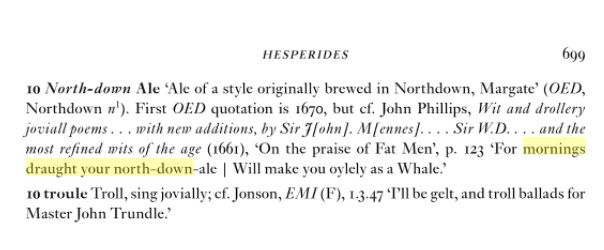
So, an 1865 citation of an account from 1723 recalling a drinking experience from forty years before that. Northdown Ale. In her blog post, Ms. Jeffery surveys the evidence and seeks to determine if she can “get a better idea of what the ale was like by looking at how it was made.” Let’s now see if we can add anything. First, I like the reference to Herrick. In one edition of his book, there is a footnote to another poet’s* line of verse anthologized in 1661: “For mornings draught your north-down ale / Will make you oylely as a Whale.” Pepys was drinking Northdown ale the year before. I am not sure why one might want to be so oily. Franklin referenced “he’s oil’d” in his 1730’s Drinker’s Dictionary. I am going to assume it means the beer is staggeringly strong for the moment. In The Curiosities of Ale & Beer: An Entertaining History from 1889, Herrick’s own lines on Northdown Ale from “A Hymne to the Lares”¹ are quoted:

The neighbouring county of Hereford, now a great cider-drinking locality, had in former times at least one town with a reputation for good ale. “Lemster bread and Weobley ale” had passed into a proverb before the seventeenth century. The saying seems, however, to have been affected chiefly by the inhabitants of the county, who, perhaps, were not quite impartial. Ray, writing in 1737, ventures to question the pre-eminence ascribed to the places mentioned. For wheat he gives Hesten, in Middlesex, “and for ale Derby town, and Northdown in the Isle of Thanet, Hull in Yorkshire, and Sandbich² in Cheshire, will scarcely give place to Weobley.” Herrick mentions this celebrated Northdown ale in the lines:—

That while the wassaile bowle here
With North-down ale doth troule² here,
No sillable doth fall here,
To marre the mirth at all here.

Did you see that? Wheat. Is this strong wheat ale? Or is that just a juxtaposition of two products of the region? Not sure. Likely the latter, given Jeffery’s references to an excellent but short lived barley malting trade concurrent with the height of Northdown ale’s prominence. Also, the diarist, botanist and courtier to Charles II John Evelyn describes being in Margate, one mile west of Northdown, on 19 May 1672 and states:

Went to Margate; and, the following day. was carried to see a gallant widow, brought up a farmeress, and I think of gigantic race, rich, comely, and exceedingly industrious. She put me in mind of Deborah and Abigail, her house was so plentifully stored with all manner of country provisions, all of her own growth, and all her conveniences so substantial, neat, and well understood; she herself so jolly and hospitable; and her land so trim and rarely husbanded, that it struck me with admiration at her economy. This town much consists of brewers of a certain heady ale, and they deal much in malt, etc. For the rest, it is raggedly built, and has an ill haven, with a small fort of little concernment, nor is the island well disciplined ; but as to the husbandry and rural part, far exceeding any part of England for the accurate culture of their ground, in which they exceed, even to curiosity and emulation.

Which tells us there were many brewers and much malting in a rich farming district. And notice another thing from the quoted text further up. Thanet. Which reminds us to ask the particular question – where exactly is Northdown? That image above is from this map from 1711. If you click here you will see a supremely confusing cross-referencing of the 1711 map with a 1623 image on Jeffery’s post. See, before branding, newspapers and scientific brewing you needed to know where a beer or ale was from to figure out what to expect. Northdown is located in southeast England in the county of Kent – as in land of the noted hops. But the land of hops most noted about 200 years after Herrick wrote his lines. It was, also, the site of the October 2015 drinking session of the year as recorded by Team Stonch. So in the 1600s, the 1800s and the twenty-first century, a place of good beer but in each era quite distinct good beers.

northd1Click on that image to the right. It’s a paragraph from a 1681 treatise entitled Ursa major & minor: or, A sober and impartial enquiry into those pretended fears and jealousies of popery and arbitrary power, in a letter. Clearly an unhappy guy. But what he’s unhappy about is how, in tough economic times, brewers are making undue profits by not only jacking up prices but doing so by having “devised several name” for drinks including China ale, Hull ale – and Northdown ale. Sound familiar? Double the price for poorer beer? And you thought craft beer invented that trick. It appears to have been quite popular with the well placed in addition to the poets. John Donne – the Younger³ – recounts being sent a poem along with “a dosen bottles of Northdown ale and sack” which means it was good enough to bottle and, seeing as it was sent by Lord Lumley, good enough for the Peerage. Which might explain the jacked up price. A premium ale for those that can afford it.

Notice one more thing. Sally Jeffery suggests there was indication that the ale was dark but also sees that “[t]he wheat stubble that is left is either mown for the use of the Malt-men to dry their Malt…” which, as we know, would make the sweetest, palest malt during that era. Enough to confirm anything? Nope. All we see from this set of records is clearly (i) a premium product, (ii) defined quite clearly to a time and place which was (iii) notably strong and (iv) bottled. The best ale during the Restoration? Maybe.

*Likely this John Phillips, royalist lad and nephew of Milton.

¹Here is the whole text of the poem:

It was, and still my care is,
To worship ye, the Lares,
With crowns of greenest parsley.
And garlick chives not scarcely:
For favours here to warme me,
And not by fire to harme me;
For gladding so my hearth here,
With inoffensive mirth here;
That while the wassaile bowle here
With North-down ale doth troule here,
No sillable doth fall here,
To marre the mirth at all here.
For which, o chimney-keepers!
(I dare not call ye sweepers)
So long as I am able
To keep a countrey-table,
Great be my fare, or small cheere,
I’le eat and drink up all here.

²I understand Sandbich to be “Sandbach” and troule means to “pass about.”

³“…an atheistical buffoon, a banterer, and a person of over free thoughts…”
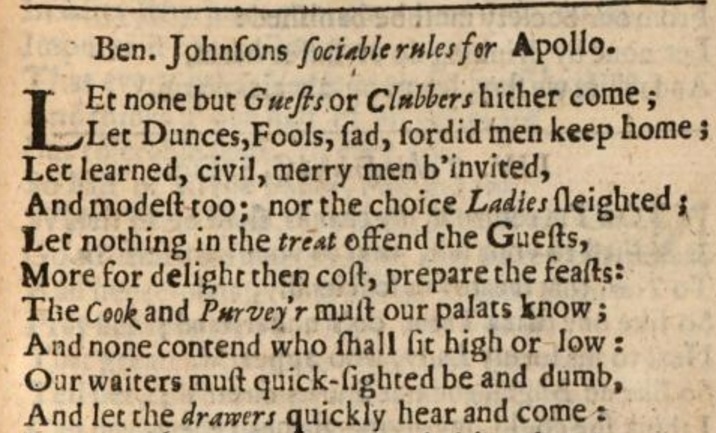
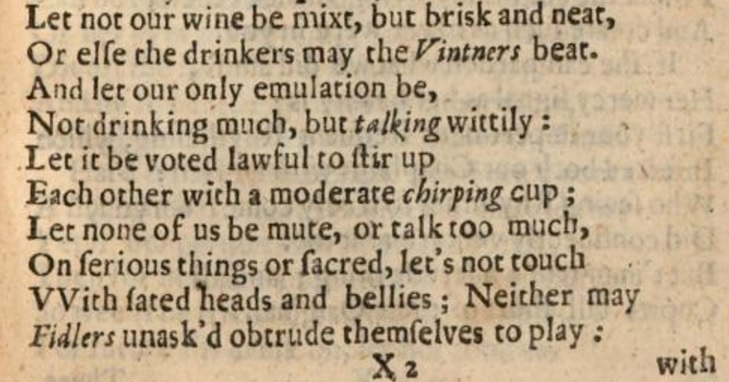
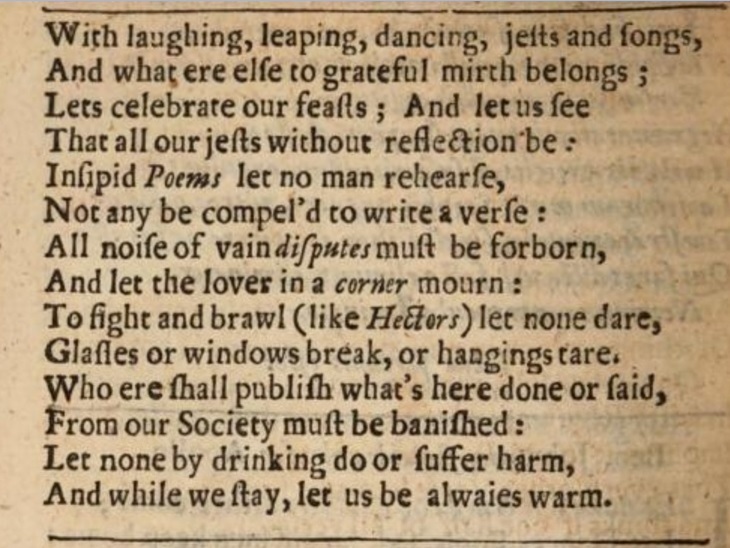
Ben Jonson And The Devil Tavern Rules, 1624

In 1939, Percy Simpson published his article “Ben Jonson and the Devil Tavern” in The Modern Language Review, Vol. 34, No. 3. Jonson lived from 1572 to 1637, a poet and playwright whose early career overlapped with Shakespeare. The Apollo was the room at the Devil and Saint Dunstan tavern near the north end of Middle Temple Lane in London, on Fleet Street near Temple Bar – the City gate of the Knights Templar. You can see the location on this map from Jonson’s time.

The Devil was where Jonson and his literary contemporaries Herrick, Carew and others met, subject to this code that Jonson wrote. They are described as Leges Convivales by Simpson – the laws of conviviality.The name of the room itself is an allusion from Plutarch, a reference to an excellent room of hospitality. Excellent. The more saintly congregation of St. Dunstans still gather, though a bit back from the road since the 1830s.

bj1bj2bj3

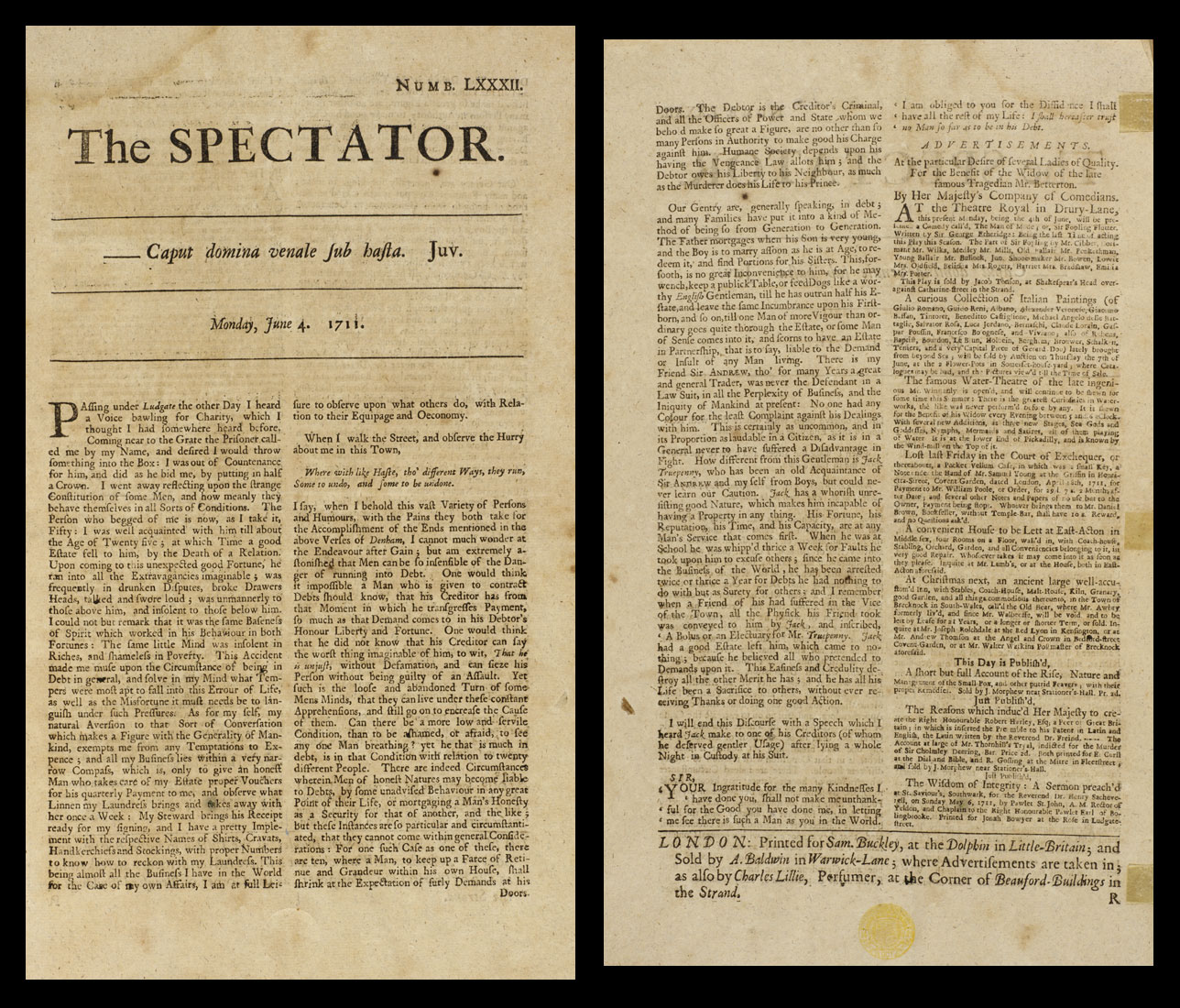
The Spectator: A Peek At London Society 1711-1715

spect1

Martyn made a very important observation the other day in the comments:

…coming-of-age ales were certainly being brewed then, and such brewings look to have increased over the next 40 or more years, though that may just be an artifact of the increasing number of newspapers being published.

We are slaves to records. As I have noted before, I am very irritated by records. It is not just that I am subject to the decisions of what gets scanned from the pool of records. I am dependent on what was recorded in the first place. It is important to appreciate that it is astoundingly good to be able to find newspaper ads from New York in the 1750s not just because the newspapers are that old but because, in as real a sense, they are that new.

Newspapers only come into being in the sense we know them today in the first half of the 1700s and, really, at the latter end of that era. One of the best of the early English periodicals considered a daily newspaper was, as any one who studied English Lit should know, The Spectator published by Steele and Addison in the first half of the 1710s, the point where last of the Stuarts under Queen Anne meets the first of the Georgians. Through The Spectatorthey explored Enlightenment values as well as meaning of their toy, the possibilities of the medium. Fortunately, we can explore their explorations as the entire thing has been put on line at Project Gutenberg with an extremely handy key work topical index. As with resources like the scans of New York newspapers I have been digging through in the last two months or the searchable databases of the law cases found in the English Reports or the proceedings of the Old Bailey online, we are both grateful for and limited by the work of the good people who select which records to scan for public use.

Unlike those other databases, however, The Spectator was not particularly geared to the tastes or describing the habits of the beer-drinking end of contemporary society. The dedication to the first issue of the journal to The Right Honourable John Lord Sommers, Baron Of Evesham states that it “endeavours to Cultivate and Polish Human Life, by promoting Virtue and Knowledge, and by recommending whatsoever may be either Useful or Ornamental to Society.” Still – and as something of a great-grandparent to Tom and Bob a century later – there was an interest in describing the world of London which lay before them even as they evoked classical poetry in the search for a higher ethical lens through which to view it. In doing so, they did make some observations of the beery life. In issue no. 436 from Monday, July 21, 1712 we read about a visit to…

… a Place of no small Renown for the Gallantry of the lower Order of Britons, namely, to the Bear-Garden at Hockley in the Hole1; where (as a whitish brown Paper, put into my Hands in the Street, informed me) there was to be a Tryal of Skill to be exhibited between two Masters of the Noble Science of Defence, at two of the Clock precisely.

It is not a boxing match. It is a duel, a sword fight, the challenger stating in accepting the opportunity that he was only “desiring a clear Stage and no Favour.” The space has a pit and galleries. It is packed with humanity, gawking and flinching with every slash and wound. There are no references to drinking but a footnote leads to a description of the venue:

Hockley-in-the-Hole, memorable for its Bear Garden, was on the outskirt of the town, by Clerkenwell Green; with Mutton Lane on the East and the fields on the West. By Town’s End Lane (called Coppice Row since the levelling of the coppice-crowned knoll over which it ran) through Pickled-Egg Walk (now Crawford’s Passage) one came to Hockley-in-the-Hole or Hockley Hole, now Ray Street. The leveller has been at work upon the eminences that surrounded it. In Hockley Hole, dealers in rags and old iron congregated. This gave it the name of Rag Street, euphonized into Ray Street since 1774. In the Spectator’s time its Bear Garden, upon the site of which there are now metal works, was a famous resort of the lowest classes. ‘You must go to Hockley-in-the-Hole, child, to learn valour,’ says Mr. Peachum to Filch in the Beggar’s Opera.

Ray Street still exists. Sounds very much like the area around London’s Golden Lane from about the same time. At the other end of the social scale and more often frequented by the regular readership of The Spectator was the club. In the recent post on Georgian mass drinking, I referenced the coming of age celebrations for the twenty-first birthday of Charles Watson-Wentworth, 2nd Marquess of Rockingham. Another thing he did on reaching that milestone, other than unleashing 10,000 hangovers, was to join clubs and in particular White’s, the Jockey Club and the Royal Society. In issue No. 508 from Monday, October 13, 1712, The Spectator – which are described in general in issue no. 9 – dealt with a certain problem one found at these gatherings often held in otherwise public spaces, the Tavern Tyrant:

‘Upon all Meetings at Taverns, ’tis necessary some one of the Company should take it upon him to get all things in such order and readiness, as may contribute as much as possible to the Felicity of the Convention; such as hastening the Fire, getting a sufficient number of Candles, tasting the Wine with a judicious Smack, fixing the Supper, and being brisk for the Dispatch of it. Know then, that Dionysius went thro’ these Offices with an Air that seem’d to express a Satisfaction rather in serving the Publick, than in gratifying any particular Inclination of his own. We thought him a Person of an exquisite Palate, and therefore by consent beseeched him to be always our Proveditor; which Post, after he had handsomely denied, he could do no otherwise than accept. At first he made no other use of his Power, than in recommending such and such things to the Company, ever allowing these Points to be disputable; insomuch that I have often carried the Debate for Partridge, when his Majesty has given Intimation of the high Relish of Duck, but at the same time has chearfully submitted, and devour’d his Partridge with most gracious Resignation. This Submission on his side naturally produc’d the like on ours; of which he in a little time made such barbarous Advantage, as in all those Matters, which before seem’d indifferent to him, to issue out certain Edicts as uncontroulable and unalterable as the Laws of the Medes and Persians. He is by turns outragious, peevish, froward and jovial. He thinks it our Duty for the little Offices, as Proveditor, that in Return all Conversation is to be interrupted or promoted by his Inclination for or against the present Humour of the Company.

Dear God in Heaven, a prig of the highest order. A curator. A beer communicator. Who knew such things were suffered across the centuries? The publishers were clearly against such things and in issue no. 201 from Saturday, October 20, 1711 wrote about temperance at a point in history closer to the Puritans than the Victorians, setting the scene in this way:

It is of the last Importance to season the Passions of a Child with Devotion, which seldom dies in a Mind that has received an early Tincture of it… A State of Temperance, Sobriety, and Justice, without Devotion, is a cold, lifeless, insipid Condition of Virtue; and is rather to be styled Philosophy than Religion. Devotion opens the Mind to great Conceptions, and fills it with more sublime Ideas than any that are to be met with in the most exalted Science; and at the same time warms and agitates the Soul more than sensual Pleasure…

Interesting stuff, such putting of passion in its place – the emotions of a child. Thoughts on temperance as we understand it and which get fairly specific about drinking were further developed in issue no 195 from just a few days before on Saturday, October 13, 1711:

It is impossible to lay down any determinate Rule for Temperance, because what is Luxury in one may be Temperance in another; but there are few that have lived any time in the World, who are not Judges of their own Constitutions, so far as to know what Kinds and what Proportions of Food do best agree with them. Were I to consider my Readers as my Patients, and to prescribe such a Kind of Temperance as is accommodated to all Persons, and such as is particularly suitable to our Climate and Way of Living, I would copy the following Rules of a very eminent Physician. Make your whole Repast out of one Dish. If you indulge in a second, avoid drinking any thing Strong, till you have finished your Meal; at the same time abstain from all Sauces, or at least such as are not the most plain and simple. A Man could not be well guilty of Gluttony, if he stuck to these few obvious and easy Rules. In the first Case there would be no Variety of Tastes to sollicit his Palate, and occasion Excess; nor in the second any artificial Provocatives to relieve Satiety, and create a false Appetite. Were I to prescribe a Rule for Drinking, it should be form’d upon a Saying quoted by Sir William Temple; The first Glass for my self, the second for my Friends, the third for good Humour, and the fourth for mine Enemies. But because it is impossible for one who lives in the World to diet himself always in so Philosophical a manner, I think every Man should have his Days of Abstinence, according as his Constitution will permit.

Sensible advice. And, as you will note, one that is pretty much in line with the best sort of recommendations today. I will trawl through the many issues and see if I can come up with any more timely references. In the meantime, remember: the fourth for mine Enemies. Excellent advice.

Who Else Misses Georgian Mass Drinking Events?


A year ago
, we read about certain Georgian era drinking habits of the early decades of the colony of Upper Canada – what is now Ontario. It includes my favorite observations included in Ontario Beer – in fact, one of my favorites in the entire history of drinking in Canada. It is from the events of 12 and, I suppose, 13 August 1827 at Guelph on the celebration of the King’s birthday:

…all sat down and enjoyed a hearty meal. “After the cloth was removed,” toasts were drunk to everybody and every conceivable thing, the liquors, of all imaginable descriptions, being passed round in buckets, from which each man helped himself by means of tin cups, about two hundred of which had been supplied for the occasion… those who remained continued to celebrate the day in an exceedingly hilarious manner, most of them, who had not succumbed to an overpowering somnolency, celebrating the night too, many of them being found next morning reposing on the ground in the market place, in loving proximity to the liquor pails, in which conveniently floated the tin cups…

A particular achievement in Pete Brown’s book on the history of the origins of IPA, the excellent Hops and Glory is how in contextualizing the history of the beer in the history of, you know, history – a rare enough thing in itself – he describes how the Georgians were quite unlike their grand-children, the Victorians. While they were cultural imperialists, they were not exactly racists. Leadership of the East India Company would intermarry into the royal classes of India just as how in mid-1700s upstate New York a man of the status of William Johnsonwould partner with a woman of the status of Molly Brant. We are in a sense as much or more the inheritors of Georgian free-spirited materialism as Victorian clenched paternalism. Maybe. One thing, however, we now definitely miss out on is the Georgian officially sanctioned staggeringly plastered public celebration.

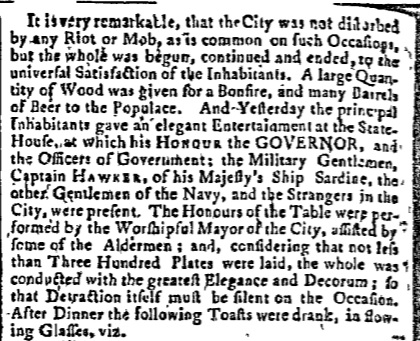
Consider the celebration described in the newspaper report from 26 May 1766 as set out in the New York Gazette. If you click on the image you will see a bigger image of the first paragraph. A pdf of the whole article is here. A great dinner is described celebrating the repeal of the Stamp Act, that most sensible piece of imperial legislation aimed at helping the American colonies pay the cost of their own protection. Ingrates. Anyway, after the dinner twenty-one 
separate toasts were given. No wonder the article begins with the statement that the evening didn’t devolve into the riot and the mob “as is common on such Occasions“! My favorite toast is the fourth one: “may the illustrious house of Hanover preside over the United British Empire to the End of Time.” Not a long time. To the end of time. Such ingrates. The list is important in itself as it arises just before the interests leading to the Revolution are fully severed but what is also interesting is the last bit of the paragraph just below the toasts.

The Cannon belonging to the Province, being placed in the State-House Yard, the Royal Salute was fired on drinking the King, and Seven Guns after every succeeding Toast. The whole concluded in the Evening with Bonfires, Ringing of Bells, and Strong Beer to the Populace, and gave general Satisfaction to every Person concerned…

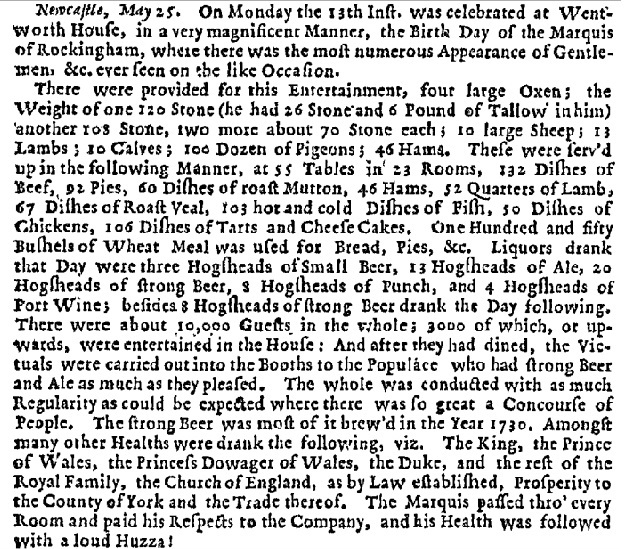
How was riot avoided? Free smashings of strong beer to the populace? What a time! What a splendid form of government!! And it was not just at state events or events of general public importance. Click on that thumbnail to the left. It’s from the New York Gazette of 12 August 1751 but it describes a celebration of another sort of birthday in England, a twenty-first birthday party held on 25 May that year for the Marquis of Rockingham at Wentworth House in Yorkshire. I grew up in Nova Scotia – first made a British colony just two years before this celebration – where both Rockingham and Wentworth are place names. Look what happens at the party:

Liquors drank that Day were three Hogsheads of Small Beer, 13 Hogsheads of Ale, 20 Hogsheads of Strong Beer, 8 Hogsheads of Punch, and 4 Hogsheads of Port Wine; besides 8 Hogsheads of strong Beer drank the Day following. There were 10,000 Guests in the whole; 3000 of which, or upwards, were entertained in the House; and after they had dined, the Victuals were carried out into the Booths to the Populace who had strong Beer and Ale much as they pleased… The strong Beer was most of it brewed in the Year 1730…

A few years ago, Martyn wrote about these coming of age, twenty-first birthday celebrations and their massive 21 year old beers brewed in the year of a child’s birth to celebrate their future adulthood. In fact when I came across this story I was just going to send it to him… until I read him “there is little or no evidence of 21-year-old ales before the 1770s or 1780s.”* It seems the news of these celebrations at Wentworth House for Charles Watson-Wentworth, 2nd Marquess of Rockingham** might represent a wee advance in brewing history. Maybe. Martyn might already know this. Probably does.

So there you are. Three mass gatherings of Georgians well prepared for and well able to meet the demands of massive public intoxications celebrating joy. I don’t think I could survive even a few hours of it. Damn Victorians.

*Being a wee bugger, I kept it for myself. Well, really, I kept it for this story. I would otherwise have sent it to Martyn, the very best sort of colleague in this beer writing game.
**A man who, if listened to, may have altered history to a greater degree.

Rebus Drinking In Scotland and England

bow1

Something very odd has happened to me over these last two months, August and September. I am reading novels. Rebus novels. I haven’t read novels for years. Decades. For some reason, I was driven off fiction by being an usher at a playhouse in undergrad. Perhaps watching plays repeatedly had the same effect as watching sausages getting made. Don’t know. Then a career in reading and writing masses of pages every week put me off pleasure reading of any sort for a long time. I’d browse through histories, graze upon articles and essays and write plenty. Hunting for clues in newspapers of the Georgians to Edwardians took a big part of my time. But undisrupted cover to cover novel reading? Never.

Then we traveled to Scotland twice in a year, spending time with family, looking out the windows of pubs. I’ve since added BBC Scotland to the regular radio playing in the background as life goes on around the house. Followed the news. And then one of the Rebus books came as a gift. Detective fiction set near to the Firth of Forth. I was little worried about it when I unwrapped it. I work with police so I was thinking it wouldn’t be much of a break from working life so it sat from spring to summer. I am now on my sixth novel in seven weeks. Consider this:

In a large pub near the tube station, a barn of a place with walls painted torrid red, Rebus remembered that he had not tried the local brews since coming south. He’d gone for a drink with George Flight, but had stuck to whisky. He looked at the row of pumps, while the barman watched him, a proprietorial hand resting on one pump. Rebus nodded towards this resting hand.
‘Is it any good.’
The man snorted. ‘It’s bloody Fuller’s, mate, of course it’s good.’
‘A pint of that then, please.’
The stuff turned out to have a watery look, like cold tea, but tasted smooth and malty. The barman was still watching him, so Rebus nodded approval, then took his glass to a distant corner where the public telephone stood.

That passage up there is from an early novel, 1992’s Tooth and Nail. Even though it’s from the one book in England, it’s typical of the tone. Plain. Observational. Often a dark corner. Always menace. Always drink. My cousins kept telling me to get to the Oxford Bar when I was in Edinburgh, the favourite of the stories’ main character. Haven’t made it there yet. Plenty of other good pubs saw me crossing the doorstep. Plenty that show up in the Rebus stories, too, both high and low. Well written recognizable realistic descriptions of unadorned pub life. Not always pretty.

It’s the sort of writing that gives you hope. So much that is written about the ordinary course of things – and especially about beer and pubs – is either pumped and puffed up or made stark to attract an audience. And certainly the Rebus stories do the latter through their narrative and pace. But not the setting. The fresh baked baps glow warm in the hands of the officer returning home after a night shift. The pubs have smells. The streets chatter. One hint. I’ve spent reasonable lengths of time in Edinburgh on five or six occasions so far in life so I have a sense of some of its parts. But not others. Bob Steel’s Edinburgh Pub Walks – with its photos, maps and pub descriptions – places a lot of the action in the Rebus novels directly into context. As good a companion guide as I might want even if unintentional.

Clowes, Newbury and Maddox, Bermondsey, London, 1827

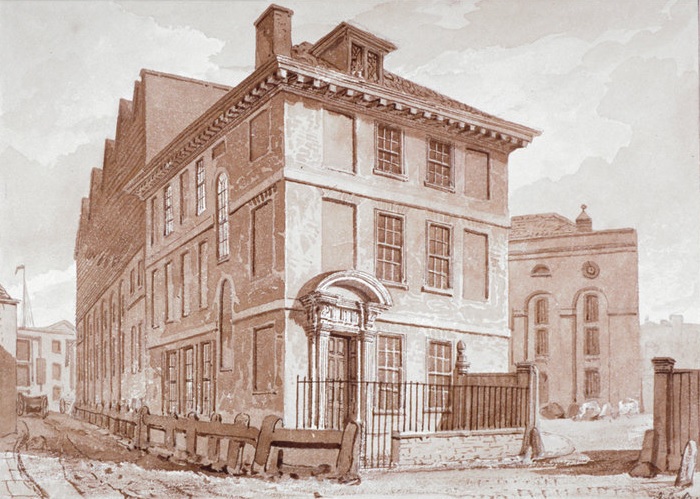
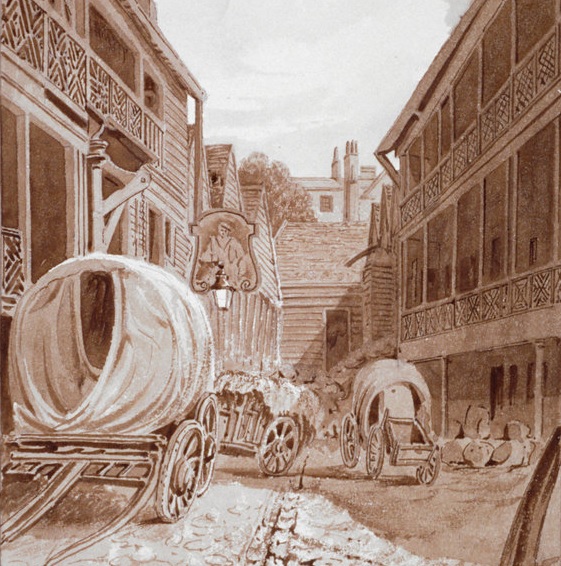
brew-house-stoney-lane-bermondseyThe brewery of Clowes, Newbury and Maddox sat on Stoney Lane in Bermondsey, London. The late Georgian artist John Chessell Buckler created a number of images from the district of Bermondsey. The watercolour of Clowes, Newbury and Maddox was painted in 1827. Charles Clowes, John Newbury and Erasmus Maddox that is. In 1868, the image was owned by the Corporation of London. I know nothing of Bermondsey other than what I read from Boak and Bailey or Stonch about the Bermondsey beer mile, something of last year’s model apparently. A place of rubbish-strewn industrial estates. Huge groups of lads getting pretty drunk, stag parties. Sounds fairly Georgian. Clowes, Newbury and Maddox were in operation in 1794. Charles Clowes was an admirable man, a lawyer turned brewer. He installed one of James Watt’s engines in 1796, even though he is reported to have refused the idea in 1785 after making inquiries. It is mentioned in a very interesting passage from 1805:

…the very capital malt distilleries at Vauxhall, Battersea, Wandsworth, and Kingston,. the large porter breweries of Messrs. Barclay, Clowes, Holcomb, &c. together with the infinity of pale beer breweries in the Borough of Southwark, and dispersed through every town and Tillage in the county, cannot be at a loss to account for the magnitude of the demand for this article.

Note. The infinity of pale beer breweries – not of households brewing pale beer – meeting the demand.

threetunsbermondsey

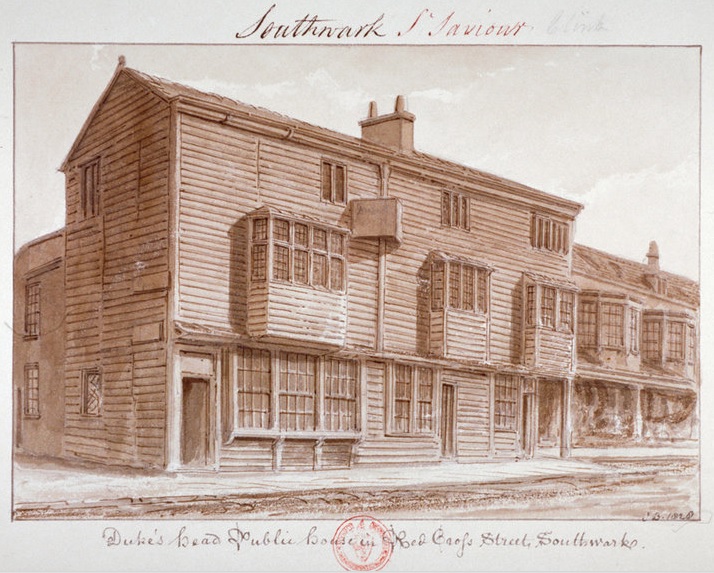
dukesheadsouthwark

kingsheadinn


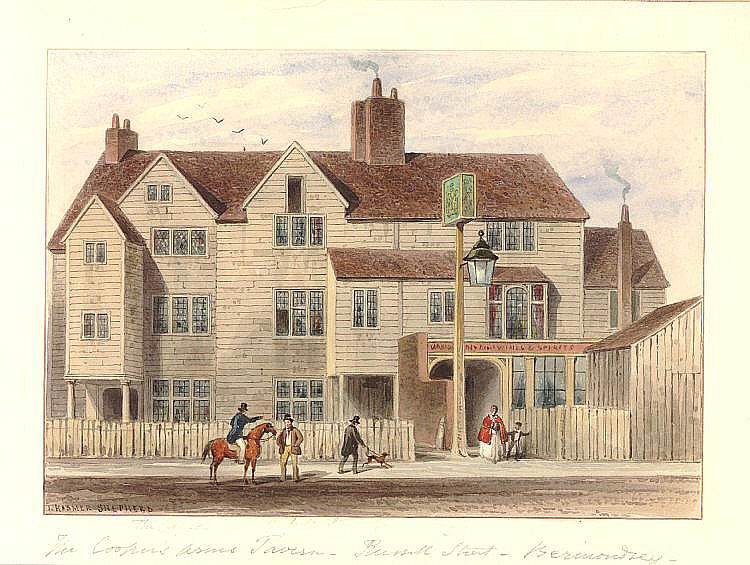
The brewery of Clowes, Newbury and Maddox seems to fit into Buckler’s interest in interesting and dilapidated structures from the previous century or before. He was an architect who was the son, brother and father of architects. The images are largely lifeless or rather at least without human participants. Their effect is sometimes present. The ruts in the road. Idle carts. His views illustrate scenes from the mapping I have been poring over. The Three Tuns public house on Jacob Street, Bermondsey to the left. The Duke’s Head Public House in Red Cross Street in the middle. The King’s Head Inn on the East Side of the High Street, Southwark to the right. The places Buckler took and interest in can be found on Greenwood’s Map of London from 1827 if you nose around a bit. The Duke’s Head lasted until at least 1874.

Considering The Badness Of Beer In 1800s Britain

4971
Hail, Beer!
In all thy forms of Porter, Stingo, Stout,
Swipes, Double-X, Ale, Heavy, Out-and-out,
Most dear,
Hail! thou that mak’st man’s heart as big as Jove’s!
Of Ceres’ gifts the best!
That furnishest
A cure for all our griefs: a barm for all our—loaves!
Oh! Sir John Barleycorn, thou glorious Knight of
Malt-a!
May thy fame never alter!
Great Britain’s Bacchus! pardon all our failings,
And with thy ale ease all our ailings!
 

That’s the first bit of “Ode to Beer” from the Comic Almanack for 1837. What a jolly bauble. Exactly what we largely like to tell ourselves about the merry merry world of the past. Dickens without all the bad bits. The view from outside the Bermondsey¹ public house, as above, in 1854. As we all rush about finding older records to share about beer and brewing in, mainly, the English speaking world, I have wondered about the difference between the official record and the actual experience. By official, I don’t mean governmental or even sanitized so much as the accepted. The approved version. One of the biggest problems leading to the approved version is the love of drawing conclusions or, more honestly perhaps, the use of records to justify comfortable conclusions. We want things to be explicable but we want to be comforted. For authority to be correct we want it to align with out needs. It rarely does. But authorities won’t tell you that. Authority has another interest. Consider this passage in a book entitled England as Seen by an American Banker: Notes of a Pedestrian Tour by Claudius Buchanan Patten published in 1885:

I was at some pains to get at the following authentic statement of methods of beer adulteration. A member of London’s committee on sewers —an eminent scientist — puts forth the declaration that “It is well known that the publicans, almost without exception, reduce their liquors with water after they are received from the brewer. The proportion in which this is added to the beer at the better class of houses is nine gallons per puncheon, and in second-rate establishments the quantity of water is doubled. This must be compensated for by the addition of ingredients which give the appearance of strength, and a mixture is openly sold for the purpose. The composition of it varies in different cases, for each expert has his own particular nostrum. The chief ingredients, however, are a saccharine body, as foots and licorice to sweeten it; a bitter principle, as gentian, quassia, sumach, and terra japonica, to give astringency; a thickening material, as linseed, to give body; a coloring matter, as burnt sugar, to darken it; cocculus indicus, to give a false strength; and common salt, capsicum, copperas, and Dantzic spruce, to produce a head, as well as to impart certain refinements of flavor. In the case of ale, its apparent strength is restored with bitters and sugar-candy.”

Now, this is interesting. And not because all the horrible gak was added to beer back then as it is being again added to beer now. But because it includes the admission of wide spread watering down at the pub. Watered down poisonous gak. Which leads to the question of what people were really experiencing as they looked down into the murky depths of a pewter quart pot a century and a half ago. It makes me wonder it might mean for all those records Ron has dug out of public libraries and brewery attics. The badness of beer by these sorts of additives appears to have arisen after legal changes in 1862 as The British Farmer’s Magazine advised in 1875. But there are other issues, more to do with quantity than quality. This passage from The Farmer’s Magazine of 1800 is simply depressing:

There are some persons who do not drink malt liquor at all; most people of fortune and fashion drink it very sparingly; while great numbers of the lower orders, particularly coalheavers, anchor-smiths, porters, &c. drink it to great excess, even, it Is supposed, to the amount of five hundred, or one thousand gallons a year each. Upon the whole, I apprehend the quantity of malt liquor consumed in the county, would almost average a hundred gallons per head of all ages and conditions. One thousand gallons per annum, is nearly, on an average, about 14 bottles of ale or porter per day, and is almost equal to what is passed through many drains, made to carry off the superabundant moisture from the earth… upwards of three millions of money are expended by the labouring people, upon ale, porter, gin, and compounds, which is 25I. per family of that description of persons. If wages, on an average, be 12s per week, the amount per ann. is 32I. 4s. which leaves only 7I. 4s. for purchasing bread, butcher meat, vegetables, and clothes!

Holy frig. Perhaps we might take a moment to thank our lucky stars that we are not living when our great-great-great-great-great-great-great-grandparents were scraping together their existence. When I tweeted the stats in that passage above, the good hearted Lars responded “I would guess a large proportion of that was small beer.” One does live in hope but, really, it’s unlikely isn’t it. The life of the industrial labourer and his family was simply horrible before the public health movement. In 1835, harvesting labourers required a gallon of beer every day for a month. In that same issue of The Farmer’s Magazine that that fact came from, there is a very interesting suggestion in an argument on why public houses were not going away despite their menace, why the labouring man had no choice:

…as to the temptation of company at the public-house or the beer-shop, would it not exist in precisely the same degree if the labourer had a cask of beer in his cellar brewed by himself, as if he had a cask purchased of the public brewer? If there were a disposition to avoid that temptation, and to drink his beer at home with his wife and family, what now prevents the labourer from purchasing a cask of beer and so consuming it? Nothing that would not equally apply to his purchasing malt and brewing his own beer. And if he had a cask, what security is there that his wife or children would not consume the greater part of it while he was absent at his daily labour? And would not he himself he likely to fall into the temptation of consuming it most improvidently either alone or with his companions?

We love to see things through rose coloured glasses. When we are not looking through amber coloured beer goggles ourselves. All but the first of the quotes and links are Georgian and pre-date temperance. When alcohol was so normal it was just a personal failing to let it affect your life as it washed over and through you. I honestly do not know what to make of it all. Have we simply forgotten the grim and bought into comforting fictions about the recent past? Accepted some sort of Jacksonian romance? My first reaction to it all is to praise the campaigners, to scribble a prohibition pamphlet – but then I remember that 1832 impromptu drinking party a traveler came upon in a cellar in Albany, NY:

…there was no brutal drunkenness nor insolence of any kind, although we were certainly accosted with sufficient freedom. After partaking of some capital strong ale and biscuits, we returned to our baggage apartment, and wrapping ourselves in greatcoats and cloaks…

The surprise of joy? Or a wallowing in the familiar? Or the land of liberty overlaid upon the event instead of the lives of those in the dark Satanic mills?

¹Yes, that one.

Three Mugs Of Beer For The Servant Girl

threemugsI’ve heard you. More tales of Cripplegate crime related to beer from the records of the Old Bailey. And why not? It’s good clean fun, in it? Let’s dissect the trial of Michael Martin and Hannah Farrington for grand larceny held on 15th October 1729. It starts out pretty clearly enough.
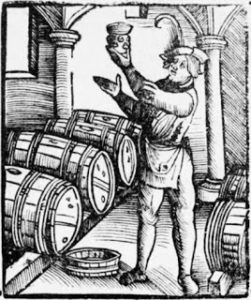
Michael Martin, and Hannah Farrington, of St. Giles’s Cripplegate were indicted for feloniously stealing two Gallons of strong Beer, value 2 s. the Property of John Ploughman, the 12th of May last.

Charged with a felony for two gallons of beer? What’s the prosecutor thinking?

It appear’d by the Evidence that the Prosecutor was a Brewer, and the Prisoner, Michael Martin, was his Servant…

Oh, that’s what’s going on. This is a private prosecution. The master, John Ploughman, has filed an information with the court against his own servant, Martin, for stealing the two gallons of beer. Breach of trust situation. The value is a bit of a side point if you think about it.

….that the Prosecutor having a Store-Cellar near Cripplegate , and Hannah Farrington being a Servant to a Customer of the Prosecutor’s, who dwelt hard-by this Store-Cellar…

Uh oh. Boy meets girl. Girl meets boy’s boss’s beer cellar. A story as old as love and beer cellars have been around.

…and having supplied the Prosecutor’s Servants with some Necessaries they wanted when at the Store-Cellar, the Prisoner, Michael Martin, or some other of the Prosecutor’s Servants, had at Times, in Return, given her three Mugs of Beer…

Had at times given her some beer! A bit imprecise for an alleged felony. Not only are the amounts of beer involved tiny but the dates of the supposed offences are sketchy. There must be more going on.

…and that the Prisoner Michael Martin , having given an Information to the Commissioners of the Excise of the Prosecutor’s using Molasses in his brewing Drink, did set on foot this Prosecution;

Ah ha! The truth will let itself be know, won’t it. Martin had ratted out his boss to the tax man for adulterating the beer and there by avoiding paying what was due. Malt tax was a pressing issue. A new tax in 1725 had led to riots in Scotland. Since 1697 In England, 6 pence was paid for every bushel of malt used in brewing. Folk were seeking ways around doing their duty. Bad folk were, that is. Folk like John Cheaterpants Ploughman. The case immediately begins to unravels rather quickly…

…giving the Drink not appearing in the Eye of the Law to be a Felony, and the Prosecution malicious, the Jury acquitted the Prisoners, and the Court granted them a Copy of their Indictment.

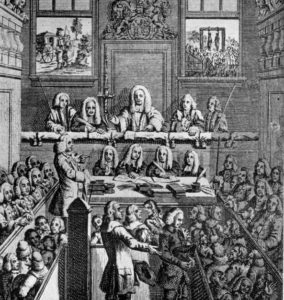
Freedom! Freeeeeedommmm! Well, no job and nothing but a piece of paper with the word acquitted on it but at least not transported or hanged by the neck until dead or anything. The latter prospect was cheerily and apparently popularly depicted in the background of that illustration up there showing the Old Bailey in 1735. Moral of the story? If you are going to cheat in 1725 cheat a bigger cheater who’s been cheating the Crown.

Ale Tunners And Tunner’s Ale in 1500s Leicester

beer1522People don’t give municipal records the respect they deserve. Where the rubber hits the road, that’s what a municipality is. Consider this from the Records of the Borough of Leicester Being a Series of Extracts from the Archives of the Corporation of Leicester, 1509-1603:
Aile tasters and sworne men within the towne of Leicester aforesaid to make inquiries there of the defaltes of tunners & typplers and especially to inquire and present the defaltes and trespaces of common dronckerdes that do vse to sitt typplynge at the aile houses all daye and all nyghte vnthryftely, and their wyves and children almost sterve at home for lacke of good releffe and sustentacion.

That cheery wee note from the Tudor world was entered into the records on November 18, 1569. Another dated April 7, 1592 just states “Ale 2\d. a gallon “as well strong ale as the tunner’s ale.” What’s a tunner? Or tunner’s ale? In the records of the municipal corporation of Boston, there may be a bit more information:

According to the Corporate records, the brewers in 1547 were ordered to sell good ale for 1¼d the gallon, double beer 1½d. the gallon, and single beer 1d. the gallon. In 1552 small ale was sold at three gallons for a penny, “till malt rise in price;” and good ale 2d. the gallon. In 1558 the brewers were to sell double beer at 20d. the firkin, and single beer for 10d. In 1575 certain persons were appointed ale-tunners to taste the ale and beer before it was sold. Brewers, before they “tunne their ale and beer, to send for the ale-tunners to taste the same to see that it is good wholesome drink:” prices to be regulated according to the price of malt.

That doesn’t look right. Muddies whether the ale tunner is an officer who is required to ensure that the beer is in good order or if they are someone who needs ordering about by an officer. The tunner seems to be consistently defined elsewhere as the cask filler, not the judge of anything. Hmm. This record from Nov. 16, 1520 also from Leicester helps a bit with the process:

Allso that no brewer within this towne sell forthe no ale tyll the allderman of that ward and too of ye XLVIll haue tasted their alls bothe the best and ye second in pene of forfeture the fyrst tyme iiij”. Wnd. and so to dowbyll as ofte as they make defawte; and yf the alderman of the ward be a brewer hymselfe or thos that [are] of the XLVIII, then to call the alderman of ye next ward to taste as aboweseyd for they that be brewers schallbe no tasters.

I love that “best and ye second” as the same was still going on in Vassar’s brewery in 1808 before things got too scientific. And there are a string of separate Tudor functions and trades all in those passages up there: the XLVIII, aldermen, brewers, tunners, typlers, tasters. The XLVIII or “the 48” appear to be members of a secondary level municipal council, beneath the one formed by the aldermen. A typler is a retailer as we can see the Leicester’s law of around that time provided “that no typler within this towne sell no ale with onlawfull mesures.”¹ It looks like the tunners and the typlers answer to the alderman and the tasters all to ensure thedronckerdes get their proper aile. If the aldermen and tasters are checking on on the tunners and typlers, they may be ensuring proper measures are sold at both the wholesale and retail levels and not just whether the stuff is foul or tasty. Quantity as well as quality control. Tasters were municipal officers who were otherwise titled better known as “ale conners” and lesser known as “ale founders” – the last of which lingers on as an especially obscure family last name. They also confirmed price. In 1853, of the 234 boroughs in England and Wales, 26 had officers titled “ale tasters”, six had an “ale founder” while only four officers were called “ale conners”. Martyn has explained that they did not sit in puddles of ale as part of their job despite modern sillinesses. Hornsey has more of both the law and the silly.

If all that is correct, the note about Boston is wrong and the tunner is not the taster as these were separate and separated tasks. Checks and balances. Still not sure what “tunner’s ale” was in 1500s Leicester… or any other place or time for that matter. Another day for that perhaps.

¹The named measures include “strykes”, gallons, “potell”, quarts, pintes. I can spot the pottle but not sure what a stryke is. By the way, I am not sure if that image is related to ale, is English or even from the 1500s. Looks swell, though.

Tom And Bob Drink With Coal Porters In Masquerade

tomandbob1

A break from the maps… yet more of the rats’ warren of Georgian information online. I have no idea what I am going to do with it. Seems a bit of a waste. But then you find this, Real Life In London, Volumes I and II by one Pierce Egan. It’s an 1821 fictional exploration of London’s nightlife high and low by gentlemen cousins Tom and Bob – including a drinking session in a pub known as the Black Diamond… or Charley’s Crib wearing “tatter’d garments and slouch’d hats” to hide their identities:

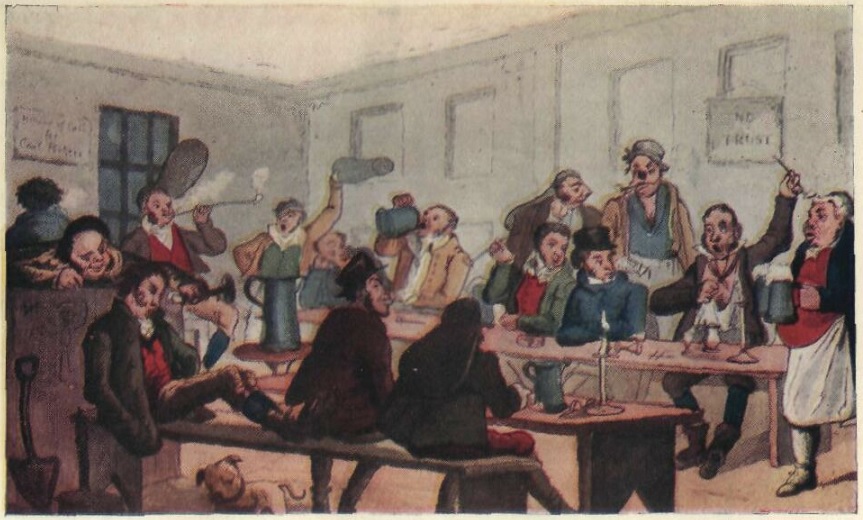
…they were in a house of call for Coal Porters. Before the president (who, by way of distinction, had turned the broad flap of his coal-heaving hat forward in the fashion of a huntsman’s cap) was placed a small round table, on which stood a gallon measure of heavy wet. On his right sat a worn-out workman fast asleep, and occasionally affording his friends around him a snoring accompaniment to a roar of laughter.

As you know I enjoy seeing what is to be found in an image of pub life like this one from 1775 but the adventures of Tom and Bob go the next step and add text description to the information in the image. You can read the story yourself. It’s not much good 194 years after the fact but look at the information that’s stuck away in there:

• Drinks: They are drinking quarts of ale. Porter-pots. There is a gallon pitcher in the middle of the floor on a small table. Punch served in bowls but taken by the glass.

• Manners: hats stay on. A penny is placed in a dish for seemingly unending supply of tobacco. No credit. Singin’ and dancin’ for each other is the entertainment.

• Slang: the drinking session is a “heavy-wet”. Not sure what “blue ruin” is… no, I go – it’s gin. They all seem to have an accent with “v for “w” – why? “Quawt” for quart. “Toast” has the modern meaning.

• Space: The tables are set in a horseshoe. Candle light. Service from the middle. The text says this is a public house but it seems more like a club.

In itself, its not going to win the Nobel for literature anytime soon. But at well over 800 pages, a pretty extensive effort to describe the scene even if through the lens of two upper class twits. Hardly lines up with the stories told in the court reports from about the same time. Which is fine. That case of the ten year old getting off murder charges in 1756 after throwing a knife into the chest of mom’s abusive boyfriend was a bit much.