The Brewing Lispenards Of New York City

lispenards

Lispenards. For a few days I have had Lispenards on the mind. We’ve seen them before. I’ve actually had them on the mind for years. In Upper Hudson Valley Beer, Craig and I wrote this:

After the war was won and New France conquered in 1760, William Johnson continued to import beer into his western Albany County estate but the records indicate that his choices were not local. He is buying Taunton ale from England as well as beer by the New York City brewer Lispenard. It may reflect his further increased wealth as he is also seeking out port wine and New Jersey cider from his southern supplier, the merchants Hugh & Alexander Wallace. Their invoice to Johnson dated Nov. 3, 1772, shows the extent he would go to pour himself and his guests the range of beers he desired:

6/-/- for 3 Barrl Strong Beer at 40/
4/10/- for 3 Barrl. Ale @ 30/
1/7/- for 6 Barrels at 4/6
7/-/- for 10 Barrels Newark Syder at 14/
0/3/- for Carting ale to the Sloop.

I got deeper into that order placed by William Johnson or rather Sir William Johnson, 1st Baronet of New York and one of the richest, most powerful men in British North America back in 2010 but suffice it to say that what Johnson was buying was the best he could get. And that included Lispenard’s ale.

What, you might ask, was a Lispenard? As the perpetually excellent Colonial Albany Project tells us, the family was founded in the New World by Anthony Lispenard of La Rochelle France who emigrated in 1669 when he was 29 and lived along the Hudson River for the remaining 27 years of his life in 1696. He was a baker, a trader and a government official including Albany’s Viewer of the Corn from 1689. In the Manual of the Corporation of New York for 1856, this founder of the clan, Anthony, was also identified as a brewer. He left three children: Margaret, Abigail and their unhelpfully named brother Anthony. Anthony Lispenard the younger himself passed away leaving not so much in the records department but three children including a son – Leonard born in the 1714 who inherited the family’s estate.

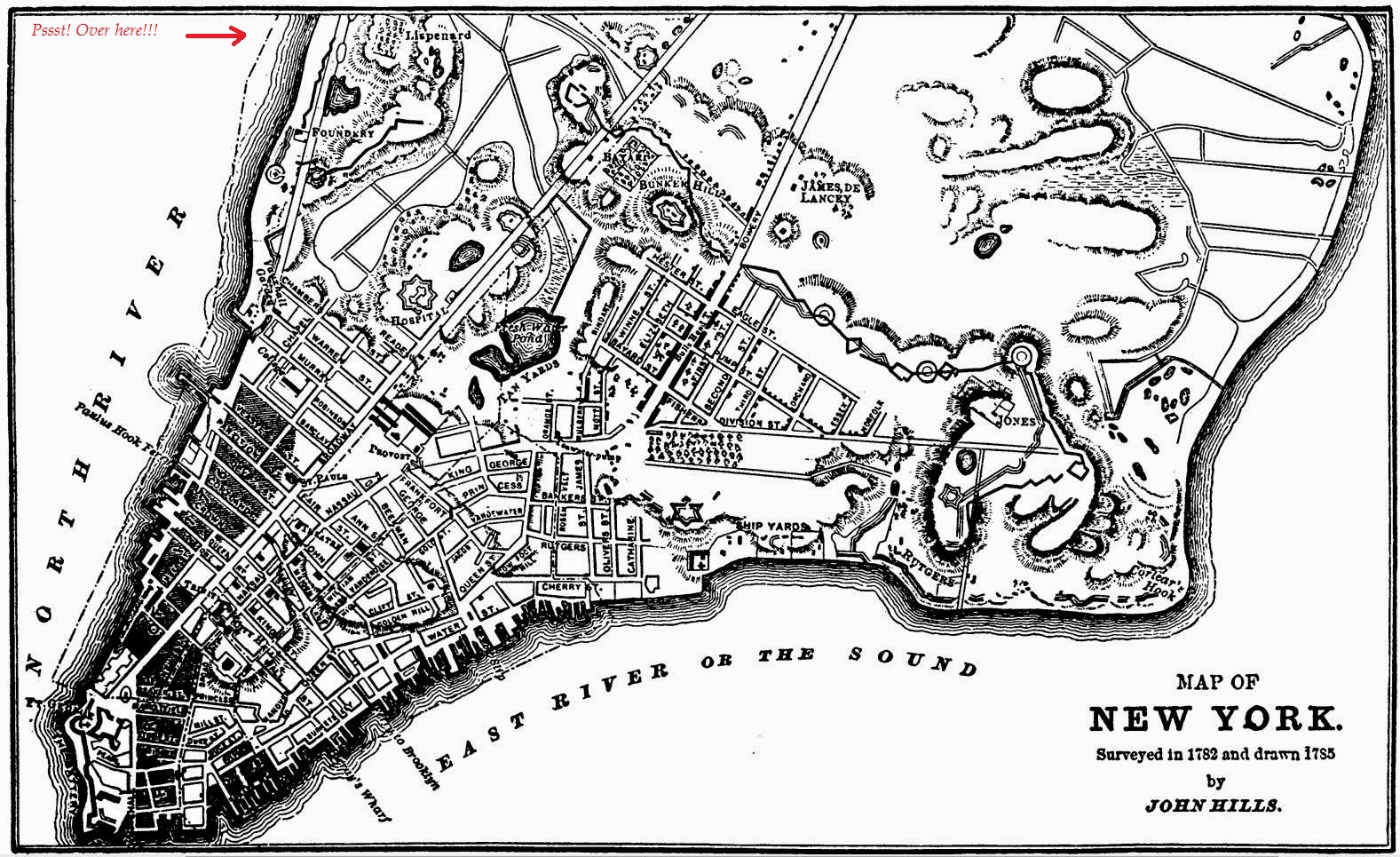
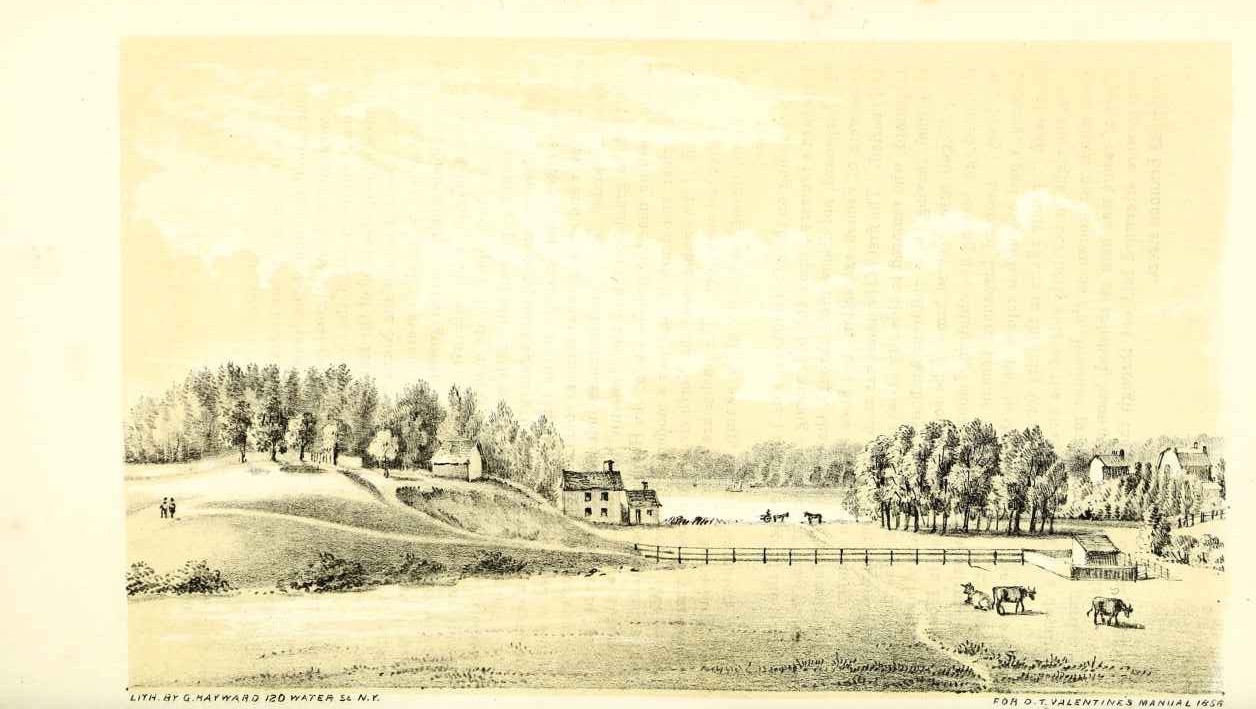
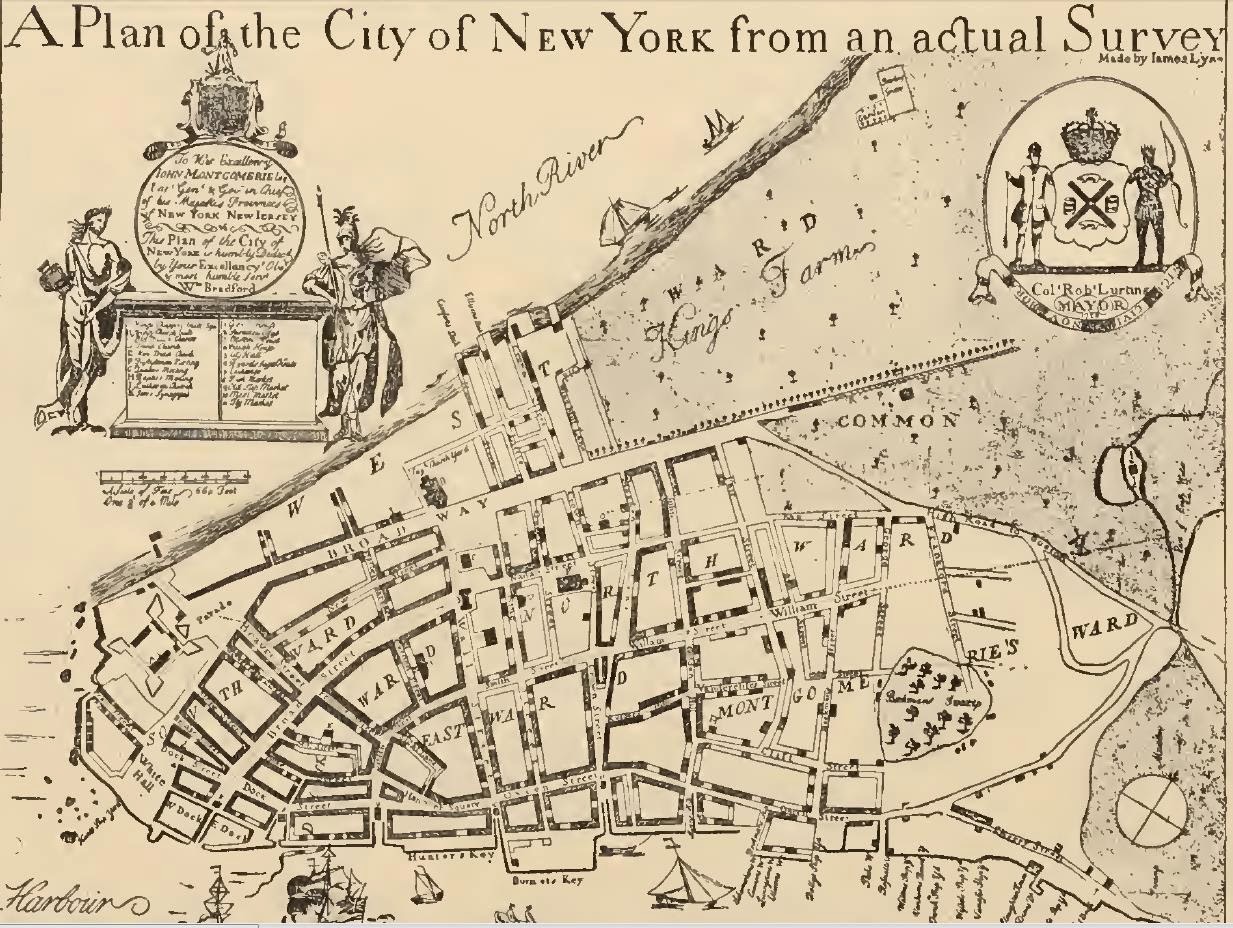
He led a prosperous private and an important public one, too. He also married well and through his wife Alice or Elsie Rutgers came into possession of one third of a grant made by George II to her father, Anthony Rutgers, which they then expanded then named Lispenard meadows and then built a mansion next door on Lispenard hill – all near a swampy area that then sat in the middle of Lower Manhattan in the area is now part of Tribeca. You can seek these lands identified as “King’s Farm” on this map from 1729. As part of his estate, Anthony Rutgers owned “large breweries and mills located on the North River (as the southern branch of the Hudson west of Manhattan was known) not far from the foot of Cortlandt Street His son-in-law, Leonard, continued the brewing operations. They had children including the unhelpfully named Leonard born in 1743 and, yes, his brother… another Anthony. Rutger’s / Lispenard’s brewery is shown above as it was about 1776 according to Manual of the Corporation of New York for 1856.

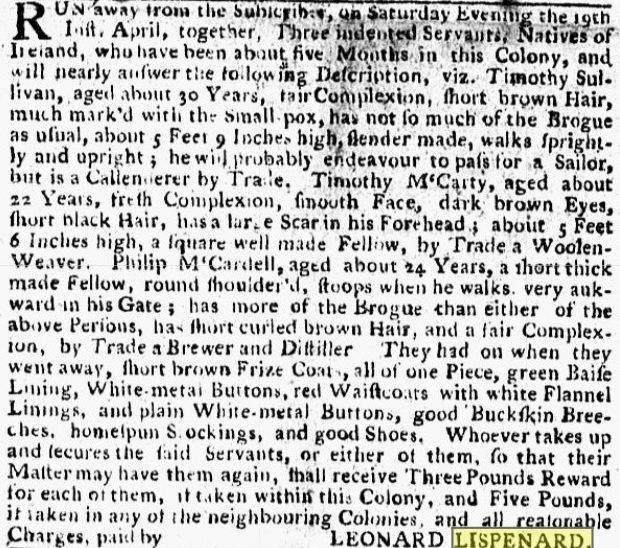
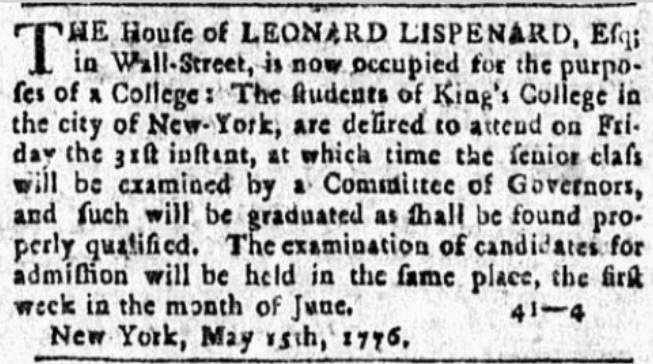
It gets a bit trickier now. Not because of all the Anthonys. Because of the Leonards. Father and son are both fairly prominent in New York City before, during and after the Revolution. They show up in the news papers. In The New York Mercury of 22 April 1765, a notice was posted on behalf of Leonard Lispenard requesting the return of three indentured servants who had been in the colony for about five months. One, Phillip M’Cardell, was described as being by trade a brewer and distiller. One of the two Leonards was employing brewers. Another notice was placed in the General Advertiser dated 15 May 1776 stated that the house of Leonard Lispenard, Esq in Wall street was being occupied by students of King’s College. Despite such seeming Loyalist credentials, three months later on 17 August, George Washington issued an order that guards be mounted day and night at Lispenard’s brewery. Lispenard Senior (aka 1714-1790) had already thrown his lot into the Revolution. He was a member of the colony’s Committee of Correspondence in 1774 and backed Washington publicly on his return to New York City in 1775 and likely a Son of Liberty.
nyntmerc22april1765nygadv15may1776


nyg1june1791lispenard

nydadv10dec1804


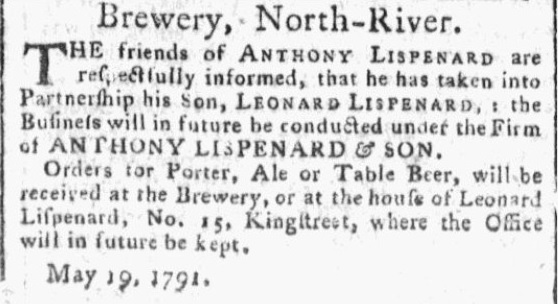
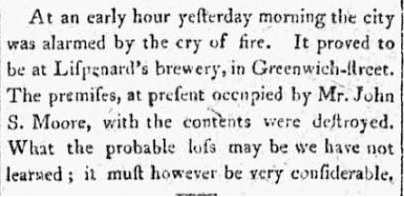
Anthony, brother of Leonard Junior (aka 1743-1800), takes off in the brewing business in his own right. He marries one Sarah Barclay in 1764 and becomes “the proprietor of the extensive breweries on the Greenwich road, near the foot of Canal Street.” I am guessing that this is the Lispenard that Sir William Johnson buys beer from through agents in 1772. In the 1 June 1791 edition of the New York Daily Gazette, a notice was placed under the headline “Brewery, North-River” which stated that Anthony Lispenard had taken his son – yes, of course.. because there was no other choice – Leonard into partnership. Note this map from 1783. Notice that they are still described as sitting on the Hudson. Shipping beer on the Hudson. And father and son – Anthony and Leonard – were inviting orders for porter, ale or table beer. The address for Leonard was given as 15 King Street. This Leonard traveled to England shortly after end of the American Revolution in 1783, and remained some years in London with the Barclays, relatives of his mother and founders of the famous breweries. On 10 December 1804, a short news item appeared in the The Daily Advertiser from New York stating:

At an early hour yesterday morning the city was alarmed by the cry of fire. It proved to be at Lispenard’s brewery, in Greenwich-street. The premises, at present occupied by Mr. John S. Moore, with the content were destroyed. What the probably loss may be we have not learned; it must however be very considerable.

An article in the Commercial Advertiser from the same date stated an entire wing of the building had been destroyed. Notice in the upper left of this map from 1789 how the Lispenard estate sits on the road to Greenwich.

The family name fades. Sons die childless. No one gets named Anthony or Leonard. The next generations in the 1800s also appear to lose interest in brewing. In 1907, the remains of Leonard Lispenard (1743-1800) were uncovered as part of a construction site. A report in The New York Times from 9 April of that year details the find as well as some of the family’s legacy. He had been buried near the farm in New Rochelle near where his great grandfather, the original Anthony, had settled after moving south from Albany. A street is still named after them.
So…There Was An Exporting Albany Brewery Before 1790

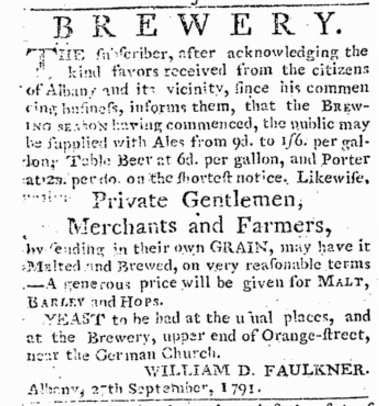
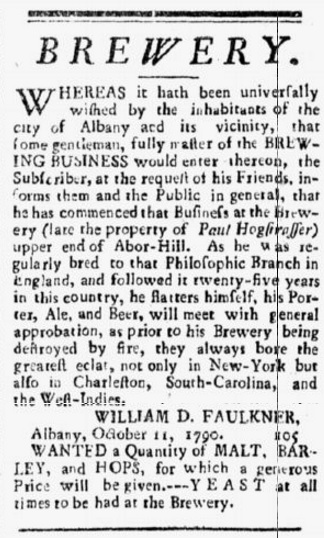
albfaulkalbreg18oct1790It’s been a busy time. Busy at work. A family matter to attend in the States. A federal election to fret about. Baseball playoffs to obsess over. Hardly time to play around with newspaper databases. Ah, well. Winter is coming. There will be time for that. Time to come across things like this ad from The Albany Register of Albany, New York from 18 October 1790. Craig and I told the story of William D. Faulkner in Upper Hudson Valley Beer in this way:

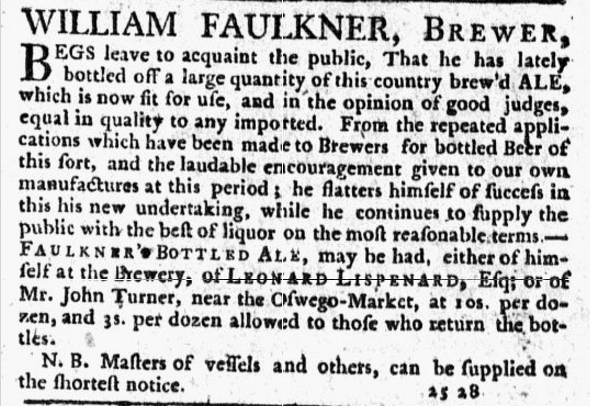
Faulkner began his brewing career in New York City in the late 1760s. Faulkner initially partnered with New York City merchant Leonard Lipsenard—the son of Albany brewer Anthony Lipsenard—to sell bottled ale and beer; then with Stephen Rapalje and Anthony Ten Eyck, but by 1771 had opened his own brewery on Cow-foot hill, in what is now modern-day Harlem neighboorhood of Manhattan. A fire in his New York brewery brought about his relocation to Albany, and in 1790 Faulkner began renting a brewery in the city’s northern neighborhood of Arbor Hill—advertising Ales, Porter, Bottled Ales and Spruce Beer. By 1792, however, William Gibbs, announced that he would be occupying that brewery. No record of William Faulkner after that point has been found.

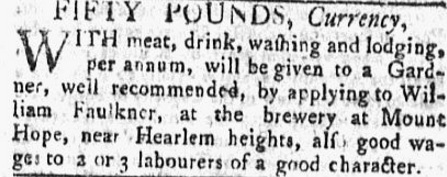
What more can we learn from the ad? Notice that he is asking for malt, barley and hops. Local hops were both a wild and cultivated crop for over 150 years at that point in Hudson Valley history. We have a record of wild hop picking by members of the indigenous Mohawk community supplying Albany’s Dutch brewers from the first decade of the 1700s. But notice another thing. This is at least his third brewery, the second one local to Albany. He’s in New York City from the second half of the 1760s. Here’s his ad from a New York City paper from 1768. Albany is in Revolutionary hands from 1776 to 1783, cut off from British held New York City during the war. In the spring of 1779 Faulkner is in NYC and he is hiring a gardener and labourers in the middle of the conflict, according to this ad in The New-York Gazette of 22 March 1779. So, his first Albany brewery must have existed sometime during the years 1783 to 1790 after he relocates up the Hudson after peace breaks out. His last ad from the fall of 1791 shows him brewing at least four beers. And during that time not only is he selling down to New York City but he is selling on to Charleston, South Carolina as well as the West Indies. The Dutch empire held what was then named New Netherlands from the second decade of the 1600s until it finally fell to the English in 1674. Trade routes to the Dutch colonies in the Caribbean were established by the Dutch and continued after the establishment of the colony of New York.

Faulkner was sending his beer down a well trod path. Ales and porters were apparently part of that trade after the American Revolution. Remember that Taunton ale was also being sent to Jamaica, even before the declaration of American independence. It shouldn’t come as any surprise. The English had been shipping large quantities of beer across the Atlantic since at least 1577. Did they all bear the “greatest eclar”? Not sure. But if anyone tells you that all beer before lager starting in the in America in the mid-1800s was smokey, brown and crappy – clearly an untruth – why would anyone in their right mind pay to have it shipped so far? Don’t believe it.

Caleb Haviland Sold Lovely Drinks In 1798

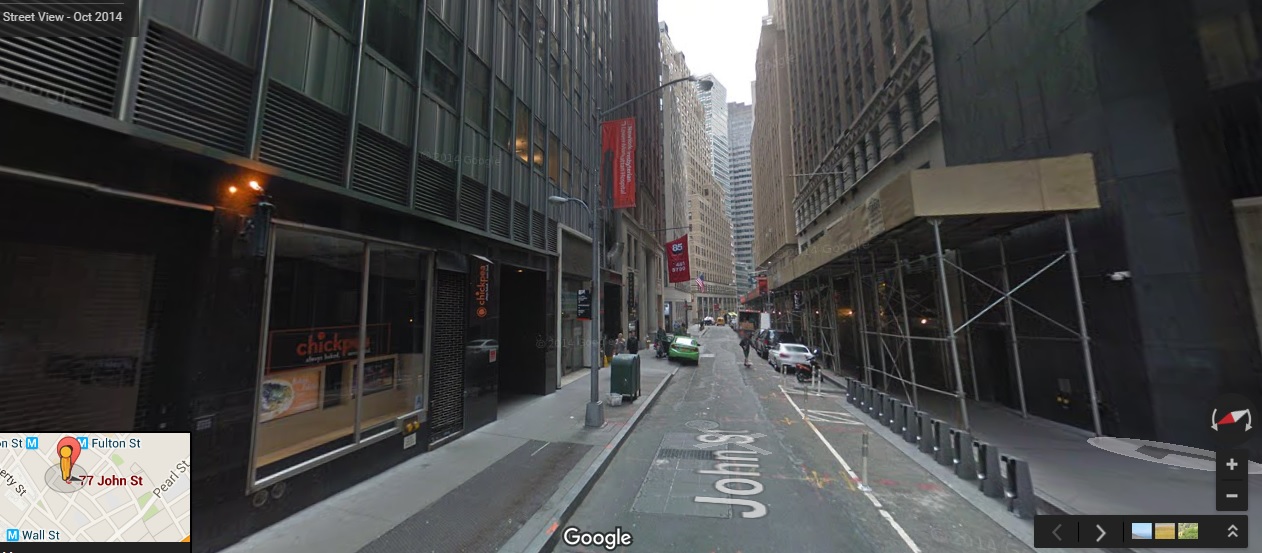
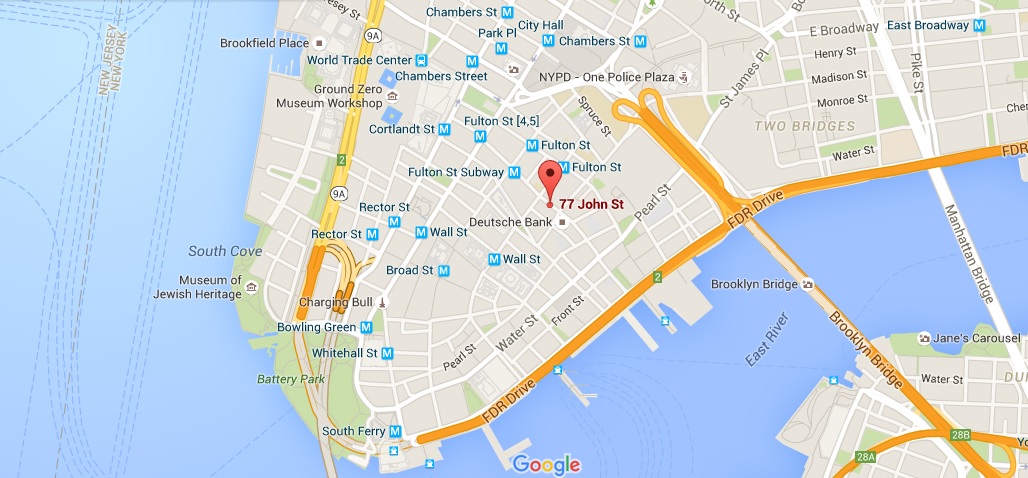
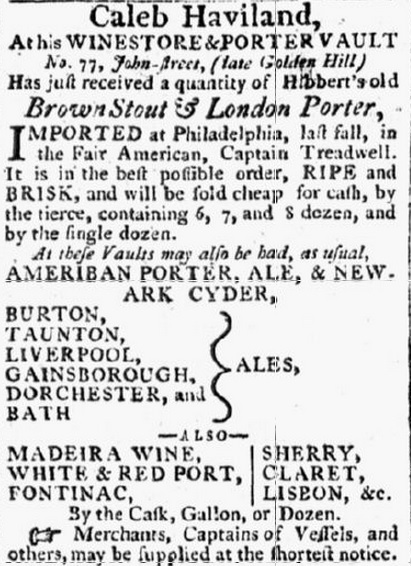
ch1Versions of this advertisement ran in newspapers in New York though the middle of 1798. This one is from the New York Gazette of 12 March. There is a reason the run ended when it did. On November 23 of that year Caleb Haviland’s widow is granted letters of administration after he dies without a will. Which is unfortunate as he seemed to have a good bit of business going for himself. You can go see where his shop was located on 77 John Street in Lower Manhattan but it looks a bit different now. You can see what the district is like at this page from Forgotten New York.

Enough about the geography. Look at the beer he is selling. Nine sorts at least. At least two had been brought into New York from Philadelphia where it had been landed from Britain the previous fall. This business of repackaging and coastal shipping of imported luxury goods is something I’m noticing is fairly common soon after the Revolution. It’s a wonder anyone could tell a Whig from a Loyalist. Porter vaults seem to have been a thing.

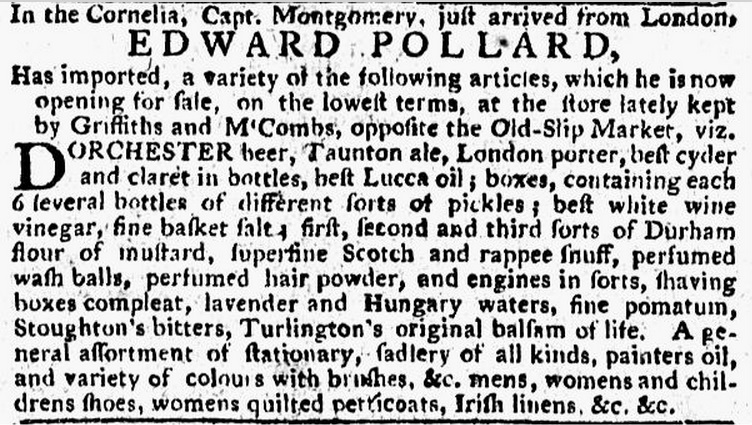
It’s one of the last ads I’ve seen listing Dorchester ale. No mention of Bath, Liverpool or Gainsborough ales in Coppinger. Liverpool was not even particularly pro-Revolution. The typo in “Ameriban Porter” is eventually cleaned up in later editions. Hibbert‘s London Porter was still being sold in Mobile, Alabama in 1857. But was it ripe and brisk? Ripe and brisk we are assured are qualities of the best possible order. If the words have the same meaning in the 1850s, ripe appears to mean conditioned, all bubbly like. Not necessarily soured. These sorts of adjectives are rare in ads earlier than this point. This ad from a 1764 edition of the New York Mercury shows how dry they were. You want Dorchester beer? Edward Pollard has some for you.

Cream Ale: I Hate Records Revisited…

Adjectives from another time. How irritating. I mentioned this the other day somewhere folk were discussing steam beer. One theory of the meaning is it’s a reference to the vapor from opening the bottle. Another says something else. Me, I think it’s the trendy word of the year of some point in the latter half of the 1800s. Don’t believe me? Just as there were steam trains and steamships, there were steam publishers. In 1870 there was a steam printer in New Bedford, Massachusetts. A steam printer was progress. Steam for a while there just meant “technologically advanced” or “the latest thing” in the Gilded Age. So steam beer is just neato beer. At a point in time. In a place. And the name stuck. That’s my theory.

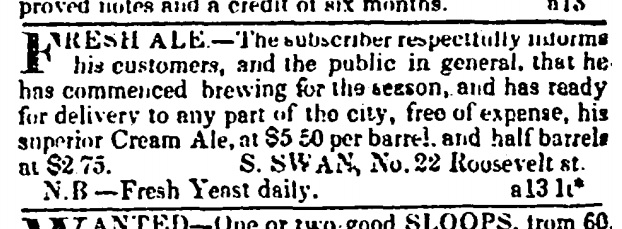
Cream is like that. Folk think it has a specific meaning. Static in time. The general theory is that cream ales started as top-fermented ales that receive an extended period of cold-conditioning or lagering. Another source closer to the ground tells me that cream ales are now just blends of basic pale ales and basic light lagers. Could be. But that up there is an ad from 1830. It’s from New York Evening Post from 13 August 1830, well before lager was a twinkle in an Empire State brewer’s eye. Mr. Swan of Roosevelt Street had some for sale. So other than the seemingly odd juxtaposition of street name and date – what does it mean? There are two obvious first choice. Cream is rich and it also rises to the top. Hmm.

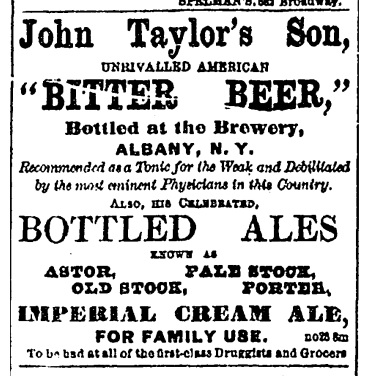
Six years later, the first or perhaps just leading American brewing industrialist John Taylor was placing ads for his Albany Cream Ale. Here is an ad that was placed in The Ulster Republican of Poughkeepsie, New York from 25 May 1836. Three years later, Taylor is advertising his Imperial Cream Ale and add the tag line “No mistake as to its superior quality.” Here is an example from the Albany Evening Journal of 4 April 1839. Which is interesting. Not a call to strength. A call to finesse. Ten years later, in an article about a new sarsaparilla works, Taylor’s Cream Ale is mentioned in the 21 July 1849 edition of the Plattsburgh Republican as an example of something the new sarsaparilla maker exceeds in production. It’s become common parlance for quantity as well as quality. Half a decade after John passes away, his sons are still prominently advertising their Imperial Cream Ale, now fit “for family use” as you can see was stated in the Albany Argus of 20 January 1869.

These are just snippets but they do show something of either an arc of meaning or perhaps a versatility. A claim more than a descriptor. Superior stuff. Was it creamy? I have no idea. I hate records.

It’d Be Nice To Get More Actual Spruce Beer Brewed

——-

Who Was Joseph Coppinger, Early 1800s US Beer Geek?

coppinger2The trouble with finding an old text in isolation like the one I wrote about yesterday is establishing some context. Without it, you are at the whim of the person’s claim to fame as opposed to his or her place. It’s as true today as it was in 1815 when Joseph Coppinger published his book on brewing. The context is totally dissimilar. Right now we are still in the era when folk can assert craft beer expertise, isolated from critical assessment due to the flux. We have to take comfort and grounding in the knowledge that few are. In the years leading up to 1815, America was similarly in a time uncertainty. The British were not yet allies again and the lands beyond the east coast’s highlands were not secured. Drifters abounded. I was thinking about this when I was thinking today about Coppinger. How the heck do I know he didn’t make up all that in his book? How can we establish he is reliable? So, I looked to see what I could find out about him. Fortunately, he liked to write letters to the famous and left a bit of a trail:

1800: claims in his 1810 letter to President Madison that, prior to emigrating from Ireland to the US, he published a paper in the reports of the Bath and West of England Society on an improved method of the drying of malt.

1802: Coppinger writes two letters to President Thomas Jefferson. He wrote from New York on the subject of naturalization and the need for him to become a citizen to patent an invention. He is an Irish Catholic recently arrived in the New World;

1802-04: Coppinger appears in Pittsburgh on the frontier partnering in a brewery operation located in and even made out of the former Fort Pitt known as Point Brewery;

1806: Coppinger enters into partnership to establish a brewery in Jessamine County, Kentucky. It never comes into operation and a law suit is begun. The dispute is settled through the intervention of the Rev. Stephen Theodore Badin, the first Roman Catholic priest ordained in the United States;

1807: Coppinger wrote from St. Louis a letter to Benjamin Rush, Revolutionary leader. Rush is a pre-Revolutionary anti-slavery activist and a medical doctor. The letter is not about beer so much as a scheme to use public resources to help raise employment levels;

1810: Coppinger wrote to President James Madison describing a list of inventions and also proposes the establishment of a national brewery at Washington. His inventions include an improved threshing machine and a better method of distilling. He gives his address as No 6, Cheapside Street, New York. Says he has been in the brewing trade for twenty years;

1813: An advertisement for Coppinger’s book is published in a Philadelphia newspaper, the Aurora General Advertiser; and

1815: Coppinger writes to former President Thomas Jefferson. He gives his address as 198 Duane St., New York. Jefferson wrote back a couple of week later quite interested in Coppinger’s ideas, noting “in my family brewing I have used wheat as we do not raise barley”.

1815: Coppinger’s publishers, Van Winkle and Wiley of New York, are quite respectable and at the leading edge of the first wave of homegrown American literature. In this same year they publish An Introductory Discourse delivered before the Literary and Philosophical Society of New York, on the fourth of May, 1814 by De Witt Clinton, then Mayor of New York, later state Governor. It is a treatise on the improvement of society.

A brief biography of Coppinger appears in the footnotes to this letter to Jefferson. In his later years he writes two more books: 1817’s Catholic Doctrines and Catholic Principles Explainedand in 1819 On the Construction of Flat Roofed Buildings, Whether of Stone, Brick, or Wood, and the Mode of Rendering Them Fire Proof. He passes away around 1825 after 23 years in the young United States of America. He looks good if a wee bit intense. But, then again, he is a participant in the making of the country, making the world anew. Does this mean he is to be trusted in his description of how to make Dorchester Ale? Not at all. But he has a very good chance of being trustworthy with a bit more digging.

Dorchester Ale: Esteemed When The Management Is Judicious


coppingerFabulous. I think my new best friend is Joseph Coppinger. Sure he published his book The American Practical Brewer and Tanner 200 years ago… but so few people come by these days I don’t care to notice such things. Like Velky Al did a couple of years ago, I came across an online copy of the book as I was looking for something entirely different. [No. No, not that.] And when I did I immediately – well, right after checking out the tanning section – noticed there were a number of recipes for beers. Styles of beers even. A listing of styles. In a two hundred year old book about beer. Odd. I thought that was invented in the 1970s by that Jack Michaelson chap. But, more importantly, he included this:

Dorchester Ale

This quality of ale is by many esteemed the best in England, when the materials are good, and the management judicious.

54 Bushels of the best Pale Malt.
50 lb. of the best Hops.
1 lb. of Ginger.
¼ of a lb. of Cinnamon, pounded.

Cleansed 14 Barrels, reserving enough for filling….This mode of brewing appears to be peculiarly adapted for shipping to warm climates; the fermentation being slowly and coolly conducted: it is also well calculated for bottling.

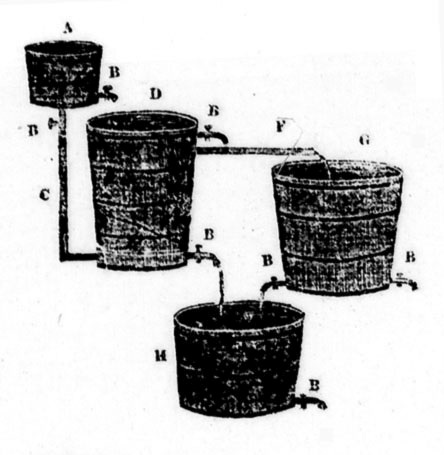
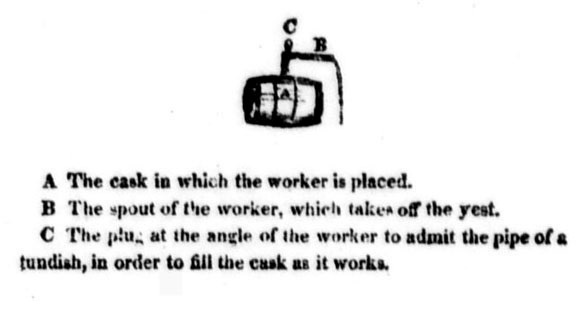
Yes, there is more. I just used those three dots to keep you focused. He goes on and on in fact. Over thirty sorts of beer and a few diagrams like the one above. A few things. First, it’s a description of how to make Dorchester Ale. The careful – or perhaps the caring – amongst you will recall that two years ago while waiting for Craig in Albany to go for a beer, I wandered into the New York State Library HQ and found a large number of mid-1700s newspaper notices for British ale coming into the new world. And a few of those ads referenced Dorchester ale. So there you have it. Dorchester was a top quality ale with a bit of ginger added. Sounds like quite nice stuff. Second, yes, the book was published in 1815. And it was published in that year by the firm of Van Winkle and Wiley located at No.3 on Wall Street. It is a guide aimed at the trade. Aimed at the trade that wants to know about shipping to the warmer climes. Which means exporting ale from New York state. Two hundred years ago. Third, he goes on. And on. The book has a lot of data. I need to get into it to find out what.

I believe this illustrates a point: the problem with records. Believing you know what things were once like based on the available records is a dodgy game. Things like (i) Gansevoort’s adin 1794 asking for barley for ale as the old state in the young nation was coming out out famine leading one to leap to (ii) a prosperous local brewery to the south in 1808 connecting you to (iii) this guide in 1815’s NYC on how to brew for export (iv) all might lead you to understanding that there was in fact a vibrant but little understood brewing trade waaay before the US Civil War and waaay before the advent of lager’s supremacy. But you have to watch that sort of thing. Because records are dodgy things. But at least we may well know what Dorcester ale was. Maybe. Sadly, no reference to Taunton. Maybe. Probably out of style by then in the New York market. That might be it. Maybe.

Clowes, Newbury and Maddox, Bermondsey, London, 1827

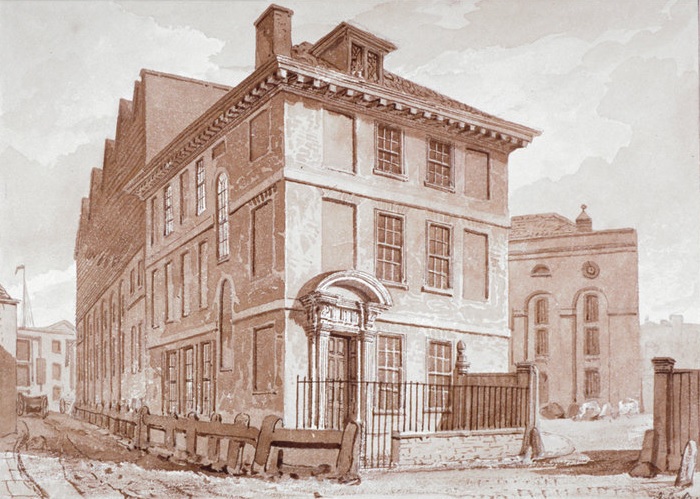
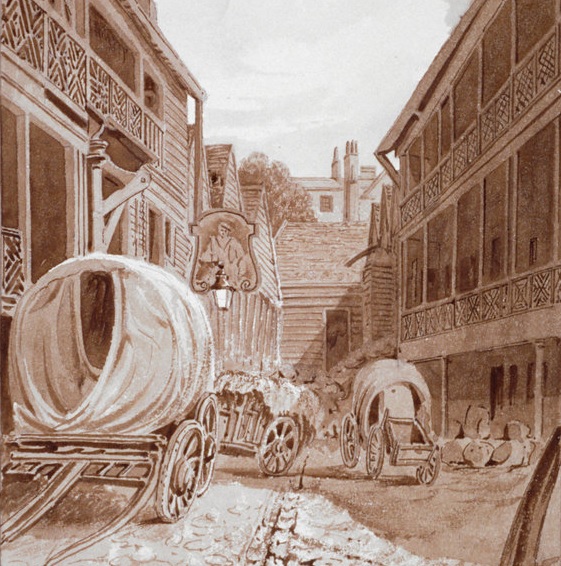
brew-house-stoney-lane-bermondseyThe brewery of Clowes, Newbury and Maddox sat on Stoney Lane in Bermondsey, London. The late Georgian artist John Chessell Buckler created a number of images from the district of Bermondsey. The watercolour of Clowes, Newbury and Maddox was painted in 1827. Charles Clowes, John Newbury and Erasmus Maddox that is. In 1868, the image was owned by the Corporation of London. I know nothing of Bermondsey other than what I read from Boak and Bailey or Stonch about the Bermondsey beer mile, something of last year’s model apparently. A place of rubbish-strewn industrial estates. Huge groups of lads getting pretty drunk, stag parties. Sounds fairly Georgian. Clowes, Newbury and Maddox were in operation in 1794. Charles Clowes was an admirable man, a lawyer turned brewer. He installed one of James Watt’s engines in 1796, even though he is reported to have refused the idea in 1785 after making inquiries. It is mentioned in a very interesting passage from 1805:

…the very capital malt distilleries at Vauxhall, Battersea, Wandsworth, and Kingston,. the large porter breweries of Messrs. Barclay, Clowes, Holcomb, &c. together with the infinity of pale beer breweries in the Borough of Southwark, and dispersed through every town and Tillage in the county, cannot be at a loss to account for the magnitude of the demand for this article.

Note. The infinity of pale beer breweries – not of households brewing pale beer – meeting the demand.

threetunsbermondsey

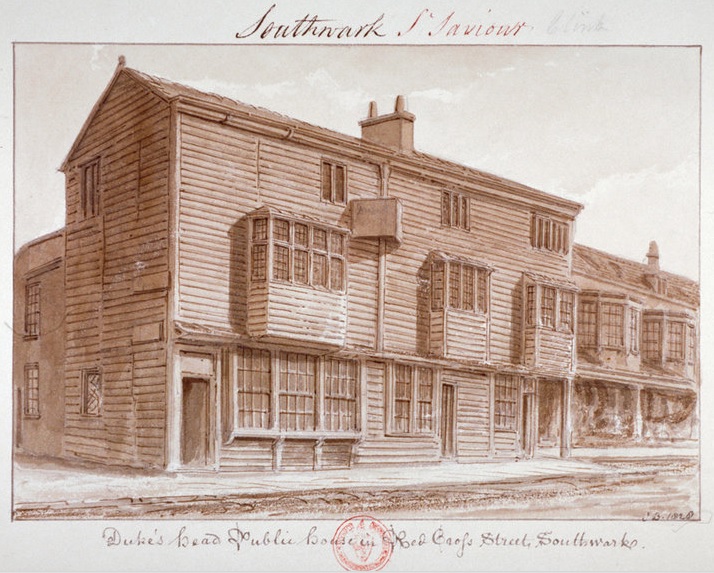
dukesheadsouthwark

kingsheadinn


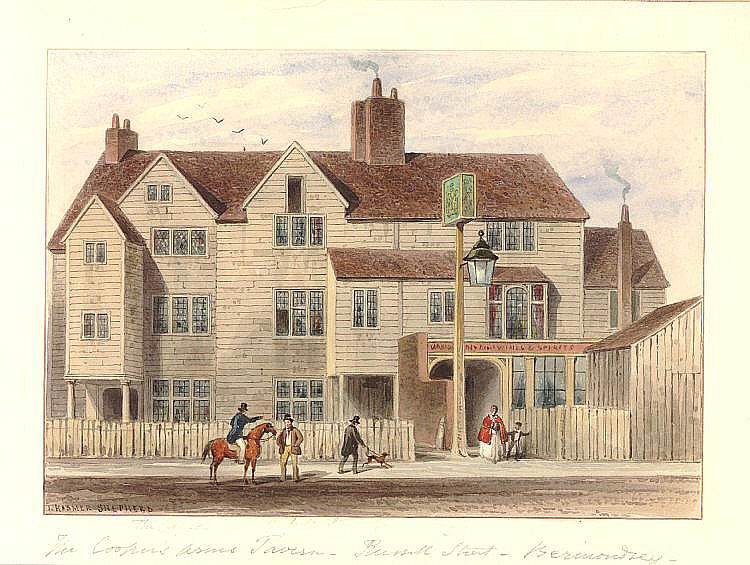
The brewery of Clowes, Newbury and Maddox seems to fit into Buckler’s interest in interesting and dilapidated structures from the previous century or before. He was an architect who was the son, brother and father of architects. The images are largely lifeless or rather at least without human participants. Their effect is sometimes present. The ruts in the road. Idle carts. His views illustrate scenes from the mapping I have been poring over. The Three Tuns public house on Jacob Street, Bermondsey to the left. The Duke’s Head Public House in Red Cross Street in the middle. The King’s Head Inn on the East Side of the High Street, Southwark to the right. The places Buckler took and interest in can be found on Greenwood’s Map of London from 1827 if you nose around a bit. The Duke’s Head lasted until at least 1874.

Considering The Badness Of Beer In 1800s Britain

4971
Hail, Beer!
In all thy forms of Porter, Stingo, Stout,
Swipes, Double-X, Ale, Heavy, Out-and-out,
Most dear,
Hail! thou that mak’st man’s heart as big as Jove’s!
Of Ceres’ gifts the best!
That furnishest
A cure for all our griefs: a barm for all our—loaves!
Oh! Sir John Barleycorn, thou glorious Knight of
Malt-a!
May thy fame never alter!
Great Britain’s Bacchus! pardon all our failings,
And with thy ale ease all our ailings!
 

That’s the first bit of “Ode to Beer” from the Comic Almanack for 1837. What a jolly bauble. Exactly what we largely like to tell ourselves about the merry merry world of the past. Dickens without all the bad bits. The view from outside the Bermondsey¹ public house, as above, in 1854. As we all rush about finding older records to share about beer and brewing in, mainly, the English speaking world, I have wondered about the difference between the official record and the actual experience. By official, I don’t mean governmental or even sanitized so much as the accepted. The approved version. One of the biggest problems leading to the approved version is the love of drawing conclusions or, more honestly perhaps, the use of records to justify comfortable conclusions. We want things to be explicable but we want to be comforted. For authority to be correct we want it to align with out needs. It rarely does. But authorities won’t tell you that. Authority has another interest. Consider this passage in a book entitled England as Seen by an American Banker: Notes of a Pedestrian Tour by Claudius Buchanan Patten published in 1885:

I was at some pains to get at the following authentic statement of methods of beer adulteration. A member of London’s committee on sewers —an eminent scientist — puts forth the declaration that “It is well known that the publicans, almost without exception, reduce their liquors with water after they are received from the brewer. The proportion in which this is added to the beer at the better class of houses is nine gallons per puncheon, and in second-rate establishments the quantity of water is doubled. This must be compensated for by the addition of ingredients which give the appearance of strength, and a mixture is openly sold for the purpose. The composition of it varies in different cases, for each expert has his own particular nostrum. The chief ingredients, however, are a saccharine body, as foots and licorice to sweeten it; a bitter principle, as gentian, quassia, sumach, and terra japonica, to give astringency; a thickening material, as linseed, to give body; a coloring matter, as burnt sugar, to darken it; cocculus indicus, to give a false strength; and common salt, capsicum, copperas, and Dantzic spruce, to produce a head, as well as to impart certain refinements of flavor. In the case of ale, its apparent strength is restored with bitters and sugar-candy.”

Now, this is interesting. And not because all the horrible gak was added to beer back then as it is being again added to beer now. But because it includes the admission of wide spread watering down at the pub. Watered down poisonous gak. Which leads to the question of what people were really experiencing as they looked down into the murky depths of a pewter quart pot a century and a half ago. It makes me wonder it might mean for all those records Ron has dug out of public libraries and brewery attics. The badness of beer by these sorts of additives appears to have arisen after legal changes in 1862 as The British Farmer’s Magazine advised in 1875. But there are other issues, more to do with quantity than quality. This passage from The Farmer’s Magazine of 1800 is simply depressing:

There are some persons who do not drink malt liquor at all; most people of fortune and fashion drink it very sparingly; while great numbers of the lower orders, particularly coalheavers, anchor-smiths, porters, &c. drink it to great excess, even, it Is supposed, to the amount of five hundred, or one thousand gallons a year each. Upon the whole, I apprehend the quantity of malt liquor consumed in the county, would almost average a hundred gallons per head of all ages and conditions. One thousand gallons per annum, is nearly, on an average, about 14 bottles of ale or porter per day, and is almost equal to what is passed through many drains, made to carry off the superabundant moisture from the earth… upwards of three millions of money are expended by the labouring people, upon ale, porter, gin, and compounds, which is 25I. per family of that description of persons. If wages, on an average, be 12s per week, the amount per ann. is 32I. 4s. which leaves only 7I. 4s. for purchasing bread, butcher meat, vegetables, and clothes!

Holy frig. Perhaps we might take a moment to thank our lucky stars that we are not living when our great-great-great-great-great-great-great-grandparents were scraping together their existence. When I tweeted the stats in that passage above, the good hearted Lars responded “I would guess a large proportion of that was small beer.” One does live in hope but, really, it’s unlikely isn’t it. The life of the industrial labourer and his family was simply horrible before the public health movement. In 1835, harvesting labourers required a gallon of beer every day for a month. In that same issue of The Farmer’s Magazine that that fact came from, there is a very interesting suggestion in an argument on why public houses were not going away despite their menace, why the labouring man had no choice:

…as to the temptation of company at the public-house or the beer-shop, would it not exist in precisely the same degree if the labourer had a cask of beer in his cellar brewed by himself, as if he had a cask purchased of the public brewer? If there were a disposition to avoid that temptation, and to drink his beer at home with his wife and family, what now prevents the labourer from purchasing a cask of beer and so consuming it? Nothing that would not equally apply to his purchasing malt and brewing his own beer. And if he had a cask, what security is there that his wife or children would not consume the greater part of it while he was absent at his daily labour? And would not he himself he likely to fall into the temptation of consuming it most improvidently either alone or with his companions?

We love to see things through rose coloured glasses. When we are not looking through amber coloured beer goggles ourselves. All but the first of the quotes and links are Georgian and pre-date temperance. When alcohol was so normal it was just a personal failing to let it affect your life as it washed over and through you. I honestly do not know what to make of it all. Have we simply forgotten the grim and bought into comforting fictions about the recent past? Accepted some sort of Jacksonian romance? My first reaction to it all is to praise the campaigners, to scribble a prohibition pamphlet – but then I remember that 1832 impromptu drinking party a traveler came upon in a cellar in Albany, NY:

…there was no brutal drunkenness nor insolence of any kind, although we were certainly accosted with sufficient freedom. After partaking of some capital strong ale and biscuits, we returned to our baggage apartment, and wrapping ourselves in greatcoats and cloaks…

The surprise of joy? Or a wallowing in the familiar? Or the land of liberty overlaid upon the event instead of the lives of those in the dark Satanic mills?

¹Yes, that one.

Three Mugs Of Beer For The Servant Girl

threemugsI’ve heard you. More tales of Cripplegate crime related to beer from the records of the Old Bailey. And why not? It’s good clean fun, in it? Let’s dissect the trial of Michael Martin and Hannah Farrington for grand larceny held on 15th October 1729. It starts out pretty clearly enough.
Michael Martin, and Hannah Farrington, of St. Giles’s Cripplegate were indicted for feloniously stealing two Gallons of strong Beer, value 2 s. the Property of John Ploughman, the 12th of May last.

Charged with a felony for two gallons of beer? What’s the prosecutor thinking?

It appear’d by the Evidence that the Prosecutor was a Brewer, and the Prisoner, Michael Martin, was his Servant…

Oh, that’s what’s going on. This is a private prosecution. The master, John Ploughman, has filed an information with the court against his own servant, Martin, for stealing the two gallons of beer. Breach of trust situation. The value is a bit of a side point if you think about it.

….that the Prosecutor having a Store-Cellar near Cripplegate , and Hannah Farrington being a Servant to a Customer of the Prosecutor’s, who dwelt hard-by this Store-Cellar…

Uh oh. Boy meets girl. Girl meets boy’s boss’s beer cellar. A story as old as love and beer cellars have been around.

…and having supplied the Prosecutor’s Servants with some Necessaries they wanted when at the Store-Cellar, the Prisoner, Michael Martin, or some other of the Prosecutor’s Servants, had at Times, in Return, given her three Mugs of Beer…

Had at times given her some beer! A bit imprecise for an alleged felony. Not only are the amounts of beer involved tiny but the dates of the supposed offences are sketchy. There must be more going on.

…and that the Prisoner Michael Martin , having given an Information to the Commissioners of the Excise of the Prosecutor’s using Molasses in his brewing Drink, did set on foot this Prosecution;

Ah ha! The truth will let itself be know, won’t it. Martin had ratted out his boss to the tax man for adulterating the beer and there by avoiding paying what was due. Malt tax was a pressing issue. A new tax in 1725 had led to riots in Scotland. Since 1697 In England, 6 pence was paid for every bushel of malt used in brewing. Folk were seeking ways around doing their duty. Bad folk were, that is. Folk like John Cheaterpants Ploughman. The case immediately begins to unravels rather quickly…

…giving the Drink not appearing in the Eye of the Law to be a Felony, and the Prosecution malicious, the Jury acquitted the Prisoners, and the Court granted them a Copy of their Indictment.

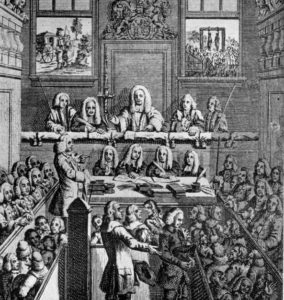
Freedom! Freeeeeedommmm! Well, no job and nothing but a piece of paper with the word acquitted on it but at least not transported or hanged by the neck until dead or anything. The latter prospect was cheerily and apparently popularly depicted in the background of that illustration up there showing the Old Bailey in 1735. Moral of the story? If you are going to cheat in 1725 cheat a bigger cheater who’s been cheating the Crown.