Your Last Thursday Beery News Update Before the Impending Canadian Hung Parliament

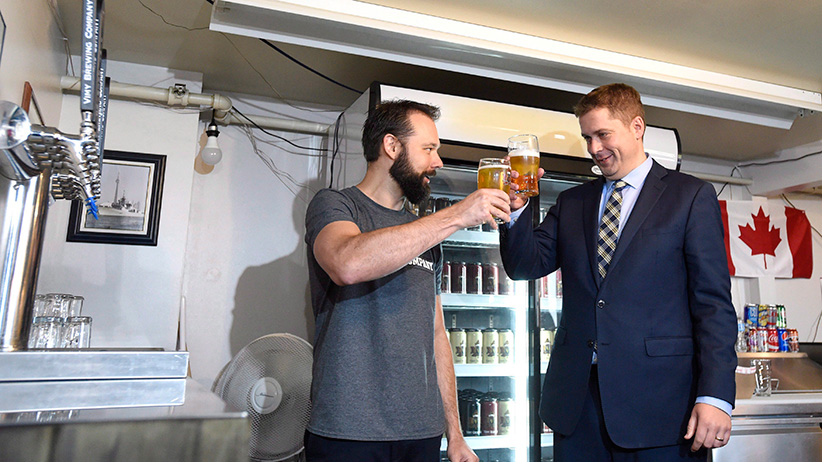
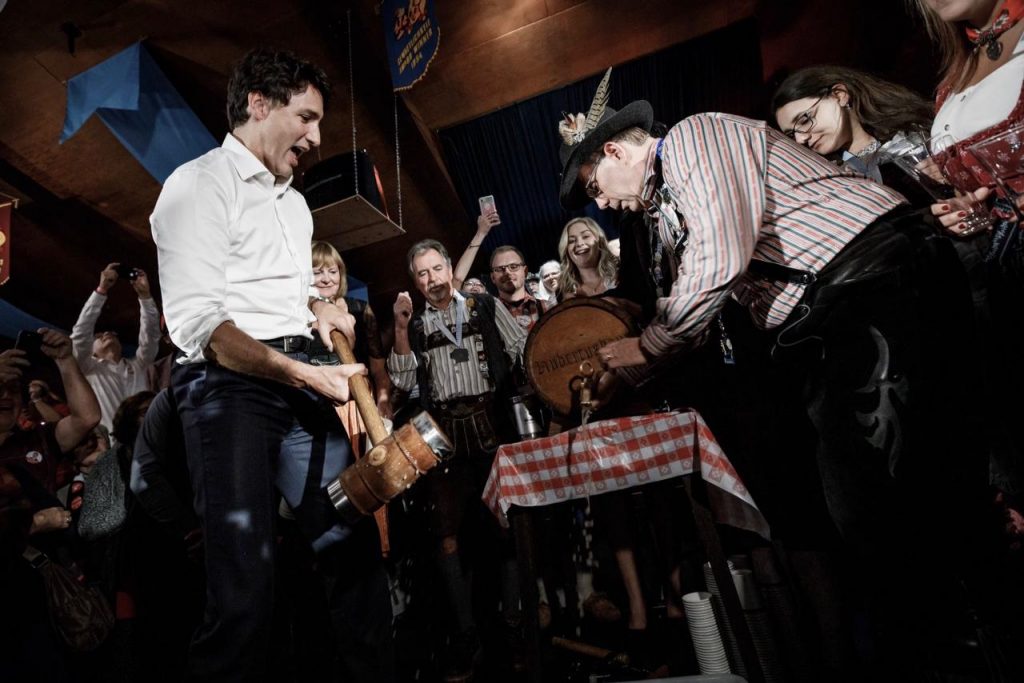
This is great. We have an absolutely gridlocked national political scene according to the polls and that, for a Canadian, is a wonderful thing. We love minority in our national federation of a parliamentary monarchy system. Best is there is a good chance that the highest vote won’t equal the most seats, given 105% of Albertans vote Tory. Probably the guy tapping the keg last week in Kitchener (at the world’s second largest Oktoberfest) gets the nod as PM.* The Leader of HM’s Loyal Opposition just looks too much like a 12 year old in his bigger cousin’s suit to pull it off. Which is fine. Which makes minorities great. Things get done. Deals get made. Progress happens.  I know in the US folks are all like “wuzza third Party?” and in the UK folk are all like “making deals based on compromise?” but here in the Great White North we know what works. And that is working.

First, an acknowledgment and a bit of a bummer. I read this note this week at Stan’s place:

For 6 years I assembled links to good reading about beer and other things fermented, posting them here on Mondays, often with a bit of commentary. That ended in with the arrival of October in 2019. Of course, the archives (in monday links during 2018 and 2019, musing before) remain, and at the bottom of every post there is a list of sites that have new links every week. You may also look at my Twitter feed on the right to see what I’ve been reading.

It would be telling half a story if I were to tell you that Stan is my favorite beer writer, the only person I will call a “beer expert” given the depth and breadth of his comprehensive knowledge. He has always had the time for my dumb questions and has even taken the time to tell me to go to straight to hell… now… exactly when I needed it. I will be sad to not read his thoughts at the beginning of every work week but I have noticed an uptick in his own blog writing activity otherwise so maybe he will focus on more posts. A welcome thought. As is the news that there will be a Lew v.2.

If there was a next gen candidate to follow in Stan’s footsteps, Evan Rail might be it. Late last week, just after the round up hit the presses, he posted an article at GBH.  (And without the obligatory 27 “GBH” references embedded in the text, too! He must know how to negotiate a contact.) The article is about hops and, more specifically, a trip he took to the Hop Research Center in Hüll, Germany to learn more about their breeding program:

Breeding itself is a delicate process. Commercial hop plants are generally all female, with female flowers. To create new crosses, male hop plants—which usually but don’t always have male flowers—are also bred. But, in the middle of a commercially important hop region like the Hallertau, how do you raise male hop plants, when just a pinch of their pollen can create unwanted hybrids on the surrounding farms, potentially ruining the crop?

Me? I probably would prefer the unofficial version of the history of CAMRA, which is what the “biography of the organization” is actually called.**

We would like this perspective to come from someone who is not perceived as having a close association with CAMRA.  The brief is for a c.50,000 word authorised biography of CAMRA, to be researched and written in 2020, with the text due at the end of the year, ready for publication in March 2021 in time for the Campaign’s birthday celebrations. Exact outline, terms and fees to be negotiated.

Nothing like a book where the subject matter gets to negotiate the outline.  Also from the UK and in line with such thoughts on the improbabilities of the world we live in, a stark truth from an English brewer on the perfect pint pour:

A proper family/regional head brewer would know that the perfect amount of foam is that which allows the publican to sell 105% of the beer from each cask.

Next, Martyn has continued in his Martyn-like habit of posting long excellent blog posts with another long excellent blog post on corporate misinformation about a certain Sri Lankan brewery’s history:***

Mind, even at five errors in four sentences, that’s not the worst pile of nonsense on the internet about what is now the Lion Brewery, famous today for an award-winning strong stout that is one of the last links with British colonial brewing in Southern Asia. The Lion Brewery’s own website is full of rubbish (and bizarre random capitalisation) as well…

Odd news out of Oregon where one brewery has been vandalized twice in recent weeks… by the same person:

Police contacted Albin in the area and arrested her for first-degree criminal mischief. However, Albin was released from the jail just three days later. She returned to the brewery around 2:30 a.m. Tuesday. That’s when she allegedly threw rocks and liquor bottles into the windows and doors of the restaurant, and made Molotov cocktails that were found thrown around the inside of the brewery. The entire incident was captured on surveillance video…

Speaking of Molotov cocktails, I now have less of an issue with paper-based beer containers:

Carlsberg announced the launch of two prototypes of the new bottle at the C40 World Mayors Summit in Copenhagen, Denmark. The newer, eco-friendly versions are made from sustainably sourced wood fibres and are fully recyclable. The concept of a paper-based bottle may sound strange at first, as you wonder how the structure would stand firm, holding liquid safely inside.

…but the technology probably would be put to better use in the jams and jellies trade. Which I assume is about 1,297 times bigger than beer. Isn’t it? I need to check out Insta-jam or whatever that corner of the social media boglands are called.

There. A bit of a quieter week, I suppose. And not particularly wide in the selection of voices. I did hunt around, honest. Let me know what I am missing. Still, plenty of good reading for a week filled with many bigger matters. Some things beer can’t fix. Expect a further Boak and Bailey news update on Saturday and then check out  the OCBG Podcast on Tuesdays. And look for mid-week notes from The Fizz as well.

*Fact: Canadian politicians must love beer.
**Illiteracy is an alarming problem, as we know, in the industrial scribbling circle but this is inordinately odd.
***And one I love as their foreign export stout makes it regularly to Ontario.

The Mid-July Thursday Beer News You Need

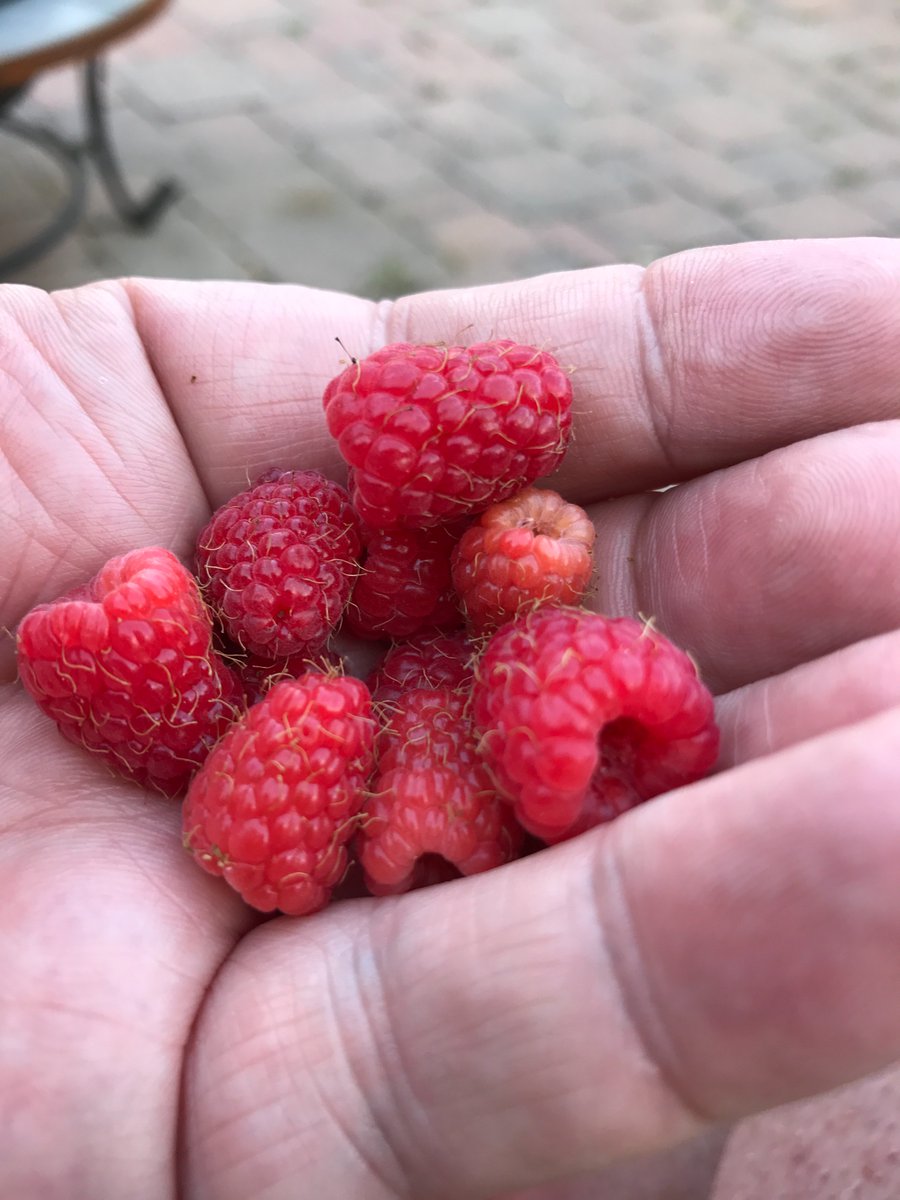
Mid-July! It’s lovely. Warm. Tropical even. We are actually getting the edgy remnants of Hurricane Barry into the Great Lakes basis so it’s all a bit thick out there.  Raspberries picked by my own sausage-like digits. And the fire flies are at their peak. I let the garden go a bit and they seem to love it. 100+ flashes a minute in one corner of the garden. Beer has its role, too. I even had one last night, mid-week. At a Denny’s.* A Bud Light. The weirdest thing was being handed a ice cold bottle and an ice cold glass. Entirely hit the spot. Mid-week, mid-month, mid-summer, mid-year, mid-aged.

What is going on? Well, Josh Noel, who admitted to needing something to wash out his mouth after writing about hard seltzer, has written a helpful article for the Chicago Tribune on dark lagers:

And that gets to the genius of dark lager. They’re beers that typically have a modest amount of alcohol — about 5 percent or so — but are long on aroma and taste. Flavors usually include a mild to deep roast character and can veer into chocolate, char or coffeelike terrain thanks to the roasted malt that gives the beer its dark hue. But unlike most of the porters and stouts they resemble, dark lagers tend to finish dry. The best dark lagers make for stealthily ideal summer beers: interesting layers of flavor, but refreshing. The color, which can range from deep amber to impenetrably black, winds up playing a visual trick.

We have an excellent local black lager, Blacklist from The Napanee Beer Company, so I am particularly grateful for this addition to the discussion.

Note: “bee boles were used before the development of modern hives to provide shelter to the skep…”

As we have been noticing over the last few weeks, beer writing and commentary seems to have divided into (i) “it is so dull and boring right now” for one reason or another** and (ii) HOLIDAY!!! So it was good to see some interesting travel being discussed by a couple of Brits abroad. Nate posted a top ten list of things to do in a city I have lived near – Gdansk, Poland – and gave ten top tips for visiting the old Hanseatic port including hitting up a museum about the Solidarity movement and this:

Shoot Some Guns – Maybe a controversial one, but I’d always wanted to shoot some guns since we can’t do it in the UK and I stumbled across a shooting range whilst doing some research. DSTeamStrzelnica was a great experience where we got to shoot four guns (A Glock 17, a revolver, AK-47 and another rifle) and it only cost us £18 each to shoot a full clip of each gun. It was a really fun experience!

Retired Martin has been in NYC and left us a photo essay with commentary:

How joyous to see a “Sorry, no samples” sign, by the way. 16 ounces (80% of a pint) is practically a sampler anyway.  I reckon the Five Boroughs Hazy IPA served in a plastic glass will have cost me £8 by the time taxes and Lloyds Bank conversion charge are added on.  Still cheaper than Port Street. “Tastes like Brew Dog” says Mrs RM.  It tasted like Hazy Jane. On to the High Line, the one place in New York where you can avoid craft beer and tipping…

Saskatchewan’s Pile O’ Bones Brewing Co. is getting a bit of heat for its name – folk saying its disrespectful to the local indigenous community – but according to this Cree language place name resource site, the location of what is now Regina was called “oskana kâ-asastêki” which meant “where the bones are piled.”

Beervana had a interesting guest blog post this week written by Ben Parsons is the co-founder/brewer, along with Rik Hall, of Portland Oregon’s Baerlic Brewing which unpacked the benefits in the US for craft brewers to self distribute their beers:

I would posit that if and when a brewery business does get into some troubled water—albeit from market conditions, saturation, losing chain grocery, etc—not owning their own distribution rights could easily be the last nail in the coffin. And although distributors are a very necessary part of the industry, their foothold on this particular part of the conversation is risky business and needs modernization so that it better fits with the current state of the industry.

Folk chatting about early brewing methods is always interesting. Who knew that bands in the pottery meant the line to fill with boiling water before topping up with cold before adding in the mash was so obvious?

At the Corrigall Farm, Orkney, large tubs that have marked lines inside, usually about one third to a half way up. Custodian told us (years ago, hope I have the details right) that you put in boiling water to the mark, then top up with cold and it’s the correct temperature.

Pilsner as the anti-NEIPA? Maybe.

This is an interesting piece, a remembrance of 16 of B.C.’s now shut early micro- and even some more recent craft era breweries. And it contains this interesting bit of history:

Horseshoe Bay Brewery was the first microbrewery in Canada when it was opened in 1982 by John Mitchell and Frank Appleton to produce beer for the nearby Troller Pub and became Ground Zero for the craft beer revolution. Mitchell and Appleton soon moved on to Spinnakers, and Horseshoe Bay briefly closed in 1985 before reopening and produced beer well into the 1990s, before closing for good in 1999. The original brewhouse, made from converted dairy equipment, is still in use today at Crannog Ales in Sorrento.

Now, that would be a real Canadian beer nerd’s pilgrimage: “honey, I am off to see the original brewhouse, made from dairy equipment!” It’s halfway between Kamloops and Sicamous, if you are planning the trip yourself.

That’s it! Have a great week as Q2 turns into Q3. I will be lounging myself. Well, dapper by day then lounging through evening. Such is the life of the office worker. Check out the beer news from Boak and Bailey on Saturday and maybe on Monday we will have a sighting of the inter-continental Stan now that he is back from Brazil.

*You can mock me after you’ve tried the burger. I was surprised, too.
**hard seltzer, everyone’s already been bought out, even glitter beer is so last year…

Apparently The Beer News Heats Up When We Reach Mid-February

Happy Valentine Day. Or is it Valentine’s Day? Never sure. Me, I grew up in a florist’s household and, as a young lad, was a Netherlands-trained wholesale florist myself. So, I pretty much have burned the entire thing out of my consciousness. Watching people line up to pay $80 bucks for roses when $25 worth of fresh red tulips was the smart move gets depressing. You worried about the big macro industrial beer trade? Worry about the big macro industrial rose trade. Just sayin’.

In other VD related news, thankfully the “what beer to pair with chocolate!” story and the “how to confront your date with beer on your big day!” story seem to have both mercifully gone away. Did you see as many? It feels like something grew up, like watching your teen finally eat a damn green bean. Time to get back to a more honest, wholesome approach. Hmm… stuffed haddock imperial sounds pretty good, actually. Thanks Pam!

Other than that, as I mention above there is plenty of heat in the real news left in the last few weeks of winter. For starters, Jeff shares the news that Portland, Oregon’s seemingly perhaps formerly beloved BridgePort Brewing has shut after 35 years:

This will hurt the soul of many Portlanders. Even if BridgePort wasn’t locally owned, even if it wasn’t making interesting beer, and even if the pub had been turned into a wannabe Chili’s, it was still the oldest and perhaps most important brewery in the state. Exactly 20 years ago, we lost a monument to Oregon beer when Miller shut down the old Henry Weinhard brewery that anchored downtown. We will lose the most important remaining emblem of our brewing history when BridgePort shutters its doors thirteen blocks north of Weinhard’s.

Keep in mind one thing. This and the other closures being reported in 2019 are occurring in an economic upturn.  What will happen if the economy starts to actually wobble?

If that sort of prospect weren’t bad enough, Robin rightly blew a gasket (as did many many others) over an entirely unnecessary but utterly sexist and creepy story run in the Great Lakes Brewing News:

This post isn’t going to talk too much about beer, but it’s something related to the beer world. Primarily one of the many things wrong with it in regards to its treatment of women. No no, this isn’t going to be talking about a sexist label or a really bad PR gaffe in which a rape joke was made. This is a special kind of trainwreck.

In response, the author/editor/publisher indicated that it was all a one off satire. Problem is… there was nothing satirical about it. Also, as I was able to show via a couple of tweets, the GLBN has had a long standing habit of publishing the author/editor/publisher’s pervy creepy personal fiction for over a decade. Breweries (including Fat Head’s which has supported with advertising for years) have now begun abandoning the publication. Nice to see, by the way, someone turning the stupid immortal Calagione statement that the craft brewing industry is “99% a**hole-free” back on itself. 99% asleep at the wheel on such matters might make for more accurate math. More here at a Wednesday round up in Detroit’s MetroTimes.

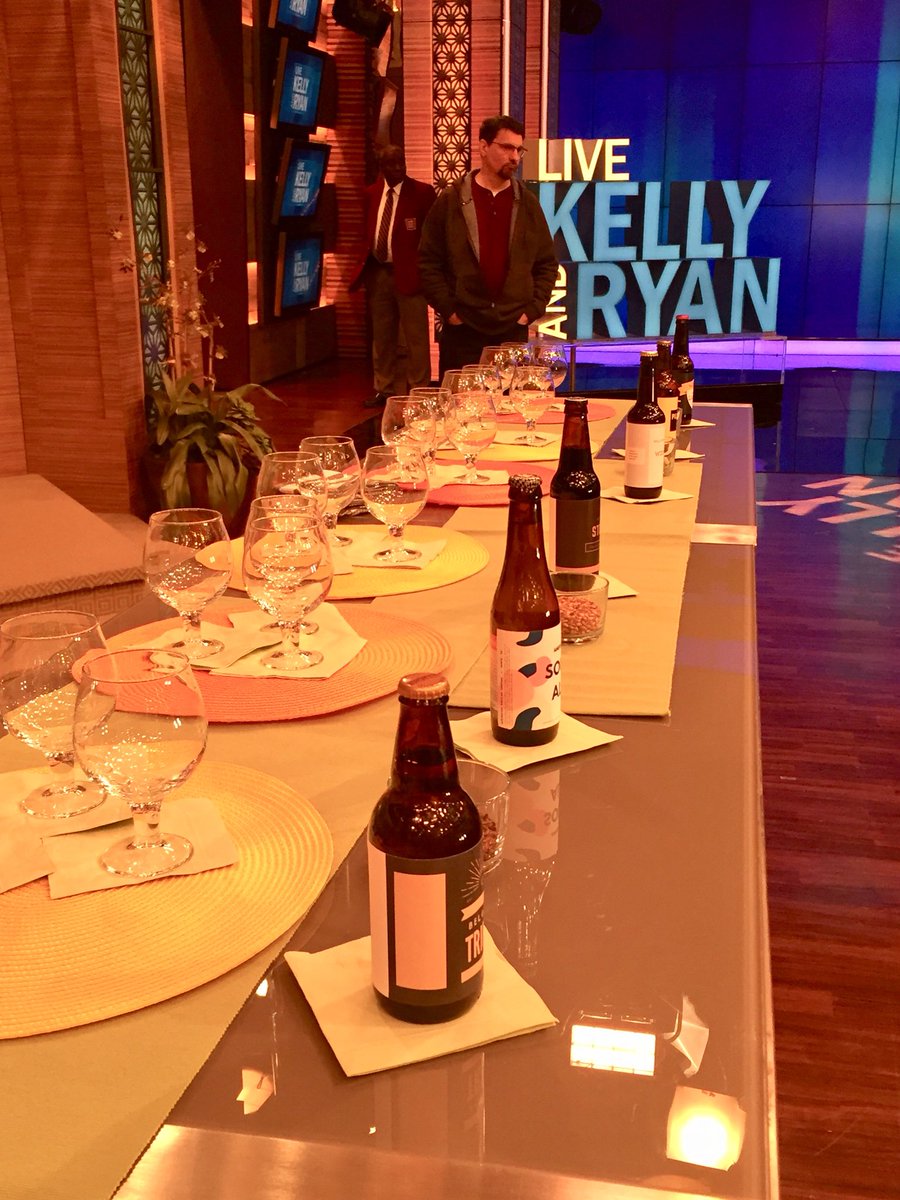
Entirely to the opposite and building on his Beer 101 webcasts that mentioned last December, Garrett Oliver proved again why he is the leading spokesperson for good beer in North America when he strode upon the small screen on US broadcast morning show LIVE with Kelly and Ryan under the FeBREWary banner:

Look alive, peeps! In the green room about to appear on @LiveKellyRyan. We’re going to improve your Monday! In the meantime, the chocolate chip cookies in the green room are pretty good. The life of the modern brewmaster is a strange thing….

Discussing good beer with the authority the O.G.G.O. brings is a rare thing indeed. Placing it on a normal everyday national forum like that was almost a shock. Here is the four minute segment.

In other good news, Anchor Brewing is thriving and going union!

There are approximately 70 full- and part-time employees in the bargaining unit, spread across the Anchor’s production facility in the Potrero Hill neighborhood and its taproom, Anchor Public Taps, across the street. The brewery employs approximately 160 people total, including white-collar workers…

Video of the week: drunken horse riding in England in 1972.

Floorboard story of the week: early 1900s Danes hid brewing archives under them.

A drinks man,  the roaring boy has left us.

Graham Dineley* has posted something of a personal history of coming to beer which entirely parallels mine – 1980s home brewing along with Dave Line’s books:

My first Baby Burco on the left, on it’s third element, is now relegated to heating sparge water. In the middle is my last remaining beer sphere, Peco mash tun and demi-johns. Inside the blue sleeping bags there is 10 gallons of beer in the final stages of primary fermentation. I bought my ingredients from Hillgate Brewing Supplies in Stockport, the shop mentioned by Boak and Bailey. It must have been just after the shop had changed hands from Pollard. The man running it was John Hoskins, if my memory serves me right. I would phone in an order: “Two of page 88 please” and pick it up the next day. He would make up recipes from David Line’s “Brewing Beers Like Those You Buy”, which was a boon for a novice brewer without any scales.

A Burco! We had a home brew shop owner in Halifax that would lend out Burcos for free like a beery private librarian when you bought your malt and hops. Fabulous. And a completely different route into good beer than the authorized version would let you believe.

Speaking of rambles down the unilateral memory lane, I might be coming around a bit more to #FlagshipFebruary even if the month is long and, frankly, chores are being missed.** It’s a good measure of which memories are considered important to some – naturally I suppose given the model includes allocation of stories through the assignments. Not everyone gets to choose Sam Adams, for example. So what has week two given us? I hand’t paid much attention to  New Zealand’s Epic Ale which seems to be a clone of a mid-2000s C-hop brew. Good for the Kiwis getting a day. I’ve like most New Zealanders I’ve met. Similarly, Evan wrote glowingly on Samichlaus which is a beer I regularly pass when shopping. Racing to be the strongest beer was like being the hoppiest – a bit of a genetic dead end in good beer but still Samichlaus hangs on. Having passed between breweries, it’s a flagship in the sense that war prizes can stock a naval fleet.*** Two more weeks to go. Crickey. No suspense that SNPA will be the last one reviewed, right? Bet it gets ripped. No? You’re probably right.

Well, that’s enough for now. After last week’s update Maureen gave high praise. I am simply grateful that somebody reads this stuff. It’s all just talon sharpening for my real world life. Well… and temper tempering I suppose. Best not to ask my inner voice too many questions. Unlike Boak and Bailey on Saturday and Stan on Monday whose more cogent thoughts should set you off in all sorts of new directions. Two weeks to March! What will March stand for? What will be it’s new hashtag? We’ll have to think about that.

*Yes, indeed.
**Nothing tells you there is a bit of confusion more than GBH insisting there should not be confusion and that he/they/it are confused by it. If people only understood how smart they were they’d get over all the weirdness.
***Whose navy indeed!


Your Beery News For A Thursday Now That The Cardigan Is Finally On

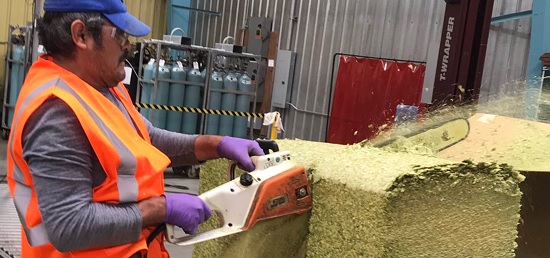
It’s World Series time. When I started putting these notes together, the first game hadn’t been played. By the time it is posted, two games will be in the books. [Ed.: Oh, the Sox won game one!] I hope the idle Stan has time to catch a game or two… not a certainty given his global gallivanting seems to be continuing. This week, he sent us all this wonderful holiday post card of a photo (above) from Crosby Hops of Oregon. Respect beer. Keep the chain oiled, but respect beer.

Wine drinkers unfairly punished by UK taxes” says wine writer Jancis Robinson responding to a discussion on the implications of Brexit. Has anyone been writing about the implications to the UK beer trade? My hope is that a currency crash and tariff increases might bring on a golden age for Fuggles. There is this point, however:

The Alcohol Beverage Federation of Ireland (ABFI) has warned that exiting the EU without finalising an Irish border solution is expected to cost €364m worth of drinks trade between Ireland and the UK. The outcome would restrict an estimated 23,000 cross-border truck movements and attract additional new tariffs on supply chains.

To be fair, it’s not like the €364m worth of drinks will not be bought and drunk. It will just be domestic bevvies from each side of the border. Does Guinness rebuild its UK operations? Probably. [Ed.: Wait – that’s not what a good blogger does.] DEFINITELY! Diageo to return to the United Kingdom by Q3 2019.  You heard it here first.

Speaking of wine, look at the size of those servings! Wee lassie sniff-a-wine is pre-gaming for the twentieth century, I’d say.

Are we actually concerned that there are too many references to cannabis in craft beer branding? I hadn’t really noticed it but now that weed is legalized in Canada, I have not been too sharp on the ball. It’s all like a hot box here, the entire country. Have you ever seen a moose in the woods smile dreamily? You can now.

It’s been an interesting week for comments about writing about beer for magazine money. Boak and Bailey in their monthly newsletter (which you really should sign up for) shared that they are done with it for the foreseeable for  very reasonable reasons including frustrations of pitching pointlessly, frustrations with not getting paid, and frustrations when articles are not published. I’ve avoided the crutch of pop beer mag writing for the most part but was quite disheartened when MASH mag went under without publishing my third article on early Canadian brewing… as in early 1600s brewing. BB’s comment – “Can you make it more appealing to Americans?” has worn us down rather – is telling, too. A variant on the too often seen editorial theme of dumbing down. The wonderful @Shineybiscuit shared another curse of the gig:*

Months of pitching a national about the great pubs in my area has resulted in a TV food critic getting to write the piece instead. Love my job.

Yikes! I hope Boak and Bailey still spare a thought for Original Gravity which, while it tends to work “the romance of beer that everyone feels on their fourth pint” as editorial stance, still offers great value for money. And it’s made it to the 20th issue which is worth celebrating in itself.** Very few do, usually with good reason. You can read it here for free.

A fabulous bio of Carol Stoudt got a Lew link and I link on. I love this paragraph:

As the craft beer industry blossomed around her, Carol smelled the roses — and detected the need “to deepen the trenches” in her home state, she says. “As more local breweries pop up, there’s no need for me to be in those markets.” She pulled back distribution around 2015 to bring her beer closer to home. “I never wanted a factory,” she says. “I like small. It’s kind of my philosophy.”

That’s captures what I have been trying to say for about a decade. If you can’t say “I never wanted a factory”, well, I’m not all that interested in what you are brewing. “Factory-made beer” is a wonderful slag against all pretenders of all label levels.

Jordan posted an interesting essay on his experiences returning to England after five year, following up on his piece [… which I have linked to somewhere around here…] what was it called… “Belgium Sucks More Than They Tell You“?… no, couldn’t have been that. Anyway, I liked this point in particular:

Here are some changes that happened when I was away: St. Austell Proper Job in cans. Apparently this is a 2018 development and six packs are available through TESCO. You know how the LCBO changed the market in Ontario by demanding 473ml cans? Well, this is a similar development and something of a standardizing influence between young startups and larger regional legacy brewers. The retailer isn’t quite king, but the 500ml bottles do look a little dated and the deep bottle discounts for multiple purchases do influence the consumer. Cans at least move volume without sacrificing the perception of value.

What is not often noted in the hack writing about “crushable” and the art on cans is their actual benefit as a flexible friend: lower investment, more control, and still that sense of value. Jordan’s other comment about Beavertown Gamma Ray – “there are a couple of dozen better American Pale Ales brewed in Ontario” – was also welcome. It is not, after all, about the quality of the beer, just the quality of the blessed “experience“… which a pop beer mag can tell you all about in a sentence and a half at the rate of about 17 cents a word.

Don C of CNY has penned an interesting article on the return of the (tiny) NY Prohibition Party:

The state’s “pro-alcohol policies are making New York sicker, poorer, and more highly taxed,” the Prohibition Party leaders  said. “Those in state government should come to their senses and end state support for the alcohol industry, or the people should vote to replace them with public servants who will.”

“Should” is the dumbest word in the language. Makes people think what isn’t is what ought to be. No “should” with Pete as he continues his considerations on cask in the UK again and in particular he discusses price. Let me ruin his ending for you:

Price is a thorny topic to get to the bottom of. As a cash-strapped drinker, of course I don’t want the price of beer to go up. But as an adviser to brewers and pubs, I’d say there’s a lot more potential margin in cask if you want it – and if the quality is good. 

The important thing to note is that a lower price is what is being offered and what is being paid. The market is what the market says it is. Which means if folk are happy with lower-price lower-quality cask, well, that might well be the product they want. Hard to capture that as a PR consultancy message*** but it might well be why what is… is what is.

Well, that is it for me for this week. The lettuce patch has not yet suffered a killing frost even if the last green tomatoes have been brought in to ripen on the window sill. The furnace doesn’t run all night but it sure gets turned on before I make the coffee. Winter is coming – but it ain’t here yet. Weekend readings? Day dreaming again, wishing that Saturday was as fun as a Thursday? Fret not. Find your next beer news fix at Boak and Bailey.

*Then removed with well-worthy self-asserted defiance! Fight!!!
**Not the Canadian… err… Toronto edition of OG which seems to have gotten stuck at issue #1.
***Though I am quite fond of my new open source media campaign on the topic “Cask: Reliably Highly Unreliable at a Reliable Low Price!”

Your Monday’s Thoughts On The Latest Beer News

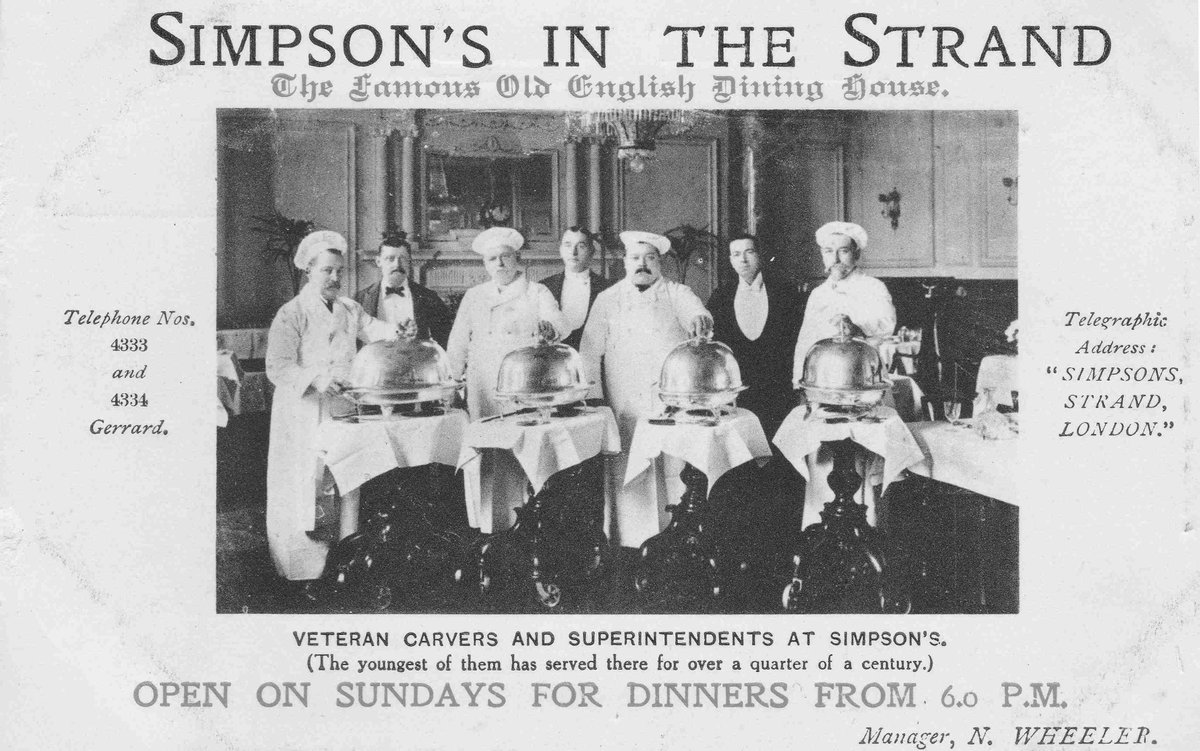
Ah, Monday. And a Monday after a quiet weekend on the beer blogging scene hovering just at the cusp of the holiday season. Dreams of Victorian veteran carvers are starting to dance in the head.* Nothing from 1600s or 1700s brewing history is nibbling at my brain at the moment. So, I turn to that other older thing I did on the blog and give a few news items less attention than they deserve. I think something picked up as Stan’s summer intern might be to blame. Enough! Too much self examination leads to bad things like supposing one might need an editor or running off chasing another hobby. No need of that. Here’s the news.

First, Martyn has posted his findings related to a trip to Norway in search of the meaning of kveik. I initially thought this a bit odd given the voluminous obsession with the subject that has been the last few year’s work of Lars Garshol including this post from just a few weeks ago entitled “‘Kveik’ – what does it mean?” But I quickly understood what what going on – a helpful summary and transposition of sorts: kveik for dummies… like me.  Once you read Martyn’s piece, I recommend you set aside a few evenings to go back through the research results posted by Lars. The idea that a third branch of brewing yeast has been quietly living on in rural settings to the north and east of the Baltic is fascinating.

On a far smaller scale, over the weekend I tweeted a tweet:

Thoughts on a can of GK Abbot Ale. Incongruous messages about cold black tea, caramel, whisky malt, potters clay in a body with oddly flat fishy stickiness. Still… relatively cheap.

That got me thinking about how consequential each beer one pours in a glass must be. The beer in question cost $2.30 which translates to £1.38 or $ 1.80 US. If I had not been paying intentional attention, it would have passed by my mind without much comment. That weird little nod to clay would not have raised itself to my consciousness. Yet just 50 cents more would have bought me a fine example of the low end of excellent regional craft. Can we still care at all for bulk imports?

Imagine – taking money to offer a favourable opinion on a beer.  Who saw that coming?

Next up, I have one itchy thought about the whole – let’s be honest – kerfuffle going on in Portland, Oregon between a brewery and the City over the use of a leaping stag logo which has appeared on a beloved landmark sign for decades. Jeff has described the issue from the perspective of one side of the debate, which is a very important one given the small brewery actually is the party that has held the trademark since 2012. But before the trademark, there was copyright. The classes of intellectual property are distinct. The craft brewery did not create the image. The sign permit was acquired in 1940 and, as authorship immediately creates copyright, someone created the image then. So, someone must own or owned the copyright in the design of the stag which is separate from and prior to the trademark. Can one trademark someone else’s design? Apparently so – but does that extinguish the copyright? These sorts of things can vary, but if (according to Wikipedia) the sign was built and owned by Ramsey Signs from the 1940s to 2009 when the City bought the sign from them, did the underlying copyright to the sign design not also pass to the City? Dunno. I once represented a man who argued he owned 25% of Times New Roman font as he owned one of the original sets of hand made typeface. Not everyone agreed but I recall he said he did receive royalty cheques. So, who first drew the leaping stag?

I think following Ypres Castle Inn means you are of a certain age.

Finally, I do tire of references to temperance as code for everything one does not like in beer regulation. It’s up there with anxieties over lack of wine world respect. Face it – public health is a key foundation of modern western civilization. Who would chose to go back to the pre-temperence society? Even when the do gooder sociologists in their laboratories get it wrong no one in their right mind wants them stopping doing their work. Give the church its gruitgeld!!!

PS: boring big craft pretending that it’s pretty much the same as taking outside investor money and the attached strings. Somehow related.

Is Good and Craft Beer Really A Form Of Temperance?

Yesterday, Jeff reviewed the stated purposes of Oregon’s Liquor Control Act of 1934 as part of an exploration of the regulation of strong drink in his state. Lew has been writing along a similar line for some time on his separate blog Why The PLCB Should Be Abolished. Cass has been running a similar campaign here in Ontario at FreeOurBeer.ca. I like these campaigns as anyone should who lives in a jurisdiction with a sensory lab. It is, after all, just beer.

But one of the odder things about the good beer discussion is sometimes a bit of pressure to sing of the same song sheet. When I posed a category titled “Beer Bloggers Against Drunk Driving” there is a bit of a chilly response, the idea that one ought not to introduce anything negative into the conversation. One should not have a strong opposite view that asks why good beer might be a wee bit obsessively too central to the world view of those who write about it. It is, after all, a drug.

All that comes to mind for me when I look at the values Oregonianites captured in that law of 1934, we see words that sit in a middle ground, that challenge me to ask how I think about them now almost 80 years later:

(a) To prevent the recurrence of abuses associated with saloons or resorts for the consumption of alcoholic beverages.
(b) To eliminate the evils of unlicensed and unlawful manufacture, selling and disposing of such beverages and to promote temperance in the use and consumption of alcoholic beverages.
(c) To protect the safety, welfare, health, peace and morals of the people of the state.

I have been thinking about words like these a bit lately. They don’t seem to me as bad as the discussion might have led us to believe. In the comments following his post, Jeff raised the spectre of that darling of pre-WWI American prohibitionists, Carrie Nation. I noted that Carrie Nation was not a proponent of temperance but of abstinence. See, my point is that preventing abuse, promoting temperance as well as protecting peace and morals is pretty much what much of western culture wants when it goes to work or mows the front lawn or sends the kids to school. Which may mean we have to consider that in the end maybe temperance won and much of western culture is the better for it. None one advocates for abuse, intemperance, peacelessness and immorality. Of course not, no more than you would support other scourges of 1800s life like child labour or lack of public health. We underestimate or dismiss how more widespread and heavier drinking was then compared to now and how it may have come smashing into conflict with industrialized urban life.

So, is good beer the natural descendant of the temperance movement? Just as lower alcohol lager was presented as a temperance drink in the latter 1800s, is tastier beer now conveying the notion that mass produced beer need not be mass consumed? This is not to say that the liquor control boards should not be undone. I want to buy my beer in cornerstores and gas stations in Ontario like I can in nearby Quebec and New York. But should we reject all? What values can you not support? What regulations would you keep?

Hair Of The Dog: Project Salvation

OK – so the issues are being worked out. And I had one Doggie Claws last night and it was infanticide, loverly but really under carbonated and cloudy. It struck me like a homebrew that I popped at two weeks rather than waiting for five to pass before I invaded its space.

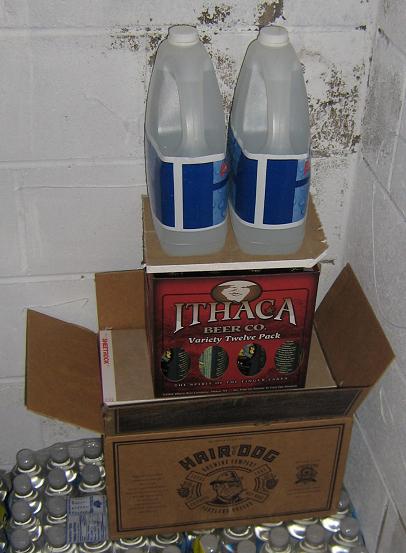
As a result, we are going to work on a little experiment. In the lower box are 18 Doggie Claws under the drywall board which are under 12 Freds which is under drywall boards which are under 8 litres of water. So all in all there is about 30 pounds of weight on the lower beer and 20 on the upper. That should assist in keeping the caps in place and the seals secure.

Aside from those hibernating 30 beer, there are still seven Doggie Claw left without the weights and, after a little sharing and a little more tasting, the Fred has six unweighted bottles left some of which have very low fill lines. The best of these remaining bottles may get a wax seal to see if that can increase the carbonation or at least stop air getting in and spoiling the brew.

Click for a bigger view.

Update: An update on Project Salvation after eight months. Had a Fred last night and the yeast held up, keeping the air out at the start and the weights on top of the caps has maintained a thin line of cap to glass contact. And the beer is still quite wonderful.

Hair Of The Dog: A Couple of Difficult Cases

This may turn out to be an epic. It may end in tears. Whatever it is you can click on each picture for a bigger image.

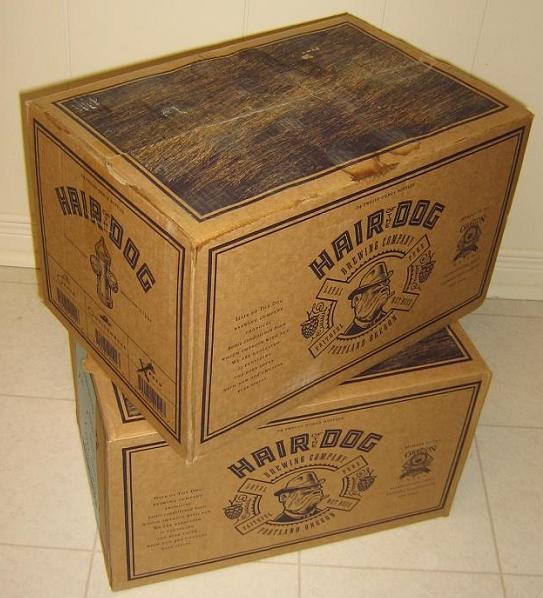
In the early fall – actually on September 28th 2006 just after noon – I jumped into my first LCBO private order, two cases from Hair of the Dog brewery in Portland Oregon being organized by the excellent gents, those Bar Towellers out of Toronto. I faxed through my deposit of $51.60 CND on a total order of $197.96 CND. I ordered one each of Doggie Claws and Fred, two 10% or so barley wines from one of North America’s top boutique brewers. I had a Fred when I was at Volo earlier this year. And then I waited. And waited.

Around the first of December, the order came into Toronto, I paid the balance and waited for it to make its way 220 km or so east to Kingston. Then there were rumours of issues with the capping. Excellent, I thought – bottle variation. The curse of decent wine. Jon Walker, a Bar Toweller, noted:

This thread worries me. As a result I went in to check on my stash of HOTD and indeed many of the caps are not fully crimped onto the bottles. Most flair at their base and do not fully grip the lip of the bottle. I was actually able to press up on one with my thumb and get the gas to release in the “PPST” common to uncapping. What do I do know? I don’t have a capper to close the caps properly (if they actually CAN be sealed, perhaps they are the wrong size???). I’ve got just shy of 70 bottles left and I’m loathe to believe I might lose some to oxidation due to loose caps.

The cases showed today, 21 December 2006, about 12 weeks after they were ordered which is really not that bad seeing as I think the beer was still in the tanks when the order was originally placed. But there was an obvious problem from one look at the case of Fred that seemed to echo Jon’s words above.


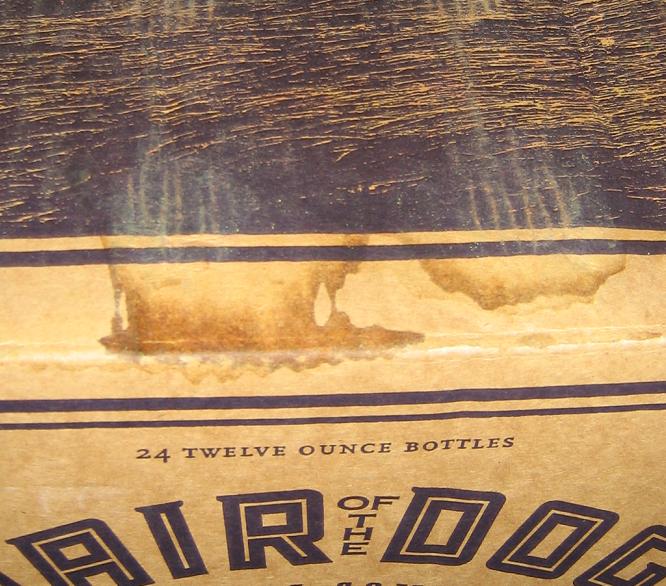
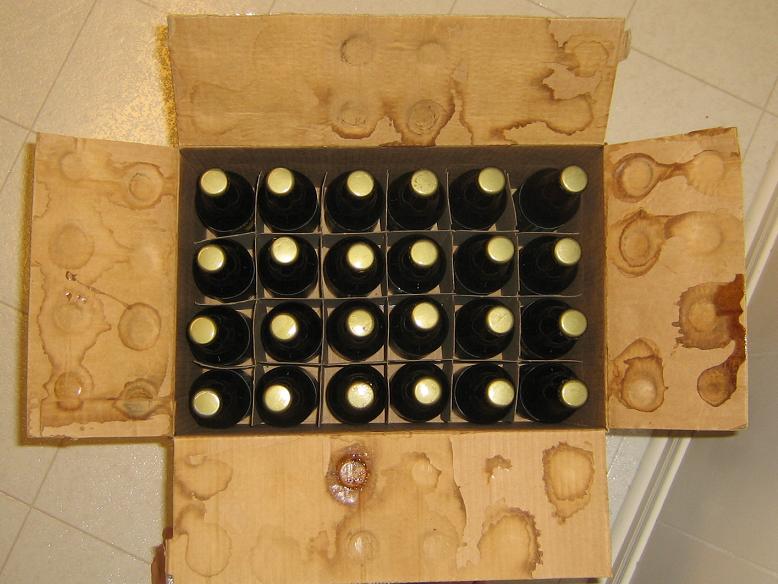
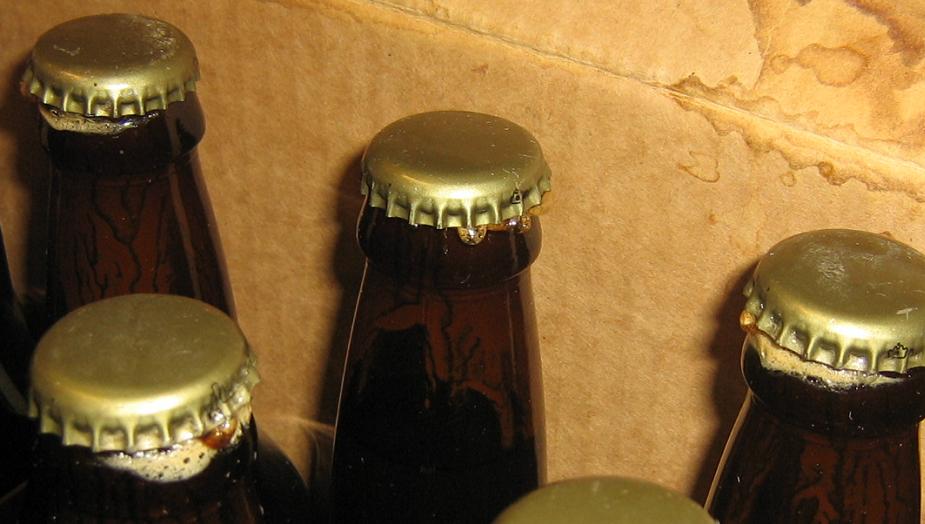
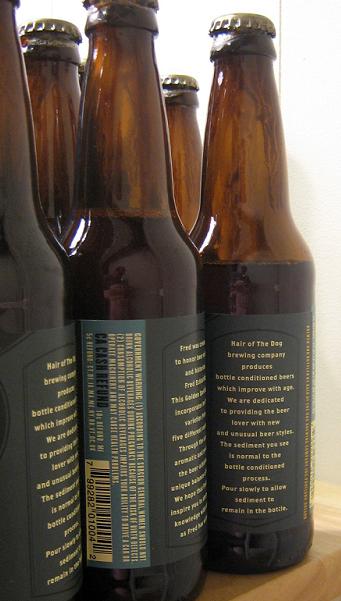
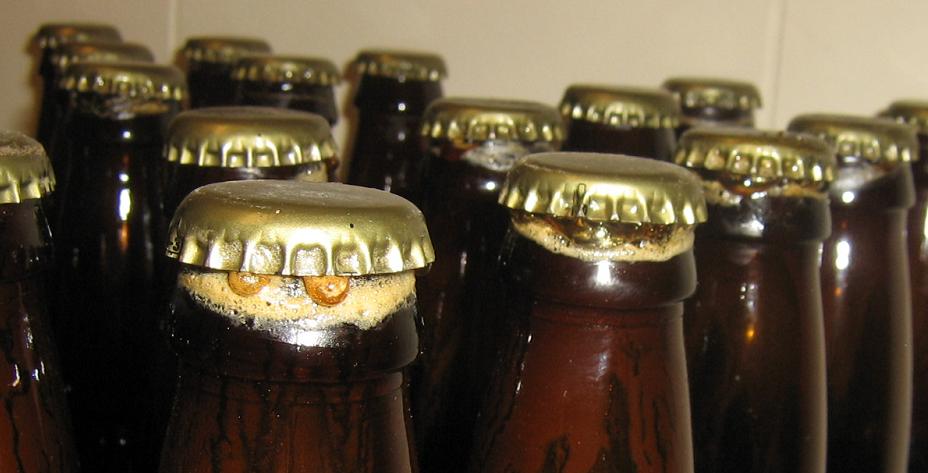
When I got home I decided to have a look inside and what I found was not pretty. The inside of the box was soaked. Ten bottles were seriously uncapped with significant beer loss with mostly empty necks like above at the right. In addition, twelve were showing little beer loss and two showed some promise. All were irregularly capped in the same way. Some caps show some rubbing and wear like there was a mechanical issue when they were put on.

It looked as though it was shipped upside down as there is plenty of yeast in the necks and a fair amount of beery sneakery out from underneath the caps. No violence to the box, just seeping. This may actually be a short term saving grace. The smell is also rich and clean, not sour like a bar on Sunday morning. I will have to have one. I am a little depressed, a little pissed off and a little curious. I have not even looked at the box of Doggie Claws.


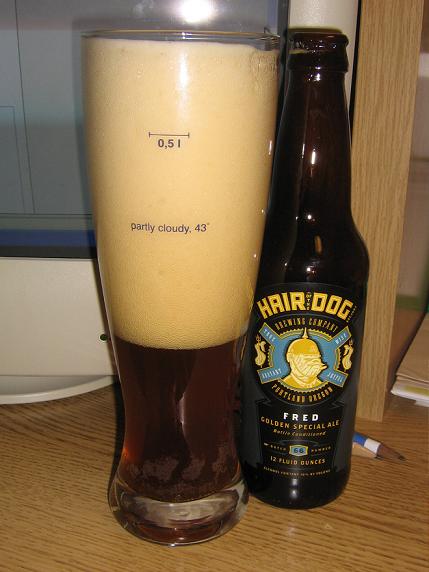
Much to my surprise, the beer, picked from the worst group of ten, opens with a loud Pfffft!!The yeast had created a seal inside as you can see below to the right and it pours with a huge head. It is huge and lovely and lively. Hallelujah! Christmas is saved. Christmas is saved. And the Doggie Claws show no sign of leakage at all with the same location of the irregular capping as the Fred but with a lot less severity.

So it will likely be a crap shoot one a bottle by bottle basis but if that yeast cakes up it may last throughout the holidays at least. “Pour slowly to allow sediment to remain in the bottle” it says on the back. What can you do? That yeast is my best friend right about now, the life in the ale securing what the dim-witted capped and shippers could not. I would hope the legal saying “buyer beware” is popping into readers’ minds right about now.


J’accuse!

Six US Darks

Washington, Vermont, New York, Oregon,
Pennsylvania and California

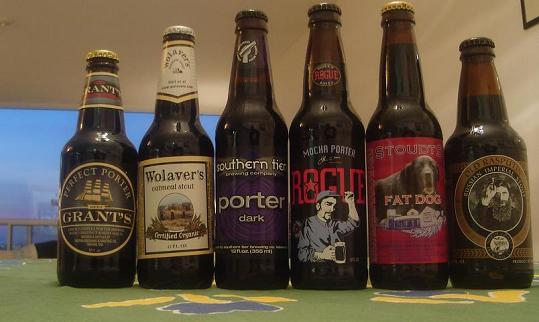
Life is tough. Life needs little projects. I found all of these lovery little brown bottles at the excellent Finger Lakes Beverage Center in Ithaca, NY and was able to buy singles of each – though the Southern Tier Porter came in a mixed 12 pack I picked up. They represent parts of the range of dark ales above brown ale. There are two dark porters, a mocha porter, an organic oatmeal stout, an imperial oatmeal stout and the granddaddy of them all a Russian Imperial stout. Mmmmm…roasty malty goodness.

  • Wolaver’s Oatmeal Stout: certified organic from Middlebury, Vermont. Effervescent, dark brown ale under a smooth rich tan head. Lots of flavour and lots of flavours. Not a slave to the silky texture oats impart, this beer also has plenty of hops, roasty grain and yeasty goodness – all in one smooth balanced beer. The hops are not as minty as Guinness’s norther brewer variety. I am thinking the citrus rind of Cascade. In the grain there is a bit of cocoa, a bit of coffee and a nice brown breadiness from the interaction with the creamy biscuity yeast. The finish goes dry, leaving the roast and then just the hops. A very fine complex medium weight example.
  • Stoudt’s Fat Dog Imperial Stout: from Adamstown, Pennsylvania. After my first contact with Stoudt through their Double IPA, I am going to need more than a moment with this brew. Darker brown with red notes under a mocha head that dissipated quickly. The sensation of this 9% ale’s strength is a little like a black rum and coke – which is to be expected as 9% amounts to around one oz. shot of 80 proof being added to a regular beer or two shots to a pop/soda. But that is a side track, a red herring. When beers are like this you have to think of them more like great port or sherry as opposed to table wine. Expect the flavours to open up over time. The body is fairly hefty, though it is not overdone – there is no massive attack of roasted grains though they are there as a supporting cast. There is some chocolate but mainly a lot of rich dark malt, pumpernickle. The hops are also there but far further in the background than the Wolaver’s. Underneath it all there is a rich double cream yeast that fills in gaps in concert with the smoothness of the oats. Quite extraordinary. And that was all from the first two sips. An hour later, two more flavours came out – licorice and some fruit which, surprisingly, I would not call dried fruit so much as plum and maybe apricot. Again complex and very worthy.
  • Southern Tier Dark Porter: from Lakewood, New York. I like this porter a lot. A good honest roasty dark ale with body to match. Too often porters or the slightly lighter style called dark ale are just darkened versions of the brewer’s pale ale. But this beer has a good amount of roasted grain, some coffee and a bit of bitter chocolate all over a nice rich biscuity yeast. Not as complex as the beers above but more of an everyday porter.
  • Grant’s Perfect Porter: from Yakima, Washington. I am quite surprised how much lighter this porter is compared to the southern tier. Its light tan head dissipates to a skim quickly over the mahogony ale. Chocolate mousse smelly. I would really call this a dark and not a porter but I should not as this is a Bert Grant’s beer. Up front there is some roast but it fades away a little sooner than I would like revealing a bit of vanilla cream and then a bit of edgy vegetative hop and smoke. I recall the Burton Bridge porter I had in 2001 or so and its lack of balance to my mind – too thin, too sharp – which later learned that it was more historically accurate. This is like the same elements placed in more modern balance – a bit of sour in the yeast, a bit of sharp in the end but better balanced than the Burton. I don’t know if I can call this tasty or attractive. At 4% a lower strength expression of the style.
  • Rogue Mocha Porter: from Eugene, Oregon. A skim of tan head over deep brown ale. Big hop tang across the roof of my mouth – minty, lime rind – over the top of dusty chocolate and black malt. Not so much mocha beer as mug of joe beer. Somewhat discordant, a bit sharp here and a bit dry roasty there. I don’t know if the yeast is really pulling its weight but, still all in all it’s got full flavour and real flavour. Not as tough a call as the Grant’s but there is a lot of thinking required with this beer.
  • Old Rasputin Russian Imperial Stout: from Fort Bragg, California. Very nicely balanced for a 8.9% beer. Lots and lots of roasty-toasty roast barley imparting a garnet hue to the inky ale, its tan head quickly dissipating. The hops are not minty and the nose is actually floral with a fair bit of black rum Christmas cake dry fruitiness as well. There is a lot of heat with hoppy spicy over the roasted black malt and roast barley and with a creamy heart. A very nice example of a well layered beer – like a big red wine lots and lots of flavours that open up over time. It would be interesting to do a side by side with Freeminer Deep Shaft, my favorite stout since I began these notes.

There you go. All six done and a fine range of examples of part of what people might think of when you say “dark beer”.

Oregon: Chocolate Stout, Rogue, Newport

I mentioned in a post below how I am amazed how the LCBO – Liquor Control Board of Ontario – cannot stock shelves better than a decent corner store in the USA. With the monopoly of 12 million people behind it, the LCBO is the greatest buyer of beer, wine and spirits in the world. The biggest used to be Sweden until that was privatized. Now it is where I live. What drives me nuts about it is the LCBO’s ability to master routes of distribution, bring in wines that sell for 20 USD and put them on our dinner tables for 12 Canuck bucks yet they cannot go out and obtain good ales and lagers with the same intellegence. It sells Genesee Ice but not Cream. That in itself is an indictment.

Another is the mere presence of a product by Rogue, one of the great US brewers, without sharing shelf space with five or ten others. At Halloween we get a small number of Dead Guy Ale and in March their St. Patrick’s day issue dry stout. For the rest of year, nuttin’.

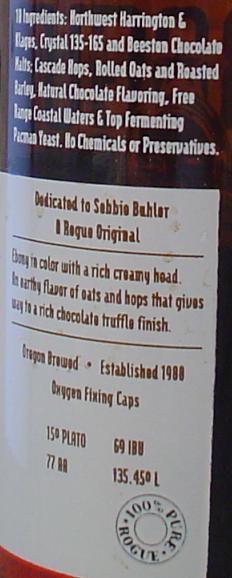
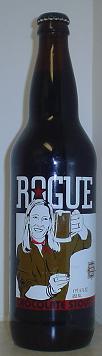
So it was with excitement I saw the quart of Rogue’s Chocolate Stout before me. Rogue is a producer of perfection. Click on the picture below right and see for yourself the pride in product – they actually tell you what’s in it. They tell you what happens when they put what’s in it together: 19 IBU is a measure of bitterness, “international bitterness units”; 15º plato is a measure of potential alcohol strength at the start of fermentation; and 135.45º L is a measurement of darkness of hue. This tells you is is moderately strong, quite bitter and very dark.

What it does not tell you in itself is its loveliness. This beer could be reduced over low heat to make a syrup you could bake into a cake, it could stand alone as a marinade for ribs and it could fill an evening with friends whether in front of the TV or as a fine dessert over nuts and blue cheese. It is fulsome in its chocolate flavour but bitter like a fine dessert chocolate cheese cake, the bitterness laying entirely in the natural hops chosen by the brewer – woodsy, rich. The style is an odd one little brewed, being an offshoot (maybe what apple orchardists would call a “sport”) of oatmeal stout. Youngs of England has a famous one, Double Chocolate Stout, that takes pride in its natural manipulation of the barley, through malting and roasting to create chocolate malt, a nuance of flavour that needs no extract or kidding one’s self. Of its own version, Rogue says:

The recipe for Rogue Chocolate Stout was created several years ago for export to Japan. The exported twelve ounce Chocolate Bear Beer bottle label is in Kanji and features a teddy bear with a pink heart on his belly. Chocolate Stout was released for Valentine’s Day in 2001 in a twenty-two ounce bottle for the US market. The label features a Roguester (Sebbie Buhler) on the label. The bottled of Chocolate Stout is available on a very limited basis in the US, so get it while you can! Hedonistic! Ebony in color with a rich creamy head. The mellow flavor of oats, chocolate malts, and real chocolate are balanced perfectly with the right amount of hops for a bittersweet finish…. .

This is an amazing drink. Painted bottle, too. Beauty. Beer Advocatonians approve.