This Week’s Fantastically Even Dramatically Encouraging Beery News Notes For W3Oct25

Usually I have something to share at the outset. Something cheery. But as the garden is on its last legs, as the month slips toward Halloween and then we deal with the changing of the clocks, it seems that any pretense that the year isn’t beginning the final act is fading fast. But… but… before all that, there is one more bit of baseball. One of the most exciting ALCS runs ever now turns into the World Series between a startlingly strong Blue Jays against the defending Dodgers led by the semi-deity known as Mr. Ohtani.  Look at him!  He’s the perfect player. Kyusung Gong of the AP took it and it sums up Ohtani neatly. He barely looks like he’s putting in any effort. His batting is the same. Yet… the Jays look good. So, even though neither of the two are my team, I will be feet up this Friday evening for game one. If you have never watched baseball you may want to watch this. One more thing. The Jays celebrate with US beer brewed under license in Canada. Lordy:

The Toronto Blue Jays are sponsored by Labatt Brewing Company, the Canadian-headquartered brewery that represents big-name booze brands like Corona, Stella Artois, Palm Bay and, yes, Budweiser. That’s why, upon the win, you could see an icy barrel stocked to the brim with bottles and cans of Budweiser within an arm’s reach of every Blue Jays player at any given time.

As I say, not my team. Next, some beery news from the world of British fitba. First up, we have Jessica Mason’s report on the new brewery being build at second tier Wrexham, Wales care of those struggling team owners Reynolds and McElhenney:

Since the duo bought Wrexham AFC five years ago, the club has risen up the ranks from the non-league to England’s second tier. Added to this, the brand has also found fame via a Disney+ documentary Welcome to Wrexham, which followed the club’s story and focused global attention on the area, also boosting tourist numbers. Then, last year, Reynolds and McElhenney acquired a majority stake in local brewery Wrexham Lager…. now there are plans afoot for other drinks brands, including Wrexham Lager to have a boosted presence with the proximity of the new brewery being developed nearby. The application reads: ‘The Wrexham Lager proposals, consisting a brewery and associated taproom and museum, will utilise existing buildings on the site.’

But then we read of the news out of England’s seventh tier as reported by Phil Hay of the newsletter, The Athletic FC:

The club were Bracknell Town, based 35 miles to the west of London. Their video drew attention because in it, their coach — the recently-appointed Matt Saunders — hammered a number of his senior players, criticising their conditioning, their attitude and their tendency towards alcohol. “I’m not going to let this football club be dragged down by people that can’t run, can’t look after their body, want to go and drink after games,” he said. “It ain’t happening.” Bracknell are having a time of it. They’re bottom of the Southern League Premier South with six points from 11 matches, and Saunders’ arrival hasn’t picked them up. 

Difference? Maybe five tiers? Boak and Bailey have also made a call via an alert on Patreon, asking for a boost to the next level:*

It’s been a while since we tackled a big question like where did lager louts come from, what’s the deal with nitrokeg beers or when did video games in pubs become a thing? We’ve got an idea to write something about The Prospect of Whitby but beyond that, what are some other questions we might tackle? We like to add the sum of collective knowledge – to pull facts together into one place where they can be found. Suggestions welcome.

In a time when some other voices have gone a bit silent or seem a little discouraged, this reminder of the need to add to the sum of collective knowledge is encouraging. Solidarity friends! Send then your ideas or even scribble your own somewhere and let us know. Similarly, The Pellicle feature this week is by Lily Waite-Marsden, a portrait of Macintosh Ales of London which, at the outset, does not offer an initial encouraging prospect:

There’s a small yard a moment away from Stoke Newington Church Street in North East London. At its entrance an entirely perfunctory and heavily battered railing protects the square of overgrown cobbles from the pavement beyond. On the first floor of the old stable buildings on three sides, four green doors lead to nothing but a 10-foot drop; the yard is hemmed with various shades of green paint—faded and flaking patchwork grass, darker, glossier army-surplus vehicle paint. But for a hand-painted sign and a number of planters giving the game away, passing on a quiet morning or late at night it might look a little tired, unloved.

But then… it was encouraging. And, turning to brewing history, Andreas Krennmair wrote about a favourite topic of mine, Schenkbier. Except when I looked at the stuff it was from the perspective of what was brewed by German speaking immigrants to the USA. Schenk was referenced regularly descriptions of the brewing trade in the third quarter of the 1800s and was described as one of three species of German beer which had crossed the ocean: lager, bock and schenk.  Andreas found some information from a few decadeds earlier that helped him unpack what was in the glass:

What’s surprising is how different the beers were in terms of original gravity and attenuation. OGs between 11 and 12.6 °P are absolutely solid, and while some of these beers didn’t have nearly as much alcohol as modern lager beers, they’d still be alright to drink, although probably on sweeter side for modern tastes. Especially the beer from Heller stands out, with a respectable 11.5 °P but only 2.9% ABV and a very high residual extract. Doing the calculation, the real attenuation was less than 40%, so this beer must have been a sweet mess. Compare this with modern lager beer, with real attenuation around 65%.

Perhaps syrupy low kick gak is the next big thing. It could be already. There is going to be a next big thing, right? Maybe not. North America’s oldest brewer, Molson, is laying off staff. And not just any staff – the white collar staff of MCBC:

Beer maker Molson Coors Beverage Company said on Monday it would cut about 400 jobs, or nine per cent of its salaried workforce in the Americas by year end as part of a corporate restructuring plan. The company’s Americas workforce consists of employees in the U.S., Canada and certain countries in Latin America. A spokesperson for the company told CBC News in an email that the restructuring “only applies to salaried non-union employees across the Americas.” The company is not providing a breakdown by country or province at this stage, and no offices or breweries will shut down as part of the restructuring, the spokesperson added.

It’s always the suits who suffer. The trends in beer are not comforting. Last week’s noting that craft might need saving** not only got some chatter going but I played Mr Smil and dipped my toe into the math that we are living with seeking to compare those apples to apples:

Interesting to note that 2024, Athletic NA beer alone was 400,000 bbl. Is NA beer a comparable to other booze? Is it booze? We should probably compare alcohol sector to alcohol sector. Take just that one brewery’s production out, the drop is more like 14%…  Worse news if we believe Beer Marketers Insights (Oct 1): “Craft beer trends (ex non-alc) steepened over the summer to volume -8.4% and $$ -6.4%; several pts below total beer volume -5.6% and $$ down 5.1% for 18 wks thru Sep 20 vs yr ago.” So 2019-24 at -14% (non-NA) could be down -20% for 2019-25.

Or more *** The Guardian wrote about another aspect of the retraction from alcohol – the loss of a cornerstone element of overall profitability for restaurants:

The industry standard markup on alcohol in a high-end restaurant is anywhere from 150% upwards, making it one of, perhaps the only, high-margin products on the menu. As people drink less, it could leave restaurants in a precarious position. For every restaurateur willing to go on the record to discuss the shifting tide, there were an equal number who refused to be interviewed for this story. Some because they say they’ve witnessed no change in customer behaviour, and others because the subject matter is at odds with promoting a hospitality business. While it doesn’t necessarily do wonders for the bottom line, diners drinking less at the table does create a more harmonious environment for restaurant workers. Fewer drunk bodies means less risk overall.
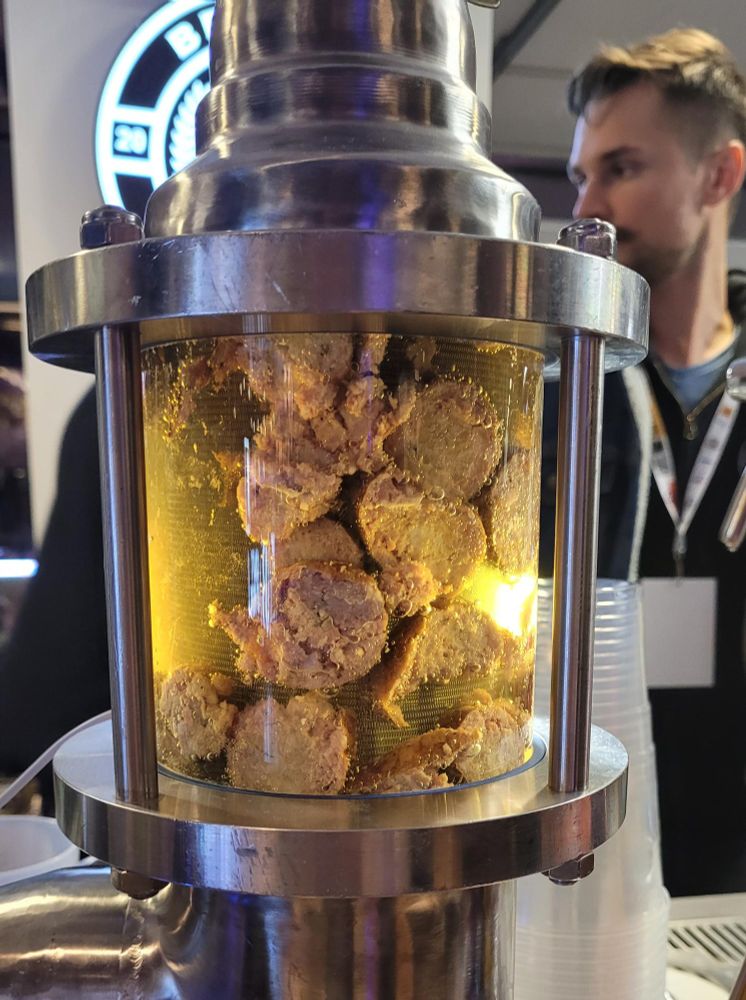
Me, I usually just have water but still try to tip like I’ve had a bit of booze. Where will this all lead?  What can be relied upon to get the attention of the public. Innovation? The Beer Nut himself spent last weekend in Warsaw and spotted one of the more innovative cultural expressions of beer culture – a sausage randall as illustrated in thumbnail format… in consideration of some of your delicate constitutions. Much consternation was found in the comments which followed his Bluesky post – but I really can’t see the difference between a lager washed through sausages and sausages washed down with lager. Much depending of course on the quality of the sausage.

Speaking of quality, Matty C. has written about the return of Boddingtons for CAMRA’s What’s Brewing and has placed it in the moment:

Being honest for a second, this beer is not reinventing the wheel – there are far more interesting and flavourful pints available, even from JW Lees itself. But I consider the resurgence of Boddingtons is about more than flavour. Reports are already coming in from Manchester venues that are not able to keep up with demand, turning away disappointed drinkers who want to be seen with a pint of it in hand. This is significant, because those who are drinking it are young, fashionable, and about as far away from the cask beer stereotype as you can possibly get. This can only be considered a positive. For many drinkers, especially younger ones, a row of handpulls featuring a range of products they’ve never heard of can be incredibly intimidating. In Boddingtons, a brand has been revived that people can easily trust.

Heritage as maybe heritage? Maybe. Speaking of maybe, there is always the potential for maybe not – as one liquor dome in Northern Ireland found out recently:

Planners order the business to remove shipping containers used as a bar and storage, as well as a takeaway food cabin with a serving hatch on a Skipper Street – a side road that runs past the beer garden. Also to go are steel boundaries with wood covering that include an access gate and windows, an enclosed walkway entrance, a “tent structure”, boundary fencing in excess of two metres in height not adjacent to a road, and storage areas for bins and beer kegs. City planners say they’ve reached their verdict as “it appears there has been a breach of planning control” on the site.

Finally and probably relatedly, here is an interesting snippet of an unlocked article from the Financial Times written by Charles Spencer (Princess Di’s brother) on the question of authenticity which includes this:

When, in 1992, I inherited Althorp, my family’s ancestral home, I felt a responsibility to return it to how it had been for much of its 500-year history. For, over the previous decade and a half, the interior had been lavishly redecorated by my stepmother, Raine, whose taste and palette were inherited from her flamboyant mother, romantic novelist Barbara Cartland… I turned to John Cornforth, perhaps the leading British architectural historian of the time, to help me return things to how they should be. We toured Althorp’s principal rooms, assessing them for Raine damage. Cornforth’s kind reassurances dwindled as we went. Finally, on entering the South Drawing Room — a cacophony of clashing pinks (on the walls, on the floor, in the curtains) — Cornforth rocked back in his tightly drawn lace-ups. “Goodness,” he mused. “I really can’t help you here .  As he departed Althorp that afternoon, he lobbed me a catch-all mantra that he hoped might help: “Good taste is authenticity — and authenticity is good taste.”

The point is excellently made. But what does this have to do with beer? Only on the idea of how his hunt for authenticity based on that saying became for Spencer a no-doubt very expensive exercise in conformity. Realizing that, he argues for a balance between respect for what has come before with a realization that you need to live in the present, too. Can we compare the return of Boddingtons or the sweet mess that was historic schenk or that sausage randall with the clashing pinks of a devotee Barbara Cartland’s fashion sense?  Obviously even the “don’t yuk their yum” level of junior beer expert might balk at the more garish, the most lurid of these pleasures. But where to draw the line?

While we consider that over the week ahead, please also check out, Boak and Bailey on this and every Saturday and then sign up for their entertaining footnotes, too. Look out for Stan when he feels the urge now that he’s retired from Monday slot… maybe … maybe not. Then listen to a few of that now newly refreshed Lew’s podcasts and get your emailed issue of Episodes of my Pub Life by David Jesudason on certain Fridays. And Phil Mellows is at the BritishBeerBreaks. Once a month, as noted, Will Hawkes issues his London Beer City newsletter and do sign up for Katie’s wonderful self-governing totes autonomous website featuring The Gulp, too.  Ben’s Beer and Badword has been on hiatus since April but the archives are out there with the all the sweary Mary! There is new reading at The Glass which is going back to being a blog. Any more? We have Ontario’s own A Quick Beer and All About Beer is still offering a range of podcasts – and there’s also Mike Seay’s The Perfect Pour. Plus follow the venerable Full Pint podcast! And there’s the Craft Beer Channel on Youtube. Check out the archives of the Beer Ladies Podcast. That’s quite good and after a break they may well be are back every month!

*Formatted to fit, to protect the innocent perhaps but mainly to fit.
**Jeff updated his thoughts, by the way, but it did make me wonder why what one wants should be limited to what some producers feel they can provide. Perhaps the former suits of Molson now share that feeling.
***A bear of beer! 

Your Beery News Notes That Entirely Capitivate… Yet Offer No Real Clues To Get Outta Here… Not Even A Key Or Nuttin’

August planting is underway. With any luck there will be peas in late September and October. And maybe baby carrots. You always think that the plantin’ is done once you are in full pickin’ mode… but no. No way. Still ten weeks to a frost that kills. Or more. Plenty of time for peas. By the way, I learned something through the month and a half of drought, humidity and heat that now seem to have finally broken. Tomatoes do not turn colour until it cools a bit. So while the peas are doing there bit it’s now also time to hit the sauce… no, not that sort of sauce. Sauce sauce!

OK – fine. What else is going on around here. Oh, yes – one of the main differentiations between beer drinking cultures found in nation to nation is the local tipping habit. Here in Canada we tip but we are left to our own decision as to how much. But, more generally, it’s not just the tip but the markups added on. I could be a tax or two, a mandatory service tip but… an administrative fee? That’s what seems to have started in the UK where, as reported in The Times, one pub is adding 4% to the price of a beer for the premium service of giving the beer to you:

The Well & Boot is banking on customers not noticing the difference between £7.65 for a pint of beer and £7.96 for a pint of beer, and it’s a safe bet. Once you’ve paid £7.65 for a pint your subconscious is already doing everything it can to suppress the pain, just to allow you to enjoy it…  Is it a rip-off? I don’t know. Pint number two — all in the name of research, obviously, was a Guinness — and that one was brought to the table, at which point a 4 per cent charge for table service is quite good value. All the other customers were having a lunchtime meal, ordered and brought to the table, so 4 per cent for that sort of service is extremely cheap.

The pub is in London as I understand in a transit hub Waterloo Station. So you are already dealing with captive audience pricing of a sort. But that base price is nuts.* You know, if I were you… I would walk a few steps to Mamuska! which, yes I disclose, is run by a college pal but also the beer is a little cheaper – but you can order a Placki Ziemniaczane to go with it!  Ask for Ian, say you know Big Al and you may get a slap on the back, too. There. You’re set.

What else… well, some bad news for those of you rootin’ for booze. The NYT reports that US drinking has hit an all time low – and its not just the kiddies this time:

The Gallup poll found an especially pronounced drop in drinking among middle-aged respondents: Just 56 percent of respondents 35 to 54 said they drank alcohol, falling from 70 percent in 2024. That “suggests the message is sinking in across the board, not just with young people,” said Johannes Thrul, an associate professor at the Johns Hopkins Bloomberg School of Public Health. The share of adults 55 and older who said they consumed alcohol increased slightly from 2024 to 2025, but is still lower than in 2023. Only 50 percent of those aged 18 to 34 said they drank alcohol, the same as in 2024 and down from 59 percent in 2023.

Jeff has his own thoughts but clearly people are not doing their part. Perhaps relatedly, Mr. Mudge wrote about the planned drop in acceptable blood alcohol limit from .08 to .05 in England and he argues against it:

Whatever the safety implications, such a policy would inevitably have a significant effect on the pub trade. While those who inhabit an urban bubble may be reluctant to acknowledge it, nationwide there are a very large number of pubs to which a majority of customers travel by car. There will be several thousand where that accounts for over 90% of their trade. Every week, hundreds of thousands of people drive to pubs and consume alcohol within the legal limit. Yes. a few customers do break the law, as people still will with a lower limit. But, given the severe potential consequences, the vast majority of drivers abide by it, and indeed generally leave a wide margin below it. 

Sadly, having practiced criminal law including as duty counsel, I can report that deaths from drunk drivers aren’t statistical matters. Neither is crime. We can as easily say “every week, hundreds of thousands of people go about and and all aspects of their lives within legal limits.” In all cases, crime is perpetrated by the few and upon the not quite so few but in each case the act and loss is a singular event. As a result, deterrence is one of the greatest benefits of criminal law. So making driving under the influence itself a crime deters many – indeed by a wide margin – from taking the step that, yes, only sometimes leads to tragedy just because some asshole decided to take the chance.

And, as reported in the Morning Advertiser, BrewDog has pushed back on the story that is has lost access to customers at about 2,000 pubs with industry voices speaking out from both sides of the fence:

“Wetherspoon trades with Brewdog on the basis of a long-term contract, which is the normal case for our regular suppliers. “BrewDog has always been a reliable trading partner and draught Punk IPA, available in almost all of our pubs, continues to be a popular craft beer, as do their bottled products; Hazy Jane, Elvis Juice and Punk AF.” All pubs within the Tim Martin-chaired business serve one BrewDog product on draught and a number of BrewDog bottled drinks too. Meanwhile, a spokesperson for Star Pubs said: “We have not supplied BrewDog products to our pubs since the end of 2023.”

PR v PR. On this side of the Atlantic but not dissimilarly, there were two interesting stories last week from Beer Marketers’ Insights, the first one being about an outreach from a group of AM distributors saying without at all be coaxed that AB is great. Then, in summary from the weekly newsletters, the response from other AB distributors:

None echoed the endorsements so pervasive on the call. Most saw this as an AB-directed initiative. “This has AB written all over it,” said one AB distrib. Another remarked: “This reminds me of the current state of politics. Everyone is scared to say something negative, knowing they will be attacked by a party at some point. If you praise your allegiance to the party, then you will be rewarded.” Some responses were angry and disbelieving that so many distribs espoused a party line. “I can’t believe what’s occurring,” said one long-term observer. “I was just appalled.”  

A free press is a wonderful thing. Speaking of appalled, have you seen the prices of things?  Sam Tierney wrote this very week thusly:

Mexican 2-row seemed mildly interesting until I saw that it was 30% more expensive than domestic or Canadian. In this economy!?! I can get German pils for that price.

And aluminum is, again, a topic at the check out this week. The Brewers Association issued a notice on the addition of beer can tops to the list of things subject to US tariffs this week noting “The Brewers Association continues to monitor developments around aluminum trade policy…” Hurrah! My two cents were these:

Consider us. Canada exports 88% of bulk aluminum the US uses. It’s sent south, gets hit with a 50% US tariff, turned into packaging, cans come back north and get another 25% tariff from Canada. So the 75% tariff will see us redevelop our can factories. Not sure the US can replace our bulk aluminum.

So, US consumers should not expect any relief soon unless someone gets into the bauxite smelting game and can replicate Quebec’s cheap hydro power to fuel the industrial process at scale. Up here, we just need to retool the manufacturing line.**

Speaking about shopping, Lew Bryson has announced that this week’s offering at Seen Through a Glass is going to be about…

Next episode will be about the great local grocery stores in central PA, everything from four aisle markets to ten-store chains with full-service butcher shops and fresh seafood. They aren’t Whole Foods or Wegmans, but they’re not 7-11s either, and they’re out here where central PA actually lives. Let’s go shopping!

Excitement reigns! Back when people published (and bought) books about beer, Lew’s guides were great support of family trips when the kids were little. Not because I would drink my face off but he included shopping and side trip hints that kept everyone happy. How else would I have learned about the garbage plate?

Note: traditional German naked ass wine. Not sure I want naked ass wine but now I know I could if I would even if I won’t.

Luxembourg! How many of you have clamoured in the comments and emails for more Luxembourgian news. Well, Jessica M found a way this week to fill that need:

Brasserie Nationale de Luxembourg, the country’s largest brewing company, has told bar operators that they will soon be able to stock beers from craft brewers without violating their contracts. While leading breweries Brasserie Nationale de Luxembourg and the AB InBev-owned Diekirch currently own many of the venues and the attached alcohol licences, it gives them exclusivity rights for stock, but things may change in the coming months. According to Finance Ministry, the country’s two largest breweries hold about a third of the nearly 3,300 bar licences and 40% of the alcohol licenses in use.

Freedom!!! Sorta. For the double, Jeff raised an eyebrow to the first list of entrants into the Craft Beer Hall of Fame:

I dunno. A “landmark” anything is always going to be a semantic/definitional category. If I were to consider American brewing in the past half century, I’d be looking at where we are and how we got here. Only one of the beers on this list played a role in that. Steam beer is a basically defunct 19th century style. Witbier is a commercial success, no thanks to Celis (Blue Moon and Allagash get the credit there.) Boston Lager was another commercial success, but the beer was also just an all-malt European-style lager (as the brewery has always proudly proclaimed).

I would add backdating to any lucid notion of “craft”, a term only widely adopted a bit over 20 years ago. If it is anything, Boston Lager is a micro… even if it’s now a macro micro.  It reflects the 1980s intention to mimic imports, not to take on big beer. But, also, where is Pete’s Wicked Ale, a top seller until it wasn’t? Does “fame” in this case really speak more to the identifiability of the brewery owners who survived?  If so, that’s craft for you.

Finally, in the weekly feature, Rachel Hendry brings it all back to where it matters, the individual experience. And she frames it with one of the most humble aspects of the beer fan’s joys – the beer mat:

A small pile sits on my desk whilst I write: vintage Double Diamond and Babycham given to me as gifts by friends—‘I saw these and thought of you’—a Beamish emblem from a trip to see family in Ireland; another of a brewery I associate with a recent romantic encounter. When I am nervous I trace their cardboard circumferences with my finger. They punctuate the bar I work in, propping up tables, ripped into shreds by skittish or destructive hands, knocked to the floor, stolen as mementos. They see so much, these beer mats. They suffer for it. It wasn’t always like this.

What a lovely bit of writing. For more of that, please also check out Boak and Bailey every Saturday and sign up for their entertaining footnotes, too. Look out for Stan when he feels the urge now that he’s retired from Monday slot… maybe … maybe not. Then listen to a few of that now newly refreshed Lew’s podcasts and get your emailed issue of Episodes of my Pub Life by David Jesudason on certain Fridays. And Phil Mellows is at the BritishBeerBreaks. Once a month, Will Hawkes issues his London Beer City newsletter and do sign up for Katie’s wonderful self-governing totes autonomous website featuring The Gulp, too.  Ben’s Beer and Badword is out there with the all the sweary Mary! And check out the Atlantic Canada Beer Blog‘s weekly roundup. There is new reading at The Glass which is going back to being a blog. Any more? We have Ontario’s own A Quick Beer featuring visits to places like… MichiganAll About Beer offers a range of podcasts and there’s also The Perfect Pour. Plus follow the venerable Full Pint podcast! And there’s the Craft Beer Channel on Youtube. Check out the archives of the Beer Ladies Podcast. That’s quite good and after a break they may well be are back every month! Such is life. Such is beer podcasting and newslettering… which, as Ray says, are blogs! And he’s right.

*Yet, I wouldn’t notice at all if the pint was served at this gem Martin visited in Edinburgh.
**Did you know that 25% of the world’s bauxite comes from Guinea? Me neither. Trump has, it is worth noting, not tariffed Guinea. 15% for New Guinea. 15% for Equitorial Guinea. None for Guinea. Perhaps he thinks he did.

Now That We’ve Cleared Up The “St. Paddy’s / St. Patty’s” Day Confusion, Here’s The Beery News Notes

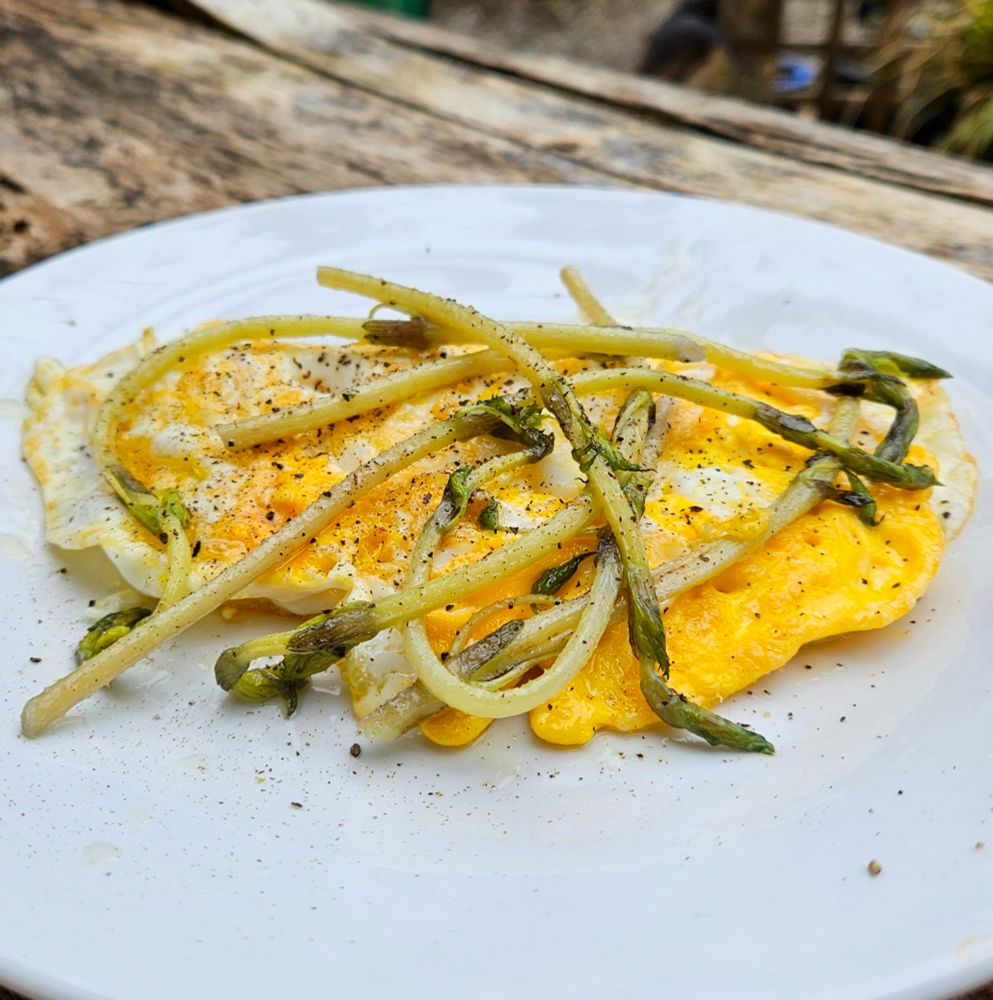
I like a good breakfast sandwich as much as the next guy but I have to say I have never elevated a disk shaped sausage to sainthood. For me, Peanuts sort of established who Patty is before she grew up to be the bassist of The Bangles under an alias. So the whole “Patty v. Paddy” thing flies by me and, anyway, I tend to use the long form.  Which is fine because, you know, we ourselves are Scottish. Which is what we told pals who invited us out to drink on a Monday night when we took a pass. Our new PM probably better knew what to do when celebrating that I did. But I think Liam, however, he of Ireland, has established an alternative answer to the puzzle of how to deal with the day. That’s a hop shoot omlette right there:

I’ve experimented with cooking hop shoots before, but this is my first time to force them in the dark. Blanched and lightly fried, and served on an omelette with pecorino and black pepper. Great texture, like asparagus but more of a delicate mangetout or green bean flavour. I’m impressed …

For a more traditional tribute to Patrick, check out The Loop for a true Americana dive bar version. I wonder what the equivalent elsewhere could be? I know who we could ask. Perhaps Retired Martin who advised on the question of what one can do when there’s a spare 25 minutes to be spent at the train station in Doncaster, all by way of very tightly focused photo essay:

I would buy a book called “What Would Paul Mudge Do ?”. He certainly wouldn’t get his beer in a takeaway milk bottle to drink on the 18:22, oh no. He’d have a pint from one of Sheffield’s cask champions. But a man doesn’t travel from South Yorkshire to South Yorkshire to drink South Yorkshire beers, so I had a pint from Tallinn. And admired the seating in what is a lovely, but slightly too small, station pub.

Admittedly, you need to go back to link each sentence to an image but it’s a nice tidy narrative if you ask me. Speaking of tidy narratives, Pete Brown‘s latest column for The Times has taken a step up, using the space so far dedicated to a newbie guide to share, instead, a vignette on a player in the trade – the beer buyer:

The Waitrose beer buyer Jourdan Gabbini, 31, from Wokingham in Berkshire, genuinely loves beer and obviously enjoys his job. His ambition is to create “a bottle shop within a shop” that doesn’t just stack up the beer but helps people engage with and explore it, in part by highlighting brewers that are local to each store. This can be frustrating when a beer you like isn’t available in your manor. But that means another local brewer is getting the benefit. Gabbini has the freedom to develop real relationships with brewers. Last year he even co-created a new beer with the Lost and Grounded brewery in Bristol and Caravan Coffee Roasters — a coffee pale ale that was exclusive to Waitrose.

Speaking of booze sales, Lew dipped his toe into the tariff dispute and examined the Canadian response when it comes to the policies implimented up here by our government run liquor trade:

The most common reaction has been pure Canada: a non-smiling “Elbows up!”, echoing Mr. Hockey, Saskatchewan-born Gordie Howe, a player who took no shit off anyone. Anyone who tried to slash Howe was getting a fast elbow to the head. Canada’s ready for this, and they’re not kidding. The angry Americans are right about one thing. The Canadian response of taking everything off the shelves, leaving only blank space behind, is disproportionate and goes further than the American tariffs. This doesn’t just affect day-to-day, month-on-month sales. This kind of action also attacks something much more valuable: the brand. Raise the price while leaving the bottles on the shelf, and you paradoxically make people think about the brand more, maybe even realize how much they ARE willing to spend to get it. But take the bottles away, leaving an empty shelf with a “BUY CANADIAN INSTEAD” sign, and the American product becomes invisible.

Lew says, quite reasonably, that this degree of response is because Canada is facing an existential crisis. I don’t actually think that’s the full story. I have loads of pals and more blood family in the USA than here in Canada but, you know, gotta tell you… we’re not going anywhere. And we’re not some sort of jilted pal. Trump just fucking pissed us off. When I played soccer in university, my Scottish father (a much better player in his own youth) would say “don’t wake the sleeping dog.” Well, we’re up now.  And we are drinking our own damn rye. Even the cheap stuff that tastes like gasoline.

Speaking of these the finer things, Nigel Sadler pointed me to an interesting 1991 Belgian beer rating guide posted by the beer importers James Clay and Sons on Bluesky:

This clever guide evaluated beers based on ABV, Sourness, Sweetness, Bitterness, and predominant flavour, which then generated a five digit code that could easily give a picture of the key characteristics.

Here are the five images (1,2,3,4,5) in case your are not part of the Bluesky way of life. I add them not just to scrape the data but to illustrate a couple of points. First, I have long thought the overbearing BJCP system was clumsy and created poorly transferrable information in a simple but meaningful way. This does that. Second, being a real nerd, I immediately recognized that this five digit system mirrors the SINPO code used by long distance radio listener nerds. The SINPO code not only succinctly frames the transient quality of a radio transmission heard well beyond the intended broadcast range but it is also understood across cultural and language gaps. Simple, neutral and still data rich. So it’s gold when you are sending your QSL reception report looking for a postcard, right? What? No! No, it’s really cool. It really is. No, you’re the big fat loser.

Getting back to where we started, Ron has been to Brazil again and, much to my delight, has posted a photo essay – a montage if you will – of many of his breakfasts as well as what it is like to be an Englishman in Rio for Carnaval:

Many not so much lightly-dressed as slightly-dressed partygoers walk by. I’ve never seen so many men in fishnet tights and tutus. It has a bit of a Gay Pride air about it. Some of the party people pause to pick up Pils. Always the Pils. There’s a merry buzz. Everyone is going to a party. I can feel their crackling anticipation as they laugh and drink their way down the road. Anticipation of a good time. A really good time. I’m starting to quite like this Carnaval thing. Everyone is in a really good mood. Even a miserable old git like me.

Over at VinePair, Joshua M. Bernstein told the tale of the rise and fall of Magic Hat #9, a once hudely popular beer out of Vermont:

Johnson built a moderate-strength pale ale infused with apricot essence, and the mysteriously named #9 hit Burlington taps in summer 1995. The beer was designed to disappear come fall, but calls from angry bar owners threatening to stop carrying Magic Hat beers led Newman to turn #9 into a year-round release. “It was never intended to do anything,” Newman says. “We were just trying to find a way to sell beer.” The beer thrived on neglect and even disdain. “Beer geeks at the time f(u)cking hated it, but the more they hated it, the better the sales were,” Newman says, adding that #9 was nobody’s favorite beer at the brewery. Magic Hat initially spent scant dollars to support #9. “I could argue that we spent the first two years doing absolutely nothing to help it grow, almost working to kill it,” Newman says. “And then one day we went, ‘What the f(u)ck are we thinking here?’ And so we got on the bandwagon and it just kept growing.”

There was a time when Magic Hat was way ahead of its time and attracted the dollars of border crossing beer nerds like me over a decade and a half ago, looking for their latest Odd Notion seasonals. I seem to have had some on New Years Eve 2004. In October 2005, I review another mixed case of their and… I mentioned that I didn’t exactly love the #9. I thought it was supposed to be peach but Oskar in the comments said “No. 9 used to be much higher quality, with a REAL apricot taste” so I wasn’t wrong wrong. Just wrong.

Speaking of travel, Katie spent a week on the Isle of Man. She didn’t mention seeing Kelly… but she did write a lovely piece at her space The Glug about solo dining at The Boat Yard in the town of Peel:

The menu is as fishy as I dreamed it would be, and while I’d normally order something picky or snacky or fried for a starter, I couldn’t think of anything nicer on such a cold night than a bowl of chowder. It came hot and creamy, filled with Manx kipper and mussels, and a healthy incorporation of curly parsley. Slurping it felt like warmth and health and happiness. To drink, I had a glass of champagne. And then another. How incredibly off-putting of me, to ignore wine tasting regulations and all common decency, but I wanted some Champagne, so I had some. End of story. If you want to fight me about it, I‘ll meet you outside. Doing champagne by the glass is not ideal for any hospitality venue, and I apologised for being so awkward. Then I apologised for apologising. My lovely host was gregarious: “You deserve to have what you like,” she said. I wondered if had I been with other people she might not have added life coaching to my menu free of charge, but I appreciated it nonetheless. And anyway, I did like it very much, because it was rich and biscuity, with a squeeze of lemon sherbet.

Smoky kipper chowder and glasses of champagne. That’s it right there. Yup.

Note: Martyn captured on the audio talking about the porter. And the book. The book that launches very soon.

And David Jesudason has managed to make me homesick for a place I have never been.  Much of my family lives along the 128 bus route east of Edinburgh and I worked in Poland for a while when I was in my twenties. So this portrait of the The Persevere in Edinburgh’s historic port of Leith has me longing… and (again) hungry:

…it retains those born and bred in Edinburgh’s historically working class Leith district, especially sports lovers who might glance at the horse racing before a match. While it also serves as a home away from home for many of the Polish diaspora who have been linked to the port since 1939. This is seen in the pub’s owners, Lublin-born Dorota Czerniec-Radowska and her husband Konrad Rochowski, and the kitchen they have run since 2015 which pumps out delicacies, such as plate-sized schnitzels and comforting white sausage (Żurek) soup. You can eat these in the pub or the restaurant-style section, known as the Percy (also the affectionate nickname given to the pub by its regulars,) where paintings of Dorota and Konrad’s hometown are displayed.

One of the pleasures of Poland was learning how useful my childhood training in the rolling of an “r” and the roughening of a “ch” were.* And, as with the Korean food, the reassembling of similar ingredients was also a welcome surprise. Next time I am there, I should make of point of being here… there… at this pub.

Note: a reminder for next week. It’s another end of the month edition of The Session… and Gary jumped the gun but gives us a good example as we prepare. Matty C is hosting:

For the March 2025 edition of The Session I’m asking participants to produce a piece of critical writing about beer or pubs. This could be a review of a beer you’ve enjoyed, or perhaps one you haven’t. A pub you’re fond of, or maybe one that has room for improvement. You could write about a beer experience (or lack of) in a setting such as a restaurant, or even produce a critique that focuses on a particular aspect of beer or pub culture. The aim is not to be judgemental, subjective or to showcase any particular bias; this is not some finger-wagging exercise. Whereas criticism involves building an argument about why you think something is simply good or bad, critique involves taking a more holistic approach, using carefully researched and considered analysis to build a reasoned, objective, and possibly even entertaining take that benefits readers by giving them good quality information to consider.

I am still working out how this isn’t a distinction without a difference as building a good argument always requires considered analysis. But I look forward to the submissions.

Did you now that some common foods do not qualify as no-alc? Well you will now thanks to the exceedingly tenuous argument placed into the discourse by the lobbyists of the The British Beer and Pub Association:

Advocates argue that the current limit not only confuses consumers but also restricts the development of innovative alcohol-free products. According to the BBPA, raising the threshold would help the UK’s brewing sector thrive in the rapidly growing no and low alcohol market, while providing consumers with more clarity and choice. The BBPA’s findings highlight that burger rolls can contain up to 1.2% ABV, while malt loaf can reach 0.7%, and ripe bananas can hit 0.5%. These levels are considered negligible and occur naturally due to fermentation, yet remain higher than the current 0.05% threshold for alcohol-free beer. The government’s consultation is set to conclude later this year, with the industry eagerly awaiting the outcome.

Eagerly. Not “patiently” or even simply “awaiting” but eagerly.

That’s it. Lots of interesting stuff to read as it turned out. While you await eagerly for more next week, please check out Boak and Bailey every Saturday (WHILE YOU CAN!!! They are holidaying in April and May) and Stan going strong again each and every Monday. Then listen to Lew’s podcast and get your emailed issue of Episodes of my Pub Life by David Jesudason on the (sometimes even but never) odd Fridays. And maybe The British Food History Podcast. And Phil Mellows is at the BritishBeerBreaks. Once a month, Will Hawkes issues his London Beer City newsletter and do sign up for Katie’s wonderful newsletterThe Gulp, too. The Share looks to be back with a revival. Ben’s Beer and Badword is out there with the all the sweary Mary! And check out the Atlantic Canada Beer Blog‘s weekly roundup. There is new reading at The Glass which is going back to being a blog. Any more? Check out the Beer Ladies Podcast. That’s quite good and they are revving up for a new year. And the BOAS podcast for the bro-ly. And the long standing Beervana podcast …except they have now stood down.  Plus We Are Beer People. The Boys Are From Märzen podcast appears suspended as does BeerEdge, too. VinePair packed in Taplines as well. All gone. But not Ontario’s own A Quick Beer featuring… Michigan! There is more from the DaftAboutCraft podcast, too.  All About Beer has sponsored trade possy podcasts and there’s also The Perfect Pour. Plus follow the venerable Full Pint podcast. And the Craft Beer Channel on Youtube.  The Moon Under Water is gone which is not surprising as the ask was $10 a month. Pete Brown’s one cost a fifth of that – but only had the one post. Such is life.

*My late toddler trauma includes being told “Whales and Wales are not homonyms!!!” as a parent’s hand was placed before my mouth to catch the whisp of an “h” that was so critical to the continuation of the culture. 

The “It’s Not Funny At All Out There” Edition Of The Beery News Notes…

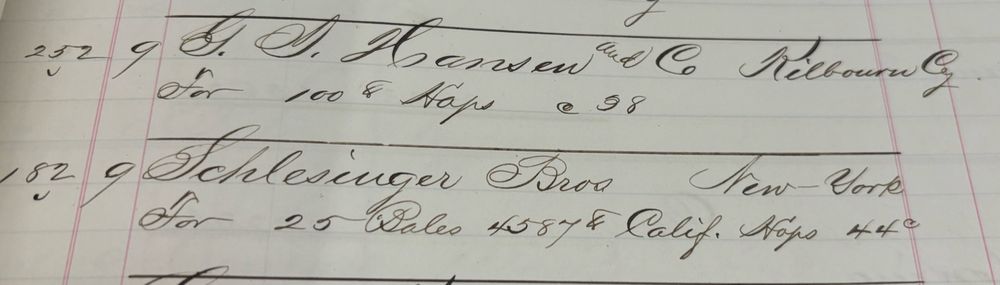
Wow. I am going to leave it at that. Because there ain’t much of the big issue sorta news I want to be reading, I suppose. Not now, not this week. Nope. I am definitely having 9/12 waves myself. Not good. But 150 years ago? Well, Jennifer Jordan on BlueSky has been discussing the 1874 business ledgers of Milwalkee Valentin Blatz and there is plenty of news. Price fluxtuations, losses at sea… but for me… just look at that penmanship!  That upper case K is out of this world! You can practically hear the pen tip scratching across the page. Whatever the coming years have in store for us – and it may not be pretty – we can at least look back at the hand of Blatz for a lesson in confidence and verve.

Where are we? Starting with some beery beer news, Andreas Krennmair shared a re-creation of a much forgotten German beer style, Adam:

Dortmunder Adambier, apparently often also just called “Adam”, was a very strong dark wheat beer, often aged for years, and thus very clear, with a dark-red-brown colour. The malt made to brew it was kilned to only a pale colour, and no additional dark malts were used, so any colour of the beer came from “browned proteins”, as the article says it, basically from the long, intense boil the wort undergoes. When Adambier was poured, it poured like oil, but without any foam, and had a sweet taste and vinous taste to it.

Sounds a bit like a beer Boak and Bailey wrote about this week after spending some time in Gdansk, Gdinya and Sopot Poland recently – Danziger Jopenbier:

It’s a historic style associated with the city, brewed to some kind of original recipe, and selling at 16 Polish złoty  (£3) for a 50ml shot. In presentation, it was treated much like a liqueur or a sherry and reminded us of both Riga Balsam and Pedro Ximinez fortified wine. It was extremely sweet and sticky, completely flat, with a funky, leathery, pipe tobacco stink. A curiosity, then, rather than something to session on.

This is just a bit of their an excellent and extended piece about their merry trip, there just a few kilometres across the waters from Putin’s own nuclear navy yards at Kaliningrad. I taught English along those same Baltic shores of Poland in 1991-92 so it’s interesting to read what’s new and what’s the same:

The city itself is a war memorial. At the end of World War II it was 90% destroyed, an apocalyptic rubblescape. The new Soviet-controlled authorities debated what to do and, at one point, someone suggested leaving the city centre as a vast ruin, to remind the Germans of what they’d done… Gdańsk was rebuilt not as it was in 1939, but instead to recall the days before 1793 when it was part of the Kingdom of Poland.

Yup. I remember being in a large church in Gdansk where a tank battle had happened in 1945… within the church.* I mentioned in the comments that that I recalled there being no pubby pubs back then either – except a rougher sort of stand up tavern for men just off work that the guide I bought suggested “are best avoided.” I mainly drank my Gdanskie at home.

David Jesudason published another pub profile last Friday and discussed a feature installed in the 1950s, a snob screen:

“They could have privacy not just from the other side of the pub,” says Ralph, “but from the bar staff as well. You open it to order your drink.” The pub had a revamp in 1956 when Young’s took it over, previously it was a cider house, and Ralph reckons the snob screens are from them and still have the original 70-plus-year glass.  Ralph finds it amusing that as a gay person he’s living and working among all this archaic segregationana.

I like that word. Perhaps we might also suggest “segregitus” Or is it “segregitis“? Or did the “segregitus” leave us with a case of “segregitis“? Such questions I have.

You know what is weird? Finding out that Canada exports the fifth most bulk wine of all the nations of the world. More than much larger producing countries like France or South Africa. And what’s weirder? Canada also exports by far the cheapest bulk wine of any nation in the world, at just 29 cents US a litre. What’s that about? What is bulk?** Where is all the dirt cheap wine being consumed?

You know what is also weird?  Chaos packaging. Like putting gravy in beer cans or, perhaps, as the ultimate end game for a certain sort of craft, the next step after NA hop water perhaps:

…the decision to market the cans of air came from marketing specialist Davide Abagnale, who initially saw an opportunity when he started with selling Lake Como posters online. Explaining more about the initiative to can the air from the area, a spokesperson for the business told CNN, that Abagnale wanted to offer “something original, fun and even provocative” as well as “create a souvenir that could be easily transported in a suitcase for tourists”. Abagnale explained how the cans, which rather than contain any liquid, subvert the norm and give people something closer to a “memory” rather than a “product”.

So, not so much about the experience but the illusion of experience. I’d gladly pay with a photograph of some money.

Have you ever wondered what something extreeeemely tannic tastes like but don’t want to taste it?  Wonder no more as, for free, Barry himself guides you through the physical convulsions that are part of the experience.

And Stan thanked me for a link to a story that I think is actually far more interesting that its initial interestingness might suggest. The initially interesting point is how pervasive alcohol is in nature and how common it is for animals, bird and bugs to consume it. I’m not surprised. In high school, we watched out the front window each autumn as tipsy starlings drunk on over ripe rowen berries flipped 360° loop-de-loops on the telephone wire – or just flopped to the ground unable to fly until they sobered up.  Interesting.  But check your mailboxes for your own copy of the latest edition of Trends in Ecology & Evolution wherein we can read the original study which also states:

…the ancestor of humans, chimpanzees, and gorillas possessed a single amino acid change (from alanine to valine at site 294, denoted ‘A294V’) that dramatically increased its catalytic efficiency for ethanol. This arose approximately 10 Mya, following the Mid-Miocene Climatic Transition when African forests were gradually replaced by savannah. Around this time, our ancestors adopted a more terrestrial lifestyle and were possibly more likely to encounter fermented fruits on the ground…

That means the question may not be when humans first had alcohol. It may be about when they first learned to make it or store it or otherwise control it enough to have it year round and not just when the fruit was juiced laying about their feet. When did it start? One Million Years BC?

Perhaps relatedly, one of the things that makes The Beer Nut the world’s top reviewer of beer (other than his incessant reviewings of beer) is his egalitarian approach to all venues and all beers, high and low. This is especially evident in his periodic coverage of Wetherspoon beer festivals – which I take to be a sort of in-pub promotion across the chain rather than a fest in the GBBF sense. He treats this event with both respect and reality as he dropped in at a number of outlets recently. I share the alpha and the omega of his most recent thoughts on the topic:

The JD Wetherspoon Autumn Beer Festival arrived in mid-October. I managed to spend some time at it, both in the central Dublin pubs, and abroad… Unsurprisingly, stout and porter were the standouts. The cask format shines brightest in the dark. Plodding through all the cheap, samey bitters to find them is worthwhile to find the good stuff.

And speaking of which, Pellicle‘s article this week is by Gabe Toth, a profile of the cask specialists at Hogshead Brewery in Denver, Colorado including this bold admission:

“Cask beer, at least in America, has that reputation of being an older person’s beer, like your grandfather’s beer, versus the hip young thing, seltzer or whatever. Beer in general is suffering a little bit of that—I feel like younger people in general are turning more toward other beverages and losing interest in craft beer.”

Jordan did some thinking about loss of interest, too, this week as he assessed the Ontario good beer scene and declared the beginning of a new era – based on the new retail modalities and associated realities:

Does the world really need Carling Light when Keystone Light exists? Does Old Vienna mean anything to people outside Chatham-Kent and Windsor? Does Labatt regret sending one REALLY EFFECTIVE sales rep to Thunder Bay in the 1990’s to sell Crystal? Whoever that was, they’re legend.  You’re going to get consolidation of products. You’re going to get less choice, at least initially. The convenience and grocery and big box retail situation has less patience for variety and more desire for expedience than The Beer Store did. The new paradigm is about choice, but it’s largely about choosing how much you’re going to pay for a single product.

Finally, before the regular list of more alt-news about alts and other beers, I would note the suspension of operations at The Share from Stephanie Grant. Looking forward to an energized return. Also, congratulations to those shortlisted with the BGBW Awards.

Otherwise, a shorter post this week. Such the way of this point in time. Other things on the mind. Still, with all that has happened and will happen… for more beery news check out Boak and Bailey every Saturday and Stan going strong again each and every Monday. Then listen to Lew’s podcast (maybe he’ll do one again) and get your emailed issue of Episodes of my Pub Life by David Jesudason on the (now hardly at all) odd Fridays. And Phil Mellows is at the BritishBeerBreaks. Once a month, Will Hawkes issues his London Beer City newsletter and do sign up for Katie’s wonderful newsletterThe Gulp, too.  Ben’s Beer and Badword is out there with the sweary Mary! And check out the Atlantic Canada Beer Blog‘s weekly roundup. There is new reading at The Glass which is going back to being a blog. Any more? Check out the Beer Ladies Podcast. That’s quite good and they are revving up for a new year. And the BOAS podcast for the bro-ly. And the long standing Beervana podcast …except they have now stood down.  Plus We Are Beer People. The Boys Are From Märzen podcast appears suspended as does BeerEdge, too. But not Ontario’s own A Quick Beer. There is more from DaftAboutCraft‘s podcast, too.  All About Beer has podcasts and there’s also The Perfect Pour. Plus follow the venerable Full Pint podcast. And the Craft Beer Channel on Youtube.  The Moon Under Water is gone which is not surprising as the ask was $10 a month. Pete Brown’s one cost a fifth of that but only had the one post.

**From this 2017 report on the British Columbian wine industry: “Nationally, it is important to note that Canadian exports totalled 72.9 million litres in 2015. Of this, only 1.8 million litres was premium wine (non-bulk), representing $32.8 million of the total $73.9 million of all Canadian wine exports. It is impressive that premium wine accounted for only 2.5 percent of wine exports, but represented 44 percent of the total value of all wine exports…” More here.
*Our beach side resort city, Kołobrzeg, on the other side of Kaszubia, was also destroyed and rebuilt as it was where the Nazis attempted a Dunkirk as the Soviets encircled them. They stuck around and the sounds of maching gun firing range welcomed one of my first late summer balcony beers when I got there.

The Flip Flops Flappin’ Cold Beer Cracking Summ-Summ-Summertimin’ Beery News Notes


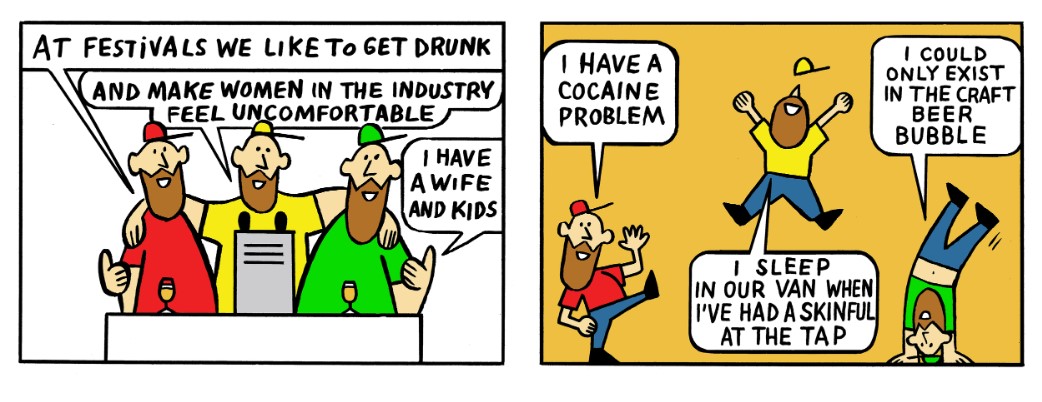
Jumping right into it, last Friday’s cartoon strip, a snippet of which site above, in Pellicle by Dave Bailey mocking craft brewery culture was something of a milestone, a bookending of sorts finally… finally confirming those inside the bubble understand what the greater world knew in 2014 when that New Yorker cover of the hipster craft beer bar was published.* The details of all the embarassing characteristics that Bailey notes as he roasts craft culture were not so publicly discussed back in 2014- even if they were obviously known to those present and paying any attention. We are told that the past is a foreign country: they do things differently there but we perhaps forget how, even over one short decade, how quickly those differences may develop.

Fortunately, Boak and Bailey** have saved you all the need to look back to through this blog’s archives just there to the right to trace all the changes which arouse at least in the UK during those intervening times. They’ve provided us with a real gem of an update on their book Brew Britannia also, conveniently,  published in 2014. It’s a beast of a bit but I am not going to ruin it for you so much as, I hope, give you reason to go dive into the full +10,000 word essay:

This long post is an attempt to fill in some of the gaps and hold ourselves to account: what did we get right, what did we get wrong, and what took us totally by surprise? More importantly, it’s about gaining some perspective. It’s easy to mistake the fact that we personally have become older and more jaded to mean that there has been a decline in the quality and vibrancy of the beer scene. Maybe there has, maybe there hasn’t – but there must be some objective facts we can use to test our gut feelings. We know other people have different perspectives, though, so we’ve also asked as many people as possible for their thoughts.

To answer all those questions, B+B applied their list of eleven indicators from 2013 of whether a community has a healthy beer culture and drew some thoughtful conclusions. Go have a look.

Speaking of lists, Jeff wrote one this week that got me thinking, too. It was a list of his top ten beer drinking experiences. I would re-arrange their order, kick a few out and add some others but the exercise is quite interesting. Consider his #10 “In the first half of a sporting event in which you are not deeply invested”:

Sporting events are festive affairs, and drinking a beer early in a game helps elevate the sense of occasion. It builds a mood of camaraderie, binding the watchers in the clink of glass. The beer itself tastes of promise—of the next couple hours, of a win, of greasy food and more beer. By the second half of any sporting event (later innings in baseball, third period in hockey, etc), the drinking event has become a sporting event and attention turns fixedly to the game. Ah, but those first minutes…

See, I see that differently – not as a linear experience but one that turns on the flow of each game. Reminded me of a 1987 Canada Cup pre-tourney hockey game between Canada and the US that I watched with pals. We ended up (like UTTER MORONS) sitting in the bar during the third period drinking beer with our backs turned to the ice because Canada was up something like double digits to diddle over the Americans. Why were we morons? Because Gretsky and Lemieux were on the ice at the same time. And between 27% to 73% of all the other hockey players who I’d ever worshiped were also right there playing. But, you know, there was beer over there on the concourse… soooooo…

Martin marked the fifth anniversary of the passing of his friend Richard Coldwell with a bit of a public service – a report on the gumwashery of Thornbridge‘s brewing of Jaipur on their new old fashioned Burton Unions saved from wreckers… or perhaps the storage locker… earlier this year:

Richard wasn’t a great fan of Burton’s beers, but would have had intelligent things to say about the Thornbridge “saving” of the Burton Unions this year. You’ll know I couldn’t care less about history or the brewing process, and argue the quality of the publican is by far the biggest determinant of the quality of the beer in your glass (see : the improvement of Bass in the hands of a smaller number of committed landlords). On Saturday, back in Sheff from Italy, I thought I’d better taste the new Jaipur at my nearest Thornbridge pub…

He approved. As did John aka TBN himself when he first encountered his first fonio:

Have you heard of fonio? If you haven’t yet, you will, at least according to Brooklyn Brewery’s Garrett Oliver who has become an advocate for this climate-resistant African grain. Its most important attribute is that you can make beer from it, which will be terribly useful once the Earth decides it can’t do barley any more. Garrett had come to St James’s Gate to make a fonio-based collaboration beer, although that won’t be out until much later this year. He also brought over some beers of his own to share.

He liked it too. You know, I am not sure whether “quite a shock; incredibly soft and chewy” or “if it’s saving the planet, then all the better” is higher praise. Clearly both worth seeking out.

Ron has been looking for a new local and last Saturday found himself with his gang checking out a really good looking stop in Amsterdam called Soundgarden – offering us a pretty good photo essay:

Soundgarden is slightly unusual as it backs directly onto a canal. Which gives it a nice view. And also means that customers can arrive by boat. Which is exactly what happened not long after we got there. How cool is that? Unlike the garden itself. Which was pretty warm. Too warm for my liking. And with almost no shade. That’s a mark against the pub. The inside was totally empty. Which meant I could take lots of nice photos without people getting in the way. I won’t bother trying to describe how it looks. I’ll let the photos do the talking.

Similarly – except a whole country away – Franz Hofer posted a study of a beer garden in Munich with this startling geolocating sentence:

Once the location of the smallest royal blacksmith, the Swiss-style hut at the edge of the estate allegedly served as Ludwig and Lola’s love den.

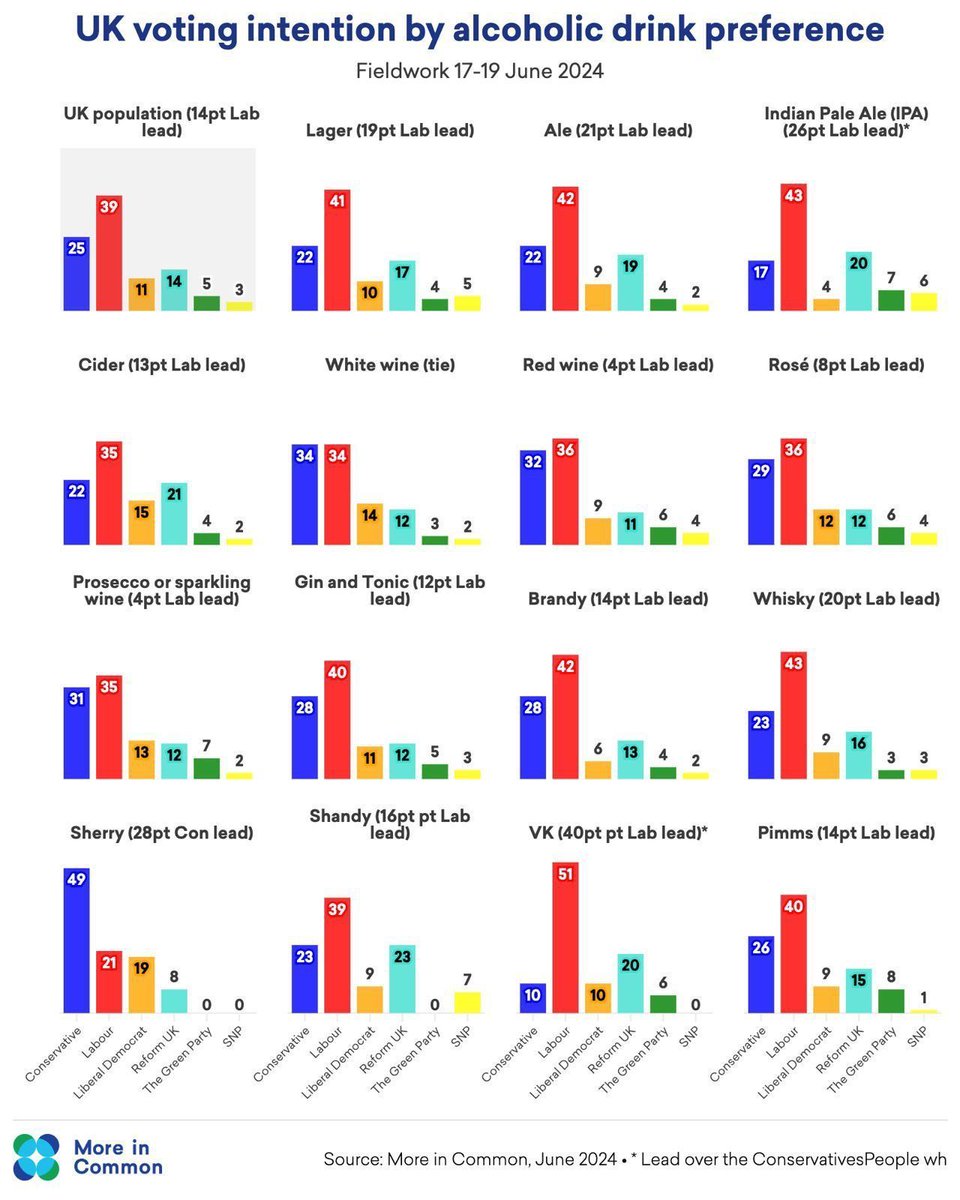
Now, let’s set all that traipsing wandering about the taverns and such aside. We live in a real world and many in the UK today will be needing one or celebrrating with one as it is election day. One poll by More in Common in particular caught my eye when it hit the sosh-meeds.  It detailed voting intentions according to a fabulous sixteen different favourite clinky-drinkies. So we learn that cider drinkers prefer Labour by an advantage of only half that of IPA fans. Almost twice as many SNP voters prefer shandy to whisky. But Sherry drinkers?  Totes Tory. They’ll be sucking back the sticky raisiny toffee gak tonight!

Speaking of the unhappy, The Times had an extended investigation into the new eco-lairds of Scotland including, as noted hereabouts last April, one Mr. Watts semi-formerly of BrewDog and his failed forestry project:

At Kinrara, Dave Morris, 77, of the Parkswatch Scotland blog, points to the dead sticks which should have grown into great Scots pines. “We should not be planting in the uplands,” he said. “There is inevitable disturbance of the soils which brings peaty ground to the surface, leading to carbon loss for decades.” Morris is furious that BrewDog received nearly £700,000 of money for the project, arguing that the land should have been left to regenerate naturally. A few metres away from the dead and dying saplings, young trees are thriving, pushing their way through the heather. Without the chomping teeth of deer or sheep to tear them down, these trees are growing naturally. All it needed was a fence to keep the animals away.

I’ve mentioned from once in a while that I worked teaching English in Kołobrzeg, Poland back in 1991 but probably didn’t mention the time I watched a construction crew out the window of the classroom. Two things caught my eye. First, they used the trunks of pine trees, bark and all, as a form of embedded rebar as they poured the building’s concrete floors. “How long until that collapses?” I thought foreshadowing a future dabbling in construction law. Second, there was a regular flow of empty beer bottles crashing down upon the work site’s ground level many floors below as the crew kept themselves… hydrated all day long. “Lordy… Lordy…” thought I. I recalled this scene when I read the news about the neghbouring Czechs cutting back on their intake as reported by Jessica Mason:

The average number of beers drunk per capita in 2023 was 256 beers per head, which is equal to approximately 128 litres, reflecting similar figures to the lowest average consumption figures ​​during the pandemic restrictions and the lowest record number in 1963. Radio Prague International (RPI) also highlighted how in 2005, beer consumption reached a record high when Czechs consumed 163.5 litres, or 327 beers per head. Consumption per person was 153 litres in 2009 holding at 140 litres for nearly a decade before falling to 129 litres in 2021… In 2021, the Czech Statistics Office estimated that beer consumption that year was the lowest since 1989 when it had been at around 151 litres per person and even jumped above 160 litres momentarily in the 90s.

So… is that really all that bad a thing for Czechs? I have consulted Max‘s dispatches for clues.

Pellicle‘s feature this week is a piece on a pub called The Swan with Two Necks by Katie, which contains some great detail of the life of a license holder living under pub chain owership thirty years ago:

One day in 1992, they received a letter welcoming them to the PubMaster group, their only notification that Whitbread had sold their pub. After a while of trying to acclimatise to their new owners, it seemed like they might need to move on again. “We just didn’t get on with PubMaster,” Steve says. “There was such a reduced selection of beer, restrictions on what we could and couldn’t buy, it was just an aggravation all the time. It just wasn’t what we set out to do.” PubMaster agreed to talk with them to see how they could help improve the situation. Before the talk was had, Christine and Steve received another letter. It read: ‘Welcome to Jennings’… “They came to me and said they had a tenancy agreement with Whitbread through PubMaster, and that they wanted me to change from partial to full-time leasehold with no compensation. And then PubMaster was bought by Cafe Inns, who were even worse.

Philadelphia magazine had an article this week on an unexpected subject, the city’s obsession with that most basic of drinks that turned out to be well suited for the most basic of bars. The drink? Twisted Tea:

The price point for Twisted Tea was lower than that for any beer they were selling, says Keenan’s owner and Grays Ferry native Scott Keenan, meaning he could sling Teas for two bucks and still turn a decent profit. Combine the price with the drink’s lack of carbonation — if you’re reading this and have somehow never been down the Shore in your early 20s, that translates into “dangerously drinkable” — and Twisted Tea was primed to explode. “It just ran like wildfire,” Keenan recalls. The numbers were eye-watering: Every week that summer, he’d sell between 350 and 500 cases of Twisted Tea. Reread that sentence, then do the math. Every week, one bar in North Wildwood was slinging between 8,400 and 12,000 bottles of Twisted Tea, outselling everything but Miller Lite.

Finally, some wise words from Jamie Goode on the subject of the role of a critic when it comes to wine which are worth thinking about in relation to good beer, too:

…what people come to a professional for is an honest opinion, built on solid tasting experience and good taste. They are looking for the model critic as described by David Hume: someone free of bias, with good sensitivity, and good aesthetic sense. Low involvement consumers are well served by the wines they are being sold. High involvement consumers – the people who are listening to the critics – are well served by critical opinion. That there might be a discrepancy is not a problem: this will always exist in any field, whether it is food, or fashion, or art, or movies. Popular taste often departs from critical opinion, but this doesn’t mean that the critics are out of touch or irrelevant. They are all part of a larger ecosystem and are doing their job. A food critic concentrating on fast food and large chains is entirely useless. So is a wine critic endorsing and second guessing the tastes of people with no real interest in wine who just want something cheap that doesn’t taste bad.

Does beer have those principles? Critical opinion writers? Or just… you know… We can think about the question for a while before we meet again next time. Send in your essays on that point by Tuesday at 5 pm. Marks deducted for late submissions.

And with that… now we roll the credits… well, the credits, the stats the recommends and the footnotes and the many ways to find good reading about beer and similar stuff via any number of social media and other forms of comms connections.*** Want to keep up with the news before next Thursday? Check out Boak and Bailey every Saturday and Stan back each Monday. Elsewhere go look at then listen to Lew’s podcast. And get your emailed issue of Episodes of my Pub Life by this year’s model citizen David Jesudason on the odd Fridays. And Phil Mellows is at the BritishBeerBreaks. Once a month, Will Hawkes issues his London Beer City newsletter and do sign up for Katie’s now revitalised and wonderful newsletterThe Gulp, too. Ben’s Beer and Badword is back with all the sweary Mary he can think of! And check out the Atlantic Canada Beer Blog‘s weekly roundup. There is new reading at The Glass which is going back to being a blog in this weeks best medium as message news. Any more? Yes! Check to see the highly recommended Beer Ladies Podcast. That’s quite good. And the BOAS podcast for the bro-ly. And the long standing Beervana podcast …except they have now stood down.  Plus We Are Beer People. The Boys Are From Märzen podcast appears suspended as does BeerEdge, too. But not Ontario’s own A Quick Beer. There is more from DaftAboutCraft‘s podcast, too.  All About Beer has introduced a few podcasts… but some may be losing steam. And there’s also The Perfect Pour. Plus follow the venerable Full Pint podcast. And the Craft Beer Channel on Youtube.  The Moon Under Water… is gone which is not surprising as the ask was $10 a month. Pete Brown’s costs a fifth of that but is writing for 47 readers over there. There was also the Beer O’clock Show but that was gone after a ten year run but returned renewed and here is the link! Errr… nope, it is gone again.

*Along with of course, the crowd pleasing cult classic The Unbearable Nonsense of Craft Beer – A Rant in Nine Acts of earlier that same year.
**Yes, yes – no relation.
***This week’s update on my own emotional rankings? Facebook still in first (given especially as it is focused on my 300 closest friends and family) then we have BlueSky (132) rising up to maybe… probably… likely pass Mastodon (929) in value… then the seemingly doomed trashy Twex (4,484) hovering somewhere well above my largely ignored Instagram (160), crap Threads (52) with Substack Notes (1) really dragging up the rear. 

The End Of July Heralds These Thursday Beery News Notes

August. It’s coming. Even though it’s the month of my road trip holiday, the first in two years, no one says “Yay! August!!” do they. It’s the last gasp, the slipping away of the sands of summer. The first hint of sweater weather. Darker beers to suit darker days. The crops are coming in, as the scene in Norfolk, England shows.

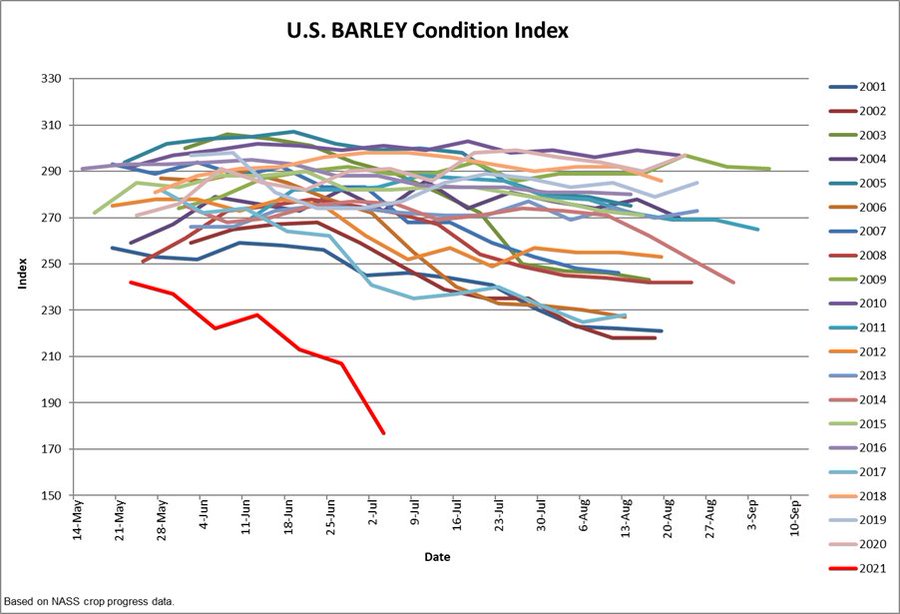
How is that barley crop doing… for those of you still drinking grain based beverages. Not well. Bryan R. tweeted a very graphic graphic, shown to the right. The US barley crop is collapsing under the heat. Canadian farmers planted 8.3 million acres of barley in 2021, up 9.7% encouraged by last year’s crop but it’s been dry and hot here, too. Northern Ireland looks to be in better shape. France looks fine, too. The rest of the western EU may be dealing with too much rain.

How’s the hops? Stan has issued his latest update on the hops markets, Hop Queries. And it contains an interest discussion on the effect of heat waves on the NW US crop this year:

“One variety that could cause issues is Cascade, as other growers have seen it hit hard.” This comes at a time that farmers have reduced Cascade acres because brewers cut back contracts. Brewers who are counting on buying fresh Cascade at below contract prices on the spot market, which has become standard operating procedure for many smaller breweries, maybe be unpleasantly surprised. (There will still be older Cascade around, but perhaps available for a good reason.) As is to be expected, the heat was hardest on “babies” (first-year plants) because they aren’t yet established. And, of course, the babies tend to be in-demand varieties, because growers are going to plant what brewers want. For instance, a field with Chinook will include only a few babies (replacing plants that grew old or became diseased), and Chinook stood up well to the heat.

Expected result? Less supply of the most desired varieties.

Lingering or revived pandemic blues got you down? Missing the many still delayed fests? Head east!

The 31st Qingdao International Beer Festival, one of the largest beer festivals in China, opened on Friday evening in the coastal city of Qingdao, East China’s Shandong province. The 24-day carnival has gathered more than 1,600 beers from over 40 countries and regions, according to the tourism commission of the Xihai’an (West Coast) New Area, where the festival is taking place. There will be over 400 activities covering international exchanges, economic and trade exhibitions, fashion shows, parades and performances during the festival.

These things are apparently a thing. Room to grow, too. Ten tents in 2022, I say!

Martyn wrote about the development of the water supply for brewing in the City of London in one of those pieces on history that does not make you yearn for the earliest of the good old days:

…despite the mythology that surrounds the river’s historic alleged unwholesomeness, brewers made use of its water to brew their beer for centuries: In 1509 the Bishop of Winchester (who owned considerable land alongside the river in Southwark – much of it occupied by brothels) and the Priory of St Mary Overies granted a license to the brewers of Southwark to have passage with their carts “from ye Borough of Southwark until the Themmys … to fetch water … to brew with,” so long as the brewers did not try to claim the passage as a highway, a license renewed by later bishops. (The Thames at Southwark is surprisingly shallow at low tide, and horse-drawn carts could be driven some way out into the stream to collect water in casks.)

Speaking of water, here as link to an interesting piece by BBC Scotland on the changing attitudes younger folk have towards alcohol. Apparently, 29% of youff are dry, up 10% over the last 15 years. If you can’t access the BBC Scotland site, here’s a brief intro. Bottom line – don’t be planning your business on an expanding beer market over the next few decades.

Elsewhere, the young folk are being less sensible as this report from France of the situation in Mexico explains:

Like all businesses in the capital — home to around nine million people — customers in the bars of Zona Rosa have their temperatures checked and are asked to use hand sanitizer. “People want to drink,” said bar owner Ernesto Castro. “The truth is that young people don’t care if they’re going to be infected or not. They want to party,” the 55-year-old said. “They feel that they’re not going to be infected and it’s a problem because the pandemic is still there and getting worse.” Last Friday the authorities raised the pandemic alert level in the capital, but did not impose new restrictions on economic or social activities.

Jenny Pfäfflin drew my attention to claims made about “natural beer“:

I’m not against alternative beers, but marketing it as more “natural” or “wholesome” than barley beer is a lot to unpack.

Seems similar to the idea of “sustainable” beer in Australia. The natural stuff is based on banana and honey and seems to be yet another weird beverage that flies the banner de jour, including the “heritage” banner. Note: “heritage” is the word for history where you leave out the bits you don’t like and rearrange what’s left to maximize comfort levels. In this case, it seems to be a tribute to craft’s heritage of banging things in to a pot and making up a back story to sell the stuff.

By the way, I never know how to react to a majoritarian/ privileged voices presenting a selection of minority/ under privileged voices. Curated protest? Appropriation of anti-appropriation? Seeing it a lot this year. But conversely, at least it is better than the bizarre branding we see in Poland: “White IPA Matters”!

The company has not responded to the allegations and complaints yet. Mr Mentzen, the owner of the brand, is a member of Poland’s right-wing Confederation party and has contested two elections – local elections in Poland’s Torun city in 2018 and for the European parliament in 2019 – both of which he lost, according to the Daily Mail.

Finally and perhaps related, a fairly sad observation to read:

I miss what my life was before beer.

Probably more common a thought that folk would admit. As you contemplate that, don’t forget to check out those weekly updates from Boak and Bailey mostly every Saturday, plus more with the weekly Beer Ladies Podcast, at the weekly OCBG Podcast on Tuesday and sometimes on a Friday posts at The Fizz as well. There is a monthly sort of round up at The Glass. There is more from the DaftAboutCraft podcast, too. And the Beervana podcast. And sign up for Katie’s weekly newsletterThe Gulp, too. And check out the Atlantic Canada Beer Blog‘s weekly roundup. Plus follow the venerable Full Pint podcast. And Fermentation Radio with Emma Inch. There’s the AfroBeerChick podcast as well! And also look at Brewsround and Cabin Fever. And Ben has his own podcast, Beer and Badword – when he isn’t in hiatus as at the mo, more like timeout for rudeness! And remember BeerEdge, too, and The Moon Under Water.

A Few Beery News Notes For Early May As I Ail Rather That Ale

This may be a brief one as I find myself on Wednesday off work sick from something with nothing to do with a virus. Food allergies. Love. It. I blame the Hungarian salami provisionally. The deli had none of the German stuff I normally buy.  I know you will join me in shaking my fist at the sky from a doubled over position as you marvel at the enhanced level of excitement the ailments of the middle age offer to the modern beer blogging reader.

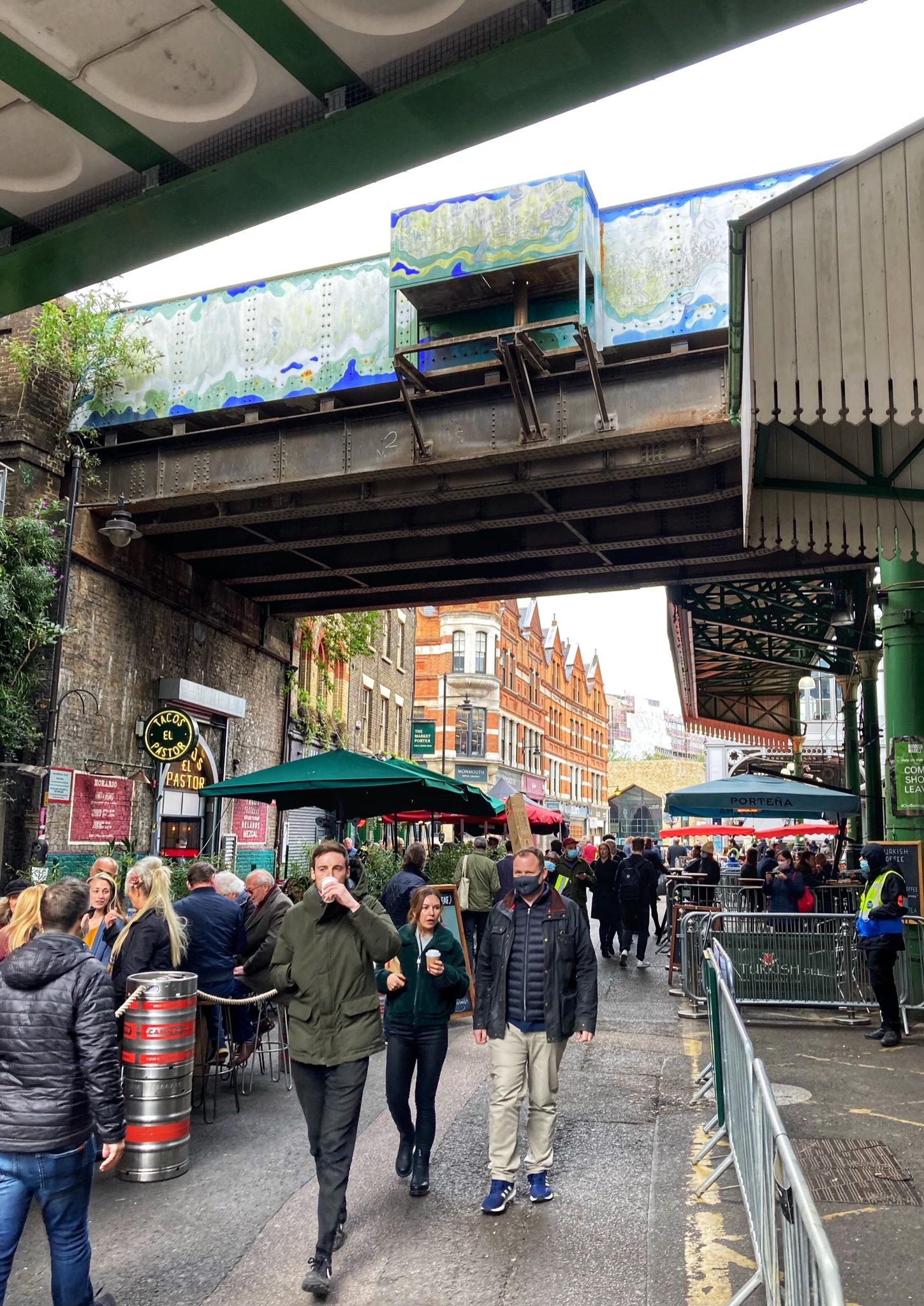
Still, I expect you have other things to do as those do in the picture of the week, posted on Twitter by Will Hawkes. My first reaction was “OH MY GOD!!!” as we have been in total lockdown for most of 2021 around these parts.  Even though Boak and Bailey are out on the crawls these days, I am no where near heading out into a crowd even though I have had my first AZ jab for half a month now. Still, it does look pleasant. Looks like the scene is near Kings Cross Station at Stoney Street. This would be more likely the scene I’d find myself in. Also in Britain this week:

i. a UK Member of Parliament told a beer joke this week.
ii. a beer rating service on CEFAX, the 1970s and ’80s TV based internet service of sorts, was remembered, too.

Update #1: according to Tom in the comments, apparently May is Mild Month so once again by June 99% of beer drinkers will say to themselves “what’s that mild stuff?”*

Update #2: Good to see our local Stone City Ales managed a local crisis in supply so well. See, they planned for a normalish patio springtime and then faced a renewed lockdown so they had waaaayyy too much beer. Their solution worked according to my email inbox:

Since we started our 25% off sale last week, we have been overwhelmed by your support, and we are so grateful. We just wanted to let you know the sale ends tonight at midnight, so if you would like to take advantage of this opportunity (for the first time, or again) just be sure to order online today, and simply choose a future delivery date. We don’t want to sit on fresh beers, and we had brewed lots thinking our patios may be open. Alas, we are take-out window and delivery only, so every sale really helps.  We are so proud of these beers we have out right now. Don’t miss out. To all of the health care workers and essential workers out there — WE SEE YOU, and deeply appreciate what you do for us all. 

The Beer Nut had a busy week with three posts and eleven beer reviews. Best of the lot appears to be the stemwear worthy beers of Land & Labour but no such joy for a sad faux choco-orange imperial stout from the obscurely named brewery, Wander Beyond:

On the flavour, oranges are conspicuous by their absence. It goes big on the chocolate, which doesn’t sit well with the assertive carbonation. The sweetness, bitterness and savoury side are all what you’d get from dark chocolate or cocoa powder, and there’s only the faintest hint of Jaffa Cake orangeiness on the finish. I’m down on gimmicks in beer generally; poorly rendered gimmicks like this are unforgivable.

When cooking cicadas, beer is optional.

Ron has done a series of posts on AK beer during WWII.

Someone mentioned recently that they thought AK died out between the wars. That’s not really true. AK was given a good old kick in the bollocks by WW I. Many found their demise in the war’s brutal gravity cuts. Others, though fatally weakened, soldiered on. Another war was the last thing they needed. Kicking off the war at a little over 1030º, there wasn’t far they could go once a new round of gravity cuts began to bite.

Posts on the grists, sugars and hops in AK brewing followed. Then he provided a brew it yourself recipe for an AK from 1945. Rather completist of him.

Gary is doing us all a great service with his continuing series of posts on pre-WW II Jewish-owned East European breweries. This week he wrote about the Teitel Brewery of Ostrow Mazowiecka, to the north east of Warsaw and the site of the murder of hundreds of Jews in 1939. Some good research supports the piece:

I located a print ad for the brewery in the National Archives of Israel. It appeared in the June 1, 1928 Trybuna Akademicka, a Jewish-themed, Polish-language newspaper in Warsaw. I wrote earlier that at least two other Polish breweries with Jewish ownership, the Pupko and Papiermeister breweries, placed ads in the paper in the same period.

By comparison with the above, please note elsewhere that it’s not a blog, its a “premier beverage research firm“! Such cringy puff.

Oktoberfest went and got itself cancelled again. Way. To. Go. To the north-west, another sort of doom is on the way as hard seltzers are boing brought to Belgium via AB-InBev-etc-etc. The Brussels Times tries to explain:

To begin with, the name ‘hard seltzer’ is aggressive enough. On the drinks’ British website, meanwhile, the company states, “It’s like alcoholic sparkling water, because that’s exactly what it is,” and “Don’t overthink it”. “We want to be a company that brings all people together, not just beer people,” said Elise Dickinson, marketing manager for hard seltzers at AB InBev. “Hard seltzers are an integral part of that. The demand for the drinks is also starting to increase in Europe. AB InBev is well-placed to help retailers enter this booming market.”

It really is an accusing finger at the craft beer trade that such a vacuous product is kicking it in the marketplace. Could a food product be less skilled? Still, gives a reason to pay freelancers in need. Canadians are less interested as we know how to pour vodka into club soda at 20% of the price.

Conversely, Asahi is investing in no-alcohol beer as opposed to no-beer alcohol:

“Non-alcohol is a good all-around product,” Atsushi Katsuki, Asahi’s chief executive since March, said in an interview. “It helps to resolve social issues, it connects us with new users and it leads to our profitability.” Low and non-alcohol beer sales have benefited as people spent more on drinks to be consumed at home during lockdowns, suiting Asahi’s broader strategy of focusing on higher-margin “premium” beverages.

As with seltzers, the big money is in offering less.

Odd that the previous Game of Thrones beer isn’t referenced. Is this even a story? GoT has become the My Little Pony of beer brandings. Looking forward to Game of Thrones sugary breakfast corn pops.

Retired Martin has been pumping out the blog posts and, in this piece on a trip to a place called Flatt Top in England, posts what has to be the single most honestly unattractive photo of a British pub that I have ever seen. Click on that thumbnail if you dare.

There. Back off to bed for me. While I’m there shivering under the covers, check out the weekly updates from Boak and Bailey mostly every Saturday, plus more with the weekly Beer Ladies Podcast, at the weekly OCBG Podcast on Tuesday  and sometimes on a Friday posts at The Fizz as well. There is more from the DaftAboutCraft podcast, too. And the Beervana podcast. And sign up for Katie’s weekly newsletterThe Gulp, too. And check out the Atlantic Canada Beer Blog‘s weekly roundup. Plus follow the venerable Full Pint podcast. And Fermentation Radio with Emma Inch. There’s the AfroBeerChick podcast as well! And also look at Brewsround and Cabin Fever. And Ben has his own podcast, Beer and Badword – when he isn’t in hiatus as at the mo, more like timeout for rudeness. And remember BeerEdge, too. Plus a newcomer located by B+B: The Moon Under Water.

*Ha Ha. Funny joke, right? No, really. Joking.

The April Fools Day Edition Of Your Beery News Notes

Here we are – April. The month of the showers that bring all the flowers. A snow storm is passing through this morning here at the east end of Lake Ontario. Such is life. Work is heavy, the third wave is heavy… and these packs of cookies and chips are making me heavy… heavier. Fine. We’re locking it all back down. I need my jab. Really. Soon please. But remember – it could be worse

Speaking of the weather… Mexico is considering taking steps about the water that is moving north from arid lands through the porous US border in the form of beer:

Mexican President Andrés Manuel López Obrador is railing against the production of beer and milk in areas where there isn’t enough water. López Obrador cancelled plans for a huge brewery on Mexico’s northern border last year, and on Sunday he questioned the whole idea of producing beer for export. “How can we have beer breweries in the north? How can we produce beer for export? What are we exporting? Water. We don’t have water in the north,” López Obrador said.

This is not a small matter, as Forbes has reported:

Beer used to come from a variety of countries. In 2020, Mexico accounted for a record 72.27% of all U.S. beer imports during a record year for all beer imports, which totaled $5.75 billion. It marked the ninth consecutive year for record U.S. beer imports and the 12th consecutive year that Mexico increased market share. Most of that beer comes a massive brewing operation outside Piedras Negras, Mexico, across the Rio Grande from Eagle Pass, Texas, which is responsible for 56% of all U.S. beer imports.

The owner of that brewery? Anheuser-Busch InBev. Economic imperialism. Sweet. Somewhat similarly, The Full Pint has somewhat bravely posted, in 2011-esque style, the list of the top 50 US craft breweries but much of the top ten is made up of odd assemblages of investment vehicles of one sort or another. Gambrinus? CANarchy? Artisanal Brewing Ventures? It’s bad enough that Yuengling and Boston Beer are in there. Who are these people… err… these mega corps? So confusing.

Somewhat economic and culturally imperially speaking, a Chinese firm has found a way to brew in Pakistan to serve the Chinese economic actors in their new work zone:

“The company formally started its beer production last week, which product will be supplied to Chinese nationals working at various projects launched in different areas of Pakistan under the China-Pakistan Economic Corridor and mines and mineral projects in Balochistan,” Mohammad Zaman Khan, director general, Excise and Taxation South, told Dawn. He confirmed a licence had been issued to the Chinese company in 2018 as it had submitted an application to the authorities concerned in 2017, pleading that the beer and liquor brand which the company produces in China is not available in Pakistan.

Almost as confusingly dramatic… Q: could a hotdog be a sausage IPA? A: apparently anything is possible these days if the logic leading to the “farmhouse IPA” is to be trusted:

The one thing we know for certain, without even a hint of ambiguity, is that the word “saison” does not attract drinkers. A few breweries and a few beers have achieved success, but it’s despite, not because of the word. Justin regularly modifies his “saison” with equally dangerous adjectives like “Brett” or “table.”—other words that scare off drinkers. It’s too bad because I am convinced beers like Ashfall and Bumper Crop and Slow Motion have broad appeal. The word IPA no longer has much connection to style. And if “saison” reads like a warning to drinkers, IPA is a reassurance, a way of saying, “You’ll like this beer.”

Reflecting a more certain time, Ron told the story of a party for the coronation of Edward VII in 1902:

…the hero of the day was enthusiastically drunk. As twilght came on the grounds were beautifully illuminated with fairy lights and lanterns, and at midnight the proceedings terminated by a display of fireworks…

Ron was less enthused, saying Ed7 was “remembered for being a debauched glutton, who ate, drank and smoked himself to an early grave.” I hope he is more charitable in his plans for the next coronation party. What plans do I have? Jings. No idea. Better call Ron and ask. Has anyone laid away a few dozen hogsheads of strong ale?

The price of beer is being lowered in India to cope with Covid.

One of my favourite memories of living in Poland 30 years ago was the hardly operational trains – and especially the food and bar cars:

…the company’s name has in Polish become all but synonymous with its dining cars, serving up a taste of Poland – everything from hearty pierogi to piping hot żurek fermented-rye soup – in sleek and comfortable surroundings. Wars dining cars have fostered countless anecdotes, inspired songs, and generated a large following among contemporary train buffs. And recently, those restaurant cars have been even more of a welcome sight, as they have become the only sit-down restaurants in Poland allowed to remain open amid coronavirus restrictions.

Go Covid! Covid loves trains!! In further news of the pandemic present, Ed has provided a summary of how his British brewing workplace has coped with the situation – and explains its very interesting business model:

… brewing through the plague year. As an essential worker I’ve been slaving away whilst many have been at home all day playing with themselves and saying how it’s affecting their mental health. Maybe the Victorian moralists were right after all? I work at a site which contains four independently owned breweries (brewhouses and fermentation vessels), of which the main brewery does the processing (stabilisation and filtration) and packaging (cask, keg and bottle) for all four, and provides staffing for three.

Reversedly equipment-wise, the UK’s Fullers PubCo is now two years into life without its own brewery but things there are looking up:

Simon Emeny, Fuller’s chief executive, said the company had entered the pandemic in strong shape financially, partly because of the January 2019 sale of its brewery, which makes London Pride ale, to Japan’s Asahi after 174 years in the business. However, the pandemic cash burn meant the company needed money to train staff and take advantage of an expected sales surge once pubs reopen, he said.

Finally, Evan has discussed the use, misuse and uselessness of “craft” in the language of drinks as spoken around the world:

In other languages, saying “craft beer” can be close to impossible, at this point being “too new” a phrase to have a local equivalent. Apiwe Nxusani-Mawela, a brewer and consultant at Brewsters Craft in South Africa, says that she wouldn’t even know how to express the idea of a craft beverage in a language like Xhosa or Zulu. “The concept is not new — Africans have been hand-crafting various items for years,” she says. “The traditional beers here have different names, but they all mean beer. Like one is called ‘utywala besintu,’ because ‘utywala’ is beer and ‘besintu’ means for traditional people or natives. But craft beer? Craft beer is still a new term. I don’t think we have a word for it.”

There. Easter weekend. Four days off heres abouts. Nice. Well, except for the whole Christ died on the cross for your sins thing. Best be good. One thing that is good and charming and interesting is Project X. I can’t tell you anything about Project X but it is exciting and charming and… interesting. More when I can tell you. Meantime, check out the weekly updates from Boak and Bailey mostly every Saturday, plus more with the weekly Beer Ladies Podcast, at the weekly OCBG Podcast on Tuesday and sometimes on a Friday posts at The Fizz as well.  There is more from the DaftAboutCraft  podcast, too. And the Beervana podcast. And sign up for Katie’s weekly newsletterThe Gulp, too. Plus the venerable Full Pint podcast. And Fermentation Radio with Emma Inch. There’s the AfroBeerChick  podcast as well! And also look at Brewsround and Cabin Fever. And Ben has his own podcast, Beer and Badword – when he isn’t in hiatus as at the mo, more like timeout for rudeness. And remember BeerEdge, too. Plus a newcomer located by B+B: The Moon Under Water.


The Last Thursday Beer News Notes Before The UK General Election

It’s not often that I get to headline the weekly update with something so.. so… unbeery – but is beer ever really that much removed from politics? Consider this photo to the right that circulated about a man to the left. I was as sad that it was Coors Light, the faceless multinationals of beer that he was pouring as much as I was saddened by the mleko* pour.  The Late Great Jack Layton held the red banner high here in Canada for years and he also knew how to pour a beer with a bit of style.

Given it is Yule, I will start with Ben Johnson and his list of ways to avoid the Christmas party hell you fear most, other drinking your good stuff:

Hosting at home guarantees my own access to good hooch but it also opens the door to the undesirable possibility that my guests might assume that they will be graced with the same luxury, which of course they are not. Indeed the one downside to hosting is that it means people might drink my beer. Thankfully, over the years, I’ve learned ways to keep my guests from dipping into my stash and I’m here to pass that wisdom on to you.

Speaking of Yule, Merryn in Orkney and Lars in Norway were discussing Christmas brewing obligations in Norway when Lars made this extraordinary statement:

This was not even the law for all of Norway: it only applied in western Norway (the Gulathing area). The other regional laws did not have this provision. (The Frostating law required brewing for midsummer.) Neither did the Swedish regional laws.

The Frostating law? Now I have to get my brain around the legal brewing requirements of other jurisdictions. It would be interesting to have a great big list when folk had to brew and why.

Katie of the shiny and the biscuit gave us a wonderful portrait of and an interview with two Mancunian fans leading the cause of cider from their demand side of the commercial transactional teeter totter, this week at Pellicle:

With Dick and Cath leading the march, Greater Manchester has become the centre of “real” cider in the North in the space of two years. Together, they created the Manchester Cider Club, and in doing so have brought cidermakers like Tom Oliver, Albert Johnson (Ross-on-Wye) and Susanna and James Forbes (Little Pomona) to the city. At regularly sold-out ticketed events and inclusive meet-ups, they are encouraged to answer questions and share their cider with a new, northern audience.

From further east, the tale of Vienna Lager was told at scale in the seven days at A Tempest in a Tankard:

Four hours east of Munich as the RailJet flies, the Viennese were marking a milestone anniversary of their own, albeit with much less fanfare: 175 years of Vienna Lager. Even if no museums commemorated the fact, and even if the media resonance was akin to the sound of one hand clapping, Vienna had good reason to celebrate its contribution to the culture of brewing. Bottom-fermented beer had been produced for centuries in Europe’s Alpine regions, but it wasn’t until Anton Dreher, owner of the Brauhaus zu Klein-Schwechat, brought together technological advances he learned in Britain and Bavaria that he was able to produce the first lager beer that could be brewed year-round. That happened in 1841. **

Big Beer Corporate News? Apparently darling of a decade ago Stone is maybe up for sale, a rumour of a story almost entirely confirmed by the denials of the brewery. In another sort of bad brewery news reporting… or rather reporting on bad news for a brewery… it appears that New Belgium may have new clients amongst the authoritarian military elite!

The New Belgium Brewery insists it is not like other companies. Its owners, who are also its employees, are devoted to fighting social inequity and climate change, proving business can “be a force for good,” its website says. Their CEO Kim Jordan was honoured among 30 “World-Changing Women in Conscious Business” last year. Employees even get free bicycles. But those ethical credentials have not stopped them planning to sell their firm, which has breweries in Colorado and North Carolina, to a beer giant accused of funding genocide against the Rohingya in Myanmar.

Wow. Too bad there was no way for the governing hands on the nNew Belgium transaction to be warned of the situation, like a hearing of the International Court of Justice or anything. Speaking of things end-timesy, beer in the U.S. of A. is dying again:

The trend doesn’t appear to be reversing itself. Sales of domestic beer slipped 4.6% between October 2018 and October 2019, according to Nielsen. Microbrew and craft beers are also in a minor slump, down 0.4%, despite Big Beer companies scooping them up left and right (AnheuserBusch just purchased Craft Brew Alliance, which makes Redhook Ale).

“Microbrew” can only be a word used by someone who knows very little about microbrewing, rights? Aside from that, the story is White Claw and, if we had any sense, no one would care as that is something other people buy like purple velvet trousers or quadrophonic stereo systems. So why do we care? I don’t care. Affects me in no way. Nada.

All of which leads to the news in Ontario that the national brewpub chain Les 3 Brasseurs has announced that four of its locations in Ontario are closing:

Ten years ago, we entered the strategic market of Ontario and, over that time, experienced some great victories, notably our Yonge and Oakville restaurants, but also some challenges,” said Laurens Defour, CEO of 3 Brewers Canada, in a statement. “This is a difficult decision, but we have concluded that we need to close some sites in order to support the evolution of our business.

Careful readers will recall that I happily attended on of the busier outlets in Oakville last year and was quite happy with the carrot pale ale I was served.

Barry in Germany posted an afternoon’s worth of photos of old apple and pear trees taken during a walk with his dog. Elsewhere in Germany, there is a pub branded with the likeness of Roger Prozt but denying it is a pub branded with the likeness of Roger Prozt. Protz commented thusly:

I’m not even allowed to be flattered. They deny any connection to me because they think – wrongly – I’m going to sue them. I recall the image that was produced for a beer event, same style for all participants.

Note: of the two being depicted, I’d suggest the dandy, the fop, jack the lad was more mocked than Peg. Interesting that the powdered wig was not a wig at all. And speaking of the Irish of yore, here is the tweet of the week:

“Ale has killed us”? Short memories of the Vikings apparently. But enough! I have a long day’s work ahead of me then need to settle in for the the election results. Don’t forget that there’s more news at Boak and Bailey’s on Saturday, at the OCBG Podcast on Tuesdays and sometimes a mid-week post of notes from The Fizz as well. And sign up for Katie’s weekly newsletter, too.

*A teacher in Poland I once was…
**I used a slightly different quotation than Boak and Bailey so I feel justified.

The Mid-July Thursday Beer News You Need

Mid-July! It’s lovely. Warm. Tropical even. We are actually getting the edgy remnants of Hurricane Barry into the Great Lakes basis so it’s all a bit thick out there.  Raspberries picked by my own sausage-like digits. And the fire flies are at their peak. I let the garden go a bit and they seem to love it. 100+ flashes a minute in one corner of the garden. Beer has its role, too. I even had one last night, mid-week. At a Denny’s.* A Bud Light. The weirdest thing was being handed a ice cold bottle and an ice cold glass. Entirely hit the spot. Mid-week, mid-month, mid-summer, mid-year, mid-aged.

What is going on? Well, Josh Noel, who admitted to needing something to wash out his mouth after writing about hard seltzer, has written a helpful article for the Chicago Tribune on dark lagers:

And that gets to the genius of dark lager. They’re beers that typically have a modest amount of alcohol — about 5 percent or so — but are long on aroma and taste. Flavors usually include a mild to deep roast character and can veer into chocolate, char or coffeelike terrain thanks to the roasted malt that gives the beer its dark hue. But unlike most of the porters and stouts they resemble, dark lagers tend to finish dry. The best dark lagers make for stealthily ideal summer beers: interesting layers of flavor, but refreshing. The color, which can range from deep amber to impenetrably black, winds up playing a visual trick.

We have an excellent local black lager, Blacklist from The Napanee Beer Company, so I am particularly grateful for this addition to the discussion.

Note: “bee boles were used before the development of modern hives to provide shelter to the skep…”

As we have been noticing over the last few weeks, beer writing and commentary seems to have divided into (i) “it is so dull and boring right now” for one reason or another** and (ii) HOLIDAY!!! So it was good to see some interesting travel being discussed by a couple of Brits abroad. Nate posted a top ten list of things to do in a city I have lived near – Gdansk, Poland – and gave ten top tips for visiting the old Hanseatic port including hitting up a museum about the Solidarity movement and this:

Shoot Some Guns – Maybe a controversial one, but I’d always wanted to shoot some guns since we can’t do it in the UK and I stumbled across a shooting range whilst doing some research. DSTeamStrzelnica was a great experience where we got to shoot four guns (A Glock 17, a revolver, AK-47 and another rifle) and it only cost us £18 each to shoot a full clip of each gun. It was a really fun experience!

Retired Martin has been in NYC and left us a photo essay with commentary:

How joyous to see a “Sorry, no samples” sign, by the way. 16 ounces (80% of a pint) is practically a sampler anyway.  I reckon the Five Boroughs Hazy IPA served in a plastic glass will have cost me £8 by the time taxes and Lloyds Bank conversion charge are added on.  Still cheaper than Port Street. “Tastes like Brew Dog” says Mrs RM.  It tasted like Hazy Jane. On to the High Line, the one place in New York where you can avoid craft beer and tipping…

Saskatchewan’s Pile O’ Bones Brewing Co. is getting a bit of heat for its name – folk saying its disrespectful to the local indigenous community – but according to this Cree language place name resource site, the location of what is now Regina was called “oskana kâ-asastêki” which meant “where the bones are piled.”

Beervana had a interesting guest blog post this week written by Ben Parsons is the co-founder/brewer, along with Rik Hall, of Portland Oregon’s Baerlic Brewing which unpacked the benefits in the US for craft brewers to self distribute their beers:

I would posit that if and when a brewery business does get into some troubled water—albeit from market conditions, saturation, losing chain grocery, etc—not owning their own distribution rights could easily be the last nail in the coffin. And although distributors are a very necessary part of the industry, their foothold on this particular part of the conversation is risky business and needs modernization so that it better fits with the current state of the industry.

Folk chatting about early brewing methods is always interesting. Who knew that bands in the pottery meant the line to fill with boiling water before topping up with cold before adding in the mash was so obvious?

At the Corrigall Farm, Orkney, large tubs that have marked lines inside, usually about one third to a half way up. Custodian told us (years ago, hope I have the details right) that you put in boiling water to the mark, then top up with cold and it’s the correct temperature.

Pilsner as the anti-NEIPA? Maybe.

This is an interesting piece, a remembrance of 16 of B.C.’s now shut early micro- and even some more recent craft era breweries. And it contains this interesting bit of history:

Horseshoe Bay Brewery was the first microbrewery in Canada when it was opened in 1982 by John Mitchell and Frank Appleton to produce beer for the nearby Troller Pub and became Ground Zero for the craft beer revolution. Mitchell and Appleton soon moved on to Spinnakers, and Horseshoe Bay briefly closed in 1985 before reopening and produced beer well into the 1990s, before closing for good in 1999. The original brewhouse, made from converted dairy equipment, is still in use today at Crannog Ales in Sorrento.

Now, that would be a real Canadian beer nerd’s pilgrimage: “honey, I am off to see the original brewhouse, made from dairy equipment!” It’s halfway between Kamloops and Sicamous, if you are planning the trip yourself.

That’s it! Have a great week as Q2 turns into Q3. I will be lounging myself. Well, dapper by day then lounging through evening. Such is the life of the office worker. Check out the beer news from Boak and Bailey on Saturday and maybe on Monday we will have a sighting of the inter-continental Stan now that he is back from Brazil.

*You can mock me after you’ve tried the burger. I was surprised, too.
**hard seltzer, everyone’s already been bought out, even glitter beer is so last year…