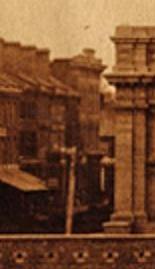
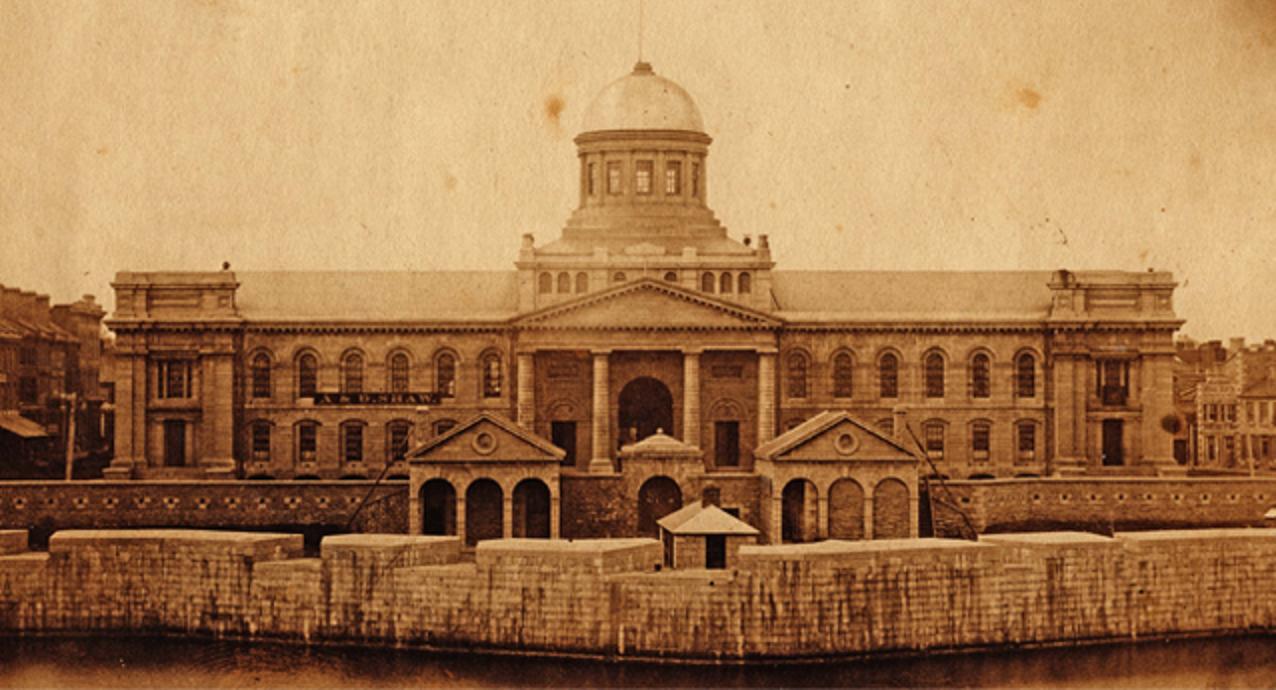
My Place Of Work About 160 Years Ago

My place of work in the 1850s when the waters lapped up to the stone wall of the market battery. As in a battery of cannon that protected the market. Because City Hall was built in the 1840s on part of the market square that he been there for decades before that. If you click on the picture you will see more detail. Like these bits:


To the left, you see the sign for “A & D Shaw” but I am not sure why there was a sign like that on the front of a government building. Were there businesses in the building, too? In the middle there is the detail to the left, a week glimpse up Market Street. To the right there is the same thing up Brock. The Market Street buildings are still there but there is no awning or porch on the south side as there was back then. An one of the buildings on Brock could be Sipps or Casa Domenico.

Garden 2012: Onion Harvest Day Is Now… As In Now!

onions2012Onions are no so much a vegetable as a necessity. At the old farmstead, I planted 2000 onion sets a year. This year, a quarter of that on about ten square feet of where the front lawn was removed last Easter.

They may last until Christmas. Unless I make a whopping pile of onion jam or something nutty like that. The smell of harvesting them with your bare hands is exotic. If onions, something we ate 1,000 years ago, were not common they would be a spice. Next year, more.

Is Good and Craft Beer Really A Form Of Temperance?

Yesterday, Jeff reviewed the stated purposes of Oregon’s Liquor Control Act of 1934 as part of an exploration of the regulation of strong drink in his state. Lew has been writing along a similar line for some time on his separate blog Why The PLCB Should Be Abolished. Cass has been running a similar campaign here in Ontario at FreeOurBeer.ca. I like these campaigns as anyone should who lives in a jurisdiction with a sensory lab. It is, after all, just beer.

But one of the odder things about the good beer discussion is sometimes a bit of pressure to sing of the same song sheet. When I posed a category titled “Beer Bloggers Against Drunk Driving” there is a bit of a chilly response, the idea that one ought not to introduce anything negative into the conversation. One should not have a strong opposite view that asks why good beer might be a wee bit obsessively too central to the world view of those who write about it. It is, after all, a drug.

All that comes to mind for me when I look at the values Oregonianites captured in that law of 1934, we see words that sit in a middle ground, that challenge me to ask how I think about them now almost 80 years later:

(a) To prevent the recurrence of abuses associated with saloons or resorts for the consumption of alcoholic beverages.
(b) To eliminate the evils of unlicensed and unlawful manufacture, selling and disposing of such beverages and to promote temperance in the use and consumption of alcoholic beverages.
(c) To protect the safety, welfare, health, peace and morals of the people of the state.

I have been thinking about words like these a bit lately. They don’t seem to me as bad as the discussion might have led us to believe. In the comments following his post, Jeff raised the spectre of that darling of pre-WWI American prohibitionists, Carrie Nation. I noted that Carrie Nation was not a proponent of temperance but of abstinence. See, my point is that preventing abuse, promoting temperance as well as protecting peace and morals is pretty much what much of western culture wants when it goes to work or mows the front lawn or sends the kids to school. Which may mean we have to consider that in the end maybe temperance won and much of western culture is the better for it. None one advocates for abuse, intemperance, peacelessness and immorality. Of course not, no more than you would support other scourges of 1800s life like child labour or lack of public health. We underestimate or dismiss how more widespread and heavier drinking was then compared to now and how it may have come smashing into conflict with industrialized urban life.

So, is good beer the natural descendant of the temperance movement? Just as lower alcohol lager was presented as a temperance drink in the latter 1800s, is tastier beer now conveying the notion that mass produced beer need not be mass consumed? This is not to say that the liquor control boards should not be undone. I want to buy my beer in cornerstores and gas stations in Ontario like I can in nearby Quebec and New York. But should we reject all? What values can you not support? What regulations would you keep?

Blogging About Blogging As Boak and Bailey Disclose

Books, beer and awkward branded clothing. And those products that supposedly make you experience of beer more convenient but do not. Emails offering come to me a number of times a week and, unless it is a really unappealing concept from the get go, I writing in reply that wee treat in the mail would be fine. Honestly, over half truly fundamentally disappoint one way or another. Sometimes, however, there are great surprises. Last week or the week before, I received a courier notice for an unexpected delivery. I hauled myself to the edge of town where the courier trucks live and was handed a box with a sample six pack of Rickard’s Cardigan, a spiced amber sort of beer – and really liked it. I didn’t expect to but with the shift in weather from stinking hot and 107% humidity to 65F and dry, Cardigan filled a need nicely. Rickard’s Blonde surprised me the same way last year as a good value brew. But I didn’t need the actual cardigan that came with it and the matching glassware will become a gift for some Christmas photo contest prize winner.

So, is there an ethical level to this? I have had an 18 wheeler stop at our suburban home to drop off a six pack and also had two UPS trucks stop at the same time down the lane a few years back on Christmas Eve, each with boxes of importers samples. The delivery guys shared looks of envy. These things happen, not often enough frankly, but overall writing about beer is a zero net affair for me. There are things I don’t get. The nutty LCBO system only offers samples at its “sensory lab” deep in the heart of its basement concrete bunker (I am told) which means I would have to travel for five hours return to participate. As if most people will interact with beer in that context. Shame on those who bow to these demands of the monopolist. Others, including certain well known US craft brewers, are notorious with being cheap with samples while others are quite keen to make it easy for you to try what they make – to, you know, spread the word. Do I like those who make it convenient more than those who don’t? I wonder.

Well, you don’t have to wonder anymore with Boak and Bailey as they are telling all by way of a disclosure page. My first reaction truly was brewers need to send them more samples. But the second was that they describe these samples as “gifts”! Gifts?¹These are inducements to help the brewer, the author or the maker of that stupid beer opener ring that rips your flesh. They are search engine optimization strategies. They are part of the trade. Marketing.

I have to run to work but would be interested in your thoughts. Given the absence of a real revenue stream, I would suggest that these things are the least one should expect, the very least.² But you tell me.

¹ See comments. I was in haste so over reacted a tiny bit. But, if I am honest, a sample from someone you like is still not a gift. This is a real issue with beer writing. We really like many many people involved with beer half the time (keeping in mind there are arses as well as in any part of life) which makes samples feel like gifts. Yet, one does also give back. How is that to be described?

² Note, too, how the juxtaposition of pleasure in beer and thought about beer can get tricky.

What Was On The Drinks Menu In 1378 Or So?

piers1

It is not often that I get to write that I was flipping the pages of Piers The Ploughman the other day but in fact… I was flipping the pages of Piers The Ploughman the other day and noticed a lot of references to drinking in Book 6. I pulled it from the back corner of the bookshelf after watching the episode of The Story of England from the BBC on life in the 14th century. This era of the plague following on the heels of a great famine saw societal disruption and population crashes. The poughman, it is explained unexpectedly only for a 21st century man like myself, was the hero of the community, the bringer of food. A morality tale, Piers joins a pilgrimage after getting his spring planting done:

…for so commands Truth. I shall get them livelihood unless the land fails, Flesh and bread both to rich and to poor, As long as I live for the Lord’s love of Heaven. And all manner of men that by meat and drink live, Help ye them to work well that win you your food.’

Notice that the winning of food by working the land earns you drink? Because the drink is ale. Made of the grain that grows in the field. So, being curious, idle and tangential – all likely sins in Pier’s worldview – I wondered what the hierarchy of drink might have been to a someone six and a half centuries back. Because what’s good about a morality play that does not list everything one way or another in hierarchies.

♦ Water. Lowest of all. The text reads at line 6.134 that “…Truthe shal teche yow his teme to dryve, Or ye shul eten barly breed and of the broke drynke…” Drag. Learn to drive the plough’s team or drink out of the brook.
♦ Thin ale is next. Wasters who will not work are punished by the reality of famine and then Piers bargains with Hunger to save them:

`Suffer them to live,’ he said `let them eat with the hogs
Or else beans and bran baked up together,
Or else milk and mean ale’ thus prayed Piers for them.

♦ Good ale. Before the character of Hunger takes his leave when the crop is in, the last year’s supplies are consumed at around line 6.300: “…Thanne was folk fayn, and fedde Hunger with the beste / With good ale, as Gloton taghte–and garte Hunger to slepe…”
♦ Best brown ale. Soon, good is not good enough as the lazy shirk again and goes off looking for something better, now available after the harvest is in and the risk of hunger has moved on as “no penny ale please them”:

Nor none halfpenny ale in no wise would drink,
But of the best and the brownest for sale in the borough.

So, not quite a style guide but clear evidence of standards, the idea that there is something worse, something good and something so much better available in town at some sort of specialty shop that you may not really need. Sound familiar?

Albany Ale: Bringing Together Different Perspectives

One of my favorite things about thinking about beer is realizing that it is actually a hugely diversified discussion even if there are significant forces trying to homogenize and standardize and prioritize the discourse. The upcoming beer school at Beau’s Oktoberfest is framing this varieties of views neatly for me. Craig has been out hunting for early central NY hops and was contacted by a home brewer who has made an attempt at one possible take of Albany Ale. Ron has been discussing the early 1800s Hudson Valley brewing logs from Vassar’s brewery and connected with alumni from the college that the brewery helped found.

Me? Me I am most interested in tracking the cultural aspects and how they fix into the context of history. I wrote Stan an email yesterday to see if he had considered the tracking of the name of CNY hops in the 1800s and had to confirm that it was not, unlike one aspect of his focus, the DNA of the varieties that I was interested in but the names given over time to the varieties. I summarized the changes and the reasons for the changes that I have been seeing in an email back this way:

♦ Post-Revolution – economic crisis that sets CNY back for best part of three decades 1775-1805. Hessian fly affects crops during this time moving beer production from wheat to hardier barley. Dutch wheat beers in Albany becomes “Bostonian” or New England style as majority of population shifts culturally. Hardscrabble farming becomes stablized farming.
♦ Post-1812 – agricultural societies, fall fairs and some scientific farming journals start. New England “improvement” moving west. Erie canal helps this take off.
♦ 1822: some sort of crisis in hop crop in UK requires reaching out for more sources, including CNY.
♦ 1830s – Robust export ale trade well underway. CNY brewers not referring to hops according to species but local supplier / grower. Exporting via ship.
♦ 1848 – UK brewers note “American hops” in their brewing log. Not by variety. [Ron has a post on this.]
♦ 1840s-60s: large and small cluster described in CNY. Geographical named hops also being referenced like “Pompey” and “Canada”. Pompey is a town. Canada is a variety that moves south, faces a false imposter and becomes “True Canada” soon after Civil War – the arse is out of all of it and mad breeding and diversification underway. Science meets money.

Keep in mind “Albany Ale” in this sense is all about the barley beer that ruled before lager takes over in around 1875 after four or so decades of expansion. Before 1775 and likely for a bit after, it remains my belief that the Dutch wheat farming of the colonial era was logically – and in accordance with the evidence – also the source of indigenous wheat beer brewing that relied on hops that were a hybrid of local wild hops and Dutch introductions. Others may have a greater interest in the industrial era when Albany was king. Or with the actual techniques of brewing. Or discovery of the actual ingredients of the beers.

Which is great. Because that is what makes the discussion complex and interesting. No one person has it right or framed the discussion.

Ottawa Brew Pub Reviewed… But Not Its Beer

bigrig1

A rather odd review of a brew pub in the Ottawa Citizen whose only value from a brew point of view is the brief introductory comments on the state of the competition in town:

How to tell apart the national capital region’s numerous and newish beer-themed eateries? Lord knows I’ve struggled. Here’s my breakdown, peppered with superlatives. Beer Brothers Bistro serves the best food. (That the venue doesn’t brew its own beer doesn’t disqualify it.) Les Brasseurs du Temps in Gatineau’s Hull sector makes the best beer. Mill St. Brew Pub has the best location. The one with the most locations — five — is the Clock Tower Brew Pub chain. And Big Rig Kitchen and Brewery, which opened in June with Ottawa Senators defenceman Chris “Big Rig” Phillips as a partner, is the sportiest and most celebrity-driven.

This is something of a good precedent, an actual attempt at comparison. It is at the outset of a review of the last one, Big Rig and does a decent job getting to the point. When, as with this article, the general media present information about beer and pubs it can go one of two ways. It can be clueless which is dangerous when the uninformed writers idea of what is great is not all that great. Or it can be more honest and direct than a beer media insider already known in a relatively small circle players. Unlike the first, the danger arises from the hedging of a direct concern, the use of oblique critique to avoid stating a harsh reality. After the introduction above, however, this review takes off on a third route. It does not mention the beer. I read the article a few more times just to make sure. The space is declared something of a large sports swag echo-ridden cube. The steak was the thinnest ever encountered. We learn that you can view the brewing equipment and that the customers are “hundreds of boisterous, beer-fuelled diners” but not a word on the beer itself.

What do you do with this sort of review that only references the key product of an establishment once it ends up as content of the patrons’ blood streams? I have seen beer being treated beneath contempt before but I am not sure I have seen it treated beneath all observation.

Garden 2012: Your Late August Update

The garden – by which I mean the yard – has been inordinately productive while promising more and more.

The green beans are on their third wave of crop. Salad green have been on every plate for weeks. Stoke’s Cherokee purple tomatoes are meaty things with tiny watery seed cell. And, as illustrated, the yellow and purple fleshed carrots that were planted where I lifted up front lawn on Easter weekend are now a foot and a half long. I dug deep. Layered in a deep seam of sheep poo. Going into a carrot cake this evening. And green beans can be made into pesto. Who knew? Ripped out another yew hedge and put in black currants. Sugar snap peas for autumn planted.

Foot long Chinese pole beans are in my diet now. Hidden under over reaching… or, really, crowded… collards there are defiant multi-coloured Swiss chard. I am already looking at seed catalogs dreaming of next year. And that shower stall in the basement might get turned into a salad grow-op for the off season. It already has a drain so why not? I could start 1,000 onion seeds in February in my own home. I could. As the thumbnail shows, Google maps hardly recognizes the place out front since the decision was to ditch the ornamental ugliness of the front lawn for tasty utility.

None

Not Beer: Unfiltered Rosé 2011, Closson Chase, Ontario

wine1

Another day with nothing to do. Another summer run into nearby Prince Edward County, Ontario, to hit a few wineries and pad what we like to call the Christmas stash. See, I like good beer just fine and all but when you have big gatherings around roasts and twenty types of root vegetable when the sun goes down about 3:15 pm and find yourselves packed in tight with people whose tastes I am not sure about – well – I am going to pour wine. I will have good beer around, too, but just like a 50th birthday party I attended recently where I took a few good beers I expect they will sit there on the counter as every cooler, every bulk beer is drained ahead of it. See, most people are not like us. They don’t share our hobbies. They like auspicious dates on the calendar to be filled with familiar comforts and joys. And why not? Does every occasion need to be some sort of amateur training session?

wine2

wine6


wine8

wine7


So, west we drove the thirty miles or so to the winery laced county. It is pretty impressive when you get into the back roads. Corn and produce stands mix with wineries as well as folks’ houses and farms down narrow back roads roamed on a Saturday. Lunch was at Huff with its table service dining. The food was swell. Architectural even. The service attentive. We only had one glass of 2007 Merlot to check on the state of one of the bottles laid in last time. No need to save it any longer. The kids will do without in the 2020’s. Then we hit Grange, a new one for us with a bucolic setting and plenty of folk enjoying a basket lunch on the grounds. Our favorite sample was the most humble, a 2006 blend that was under 11 bucks. I also bought a Cabernet Franc, too. It’s destined for a roast as well. The tasting room had that odd library hush about it that wine people seem to like but the service was pleasant. Not that I was going to slap my knee and shout yee-haw or anything but, really, could the staff ask what I thought of their wine?

wine3

wine5


wine4

wine9


Last of the three was the smallest, Closson Chase, a return visit. On the way out, I told the staff that they won our loyalty with that free Freezee give away – not to mention the gardens in which you were invited to take the samples. Kids need a break and drinks buyers have kids. Smart move. Buys you 12 minutes. We tried a pinot noir, their 2010 Chardonnay from local grapes as well as this pinot rosé in my glass here later at home. It is tough having pinot noir or other red wines from Ontario having been trained as you all have for years on inky red plonk from Oz and Chile. These are lighter. And complex in ways that are… complex. So, even swishing the rosé around we noted something that was not acid, fruit or mineral in there. Something vegetative. We hummed. We hawed. Then green beans next to salmon were mentioned and, bingo, there you were. Now that thing is reminding me of that thing in saison that I like when it is there in a saison. Something between white pepper and green beans.

That was it. All the kids could take. We were off to the beach to paddle about and then off to Black River for cheese curds, a block of maple cheddar and a round of ice cream before the ferry home.