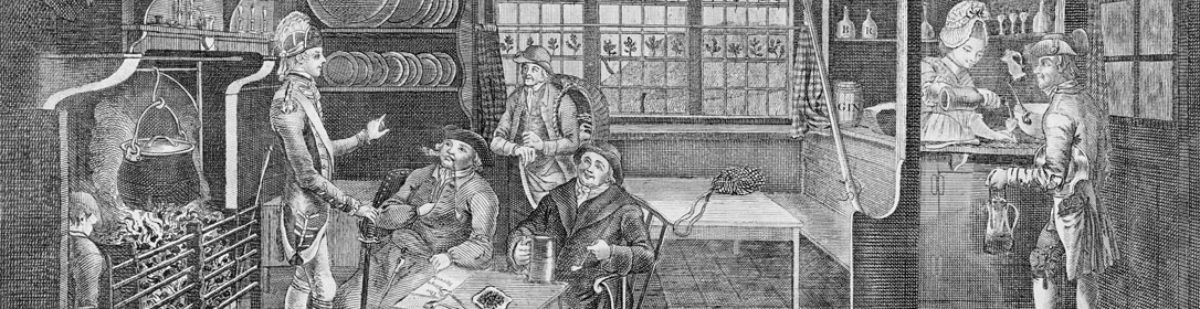
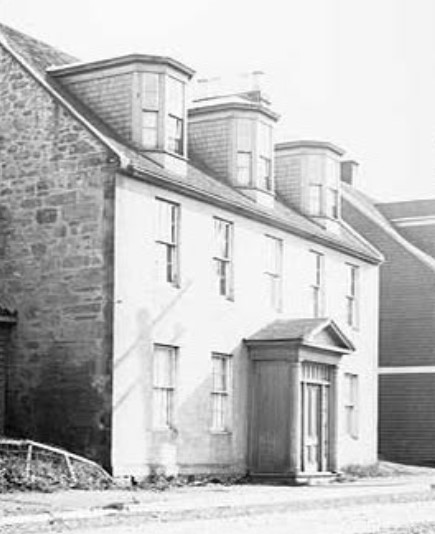
 A few years ago – fourteen if you are counting – I posted a short post on about the “houses of entertainment” as described in Western and Eastern Rambles: Travel Sketches of Nova Scotia.* These sketches were originally published in The Nova Scotian in 1828-31 by newspaper owner Joseph Howe (and edited by my undergrad CanLit prof.) I was reminded of that 2012 post of mine when I was researching and decided to add something clever (and original) to this post I was writing about the description of Nova Scotia’s “houses of entertainment” of Pictou County’s as described in 1821‘s Letters of Mephibosheth Stepsure to the Editors of the Acadian Recorder by Thomas McCulloch.** (That’s an old and largely gratuitous photo of Lorrain’s Hotel of Pictou built in the 1820s for dubious context.) But when I went to search for online discussions of the book by Howe I was presented with that old forgotten post of mine via Lord Goog. Shortcut achieved, thanks very much to Mr. 49 Year Old Me.
So…there are a few things to mention about the two texts. They are both columns in colonial newspapers. They are also by date pre-Victorian and in tone pre-temperance, practically speaking. By this I mean that they are Georgian and as such frame personal failure due to alcohol misuse as a matter of individual character flaw as opposed to larger societal ill. By way of example certainly at the frontier, we can witness the events of 12 and, I suppose, 13 August 1827 at Guelph on the celebration by the local great and good of the King’s birthday:
…all sat down and enjoyed a hearty meal. “After the cloth was removed,” toasts were drunk to everybody and every conceivable thing, the liquors, of all imaginable descriptions, being passed round in buckets, from which each man helped himself by means of tin cups, about two hundred of which had been supplied for the occasion… those who remained continued to celebrate the day in an exceedingly hilarious manner, most of them, who had not succumbed to an overpowering somnolency, celebrating the night too, many of them being found next morning reposing on the ground in the market place, in loving proximity to the liquor pails, in which conveniently floated the tin cups…
Dead drunk they were – but all for a good cause on a special occassion. Howe, just a couple of years later, avoided that sort of liquor soaking when he saw the madcap night life offered to the stage coach traveller who arrived in what was and is now still Kentville, NS:
…hardly do you get into the village before some long-legged Merchant pops you into a gig and gallops you away to church – or some other sinner of the same stamp gets you into his house, from which it is no easy matter to escape. You may run about, like Blair‘s soul, knocking at every outlet but in vain – Port stands sentry in one place – Madeira in another, while Claret, at the head of Bacchus’s light infantry, fairly cuts you off from every retreat…***
Kentville then was apparently as awash as Guelph had been – but was so on any given day. “Not for me!” says Howe. Still, McCulloch in his Stepsure Letters takes the question of boozing to another level of piety or at least ridicule. His fictional essays are a satire on the rise and fall of various sorts of leading men in rural Pictou County, leaning apparently on the message in Proverbs 12:11:
He who works his land will have abundant food, but he who chases fantasies lacks judgment.
For McCulloch, it is not booze that ruins a life so much as an avaricious ambition that takes someone off the farm. That leads inevitably to ruinous financial decisions and, then, recourse to the bottle. Take for example the formerly sober and prosperous farmer Caleb Castup who, through his taking on new political ambitions, became the local commissioner of roads leading work crews to open up the forest…
… he was a man of some consequence… [and] … his respectability required himself to lodge in Mr. Soakem’s tavern. Here… he would spend his evenings with Mr. Soakem, and those who frequented his house. To make a long tale short, from being a sober, industrious man, he became a mere sot, and his boys are getting on after him as fast as they can. The farm, from neglect, became of no use to his family. The sudden decrease of our revenue, also, made his profit by the roads a mere song, when one day, as he was passing the sheriffs, that gentleman invited him to walk in…****
The joke about the sheriff inviting him “to walk in” is the same joke in many of the letters. Castup is incarcerated for his debts. But not after bringing ruin upon his family:
…home had no charms. At first, when he would come home to Mrs. Castup, intoxicated, she considered it merely as a state in which all are occasionally are, and it gave her no uneasiness, “But frequent repetitions. produced weeping and entreaties, and at last reproaches, And it was even said, though I cannot affirm it, that they proceeded as far as a battle. Certain it is, that, between poverty and quarrelling, home was a torment to them both. His family, also, and a fine family they were, are fit for nothing else but strolling about and drinking; and poor Mrs. Castup curses the day which made her husband a commissioner of roads…*****
Hardy har har. Note: she cursed not the day he took up drink but the day he obtained the position of a government official. Occasional intoxication gave no uneasiness. Note also: one of the fellow jailed inmates of Mr. Castup was Mr. Soakem the tavernkeeper himself. His story began similarly:
Like the rest of us, he began the world by settling upon a farm. At first, he was a hard working man, and soon made himself comfortable. But he was very eager to be rich, and he would frequently compare his hard labor with his little gains, as he called them.******
Greed, you see, is the curse of the farmer and as a result the cause of disaster for the farmer’s family. Ambition also makes you uppity:
…when Mr. Soakem was abroad, in order to maintain his reputation, he would stop at every tavern on the road, and show how a gentleman ought to behave. In the mean time, the young people were left to manage both the farm and the house of entertainment. This was more than they could well do; and, besides, not very consistent with sober and industrious habits… travellers, understanding how things stood, passed on to the New Inn about half a mile distant. In short Mr. Soakem’s gradually became like the habitation of the wicked, he was rarely in it himself; his children were always strolling about ; and no traveller came near it; when, at last, one day the sheriff calling and finding him at home, remarked, that he must now be very lonely, and insisted upon introducing him to the company…*******
There are others in that company held at the Sheriff Holdfast’s house. The farmer turned logger. The farmer who becomes a merchant. The farmer turned gypsum exporter. All go broke and end up jailed for debt. Much to the chuckles of the agricultural readers of the Acadian Recorder who knew their place is at home on the land – and who knew how to mind their manners. And who didn’t stroll about! Another thing about that company of those jailed by the sheriff indicates to me that the key vice in all this isn’t the drinking. Consider this:
when I arrived at the sheriffs, I found Mr. Soakem, with eyes like collops, poring upon the cards, and the grog before him.********
…and also this passage when the author of these letters responds to the newspaper’s readers who are upset with him:
I am reviled at home as well as discredited abroad. Sheriffs lodgers, in particular, are very angry at what I have written about their grog drinking and Mr. Holdfast’s kindly treatment. So far from being sensible of this gentleman’s good offices, Mr. Pat O’Rafferty declares that he is a perfect Polyphemus; only he does not eat them, when ho has got them into his den.*********
The sheriff serves grog to the inmates! And lets them read the newspaper. And then write letters to the editor. How civil. One last thing. Both the Howe and McCulloch texts use the phrase “house of entertainment” in parallel with “tavern”, the latter being the descriptor last mentioned in my post on The Ports. It appears both are the accepted and even legal language of the time as this passage about the application process and an objection at the hearing from the local parson Mr Drone suggests:
…he applied to the magistrates. He told them that taverns are at best but necessary nuisances, and ought not to be multiplied. He bid them look round the township, and see how many had been ruined by living in their neighbourhood. And as he got on, becoming gradually more earnest, he said they had received his Majesty’s commission for better purposes, than to grant a license to every fool who chose to ruin himself and his family; that they were the guardians of good order; and, that, if they placed temptations in the way of the unwary, they were the partakers of other men’s sins; and might assure themselves that the gall and wormwood would be shared between them. Our magistrates have always been in the practice of giving licenses to all who request them. The town, they say, needs the license money; and, if the taverns increase too much, those who keep them will get tired of the business, They were, therefore, not well pleased that Parson Drone should interfere, and pretend to instruct them in their official duties, They never meddled with his preaching, and he had no right to interfere with them. Hence, partly at the solicitation of Mr. Soakem, and partly from opposition to the parson, the license was granted.**********
Hah! So the magistrates are mocked. The parson is mocked and certainly the greedy are mocked. That is the humour of the colonial Georgians of the 1820s. Thus endeth the sermon. Both for Parson Drone and, for today, myself.
*My physical copy is Howe, J, Ed.:Parks M.G.(1973) Western and Eastern Rambles: Travel Sketches of Nova Scotia, (U of Toronto Press, Toronto). I took Canadian Literature from Professor Parks of Dalhousie University in 1982-83.
**My physical copy is McCulloch, T. (1960) The Stepsure Letters, (McClelland and Stewart, Toronto). McCulloch founded Pictou Academy in 1816. It’s still the town’s high school and in the fall of 1979, my Truro soccer team of C.E.C. played them only for the game to be called when our striker, sick and tired of being hacked by one of the brave Pictonians, applied his black belt in judo to flip and hammer the thug. I played centre back and had a fabulous view of the incident. Mayhem ensued. Don’t asked me about the later Truro Town v. Pictou Town men’s league game from around the summer of 1984. Don’t!!
***Howe, p.78.
****McCulloch, p.36.
*****Ibid., pp.36-37.
******Ibid., p.29.
*******IbiddityIb, p.31.
********Idib, p.32.
*********IbbyDibbyDooo, pp.40-41.
**********(!!!)IbbyDibbyDone, pp.29-30. Drone had previously dealt directly with Soakem only to be told “Mr. Soakem em. was not convinced. Houses of entertainment were necessary, and might be very decently kept by religious people.” Please refer to Lamentations 3:19 on the whole “gall and wormwood” thing.
The idea that leaving the farm to indulge worldly ambitions led many to dissolution and ruin must have been a Canadian rural trope. A paper I wrote two years ago, “A Canadian Farmstead’s Baked Beans: Luscious Lesson”, noted how an Ontario farm wife of the 1920s-30s mistrusted “business” and felt that leaving the farm would invite only trouble. https://ruralwomensstudies.org/a-canadian-farmsteads-baked-beans-luscious-lesson/ One son left and had notable succcess, however. The farm couple too, to run a local store, but it was not successful. Maybe their heart wasn’t in it.