Could Cream Beer Actually Be Cream Beer’s Ancestor?


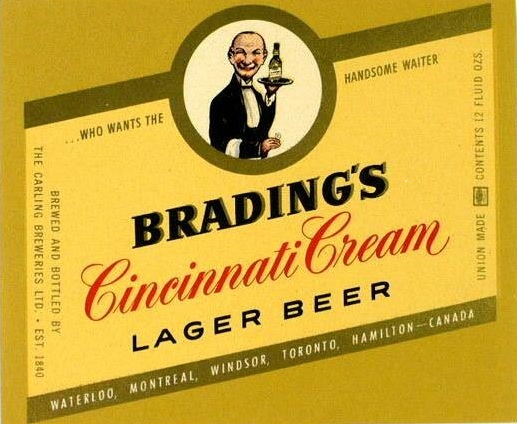
…by “handsome” I presume you mean the “other” one…

Here’s the thing. There is only so much I can lay out to support this idea so I might as well do it and admit that it is something of a reasonable hypothesis. To be fair, I rarely take a position that I can’t later extract myself from. I am squidly like that. But today I am almost extracting myself at the same time I make the assertion. Which assertion? That cream beer in 1820 may well be the forefather of cream beer today and that neither has anything to do directly with cream ale. Three people worldwide just fell off their chairs. How did I get there? First, I submit two biographical statements for two people – John and Mary – who were each children of German-American immigrant brewers, Philip German and Christian Frederick Haas:

…GERMAN, John W., was born in Harrisburg, October 27, 1851. He is the son of Emanuel S. German, who was born in Harrisburg in 1821, whose father, Philip German, a native of Germany, came to Harrisburg in 1800, and established a brewery, celebrated for its “Cream Beer,” and conducted it for many years…

…Mrs. Maltzberger was born in Zanesville, Ohio, where her father had removed in 1833. He was a native of Germany and emigrated to America early in the nineteenth century, being a brewmaster by trade, brewing what was known in the early days as cream beer. While in Zanesville he purchased much valuable real estate, and owned a brewery, and hotel. He was a very prominent man, and was highly esteemed by all who knew him…

If you go to page 1219 of this text you will see that Mrs. Maltzberger was named Mary and her father was Christian Frederick Haas. Both Haas Sr. and German Sr. come to the young United States early in the 1800s, establish a cream beer brewery and do very well. Convinced of anything yet? Me neither. So, let’s look at this passage from the April 1900 issue of The Pennsylvania-German a magazine “devoted to the history, biography, genealogy, poetry, folk-lore and general interests of the Pennsylvania Germans and their descendants.” At page 42 in a travelogue piece, we read the following:

In Nantucket it is safe to address every man as captain, and his return salutation, if he wishes you to enter his home, is “Come aboard.” So we say. “get aboard,” and let us resume our journey westward toward Middletown, so named because it was midway between Carlisle, then an outpost, and Lancaster. Leaving the centre square, we cross the Conoy Creek, which empties into the river at Bainbridge, and gives its name to one of the townships. That old brick house, just across the bridge, used to be Pfaff’s brewery, where cream beer, or Lauderschaum, was brewed more than half a century ago. It was a pure malt, wholesome and non-intoxicating. The art of making is lost, for you see none on the market.

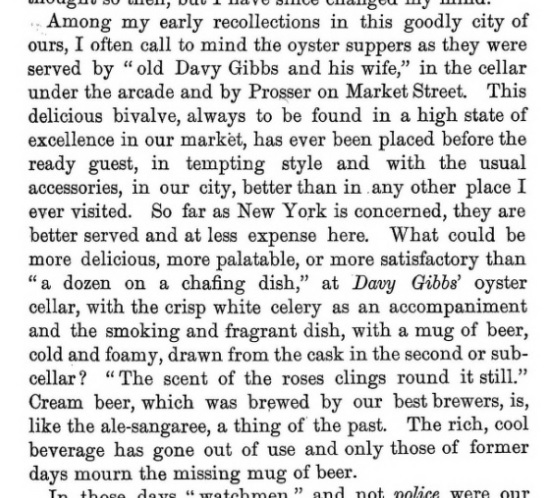
OK, so again cream beer is placed in the early 1800s in a German immigrant context. It also now has a German name, Lauderschaum. I am advised that schaum is German for foam. Based in part on this incredibly detailed essay on the word lauter I am going to suggest that the lauder- in lauderschaum in fact lauter- and means “pure” or “honest” or even “only” which makes cream beer pure honest foamy beer. Buying anything yet? OK, how about this. It is a memoir of a gent, George Farquhar Jones, who lived from 1811-1887 in both Providence, Rhode Island, and Philadelphia and contains this recollection at page 231:

Rich, cool, in Pennsylvania and no longer in existence when the book was published in 1887. Hmm… Another? OK, look at this:

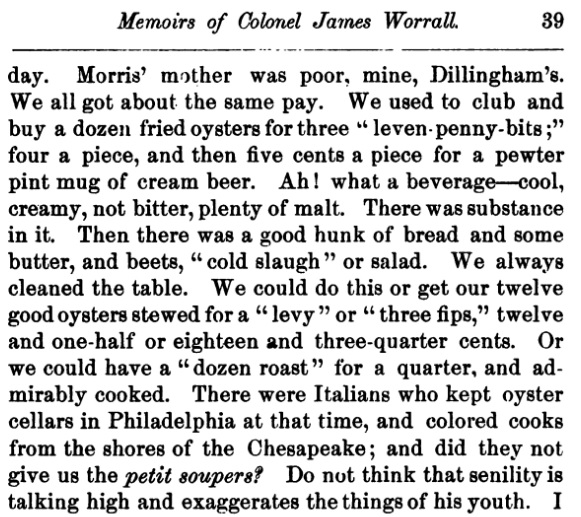
It’s another passage from a second memoir – this one about one Colonel James Worrall, Civil Engineer. He lived from 1812 to 1885 and in that passage above was recalling his youth in Philadelphia. Cream beer was “cool, creamy, not bitter, plenty of malt.” Sounds familiar?

All five sources use the term “cream beer” in relation to Pennsylvania in the early 1800s. Two reference that it’s malty and not bitter. It’s lower in strength. If we go back and look at the notes on Perot’s brewing logs for 1821-22 we see that the draught beer they are brewing is lower in hops and likely lower in strength. Both these records and 1820s notices from New York City indicate that it was considered rich. I am going to declare that it was a thing based on the above. Here’s another thing. Kevin Gibson in his 2014 book Louisville Beer: Derby City History on Draft states that the City had cream beer which became known as Kentucky Common later in the century after it evolves locally to be made with corn and caramel for colouring. It was associated with German breweries, was light in alcohol and lacked bitterness. Remember Mrs. Maltzberger up there? Her father immigrated internally too, bringing his brewing and maybe his cream beer to Zanesville, Ohio, too, where he established the American House Brewery. Like the German brewer in Harrisburg, Pennsylvania around 1800 and the ones in Louisville, Kentucky, a bit later in the 1830s Christian Frederick Haas struck out for the interior to set up shop.

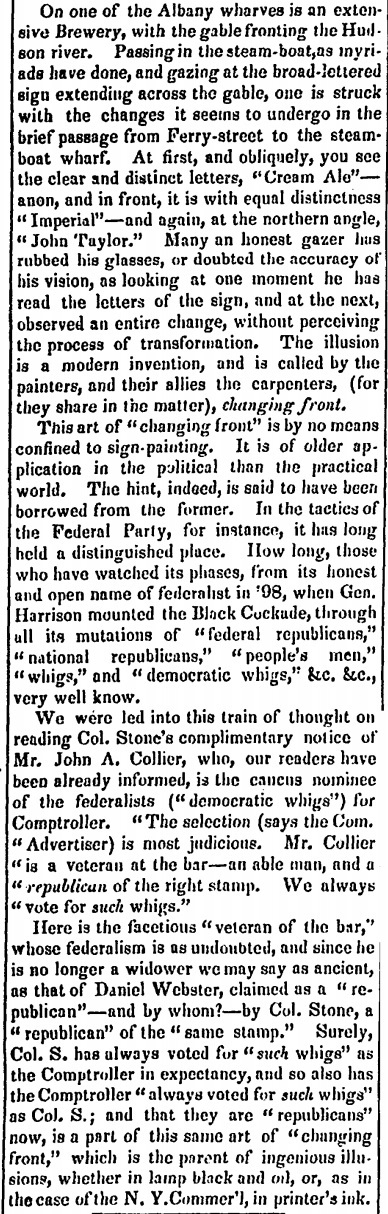
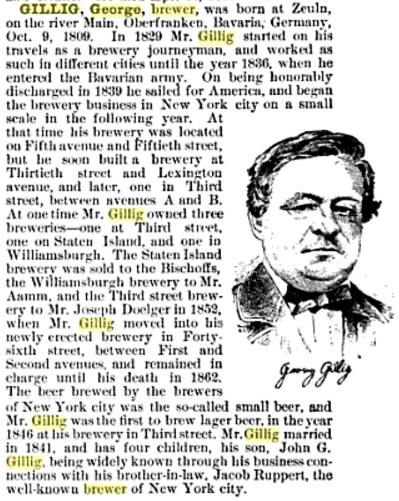
Which is interesting and, if correct, sets cream ale a bit adrift on its own course. If we recall, cream ale shows up in newspaper notices in the Hudson Valley in the 1830s. John Taylor of Albany takes it on and, by 1839, is selling an imperial cream ale. Taylor is a hugely successful ale brewer which is no way dependent on the German tradition. The sign proclaiming “Taylor’s Cream Ale” scars Albany’s waterfront skyline as early as 1841. His beers, like most others in the city, appear to be a different thing – big Anglo-American ale bombs – certainly when compared to lighter Teutonic cream beer awaiting its co-national lager to show up care of George Gillig in the early 1840s. Each goes on and traces its own route west – and even north as we see above – as part of the American story, evolving and lasting well into the ensuing decades and centuries.

Could it be that each happily just latch on to the adjective oblivious of the existence of the other? Could be. Could be.

Francis Perot Brewed 116 Times In 1821 to 1822

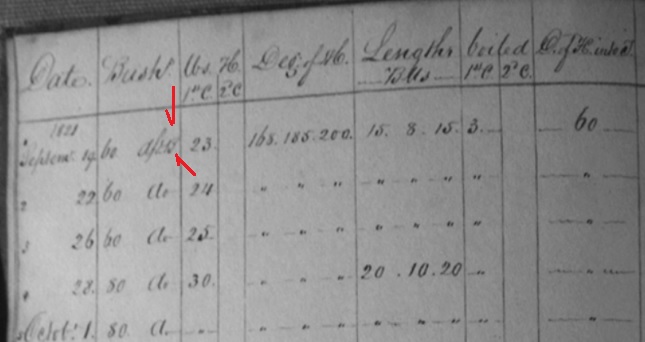
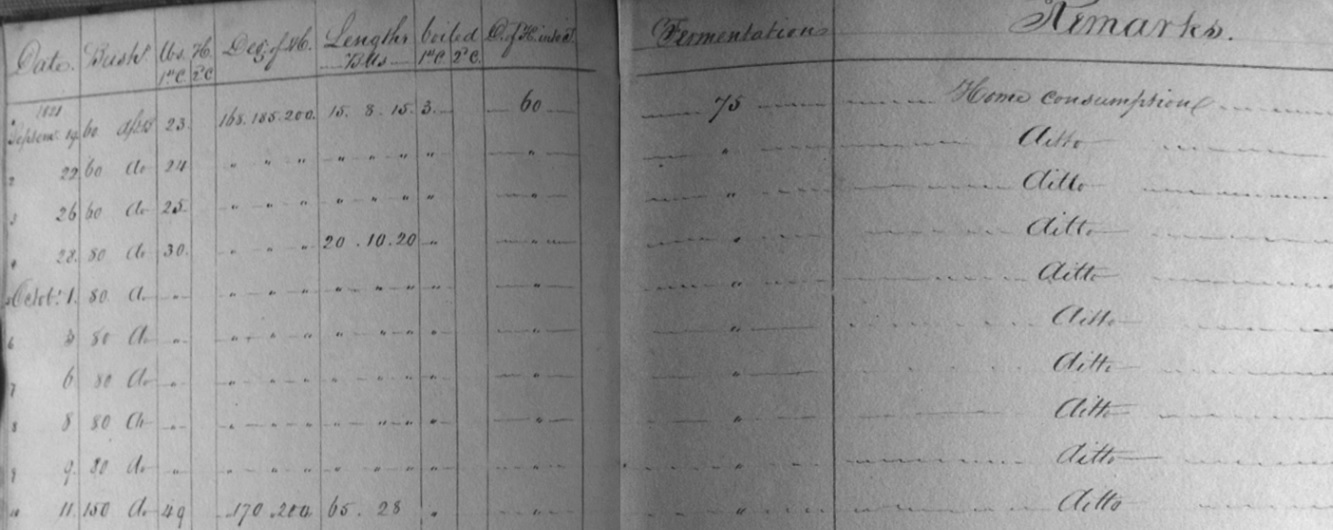
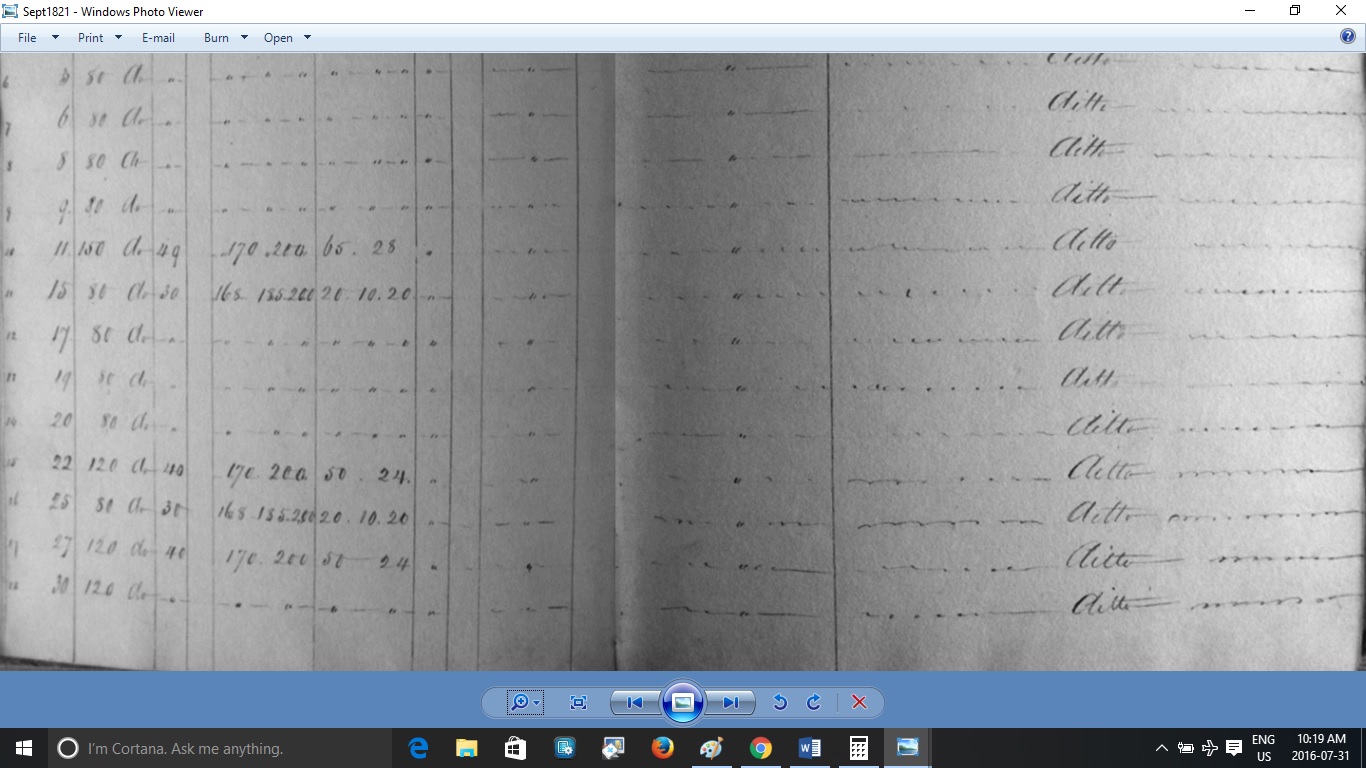
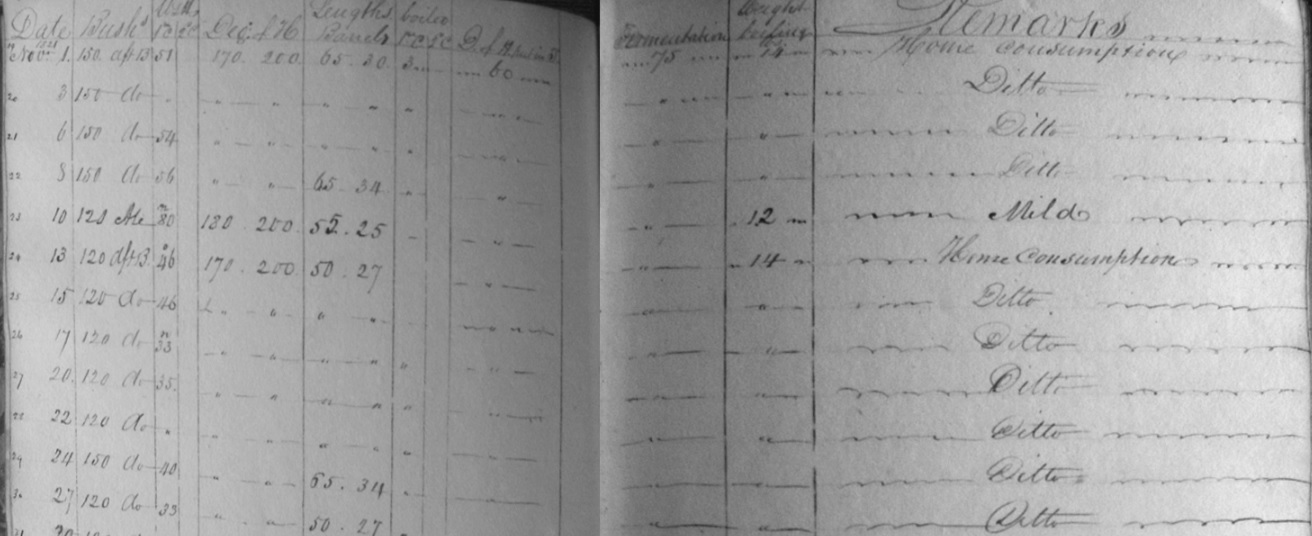
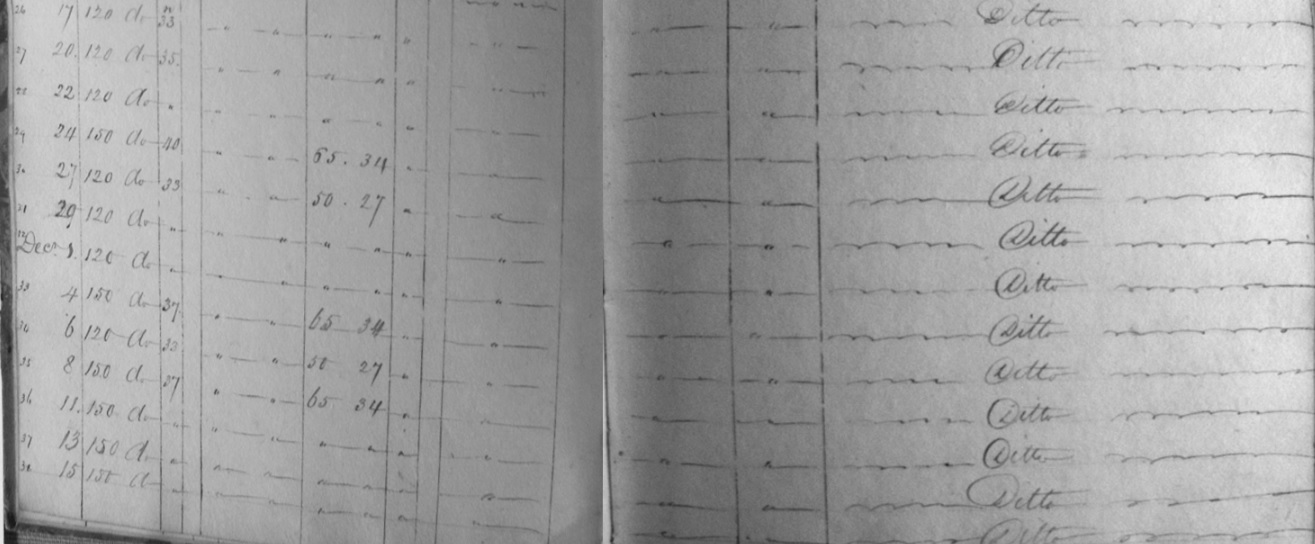
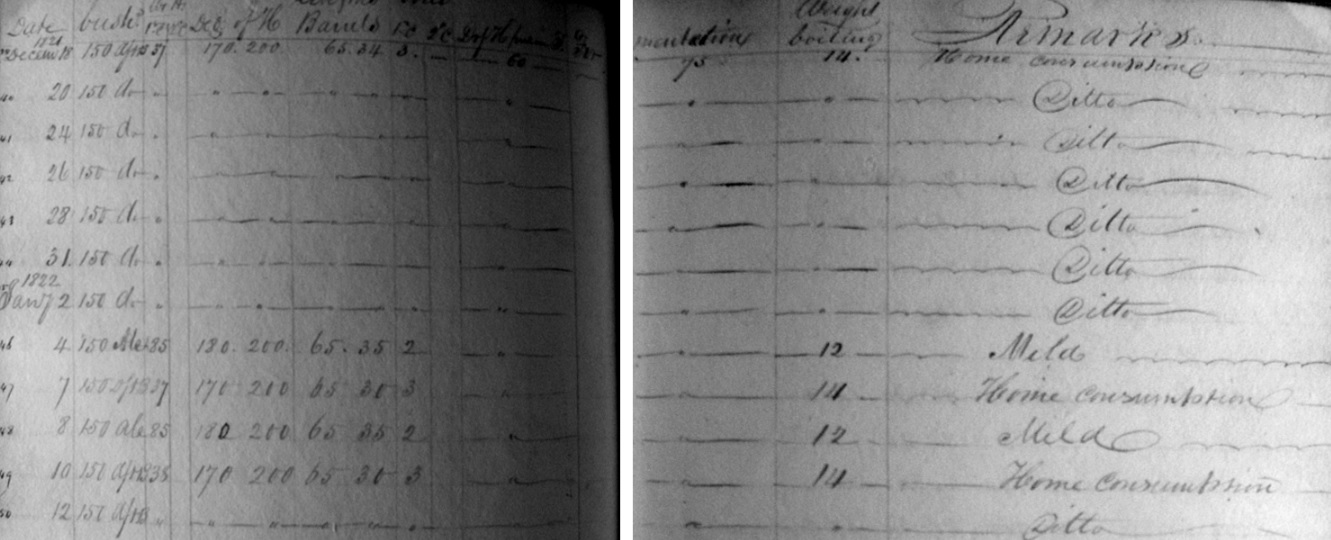
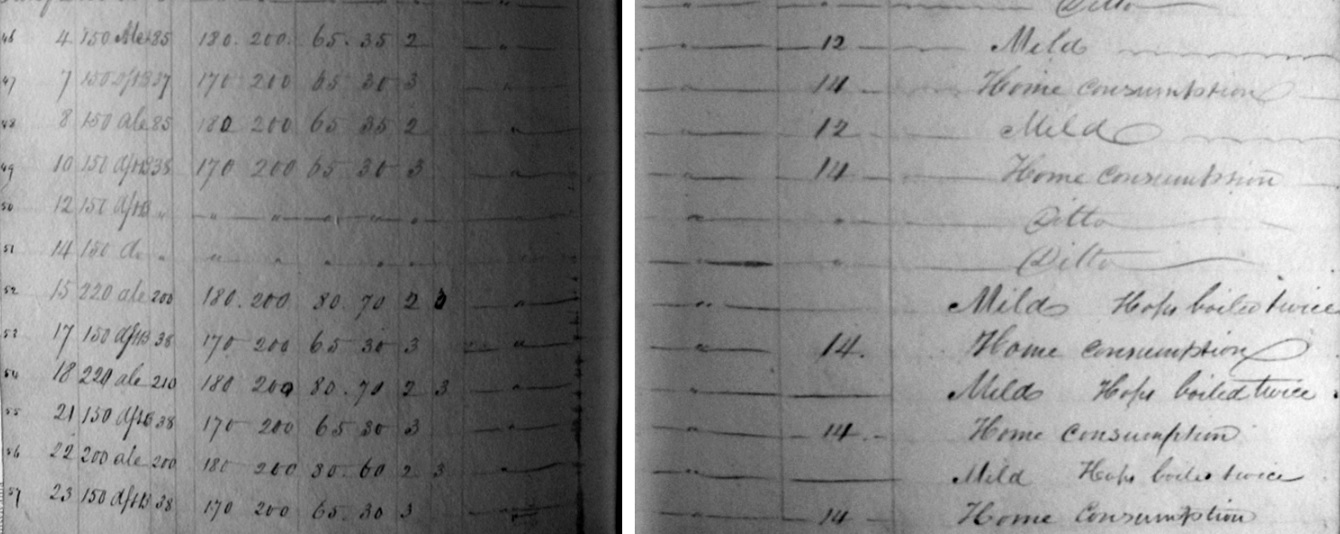
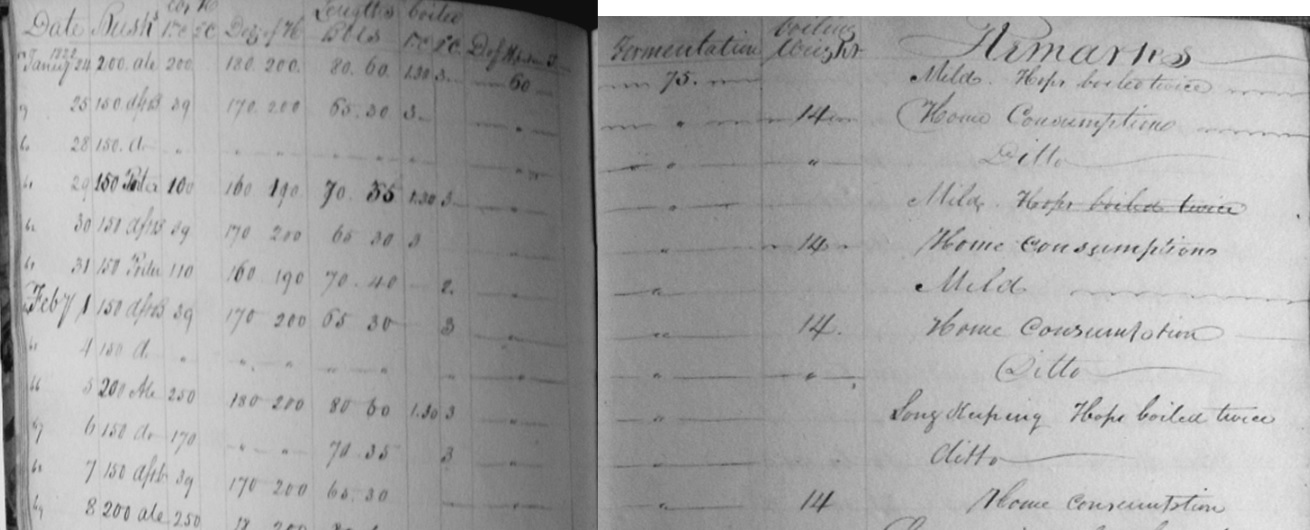
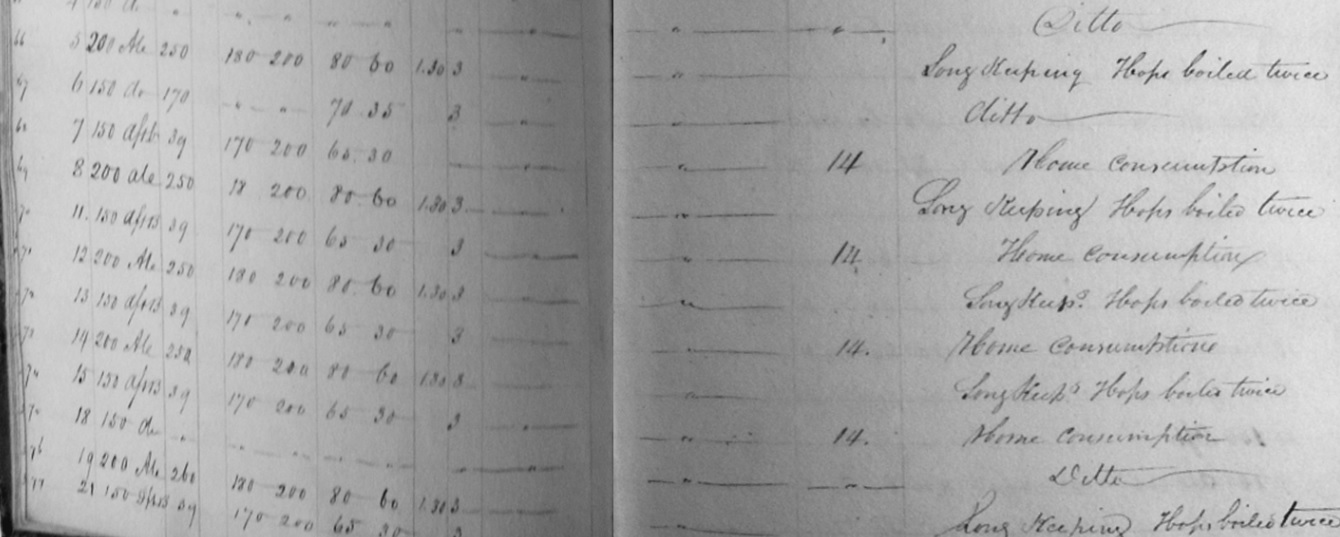
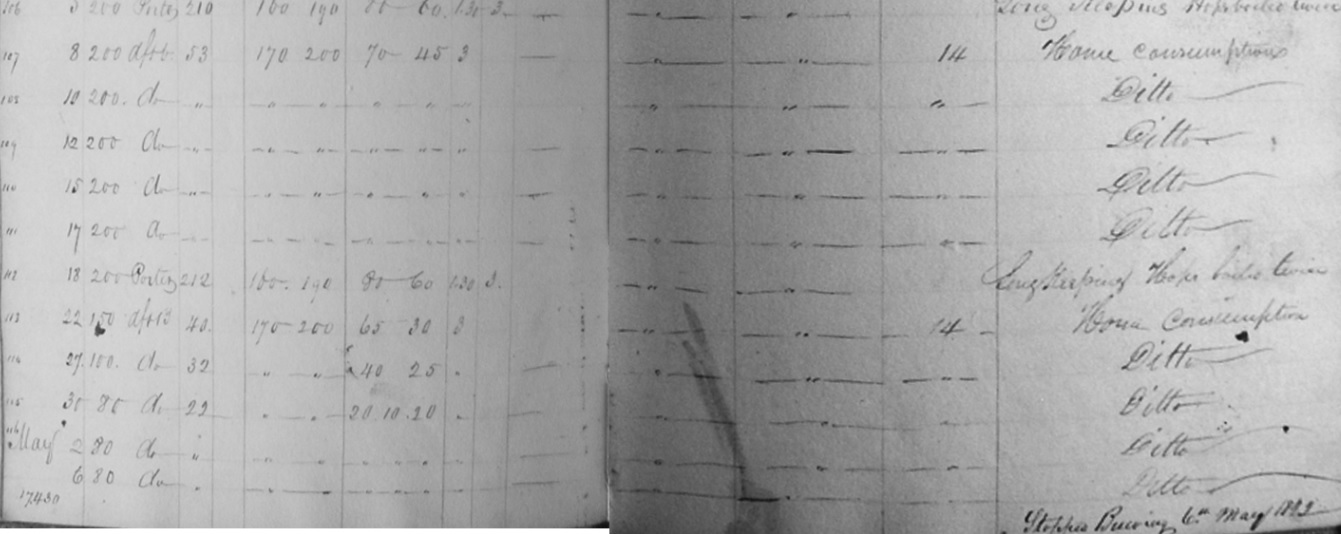
perotlog1821dftbBrewing was seasonal in the early 1800s east coast towns. You see it in the Vassar logs from Poughkeepsie NY and again with the brewing logs of Francis and William Perot of Philadelphia of 1821-22. Ed Carson was good enough to scan them last fall and I am drawn back to them by
this question about what “cream beer” might be at that moment. That “B” up there is potentially very important. “Cream” is a word that gets used in a number of ways in brewing over the years so being fairly tight on what is being described is a good approach. In this exercise, I am trying to think about what it meant attached to “beer” in Philadelphia and also NYC in 1820 to 1925 or so. It is clear from the newspaper notices discussed last time it was (i) a novelty, (ii) desirable and (iii) local to Philadelphia. But what else can this year’s worth of notations tell us even though “cream” is never mentioned?

First, who is Perot? Highlighted above is the first log entry for the 1821 to 1822 season from the brewery of Francis and William Perot. Francis becomes quite accomplished. He was known for his cream beer.. His summary biography states:

Francis Perot (1796-1885) was apprenticed in 1812 to the 5th and 6th generations of Morrises (Thomas and Joseph). In 1818, Perot started his own brewery and malt house on Vine Street between 3rd and 4th Streets, bringing other family members into the business and marrying Elizabeth Morris. The Morrises turned their business over to Francis Perot. T. Morris Perot and Elliston Perot represent the 7th and 8th generations in the business — an unbroken line of descent in the business.*

More needs to be written and researched about Perot. For today’s purposes, we can stick to this one brewing year’s worth of log entries. I will post the log pages is a bit for purposes of your rebuttals and accusations but for now I see the following:

=> In 1821-22, all but one of the 87 brews of draft beer are noted as “home consumption.” But his ale is either mild (1/3) or “long keeping” (2/3). One batch of draft beer is shipped to Virginia;

=> As Ed pointed out, “the “Dft B” is less hoppy with 1 lb of hops to 3-5 bushels of malt, while the ale is .5 to 1+ lbs per bushel. And the Porter is the strongest with a hop rate of 1 to 1″;

=> In addition to the 87 batches of “Dft B” they brew twenty-one of Ale and eight of Porter. Like the Ale, their Porter has notes as to whether the batches are mild or for long keeping. They also each have, for certain batches, the notation “hops boiled twice”.

=> They brew doubles and singles off a single batch and in some cases three separate runnings. They appear to be kept at least initially separate as they are accounted for by number of barrels of each.

=>The log records that 57% of the bushels of barley went into the “Dft B” but it accounted for 75% of the batches produced. I have to count up the barrels for each batch as Perot does not total them but they do not appear to skew to the same ratio. It may well be that it is beer is lighter in strength than the Ale and Porter. Gotta do a bit more looking at that…

What to make of it? In the summary page, Perot uses the full term “Draught Beer” as opposed to “Porter” and “Ale” but what is odd is that low hopped brewing results in the “beer” which is the opposite of the normal usage of the word, isn’t it? By fifteen years later, we see regular ads for “cream ale” but at this point whatever is coming out of this Philadelphia brewery is called beer, looks like what gets called “cream” beer – and it has half the hops of their ale.

Later: The 1821-22 Perot Logs

Page 1 and 2 – 19 Sep 1821:

perotlogpage1a

perotlogpage1b


Page 3 and 4 – 1 Nov 1821:

perotlogpage2a

perotlogpage2b


Page 5 and 6 – 18 Dec 1821:

perotlogpage3a

perotlogpage3b


Page 7 and 8 – 24 Jan 1822:

perotlogpage4a

perotlogpage4b\


Page 9 and 10 – 23 Mar 1822:

perotlogpage5aperotlogpage5b


Neato. There is plenty more to write about. As far as I can tell there may be five “creams” in US NE brewing history: pre-1825 Philly cream beer; 1835-1860s Taylor-style cream ale; 1860s-1910 cream ale; post prohibition cream light lager like Genny Cream; and craft cream… whatever that is. Much more work to do to see if that is right or if something else is going on.

*Cited this way in the family papers: “Information from: “A Condensed History of the Oldest Business House in America – The Francis Perot’s Sons Malting Co. of Philadelphia.” 1890.”

Cream Beer Before Cream Ale In 1820s New York City

nygaz30oct1821Look at that. Just look at that. It is a notice in the New York Gazette from 30 October 1821. James H. De Lamater had brought in a supply of Larer’s Superior Cream Beer. Imported by the sloop David. Shipping is not any sort of surprise. Beer and ale was shipped all over the place by the Georgians. This beer, however, is likely being brought in to NYC at this time as this is the era when the good water started to disappear. The 1820s were the decade when “the remaining wealthy residents fled.”

Last fall, I wrote about how “cream ale” began to show up in some ads in the 1830s in New York City and Albany. But here is that word cream again from the outset of the previous decade – and this time describing a beer, not an ale. There appears to be four breweries by the name “Larer” that operated out of Philadelphia from 1805 to 1843. This beer comes from the second, the Melchior Larer & Son John Brewery. Lamater’s address, 9 William Street, is still there. Down in the southern tip of Manhattan amongst the towers in what was the original Dutch settlement. Now have a look at these notices from a few years later.

nyevenpost10dec1823

nyevenpost30oct1824

nydailyadv30dec1826


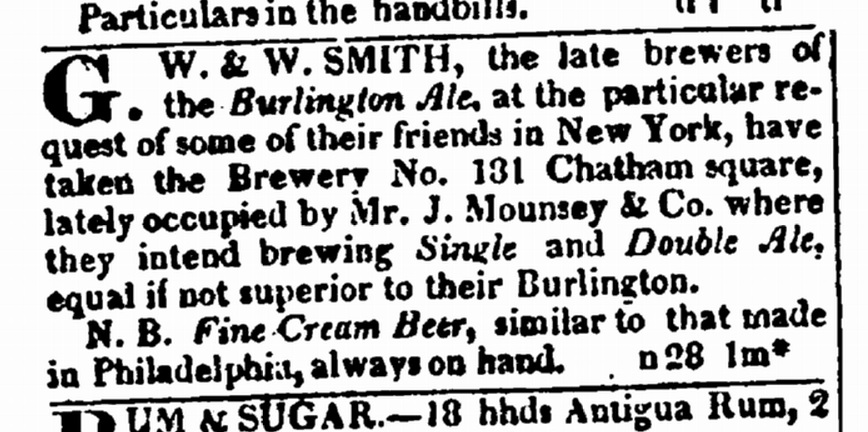
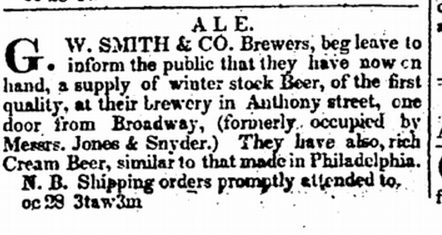
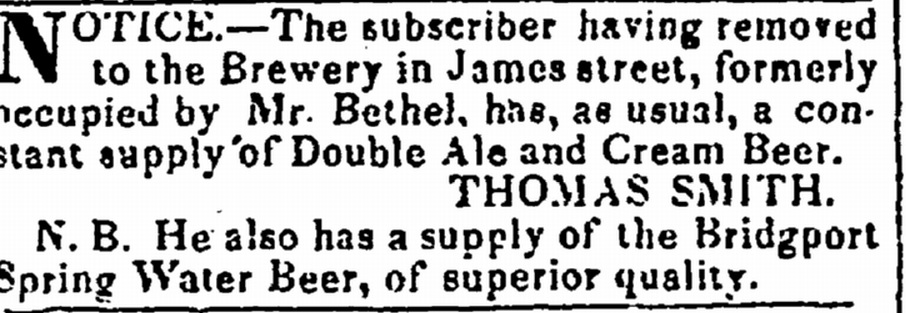
To the left, there is an ad from New York’s Evening Post of 10 December 1823. G.W. and W. Smith, brewers at 131 Chatham Square, promise that their “Fine Cream Beer” is similar to that of Philadelphia. In the middle we see a year later in the 30 October 1824 edition of the Evening Post that G.W. has lost his partner “W.” and relocated to the corner of Anthony and Broadway but he assures that his “rich Cream Beer” is still similar to that of Philadelphia. In the right hand notice, one Thomas Smith brewing out of James Street placed a notice in the 30 December 1826 New York Daily Advertiser offering his Double Ale and Cream Beer.

So, in the first bit of the 1820s, “cream beer” is a thing in both Philadelphia and New York. There are a few things to note other than the Smith-centric nature of the stuff.* Notice how, as far as I can tell, “cream” in this use is the first time I see a quality of beer – as opposed to a technical aspect as in double ale – being used in the classification of the beer. In 1798, NYC notices for porter could describe it as “ripe and brisk” but it is not “Brisk Porter” in the way the drink in these notices are consistently offering “Cream Beer” along with other known styles like. Notice also how it is “rich” and “fine” in the descriptions. The three adjectives would be conveying meaning to the buying public. Just as “ripe” and “brisk” would have to those earlier Federalist porter drinkers of the 1790s clinging on to the British style, if not her Crown. It’s also likely not the later cream ale, either. Folk could tell a beer from an ale in these days. Nothing to do with Genny Cream either. It was a new thing – a nativist beer for the post-recession era, the promise of the Era of Good Feelings fulfilled in a glass. Was it the first truly American beer?

*Another Philadelphia brewery that ran from 1832 to 1888 was started by a Robert Smith, a Londoner who trained at Bass – according to Rich Wagner in his excellent Philadelphia Beer. Francis Perot born of brewers who himself began brewing in 1818 was known for his cream beer, too – “far and wide.”

“…In The West Indies And In The Southern States…”

albgaz03april1820albanyaleformerfame

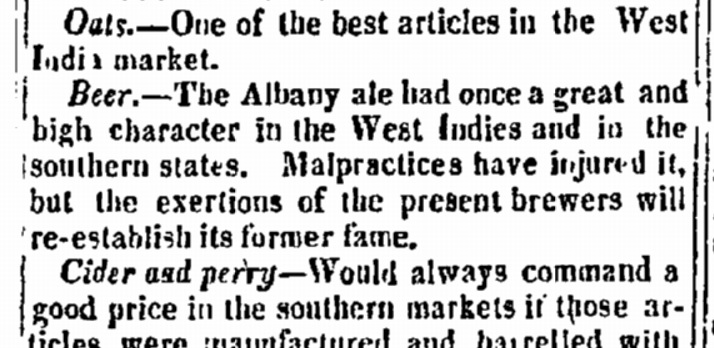
That is from the 3 April 1820 edition of the Albany Gazette. Harkening back to an earlier era when Albany ale had a reputation – “a great and high character” – in the West Indies and the southern states. I think this both confuses and confirms a number of things. Not sure. It’s located in the schedules to a report of the Commissioners appointed to devise a plan for improving navigation on the Hudson river. It’s in a list of products that could be shipped were the river just improved. So, yes, it’s about a bit of the brag up – but it’s still a curious thing:

1. Who was brewing the better beer before 1820 that was called Albany ale? Le Breton only posted his first ad in 1803 and it’s two years later when “Albany ale” was used for the first time as far as we knew when the book was written. Is 17 years enough to justify such a harkening back to an earlier era?

2. Who was shipping it to the West Indies way back in that golden era? We know that NY City brewed porter was shipped to the West Indies in the first years of the 1800s but did we know that about Albany ale?

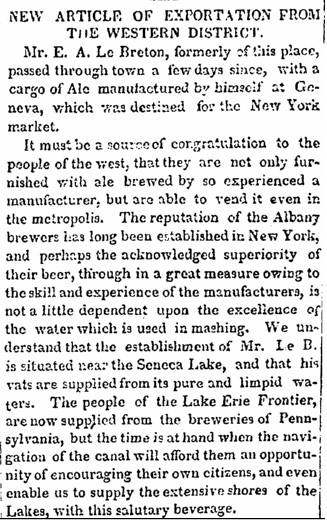
3. What’s the dip in reputation? In an article in the Albany Argus about LeBreton passing through town in 1822, we are told “the repuation of the Albany brewers has long been established in New York.” Does the report writer mean that the West Indies markets were lost as opposed to the beer went off?

This is obviously a plea fro Craig and Gerry to pipe up and have a think. Is this just the same old 1820s river navigation improvement consultant talk? Does it just relate to the general post-war economic decline? Or does it actually mean something specific?

Signs Of The Panic Of 1819 In 1820s NY Brewing

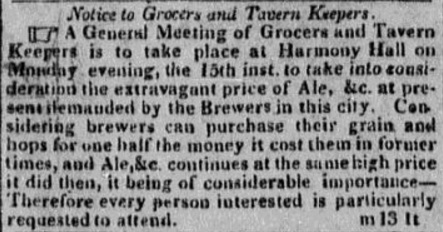
Not the cleanest image but obviously something was up in New York in the spring of 1820 if we are to believe the New York Mercantile Advertiser of 13 May 1820. What was up was the after effects of the Panic of 1819, the high point of a depression that hit the US after the end of the War of 1812 in 1815 leaving Britain even less interested in helping its former colony as well as the end of the Napoleonic Wars which saw Europe less interested in American wheat. While the Whig and Federalist brewers are in or past their last days, some still seem to be relying on status to soak the marketplace. After all, this is old New York and not some Jeffersonian frontier. The reign of the patroons just a little up the Hudson still has decades to play out.

schencab31may1820pricedrop

nydailyadv15may1820ininglass

schencab16jan1820beercandles


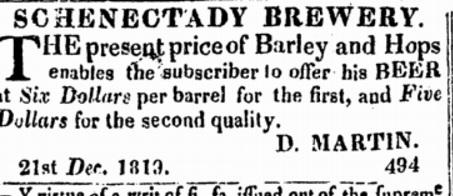
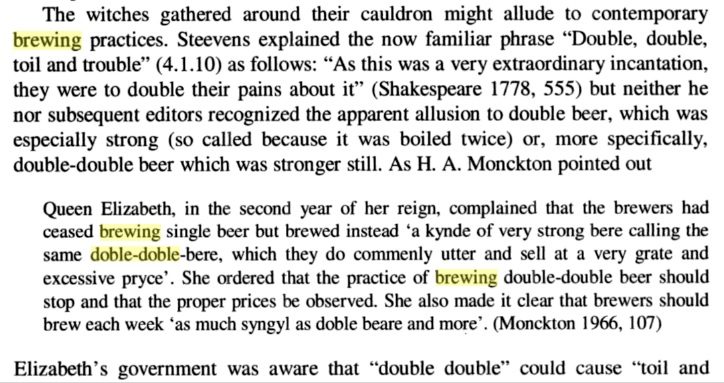
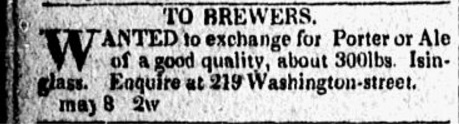
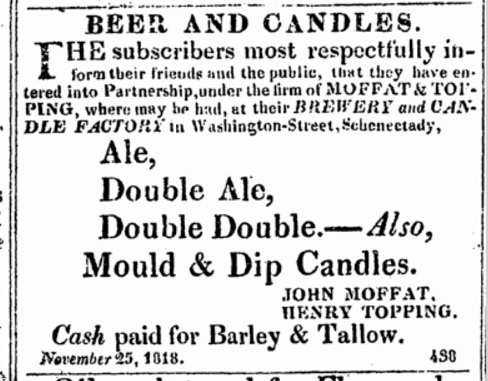
It goes both ways. Some elsewhere in the state did drop their prices as you can see in the ad to the left placed starting in December 1819, continuing deep into 1820. And people tried to barter with brewers like the guy placing the ad in the middle from the Daily Advertiser the same day as the meeting of the tavern keepers. [How much ale does 300 lbs of isinglass clear? And, come to think of it, I had no idea brewers in that era was worrying all that much about isinglass. Seems to put the whole “lager creating clarity mania” theory in perspective.] Hmm… and how about the brewer who placed the ad to the right, in Schenectady’s Cabinet, to advise he’s gone into business with a candle maker… although in a heroic effort to preserve the very elusive now extinct double double – clearly an ale quite distinct from the mere double ale. Trouble since Shakespeare’s day.

schencab02aug1820duanesburghYet, the future was now. Science was coming to agriculture in upstate New York. Ben Franklin’s dream of advanced husbandry which took a foothold in Philadelphia after the Revolution finally found fertile ground in the race west – even before the Erie Canal. See? The 1820 Duanesburgh fall fair was giving out prizes for the best acre of spring wheat. Twice the prize for the best acre of barley. Then as now – Duanesburgh looked to the future.

Philadelphians Studying Barley Varieties In 1788 And 1819

A road block. As much a writer’s block as a researching one. Spring is a rotten time to sit down to a computer in the evening. Softball games need being watched, exam sitters need being encouraged and the garden still remains not fully planted. It’s a bad time of the year to daydream about what was going on with brewing in the years around 1800. But then the hint is there – the garden – and away you go again.

The Philadelphia Society for Promoting Agriculture is the oldest agricultural society in the United States, first organized in 1785. Reports about its early findings pop up fairly regularly in newspapers reminding you that leading edge science was always interesting and important. Was it the Homebrew Computer Club of its era? Maybe. Ben Franklin was a founder. But it didn’t exactly set off a nation-wide explosion of research. My nearby Jefferson County Agricultural Society is the second oldest in New York State but, still, it’s thirty-two years younger than the one in Philadelphia. But it started things rolling. The Philadelphia Society’s is mentioned in the 31 July 1788 letter to George Washington from gentleman farmer George Morgan discussing strategies to avoid crop loss that seems connected to that newspaper report in the Poughkeepsie Journal on Hiltzheimer’s crop planting tests from that fall. Both are related to the Hessian Fly. Morgan writes:

Your Excellency is no doubt informed of the Ravages made in Connecticut, New York and New Jersey by the Hessian Fly, whose History is given in various Publications: As this Insect is now advanced to the Neighbourhood of Philadelphia, and its Progress southward is alarming to the Farmer, I have taken some Pains to inform myself of its Manners and Life, and to make several Experiments to oppose its destructive Depredations: From these it appears that good Culture of strong Soil, or well manured Lands, may sometimes produce a Crop of Wheat or Barley, when that sowed in poor or middling Soil, without the other Advantages, will be totally destroy’d…

The Hessian Fly, Morgan reports, only attacked the wheat and barley. Rye was seldom touched and oats, buckwheat and corn were unaffected. The Hessian Fly was still hammering the crops in the Upper Hudson in 1799. Which goes a long way to explain why Sir William Strickland is studying American agriculture in the mid-1790s. Given Europe’s croplands are being ravaged by war, finding sources of grain was vital. Two decades on, the issue is still a concern of the Philadelphia Agricultural Society, as noted in volume 1, number 12 of The American Farmer from 18 June 1819:

In England, and other parts of Europe, and in the northern parts of our country, summer wheat is raised to great advantage. Whether or not it would escape the fly is doubtful; for flies have been found in plenty in summer barley. ‘ It is not yet agreed what kinds of wheats best withstand injuries from the Hessian Fly. The yellow bearded and other wheats with solid straw or strong stems, (the solid stemmed wheats being designated by the appellation of cane or cone wheats) are deemed the most efficacious. Farmers should bend their sedulous attention to the selection of such wheats. Good farming, manure, and reasonably late sowing, are certainly the best securities. But too late seeding is unsafe; for the spring-brood of flies attack the tender plants of every late sown wheat, not sufficiently forward to be capable of resisting this foe, with the like destructive effect we experience in spring barley; appearing to prefer, for this purpose, plants in the early stages of their growth. It is, most probably, a native here. lt never entirely leaves us; though it appears, at irregular periods, in numbers less scourging than at times when its ravages are more conspicuously destructive.

Which indicates that there was a very good reason that six-row winter barley continued to be the preferred crop of barley well into the 1800s despite the advice given from England to move to two-row and its higher productivity. The finer crop simply was not suited to the local conditions. Winter wheat was out of the ground and hearty enough to withstand the fly. This also ties into Craig’s observations from last January about the second third of the 1800s when he noticed Albany area brewers adding honey to the wort to top up the fermentables. Six-row worked.

Which makes me wonder when exactly six-row ever got into most of the mash in America?

The Steelyard, Stillyard, Stylyard and Spelling

hans1561map1633sm

Ah, the Hanseatic League. I posted about the Hanseatic League earlier this year, pointing out how it was likely the conduit for the first introduction of hopped beer into England – and, by implication, not the Dutch. I think that might be the case for no other reason that the Dutch were introduced to hopped beer by shipments from the Hanseatic League, the Renaissance corporate port towns of the Baltic which had that handy corporate navy with corporate cannon to enforce its idea of open trade.

Renaissance and Elizabethan brewing and drinking in England is particularly interesting as the period ties a lot of later things together…. or founds them… or whatever. For example, Hull was a 1600s brewing town that also was a Hanseatic depot. Hull ale was a contemporary of Northdown as being a premium drink in London in second half of the 1600s. It’s a coastal ale of the sort that governs until the canals reach deeper into the countryside releasing the odd sulfurous and maybe hoppier beers of Burton in Staffordshire upon the national and international market. Like the railways in the mid-1800s Ontario that gave rural Labatt and Carling the opportunity to explode out into the world, England’s canals of the early 1700s also placed brewing at scale nearer the grain fields, likely cutting out middlemen and displacing premium coastal brewing perhaps by undermining existing price. Theory. Working theory.

What was displaced was the model set by the Hanseatic League. Renaissance Hamburg was the greatest brewing center in the history of beer – 42% of the workforce was involved in brewing. The Hanseatic depot at King’s Lynn still stands, one of the branch locations of Hanseatic activity. London was the Kontor with its headquarters of import / export operation located just west of London Bridge on the north shore of the Thames where Cannon Street station now stands. One of the coolest thing is that there have basically been two owners of that site since perhaps 1250 as the vestigial Hanseatic League interests in Lübeck, Bremen and Hamburg sold it to the South-Eastern Railway Company in 1852. The presence of the Hanseatic League cannot be minimized at the critical point in the 1400s. Consider this passage from 1889’s bestseller The Hansa Towns by Helen Zimmern. It has a certain ripe Victorian style but does explain things like this:

Nor was London by any means their only depôt. It was the chief, but they also had factories in York, Hull, Bristol, Norwich, Ipswich, Yarmouth, Boston, and Lynn Regis. Some mention of them is found in Leland’s “Itinerary.” Under an invitation to the Hanseatics to trade with Scotland we find the name honoured in legend and song of William Wallace. In John Lydgate’s poems we also meet with our Hanseatics. In relating the festivities that took place in London city on the occasion of the triumphal entry of Henry VI, who had been crowned king at Paris some months previously, the poet narrates how there rode in procession the Mayor of London clad in red velvet, accompanied by his aldermen 196 and sheriffs dressed in scarlet and fur, followed by the burghers and guilds with their trade ensigns, and finally succeeded by a number of foreigners.

“And for to remember of other alyens,
Fyrst Jenenyes (Genoese) though they were strangers,
Florentynes and Venycyens,
And Easterlings, glad in her maneres,
Conveyed with sergeantes and other officeres,
Estatly horsed, after the maier riding,
Passed the subburbis to mete withe the kyng.”

A love of pomp and outward show was indeed a characteristic of the Hanseatics in England who thus perchance wished to impress upon the natives a sense of their wealth.

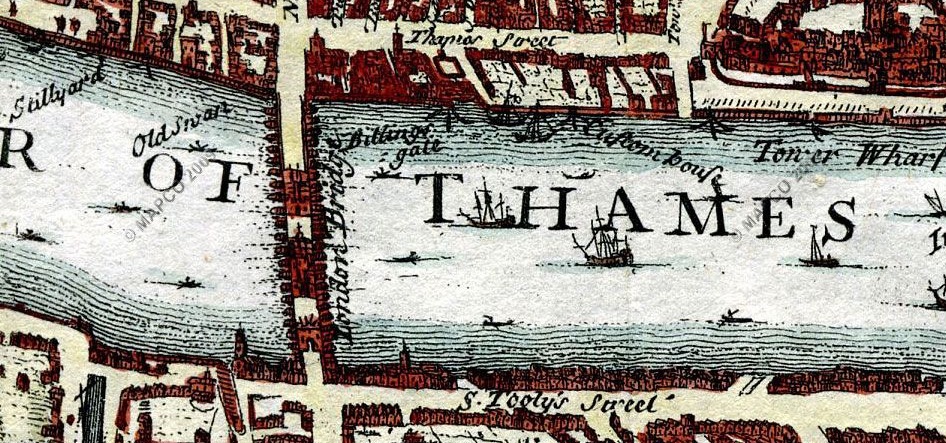
Henry IV was crowned the King of England in 1399. Hanseatic League ambassadors are in the procession when he enters London for the first time. They are somebodies. And they are powerful. They had a wee war with England from 1469-74… and won entrenching their right to trade. Hopped beer was not introduced to England by a few straggling sailors showing up at a few coastal towns. It was brought along – even imposed perhaps – by a massive commercial and military complex. Let’s look at some maps at how the Hansa QH has been described:

hans1561map1633lg

hanselizmap1720

hanslondon1667


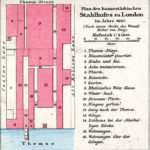
The illustration to the left is a detail of the 1633 reprint of the 1561 Agas map. You can see the location of London’s Hanseatic Steelyard in blue to the west of London Bridge. Above way at the top of the text is a much finer detail of the site. Notice it is referred to as the “Stylyarde.” In the middle is a 1720s map of Elizabethan London. Notice the site is now referred to as the “Stillyard.” And to the right is a diagram of the site of the Steelyard itself in this case called the “Stahlhofes” – as it was in 1667 according to a late 1800s German atlas. So, we have four ways of spelling the name of the site. Which means that each needs to be run through the dark Satanic
research mills if we are going to have an idea of what’s going on. In a note to the discussion of John Stow‘s Survey of London (editions from 1598 to 1603), British History Online has an extended discussion in a footnote on the variously described Stillyard / Steelyard / Stilliard / Stelehouse / Steleyard which states that there was a trade presence from Cologne there as early as 1157. It also indicates that the German version Stahlhof that appears rather early on means a stall hall – a marketplace. Stow himself describes the site and operations at length in his narrative map of London including the following:

Next to this lane, on the east, is the Steelyard, as they term it, a place for merchants of Almaine, that used to bring hither as well wheat, rye, and other grain, as cables, ropes, masts, pitch, tar, flax, hemp, linen cloth, wainscots, wax, steel, and other profitable merchandises.

Interestingly, as Stow notes, past the intervening church, near the Steelyard in Haywharf Lane in the late 1500s there was a “great brew-house” operated in the past by Henry Campion and then by his son Abraham. Life in the district was… lively. In the poem by Isabella Whitney (1548–1573) “The Wyll and Testament of Isabella Whitney” we read the following:

At Stiliarde ſtore of Wines there bée,
your dulled mindes to glad:
And handſome men, that muſt not wed
except they leaue their trade.
They oft ſhal ſéeke for proper Gyrles,
and ſome perhaps ſhall fynde:
That neede compels, or lucre lures
to ſatiſfye their mind.

So, as we see on the image to the right, there is a wine house. I assumed it was a wholesale depot but it appears to be an Elizabethan retail party palace where lads and lassies mingle as they consider drink, lust and lucre. February 1582 government orders issued by the Privy Council to the Lord High Treasurer show the Stillyard being excused from certain taxation – right under another order allowing the export of 1,000 tuns of beer from London. Elizabethan brewing and trading at scale. You don’t hear about that often. Leaping ahead into the next century, Samuel Pepys, diarist and high government official, records a number of visits to the site in the 1660s. On Friday, 13 December 1661 he wrote:

…to the office about some special business, where Sir Williams both were, and from thence with them to the Steelyard, where my Lady Batten and others came to us, and there we drank and had musique and Captain Cox’s company, and he paid all, and so late back again home by coach, and so to bed.

On Monday 26 January 1662/63 he stated that he was “up and by water with Sir W. Batten to White Hall, drinking a glass of wormewood wine at the Stillyard… while on Sunday, 2 September 1666 he uses it as a location in his description of the Great Fire of London. Perhaps most gloriously, he gives us this image of a part of his day on Wednesday, 21 October 1663:

Thence, having my belly full, away on foot to my brother’s, all along Thames Streete, and my belly being full of small beer, I did all alone, for health’s sake, drink half a pint of Rhenish wine at the Still-yard, mixed with beer.

Rhenish mixed with beer. There’s a challenge to today’s sense of yum. Thankfully, he also drank Northdown and Hull so it was not all weird for Sammy. I am going to leave it there but to review, then, what we have seen is that the Hanseatic League was a massive trading partner which had a huge export trade in beer in the 1400s. It had a very significant governmental foothold in the middle of London which was recognized from at least 1399 to the 1660s as something to be reckoned with. The business presence stretched for 700 years from the 1150s to the 1850s. They ran a retail and entertainment hall of some sort exactly when beer is coming into England at the same time that they operate the largest brewing center in the world at Hamburg.

Suffice it to say, there is more to be found about the role of the Hanseatic League and the history of hopped beer in England. Does it support the rough overlapping sequence Haneastic hopped beer (say Hamburg and later Flemish 1300s to 1600s) => coastal hopped beer (like Hull and Northdown, say, late 1400s-1712) => canal based hopped beer (Burton after 1712)? Could be. Need to find out.
Slavery, Servitude and The Interests of Patroons

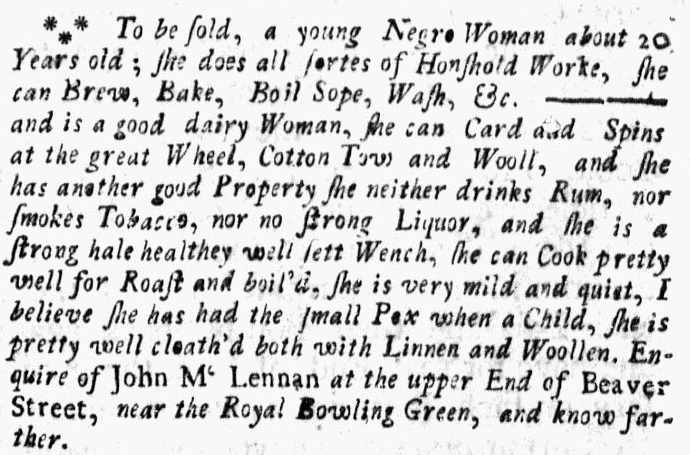
nywj15april1734slavebrewer

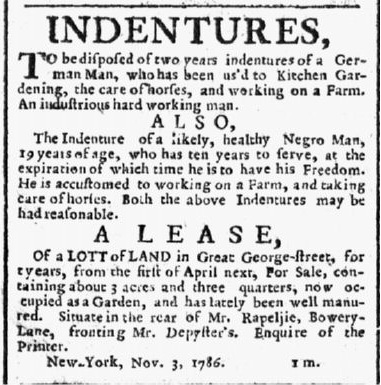
What a sad image to come across. A human for sale. It’s from from the 15 April 1734 edition of the New York Weekly Journal. Apparently the sale didn’t come to pass as she was still for sale half a year later. Unless that is another unnamed woman for sale with the same skills. The colonial economy of the Province of New York included slavery. It’s a fact you have to keep in mind when researching the colonial brewing economy. This is not to point fingers. It’s just tragic reality one cannot reach back and undo. There were people enslaved here in my town well after the relocation of the Loyalists from New York to here – some even fighting with their enslavers on behalf of the Crown. The North American economy simply included the use of and trade in forced labour in areas other than what became the Confederacy. Brewing business included. People, both slaves and indentured, were commodities.

nymerc08oct1753runawaycooper

nymerc09june1760rutgersslave


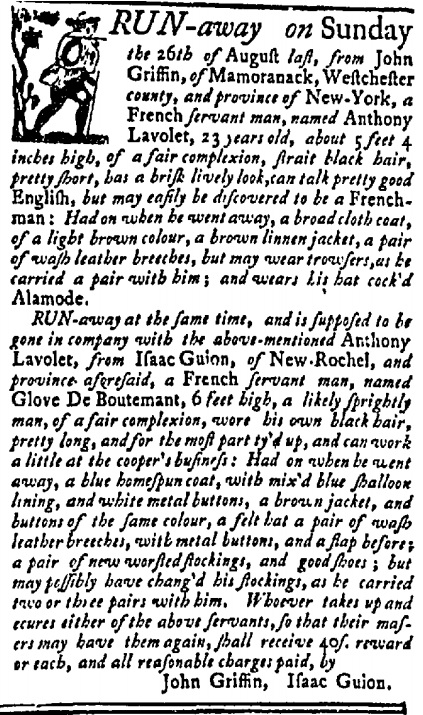
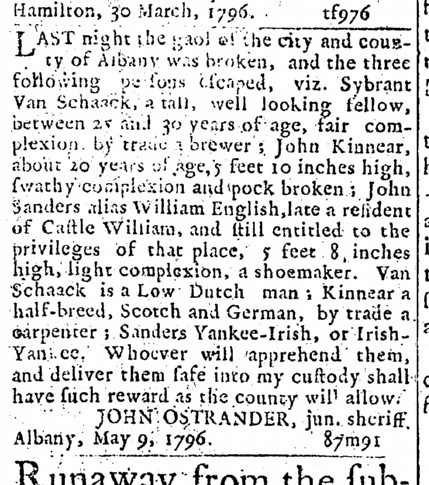
How did you deal with oppressive conditions in the 1700s? Options were limited and often at the drastic settling in those times. You could kill your captain if he earned himself a mutiny. You could run away. Look at the first thumbnail. Henry Rutgers, brewer, posted a notice in the New York Mercury of 9 June 1760 offering a reward for a runaway (aka freedom seeking) woman named as Jenny. And it wasn’t just slavery. Under the other thumbnail you will see another notice. In 1753, two indentured servants – both Frenchmen – ran and the one was noted as being a cooper. A maker of barrels. And it was not only about economic oppression. A brewer could even escape from jail – although I am not sure where a brewer named Sybrant Van Schaack could hide.

These sorts of hardships were the lot of mankind through most of time and space. I am sure there are enslaved brewers still today. But in the 1600s, 1700s and even into the 1800s, New York had a special sort of restriction on liberty. The system of patroonship. The patroons were a Dutch introduction, a form of landed gentry in the Hudson Valley which somewhat dysfunctionally off-setted the colonial power of the Governor of the West India Company. Like the seigneurial system in New France, these landlords controlled large tracts with the goal of maximizing economic output – including, as we stated in our book, the brewing trade:

In 1643, the patroon van Rennselaer contracted Evert Pels to work as a public brewer for six years between 1643-1649, in the colony at what would become the colonial brewery in Greenbush. Pels had recently arrived in the colony on the ship Houttuyn or “the woodyard”. He traveled in the company of a Rev. Megapolensis and family a surgeon named Abraham Staes, as well as more farmers, and farm-servants. The ship carried a great volume of supplies for the colony including four thousand tiles, and thirty thousand stone for building. It also carried between 200 to 3000 bushels of malt for the brewery of Mr. Pels.

The Manor of Rensselaerswyck was likely the most successful of these estates and certainly the most relevant to Albany. The original plan for the brewery was that it would supply all the beer for the entire New Netherlands enterprise. The founder of the Rutgers clan, Rutgers Jacobson, brewed for the patroon. In no small part due to the support given to the Federalist leadership during the Revolution, the system lasted through eleven or twelve patroons over 200 years until the 1850s when the last leases were sold off by the van Rensselaer family. Being a controlled community for much of that time, the patroon ultimately controlled the crops as well as the infrastructure like breweries. The fourth patroon married the daughter of a brewer, Maria van Cortlandt, who herself set up a brewery on the estate in 1662. For generations, control of all aspects of the estate’s economy generated vast profits. The last patroon, Stephen III, is considered the tenth most wealthy American of all time. Not the sort of thing a Jeffersonian expected would exist still half a century after the Revolution was won. Rents were to be paid in wheat, a crop which was especially not well suited to the western portion of the estate. Also, the patroon retained all water rights. Not exactly the circumstances which might trigger individual investment in an independent brewery.

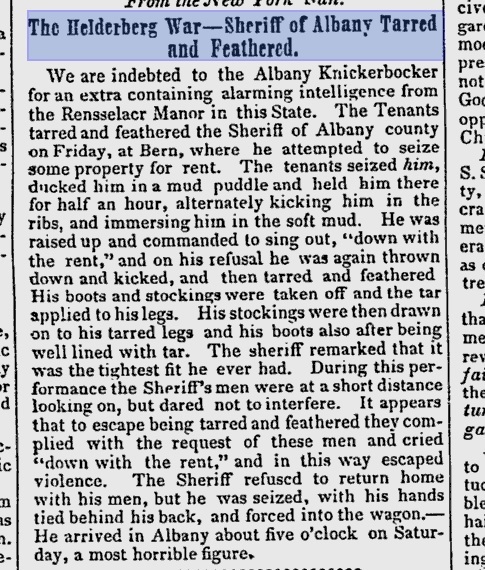
The system failed after the Panic of 1819 and the collapse of wheat prices. Tenants declared they were living in a form of slavery but nothing changed until, in the 1840s, there was open revolt. The Anti-Rent or Helderberg War was well underway. Once won, it didn’t take long for the region’s hop plantations to take off. The NY state crops centered in the region expanded nine-fold from 1840 to 1860. Today, Deitrich Gehring is growing hops and barley in the same lands of Helderberg for the Indian Ladder Farmstead Brewery And Cidery. I have met Deiter, through Craig, a few times. He has co authored The Hop Grower’s Handbook: The Essential Guide for Sustainable, Small-Scale Production for Home and Market with Laura Ten Eyck. Such are the fruits of freedom.

Georgian Era Long Distance US Beer Shipments


vasserdetailaug1834
The main reason I got into hunting for parallels to IPA over six years ago was Pete Brown’s excellent book Hops and Glory. I liked it so much that I posted a review in four parts. It seemed to me that if beer was being shipped to India it should have been shipped across the Atlantic Ocean as well. And as it turned out my hunch was correct. It shouldn’t have needed to be a hunch, of course. This all should have been well researched but, as I have droned on about, there has been a tendency in beer writing to skip the whole research thing and rush to observation. So, we have wallowed in myth. In this post, like the one on how beer was commonly not pale and not smoke-laced before the use of coke for malting, let’s just summarize what is known so that we don’t ever have to slip back into the land of fibs where it takes the latter 1800s popularization of lager to invent the concept of the know-how and practice shipping of US beer over long distances to lucrative markets.

=> First, Taunton ale. As we have known for a few years, Taunton ale was imported in large quantities into New York City since at least the 1750s when newpaper notices for the stuff start appearing. It was brought to NY in the first two decades of the 1800s. It was certainly also in Jamaica in the later 1700s. We do not know how much of it was imported into other colonial communities solely because no one has researched the question as far as I know.

=> nygaz07may1805albanyalehibbertsNext, Hibberts Brown Stout. This stuff is all over the place. Click on that thumbnail. That is a notice from just one store in 1805 stating that they have fifty-five casks on hand with another 498 casks on route. British beer brought in and in bulk. Broadly. Nova Scotia. Texas. Lots of folk were importing. They knew how to put a cask on a ship.

=> And then, porter. As I recently wrote, it “was enjoyed in New York City as an import and then a local product in the second half of the 1700s, before and after the Revolution. The best was “ripe and brisk.” A brewery built in the 1760s by a Hudson River dock was known as the porter brewery for half a century. It shipped to both the East and West Indies. Again, masses of the stuff being shipped in and shipped out.
=> There’s New Haven ale, too. Worthy of its own post, New Haven, Connecticut ale appears in Albany (of all places) in 1802 in an ad that also have NYC ale coming north, too. There was an agency in NYC and some sort of Federalist plot related to the 1803 burning of the brewery. The brewery had enough barley for 1500 barrels of ale when it was destroyed. Scale.

=> albfaulkalbreg18oct1790Plus, there’s southern beer. You see it in the logs. Click on the ad. Brewing was not practical below a certain latitude so brewers like William Faulkner of NYC and Albany shipped to South Carolina… and the West Indies. He died in 1792. Not to mention there was northern beer, too, three decades later. I haven’t even figured out what that was. Except it was shipped in bulk and was intended for trade.

=> And, of course, there’s the entire history of Albany ale in the first half of the 1800s. Enjoyed from Newfoundland to Hawaii. Brewed at a scale that rivaled anything in Europe by mid-century and for decades after that.

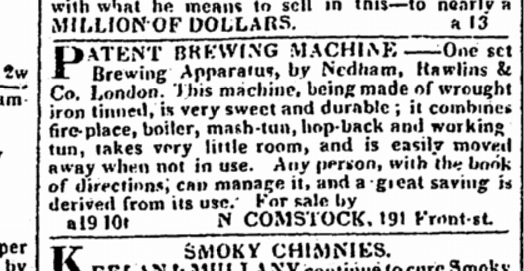
=> nyevenpost19dec1823eaglebrewery61crosbyAnd it goes on and on – there was Burlington Ale and Philadelphia Cream. There was all that Philadelphia porter, too. And then there was just those notices for custom batched shipping beer, a purely wholesale product in the 1820s like under that thumbnail. Local and shipping were two distinct and equally valuable markets for the ambitious brewer in the early 1800s. That image way up there? A detail from Vassar’s log in August 1834. Like other every page, it shows how mixed his intended markets were. Why else do you think US ale breweries were built on rivers or near the
sea?

Why wouldn’t US brewed beer and ale be shipped in mass quantities well before the rise of lager? Ship’s beer is a core product. Ship + brewing = wealth. Just like they knew how to make pale ale without smoke fouling, the English knew how to load a ship full of beer for an expedition to the Arctic in 1577, for God’s sake. The Hanseatic League was shipping beer internationally before 1400. Why? Money! Just as with big craft today, every brewery owner has always known that getting past the local market is where the real money is. It’s the goal. The goose that lays the golden egg. When the great American lager breweries begin shipping by rail in the later 1800s they are just building upon centuries of bulk beer shipment under wind and sail. Albany may have been a leader but it was not unique. The more that actual brewing trade research is undertaken the more clearly this will be set out. Guaranteed.
Lemon Beer In Schenectady In The 1830s

schencabinet28march1832lemonbeerI was looking up spruce beer to see how late it was being advertised and came across a small batch of notices from one newspaper in Schenectady New York in the 1830s. By the second half of the 1800s, there are plenty of recipe books that offer homemakers the ability to make a 1.5% alcohol soft(ish) drink for the family based on sugar and essence of lemon. Unlike those household guides, the 1830s lemon beer appears to take its place with other alcoholic beers and not in the temperance drinks cabinet.

The notice of the lost notebook to the right is particularly interesting. from the 28 March 1832 edition of the Schenectady Cabinet, it explains its own purpose – but whoever was keeping track of the debts of this drinker was serving lemon beer along with rum and beer. Or porter, sweet wine, strong beer and New Jersey cider. Premium drinks. Yet, the recipe for ginger beer to the lower right is from 2 May 1818 of Albany Gazette and that looks a heck of a lot like the later 1.5% temperance drinks. Maybe the stuff was both premium and light, a small nod to sensible drinking in the fairly debauched days of James Monroe.

schencabinet27may1835lemonbeerschencabinet25may1831lemonbeeralbgaz02may1818gingerbeer