
Driving Around Albany With Craig And Ron


realm1Not just Albany. Delmar, too. Delmar! Land of Craig’s youth. We sat at Real McCoy with owner and sign maker Mike Bellini and his pal Jay, a pro ciderman. I like a one-person brewery. Ron said it was the set up he dreamed of for himself. He was preaching the double brown gospel. Research. Comparing notes. Overly precious hipster nano failure v. single hop and malt explorations. The height of barley stalks and why. Maybe. Local hops were passed around. Forgot to mention the spruce beer idea, that coniferous flavouring predates DIPAs in the repetior.

realm2Everywhere we go Canadian malt is the backbone of NY craft brewing. Good to see. It’s good to be helpful. Definitely some sort of brown ale revival going on. And local ciders everywhere. 2014’s fruit salad obsession may just be history. Wouldn’t that be nice. Yesterday, Gerry L. was with us for a couple of hours and was corroborating and filling in gaps in 1700s NYC. And backdating schenck and lager. Was it just a new word layered on existing practice before the Panic of 1837? Maybe.

More nerdism this evening. Trains, canals and marketplace expectations. You don’t advertise in a paper to the neghbourhood customers. Not in the 1790s. No way.

In 1795 A New Brewery Opened in Cooperstown

nyotsegoherald18sept1795morganmulcockcooperstownStanding in the mid-1790s looking forward in time, I have a sense of things changing in the history of New York brewing. I am a bit concerned that in a few years I will be facing a confusing mass of information coming at me too soon, from too many directions. Still, for now as the frontier just begins to fill there are stories which are manageable. We certainly understand the situation in Albany and in New York City itself at 1790 where long standing families still controlled the market as they have for generations. Soon these dynasties will be outnumbered as new immigrants arrive, some close up sensing change. Others struggle with the coming grim reality. As the frontier lands begin to be populated and repopulated in the first decade after the American Revolution new breweries open in new towns. We have seen breweries opening to the northeast of Albany in Galway and Stillwater in the 1790s. There is one more in Kingston advertising in January 1795 and another posting a notice in Troy the next month. We have seen how beer shows up in the last years of the decade in western New York related to the colonization coming up from Baltimore along the Susquehanna which flows to the south. And in 1795, a brewery opened in Cooperstown.

Historian Alan Taylor won the Pulitzer Prize for his book William Cooper’s Town in 1996. Like the colonization of the Conhocton via the Susquehanna centered on a new town, Bath, the creation of Cooperstown was an example of one land owner developing a district and a community as a personal investment. Unlike at Bath, Cooper did not depend solely on his agent and was personally involved. And that, as Taylor explains, included building a brewery:

An even more significant proof of Cooperstown’s advancing civilization was that beer, as well as water, flowed in the village by early 1796. As in the maple sugar production, William Copper encouraged a brewery as an act of both social benevolence and economic service. During the 1790s many enlightened gentlemen promoted the drinking of beer and ale as antidotes to Americans’ swelling consumption of the more ardent distilled liquors associated with alcoholism, poverty, and violence. In New York City Cooper met and recruited Walter Morgan and George Mulcock, English immigrants and brewers who removed to Cooperstown in the spring of 1795. Extolling the projected brewery as a patriotic and philosophic manufactory,” Phinney’s newspaper asked and exhorted the locals: “What shall we do? Drink beer, till we are merry.”

nyotsegoherald09october1795cooperstownadvicegrainnyotsegoherald30october1795cooperstownboomnyotsegoherald04may1797morgandisownsmulcockcooperstown


The enterprise takes off with great hope. Up top, the notice in the 18 September 1795 edition of the Otsego Herald in which the brewers offer the highest price in cash for any quantity of barley. They hope to brew so much that farmers of the district not have to export it out of the county. The clipping to the left looks like a letter to the editor. It’s from the paper’s 9 October edition and seems to oppose the development, the drinking and being merry line being sarcastic. The notice in the middle from October 30th describes a fairly significant operation. The brewery 83 by 25 feet with a 19 foot high roof line. Taylor states that Cooper invested over £270 in the construction. He was also building a library, a school and a lodge for the Freemasons. The brewery caught fire in December 1796 but was saved when “the villagers rushed out to subdue the flames.”

It did not last as first envisaged. By April 1797, George splits town and partner, Walter, dissolves the partnership based on the defection as you can see from the notice at the right up there. It probably was not entirely Walter’s fault. In 1795 the district had a booming grain growing economy feeding into the European market ravaged by the Napoleonic wars. By 1797, the Hessian fly was ravaging crops here as it was elsewhere. And there was the Panic of 1796-97. Plus, as Taylor explains, by the summer of 1796 Cooper as Federalist patriarch is facing a younger generation of more republican men of merit who defeated Cooper in his bid for a seat in Congress. It split the community. Perhaps George Mulcock picked the wrong side. Plus a local wave of anti-Masonry bigotry broke out, too, in response to the new lodge. Maybe he was a Mason.

William Morgan appears to have met a bit of a weird end. In 1827, the Governor of New York wrote the Lieutenant Governor of Upper Canada to state that Morgan had been kidnapped and taken across the international border. A reward was offered of $200 just to for information on his whereabouts. If that in fact is the same Morgan, the man of fifty stories and rabid anti-Mason.

Session 109: Porter And Our Shared Georgian Culture

sessionlogosmFor this month’s edition of The Session, Mark Lindner, the Bend Beer Librarian has asked us to write about porter:

There are English porters, Brown porters, Robust porters, American porters, Baltic porters, Imperial porters, Smoked porters, barrel-aged variants of most of the preceding, and so on. With as many variations as there are it is hard to believe that porter is perhaps a neglected style. Then again, it did disappear for a while [see Foster, Porter, and others]. Of 14 beer people asked about overrated and underrated styles three of them said porter was most underrated and no one suggested it as overrated in our current market climate. [Yes, I know that is from Thrillist; feel free to ignore it.] I would like you to sit down with one or more porters of your choosing. Pay a few minutes attention to your beer and then use that as a springboard to further thoughts on the style.

wmporter1830a
Click on that image. It’s from the commonplace book of William Maud, evidently of Wetherby, York, England, b. 1787 who served as a customs official in Great Britain; he was employed at the excise office in Leeds in 1830. In his note book he keeps track of things of personal interest like Egyptian history and the excise table. On page 135, he wrote down two recipes: strong porter and common porter. He was likely taking an interest as the district excise man in the business of those who paid him taxes. The 184 year old jottings of a curious unfamous man.

There is so much going on. Both the common and strong porters are built upon a bit more porter malt than pale malt. The strong porter calls for Clay hops, which I now know from this 1855 agricultural journal was a rather rank hop that had particular preserving qualities. Which is interesting as Maud notes that the amount of hops you use depends on “the length of time you intend to keep the porter in the vats.” I am not sure that I had understood the word “cleanse” to mean the primary fermentation dropping clear. Notice he records that cleansing the common porter is accomplished by raising the temperature of the primary from 71 to 77 degrees. His conclusion is wonderful: “this is all wrought in the Punchin”! As with porter so with life.

Porter is Georgian Britain’s gift to us all. It comes in many forms. It was enjoyed in New York City as an import and then a local product in the second half of the 1700s, before and after the Revolution. The best was ripe and brisk. It survived both sides of that civil war. As we wrote in Ontario Beer:

The day book of tavern owner Abner Miles from 1798 illustrates drinking preferences of the governing elite who spent this a English money. Merchants Hamilton and Cartwright along with Commodore Grant and Chief Justice Elmsley along with many others are noted drinking a wide range of strong drinks with their meals and afterwards. They drank an impressive number of bottles and bowls of white wine, syrup-punch, brandy, rum, port, madeira, gin sling and sour punch along with mugs of beer and bottles of porter. The variety of drink indicates that, at least for the elite, tastes were as varied as imports from throughout the British empire and beyond would allow. The imported porter also illustrates a commercial connection to imperial and global brewing that continues to the present.

It does continue. I am having a Fuller’s London Porter as I write this. The grainy dusty texture of the malt so chocolately good. The hops twiggy minty good.

The Earth Turns Again And All Of A Sudden…

Previous celebrations: 2004, 2005, 2006, 2007, 2008, 2009, 2010, 2011, 2012, 2013,2014 and
2015. Unlike last year, this March comes in after a soft winter. Plenty of warm stretches and only one heavy dump of snow in mid-February. No viral plagues. In the furnace room, weights were lifted and planks were even planked. The season’s seeds have been in hand for weeks with the package of parsnips showing up just yesterday, last year’s crop a few weeks from harvest once the thaw comes. Maple soon.

None

According To Me: How Brewing Cultures Develop

This is the third in a series of occasional posts in which I try to figure out what I really think about things like measuring how much one drinks or what taste looks like. This one, disconcertingly, it looks like a unified theory – something I have mocked for years. But a few weeks ago, Jeff and I shared some useful – perhaps spicy – comments by email back and forth about each other’s prose which triggered some reflection. Explaining myself, I put it this way:

I do not write for the reader. The entire thing, my entire hobby is an exercise in testing my own assumptions. I am trying to solve a very large puzzle. And then I apply the things I come up with – structures of argument in some cases but in other just very big thinking – back into my work life as well as my relationship with life generally. I appreciate that this is all sounding odd – a bit hypomanic – but it is very hard to explain. Last year I even wondered what it would be like to be a beer writer who never drinks beer at all. So it is not so much about being in or out of the bubble but seeing it as a bubble within bubbles next to bubbles and trying to get it all ordered.

I see bubbles. I guess. The other night I woke up at 4 am after a pre-post-apocalyptic dream* and, mulling bubbles for a while afterwards to change the story in my head, thought about what I had been seeing with all this research over the last year, the diving back and forth over centuries. What has struck me even more than ever is how pervasive beer is in our English-speaking culture’s history. There is an obvious reason for that. Alcohol arises naturally, spontaneously. I remember in high school watching out my front window at starlings gorging on the rowan berries in the front yard bush. They were getting quite drunk off the fermented juice. Having a hard time landing or staying on a branch. One bird holding tight to the telephone wire side by side with his or her fellow lost toe grip and swung right round 360 degrees. The berries were loaded with rough country wine. And so became the birds.

This is good. It is a thing of nature. Beer is too. When we say “I would like to shake the hand of the man who invented beer” we tell a fib. Someone somewhere some long time ago came across a puddle. It had formed twice. Once briefly to get the ripe grain laying on the ground damp enough to sprout. And then again later for the now-altered malt to ferment. Someone drank from the puddle and figured out what had happened. All the brewing in all the history of humanity is a repeated effort to replicate the moment. To recreate what that puddle spawned. I see three core tendencies or aspects of those efforts, those replications: vernacular beer, scientific beer, mass market beer. Each is normal… whatever normal is. Better to say they reliably reoccur. Each tendency generates pleasure and profit reliably, too. And breweries – and brewing cultures – over time reflect more than one tendency or aspect. Just the few city blocks of Golden Lane in London, England display all three facets over the centuries. And each tendency generates associated sorts of beer. In a fairly regular pattern.

I prefer the idea of vernacular brewing over words like traditional or indigenous. Brewing can speak of a place. Stan will be pleased. Look at that video up there. It’s was shared by** the ever excellent Lars Garshol of Larsblog. Look at what is going on there. It’s likely very similar to how ale was brewed by an early micro. Or by William Mead in 1790s Stillwater, NY. Or at Hoegaarden in the 1400s for that matter. Vernacular brewing depends on a measure of geographical, jurisdictional or economic isolation. Look at the thumbnail. That is a page of Lord Selkirk’s diary from 1803 in which he describes a 12 barrel brewery on the frontier in NNY. Barley is little grown. So the beer is made of a blend of wheat, what barley that can be found and chopped straw. Tidy and efficient. Local resources making local beer for the local population. Unger indicates that how the semi-autonomous jurisdiction of Hoegaarden exported its singular sort of beer throughout the Low Countries of the Renaissance. Understanding local can be very important. Many years ago my part-time farmer father-in-law’s veterinarian traveled to the Ukraine as part of a Canada-USSR project to assist in improving farming practices. He entered a barn where he found the cattle eating fresh cut corn – the whole plant, unripened corn and all. The advice he gave? Kill half the cows. Not enough food to feed all of them from the crops they had on hand. Gotta know what’s possible. Locally.

Scientific brewing represents a refusal. A refusal to accept what vernacular brewing teaches us. It is geared for efficiency or as E.P. Taylor might put it as in the 1942 letter beneath that thumbnail, the avoidance of waste. Coppinger in 1815 wrote of the need for cleanliness and an “economical mode” of building a brewery if the new American Republic was to meet the standards of old world brewing. Efficiency is not code for skill. Coppinger knew it was possible to make “clean bright malt” in a rustic setting. Unlike what some will tell you, pale ale spared from smoke was well known long before the scientific revolution. In addition to the race for efficiency, brewing changes to react to scarcity. Coke was introduced to malting as a replacement for charcoal long before that, as well. It was not so much because it was better as it was due to fact that England’s forests had been drastically thinned out by the late 1500s. The new fuel provided a new way to continue on with brewing. It is related to better husbandy. The late Georgian and early Victorian reports of the recently invented Agricultural Societies on both sides of the Atlantic described the advances in brewing from an economic point of view. Beer is persistent.

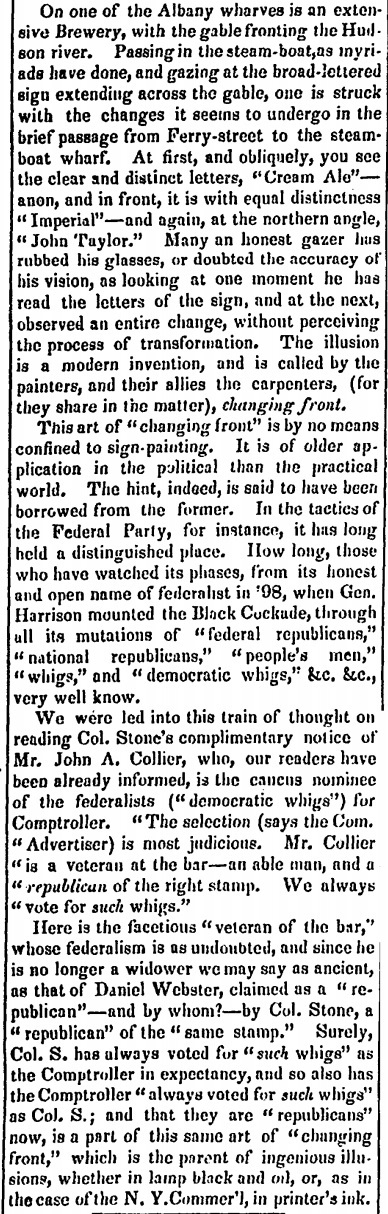
The scale of the mass market has also been an abiding theme with brewing. Taylor of Albany had a pontoon room in the mid-1800s which echoes the royal breweries of ancient Egypt. The Hanseatic trade routes of the 14th and 15th century that allow Hamburg to have a massive brewing industry mirror how the coming of the railway to southwestern Ontario unleashed the carbohydrate laden grain fields out to the British Empire though the previously local brands Labatt and Carling. It took the improvement of the River Trent in 1712 to get the sulfurous local brewer out into the wider world. The English hops trade was subject to scale in the mid-1700s with one merchant London-based James Hunter being “one of the one of the most considerable dealers in hops in England” controlling a huge portion of the marketplace. Beer has a habit to expanding and adapting to meet the possibilities.

If that is so, if brewing has a number of constant attributes like vernacular expression, scientific efficiencies and the opportunism of scale – not to mention the relative certainty of wealth creation – how extraordinary is any era? Is this era? In a way its consistency over time could one of its weirdest characteristics. But then couldn’t the same be said of other persistent commonplace things like shoes, cheese or rope? Something about the pattern make me wonder if it is all a symbiotic relationship held with yeast. Maybe even a wildly successful outcome of an experiment undertaken millennia ago by the Central Yeast Planning Council. It would at least make sense of the formula beer > drinking culture > brewery. Or at least that’s what I think.

*Lots of daytime grey clouds to the horizon views with commentary like “oh, this doesn’t look good.” At one point from an apartment I saw a darker swirling column of grey far off, another moment I was on a path among dunes watching meteor-like flashes in all directions overhead. I never have dreams like this. More Torchwood than Doctor Who.

**Lars commented that he was not the source of the video. I think I saw him link to it now that I think of it.

In The 1790s New York’s Frontier Also Moved North

albgazmeadbreweries1790

You can click for a slightly bigger image if that’s too tiny. See, what they are? A notice announcing the opening of a new brewery in 1790 and a notice announcing a brewery for sale in 1799. Same last name in each notice. Hmm… New Galloway is actually Galway, New York which was improperly recorded as being named after a town in Ireland instead of its actual namesake in Scotland. Stillwater, New York sits just over 30 miles to the east of Galway. These notices are not about the same brewery. North of Albany. Hmm…

Who are these Meads? A man named William Mead is described in a genealogy of the family as follows:

WILLIAM MEAD, M.D. was born October 15, 1747 in Greenwich, CT, and died February 01, 1829 in Galway, Saratoga Co, NY, buried in Charlton, NY. He married (1) PHEBE FARRANT. She was born Abt. 1750, and died October 21, 1776. He married (2) GEERTRUYD MYNDERTSE Abt. 1779 in Schenectady, NY. Notes for WILLIAM MEAD, M.D.: Revolutionary War Surgeon, 1st New York Regiment.

Is it him? This William dies in John’s town. Doesn’t look right. Hang on… there is another one:

WILLIAM MEAD was born January 08, 1748/49 in Nine Partners, Dutchess Co, NY, and died February 27, 1838 in Hector, Tompkins Co, NY. He married HANNAH PALMER 1778 in Stillwater, Albany Co [now Saratoga], NY, daughter of ELIAS PALMER. She was born September 13, 1760 in Norwalk, CT, NY, and died Aft.July 28, 1840 in Hector, Tompkins Co, NY. Notes for WILLIAM MEAD: William kept a tavern in Stillwater, NY, where he had moved two years after the Revolutionary War. He served at the rank of Colonel during the Revolutionary War.

Now that looks more promising. Here is a sheriff’s notice from 1790 showing William owning that tavern in Stillwater in 1790. Here is another from 1792 – see who the sheriff was? Peter Gansevoort – of the brewing Gansevoorts. And notice in the ad up there to the left that the brewery could do a 13 barrel brewing session? That is not a tiny operation. That is about the same size as the smaller kettle at the Brooklyn Brewery prior to the Revolution. It’s in the same ball field as Vassar’s first brewing set up in 1808. So, it’s a fairly generous operation for the time. Heck, it’s almost twice the size of Greg Noonan’s micro in Vermont. Notice also that he moves into the area from the south, his wife from Connecticut. A lot of the folk in the genealogy appear to do that. So, just as we see folk moving up the Susquehanna from the Mid-Atlantic to colonize the central Southern Tier in the first half of the 1790s there are others from New England moving into the area around Albany in the later 1780s. Likely moving into Loyalist farms, already cleared land. And brewing their beer.

albgaz21june1799hessianfly1799 was a bad year for NY brewers. Or at least a year in transition. The tail end of a recession. The Catherine Street spruce beer brewery is for sale. The once mighty Greenwich brewery of the Lispenards? Up for sale. Groshon’s place is up for sale, too. Yet there are the first want ads for folk wanting to hire brewers. Even coopers. Flux? Hessian fly? Click on the thumbnail. The Hessian fly is certainly hammering the fields.

What about the other guy. John Mead, the brewer. Crap. One thousand, one hundred and eighty references to men named John in the genealogy of the Mead folk. This may take some time.

Upstate New York Frontier Post-Revolutionary Brewing

nymap1796beerrouteWhat a title. I have been trying to figure out how to move out of the cities of Albany and New York and figure out what is going on in the young state’s countryside after the American Revolution. As with today, a variety of factors cause how beer is and is not available. And a variety of factors which affect why Albany remains the center of brewing in New York for the next two or three generations. As always, it is not just about the great white male even if there are plenty around to take credit and, yes, to have some effect. To understand what happens as a matter of individual personal will, however, is to miss much of history.

First, we need to consider a map. This is a detail of the 1796 map by John Reid showing western New York. It’s really large scale. Have a look around. Notice something? Not a lot of roads. Not a lot of towns. Not a lot of people even 13 years after the end of the Revolution. There are reasons for this. It was difficult to settle. There were treaties with the aboriginal population of the remaining Iroquois to settle. And there were residual colonial rights of the state of Massachusetts to play out as well. Beer needs people and, for the most part, beer drinking people were not there yet.

Next, you have to appreciate where people are showing up, their needs do not generally focus on access to beer. They are trying to survive on the frontier in accordance with how they show up in these newly acquired lands. Unlike with British held Upper Canada, settlement does not always happen in a controlled organized fashion. There are two competing approaches: Whig-theory colonization and Jeffersonian pioneers. Consider this description of the first Euro-Americans who arrive as pioneers at Ithaca, New York:

In the month of April, 1783, eleven men left Kingston, on the Hudson River, with two Delaware Indians for guides, to explore the country west of the Susquehanna, with the intention of securing a future home. They were a month or more thus employed, but returned without making a location. In April of the following year, three of their number, related to each other by marriage, Jacob Yaple, Isaac Dumond, and Peter Hinepaw, revisited the district previously explored Ind selected four hundred acres on lot No. 9-1, then in the county of Montgomery, of which the west line of Tioga Street in the village of Ithaca is now the western limit. Upon that part which was in the valley were several “Indian clearings,” being small patches from which the hazel and thorn bushes had been removed, and which had been cultivated after the manner of the Indians. It appears that for many years after the first settlement it was the custom for the whole neighborhood, extending several miles around, to avail themselves of these clearings on the Flat. Here they planted corn principally, thinking that it could not be raised upon the higher ground… The settlers, having planted their corn in these places, left it in the care of John Yaple, a younger brother of Jacob, and returned to bring their families, with whom they came back in September. They brought also a few articles of household furniture, farming utensils, and a number of hogs, sheep, cattle, and horses. The three families numbered twenty persons. A month was consumed in their journey to Owego, where there was a small settlement, and nineteen days from thence to Ithaca. The route pursued and the difficulties necessary to be overcome account for their slow progress. Between Owego and the head of Cayuga Lake was but a well-beaten Indian trail, along which the way had to be cleared through the forest. Arrived at their new home, they at once set to work to provide appropriate shelters for the several families…

And not only were these settlers focused on just making a living but they are likely illegal occupiers. They are occupying the lands before they have a right to be there. Look at the case of Seth Read. He shows up in Geneva, New York in 1790, makes an improper deal to buy lands from the Seneca and later, his time and money not offering return, has to move on further west into what is now Erie, Pennsylvania. Without title to the land you are not going to amass the capital to create infrastructure. Things like roads and mills. And schools and breweries. Compare this with the colonization efforts by those with proper claims to land title. A few years later to the north end of the next Finger Lake over, the settlement of Geneva, New York was described in 1797 as much more orderly and advanced:

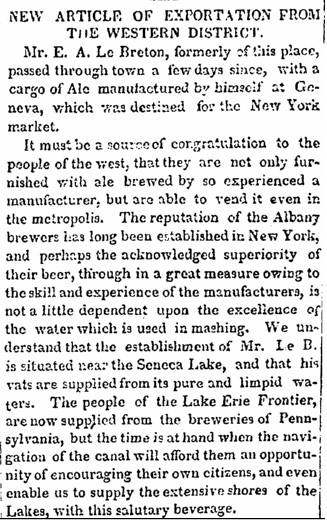
Hence the road from Fort Schuyler, on the Mohawk River, to Genesee, from being, in the month of June, 1797, little better than an Indian path, was so far improved, that a stage started from Fort Schuyler on the 30th of September, and arrived at the hotel in Geneva, in the afternoon of the third day, with four passengers. This line of road having been established by law, not less than fifty families settled on it in the space of four months after it was opened. It now bids fair to be, in a few years, one continued settlement from Fort Schuyler to the Genesee River. All last winter two stages, one of them a mail stage, ran from Geneva and Canadarqua to Albany weekly. A wilderness changed, in so few years, to the comfortable residence of a numerous body of industrious people, who enjoy the comforts and conveniences of life in a degree superior to most parts of the United States, affords matter of curiosity to the intelligent traveller, and many respectable characters undertake the journey from no other motive. To them, therefore, it must be highly gratifying to find entertainment and accommodation equal to any thing of the kind in America. Very few places of the size now exceed Geneva, either as to the stile of the buildings, the beauty of the adjoining country, or valuable improvements. The number of sail-boats have greatly increased on the lake, and the sloop finds constant employment : and, in addition to their comforts, a person from Scotland has established, at Geneva, a very respectable brewery, which promises to destroy in the neighbourhood, the baneful use of spirituous liquors. The apple and peach orchards, left by the Indians, yield every year abundance of fruit, for the use of the inhabitants, besides making considerable cyder; so much so, that one farmer near Geneva sold cyder, this year, to the amount of one thousand two hundred dollars.

See that? One thousand two hundred bucks from cider? A fortune! And see that other thing? A brewery in 1797 in Geneva, New York. Half way between what is now Syracuse and Rochester. That’s the log cabin brewery that Lord Selkirk came across in 1803 and recorded in detail in his diary. Clear title to land and a road established by law. Things the true pioneer lack. The settlement at Geneva had another advantage. An early route to the sea. Before the road reached it, early Geneva sat on the lake. And the lake reached south. Have a look at the map again. Find Geneva and trace a line south. See the bottom of Seneca Lake? Look left a bit. See Mud Lake? See that branch of the Conhocton River reaching over to the north and east. Before the roads were there to move goods on land there was a route to get people and goods in and out that reached south. To the mighty Susquehanna and on to Baltimore.

nydiarymaude23july1800Click on that thimbnail. It’s an entry in the diary of John Maude from 23 July 1800. It describes a scene in a haying field near the Conhocton River, wild enough that its infested with rattlesnakes but settled enough that the locals are handy in dealing with them. And there is beer. Is that the route it took up there in red? The colonization of the Conhocton was a big effort that centered on a new town, Bath. It sought to create an estate in the old world style and it was based on the idea that a proper community needed a number of resources including beer. You may have noticed that there is no great city there today. The idea did not work out as planned. Bath never became more than a village and the surrounding area never became another Hudson Valley. But it does illustrate the way in which the civilization of beer first came to the frontier lands of New York, bringing the promise “to destroy in the neighbourhood, the baneful use of spirituous liquors.” Peace, population, law and investment. All preconditions to the establishment of a beer culture.

This is just a high level introduction. I am going to dig into New York state brewing in the 1790s, conclude the state of New York city brewing to the end of the 18th century and establish another foundation for the ascendancy of Albany in the first half of the 1800s. That will require looking at the Dutch estate properties, slavery, another early colonization effort at Cooperstown as well as the hovering menace of the British to the north. Piece of cake. Done by March. Easy peasy.

The Great White Male Hero Theory Problem

This is a pretty interesting article from outside the usual fanboy circle of craft – but it still illustrates an analytical tendency that hinders discussion. Consider this:

It’s no secret that without Jim Koch and Boston Beer as standard bearers for the industry, craft beer would not have its current identity and the trade group is loathe to lose its most effective cheerleader.

You can take this sentence at least a couple of ways. Either (i) Koch has been a major cause of the success of US craft or (ii) he has shaped US craft to meet the needs of Koch and in doing so brought others along with him. The trouble is both suggest a “but for Koch” implication which is not realistic even if it is seductive. We must keep in mind that, while craft has made him massively wealthy, the man also believes yogurt helps him be less drunk. Because he is human and few humans lack their own weirdnesses.

Good beer has been made for millennium after millennium by millions of people. It has satisfied literally billions of humans over hundreds of billions of experiences in both its functional and pleasurable aspects. It is in a real sense the cause and effect merged. But there is a tendency to ignore that reality and place upon the head of those who harness – or shackle – beer’s inherent continuity with a gold star. I suppose it’s due to the need to get ones hand around the scale of beer’s place in our cultural heritage. But beer is too much like a virus for that. It’s too much like an independent phenomenon, slightly separate from the people who brew it.

Koch is not the cause of the success of Shocktop as the piece suggests. Beer itself is. It’s brewed by so many to such ready profit exactly because of its simplicity. We are in a time of transition away from the exceptionalist fallacies of the last ten years back to the reality of diverse pervasive skillful brewing. It is very similar to the post-Revolutionary era as well as the early colonial period. They are each eras before aggregation occurs. Then… it occurs. It’s cyclical. Koch has just been repeated the pattern of E.P. Taylor starting in the Canada of the 1920s before moving on to the UK, using his understanding of merger and acquisition. He is just like the Rutgers brothers, Anthony and Harman in New York City in the mid-1700s creating a vertically integrated brewing dynasty across Manhattan. He’s like the Hanseaticbrewers’ guilds in the 1400s leveraging the new opportunities of hops. He has asserted control. If he had not filled the space of the controlling craft aggregator someone else would have. It’s not the stuff of alternate universe fantasy to point out the propensity of brewing to provide for this. There’s a reason all the home runs in sport are hit in baseball. Because it provides for it.

This is a nice segue. I need to get back into the records to study brewing in North America before 1850. There is such a wealth of databases to work through that it would be more than a disservice not to. Primary records which tell their own story. No spin doctors. Maybe. Gotta watch out for those who give themselves a gold star or who sidle up next to them. Gotta keep an eye out for them.

I’d Like #IndieBeer To Really Mean… Something

In response to the disassembling of US craft beer that’s been going on for a year or so – the surprise sales of big players as well as the retirements of key figures – suddenly we are seeing this term “indie” beer being tossed around like it has some meaning. It would be nice if it does end up having a a degree of decently intelligible substance but it faces some opposition in the race to promote it as brand. Here’s what I think might be going on:

– Mr. B has been making a a very good case that the word “craft” has achieved a very good thing – public recognition. There is a related thought that arises from this fact. Replacing it or, worse, duplicating it with indie beer will cause confusing and will undermine this achievement. I like this argument much more than I like the term “craft” itself. And if this is so, “indie” ultimately hurts more than it helps.

– Jeff has been exploring or maybe just testing out “indie beer” but has faced another reality: the future for much of good beer may be controlled by large international drinks conglomerates. The deeper trouble with that analysis, however, rests in the admission he makes: “There will of course still be thousands of small breweries scattered across the country…” See, three sources of good beer are being described – (i) small and local, (ii) medium regional or national and (iii) large multinational. “Indie” beer simply cannot describe the third category and can’t really be applied to the second with a straight face. Maybe “indie” is just too accurate to replace the useful general vagueness of craft.

– The third reality is that this talk of “indie” beer might be just a trial balloon being floated by a trade association staffer communications committee. We have to be honest to understand why they’d do that. Big craft, the middle regional or national brewers, got greedy and started to build branch plants and trucking fleets. Much of craft abandoned small. And, in return, a number of major figures have abandoned craft. They don’t need it any more. This disloyalty to the values put forward when “micro” was deemed not good enough in the first years of the 2000s has been traumatic. Turns out “craft” has run its course as the catch all, the kitchen sink. Which leaves boosters in pickle. Maybe grasping at straws. It’s normal. So “indie” gets trotted out. Let’s see if that one works. The other committee members nod. Ruh-roh. No such luck. Frankly, “indie” has that bad feeling you get seeing a friend dating on the rebound after getting dumped by that really great long term girlfriend. He’s needy. Panicky. Never a good thing.

Paradigm lost. It sucks in a way that we are in the post-“craft” world given how so much effort and resources have been put into the word by brewers. Trouble is… now that we are in the marketplace of sufficiency very few individual breweries are all that vital. They can each come and go but the whole remains largely unaffected. They are replaceable. Drinkers ask for craft IPA or the latest craft sour. Other than the fusty ticker – or its more recent and better groomed manifestation, the hipster – the success that Mr. B notes means that most craft drinkers do not care that much about the brewery. It’s become a fungible. A concept alienated from both its making and its maker. Except, perhaps, if the brewery is just down the road and gives a level personal touch that social media and stacks of cases at grocery store aisle ends can never replicate. Local has meaning.

Can “indie” compete in this new marketplace of ideas? I don’t know. I’d like it to as it sounds so good… but if it means corporations with absentee shareholders, trucking fleets and owners who like to post pictures on Facebook on unending holidays in the sun, well, no one is going to accept it. But maybe, instead, it settles into its natural angle of repose and comes to describe just the breweries which are actually local, small and independent. Maybe we now live in at least a four sector reality: indie, big craft, macro and import. Maybe no one word can capture the part of all beer that which makes the good stuff because all sectors can. Maybe that’s OK.

Still Not Backing Down For Four Hundred Years

What a great ad. It basically sums up everything about American brewing for the last four hundred years. It’s so absorbing you hardly notice how weird the music is. Part movie soundtrack when Gene Hackman smashes the Mopar though downtown. Part Eminem run through the graphic equalizer. It sounds like it starts at a point about a minute, fifteen seconds into the crescendo that started in last fall’s “Choices Have Consequences” ad. And the message builds, too. Poor widdle cwaft thinks that it is all about the big bad brewer running scared but it’s not. It’s gleeful assertion meeting commercial reality. The upstretched middle finger to some. The assertion of tribe to many others. An umbrella for those who buy the 80% or more of beer that is still light, inexpensive and easy to drain. It’s lovely. The greatest part of the loveliness is, however, not just its in the design elements of the presentation but that it addresses the same set of themes which have consistently sprung from or imposed upon brewing on this continent ever since warmed water was poured over cracked grain by our first founders around four hundred years ago.

=> Beer creates aggregation. Obviously the ad is about might. Brewing in North America has always been about the generation of might. A powerful place within the industry. Leveraging the wealth it generates out into society. It took a few generations of the pre-industrial pre-Revolutionary Dutch brewers of New York state to achieve it. It took brewers like John Taylor a lifetime in Albany of the mid-1800s. It took E.P. Taylor about a few decades in the mid-1900s. And it took a decade for microbrewing to spawn millionaire and billionaire big craft from 2005-15. Through co-operation, collusion and control brewing creates the opportunity to generate wealth, independence and even power. This is good as it is success. Sipping is not so good for success.

=> Beer is a means to an end. Not only does brewing aggregate but it does so in a repeated similar pattern. If you follow Michigan brewer Larry Bell on Facebook you will notice he spends a lot of time not brewing in Michigan. He in on a boat in the Gulf of Mexico or some such place. Interestingly, members of the mid-1750s Dutch brewing dynasties did the same thing. Anthony Rutgers IV was a privateer and lived on Curacao tending to the Hudson valley Dutch plantation trade that extended well past the British invasion as well as the American Revolution. Beer actually appears to dislike folk not improving their station in life. It attracts money too readily. Big craft branch plants on the east coast or in Europe are just another form of expansive market control that beer has always undertaken.

=> Beer is cyclical. Just as Mr Bell is retracing the wake in the warm water Mr Rutgers sailed in the 1700s, brewing repeats itself in overlapping cycles. Anything that imposes on the production of grain seems to restart the clock. The Hessian fly causing the deprivations and hardships of 1788-90 are not unlike the relationship between the Civil War and, as with the standard rules of baseball, the development of a homogenized taste for premium lager… not to mention the later dominance of industrial light lager after World War II. It also takes on and defeats – or at least holds down – the challenges of traditional brewsters’ beer houses, self-sufficient estate brewing, temperance drinks, imports, brew-your-own operations, micros, home brewing and now new nanos as they come forward each in their turn. These things come in waves but brewing continues. It knows it needn’t back down.

=> Beer is responsive. It needs to react to external forces. The overlapping cycles are not determined by brewing. It is the natural response of brewing to reassert itself in the face of crisis to maintain production and profit. It also reflects simple cultural change. It’s not by chance that micro brewing takes off in the 1980s concurrent with factors like the variety of cable TV and androgyny in pop music. It’s the decade that the range of choice explodes. Micro brewing follows that greater trend. Had the pioneers of micro not come forward rest assured other pioneers of micro would have come forward in the same cities in pretty much the same way. Beer responds in the late 1700s and early 1800s to scientific advances in agriculture in the same way. The Agricultural societies which arose after the end of the War of 1812 gave stability to the new farming lands and spread the news about scientific brewing just like cable TV informed consumers that they wanted the new beer because they wanted new cheese. Beer is responsive because it is one man – the ancient everyman – now carrying the keg, now armed with stainless steel at scale. He (or she) is fighting ocean going container ships stacked with uniformly Heineken green cargo boxes.

=> Beer is pervasive. Because brewing has transitioned in response to societal change over and over it has earned its place. Unlike, say, the mustards on the grocery shelf the aggregating tendency of beer needs a team. It asks for loyalty and gets it. Why would inexpensive joy juice not? It’s the mild affordable anesthetic that gets you through life. Tribal affinities are natural whether they are constructed of the cult of craft or light lager in the NASCAR stands. It’s heavy metal and new country. Craft and social media. Trains in the late 1800s sent out the message of better cheaper beer than the local brewer was making or charging. Trains from places like St. Louis and London, Ontario carrying casks branded with names like Anheuser-Busch and Carling reaching out from larger and larger breweries placed near those other train tracks which reach out into the grain fields. Beer informs you about both progress and legacy. It’s where you’ve been and where you are going. Get in line.

=> Beer resists. Because beer wants to keeps its rewards it pushes back and fights. If the fluid in the Bud ad up there was Sierra Nevada Pale Ale you would not have to change out many of the other elements. The boosters would just have to swap places. It does not like to hear other points of view. Big craft – including its co-opted communicators – is as much in lock step as the Bud ad as much as the 1600s to 1700s Dutch then 1800s to 1900s German brewing dynasties, each taking care to include all the cousins in the benefits. The business formula is too certain, too successful to do otherwise. No wonder we have identatext book after identatext book. Beer likes puff. We already see discussion in craft like this has fallen away. Disagreement is now disagreeable. It’s all the Borg. Bud is truly not backing down. No beer backs down. Because? America.

I love it. I had a Bud on Thursday night. I have one a couple of times a year. About as often as I have mashed turnip. They are both unpleasantly bitter and they are both cultural touchstones. Neeps are the ultimate statement of Scots cuisine. Bud is America. I get four clear phases: sweet rice, lumber, dirty bitter hop and a stale finish which more of that sweet rice quickly remedies. You are not supposed to like it. Turnip? It’s not yummy either. You are supposed to accept it like the other realities of life and be grateful for the comfort it brings. Bud tells you about North American life, too. It’s not fussy. Lemon flick. It meets you on the level. Given the existing kit that’s long paid off, it’s easy to make following instructions out of readily available resources – even as it tells you it’s difficult to make. You need to rely upon its word on that point even though you can make an acceptable substitute for less in your own kitchen. You can actually make good beer easily in your own home. But you don’t. Because you are part of something bigger. Something that works. The same way. Every. Time.