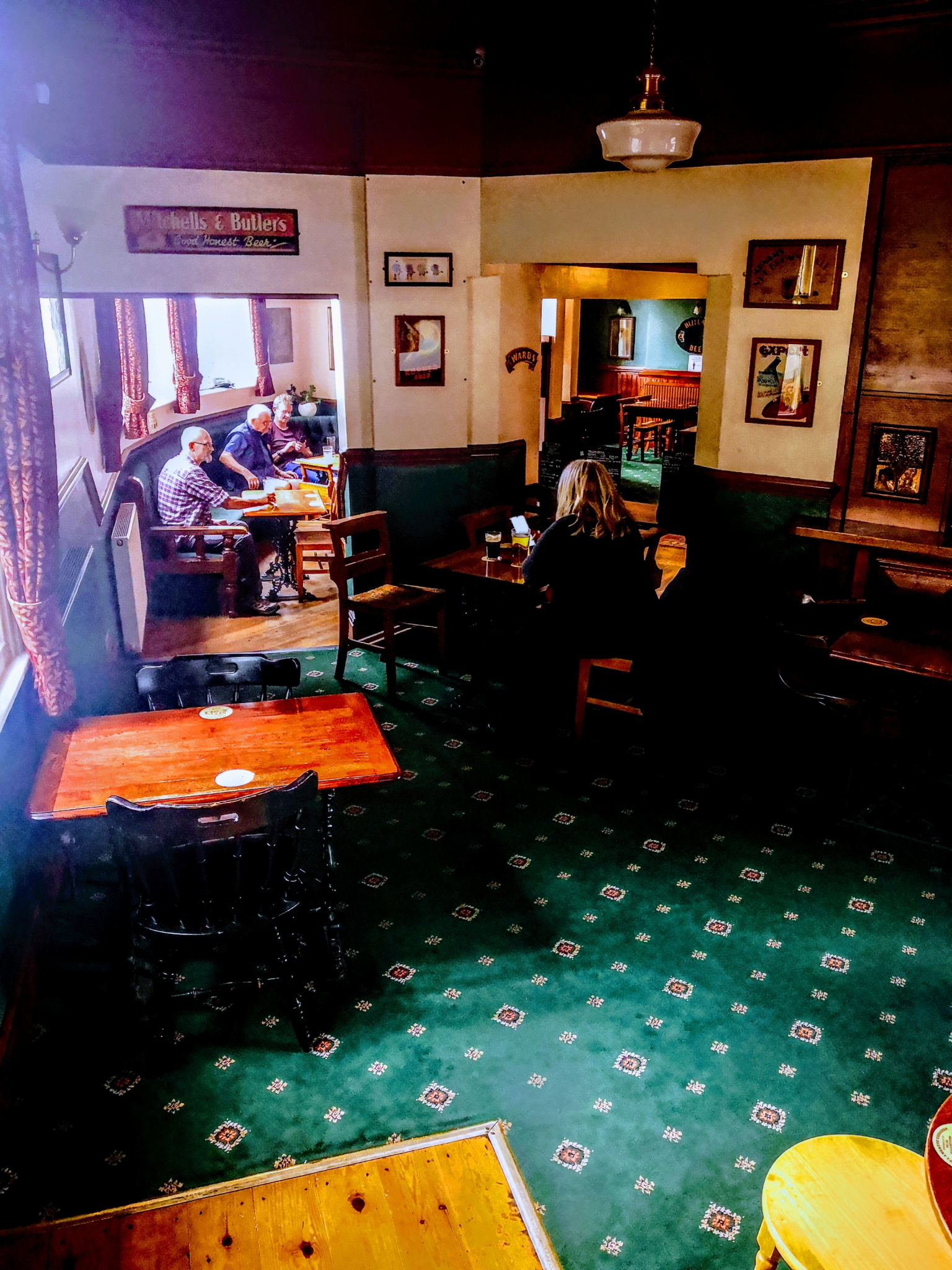
Your Thursday Beery News Notes For A… For A… I Dunno…

You can get in a rut about things can’t you. These headers for example. It’s just a thing. But a thing almost in a rut. Is craft beer in a rut? I dunno. It didn’t do anything new and stupid this week, did it? It is, however, like a thing that could find itself in a rut, isn’t it.  Makes people say odd things… like: “…not me, not my part of the thing… my thing is really a separate thing…” When things are actually fairly bad, people still take time to say that sort of thing. Because this thing is not like that thing. Not my thing. Can’t be. Never.

First up, the views shared by Alistair at Fuggles on home brewing around little kids ring true for me as I packed in my questionable home brewing hobby completely once we were well and truly surrounded by rut rats :

This weekend was the twins 4th birthday and with time speeding by at a fair old clip, it feels difficult to justify taking 8 hours, give or take, to brew an all grain batch of homebrew. While there is no shortage of decent beer to be had in the central Virginia region, either locally produced or from further afield, there are still times when I just want to drink something I have brewed myself. Enter pre-prepared malt extract.

Speaking perhaps of my home brewing, I found this piece on on imposter syndrome as suffered by women in the drinks trade interesting but I was particularly interested as I have known many men who admit to suffering from the experience as well, especially in law:

Imposter syndrome, according to the American Psychological Association, is a psychological phenomenon wherein you doubt your own skills, abilities, and inherent worth, no matter how much you achieve or accomplish. For many, it’s an inner voice that whispers, “you’re not good enough, you don’t know anything, and one day, everyone is going to find out… storytelling has the power to combat imposter syndrome; however, it will take a proactive effort to tell stories that go beyond the bylines, brewers, and old-boy’s networks that have dominated both breweries and beer journalism.”

Come to think of it, a lot of what sucks about craft beer sucks about law. Stress. Alcohol. Irrational expectations. But not the 50 kg sacks of grain. Even in my early 40s when folks wanted me in on a brewery I knew there was no way I could hack hauling around 50 kg sacks of grain. I wasn’t ever going to go there once I grew used to the seeming reassurance of the hard tight black shoes.

Next up? Just last week I wrote:

Thing never said in beer: “…and certainly thanks to all those who nominated the winners…” Oh… 

And this very week I am pleased to read:

Oh wow, this is huge. A massive thank you to whoever nominated me and a huge congratulations to all the other incredibly talented people on this list!

Which is great. More of this, please. And congratulations Charlotte Cook aka @ilikeotters along this the others who were nominated by even further others who, as nominees in the Best Brewer of Britain category, likely can in fact haul around 50 kg sacks of malt, nae doddle.

How to quit in style. Fabulous.

Careful readers out there will recall that I have a particular thing for the role of alcohol in early victualing of ships‘ holds. This week VinePair shared what dear old Ferdie Magellan was packing:

Documents from Magellan’s expedition cite a hefty 203 butts (barrels) and 417 wineskins — from the Jerez wineries in southwest Spain’s Andalusia region — made it onboard. Today, this amounts to nearly 243,000 liters of booze. Magellan and his crew must have really needed the extra liquid luck on the expedition, seeing as the cost of wine and other provisions amounted to 1,585,551 maravedis. Taking inflation and conversions into account, Magellan brought about $475,665 worth of booze on board. Researcher and crew member Navarrete noted in Document No. XVII that this number accounted for 20 percent of all costs on board.

Speaking of the ancient of days, Garrett Oliver himself guided me to this story in The Harvard Gazette about the scale of brewing in ancient Egypt:

Thanks to his recent excavation of a brewery in the ancient Egyptian city of Abydos, the senior research scholar at New York University’s Institute of Fine Arts may get his wish, and soon. But the excavation revealed far more than a way to reconstruct an ancient recipe for suds. The industrial-scale production — on par with today’s best microbreweries — offers direct evidence of the kind of power wielded by Egyptian kings.

I would have thought sustaining an empire for thousands of years might have been evidence enough of the power of Egypt but… you know… I am not a guy who went to Haaaa-vaaaard. Where they call beer suds!*

Evan Rail on hard seltzers: “I thought most of them were gross. A few were harmless but boring. Several were close to nauseating.” Exactly.

Gary Gillman (aka Gee-Gee… OK, not) went off on an interesting wander around what is/was and what is/was not the North American hop known as Neomexicanus care of a part called part one (including below) and part (…wait for it…) two:

…the sources mentioned seem to reserve “neomexicanus” for the Rocky Mountain, American-origin hop while “Manitoba” or “Canadian” describes another hop from North America. While classification as such for regional examples of North American wild hops is beyond my scope here, it might be noted that location – terroir, if you will – plays an important role for all hop attributes, even relatively locally as Stephens explains in her article.

I just don’t believe in #RauchBeerMonth.

Throughout the Commonwealth we hear comments about the news that Vanity Fair has reported: HRH The Sovereign Herself has got to cut back:

According to two sources close to the monarch, doctors have advised the Queen to forgo alcohol except for special occasions to ensure she is as healthy as possible for her busy autumn schedule and ahead of her Platinum Jubilee celebrations next June. “The Queen has been told to give up her evening drink which is usually a martini,” says a family friend. “It’s not really a big deal for her, she is not a big drinker but it seems a trifle unfair that at this stage in her life she’s having to give up one of very few pleasures.”

I dunno. Ninety-five? That’s when I start smoking menthol ciggies regularly. I’ve beaten the odds by then. No filters either. Something else is killing me by then.

Daniel Craig‘s choice of bars makes perfect sense:

“I’ve been going to gay bars for as long as I can remember,” the 53-year-old actor told Bruce Bozzi on the “Lunch with Bruce” podcast. “One of the reasons (is) because I don’t get into fights in gay bars that often. … The aggressive dick swinging in hetero bars, I just got very sick of it as a kid because it’s like I don’t want to end up being in a punch-up. And I did. That would happen quite a lot.”

Nice. Still, can’t go a week without reminding you all of how craft has failed once again, with some pointing out how BrewDog seeking to redefine arsehole ridden work environment with the phrase “high-performance culture” which guides one’s mind to the article on imposter syndrome up there… and perhaps thoughts on who exactly is the imposter in these cases?  The burdened worker or the poser jet set whiner?

I can’t even imagine how horrible having a fruit lambic with eggs benedict might be.**

In the category of “discussions of places I will never go” I came across this fantastic example of a buried lede in this quotey piece on a Cornish rarity, Spingo,  in Pellicle by Lily Waite:

“Spingo is the definition of a cult beer. It stands outside the ‘scene’ and, like [local annual festival] Flora Day, is about Helston doing its own thing,” says Jessica. “They bring out a new beer every twenty years or so and that’s it. The locals seem happy with Middle and, from our observations, seem to regard Flora Daze as a dangerous innovation. You haven’t really experienced Spingo until you’ve had a pint at 8am on Flora Day, dispensed from a hosepipe into a plastic glass. Magic.”

Speaking of Jessica, she and Ray visited Kirkstall Brewery in Leeds and provided a first hand report. The story illustrates how superior the web based beer writing can be if only that it is current.  Like radio reporting on a sports event, it’s fresh and immediate even if a snapshot of a weekend trip I wasn’t on and can’t realistically replicate. By contrast, the piece on Stingo above refers to a visit in June. Why the backlog? Why wait for Waite? Worse, of course, is when you have to read through something that comes out of a physical printing press.  Stale and via mail. Viva hands on laptops! Vivi!!

Viva indeed. For more check out the updates from that same Boak and Bailey mostly every Saturday and from Stan now on a regular basis again every Monday, plus more with the weekly Beer Ladies Podcast, and at the weekly OCBG Podcast on Tuesday and sometimes on a Friday posts at The Fizz as well. There is a monthly sort of round up at The Glass. There is more from the DaftAboutCraft podcast, too. And the Beervana podcast. And sign up for Katie’s weekly newsletterThe Gulp, too. And check out the Atlantic Canada Beer Blog‘s weekly roundup. Plus follow the venerable Full Pint podcast. And Fermentation Radio with Emma Inch. The AfroBeerChick podcast as well! And also look at Brewsround and Cabin Fever. And Ben has his own podcast, Beer and Badword – when he isn’t in hiatus as at the mo, more like timeout for rudeness! And remember BeerEdge, too, and The Moon Under Water.
*I love knowing that someone’s ass is burning by someone else calling beer “suds” because it totally disrespects their mild addiction cloaked as a hobby.
**Not to mention which fruit was lambicized before the eggs benedict was held hostage.

The Middle Of September 2021 Edition of Your Beery News Notes

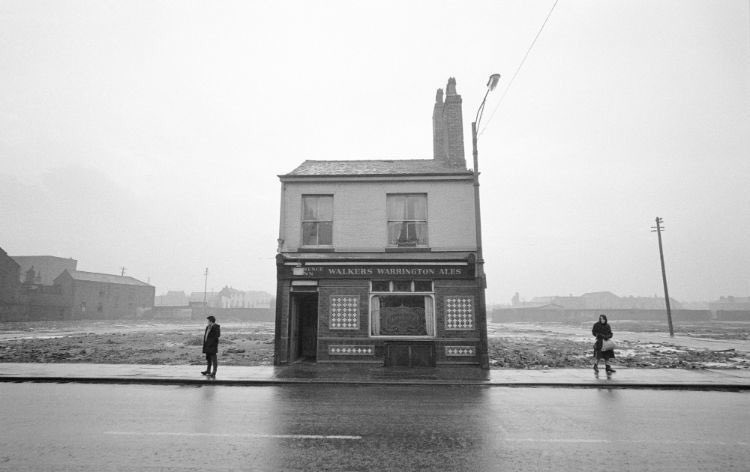
Where to begin? It’s been a good week in my hometown. CHeery even. The summer is lingering and the backyard crop of tomatoes and grapes has been coming in. Eighteen months in, it is one of the most normal weeks so far even if we see elsewhere things are returning to other more difficult norms. I was reminded of even a third norm by the wonderful image above of the lonely pub by John Bulmer from 1964 that passed by on social media this week. Lovely and evocative. It reminded me of me. Or at least mine. That empty space? Space like that was where my people lived. Or did before they move up and/or away. This norm of today shall also pass.

Update! Lisa Grimm on new bad stouts in Ireland:

…with Heineken recently releasing Island’s Edge, and Guinness rolling out their new Guinness 0.0. Island’s Edge has been expressly positioned as a stout for people who don’t typically drink stout, and to that end, it includes tea and basil in the recipe to make it, to paraphrase, less bitter and more refreshing, though none of the flavours of tea or basil are noticeable in the resulting beer. So, having had a pint of it recently, I can confirm that it does, indeed, lack those flavours…along with most other elements of flavour.

Next, I had to grab a screen shot of this image to the left from Stan‘s weekly round up. You can open it in a new tab for the full size. It’s super tiny because it’s a huge image from the Craft Brewers Conference on an indoctrination education session on lager brewing. These images always make me scratch my head year after year. It was all about hazy beer education a few years ago and massive barrel ales a few years before that. Beyond clubby. Chasing the tail in lock step with every other brewery in attendance. That once again is the business plan for these fiercely independent and sometimes off center breweries. That’s weird.

The same idea is bouncing about in Kate Bernot‘s excellent, subtle and perhaps surreptitious piece on Oregon’s Full Sail Brewing’s perhaps last chance effort to regain some reputation in the craft beer marketplace. The plan? A fantasy of chasing and copying Boston Beer’s now decade or more and well established run as far away from actual beer as possible. There are three references spread across the article to that strategy. It’s like a plan to marry rich. Plus look at this:

… Full Sail’s beers weren’t being placed on shelves in desirable places, primarily because low prices on the Session line of beers led them to be shelved next to light beers, while the drinker Full Sail wants to attract might only be shopping in the craft section… To correct this, Full Sail raised prices on June 1 on most of its beers by a couple dollars per pack to bring them more in line with other regional and national craft breweries. Though it goes against the laws of supply and demand, the switch led to an +11.5% boost in sales on Session beer in Oregon and Washington markets three months after the price change… Tiernan says part of the boost for Session is shelf placement next to other craft breweries, and part of it is a more strategic approach to the idea of “value.”

Entirely anti-beer consumer initiatives like that might be described as the “premiumization of old craft”… or perhaps lipstick on a pig. Time will tell if the bait and switch has a lasting effect with the beer buying public. It’s probably far too late. As Jeff on the ground both tweeted and was quoted: “I suppose a few folks are still kicking around who feel warmly about [Full Sail], but not many…” Dead cat bounce?*

Ian McKellen helps out on quiz nights at his pub.

There was an interesting hour of radio provided by the CBC’s new season of Tapestry and its interview of Edward Slingerland, academic and author of Drunk: How We Sipped, Danced, and Stumbled Our Way to Civilization. He also confirms or at least bolsters my suspicions or at least speculations that alcohol pre-dates community discussed here four years ago.

…in the standard account, alcohol’s this kind of byproduct of agriculture, and it happened after agriculture. But once I started doing the research for the book, if you dig into the archaeological record, what it looks like is hunter-gatherers were making alcohol in a serious way, way before agriculture. Probably this goes back 20,000 years or so, but we certainly have direct evidence 13,000 years ago that people were making beer in what’s now Israel. And then we have sites like the site in Turkey called Göbekli Tepe, where hunter-gatherers — this site’s probably 12,000 years old — were coming together, building these massive ritual complexes.

He does unfortunately use the word “myth” to describe the idea how alcohol makes people aggressive suggesting those people were already aggressive before describing how alcohol just dampens control. That, to me, is describing removing the guard against bad behaviour that would otherwise be left in place. Odd argument. Also uses “neo-prohibition” while advocating for measured control. As in temperance. Which is pretty close to what people mean by “neo-prohibition”…But a good listen nonetheless.

Question: is Matt suggesting that Boursin spreadable cheeses are his perfect hangover cure?

Ron shared a few thoughts on him being compulsive which he believes is the basis for his success as a beer historian:

I realise my head isn’t like everyone else’s. Compulsive behaviour. It’s part of me. When I looked out of my office window and saw someone touching every sign along the road, I didn’t think “What a weirdo”. No. That’s just like me, I thought. A bit more public and odder looking, but basically just like me. Being compulsive has its advantages as a researcher. It means I go through material fully. Really fully. Whenever I see beer analyses or price lists, I have to record them. It’s a pain in the arse, quite a lot of work, but I can’t help myself. Thirty years of such compulsive behaviour has left me with some amazing datasets.

Mostly unrelated, making beer can sometimes remind me of the consequences of drinking beer.

Finally, this quotation from the CBC and Dr. J Nikol Jackson-Beckham gave me pause:

“If you weed out a bad actor but do not change the culture, when the next bad actor comes along, they will thrive in the same environment.” Dr. J, “The unthinkable has happened, finding your way after harassment, discrimination, or abuse has changed everything.”

I paused for the message itself as well as the long haul Dr J. is on. I wrote about her thoughts in 2017 in a post titled “Peter Pan As Craft Beer’s Archetype” and it may well be that not much has changed. Fight!

That’s it. As you start at the bottom of the glass or at the floor before you, for more check out the updates from Boak and Bailey mostly every Saturday and from Stan now apparently a regular again every Monday, plus more with the weekly Beer Ladies Podcast, at the weekly OCBG Podcast on Tuesday (the talk was of awards this week) and sometimes on a Friday posts at The Fizz as well. There is a monthly sort of round up at The Glass. There is more from the DaftAboutCraft podcast, too. And the Beervana podcast. And sign up for Katie’s weekly newsletterThe Gulp, too. And check out the Atlantic Canada Beer Blog‘s weekly roundup. Plus follow the venerable Full Pint podcast. And Fermentation Radio with Emma Inch. The AfroBeerChick podcast as well! And also look at Brewsround and Cabin Fever. And Ben has his own podcast, Beer and Badword – when he isn’t in hiatus as at the mo, more like timeout for rudeness! And remember BeerEdge, too, and The Moon Under Water.
*Investment concept referring to a late final brief upturn of a plummeting stock. Refers to the fact that even a dead cat will bounce on the sidewalk if dropped from great enough a height. Not sure this is actually true but the image is effective.

Your Thursday Beery News Notes For Mid-July

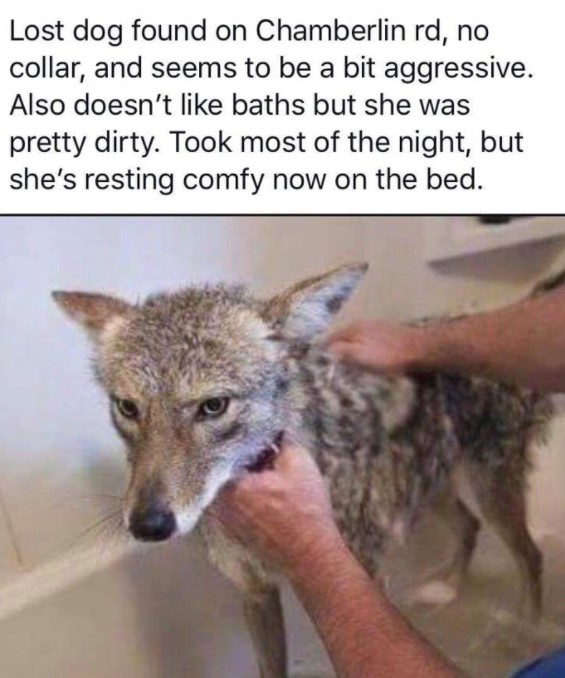
Beer season. This right here. This week. This is the week in all the beer ads. Mid-July. No “Back to School” sale ads on the TV yet and no freak snow storm hits Manitoba” news items of the Weather Network. Right here. Right now. The moment of beer. Perfect. I spent a similar perfect summer night, the night before last, stuck at the site of that weird weekend seven years ago with Ron Pattinson and hairy Jordan, when I stayed at an airport hotel full of wedding parties to save a buck. Well, I had to see my middle kid off on a plane so it only made sense to stay at the same place, right? No. Odd seeing the formerly jammed hotel essentially devoid of people. And devoid of services like food. I also had a work meeting from 5:30 to 10:45 in the evening by Zoom which was also odd to do in a hotel room. I don’t know how any of that relates to my new favourite web thing, pictures of dogs people have rescued that are really coyotes but there you go.

OK. Enough! Let’s get right to the good beer reading. There was a most thoughtful article on saison published by Joe Stange in Beer and Brewing. It provides great insight as to the methodology he recommends for formulating a beer.  Like this passage about grain options:

Chucking in different grains is fully in the spirit of saison. Keep it intentional: Know what malted or unmalted grains are going to do to your flavor and body, and choose them based on the profile you want. Wheat and spelt can bring softness and nutty, lemony notes, for example. Rye tends to bring peppery notes along with a certain smoothness. Or keep it clean and bright—Saison Dupont, after all, is brewed with 100 percent pilsner malt. 

Know. Great word choice. Best line: “I’ve never had a saison that was more drinkable because of spices, but I’ve had many that would’ve been more drinkable without them.”

Top tier side interest from Katie MatherSpeedway!

I was delighted to find Shove it, Chuck it, Toss it… a blog about English pub games, a topic near to my heart and largely distant from my experience. Consider this detailed description of The Princess Royal in Taunton, Somerset including facts facts facts like this:

With social distancing rules in place for another couple of weeks at least, pubs of all sizes are having to be very careful and creative around the potential for crowding, particularly during large sporting events like the EUROs. Some of the more traditional West Country pubs are better equipped than most to deal with these issues thanks to their (currently mothballed) Skittle Alleys. The Princess Royal is one such pub, with a substantial Twin Skittle Alley/Function Room that’s currently being put to good use as an overspill to the main bar when things get a bit too busy.

Staying in Britain* I spotted this excellent observation on the state of cask ale from El Mudgeo:

You might well think that, if cask beer is struggling, there is already an organisation ideally placed to champion and promote it, and indeed incorporates it in its name. However, over the years, CAMRA’s objectives have multiplied and become more diffuse, and cask beer itself doesn’t seem to feature very high on its list of priorities. No doubt many members will say that Marston’s beers wouldn’t be much loss anyway, while happily sipping on a keg mango sour in the craft bar. It is a touch hypocritical to claim that you are campaigning for real ale while at the same time dismissing most of it as not really worth drinking.

Excellent continuation of the story of a walk from Max:

The place I wanted to go to was about 7 km away, but the walk promised to be mostly under the sun and I just couldn’t be arsed. Fortunately, there’ s a train leaving regularly from the town’s main station that would take me (almost) there in a few minutes – it was a no-brainer. But what to do with the time I would save? Pivoing, of course; I remembered Minipivovar Labuť still had a few beers I wanted to try.

Excellent continuation of the story of Charleston:

Mr. Sammy Backman has been a family friend since I was three years old. A significant part of my upbringing took place on James Island at Backman’s Seafood, a family-owned dock and seafood market that’s been around since the late 1950s. In my life, I’ve never referred to him as anything other than “Mr. Sammy.” “Back then, Black folks didn’t own any boats. It was hard for us to get loans,” Mr. Sammy says. “My mother once paid off a $100,000 loan, only to have the bank ask for collateral when she later asked for a $10,000 loan.”

Excellent story elaboration via Twitter from Dr. Christina Wade:

We also have an Old Babylonian text from Ur, which is basically one giant insult, which among phrases like ‘’You are the one who disappears from work” and ‘you raise an afflicted hand in order to eat food’.

The Tand wrote of “the Beer Police” which is nice if only because it reminds us that folk are getting back to normal and fretting over nothings:

It is funny how tables have turned, but didn’t CAMRA with its erstwhile disapproval of keg beer, used to get the same Beer Police allegations thrown at them? For the record CAMRA is all about choice with an emphasis on cask ale. In line with that, my drinking last Thursday, with its overwhelming predominance of cask, fully complied with this. “Take that Beer Police.” The Beer Police have also been having a pop at us Bass drinkers. Liking Bass is harmless, doesn’t mean approval of Molson Coors and there are bigger beery fish to fry, so lay off.

Speaking of Ron, he discovered that Canada was in fact part of the British Empire in both the spirit and letter of the law this week:

Have you spotted my current theme yet? Obviously, it’s Canada. Only joking. IPA…  Away from the topic of this post: Canadian IPA in the late 19th century. I’d forgotten that I had these. It was only when I started going through my analyses of IPAs that I spotted them. That’s the problem with having so much information. You can’t remember all of it. What strikes me is the similarity to domestic UK IPA. (Only because I was looking at those yesterday could I remember.). The Canadian versions average out a little stronger, by 3º in gravity and 0.34% ABV. While the rate of attenuation was a little lower, but still very high.  Still, a striking similarity between the two sets, despite being brewed 50 years apart.

And finally, more “BrewDog sucks” news at VinePair which is really getting so common is it even really news anymore?

Posts on the shareholders-only, company-run BrewDog EFP forum, reviewed by VinePair, suggest that the brewer has at times struggled to deliver on the perks it has promised its punks. A November 2020 thread has become a 2,000-posts-and-counting clearinghouse for equity punks’ grievances, ranging from long-delayed deliveries and reduced “lifetime” discounts, to poor communication from the company in which they’ve invested. “By the way still no EFP beer after waiting nearly 2 years,” posted a frustrated punk. “For a beer company that makes beer, wastes beer, pours away beer, makes more beer … is it really too much to send said beer to it’s [sic] shareholders as promised?”

Yes, it is too much. Because that was not the point of giving them money.

Contrary-wise to all the foregoing, have you noticed the over use and misuse of “nuance” in beer chit-chattery? It seems to be getting worse.  Tends to ultimately mean “my point is not being well made” as far as I can tell. In this moment, the second and third level writers** (none of which are mentioned above) seem to be jockeying*** a bit like the first level ones did not long after Michael Jackson died. That was more subtle. Folk suddenly added “top beer writer” to their web bios. Within days. “Top not dead beer writer” was more like it. Anyway – and as with “leading” – I think “nuance” is a marker of some sort. But what? Jockeying for the small cheques docile compliance offers? And how does it relate to finding yourself washing a coyote in your bathtub?**** I only mention it as I have to wade through the stuff each week.

That’s all for this week. For more, don’t forget to check out those weekly updates from Boak and Bailey mostly every Saturday, plus more with the weekly Beer Ladies Podcast, at the weekly OCBG Podcast on Tuesday and sometimes on a Friday posts at The Fizz as well. There is a monthly sort of round up at The Glass. There is more from the DaftAboutCraft podcast, too. And the Beervana podcast. And sign up for Katie’s weekly newsletterThe Gulp, too. And check out the Atlantic Canada Beer Blog‘s weekly roundup. Plus follow the venerable Full Pint podcast. And Fermentation Radio with Emma Inch. There’s the AfroBeerChick podcast as well! And also look at Brewsround and Cabin Fever. And Ben has his own podcast, Beer and Badword – when he isn’t in hiatus as at the mo, more like timeout for rudeness! And remember BeerEdge, too, and The Moon Under Water.

*Unlike that trophy…
**The finest of the regularly wrong, much more so than that boogieman “the media“!
***It’s all a bit of a status v. merit struggle, like the 1790s tensions between the Washingtonians and the Jeffersonians. Whiggery depended on the mutual acceptance of status regardless of merit whereas libertarian might is right principle was all about the cacophony of the aggregate ends justifying the means. Whigs give us the small intense circle of praise seal mitten cartoons from Ackbar planet and the textual equivalent. Whigs praise each other as important. That makes them important, too. See? But who can really be trusted? None. Who is an expert? Nobody. In a small pond with too many fish for the available oxygen, things get rough. These aren’t those early days by that small lake at William’s Coopers Town.
****Other than, you know, the seeming requirement to be fundamentally wrong about obvious things.

Your Thursday Beery News Notes For The First Of Summer

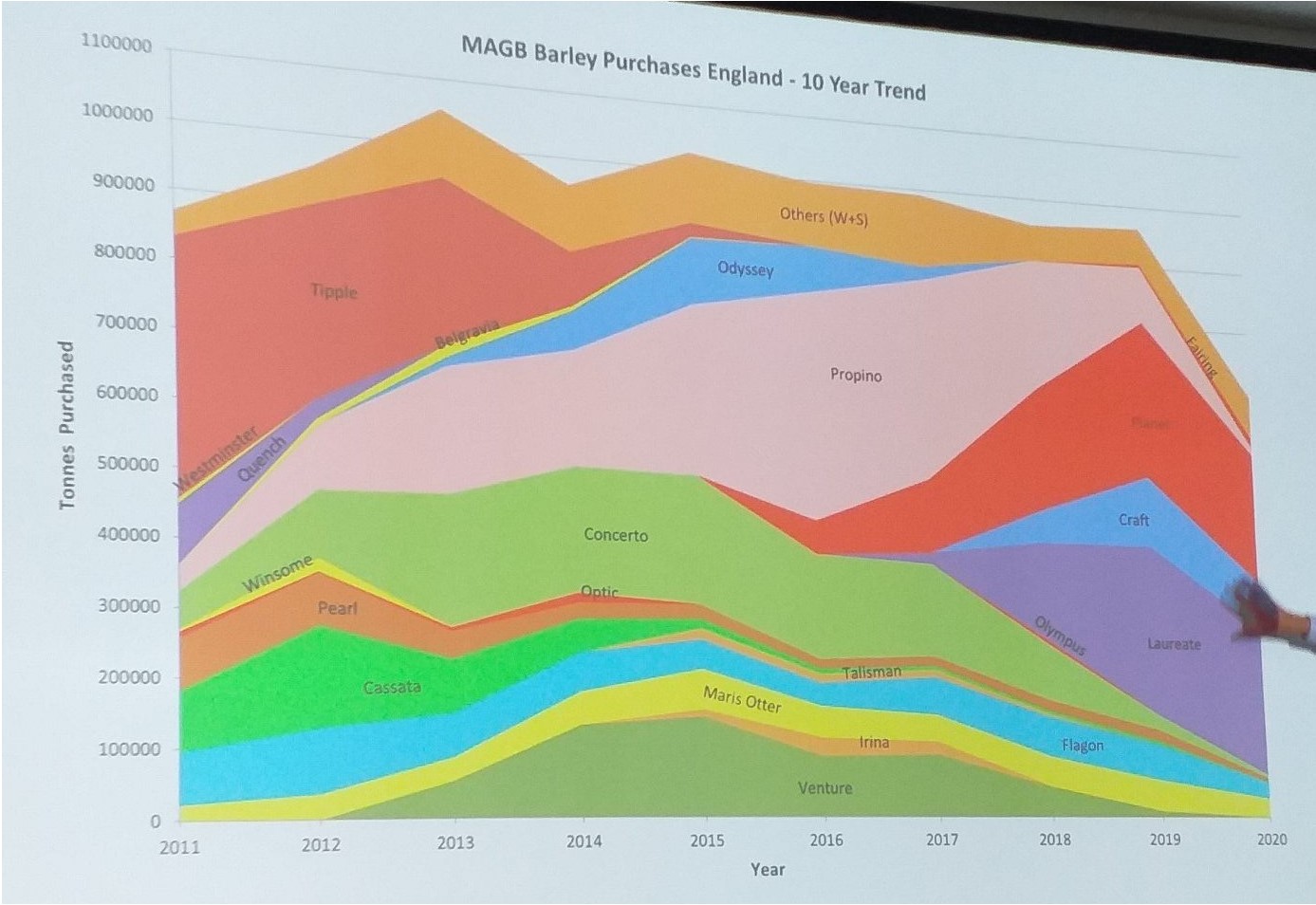
Above, is an image from a conference posted by Ed Wray, which he dubbed “Ten Years of Barley Varieties.” It is lovely. And not unlike the chicken wings crisis chart, that. It is quite the thing to see how rapidly varieties come and go. When I worked in Holland in 1986 in the big cut flower auctions, I had a favorite rose –  Mercedes – which had a particular balance between its soft scarlet bloom and the pea green of the stem. But like all things, it fell out of fashion or the hybridization isn’t that stable and when back in Canada it only lasted a few years before it was no longer available in the market. Nice to see the constancy of Maris Otter. Something like myself.

Update: apparently, the G7 event at Cornwall England reported upon last week due to Trudeau’s pint has become a super spreader event that “…is closing down pubs, bars and hotels at a frightening rate.” I have moved forward my second jab to the end of tomorrow afternoon. There is some disagreement as to the cause, however.

Also from the UK, perhaps a different sort of political statement from Stephen McGowan on the issue of sticking with the process for evaluating the effect of minimum pricing in Scotland:

I would remind all stakeholders that the Scottish Parliament is under a legal obligation to consider the impact of MUP on licence holders and producers; as well as the impact on the licensing objectives, as well as the impacts on individuals and groups in society. “Success” is therefore a nuanced, complex pattern. Parliamentarians, like the rest of us, will always welcome news of falling health harms – but I urge us all to remain circumspect about whether MUP is a “success” for if we allow ourselves to view success through the sole prism of consumption levels, that is to ignore what the 2012 Act actually requires.

Like self declaration of importance, “nuance” is one of those proclamation that usually hides a combination of motive and the incapacity to actual state an idea. In this case, it’s really not nuanced at all. Just a call for balance. But we need to remember what is being balanced is the health of one person as opposed to the income of another. Such is the reality of a regulated trade in compromising pleasure products.

Note: “…allegations of widespread misconduct in America’s craft beer industry…” is how it is described in the journalistic part of the world. Misconduct is a great word for is as, like bigotry, it is an umbrella word avoiding the need to distinguish between the different forms of grasping that we are learning more and more about. Craft beer seems particularly fertile ground for this sort of bad behaviour, being not quite consequence free as its hymnals promise. BrewDog seems to be the gift that keeps giving in relation to now a number of aspects of this stuff. The Press and Journal of Aberdeen, Scotland shared information about the brewery’s (literally) dodgy habits when it comes to business partners:

Alex Cobham, chief executive of the Tax Justice Network, the advocacy group that campaigns for a fairer tax system, said: “This is a disappointing, but sadly common story – companies whose approach to tax havens is entirely at odds with their projected image. “Having major investors using Cayman as a conduit is certainly antisocial, but it’s about as punk as croquet… Asked how the company could reconcile its ethos with the fact such a large proportion of its stock was held by the Cayman entities, a Brewdog spokeswoman said she “can only comment about BrewDog’s own tax obligations and activity”.

But see, unlike those who look at this things as “snafus“, the relationship between investors having spare change from not paying proper taxes and investment recipients then receiving cash from the same the resulting pool of investment funds is entirely direct and, frankly, obvious. BrewDog receives a benefit because the UK Treasury does not. And the UK taxpayer is asked to make up the difference. Now, their brand’s health is dropping in the standings and, as Brewbound reports, BrewDog’s good housekeeping seal of advanced ethical status is now at risk. Are they a ponzi? Punk as croquet. Gold.

We have to recall that there was a before times, that the “craft” brand is recent and has never been better than wobbly if not simply needy. Ed the actual brewer shared his thoughts:

As to actual craft beers many of them sound more like alcopops now anyway, and certainly some craft brewers have embraced exogenous enzymes, bollocks ingredients including actual bollocks, and genetically modified yeasts (something multi-national brewers have never dared use). I’m not going to make any moral judgement but I can’t see where the craft is.  The standard bearers of craft beer in Britain have always been Brewdog and it’s been obvious for years that they’re tossers. Recently their ten year plan was revealed and they’re going to focus on producing lager because they want to be bigger than Heineken. Can anyone tell me how becoming a giant lager selling multi-national is craft?

We have to remember that “craft” arose to prominence only around 2003 after (1) the stalling of the markets in the late 1990s, (2) the formation of the BA and (3) the “Sex for Sam” scandal. Micro needed rebranding. Then it starts to die a slow death starting in 2015-16 with the sell off which continues today with the trade abuse scandals.

Entirely conversely, Max continued his purifying walk to Litoměřice – and his story gets even better with this bit below proceeding an ending of this middle of the tale drawn surely from the early pages of Wind in the Willows:

The walk was as brutal as I expected given my shape, and there were several moments when I questioned the wisdom of the endeavour, but the sights and the utter peace that surrounded me more than made up for it. When I reached the highest point, I found a resting site and I spent a good while just admiring the view of the České Středohoří and feeling very well about myself. From then on, the way will be mostly downhill and I had already cover about two thirds of the distance.  The trail took me to the village of Hlinná, a few kilometres outside Litoměřice. It was not in my plans, but I saw a pub and couldn’t resist it. There was nothing in this world that I wanted more than a beer at that moment…

Somewhat similarly, Martin celebrates a stroll but one through less green, more hardened lands to reach the wonders of the Elton Liberal Club:

A succession of Old Boys come in and report difficulties renewing their membership, skilfully resolved by the young barman. Old learning from young, and vice versa. “There’s a wake later” the barman tells us. For the Liberals, I assume*. But not for the Elton Social Club, which seems in splendid health as I leave to the “Push the Button” by the Sugababes.

The BBC has one of those stories about beer bottled yeast in the holds of shipwrecks:

Scientists at Brewlab, a spin-out from the University of Sunderland, have studied yeast strains and brewing techniques for years. The firm’s founder, Keith Thomas, says that once beer from the Wallachia was in his lab, it was treated with the utmost caution. “We opened it in containment level two laboratory conditions,” he says. This involved unsealing the bottles in a special cabinet filled with sterile air, in order to protect the scientists from any possible pathogens in the beer. This measure also ensured that the samples did not become contaminated with any modern-day yeast strains.

I’d be sending the submarines to the Black Sea, myself. Home of ancient wrecks in deep cold oxygen-less waters. Imagine finding sealed beers from Hanseatic League in the Baltic. That would be neato.

Hints of things ending. A great brewery’s trappings being auctioned off. Maureen‘s recollection of her rejection of an otherwise beloved beer bar in Colorado. And Boak and Bailey’s call in their newsletter to save The Rhubarb:

This time, though, it feels different. The Rhubarb is the last pub in the neighbourhood. When it’s gone, it will be gone, and a great swathe of Bristol will be totally publess. They say you need to pick your battles. It feels as if this might be ours although we’re worried we don’t have the time to commit to a long campaign. The difficulty is at the moment there doesn’t seem to be an organised campaign to save it.

I am too Scots Presbyterian to accept the oneness of intoxicating substances even while I entirely acknowledge them. In Ohio, there is the 350ness of it all apparently. Still, not sure if this is correct as we have gone over the “unmalted grain becomes beer” scenario* a number of times over the years:

“Primitive beer is [as simple as] ripping grains out of the ground, taking them in your hand, and throwing that grain into water,” Muraresku says, wisdom imparted to him by a prominent beer scientist. “The microbiome on the hand could have been responsible for those early yeasts. Aside from not having to dehusk it or heat it, you’re creating a beverage that … is safer than water. And if the right grain was sitting in the right water over time, it would have naturally started to ferment with whatever yeast and fungi were on the grains.” 

Sir Geoff Palmer, surely one of the most interesting users of Twitter, shared a very interesting set of images illustrating the intersection of racist bigotry and brewing science at an early point in his career:

Our History: Truth-battle did not start with me calling Dundas a slaver, it started in the 1960s when my research said the Aleurone produced the digestive enzymes in the grain, not the Scutellum. Maths and more recent publications say I was correct. Lucky…l nearly got the sack.

Note: if anyone suggests they are a beer expert immediately ask them to describe the difference between the aleurone and the scutellum. Email me the response.

And Barry Masterson wrote about “Perry, Pomonas and Pomology” for Cider Review:

…the earliest developments of British pomology (the study of fruit and its cultivation) were tightly bound with the making of cider and perry, an industry that developed with great intensity during the latter half of the 17th century. With the end of the English civil wars, farming life was returning to normal, perhaps with renewed energy. At the same time, conflicts on the Continent meant that foreign wines were maybe not so easily imported, so the production of local wines became an important topic that exercised the brightest minds of Britain…

Finally, amongst the greatest bar tabs of all time we give you the Boston Bruins of 18 June 2011.

That’s a good bit of reading for you. Once that’s done, don’t forget to check out those weekly updates from Boak and Bailey mostly every Saturday, plus more with the weekly Beer Ladies Podcast, at the weekly OCBG Podcast on Tuesday  and sometimes on a Friday posts at The Fizz as well. There is a monthly sort of round up at The Glass. There is more from the DaftAboutCraft podcast, too. And the Beervana podcast. And sign up for Katie’s weekly newsletterThe Gulp, too. And check out the Atlantic Canada Beer Blog‘s weekly roundup. Plus follow the venerable Full Pint podcast. And Fermentation Radio with Emma Inch. There’s the AfroBeerChick podcast as well! And also look at Brewsround and Cabin Fever. And Ben has his own podcast, Beer and Badword – when he isn’t in hiatus as at the mo, more like timeout for rudeness. And remember BeerEdge, too. Plus a newcomer located by B+B: The Moon Under Water.

*Are beer writing editors no longer a thing? 2018 seems so recent.

If That Was April Is This Thursday’s Beery News Notes?

Boy, did that fly by. April 2021. Lots of real world activity in my life even in the time of the enhanced Ontario lockdown. Vaccine jabbed, moved a kid from one city to another, annual income taxes submitted, another birthday… So things are looking up. Certainly could be worse. I could have concerns about the Truman Brewery Shopping Mall development as illustrated above. I know nothing about it. But the Evening Standard of London, England reports:

…heritage groups, residents and existing business owners have said the new plans are not in keeping with the area, the work could obscure views of the landmark’s Grade II listed chimney and there will be less need for office space post pandemic. Developers Old Truman Brewery said there has been “extensive consultation” with the council, residents, local workers and businesses and is a “high quality design with appropriate uses.”

Speak of the old and the brewing related, there was a fair bit of interesting char related to this article on an archaeological dig in Pembrokeshire, Wales:

Some 2000 years after Neolithic occupation began on the site, a stream became a focus of activity, where hot stones were used to generate steam or hot water, which resulted in the formation of a burnt mound. Water contained in the wooden trough was heated by stones placed in an adjoining hearth. While this process is well understood, the purpose of such features remains a matter of ongoing debate, with use for cooking, craft activities, brewing and saunas all suggested. Over 40 such mounds were found along the pipeline, with radiocarbon dating at one site indicating reuse over a remarkably long timespan of over 1500 years.

“Bronze-age Welsh brewery, I’d say” according to Martyn and “…the size of the troughs matches the batch sizes for farmers brewing for their own household…” says Lars. Barry: “I used to survey them… to calculate potential number of uses based on fracture rate of the stone used and the size of the mound…” Plenty of neato.

He’s the thing… as you may appreciate I have little interest in the alcopops labeled as “vodka soda” or even “craft beer” or even even “IPA” so you likely can guess how little I care about small-dose cannabis beverages. But there was this money quote in this article in Forbes this week which was fairly blunt:

“This is not a medical product. This is an alternative for White Claw,” Kovler says plainly. “No one under 35 likes beer anymore and calories and hangovers are unattractive. For us, it’s an obvious, forward-thinking idea… there is so much opportunity.”

Has anyone mentioned that cannabis comes with a hangover called crippling anxiety for many? No. Thought not. Anyway, it this were to kill off White Claw I suppose it would be something. But it won’t. Just another product in a pretty can on the shelf that really doesn’t have much to do with beer which is fine as I am well over 35 and don’t plan changing that in the near or medium future.

The Beer Nut celebrated his 16th bloggaversary this week, channeling Beckett. Less focused with a piece in Pellicle by ATJ on smoked beer or perhaps just the one sort of smoked beer called rauchbier or… well, when you reference both Game of Thrones and Lord of the Rings along with Prometheus, well, it all gets a bit… well… but it is important to note that Game of Thrones did actually make a beer:

This strong golden ale is co-fermented with pinot grigio and viognier grape juices, then bottle conditioned with Champagne yeast.

So this wasn’t that… as it were.

Stan issued another edition of Hop Queries this week and, as usual, shared some excellent insights into corners of the brewing trade few others write about – including this time stuff related to a “fuss that resulted from a few things Shaun Hill of Hill Farmstead Brewery said in New Zealand last month”:

“I’ve unfortunately had to brew with some of that Galaxy and destroyed batches of beer that tasted like pencil shavings because of it. At the point that something of highest quality is not being produced with transparency and things are being done for the sake of homogeneity, monoculture and, basically, just earning capital, things can get pretty far out of whack pretty quickly.”

Stan also shares the position of Hop Products Australia on the matter, contrasting the needs of the niche specialist brewers like Hill Farmstead and the general craft brewing trade stating a bit obliquely “consistency encourages a level of brand loyalty that forms the foundation for future growth.” I am not sure with whom I sympathize but Hill comes off as suggesting he should get first access to goods produced by others to literally cherry pick. Sounds like the folk who get to the grapes at the grocery store first, picking through the bunches leaving bruised fruit behind.

Lily Waite joined a trend I have noticed and referred to the craft beer trade as “we” describing an article on the craft beer trade… but she runs a brewery so it is all inside baseball. Good. And a great tl;dr ensued.

I found this an odd statement from the wine world:

No more Kiwi wine for me while New Zealand kowtows to China.

I presume Mr. Johnson is similarly concerned about the authoritarian tendencies of Viktor Mihály Orbán, Prime Minister of Hungary, home of Johnson’s beloved Tokaji. New Zealand has taken a path that is distinct from the battling one that Australia is taking in its trade war with China, a diplomatic row that includes malting barley:

Beijing hit Australian barley with a 73.6 per cent anti-dumping duty and a 6.9 per cent countervailing duty last May, in a move Canberra regards as politically motivated. Previously about half of Australia’s feed barley and 86 per cent of its malting barley, by value, was exported to China – but that trade has withered since Beijing’s taxes took effect.

Speaking of the politics of beverage alcohol, Chuck nailed it:

Senate Majority Leader Chuck Schumer trolled Donald Trump’s former adviser, Larry Kudlow, Sunday with a tweet mocking him for apparently failing to realize that all beer is “plant-based.” “Excited to be watching the Oscars with an ice cold plant-based beer. Thanks Joe Biden,” Schumer posted, along with a photo of himself sipping one in front of a TV.

Nice. That’s it for now. Enjoy your May Day. Wave a red flag and, while you are doing so, check out the weekly updates from Boak and Bailey mostly every Saturday, plus more with the weekly Beer Ladies Podcast, at the weekly OCBG Podcast on Tuesday (who marked their 100th episode with gratitude for all) and sometimes on a Friday posts at The Fizz as well. There is more from the DaftAboutCraft podcast, too. And the Beervana podcast. And sign up for Katie’s weekly newsletterThe Gulp, too. And check out the Atlantic Canada Beer Blog‘s weekly roundup. Plus follow the venerable Full Pint podcast. And Fermentation Radio with Emma Inch. There’s the AfroBeerChick podcast as well! And also look at Brewsround and Cabin Fever. And Ben has his own podcast, Beer and Badword – when he isn’t in hiatus as at the mo, more like timeout for rudeness. And remember BeerEdge, too. Plus a newcomer located by B+B: The Moon Under Water.

Your Thursday Beery News Notes For The February Blahs 2021

The blahs. I have never liked February all that much but in this year of the plague I’ve actually come to appreciate it. The the lengthening days compare well to what’s been out the window for the previous couple of months. So there. But there is a blah nonetheless. Not much vibrancy in the world of beer writing. That’s what I am talking about. It’s all a bit due to other themes both worthy and banal being layered over, sure, but even with that… there is blah.

Not as blah as that image up there of a pub lovingly taken and posted by ATJ. I love it because it is so horrible. It could be called The Blah Pub unless it was 1994 when it would be Pub Blah. The image of the scary lad drinking painted on the façade in the upper right is particularly horrible. Who thought that would help? Anyway, it reminds us all that ugly is not necessarily all about the ugly. Therefore… I start this week in an effort to disprove my own blahlological observations with a study of “blah /  not blah.”

Not blah? Perhaps this tweet, as it is at least taking a stance:

Beer should be like wine. Only named after the region or the hops used. Styles are just made up.

Except beer isn’t really regional and hops only define certain sorts of beer. So.. a bit blah but assertion saves it somewhat. And “style” sucks, we all know that now.

Elsewhere, Rob MacKay, Creative Director at Glasgow’s Drygate Brewing Co., created and shared what he calls Beer Care Instructions:

“…a handy set of standardised icons, which can be applied to beer in the same way that the global standards for laundry care are…”

I like this a lot and it is definitely not blah as it is both thoughtful and somewhat cheerily useless. Yet serves as an alternative construct to all the failures laying about our ankles. One that I see is missing is “tastes like beer and not a fruit salad that’s been left out in the sunlight.” Still, very not blah.

History. Not blah is the news out of Egypt that a 5,000 year old mass production brewing facility has been uncovered, as the BBC reports:

The brewery consisted of eight large areas, each 20m (65ft) long and each containing about 40 earthenware pots arranged in two rows, according to the secretary general of Egypt’s Supreme Council of Antiquities, Mostafa Waziry.

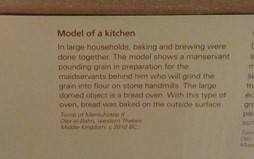
Seven years ago, I posted about a visit to the Royal Ontario Museum where I saw an original display showing brewing in Ancient Egypt. Perhaps this group of people represented one of these eight areas or even just a portion of it. Nope. Not that. A household brewery in Thebes. Never mind. Update: the site has been known for over a century. Q: if Hornsey knew that Egypt was fuelled by beer consumed throughout society, how is a 22,000 litre facility a surprise? At a max a gallon a day consumption, this facility supplies 6,000 people.

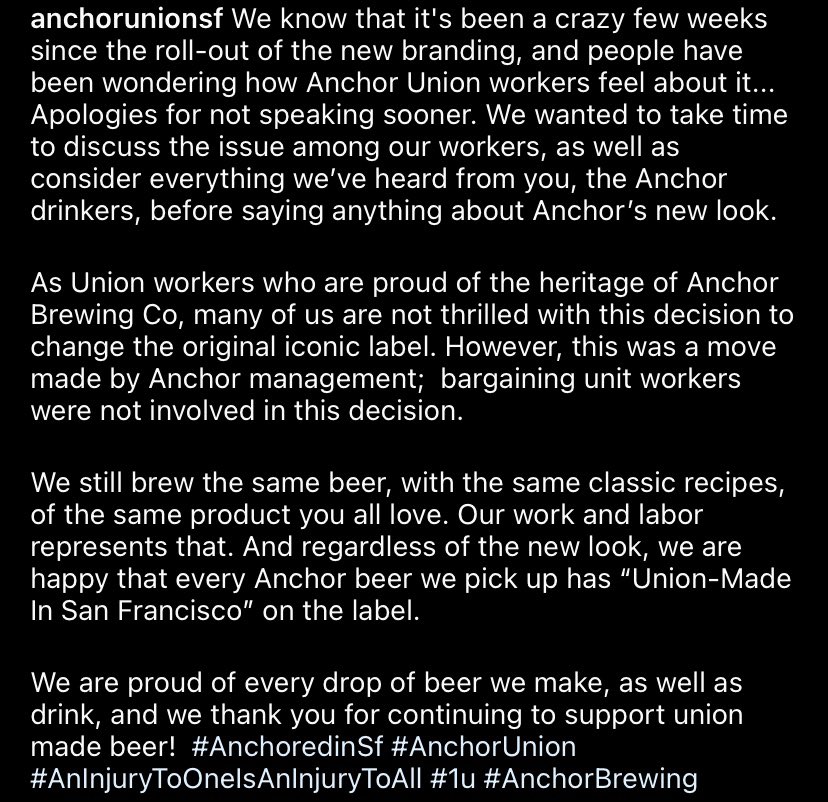
Revisiting that tiny part of my mind we discussed the other week, the bit that recalls that Anchor changed its branding, it’s interesting to see that that the brewery’s union is not happy and made it clear-ish on their Instagram account. And while “…many of us are not thrilled…” isn’t exactly a lyric from a Woody Guthrie song still makes the point. More not blah than blah. But overall, still a bit blah.

Further afield, Kenya is considering banning the quart, the preferred measure of youth and Cape Breton barroom brawls of the mid-1960s:

“We believe this is an outrageous, retrogressive proposal that has no place in our developing economy today and we are opposed to the proposals in the Bill,” Gordon Mutugi, ABAK chairman, said. The association argues the elimination of the option to sell alcohol packed in smaller packages would force those who cannot affordable quality alcoholic beverages sold in larger packaging to seek illicit and unhealthy alternatives. These include the purchase of alcohol in bulk and sharing it into smaller containers or consuming contraband alcohol from neighbouring countries.

Garth fears change. You know, that seems all a bit real. It’s been almost a year since me myself I saw actual real. Hmm… And I am not sure that I want to suggest Jeff shared a blah – but revisiting “craft” has been done by too many:

Craft brewing didn’t start becoming a real player for another decade—thirty years after its birth. And even then, it was making slow inroads into the fuller market. Only by the mid-teens had it achieved real substance, with 12% market share—though more important to an industry, it was earning more than one in five dollars of revenue.

Sure it’s just a label, a brand as much as Anchor’s only was… is… But, see, we are aware of these things but really the order is: (i) micro brewing (1980-2007ish), (ii) craft (2007-2015ish) and (iii) post-craft chaos (2015-now.) It is not analytically satisfying to backdate an era or delay its passing. Sure, I don’t really mind it as a unsubtle umbrella term, I suppose. But “craft” has been dead now coming on six years. Actual punk rock comes and goes in less time. It’s time to figure out what is going on now. What is it?

Relatedly, Toronto’s… err… Canada’s other national newspaper, the National Post also attempted to explain craft beer in the post craft chaos era including a description of the work of Lex Konnelly, a PhD candidate in the University of Toronto’s Department of Linguistics:

Beer has shifted from a working-class beverage to elite commodity, Konnelly explains in their paper recently published in the academic journal Language Communication. By speaking the language of so-called beer snobs, brutoglossia (“craft beer talk”) can perpetuate inequalities. Taste is far from arbitrary. It’s wrapped up in social status, which is in turn influenced by other categories such as gender and racial identity. Language is one of the ways people define the in-group and out-group.

Oh dear. What to make of it all? Comparing today’s clever lowest common denominator alcopops to an “elite commodity”?*  Oh dear, oh dear. Then, similarly but far less so, “Flagship February” is hanging on but has shifted into a more general thing, another blog under a bushel like all those other blogs pushed out on the unsuspecting, feigning under any other name but blog. Yet… and yet… Stan sets aside any resulting potential for blah with his profile of a place called Halfway Crooks he posted on the FF blog:

Before Halfway Crooks Beer even opened their taproom in July 2019, they sold through their first run of hats with the words “LAGER LAGER LAGER LAGER” serving as a billboard. However, it would have been a mistake for beer drinkers walking around Atlanta proudly showing off this new hat to think this would be a lager-dominant brewery.

And, for the double,** Stan also gave us his thoughts on the effect of the US West Coast fires of 2020 on the hop crop:

…this is bad news for farmers affected because it reduces the value of some of their crop. But brewers should be aware that tainted hops could make their way into the supply chain. As one grower told me, “Here’s hoping we don’t see a rush of rauchbier’s coming into the market.” Unlike many people, I like rauchbiers, but I’m not looking forward to being surprised by a juicy IPA that tastes like licking an ash tray. (“Licking an ashtray” being a phrase used to describe wines made with smoke-tainted grapes.)

Blah beer but not a blah story. Not at all. And for maximum not-blah we have a post from Rye’s own pubman in hiding, Stonch sharing his fabulous style:

I drank a can of strong-as-fuck beer a couple of weeks ago, tweeted about it, and promised to review it here. One person has since asked me why I didn’t. In the face of such overwhelming demand, I must deliver. I can’t be bothered to match the pithy and succinct style I’d developed when this semi-dormant website was in its pomp, so you’ll have to plough through some verbose bullshit.

Finally – and as if just to prove they are not merely Egyptologists- the BBC tells us the latest calamitous news of the UK pub trade according to the British Beer and Pub Association (BBPA):

The BBPA said trading restrictions and lockdowns knocked sales by 56% – worth £7.8bn – last year. In the first lockdown in the second quarter of the year, beer sales plummeted by 96%, it said. Even during the summer, which saw the Eat Out to Help Out scheme and a temporary VAT cut on food and soft drinks, pub beer sales fell 27%.

Wow. Not blah. Yikes. Except things were locked. So it might be more odd that it was not 100%.  Who was that 4%. We all now pray to Dr. Fauci and the gods of global distribution systems. Eleven months and in we know its closer to the end than the beginning. We know.

Do it! And while you are, for more good reading, check out the weekly updates from Boak and Bailey, back now mostly every Saturday, plus more at the OCBG Podcast on Tuesday (Jordan flips out over beer cocktails this week!) and sometimes on a Friday posts at The Fizz as well.  We have a new entry from the DaftAboutCraft  podcast. And sign up for Katie’s weekly newsletter, The Gulp, too. Plus the venerable Full Pint podcast. And Fermentation Radio with Emma Inch. There’s the AfroBeerChick  podcast as well! And also look at Brewsround and Cabin Fever. And Ben has his own podcast, Beer and Badword (featuring another one of his irregular 1970s-esque TV dramedy season finale. Finaleissimmo!!!) And remember BeerEdge, too.

*The elite are actually drinking pre-mixed Clamato out of cans.
**Say “pour le double!!” like you are Charles de Gaulle speaking to Quebec in the 1960s!


Christmas Eve 2020’s Merry And Very Own Beery News Notes


1775tavern1

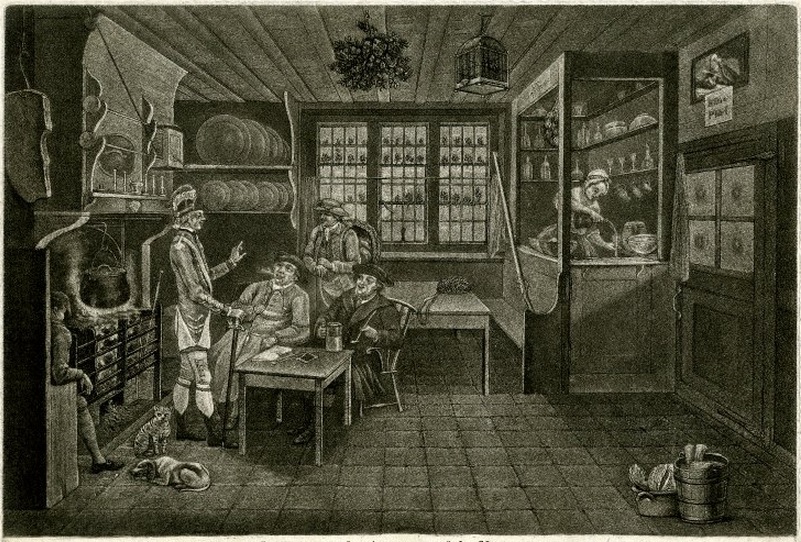
It’s gone a bit quiet, hasn’t it. Yes, yes… there’s lockdown after lockdown all around – but there’s also winter settling in and Yuletide, too. Watching the UK – French blockade news is disheartening but at least France 24 is reporting all the Scottish scallops now in Paris have been sold. So, while we can’t be like those folk above from 1775 – and while we can’t even be down the pub with Santa Sid – we can more quietly mark the season and the day as our beliefs guide us. Go make a snow angel or just watch the stars overheard if the clouds take a break. Or do whatever you want… MNSFW.  It’s too late anyway, December 23rd as I write this. Tibb’s Eve in Newfoundland. Too late to change what’s happening now. The arse is out of it. We have bought the gifts, loaded the larder, filled the buttery and started to drain the bottles. Not quite the new roaring ’20s yet still a welcome break from the lockdowns.

Lockdowns. Always the lockdowns. One report on the lockdown from the auslanders on the way out of the EU  comes from The Retired Man Named Martin who went out a shipping in Sheffield:

Well, there was no panic buying. Perhaps because Northerners are less reliant on brie than London, perhaps because Morrisons are better at stocking shelves than Waitrose, perhaps because there’s a choice of a dozen supermarkets within a mile radius.

No panic. Good. No one needs that. Similarly – but a word that beer nerds like to deny – one of the most important in brewing is also on the go. Consolidation.  As Cookie noted, it is interesting then to read news of CAMRA welcoming one particular deal:

The Campaign for Real Ale said: “While we still need to see the detail of this deal, at first glance it appears a positive move. We hope this means that Marston’s will continue to run the pubs as beloved locals, securing their future for the communities that use them and the people they employ.” Findlay pledged to continue with Brains beers and said its tenanted tied pubs would now be able to stock the ales made by the Carlsberg Marston’s Brewing Company as well.

1,300 jobs saved. Maybe. Prepare ye for the top trend of Q1-Q3 2021. Consolidations are coming just as they always have after bottom is hit. Speaking of saving the day, I had no idea that there was intra-Germanic regulation of beer branding:

The consumer protection agency from the state of North Rhine-Westphalia (NRW) has now banned a beer called Colonia, produced by a Frankfurt brewery, from being sold in NRW, where Cologne is situated. The State Agency for Nature, Environment and Consumer Protection (LANUV) said the Frankfurt beer’s name and label could lead consumers to think they were buying Kölsch… The word Colonia harks back to the Latin name of the Roman colony from which the city developed, Colonia Claudia Ara Agrippinensium… The term “Kölsch” has a protected geographical indication (PGI) within the European Union, meaning that a beer can be sold under that name only if it is brewed within 50 kilometres (30 miles) of the city of Cologne.

The Beer Nut is not panicking either in this time of second or third wave – and gave a lesson to those unappointed and slightly sad mere beer experts who know not how to cram so much opinion, information and joy into just one paragraph:

Blackest of the black; shiny with a deep tan head, it looks like it promises a good time. The aroma is fairly mild, but gives you all the cocoa you could want from a porter. The flavour is where it really excels. Well, flavour and mouthfeel: the two are inextricably linked. Big and creamy, and a little chewy is how it rolls; cakey, gooey. On that texture rides dark chocolate and liquorice for two kinds of sweetshop bitterness: a rich coffee roast and then a fruity plum pudding thing at the end. It’s sumptuous, and one of those strong dark jobs that makes you wonder why breweries even bother with barrel ageing. More biggity-big no-gimmick porters please!

Speaking of excellence, Martyn noted one “ancient brewing” story that was 67% less full of lies – and utter lies – with only passing reference to Dog Fish Head and the Hymn to Ninkasi, both well trod recourses to the shortcutter, in favour of more interesting info:

The location suggests the Natufians—a hunter-gatherer group that lived along the eastern Mediterranean from 15,000 to 11,000 years ago—used beer in honoring the dead. The beer’s age—between 13,700 and 11,700 years old—is a surprise. The beverage is roughly as old as the oldest Natufian bread, from between 14,600 and 11,600 years ago, discovered at a nearby site in Jordan.

Also thinking historically-wise, Gary posted a double this week, both on the question of English Christmas ales. One about Hallett and Abbey’s version from 160 years ago and, then, the associations between the day and the beer:

The Belgians and northern French took in general to branding beer for Christmas especially after World War II. It was a progenitor to the current widespread practice by craft brewers to label beers for the Season. Anchor Brewery’s annual Christmas Ale was influential here. Its beer is spiced, a different formula each year, reflecting that part of the Christmas beer tradition. Christmas ale was never, in other words, a fixed style or type of beer. At best it might mean something special made available at Christmas. Sussex-based Harvey’s award-winning Christmas Ale, a barley wine (old Burton type), is an outstanding current example in the UK.

Never knew that. And speaking of things I had never heard of until just now, Stan released his latest Hop Queries monthly newsletter this week full of stats and non-stats sharing mucho including this about “dip hopping”:

So what do we know? Kirin began using the process in 2012 for its Grand Kirin beers. Basically, brewers there make a slurry by steeping hops for about an hour at temperatures (150-170° F) lower than found in conventional whirlpooling, then add the slurry into cooled wort before pitching yeast. Kirin found that the resulting beers contained as much linalool as dry hopped beers but less myrcene (which may mask fruity aromas associated with linalool and other oxygenated compounds). This also reduced production of 2M3MB (an onion-like off flavor).

Onion an off flavour? Don’t tell my Yuletide roasts. All in moderation, of course. And one last note. Stay within your means. Even Jude Law, the other lesser Leonardo DiCaprio, has issues with focusing on managing the load. Govern yourselves accordingly. Ho. Ho. And… ho.

There. Soon 2020 will be gone. Like I said about 1987. That one sucked. Let’s see how the last week of 2020 plays out but Trump’s going, we may now be past peak beer writer editor fawning and the vaccine is well on the way. Can’t be all bad. And remember that for more good reading check out the weekly updates from Boak and Bailey mostly every Saturday, plus more at the OCBG Podcast on Tuesday and sometimes on a Friday posts at The Fizz as well.  And sign up for Katie’s weekly newsletterThe Gulp, too. Plus the venerable Full Pint podcast. And Fermentation Radio with Emma Inch. There’s the AfroBeerChick  podcast as well! And have a look at Brewsround and Cabin Fever. And Ben has his own podcast, Beer and Badword (who advocates for a blog renaissance this week… though it is funny that he says “paid=good”… just means obedient far too often.)  And remember BeerEdge, too. Go! Merry Christmas all you all. See you on New Year’s Eve.

Thursday’s Beery News Notes For The Clampdown

What are we going to do now? It appears the summer has ended with a thump. The clampdown. The BBC reports that social gatherings above six are banned in England from 14 September.  The nightclubs of British Columbia are now shut. Greece has shut down.  Kinda makes reading about beer a side show… kinda. Jeff, however, connected the dots and spoke for all of us when he wrote:

I’d like to raise a mug to all those workers out there who make possible the pint of beer it contains. This has been a rough year. Depending on how you count, the pandemic put somewhere between thirty and forty million people out of work. Many breweries were forced to lay off staff as volumes fell.

The BBC (again) published about the why for those being displaced in shops, restaurants and bars serving the now empty high-rise office block with particular attention paid to the underground network beneath much of downtown Toronto:

For businesses in areas like the PATH, the Covid emergency phase is not over,” says Dan Kelly, president of the Canadian Federation of Independent Business. “Yes, the government is no longer imposing closures, but effectively you may be closed because you have no customers.” While no agency has calculated the estimated cost of these closures yet, the businesses in the PATH typically generate $1.7bn in revenue annually and generate about $271m in tax revenue, according to the city of Toronto, and many have been shuttered since mid-March.

What is a bar to do when its whole model is predicated on the presence of humans? Maureen asked a similar question. I answered: “goats!

What news of beer otherwise? First, some law and an application for municipal planning approval for the replacement of everything on one (again) Toronto City block has caused great upset. Because it is the location of a dive bar called Sneaky Dee’s:

Local Toronto bar Sneaky Dee’s could be torn down after the city announced it has received a proposal for a 13-storey building in its place. The proposal, which was submitted Sept. 4, calls for a mixed-use building that would cover the current residents of 419, 421, 423, 429, and 431 on College Street. It would also consist of a total of 169 units and more than 13,000 square metres of “combined residential and non-residential gross floor area.” Some Torontonians took to Twitter to express their unhappiness about the proposal, and a petition has been started calling for it to be rejected.

In other legal unhappiness, much has been made of the implications of the firing of many staff by Surly, a craft brewery in Minneapolis, coincidental to a union drive. “Arise, Surly Workers” wrote Dave Infante who noted an obvious trend:

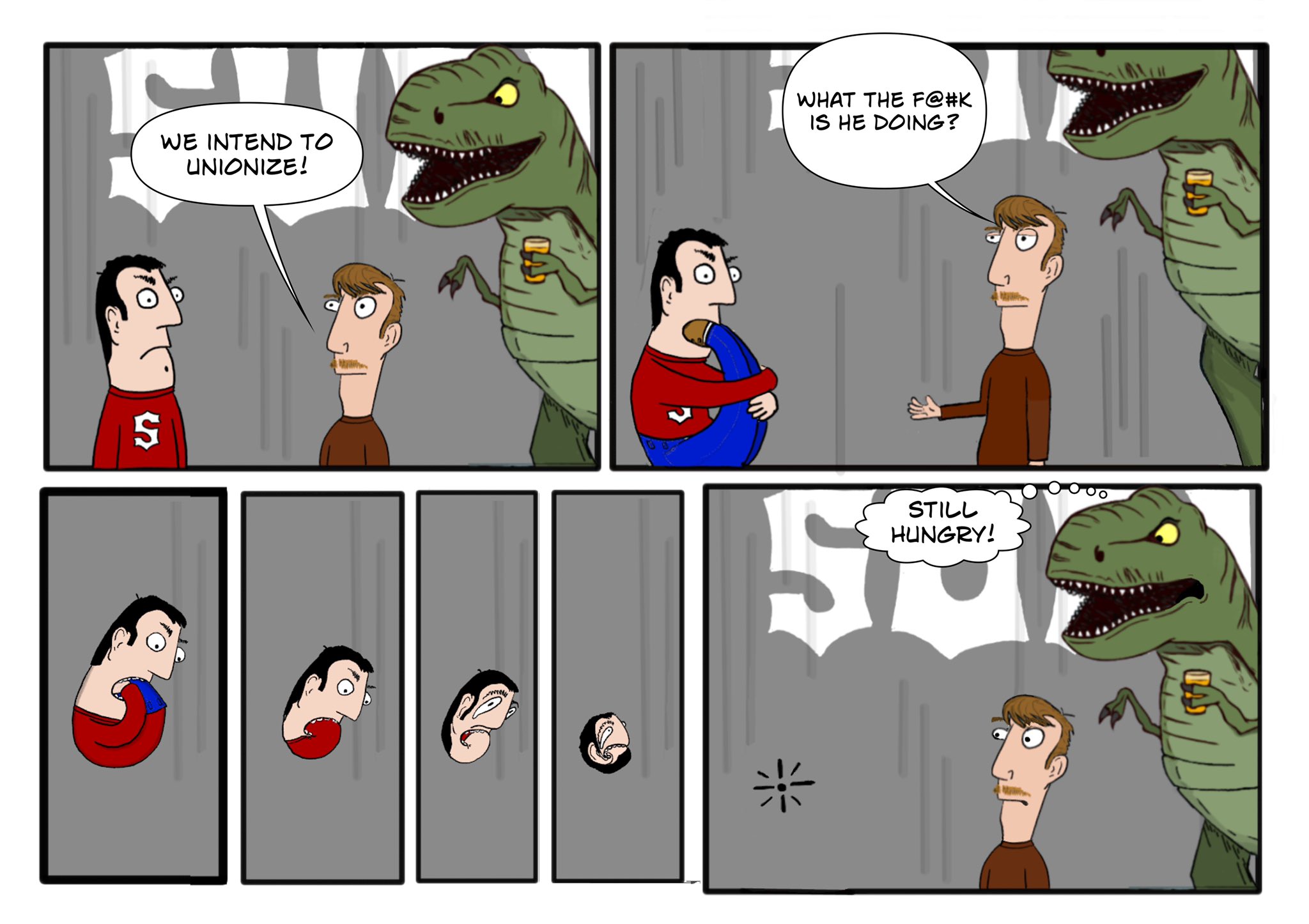
In the few instances where workers in the craft brewing industry have seen through the charade and decided “lol this sucks, let’s organize,” owners have dropped the #oneteamonedream pretense with the quickness. It happened at Rogue Ales in Newport, OR in 2011; and again at Pyramid’s Berkeley, CA brewpub in 2013; and in 2019 in San Francisco, where workers at Anchor Brewing, the country’s oldest craft brewery faced a decidedly corporate union-busting campaign that featured high-powered anti-labor law firms and managers shouting “fake news” at workers exercising their federally protected right to unionize. Very cool shit, nice work all around. 

T-Rex understood what was what as illustrated to the right. Beth, too. And GBH published something a wee bit adrift on the topic but, surprise, could not come to clear conclusions. In sum:

The tension between the two narratives shows that despite businesses reopening, the pandemic’s dramatic effects on the hospitality industry are far from over… It’s currently unclear whether the Unite Here union has any legal avenue to fight the layoffs or planned Beer Hall closure.

Displaying greater clarity, this explanation about pouring central Euro lager is excellent. Effective use of social media. Twenty-seven 600 word articles on the subject could not have put it so well.

Note: not a brewery. A beer company, sure.

Note: not small. Not really even a beer company anymore, either.

More law. Ron wrote an interesting post on a question of Scots law, circa 1948 in the case of more than one case of “Dodgy crown corks”:

The defect in their condition was due to being kept in the damp cellar since February 1948. Dunn knew that corks should be stored in a dry place, and that dampness encouraged the growth of various moulds. Moreover, he failed to use the corks in the order in which they were sent to him. Further, he or his servants ought to have inspected the corks within a reasonable time after delivery, and in any event prior to using them.

Nice touch in the report on the use of “various moulds” indicating, perhaps, a particularly unpleasant multi-coloured effect.

Completely separate from either the situation today and the law, Merryn published a piece on the conclusions drawn in her thesis on pre-historic brewing – very high on the neato scale:

Brewing uses few ingredients, only requiring malted grain, herbal preservatives, water and yeast. These ingredients may survive in the archaeological record in a number of ways. Accidents in drying the malted grain, as happened at Eberdingen-Hochdorf can occur. Residues or sediments of the brewing process may occasionally survive in unusual contexts, such as in the sealed Bronze Age cist graves at North Mains and Ashgrove. Residues of barley without any other plant remains indicate the residues that result from washing the sugars from the mashed barley or ‘sparging the wort’. Those barley residues that contain pollen or macro plant remains indicate the addition of herbs during the boil prior to fermentation.

Again, and without a thought for the law, Retired Martin has again taken us to a place without the cares of the day… except in this episode of his series entitled “287,392 UK Pubs” he explains how those at the Blake Hotel in Sheffield are managing the Covid-19 social distancing rules:

3 pm on a Saturday, filling up but quieter than you’d think, a landlord giving the now customary speech. “Take a seat, fill in the track and trace, follow the one way system, one at a time in the loos, leave glasses on the table“ I felt sorry for him. “I’m sounding like a stuck record !“. “We’re trad drinkers, we miss the interaction at the bar” said the next group. I know how they felt.

Speaking of ye olden times, Eoghan Walsh published a good story of a gruit revival, something I may now have lived through two or three times. While a nod to Unger‘s clarifications on the important role control of gruit played in medieval society would have been nice, I love this level of detail:

Invaluable input came from a most unexpected source: a rich seam of human excrement mined by archeologists from the bottom of a medieval latrine. “They found the remains of hops, juniper, caraway, and bog myrtle, and they asked me how this could be possible that in one stratum of this toilet are these four ingredients appearing together at the same time,” Overberg says. “They thought this clearly had something to do with brewing.” And Overberg naturally agreed. “They have excavations for a period of 300 years, and it is all the same. It’s always hops and bog myrtle, caraway, juniper.

Lastly, The BeerNut wrote a review (no, really he did!) that contained a passage that triggered another thought:

Pyynikin has really missed the mark on “Pacific” here. There’s not an iota of tropicality about this, and nothing American either. Maybe it’s a Finnish take on New Zealand’s ubiquitous Canterbury Draught, because that’s about the only way it makes sense. As beer in its own right it’s inoffensive, and might even be enjoyable as a dark-evening sipper. I couldn’t deal with the surprise, however, and resented it for the rest of the glassful. Adjust your expectations accordingly.

My first thought was it was clearly a tribute to the possible first brewer in Quebec Brother Pacifique Duplessis. But then I thought… how little I care about branding of beers. Then I realized how much I have to wade through every week is basically (i) folk writing about the branding of beer especially as displayed on the container. As opposed to the beer itself … and clearly unlike the TBN above who makes note of the  missing connection. Then I wondered what else are similar categories for me: (ii) fun and pozzie but samey brewery owner interviews, (iii) conversely, greater important questions of rights contextualized in brewing,  (iv) then, conversely again, dreary cut and paste posts of others’ research labelled as “reporting” and… (v) all the superlatives. Always the superlatives. Each theme has its audience I suppose and certainly varies in ultimate value… but what percentage of the weekly collective output isn’t one of the five categories above? Sure, these things come in waves – like yesterday’s topics of food pairing and sell outs – but more would be good to add. Please advise by next Wednesday. A fella has deadlines, you know. Next big thing could be canals. Could be.

There. Done. For more please check in with Boak and Bailey Saturdays, plus more at the OCBG Podcast on Tuesdays (where Jordan points a particularly pointy finger at the letter “B”!) and sometimes on a Friday posts at The Fizz as well.  And sign up for Katie’s weekly newsletter, too. Plus the venerable Full Pint podcast. And Fermentation Radio with Emma Inch. There’s the AfroBeerChick  podcast as well! And have a look at Brewsround‘s take on the beer writing of the week. Not to mention Cabin Fever. And Ben has finally gone all 2009 and joined in with his own podcast, Beer and Badword. And BeerEdge, too.

The First Thursday Beer News Notes for A Q3 2020 Week

See, we made it to Q3! Now we can sing all the Q3 carols, dance the Q3 dances and enjoy all the hot mulled ales of Q3s of old. It’s stinking hot here. Nutty hot. +40C with the humidity hot. Too hot – I might add – even for a beer. At a certain point, I’m just of the iced club soda sorta guy. And busy. This has been a nutty week already. I’m writing this wearing a tie in my laundry room waiting for my chance to answer a question over the next five or six hours on another Zoom meeting. Oh, no… a Webex meeting. Choppier Webex.

The return to pubs in Britain, as Mudgie noted, led to a lot of chat about whether we are being fair to all our brothers and sisters in ale and lager when we think of who got to the newly reopened door first. I liked the image above tweeted from that good day which included the comment ” Jimmy hasn’t gone to bed after his night shift tarmacking the roads.” Nice. I’m on Team Jimmy. Jeff marked the last day of carry-out at his pub with another great image and I am convinced he, too, is on Team Jimmy. We all, however, hate the no-shows and, as Katie noted, hate the bad reviews on day one. But beware the worst beer garden in Scotland.

Jeff at Beervana has been sharing some stories provided by the breweries and brew pubs and bars in his part of the world and what Covid-19 has meant for their businesses. Matt Van Wyk of Alesong Brewing shared some thoughts about the problem that his clients are mainly human beings:

…if you don’t work very hard to keep order in your facility (rules, signs, verbal herding) people will certainly move toward chaos and do whatever the heck they want without remembering we are in a world pandemic. “Please don’t touch that water pitcher with the sign ‘Staff only!’ on it.” Most people are very respectful of what we in the industry have to deal with but it’s hard to serve both sides of the “caution spectrum.”

The US Brewers Association has been in the news – but not perhaps for one item that caught my eye, the salaries paid top staff:

CEO Bob Pease earned $341,950 in compensation in 2018, plus $44,370 in “estimated other compensation from the organization and related organizations.” That’s down from the $409,000 he earned in base compensation in 2017, and more than Charlie Papazian earned in the same position in 2014. Papazian’s salary at that time was $258,000.

Yowza!*  That’s hospital chief executive coin! And a hell of a lot of coin for an organization which in its hymnal offers the regular refrain “there is no money in craft beer.” GBH much to my surprise did some good digging, letting Kate Bernot do the job properly and and did a follow up with a post contextualizing recent staff shifts in a very neat and tidy way. Others raised other issue related to the value proposition including this:

I’ve been vocal about my concerns with @BrewersAssoc harboring racist members recently, and in response they followed me (perhaps to spy), and I’ve been ignored here and on Instagram while white folks both places get responses.

Not good. Dr J. invited folk to step up and get in there to make the change. Similarly from Beth,

…whoops just wrote a 1,500 word critique about San Diego beer for a local beer magazine, brb gotta go prime my inbox for hate mail.

Timely and excellent news, then, on the creation of a scholarship fund to increase diversity in brewing and distilling:

Renowned Brooklyn Brewery brewmaster Garrett Oliver announced the formation of the Michael Jackson Foundation for Brewing and Distilling (MJF) to help people of colour in, or who wish to join, the brewing and distilling industries. The MJF will be helping ‘predominantly people of colour’ by funding scholarship awards to ‘directly fund a more equitable and dynamic future for brewing and distilling’, Oliver said on Twitter…

Happy to see that the brewing scholarship is named as Sir Geoff Palmer Scholarship Award for Brewing. I have been following Sir Geoff on Twitter for a while but have to admit that I did not do so for any reason related to brewing. My parents came from Scotland, Dad from a sugar refining city, and I found him solely through his writing on racial discrimination there and through Scotland’s connections to the sugar slave trade. Fabulous decision.

Crowds of actual modernists – some wearing boaters! – flooded the streets of Dublin as noted by Monsieur Noix du Biere himself.

And Matt C himself had something dear to my heart published this week – an essay entitled “How to Start a Beer Blog“!!

The first piece of doubt you’ll form when you consider starting out as a blogger is that there are already loads of beer blogs in existence, so why does the world need another? In truth there really aren’t that many voices in beer, and there is no such thing as too many beer bloggers. Sure it might take a few good posts to earn your stripes from some of those who’ve been doing it for a while, but people love reading about beer, and a new voice providing fresh content is always welcome.

Boom!!! I’ve been saying that all month… or more… probably more…

Finally, traces of Iron Age beer have been found in Sweden.

Another week in the books. And as Matt said, keep writing and tell us what you see. Be brave. Do it! And check in with Boak and Bailey most Saturdays, plus more at the OCBG Podcast on Tuesdays and sometimes on a Friday posts at The Fizz as well.  In their latest episode, Robin and Jordan are showing signs of losing it from da ‘Vid… or they just really have an odd sense of geography and time. Never mind! And sign up for Katie’s weekly newsletter, too. Plus the venerable Full Pint podcast. And Fermentation Radio with Emma Inch. There’s the AfroBeerChick  podcast as well! And have a look at Brewsround‘s take on the beer writing of the week. Not to mention Cabin Fever.


*Ms. Ogle did not share my thoughts.


The Mid-July Thursday Beer News You Need

Mid-July! It’s lovely. Warm. Tropical even. We are actually getting the edgy remnants of Hurricane Barry into the Great Lakes basis so it’s all a bit thick out there.  Raspberries picked by my own sausage-like digits. And the fire flies are at their peak. I let the garden go a bit and they seem to love it. 100+ flashes a minute in one corner of the garden. Beer has its role, too. I even had one last night, mid-week. At a Denny’s.* A Bud Light. The weirdest thing was being handed a ice cold bottle and an ice cold glass. Entirely hit the spot. Mid-week, mid-month, mid-summer, mid-year, mid-aged.

What is going on? Well, Josh Noel, who admitted to needing something to wash out his mouth after writing about hard seltzer, has written a helpful article for the Chicago Tribune on dark lagers:

And that gets to the genius of dark lager. They’re beers that typically have a modest amount of alcohol — about 5 percent or so — but are long on aroma and taste. Flavors usually include a mild to deep roast character and can veer into chocolate, char or coffeelike terrain thanks to the roasted malt that gives the beer its dark hue. But unlike most of the porters and stouts they resemble, dark lagers tend to finish dry. The best dark lagers make for stealthily ideal summer beers: interesting layers of flavor, but refreshing. The color, which can range from deep amber to impenetrably black, winds up playing a visual trick.

We have an excellent local black lager, Blacklist from The Napanee Beer Company, so I am particularly grateful for this addition to the discussion.

Note: “bee boles were used before the development of modern hives to provide shelter to the skep…”

As we have been noticing over the last few weeks, beer writing and commentary seems to have divided into (i) “it is so dull and boring right now” for one reason or another** and (ii) HOLIDAY!!! So it was good to see some interesting travel being discussed by a couple of Brits abroad. Nate posted a top ten list of things to do in a city I have lived near – Gdansk, Poland – and gave ten top tips for visiting the old Hanseatic port including hitting up a museum about the Solidarity movement and this:

Shoot Some Guns – Maybe a controversial one, but I’d always wanted to shoot some guns since we can’t do it in the UK and I stumbled across a shooting range whilst doing some research. DSTeamStrzelnica was a great experience where we got to shoot four guns (A Glock 17, a revolver, AK-47 and another rifle) and it only cost us £18 each to shoot a full clip of each gun. It was a really fun experience!

Retired Martin has been in NYC and left us a photo essay with commentary:

How joyous to see a “Sorry, no samples” sign, by the way. 16 ounces (80% of a pint) is practically a sampler anyway.  I reckon the Five Boroughs Hazy IPA served in a plastic glass will have cost me £8 by the time taxes and Lloyds Bank conversion charge are added on.  Still cheaper than Port Street. “Tastes like Brew Dog” says Mrs RM.  It tasted like Hazy Jane. On to the High Line, the one place in New York where you can avoid craft beer and tipping…

Saskatchewan’s Pile O’ Bones Brewing Co. is getting a bit of heat for its name – folk saying its disrespectful to the local indigenous community – but according to this Cree language place name resource site, the location of what is now Regina was called “oskana kâ-asastêki” which meant “where the bones are piled.”

Beervana had a interesting guest blog post this week written by Ben Parsons is the co-founder/brewer, along with Rik Hall, of Portland Oregon’s Baerlic Brewing which unpacked the benefits in the US for craft brewers to self distribute their beers:

I would posit that if and when a brewery business does get into some troubled water—albeit from market conditions, saturation, losing chain grocery, etc—not owning their own distribution rights could easily be the last nail in the coffin. And although distributors are a very necessary part of the industry, their foothold on this particular part of the conversation is risky business and needs modernization so that it better fits with the current state of the industry.

Folk chatting about early brewing methods is always interesting. Who knew that bands in the pottery meant the line to fill with boiling water before topping up with cold before adding in the mash was so obvious?

At the Corrigall Farm, Orkney, large tubs that have marked lines inside, usually about one third to a half way up. Custodian told us (years ago, hope I have the details right) that you put in boiling water to the mark, then top up with cold and it’s the correct temperature.

Pilsner as the anti-NEIPA? Maybe.

This is an interesting piece, a remembrance of 16 of B.C.’s now shut early micro- and even some more recent craft era breweries. And it contains this interesting bit of history:

Horseshoe Bay Brewery was the first microbrewery in Canada when it was opened in 1982 by John Mitchell and Frank Appleton to produce beer for the nearby Troller Pub and became Ground Zero for the craft beer revolution. Mitchell and Appleton soon moved on to Spinnakers, and Horseshoe Bay briefly closed in 1985 before reopening and produced beer well into the 1990s, before closing for good in 1999. The original brewhouse, made from converted dairy equipment, is still in use today at Crannog Ales in Sorrento.

Now, that would be a real Canadian beer nerd’s pilgrimage: “honey, I am off to see the original brewhouse, made from dairy equipment!” It’s halfway between Kamloops and Sicamous, if you are planning the trip yourself.

That’s it! Have a great week as Q2 turns into Q3. I will be lounging myself. Well, dapper by day then lounging through evening. Such is the life of the office worker. Check out the beer news from Boak and Bailey on Saturday and maybe on Monday we will have a sighting of the inter-continental Stan now that he is back from Brazil.

*You can mock me after you’ve tried the burger. I was surprised, too.
**hard seltzer, everyone’s already been bought out, even glitter beer is so last year…