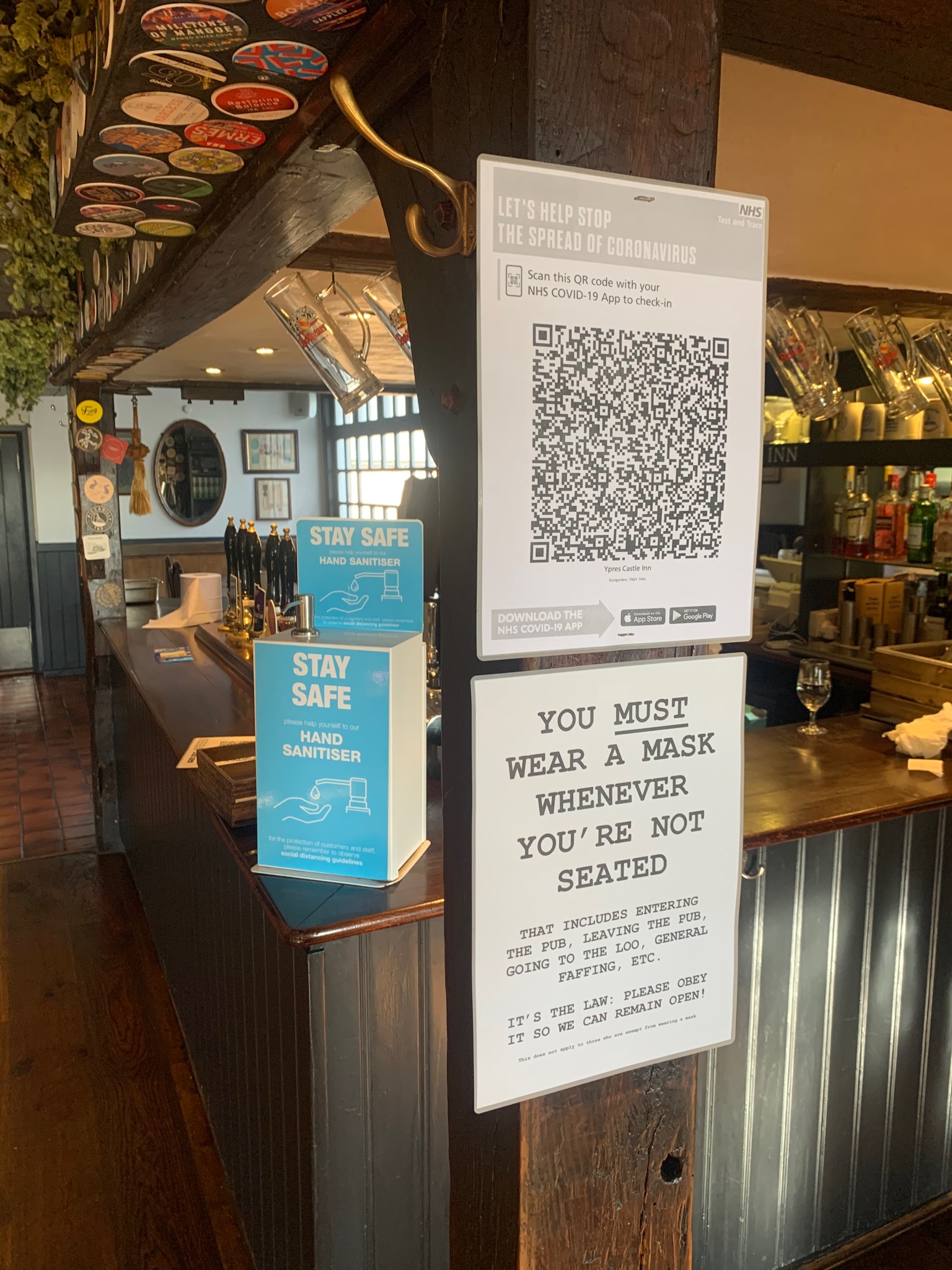
Some Thursday Beery News Notes For A Normal Mid-October Week

It’s normal now, right? All normal. Despite what we think and do, it’s definitely normal to get locked inside when the cold creeps in around the nooks and crannies in mid-October.  Yet people are still running around outside, the massive idiotsWear your masks! And don’t complain about sensible pandemic safety processes!! And write short sentences with many exclamation marks!!! Hmm… the only thing that has really ticked me off this week is I haven’t found any good images to plunk to the right of the first paragraph. Bet Max has something… let me check…  nope. Jeff? Yup. Wear your masks.

Now that that is clear, first up we have a post by Stan is always cause for some serious noting, especially as it relates to the sense of smell and does not advise that loss of the sense is tied to Covid-19:

Researchers at Kyushu University found that the olfactory sensory neurons can exhibit suppression or enhancement of response when odors are mixed, meaning that perception is not the simple sum of the odors. In their experiments, mice that were genetically modified to have their neurons emit green light depending on the amount of calcium ions in them — an indicator of activity — upon absorption of excitation light, the researchers were able to record the response of the neurons in the mice’s noses.

Mice. Noses. Little mousie noses. As with most things, I do not actually understand what is going on here but I trust and have a firm belief in science that gives me an abiding sense of comfort. I am also a good smeller. That sort of thing regularly appeared on my middle school report cards.

Aaaaannnd…. I also don’t understand this from an email received from Pellicle… exactly… which states they will be converting from $ to £:

With recent exchange rate fluctuations the amount getting paid to us has become an uncertain factor, and we’re aware that most of our supporters are UK-based, so this will also avoid any extra fees from your bank when you are paying in dollars. It means we’ll get stronger idea of what we’re receiving each month, and can build more concrete editorial plans in advance. 

Govern yourselves accordingly. I do hope they still take my money. And I hope they take yours once you sign up, if only for pieces like this drinky travel piece taking us to rural England by Kate published this week under the title “With Provenance to Guide Us — Visiting The Moorcock Inn, West Yorkshire“:

It’s late February and sleeting sideways; the sky is an impressive shade of gritstone. Smoke plumes diagonally from the restaurant’s brick ovens outside, which have been slowly roasting mutton all night. Hot roast potatoes will be pulled from them throughout the afternoon, served with aioli as the bar snack of your dreams.

Kate also made the news. News? Oh. News! Oh, well. Let’s see what’s going on. Parts of Britain are now shutting again. In Glasgow, bar and restaurant workers dumped piles of ice in the street as a hospitality shutdown came in and the work went away. The commentary by, I assume, Jimmay is fabulous. Pub man Stonch unpacked an interesting aspect of the laws that applied in his area: the meaning of a “substantial meal”:

… this means the Coronavirus regs on this can be interpreted using case law relating to the ‘64 Act. In Timmis v Millman (a 1965 case) “a substantial sandwich accompanied by beetroot and pickles was a table meal”. So there you go. Get your beetroots ready, publicans!

And Mr. Mudge wrote on the same worthwhile issue:

If you are not going to have an objective yardstick such as price, then you will need to resort to a more subjective definition. Government minister Robert Jenrick* tied himself up in knots by saying that a Cornish pasty on its own wasn’t a substantial meal, but put it on a plate and add chips or salad and it magically becomes one. Few would dispute that a burger and chips would qualify, and the health-conscious should surely be allowed to substitute a salad for the chips. If a burger, then surely also a steak ciabatta, which is in principle the same kind of thing. And a cheese or hummus one for the vegetarians. Before too long, you have a cheese toastie with a couple of lettuce leaves qualifying.

You know… I don’t actually know what a toastie is exactly, either. I assume a toasted sandwich. Or a sandwich made of toast. That was on my middle school report cards too: “..the child thinks a toastie is a toasted sandwich… no hope…

That’s pivoting. Everyone pivoting. Even though we are staying still. Here in Ontario, Ben has been writing upon his blog (taking a break from narrowcast poor radio impersonation) and decided that Covid-19 has been somewhat good for the Ontario booze trade or at least increased consumer access:

But there is an upside to this — if you’re the kind of person who can find the upside to a viral pandemic increasing our substance use – and it’s that the vigour with which we’ve all embraced the drink has actually had an affect on the availability, politics, and culture related to beer. Yes, this pandemic is a lot of things, most of them terrible, but it also might just be the best time to drink beer in Ontario.

Not necessarily a great deal for consumers medium or long term unless wholesale rates come down – but a good survival technique and good for us all to take part in now. New shops like Byward Market Wine Market (fine booze plus small takeaway meals) will be a next model… until the next next one comes.

In other good news here in eastern Ontario – as reported on Canadian Beer News and also discussed on OCBGTP Slake Brewing in nearby Prince Edward County (just south of the very questionably named county seat of Picton) has opened. I post to remind myself to go.

Pivoting #2. Or is it #3? Or #4? Something called the Drinking Studies Network (that also looks a lot like a blog) posted “Threat or Opportunity? COVID-19 and Working Men’s Clubs” by Ruth Cherrington:

The post-COVID future of clubs could lie to some extent in drawing upon their enduring ethos and ideals which include their not-for-profit status. The 21st century setting has brought new challenges but also some tools that can help such as social media. With the usual club experience and contact with members impossible, club committee members had to make more use of Facebook, Twitter and other platforms. Nearly 9% of those surveyed used social media to build up the club’s community and membership over lockdown. Facebook groups became more important for clubs’ committees, especially to let members know what was happening, when they would be reopening and how.

I’d go to an old farts club if they had them around here. Maybe. Would I? Dad peeling potatoes in Yorkshire during the Berlin Airlift might even qualify me for the Legion. But would I go during these the early dark ages? Do I go anywhere? Well, other than the used record shop…

Unrelatedly, this thread on the habits of those in sports and entertainment who passed through this person’s former job at a hotel bar is fun: “Bob Seeger: Honestly he looked like anybodys grandpa with his flannel and orthopedic shoes“; “Stevie Nicks …difficult.” Remember hotel bars?

Now, in this week’s History Comes Alive corner, Gary is finding the time and steam power to get some of the beer history researched and writ… the opposite of my efforts, a personal failing that gnaws within me. One of many. This week he posted about the first draught beer sold in bottles and began with a handy definition:

Pasteurization is used in brewing, including for most imports and mass-marketed beers, not to make it safe for consumption as in the case of milk, say, but to render it stable from a microbiological aspect –bar  to retard souring in particular. Thus, for modern, bright, bottled or canned beer that is not pasteurized, which is the first?* Coors beer is a notable early case, at least the domestic U.S. Coors.** Coors did not abandon pasteurization in bottles until 1959 though…

Elsewhere in space and time, Martin asked “where does Bristol end?” and found a pub that went all snug for Covid-19. BB2 replied: “One of our guidelines is unless there’s an open field separating it, it’s in Bristol.

Beer… should reference something beery… The proper brewing of lager was discussed in Craft Beer & Brewing through a piece by Steve Holle of the KC Bier Company in Kansas City, Missouri:

Traditional lager brewing requires “more” than a typical ale fermentation. Because the “more” requires additional costs and resources to achieve very subtle, small, and incremental enhancements to flavor, there is always the temptation to take shortcuts by buying cheaper ingredients, skipping decoction, pitching less yeast, raising the fermentation temperature, shortening the conditioning time, or using artificial carbonation.

This neatly illustrates nicely the need for a separation of traditional lager from macro gak conceptually. I was thinking of that when I was writing back and forth with Jeff yesterday about his excellent SNPA post. Others were also thinking of proper lager brewing. Alistair was asking about if decoction mashing was practiced in Victorian Britain.

And finally, Kate Bernot has written about Canada’s ice beers… though sorta missed the twin towers of the phenomenon, Maximum Ice and all the future goth TV ads especially the one with The Smiths*, in favour of something about… a penguin. Still, it is a handy primer and notes importantly that the ice beer boom never busted as it traveled south:

Ice beers are a Canadian invention dating back to the early 1990s; they’re essentially stronger versions of the domestic lagers North Americans had been drinking for decades. American beer companies swiftly copied this “innovative” idea and mass-produced their own versions including Milwaukee’s Best Ice, Keystone Ice, Bud Ice, Busch Ice, and Natural Ice. 

Why does it live on? It’s richer as well as stronger. So curlers dig the stuff. Goes with rye and K-Tel LPs.

There. Enough! I’m rating this a mid-grade week. Or maybe just a mid-grade post. Either way, another week has passed. Like the grains of sand passing through the hourglass, these are the days of our lives. Remember there’s  Boak and Bailey mostly every Saturday, plus more at the OCBG Podcast on Tuesdays (this week Jordan shits on tweens!!!) and sometimes on a Friday posts at The Fizz as well.  And sign up for Katie’s weekly newsletterThe Gulp, too. Plus the venerable Full Pint podcast. And Fermentation Radio with Emma Inch. There’s the AfroBeerChick  podcast as well! And have a look at Brewsround‘s take on the beer writing of the week. Not to mention Cabin Fever. And Ben has finally gone all 2009 and joined in with his own podcast, Beer and Badword. And remember BeerEdge, too. Plenty of good writing. Only a little journalism. Journalism. Yup. Apparently all writing is ultimately… journalism. Sorry Shakespeare. You aren’t in any give-away trade papers.

*Someone at the Labatt PR firm back then knew the value of good music in a beer ad.
The Days May Grow Short When You Reach September, Frank, But There’s Still Time For Beery New Notes

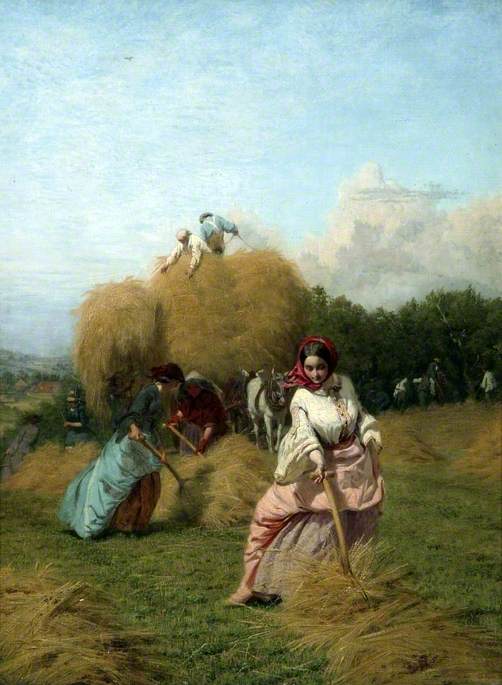
The summer has raced by. We only have a bit of lingering warmish things left. Then false summer comes, followed by the now doubly  questionable Indian summer, then lastly a few surprisingly cool rather than cold days. Harvest is coming in. Season of mellow fruitfullness and all that entails. For the ladies to the right it included rather nice dresses. I saw this image on the Twitter feed of The Georgian Lords but have no idea where it is from. I suppose it indicates all hands on a day where there were deck as it’s hardly The Gleaners of months later on in the cycle. But, perhaps surprisingly, not unlike The Harvesters of 1565.

First up and as an excellent introduction for an effort which seeks to separate from chaff from the grain, Stan wrote about an article about wine writers and junkets and other seductions. Like the author, the excellent Jamie Goode, he uses the word “satire” but, as is usually the case with satire, it is framed as such to make a point about a truth:

Good reading from an author who writes, “Personally, I’d rather drink beer than suffer these dull, dishonest, trick-about wines.” Not sure what alternative he’d suggest for dull, dishonest, tricked-about beer.

Is it the beer that is dishonest? In some cases, yes but not always.  Anyway, excellent thoughts as we seek out the good as well as… the Goode in what’s out there to read this week. A reasonable contrasty comparison is this article that Matt noticed by Alicia Kennedy which in part covered similar ground with less of a satirical veneer and more of a personal reflection:

When I was 31 and used my passport again, it was to go to Spain on a trip paid for by a winemaker. The next month, it was a two-week trip to Italy with family that completely drained my meager savings (until I moved to Puerto Rico, this was the longest I’d ever been out of New York), and the next, it was to Scotland for whisky tasting. From 2017 through my move in 2019, I traveled somewhere pretty much every month. These professional opportunities (some personal), about which the ethics were and are always dubious, suddenly began appearing in my inbox at just the right time: after my brother passed away at the end of 2016 and I needed not to wallow, not to continue having panic attacks. 

Staying at home, Martyn triggered a lot of arge and the barge when he himself wrote triggered about changes to the small brewery taxation laws of England and Wales.* It’s all the same to me in that I think reasonably healthy taxation of beer and other strong drinks is a perfectly normal thing to do but decide for yourself:

Much of the outrage seems to come from exaggerated claims of how many and how much brewers will be adversely affected by the proposed reforms, and allegations that the changes will mean large brewers gaining at the expense of small brewers, though the group that led the call for a change in SBR, the Small Brewers Duty Reform Coalition, includes a fair number of brewers making less than 5,000 hectolitres a year among its 60-plus members.

Plus, and I presume some brewers read this so I appreciate it’s not what everyone wants to hear, the idea that the outrage is “manufactured” is not necessarily an accusation. It’s a reality that the discourse is bent and pushed and pulled for any number of reasons and interests. This is one of them.

According to the NME, 99 metal bands have signed up for a ’99 Bottles Of Beer’ charity cover:

The idea for the cover was put together by The Boozehoundz, the moniker of Scour members Derek Engemann and John Jarvis alongside Robin Mazen of Gruesome. It sees 99 musicians all singing a single line of the song, amounting to a mammoth 23-minute song.

All of which is entirely excellent.

Speaking of music, the earlier Matt in my life on these information superhighways linked to an excellent remembrance of being a teen at raves in Preston 30 years ago:

There was an abundance of places to go out to in Preston in the early 90s. The country was in recession but everyone was partying hard. Friday was rave night at Lord Byrons and Saturday was indie/dance. After a grim experience at a club in town when I was 16, Saturday nights at Byrons became part of my life. Most Saturday nights from the beginning to the end of 1991 we were there, drinking cider and black, dancing to our favourite music and forging friendships that would continue for three decades and more.

Reads as true as a witness statement in a criminal proceeding.

Andreas K. wrote about Carinthian Steinbier this week, an Austrian beer that disappeared over 100 years ago, and in doing so gave us a great intro into the world of hot rocks in cauldrons:

Carinthian Steinbier is interesting because it survived for a fairly long time, until 1917 to be exact, despite repeated attempts to completely supplant it with what was called “kettle brewing”, i.e. brewing involving metal kettles. During other research, I recently stumbled upon a 1962 article that is probably the most detailed description of Carinthian Steinbier tradition that I’ve found so far.

Things You Gotta Try” on NPR’s Splendid Table included dipping Oreos in red wine. Oatmeal Walnut cookies in Imperial Stout anyone?

I have to admit, I have no interest in hard seltzer or hard soda or hard kombuchca and even little interest in most beer writing about cider but I do appreciate Beth’s argument that at least for the business of brewing, non-beer may be one of the ways forward:

They’re not the only San Diego brewery to fully embrace the seltzer craze. Mikkeller’s own line of hard seltzers—dubbed “Sally’s Seltzer” as a nod to one half of their iconic character duo Henry and Sally—launched in January 2020 in response to craft consumers’ changing demographic. “It’s a perfect change of pace for any type of drinker—and a cool opportunity for us to connect with a wide demographic,” explains founder/CEO Mikkel Borg Bjergsø. “It also fits with our desire to be inclusive and reach as many people as possible.”

Let’s be honest. They are end-times beverages, just the same coolers which have been with us for almost thirty years and just gak by another name. As relevant to an interest in good beer as the brand of bubble gum stuck under a pub’s table top. Mr. B. noted the latest abomination: “India pale hard seltzer.” FFS.

Finally, it was with great sadness that I heard the news about the death of Jack Curtin, dean of Philadelphia’s beer writing scene. He was a great supporter of this beer blog from day one and someone with whom I shared an interesting email relationship even if we never met. One of his greatest skills was ripping into his pal Lew Bryson, who I know will mark the loss deeply.

Enjoy the rest of your summer days. As you do, check in with Boak and Bailey most Saturdays, plus more at the OCBG Podcast on Tuesdays (where Jordan shits on church ladies and is dead wrong about coconut macaroons) and sometimes on a Friday posts at The Fizz as well.  And sign up for Katie’s weekly newsletter, too. Plus the venerable Full Pint podcast. And Fermentation Radio with Emma Inch. There’s the AfroBeerChick  podcast as well! And have a look at Brewsround‘s take on the beer writing of the week. Not to mention Cabin Fever. And Ben has finally gone all 2009 and joined in with his own podcast, Beer and Badword. And BeerEdge, too.


*Never sure when these things apply to the whole or the part.

Your Thursday Newsy Notes For The End Of July In Beerland

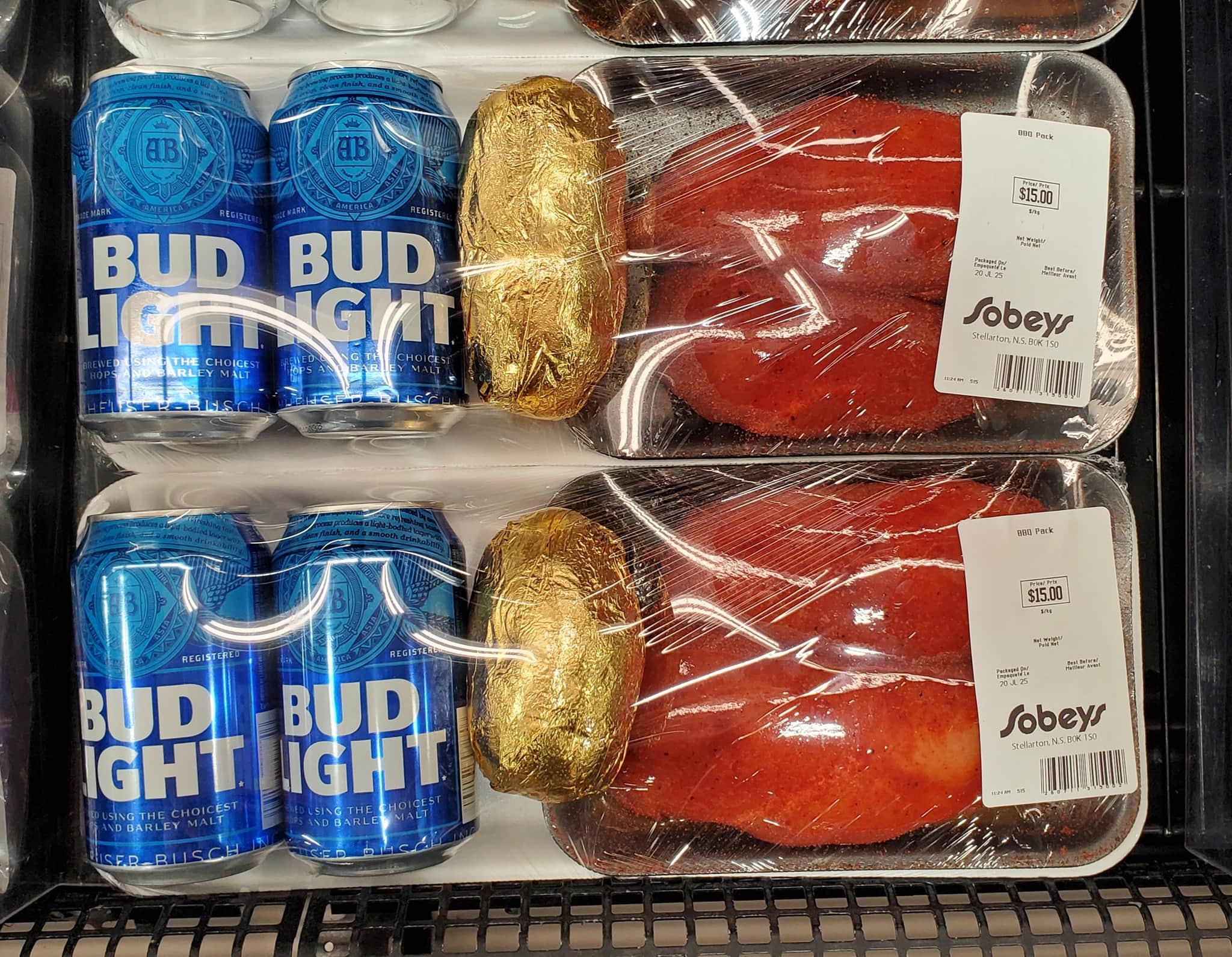
After last week’s mess of unified theory of a something or other, it would be nice to find some chat that is (i) about beer and (ii) not about other things. You know, those bits of the trivial dribble that attracted me to scribbling about beer in the first place. It’s not just that good beer got into sectarian schisms, then politics, then laced with the pandemic – it’s that it all got so real. Don’t get me wrong, the real is good and important. But sometimes I like to wallow in, the vital but unimportant things in life. Like that really sad BBQ pack, above, that my pal Brian saw at a Maritime Canadian grocery store this week. Pointless… yet strangely compelling.

As a means to hopefully show what I mean, consider this wonderful bit by Katie in Pellicle on the place of burger vans in her life:

This is where I draw the line between burger vans and food trucks. For me, food trucks bring me images of gourmet falafel wraps, jackfruit tacos, outrageous fried chicken and homemade sauces. They’re run by chefs and dreamers on enthusiasm and aspiration, passion and excitement. I enjoy them, but they are a different beast. A burger van might also be a grill on wheels, but that’s where the comparisons stop. A burger van is a means to an end. The owners are chipper, but brisk and efficient. The sauces are bulk-bought and sharp with vinegar and citric acid.

Lovely writing about what is basically… well, is “…what my mum would call “a waste of money.” I have especially enjoyed following her family’s obsession with Superbike, something which really does not exist in my imaginary North America, something British which I only know through staring at 1930s racing championship programs on offer at eBay.

Beer reviews. That is pretty old school straight forward beer blogging, right? Well, Alistair over at Fuggled has renewed his blogging activity and shared his thoughts on one old friend, London Pride:

There are times when I drink this that I really understand why American brewers and drinkers have such a hard time grasping the fact bitter should be, well, bitter. It’s not that it is terribly sweet, though the mouthfeel feels a little like undissolved jelly cubes, it’s that the hops are nudged out by the famous Fuller’s yeast character, as well as not being the same kind of citrus as folks are used to here. So many breweries here use very clean top fermenting yeasts that the character of the beer is so different, and I wonder if American breweries under hop the tyle as a result?

And when the conscientious beer blogger is not writing reviews, she or he should be discussing pubs like the Tand himself did this week when he wrote about one of his “…favourite pubs in the UK, the Coalbrookdale Inn in, well Coalbrookdale…” and included this fabulous paragraph:

After a few minutes – the pub has a more or less square bar – the landlord shouted “Phone call for Peter”.  We all ignored this. Now to explain to my younger reader, back in those days – pre mobile phone – it wasn’t at all unusual to call a pub and ask to speak to “whoever” if he is in.  Now nobody knew we were there we thought and therefore the call out in a busy pub could not possibly be for any of us and could be safely ignored. We carried on supping. Having got no response, the barman returned to the phone, presumably to relate the lack of success to the caller.  A few seconds later he appeared in front of us. “Any of you lads Peter Alexander?” quoth our hero. I stammered “Me” while we all looked on in astonishment. “Phone call for you” he said.

Do you like brewing history? Good news for all! The UK’s National Brewery Centre’s archives have gone online:

Two years ago a project began to produce a digital catalogue and this is what launches today. At a cost of £50,000, it was funded by generous grants from the likes of the Consolidated Charity of Burton on Trent, Staffordshire Community Foundation, the Campaign for Real Ale (CAMRA) and the Brewers’ Research Education Fund, additional funds were raised from corporate and individual donors as well as via a crowdfunding campaign. The archive system was designed and built by Shrewsbury-based digital heritage consultants Orangeleaf Systems, whose other projects include The Parliamentary Archives and the Royal Mail Archives.

More fabulousness!

Lars opened up a small can of worms in a very small pantry when he asked “What counts as a farmhouse ale?” in an actual blog post:

The most common question I get in interviews is “what do you consider to be a farmhouse ale?” and since the answer is a little involved I decided to write it up more fully. There is a fairly clear-cut definition, but it takes a little explaining.

I think the only issue is that Lars has to have one footnote to the first paragraph that reads “*supra, Lars” given he is both the reporter and the compiler of the information in the topic. I don’t necessarily agree with the idea that there is a thing called “farmhouse ales” which is an umbrella noun under which all styles fall. But I do like it as a process description that is identifying similar practices playing out in sheds and kitchens in disconnected locations. As a function of what the life of a farmhouse includes.  As Lars notes in his piece:

In the 18th and the 19th Centuries, you had plenty of farming treatises being published. In most if not all of them you have a chapter on brewing.

Brewing as a farming function as much as managing the manure pile or tilling the fields. Note: the wonderful Girardin grows its own grain and has done so for generations… but it may not be brewing farmhouse ale.

Perhaps less monumental that van burgers or les bieres des shed, is the story told by B+B of pubs collecting pennies for charity in post-war Britain:

Looking through old brewery in-house magazines from the 1950s and 60s, one recurring image is inescapable: a monstrous pile of pennies on a bar, in the process of being toppled by a celebrity.

Jeff wrote about losing his blog’s sponsorship to Covid (sorta like I did in the aftermath of the market crash of 2008) which is a very brave admission and not really fabulous at all:

The first question was whether I should even continue with the site. Most writers don’t maintain blogs. They would rather put their effort into procuring and writing paid gigs. It was kind of crazy that I hadn’t monetized the site at all for its first decade, and I realized I couldn’t put the hours of work into it for free anymore. Either ditch it or—sorry for the crass jargon—monetize it. I decided to try the latter before resorting to the former, and considered how to do so in the way that would minimize my conflict of interest while maximizing revenue.

Keep the blog. Writing gigs may make money but the writing is Dullsville.

And lastly, Stan went into the woods this week and he sure got a big surprise.

Enough unreality for you? Fine. OK…. here are the top real news items for the week:

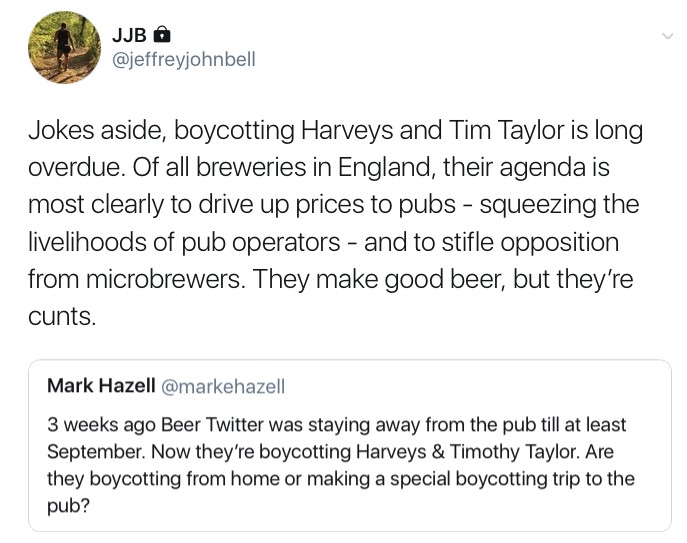
1. JJB took a side on the small brewers’ tax credit reforms in England and Wales. Matt is angry over the same thing.

2. Jeff has split off his political writing from his beer blog to share what he is seeing on the front lines of the fight in the US’s pro-democracy movement in his hometown.

3. Alcohol use, especially heavy use, weakens the immune system and thus reduces the ability to cope with infectious diseases.

4. And today would be a great day to arrest those who killed Breonna Taylor.

Don’t forget it is real out there.  The cool sip of a mild legal intoxicant that is wearing down your internal organs prematurely should not distract you too much from the real. Beer isn’t real.*

There. Done. Some great pro-am and am beer writing for the week. A bit of a side show but, still, worthy in itself. For more, check in with Boak and Bailey most Saturdays, plus more at the OCBG Podcast on Tuesdays and sometimes on a Friday posts at The Fizz as well.  And sign up for Katie’s weekly newsletter, too. Plus the venerable Full Pint podcast. And Fermentation Radio with Emma Inch. There’s the AfroBeerChick  podcast as well! And have a look at Brewsround‘s take on the beer writing of the week. Not to mention Cabin Fever. And Ben has finally gone all 2009 and joined in with his own podcast, Beer and Badword.

*The latest blurt from Stone should be enough proof of that.

The Last Thursday Beer News Update Before Santa Visits And Delivers All The Stuff

Yuletide.  Its been busy so far this month but after one last late evening meeting for work tonight I think I might be sliding into Yule proper.  As I mentioned a few weeks ago, the days of the Christmas Yuletide Hogmanay Kwanzaa and Hanukkah Beery photo contest may be well past us but the archives go on and on. To the left is 2014‘s co-winning entry from Thomas Cizauskas, one of the drinks world’s longest serving bloggers (care of Yours for Good Fermentables) and general gentleman of the trade. I remember being immediately taken by the way it reminds me of Vermeer, busily full of subtle detail.

Speaking of detail, the efforts of Boak and Bailey to single handedly keep beer blogging going never fail to impress and this week we have, in addition to their normal weekly roundup as well as a summary of their favourites among their own posts,* a wonderful summary of the best that they have read from the blogs of others:

We do this not only as a reminder that there’s lots of great stuff being produced by talented writers but also because writing online is transitory – you sweat over something, it has its moment of attention, then sinks away into the bottomless depths of the Eternal Feed. The pieces we’ve chosen below excited or interested us when they were published an, rereading them this weekend, retained their power. They tell us things we didn’t already know, challenge our thinking, find new angles on old stories, and do it with beautiful turns of phrase and delightful images.

Wonderful and particularly wonderful as they liked my August 2019 post on Lambeth Ale to include it. I don’t get the time as much to do research so I am pleased that one was pleasing.

Look! A wonderful pub in England. In a time of need, too. Elsewhere, holiday tragedy struck in Scotland this week when a truck full of Brussel sprouts went off the road.

The vehicle pulling the trailer full of the Christmas dinner vegetable overturned in Queensferry Road in Rosyth at about 10.45. Police Scotland said it had closed the road and was urging drivers to avoid the area. A spokesman tweeted: “There’s been a bit of a Brussel Sprouts accident at the roundabout at Admiralty Road.” The tweet added: “Please avoid the area if possible. Traffic and Christmas dinners may be affected. Apologies for any delays.”

Now, you may say what has this got to do with beer but there is nothing so good as a sprout covered in gravy washed about the gums by a faceful of Fullers Vintage Ale on the 25th of December and I will call out anyone who disagrees. By the way, if the city is Brussels why is the sprout singular? Ha ha! They are not. It’s Brussels sprouts. I grew them once about twenty years ago. Only pick them after a few frosts. Top tip, that.

Speaking of not beer, there is a wine glut in the world:

From a balance of supply and demand for bulk wine as recently as a couple of years ago, we are now in surplus worldwide thanks to some abundant recent vintages, and also possibly due to declining demand as consumers trade up while per capita consumption levels off or declines.

Speaking of holidays, excess and mindless abandon, I have learned that the good folk in Australia have come out with new drinking guidelines which are prefaced in a very Antipodean style:

“We’re not telling Australians how much to drink. We’re providing advice about the health risks from drinking alcohol so that we can all make informed decisions in our daily lives. This advice has been developed over the past three years using the best health evidence available,” says Professor Anne Kelso, CEO of the National Health and Medical Research Council.  “In 2017 there were more than 4,000 alcohol-related deaths in Australia, and across 2016/17 more than 70,000 hospital admissions. Alcohol is linked to more than 60 medical conditions, particularly numerous cancers. So, we all need to consider the risks when we decide how much to drink.”

Good way to send the message. And similarly from the “the sky ain’t falling department, the Pub Curmudgeon reports on the after effects of the lowering of the drunk driving limits in Scotland five years on, objecting to a study’s core findings:

This month sees the fifth anniversary of the reduction of the drink-driving limit in Scotland in December 2014. At the time, the immediate impact on the licensed trade was such that it caused a noticeable downward blip in Scotland’s national GDP figure. Now, five years later a study by academics at Stirling University has examined the longer-term effect on the trade and, perhaps predictably, concluded that it hasn’t really made a great deal of difference, saying that “Most participants reported no long‐term financial impact on their business.”

He argues that the rural pub is affected the most and therefore the study places its finger on the wrong outcome. Interesting…

Speaking of criticism, there is a wonderful piece on the site for NPR’s foodie show The Splendid Table on how the role of restaurant critic has evolved since the 1970s:

Today, the relationship between restaurant critics and restaurants themselves is kind of adversarial; it wasn’t then. To me, we the people who were cooking the food and the people who were writing about it were all on the same team. And as time went on, I started seeing my role changing a little bit in that I honestly believe that cities get the restaurants they demand. I started in the mid-1970s, and by the mid-1980s I was starting to think that it was really important that people be more demanding of restaurants, that the food in the city would be better if people didn’t settle for mediocrity.

Is good beer, therefore, almost four decades behind?** Or is the good beer writing about good beer now good?

Speaking of being behind, I am ashamed I never heard of this story of racial discrimination, one beer and the Supreme Court of Canada from eighty years ago:

…since Christie vs. York was handed down, 80 years ago this month, little else has been known about the man who took a Montreal tavern to court for refusing to serve him because he was black. Civil rights activists in Montreal, wanting to honour his legacy, have been trying to locate Christie’s relatives and gather more information about him.  It was believed he moved to Vermont in disgust after the Supreme Court decision. That’s where the trail ran cold.

I should unpack that case. The majority opinion reads like something from the 1800s. The single dissenting ruling sounds like modern law.

Someday, brewery features will features sources other than the brewery owner.  Until then, there is this. Tell me if you’ve heard it before.

That’s it. A bit of coal after many pressies. Next week’s edition will be out on Boxing Day. Make sure you are good and lubricated for the wonder that ye shall behold. And don’t forget that there’s more news at Boak and Bailey’s on Saturday, at the OCBG Podcast on Tuesdays and sometimes a mid-week post of notes from The Fizz as well. And sign up for Katie’s weekly newsletter, too. Merry Christmas to you all!!!

*…in which they include my favorite post of the year from anyone, their piece “The Swan With Two Necks and the gentrification issue” from November.
**That is so meta of me.

The Thursday Beer News Update For A Week When My Mind Was Elsewhere

On Tuesday, I had a great joke all prepared for my proctologist, analogizing with him or her over the election results. But… well, at least in the end, we seem to have had a good result. In both senses. Not much time for me to focus on the beer industry, however, which makes this week’s beer update as much news to me as to you. Let’s see what’s been going on.

First, speaking of biological science, Stan sent out his regular hops newsletter this week and, as exemplified by the photo up at the top, decided to provide some photos from the Hop Research Center in Hüll, Germany that Evan recently wrote about, as mentioned in last week’s news update. Up there, that’s a picture of some of the Center’s germ plasm collection of long-held varieties. Want more? You will have to pay Stan for back issues of his newsletter now if you want to see the images but haven’t subscribed already.*

The biggest story has to be the member of management at Founders giving testimony in a disposition that he did not know if someone who was… well, let’s see see how the story was covered:

A transcript of the exchange between Founders’ Detroit general manager Dominic Ryan and Evans’ attorney, Jack Schulz, shows Schulz shifting from shocked to incredulous and perhaps a bit angry as Ryan claims he had no idea Evans is Black. Instead of just answering the question and moving on, Ryan digs in deeper and deeper, repeatedly asking for clarification when Schulz asks questions like “Are you aware Tracy is Black?” At one point, Ryan even claims that he doesn’t know if former President Barack Obama, Kwame Kilpatrick, or Michael Jordan are African-American, because he has “never met them.”

The Beer Law Center tweeted: “This is stupid. The “if I didn’t say it, you can’t prove it” strategy – quite simply – sucks. The law, justice, trials, and courts, just don’t work that way. Shame on Founders.” As a practicing lawyer a quarter century into his career, I can’t disagree. The person diving the testimony did themselves no favours. Plenty of rightly offended folk now rejecting the brewery like Beery Ed: “if you still drink founders , you suck.” Which is true.

Boak and Bailey proposed a scoring system this week to determine if a British pub is in fact a pub.

Monty Python’s Terry Jones was on the BBC in 1984 and discussed both dental hygiene in medieval Britain and his brewing. Wogan preferred keg to cask. Jones, having a multi-faceted shirt malfunction announced: “real beer can only be made on a small scale.” Heed ye all!

Lisa Grimm has had a timely article published in Serious Eats about the haunted history of the Lemp family of brewers out of St. Louis:

Today’s beer history installment is something of a micro-level view of my previous column on German-American brewers—but this one has a Halloween twist. The story of the rise and fall of the Lemps, once one of America’s most powerful brewing families, reads like something out of gothic fiction; and, as would be entirely appropriate for that genre, some say that they’ve never left. The story begins familiarly enough…

A great technical article on barley came my way entitled “Characterising resilience and resource-use efficiency traits from Scots Bere and additional landraces for development of stress tolerant barley” I believe from @merryndineley. Now I have to go and look again at the standard for “landrace” when it comes to barley as I’ve seen husbandry in the 1600s but when we are talking bere we are talking about something much older than that as the abstract suggests:

Potential sources of viable resilience and resource-use efficiency traits are landraces local to areas of marginal land, such as the Scots Bere from the Highlands and Islands of Scotland. Bere barley is a deeply historically rooted landrace of barley that has been grown on predominately marginal land for the last half millennia. The landrace yields well in these conditions. The project aim was to assess and genetically characterise traits associated with enhanced resistance/tolerance, and to identify contributing genomic regions.

Speaking of great technical articles, I was blessed with a copy of an article on the history of Fuggles hops by the perennially referenced Martyn which, this time, appeared in Technical Quarterly published by Master Brewers Association:

The Fuggle hop is one of the most important varieties on the planet, not only in its own right as a contributor to the flavor of classic English beers for more than a century but also for the genes it has given to almost three dozen other hops… It is surprising, therefore, that until this year there was considerable mystery over the parentage of the Fuggle—it seemed to be unrelated to any other English hop type, with a hop oil profile much closer to the German landrace variety Tettnanger—and a fair amount of doubt and confusion over exactly who developed the hop and when it was first commercially available. Now, however, research in England and the Czech Republic has convincingly answered all the questions…

Nice article in Pellicle on the realities of the beer scene in Iceland:

We had moved up to the bar at Kaldi, and the low-hanging bulbs made the copper bar top and our bartender’s shaved head shine in the dim light. I had just ordered the Borg Garún Icelandic Stout Nr. 19, an 11.5% behemoth. If you haven’t heard, beer and food are pretty expensive Iceland. Pints of basic craft styles were $12-$15 (£9-£12) everywhere, and the higher in alcohol pours were $20-$30 (£15-£23).

Even at those prices, beats the hell out of an vaguely described essay on (what Canadians properly spell as) bologna.  Sums something up.

Katie tweeting on junkets triggered that a discussion wasn’t the usual monocrop of defensiveness.

There was a discussion on Facebook on the early days of the British Guild of Beer Writers awards dinners with some entertaining recollections. Martyn** recalled a night 22 years ago:

The earliest awards dinner menu I have is from 1997 – ham cured in Newcastle Brown Ale (!), accompanied by figs steeped in Old Peculier, breast of guinea fowl braised in Fraoch heather ale, pears in porter and cheese served with McEwans Champion Beer. Dinner sponsored by Tesco …

Ah, the romance… Related perhaps is this thread about traditional brewing in today’s alcopop world.

That’s it? Yup. For further links, check out the Boak and Bailey news update on Saturday and then bend an ear towards the OCBG Podcast on Tuesdays. And look for mid-week notes from The Fizz as well.

*I don’t make the rules. Stan does.
**Again with the Martyn!!!

The “I’m Just Back From Toronto And Boy Are My Arms Tired” Edition Of Thursday Beer News

A pubby sort of place

It was a short visit. Twenty-two hours. Nine of which were used up at a conference. A very interesting one. Ten of which were the worst hotel stay that I have had in a very good hotel in my entire life.* And three of which I hung out with Jordan. [You may place these experience in their proper order in your mind as you see fit.]   We wandered and ended up down by the docks. The nice docks.** We talked about craft fibs, money, and the seeming draining away of fun in good beer culture.*** And then we asked the waiter if he liked his job, because he seemed to.  He did. A lot. When the waiter left, we asked why any place would make a beer that tasted like thin lemonade with a soapy hint of dish liquid. Jordan made me drink it. I made a funny face when I had the first sip of that one. Then made another sort of face when I gulped the rest of the sampler glass. I am sure it sells. What do I know?

Two bits of news related to getting things right. Getting the truth out. First, Maureen Ogle has finished her revisions to Ambitious Brew and is about to press the publish button. [Editorial note: she did… buy it now!]**** Fabulous.

And Martyn has written yet another post. It’s like 2009 over there at his blog. Active. So odd to see an active blog. Anyway, it is excellent set of complaints about how horrible the beer style information is in the Good Beer Guide 2020:

It’s not as if all the information on beer styles that the GBG gets wrong isn’t out there in easily discoverable forms: there are now a considerable number of books, blogs, magazine articles and so on giving the true facts about how the beer styles we know today developed. And yet the 2020 GBG still prints utter nonsense…

Excellent. And then there were comments this week about money. Money is like truth. Stan wrote this in passing in his Monday beer news update and it struck me as a particularly obvious point that I had not seen made yet:

The price question is a constant in beer circles (and pops up pretty much every day). But it is one that brewers must continue to consider if they are serious about inclusivity.

I was a bit less impressed with the opposite argument seeming to be be made, that expense and exclusivity were not a barrier to inclusion. But then that was put in a bit of perspective when I read someone arguing that if people really cared about working in craft beer that they should not be too concerned with being paid. These are some of the reasons craft beer culture sometimes seems like an alt-reality with whole necessary pieces simply missing. Then BeeryEd wrote this and the whole thing seemed to right itself again as fresh air returned:

Trust me. As someone that’s been in the game a lil while and spent waaaay too many hours on spreadsheets in regards to costings etc. I guarantee you there is enough to pay people fairly. I promise you. Hence why we have a bunch of brewers that do and are fine….

The comments that flowed from his string of tweets were instructive. And then they just got mean. Because craft beer is full of great people. And thin lemonade with a soapy hint of dish liquid.

Speaking of inclusion, I’ve learned there is a frequently updated list of “Black Owned Craft Brands and Other Diversed Ownership” drink makers map! And because I love maps almost as much as inclusion I am linking to it right => here. Add more data. The world needs more data.

Care of a Katie tweet, I found this fabulous review of the food and drink at the Hackney Church Brew Company by Jay Rayner in The Guardian which starts thusly:

Down a shadowed road an old man shambles. He’s wearing a secondhand pinstripe jacket and sensible shoes with cushioned soles. Pools of buttercup-yellow light spread from reconditioned railway arches, illuminating the uncreased faces of the Friday-night crew outside, bottles of the finest local microbrew in hand. Music booms. There’s a cavernous bar gilded in red neon with the legend Night Tales. Broad-shouldered bouncers stand sentry, thumbing their phones. The old man shuffles past, aware it’s not for him. I can’t help but feel a little sorry for him. This is because the old man is me.

I resemble that remark myself. And I even went to yet another bar this week. I never go to bars but last Friday for one at the Kingston Brewing Company after work. It’s like I never had children. And what a selection! I had a Vim & Vigor which I much prefer to think of as Vim & Vigour.

Fergie Jenkins beer! He once almost slapped me to the ground in 2006. At Cooperstown, NY. Hall of Fame Game crowd. Walking towards the game he was barreling from where he had been signing books to the field where he was to be introduced before the game between the Reds and the Pirates. He was 64. Felt like I was hit by a side of beef. Solid. Took one of my best photos ever – of a ball hit into the left field crowd just near me.

And finally, Lew has been recalling the first time he experienced a regular undergrad habit of mine:

I stopped at the border liquor store before returning home to the dry county of Hardin. The cashier weighed my empty milk jug, I filled it with draft Schlitz, and she weighed it again—the store sold beer by the pound.***** When I got home, I opened the jug and started drinking. I put away the groceries, and decided I needed a shower. On a whim, I took the beer along. It wasn’t long till I was soaped up, hot water rinsing off the day. I grabbed the jug, and tilted it back. Hot water pounding on my back, cold beer running down my throat. Wow! I’d found a whole new experience. The shower beer!

There. I need a rest. My fingers are all tipped with blisters from all this writing. No worries. I have time to heal. Boak and Bailey will be on duty for the beer news on Saturday and Stan will be covering on Monday. The OCBG Podcast is available most Tuesdays in plenty of time for happy hour at the mess, too. See ya!

*I checked my diaries all the way back just to make sure.
**Amsterdam’s Brewhouse on the Lake, 245 Queens Quay West. Everyone has a screen, watches a screen, is a screen.
***I blame all the off-flavour seminars teaching folk how much good beer is bad or at least flawed. Yet teaching people that soapy lemonade is OK. Haven’t got to the soapy lemonade bit yet? Wait for it.
****But please also seek out the actual vibrant story of colonial brewing in British North America from the 1620s and then its continuation in the USA before the Germans brought over lager in around 1840. Start here.
*****Beer by the pound is an even more interesting story that needs to be researched and reported upon.


The Thursday Beer Notes For A Week Or So From My Summer Vacation

There is a certain something in the air. The sound of back to school ads? The fear of seeing a pumpkin ale on a store shelf? Summer is winding up. Harvest has begun, as MacKinnon has pointedly pointed out.  I was out there in the trenches… err… ditches in 2018. Looking forward to their Harvest Ale this fall.

Not entirely unconnectedly, we were up in Ottawa last weekend visiting with eldest before it does and one of the best moments was a pint of London Pride. The middle one has been working at a craft brewery this summer and it was very instructive to watch him take a sip. He has been canning contracted and the brewery’s own stock of beer since May, coming back coated with the stuff. He has tried many brands. But he didn’t know what to make of London Pride, asking what that taste was. It wasn’t fruity. It’s an actual ale, I said.

I thought of that when I read this from The Beer Nut on Wednesday in one of his inordinately regular, lengthy review posts:*

My only other Irish beer for today’s post was from YellowBelly, a brown porter named Chewbaccale, in defiance of the Walt Disney Corporation. It is, fittingly, a big lad, at 6% ABV. It’s all about the balance: a touch of roast, but not too much, and a splash of caramel, but not too much of that either. It’s incredibly satisfying to drink, in that way you only get from brown malt. A little weaker would perhaps make it even better, but might also make it Touching the Scald. Either way, I’d love to see lots more beer like this around.

I was also thinking about this when I chatted with Jordan last Friday morning as I sat in the yard on a day off:

Does Beer develop or just change? Not priggery. “Develop” might suggest (i) progression, (ii) intention. As The Beak of the Finch shows, evolution causes both loss + gain. Each are just results of pre-existing qualities that succeed or fail in new contexts…

My point was illustrated by the idea that it is impossible to have a general global English pale ale fad before 2022 as there just aren’t the hops to support it. Fruit-ee-oh favoured hops control the world. Stan had confirmed that peak Fuggles in the US was achieved in 1930. No wonder TBN longs for more traditional British ale flavours. No wonder my son the brewery worker did not recognize the taste. Hmm. Have traditional British styles become so rare abroad that we have to think of them like Belgian beers in the 1970s?

Elsewhere, something called The Suffolk Gazette posted results of a study that suggest that drinking beer makes men more intelligent:

Boffins at Suffolk’s prestigious College of Medicine found men who drink at least five pints of ale a day were far better equipped to hold high-level discussions about important issues of the day. And blokes on the beer were also more adept at completing brain tasks like finishing cryptic crosswords and solving complicated mathematical equations. The surprising findings will be music to the ears of boozers across Britain, who have been insisting beer is good for them since the drink was first invented in 1937.

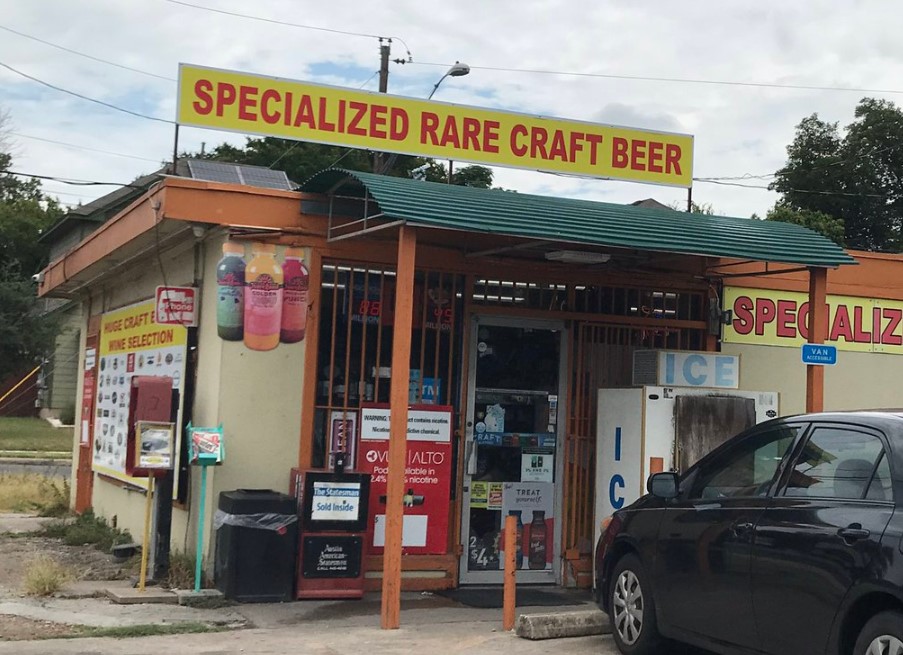
Oh, it’s a joke. Speaking of which, Stan posted the picture to the right on Twitter and heard from the crowd: “That store is NO JOKE. He must have $60k+ in bottled beer stock in there.” Which sounded pretty general to me.  This sort of thing interested me in 2006. Do people still drop $300 after driving for hours? Do they have kids?

Did you know that Ontario has a deli meat cold cuts competition every two years? I wan’t that press pass. But the judging took place a couple of weeks ago so I will have to wait until 2021.

The Master Brewers podcast posted an episode entitled “Breathe, Breathe, Breathe, Scream” about brewer Kerry Caldwell who overcame the 34% chance of survival calculated by the hospital after she was injured in 2015 when a brew kettle boiled over at a brewery where she formerly worked. They also discuss improving brew house safety by adding a cut-off mechanism that would avoid her sort of incident.

The Beer Nut** has yet again alerted me to a matter of good ecclesiastic practice. In Cork, Ireland one priest is a bit fed up with folk bringing beer and other personal relics of the deceased to funerals:

Fr Tomas Walsh, who has previously spoken out about Godless Godparents and disrespecting the Holy Eucharist, has criticised behaviour he has seen at funerals. Writing in the weekly Gurranabraher newsletter, Fr Walsh said inappropriate memorabilia is being brought up to the altar at funeral Masses. “Bringing things such as a can of beer, a packet of cigarettes, a remote control, a mobile phone, or a football jersey does not tell us anything uplifting about the person who has died,” Fr Walsh wrote.

My late father, a Protestant minister, confiscated cameras brought out during weddings – walking up the aisle hand outstretched for delivery of the offending article as he continued to speak, leading the service – so I do get Fr Walsh’s point.  Seems a bit pagan. Except the remote control. That’s gold.

It’s interesting that the acquisition of a craft brewery by big bad macro is so uninteresting:

AB InBev SA (NYSE: BUD) has agreed to acquire Platform Beer Co., which will join Anheuser-Busch’s Brewers Collective as its newest craft partner. Platform Beer Co is the fastest growing regional brewery in the United States in 2017, known for their diverse portfolio of unique beers and innovative approach. Platform, founded in Cleveland by local entrepreneurs Paul Benner and Justin Carson, began in 2014 as a homebrew-inspired brewery devoted to community outreach and education. Still carrying community values at the core of their business today, Platform is known throughout Ohio for their taproom customer experiences and vast beverage portfolio of award-winning innovative products – creating more than 200 unique beers per year. The brewery’s unparalleled creativity and experimentation has resulted in more than 600 recipes that include a variety of unique seasonals, sours, ciders and fruit ales, barrel-aged beers, and a line of hard seltzer.

Homebrew-inspired“? Now there is a new nothingness. “…a line of hard seltzer…”??? Hooray for everything! I look forward to maybe three of those 600 brands being discount regional pale ales by 2022.

There. Next week will be the day before the holidays expect the quality to decline… if that is possible.  Check in with Boak and Bailey for more news on Saturday and Stan on Monday. The OCBG Podcast should be there, too, on  Tuesday so check it out. Have a good weekend!

*Pray for his liver.
**The Double!!!

The Summer’s Lease Hath Far Too Short A Date Edition Of Thursday Beer News Links

Gather ye rose buds, lads and lassies. Five more weeks until Labour Day weekend looms. Back to school ads on the TV start soon. Remember: every fair from fair sometime declines. Boom. Chucka. Lucka. Photo of the week is from retiredmartin who has been out gathering. Note the first:  check out the third person’s experienced expression. Note the next: there is a missing fourth person. What is not to love?

A great start this week so far, don’t you think? Let’s go! Next, Dr. J. Nikol Jackson-Beckham spoke at Slow Food Nations about the progressive influence craft beer has on communities – something I would have thought would have been happening at every slow food conference since time began. She sat for an interview on her thoughts about food and justice:

Largely people are heartbroken because their intentions are good but haven’t actually been realized in their business. The project of equity, inclusion and justice tends to overwhelm people with a sense of fear of doing it wrong. So my approach is to come at this as a huge opportunity for a business both in terms of social good and the bottom line. To do this, a business has to think about it on par with all other organizational goals, build infrastructure and then talk through specific tactical scenarios that people can grab on too.

Here’s some science for you. Drinking is being studied studiously and one study has found out that folk are not altering their habits all the same way. It asked the question “why are alcohol-specific deaths going up in Britain when alcohol consumption is going down?”

Countervailing alcohol consumption and alcohol‐related harm trends in the UK may be explained by lighter and heavier drinkers having different period and cohort trends as well as by the presence of cohort trends that mean consumption may rise in some age groups while falling in others.

I heard a similar science-like story on NPR Monday morning but never found the link. [It’s sad when things turn out like that.] But the point was teens seem to be reversing what the last set of teens did and the newbies are turning to the bottle after their elder teens of the last ten years have been subsisting digitally.

Writing advice. Boak and/or Bailey included more than one excellent observation in their monthly newsletter but I liked this one the bestest:

A couple of weeks ago we posted about migrant workers from Suffolk in the Burton brewing industry. In a follow-up Tweet we said: “TIP: If you really want to learn about beer and brewing, don’t just read beer writers – look beyond.” This is something we think is important. When we wrote Gambrinus Waltz, for example, most of the research was undertaken in newspapers, old magazines, books about London, theatrical biographies, autobiographies… We hardly looked at a single book by a capital-B, capital-W beer writer, except for Ron Pattinson and Martyn Cornell.

Sounds like a couple of dodgy sorts to me… but the point is correct: get ye to the primary records as often as possible. Right after the rosebuds. Or perhaps they are your idea of rosebuds. Good all-round general thinking advice, when you think of it.

Hmm. Not sure I like this. The next nightmare beverage has apparently shown up in Malaysia:

Asians love the bubble milk tea. They love beers as well. One franchise has decided to merge the both together in what it considers the “matchmake of the century”… The Boba Beers consists of Butter Beer made with Kirin Ichiban, Guinness Milkshake with Guinness (duh), Strawberry Lime Cider made out of Apple Fox Cider, and Watermelon Beer mixed with Tiger Beer.

I don’t judge but, well, it sounds pretty yik. I expect some craft brewer will update* it and the kids will go nuts.  Because tea+beer=boba can’t help but be cheaper to make than even beer+juice+radler.

Geoff Latham had a good go at pointing out that one craft fabulous UK brewer selling into the EU was seemingly breaking the law:

It’s not allowed under EU rules. They closed the “personal import by post” loophole when tobacco sales by post rocketed. The person importing can have their goods seized and face prosecution. The company exporting also can if the correct customs documents don’t accompany the beer

I liked Zak Avery’s experienced views on the matter, too. Craft is all fine and good but a couple of weeks of short sharp shock might be called for.

New brewery news: Ontario emigrants brewmaster Andrew Bartle, marketing manager Marissa Bégin have declared their new operation The Church Brewing open for business. This is great and especially so as they are located in Wolfville, Nova Scotia** near where I grew up, where my Dad was a United Church minister which means he likely went to presbytery meetings in a future brewery.

I am enjoying the approach Matt Curtis and his journal Pellicle are taking in treating good beer as part of broader food and rink production.  British wine has been included in that scope this week:

Thanks to this bumper crop, British wine is being spoken about with more fanfare than ever before. British sparkling wine, particularly from vineyards based in Sussex and Kent, is now widely recognised to be on par with Champagne. This perhaps explains why in 2017 the Champagne house Taittinger planted vines in Kent (though, due to its appellation, they cannot call what they make here Champagne) in order to exploit similar growing conditions as the prestigious house enjoys in France.

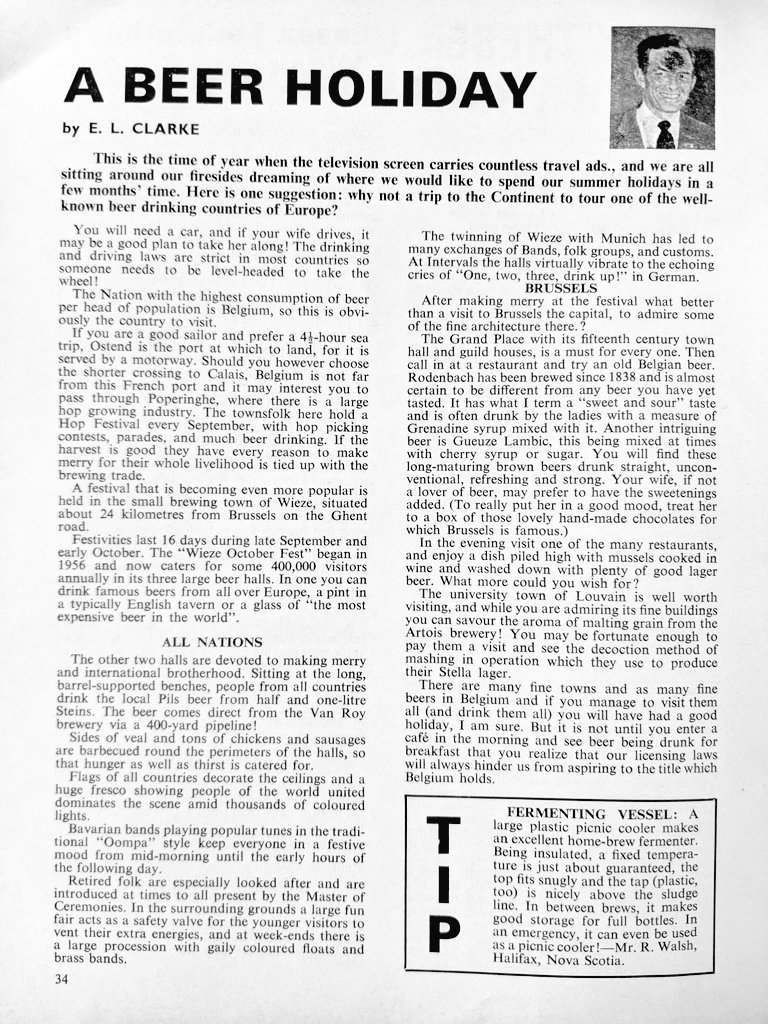
Boak and Bailey have hit for the double this week when on Wednesday they posted a tweet with a link to a 1971 article from the publisher of the foundational and likely all-time leading home brew and good beer books in terms of sales, Amateur Winemaker. The article is about beer tourism to Belgium, a copy of which is produced to the right. I love it. While a bit cringe making on topics matrimonial, it is far less creepy in its sexist approach than the sometimes leering thoughts of one Mr. Jackson when he spoke of ladies AND it does an excellent job describing the subject matter of his article – traveling to Belgium in that year of 1971 to explore the beer culture. I particularly like the observation that sweetening sour beers like Rodenbach or Gueuze was locally common. This primary record proves their earlier observation – and raises again the question of why no one has seriously studied the influence of Amateur Winemaker publications. Then again, perhaps Columbus did actually discover the New World.

Finally, a point of view from our side good beer on the word authenticity. While I am a bit of a loaf, I do like reading about good menswear as I am a man who needs to wear things. Permanent Style is one of the best current guides to things I can never afford which offers an alternative voice on matters analogous to good beer and here is their take on that word:

In the past couple of years ‘authentic’ has become increasingly important to how I see clothing.  Partly, this is because the other terms – or values – have become less important.  Heritage has been overemphasised. Frankly, some old companies make terrible products and are stuck in the past, unable to adapt either to changing consumer expectations or the media that markets them.  So too has craft. The fact it is done by hand doesn’t necessarily make it better. Some craftsmen set out on their own before they’re ready, and deliver a poor product. And some things are just better made by machine. 

Interesting. Given most “craft” beer is made on computerized set ups that manage much of the process automatically, the comparison may well be a useful one.

Well, that is it for now. Not a boring week at all. Boak and Bailey should have even more to share on Saturday and I am now trusting Stan to being back again Monday. Consider, too, the OCBG Podcast which is broadcasting the thoughts of Robin and Jordan as they observe upon good beer each Tuesday now coming on three months or so.

*aka poach.
**pronounced “Wuhff-fuh” locally.

Tra-La! It’s May!! Here’s Your Thursday Beer News For The Lusty Month

Ah, summer… or at least that part of spring that is after filing taxes. Tax Filing Day, Labour Day and Christmas Day are the only three actual dates that turn the calendar for me. The real seasons are (i) winter plus mud month plus fretting about the furnace and tax forms, (ii) the months of joy, the time of year when all the good movies are set in, and (iii) the long goodbye to all signs of life on the planet. Last week’s cruddy news was clearly the last burst of the bad time before the coming of… the good time. It all makes sense.

What has that got to do with beer? Other than that the months of semi-public semi-irresponsibility are here? Do you think I could sit around my yard listening to a ball game on a tiny AM radio in view of the neighbours and passers by wearing plaid shorts and a funny hat drinking a beer in November or March? No, that would be weird. Now? It’s expected. You know what else is expected? The week in beer news. Let’s go!

First, all bow to Bristol as Boak and Bailey have posted a remarkable post on the 1960s opening of a Guinness brewery in Nigeria based on a collection of records shared with them by the daughter of the plant’s technical director:

David Hughes’s 2006 book A Bottle of Guinness please gives an excellent summary of the rise and fall of the Ikeja brewery. After 1985, the import of barley was banned, and so Nigerian Guinness began to be brewed entirely with local sorghum. Stout ceased to be produced at Ikeja after 1998, with production moving to Ogba, further away from Lagos again. Fiona’s father, Alan Coxon, went on to become head brewer at Park Royal from 1972 until 1983–84. He left Guinness after a dispute with management over, as Fiona understands it, plans to gradually and slyly reduce the ABV of Guinness’s core products.

Value. Interesting. Hmm… somewhat distantly relatedly, I remember first seeing this phenomenon in a New York beer store years ago when there were cans of Heady Topper or some other supposed special beers that wasn’t supposed to be sold outside of Vermont. They sat on the counter by the cash register for ten bucks a pop. I thought “what idiot pays ten bucks for one can of beer” but now it appears that sort of idiot might be the backbone of UK small craft beer retailer strategies:

Some buyers are driven to underhand measures to secure hyped beers for their shops. “I know there’s a lot of jiggery-pokery that goes on,” says Sandy. “It’s a dog-eat-dog world in the craft beer scene.” Stories of retailers buying beers from other shops to resell in their own establishments are common. This can even stray across borders. “I’ve certainly heard of bottle shops ordering from European websites,” says Ferguson. “I know someone up the road was doing grey market beer imports. Obviously HMRC wouldn’t take a kind view of that.”

[Note: I only take journalists seriously when they choose to use the word “jiggery-pokery” if and only if “dog-eat-dog” also is used.]

As another example of writing worth your time, Matt Curtis has led the announcement of his new project Pellicle, a digital magazine with a scope broader than the normal and seemingly failing format of the beer mag, with an article on Irish oysters… and beer:

Inside, we arrive at a table laid out with freshly cut wedges of lemon and lime, along with a few bottles of Tabasco. The gathered crowd marvelled at the effortlessness with which Hunter shucks an oyster. Taking it in one hand—that hand encrusted with salt and dirt, evident that he had been hard at work pulling in nets that day—he inserts a short blade into the shell. Finding exactly the right spot in less than a second, he pops the shell in two with a single motion. Careful not to touch the salty fruit within with his fingers, he then uses the blade to clean the shell of any grit or rough edges, before ensuring the oyster is no longer attached to its shell, and serving.

Having lived in an oyster area or two in eastern Canada, my only concern is Matt failed to find a place for my favorite oyster word – spat. That’s what we of the western Atlantic call a first year seed oyster. Never mind. What I like is how the article is unburdened by any of the wowsy, life changing experience claims much beer writing for money is larded with. Which means it’s an example of just better writing. And a nice clear subject matter travel funding statement, too. Nice. Still, slathering an oyster with Tabasco is an utter waste. But, well… never mind.

Next, Robin wrote an interesting post under the title “Tampopo, Ramen, Beer, & the Amateur” which I immediately was taken by given her assertion of the priority – nay, the primacy of the amateur:

With the word amateur celebrated instead of filled with negative stigma (the latter, I feel, unfairly gets more focus), suddenly all the events people go to, the sense of wonder and excitement I feel when I go to a bar I’ve never been to before, when I don’t recognize a THING on the beer menu, and that wild, devil-may-care attitude when I order something to just try it…all of that suddenly made more sense to me. There was no single word that could accurately define it. “Passionate” felt too one-sided. “Curious” didn’t quite cover the drive. And a label of “connoisseur” or even “expert” seemed to remove a lot of the assumption that there is always more to learn and discover about beer. 

Excellent. The only folk who could fine a negative in amateur is the phony pro, the self-labeled expert. Ay mo. A mass. Am ant. It’s all about love, baby.

The opposite of which, I suppose, is the grasping crowdfunder. Give me the amateur over that every time. Boo, grasping crowdfunders!!

Martyn wrote a wonderful fact packed tweet that I need to share in full:

In England in 1831 there were 5,419 common breweries, 23,582 full-licence pubs that brewed their own beer and 11,432 beer shops that brewed their own beer, over 40,000 breweries in all. The country’s population was 12,011,830. That would require over 187,000 breweries today.

I think of facts like that when I read folk think there were something like 150 or 275 breweries in the US prior to 1800. Makes no sense. Ah, but for a record to bring us back to reality we wallow in the shallows of easily available evidence.

Speaking of summer, tra-la and all that, we often hear a lot about the quality of beer at baseball games. Suckers who like the Toronto Blue Jays are particular complainers. Me, if I am honest and count my ticket stubs, I am more of a minor league guy. So I’m delighted to read that my nearby Syracuse Mets have upped their triple-A game beerwise:

It’s seems to be going about as well as the ballclub hoped. Even on a day when lots of beer was available for a buck, a steady stream of customers popped in for a full-price IPA, Imperial Stout, Saison or other style made by a noted local or national craft brewer. “We’re getting a whole new demographic of people coming to the games — the craft beer enthusiasts,” said Clint “Tonka” Cure, the Mets’ assistant general manager. “And then we’re also getting the craft curious — the people who aren’t sure they’re going to like it but think this is a good time and place to give it a shot.”

That picture way up at the top is from my July 5, 2016 visit to the ball park at Syracuse.  I love Syracuse. We haven’t been south for a couple of seasons since the Canadian dollar tanked but maybe I’ll get my butt back down there this year for a few games. I can take my Mr Mets book to get signed.

That’s it! Another week has passed and tonight I sleep in Oshawa!! What could be better? I bet Boak and Bailey on Saturday and Stan on Monday will let us know.

The Government-Shutdown No-Deal-Brexit Why-Kids-Don’t-Drink Version Of Thursday Beer Notes

Woot!!! Holding up the roof since 1693!!!!

So… two weeks and a bit until #FlagshipFebruary* begins… meaning the inevitable rebound to #TrendyMarchMania will see some of the dry,  those off the sours for almost nine weeks hitting the bottle extra hard. You know, we really need to full year calendar to keep all this stuff straight – given we also have #MildMay and #DecemberIsForAmataurs, too.

As I mentioned a few updates ago, the US government shutdown has caused all approvals required by brewers from the  Alcohol and Tobacco Tax and Trade Bureau. I clucked at the time that at least this halted the manic pace of biere nouveau but – and with a hefty h/t to @beerinator – it appears that the permitting process is far more intrusive that that:

In a suit filed Tuesday in U.S. District Court in D.C., Atlas notes that the government has approved labels for its cans of The Precious One, an apricot IPA, but not the labels for its kegs, known as “keg collars” before the shutdown began. Those kegs can’t be shipped out for sales outside of D.C. without label approval from the Alcohol and Tobacco Tax and Trade Bureau: Doing so would violate federal law.

Who knew that “permitting” included such minor matters?***1/2

Next but disconnectedly so, here is an excellent primer for buying wine for a crowded restaurant table. Note the following statements:

I simply order what I most fancy eating and what I’d most like to drink, that’s what gives me most pleasure — even if the combination may seem bizarre to the sommelier… Do you worry about which cheeses to pick off a cheeseboard? I’m sure you don’t, so don’t worry about the wine…

Fabulous advice. Applies to beer, too.**

Unrelatedly, wonderful views (see above) of a +335 year old pub structure in Dublin, Ireland. Here is some backstory from 2016 on the efforts to save the structure:

“The astonishing skeletal grid of ceiling beams and joists is still intact on the ground floor, as well as early brick walls with ancient embedded timbers… With all of the modern partitions and ceilings now removed, the ground-floor shop retains all the grand scale one would expect of a public inn of the post-medieval period, complete with typical corner chimney stacks…”

Not connected at all, good to see some wonderful news of Young’s in England taking a stand on saving its affected staff from the fallout caused by Brexit. More here on the business reasons behind this sensible move:

The boss of pubs firm Young’s on Thursday cheered higher sales, but warned that hiring staff is tougher. Patrick Dardis said around 38% of his 5000-strong workforce are EU nationals, and added: “More workers [from Europe] are leaving here than coming. The recruitment and the retention of top talent is increasingly difficult.

Whiplashedly, ScienceDirect published this so it must be right. It’s a research paper entitled “Why are young people drinking less than earlier? Identifying and specifying social mechanisms with a pragmatist approach” which sets out a number of reasons why my children are apparently smarter than I was as a kid:

Recent analyses of surveys of youth drinking in Sweden have found a strong decrease both in rates of abstinence and in levels of drinking among drinkers. For instance, alcohol consumption among 15- to 16-year-olds has fallen more than 50% between 2000 and 2012. At the same time, the abstention rates among boys and girls have increased from about 30% to more than 50% . Moreover, heavy episodic drinking has decreased from 34% to 18% among boys (ibid.)…  Similar declining trends of alcohol consumption among young people have been identified in other European countries, North America and Australia…

Virtigo inducingly, the Tand himself has posted about how craft sees cask and it’s good enough to have a whole month dedicated to the #MarchOnCraftFibs campaign. It starts fabulously thusly:****

Yesterday there was a Twitter post that caught my attention. It referred to an opinion piece in Imbibe Magazine by Jessica Mason in which she claims that “We’re on the precipice of a cask revival”. The article goes on to explain her thinking which can be summed up – more or less – that cask can revived – wait for it – by modern brewers adopting Golden Ales. Well I exaggerate, but I hardly agree either with the way the article says “cask is becoming ever more exciting, flavoursome and stylistically broad” as if we’ve all been drinking flavourless crud for all these years and can only be saved by innovative craft brewers rescuing us from our own stupidity. 

And utterly conversely, I finally figured out what I don’t get about GBH writing style. This piece by Roth is pretty good even if it needs editing down to get some control of the subject. It’s like there is a need to give each source equal space.  And the obvious extra access to New Belgium, an acknowledged sponsor, is there, too. But those are the problems with the subject matter presentation. That’s normal middly stuff. No, it’s the fact that the letters “GBH ” actually appear 22 times within the text of the story. Twenty-two! Breakout the flashing neon font. Enough already. One is enough. Three is cloying. But referencing your own publication 22 times in a story is weird. Needy. And too bad. It’s an important story and would have been much better if it was just cleaned up with a lashing of confidence.

One last thing: stunning stats on pub waste.

That’s enough for now. My neck hurts. Odd. Mid-January is quiet time. I actually typed all this while balled up in family quilts watching VCR recordings of cooking shows from the 1990s. Seriously. Who has time for -26C, Sunday’s promised nighttime high?  I want it over. You want it over. Like Brexit, we know the next few weeks are just going to be ugly and we need to get them out of the way. Need relief along the way? Check out Boak and Bailey on Saturday and then Stan on Monday for a well earned break.

*Hmm. Now not thrilled with the hinted need to seek to attach a big old lumbering craft revenue stream to what is basically a hashtag.
***1/2Not sure what this footnote is for… it’s even out of order.
**Have another cold Big Mac, you big carrot-headed lardass! [Note: as a distant cousin of Mr. President, I reserve the right to call him a big carrot-headed lardass.]
***So much of wine pairing advice these days is based on relaxing and not worrying while beer pairing advice is so anxious.
****We really do need to acknowledge what a clear focused writer the Tandy One is.