Some Uses Of Beer In Early 17th Century Newfoundland

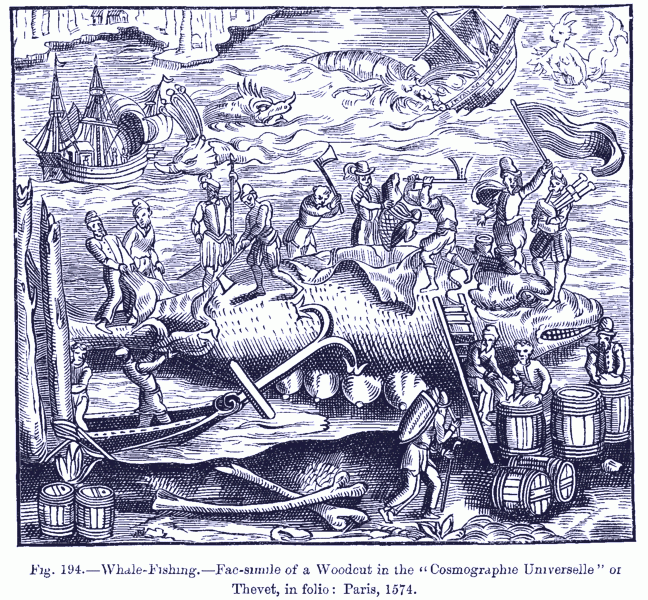
1574whalers

Richard Whitbourne is one of those guys probably a few people know a whole lot about but a whole lot of people know nothing about. He fought against the Spanish Armada in 1588 and then spent the next thirty years of his life involved with the Elizabethan whaling fleets off and, later, colonization of Newfoundland. He served as Governor for a time and also held the first court of justice in North America in 1615. And he wrote a book. About Newfoundland. He wrote a book , A Discourse and Discovery of Newfoundland, about Newfoundland in 1620 which contained a few interesting references to beer. Because it’s not like you came here to read about Newfoundland history, right? Well, let me tell you it’s good for you so listen up. First, in a section titled “Herbs and flowers both pleasant and medicinable” he states:

There are also herbes for Sallets and Broth; as Parsley, Alexander, Sorrell, &c. And also flowers, as the red and white Damaske Rose, with other kinds; which are most beautifull and delightfll, both to the sight and smell. And questionlesse the Countrey is stored with many Physicall herbs and roots, albeit their vertues are not knowne, because not sought after; yet within these few yeeres, many of our Nation finding themselues ill, haue brused some of the herbes and strained the iuyce into Beere, Wine of Aqua-vita; and so by Gods assistance, after a few drinkings, it hath restored them to their former health.

One interesting thing about this advice is how the straining of the juice of herbs into beer is something our pal Billy Baffin and his crew did four years earlier on the shores of Hudson Bay when they boiled “scuruie grasse…in beere.” I trust you will be doing likewise when scurvy next strikes. In addition to health matters, in a later section he wrote about the economics of the Newfoundland enterprise including how beer played a role:

And this certainely, in my vnderstanding, is a point worthy of consideration, that so great wealth should yeerely be raised, by one sole commodity of that Countrey, yea by one onely sort of fish, and not vpon any other trade thither, which must needes yeeld, with the imployments thereof, great riches to your maiesties subiects: And this also to bee gathered and brought home by the sole labour and industry of men, without exchange or exportation of our Coine, and natiue Commodities, or other aduenture (then of necessary prouisions for the fishing) as Salt, Nets, Leads, Hookes, Lines, and the like; and of victuals, as Bread, Beere, Beefe, and Porke, in competent measure, according to the number and proportion of men imployed in those voyages.

As noted a few years back, it is not necessarily the case that all you needed was to drop off the supplies and take away the fish as by the late 1500s there were autonomous groups of masterless men on the Newfoundland coast likely brewing their own beer while fishing and trading dried cod for Spanish wine and other luxury items. But Whitbourne is writing to promote the plantations for investors so wouldn’t want to note these sorts of vagabonds living, you know, free lives. Moving on and keeping the reader’s eye on the potential rewards of investment, in another section mentioning beer he tells more about what was required to bring colonists over and the benefit of leaving them to over-winter on the coast:

The allowance of victuall to maintaine euery sixe men onely, to carry and recarry them outwards bound and homewards, is sixe hogsheads of beere, and sixe hundred waight of bread, besides beefe and other prouision; which men, when they saile to and fro (as now they vse) doe little good, or any seruice at all, but pester the ship in which they are, with their bread, beere, water, wood, victuall, fish, chests, and diuers other trumperies, that euery such sixe men doe cumber the ship withall yeerely from thence: which men, when the voyage is made, may be accounted vnnecessary persons returning yerely from thence. But being left in the Countrey in such manner, as aforesaid; those parts of these ships that leaue those men there, that are so pestered now yeerely with such vnprofitable things, may be filled vp yeerely with good fish, and many beneficiall commodities, for the good of those Aduenturers that wil so settle people there to plant.

So, a hogshead a man and a hundred pounds of bread for the same per trip. But if they are left on their own and not travel back, the ships can be filled up with cod. And what was the thing stopping people from doing that? The cold. He wrote about the cold and the sort of people who should be sought out for the colonial endeavor:

Now if such men, when they come from thence, that haue but little experience of the colde in other Countries; neither take due obseruation of the colde that is sometime in England, would listen to men that haue traded in the Summer time to Greeneland, for the killing of Whales, and making of that Traine oyle (which is a good trade found out) and consider well of the abundance of great Ilands of Ice, that those Ships and men are there troubled withall at times, they would thereby bee perswaded to speake but little of the colde in New-found-land: yet praised be God, seldome any of those Ships and men that trade to Greeneland, haue taken any hurt thereby…. I doe conceiue, that it is but a little needlesse charie nicenesse vsed by some that trade there, that complaine any thing of the cold in that Countrey, by keeping themselues too warme: which cold (I suppose) some that haue bin there, may feele the more, if they haue beene much accustomed to drinke Tobacco [sic], stronge Ale, double Beere, or haue beene accustomed to sit by a Tauerne fire, or touched with the French disease, such peraduenture may, when they come to a little cold, wheresoeuer they bee, feele it the more extremely then otherwise they would.

Which is another way of saying only sooks can’t handle whaling off Newfoundland in the early 1600s. You mommy’s boys of like to sit by the tavern fire sucking on strong ale or double beer? Same as it was in 1378. Wastrels. Don’t bother. Can’t handle it. Everyone else? There’s money to be made if you can just suck it up a bit. I even cut out the bit about how it is no different than when the “Gentlewomen in England doe the colde in their naked bosomes, neckes and faces in the Winter time“!! A real man doesn’t suck on his double beer by the tavern fire. He’s off to Newfoundland to make his fortune.

What I like about this is how beer is used by Whitbourne, tucked here and there to make his rhetorical arguments. And Elizabethan whaling 200 years before the ship that led to the writing of Moby Dick. That’s pretty cool, too. Yet even then it was not new. The Basques had been doing this for three generations or more before Whitbourne had written his book. Forty-five years earlier, Martyn Frobisher had mined ore well to the north of the whaling grounds. What was different now was the call out to take up the opportunity. It was not an expedition to the edge of the Earth anymore. It was just a reason to step away from the tavern fire.
Session 89: A History Of The Hop And The Malt And The Beer…

sessionlogosmIt’s that time again. The monthly edition of The Session. Beer blogging boys and girls gather ’round the coal fired ISPs throughout the world to share their thoughts on a topic. This month our host is the Pittsburgh Beer Snob who writes:
At many points in history you can look back and find alcohol intertwined. A lot of times that form of alcohol is beer. Beer is something that connects us with the past, our forefathers as well as some of our ancestors. I want this topic to be a really open-ended one. So, it should be fairly easy to come up with something and participate. If you were among any readers I had when I posted most of the time you have a very good idea of where I might be going with my post when the time comes. The same doesn’t apply to you. Do you want to write about an important beer event with great historical significance? Famous figures that were brewers? Have you visited an establishment that has some awesome historic value? Maybe a historically-themed brewpub? I wouldn’t be surprised to even see a few posts on Prohibition. It doesn’t really matter when it comes to history!

History is good. I am actually of the opinion the best histories of beer and brewing are yet to be written. But I also believe the best beer writing, thinking, constructs, descriptions and criticism are all a fair ways off, too. We wallow in times of self-satisfaction. Would you just look about you at the works so far, Ozzy?

Anyway, that being or not being the case, what to make of the state of brewing history? I have written a bit of my bit to be sure but I am still not satisfied. I have come across beer in the Arctic in the 1570s, the 1670s and the 1850s. Fabulous facts. Beer for those living on the edge. Why? Because it kept them alive. Happy and alive. Billy Baffin, that giver of what I think the most Canadian surname, on his fifth voyage in 1616 got into a real pinch and had to hightail it to an island off Greenland and make a tea to keep he and his crew alive:

Now seeing that wee had made an end of our discouery, and the yeare being too farre spent to goe for the bottonie of the bay to search for drest finnes ; therefore wee determined to goe for the coast of Groineland to see if we could get some refreshing for our men ; Master Hei’bert and two more having kept their cabins above eight days (besides our cooke, Richard Waynam, which died the day before, being the twenty-six of July), and divers more of our company so weake, that they could doe but little labour. So the winde favouring us, we came to anchor in the latitude of 65° 45′, at six a clocke in the evening, the cockin eight and twentieth day, in a place called Cockin Sound. The next day, going on shoare on a little iland, we found scuruy great abundance of the herbe called scuruie grasse, which we boyled in beere, and so dranke thereof, using it also in sallets, with sorrell and orpen, which here groweth in abundance; by meanes hereof, and the blessing of God, all our men within eight or nine days space were in perfect health, and so continued till our arrivall in England.

God is good, indeed. Beer is a bounty that is provided to us for health and joy and the lessons of history prove it. Yet, history also proves the wages of not only drunkeness but seeking out the best and brownest. Beer is neither benign or neutral but a powerful tool. That is what history teaches us. It can trace empires for us. Fortify a frontier. Collapse a region. Give hope. And bring despair.

Another Candidate For First Beer Downed In North America

1578beer

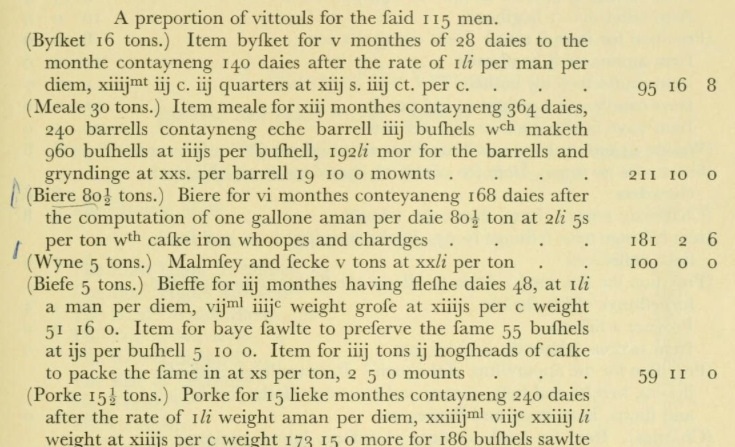
Martin Frobisher. He was taking a group of miners to what later gets called Baffin Island¹ in the Canadian high Arctic to dig for ores. The image is from The Three Voyages of Martin Frobisher, a book from 1938 that reprints the 1576-78 journal of crew member George Best along with other records. It is very likely that this is not of the first beer in any respect. Almost certain. Because it is from the second of the expeditions. The 1576 expedition had five tons of “beare” listed amongst the “furniture” – as in things furnished – for the voyage. So it’s nearly the first… maybe.

The thing I thought I would find as I have seen elsewhere was barrels of malt and hops being shipped over. I’ve seen it on Newfoundland’s shores about twenty years later as well as in Hudson Bay a century later. But this was no crew of masterless West Country men salting west Atlantic cod or factors left to overwinter to trade in northern furs. Nope. Frobisher’s crew was funded by Earls, Countesses and Lords to the tune of 50 to 200 pounds each. The Queen’s Majesty herself threw in a rounded thousand. There was a surgeon on board as well as four tons of cheese. Almonds and raisins plus two firkins of prunes. Just in case. They are living in style. There is both Malmsey and sack, for heaven’s sake. That would now be described as Madeira and sherry respectively.

A gallon of beer for each man each day. Likely downed in wooden tankards like these. A gallon. That is the equivalent of twelve 12 oz or 350 ml bottles a day every day. In 1576, it was two pounds two shillings for a ton of beer but two pound five shillings in 1577. Seven percent inflation over one year is unlikely. Maybe a better grade of beer? Not a lot of detail of the life on shore in the accounts. Just interaction with the local Inuit as well as the work gathering of tons of ore. Each group seemed to appear pretty silly to the other.

¹… because our lad Billy Baffin isn’t even born until around 1584.

Ontario: 1600’s Hudson Bay Company Arctic Ale

image_thumb83So, we are working through the final draft of the history of beer in Ontario and I realize something has been staring me right in the face for quite a while now. Here is the passage in question:

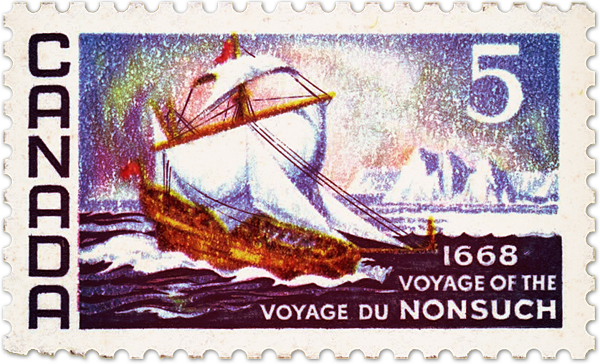
The early ships’ crews considered its beer of great importance and even survival. In 1668-69, the crew of the Nonsuch over wintered on the James Bay coast and reported upon their return:

…they were environed with ice about 6 monethes first halting theire ketch on shore, and building them a house. They carried provisions on shore and brewd Ale and beere and provided against the cold which was their work…

See what I missed that was sitting right before my eyeballs? They brewed ale and beer. The news was reported in issue 408 of The London Gazette, too. Not that they made both ale and beer but that they survived a winter in the Canadian Arctic. The Nonesuch was small and tough, custom picked to both survive the trip to the edge of the known world and be hauled out of the water to avoid the crush of ice. Only 53 feet long, a replica can be found in a museum in Manitoba. Manitoba? Yes, well, after the British Parliament’s Canada (Ontario Boundary) Act of 1889 introduced a boundary that divided the former Rupert’s Land that included the watershed of the big bay, including much of what became Ontario’s north.

Got it? Wonderful. But let’s get back to the point. They made two things to drink. Two fermented beverages. Why? You are stuck in a situation that may as well be the dark side of the moon, you have cleverly brought a survival space pod as well as sufficient supplies (think food in tubes) to make it though the six months of frozen horror… and you make two types of booze? Why the heck do you do that? Well, just a century and a generation before the voyage, the benefits of ale was described in 1542 by the physician Andrew Boorde in his book A Dyetary of Helth. The key was conveniently referenced by Martyn this week: “Ale for an Englysshman is a naturall drynke.” Yet he is also the man who wrote:

If it do come by an hurt in the head, there is no remedy but pacience of all partes. If it do come by debilite of the brayne & head, drynke in the mornynge a dyshe of mylke, vse a Sirupe named Sh’upus acetosus de prunis, and vse laxatiue meates, and purgacions, if nede do requyre, and beware of superuflous drynkynge, specially of wyne and stronge ale and beere, and if anye man do perceuye that he is dronke, let hym take a vomite with water and oyle, or with a fether…

….so it is hard to know what to believe. Especially if you remember what Pepys said folk on ships got up to when they were on the ale on April 30th, 1660:

After that on board the Nazeby, where we found my Lord at supper, so I sat down and very pleasant my Lord was with Mr. Creed and Sheply, who he puzzled about finding out the meaning of the three notes which my Lord had cut over the chrystal of his watch. After supper some musique. Then Mr. Sheply, W. Howe and I up to the Lieutenant’s cabin, where we drank, and I and W. Howe were very merry, and among other frolics he pulls out the spigot of the little vessel of ale that was there in the cabin and drew some into his mounteere, and after he had drank, I endeavouring to dash it in his face, he got my velvet studying cap and drew some into mine too, that we made ourselves a great deal of mirth, but spoiled my clothes with the ale that we dashed up and down. After that to bed very late with drink enough in my head.

Is that what they were doing with that ale up there in the Arctic in 1668? My heavens.

Two Wooden English Tankards From The 1500s

1500stankard1

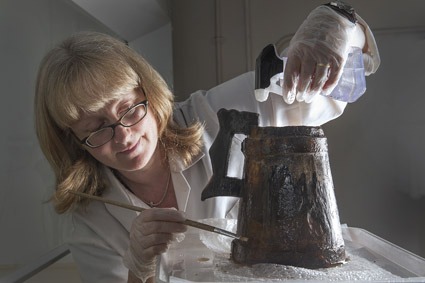
A few months ago, I referenced a wooden tankard that had been found on Henry VIII’s flagship, the Mary Rose, as part of my review of Mitch Steele’s book IPA. I didn’t clue into one aspect of the tankard until I read this story about another similar wooden tankard from the 1500s found last year in the mud of the River Thames as described in this story posted at the Museum of London’s website:

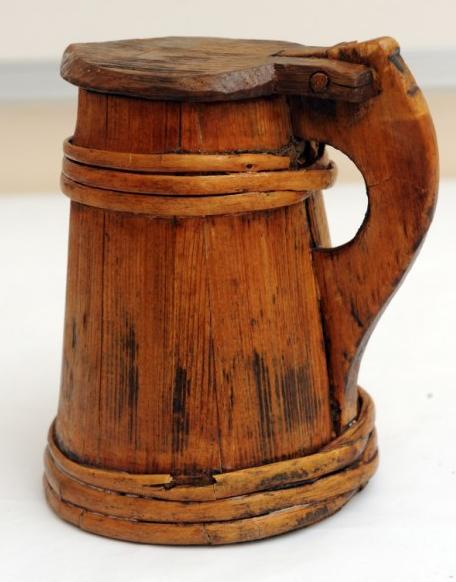
It is comparable in shape to a modern beer mug, however, this tankard holds three pints. Was it used to carry beer from the barrel to the table or, was this someone’s personal beer mug? The quantity of liquid held in the tankard and markings suggesting it once had a lid, may indicate that it once served as a decanter. However, the lack of a spout seems to contradict this theory. The only other items that are contemporary and similar in appearance come from the Mary Rose, although the Mary Rose examples carry 8 pints.

1500stankard2Eight pints!! That is otherwise known as a gallon. Click on the picture to the right for a full version of the Mary Rose tankard.  Notice how it appears to have straps of split branches rather than metal. Notice also how the photo above of the three pint tankard neatly illustrates how the handle shape likely indicates there was a lid just as on the Mary Rose tankard. Otherwise, why does the handle rise up above the rim as it does? Nothing like the well applied use of scientific photography in the cause of drinking vessel description accuracy by Murray Saunders for the Daily Mail and the unnamed photographer in the Wharf article. Perhaps a guild of their own is in order.

Speculation goes on that these large vessels may have been used as jugs but I wonder. Not only is there no spout, obviously a known technology in those times but it presumes very odd handling of the beer. Barrel to jug to mug. Why not just barrel to mug? B => M is better than B => J => M technology as it needs no staff person as middleman. No waiter. Why wouldn’t these sailors just be lined up daily and given their full gallon, the measure for consumption throughout day? It’s not like they are sitting in a pub as they drank the stuff. Besides, ship’s beer was weak. And anyway, serving jugs had a different shape.

The State Of English Fuel And Malt In 1593-ish

tudorbeer1Ah, the 1500s. Remember them? They were great. Jeff’s comments yesterday got me thinking about causes for changes like the introduction of coke in the early 1600s and its application in malting at mid-century. See, there is this idea that goes well beyond brewing history that somehow folk in the past were dim and ate poorly that casts a shadow on the idea that coke was introduced to make pale malt and while Jeff didn’t speak to that, the temptation to reverse the clock and make chronology run backwards can be seen at play. I don’t believe any of it. For the most part, folk didn’t sit around glum at the state of their technology wishing for a better tomorrow. They were pretty much as clever as we are just that they operated within a construct of technology and knowledge that differed from us. No? Well, just don’t be thinking what the future will make of us, then.

What was the English speaking beery world like over four centuries ago? In his “Dietary” of 1542, Andrew Boorde made himself clear about what he considered was the best ale:

“Ale is made of malte and water; and they the which do put any other thynge to ale than is rehersed, except yest, barm, or goddesgood doth sophysicat there ale. Ale for an Englysshe man is a naturall drinke. Ale muste have these properties, it muste be fresshe and cleare, it must not be ropy, nor smoky, nor it must have no wefte nor tayle. Ale shulde not be dronke under .V. dayes olde. Barly malte maketh better ale than Oten malte or any other corne doth…

Not smoky. Interesting. In the latter 1500s we are still in the world of beer and ale with beer being very much the newcomer on the block. In the 1550s, beer is a manly burly drink while ale is for the ladies and young. By 1577, it is described as being for the old and ill.¹ Malt markets were part of the weekly cycle of life. In York:

…the 16th century the malt market was held on Tuesdays, Thursdays, and Saturdays, near St. Martin’s Church in Coney Street; the hours of sale to citizens and foreigners were regulated and a bell rung to announce its opening. It was permissible for malt to be brought into the city on Mondays, Wednesdays, and Fridays if it had already been sold.

Note that it is a market for sales to citizens by maltsters coming into that city. In Elizabethan England was less than five million and Stratford upon Avon had just about about 1,500 inhabitants. A report in the town’s records by Shakespeare’s local pal still living there, Richard Quyney, gives a contemporary picture of the important role of malt: “Auncient in thys trade of malteinge & have [sic] ever served to Burmingham from whence, Walles, Sallopp, Stafforde, Chess. & Lanke allso are served.” Stratford is a regional malt hub with an extended reach. Quyney also noted a downside of this community asset:

….houses made to noe other use then maltinge’ and complains that the town is “deceived by reson of contreye malte kylnes wch make ther owne Benifytt in malting ther Barley att home, wch usuallie was Brought to be solde att or m’kett & ther made & converted to malte.” A survey taken in 1598, a year of high prices and great distress, shows that 75 persons, probably a third of the more substantial householders in the borough, had stores of malt on their premises, amounting in all to 696 quarters, while 30 of them had also 65 quarters of grain of various kinds…. Of the malt returned in the survey of 1598 rather less than two-thirds is classed as townsmen’s malt; the remainder, 250 quarters, is strangers’ malt.

The “strangers” storing their malt included many leading citizens from the neighbouring region. In a time of famine, this stockpiling in Stratford was not welcome and a resident of Stratford invited the Earl of Essex, a favorite of the Queen, to come to the town and restore commercial order by having the maltsters hanged “on gibbetts att their owne dores.”² Sounds like speculation going on. Why? In that same decade, use of malt for home use is being restricted due to a lucrative market export market for English beer having been established.³ There is now a developing opportunity for making money in brewing and malting at a scale.

In addition to pressure from investors and speculators, there was something of a crisis in malt and fuel supplies as far back as the mid-1500s:

…the forests around York had greatly diminished and receded. Chiefly for this reason the malt kilns were in 1549 closed for two years and a survey of disforestation for eight miles around was instituted. At this time, too, the commons included the dearness of fuel in their bill of grievances and the M.P.s were asked to seek a commission from the king to check disforestation.

The crisis of English deforestation led to a search for fuel alternatives and the main alternative was coal. The timber crisis was most acute in England from about 1570 to 1630 during which making coke from coal was invented. The vast majority¹¹ of coal, however, was not appropriate for malting. Unlike the best malt from wood kilns, coal would be worse than smoky, it would be fouled. Which, when you have a population needing beer as well as new speculating investors wanting beer to export is not good.

So where does that get us? To a world around 1600 where traditional pale malt making continues using diminishing resources including wood but also wheat-straw, rye-straw, barley-straw or oaten-straw… and, if it is all you have, dried ferns. In 1642, an entire contemporarylifetime later, coke – only conceived of as a product derived from coal in 1603 – is first used to make pale malt without the traditional bio-mass. Was it actually due to the need to “invent” smoke-free pale ale? Not really. But greater volumes of pale ale would have become available. Was it due to the opportunity to invest in brewing to maximize the export opportunity as part of a larger reordering of society and resources? Probably. Tensions from the middling gentry, the rise of non-conformity, English colonization of America and trade with other parts of the world took all off at this same time, creating the world we live in today. But, really, the shift to malting with coke occurred because there was no choice. The forests and other sources of bio-mass were disappearing fast.

¹See A History of Beer and Brewing by Ian S. Hornsy, (RSC, 2003) at page 353.
² See Shakespeare’s Professional Career by Peter Thomson, page 10.
³ See Honsey at page 351. Also there were objections to the number of malt-kilns in York according to “The Tudor economy and pauperism“, footnote 31 at British History Online: “Richard Layton told Cromwell in 1540 that the demand for malt played into the hands of corn regraters and also caused every idle knave in York to get an alehouse, so impairing honest trade.” A regrater was a middleman, a retailer, a taker of a slice.
¹¹In the late 1880s, a grade of Welsh coal was called “best malting coal” due to it having less than 1% sulphur, 0% arsenic and very low ash. One business listing from 1881 from a Swansea merchant claims: Carvill Bros. (& importers), 34 Merchants quay, Drysdale G.A. (best malting coal as supplied to many of the largest maltsters, brewers and distillers in the kingdom. Prices quoted delivered in truck loads to any railway station in England, also f. o. b. at Swansea, or delivered to any port, including cost, freight, and insurance ; exporter of best lime burning & hop drying anthracite coal) ­ Address, Mailing Coal Offices, Swansea.

My Most Interesting Discovered Drinky Thing Of 2011

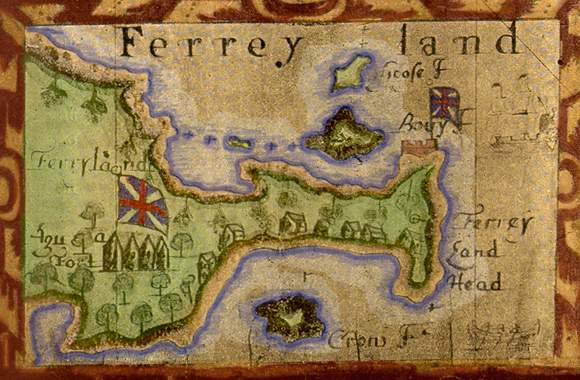
mapof_ferryland

This has been a year that I have thought about history a bit more than others. Canadian history for the most part. We make great mistakes in considering our own time on this land. We dismiss the First Nations. We pretend that Canada began when the current constitution was signed in 1867. But Canada has been populated for thousands of years and Europeans have been nibbling at the edges for the best part of a millennium. Vikings lived in northern Newfoundland back then. In 1674, the Hudson’s Bay Company was importing malt and hops into the Arctic. But this year I came across another couple of fact that I found most interesting in this report. It’s in the bibliography:

ROSS, L. (1980) – 16th-Century Spanish Basque Coopering Technology: A Report of the Staved Containers Found in 1978-1979 on the Wreck of the Whaling Galleon San Juan, Sunk in Red Bay, Labrador, 1565. Manuscript Report Series.Ottawa. 408.

See that? 1565. And the other thing? Staved containers. I have found West Country seasonal fishermen recorded as importing malt as part of their seasonal businesses packing salt cod for the Iberian market in the 1630s. How far before that did the practice occur? Peter E. Pope in his book Fish into Wine: The Newfoundland Plantation in the Seventeenth Century explains that there was a regular practice of travel each spring from Elizabethan England to what is now eastern Canada for this fishing trade. It is inconceivable that these men in the 1500s did not ship malt, too. That they did not pack drinks in casks for the voyage here and back, too.

But where are the records? Where are the records for Albany ale for that matter like Taylor’s brewing books? Or early Ontario beer? That’s the thing. The records. In overseeing the OCB wiki, it has already become a little bit of a jostle over which record is the one to be trusted. Yet there is the tantalizing possibility that in the later half of the 1500s on cool spring days on the Newfoundland shore, men made beer for themselves many decades before the first beer was thought made in this country. There is a phrase for those whose families went on in places like Ferryland to shift to year round residence: masterless men. Don’t you think they might have made themselves a little beer?

Mmm… What I Need Is A Big Bowl Of Thick Beer!

flemish1I knew this. I think I knew this anyway:

“This process is much like how you would do in a fourth-grade germination science project, where the grains would be soaked in water for about 24 hours, drained and then laid between sheets of cloth until they sprouted,” said Amanda Mummert, an anthropology graduate student helping Armelagos with his research. After germination, the grains were dried and then milled into a flour used to make bread. Streptomyces bacteria most likely entered the beer-making process either during the storage or drying of the grain or when the bread dough was left to rise. Nubian brewers would take the dough and bake it until it developed a tough crust, but retained an almost raw center. The bread was broken into a vat containing tea made from the unmilled grains. The mixture was then fermented, turning it into beer. The final product didn’t look much like the pint of amber you sip at your local watering hole. “When we talk about this ancient Egyptian beer, we’re not talking about Pabst Blue Ribbon,” Armelagos said. “What we’re talking about is a kind of cereal gruel.”

I knew that. Not that bacteria stuff. No, not that. Forget all that medical properties stuff. Look at that word “gruel”! I think there was reference to the thickness of 1500s gruel beer back in Martyn’s Beer: The Story of The Pint which I am surprised to now read that I blogged about seven and a half years ago. There is stuff in Hornsey about beer as gruel as well. Boozy porridge. So, how is it when we are presented with these supposedly authentic ancient beers, well, they pours like water or least an IPA?

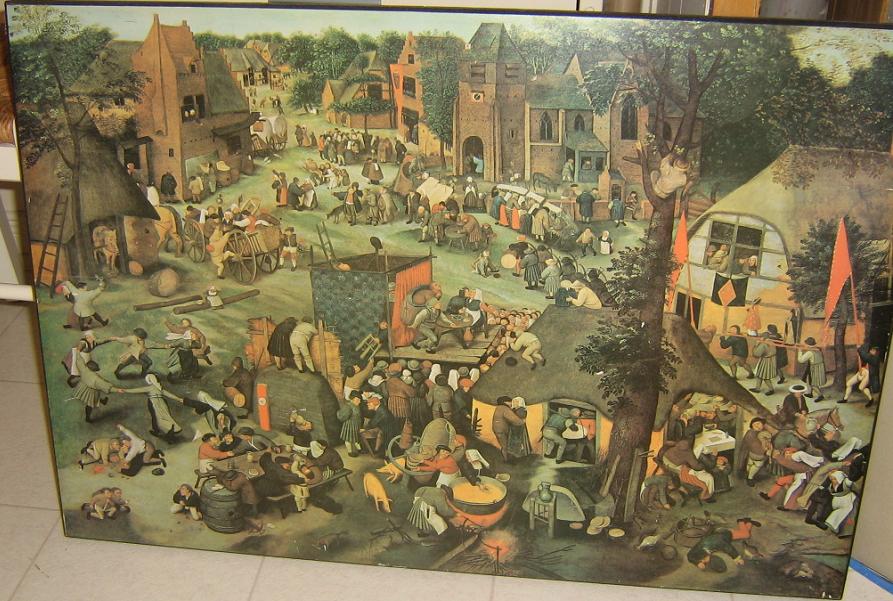
More to the point, don’t you want to try some breakfast gruel beer? Couldn’t we make it like it was enjoyed back then? Not the contemporary southern African version for 12 to 20 but the big vat whole dang community serving sized pot o’ Quaker Oats meets Budweiser. If we look again at “Village Kermis With Theater and Procession” by Pieter Bruegel the Younger (discussed in in 2007 in terms of the pub game in the lower left) we see in the lower center the making of a big mess of something being sucked back by the crowd, right across the street from the joint I’d guess was the tavern. Have a look at the painting Bruegel maybe ripped off and the detail is even better. I am not suggesting we need to get all deep about this stuff but does anyone do a village kermis with gruel booze anymore – other than, say, in rural Romanian where I am pretty sure I will never find myself? Would people folk to such a legitimate recreation as much as for another thinly veiled faux stab at brand buffing? Apparently the children’s games scholars are already at it.

Breaking News: Their First Beer Festival In 400 Years

Big news out of Lyme Regis in Dorset, England as they are reviving or at least reinterpreting a festival that ended back in 1610.

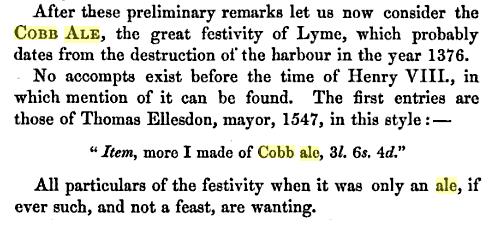
The ale will be in full flow at Lyme Regis when the town hosts its first beer festival in 400 years. A festival called The Cobb Ale started in Lyme in the 14th century and lasted for around 250 years. The annual knees-up was held to raise money for the maintenance of the Cobb but it was stopped around 1610 by the Puritans. Now three local brewers, the Mighty Hop Brewery and Town Mill Brewery, both in Lyme Regis, and North Chideock’s Art Brew, will revive the tradition for a one-day festival in March.

Friggin’ Puritans. They ruin all the fun. But there is fun – real fun – to be had and it is not some phony baloney made up thing. You know that’s true because the Victorians wrote about it. That clip way up above is from the 1856 books called The Social History of The People of the Southern Counties by George Roberts who spends twenty pages or so – from 327 to 346 or so – on the history of the Cobb Ale festival. It is great stuff.

OK, it may be an utter lie as might be the renewal but it is very entertaining. Martyn and other cleverer folk than me know more about this stuff but the very idea that something celebrating 1376 could be celebrated still is very appealing to me. I might take it so far that, for me, the distinction between “ale” as festival and “ale” as the juice that makes the community festive described by both Martyn and George above escapes me a bit in the light of the knowledge that they who celebrated knew the resonance of one meaning to the other. It’s a bit like “party” as both noun and verb in the sense that one parties at the party. Having an ale at an ale must have been all quite affirming.

Book Review: A History of Brewing in Holland 900 – 1900

hbhI started reading my copy of A History of Brewing in Holland 900-1900: Economy, Technology and the State by UBC professor Richard W. Unger, published in 2001. Careful readers will recall that I had ached after this book ever since I reviewed his 2004 publication Beer in the Middle Ages and the Renaissance but was a bit depressed about the sticker price of this one. Divine (or at least professorial) intervention, however, landed me the prize of a review copy.

I am only about 70 pages in – up to the 1400s – and am fascinated all over again by the precision and detail of the research yet also by how readable Unger makes understanding his work. So far, in a nutshell, he has taken medieval tax and shipping records and then traces how the semi-autonomous cities and towns within and neighbouring the Low Countries produced traded and consumed beer. He shows how Holland’s success in leveraging the new fangled hop that arrived from the south-eastern North Sea shipping trade in the 1300s led to the replacement of gruit as a flavouring in beer, triggered a shift in taxation and public regulation while expanding commerce through the ability of hops to stabilize the beer to allow it travel farther while maintaining its good condition. This portion of the book mirrors some of what was included more detail in his other book – for example, how taxes were based first on granting a monopoly to supplying an ingredient (ie counts farming to local towns the right to control the gruit trade) then on the production of beer (excise tax based on production provided more than 50% of Lieden’s revenue in the early 1400s) then on control of shipping of beer (through tolls, holding periods for trans-shipped casks and special import duties). The general information on the medieval economy is also interesting – like the fact that the Black Plague led to the marketplace for labour after it passed through as the survivors could decide what to do with their skills and thereby their lives.

I will add to this post as I move through the book but, again, I am struck how I would love to find a current text of this detailed quality in relation to the economics of English, American or any other region’s brewing but, other than Hornsey’s more scientific and encyclopedic A History of Beer and Brewing, know of none.