One Brewery And The Problem With Records

kingston17901kingston18011kingston18101
kingston18151
kingston18281
kingston18451
kingston18491
kingston18501
kingston1850a1
kingston1850b1
kingston18531
kingston18581
kingston18661
kingston18691


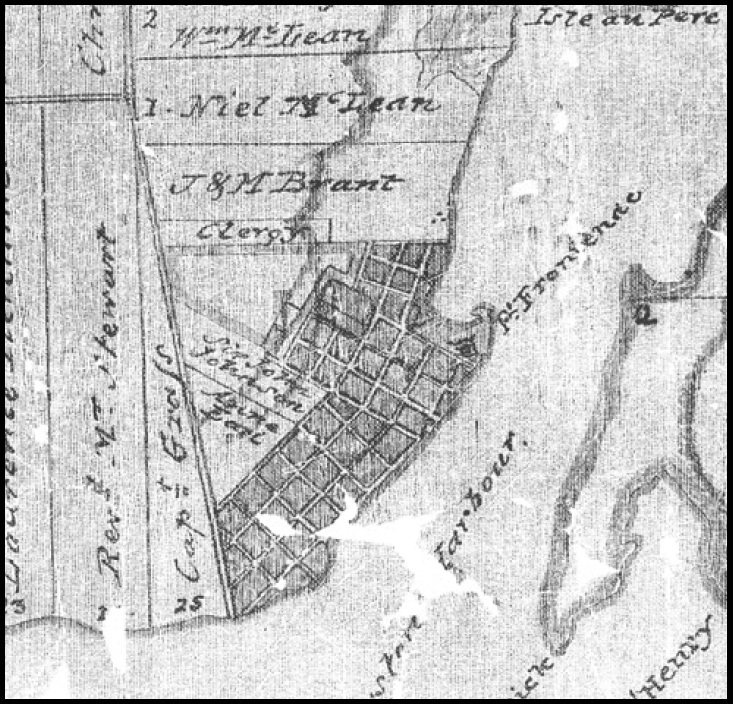
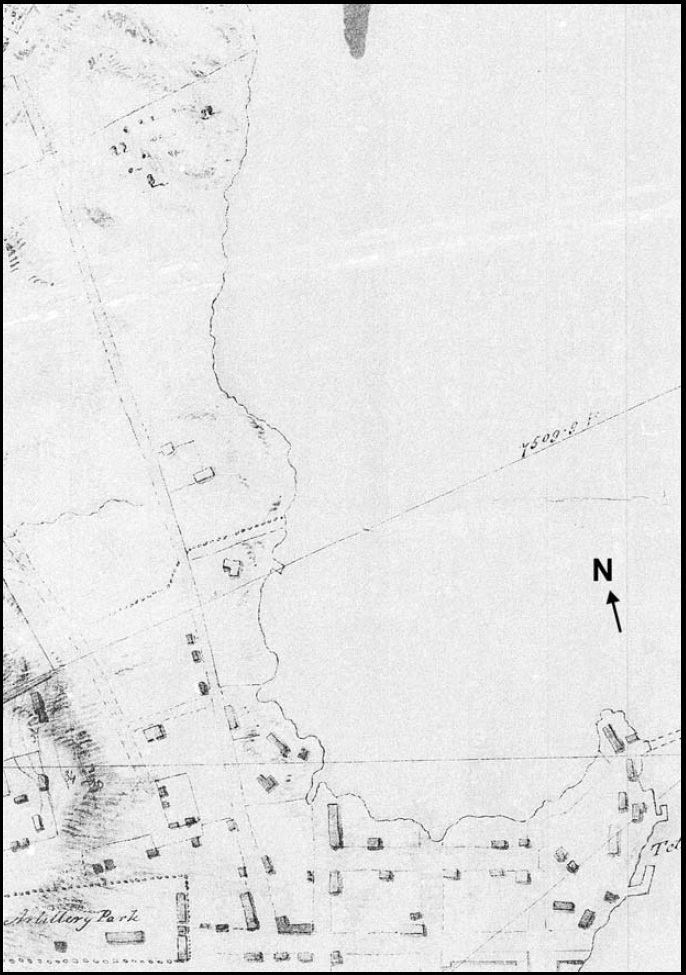
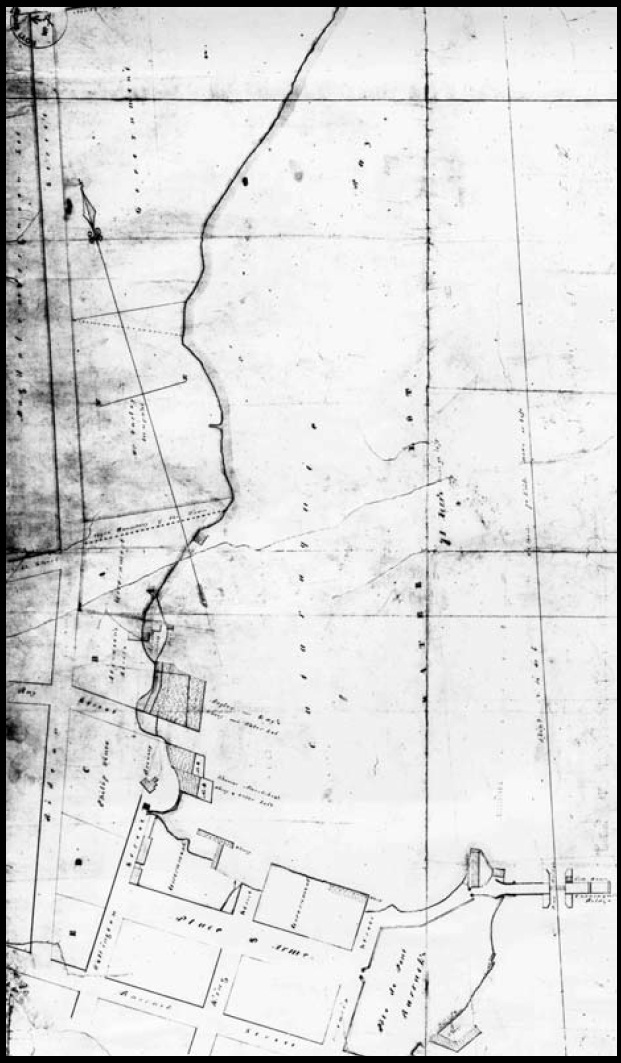
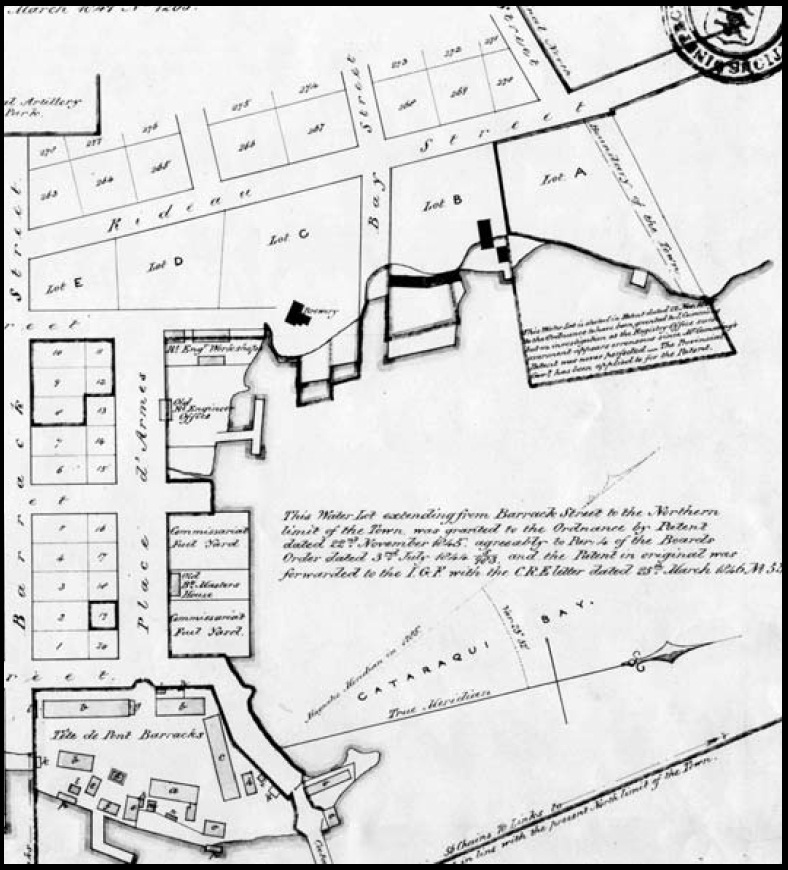
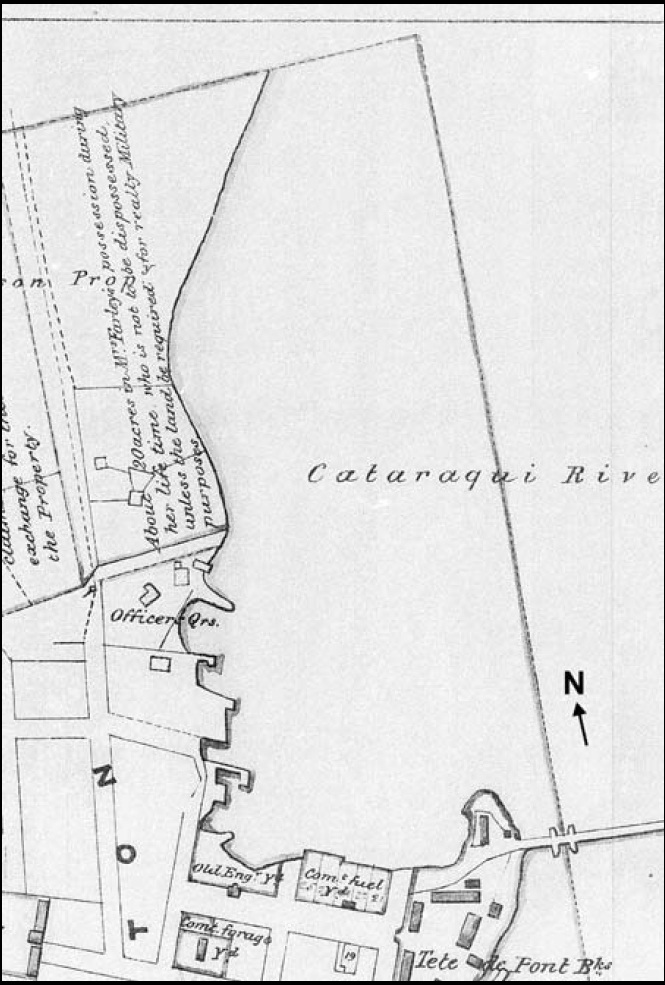
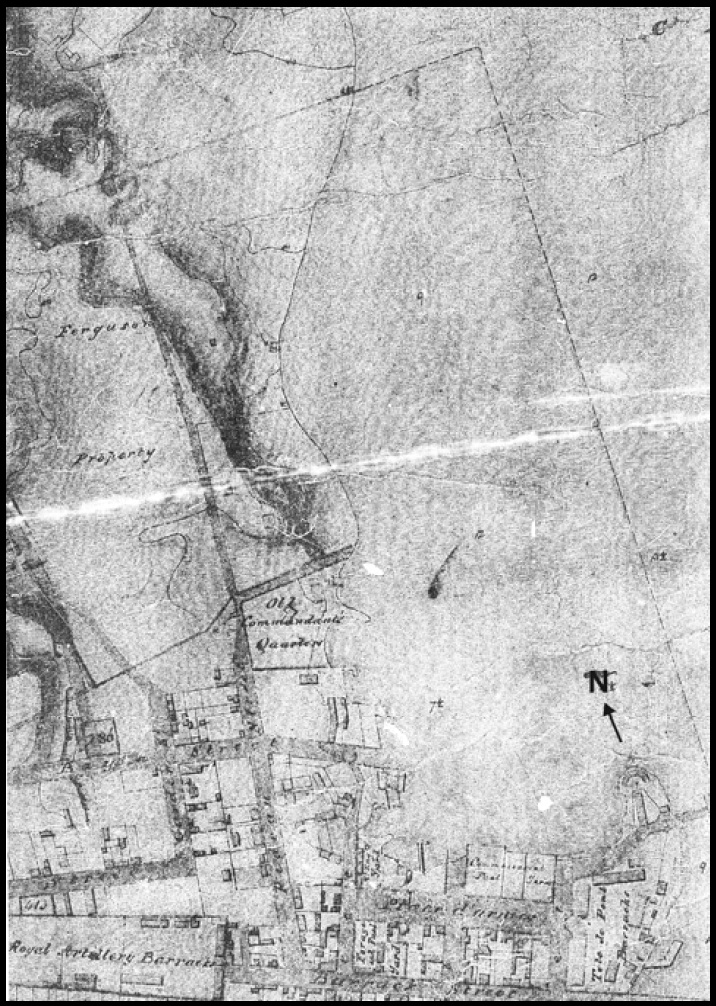
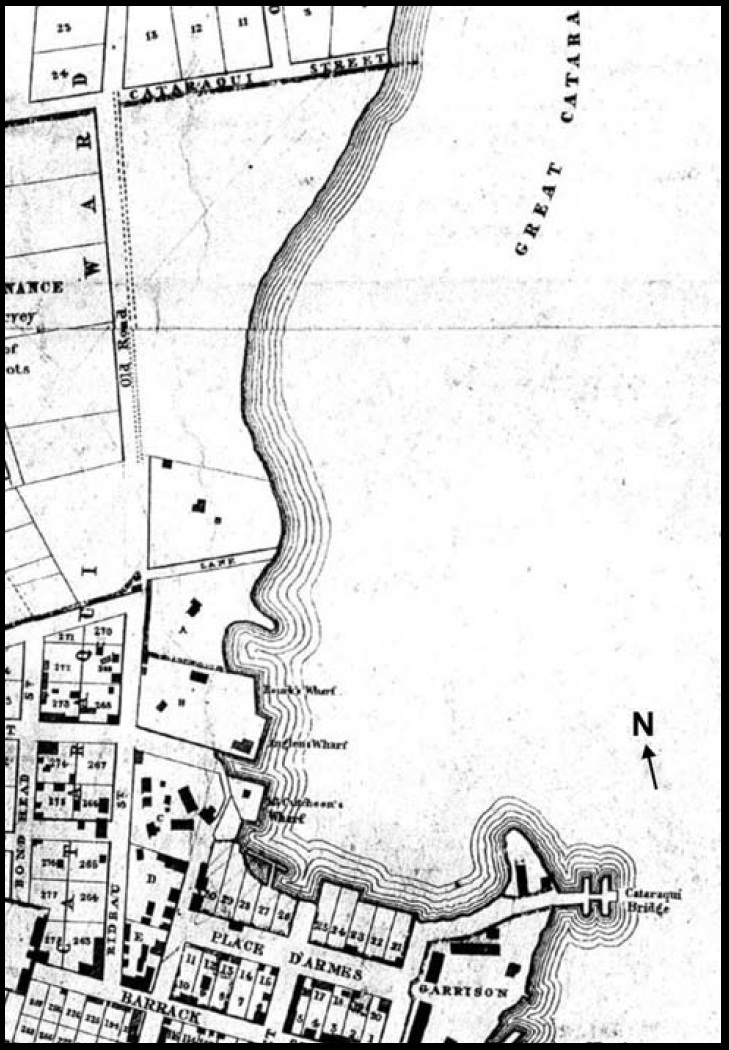
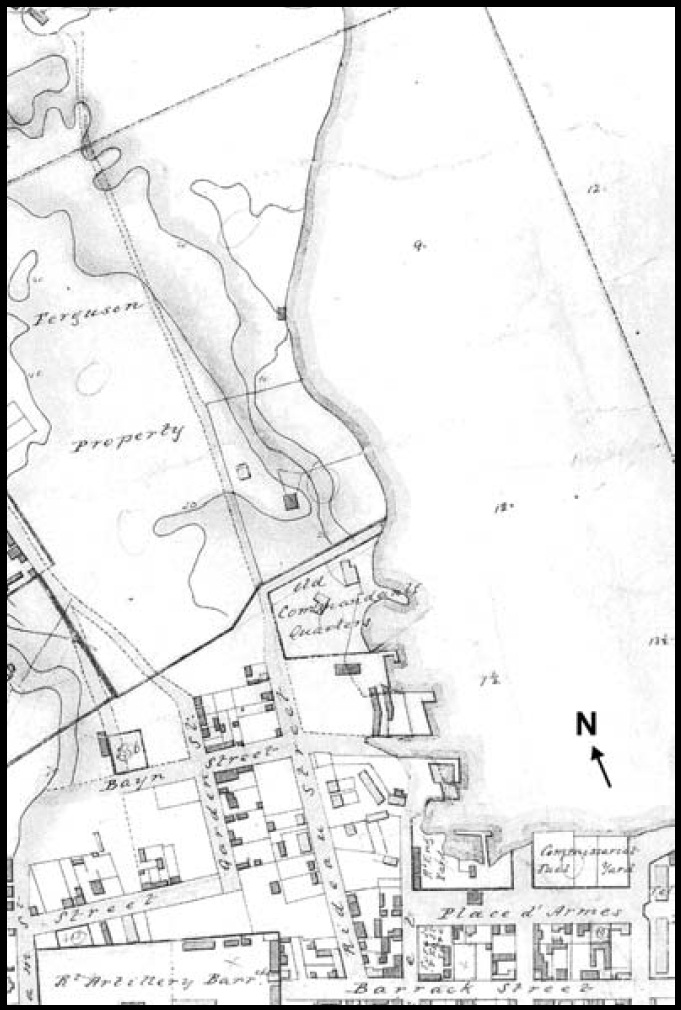
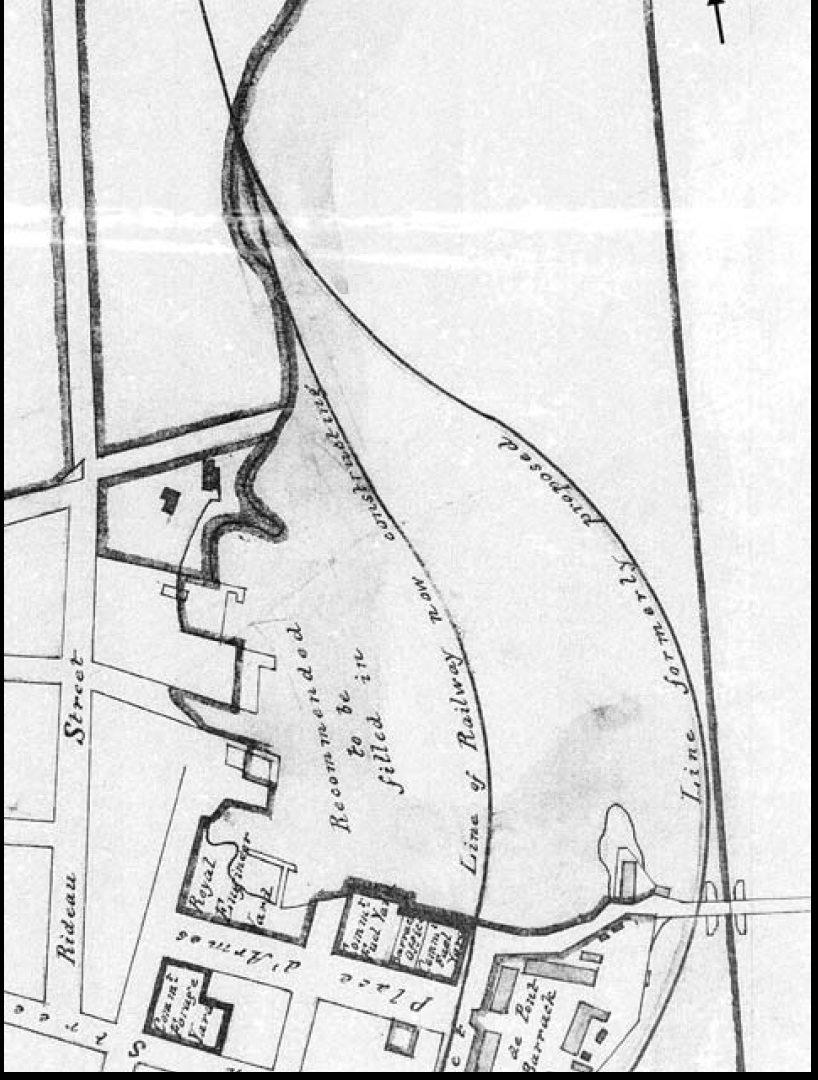
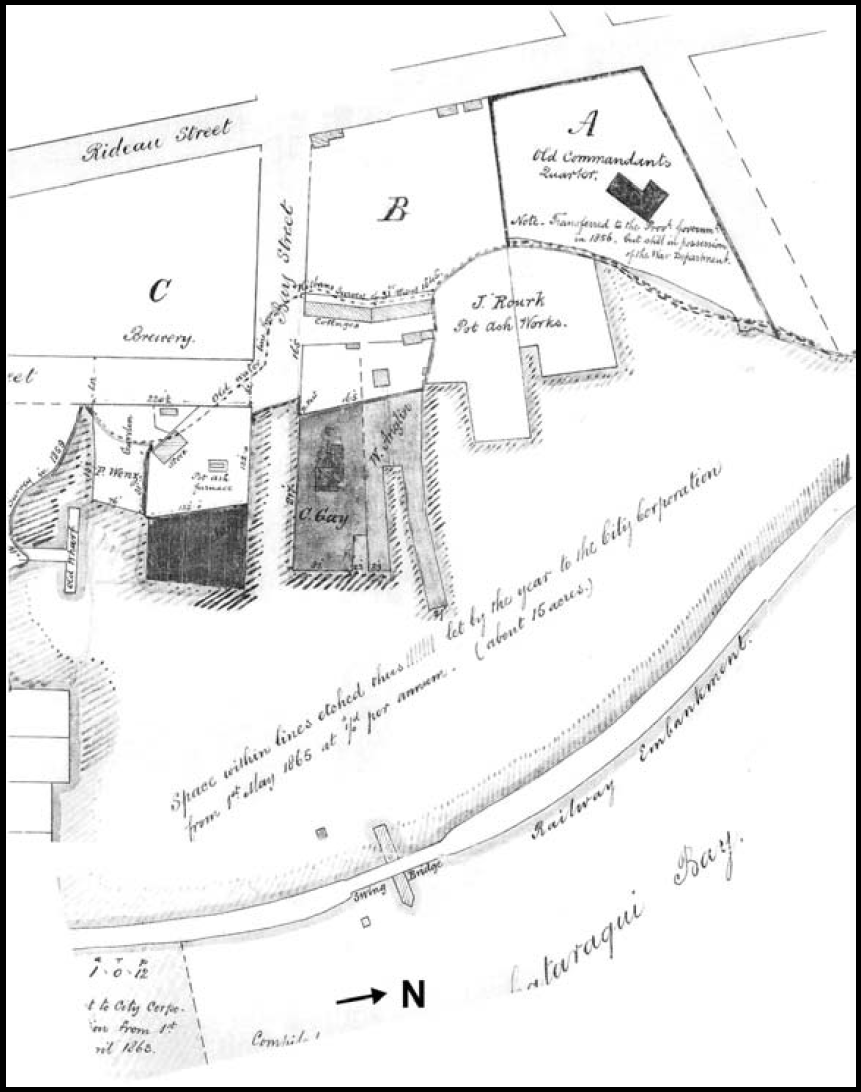
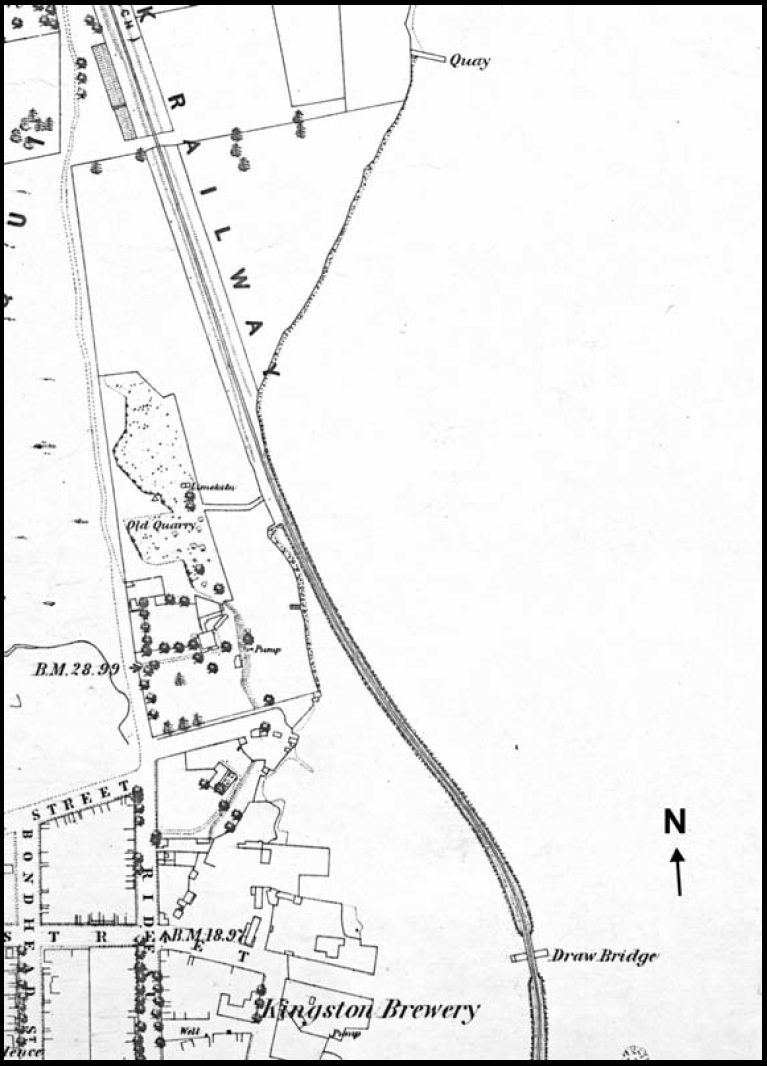
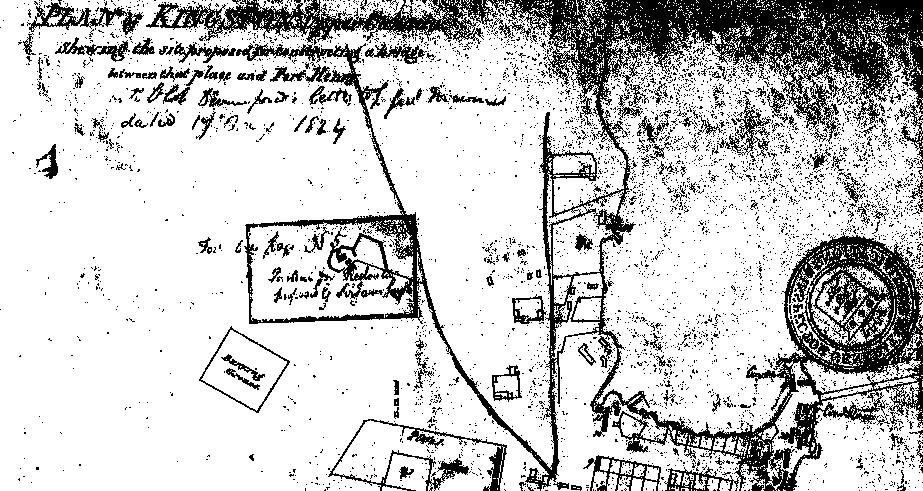
I hate records. Well, I really like them. But I hate them. See, we are subject to their limitations… or at least two of them. Or three. The last one first. Finding them. For a while I have been grabbing images of maps including the sites of early breweries in Kingston. I have not seen the actual maps. Just the scans. So I realize that, over time, I have noticed that the maps do not focus on my needs but the needs of others. How surprising. But then I next realize there are other records I know nothing about. The maps above are from the 1790s, 1801, 1810, 1815, 1828, 1845, 1849, 1850, 1850, 1850, 1853, 1858, 1866 and 1869 respectively. There must be others. Yet, I know there isn’t the set I need. A set of maps about the Kingston Brewery first built no later than 1793 and then build up and added to… and renovated… then burned down then rebuild and added… and renovated… then burned down… and built again. What did we write about this spot in Ontario Beer?

In the garrison communities of Kingston and Niagara-on-the-Lake, larger and more formal breweries were founded to supply the colony generally and the troops in particular. They were built with government approval to provide beer to the colony and its protectors. In 1793, at Niagara-On-the-Lake, John Hewitt placed a notice announcing both establishment and official approval of his brewery. It was set to open in time for that year’s grain harvest. In that same year, John Forsythe built his brewery in Kingston at the south end of the aptly named Brewery Street. Forsythe appears to have been an investing capitalist, apparently without the skill or inclination to brew the beer himself. He moved through a number of partners and tenants before John Darnley took over operations in 1797. Darnley managed the brewery until 1810.

Steve Gates has more detail in his book The Breweries of Kingston and the St.Lawrence Valleybut the most interesting thing is that part of the structure of the brewery as it grew and aged and hung on and got turned into condos is still there. Which got me thinking… what is still there? So, we go to the maps. In the 1790 map, the road is called Brewery Street which makes one think there is a brewery on the street but the brewery is not shown where it is later shown. The 1801 map shows a couple of buildings on water lot “C” and the 1810 map names lot “C” as being in the hands of John Forsyth – no final “e”. So we know we have the right spot. The 1828 map shows the location of buildings in quite a realistic style oriented towards the shoreline just north of where it takes a 90 degree turn. A small Georgian colonial enterprise.The 1845 map shows one building sitting in the way of the northern ambitions of Wellington Street. It also shows water lot “C” as the property of Phillip Wenz who bought it in 1826.

The 1849 map is a peach. It shows the brewery clearly and also how the water lots are getting filled in. The brewery is starting to seem out of time with the surrounding land uses. It’s not on the first 1850 map. It is on the second one and seems to have a lane working its way around the front of it to take into account the odd orientation of the building. The shoreline is getting farther and farther away with all the filling going on. The last 1850 map and the 1853 one shows up to ten buildings located on water lot “C” all entirely higgle-piggle to each other. The 1858 one shows no brewery building but a whack of new fill proposed to take into account the snazzy new railway. The 1866 map shows Wellington now reaching all the way to Bay Street, built on fill, the brewery noted on the new street corner. By 1869, it appears the brewery is all neat and tidy and faces the road neat and tidily like all the other orderly Victorian structures in the neighbouring roads. None of your organic Georgian ways for this modern brewery.

What does all this mean? Well, there could be the recording of four or five configurations of the buildings. None of which were the location I noted in 2012. If you click on the left hand image at the top of this post, you can see some of the oddly oriented buildings were still there in 1908. And bits of that era continue today as you can see in this post from 2003 the building hundreds of feet inland from the 1824 waterfront location. It moved overtime. Reconfigured. If you had enough of the right records you could write an entire book on the history of that one patch of land. If you had the right records.

Pre-1600 Ale And Beer Not All Dark And Smoke-Laced

1885malttable2

This has been a bit of a brain worm for me for a while. No, not that kind. The other kind. And for a longer while, I’ve been reading about how, before a certain point, all English beer and perhaps elsewhere was brown and smokey. But, quite rightly, the other day I was righteously snapped at for referring to the one post I have written on the idea. I should do a better job that that if I am going to get any sort of passing grade. So, here are some ideas that I am plunking together now. This is not to be definitive. I am showing my work and will build it upon going forward:

• Mid-1200s: In the first half of the 1200s, when England and northern France were under one government but still two cultures, Walter of Bibbesworth wrote Le Tretiz, an English-French primer to teach Anglo-Norman children about life and language. He describes the things in the world including ale making. A current edition of the book ishere. This is a translation from which we find this passage about malting:

Now it would be as well to know how to malt and brew
As when ale is made to enliven our wedding feast.
Girl, light a fennel-stalk (after eating some spice-cake);
Soak this barley in a deep, wide tub,
And when it’s well soaked and the water is poured off,
Go up to that high loft, have it well swept,
And lay your grain there till it’s well sprouted;
What you used to call grain you call malt from now on.
Move the malt with your hands into heaps or rows
And then take it in a basket to roast in the kiln;
Baskets, big or little, will serve you in plenty…

That tells us the basics of malting in a way that one commentator states “…medieval malting was, except for the lack of mechanical processing equipment, essentially identical to modern techniques.” Maltings from the 1200s were discovered this year in Northampton.

• Mid-1300s: One hundred years and more after Walter of Bibbesworth, there is a record that confirms, ale was not uniform within a single local market for as reasonably a long time as one needs to consider it a hell of a long time. In 1378 or so, in a moral narrative called Piers The Poughman at least three sorts of ale: thin or mean ale, good ale and best brown ale. He also uses the phrase “halfpenny ale” but that may well be good ale. Variety of ale brewing must include consideration of the potential for variety in malting techniques.

• Mid-1500s: As discussed in February of 2013, in his “Dietary” of 1542, Andrew Boordemade himself clear about what he considered was the best ale:

“Ale is made of malte and water; and they the which do put any other thynge to ale than is rehersed, except yest, barm, or goddesgood doth sophysicat there ale. Ale for an Englysshe man is a naturall drinke. Ale muste have these properties, it muste be fresshe and cleare, it must not be ropy, nor smoky, nor it must have no wefte nor tayle. Ale shulde not be dronke under .V. dayes olde. Barly malte maketh better ale than Oten malte or any other corne doth…

Not smokey. Pretty clear statement.

• Later-1500s: In this 2004 report on an archaeological excavation of a medieval malting kiln it is stated:

The fuels used in the malting process were documented in 1577 by William Harrison, who wrote: “In some places it (the malt) is dried at leisure with wood alone, or straw alone, in other with wood and straw together, but of all, the straw dried is the most excellent. For the wood dried malt, when it is brewed, beside that the drink is higher of colour, it doth hurt and annoy the head of him that is not used thereto, because of the smoke.

Notice that again we see grades of now hopped beer just as we did in 1378 but it is not quality of strength that differentiates but the quality of the malt. And wood-kilned malt is noted to be both darker and the means to make a poorer beer – because of the smokey quality wood added. Harrison published his book A Description of England in 1577. Here is a full copy of the text posted by Fordham University in which you will find this: “The best malt is tried by the hardness and colour; for, if it look fresh with a yellow hue, and thereto will write like a piece of chalk. Chalk is, you will note, pale.

• Late 1500s to early 1600s: Also as stated before, there was something of a crisis in malt and fuel supplies as far back as the mid-1500s:

…the forests around York had greatly diminished and receded. Chiefly for this reason the malt kilns were in 1549 closed for two years and a survey of disforestation for eight miles around was instituted. At this time, too, the commons included the dearness of fuel in their bill of grievances and ten M.P.s were asked to seek a commission from the king to check disforestation.

The crisis of English deforestation led to a search for fuel alternatives and the main alternative was coal. The timber crisis was most acute in England from about 1570 to 1630 during which making coke from coal was invented.

• Mid-1600s: In an edition of A Way to Get Wealth by Gervase Markham from 1668, a book first published in 1615 we have an opinion on the preference for straw… and not just any straw:

…our Maltster by all means must have an especial care with what fewel she dryeth the malt; for commonly, according to that it ever receiveth and keepeth the taste, if by some especial art in the Kiln that annoyance be not taken away. To speak then of fewels in general, there are of divers kinds according to the natures of soyls,and the accommodation of places-in which men live; yet the best and most principal fewel for the Kilns, (both tor sweetness, gentle heat and perfect drying) is either good Wheat-straw, Rye-straw, Barley-straw or Oaten-straw; and of these the Wheat-straw is the best, because it is most substantial, longest lasting, makes the sharpest fire, and yields the least flame…

Again, as Harrison half a century before, you have grades of malting based on the fuel used but now not just wood or straw are described but in this passage four separate sorts of straw. But Markham continues. After these light grain straws he lists fen-rushes, then straws of peas, fetches, lupins and tares. Then beans, furs, gorse, whins and small brush-wood. Then bracken, ling and broom. Then wood of all sorts. Then and only then coal, turf and peat but only of the kiln is structured to keep the smoke out of the malt. If you go back to that 2004 archaeological report you will see a reference to evidence of that sort of malt kilning in practice in the 1400s: “… [A] charred deposit overlying the brick floor of the cellar was sampled and found to comprise mainly charcoal fragments from narrow twigs, several straw culm nodes and occasional charred weed seeds.” You can learn more about culm nodes here.

• Late 1600s: In his book A New Art of Brewing Beer, Ale, and Other Sorts of Liquors…published in 1690, Thomas Tryon discusses malting. Large parts of the book was reprinted in the 1885 text Malt and Malting: An Historical, Scientific, and Practical Treatise… by Henry Stopes. Tryon confirms the ascendancy of coke over straw due to its “gentle and certain heat.” Straw, he has to admit, is still a close second but depends more on the skill of the maltster. Wood kilning is called unnatural in that it leaves a smokey taste.

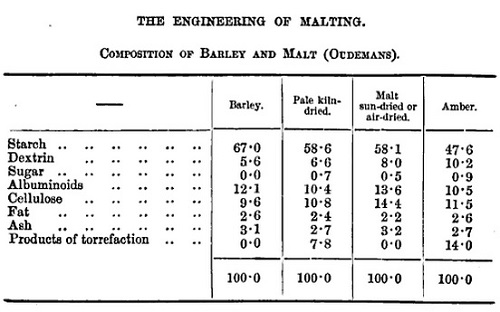
• Late 1800s: A big jump in time to the document from which that table waaaaay up top comes from page 66 of the Transactions for 1884 of the Society of Engineers based in London, England. That table is found in an article “The Engineering of Malting” read by one Mr. H. Stopes at the meeting of that organization. He also read it at the eleventh meeting of the Society of Arts on 18 February 1885. In his article, Stopes describes the malting process briefly in this way: “The English system, briefly, is steeping corn in an open vessel, germinating it upon flat exposed floors at very shallow depths, and drying upon an open-fire kiln with single floor at from nine to twenty-one days after steep.” As noted above, that sort of description could have been written by Walter of Bibbesworth 650 years earlier because the making of malt was an incredibly stable practice. He goes on to describe many sorts of malting he has witnessed including the most basic:

The simplest form of malt-house possessing any capacity for work is a plain two-story building, having attached to it a kiln or drying-house, and consisting of a ground floor of clunch, a brick steeping-cistern, and a first-floor of timber, with or without partitions for separating the stored grain or malt. The only implements are a wooden shovel and a winnowing-fan or sieve to separate the roots or “combs ” from the malt prior to its use in the brewhouse. The author has seen malt made in Italy in an open court or loggia, where the barley was steeped in a tub, allowed to germinate upon the stones in the open air, and dried in a small lean-to building, with only a hole in the roof for the exit of smoke and vapour. This was furnished with a floor of perforated sheet iron and a furnace similar to that used under an ordinary washing copper in an* English scullery. Even more primitive operations are performed in Nubia, as there millet, when malted, is dried in the sun. Such rude malteries Concern us only so far that they occupy the lowest end of the scale, and indicate the necessity for moisture, growth, and curing or drying, the three essential conditions of making malt.

Sun dried malt. That’s be pale. Stopes does not really explain his table. But he includes a column for sun-dried or air-dried malt as opposed to kiln dried. And shows that it, like plain barley, it contains no products of torrefaction. Torrefaction is toasting, roasting, etc. He does however state that kilning pale malt and amber malt is a difference of 200° to 240° F and that the time for malting is counted in days. Plenty of time to control the process. Not something in 1885 that needed scientific instruments. And if not in 1885 likely not in 1385.

I am going to keep working on this and posting updates. I may also be seeing this rudimentary traditional pale malt production evidenced in frontier New York in the first decade of the 1800s. I need to think more about that. And all of this. Suffice it to say, I am pretty certain there is evidence that the making of pale malt was not dependent on the invention of coke and that English speaking peoples in centuries past enjoyed ales which were not dark and smokey. This is in no way to say that most beer was not dark and smokey. It just seems to me that this may be found where (i) the folk are poor, (ii) resources and skills are limited or (iii) standardized industrial techniques such as – or rather concurrent to – the use of coal and coke beginning in the 1600s forced people to put up with beer that was dark and smokey. I also need to tie it into grain drying as well as bread ovens, both technologies used since the middle ages which could be overlapped with the kilning of malt.
Some Thoughts: Month One Of James Vassar’s 1808 Day Book

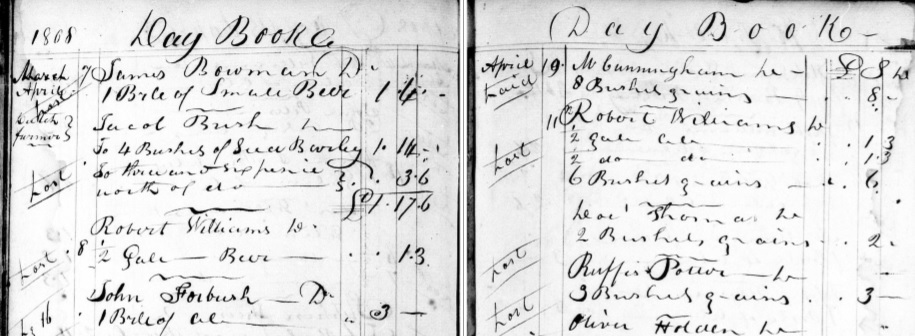
vassar1808pageI have started a winter project. I am transferring the data in the 1808 Day Book kept by James Vassar‘s brewery at Poughkeepsie NY into a spreadsheet to allow me to grind the data to see if I can learn anything. Careful readers will remember that two and a half years ago (Good Lord!) I posted about the brewing log from his son Matthew Vassar‘s days heading his own brewery in the mid-1830s. That book described ale batch after ale batch, details the particulars of each session. It traces seventeen or so stages from heating the water to selling the barrels. The log that starts in March 1808 log is different. Being earlier and prior to the advent of things like agricultural societies, it is slightly pre-scientific. It is a business general ledger showing purchases and sales, identifying customers and suppliers as well as the prices of supplies bought and ale barrels sold. I hadn’t expected to see things worth reporting on after just copying the first month’s worth of entries but here’s what I see so far:

• The record may confirm that he was still brewing with the local wheat as the Dutch in the Hudson Valley had been since for almost 200 years. For the first four weeks he notes purchases of “grain” by the bushel from a number of sources. Then in the second week of April he buys “seed barley.” Why note the sort of grain only that one time otherwise? In January 1809, there is an entry for the purchase of rye. What indeed is “grain”?

• He seems to know most of the people he is dealing with. Only two receive special notation. One supplier of grain is noted as “Dutch Farmer” while another, William Jackways, is stated to be from “Rhine Beek.” Most of the others are both repeatedly referenced in the book as well as listed without citation, some without even a first name like Mr. Cunningham and Dr. Thomas. Rhinebeck NY is across the Hudson and maybe tent to twelve miles north of Poughkeepsie. Why did the man from Rhinebeck come that far? Who knows but he bought 13 barrels of ale for 39 pounds. By more than ten times, the biggest sale of the first few weeks.

• As I noted on Facebook, cross referencing the brewery logs to other web based documents like cemetery records helps identify the some of the guys who are buying beer from Vassar in 1808. It seems that a rather good class of chap likes Vassar’s ale. One Thomas Oakley, likely this one, buys a half gallon of ale on 19 March for just one shilling, 3 pence. That’s a growler in today’s measures. He’s the eighth account entry on that day busy with grain deliveries. It’s also the year before he marries, he is a twenty-five year old lawyer early in his career and long before he is in Congress. It was a Saturday. Good for you, Tom.

• On that same March 19th, Vassar buys 14 pounds of hops from Thomas Harden. The price is 1/6.1.1 which I am not quite clear about. Maybe one pound six shillings and change? We can leave it at that. No, in June he buys 93 pounds of hops from someone else and the rate is given there as 1/7 or one shilling and six pence per… whatever… and then the price paid of seven shillings and seven pence. it seems to be that hop prices are bargained for while grains are bought for a straight shilling per bushel. Hops by weight but grain by volume. Note that.

• One man who both buys and sells beer is only listed as Mr. Cunningham. Likely he is Garwood Cunningham, landlord of the Poughkeepsie Hotel. It was the successor of the Van Kleeck House – note that name – which was the first tavern in Poughkeepsie, and was kept as such for nearly a century. It was built in 1797. Garwood himself was quite a lad:

CUNNINGHAM, GARWOOD H., son of Garwood and Mary, became a man of considerable importance in Woodbury, as a military officer, and Major of the 13th Regiment of Infantry. Representative to the General Assembly from Woodbury, three sessions; twice in 1799, and once in 1801 ; also a selectman, &c, and sheriff’s deputy many years in Litchfield County. He m. Sarah Hawkins, of Derby, Conn., a sister of Joseph Hawkins. He removed early in the 18th century, to Poughkeepsie, New York, where he remained several years as keeper of the principal hotel there. In the war of 1812, he was connected with the American army, near Canada, where he was taken sick and died;

Looks like he was an officer in both wars. He also may have had a son called Garwood. He sells Vassar grain in seven separate ten bushel batches in that first month and buys six full barrels of ale throughout that first month. Not only does he have the hotel but he keeps a farm.

That is it for now. Expect more as the winter weather ebbs and flows. Or flows and ebbs. I have a sense that both the economics of running a brewing business in 1808 are right there to be spun out and perhaps also a significant part of the life of a small community in the early days of the new nation. One fellow recorded, Rufus Potter, ran for election as a village trustee in 1811. Another, Oliver Holden, was President of the Board of Village Trustees in 1825 when one Matthew Vassar, son of James, also sat on that body. Fabulous.

Certain Georgian Drinking Habits In Pre-Reform Upper Canada

lbotAs a careful reader of this blog may have picked up, I have a certain preference for the pre-lager pre-Victorian world of British Empire beer – if only because it’s so widely ignored. As beer writers and nano brewers are now painfully aware, too many claims against too little content makes for thin rewards. Always best to specialize where no generalists have yet trod as far as I’m concerned. In our book Ontario Beer, Jordan and I came across many such areas of unexplored history – much to our surprise. Turned out that no only had the province’s brewing history been little explored but there was no set of competing books, no library shelf filled with books even on the topic of this colony and province’s general history. A shame. But a gap we were happy to take some small steps to help fill.

Through our research, one thing I really came to understand was how what is now Ontario not only has a Victorian past but also Georgian, Stuart and even Baroque ones. One favorite book I came across was The Annals of the Town of Guelph, 1827-1877 by Charles Acton Burrows. In that book there are a few passages, one of which I mentioned here, that describe the pre-lager pre-Victorian drinking habits on the Upper Canadian frontier. Here is a more complete description of the events of 12 August 1827 at Guelph:

It was now the month of August, and the 12th being the king’s birthday, and also the anniversary of the formation of the Canada Company, he determined to celebrate it by a general holiday and public dinner….On the Monday morning the town was in a state of the greatest excitement, it being determined to roast an ox whole on the market place, and have a right jovial time generally, in which they appear to have succeeded. Early in the morning four huge posts, which remained as a memento for many years, were let into the ground, from which, by means of logging chains, the carcase was suspended, an immense log fire being kindled on each side. While the ox was roasting a large number of guests, who had been specially invited by Mr. Galt to take part in the festivities… When dinner time had arrived the roasted ox was carried into the market house, and placed upon a strong table, where it was carved ,and the guests, to the number of about two hundred, enjoyed a right royal feast… the first thing to be done to lend an air of refinement to the meal, was to provide forks, which each man did for himself, by going to the lumber pile and selecting or cutting a suitable stick, whitling a fork out of it with his jack knife, which indispensable article every man of course had with him, and with which he afterwards cut up his beef. Plates being somewhat scarce, and the few possessed in the town being far too valuable to risk at such a gathering, each selected as clean a shingle as possible, from the pile, which remained after the market house roof had been finished, and with keen appetites all sat down and enjoyed a hearty meal. “After the cloth was removed,” toasts were drunk to everybody and every conceivable thing, the liquors, of all imaginable descriptions, being passed round in buckets, from which each man helped himself by means of tin cups, about two hundred of which had been supplied for the occasion…

…those who remained continued to celebrate the day in an exceedingly hilarious manner, most of them, who had not succumbed to an overpowering somnolency, celebrating the night too, many of them being found next morning reposing on the ground in the market place, in loving proximity to the liquor pails, in which conveniently floated the tin cups. This celebration was taken hold of by the fault finders, not on account of the quantity of liquor consumed, for that was a mere trifle in those days, and an indispensable adjunct to such an occasion, but because they asserted that the health of Sir Peregrine Maitland, the Lieutenant Governor, had been omitted from the list of toasts.

And here is another from the celebration of the laying of the foundation of the community’s first school house:

A few fights brought the public proceedings to a close, when the elite adjourned to the Priory, where a dinner on a somewhat grand scale had been prepared. Mr. Galt presided, the vice chair being filled by Dr. Dunlop, and about eighty guests being present. What followed the removal of the cloth it is not necessary particularly to describe, but

“The nicht giew on wi sangs an clatter,
“An* aye the ale was growing better,”

As the “wee sma hours” approached some of the guests grew a little pugnacious, and Thomas Brown, the father of Miss Letitia, acting as constable pro tem, was called on to quell the disturbance, and in his attempts to restore peace had his hand badly cut by a carving knife in the hands of one of the rioters. He was consequently disabled from working for some time, and was therefore appointed to the honorable position of “grog boss” among the Company’s workmen, the duties of which he filled to the entire satisfaction of the men.

Such times. Such foreign times. Dr. William “Tiger” Dunlop is among my favorite early Ontarians. He was born in my father’s home city of Greenock so I was raised on stories of his life… or at least I was in the room when things were stated even if I only paid half the attention I should have. In 1827-28 when the stories above unfolded, Dr. Dunlop is in his third year as a senior official of the Canada Company. John Galt is the enterprise’s founder, corporate secretary and first superintendent. When these men were carving farming settlements out of the forest which had fed the Ojibwe who had lived there, here was a great deal of strong drink in Upper Canada – including a wide range of ales if you could get your hands on them. As we noted in the book, the roads were bad and beer was heavy. Much of it was strong. Thirty years later, in 1858, courts ruled in nearby New York that lager was not intoxicating because of its lack of a strength. Which means what came before most likely was quite intoxicating.

All of which is presented to you in response to one point Jordan made in relation to his recent and by all accounts excellent recreation of an 1832 mild ale from Helliwell‘s, a brewery located in what is now Toronto. In his weekly article, Jordan also states that the function of the 9.1% beer was its caloric strength and

it explained why Helliwell only ever mentions having “a glass of beer” in his diaries. Two of them would put your lights out.

This my only quibble. While Helliwell the brewer may have liked a glass and the calories were important, I am pretty sure that what we now consider intemperate drinking was common and socially acceptable – even perhaps socially required and welcomed. Soon, the scales would tilt as the new settlers become established and by the 1850s are creating a middle class with its new values and interest in spawning reforms. Temperance starts to become a measure of one’s virtue. But even at the highest levels it is many decades before that is the new normal. Even in the mid-1860s, Canada’s founder Sir. John A. Macdonald, whose law career began in the last Georgian years, led a debate on constitutional changes needed to bring Confederation into being while being “on a spree” and “half drunk” as well as “quite drunk with potations of ale.” It is hard to imagine a century and a half later. It is probably good that it is hard to imagine. But there is every reason to understand that a fair share of those who created this create land were half schgoggled from what can only be considered wild-eyed barrel draining a significant part of the time.

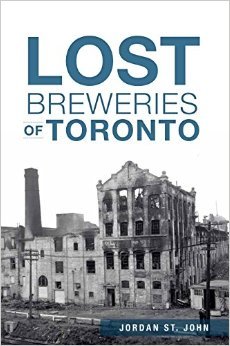
Thank God for the temperance movement. It saved us all from our forefathers’ ways. Jordan has more of the story in his new book Lost Breweries of Toronto. You really need the whole set, right?

Did Hipsters In The 1850s Like Adulterated Beer, Too?

uhvb1aThis is a pretty interesting bit of news in the New York Post:

The scientists discovered the glass “California Pop Beer” bottle on Bowery Street near Canal Street, where a popular beer hall, Atlantic Garden, bustled in the 1850s, scientists said. “It’s a light summer drink, slightly minty and refreshing” said Alyssa Loorya, 44, president of Chrysalis Archaeology, which headed the project. The beer is infused with ginger root, sarsaparilla and wintergreen oil, and other herbs, giving it a one-of-a-kind kick, Loorya said.

If the beer bottle collector nerds are to be trusted, California Pop Beer was produced as Haley & Co. Celebrated California Pop Beer out of Newark, New Jersey… but apparently sometimes in New York as well. The archaeologists reproduced the beer based on research that led to finding a patent for the stuff. I suspect that. I suspect something about it all. I am suspicious. Seems a bit weird that you would get a patent for a beer when every other brewery in the world relies on and has relied on trade secrecy as opposed to a patent telling the whole world about what goes into the bottle. Fortunately, someone in the Google Borg decided we should all have access to patents so we can have a look at what went into this stuff at least in 1872. Hmm…. not really beer. A yeast and an extract of wintergreen, sassafras and spruce are prepared and then, if I read correctly, they are combined with “ten gallons of water one hour, after which seventy pounds of granulated sugar”. Or maybe 105 gallons. Yum? Does it matter?

What is most interesting to me is that this is an example of a second half of the 1800s popular beverage. It relies upon the word “beer” but really is more like a an alcopop or cooler. It comes from a time when, like today, purity is less important than flavour. It also plays upon California in the branding right about when Quinn & and Nolan in Albany, New York were advertising their California Pale XX and XXX Ales. Maybe California was just neato right about then. I like the idea that spruce is part of the taste profile. An old regional favorite flavor that you can learn more about if you BUY THIS BOOK. Oh. That was a bit gratuitous, wasn’t it.

Never mind that. The point remains. The past is a foreign land and so were their drinks.

Session 89: A History Of The Hop And The Malt And The Beer…

sessionlogosmIt’s that time again. The monthly edition of The Session. Beer blogging boys and girls gather ’round the coal fired ISPs throughout the world to share their thoughts on a topic. This month our host is the Pittsburgh Beer Snob who writes:
At many points in history you can look back and find alcohol intertwined. A lot of times that form of alcohol is beer. Beer is something that connects us with the past, our forefathers as well as some of our ancestors. I want this topic to be a really open-ended one. So, it should be fairly easy to come up with something and participate. If you were among any readers I had when I posted most of the time you have a very good idea of where I might be going with my post when the time comes. The same doesn’t apply to you. Do you want to write about an important beer event with great historical significance? Famous figures that were brewers? Have you visited an establishment that has some awesome historic value? Maybe a historically-themed brewpub? I wouldn’t be surprised to even see a few posts on Prohibition. It doesn’t really matter when it comes to history!

History is good. I am actually of the opinion the best histories of beer and brewing are yet to be written. But I also believe the best beer writing, thinking, constructs, descriptions and criticism are all a fair ways off, too. We wallow in times of self-satisfaction. Would you just look about you at the works so far, Ozzy?

Anyway, that being or not being the case, what to make of the state of brewing history? I have written a bit of my bit to be sure but I am still not satisfied. I have come across beer in the Arctic in the 1570s, the 1670s and the 1850s. Fabulous facts. Beer for those living on the edge. Why? Because it kept them alive. Happy and alive. Billy Baffin, that giver of what I think the most Canadian surname, on his fifth voyage in 1616 got into a real pinch and had to hightail it to an island off Greenland and make a tea to keep he and his crew alive:

Now seeing that wee had made an end of our discouery, and the yeare being too farre spent to goe for the bottonie of the bay to search for drest finnes ; therefore wee determined to goe for the coast of Groineland to see if we could get some refreshing for our men ; Master Hei’bert and two more having kept their cabins above eight days (besides our cooke, Richard Waynam, which died the day before, being the twenty-six of July), and divers more of our company so weake, that they could doe but little labour. So the winde favouring us, we came to anchor in the latitude of 65° 45′, at six a clocke in the evening, the cockin eight and twentieth day, in a place called Cockin Sound. The next day, going on shoare on a little iland, we found scuruy great abundance of the herbe called scuruie grasse, which we boyled in beere, and so dranke thereof, using it also in sallets, with sorrell and orpen, which here groweth in abundance; by meanes hereof, and the blessing of God, all our men within eight or nine days space were in perfect health, and so continued till our arrivall in England.

God is good, indeed. Beer is a bounty that is provided to us for health and joy and the lessons of history prove it. Yet, history also proves the wages of not only drunkeness but seeking out the best and brownest. Beer is neither benign or neutral but a powerful tool. That is what history teaches us. It can trace empires for us. Fortify a frontier. Collapse a region. Give hope. And bring despair.

Considering The Role Of Ale On This Canada Day

canadaday

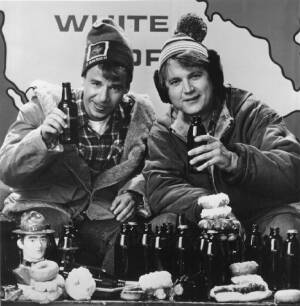
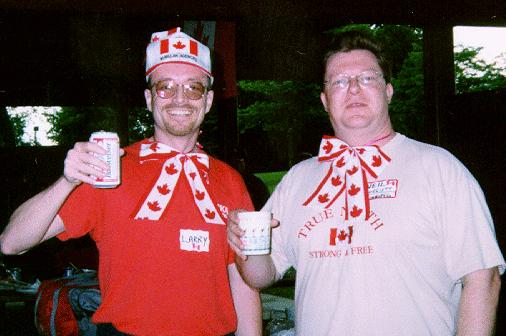
Nine years ago, back around those heady days of political blogging, I wrote a series of posts on a fictitious Atlantic Canadian separation movement focused on a mde-up new capital called Tantrama City. One post set out details of the Canada Day celebrations under the new governmental order and featured the photo of Neil and Larry above. I have no idea who these guys are but I love it. It may be the most Canadian image I have ever seen. The nutty bow ties in the national colours, Neil’s boring earnest shirt and Larry drinking a Bud. And the fact they don’t give a crap and are just having a good time.

Is there a Peru Day or a Norway Day? Canada Day is such a politely bland concept but, this being a confederation with lingering prickly regional identities, it suits us. We are the country that cancels recreations of historic events. Why recall past unhappinesses? What we remember in particular is the formation of one semi-autonomous colony out of three in 1867 (or was it four… Canada was sort of split into Canada East and Canada West but had formerly been separately Lower Canada and Upper Canada from 1791 to 1841), two of the invitee colonies not joining in until six (PEI) and eighty-two (Newfoundland) years later. My particular part of the nation remembers the events with mixed emotions.

So, on this we day celebrate the fourth version of Canada after the one that was otherwise a bit chunk of New France up to 1760, then the one with the Upper and the Lower, then the one that didn’t work from 1841 to 1867. And maybe the one from 1763 to 1791, too. OK, maybe this is the fifth Canada. Most of all we recall the man who is attributed with bringing the four colonies together, Sir John A MacDonald. Larry and Neil might well have been making a joke or two about him – as the founder of a large part (but not all) of our current constitutional structure (yes, it is a bit messy) was a bit of a drinker. A bit of one. Consider this description of one of the planning sessions from the pre-Confederation years:

“…The Council was summoned for twelve and shortly after that we were all assembled but John A. We waited for him till one – till half past one – till two – and then Galt sent off to his house specially for him. Answer – will be here immediately. Waited till half past two – no appearance. Waited till three and shortly after, John A. entered bearing symptoms of having been on a spree. He was half drunk. Lunch is always on the side table, and he soon applied himself to it – and before we had well entered on the important business before us he was quite drunk with potations of ale.” But, after two and a half hours of debate, the wound up their discussions of the constitutional changes and agreed on the course to be followed…”

So, we are a nation imagined and brought into being by a drunk. That is the story we are told. Historian Ged Martin in 2006 published this detailed study of the record of Macdonald’s drinking patterns which both confirms the fantastic level of consumption, his personal struggles as well as the possible causes. It is a very sympathetic piece. If they read it, I am sure Larry and Neil would like him more… and raise another beer to the nation imagined mid-spree thanks to potations of ale. They’d probably raise an American one come to think of it. But only if it was the nearest one. We are not that fussy.

Reasonable Evidence The Older Stuff Was Quite Strong

An interesting tidbit from The New York Times of 6 February 1858 in an article entitled “An Important Question Decided“:

It has long been a disputed point whether lager bier can be properly classed among toxatious drinks, but yesterday, Judge Strong of Long Island, decided, in the case of Jacob Staats, who was indicted for selling intoxicating liquors on Sunday, that lager bier is not an intoxicating drink. If the question had been whether lager is a stupefying drink, or not, the decision would probably have been in the affirmative. The decision is a very important one, and it will have a decided effect upon the habits of a very large class of our population, to whom lager bier has become almost a necessary of life. There will be great rejoicing over the decision of Judge Strong by our German population, and the “saloons” where their favorite beverage is sold will be crowded to-morrow with thirsty devotees.

There some interesting things in there. Is “saloons” in quotation mark to challenge the use of the term? Were they then too lowly? There are certainly plenty of stories in the newspapers of the period of dark deeds done in the lager saloon. And on the scale of words for drunk wouldn’t “stupefying” represent a higher state of affairs than “intoxicating”? A reminder to be wary of familiar words arising in other eras. The ruling ended up not deciding the matter. More court cases would follow as the role of the new lighter German style beer was assessed. Not just drinking on the Sabbath but drinking after midnight. Theater owners complained about entertainments in beer gardens, not required to pay the same license fees. Evidence is given of astounding feats of consumption over and over, of drinking 30 quarts in two hours… without “intoxicating” effect.

The stories are laced with an undertone of cultural conflict and, as part of that, an understanding of what beer is. To those writing the laws and drinking older styles, beer is stronger and something that could not be downed in such volumes. Beers like the over 8% Albany ales needed legal regulation even before the full rise of the political power of the temperance movement. In the 1850s, “lager bier” is a new social technology that doesn’t fit and may threaten. By the 1870s, however, Germans are presented as the model immigrants, supporting savings banks and charities even if they still have their lager bier saloons. If there had been a culture war, they may well have won.

May Two-Four And Our Well-Wishing To The Crown

bobdoug1Even though it is just the 17th of May, this weekend is nicknamed May Two-Four. It is Canada’s non-much-observed celebration of the lass who was Queen Victoria. Monday is still called Victoria Day. It also has a quiet subtext of somehow being the celebration of the present Queen’s birthday. If those are the dimming antecedents, the once glowing purposes of the day – they are doubly wrong. Our current absentee monarch was born on an April 21st. Vicky was born in May 24th but, as you may note, that is not today’s date.

And yet this is the weekend of May Two-Four. Not next weekend which contains the twenty-fourth day of May. This one. Why? Because a two-four is the name of a cardboard case of 24 bottles of beer. Twenty-four 12 ounce bottles is that unit that is beyond personal consumption. It implies either sharing or duration. A long warm weekend is apt for both. And gardening and fireworks. Because we have no real remaining cultural focus on this long weekend, unlike any other long Canadian weekend, we are now free to create our own. So we think about drink in itself. We just enjoy ourselves.

It was not always so. In the course of co-writing one book on the history of beer in Ontario and another on Albany, I have written about three drink laced celebrations of the Monarch’s birthday in 1755, 1776 and 1828. As I mentioned the other week, Sir William Johnson supplied the Royal loyal allies of the monarchy, the Mohawk nation of central New York, with beer during the Seven Years War – aka the French and Indian War. One of those deliveries, as noted at page 572, was on June 4, 1755 when he obtained two barrels of beer from Hendrik Fry for the Mohawk at Conajoharee to drink to toast the birthday of George III. As I wrote a year ago, Craig and I located the scene of the drunken tavern brawl 21 years later in Albany which finally ripped that city’s Tories and Patriots apart triggered by overly vigorous toasting to the King. Perhaps my favorite Royal birthday celebration in British North American happened about half a century later. As you will see in Ontario Beer, at a celebration of the King George IV’s birthday hosted by the Canada Company on 12 August 1828, 200 settlers gathered at what is now Guelph when it was at the point where the forest met the clearing of fields. A whole ox was roasted held over the fire with logging chains. As there were few utensils, most of it was eat off of wooden shingle plates with a stick for a fork. After the eating was done:

…toasts were drunk to everybody and every conceivable thing, the liquors of all imaginable descriptions being passed round in buckets from which each man helped himself by means of tin cups…

It is recorded that many were found the next morning reposing on the ground in the marketplace “in loving proximity to the liquor pails.”

Now, I am not suggesting we take our Canadian admiration of the Crown to that point. But… it is a proud tradition. It brought together peoples as loyal allies, insulted our treacherous enemies and celebrated the new frontier in our new homeland. If I had my druthers, that would be what we celebrate today. Not so much the Crown or a particular monarch but the loyal pioneers who defended the cause and created the nation. And drank like idiots as they did and because they did. Because we are like that.

Why Does The NYT Perpetuate A US Craft Fiction?

Stan linked to a NYT opinion piece by Steve Hindy who is correctly identified as “a founder and the president of Brooklyn Brewery and a member of the Brewers Association board of directors.” I think it struck me a little differently from Stan. Consider this:

…state laws continue to empower distributors to select brands and manage them however they want — selling those they choose to sell, while letting other brands sit in their warehouses. The only recourse is to sue, and many small breweries lack even a fraction of the resources needed to take on a big distributor in court. As a result, they’re stuck with the bad distributor, which severely hampers their ability to perform and grow as a business. Buy a small brewer a beer, and pretty soon he or she will be regaling you with war stories about fights with distributors…

See what’s going on? Small brewers. No discussion about the different effect regulations have on actual small brewers compared to big national craft brewers like Brooklyn and the other oft cited Dogfish Head. As the owner of Notch Brewing, Chris Loring, recently shared with Max, the interests of big national craft are very much at odds with the interests of actual small and local breweries. The opinion piece, as would be expected from its source, references nothing of that. Gripes about regulations from state to state are only a burden to those business folk whose aims include 18 wheel transportation and national advertising campaigns.

So, while the title of the bit is “Free Craft Beer!” it really could better be “Unleash The Opportunity For Brewers With Scale!” We know what would happen were this sort of shift to occur. We’ve seen it before. It happened in North America in the 1860s to 1890s. It wasn’t that laws were change so much as the railway established itself. All over Ontario many many small brewers making good beer were crushed when previously local brewers like Labatt and Carling out of the southwestern town of London got their casks out of their towns and into the province, the nation and then the world. Yes, that Labatt and that Carling. Prohibition did not close the breweries. Advantages of scale did. The wiping away of borders and other obstacles did. As you can read in the article “The Canadian Brewing Industry’s Reponse to Prohibition 1874-1916” by Matthew J Bellemy in Brewing History, there were 61 breweries in Ontario at the turn of the twentieth century. There were 49 in 1915 and 23 two years later. The strictest form of temperance law imposed locally came into force in 1916. Historically, it is clear that beer and brewing likes a few things like peace and a good growing season. It also likes oligopoly. Beer responds well to aggregation. We know that because all big beer was once small.

Actual small, local and well made beer is antagonistic to oligopolistic economic forces. Actual small batch beer made by actual small brewers is easily crushed. By perpetuating the idea that there is that one homogenous thing called “craft beer” and “small brewers” we ignore that big commercial brewing enterprises are different. We cover over the fact that intra-national importing brewers moving beer coast to coast in the US like Brooklyn, Dogfish Head, Stone or Sierra Nevada pose as much or a greater danger to actual small brewers than Bud or – what ever is like Bud but not Bud – does. It is not wicked that this is the case… but it is a natural economic force. If you want to live in a world with brewers making good beer in every second town you may want to take what national and now exporting international craft argues with a healthy dose of skepticism. A healthy dose of skepticism actually pairs extremely well with actual small scale, local and good brewing.