Delaware: Golden Shower, Dogfish Head, Milton

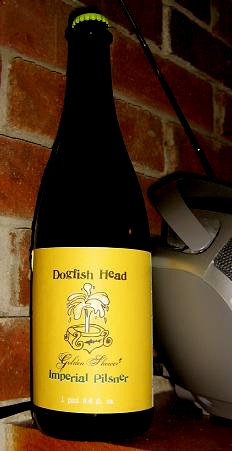
An imperial pilsner. This is a sort of beer I never imagined I would need to concern myself with. Unlike stouts or pale ales with their history of bigness, surely no one would bother upping the game of brewing the steely king of lagers. No one told Dogfish Head from Delaware, however, and they went ahead and did it as they tell you about at no lack of length on their website, including this:

The big breweries are as guilty of any company in any industry of brainwashing the consumer through the sheer oppressive magnitude and breadth of their marketing efforts. They are selling a brand name and an image with such zeal that they have forgotten about the product behind all of this horseshit and hyperbole – the beer itself. Dogfish Head Golden Shower is the beer itself. A true Pilsner brewed with 100% Pilsner Barley, and impressively hopped using our self-developed continuing-hopping method. At 9% abv it’s also nearly twice as strong as the American, wanna-be pilsners made by the big boys.

If you have read my reviews here before you know I have questions about my relationship with pilsners. I respect the fact as much as the next guy that it is a noble and traditional style but then there is that metallic zing…or is it a zang…that fills my mouth as if I was chewing a quarter pound of four penny nails that have been laying around the shed. So I approach this beer with some trepedation. And some of the low rating BAer reviews are backing that up – like this one:

…Not drinkable at all. Really sad for such a great brewery. I dumped the remainder of my $12 bottle in the toilet, where it belongs. Don’t waste your money on this golden shower…

Yikes. I only paid $8.99 for mine but still. Intersting to note, however, that the highest BA raters consider many of the same elements but like them. I don’t know what to expect now.

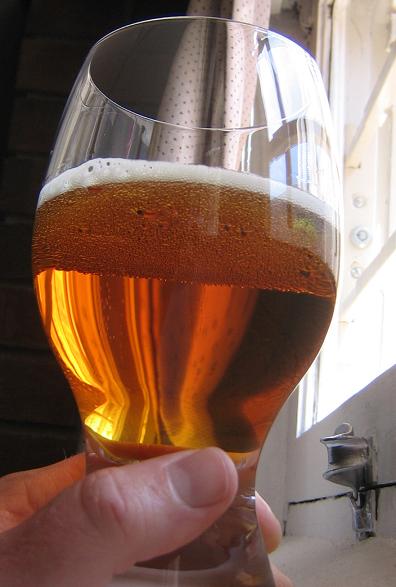
The beer pours a very attractive bright burnished gold with a white head that resolves to a rim what with the low carbonation. When you shove your nose into the glass there is plenty of sweet apple and pear concentrate. The first thing I think of when I sipped was triple. It is sort of like a Belgian triple – candy-ish sweetness and all – but also with a fall fruit aspect like calvados. It is also thickish and does not have the overly metallic hop profile I feared – the hops are tightly herbal as much as anything. In fact, it is far more pale malty than anything else. And that is a remarkably well hidden 9%. The beer is not hot in the mouth but it certainly does warm otherwise.

Where does this beer fit in? It is a near neighbour to Belgian golden strong ales like Duval or triples like Chimay Cinq Cents with the white label – but without the bubble gum or candy floss notes Belgian candi sugar provides. A beer to contemplate the coming autumn. A beer to eat apple pie and vanilla ice cream along with, oddly enough. It would be interesting to have this beer condition in a wood cask as there is that butter and/or vanilla richness that could be umphed one notch for experimental purposes.

Cyclops – Perhaps The Worst Idea Ever

Describing taste in words is funny business but making the effort is worthwhile as it provides you with a mechanism through which you can record your experiences with food and drink, and especially craft foods like real ale. We each take in the esters, phenols and other organic elements and recreate their interconnection in our own minds as we sip, sometimes discovering what the brewer intended and sometimes finding out new nuances never expected. Then you use your words to frame your experience. Do it often enough and you develop your own descriptors that make sense for your experience.

So it is inordinately shocking, then, to learn about what may be the worst idea in the craft beer movement I have ever heard of – a standardized system of beer description not unironically called Cyclops:

Cyclops, the new scheme launched today at the Great British Beer Festival at Earls Court in London, has the backing of 14 real ale breweries. Under the scheme, the brewers have agreed to follow a standardised template on all promotional material, describing the style, smell, look and taste of their beers. Bitterness and sweetness – the two main measures used to describe real ale’s characteristics – will also now be scored from one to five.

Cyclops follows a pilot scheme introduced by Leicester brewer Everards, which simplified the language used to describe real ales on promotional materials so customers knew exactly what to expect. A Campaign for Real Ale spokesman said: “Real ale is an incredibly complex drink with an enormous range of styles and tastes. Cyclops will demystify real ale so drinkers will know what a beer will look, smell and taste like before they part with their cash at the bar.”

This is tragic. And it is stunning that CAMRA supports such a thing. It is important at this moment in time that the most famous Cyclops, Homer’s Polyphemus, was blinded for life by drinking strong wine and ate people. This is hardly the making of a good brand. But even when he had one good eye he saw things…like he was born with one eye in the middle of his forehead – as in without particularly strong ability to see things from other perspectives. Plus, as man eating giant shepherds who get tricked a lot, they sort of fit the images of a rural rube caricature, kinda like in the satirical play by Euripides

And that is sort of what the program takes the craft beer lover for in presuming to tell you how to taste – it takes you for an ignorant oaf. It will create one recommended way to look at things and a snobby attitude to those who find their own way. Reject such mecho-branding systematic standards that will homogenize response patterns and trust yourself. If you think a beer tastes like the armpit Polyphemus after a long night in the cave (if you know what I mean) while the brewer tells you something like “it is a 5 (bitter), 3 (waterhardness), 3 (maltiness), 2 (mouthfeel) and 4 (overall) pale ale” then you just trust yourself and know that is likely tastes like that armpit.

¹…which would have been funnier if, instead of saying he was called “No man” thus leading to lots of punning hi-jinks that confused the big old dope, Odysseus had actually called himself “Norman” which would have led to a lot less confusion and likely the eating of Odysseus in the first few scenes thus saving thousands of undergrads the misery of figuring the whole thing out.

Four More English Pales Ales

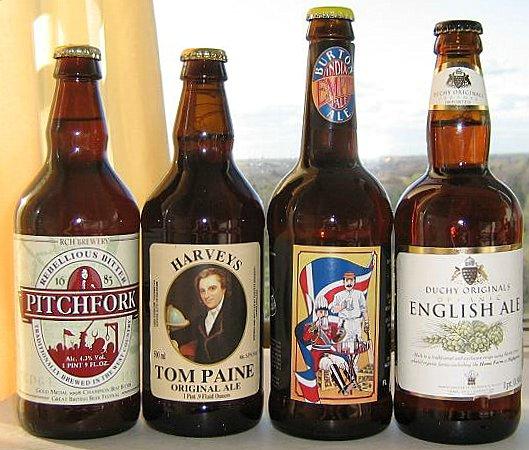
I have done a couple of sets of tastings of English pale ales before and with a guest about this is another good opportunity. Here are four more English ales: a 4.3% best bitter from Somerset to the left, then a 5.5% pale ale from East Sussex, next a 7.5% Burtonian IPA and to the right an organic 5.0% ESB from Oxfordshire. What an excellent selection with which to consider the pale ale family as expressed from its homeland.

Pitchfork Bitter: White merenge stiff whipped head over medium straw ale with a light floral and grainy nose. The mouth feel is light, full of pale malt graininess, bright with pear and unripened peach fruit from the malt. Dryish with significant but not overwhelming hopped. Well balanced and refreshingly clean. A very attractive lighter pale ale. Here is what the brewery says. Here is what the BAers say.

Thomas Paine Original: white foam and rim over amber. Black china tea hops plus fruity malt with caramel and a hinty molasses note. The fruit is raisin and fall apple. Heavier again, clearly an ESB, some way to Chas. Wells Bombardier but just one wee step down that path. Yes, here is what the brewery says and, yes, here is what the BAers say.

Burton Bridge Empire India Pale Ale: Woah, Nelly! I had a Burton Bridge Porter in 2001 and this is its somewhat nicer twin cousin. White whipped egg white head over cloudy deep straw. Unique Burton Bridge hops along with that Burton Bridge unique tang. The hops are sharp, green and like a marigold-based drink from the blender. The only brewery’s hop profile which is beyond my descriptor of the smell and taste of driving a lawn mower into a patch of weeds in June. Tangier than that. So tangy it is tongy, like licking a cast iron pot coated with plain yogurt. [Not really but no other ale I have had could plausibly have that image in the review.] Yet underneath is grainy malt and creamy yeast. Black pepper at the dry finish. Again, here is what the brewery says and here is what the BAers say.

Duchy Originals Organic English Ale: Light tan foam over orange ale with no notable aroma. Soft water, quite flavourful watery water. Some sweetness but not yet up to raisiny. Some thought of orange marmalade but nowhere near Special London Ale. Hints – all hints. A tiny notch heavier than Pitchfork above, more tangy white grapefruit hoppy. This beer is brewed by Wychwood for Prince Charles:

When the Prince of Wales created Duchy Originals in 1990 it was because of his belief in the clear advantages of organic farming: the production of natural and healthy foods and sound husbandry which helps to regenerate and protect the countryside. Profits from sales of Duchy Originals products are donated to The Prince of Wales’s Charitable Foundation, which has to date raised more than £1.7 million.

Imagine that! It reminded me a bit of St. Peter’s organic. Finalissimo and once again, here is what this brewery says. Here is what the BAers say.

An excellent collection and instruction itself as to a portion of the English pale ale continuum.

Book Review: Beer in the Middle Ages and the Renaissance

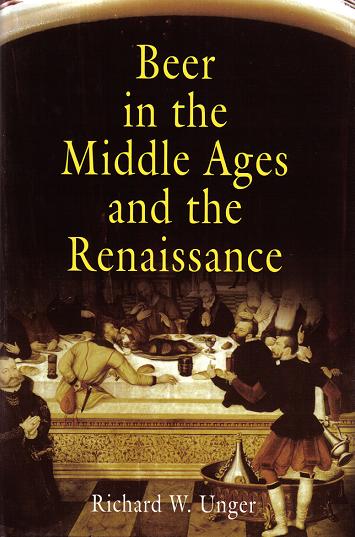
ungerFinding this, for the beer nerd who also likes book with footnotes, is something of a moment, a wee glimpse of nirvana. The author, Richard W. Unger, is a professor of the history of the medieval period from the University of British Columbia who has also written texts about shipping and brewing from the perspective of pre-1800 Holland. Serious writing about a topic that deserves a serious approach.

What can I say about this? First, it cost me 75 bucks at the World’s Biggest Bookstore in Toronto. Like any academic text with a short run and a limited market, it is not a cheap book. And, if you do not think you are going to find something interesting in the discussion of the effects of 15th century taxation policy on North Sea coastal trade, well, maybe this is not going to be the book for you. But if the idea of a seventeen and a half page bibliography of source material on medieval brewing – not to mention thirty-nine pages of endnotes – is your type of reading, well this is the book for your next holiday weekend.

Really, Beer in the Middle Ages and the Renaissance is not so much about beer as the effect of the hop on trade in beer which caused the first industrial revolution in beer through the southern North Sea trade routes from roughly 1350 to 1550 – the second being triggered by the porter boom of roughly 1760 to 1840. The main concept is quite simple actually. Hops preserved beer. Once beer is preservable and can last more than a few days, long enough to be moved, then it will be moved and sold for a premium price as a luxury item. After it comes to be understood, it will then be copied as a local product which over time drives out the previous locally made unhopped ale. Later, it loses out to the next following luxury items as well as a general economic downturn both of which conspire to lowers its central role in the economy.

Unger traces the development of trade in beer largely with a focus on the Low Countries through analysis of tax records, municipal by-laws, guild creation, shipping records and other evidences of the huge role beer played in medieval society. He does so aware of the vastly different context in which beer is places in contemporary culture. This the first paragraph of the book’s preface illustrates that distinction neatly:

The mention of the history of beer always brings a laugh or at the very least a snicker. The histoty of beer for most people is not a serious topic of study. It seems to them frivolous and hardly worth more than a few diverting minutes of anyone’s time. Beer, after all, is a drink for leisure, for young people, generally men, and associated with sports and student life. That perception of beer is a case of historical myopia, of an inability of many people at the beginning of the twenty-first century to convince of a world different from their own. The prevailing presentism makes it difficult for many to comprehend a world where beer was a necessity, a part of everyday life, a drink for everyone of any age or status, a beverage for all times of the day from breakfast to dinner and into the evening.

Not to worry that you will not appreciate how this detailed focus on a relatively short period as Unger leads you into the medieval with a description of fermented drinks of preceeding periods and also carries on after the main discussion showing how innovations in the gin and wine trades as well as the tropical beverages of tea, coffee and cocoa replaced beer in may social settings and therefore in the economy.

I may add a bit to this later but suffice it to say if you enjoy a good read about the history of beer and have read more popular histories like Beer: The Story of the Pint or Man Walks into a Pub, I would say it is time to take on this more purely academic text.

The Two-IPA Challenge

ipavipa

I’ve wanted to try this comparison for a while. Sgt. Major’s IPA from Fitzroy Harbour in the Ottawa Valley is a unique beer in at least the eastern side Canada in that it attempts to take on the US style on its own chewy hoppy terms. Hop Devil IPA from Victory in Pennsylvania is one of the classic northeast US IPAs – balanced but big.

ipavipa2

The two beers pour deep amber under fine off-white heads but the Hop Devil is darker while the head of the Sgt. Major holds its fine head with almost Guinness-like will power. In the mouth, the Canadian is hoppier by a long shot but the American presents raisin notes and is richer but by only a notch. Both rely on American hop strains to provide an unsweetened grapefruit twang thang. Both have a good grainy profile from a honest quality malt bill and both use fairly softish water compared to the amount of bittering – no sulfate cheating here. The Hop Devil uses a creamier yeast strain. The overall quality of the beers is extremely similar which is a real tribute to the small Ontario brewer.

I like them both and will have some confidence in picking up a six of Sgt. Major next time I am cranking in my mind about the lack of variety at the local beer suppliers.

Ontario: Bar Volo, Yonge Street, Toronto

volo1The other day, when I did rock, we headed up Yonge Street in Toronto to finish the evening at Volo, a much discussed beer bar amongst the Bar Towelling set. With very good reason as well. While I wasn’t able to take my camera and get some shots, I can tell you that the place seats about 40, is something of a cheery jumble of mismatched antiques, plants and beer bottles and has the feel of rec room meeting a cafe. Certain Bear Republic quarts noted. Like a walk-in stash with knowledgable staff. Very nice and, frankly, a brave effort given the legal loops they must have to go through to amass the well chosen and properly handled collection. As a result, the prices are honest and sometimes even bracing but just don’t go every night and you will be OK, OK? Here are some directional hints for Volo.

We were not there for long but I got to try a few firsts. I had a bottle of the barley wine Fred by Hair of the Dog and my brother’s split a large La Chouffe. I also tried Church-Key Brewing’s new biere de garde on tap. I really wish I had had my camera as I remember looking at the chalk board thinking “they don’t make a BdG!?!” and here I am thinking that I am going to find a reference on the bar or brewer’s web site as to its existence and I find nothing. [Later: Bar Towel News Services has more on this new BdG. I think this is the style of the next two years.]

The Fred was a big rich ale, green hop and with chocolate notes in the malt supported by creamy yeast. In a way, a little light for a ten percent ale as it was neither hot or spicy. The La Chouffe was pear juicey cream rich and round with a nice burlappy hop. I also wrote parsley potato. I will leave you to judge the state of my note taking. La Chouffe is at the SAQ, Quebec’s government store, so if I have to do a trip east this summer, I may survive on a case picked up in Trois Riviere. The Church-Key was slightly uncious with a honest but sort of quiet spud peel biere de garde mouth feel. But it was also pale malt grainy making me think it was sort of like their stock ale with a healthy nod towards biere de garde. Milky yeast and soft water, low hopping and medium to low carbonation. If the brew actually exists, that is.
cwbeerEarlier in the day, pre-rocking, supper was a buffalo burger at C’est What, a great tap restaurant which I have written about before. My first beer was a Denison Weisse, a hefe of lemon cream cut by a swath of weedy seet hop greens. Lively and prickley carbonation and a really nice grainy wheat texture. I also had a Black Oak Nut Brown, a good honest pint of dusty cocoa with twig-green hop, a milky yeast and pale grain roughness. C’est What is a great comfy basement bar with that most excellent of seating technology, the sofa.

So all in all – with a stop at the Queen’s Quay LCBO with its well-stocked and staffed beer corner as well as a decent beer book find – it was a very successful beer related run into the Big Smoke.

Ontario: Rogers’ Red Coat Pale Ale, Glenora, Prince Edward Co.

roger1aNew to the LCBO in a 650 ml bomb.

The graphics are very nice and honour a Loyalist unit from the era of the American Revolution that operated in northern New York and the Canadian St. Lawrence river valley.

Sadly, I cannot recommend this beer. It is sharp and cidery. Again, I can only hope this is off.

Ontario: Stratford Brewing Company, Stratford, Perth County

strat6

This weekend I made a discovery while looking for things to do while visiting family…OK, my in-laws. Right there in little Stratford Ontario was the Stratford Brewing Company. At the south end of town in a small industrial park area at the back of a building there it was…a van, a man and a set of second-hand brewing equipment making one of the best pilsners I have ever had.

strat7

strat4

strat2


After I got past what looked like an attack beagle, I met Joe Tuer who ended up taking over two hours of his day to tell me about his beer and his business.

I actually came back with the camera and a note pad. I was going to do this interviewing thing right. Looking at my notes now you would think I was sitting in a chilly lagering room in the middle of a Canadian winter fixated on the beer in front of me and chatting with a new found beer nerd fellow traveller. Oh…I was. I did get a good quote after I asked what his challange as a brewer was, which he replied:

I don’t want to be someone’s favorite beer. I don’t want someone to buy our beer religiously. If we’re in your top six – perfect.

This is a two beer operation. The flagship is a 4.9% Czech pilsner – by name of Stratford Pilsner – which has a nice breadcrustiness from the pale malt as well as a easy drinkability from Stratford’s soft artesian well water. Joe also poured me a new 4% porter he decided to add for winter. Chocolate with a nice snap of twiggy hops, this beer relies on a light fruity English ale yeast as well as that soft water. Again, quaffable at the lighter end of porter. The malt Stratford Brewering uses is from Gilbertson & Page of nearby Fergus, the hops from Hop Union and the yeast are from Wyeast.

strat3

strat1

strat5


Brewing lager takes a bit of an investment and a bit of a chance. Lager has to be “lagered” or stored in cold temperatures for a significantly longer period of time than ales. This means you need more storage capacity to produce the same amount of beer as an ale brewer. It also means you have to pay higher cooling costs. But what is smart about it is that you are aiming at a niche that the average southern Ontarian is already used to supping. You have market. Stratford Brewing services a keg market of about two dozen accounts right now which is largely based on local loyalty in town as well as beer lovers in downtown Toronto, about two hours drive east. The town of Stratford has a world famous Shakespeare festival which attracts folk from around the world including many who expect a town to have a local town brewer and who ask for his beer before they even know the name.

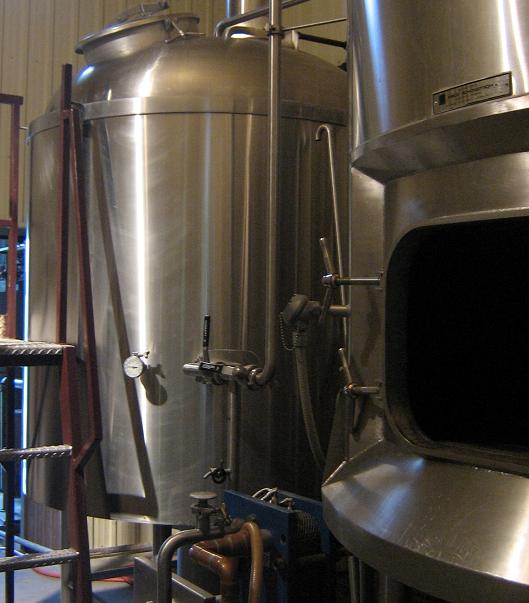
After some rejection from banks as a new grad with a business degree, Joe reinvented his business interest in beer while working in Singapore enjoying the ex-pat life. Diligent readers of the archives will be familiar with Brewerkz, a brew pub there visited by Newfoundlander and Asiapundit, Chris Myrick before he moved to Shanghai, land of pineapple beer. Joe got a short course of over the shoulder training from Scott Robertson at Brewerkz which carried him back to Canada a year and a half ago and started him on his search for equipment. What he found was in Cincinnati – a 14 barrel Specific Mechanical system originally from BC shown here.

I will revisit Stratford Brewing (and not only because I visit my in-laws there) from time to time. This is a lager I would return to – and this is from someone who is not a lager fan. I hope to find Joe on a hot August Saturday with a lawn chair each and time to contemplate his work.

C’est What, Toronto, Ontario

cest5I was in Toronto for a few days this week and was able to stop by a brewpub called C’est What. I have some notes to add later after I dig through my stuff but wanted to get these pictures up.

cest7The Next Day: I appear to have sprayed my things with notes-be-gone so I’ll do this from memory. I tried two of their own ales with my Porter Beef Ribs and like both a lot. The first was the redundantly named Brown Mild Ale. While it is true there is a style of that is a light coloured mild, it is rare enough that it is an exception to the general principle that mild is brown. At 3.3%, it is the right strength for a session of supping. The beer menu said it was nitro dispensed meaning instead of being pushed by the normal CO2 there is a measure of nitrogen added. This is the same idea behind cask flow ale in a can that leaves a tiny fine head. With this real ale, it works very well giving a creamy head that incorporates many of the flavours of the yeast. The beer was creamy with chocolate and walnut flavours. The hops were subdued giving a bit of structure to the finish. Very nice.

cest1

cest9

cest4


At the heart of the ale there is fresh clean water, exactly right for the style. This beer alone would bring me back to this pub. It is a beer that every brew pub should offer, that and/or ordinary bitter, a low alcohol version of a hopped light ale. My only complaint is that it costs the same as the other stronger ales. As 60% of the ingredients go in, ther should be some accomodation in the final cost I pay. That being said, $5.18 CND for a quality real ale pint is a good price.

cest8

cest6

cest2


The second ale I tried was their hemp ale. This is a favorite of mine whenever I have had it, the hemp replacing or adding to the hop effect. Depending on the amount and selection of hooping, the tastes can be quite different. In this version, it is basically a basic best bitter of 4.5% to 5.0% in terms of mouthfeel which has a layer of sweet green vegetableness added to it. And the green tastes like…fresh broad beans. Should gross but it is not. Quite good with the ribs. cest3The ribs themselves were worth attending again, though the were a smidge underdone for my liking. Meat should fall off ribs and the inner tissue should have essentially melted away. There was a bit too much of a gnaw to the meal but in terms of flavour and texture it was spot on. Served with a spring salad overly drenched in dressing and tastey fine cut herbed french fries. You can order extra ribs and I did, hence the Freddie Flinstone pile on the plate.

This is the second time I have been to C’est What and each time I think there is something less manic about brewing that I would think normal. Less brewiana-esque than most and a little cool or, better, laid back. But I suppose that is the market they are playing to. Odd to see errors like the menu saying Black Sheep Ale is from Scotland when it is from Yorkshire. Nerds usually do not get that wrong. That being said, the quality of the beers – especially in terms of the yeast selection – is as good as I have every tried.

Medieval Ale Drinking In London

An exhibit opens this week in London, England which provides evidence as to the drinking habits of the locals from around 1300 AD:

Experts have uncovered evidence that 12th century Londoners drank ale by the gallon, starting at breakfast time, due to poor quality drinking water. Exhibits at the Museum of London, including a selection of old Toby jugs, depict tubby men with beer bellies. London’s many drinking dens entertained ‘immoderate quaffing by fools’, according to a writer of the time.

Here is the website for the museum’s new exhibit. That would be an interesting place for a correspondent to visit. Any takers?