Your Mid-August Mailing It In From Vacation Beery News Notes

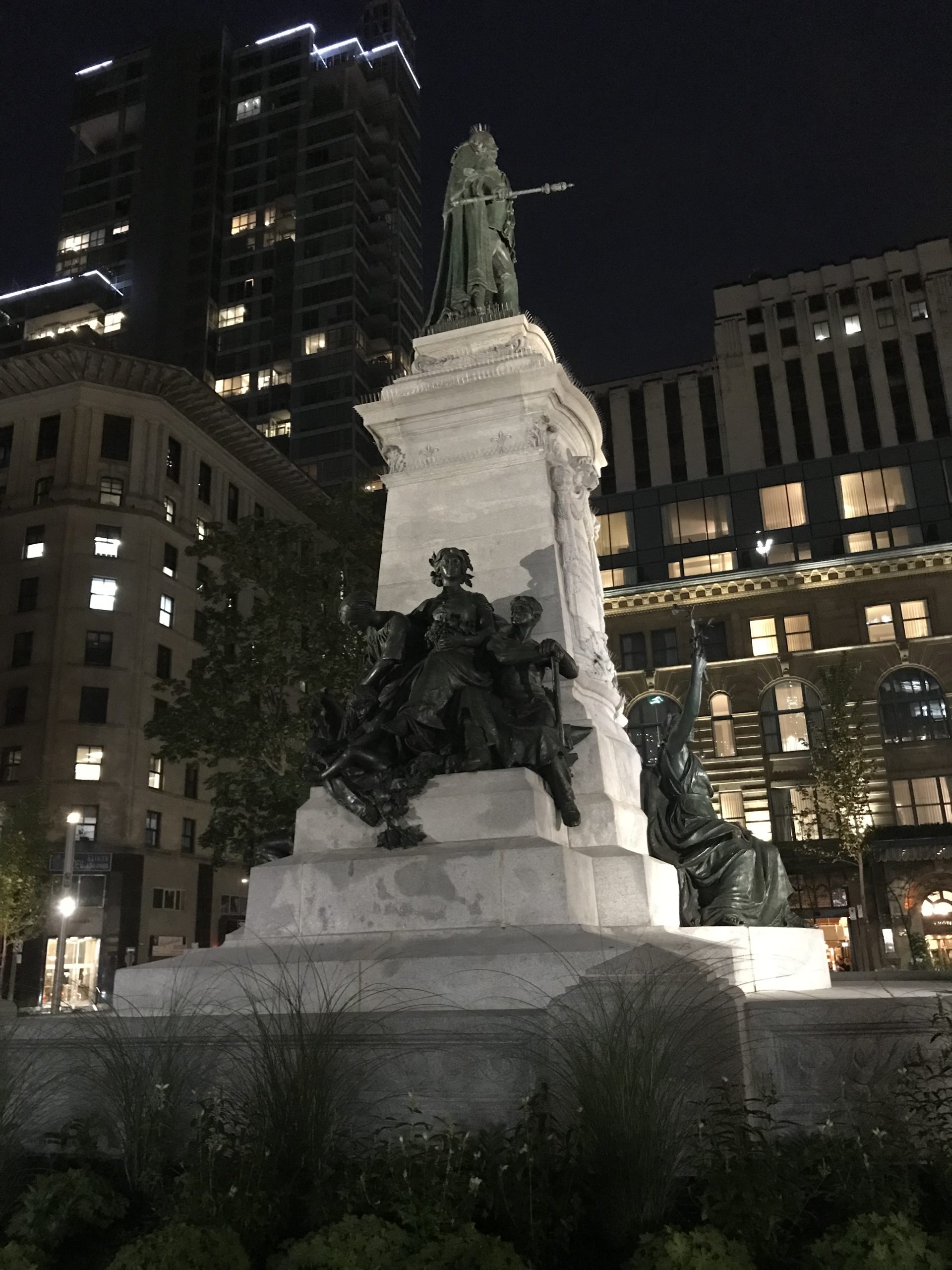
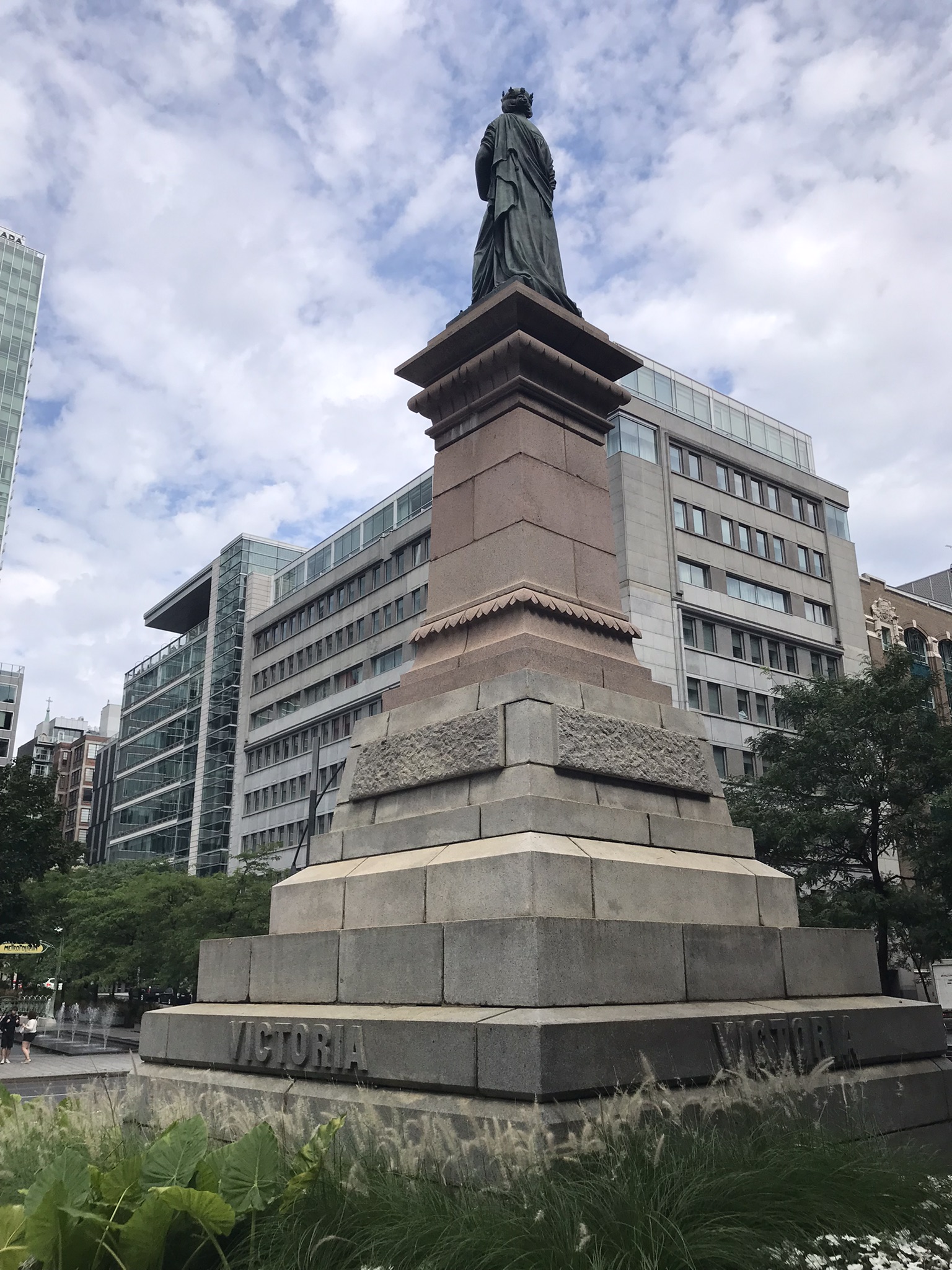
So, I probably should have skipped this week’s post given I have paid less than my usual not paying all that much attention. But walking past Montreal’s statute of Edward VII, the best of him that I can think of,* has inspired me to do my duty. So much nicer that the somewhat ignored statute of his mammy, Vicky, turning a cold shoulder a couple hundred yards further south. These little imperial spots are joined by other odd wee hints like we see at the Bell Telephone building on Beaver Hall built in 1928, where we can see a little hint of the rose of England there above the main door. Very weird. Makes one a wee bit more sympathetic for the nationalist cause, doesn’t it.

Well, enough imperial politics. What has been going on with beer? I have had one or two but I like my vacations without beer as much as with. Not so with others out there. For example, Ron has been on the road again, the descriptions of which travels are always some of my favorite things of his to read. Luckily he has not forgotten his need to describe his first meal of every… frikkin’… day:

We don’t rise very early. Well, the kids don’t. Me and Lexxie head down for breakfast at 10:30. And just miss breakfast. But they are serving brunch. Luckily, I can get something with fried eggs: pork hash. It’s quite nice, but the broccoli is almost raw and very tough. As we eat, the dining room fills up a bit. Still far from full, though it is pretty big. 

And Stan has taken a break in his vacation to do a bit of a round up on Monday but he is in no way not not not promising to do it next Monday. I liked this comment he made:

I pass it along not only because I think the combination of five words at the top should be put to music, but because it helps explain why the speed at which beers that don’t taste like beers that came before are being introduced.

Speaking of beers that don’t taste like beers, I liked this thought by Mr. B as to perhaps the why of it all:

Allow me to add a reminder that, back in the early days of microbrewing, what gave rise to the craft beer industry we know today was specifically NOT listening to what people wanted, but rather making good beer and educating people as to why it was so good.

Speaking of which, please note that fresh beer was very common before the days of micro brewing. It was called draft. Ask your uncles. Everyone drank it. And please also note that in 1997 imported beers were not hard to find and often in quite good condition if you had any interest in finding the store or bar that had them. Unlike revisionist histories so common today, reading reports from the time will quickly confirm that the main impetus for the micro brewing revolution was not to take on big beer but to make beers like those widely available imports. I have no idea why so little effort goes into researching a certain class of article when they reference the recent past  – but it shows. I can only appease my disappointment with another entirely gratuitous shot of another fabulous building in Montreal. Just click on the link for the fine details. It’s some sort of bank… or a hotel… or a hotel for bankers… Have I mentioned I’m in Montreal?**

Trying to make sense of another sort of misinformation – the adulteration of the concept of IPA – Matt wrote a long piece on the classifications of beers falling under that shadow… err… label and I was for the most part a very useful thing. There is still too little critical consideration of hierarchical, chronological and taxonomic legitimacy… but… what a lovely bit of truth telling is this:

A session IPA is not an IPA. It is a marketing term designed to sell you lower strength beer on the premise of it being as intensely hoppy as its stronger cousins. In reality, these beers are pale, or golden ales. In the past I have been told by brewers that a session IPA is brewed with the same amount of hops as an IPA, but some of those brewers also make beers called DDH pale ales, so which is it? Call it pale, call it golden, call it a hoppy bitter for all I care, but please let’s stop giving these low strength pretenders the credibility of a true IPA. 

Actual nerds interested in actual history may want to block out May 11-13, 2023 to hold a spot for a virtual lecture or some such experience on experimental archaeology and medieval brewing. Those so inclined can also watch the archives of past beery discussion panels from Ireland’s BeoirFest here.

Excellent reportage of London’s past from Boak and Bailey this week with a story on the Star of the East pub as well as an oral history from Robin Davies, a worker at  Godson’s Brewery in the 1980s. Fabulous.

Finally, Beth wrote another good article on the continuing systemic pale old boy control of craft – which, come to think of it, does remind one of the keystone above the entry way to that Bell Telephone building:

… according to those interviewed for this article, even if some people do begin to accept their role in beer’s exclusionary hierarchy, marginalized folks in craft beer will still likely face insurmountable barriers to equity unless organizational leadership and decision-makers relinquish their need for control. “There are a lot of spaces in which white people, and especially white men, still hold power,” says Lay, who notes that history has shown that redistribution of power rarely comes by asking nicely.

Indeed. There. Just a short report this week. I am sure I missed the most interesting stuff but I am out of here. Well, and then I will be over there by Friday. More later on my movements. Until then check out the updates from Boak and Bailey mostly every Saturday and perhaps now from Stan once in a while on a Monday. Check out the weekly Beer Ladies Podcast, and at the mostly weekly OCBG Podcast on Tuesdays or Wednesdays – and also sometimes, on a Friday, posts at The Fizz as well (Ed.: we are told ‘tis gone to podcast heaven… gone to the podcast farm to play with other puppies.) And the long standing Beervana podcast (Ed.: which I have missed from this list for some unknown reason.) There is a monthly sort of round up at The Glass. (Ed.: that seems to be dead now… nope, there was a post on July 25th… in 2022 even.) There is more from DaftAboutCraft‘s podcast, too. And the Beervana podcast. And sign up for Katie’s (Ed.: now very) irregular newsletterThe Gulp, too. And check out the Atlantic Canada Beer Blog‘s weekly roundup. Still gearing  up, the recently revived All About Beer has introduced a podcast, too. (Ed.: give it a few weeks to settle in and not be as agreeable.) Plus follow the venerable Full Pint podcast. And Fermentation Radio with Emma Inch. The AfroBeerChick podcast as well! And also look at Brewsround and Cabin Fever. And Ben has his own podcast, Beer and Badword (Ed.: …notice of revival of which has been given… still not on the radio dial…)  And remember BeerEdge, too, and The Moon Under Water. There has also been the Beer O’clock Show but that’s now wound up after ten years.

*Only one I’ve ever seen. Such a bragger.
**I am in Montreal!
These Are The Beery News Notes For The Week Of Jubilee Madness

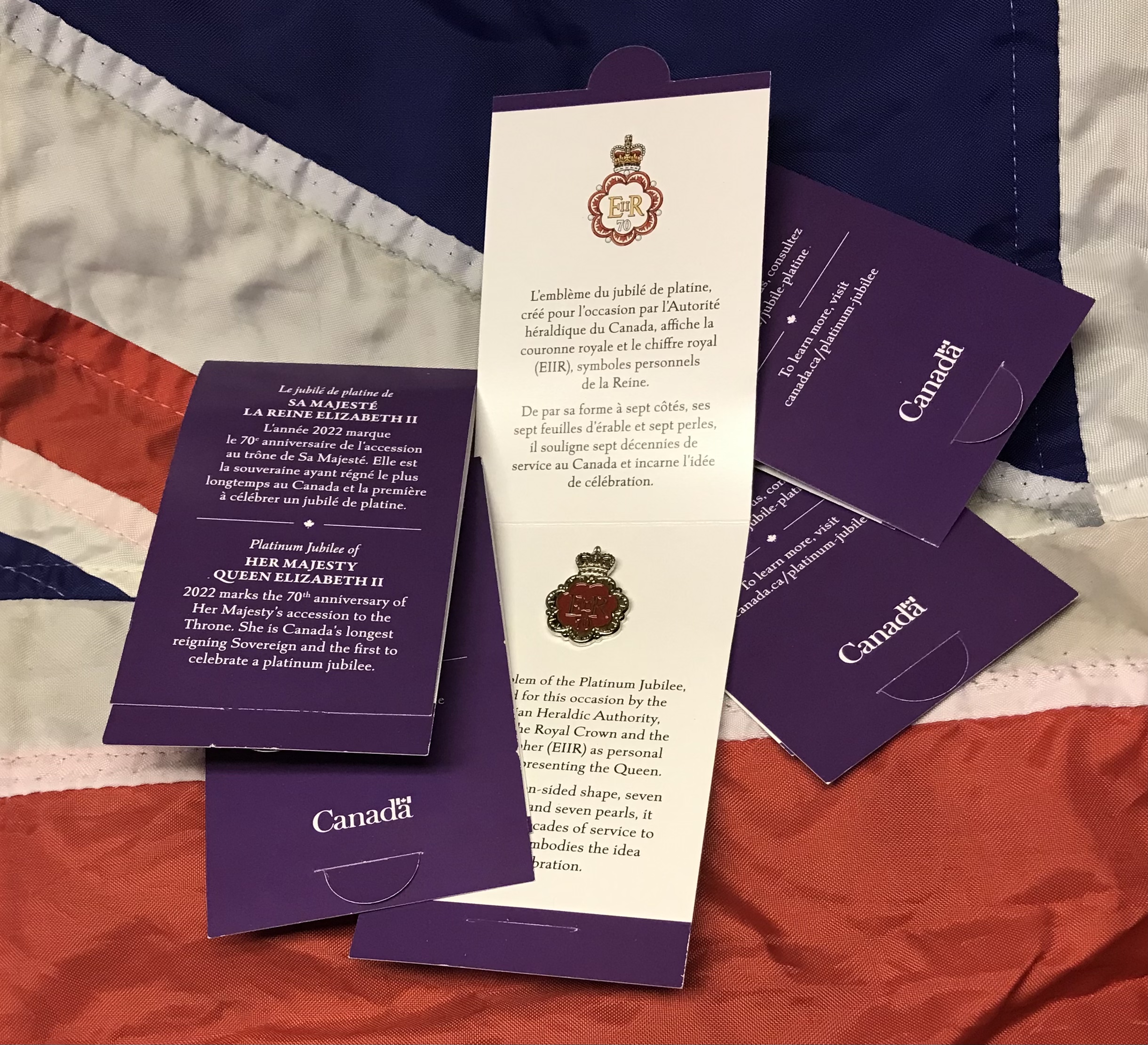
It is here! Jubilee!!* There shall be bunting. Confession time: I like the Queen herself. I like the structure that the Crown in Canada give the law that I practice. And… that’s pretty much it. Others are less enamored thanbeven that. So… we recognize that Her Maj does like a drink and a pub yet we do recognize that the whole rah-rah Union flag bunting and the children of Oswald Mosley’s nasty jingoism has tainted the whole flaggy wavey aspect… along with the colonial record… and… rampant and growing inequality… and well… Boris… but HRH like a drink and a pub!  In commemoration of the Platinum Joobe, I participated in one of the few ways the government in Canada provided and got a few pins. Pins! What Canadian child doesn’t long for their very own lapel pin celebrating HRH? And in mad cap celebration, one will be gifted to the maker of the cleverest comment left below this post or on social media responding to this post on an appropriately related theme. Remember – cleverest.

First, I missed this a few weeks back, a post from Ashley Newall with a number of forms of branding from Bradings brewery of Ottawa, the first step on our blessed patron E.P. Taylor’s rise to fame.  Of particular note is the photo of the Bradings Man by Yousuf Karsh and how similar it is to one of EPT’s assets, the branding for Cincinnati Cream Beer discussed in the bigger scheme of cream beer six years back.

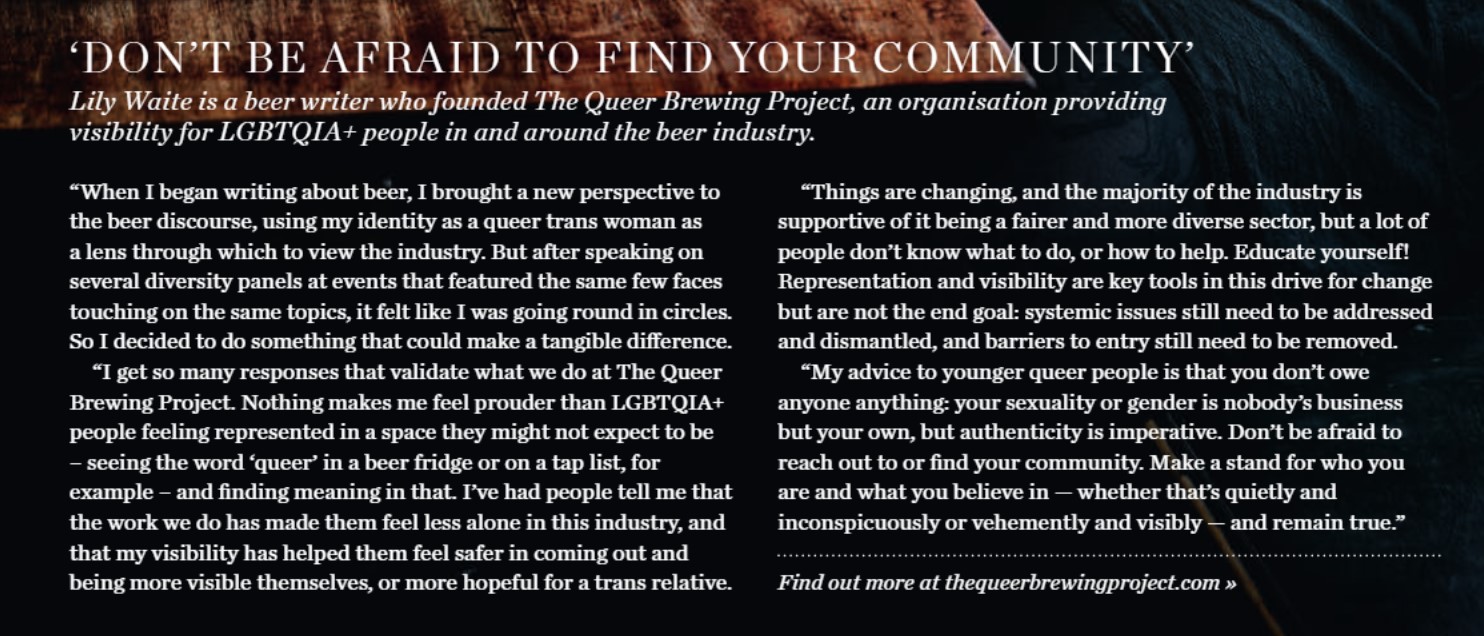
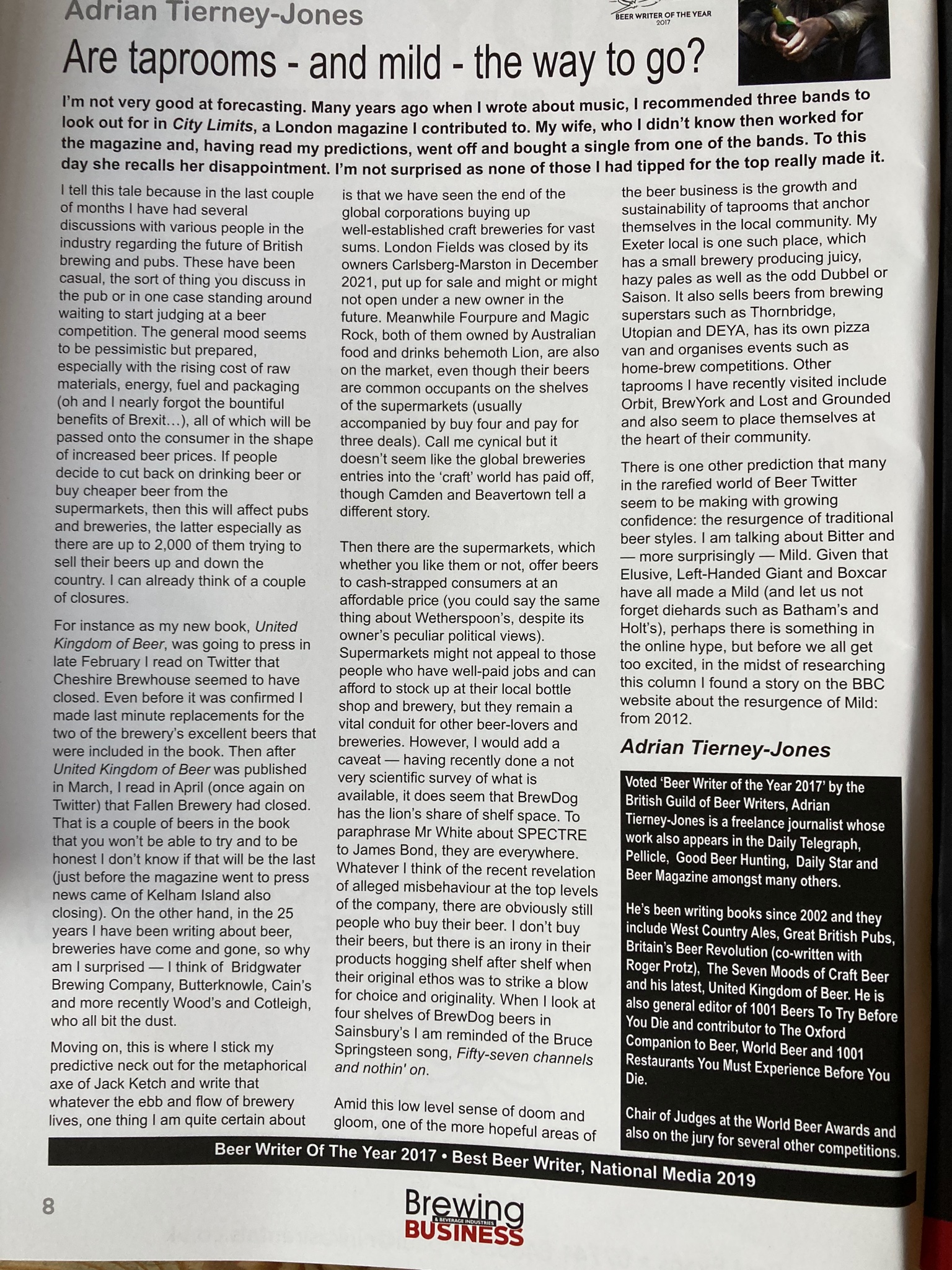
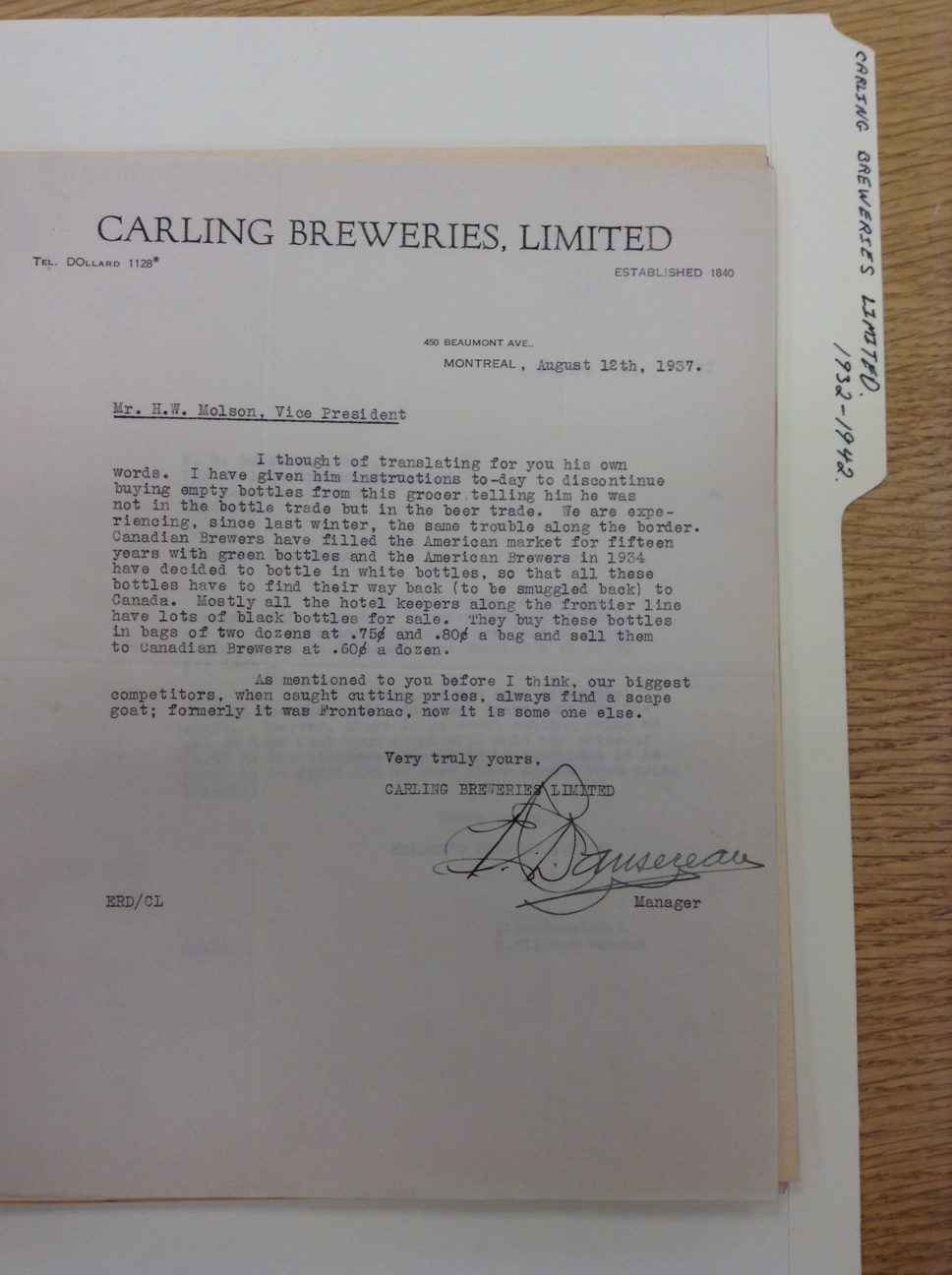
Two writers took the helpful step this week of tweeting guidance on stories located in obscure journals. First, a Lily Waite bio in Waitrose Magazine (as illustrated) and, second, ATJ in Brewing & Beverage Industries Business saved here on the perils facing brewing industry in these uncertain times. Brewery closures, investment failures and hegemony from big craft. Times are hard at all corners of the trade, especially given the UK’s situation. It was all foretold of course, if only by the obvious patterns set out in brewing industry history. Consider this letter from Carling to Molson in the 1930s. Beer competes. Beer colludes. The small and weak fail. Spend your pennies wisely.

Not sure the monks were all that wise with the pennies as Jeff explores, here quoting from reporter John W Miller** of the publication America: the Jesuit Review:

“…it is very modern, with automated machines that require only a handful of workers. Everything is top-of-the-line. Bottling lines come from Italy, brewing gear from Germany…” In order to service the debt and fund the monastery, the business plan called for the monks to build to annual production of 10,000 barrels a year… Miller helpfully reports that they had annual revenues of $1.5 million, which is pretty good if you’re not servicing a lot of debt.

In Boak and Bailey’s newsletter for May there was a comment made which, unlike everything they have ever ever written, had me shaking my head. It’s this passage in a good discussion about when to stop blogging:

Another natural full stop on a blogging project might be when you ‘make it’ as a writer and sell your first commercial piece. That’s not why everyone gets into blogging but we’ve certainly seen quite a few people make that transaction, with the blog as a stepping stone.

Perhaps what is meant is that this is the reason folk themselves think to stop blogging about beer – which I agree with – but it is not an actual reason to stop writing for the public without pay on a website you control. Why write to make someone else money? Seems weird. Let’s be honest. You have not made it or (too often) you have not made much of anything. So much of what I have to sift through to put together this weekly review is boring derivative and/or feeble writing for pay.  Very generously I would say half of what is most interesting is writing shared freely.*** Very generous half. Hunt out that other good stuff along with me. And write.

Lew on blind tasting:

We taste 5 spirits (blind picked by my daughter from 20 whiskies, rums, barrel-aged gins, calvados) in colored @GlencairnGlass & fearlessly guess all but one wrong.

Lew: “I’m dead sure we’re stupid…” Gold!

Not really related at all, BBC Four apparently ran a replay of Abigail’s Party last evening. You can see the entire miserable drunken thing here. A great trip back into “not nostalgia” for anyone convinced the past was a better place.

Perhaps it’s just an unfortunate camera angle but only in Montreal could someone out-Scandinavia the Scandinavians when it comes to stark and grey:

The space, designed by Ethan’s wife, interior designer Annika Krausz, has soaring ceilings, a firehall door with daytime light streaming through, and heated floors for the winter. Two immense earth-toned paintings by Annika’s father, renowned artist Peter Krausz, and a huge red light fixture above the semi-circular bar further enhance the space.

Another sighting of a brewery sending 100% of proceeds and not just profits as part of supporting the Ukraine cause. Good.

Debates of the week: (i) In the US, can you cool warm beer that was previously cold and (ii) are UK rough pubs a real thing?**** Expertise abounds with, as per, many contradictory positions taken.

Conversely, for years I wondered why beer writing did not focus more on particularly fabulous pubs… then I realized that there would be a chill from the many of those not mentioned,***** one of the great drivers in beer writing topic selection. Robot says “must raise all ships must raise all ships.” Happy then are we to see in Pellicle an honest to goodness warming tribute to a great singular pub, The State Bar of Glasgow:

The State Bar isn’t particularly trendy or arrogant, it’s a humble affair with an unassuming frontage. Possessing an Edwardian horseshoe bar upstairs—an ideal spot for watching football, doubly so as the bar is strictly non-partisan, (a rare blessing in Glasgow). Head downstairs and you’ll find yourself in what feels like the cosy library of a well-to-do Victorian household, complete with dusty books to read, well-worn leather chairs and a crackling fireplace. You can find all the essentials here; house wines and spirits, Tennent’s, Guinness, Cider & McEwans 80-/, or “wee heavy” as it’s known by the locals, and a stage for the bar’s weekly comedy or acoustic nights.

Nice. Now on to cheery international beery news time. Price hikes of 6% to 10 % expected in Japan. In India, beer drinkers may also be facing beer price hikes in addition to the local rationing mentioned last week. South American brewers are seeing “early signs of demand destruction” while a beer contamination scandal in Brazil (in which coolant and wort mixed during the brewing process leading to deaths) has reached the courts. Brewing for a rare medical disorder charity in New Zealand.

Finally, GBH seemingly did the right thing – though in the wrong order – and got some actual advice about writing risky bits about BrewDog and British court processes now republished, though there is the odd suggestion that others can rely on the legal opinion received. Beware! Now… it will be interesting to see if a legal paperwork of some sort now follows. As I have often said, just getting a legal opinion doesn’t stop a plaintiff from taking steps. I trust all involved got independent legal advice, too, just in case assurances had been given.

For more, check out the updates from Boak and Bailey mostly every Saturday but not from Stan every Monday as he is on his summer holiday. Check out the weekly Beer Ladies Podcast, and at the weekly OCBG Podcast on Tuesday (Ed.: but not again this week) and sometimes on a Friday posts at The Fizz as well. There is a monthly sort of round up at The Glass. (Ed.: that seems to be dead now.) There is more from DaftAboutCraft‘s podcast, too. And the Beervana podcast. And sign up for Katie’s irregular newsletterThe Gulp, too. And check out the Atlantic Canada Beer Blog‘s weekly roundup. Plus follow the venerable Full Pint podcast. And Fermentation Radio with Emma Inch. The AfroBeerChick podcast as well! And also look at Brewsround and Cabin Fever. And Ben has his own podcast, Beer and Badword (Ed.: …notice of revival of which has been given)  And remember BeerEdge, too, and The Moon Under Water. Things come. Things go.

*I expect scenes not unlike those in The Return of the Archons to play out. In tribute, an old pal used to shout “Festival!” in bars as he smoked three cigarettes at a time. That sort of thing.
**Quoting heavily yet still slightly slagging the author he relies upon as it relates to a side issue: “… but he’s not an industry writer and doesn’t realize…” No need of that I clearly like to project a less saucy approach!  
***If you have any doubts, read Boak and Bailey‘s archives… then go on to Jeff at Beervana… or Jordan‘s site or… or… or…
****Of course they are. The playgrounds of racist, sexist and every other sort of beery bigotry… oh, and violent, too. But most labeled as such are not.
*****And perhaps also the tourist association funders who ensure junkets are (i) paid for and (ii) non-selective. I mean, sure, a rising tide raises all boats but who doesn’t want to control the tides???

Here We Are! February!! A New Month Of Beery News Notes!!!

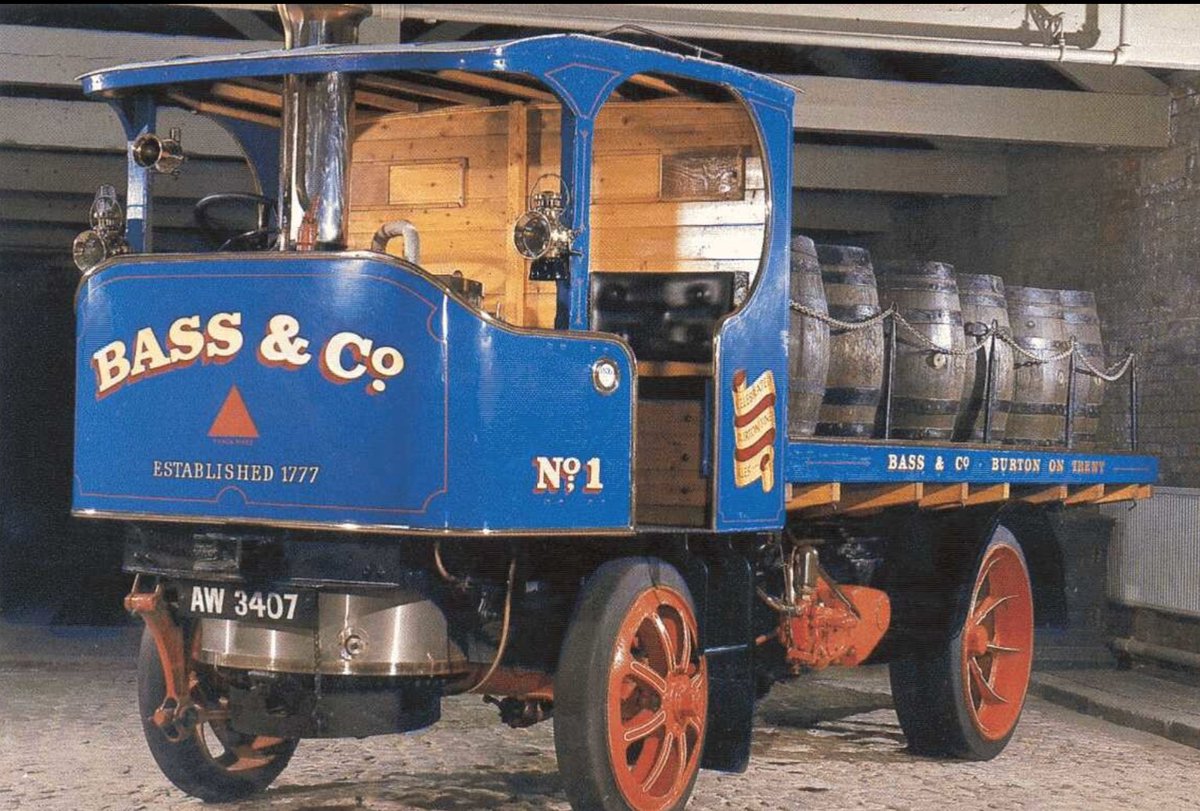
Last week I was doom scrolling about the Ukraine. Earlier this week, it was about Ottawa.* Now it’s just about the blizzard. Today? Well, if my last name was “Event” I could have named a kid “Snow” and enlisted them in the army to remind me of today: Major Snow Event. Nasty stuff all over eastern North America. Good thing I have my internets to keep me warm. Just look at that up there. Bet that didn’t spend useless days blaring its horn to protest nothing and everything. Sweet. From Brewing Heritage, it’s a…

…handsome steam lorry was built in 1916 by Alley & MacLellen Ltd. of Glasgow, and first registered in February 1917.

Neato. Well, what is going on? Dry January is over. That’s something. The Times of London reported (probs paywalled) that…

A record number of Britons have given up meat, dairy and alcohol for January, with demand for vegan foods and non-alcoholic drinks rocketing over the month, according to data from Britain’s biggest supermarket.

An interesting story, actually. Virtue is in… for a few weeks at least. And the British of Britain** are buying things like “Nozeco Spumante, alcohol-free fizzy wine” (sales up over 200%) and “Gordons 0.0%, a no-alcohol gin”! Yikes. Alcohol-free gin sounds like gin-free gin to me. But I own a juniper tree so I can just suck on a few berries for free if I am desperate. Why pay 20 pounds a litre for flavoured water? Holy moly! NA brewers are missing out on a good payday.

Very conversely, this is great news as we walk away from another lockdown. I can now relive the glory of my beery life fifteen years ago and head to a new beer store in Syracuse, NY just two hours to my south:

The store occupies 9,500 square feet, split primarily into two large rooms. On Monday, Singh’s inventory list showed more than 14,000 “items,” such as 4-packs, 6-packs or cases. And there’s still unused space to fill… “They’re definitely making an effort to provide a wide selection,” Hagner posted recently to the Syracuse Craft Beer Enthusiasts Facebook page. “There’s lots of local stuff, some timely national releases (my first sighting of Hopslam), the biggest SN (Sierra Nevada) assortment I’ve seen. … Personally I was pleased with the import/German section as well as traditional stuff that’s often hard to find.”

Elsewhere, the old is also new again in London where Guinness is creating a new destination brewery with some very good  timing:

Guinness sales in Great Britain have grown by over 30 per cent in the last six months and one in every 10 pints sold in London is now a Guinness. The new site, to be called Guinness at Old Brewer’s Yard, will include: A microbrewery producing limited edition beers and offering tours with Guinness beer specialists; event spaces and central covered courtyard; a Guinness store selling rare items, and a open-fire kitchen, restaurant and 360 degrees glass rooftop space.

I can’t link to every one of the excellent posts in Eoghan’s most excellent series A History of Brussels Beer in 50 Objects can I? I will, however, for this week’s story connecting Belgian colonial brewing in the Congo with the fight for freedom in the late 1950s:

Brasseries du Congo, or Bracongo, were known for the slender green bottles of their Polar brand. In September 1957 Bracongo hired a former postal worker recently-released from prison following an embezzlement conviction to help sell them. Patrice Lumumba not only grew Polar’s business in the capital, he also used his salesman skills and his client network to advocate for Congolese independence. 

Look at this. We all suffer from the unending spam from the glassmakers of each and every nation. Here, however, we see the reality of fancy glassware according to The Times Of New York:

Most wine drinkers, admittedly, will neither want nor need such rarefied glasses. Many casual drinkers are happy these days to use inexpensive goblets or even stemless glasses, which I would not seek out, though I am happy enough on occasion to drink wine from a tumbler.

Speaking of which, Jancis on Boris… who is clearly a tumbler man:

For months, while millions of ordinary people were deprived of a convivial after-work drink with friends, the staff at 10 Downing Street partied on. It could seem, not least because of the late-night dashes to the supermarket, that the aim was chiefly to drink as much as possible. Connoisseurship appears to have played little part. I feel thoroughly ashamed of how this must look to the rest of the world. Downing Street behaviour looks like binge drinking. 

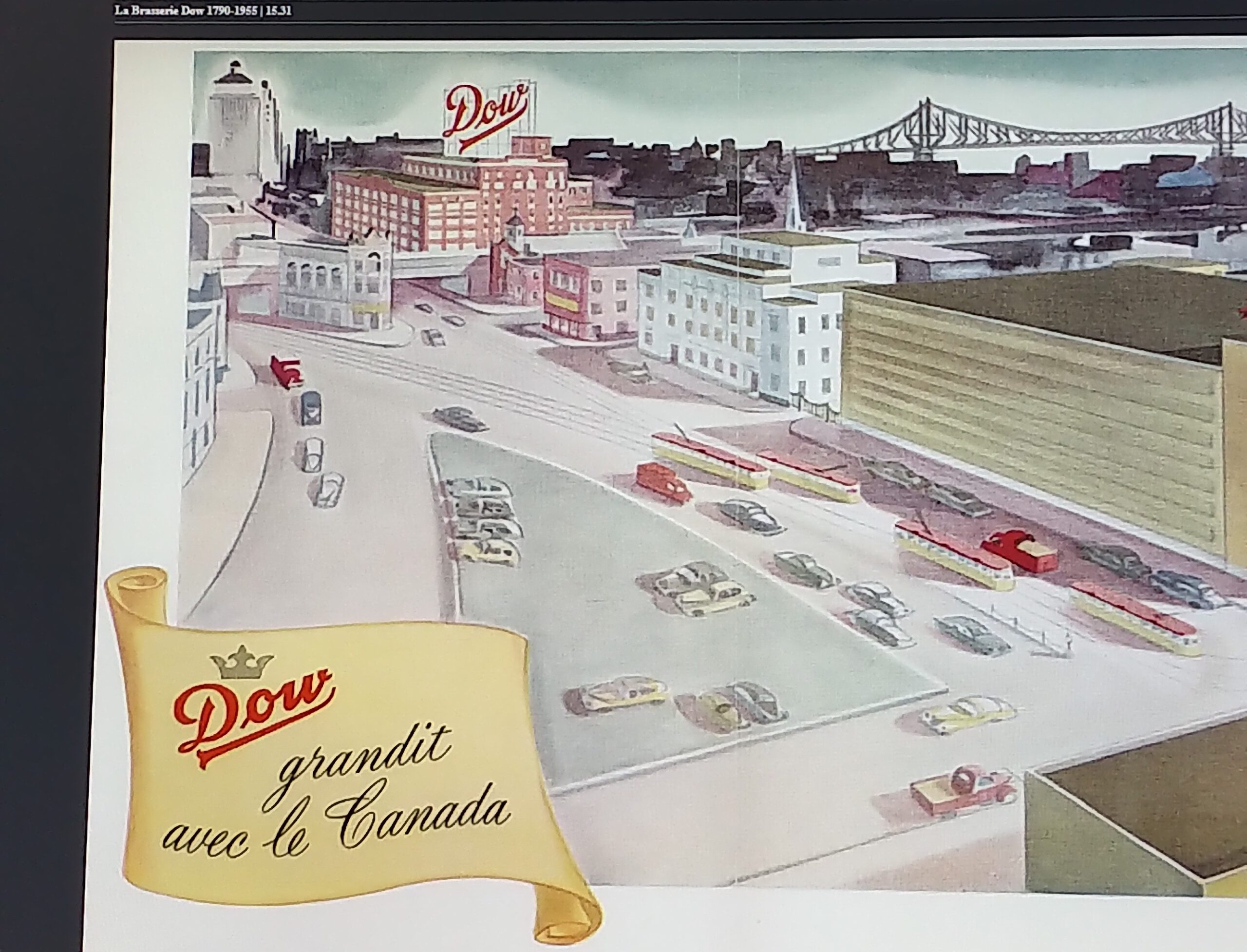
Bingy Boris. A notch or two more sophisticated is Gary who noticed his modernist Montreal in 1950s promotional material created for the Dow brewery by Albert Edward Cloutier (1902-1965):

The use of pastels in commercial art was a trend internationally at the time, as, say, some European beer posters show, or those dreamy pink, blue and yellow posters advertising holidays on the Riviera. Cloutier rendered a Platonic picture of 1950s Montreal, one rather removed, as I suppose for any city, from the reality in street and district, whether rich, poor or otherwise for that matter. (We were entre les deux chaises). When I think back, it is his Montreal I will remember, family apart.

And Jim Koch thinks cider is a sort of beer. “Fluids I make profit from” appear to be beer to Jim Koch.

Finally, know your medieval English plowing practices. There’s a good explanation of how it worked – and still works in some localities in BBC’s 2010 series The Story of England. Also learn how Piers the Plowman was worth writing about in 1378 as he is the technical wiz of his day even if he shuns the “best brown ale” unlike those young whippersnappers.

That’s it for now. A quieter maybe saner week in beer land. For more check out the updates from Boak and Bailey mostly every Saturday and from Stan every Monday, plus more with the weekly Beer Ladies Podcast, and at the weekly OCBG Podcast on Tuesday and sometimes on a Friday posts at The Fizz as well. There is a monthly sort of round up at The Glass. (Or is that dead now?) There is more from the DaftAboutCraft podcast, too. And the Beervana podcast. And sign up for Katie’s irregular newsletterThe Gulp, too (… back this week!) And check out the Atlantic Canada Beer Blog‘s weekly roundup. Plus follow the venerable Full Pint podcast. And Fermentation Radio with Emma Inch. The AfroBeerChick podcast as well! And also look at Brewsround and Cabin Fever. And Ben has his own podcast, Beer and Badword (which I hope is  revived soon…)  And remember BeerEdge, too, and The Moon Under Water.

*Organizer“!!!
**Scottish“!!!

The Beery News Notes For The End Of January And Perhaps Of BrewDog

What an odd week. Very bad stuff about craft beer in the UK then more about very bad things in Ontario craft beer. Didn’t help that I was reading Motherwell, a recent memoir about someone about my age whose family didn’t emigrate from the same bit of Scotland mine left behind for Canada in 1956. Grim pain and judgemental negativity pulsing through a hardscrabble family living through hard times in an industrial town near Glasgow. We dodged. Just a few phrases I heard growing up echoed. I hated “know your place” the most, especially as I didn’t have to. Why bother? Why should anyone? Why in craft beer now? Who are these assholes?

MindbogglIng. Let’s start somewhere else. Stan’s latest edition of Hop Queries came out this week with good news from the Czech Republic:

Czech farmers harvested 18.2 million pounds of hops (for perspective, that’s about as much as Americans grow of Citra alone), 40 percent more than 2020 and 34 percent more than the 10-year average. Average yield of 1,467 pounds per acre was an all-time high. (American farmers average 1,900.)

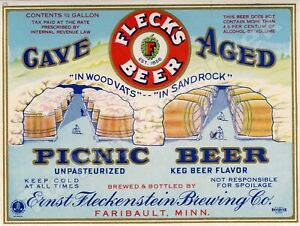
Gary updated a series of posts that he began in 2020 – who hasn’t been up to that sort of thing? – and included the image to the left. It’s not a super huge .jpg but worth a click. I love the name of the beer – PICNIC BEER. It needs an exclamation mark. It needs to be on every brewery’s list of brands. Anyway, Gary was actually not writing so much about PICNIC BEER out of Minnesota as the use of the term “sand porter” in Montreal brewing in days of yore – by which I mean the late 1800s aka The Gilded Era:

Until recently I felt the sand-topped lid idea made the most sense (some English brewers still practiced it into the next centuries, using “marl”, a similar idea). However, in studying recently the history of a Minnesota brewery, Fleckenstein, I now have a further idea what sand porter meant.

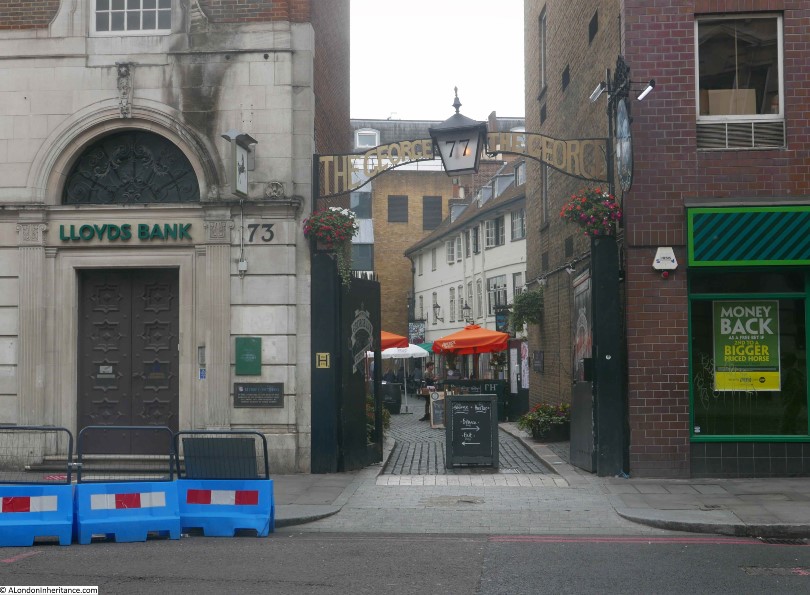
Speaking of yore, the free web service known as A London Inheritance included a post on the George Inn in Southwark which was, as we all recall, the subject of Pete Brown’s book Shakespear’s Local. Lots of unconventional photographic views and mapping, like this one to the right giving a very unromantic vision of what you actually see from across the street. It is actually a massive post. A data fest. Well worth reading. The post includes this astute observations about the value of certain second hand books:

Old books help as they provide information closer to the time they are recording. Some care must be taken to double check, but they are a good source of information. These books also have their own history as they pass from owner to owner over the years, accumulating a memory of their time with some of the owners of the book.

The post then goes on to highlight photos and even a letter relevant to the subject that had only been stuck in copies of books that he had found over the years. All fabulously illustrating the unique archival value blogs. Much praise to the author… whose name is not particularly highlighted on the site. Freddie?

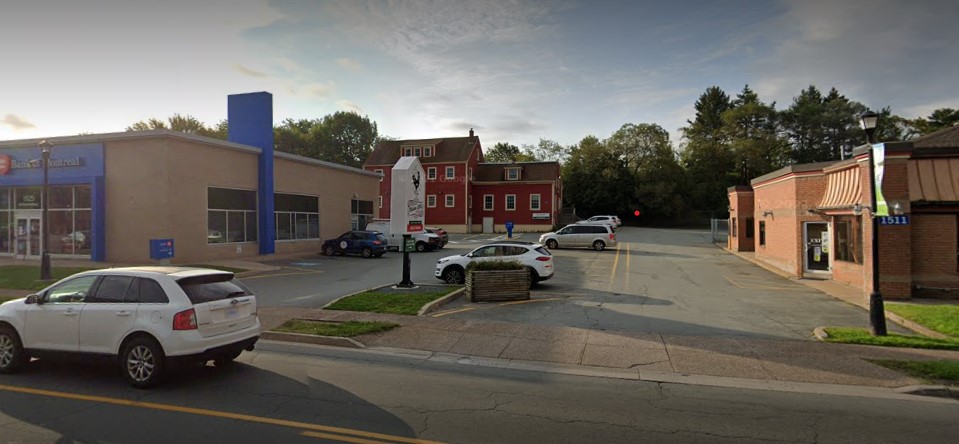
On a similar theme but in a colonial context, I saw a reference on Facebook to Ten Mile House in Halifax, NS (my old home town) this week and wondered what shape that was in:

The house was located ten miles from Halifax on the Bedford Highway. It was built in the late 1700s for Colonel Joseph Scott on land granted to him in the 1760s. In 1798 it was called Scott’s Inn, and opened as a House of Entertainment by John Maddock. Joseph Scott died in 1800 and his widow Margaret conveyed property to John Lawlor. Who opened and operated Lawlor’s Inn from 1802- 1809, possibility later.

Nice image at the Nova Scotia Archives website. As you can see from the thumbnail it is now sitting well back of the main road, the Bedford Highway, but looks from photos on Google to be in very good shape right by The Chickenburger. There are plenty of these colonial taverns and inns out there if you know what you are looking for. Like a favourite of mine, the Fryfogle. Interesting note: at the time Ten Mile House was in operation as Scott’s Inn in the late 1790s, it was just down the road from the estate of Queen Victoria’s father, the Duke of Kent. The tavern not the Chickenburger. The Chickenburger is old but not that old. I will pay it a visit when I am back there in early March.

And in one last note about built heritage of pubs, taverns and inns this piece in Eater Chicago was interesting in terms of how one preservation project was undertaken:

While Lincoln Square reconfigures during the pandemic — across the street from the Brauhaus space, the Huettenbar has quietly closed (owners hold to hope that it could eventually reopen) — fans can take solace that the Brauhaus has returned in a slightly different format. The bar, at least in spirit, is now located on the second floor of the DANK Haus German American Cultural Center.

In a less physical form of preservation, Edd Mather posted this bit of video on facebook, a fabulous step back into the near past of Ireland and the question of corks v. crown caps which relies on any number of associated technologies:


OK – the bad news. I have mentioned this before so let’s be upfront. Once upon a time, BrewDog sponsored this blog. When they were tiny, not the £2 billion international corporation they are now. I still have that label from a sample they sent at the time and it was put on with Scotch Tape. Well before the stupid squirrel and certainly well before BBC Scotland News detailed what apparently everyone in the trade knew but too often was not willing to put into print. The main allegations so far:

a. James Watt owns a massive amount of shares in the global beer brand Heineken hypocritically contrary to his “big beer is bad” stance.
b. James Watt is accused of being a pervy boss;
c. BrewDog falsified paperwork submitted to allow it to import into the United States; and
d. BrewDog carefully structured the Equity for Pinks fundraising to benefit the brewery and not the investors.

This reaction to the first bit of news is gold. Deals between breweries started to come apart. Punks with Purpose said the fight goes on. There were also calls for a resignation. Also questions: “why the obsession?” I will leave it there* as you all know this – and my job is to root out the unknown and beery for your reading delight.** BrewDog has not been delightful for many many years. But we need to remind ourselves, while they are big they are just one of many – as @esbroadfoot helped remind us by inviting  and sharing stories of rotten treatment, largely in the Canadian craft scene.

Still, by Wednesday, it all seems to have put JJB/Stonch in a reflective mood:

Placing orders to fill an empty pub cellar has made me realise what an amazing choice of absolutely superb beer from independents I have. Yes, the craft beer industry has its bad sides, and faces daunting challenges this year, but let’s not forget how brilliant it is.

He’s always hated BrewDog pubs (“…Awful aesthetic, odd places….”) but appreciates how others feel cheated. He also reminds us to be kind to the good folk who distribute our beer. He also posted a link to a 15 year old post about the horrors of a pub crawl in St. Albans, home of CAMRA, for a fair and balanced set of thoughts.

Elsewhere in space and time, Ron has been exploring the colour of milds and has come across a new unit of measurement – tint!

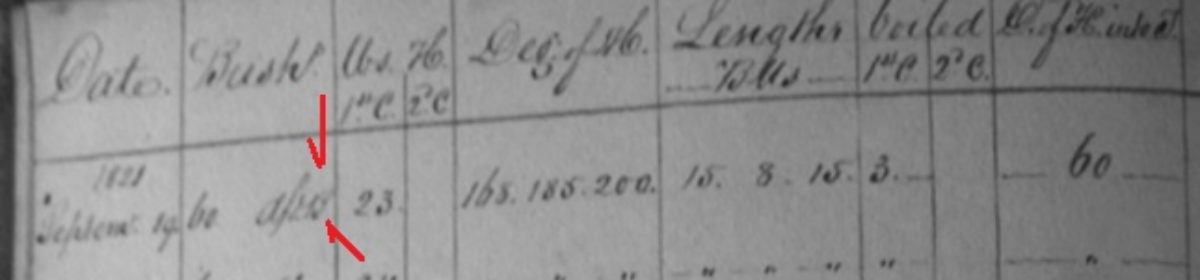
The biggest problem is the lack of hard data. It’s tricky calculating the colour from the ingredients, especially when sugar is involved. As this is mostly only described very vaguely. There are very few records of beer colour before WW I. Occasionally chemical analyses will include a number for the colour, mostly in some weird scale that died out 100 plus years ago. Only a handful of Barclay Perkins records from the Edwardian period include the beer’s colour. At least that’s what I thought. Until I happened to notice that line in a Fullers brewing record. That “Tint” number looked like it was in an understandable scale. The type of Lovibond used before WW II.

Even further afield, does Syracuse have a low estimation of its own worth in the beer world? Like Toronto?  As bad as that? I spent a lot of time in Syracuse up to a certain point… the point at which the Canadian dollar collapsed from parity to 75 cents frankly. For AAA baseball. For the beer shopping day trips. For bars now long gone like The Blue Tusk and Clark’s Ale House. For Wegman’s. I love Syracuse. I used to cross sometimes just for the white hots. Je me souviens… but more to the south…

Finally, note: union made. Nova Scotian beer cases always said that too. Plus health tax included. So by drinking beer you knew were doing your part. I might do a bit of that when I head out east in March, too.

That’s it for now. Too much. For more check out the updates from Boak and Bailey mostly every Saturday and from Stan every Monday, plus more with the weekly Beer Ladies Podcast, and at the weekly OCBG Podcast on Tuesday and sometimes on a Friday posts at The Fizz as well. There is a monthly sort of round up at The Glass. (Or is that dead now?) There is more from the DaftAboutCraft podcast, too. And the Beervana podcast. And sign up for Katie’s irregular newsletterThe Gulp, too (… back this week!) And check out the Atlantic Canada Beer Blog‘s weekly roundup. Plus follow the venerable Full Pint podcast. And Fermentation Radio with Emma Inch. The AfroBeerChick podcast as well! And also look at Brewsround and Cabin Fever. And Ben has his own podcast, Beer and Badword (which I hope is  revived soon…)  And remember BeerEdge, too, and The Moon Under Water.

*But if this is correct and such acts are common in craft beer, well, we can all agree that anyone who knew this and is claiming to be reporting on the beer trade… is pretty much a fail, right? If not complicit… right?
**Plus I am aware of my own little realistic chance of not ending up in HELL!!!

Your Very Merry Christmas Edition Of Beery News Notes

This is the week! Santa and everything. So exciting. Last minute shopping opportunities abound even while heads nestle all snug in their beds bothered by visions of some sort. We are as happy for anything around these parts over the vaccination drive through outdoor wintery clinics, as seen above, which are boosting 5,000 people or about 4% of the city’s population per day. After a very scary spike that led the nation just a week or so ago, this is very good news for the holidays. The goose or turkey or whatever is sorta taking second place this year.

It is Tibb’s Eve today, a Newfoundland early start that may go back to 1700s and into the rural outports. What’s that about, you say?

Tibb’s Eve was a “non-time”; if something was said to happen on Tibb’s Eve, it was unlikely it would ever happen. It appears circa 1785 in “A classical dictionary of the vulgar tongue” thusly: “Saint Tibb’s Evening, the evening of the last day, or day of Judgement; he will pay you on St. Tibb’s Eve, (Irish).”

Fabulous. What is going on in beer itself? Well, I was really exciting by (as excited as one might get by I suppose)… by Ron’s reworking of some data to discover some very basic information about Dutch beer culture in the mid-1900s:

The obvious post-war trends were moves from dark to pale, sweet to bitter and draught to bottled. I’m shocked that pre-war dark beers accounted for almost 50% of the Dutch market. I would never have guessed that. Nor that such a high percentage of beer was sold on draught. Even in the UK, where draught was the norm, a higher percentage of beer was sold in bottled form on the 1940s.

That’s a fourth approach in addition to function, nationalism and style. This illustrates the great thing about amassing and writing in quantity – interesting qualities will jump out that would otherwise be missed.

Trying to be upbeat this week but this story on the death of one UK craft buyout is really interesting – especially as it is written from the marketplace reality point of view as opposed to the usual PR hopes and wishes:

Timing was an issue too. When it bought London Fields, Carlsberg’s eponymous lager and Export brews had been seriously struggling for years. Moving distribution to DHL also didn’t help, according to a second industry source, who says the tie-up was “fraught with difficulties” leaving irate retailers “unwilling to entertain a broader range”. Then after Covid hit, the merger became top priority. Put simply “[brewers] are potentially heading into another difficult period and it is all about cost right now, rather than growing younger brands”.

I really enjoyed watching Lars M.G. discussing why beer and Christmas are deeply connected, and what Christmas was originally all about all on a live (and free) online talk Tuesday afternoon my time hosted by @ChiBrewseum. These presentations they are putting on are a great addition to the good beer scene. He mentioned a record from the 1270s when the Norwegian king required prayers over the beer bowl to Odin to be replaced with those to Jesus. I mentioned that is right about when and why my peeps left town. We are also all the Elliots, too.

I really liked the “best of” reading list from Boak and Bailey if for no other reason that it is the sort of list that is separate from the self nominations we see on awards lists. Which can lead to this sort of unhelpful thing. Every entry is well worth your time. If I would pick out any one as the best 0f their best of 2021, it would be the epic A History of Brussels Beer in 50 Objects by Eoghan Walsh of Brussels Beer City.  Catch up! There is another half year of this tremendous bit of writing to go.

Great insider thread on the state of the bar scene in the USA in these days of the fourth wave.

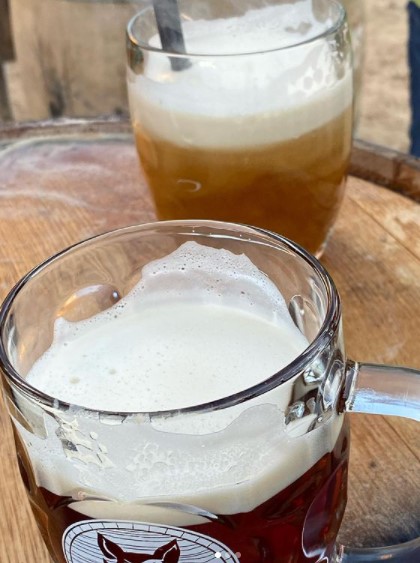
The new drink buzz this week was all about the hot poker being thrust into your malty winter ale on a cold tavern patio somewhere.  Kate B. posted a vid. Stan on Insta wrote:

Some like it hot. Next please. My beer (Hogshead ESB) waits for a poke in the mug with a very hot iron. Lots of foam. Toasted marshmallow. 

I liked this – it’s a return to an old practice for winter punchbowls, whether filled with wine or ale… or both. Try it yourself, out in the yard with a Lambswool a la Braciatrix.

Martyn posted about one grump, sort of an anti-communicator, complaining about the quality of his drink:

In October 1736, Jonathan Swift, dean of St Patrick’s Cathedral in Dublin, and the foremost satirist of his age, published an attack on English porter, which was made, he said, of “the worst Malt, which is sent from all parts of the Country for that Use, and consequently nothing but Gin exceeds it for Badness.” The smell of London porter, he said, was “sufficient for any Creature above a Swine”…

Yikes. More tastefully, good news for hopheads in Stan’s newest edition to Hop Queries:

Friday the United States Department of Agriculture reported record hop production of 116 million pounds in Idaho, Oregon and Washington. That’s 12 million pounds more than 2020, when weather and smoke damage drug down yield, and 4 million more than the previous record of 112 million pounds harvested in 2019.

Speaking of good taste, Jordan brushed off his fountain pen and wrote about the state of Glutenberg, the Quebecois gluten free brewery and, like the Lord looking down upon creation, was pleased:

Alternative fermentables are used all over the world and the millet and buckwheat, which tend to be from arid climates, are probably things we’re going to need to look into in the near future. One thing this has certainly highlighted for me is how much we’ve become dependent on wheat and oats in the last half decade as the influence of New England IPAs has crept into other styles. I wonder whether that makes the Glutenberg products more accessible than they would have been six or seven years ago since haze and cloudiness are not issues in the general market anymore.

Finally, its time to brush off the Xmas tale from Church-Key Brewing of Campbellford, Ontario has arrived. Gather the kiddies, get your popcorn and Kleenex:


Well, the holidays are definitely here now. Be happy and eat a chestnut or whatever it is you eat that’s a bit weird. While you are being happy please also check out the updates from Boak and Bailey mostly every Saturday and from Stan every Monday, plus more with the weekly Beer Ladies Podcast, and at the weekly OCBG Podcast on Tuesday and sometimes on a Friday posts at The Fizz as well. There is a monthly sort of round up at The Glass. (Or is that dead now?) There is more from the DaftAboutCraft podcast, too. And the Beervana podcast. And sign up for Katie’s weekly newsletterThe Gulp, too. (That’s a bit now and then now.) And check out the Atlantic Canada Beer Blog‘s weekly roundup. Plus follow the venerable Full Pint podcast. And Fermentation Radio with Emma Inch. The AfroBeerChick podcast as well! And also look at Brewsround and Cabin Fever. And Ben has his own podcast, Beer and Badword (which he may revive some day…)  And remember BeerEdge, too, and The Moon Under Water.


Your Very Own Mid-April 2021 Beery News Notes For A Thursday

What a difference a week makes. My birthday is coming up. My 18th bloggaversary is coming up. My jab appointment is coming up. The radishes are well up.  Speaking of the 18th bloggaversary, I was thrilled to realize that quite early on I had witnessed and captured forever perhaps the first bit of beer blogging snark or at least shade back in 2003.  Nothing like being a part of history. Oddly, someone just offered me $300 for that original URL  “genx40.com” under which the beer blogging started. I can’t imagine what for.

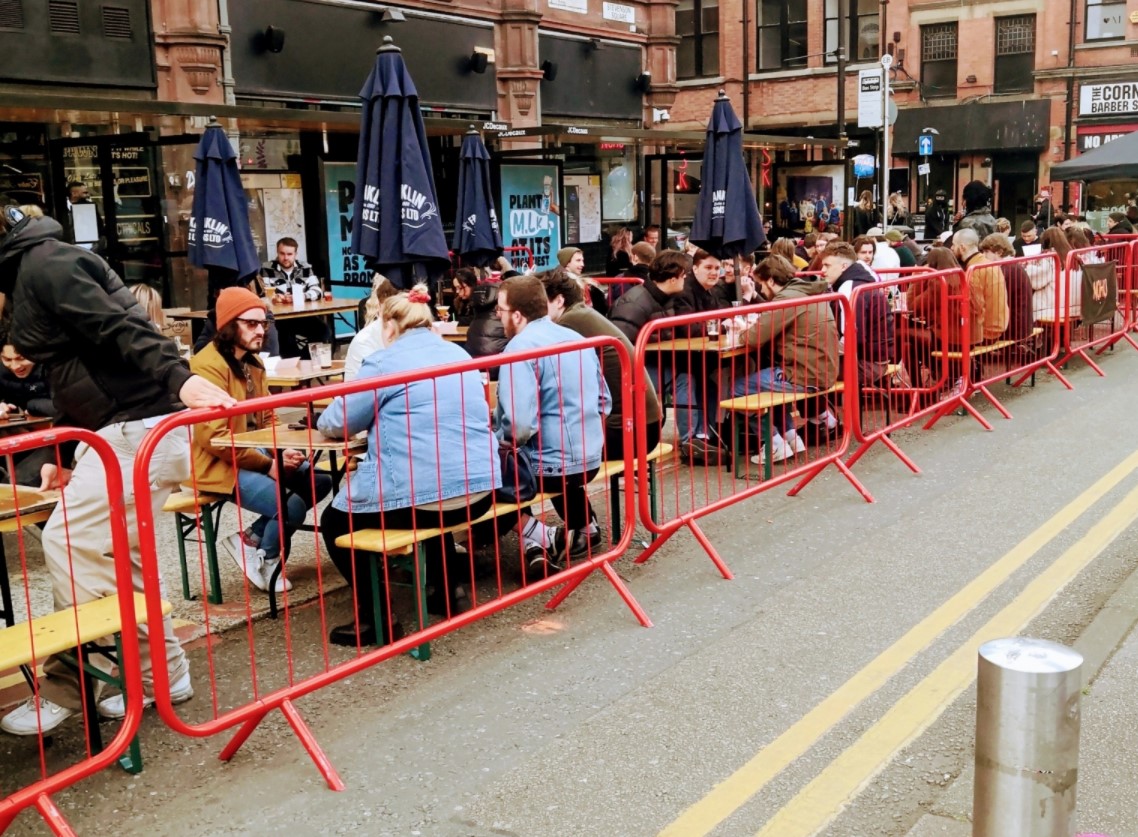
Pubs are open in England for outdoor service and apparently everyone I follow is a vitamin D deficient dipsomaniac. Except Matt. He was anxious. And Boak and Bailey hovered.  Me, even after I get the jab it’s going to be a while before I am settled enough to race towards a crowd. Retired Martin, as always, provided a great photo essay of his experience, a portion of one of which is captured above. I love capturing of the moment, the hipster hat in shades next to the guy at the left taking a seat. Two years from now the set up will look like something from a sci-fi movie.

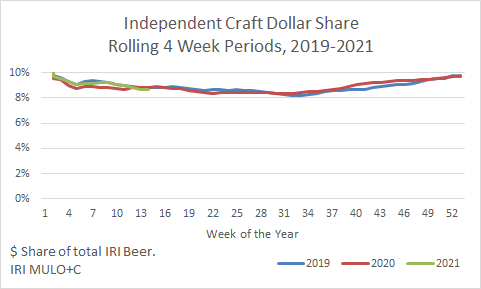
Speaking of things not affected by the pandemic, what is not to love about this chart provided by BA Bart indicating what is needed to be remembered if you hang your emotional well being on the peg of craft beer. It shows the percentage of actual craft (not baloney craft) sales as a percentage for the years 2019, 2020 and into 2021. The percentage is stable. You see it dips in the summer when normal people buy more normal beer. And rises when they slow down. Nice. Pundits can cease their concerns otherwise.

In the greatest city in the world, Montreal, people are falling in love with the local lager scene:

Richer says lagers “appeal to a lot of different people” — everyone from “Monsieur et madame Tout-le-monde,” who might normally be fans of Molson or Labatt, to beer geeks who are looking for something simple, but well-crafted, and with lots of variety. To be clear, this isn’t a trend created by the pandemic — just accelerated by it. Across Quebec, hopheads still rush out to the latest can releases at breweries like Messorem Bracitorium, Brasserie du Bas-Canada, and Sir John, which specialize in full-on, double-dry-hopped hazy IPAs. But even those breweries are making lagers.

Perry. One of my heroes in the drinks writing world is Jancis Robinson and this week she offered her website a space to let us know about a rare perry:

Flakey Bark is a marvel of a drink. Broad, bold, structural, it carries on its breath a muscular depth of pear skin, peach pit, earthy bacon rind and wet slate. Its tannins in youth are formidable – so much so that eating the fruit raw is said to skin the roof of your mouth. It is built for food-pairing, offers extraordinary versatility in that respect, and with age it unfurls into layers of riper, fleshier fruit. A treasure – a delicious one. And one bad storm could wipe it entirely from existence, because there are only six mature Flakey Bark trees left in the world.

Nutso. Absolutely nuts. Speaking of which: brewery gets grocery store deal,  brewery told off apparently by morons.

I set out a slightly different understanding of the agreement which binds Ontario’s In and Out Store, aka The Beer Store, compared to some skuttlebutt observations being made. Our own expert beer business reporter Josh Rubin knows more about the situation than anyone else and has set out the deets in The Toronto Star. Very unlikely (aka impossible) that the team leading the big brewers who own TBS into the 2015 Master Framework Agreement that gave us grocery store beer did not see the writing on the wall for the system’s long term prospects. The ten year deal gave them the time to transition.

Or maybe an agreement to terminate. The talks leading to 2015 weren’t exactly public but getting ten years to transition otherwise stranded capital assets into operational loss offsets is a pretty civilized way to wind up EP Taylor’s brilliant idea as it became obsolete… it ends up being free to the 3 owner/breweries’ own pockets and fairly organized as it gives them time to sell the properties applying the funds meaningfully. Not unlike how the Federal gov’t has done it since Chretien. Securing the pension plan will be the big question.

That last point is key. The question of the land and buildings in the inventory of assets is not an issue. Otherwise useless assets offset operational losses. That’s part of the solution. That’s having a spot to put down the hot pan from the oven. The pension, however, is potentially problematic unless it is vested and capitalized. If so, all in all it was a brilliant plan.

Looks like Flying Dog,* the sort of brewery folk thought much about before the second Obama administration, has lifted the IP from BeerKulture, the diversity collabs they were working with:

Hi, @FlyingDog! Did you folks really have a meeting with @beerkulture to work on a collab, walk away from it, and then release Kulture King? That’s disgraceful, dilutes @beerkulture’s brand, and undermines the work they do to make beer better.

Two odd last things. Folks for over a decade have suggested that there is an issue with the reality of the Great White Male narrative in craft beer. Good reason. It’s a false construct. This is not news. Why did you think it was? Also, the idea that WBB invented criticism of craft beer?  Maybe if you were nine years old in 2014. Please. A very fine voice but pretty much common until folk stopped caring much about craft beer in 2015. Grow up. Buy my book. Please.

I really still can’t tell you anything about Project X but it is exciting and charming and… interesting. More laters. Meantime, check out the weekly updates from Boak and Bailey mostly every Saturday, plus more with the weekly Beer Ladies Podcast, at the weekly OCBG Podcast on Tuesday (who marked their 100th episode with gratitude for all) and sometimes on a Friday posts at The Fizz as well.  There is more from the DaftAboutCraft  podcast, too. And the Beervana podcast. And sign up for Katie’s weekly newsletterThe Gulp, too. Plus the venerable Full Pint podcast. And Fermentation Radio with Emma Inch. There’s the AfroBeerChick  podcast as well! And also look at Brewsround and Cabin Fever. And Ben has his own podcast, Beer and Badword – when he isn’t in hiatus as at the mo, more like timeout for rudeness. And remember BeerEdge, too. Plus a newcomer located by B+B: The Moon Under Water.

*A proud sponsor of many of A Good Beer Blog’s Christmas Photo Contests of 2005 to 2016… or so…

The Last Thursday Beer News Update Before Santa Visits And Delivers All The Stuff

Yuletide.  Its been busy so far this month but after one last late evening meeting for work tonight I think I might be sliding into Yule proper.  As I mentioned a few weeks ago, the days of the Christmas Yuletide Hogmanay Kwanzaa and Hanukkah Beery photo contest may be well past us but the archives go on and on. To the left is 2014‘s co-winning entry from Thomas Cizauskas, one of the drinks world’s longest serving bloggers (care of Yours for Good Fermentables) and general gentleman of the trade. I remember being immediately taken by the way it reminds me of Vermeer, busily full of subtle detail.
Speaking of detail, the efforts of Boak and Bailey to single handedly keep beer blogging going never fail to impress and this week we have, in addition to their normal weekly roundup as well as a summary of their favourites among their own posts,* a wonderful summary of the best that they have read from the blogs of others:

We do this not only as a reminder that there’s lots of great stuff being produced by talented writers but also because writing online is transitory – you sweat over something, it has its moment of attention, then sinks away into the bottomless depths of the Eternal Feed. The pieces we’ve chosen below excited or interested us when they were published an, rereading them this weekend, retained their power. They tell us things we didn’t already know, challenge our thinking, find new angles on old stories, and do it with beautiful turns of phrase and delightful images.

Wonderful and particularly wonderful as they liked my August 2019 post on Lambeth Ale to include it. I don’t get the time as much to do research so I am pleased that one was pleasing.

Look! A wonderful pub in England. In a time of need, too. Elsewhere, holiday tragedy struck in Scotland this week when a truck full of Brussel sprouts went off the road.

The vehicle pulling the trailer full of the Christmas dinner vegetable overturned in Queensferry Road in Rosyth at about 10.45. Police Scotland said it had closed the road and was urging drivers to avoid the area. A spokesman tweeted: “There’s been a bit of a Brussel Sprouts accident at the roundabout at Admiralty Road.” The tweet added: “Please avoid the area if possible. Traffic and Christmas dinners may be affected. Apologies for any delays.”

Now, you may say what has this got to do with beer but there is nothing so good as a sprout covered in gravy washed about the gums by a faceful of Fullers Vintage Ale on the 25th of December and I will call out anyone who disagrees. By the way, if the city is Brussels why is the sprout singular? Ha ha! They are not. It’s Brussels sprouts. I grew them once about twenty years ago. Only pick them after a few frosts. Top tip, that.

Speaking of not beer, there is a wine glut in the world:

From a balance of supply and demand for bulk wine as recently as a couple of years ago, we are now in surplus worldwide thanks to some abundant recent vintages, and also possibly due to declining demand as consumers trade up while per capita consumption levels off or declines.

Speaking of holidays, excess and mindless abandon, I have learned that the good folk in Australia have come out with new drinking guidelines which are prefaced in a very Antipodean style:

“We’re not telling Australians how much to drink. We’re providing advice about the health risks from drinking alcohol so that we can all make informed decisions in our daily lives. This advice has been developed over the past three years using the best health evidence available,” says Professor Anne Kelso, CEO of the National Health and Medical Research Council.  “In 2017 there were more than 4,000 alcohol-related deaths in Australia, and across 2016/17 more than 70,000 hospital admissions. Alcohol is linked to more than 60 medical conditions, particularly numerous cancers. So, we all need to consider the risks when we decide how much to drink.”

Good way to send the message. And similarly from the “the sky ain’t falling department, the Pub Curmudgeon reports on the after effects of the lowering of the drunk driving limits in Scotland five years on, objecting to a study’s core findings:

This month sees the fifth anniversary of the reduction of the drink-driving limit in Scotland in December 2014. At the time, the immediate impact on the licensed trade was such that it caused a noticeable downward blip in Scotland’s national GDP figure. Now, five years later a study by academics at Stirling University has examined the longer-term effect on the trade and, perhaps predictably, concluded that it hasn’t really made a great deal of difference, saying that “Most participants reported no long‐term financial impact on their business.”

He argues that the rural pub is affected the most and therefore the study places its finger on the wrong outcome. Interesting…

Speaking of criticism, there is a wonderful piece on the site for NPR’s foodie show The Splendid Table on how the role of restaurant critic has evolved since the 1970s:

Today, the relationship between restaurant critics and restaurants themselves is kind of adversarial; it wasn’t then. To me, we the people who were cooking the food and the people who were writing about it were all on the same team. And as time went on, I started seeing my role changing a little bit in that I honestly believe that cities get the restaurants they demand. I started in the mid-1970s, and by the mid-1980s I was starting to think that it was really important that people be more demanding of restaurants, that the food in the city would be better if people didn’t settle for mediocrity.

Is good beer, therefore, almost four decades behind?** Or is the good beer writing about good beer now good?

Speaking of being behind, I am ashamed I never heard of this story of racial discrimination, one beer and the Supreme Court of Canada from eighty years ago:

…since Christie vs. York was handed down, 80 years ago this month, little else has been known about the man who took a Montreal tavern to court for refusing to serve him because he was black. Civil rights activists in Montreal, wanting to honour his legacy, have been trying to locate Christie’s relatives and gather more information about him.  It was believed he moved to Vermont in disgust after the Supreme Court decision. That’s where the trail ran cold.

I should unpack that case. The majority opinion reads like something from the 1800s. The single dissenting ruling sounds like modern law.

Someday, brewery features will features sources other than the brewery owner.  Until then, there is this. Tell me if you’ve heard it before.

That’s it. A bit of coal after many pressies. Next week’s edition will be out on Boxing Day. Make sure you are good and lubricated for the wonder that ye shall behold. And don’t forget that there’s more news at Boak and Bailey’s on Saturday, at the OCBG Podcast on Tuesdays and sometimes a mid-week post of notes from The Fizz as well. And sign up for Katie’s weekly newsletter, too. Merry Christmas to you all!!!

*…in which they include my favorite post of the year from anyone, their piece “The Swan With Two Necks and the gentrification issue” from November.
**That is so meta of me.

Beer And Brewing By Hudson Bay In The Late 1600s

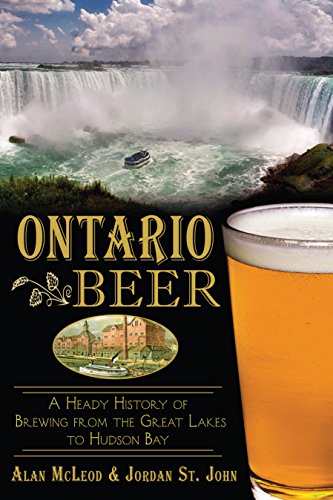
This post is a reworking and updating of a passage from that cult classic Ontario Beer: a Heady History…, the book Jordan and I published five years ago. I post this not only as a blatant reminder for Christmas giving, but as a look see to add to what we knew then about the role of beer in the years from 1660 to 1690.  This was one of my favourite bits to research as it combined a number of heroic tales on the edge of Europe’s known universe.

The conflict for control of what is now Ontario from the later 1600s was primarily between France and England. But the Dutch colony in what is now central New York on the Hudson River also sought its share through its alliance with the Mohawk nation until the 1660s. In the northeastern interior of the continent, events were part of what were known as the Beaver Wars.  The beaver was destined for hat makers in Europe and at this point

The fur trade depended on the labour of native people and on their centuries-old trading network… After being worn for a year, the pelts that made up the robes shed their long guard hairs, exposing the short hairs required for the felting process. Several hundred thousand used pelts, known as castor gras d’hiver would have been available annually…

Who knew European fancy hats depended on used Indigenous clothing?  The beaver pelt was certainly a commodity recorded in the Company’s minutes. Anyway, after taking New Netherlands to the south of the French, England continued to expand its North American trading empire on Hudson Bay and James Bay through the establishment of “factories” or commercial settlements in the 1660s and 1670s. Beer was consistently included in the ships stores for the voyages to the factories and, apparently unlike the French, so was the means to brew beer as soon as the ship made shore.

The English came well prepared with provisions, useful trade goods and even spoke the language – and as part of those preparations beer was clearly important to the early explorers.  Perhaps their version of an astronaut’s roast beef dinner in a squeezable tube of three centuries later.  The early ships’ crews exploring the eastern fringes of the Canadian Arctic in voyages in the 1570s and early 1600s considered their beer of great importance and even instrumental in survival.  Driving further west in search of trade routes, in 1668-69 the crew of the Nonsuch were forced to over-winter on the James Bay coast and reported upon their return:

…they were environed with ice about 6 monethes first halting theire ketch on shore, and building them a house. They carried provisions on shore and brewd Ale and beere and provided against the cold which was their work…

Here is a YouTube vid showing the recreation of the ship, giving a sense of scale. It’s tiny. Note the reference to the two separate forms of fermented drink. Ale was likely unhopped or lightly hopped and brewed for early drinking while beer would have been hopped likely for longer keeping. None would have been considered an IPA as the sulfurous vomitous mess that later became known as Burtonized water was only being first explored as a tonic in a small alehouse in 1686.

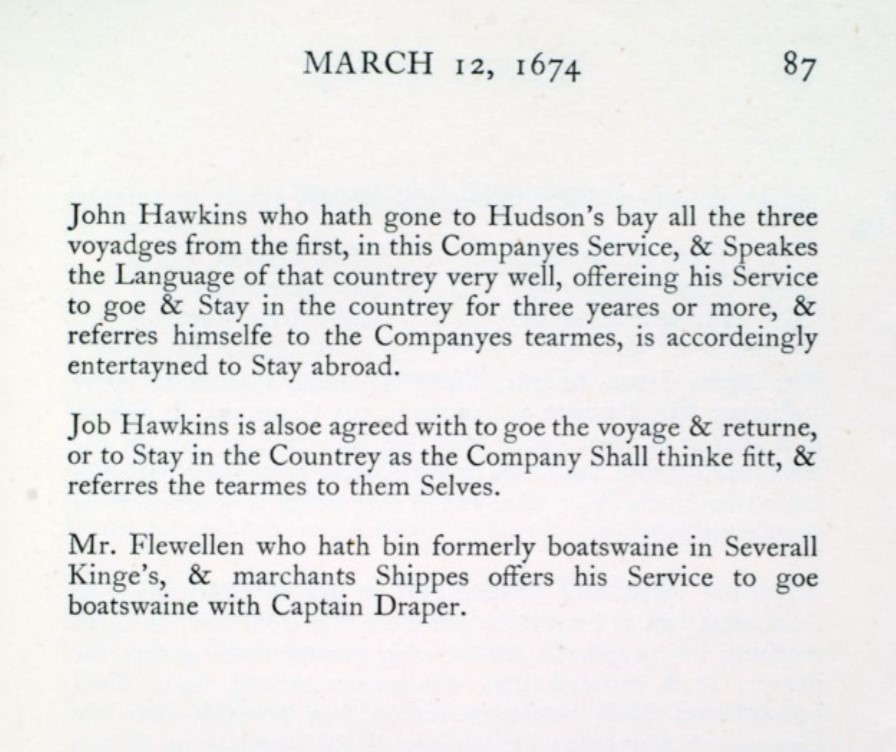
After the return of the Nonsuch, Charles II granted a charter to the Hudson Bay Company in 1670. According to the Minutes of the Hudson Bay Company from the early 1670s, an order placed by the Hudson Bay Company’s London management for three grades of beer as well as malt and hops was recorded in the minutes noted on 16 February 1674:

John Raymond: By Severall quantities of Ship Beere at 40s p. Tonn Strong beere at 12s, 9d a barrell & Harbor Beere at 6s 6d p. barrell with Malt & Hopps dd. Capt. Gillam, Morris and Cole, £ 79.

A few months later, on 6 July 1674, the committee of the Hudson Bay Company directed payment to the same John Raymond £ 30 on account of “Beer and Malt. dd. on board the Prince Rupert.” The three grades of beer supplied and the means for crews to brew their own beer once the ships made landfall illustrates the various functions beer played in the life of the company. Ship beer sold in bulk not the barrel was the cheapest and weakest would have served as daily drink for the crew while at sea. The strong beer was reserved for the officers, as was apparently the case on Hudson’s voyage. The drink identified as “harbor beer” was sold at half the price of strong and may have been a middle strength beer for when the ship was at anchor. It’s actually the only time I have seen that grade of beer listed.

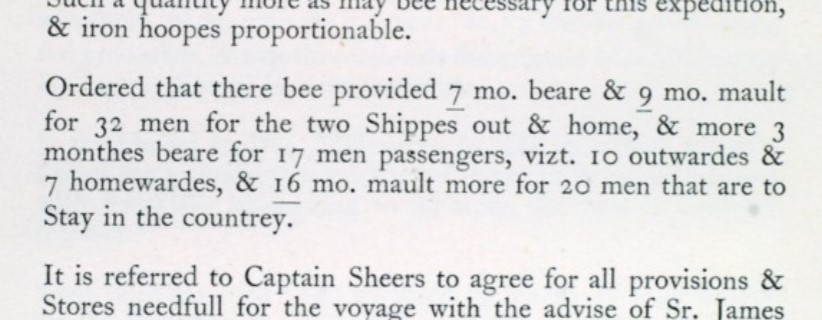
In 1674, the Hudson Bay Company planned 3 quarts of beer a day per man and shipped enough beer and malt to supply the trip there and back – and also to survive a winter. Twenty-seven tunns of beer and fifty-nine quarters of malt were purchased in 13 April 1674 for that season’s sailing of the 32 man expedition. Here are the instructions – and note that the plan included enough malt (or “mault”) for the 20 who were supposed to overwinter:

They were clearly planning to brew and that would require a total roughly 18,000 lbs of malt or enough malt to provide each man with a beer made from pound of malt a day. The details of all provisions can be found in the minutes from 14 April 1674.

Like the Nonsuch six years before, the crews of the Prince Rupert and Shaftsbury had to stay over in the winter of 1674-75 but were better prepared and provisioned for this possibility. It was too late too late in the season for the ships to return to England so arrangements were made for them to over winter in Rupert River and the crews were employed to cut timber to build houses for them as well as a brew-house and a bakery in the small fort. Their planning was not always successful. The beer and “winter-liquor” reportedly ran out by April 1674 at one Hudson’s Bay fort even if the stores of beer and malt shipped with the crews were significant.

The establishment of the northern English presence did not go unnoticed and clashes between the empires required feats of nearly unimaginable hardship and daring. When forces from New France struck at the forts on Hudson Bay in 1686, its soldiers walked north overland from the St. Lawrence Valley through hundreds of miles of forest before attacking and capturing Hudson Bay forts including Moose Factory at the mouth of the Moose River.  The conflict was fairly civilized, with negotiations taking place over flagons of port wine. The return trip of the French forces by foot took four months just to reach the northern community at Temiskaming in December. The French detachment survived on five or six pounds of pork each as well as sprouted barley which had been “originally intended for brewing beer.” They probably found more than enough malt when they opened the brewery’s store rooms.

The French, temporary victors in this phase of Europe’s war for the New World’s north, survived the march home through the primeval winter forest by eating the brewing malt of the defeated English. Seventy or so years later, their control of northeastern North America was about to be lost.  England and later Britain continued its trade via Hudson Bay but the greater focus of European efforts had long shifted away from the trade in woodland pelts.  To the south, colonial farming plantations and entrepreneurial coastal towns were expanding in the early 1700s – which was accompanied by the first boom of commercial brewing in the Western Hemisphere.

The End Of November’s Thursday Beery News Notes

I won’t miss getting past November. The worst month in my year. Damp and dreary. I mourn the end of the garden, the shortening of the days. The death of parsley. While Katie may have pointed us to a more healthy approach to November, I know too well that just a month from now, nearing the end of December, we’ll start feeling the days just slightly lengthening even it the cold is deepening. I took Monday off as I am still due about three weeks away from the office this year and drove off looking for signs. Just after noon, I found one on that dirt road up there. On the south side of Bloomfield, Ontario in Prince Edward County. It’s the last few hundred yards to the rolling idled farmer’s field across from Matron Fine Beer. I stocked the pantry with some jolly juice for Yule. Clever me.

Speaking of the hunt, Boak and Bailey may have found a small redoubt in the battle for more mild assisted by those behind the lyrically titled BADRAG:

Tasting notes on mild, like tasting notes on ordinary lager, can be a struggle, like trying to write poetry about council grit bins. Good mild is enjoyable and functional but, by its nature, unassuming, muted and mellow. Still, let’s have a go: dark sugars and prune juice, the body of bedtime cocoa, hints of Welsh-cake spice, and with just enough bite and dryness to make one pint follow naturally into the next.

I actually have to write bits of essays about council grit bins once in a while at work but never poems.

Never thought we would need a beer cooler for keeping beer cool when ice fishing out on a wintery lake in Saskatchewan frozen a foot thick but this is actually a clever idea. It keeps the beer from freezing.

The decade photo challenge as posted on behalf of IPA. I wonder if IPA will sue for defamation or whether the law’s recent dim view of chicken not being entirely chicken will deter such reckless? Speaking of the laws of Canada, drunk driving in Quebec now carries a new serious penalty:

Starting Monday, Quebec motorists convicted of drunk driving twice in 10 years will have to blow into a breathalyzer every time they start a car — for the rest of their lives. Their licence will be branded so any intercepting police officer will know to inspect the driver’s ignition for an interlock device — a piece of equipment that prevents the car from starting if the driver’s estimated blood alcohol concentration is above the legal limit.

To my east across the ocean, Mr Protz alerted us all to the closing of a pub that has been in place for about 750 years, the Cock Inn “situated on an upward slope on the north side of a tributary of the river Sence” as reported in the Leicester Mercury:

One of the oldest inns in England built in about 1250 AD, it witnessed the preparation and aftermath of the Battle of Bosworth Field and the death of Richard III and the start of the Tudor reign. The notorious highwayman Dick Turpin would return here after working the Watling Street, taking refuge in the bar chimney, stabling his horse in the cellar when pursuit was close at hand.

Interesting to note the nature of its feared fate: “…hope it will reopen and not become a house, as many village pubs do.” Still on the pubs, Retired Martyn has ticked all the GBG 2020 pubs in Glasgow but on the way made something of an admission about a distraction:

Yes, by the Tim Horton Christmas Spiced Caramel Brownie and a medium filter. I read that “nearly eight out of 10 cups* of coffee sold across Canada are served at Tim Hortons restaurants and more than 5.3 million Canadians – approximately 15 percent of the population – visit the café daily“, and Canadians are never wrong. Most of them.

Who knew? And he visited Greenock, the paternal ancestral seat, too. Great photo essays as always. The Pub Curmugeon prefers to work similar themes in text.

I was confused by a thread about CAMRA discount cards this week, accused of being  out of date, faithless to the true cause and a money grab… but then there seems to be no way to replace them in terms of the good they do. It stated with this:

I’m a CAMRA member & I work in a brewery. CAMRA needs to address the corrosive paradox of claiming that real ale is ‘the pinnacle of the brewers art’ while promoting discount schemes for cask beer. So I’ve drafted an AGM motion & explanation.

Discount? Doesn’t that mean well priced? Speaking of which, is beer about to get cheaper in Sweden?

Sweden’s state-run alcohol monopoly chain Systembolaget is planning to cut the costs of its cheapest beer from next year. The cheapest beer sold at Systembolaget today costs 8.40 kronor ($0.87). But next year it plans to launch two new kinds of canned beer for less than 6.90 kronor… the plans, which are meant to compete with border trade, that is Swedes travelling across the border to Denmark and Germany to stock up on crates of cheap beer.

The wonders of scale. Big entities can do great things, can’t they. Just consider this story on beer and the environment:

Anheuser-Busch, in partnership with Nikola Motor Company and BYD Motors, completed their first ever ‘Zero-Emission Beer Delivery’ in the company’s hometown of St. Louis — utilizing both companies’ innovative fleet technology to deliver beer from the local Anheuser-Busch brewery to the Enterprise Center using only zero-emission trucks.

Imagine! Using the word “innovation” and not referring to copycat alcopop IPAs!

Finally, I am not sure I want legalized beer corkage opportunities. Just another argument I don’t need. Go out where you want and spend the money at the place.  Don’t bring your own cutlery either.

There. A quieter week in these parts. But a busy one at work so there you go. Busier still soon enough, too, what with the last month of the decade comes the inevitable “best off” lists. I myself sorta did one at the end of 2009, at least painting a picture of where things stood.  I’ll have to think about what I’d say ten years on… other than wondering where the time went. Where did it went…

In the meantime,  there’s more news at Boak and Bailey’s on Saturday, at the OCBG Podcast on Tuesdays and sometimes a mid-week post of notes from The Fizz as well. And look for Katie’s weekly newsletter, too.


The Probably Not Quite As Long As Usual Thursday Beer News Given I Am On Holiday

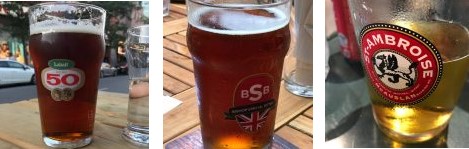
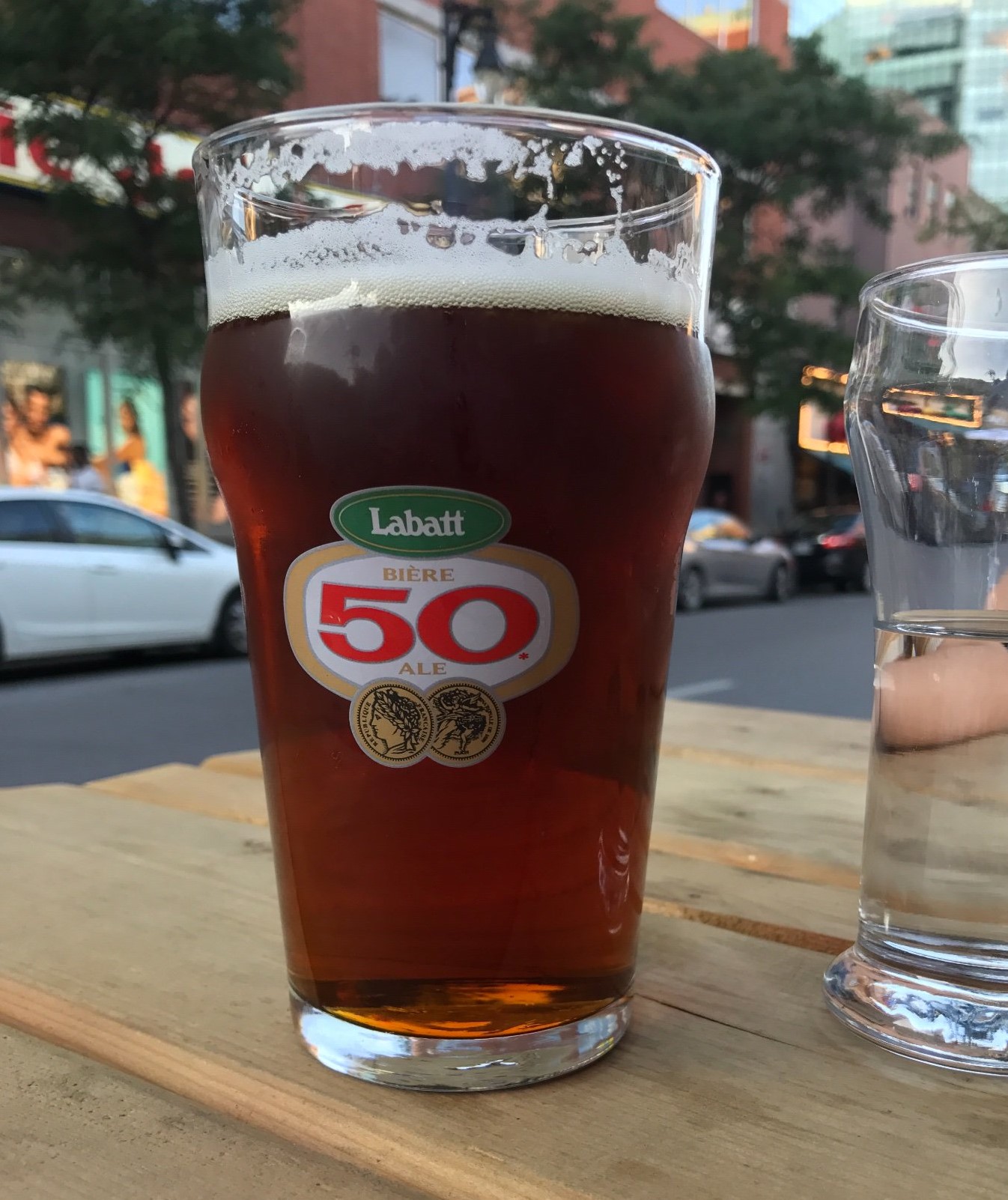
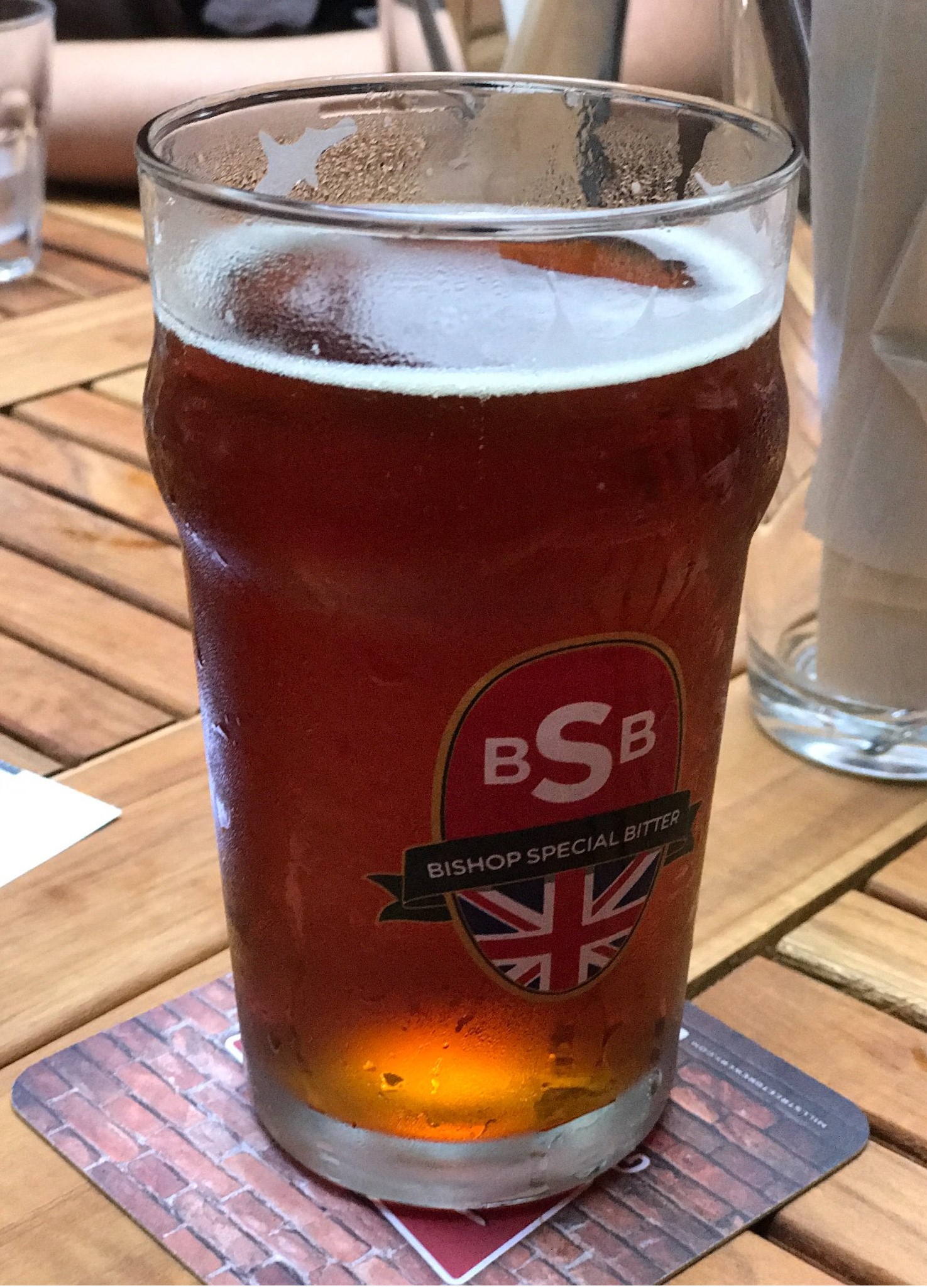
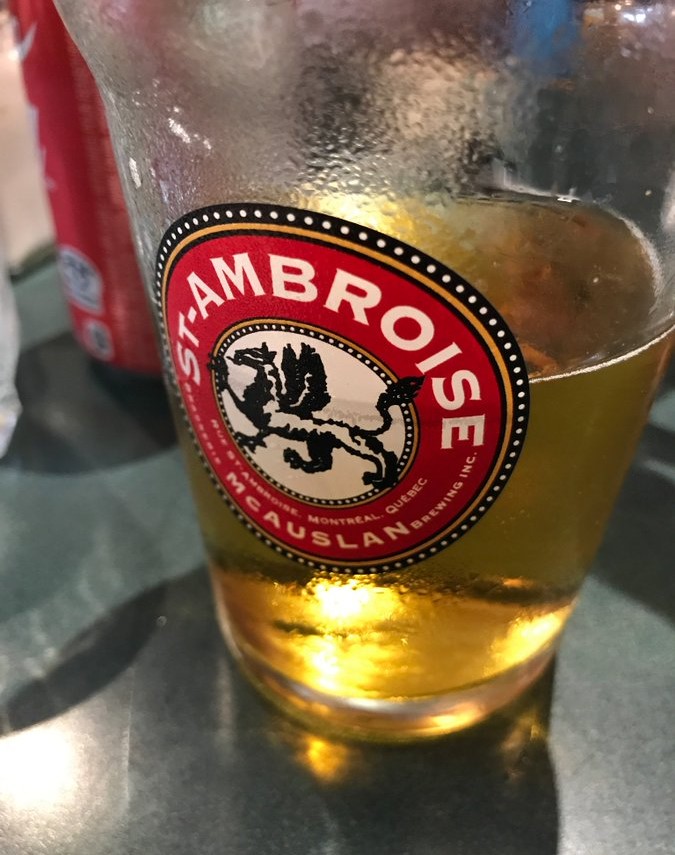
I want to live in Montreal. Might retire there. Just for the subway.  It runs on rubber tires. No screeching metal on metal. And the pale ales.  All over the place, you go in to a pub or restaurant and there they are. Good malt forward classic cold pale ales of one sort or another. Without haze. Without franken-hops pretending to be mango or hot dogs.  Below left to right* are Archibald, Bishop and St.-Ambroise. From Quebec City, Montreal and Montreal respectively. Happy. Happy. Happy. Beer with beer flavour. Favourite newly found bar? Tie. Wolf and Workman, Old Montreal and Le Petite Marche, at the north end of the Plateau on St. Denis. Might go again next week. It’s only two hours drive away.

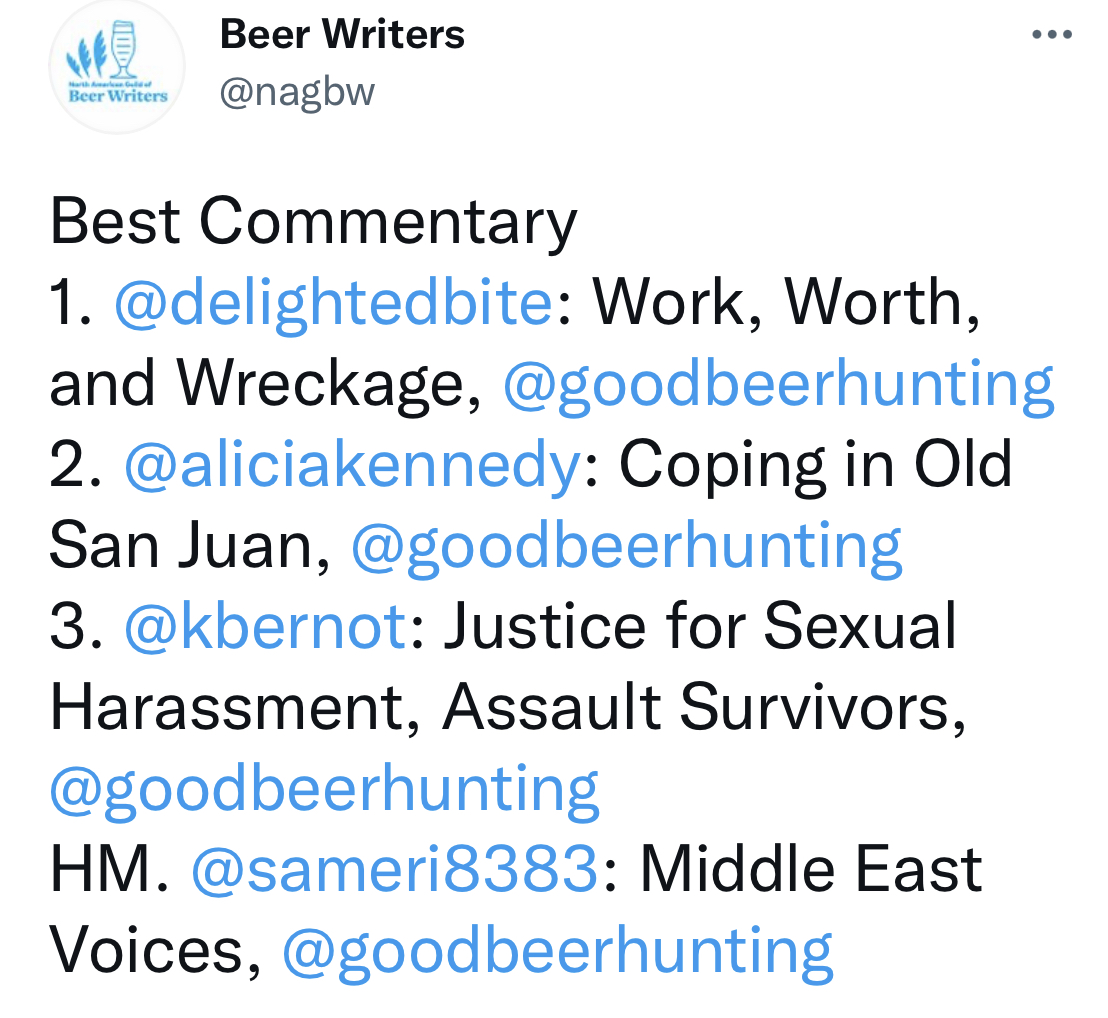
First up, one obvious sign that you are dealing with a good beer writer is that they are just a good writer.  So happy news, then, as this was announced by one of the B‘s of B+B as it related to the other B:

Anyway, the reason we’ve been on a Monday afternoon bender is to celebrate publication of Ray’s first novel, “The Gravedigger’s Boy“. We’re not going to use this account to promote it, but I wanted to say *something* coz I’m dead proud of him. ^Jess 

Elsewhere in England, Greene King has been acquired by a Hong Kong based firm CK Asset Holdings for mind-boggly £4.6 billion. The Tandy one has shared his thoughts:

As Greene King carries little emotional attachment in the mind of most beer drinkers, it was always unlikely that its takeover would have beer fans rushing to man the barricades. That’s just how it is, but wait.  Greene King is a big part of the British brewing industry. It owns a large number of pubs – over 2,700 – and these are spread all over the country. Heck we even have plenty of them here in Greater Manchester where, one must admit, they aren’t exactly the most popular beerwise.  Their type of beer is not always particularly suitable to local tastes. 

Something else that’s not suitable to location tastes as the brewery that controls the license to brew Skol in Rwanda has had to retract an alarmingly bad branding idea:

A beer company in Rwanda has apologised after critics said jokes that appeared on their bottles were sexist. One of the jokes on a bottle of Skol asked, “when can a woman make you a millionaire” with the answer “when you are a billionaire”. Skol launched the beer labels with the jokes printed on them on Friday but on Monday promised to stop using them.

Being a northern hemisphere western hemisphere sort of person, I was happily informed that “Rwanda is ranked fifth in the world for gender equality, according to the World Economic Forum’s 2016 report” – which makes the local brewery’s initial decision all the more mystifying. Except that it’s beer. And… you know.

Reading Canadians on personal consumption politics is a bit like reading English folk writing about voicing opinions on the personal preferences of others. It always seems a bit awkward and unpracticed. The Polk and Ben Johnson as well as others in Ontario wrote this week about the question of craft breweries donating to political parties. First, a bit of Polk:

It is the ultimate first world problem to be worried about the politics of your favourite brewery, but in a world where every dollar counts, it does to those of us who wish to see the world a better place for everyone. Our money is a reflection of our beliefs to a certain extent, although most of us still shop at Walmart, Loblaws and other huge corporations with spotty track records in how they treat their employees, the environment and even their loyal customers.

Now, a bit o’Ben:

 A savvy business owner should recognize the importance of being at the table when decisions are made that affect his or her business and the best way for a brewery to do that in Ontario is with donations (Indeed, the lack of an alternative method in the form of cohesive lobbying efforts is probably one of my biggest beefs with the brewing industry in this province and is a conversation for a dozen more blog posts). Because don’t forget: Breweries are businesses.

If I was to suggest anything, I think both views somewhat overstate the case. No donation gets you access you don’t otherwise get by being otherwise annoying and individual purchasing choices don’t really send the sting of a generally organized boycott. Yet, if a smarmy Canadian-style middle ground is needed, I might suggest that being aware of your beliefs as you make these decisions is good for the soul and arms you for the next time you face the ballot box.

Katie:

If only writing was just sitting down and thinking about what I might want to say and it just happened…

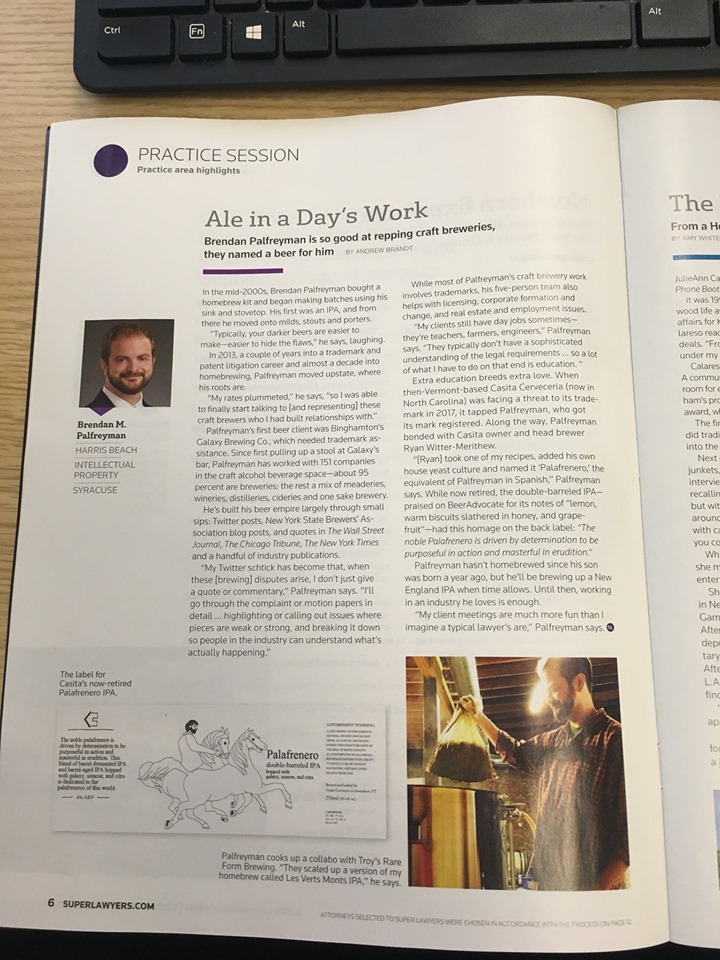
CNY beer intellectual property law guy Brendan Palfreyman was featured in a law publication recently. It’s always good to be recognized outside the bubble. Have a look under the thumbprint right there next door. You can likely read the whole thing. Probably an utter violation of copyright law!

One third of the way in, this two-week holiday thing is working out just fine. Expect Boak and Bailey to have more news on Saturday and Stan to be there on Monday. The OCBG Podcast is a reliable break at work on  Tuesdays, too.

*1,2,3.