Your Beery News Notes For The End Of July And The Beginning Of The Back To School Ads

The last day of July. It’s one of the first endings of the year. Well, there is the end of winter but no one regrets that. And the switch from late spring to early summer never really leaves a ripple. But… July. Spent the other evening watching dusk arrive at a nearby conservation area, listening for bobolinks and kingbirds as they snabbed a few last bugs out over the field. Saw a raven. Heard it croak.  Mr. Nature. That’s me. Five Saturdays to Labour Day. But even that date’s lost its sting as it’s the first September that not one kid is in the public school system for twenty-three years. What milestone is left? Last day of July.

First up, David J. announced the roundup for the July edition of The Session with a pretty interesting set of submissions this month, interruping his reguarly scheduled broadcasting:

Today’s Substack is ‘free to air’ – like Test cricket and Premier League football should be – so that the people who have contributed can gain the widest readership possible. (Also a desi publican I was going to interview suffered a bad injury and had to postpone. He’s fine, though, and I’ll be bringing his story soon.) On July 11, I asked various participants to write a blog, web post, newsletter (like this one) or even a SM thread on the subject of food in pubs. I’ve rounded up their work and at the bottom have written about the dangers of being a go-to voice on pub food.

Go have a look. Plenty of good reading. Also well worth a read, Ruvani de Silva has announced the launch of her course hosted by CAMRA on American Heirloom Cider Apples and it is good to see the historical context at the forefront:

Settlers, noticing the tribes’ bountiful orchards and the quality of the land they were cultivating on, were keen to claim it for themselves, unafraid to use violent displacement to do so. In one particularly horrific example, future President George Washington took a break from fighting the British in 1779 to send Generals Clinton and Sullivan to implement a scorched-earth policy across the Six Nations of the Iroquois’ beautiful, fertile Fingers Lake land in upstate New York, burning their flourishing orchards to the ground.

This lines up from some of what I found when researching upstate New York history over a decade ago including Lord Selkirk’s 1803 description of apple orchards around Geneva NY from before the Sullivan raids as well as this description from 1797:

…a person from Scotland has established, at Geneva, a very respectable brewery, which promises to destroy in the neighbourhood, the baneful use of spirituous liquors. The apple and peach orchards, left by the Indians, yield every year abundance of fruit, for the use of the inhabitants, besides making considerable cyder; so much so, that one farmer near Geneva sold cyder, this year, to the amount of one thousand two hundred dollars.*

Speaking of solid research, after last Saturday’s news update was posted by Boak and Bailey, I rushed to their footnotes at Patreon which included this tidbit:

…we’re entering the era of ‘normalism’. People want to drink normal beer, in normal pubs or bars, while eating normal food, and wearing normal clothes… Perhaps because they don’t have the headspace to cultivate less mainstream tastes, or maybe because standing out as an individual feels like a dangerous business in 2025. Or just pointless. We keep seeing young couples dressed head to toe in formless matching beige. 

I thought of that Monday evening when I saw a young man waiting for the lights to change, standing at an intersection in beige Sperry Top Sider clones. They had to be clones, right? I also thought of this when I read Jessica Mason‘s news about the recent rise  in Heineken’s fortunes:

Speaking about the results, Heineken CEO and chairman Dolf van den Brink said: “In the first half, we delivered solid results as organic operating profit grew 7.4% as the operating margin expanded by 26 bps and net revenue increased 2.1%…” Highlighting the strides the business has made, van den Brink pointed out how Heineken’s “volume performance improved across all regions in the second quarter and continued to be of high quality…  Describing how the company has achieved this, van den Brink explained: “Our advantaged geographical footprint helped us to adapt to ongoing macro-economic challenges which impacted consumer sentiment and expenditures.**

Is that so bad? Perhaps green is as much the new beige as beige is. Normal. Makes more sense than spinning in your sheets over and over thinking of all the coulda woulda shouldas. The trend is evident in the US craft scene as summarized by Keith Gribbins at Craft Brewing Business the other day:

The Brewers Association’s 2025 Midyear Report shows an industry still facing strong headwinds. Yet, pockets of growth remain — especially for the smallest on-site brewers. As of June 2025, 9,269 craft breweries were operating in the U.S. — down 1% from a year ago. Closures continue to outpace openings, led by a 3% decline in microbreweries. Taprooms dipped 1%, while brewpub and regional brewery counts remained flat. Craft beer volume also shrank. The BA estimates a 5% year-over-year decline in production. 

Five percent cut in production in the last 12 months is not a “maturing” or any sort of “sideways” something. As one would say in my youth, the arse is out of it. Doug Veliky shared some thoughts about where those buyer might be heading and why the trip isn’t that difficult:

Low-dose THC beverages offer the same qualities that have made light beers, spritzes, and canned cocktails so popular. They are social, easy to enjoy, and deliver a consistent experience every time. Because these drinks are made to be consumed more than once in a sitting, they help establish rituals that lead to frequent, repeat purchases. Instead of being one-and-done, the format allows consumers to stack their way toward their preferred level of buzz.

So, craft may have lost its hook. By which I mean that idea of the ritual habitual. People are still doing things, sure. They’re just not doing those things because they now have the option to do these other things. Or is that the new habit? Being what B+B call normal. It might actually just mean not needlessly complex. Manufactured difficulty. Life’s hard enough without made up difficulties.

Note: not only do the top 40 breweries in the world not include much that can be called craft, onely one and a half seem to be American.

By way of comparison but really only as juxtaposition, Jeff continued his explorations into what makes a saison a saison, following up on his article on the style in Craft Beer & Brewing, illustrating once again that blogging about beer is always superior to the store bought stuff. I particularly liked how he moved the discussion from the romantic (ie lazy / fibby) explanation that saison is “something you feel” to getting to the elements of they stuff including the importance of a coarseness of character to the grains, as decoratively mentioned by Alex Ganum of Upright Brewing of Portland, Oregon:

Not sure if I ever shared this story, but back when we were running Old Salt, our hog rancher kept bugging me about using his triticale, which was the animal feed. He grew it himself and was proud of the quality, but I dismissed it early on thinking, ‘How good can animal feed be? ‘Well, that was dumb, because he eventually just dropped off a bag and it turned out to be incredible (which probably explained part of why his pork was delicious). So we asked him for a pallet and worked it into the Five for about a year or so.

Sixteen years ago, when I had the time to do so, when the kids were little enough that they couldn’t get too far, I grappled with the idea of these sorts of beers and their cousins, back when I could take a Saturday to contemplate such things in the shed. But that right there is as good an explanation as ever I’ve seen: beer made from bits fit for the livestock. Farm yard as much as farm house. Normal may not have time for farm yard.

Speaking of simple pleasures, Katie shared a lovely bit of recollection, a remembrance of Wetherspoons past involving herself and her staff access to discount chips:

When I worked at Wetherspoons many thousands of years ago, the one redeeming feature of the job other than the wage was access to a staff menu, off which we could also take a 50% staff discount. My favourite shift tea from this reduced selection of kitchen scraps was sausage and chips. It was not served with vegetables of any kind. A person can talk shit about Wetherspoons all day, and I will join in, but their chips have always been godly, the best of all the frozen chips. I am certain they are coated in semolina for extra crunch, leaving the centres fluffy and light. With mayonnaise, this dish, which cost me around £1.30 in 2008, was my favourite food. It didn’t make the pub I worked in any better, however. You can’t judge a pub by its chips—sometimes they are simply angels sent to soften the blow.

Normal likes chips and especially good discount chips. Quite right, too. Also alarmingly normal is Martin who has admitted to falling behind in his pub reporting and is trying to catch up which some of the highlights (*ahem*) of his continued touring:

Admit it, you’ve never heard of Cockerton, have you? Neither had I, even though this small Durham village is virtually contiguous (great word) with Darlington and only a few minutes from Piercebridge and my best-read blog post. And it’s got a free space for my campervan from which I can finish Durham’s Guide entries for another year. What Cockerton doesn’t appear to have is much actual character. though it does have excellent podiatry.

Note: at the Vytopna in Prague a little train set delivers your beer…

Finally and for the double, David Jesudason wrote the feature in Pellicle this week, the story of a thriving community pub at the edge of London that makes room for many and much:

Artist Neal Vaughan believes my snap judgment about Carshalton being a bit of a sleepy backwater is wrong. He explains how it’s a hub of creativity, which the Hope is at the centre of. Citing a memory from 2016, Neal recalls when Rodger encouraged him to set up Carshalton Artists’ Open Studios with all meetings and post-event drinks held in the pub. Tuesdays are described as a sacred weekday at the pub by Neal. It’s when folk musicians play an open session, board-game enthusiasts battle against each other at Scrabble, chess and Magic: The Gathering, and on occasion a leather maker taps away while seated on a chair. The pub even has a sailing crew that charters yachts, and when I visit they’re off for 10 days in the Adriatic.

There we are.  The end of trends, the end of a week’s news and the end of the month. It’s sorta normal. And as the sands trickle on down in your personal hourglasses, please check out Boak and Bailey every Saturday. Look out for Stan when he feels the urge now that he’s retired from Monday slot… maybe. Then listen to a few of the now rarely refreshed Lew’s podcasts and get your emailed issue of Episodes of my Pub Life by David Jesudason on the (sometimes even but never) odd Fridays. And Phil Mellows is at the BritishBeerBreaks. Once a month, Will Hawkes issues his London Beer City newsletter and do sign up for Katie’s wonderful newsletterThe Gulp, too.  Ben’s Beer and Badword is out there with the all the sweary Mary! And check out the Atlantic Canada Beer Blog‘s weekly roundup. There is new reading at The Glass which is going back to being a blog. Any more? We have Ontario’s own A Quick Beer featuring visits to places like… MichiganAll About Beer has given space to some trade possy podcasts and there’s also The Perfect Pour. Plus follow the venerable Full Pint podcast with an episode three weeks ago!. And there’s the Craft Beer Channel on Youtube. Check out the archives of the Beer Ladies Podcast. That’s quite good and after a break they are back every month! Such is life. Such is beer podcasting and newlettering… which, as Ray says, are blogs! And he’s right.

*See also History of Tioga, Chemung, Tompkins and Schuyler counties, New York. With illustrations and biographical sketches of some of its prominent men and pioneers at page 13: “The army was to march from their winter quarters on the Hudson to Wyoming; thence up the Susquehanna to Tioga, where another division, under General James Clinton, marching via Otsego Lake, after a diversion into the Onondagas country was to effect a junction, when the combined army, consisting of four brigades of infantry and riflemen, and a park of artillery, was to proceed through the valley of the Chemung; thence northward to Genesee River, destroying crops and houses and everything of value to the Indian as far as could be reached on either side of the trail of the army. The success of the expedition was most complete. Forty towns and more than 200,000 bushels of corn were destroyed, besides vast quantities of pumpkins, beans, melons, and other vegetables, and peach and apple orchards, and a most desolating march executed through the richest portion of the enemy’s country, with small loss to the invaders. Washington was afterwards called by the Indians Hano- dogarear, ” the town destroyer.”
**Oddly, The Independent reports Heineken has suffered losses in the first half of 2025. Who can you trust these days? Other than, you know, me.
As July Turns To Face August These Are Your Thursday Beer News Stories

Last weekend saw the family head off to the Big Smoke for a Pixies and Weezer combo concert at an outside venue at the west end of  Lake Ontario. It was great. Stinking hot. 15,000 people. Me and a lot of other old guys having a scream-along to “This Monkey’s Gone To Heaven” and “Hash Pipe” which was great. The scene, the Budweiser Stage at Ontario Place,  was an absolute fleece-fest: a tall boy of Bud Light Radler selling for about 15$. I had a Bud with my bland black bean burger before the show. Ice cold it went down like an icy cold Bud. Which was great until it warmed to about 5C after a couple of minutes and then it got, you know, not so great.

I wasn’t really following up on Andy’s idea of taking time to try a classic this summer when I had that Bud. I wasn’t in a place where Bud existed when three decades ago so it does not fill a personal space like that. Not my classic. It’s gas station cooler 1990s New England road trip scenery to me. The beer I passed up. But I did have an old favorite on Friday… and it was an odder experience. Hennepin, which I have enjoyed since at least 2005, showed up in my local LCBO for about $11 for a 750 ml (behind a far worse label… updated branding fail.) I was up for this. We were having a slab of salmon for supper. But it was not the beer I wanted. Hot and heavy even though it was perfect eight years ago on another hot summer night. It’s not like the beer was off. It was lovely. It was just way more than fit my interests, my needs. Am I turning into a target for the low-no movement? What do I actually want?

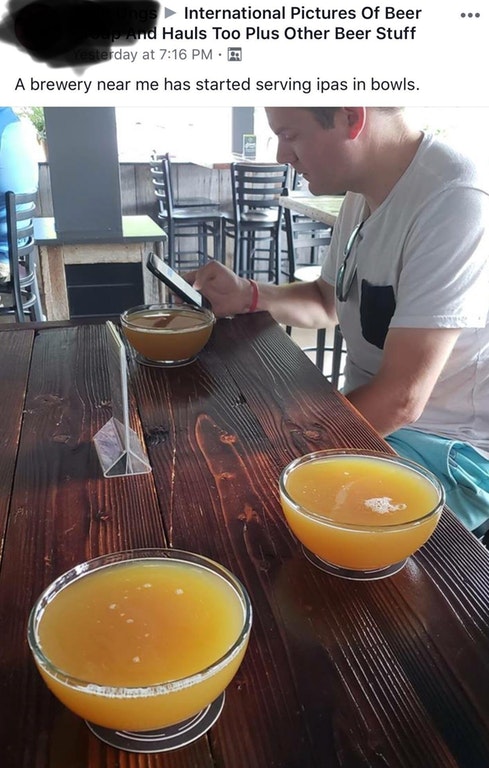
Jonathan Surratt wins (or perhaps poaches) the “Shaming the Worst of Craft” award with week with the news he shared embedded in that photo to the right. Some gawdawful craft bar somewhere is serving beer in bowls. Could you imagine being served that? Do they serve the food in flute glasses? Do they expect people to pay with actual money? Boo!

Ben notes how a single beer craft brewery putting out a fairly acceptable product that sells well has created another single beer craft brewery to make a fairly acceptable product that sells well. I think of these things like I thought of the music of The Carpenters when I was in my teenage punk phase in the latter 1970s.  They made music that was safe enough for parents who did not like discussing bad things. Like “why Alan is listening to all that swearing?” Mind you, my folks didn’t listen to The Carpenters so I am not sure I will bother buying this beer. Especially as “bugle” is actually a well-known euphemism for beer induced gastric issues.

Is this #ThinkingAboutDrinking? I suppose the idea of thinking is that it’s not about being all positive, just supportive. Fight!

Now this is great: a service to us all. The current big craft and macro craft family tree. Then updated for more detail. Nice to see honesty in the placement of breweries like Sam Adams, BrewDog, Brooklyn and Founders in their natural state. Speaking of Sammy A, sweet dissection by Jeff of another slightly… smarmy GBH post* on the supposed risk of Jim Koch somehow losing status. The lack of institutional knowledge is amazing. Jeff’s point: “when Boston got too big, BA changed the definition.” My point was how Koch was actually an outsider to the main micro/craft movement, which Josh Noel noted and “Sex with Sam” confirmed. Why do we have to fudge things rather than knowing and writing about the actual history of the craft beer movement?

How to sit on a fence.

This is either a story about art v. the regulation of alcohol or it is a story about arts management not grasping the need to find a venue with a stage with a normal licence. I love the “Toronto the Good” half-news in the footnote:

Editor’s note: The Tarragon Theatre has now relaxed their rules for this particular show. Patrons are now able to buy beer up until show time.

AKA: accept what you have been granted.  In other Ontario drinks sales regulation news, Robin has written about how for a few weekends she worked as a beer selection advice giver in one of the few grocery stores with a limited alcohol sales licence.  The role and the context may appear odd. It may well appear odder still as the new provincial government has promised beer and wine** in every corner store! Mind you, the promise has no details. But it may well be that the brave new world promised in 2015 will have a best before date of maybe 2018. So, Robin’s notes may well end up being a valuable set of observations on the state of affairs at the front line in which turns out to be a transitional period. Fabulous information for the future beer regulation historian.

Brendan has shared news that:

files opposition versus beer (and other beverages) trademark application for STONEMILL

With so many breweries using the five letters “s-t-o-n-e” is no one going to point out to the courts how this “just waking up to the news that there are intellectual property claims to be made” approach might be a tad selective on the plaintiff’s part? BeerAdvocate lists 3267 beers or breweries with the letters in that order in their name. Because it is as common as a very common thing. If I don’t associate “Firestone” or “Stone City” with Stone why would “Stonemill” confuse me?

Let’s conclude our collective cogitations this week with a few thoughts about wine writing from Jon Bonné, Senior Contributing Editor with Punch wegazine:***

We assumed experts are meant to provide some kind of road map through an unknowable, confusing realm. We’re expected to help you find a bottle for dinner, and not complicate the conversation. But that has led us, at a time when wine is more interesting than ever, to trivialize its cultural value. We’ve sacrificed context—I mean real critical context, not the fanboy literature that passes for too much wine writing today—for comfort and a sense of belonging. I think Bourdain might look at the situation and point a blaming finger at many of us for failing to explain why one wine is worth more than another, or why certain wines are culturally suspect because they’ve been made with cynical motives. (Big wine companies love when we abandon context for the blind pursuit of deliciousness. Context is the enemy of fake-artisan wine, after all.)

The piece is interesting as it builds on the loss of Bourdain and that irritatingly bland idea of “woke” to get to the notion that context and value are important. It’s a bit too toggle switch for me. Things are complex even if fakers are all around. And I am already a bit sad to see Bourdain being used as a prop for the arguments of others. But I like the call to deeper learning. Hence #ThinkingAboutDrinking.

Upcoming week? The second half of baseball begins. Six or seven weeks until school starts. Use the time you have left wisely. As part of your path to wisdom consider stopping for a pause with Boak and Bailey on Saturday and again after the weekend with Stan next Monday. Laters!!

*Time for an incidental graphics update, too. Keep it fresh.
**Hard liquor, as we call it here, will remain at the surprisingly good LCBO, our government store.
***It actually calls itself “PUNCH” in shouty all-caps… but is font really identity? I mean if it was PUNCH would i have to italicize it? 


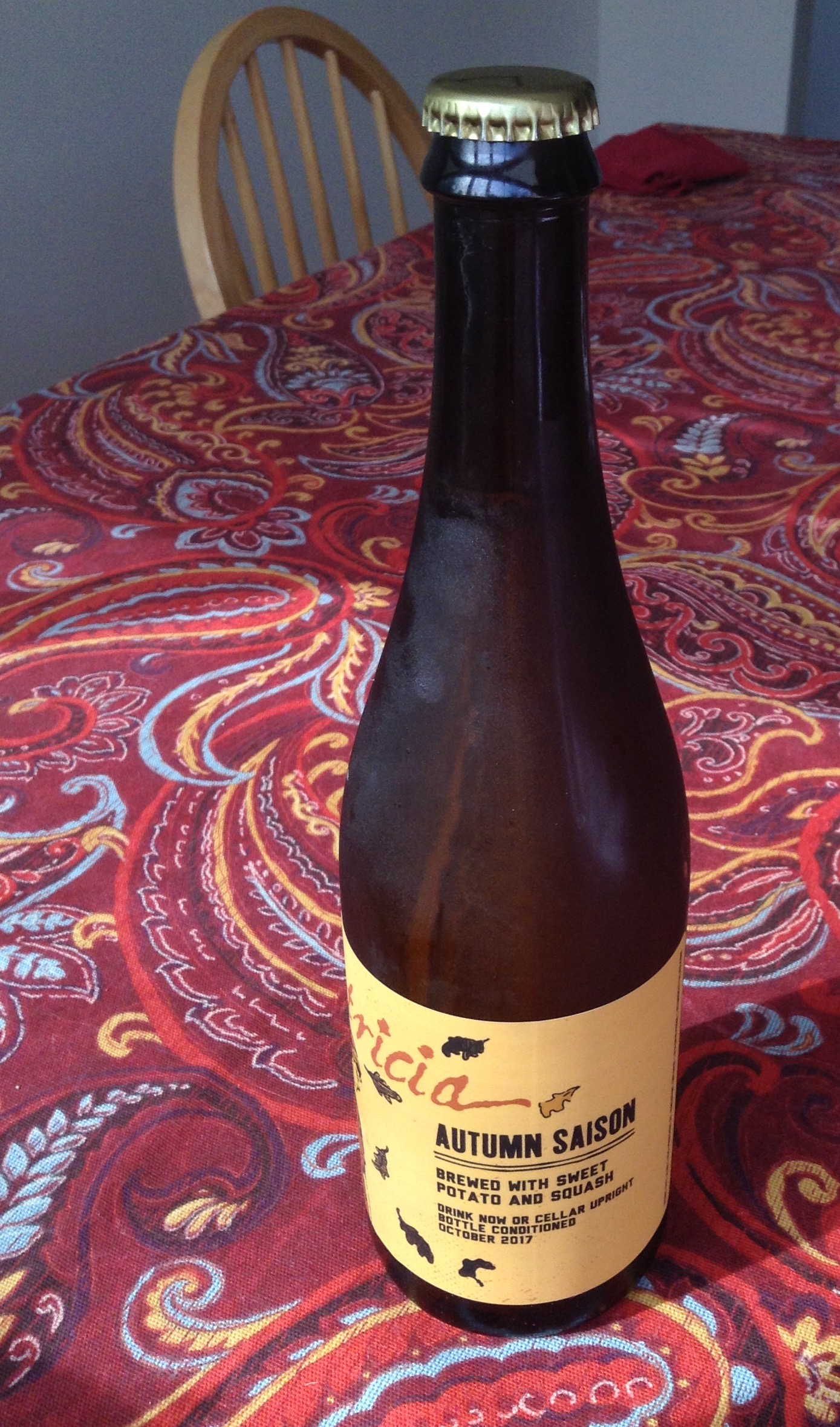
Ontario: Patricia, Stone City Ales, Kingston

A beer with subtitles: autumn saison, brewed with sweet potato and squash. I bought two bottles of this a few Fridays ago from the retail counter at Stone City, a short march up the hill from work. The first bottle gave me a bit of pause. This was an example of something. An excellent beer thoughtfully made that I liked but, still, one that I was not sure about.

And my uncertainty was fuelled by my own uncertainty as to why I am uncertain. So I am glad I bought two. This is a fabulous beer. The base saison is white peppered and dry. The gourd and rhizome quite restrained. On this warm Sunday afternoon in the middle of this strangely warm autumn, it tastes like the rich earthy air flowing in through the wide open windows. It is a clever timely release with adjuncts which are right up my alley. I grow squash and we even have use the nickname Swee Apado around the house, given we eat so much of it. So what is wrong?

Clouded vintage gold ale under a lacing fine white head. On the nose, it is classic saison in the Dupont style. Not the DuPont one, if you know what I mean. Backing it up is the dirt-tang of sweet potato. In the mouth, immediately dry and twiggy herbal with an very pronounced opening of flavours in the swallow followed by a long long hot herbal finish that resolves into the squash. The vegetable elements hide, show, hide then show.

I worry that my problem is this beer is cleverer than I am. Rustic and elegant. I can personally only claim the first. In my mind, I am searching for a place to put the beer. Pigeon hole it. I want to have it with spurting hot venison sausages. In a coconut curry. Or pork shoulder roasted on a bed of parsnips. I want a balancing fattiness. But is that fair to the beer in itself? Yeats spoke about loving something, someone for herself alone.  I have never claimed to be all that nuanced in my tastes but this may well be suggesting, strongly, that I revisit my limitations. I don’t like to not get the point of something this good.

So… I consulted Keats and his poem Ode to Autumn. The subtitle asked me to, no? And this explains everything. This is not the autumn of mists and mellow fruitfulness in the glass. That’s the autumn of back to school. A month ago. This beer speaks to a later point – the brittle leaf pile, warm welcome corduroys. Early sunsets and chilly walks back up Cobourg Road to get to college, to happy hour. Soccer practice with freezing knees. Remembrance Day and singing “Abide with Me” down at the Grand Parade.

We are not there yet. Here the leaves are still on the tree and I am picking cherry tomatoes off the vine a month after the equinox. I mowed today. Soon it will be six months to May. Four to March. This will be a short winter if autumn still is a ways off yet.


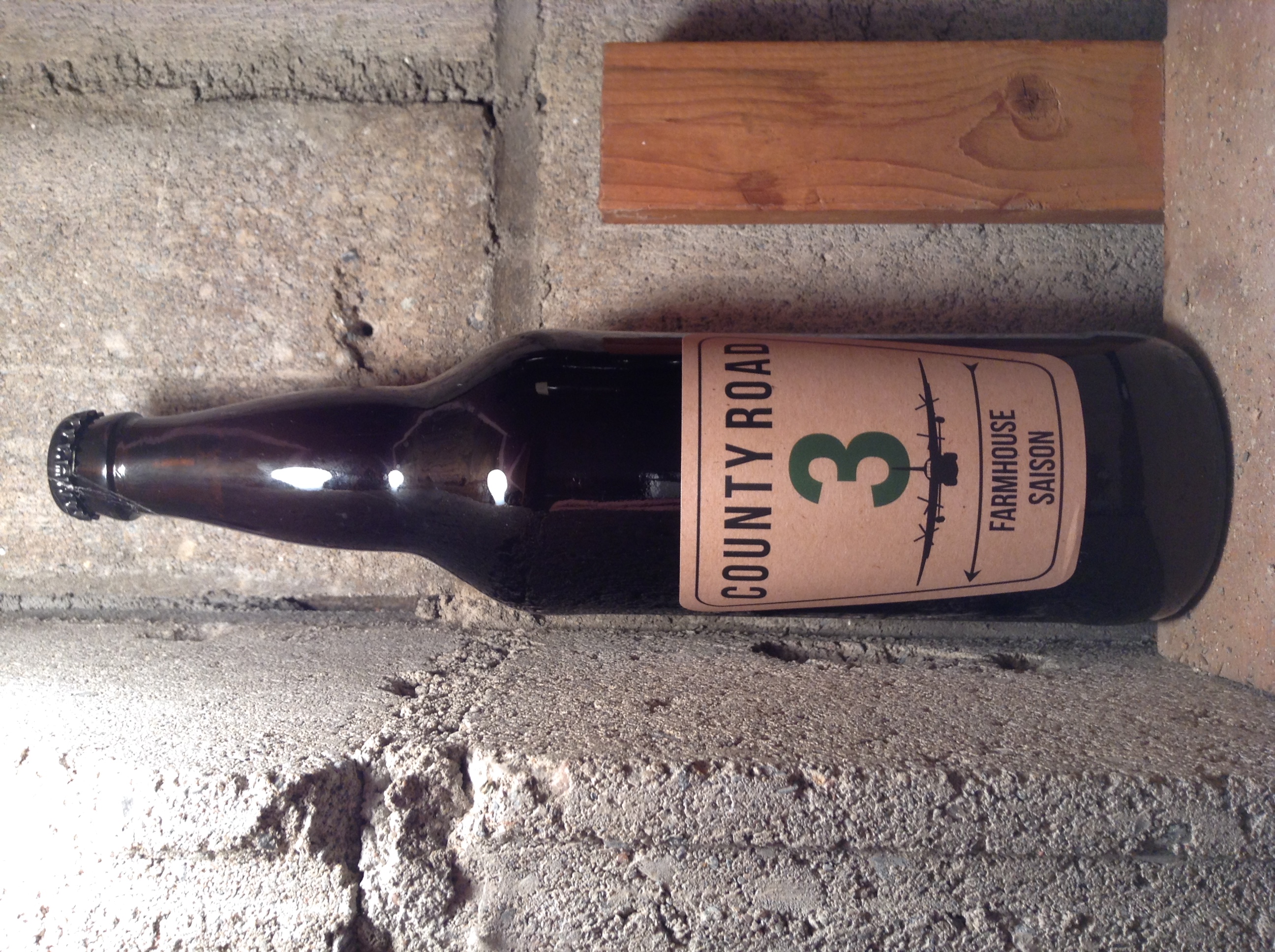
Saison: 3 Farmhouse Saison, County Road Beer Co., PEC

I am not exactly sure of this beer’s name. In its fullest, it is County Road 3 Farmhouse Saison. And it is a saison made out in a farming district. But as it is made by County Road Beer Co. of my wonderful nearby neighbouring wine region, Prince Edward County, I will just call it “3” entirely out of endearment. Careful readers will recall how I visited the site of its brewing almost two years ago just as the concrete for the brew house floor was being poured. For some months now, their saison has appeared in the government store.

You know, it must be horrible to be a saison. Of all the classes of beer, saison is the one which still illustrates the original meaning given to the concept of “style” by Michael Jackson.

There are certain classical examples within each group, and some of these have given rise to generally-accepted styles, whether regional or international. If a brewer specifically has the intention of reproducing a classical beer, then he is working within a style. If his beer merely bears a general similarity to others, then it may be regarded as being of their type…

Saison sits weighed under by the classic example, Saison DuPont. Cursed by it. Blessed by it. Luckily I have my New Years Eve 2005 notes to remind me of the particular tyrannical slavery I must subsume myself, my experience under each and every time I encounter any other beer claiming affiliation to the style:

Saison Dupont: 8 pm. New Years In Scotland has come. Very nice. Rich and round with masses of dry palt malt. Lively antique gold ale under replenishing white foam. Fruitier on the nose than in the mouth. There is a pronounced graininess to the malt with only the slightest nod to pear fruit perhaps. The yeast is slightly soured milky. There is hop which is dry, twiggy or maybe even straw-like because it is not like twigginess of Fuggles, devoid of English green or German steel.

Most importantly, the note is date stamped. This couldn’t have been the 42 year old me’s first Hogmanay drink. Likely already wobbly. Still, it’s interesting that I describe what I wasn’t tasting. Spare, dry stuff saison. Yum.

Saison can be horribly mistreated. Somewhere in the archives I have yet to bring over to this new system, I note that I had a saison which was sweet and fruity. In 2010, I wroteI feel bad about pouring that Three Floyds saison down the drain but it really was poorly thought out…” For me, that is usually the case when saisons go wrong – when many beers go bad, in fact. Blame the original designer. But if saison is hamstrung by the ghost of brewing past, shackled by its own classic example, is it possible that saison designers have less wiggle room? Does this cause the accusations to fly more often? P’raps.

How does this one stand up? It pours an attractive golden pinewood with orange hues. Clouded and effervescent. All under a growing stiff egg white head. It gives off aromas of bubblegum, white grapefruit pith and a bit of dry twiggy herb. Around the gums, the pith and twig come forward with French bread crumb laced with white pepper and a little parsley – then a little tweek of orange, a heart of cream of wheat, a nod to honey and dry lavender in the finish.

What is not to like? Only two BAers, one unhappy. Sadly style foolish as so many are.

Beer and Art: The Harvesters, Pieter Bruegel the Elder, 1565

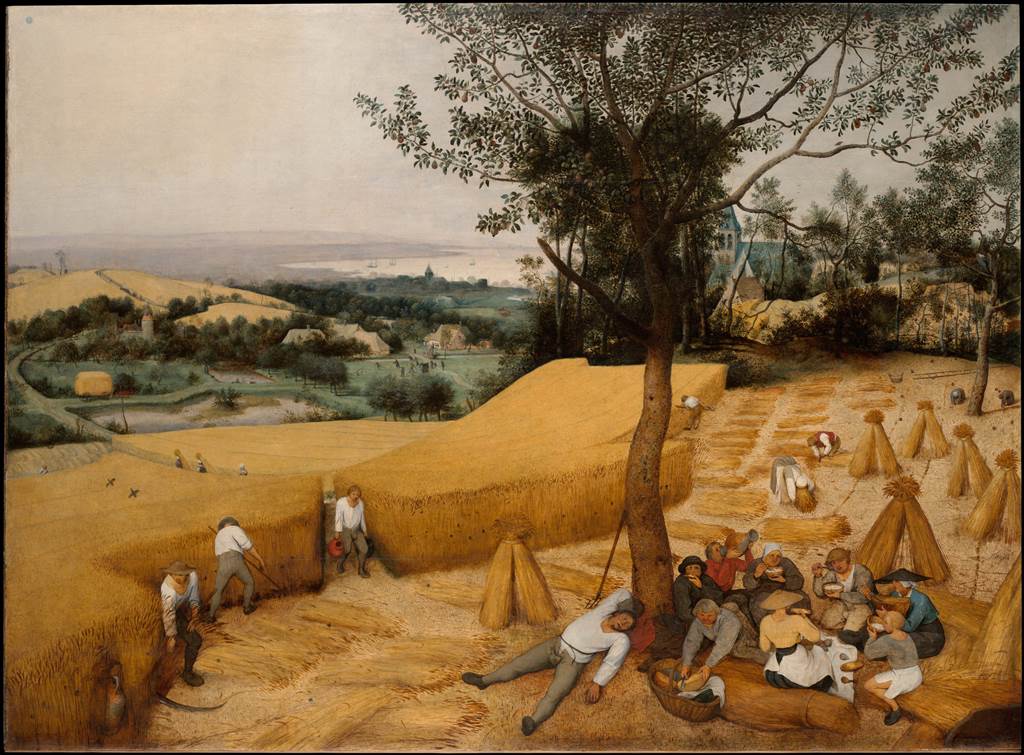
Nosing around the Met‘s digitized collection a bit more, I came across “The Harvesters” by Pieter Bruegel the Elder from 1565. Not hard as it was on the front page. I have posted a few times about paintings by his son, the imaginatively named Pieter Bruegel the Younger, over the years but this one struck me as perhaps illustrating a few things worth thinking about.

Look at the scale of the people compared to the height of the grain. One of the characteristics of Battledore barley two hundred years later in Britain was that it had a short stalk. It could survive hail or wind better than other varieties but didn’t provide all that useful straw that we learned about in relation to beer in New York before the switch to barley from wheat. The stalk was in itself important to the community as a multi-purpose material for mattress stuffing to looser wheat mash spargings. In “The Harvesters” the stalks are tall and entire stooks* are taken from the field with care. The stooks are strong enough to serve as a bench for the workers having their meal.

Harvest time is big stuff. The image is a narrative of agricultural economy in the Renaissance. If you click on the image at the met site, you can zoom in quite closely. Look at how the topography is used to illustrate the economic activity. The field being harvested is on the top of a hill. Scythed and stooked, it is carried one by one to the bottom of the hill where it is loaded on a cart and carried away. There are three communities in the painting. The hilltop has a church to the upper left seen through the trees. Down below there is a manor of some sort where some are swimming while others are killing a tied up goose as a blood sport. In the far distance, there is a coastal town with ships in the harbour. Is one point of the painting’s structure that the grain gets exported?  Or is beer made from the grain getting shipped out?  I should cross reference the painting with Unger.

Where is this place? The blurb attached to the image by the Met says:

Bruegel’s series is a watershed in the history of western art. The religious pretext for landscape painting has been suppressed in favor of a new humanism, and the unidealized description of the local scene is based on natural observations.

But is this really a local scene or an imaginary one? Where is it? Bruegel lived in coastal Antwerp, Belgium a city of about 100,000 at the time and the richest in Europe. He was born in the river town of Breda, another community now in the Netherlands but then also in the Duchy of Brabant. Perhaps one of those two centres is in the background.  Could you find the field and stand where the artist stood?

But what about the beer? As one commentator notes, the scene is about producing and consuming. Or – if you are the goose – producing, torturing then consuming. The workers are eating bread and cheese as well as pears that one guy is shaking from the tree to the upper right. And they are drinking. A central character is a man carrying two large jugs up the path. Another man in the circle having a meal drinks directly from a jug. A fourth jug with what looks like a loaf of bread on top sits in the uncut wheat to the lower left.

We are told by Markowski that saison and biere de garde were brewed for centuries in the Low Countries and northern France to attract and retain workers. Farmhouse beers. The scene in “The Harvesters” is smack-dab in the middle of that culture, in the saison zone that included Brabant. Unger explains that particularly in the sixteenth century, tax records indicate a wide number of names for various grades of beer: “… dun and scheynbier and volksbier and scharbier and scherbier all turn up. No matter the name, it was always cheap.”** Was that what was in the jugs? We can’t reach back to ask those in the picture what they called their drink or even if it was in fact beer. But it could be and, frankly, likely was so… it is what it was. Day drinking 1565.

*I use the SW Ontario usage, spelling and pronunciation of the in-laws.
**at page 129.

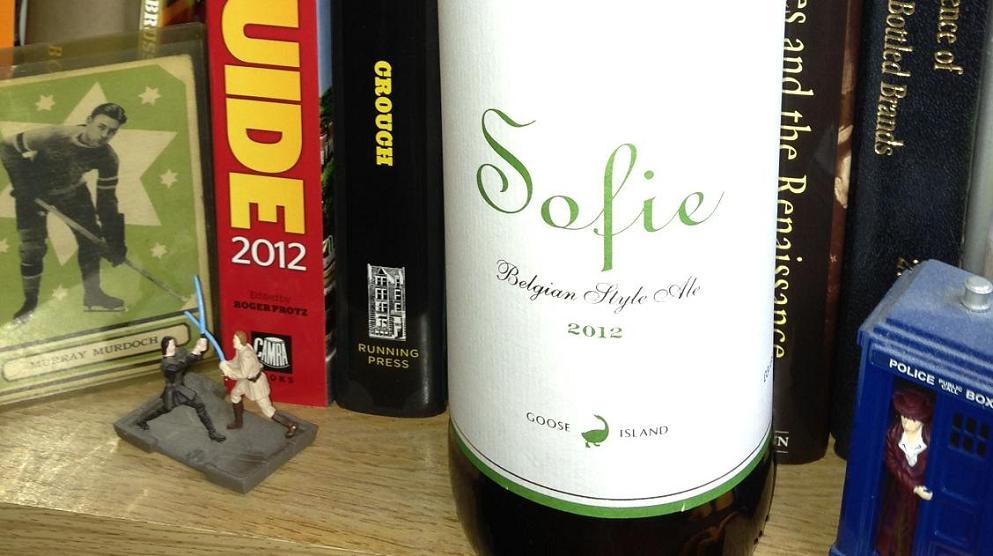
Illinois: Sofie 2012, Goose Island Beer, Chicago

The beer that proves craft v. crafty is a big sloppy fib – and well within the range of possible futures for brewing generally. $8.99 last weekend just across the border. I look for it and its siblings whenever I cross over as it is one of the best values in good beer.

Lemon, pears and fine herb aromas. In the mouth, bright mid-weight beer with a creamy texture up front followed by slightly astringent green apple and lemon acidity. Overarching bready huskiness, light spice, a bit of sulfurous funk and a slightly yoghurty yeast. White pepper note in finish. Loverly and reasonable. Rare combination.

An absolutely swell beer made by a brewery owned by an international faceless monolith. Deal with it. BAers have the love.

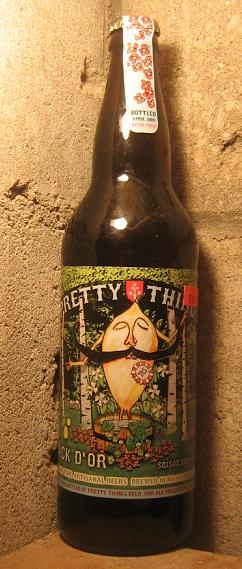
Massachusetts: Jack D’Or, Pretty Things, Holyoke

If you have read this blog for a while you will appreciate that I like saison. A few years back I wondered out loud if it was going to ever be the next big thing and I may have had my wish granted to some degree as they are out there even if they haven’t exactly bumped macro pilsner off the shelf. Pretty Things, which calls itself a beer and ale project, says this is simple table beer but they are being coy. A sensible $5.99 paid for a bomber belies the quality here. A while back, I inhaled upon one of their Saint Botolph’s Town rustic dark ales. It happened so fast, without a moment to type notes. I have high hopes for this one.

It pours yellowed straw ale under a fine white head. The aroma is lightly citrus with herbals. I once grew lemon verbena and – while I can’t say it reminds me of that – it did remind me that I once grew lemon verbena. There is also a creamed sweet maltiness. In the mouth, there is pith and white pepper, twiggy minty notes as well as a cream soft malty underbelly, smoothed from the oats. A bit of pear juice but also a nod to cox orange pippin apple as well as a mid-mouth astringency. Apparently no spices whatsoever if the brewer is to be believed (who’s calling them liars? you??) so it coaxes all the herbal notes from hops. And yeast strains. Why don’t we argue more about having more interesting yeast strains? But no spices. Sorta like those early Queen albums proclaimed in the liner notes that no synthesizers were used now that I think of it. In fact it goes rather well with 1974’s Queen II now that I think of it. I don’t know if it would be Zepworthy for, perhaps, even Houses of the Holy, a record I might rather pair with Fantome but still it does remind you that these earthier manorial beers like certain aspects of the 1970s overly dramatic folk tale art rock playbook, even for their pre-democratic roots, are far more than table beer.

I would like to try it against Hennepin. I am thinking this is a bit bigger and maybe more complex but shares the moreishness. Like all saisons, primal. I particularly like the use of the cap security label to tell me that this is a representative of their April 2009 Third Batch. We are in this for the data after all. BAers are in love.

Grill, Shed, Steak, Rain, Bieres de Garde And Saisons

The trouble with charcoal grilling is that when the rain comes you can’t turn it off. Propane, on the other hand, has a nice dial that has a “0” setting. But there is the garden shed and, when it rains and you have visitors, it can turn out to be a delightful place to while away a late afternoon hour reading last week’s newspapers in the recycling bin, listening to AM radio and comparing a few examples of bieres de garde and saisons.
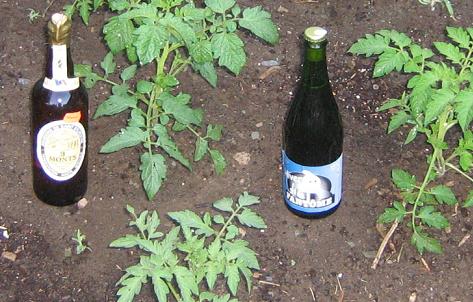
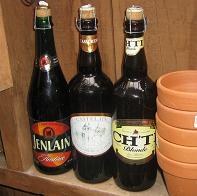
We opened the Ch’ti Blonde from Brasserie Castelain à Bénifontaine first, a gold ale called a saison (though French not Belgian) by the BAers but a biere de garde by Phil Markowski in his book Farmhouse Ales under a white mouse head that resolved to a froth and rim. It was the favorite of the set with cream malted milk, pear juice and nutty grain. Very soft water. I actually wrote “limpid cream of what graininess” but I am a little embarrassed by that pencil scribble. It gets a fairly poor rating from the BAers but maybe that is because they were not in a shed when they tried it. Castelain’s Blond (no “e”) Biere de Garde was drier but still creamy fruity, not far off the greatest example of a Canadian export ale. Light sultana rather than pear. Also dry in the sense of bread crusty rather than astringency. Lighter gold than the Ch’ti but, again, the rich firm egg white mousse head and far more BAers approve. By this time the shed dwellers had decided that steak could in fact be finger food and also that these ales were an excellent pairing with chunks of rib and New York strip. The Jenlain Ambree by Brasserie Duyck was another level of richness altogether, the colour of a chunk of deep smoked Baltic amber, the richest lacing I have ever seen left on a glass. Hazelnut and raisin, brown sugar and black current with a hint of tobacco. Lately I have been thinking that amber ales are the one style that could quietly slip away and never be missed. Placing this in the glass in the hand in the shed as the rain thumped on the roof and steak was eaten was an instructive treat as to what ambers can be, though 6% of BAers hesitate to be so enthusiastic.

I think this is the worst photo I have ever posted so I will keep it tiny unless you choose to click on it for the full effect. Apparently there is a limit to the beery photographic arts and I have made it my own. The 3 Monts to the left was picked up at Marche Jovi in nearby Quebec for a stunningly low price of under six bucks. Plenty of malteser and pale malt graininess with yellow plum and apple fruitiness, straw gold with more of the thick rich head, cream in the yeast. The water was not as soft was either beer from Castelain but all BAers love it. By Brasserie De Saint-Sylvestre who also made this biere nouvelle. To the right, the Fantome Winter was one of the stranger beers I have ever had and, frankly, a disappointment. All I could taste was radish, sharp and vegetative, over and all around the insufficient malt. In my ignorance, I didn’t realize that was likely quite an aged beer as the happy BAers explain. Neither the cork or even label, with its unmarked best before portion, give a hint as to the year but that is all right as I suspect I will consider this just a lesson learned even though I generally love Fantome.

By this time there were stars and a breeze as the cold front finished moving through.

Belgium: Brise-BonBons, Brasserie Fantome, Soy

I have to say I am in a conflict with this beer. I have liked all the Fantome I have tried…and I am supposed to approach these reviews with some sense of objectivity…supposedly. I love this beer. There I have said it. And, yes, I would marry it, seeing as you asked. Fresh pear juicy bright. There is a milkiness, a white pepperiness and cream of wheat. There is grain and there is toffee sweet. And there is green hop, arugula. Fabulous masses of thick lacing rich off-white foam over cloudy deep straw. Tea astringency in the end. Here’s the brewer’s website. All 61 BAers share the love.

XOXO. This is the beer you wish you had.

Belgium: Wallowing In Four Saisons


foursaisons1

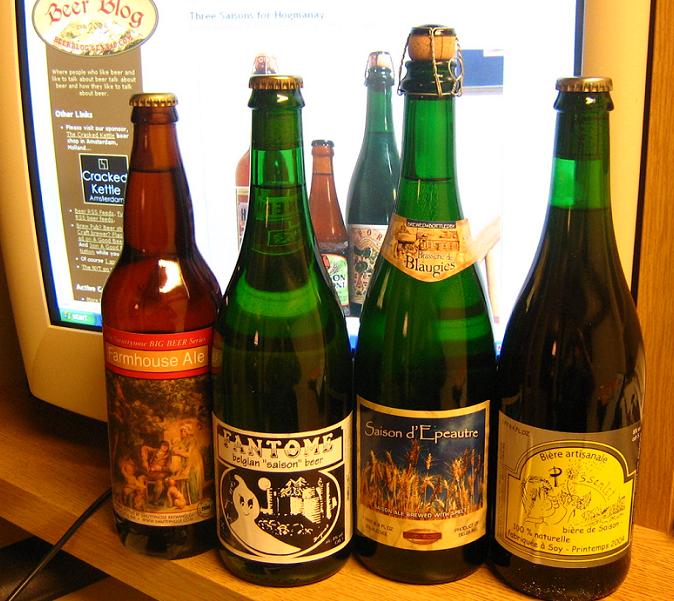
Saisons are one of best kept secrets in the world of beer. In the recent book What to Drink with What You Eat, awaiting my review, Garrett Oliver of Brooklyn Brewery names “Saison du Fond” – is that a typo of “Saison Dupont”? Yes it is – as his first beer in his fantasy desert island dozen. Early last month I reviewed a book entitled Farmhouse Ales which covers both the southern Belgian and their near neighbours the southern French saisons. In past posts, I have reviewed two Duponts and a Hennepin as well as a funkier form of the Fantome but this collection is one of the best. I am pretty sure I picked up all four at the ever excellent Finger Lake Beverage Center of Ithaca, NY and it speaks to their obvious commitment to quality. I will be particularly interested to note whether the seasonal Farmhouse Ale from Smuttynose of New Hampshire is anywhere near the quality of Ommegang of New York’s Hennepin.

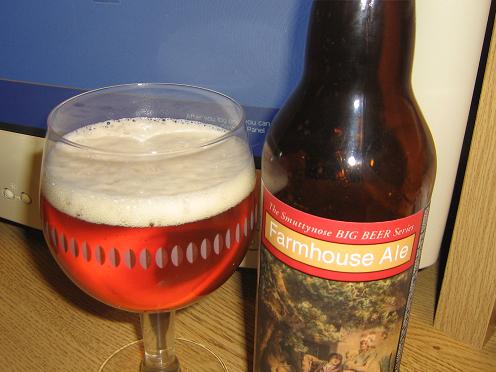
foursaisons2Farmhouse Ale: from Smuttynose of New Hampshire. This beer is part of the their big beer series and comes with its own brewer’s notes:

Like almost every other brewer who read Phil Markowski’s book “Farmhouse Ales” last year I decided that it was time for Smuttynose to try its hand at a saison…We decided that it was all about the yeast so we had White Labs send us a pitch of their saison yeast, which I believe is in the Dupont vein. Dr. White suggested that we ferment the beer without cooling and let the temperature rise to wherever it wants to go. Easier said than done, believe me.

Smuttynose is one of the great brewers these days if only for these notes that set the plan and the background out so clearly. The beer does not disappoint.Glowing orange without the usual underlying amber when I see orange in the beer. Quite still with a slight white rim and a skim of foam. It is as full of fruit as any beer I have ever had – orange, apricot and peach – all coaxed out of the malt without addition. The brewer thinks it is a little too full, too sweet and that is a fair comment but this is in no way sickly. It is more that the fruit overpowers the grain, like a record player with the balance set to far to one speaker – further attenuation would help restore the equilibrium. The fullness has a thick glyceral quality and while there is a spice quality harkening of cumin is it more like the roughness of rye than anything you would have in a Christmas pud. Again, the plan for next year’s version might resolve this. So bigger than Hennepin but well within the ballpark yet respectful of the show of finesse that is Ommegang’s product. All BAers support the cause.

Saison d’Epeautre: from the Brasserie de Blaugies, makers of the fig lambic I tried last June. 2004 marked on the cork. The beer pours a light straw with a white foamy head. On the nose, there is light melony tell-tale saison-ness. The taste is very dry and the body is lighter than I am used to for a saison. Grain huskiness with notes of cantelope, sultana raising and white pepper. Some cream in the dryness but not much. The dry is not an astringent hop-based dry. At the swirl, more milkiness and more white pepper spice. All the BAers like this 6% take on the style. The brewery says this:The german wheat is an unrefined yeast which contains a natural flavour enhancer, giving a good taste to the bread but also to the beer.I don’t think that really makes any sense. Oh, for the lack of decent translation!

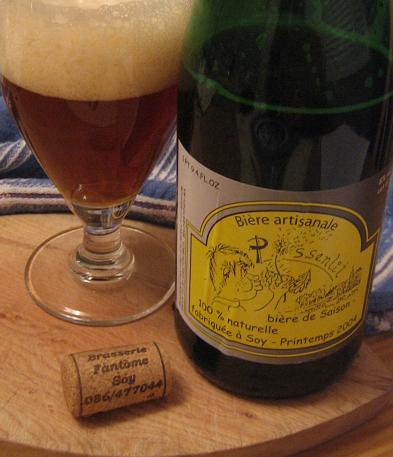
foursaisons3Pissenlit: from Fantome of Soy, Belgium. Spring 2004. Once I realized this was dandelion beer I checked out some reviews and wondered what I was in for. Not to worry – at least for me. The beer poured an amber ale under tan frothy foam and rim.
The core flavour is a little hard to put your finger on but it is both familiar and welcome: rich sweetness but biscuity; fresh apple, orange and fresh squeezed lime juices; a bit of white pepper and twigginess; and that tone which must be the dandelion – maybe I am thinking of sorrel in the spring when I go down onto the lawn to eat something growing. It is a mild greenness. The end is a mild bitter with a little huskiness moving into richish cider. Much more attractive to me than other brew reviewers suggest so perhaps beware. This may just particularly suit my tastes. On the swirl, there is cream but much more softly bitter green. At the end of the dregs it is almost like light drinkable cheese.

A beer that reminds me of a white lirac wine I once had whose only accompaniment I could think of was fresh leaf lettuce. This is more robust but in the same range. A beer or a waldorf salad with apples, walnuts and celery. Maybe Thai food, too. BAers see the challenge yet take it on with only 2% saying no despite its thoughtful unconventionality. A beer that makes me wonder if Fantome is the best brewer in the world.

Fantome Saison: also from Fantome of Soy, Belgium. Funnily, I did not like this quite as much as the Pissenlit but I still liked it a lot. Very active amber ale with a creamy white head. In the mouth pear and grape juice with white pepper, biscuit and a drying astringency across the tongue. Chalky notes under the herbal hoppiness not unlike Orval in a lavenderish sort of way. Well hidden strength at 8%. On the swirl, the astringency calms though the white pepper remains. Many BAers ask good questions but still rank it highly. A discomforting beer perhaps but still very attractive.

What a great hobby I have. I could consider saisons all day most every day. It is a real shame that so few craft brewers in North American have taken on the style with two major Belgian-style brewers in the north-east Unibrou and Allagash even ignoring it.