“Grain Suffisamment Pour Faire De La Biere”

hebertThe footnote quoting a text from 10 August 1620 actually reads in full:

Nous avon du grain suffisamment pour faire du pain and de la bière

That statement was written by Denis Jamet, Récollet missionary at Quebec in New France. When I wrote the bit about New France in Ontario Beer a year ago, I only thought to state that beer “came to New France at the latest in the 1630’s with Jesuit priests who brewed as part of their daily duties.” Hadn’t thought of the Récollets. The Jesuits come along a little later and, by 1634, they have a full brewery was being planned but in Quebec the Récollets were here first. I’ve been reading about their entry into the extremely sparce European population along the St. Lawrence Valley in the early seventeenth century in Champlain’s Dream by D.H. Fischer. In 1617 when there were 50 or 60 male residents of New France, there were four Récollets, three at Quebec and one further west at Huronia in what is now central Ontario. Denis Jamet was one of them. He came to New France for a second stint on board Champlain’s spring 1617 sailing from France to the new world.

Early New France did not do without strong drink. As part of their provisions, every year “they imported generous quantities of eau-de-vie, wine and cider.” People were arriving, too. Along with Denis Jamet, in 1617 the first permanent colonial family arrived in New France: Louis Hébert and Marie Rollet along with their three children. Hébert takes up planting, serving as apothecary to the settlement and starts over the next few years to create some economic stability and wealth for his small clan. He dreams of being on a stamp one day. He dies in January 1627 but not before he he becomes, as noted, also associated with “une chaudière à brasserie” – a brewing kettle. This document mentions it arriving in 1622. Which means, if Jamet is to be trusted in that first bit I quoted up there, the first colonists were making beer at least two years before the kettle arrive. Makes sense. Raw ale was a thing. And these technologies like kettles took time to all get in place. Apparently the plough Hébert requested showed up a year after he died.

Which leads to a bit of a puzzle for me. When Jamet made that statement, who is the “nous” – the Récollets only or the population of New France as a whole. Perhaps just the priests yet this brewing history of Quebec seems to indicate that both Hébert and the Récollets were brewing in or before 1620. None of this will win the prize as to the first beer brewed in what is now Canada as that was clearly going on in Newfoundland at Cupids in the early 1610s and was likely also being done for a few decades before that by summering West Country English fishermen on the Newfoundland shores who brought along barrels of malt. I do think, however, that Hébert and/or the Récollets may be the first to grow their own grain for beer making, to take control of the whole process. Hébert is understood to be the first wheat farmer in New France.

He was also the apothecary. You will recall that I posted a while back about Richard Whitbourne, who was in Newfoundland around the same time and described how “many of our Nation finding themselues ill, haue brused some of the herbes and strained the iuyce into Beere.” One of the things folk were struggling with was how to survive in North America. Baffin and his crew get hammered by scurvy in the Arctic 1616 and in the years before that Champlain loses many early overwintering explorers to the disease. He thought that it had to do with having access to fresh meat. They are working out new Baroque era medical science on the edge of known world. And likely experimented with the properties of their beer as part of that process.

What is not to like? Exploring farmer scientist educated devout brewing adventurers. What did you do today?

The Eight Years Reign of “Craft” Beer Ends

As with many of the words and ideas hovering around good beer for the last decade, we all knew for a while that “craft” beer has been a bit of a loser. Yesterday on social media, two of the biggest voices in good beer publishing affirmed its relegation. Here is an article John Holl of All About Beer on the status of the word:

As a media company, we rely on using words properly. One year ago this magazine took the first step in limiting the word craft in our coverage. Our feature articles no longer differentiate between craft brewers and not because we don’t have a solid definition. As we’ve always done, we report the news of breweries around the world. All breweries. Of course we know this will not be universally recognized, so you can expect to see the word pop up from time to time in quotes, or when certain groups, like the BA, talk about membership, or in our business coverage, where craft is considered a specific sales segment. It’s our duty to cover that as represented, and we will.

On Facebook, Todd Alstrom of BeerAdvocated commented in this way in Facebook:

I remember this conversation. 😉 BeerAdvocate magazine has also stopped gratuitously using the term. And Jason and I have been saying this for ages: Just because it’s “craft” (or “local”) doesn’t mean it’s good, nor should we blindly support it; especially given the level of mediocrity (at best) coming from far too many brewers these days.

It’s not a new idea. “Craft” as a label on good beer had been dubious for at least half a decade given its twisting for interested purposes including ensuring certain very rich people get very large tax breaks rightfully granted to other small business folk. And think about its actual lineage. It is not really appropriate to consider when the word was first used as that is the “tree falling in the forest” moment. It is only when a word gains both broad acceptance and ascendancy over its competition that it becomes definitive. A far more useful measure is the sort of thing we see when we compare the use of “craft beer” with “microbrewery” in the pages of The New York Times. “Craft beer” takes off only around 2007-08. Less than a decade ago.

If we truly care about meaning, we may want to ask why this happened. It is interesting to note that the popular acceptance of “craft” closely followed the merger of The Association of Brewers and the Brewers’ Association of America to form the Brewers Association. One of the key PR goals of the Brewer’s Association has been control of the discourse. They are obsessed with definitions and now hire many professionals including an economist to prop up their PR bulwarks. There was good reason to try to get more professional about these this given the countervailing “whack job approach” to making a case that was prevalent. The trouble is there is a whole pesky bigger separate discussion going on with consumers. Despite the efforts of the breweries, the consumer had an open mind and an independent eye.

And the PR spin was more than a bit of a botch. In 2012, the BA rolled out the failed “craft v crafty” campaign which fairly immediately fell flat on its face. It invited consumers to consider closely two things which had not yet been at the forefront of the discourse: (i) holy frig, those big “crafty” brewers can make pretty good beer and (ii) holy frig, those small “craft” brewers aren’t small. Notice what Holl and Alstrom mention up there. They dropped using “craft” a year pervasively or more ago. So, the arc of popular acceptance can, at best, be dated from 2007 to 2015. Eight short years.

This is good. Words come and go. And one reason they come and go is that the general pool of people in any given discourse know how to smell a rat. People recognize that the control of language is one of the first goals of anyone trying to not only promote but affix their interests a few rungs higher up the ladder than they deserve to stand. It is also good because we now live in the world of big craft billionaires and international big craft branch plants. “Craft” will slowly recede from the vocabulary as it should. Time for a new word. Or, better, words. What will they be? Stay tuned. The public will let you know.

Addendum: Have a look at Oliver’s take, an etymological view. And, if one is Swiftian, not a modest proposal at all as there is no hint of acerbic parody.

Looking Out The Window Of A Pub

4820

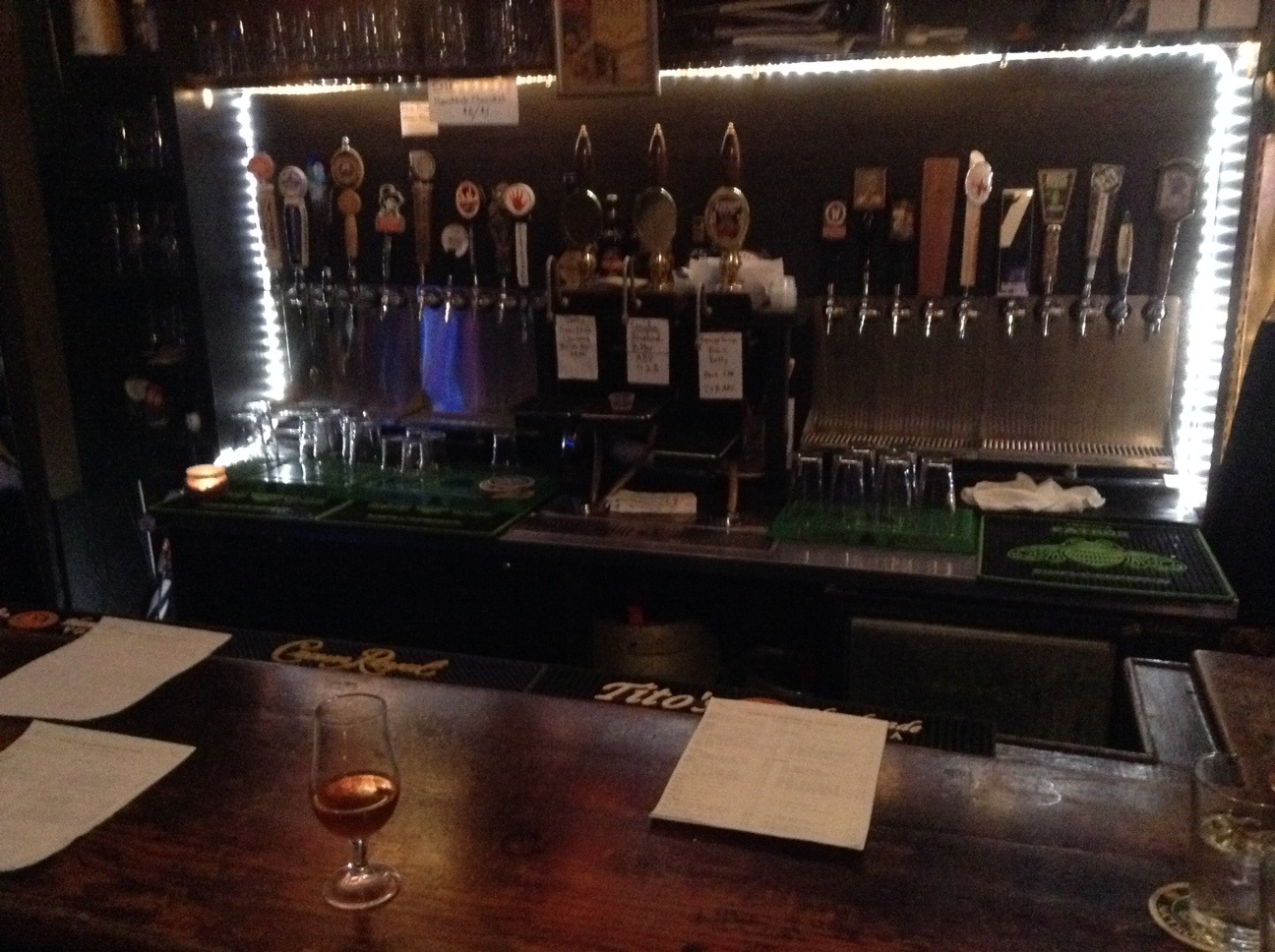
It’s one of my favorite things to do, sitting looking out the window of a pub. This was last Monday afternoon. The Bow Bar in Edinburgh. I was just getting used to the time zone and would fly out the next day. Two guys standing at the bar in the small one room space were providing the background track to the seat with a view. Apparently, the Bow Bar is packed on weekends but who sits in bar staring out the window on weekends? It’s something to do when your colleagues are at work. When you could be writing a report. Making plans. Paying bills.

Is It Even Possible To Be A Beer Expert?

monkey4Jeff wrote an article for All About Beer this week called “Why Beer Experts Matter”. I commented by Twitter that it set out a “good argument by @Beervana but expertise is key, not the “experts” – personifying a body of knowledge just limits it.” Discussion ensued. I meant it. Good. It was not snide code. It good – and good can be, you know, good. And it got me thinking about experts, expertise, professionalism, experience and interest… and interests while we are at it. And Lars asked for more detail. So, In this post, I am going to try to explain myself to myself, Jeff, Lars and to you if you care to follow along. It is, however, not mandatory reading, there will not be a test and it is Saturday.

Let’s think about what these words mean: experts, expertise, professionalism, experience, interest and interests. One way or another they are all about being clever. Having amassed a body of information. But then they represent doing different things with that information. It is interesting to separate the threads to discuss each but it is really important to keep in mind how much they overlap. Things like this are not neat and tidy. That being said, let’s have a look:

Professional: A professional is not someone paid to do something. A professional is someone whose opinion you can act upon as presented without interpretation. Lawyers, accountants and doctors are professionals. Engineers, too. They… we… carry errors and omissions insurance in case our opinions are wrong and cause harm to those who relied upon them. It is not to say that that those who are not professionals are highly skilled or deserving of significant pots of money. But every time I hear someone mention professional baseball players, I ask myself where fans can file the claim against the Chicago Cubs for undue emotional reliance. Similarly, I can’t see any brewers getting errors and omissions insurance to protect drinkers against negligent brewing, especially given the amount of that going around. Are there beer professionals? Not that many. Not most of the folk you might hear calling themselves professionals.

Expert: Not all professionals are experts and not all experts are professionals. As a professional lawyer, I hire experts and I challenge experts – both pros and not pros. People don’t like us for that. Lawyers don’t really care. It’s the job. No, it’s the profession. Me, I have done enough work in certain specific areas like history and heritage related matters that I peer review the work of experts myself. I challenge the content of their reports. Even reports by experts who are professionals which I am supposedly not required to go behind. Thankfully, it happens rarely. Mainly because (i) professionals who are not experts in a given field should be aware of their incapacity and do not tread beyond their specialty and (ii) true experts are so focused on the particulars of their particular topic. Because experts are experts in niche topics. Can there be a beer experts? Not in my opinion. Because, for one thing, “beer” is too big a topic and, for another, so much about beer and brewing is so self-evidently shallowly researched. So far. Example. Stan asked where Cicerones fit in. I responded that it was an example of “expert creep – trained as top notch wait staff they take on more status.” I should have written “some” take on more status. The niche training works in the niche. Beyond the niche… well, things get wonky.

Expertise: This I think is the most important point. The body of knowledge is collectively the “expertise” in that topic. It also means the skill of an expert. I am interested in the first meaning. “Canada’s expertise in coconut production is lacking” is something that can be said. Similarly, we can correctly say that the western worlds collective expertise in all aspects of beer and brewing is not as sophisticated as its collective expertise in public health or the economics of international trade. Beer and brewing is (i) not as complex topic to attract a body of expertise and (ii) where it is complex it is not well researched… yet. There are reasons for this lack of complexity that are obvious. It is only beer. But there are also reasons for the lack of detailed study that are not as obvious. I call these factors “interests” and they are not all alike.

Interests #1: This is where things get truly odd with beer. Dr. Johnson in the 1700s once stated, “We are not here to sell a parcel of boilers and vats, but the potentiality of growing rich beyond the dreams of avarice.” He was an executor of the brewer Henry Thrale and spoke the truth. There is a lot of money in beer. Micro and craft brewers work incredibly hard to avoid discussing that. In 2007, it was so shocking to point this out that one risked a playground pile on and perhaps a cherry belly, too. Many excellent points were made. Tomme Arthur and other brewers chimed in mainly defending price inflation. I think that time has passed. We are more realistic about brewers as Andy’s recent article about Jim Koch and the reaction showed. We are no longer “all in it together.” Financial interests are exposed and being discussed. Which is good. Many beer fans won’t be taken as suckers any more. AND brewers will be able to describe the well deserved rewards for their efforts… even if a well informed consumer base means the less than realistic brewers out there may end up paying for their own experiments and self-assigned artistic status from their own pocket, not mine. Money is good but we all benefit from real information as much as we want honest beer at an honest price.

Interests #2: There are other sorts of interests at play which put pressure on access to real information about the beer we like. In my 12 years of writing about beer nothing as stupid has ever been written as the article from 2009 “Sober Thoughts On Writing About Beer” in which it was suggested that fewer people ought to be writing about beer. I reacted strongly. I won’t repeat the discussion but point out that while Jeff did not say the same think, he could be taken for being in the same neighbourhood when he argued “[w]hy should you bother seeking out an expert? Because beer experts do some things even 900 laymen together can’t.” What he was not saying, however, is that the 900 lay folk should shut up. He made a different argument. But I still think it was flawed for the reasons about seeing as he based much of the argument on this idea he wrote “[a] good expert opinion will draw on several threads of information—science, process, history and culture—and bring all of that knowledge to the discussion of a beer.” The trouble is not the validity of the idea itself but its applicability. For two reasons: (i) the science, process, history and culture of beer is not yet well studied and (ii) those holding themselves out as experts in beer generally have self-evident disinterest and even disdain for knowledge about “science, process, history and culture of beer” not to mention the economics of it, the health implications of it, public policy related to it etc. These are the people who might tell you all English beer was smoky before the use of coke in beer. They say so because they have not bothered to do two hours of studying. We need to be honest. There is much greater interest in protecting the status of expert in many of those who suggest they or others are experts than there is an interest in gathering and building the collective expertise. Beer is money. And the shallow PR wading pond needs to be fed. But note I said “many”. To be abundantly clear, if I am looking for information about current trends in the global beer retail market, I seek out Mr. Beaumont‘s opinion. If I want to know as much as I can know about hops, I ask Stan. There are others with that sort of focused understanding who have not only earned but absolutely resonate with the necessarily broad, deep and detailed awareness to be respected as experts in their field. And each of these guys would also guide me and you to others of whom they might say are the expert’s experts. I would estimate them to total about 10% of those who have an interest in you thinking they are beer experts. Sorry to break the news.

Interest: we all have an interest in beer. I would not be writing on this keyboard if I did not. I would not be sketching out a number of alternative choices fourth book on beer if I did not. Everyone who wants to experience a greater variety of the deliciousness of beer, the exquisite comfort of pubs or the vast and particular history of brewing through time has an interest. It is lovely. It is worth doing. It’s participating in part of a bigger thing across culture and centuries. But the beer itself is experienced one person and one beer at a time. Beer is experienced only in the theatre of the mouth. With time and practice, anyone can hone their skills and create a deep body of experience which gives them greater and greater pleasure. Along with this they can write reviews of the beers they taste, write blog posts about the themes they see developing and a few can be lucky enough to be asked to write articles and books. Which leads to requests to be quoted. And called an expert. Hmm. It also leads to cherry syrup laced, bourbon barrel aged, sea salt infused gose. Which sucks. But the “expert” told you you should like it… except you just don’t understand. Sadly, you buy it and drink it and feel bad about yourself for (i) being not smart enough and (ii) having that crap in your mouth and (iii) having just dropped ten bucks to affirm you are not smart and to place crap in your mouth. This is a terrible thing for one simple reason. Beer should make you happy.

So you see how this works? It all relates the thoughts of Ivan Illich in fact. And do you see what I just did? I made you feel odd about the whole Ivan Illich thing. I just experted on you. I didn’t mean to. Sorry. This essay is in no way intended to be a sword of Zorro moment, a triumphal flourish in which the topic is summed up so completely you need not think further. That is not my point. I only propose the above. It is just something I have been thinking about. If I took more time, I would weave in more links with illustrations of the points I may be making. I’d add in Andy’s discussion here. But I didn’t. This is not a professional opinion. It’s not the statement of an expert. It’s just something I have an interest in triggered by the excellent thoughts of Jeff and Lars related to one corner of the whole body of knowledge related to beer and brewing.

Back From That Trip To Scotland That I Mentioned…


edinburgh

I was away for a week on a business trip to Scotland. A whole week? Well, as I am the son of two of those Scots who took to the four corners of the world, I did add a couple of days of vacation but, much to my surprise, it also took 33 hours of travel to get from where I am to where I was going and then, for unknown reasons, well over 20 hours to get back. Evil ocean. Where are the supersonic subs I was promised in comic books as a kid? So while the jet lag isn’t as bad when traveling west, I still need to put things in order. A bit of a photo travelogue, then, tonight. A slide show.

image254image252image251


image250image249image248


I had not sought out the Bow Bar in Edinburgh before but if there was a ticking habit in my life I feel my one pint in the corner was one big check mark on page one. image247I was not actually hunting it out and had it in entirely the wrong place in my mind, over at the west end of Rose Street. Probably something else wonderful that I am unaware of is over there. We found ourselves standing next to it when I was hunting out a shop to buy things made of wool. I had a pint of their 3.8% house Bowhemian Ale brewed for them by Alechemy Brewing. It was testimony to the pointlessness of beer over a certain strength. Lots of body. Refreshing in the middle of a march around the town. Interesting with plenty to think about.

image253image253image244


image260image268image262


The day before the goal was well understood. We headed directly to the door of the Cafe Royal near Waverley Railway Station where we had stood in the summer only to be told the kids could not come in. The laws on kids and bars in Scotland can get quite frustrating but do allow one to consider leaving them behind on another continent with the in-laws. The place is magnificent. The opposite of the study in plainness that is the Bow Bar.

image263image264image265


image257image258image258


That was good, having the night before been at an event at Glasgow City Chambers where I sat down to dinner with – I kid you not – a Sir, a Lord, a Lady, a High Commissioner, two Right Honourables, a Baillee and… a Baroness. Got piped in and everything. image261The Cafe Royal is second only to the rooms in that municipal palace for grandeur. Not a word I use often. Grandeur. Back at the Cafe Royal, I had cullen skink as well as some smoked salmon along with a couple of pints, ROK IPA as well as an Edinburgh Pale Ale. The latter was a gem. Just 3.4% with a black tea malt lingering finish there was plenty of malt in the body. The tiled art on the southern wall of the bar is quite the thing. It appears to be a selection of great moments in science’s benefits to mankind. More on those tiles here.

The Piper Bar off George Square in Glasgow and into a weird flashback into pop metal of the 1980s and ’90s. I had a couple of pints of Bitter and Twisted as we head bobbed along with the crowd to Metallica, Iron Maiden and AC/DC. It was pretty refreshing after an evening at the high table. There were airport beers, too. A 4% Camden Pale Ale at Heathrow on the way home and an 8% Wellington Imperial Stout on the way there at Toronto Pearson. The CPA was more expensive. A lunch at The Beehive Inn on Grassmarket to the south of Edinburgh Castle featured whitebait. I want whitebait all the time now. It’s like smelt. But more like smelt-lettes. French fries made of the whole body of a tiny fish. A cheery 4.2% Crofters’ Pale Ale by An Teallach Ale Company of Camusnagaul, Dundonnell, Little Loch Broom went down with that. Just enough to get me out the door and, about an hour and a half later, into the Bow Bar.

image3

image1

image245


image272image273


What to make of all this? Certainly that there is plenty of good beer to be found even when you are not hunting it out if you are in the right sort of community and know what to look for. No sessions. Just one here. Another there. And certainly there is plenty of good beer well under the 5% lower limit that is so common in much of North America. Think I am going to head over to my local brewery and propose a collaboration. Which is code for pushy beer writer who wants a beer he can’t get. That’s it, right? Anyway, home again. Where the houses are larger and warmer. Where the grass is not a lovely shade of green in January. Where you don’t have to tip the help because it’s your teenager.

Albany Ale: Straw In Wheat Beer Is Next Big Thing

It’s not quite like ten years ago when one’s name could appear in The New York Times, but I got word from cousin Mike Malone of, amongst many other things, “Books and Beer” on 1460 AM radio WVOX that news of the May 16th event in Middleburgh, NY had hit the Ale Street NewsCraig has been working on a press release:

On May 16th, The Middleburgh Public Library, The Albany Ale Project, and Green Wolf Brewing Company are hosting a day long (1pm to 5pm), family-friendly event celebrating beer, brewing, and Middleburgh’s Revolutionary War history to benefit the Middleburgh Public Library. MacKinnon Brothers Brewing Company, of Bath Ontario, will also be participating. The event will be held on Baker Avenue around Green Wolf Brewing Company (315 Main Street, Middleburgh) and behind the Middleburgh Public Library (323 Main Street, Middleburgh.)

The day’s activities include a Revolutionary War encampment, colonial brewing and cooking demonstrations, 18th century toys and games for kids, talks on the history of beer and hops in upstate New York and the Schoharie Valley, a Schoharie Valley hops display at the Middleburgh Library, beer samples from Green Wolf and MacKinnon Brothers.There will be Green Wolf brewery tours, as well as food from Middleburgers BBQ and Under the Nose gift shop and bakery. Craig Gravina and Alan McLeod will be selling and signing copies of their book Upper Hudson Valley Beer, and the day culminates in “The 1780 Beer Challenge”, cask tapping and tasting.

This is really neat. Looking forward to learning more about one of the areas of New York where the people who found refuge in eastern Ontario came from 240 years ago. And really looking forward to seeing recreations of how straw was used to make strong wheat ale. The more I learn about straw the more I think it was critical to pre-industrial scale brewing even if we have all forgotten its usefulness. Go straw!

Origins Of Ontario’s Beer Wholesaling Cooperative

Jordan has posted an excellent article this evening on the current state of the sale of beer in Canada’s biggest province, Ontario. Thirteen and half million Ontarians are served their beer through two large entities: (i) The Beer Store which is owned by the big brewers and (ii) the Liquor Control Board of Ontario, a provincial Crown corporation. Sure, you can buy your beer at a microbrewery, you can home brew and you can even still go to a brew-your-own place. But you really buy beer from the big two outlets. Brew-your-own or “U-brew” businesses are good to keep in mind as we think of how to move forward. In our book Ontario Beer, we pointed out that in the mid-1990s, “brew your own beer” businesses held a position comparable to small breweries today until they caught the attention of big beer. At a 1996 Federal hearing on taxation of major Canadian industries, Sandy Morrison, President of the Brewers Association of Canada complained about the lack of any imposition of taxation or regulation on these businesses:

These brew-on-premises outlets now have an 8% share of the British Columbia market and a 3% share in Ontario, which is the largest beer market in Canada. In total, they account for about 10 million dozen-cases of beer a year. The production from these unlicensed, unregulated mini-breweries exceeds that of the micro-breweries across Canada, and certainly in the two provinces concerned.

Brew-on-premises business were full-scale commercial operations that focused on government alcohol tax avoidance. Lost tax revenues in Ontario and BC totaled $69 million according to Morrison. Soon thereafter the law was changed. Regulations as well as taxes were applied. As can be expected, market share collapsed. The interests of the government and big brewing aligned to pressure the young upstarts.

There are echoes of more than the mid-90s in the situation today. The immediate origins of both the LCBO and The Beer Store date to the mid-1920s. After a series of elections and referendums, in 1927 Ontario’s experiment with prohibition ended with the repeal of the Ontario Temperance Act and its replacement with the Liquor Control Act. Along with the new law, the Liquor Control Board was founded. The province was once again drinking full strength booze in their homes – albeit after purchasing their drink at a government controlled store and transporting it in a sealed package. In the same year, Brewers Warehousing Co. Ltd. was founded as a brewers’ distribution collective. The provincial government retained control of the sale of wine and spirits through the LCBO, but beer was retailed by hundreds of mom-and-pop stores. Initially, the brewers were involved only in wholesale operations, jointly warehousing and distributing their product to stores operated by private contractors. In 1940, the brewers bought out the retailers and took over the stores, changing their name to Brewers Retail Inc and, more recently, changing again to The Beer Store.

Another thing was happening at the end of the 1920s. A corporate giant was starting out his career. Starting with next to nothing other than a few years in the financing business, E.P. Taylor had a plan to acquire and merge a large number of regional and local brewers with the goal of controlling half the brewing capacity in the province. Virtually all Ontario’s firms but Labatt and the breweries controlled by the Doran family in the north were his targets. His goals made perfect sense for the times. Breweries were operating at under 25% capacity. They were technological dinosaurs. By 1931, Taylor already controlled 27.5% of all Ontario beer sales. By 1950, he controlled 50% of the provincial beer market compared to 20% for Labatt. His deal making reached beyond Ontario. He shared a correspondence with H. William Molson, president of Quebec’s most famous brewery which dated back to 1932 and, in 1942, Taylor suggested quite an arrangement:

Don’t you think for the duration of the war we should arrange to divide the business in the two provinces in a fixed proportion and cut out most of the waste? I fully realize that your Company is not as extravagant in Ontario as some of the rest of us and you are certainly in an enviable position in that regard. At the same time I think that if you gave leadership to a proposal for pooling the business until after the war, everyone would feel inclined to work something out.

“Waste” was a theme for E.P.Taylor. In September 1939, he spoke to a meeting of the Brewers Warehousing Company. As war had just been declared, the tone was certainly patriotic but it was also entrepreneurial. Taylor argued that the lowest price possible for beer should be established to decrease “wasteful selling expenses” while increasing sales, volume and taxes for the war effort. Profits would also rise. While not the start of the concept of commodity beer and radically controlled distribution, this statement certainly places it at the centre of Ontario’s way forward. When you think of The Beer Store today you need to hear E.P. Taylor’s words from 1939 – “wasteful selling expenses” – ring in your ears. As Jordan put it today:

The Beer Store’s organization is such that it works in your favour if you are a very large company. The fact that your beer can only be sold in predetermined locations and that the organization that runs those locations stocks those stores from centralized warehouses means that you don’t have to pay for delivery, storage or a sales force. It’s a gigantic savings. The large breweries don’t generate profit from owning and running The Beer Store and this is something critics frequently fail to understand. The monopoly is not profitable for the owners because it extracts profit on sales. It is profitable for the owners because it saves a frankly ridiculous amount of money on outlay.

By the late 1950s, E.P. Taylor was arguably the most famous Canadian before Pierre Trudeau came on the scene a few years later. His positive effect on the economy of Ontario and Canada cannot be underestimated. But he stepped away from his role as corporate leader before 1970. In another ten years, loyalty to ale and even Ontario’s beer brands was fading fast. We now live in a marketplace where the best selling beer is Coors Light and The Beer Store is owned by foreign brewing corporations. That all being the case, why retain a distribution model set up in the late 1920s to balance the needs of local brewers with the majority of the population which still had strong preference for temperance principles? None really. None at all. Unless, like in the mid-1990s, the interests of big beer and government revenue are all that matter.

Another Canadian Barley Farm Brewery

This is maybe my hobby interest in this hobby of mine – brewers growing their own barley. This time its in Saskatchewan:

They wanted to go back to farming, too, and were able to buy back the original farm. Lawrence and his family live there today. Most farmers sell their grain wholesale, but the Warwaruks have figured out a smart, sustainable way to add value to the barley they grow. They do this on a much smaller acreage than the typical large-scale farming operation, where 3,000 acres is usually the minimum to make a profit on the wholesale grain market. The Warwaruks’ farm is just over 160 acres. All the barley grown on the farm is used for Farmery products. “If I was to take that barley to an elevator, I’m getting less than $3 a bushel, which is crazy,” says Lawrence.

What is the big deal? New York has farmhouse breweries all over the place. And I suppose that is right. And Lars is studying the farmhouse brewing traditions of Europe and particularly Scandinavia. It’s everywhere already, right? But in New York, a percentage of the hops and other ingredients must be grown or produced in New York State. Not all. And not all on that given farm. It’s a great program but it’s not all from one farm. And what Lars is exploring are really town and country brewing traditions – which is great. But it’s not what I am thinking about.

What I think the Warwaruks and my nearby neighbours the MacKinnons may have in common is that they are involved with (i) family grain operations, (ii) the are using brewing to create a premium value revenue stream to secure the farm from risk and (iii) they are not making overly wrought beers. This model may not scale. It may not ever extend beyond the local market. But it is intensely local. It is malt barley focused. It is also not the result of a funding or a research program. It’s utterly normal.

Any other examples out there? Girardin I suppose.

Ontario: Bar Hop, 391 King St W, Toronto

bhto1

Being in the Big Smoke for proper reasons, I took the chance to let Jordan pick someplace that I hadn’t been to before. He chose Bar Hop. Over a couple of hours we talked about writing books, the neat and younger crowd, the beers and other gossipy things like who has the unpaid social media interns.

Standing at the bar as we waited for a table, I was handed a pint of County Durham Session Ale. It was in very good form at 4.4%, $6.95. I say pint as it was thankfully in a nonic but I noticed later that the pour was called 18 oz. Which is open and fair and transparent. It also was what most other pubs would serve as a full pour. Soon we sat in the dark and sorta noisy back of the bar. An unidentical pint of the County Durham Session Ale was then placed before me. Jordan leafed through the menu and picked out favourite. A rye saison was very nice. Sawdust City made it. My beer turned out to be another lovely lighter sort of beer but not cask at all, not what I thought I had asked for… or as I saw later was billed for. Nutty, nitro head even… perhaps. It was also quite nice.

The nonic emptied over a half an hour, We had starters. Jordan had almost half a pint of olives placed before him. I had cod cakes. He had a lot of olive. I had just enough cod cake. Then I had a gose. Very light at 3.8% was a slightly salty Sunny D but in an OK way… sorta… he said politely. I mentioned that Toronto seems to like a fruit flavoured core to a beer judging by this and my last trip. Jordan recommended a beer by a very reputable brewer that tasted like bubblegum dissolved in an IPA to me. I handed the rest to him. Sometimes it’s an added ingredient, some sauce. Sometimes it’s that heavy hand with the mango flavoured hop. I prefer beer to have graininess of one sort or another. A beer where the ingredients come together to make flavours composed of them but not of any one of them. Not a fully popular view apparently in Toronto these days but it’s a blip.


bhto2bhto3


bhto4

bhto5


We then both got into our main meals, flank steak with salad for me, and both tucked into Kingston’s Stone City wheat ale called Sons of Sydenham. Seeing as Lord Sydenham had, we are told, a pretty debauched life during his short term as Governor General of the newly United Canada of the 1840s, it seemed an odd name for such an evening of light beers. It was, however, clearly the best. You could taste all the beeriness of the beer. It’s was intended in fact to taste of beer which is handy in, you know, a beer. Made the night along with the service, the food, the hum of the room and the strange table manners of the neighbours.

We left Bar Hop and talked some more as we walked. About the impending crisis which could not quite be defined. About the need to have a car. The architect behind that church facade. The idea of having unpaid social media interns.

Pre-1600 Ale And Beer Not All Dark And Smoke-Laced

1885malttable2

This has been a bit of a brain worm for me for a while. No, not that kind. The other kind. And for a longer while, I’ve been reading about how, before a certain point, all English beer and perhaps elsewhere was brown and smokey. But, quite rightly, the other day I was righteously snapped at for referring to the one post I have written on the idea. I should do a better job that that if I am going to get any sort of passing grade. So, here are some ideas that I am plunking together now. This is not to be definitive. I am showing my work and will build it upon going forward:

• Mid-1200s: In the first half of the 1200s, when England and northern France were under one government but still two cultures, Walter of Bibbesworth wrote Le Tretiz, an English-French primer to teach Anglo-Norman children about life and language. He describes the things in the world including ale making. A current edition of the book ishere. This is a translation from which we find this passage about malting:

Now it would be as well to know how to malt and brew
As when ale is made to enliven our wedding feast.
Girl, light a fennel-stalk (after eating some spice-cake);
Soak this barley in a deep, wide tub,
And when it’s well soaked and the water is poured off,
Go up to that high loft, have it well swept,
And lay your grain there till it’s well sprouted;
What you used to call grain you call malt from now on.
Move the malt with your hands into heaps or rows
And then take it in a basket to roast in the kiln;
Baskets, big or little, will serve you in plenty…

That tells us the basics of malting in a way that one commentator states “…medieval malting was, except for the lack of mechanical processing equipment, essentially identical to modern techniques.” Maltings from the 1200s were discovered this year in Northampton.

• Mid-1300s: One hundred years and more after Walter of Bibbesworth, there is a record that confirms, ale was not uniform within a single local market for as reasonably a long time as one needs to consider it a hell of a long time. In 1378 or so, in a moral narrative called Piers The Poughman at least three sorts of ale: thin or mean ale, good ale and best brown ale. He also uses the phrase “halfpenny ale” but that may well be good ale. Variety of ale brewing must include consideration of the potential for variety in malting techniques.

• Mid-1500s: As discussed in February of 2013, in his “Dietary” of 1542, Andrew Boordemade himself clear about what he considered was the best ale:

“Ale is made of malte and water; and they the which do put any other thynge to ale than is rehersed, except yest, barm, or goddesgood doth sophysicat there ale. Ale for an Englysshe man is a naturall drinke. Ale muste have these properties, it muste be fresshe and cleare, it must not be ropy, nor smoky, nor it must have no wefte nor tayle. Ale shulde not be dronke under .V. dayes olde. Barly malte maketh better ale than Oten malte or any other corne doth…

Not smokey. Pretty clear statement.

• Later-1500s: In this 2004 report on an archaeological excavation of a medieval malting kiln it is stated:

The fuels used in the malting process were documented in 1577 by William Harrison, who wrote: “In some places it (the malt) is dried at leisure with wood alone, or straw alone, in other with wood and straw together, but of all, the straw dried is the most excellent. For the wood dried malt, when it is brewed, beside that the drink is higher of colour, it doth hurt and annoy the head of him that is not used thereto, because of the smoke.

Notice that again we see grades of now hopped beer just as we did in 1378 but it is not quality of strength that differentiates but the quality of the malt. And wood-kilned malt is noted to be both darker and the means to make a poorer beer – because of the smokey quality wood added. Harrison published his book A Description of England in 1577. Here is a full copy of the text posted by Fordham University in which you will find this: “The best malt is tried by the hardness and colour; for, if it look fresh with a yellow hue, and thereto will write like a piece of chalk. Chalk is, you will note, pale.

• Late 1500s to early 1600s: Also as stated before, there was something of a crisis in malt and fuel supplies as far back as the mid-1500s:

…the forests around York had greatly diminished and receded. Chiefly for this reason the malt kilns were in 1549 closed for two years and a survey of disforestation for eight miles around was instituted. At this time, too, the commons included the dearness of fuel in their bill of grievances and ten M.P.s were asked to seek a commission from the king to check disforestation.

The crisis of English deforestation led to a search for fuel alternatives and the main alternative was coal. The timber crisis was most acute in England from about 1570 to 1630 during which making coke from coal was invented.

• Mid-1600s: In an edition of A Way to Get Wealth by Gervase Markham from 1668, a book first published in 1615 we have an opinion on the preference for straw… and not just any straw:

…our Maltster by all means must have an especial care with what fewel she dryeth the malt; for commonly, according to that it ever receiveth and keepeth the taste, if by some especial art in the Kiln that annoyance be not taken away. To speak then of fewels in general, there are of divers kinds according to the natures of soyls,and the accommodation of places-in which men live; yet the best and most principal fewel for the Kilns, (both tor sweetness, gentle heat and perfect drying) is either good Wheat-straw, Rye-straw, Barley-straw or Oaten-straw; and of these the Wheat-straw is the best, because it is most substantial, longest lasting, makes the sharpest fire, and yields the least flame…

Again, as Harrison half a century before, you have grades of malting based on the fuel used but now not just wood or straw are described but in this passage four separate sorts of straw. But Markham continues. After these light grain straws he lists fen-rushes, then straws of peas, fetches, lupins and tares. Then beans, furs, gorse, whins and small brush-wood. Then bracken, ling and broom. Then wood of all sorts. Then and only then coal, turf and peat but only of the kiln is structured to keep the smoke out of the malt. If you go back to that 2004 archaeological report you will see a reference to evidence of that sort of malt kilning in practice in the 1400s: “… [A] charred deposit overlying the brick floor of the cellar was sampled and found to comprise mainly charcoal fragments from narrow twigs, several straw culm nodes and occasional charred weed seeds.” You can learn more about culm nodes here.

• Late 1600s: In his book A New Art of Brewing Beer, Ale, and Other Sorts of Liquors…published in 1690, Thomas Tryon discusses malting. Large parts of the book was reprinted in the 1885 text Malt and Malting: An Historical, Scientific, and Practical Treatise… by Henry Stopes. Tryon confirms the ascendancy of coke over straw due to its “gentle and certain heat.” Straw, he has to admit, is still a close second but depends more on the skill of the maltster. Wood kilning is called unnatural in that it leaves a smokey taste.

• Late 1800s: A big jump in time to the document from which that table waaaaay up top comes from page 66 of the Transactions for 1884 of the Society of Engineers based in London, England. That table is found in an article “The Engineering of Malting” read by one Mr. H. Stopes at the meeting of that organization. He also read it at the eleventh meeting of the Society of Arts on 18 February 1885. In his article, Stopes describes the malting process briefly in this way: “The English system, briefly, is steeping corn in an open vessel, germinating it upon flat exposed floors at very shallow depths, and drying upon an open-fire kiln with single floor at from nine to twenty-one days after steep.” As noted above, that sort of description could have been written by Walter of Bibbesworth 650 years earlier because the making of malt was an incredibly stable practice. He goes on to describe many sorts of malting he has witnessed including the most basic:

The simplest form of malt-house possessing any capacity for work is a plain two-story building, having attached to it a kiln or drying-house, and consisting of a ground floor of clunch, a brick steeping-cistern, and a first-floor of timber, with or without partitions for separating the stored grain or malt. The only implements are a wooden shovel and a winnowing-fan or sieve to separate the roots or “combs ” from the malt prior to its use in the brewhouse. The author has seen malt made in Italy in an open court or loggia, where the barley was steeped in a tub, allowed to germinate upon the stones in the open air, and dried in a small lean-to building, with only a hole in the roof for the exit of smoke and vapour. This was furnished with a floor of perforated sheet iron and a furnace similar to that used under an ordinary washing copper in an* English scullery. Even more primitive operations are performed in Nubia, as there millet, when malted, is dried in the sun. Such rude malteries Concern us only so far that they occupy the lowest end of the scale, and indicate the necessity for moisture, growth, and curing or drying, the three essential conditions of making malt.

Sun dried malt. That’s be pale. Stopes does not really explain his table. But he includes a column for sun-dried or air-dried malt as opposed to kiln dried. And shows that it, like plain barley, it contains no products of torrefaction. Torrefaction is toasting, roasting, etc. He does however state that kilning pale malt and amber malt is a difference of 200° to 240° F and that the time for malting is counted in days. Plenty of time to control the process. Not something in 1885 that needed scientific instruments. And if not in 1885 likely not in 1385.

I am going to keep working on this and posting updates. I may also be seeing this rudimentary traditional pale malt production evidenced in frontier New York in the first decade of the 1800s. I need to think more about that. And all of this. Suffice it to say, I am pretty certain there is evidence that the making of pale malt was not dependent on the invention of coke and that English speaking peoples in centuries past enjoyed ales which were not dark and smokey. This is in no way to say that most beer was not dark and smokey. It just seems to me that this may be found where (i) the folk are poor, (ii) resources and skills are limited or (iii) standardized industrial techniques such as – or rather concurrent to – the use of coal and coke beginning in the 1600s forced people to put up with beer that was dark and smokey. I also need to tie it into grain drying as well as bread ovens, both technologies used since the middle ages which could be overlapped with the kilning of malt.