Beer and Art: The Harvesters, Pieter Bruegel the Elder, 1565

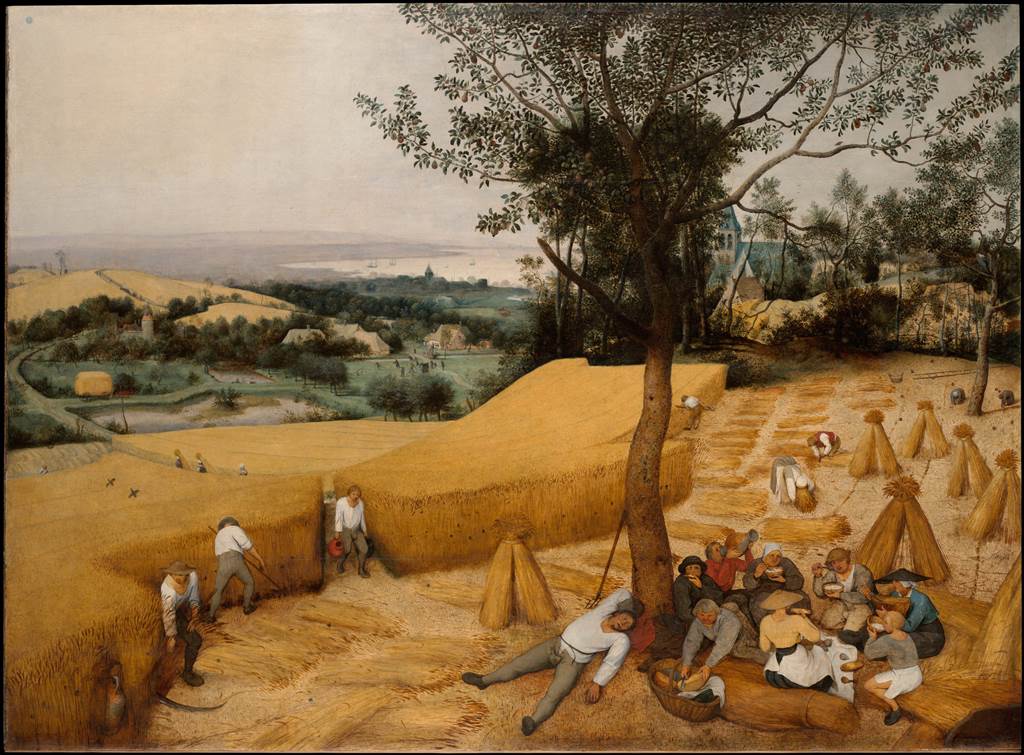
Nosing around the Met‘s digitized collection a bit more, I came across “The Harvesters” by Pieter Bruegel the Elder from 1565. Not hard as it was on the front page. I have posted a few times about paintings by his son, the imaginatively named Pieter Bruegel the Younger, over the years but this one struck me as perhaps illustrating a few things worth thinking about.

Look at the scale of the people compared to the height of the grain. One of the characteristics of Battledore barley two hundred years later in Britain was that it had a short stalk. It could survive hail or wind better than other varieties but didn’t provide all that useful straw that we learned about in relation to beer in New York before the switch to barley from wheat. The stalk was in itself important to the community as a multi-purpose material for mattress stuffing to looser wheat mash spargings. In “The Harvesters” the stalks are tall and entire stooks* are taken from the field with care. The stooks are strong enough to serve as a bench for the workers having their meal.

Harvest time is big stuff. The image is a narrative of agricultural economy in the Renaissance. If you click on the image at the met site, you can zoom in quite closely. Look at how the topography is used to illustrate the economic activity. The field being harvested is on the top of a hill. Scythed and stooked, it is carried one by one to the bottom of the hill where it is loaded on a cart and carried away. There are three communities in the painting. The hilltop has a church to the upper left seen through the trees. Down below there is a manor of some sort where some are swimming while others are killing a tied up goose as a blood sport. In the far distance, there is a coastal town with ships in the harbour. Is one point of the painting’s structure that the grain gets exported?  Or is beer made from the grain getting shipped out?  I should cross reference the painting with Unger.

Where is this place? The blurb attached to the image by the Met says:

Bruegel’s series is a watershed in the history of western art. The religious pretext for landscape painting has been suppressed in favor of a new humanism, and the unidealized description of the local scene is based on natural observations.

But is this really a local scene or an imaginary one? Where is it? Bruegel lived in coastal Antwerp, Belgium a city of about 100,000 at the time and the richest in Europe. He was born in the river town of Breda, another community now in the Netherlands but then also in the Duchy of Brabant. Perhaps one of those two centres is in the background.  Could you find the field and stand where the artist stood?

But what about the beer? As one commentator notes, the scene is about producing and consuming. Or – if you are the goose – producing, torturing then consuming. The workers are eating bread and cheese as well as pears that one guy is shaking from the tree to the upper right. And they are drinking. A central character is a man carrying two large jugs up the path. Another man in the circle having a meal drinks directly from a jug. A fourth jug with what looks like a loaf of bread on top sits in the uncut wheat to the lower left.

We are told by Markowski that saison and biere de garde were brewed for centuries in the Low Countries and northern France to attract and retain workers. Farmhouse beers. The scene in “The Harvesters” is smack-dab in the middle of that culture, in the saison zone that included Brabant. Unger explains that particularly in the sixteenth century, tax records indicate a wide number of names for various grades of beer: “… dun and scheynbier and volksbier and scharbier and scherbier all turn up. No matter the name, it was always cheap.”** Was that what was in the jugs? We can’t reach back to ask those in the picture what they called their drink or even if it was in fact beer. But it could be and, frankly, likely was so… it is what it was. Day drinking 1565.

*I use the SW Ontario usage, spelling and pronunciation of the in-laws.
**at page 129.

Ontario: Golden Beach Pale Ale, Sawdust City

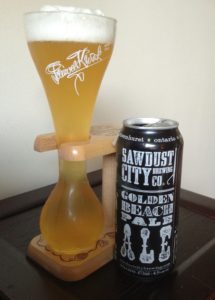
kwakAh, my least favorite glass ever meets my favourite brewery of 2016. I got the Kwak glass likely the best part of a decade ago and had to wash a decade’s worth of dust off it to celebrate or mark or mourn today’s news. I am not sure I deeply care as I have never liked the beers of Bosteels all that much – though I liked Kasteel in 2004. Jeff has some of the early reports. Suffice it to say that the Great Satan now has a maker of muted B grade Belgian malty things in its portfolio. My world has not altered.
Which is not what I said when a number of mid-central Ontario’s Sawdust City beers started showing up in tins placed on retail shelves here in south-eastern Ontario. Great value at about $2.75 CND each, they all have more then held up their end of the bargain. This 4.5% ale pours a swell yellow gold with a rich white head. On the nose there’s plenty of weedy herb along with a fair chunk of white grapefruit rind over a cream background. The swally is interesting. A brightly ringing bitterness elbows out a modest lemon cream cake foundation. Lots of dry white grapefruit pith from the four hops named on the side of the can. Busy but still attractive. Especially on a day that is hitting 102F with the humidity.

You know, I’ll pour the next beer in another glass and put this monstrosity away likely until I hit my sixties. It’s all more than a little overdone, pointless marketing for a brewery that really hid in a safe spot in the market. Now owned by the forces of evil. Or of the future. Or just of reality. Gnashing over it all is a bit like being angry about that goldfish that died back in junior high. Things change. Things you have ultimately little to do with. Good beer, however, keeps showing up. Like this one from Sawdust City.

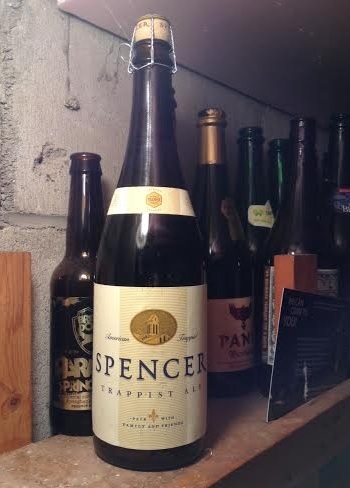
Massachusetts: Spencer, St. Joseph’s Abbey

Long time reader Brian was good enough to deliver this to me after having driven west for the 1780 Challenge back in May. The beer is brewed by the monastic community at Spencer, Massachusetts. Fortunately, they are a fairly prudent bunch as their beer comes in at just 6.5%. Every time I read some git saying big bottles are for sharing I think of this strength of beer. Mine.

The burnished gold ale sits under fine lace leaving egg white foam. Shoving the nose deep into the glass, there are aromas of burlap, dry twiggy herbs with pear and banana. A bit of sheddiness but very pleasantly so. The monks suggest there is a light hop bitterness. They are fibbing. On its trip by the gums, there’s plenty of bitter herb as well as a bit of menthol lingering at the end. More of the musty burlap. Underneath the pale malt is sweet and creamy but definitely playing a supporting role. A lightness shows up mid-mouth. There is a little smoke amongst the herbs making me think that this would go great with bacon and old cheddar. But, then again, so does life. There is even a wee bite that reminds me of those saisons which an edge from a bit of white pepper. Clove or very bitter orange maybe. I opened a bag of snapea crisps, the sort of snack monks may have sworn off. It works.

The BA bros rank it lower than the general BAer masses. I get their observation that “nothing really pops out to wow our palates” but I am not sure that’s always the reasonable expectation. This is one of the best beers of its sort that I have had, the flavours articulately placed. But it is not a show off. Instead, it shows restraint and balance. It shows thought. Thank God for that.

Beer And Art: Bruegel’s “Return From The Inn”

image275

A couple nights in Montreal leads to a lot of good things. A number of forced marches for the family through an alarmingly frigid city to this meal or that shop. Buying beer in a grocery store. Five new pairs of Converse sneakers for distribution across the clan. And a stop at the Montreal Museum of Fine Arts where I saw this, “Return from the Inn” by Pieter Bruegel the Younger (again with the PBtY) … or is it Return from the Inn? Such things elude me. It’s not the greatest image in terms of sharpness but a larger scale image is clickably before you if you want a closer look.

Aside from all the allegorical stuff, I noticed the two items related to brewing right away: the massive sacks of grain on the untended cart as well as the sign of the wreath indicating, I understand, that strong drink is on offer within. I would expect the birds pecking away at the spilled grain which has fallen to the ground would be a sign of decadent waste to someone 400 years ago. Not sure if the load has been left by carters now inside filling their bellies with ale or whethers it’s the inn’s own supply. Lot of snow on those wheel spokes.

I suggest you ignore all the brawling gifts swinging agricultural tools and the steamy suggestions of sexual faithless. Reminds me too much of the final half hour of a craft beer fest. A rather snazzy explanation of the whole thing can be found here. The image is from around 1620 or just when various European nations are setting up colonies in what are now Quebec, New York, Delaware and Boston. This would be what normal would look like to those earliest colonists, the way they would have approached – or avoided – this sort of inn if out looking for a beer of an afternoon.

Sour Studies: Timmermans Oude Gueuze 2013, Belgium

image232Session beer. 5.5% and sufficiently sour that a personal sized 750 ml gives at least two hours – or four laundry loads – worth of sips. It pours a slightly clouded golden straw. Plenty of must and funky tang when the nose is rammed into the nonic. Still, a bit of fruit in there. Maybe lingonberry. Just a hint. Much more going on in the swally. Sour, yes, certainly sour with a light summer apple, lemon, creamy wheat, nutmeg heart. “Rotten lemon, more like it!” says the lad after he sticks a finger in the glass. Which pretty much sums it up.

What is my relationship to this sort of brutal beer after all these years of study? I certainly have an appetite for any I get a chance to lay my hands on but they come along so few and far between for Ontarians given out mediocre retail options that I wonder if the scarcity makes them more interesting. I bought this in Albany a few months ago and do like to have a few bottles of panic gueuze… but wonder if I would be quite so excited if I could buy one of these any old day down the street? Or should I just be happy that one of these every three or four months is just what keeps me happy. You really can’t measure the relative value of the exotic.

BAers give it solid respect.

Illinois: Sofie 2012, Goose Island Beer, Chicago

The beer that proves craft v. crafty is a big sloppy fib – and well within the range of possible futures for brewing generally. $8.99 last weekend just across the border. I look for it and its siblings whenever I cross over as it is one of the best values in good beer.

Lemon, pears and fine herb aromas. In the mouth, bright mid-weight beer with a creamy texture up front followed by slightly astringent green apple and lemon acidity. Overarching bready huskiness, light spice, a bit of sulfurous funk and a slightly yoghurty yeast. White pepper note in finish. Loverly and reasonable. Rare combination.

An absolutely swell beer made by a brewery owned by an international faceless monolith. Deal with it. BAers have the love.

Mmm… What I Need Is A Big Bowl Of Thick Beer!

flemish1I knew this. I think I knew this anyway:

“This process is much like how you would do in a fourth-grade germination science project, where the grains would be soaked in water for about 24 hours, drained and then laid between sheets of cloth until they sprouted,” said Amanda Mummert, an anthropology graduate student helping Armelagos with his research. After germination, the grains were dried and then milled into a flour used to make bread. Streptomyces bacteria most likely entered the beer-making process either during the storage or drying of the grain or when the bread dough was left to rise. Nubian brewers would take the dough and bake it until it developed a tough crust, but retained an almost raw center. The bread was broken into a vat containing tea made from the unmilled grains. The mixture was then fermented, turning it into beer. The final product didn’t look much like the pint of amber you sip at your local watering hole. “When we talk about this ancient Egyptian beer, we’re not talking about Pabst Blue Ribbon,” Armelagos said. “What we’re talking about is a kind of cereal gruel.”

I knew that. Not that bacteria stuff. No, not that. Forget all that medical properties stuff. Look at that word “gruel”! I think there was reference to the thickness of 1500s gruel beer back in Martyn’s Beer: The Story of The Pint which I am surprised to now read that I blogged about seven and a half years ago. There is stuff in Hornsey about beer as gruel as well. Boozy porridge. So, how is it when we are presented with these supposedly authentic ancient beers, well, they pours like water or least an IPA?

More to the point, don’t you want to try some breakfast gruel beer? Couldn’t we make it like it was enjoyed back then? Not the contemporary southern African version for 12 to 20 but the big vat whole dang community serving sized pot o’ Quaker Oats meets Budweiser. If we look again at “Village Kermis With Theater and Procession” by Pieter Bruegel the Younger (discussed in in 2007 in terms of the pub game in the lower left) we see in the lower center the making of a big mess of something being sucked back by the crowd, right across the street from the joint I’d guess was the tavern. Have a look at the painting Bruegel maybe ripped off and the detail is even better. I am not suggesting we need to get all deep about this stuff but does anyone do a village kermis with gruel booze anymore – other than, say, in rural Romanian where I am pretty sure I will never find myself? Would people folk to such a legitimate recreation as much as for another thinly veiled faux stab at brand buffing? Apparently the children’s games scholars are already at it.

Beau’s Thursday Night Tasting In the Backyard

A fun way to spend the evening. Beau’s had their quarterly business meetings in town and they all came over for a few hours of opening bottles – including the father, son and a sizable host. We nine started well with two saisons and biere de garde: Hennepin, Jack D’or and 3 Monts. Batch 10 from Pretty Things was much better than the more recent bacth 13. Lesson: let it sit.

Things got a little wobbly with three Quebec takes on Belgian white beer. We thought RJ’s Coup de Grisou was fine and a good value beer. And Barbier from L’Ilse D’Orleans was not well understood given its level of rich maltiness. But Blanche from Charlevoix was a revelation in nasal interaction with beer. Freesia. Fabulous.

Three more bottles were opened. Trade Winds Tripel from the Bruery was a bit muddled with a nice aroma. Too much of the malt ball for the style or maybe just our level of interest given the other choices. Next, the Poperings Hommel Ale, as always, was amazing. The greatest pale ale in the history of the planet? Could be.

Then the taxi was called for the eight to be off. It was time. The mosquitoes had begun to bite. Just time to open a quart of Drie Fontienen’s Oude Gueze, one of the few beer that could follow a Poperings. Like any divider of people, some were not with it. They got the first taxi. The rest of use stood on the driveway, waiting on the warm quiet summer night sipping. Then the taxi and then they were off and away.

Do Olde Geuze And Oysters Go Together?

oysgeu1-1I was out hunting for some Caribbean stout to go with the PEI oysters I picked up at the incredibly jambi Mike Mundell’s shop this afternoon. Without success. What to do?

I love oysters. I used to live in view of the Gulf of St. Lawrence on PEI’s north shore and heading over to Carr’s at Stanley Bridge for a half dozen Malpeques to suck back with my home brew. Despite the trade’s odd view of what makes for a benefit, the oysters know not what is done in their name. Quietly in their rocky shells they ignore such things, preferring to be pretty damn tasty and – at a buck and change – a great value.

So, instead of a strong sweet stout, I thought I would try them with a geuze, in the case a half bottle of Drie Fontienen’s Oude Geuze, the beer I had last New Year’s Eve. This one was bottled back on Friday, February 1, 2008 when I was having an Old Guardian for the twelfth edition of The Session. Let’s see what happens in mid-summer two and a half years later..

Wow. That is quite a combination. The barnyard funk of the geuze hits the oyster’s wharfy skank head on in your mouth. One of my more intense taste experiences when I think of it – which is all I can do given it is happening in my mouth right now. All that is missing is an overly aged chunk of blue cheese to make this as overwhelming an experience as it could be. But the aftertaste is creamy, like two waves counteracting each other leading to calm. The oyster brings out the apple notes and places the acidity in context. I am happily reaching for the next meaty oyster.

Success. Each assisted through the difficulties the other can pose. A vital combination.

Session #39: Collaboration? Call O’ Bore-a-tion?

That’s not very clever. Or polite. But one must pun as one can. And one has to be always on watch for indulgence – especially when it comes to marketing… or is it marketability. That is what Stan mentioned: “Collaborations are good business, good marketing, good fun and often result in interesting beer.” Or a bit of what he said… or implied. Sorta. But can they also result in bad business, poor marketing, tedium and dull beer? Of course they might. If not, what point would there be to this month’s edition of The Session?

This brew is a good illustration of the quandary, Brewmaster’s (sic) Collaboration Signature Ale #1 which resulted from a brewing get together 3 years ago and two months ago between Tomme Arthur of Port Brewing and Dirk Naudis of De Proef. It pours a deep rich varnished pine under thick rocky clinging off white head. The aroma includes pine sap and nutmeg, bubblegum and marigold. The mouthfeel is very soft and compelling but turns on you with the twin bite of hops and alcohol. There is pear and honey in the malt. All very attractive yet it’s a bit of a muddle. It’s overly hot from just 8.5% alcohol, the hops also burn and the malt’s a wee bit flabby. There is a bit of brett or some other sour tang a bit down there as well as a little of spice. But the furniture polish hops overwhelm it all. As they usually do. Like using the fuzz or the waa-waa pedal or a car with an intentionally bad muffler. The label claims that “these notes could be out of balance were it not for the generous maltiness that holds the beer in check.” I am not sure I agree.

Could be that time or the shelves of the middleman have taken a toll? I think not. This beer is like a decent Belgian golden strong ale got mixed up with a good California double IPA which stumbled into little dubbel. Plenty of BAer love but hasn’t this been done? A hundred times? Could be by now – but had it “been done” back in March of 2007? Three years and two months is a lifetime in craft beer marketability trends. It took until 2009 before folks got a bit jaded on the idea. Maybe this was one of the first inquiries into the collaboration idea that branched into or at least was working with into that early late mid-decade Belgian double IPA idea. When collaboration was new and interesting.

Collaboration might be a great idea but it also might be an idea with less universal applicability or longevity than one might have hoped a few years ago. Let’s be honest. All craft beer is collaboration. Brewers work with other brewers, were trained by brewers and were inspired by brewers. Does it really matter that one craft brewer held the basket of hops as they were shaken into the other’s brewing kettle? After taking a jet?