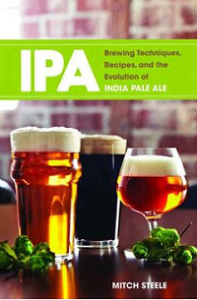
Book Review: IPA, Brewing Techniques, Etc., Mitch Steele

ipamitch1This is another book from Brewers Publications that bridges the worlds of brewers and drinkers. As with Stan’s excellent For The Love of Hops, the book provides context, history, categorizations, practical application of the topic in brewing and plenty of evidence of sheer enthusiasm. That being said, a few initial quibbles:
⇒ The advent of pale malt did not occur in the late 1600s as suggested at page 15. Coke is used to dry malt first in 1642 and straw dried malt goes back well before that, probably as a folk skill unrelated to commercial enterprise or estate management. Makes sense. After all, grain-drying was known in the medieval centuries as a means to preserve a damp crop and preference for better beer was known to the hipsters of the 14th century.

⇒ Beer on English ships goes further back than described at page 19. It was present on board Elizabeth’s navy during the second half of the 1500s. Here is the wooden tankard from Henry VIII’s Mary Rose from the 1540s. Unlikely beer on ships was key to the instigation of 1700s beer exports from Britian.

⇒ The trade in beer by ship described around the same point predates the suggested time frame by centuries and was not created by England. Unger shows how Wismar of the Hanseatic League – in what is now Germany located on the Baltic coast east of Denmark – barred the import of beer by sea in 1356.¹ What creates the opportunity for the Burton beer trade to Russia as much as anything in the latter end of the 1600s for England is the usurpation of Dutch dominance of Baltic shipping.²

Let’s be clear. There are nothing wrong with the facts were they just characterized as a little less conclusive but rather more part of a pattern in a larger flow. And the choices made are done so in support of the narrative. And to create that narrative levels of abstractions are used by necessity to achieve a consistent voice. So, these are quibbles only but they are ones that get noticed if you are looking for this sort of thing. And the audience is not meant to be looking for this sort of thing, is it.

Worth noting is how the book’s introduction is an amazing “who’s who” of folk thinking about beer these days, most of them thinking intelligently. I found the statement that Martyn and Ron had fact checked the material in the book odd as it, at first, gave me that sinking feeling that we were facing authority by reputation. As we know, like the Gospels, Michael Jackson can be cited for any proposition that might be wanted to be made in relation to good beer these days. I would hate for such a fate to be extended to others. But – and note I did say “at first” two sentences back – we are blessed with a bibliography that includes each of their writings as well as, blessings fall upon the head of Mitch Steele, actual footnotes. These give you the ability to see whose work was relied upon for each sentence in certain sections allowing you to judge accordingly as well as provide the reader with the tools to undertake some follow up reading.

Much of what is written above focuses on a limited portion of the history of IPA as described by Steele and should give you a sense of the engagement with his topic he offers the reader. Unlike this review, the book spends most of its time discussing variants of IPA across time and continents up to and including gag-reflex tickling evolutionary dead end of White IPA: “…effectively a blend of the Belgian Wit and the American IPA.” I would have liked to see a discussion of IPA as brand in which anything hoppy can have the “IP” slapped on as a prefix and, voila, a style is born. I would have also liked to see a bit more of a discussion on how IPA as we know it now is a bit of revisionist concept a bit decontextualized from its relatives pale ale and the variants.³ But this is an enthusiast’s text, not a critical study. Nor should it be.

Bottom line? Another excellent volume that should satisfy the intermediate and experience beer nerd. It should also be mandatory bedside reading for any brewer or aspiring brewer.

¹See: Beer in the Middle Ages and the Renaissance, (Fenn, 2006) at page 73.
²See Peltries or Plantations, (John Hopjins Press, 1969) at pages 63 to 71; see also Holland on the Hudson, (Cornell, 1986) at page 209.
³For a similarly structured book that accomplishes this better if in less detail, see Pale Ale by Terry Foster from 1990, from the same publisher’s, Brewers Publications, earlier generation of style guides.

Albany Ale: In 1670 The Best Ale Was Wheat Ale

You ever wonder why the reference you find after two and a half years took two and a half years to find? Look at this:

Their best Liquors are Fiall, Passado, and Madera Wines, the former are sweetish, the latter a palish Claret, very spritely and generous, two shillings a Bottle; their best Ale is made of Wheat Malt, brought from Sopus and Albany about threescore Miles from New-York by water; Syder twelve shillings the barrel; their quaffing liquorsare Rum-Punch and Brandy-punch, not compounded and adulterated as in England, but pure water and pure Nants.

This is a description of the drinking habits of the Dutch population of the Hudson Valley of New York from page 35 of a journal published in 1670. It was written by Daniel Denton and was called A Brief Description of New York: formerly called New Netherlands, with the places thereunto adjoining. So in addition to the 1649 legal ordinance barring brewing with wheat during a crop collapse and the 1749 reference by a traveling scientist to the malting of wheat, we have not only confirmation that wheat ale was brewed but it was the best to be had. The description by Denton is particularly trustworthy as it is incidental to other cultural references about the Dutch, particularly about their smoking and drinking habits. There is another reference to beer in his writing, too, that is quite revealing. It sits in this passage about the freedoms being enjoyed in the newish New York:

Here those which Fortune hath frowned upon in England, to deny them an inheritance amongst their brethren, or such as by their utmost labors can scarcely procure a living—I say such may procure here inheritances of lands and possessions, stock themselves with all sorts of cattle, enjoy the benefit of them whilst they live, and leave them to the benefit of their children when they die. Here you need not trouble the shambles for meat, nor bakers and brewers for beer and bread, nor run to a linen-draper for a supply, every one making their own linen and a great part of their woolen cloth for their ordinary wearing.

There you go. Freedom loving prosperous newly absorbed New Yorkers making their own wheat ale and bread from good malt grown around Albany over 100 years before the American Revolution.

So who is going to brew some up? Are there any mid-1600 Dutch guides to household management that include brewing techniques?

Pass Peter’s Pewter Pottle Pot, Please!

pottle

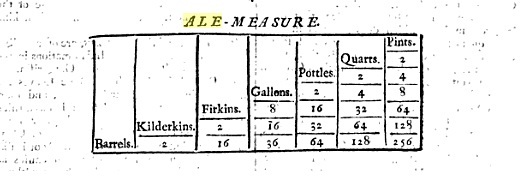
In my quest for objects out of which to drink ale, I have a 1940s ceramic part pint, an 1840s pewter quart pot and have declared 2013 the year of the 1700s etched ale glass. But, what ho! Something came before my eye today that I had not only never seen before but never had heard of – the pottle! Not an actual pottle but just the concept.

As you can see, that is archaic word for a half-gallon. The image above is a handy illustration from the entry for “Ale” in 1725’s smash best selling book Dictionaire oeconomique: or, The family dictionary. Containing the most experienced methods of improving estates and of preserving health, with many approved remedies for most distempers of the body of man, cattle and other creatures…. You will have to excuse me for deleting more than half the title but you get the hint. But now you know that there are 16 pottles to a firkin. That’s knowledge, baby.

There are a few references to pewter pottle pots on Google mainly referencing legal cases where a whole bunch of things are listed as being stolen or being in a will. In 1267, it is recorded in The Court Rolls of Ramsey, Hepmangrove, and Bury that a number of naughty brewsters of Ramsey were brought before the rather ripely named William De Wassingle – who I have no doubt was called “Assingle” behind his back – to pay fines and pledge security. Earlier in the day there was a far more interesting case which is recorded as follows:

6 d. from Emma Powel for making unclean puddings, as presented in the last view. Pledge: Simon de Elysworth. Order that henceforth she not make pudding.

You wag, Assingle. Anyway, in the brewster cases on that day, the security pledged against failure to pay the fine included many pottles. Four centuries later but still over 350 years ago, in 1659, the court heard an action of trover and conversion brought against one Gervase Maplesden by one Gabriel Beckraan for a number of things including one pewter gallon pot, one pewter quart pot, one pewter pottle pot and one pewter pint pot. Battlin’ pewterers action! Nothing like it.

But where are the pottle pots now? Not only can I find none on the internets for sale but none even pictured. Can you send an image to one of these massive drinking vessels? Have you ever seen one?

The Greatest Cease And Desist Letter Ever!!!

And just in time for Christmas…

Normally, one would not like a cease and desist letter claiming that one had breached someones intellectual property rights. I mean we as bloggers are supposed to get all hot and bothered about these things, right? We’re living in the post-legal mash up paradise promised by the Boingsters back when blogs were new, right?? Well, that all came crumbling down yesterday when the following love letter popped into my inbox:

The undersigned declares under penalty of perjury that I am authorized to act on behalf of the above referenced author, the owner of copyright in the Intellectual Property, and Hachette Book Group, Inc., the exclusive US publisher of the Intellectual Property, including without limitation, the cover and other art incorporated therein (collectively, the “IP Owner”). I have a good faith belief that the materials identified below are not authorized by the IP Owner, her agent, or the law and therefore infringe the IP Owner’s rights according to federal and state law. Accordingly, we hereby demand that you immediately remove and/or disable access of the infringing material identified below.

Frig, said I. I am a lawyer. I know when the jig is up. For a second, it was like the ending of “The Public Enemy” and I was Jimmy Cagney. But when I looked at the link I knew what was going on. See, six years ago, I posted about how great it was that I had found the text to a 1987 article in The Atlantic magazine called “A Glass of Handmade” by William Least Heat Moon, a bit of writing that was my introduction to thinking about good beer. And I tucked away a copy of the text in the articles section of this blog because I was sure it was fluke that I had found it and that I would never find it again, assuming all copies of that issue had long been sent to the dump or lodged in the back of a barbershop I would never visit. Flash forward six years and, once I realized what was going on, I removed the article from public view and, just like that, me and the lawyers at Hachette Book Group were at peace. In fact, they were quite nice about it and let me know what is going on and it is good news:

Thanks for removing the essay from your site. We appreciate it! And, yes, it is included in Here, There, Elsewhere which comes out on January 8th.

So, now no need to have the article squirreled away from fear it would disappear from knowledge. You can get your own copy of Here, There, Elsewhere: Stories from the Road by William Least Heat-Moon on discounted pre-order from Amazon right now. A little late for Christmas but as important an essay on early US craft beer as there is. I can’t encourage you to get your own copy enough.

And I can confirm that this endorsement is not part of any legal settlement!

More International Insurance Map Brewery Fun

insrurmap1insrurmap2insrurmap3insrurmap4insrurmap5


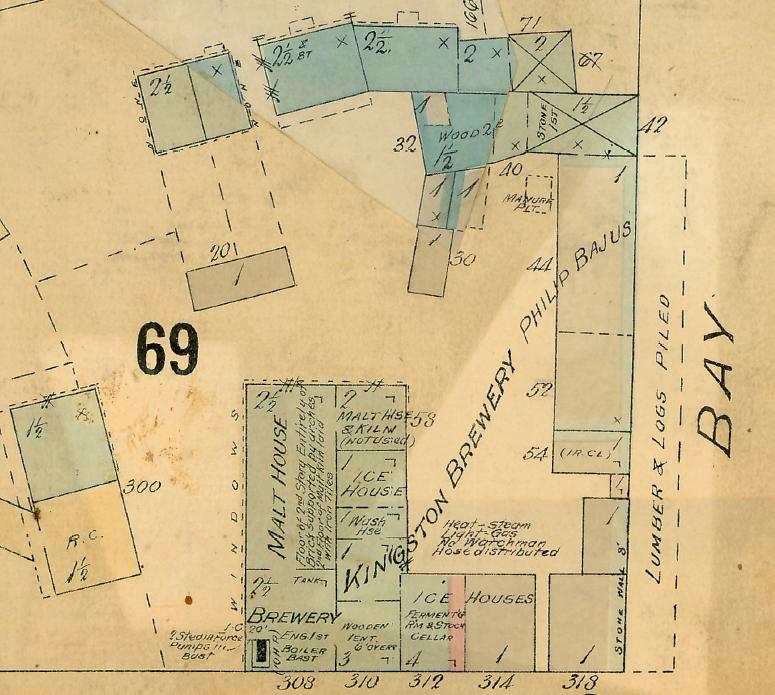
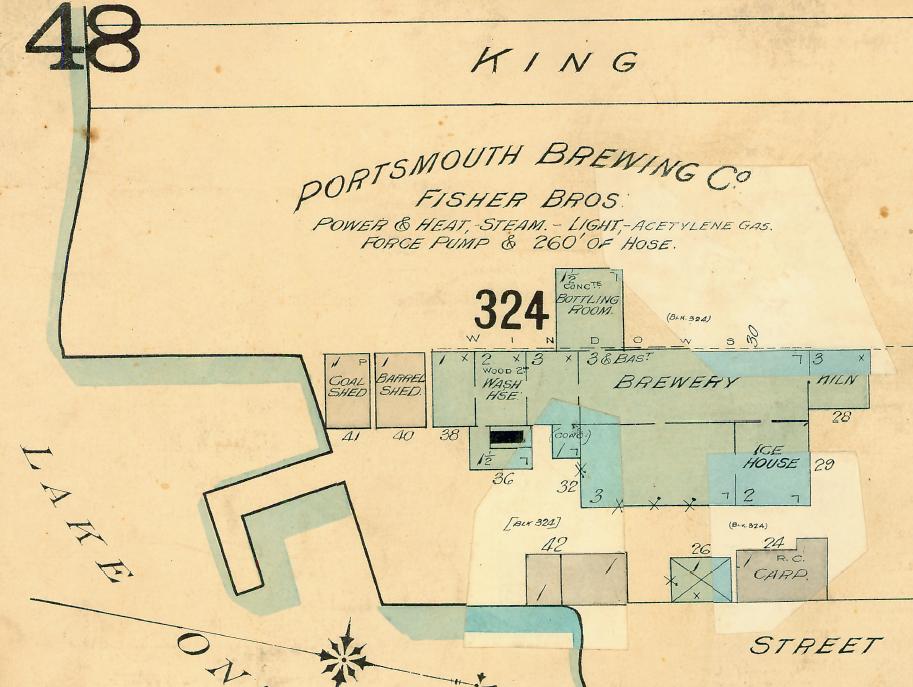
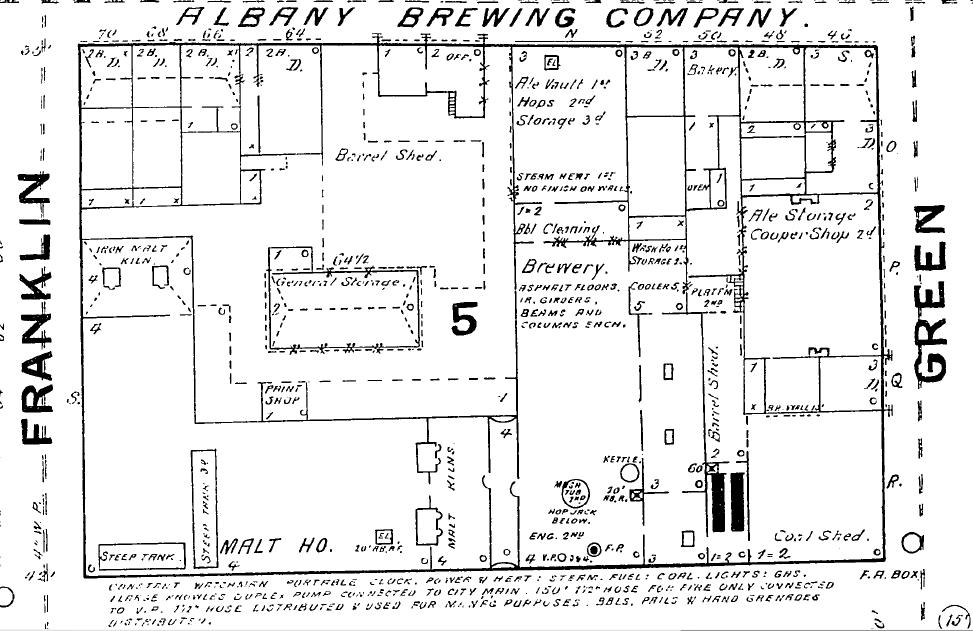
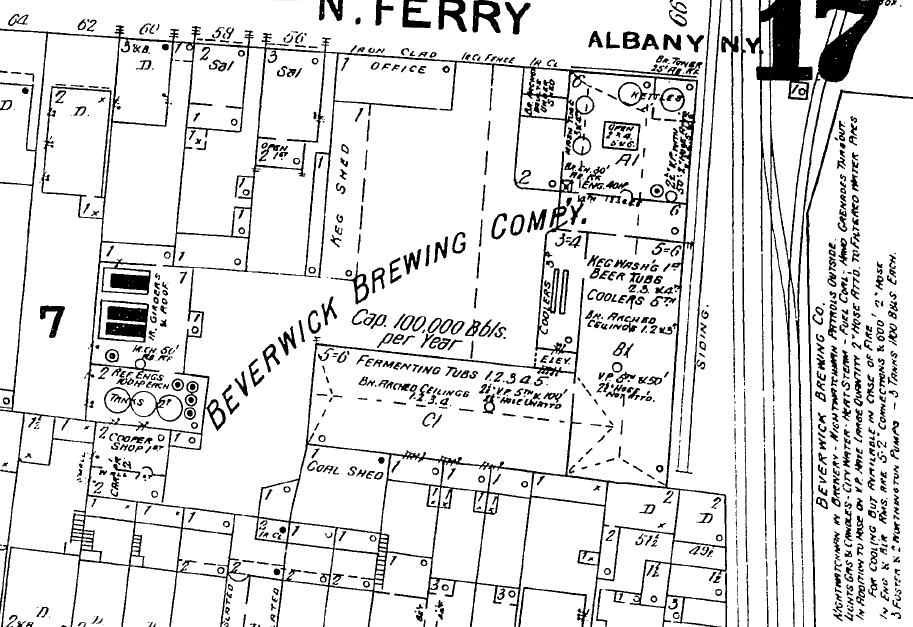
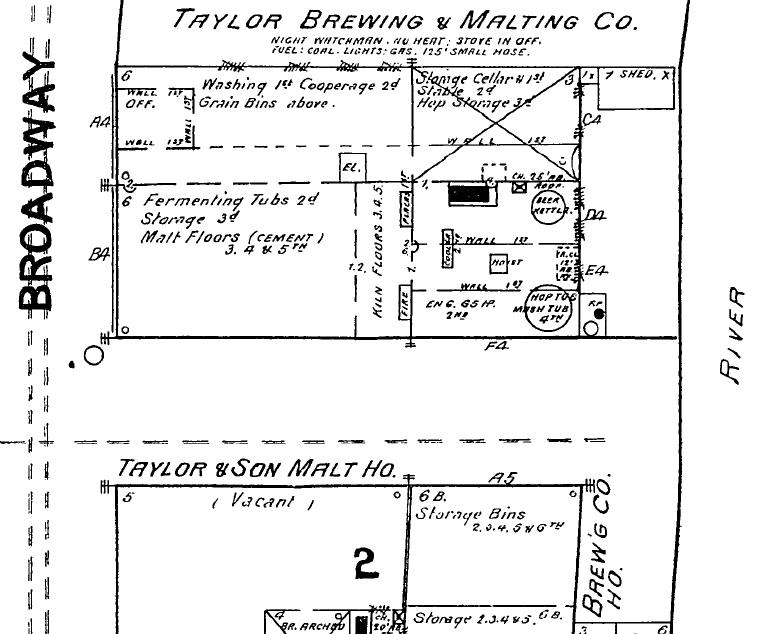
It was the best of times and insurance maps. It was the worst of times, you know, and… insurance maps. Errr. a tale of two cities of sorts, I suppose. From the upper left we have the Kingston Brewery as well as Portsmouth Brewing of my town from 1908 plus, to the upper right, the Albany Brewing Company, then below left Beverwick Brewing Company and, lower right, Taylor Brewing and Malting all of Albany in 1892. What can we learn from these images? Click on each image and find out for yourself. Here is what I see:

UL: As discussed last August, the Kingston Brewery dates from at least 1791. The badly digitized 1824 map shows a set of buildings on the inland side of the inner harbour road. The 1908 map shows much of the same complex built up overtime. The malt kiln, laid with iron tiles, is no longer used and a lot of space is dedicated to ice houses as part of the lager operations. And there is a manure pit. Dangers which might be faced by fire crews are noted. Where a boiler might be found or a pump. The notes state that hoses are distributed meaning there is water throughout. The basic set up is a courtyard. There is a four story tower as well as a basement with a fermentation room and a stock cellar.

UM: By comparison, Portsmouth Brewing in is more orderly. Based more about access to the lake than the older cross town competition. The kiln is on the land side of the property and leads into the brewery proper which leads to the bottling room. The coal and barrel sheds are separate. There is a basement and the main building is three stories high. Our commentator Steve Gates, author of The Breweries of Kingston and the St. Lawrence Valley has an excellent photo of the brewery from the next year taken from the vantage of someone under the letter “F” in “Fisher” as shown on the map. He also tells us that they had been brewing lager since 1872. Hence the ice house.

UR: Next, the Albany Brewing Company neatly fills a city block as this picture from the coal shed view of 1865 to 1870 shows. I am sure there is a very good reason that hand grenades were distributed throughout the brewery for fire fighting purposes but I am not sure what that might be. Unlike the Kingston breweries above or Taylor below, there is no access to waterfront. Unlike Beverwick below, there is no train spur leading to the building. To the right center, there is a five story tower where it appears the coolers are located. The office is across the street to the south and a police station to the north. It’s in the middle of things. Looks like there are horse stalls near the coal shed that open out on to Green Street to the left of the image.

LL: The Beverwick Brewing buildings appear to be more modern again. Founded in 1878, it has a rail siding… which apparently leads it to be suitable for a model railway set. The main building looks impressive. Five stories with a sixth in the attic. Brick arched ceilings on multiple floors frame fermenting tubs and beer tubs. Coolers are located in the fifth floor. A more compact footprint but, at 100,000 barrels a year, very productive and, therefore, famous. A very industrial set up compared to the others.

LR: Last, good old Taylor Brewing in its elder years. The neighbouring buildings have been left vacant with only the core brewery seemingly in operation. Six stories very much oriented towards the river. When I saw this and saw the images of de Hooch yesterday, its position by the water looked like Dutch breweries lined up along the shore in Haarlem in 17th century paintings. I think that’s the building to the middle right in the image at Craig’s post on the brewery, though that was almost half a century earlier.

What does that tell us? You tell me. I see a range of brewing systems laid showing about 120 years of technological advances. Still plenty of ale brewing going on but a range of transportation methods from horse carts to ships to trains. For the most part, the breweries are all still malting at the turn of the 20th century.

My Place Of Work About 160 Years Ago

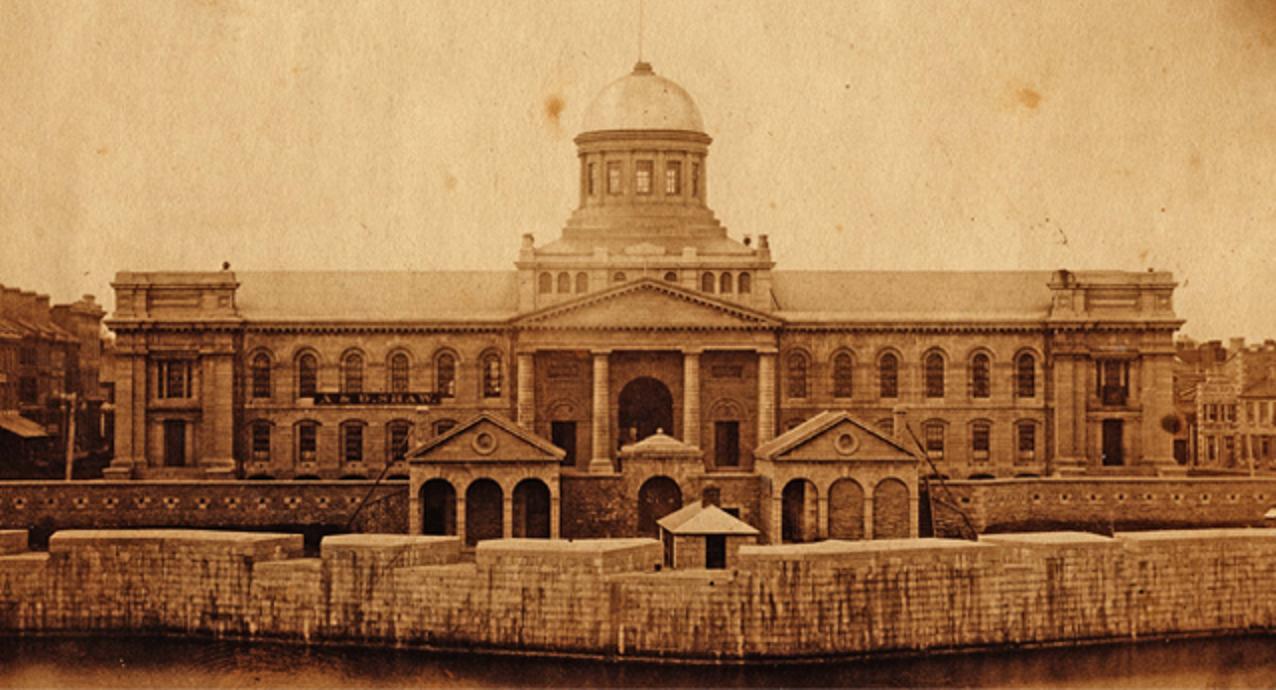
My place of work in the 1850s when the waters lapped up to the stone wall of the market battery. As in a battery of cannon that protected the market. Because City Hall was built in the 1840s on part of the market square that he been there for decades before that. If you click on the picture you will see more detail. Like these bits:


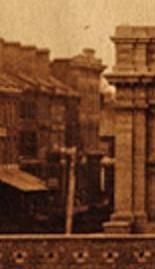
To the left, you see the sign for “A & D Shaw” but I am not sure why there was a sign like that on the front of a government building. Were there businesses in the building, too? In the middle there is the detail to the left, a week glimpse up Market Street. To the right there is the same thing up Brock. The Market Street buildings are still there but there is no awning or porch on the south side as there was back then. An one of the buildings on Brock could be Sipps or Casa Domenico.

What Was On The Drinks Menu In 1378 Or So?

piers1

It is not often that I get to write that I was flipping the pages of Piers The Ploughman the other day but in fact… I was flipping the pages of Piers The Ploughman the other day and noticed a lot of references to drinking in Book 6. I pulled it from the back corner of the bookshelf after watching the episode of The Story of England from the BBC on life in the 14th century. This era of the plague following on the heels of a great famine saw societal disruption and population crashes. The poughman, it is explained unexpectedly only for a 21st century man like myself, was the hero of the community, the bringer of food. A morality tale, Piers joins a pilgrimage after getting his spring planting done:

…for so commands Truth. I shall get them livelihood unless the land fails, Flesh and bread both to rich and to poor, As long as I live for the Lord’s love of Heaven. And all manner of men that by meat and drink live, Help ye them to work well that win you your food.’

Notice that the winning of food by working the land earns you drink? Because the drink is ale. Made of the grain that grows in the field. So, being curious, idle and tangential – all likely sins in Pier’s worldview – I wondered what the hierarchy of drink might have been to a someone six and a half centuries back. Because what’s good about a morality play that does not list everything one way or another in hierarchies.

♦ Water. Lowest of all. The text reads at line 6.134 that “…Truthe shal teche yow his teme to dryve, Or ye shul eten barly breed and of the broke drynke…” Drag. Learn to drive the plough’s team or drink out of the brook.
♦ Thin ale is next. Wasters who will not work are punished by the reality of famine and then Piers bargains with Hunger to save them:

`Suffer them to live,’ he said `let them eat with the hogs
Or else beans and bran baked up together,
Or else milk and mean ale’ thus prayed Piers for them.

♦ Good ale. Before the character of Hunger takes his leave when the crop is in, the last year’s supplies are consumed at around line 6.300: “…Thanne was folk fayn, and fedde Hunger with the beste / With good ale, as Gloton taghte–and garte Hunger to slepe…
♦ Best brown ale. Soon, good is not good enough as the lazy shirk again and goes off looking for something better, now available after the harvest is in and the risk of hunger has moved on as “no penny ale please them”:

Nor none halfpenny ale in no wise would drink,
But of the best and the brownest for sale in the borough.

So, not quite a style guide but clear evidence of standards, the idea that there is something worse, something good and something so much better available in town at some sort of specialty shop that you may not really need. Sound familiar?

Albany Ale: Bringing Together Different Perspectives

One of my favorite things about thinking about beer is realizing that it is actually a hugely diversified discussion even if there are significant forces trying to homogenize and standardize and prioritize the discourse. The upcoming beer school at Beau’s Oktoberfest is framing this varieties of views neatly for me. Craig has been out hunting for early central NY hops and was contacted by a home brewer who has made an attempt at one possible take of Albany Ale. Ron has been discussing the early 1800s Hudson Valley brewing logs from Vassar’s brewery and connected with alumni from the college that the brewery helped found.

Me? Me I am most interested in tracking the cultural aspects and how they fix into the context of history. I wrote Stan an email yesterday to see if he had considered the tracking of the name of CNY hops in the 1800s and had to confirm that it was not, unlike one aspect of his focus, the DNA of the varieties that I was interested in but the names given over time to the varieties. I summarized the changes and the reasons for the changes that I have been seeing in an email back this way:

♦ Post-Revolution – economic crisis that sets CNY back for best part of three decades 1775-1805. Hessian fly affects crops during this time moving beer production from wheat to hardier barley. Dutch wheat beers in Albany becomes “Bostonian” or New England style as majority of population shifts culturally. Hardscrabble farming becomes stablized farming.
♦ Post-1812 – agricultural societies, fall fairs and some scientific farming journals start. New England “improvement” moving west. Erie canal helps this take off.
♦ 1822: some sort of crisis in hop crop in UK requires reaching out for more sources, including CNY.
♦ 1830s – Robust export ale trade well underway. CNY brewers not referring to hops according to species but local supplier / grower. Exporting via ship.
♦ 1848 – UK brewers note “American hops” in their brewing log. Not by variety. [Ron has a post on this.]
♦ 1840s-60s: large and small cluster described in CNY. Geographical named hops also being referenced like “Pompey” and “Canada”. Pompey is a town. Canada is a variety that moves south, faces a false imposter and becomes “True Canada” soon after Civil War – the arse is out of all of it and mad breeding and diversification underway. Science meets money.

Keep in mind “Albany Ale” in this sense is all about the barley beer that ruled before lager takes over in around 1875 after four or so decades of expansion. Before 1775 and likely for a bit after, it remains my belief that the Dutch wheat farming of the colonial era was logically – and in accordance with the evidence – also the source of indigenous wheat beer brewing that relied on hops that were a hybrid of local wild hops and Dutch introductions. Others may have a greater interest in the industrial era when Albany was king. Or with the actual techniques of brewing. Or discovery of the actual ingredients of the beers.

Which is great. Because that is what makes the discussion complex and interesting. No one person has it right or framed the discussion.

Ontario: An Early Reference To The Kingston Brewery

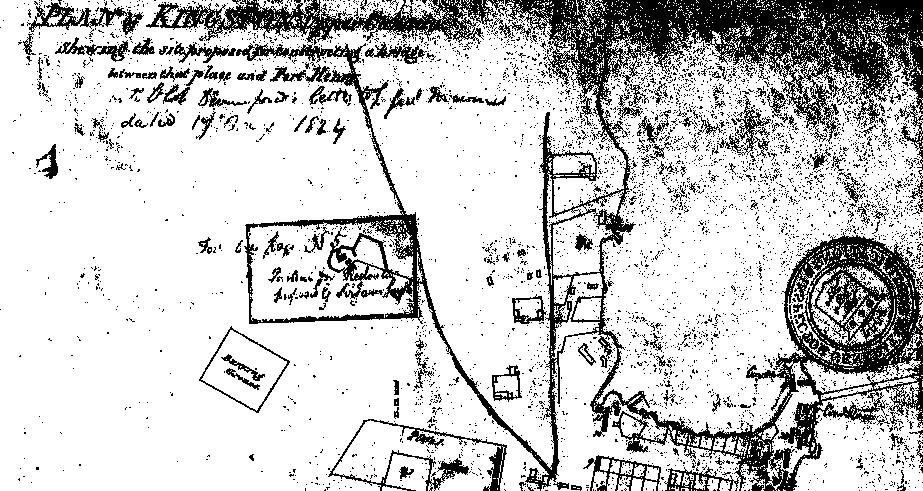
kingston1824The funny thing about Ontario is it started as a part of Quebec. Until the division of Upper and Lower Canada in 1791, this was all the one unified colony that Britain took from France in the conquest of 1760. Settlers started moving in 1783 first from central New York in the first direct Loyalist wave, then over the rest of the decade from the eastern US seacoast as the losers of the Revolution filtered their way around up from New York, Nova Scotia and then down the St. Lawrence. An oblique reference in a land document for a Lieut. Mackay from 1794 gives an interesting hint as to the development of brewing here in Kingston, the commercial center of this new colony:

On May 27, 1794, a petition had been presented in Council on his behalf for “a Piece of Land about the usual Size of a Town Lot, situated on the West side of a Lot lately laid out for the Kingston Brewery, to be bounded on the North by the said Brewery on the East by a small run of Water, on the South by the Common, & on the West by the top Bank…”

The passage is from The Parish Register of Kingston Upper Canada 1785-1811, an online resource that also confirms that by 1797 it was managed by one John Darnley. That is it above shown on a map of my town from 1824. It is also shown on a map from 1865 and later additions are still there – as the 2003 photo at this post shows. There was earlier brewing in the colony but likely tied to taverns like Finkle’s in nearby Bath. Steve Gates, our comment leaver and author of the excellent book The Breweries of Kingston & The St. Lawrence Valley pegs the building of the brewery in 1793 by merchant John Forsyth but it is John’s brother Joseph who is more of the man about Kingston in the 1790s. But, as a garrison town and a depot supplying deep into the continent from the main colonial centre of Montreal, it is entirely likely that their Kingston business affairs overlapped repeatedly.

Creation of the brewery reflected some level of certainty after years of difficulty in ensuring the grain crops could supply the expanding colonial population. A 1796 letter noted in Preston’s Kingston Before The War of 1812 even speaks of the continuing infestation of Hessian Fly affecting the area. Building a brewery spoke to an expectation of peace.