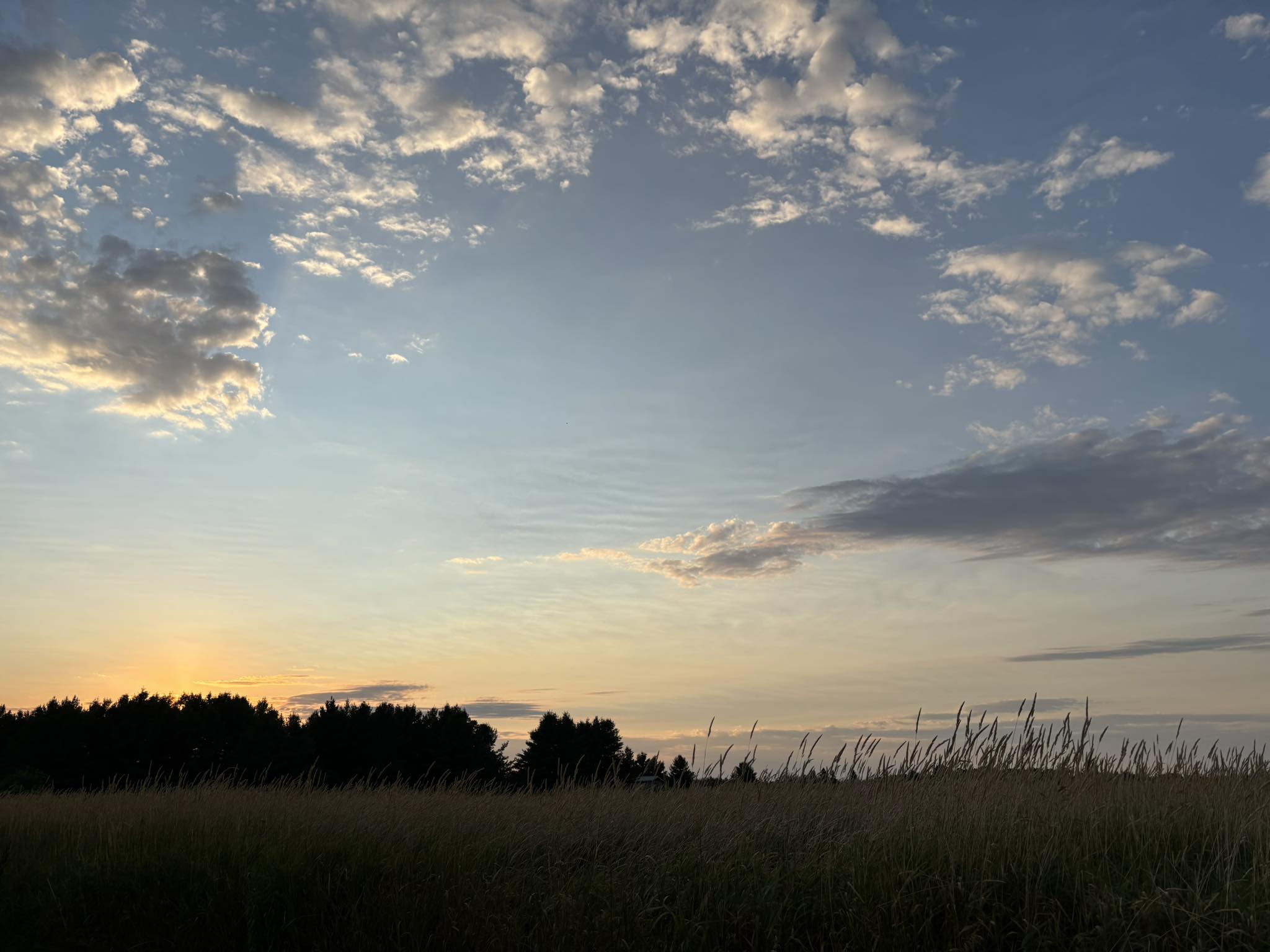
The last day of July. It’s one of the first endings of the year. Well, there is the end of winter but no one regrets that. And the switch from late spring to early summer never really leaves a ripple. But… July. Spent the other evening watching dusk arrive at a nearby conservation area, listening for bobolinks and kingbirds as they snabbed a few last bugs out over the field. Saw a raven. Heard it croak. Mr. Nature. That’s me. Five Saturdays to Labour Day. But even that date’s lost its sting as it’s the first September that not one kid is in the public school system for twenty-three years. What milestone is left? Last day of July.
First up, David J. announced the roundup for the July edition of The Session with a pretty interesting set of submissions this month, interruping his reguarly scheduled broadcasting:
Today’s Substack is ‘free to air’ – like Test cricket and Premier League football should be – so that the people who have contributed can gain the widest readership possible. (Also a desi publican I was going to interview suffered a bad injury and had to postpone. He’s fine, though, and I’ll be bringing his story soon.) On July 11, I asked various participants to write a blog, web post, newsletter (like this one) or even a SM thread on the subject of food in pubs. I’ve rounded up their work and at the bottom have written about the dangers of being a go-to voice on pub food.
Go have a look. Plenty of good reading. Also well worth a read, Ruvani de Silva has announced the launch of her course hosted by CAMRA on American Heirloom Cider Apples and it is good to see the historical context at the forefront:
Settlers, noticing the tribes’ bountiful orchards and the quality of the land they were cultivating on, were keen to claim it for themselves, unafraid to use violent displacement to do so. In one particularly horrific example, future President George Washington took a break from fighting the British in 1779 to send Generals Clinton and Sullivan to implement a scorched-earth policy across the Six Nations of the Iroquois’ beautiful, fertile Fingers Lake land in upstate New York, burning their flourishing orchards to the ground.
This lines up from some of what I found when researching upstate New York history over a decade ago including Lord Selkirk’s 1803 description of apple orchards around Geneva NY from before the Sullivan raids as well as this description from 1797:
…a person from Scotland has established, at Geneva, a very respectable brewery, which promises to destroy in the neighbourhood, the baneful use of spirituous liquors. The apple and peach orchards, left by the Indians, yield every year abundance of fruit, for the use of the inhabitants, besides making considerable cyder; so much so, that one farmer near Geneva sold cyder, this year, to the amount of one thousand two hundred dollars.*
Speaking of solid research, after last Saturday’s news update was posted by Boak and Bailey, I rushed to their footnotes at Patreon which included this tidbit:
…we’re entering the era of ‘normalism’. People want to drink normal beer, in normal pubs or bars, while eating normal food, and wearing normal clothes… Perhaps because they don’t have the headspace to cultivate less mainstream tastes, or maybe because standing out as an individual feels like a dangerous business in 2025. Or just pointless. We keep seeing young couples dressed head to toe in formless matching beige.
I thought of that Monday evening when I saw a young man waiting for the lights to change, standing at an intersection in beige Sperry Top Sider clones. They had to be clones, right? I also thought of this when I read Jessica Mason‘s news about the recent rise in Heineken’s fortunes:
Speaking about the results, Heineken CEO and chairman Dolf van den Brink said: “In the first half, we delivered solid results as organic operating profit grew 7.4% as the operating margin expanded by 26 bps and net revenue increased 2.1%…” Highlighting the strides the business has made, van den Brink pointed out how Heineken’s “volume performance improved across all regions in the second quarter and continued to be of high quality… Describing how the company has achieved this, van den Brink explained: “Our advantaged geographical footprint helped us to adapt to ongoing macro-economic challenges which impacted consumer sentiment and expenditures.**
Is that so bad? Perhaps green is as much the new beige as beige is. Normal. Makes more sense than spinning in your sheets over and over thinking of all the coulda woulda shouldas. The trend is evident in the US craft scene as summarized by Keith Gribbins at Craft Brewing Business the other day:
The Brewers Association’s 2025 Midyear Report shows an industry still facing strong headwinds. Yet, pockets of growth remain — especially for the smallest on-site brewers. As of June 2025, 9,269 craft breweries were operating in the U.S. — down 1% from a year ago. Closures continue to outpace openings, led by a 3% decline in microbreweries. Taprooms dipped 1%, while brewpub and regional brewery counts remained flat. Craft beer volume also shrank. The BA estimates a 5% year-over-year decline in production.
Five percent cut in production in the last 12 months is not a “maturing” or any sort of “sideways” something. As one would say in my youth, the arse is out of it. Doug Veliky shared some thoughts about where those buyer might be heading and why the trip isn’t that difficult:
Low-dose THC beverages offer the same qualities that have made light beers, spritzes, and canned cocktails so popular. They are social, easy to enjoy, and deliver a consistent experience every time. Because these drinks are made to be consumed more than once in a sitting, they help establish rituals that lead to frequent, repeat purchases. Instead of being one-and-done, the format allows consumers to stack their way toward their preferred level of buzz.
So, craft may have lost its hook. By which I mean that idea of the ritual habitual. People are still doing things, sure. They’re just not doing those things because they now have the option to do these other things. Or is that the new habit? Being what B+B call normal. It might actually just mean not needlessly complex. Manufactured difficulty. Life’s hard enough without made up difficulties.
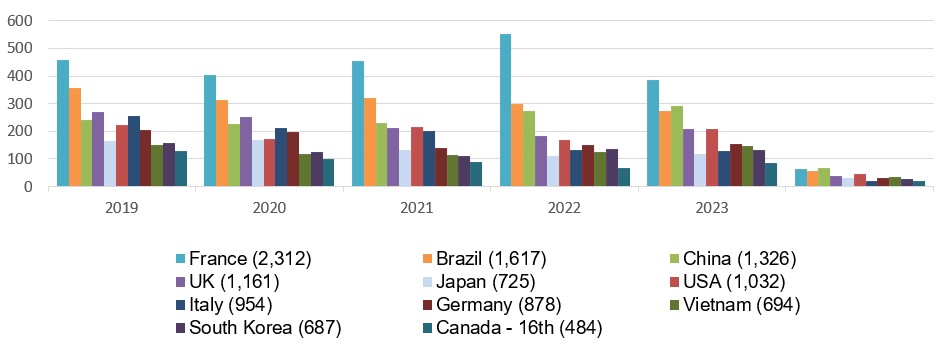
Note: not only do the top 40 breweries in the world not include much that can be called craft, onely one and a half seem to be American.
By way of comparison but really only as juxtaposition, Jeff continued his explorations into what makes a saison a saison, following up on his article on the style in Craft Beer & Brewing, illustrating once again that blogging about beer is always superior to the store bought stuff. I particularly liked how he moved the discussion from the romantic (ie lazy / fibby) explanation that saison is “something you feel” to getting to the elements of they stuff including the importance of a coarseness of character to the grains, as decoratively mentioned by Alex Ganum of Upright Brewing of Portland, Oregon:
Not sure if I ever shared this story, but back when we were running Old Salt, our hog rancher kept bugging me about using his triticale, which was the animal feed. He grew it himself and was proud of the quality, but I dismissed it early on thinking, ‘How good can animal feed be? ‘Well, that was dumb, because he eventually just dropped off a bag and it turned out to be incredible (which probably explained part of why his pork was delicious). So we asked him for a pallet and worked it into the Five for about a year or so.
Sixteen years ago, when I had the time to do so, when the kids were little enough that they couldn’t get too far, I grappled with the idea of these sorts of beers and their cousins, back when I could take a Saturday to contemplate such things in the shed. But that right there is as good an explanation as ever I’ve seen: beer made from bits fit for the livestock. Farm yard as much as farm house. Normal may not have time for farm yard.
Speaking of simple pleasures, Katie shared a lovely bit of recollection, a remembrance of Wetherspoons past involving herself and her staff access to discount chips:
When I worked at Wetherspoons many thousands of years ago, the one redeeming feature of the job other than the wage was access to a staff menu, off which we could also take a 50% staff discount. My favourite shift tea from this reduced selection of kitchen scraps was sausage and chips. It was not served with vegetables of any kind. A person can talk shit about Wetherspoons all day, and I will join in, but their chips have always been godly, the best of all the frozen chips. I am certain they are coated in semolina for extra crunch, leaving the centres fluffy and light. With mayonnaise, this dish, which cost me around £1.30 in 2008, was my favourite food. It didn’t make the pub I worked in any better, however. You can’t judge a pub by its chips—sometimes they are simply angels sent to soften the blow.
Normal likes chips and especially good discount chips. Quite right, too. Also alarmingly normal is Martin who has admitted to falling behind in his pub reporting and is trying to catch up which some of the highlights (*ahem*) of his continued touring:
Admit it, you’ve never heard of Cockerton, have you? Neither had I, even though this small Durham village is virtually contiguous (great word) with Darlington and only a few minutes from Piercebridge and my best-read blog post. And it’s got a free space for my campervan from which I can finish Durham’s Guide entries for another year. What Cockerton doesn’t appear to have is much actual character. though it does have excellent podiatry.
Note: at the Vytopna in Prague a little train set delivers your beer…
Finally and for the double, David Jesudason wrote the feature in Pellicle this week, the story of a thriving community pub at the edge of London that makes room for many and much:
Artist Neal Vaughan believes my snap judgment about Carshalton being a bit of a sleepy backwater is wrong. He explains how it’s a hub of creativity, which the Hope is at the centre of. Citing a memory from 2016, Neal recalls when Rodger encouraged him to set up Carshalton Artists’ Open Studios with all meetings and post-event drinks held in the pub. Tuesdays are described as a sacred weekday at the pub by Neal. It’s when folk musicians play an open session, board-game enthusiasts battle against each other at Scrabble, chess and Magic: The Gathering, and on occasion a leather maker taps away while seated on a chair. The pub even has a sailing crew that charters yachts, and when I visit they’re off for 10 days in the Adriatic.
There we are. The end of trends, the end of a week’s news and the end of the month. It’s sorta normal. And as the sands trickle on down in your personal hourglasses, please check out Boak and Bailey every Saturday. Look out for Stan when he feels the urge now that he’s retired from Monday slot… maybe. Then listen to a few of the now rarely refreshed Lew’s podcasts and get your emailed issue of Episodes of my Pub Life by David Jesudason on the (sometimes even but never) odd Fridays. And Phil Mellows is at the BritishBeerBreaks. Once a month, Will Hawkes issues his London Beer City newsletter and do sign up for Katie’s wonderful newsletter, The Gulp, too. Ben’s Beer and Badword is out there with the all the sweary Mary! And check out the Atlantic Canada Beer Blog‘s weekly roundup. There is new reading at The Glass which is going back to being a blog. Any more? We have Ontario’s own A Quick Beer featuring visits to places like… Michigan! All About Beer has given space to some trade possy podcasts and there’s also The Perfect Pour. Plus follow the venerable Full Pint podcast with an episode three weeks ago!. And there’s the Craft Beer Channel on Youtube. Check out the archives of the Beer Ladies Podcast. That’s quite good and after a break they are back every month! Such is life. Such is beer podcasting and newlettering… which, as Ray says, are blogs! And he’s right.
*See also History of Tioga, Chemung, Tompkins and Schuyler counties, New York. With illustrations and biographical sketches of some of its prominent men and pioneers at page 13: “The army was to march from their winter quarters on the Hudson to Wyoming; thence up the Susquehanna to Tioga, where another division, under General James Clinton, marching via Otsego Lake, after a diversion into the Onondagas country was to effect a junction, when the combined army, consisting of four brigades of infantry and riflemen, and a park of artillery, was to proceed through the valley of the Chemung; thence northward to Genesee River, destroying crops and houses and everything of value to the Indian as far as could be reached on either side of the trail of the army. The success of the expedition was most complete. Forty towns and more than 200,000 bushels of corn were destroyed, besides vast quantities of pumpkins, beans, melons, and other vegetables, and peach and apple orchards, and a most desolating march executed through the richest portion of the enemy’s country, with small loss to the invaders. Washington was afterwards called by the Indians Hano- dogarear, ” the town destroyer.”
**Oddly, The Independent reports Heineken has suffered losses in the first half of 2025. Who can you trust these days? Other than, you know, me.