Your “Is It Now Yule?” Edition Of The Beery New Update For A Thursday

December. The month that is three weeks long followed by two weeks of blur before real winter sets in. Winding up the year’s work is the main thing on my plate. From 2006 to 2015 this would have been the culmination of the annual Yuletide Kwanzaa, Hogmanay, Christmas and Hanukkah photo contest but I have long come to my senses. You can see the annual winners here. That is the 2012 Champion up there by Robert Gale of Wales. As I wrote then, click on the photo so you can see the full scale and explore all the detail for yourself. Robert explained in his email where the photo was taken:

Located in Manchester, England, the Circus Tavern apparently has the smallest bar in Europe. It’s also located in the hallway of the pub near the entrance which means it very easily gets crowded.

Well, did anything happen this week in beerland? OK, fine: the big news in craft was not just a buyout this week but that a minnow was seemingly swallowing a whale. The billion dollar baby that is Ballast Point was sold seemingly to a mere brewpub. It is not quite what it appears as the purchase was made with a bucket of moolah earned from a sale four years ago in the hospitality industry along with input from other friendly and wealthy investors. Within minutes of the announcement, Josh Noel on the scene in Chicago noted the reasons why the sale was made from the view of Constellation brands:

… on maximizing growth for our high-performing import portfolio and upcoming new product introductions, including Corona Hard Seltzer, scheduled to launch this spring.” That’s right. It all comes back to hard seltzer.

Excellent. Hard seltzer. The future is now. Anyway, Noel’s story in Wednesday’s edition of the Chicago Tribune will be your best starting point for the background. Me, I suspect that (even if not Plan A but at the fallback Plan C level of the original Ballast Point purchase) there was the opportunity for significant tax write offs down the road.

Elsewhere, I declared that one particular story was one of the best bits of beer writing I’ve read this year and I meant it. Just look at this:

The ditching of big-brand lagers was similarly controversial and Ashley’s attitude reveals the gulf between traditional attitudes and those of the modernisers. There is still lager on offer but it’s from Moor and Lost & Grounded. Though you might think these would appeal to Bristolian drinkers, there’s a weird loyalty to international brands brewed under licence, and these sometimes hazy, fruity, characterful beers bear little practical resemblance to Foster’s or Stella, despite the shared family tree.

An actual investigative research and writing piece from Boak and Bailey that takes a very immediate specific example of the life of a pub in our times and makes it a universal question cut with a strong note of sympathy: “it’s drinkers who prefer a more traditional, unpretentious atmosphere who have to schlep or catch the bus.” Fabulous.

Others have commented but I was – perhaps oddly – reminded of this when I read Matt Curtis and his reasoned argument for more UK breweries joining SIBA to promote independence. While he is correcting in stating this:

This still means that at least 86% of beer sold within the UK is produced by the multinationals. As such I am eager to see the next step in the discussion of independence, and some real progress in terms of presenting this argument to a greater number of industry members and bringing them together to form a unified front against increasingly tough competition and unfair access to established routes to market… 

I am mindful of the beer drinker of modest means seeking their refuge from craft. Is that not as much a cry for independence? For autonomy from the gaping maw of gentrification into which craft beer is poured?

Bad Guinness pours. All day. All bad.

I am never sure of anything that is based on the concept of “wine drinkers” and “beer drinkers” as being subsets of the population but I found this bit of discussion from Danielle Bekker of Good Living Brewing failure interesting. She asks whether it wouldn’t be better to describe beer according to flavour profiles as opposed to more familiar methods. Being a hearty believer in the uselessness of style as a construct I like the idea but then hit a wall with the notion of a beer that “will appeal to wine drinkers as well as women.

Sadly and as reported on this week’s edition of the OCBG, Waterloo Brewing Ltd. from Ontario says it has lost $2.1 million to a cyber scam:

The Ontario brewery says the incident occurred in early November and involved the impersonation of a creditor employee and fraudulent wire transfer requests. Waterloo Brewing says it initiated an analysis of all other transaction activity across all of its bank accounts, as well as a review of its internal systems and controls that included its computer networks, after becoming aware of the incident this week.

Martyn made a confession

I know there are beer writers who eschew any involvement with corporate freebies, but my argument has always been that I’m very happy to accept free stuff, from beer to trips abroad, when it enables me to put information in front of my readers that I would not be otherwise able to give them. Certainly I do not believe I have ever held the boot back because someone had dropped off a case of beer. 

At the risk of someone searching the blog’s archives, I don’t think this is ever the key points. My concerns are always two-fold: (i) you are telling the story that the brewery provides for you, even if you do put the boot in and (ii) you are not telling the story of the brewery which does not pay for the trip. So they all go to Asheville and then they all go to Carlsberg. Bo. Ring. There is a third point. You do not go to these junkets alone. Even if “it enables me to put information in front of my readers that I would not be otherwise able to give them,” well,  the same information will be put in front of same readers by the other members of the same traveling hoard sent the airplane tickets, the hotel room reservations and the buffet passes. There is no special story attached to a junket. Go find a unique story instead.

Two items from the co-authors. First, Craig has been digging more and found two very early advertisements for Albany Ale in the Charleston Daily Courier of 1808. Which not only means triple was being brewed in 1808 but it was being shipped to Charleston. Which is cool. I have seen “treble” spruce beer in New York City in 1784 but never a pale ale at that weight with that name.

Second, Max. Max was the centerfold cheesecake pin up in a Czech newspaper this week. A very hairy centerfold. Wonderful.

The DC Beer 2019 year in review post is up.

That is it. I am on a train as you read this over your morning coffee. I’ll be back tomorrow. In the meantime,  there’s more news at Boak and Bailey’s on Saturday, at the OCBG Podcast on Tuesdays and sometimes a mid-week post of notes from The Fizz as well. And look for Katie’s weekly newsletter, too.

Beer And Brewing By Hudson Bay In The Late 1600s

This post is a reworking and updating of a passage from that cult classic Ontario Beer: a Heady History…, the book Jordan and I published five years ago. I post this not only as a blatant reminder for Christmas giving, but as a look see to add to what we knew then about the role of beer in the years from 1660 to 1690.  This was one of my favourite bits to research as it combined a number of heroic tales on the edge of Europe’s known universe.

The conflict for control of what is now Ontario from the later 1600s was primarily between France and England. But the Dutch colony in what is now central New York on the Hudson River also sought its share through its alliance with the Mohawk nation until the 1660s. In the northeastern interior of the continent, events were part of what were known as the Beaver Wars.  The beaver was destined for hat makers in Europe and at this point

The fur trade depended on the labour of native people and on their centuries-old trading network… After being worn for a year, the pelts that made up the robes shed their long guard hairs, exposing the short hairs required for the felting process. Several hundred thousand used pelts, known as castor gras d’hiver would have been available annually…

Who knew European fancy hats depended on used Indigenous clothing?  The beaver pelt was certainly a commodity recorded in the Company’s minutes. Anyway, after taking New Netherlands to the south of the French, England continued to expand its North American trading empire on Hudson Bay and James Bay through the establishment of “factories” or commercial settlements in the 1660s and 1670s. Beer was consistently included in the ships stores for the voyages to the factories and, apparently unlike the French, so was the means to brew beer as soon as the ship made shore.

The English came well prepared with provisions, useful trade goods and even spoke the language – and as part of those preparations beer was clearly important to the early explorers.  Perhaps their version of an astronaut’s roast beef dinner in a squeezable tube of three centuries later.  The early ships’ crews exploring the eastern fringes of the Canadian Arctic in voyages in the 1570s and early 1600s considered their beer of great importance and even instrumental in survival.  Driving further west in search of trade routes, in 1668-69 the crew of the Nonsuch were forced to over-winter on the James Bay coast and reported upon their return:

…they were environed with ice about 6 monethes first halting theire ketch on shore, and building them a house. They carried provisions on shore and brewd Ale and beere and provided against the cold which was their work…

Here is a YouTube vid showing the recreation of the ship, giving a sense of scale. It’s tiny. Note the reference to the two separate forms of fermented drink. Ale was likely unhopped or lightly hopped and brewed for early drinking while beer would have been hopped likely for longer keeping. None would have been considered an IPA as the sulfurous vomitous mess that later became known as Burtonized water was only being first explored as a tonic in a small alehouse in 1686.

After the return of the Nonsuch, Charles II granted a charter to the Hudson Bay Company in 1670. According to the Minutes of the Hudson Bay Company from the early 1670s, an order placed by the Hudson Bay Company’s London management for three grades of beer as well as malt and hops was recorded in the minutes noted on 16 February 1674:

John Raymond: By Severall quantities of Ship Beere at 40s p. Tonn Strong beere at 12s, 9d a barrell & Harbor Beere at 6s 6d p. barrell with Malt & Hopps dd. Capt. Gillam, Morris and Cole, £ 79.

A few months later, on 6 July 1674, the committee of the Hudson Bay Company directed payment to the same John Raymond £ 30 on account of “Beer and Malt. dd. on board the Prince Rupert.” The three grades of beer supplied and the means for crews to brew their own beer once the ships made landfall illustrates the various functions beer played in the life of the company. Ship beer sold in bulk not the barrel was the cheapest and weakest would have served as daily drink for the crew while at sea. The strong beer was reserved for the officers, as was apparently the case on Hudson’s voyage. The drink identified as “harbor beer” was sold at half the price of strong and may have been a middle strength beer for when the ship was at anchor. It’s actually the only time I have seen that grade of beer listed.

In 1674, the Hudson Bay Company planned 3 quarts of beer a day per man and shipped enough beer and malt to supply the trip there and back – and also to survive a winter. Twenty-seven tunns of beer and fifty-nine quarters of malt were purchased in 13 April 1674 for that season’s sailing of the 32 man expedition. Here are the instructions – and note that the plan included enough malt (or “mault”) for the 20 who were supposed to overwinter:

They were clearly planning to brew and that would require a total roughly 18,000 lbs of malt or enough malt to provide each man with a beer made from pound of malt a day. The details of all provisions can be found in the minutes from 14 April 1674.

Like the Nonsuch six years before, the crews of the Prince Rupert and Shaftsbury had to stay over in the winter of 1674-75 but were better prepared and provisioned for this possibility. It was too late too late in the season for the ships to return to England so arrangements were made for them to over winter in Rupert River and the crews were employed to cut timber to build houses for them as well as a brew-house and a bakery in the small fort. Their planning was not always successful. The beer and “winter-liquor” reportedly ran out by April 1674 at one Hudson’s Bay fort even if the stores of beer and malt shipped with the crews were significant.

The establishment of the northern English presence did not go unnoticed and clashes between the empires required feats of nearly unimaginable hardship and daring. When forces from New France struck at the forts on Hudson Bay in 1686, its soldiers walked north overland from the St. Lawrence Valley through hundreds of miles of forest before attacking and capturing Hudson Bay forts including Moose Factory at the mouth of the Moose River.  The conflict was fairly civilized, with negotiations taking place over flagons of port wine. The return trip of the French forces by foot took four months just to reach the northern community at Temiskaming in December. The French detachment survived on five or six pounds of pork each as well as sprouted barley which had been “originally intended for brewing beer.” They probably found more than enough malt when they opened the brewery’s store rooms.

The French, temporary victors in this phase of Europe’s war for the New World’s north, survived the march home through the primeval winter forest by eating the brewing malt of the defeated English. Seventy or so years later, their control of northeastern North America was about to be lost.  England and later Britain continued its trade via Hudson Bay but the greater focus of European efforts had long shifted away from the trade in woodland pelts.  To the south, colonial farming plantations and entrepreneurial coastal towns were expanding in the early 1700s – which was accompanied by the first boom of commercial brewing in the Western Hemisphere.

The End Of November’s Thursday Beery News Notes

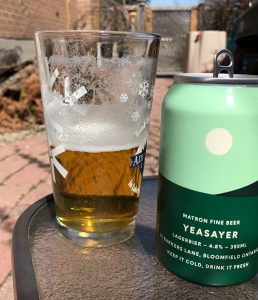
I won’t miss getting past November. The worst month in my year. Damp and dreary. I mourn the end of the garden, the shortening of the days. The death of parsley. While Katie may have pointed us to a more healthy approach to November, I know too well that just a month from now, nearing the end of December, we’ll start feeling the days just slightly lengthening even it the cold is deepening. I took Monday off as I am still due about three weeks away from the office this year and drove off looking for signs. Just after noon, I found one on that dirt road up there. On the south side of Bloomfield, Ontario in Prince Edward County. It’s the last few hundred yards to the rolling idled farmer’s field across from Matron Fine Beer. I stocked the pantry with some jolly juice for Yule. Clever me.

Speaking of the hunt, Boak and Bailey may have found a small redoubt in the battle for more mild assisted by those behind the lyrically titled BADRAG:

Tasting notes on mild, like tasting notes on ordinary lager, can be a struggle, like trying to write poetry about council grit bins. Good mild is enjoyable and functional but, by its nature, unassuming, muted and mellow. Still, let’s have a go: dark sugars and prune juice, the body of bedtime cocoa, hints of Welsh-cake spice, and with just enough bite and dryness to make one pint follow naturally into the next.

I actually have to write bits of essays about council grit bins once in a while at work but never poems.

Never thought we would need a beer cooler for keeping beer cool when ice fishing out on a wintery lake in Saskatchewan frozen a foot thick but this is actually a clever idea. It keeps the beer from freezing.

The decade photo challenge as posted on behalf of IPA. I wonder if IPA will sue for defamation or whether the law’s recent dim view of chicken not being entirely chicken will deter such reckless? Speaking of the laws of Canada, drunk driving in Quebec now carries a new serious penalty:

Starting Monday, Quebec motorists convicted of drunk driving twice in 10 years will have to blow into a breathalyzer every time they start a car — for the rest of their lives. Their licence will be branded so any intercepting police officer will know to inspect the driver’s ignition for an interlock device — a piece of equipment that prevents the car from starting if the driver’s estimated blood alcohol concentration is above the legal limit.

To my east across the ocean, Mr Protz alerted us all to the closing of a pub that has been in place for about 750 years, the Cock Inn “situated on an upward slope on the north side of a tributary of the river Sence” as reported in the Leicester Mercury:

One of the oldest inns in England built in about 1250 AD, it witnessed the preparation and aftermath of the Battle of Bosworth Field and the death of Richard III and the start of the Tudor reign. The notorious highwayman Dick Turpin would return here after working the Watling Street, taking refuge in the bar chimney, stabling his horse in the cellar when pursuit was close at hand.

Interesting to note the nature of its feared fate: “…hope it will reopen and not become a house, as many village pubs do.” Still on the pubs, Retired Martyn has ticked all the GBG 2020 pubs in Glasgow but on the way made something of an admission about a distraction:

Yes, by the Tim Horton Christmas Spiced Caramel Brownie and a medium filter. I read that “nearly eight out of 10 cups* of coffee sold across Canada are served at Tim Hortons restaurants and more than 5.3 million Canadians – approximately 15 percent of the population – visit the café daily“, and Canadians are never wrong. Most of them.

Who knew? And he visited Greenock, the paternal ancestral seat, too. Great photo essays as always. The Pub Curmugeon prefers to work similar themes in text.

I was confused by a thread about CAMRA discount cards this week, accused of being  out of date, faithless to the true cause and a money grab… but then there seems to be no way to replace them in terms of the good they do. It stated with this:

I’m a CAMRA member & I work in a brewery. CAMRA needs to address the corrosive paradox of claiming that real ale is ‘the pinnacle of the brewers art’ while promoting discount schemes for cask beer. So I’ve drafted an AGM motion & explanation.

Discount? Doesn’t that mean well priced? Speaking of which, is beer about to get cheaper in Sweden?

Sweden’s state-run alcohol monopoly chain Systembolaget is planning to cut the costs of its cheapest beer from next year. The cheapest beer sold at Systembolaget today costs 8.40 kronor ($0.87). But next year it plans to launch two new kinds of canned beer for less than 6.90 kronor… the plans, which are meant to compete with border trade, that is Swedes travelling across the border to Denmark and Germany to stock up on crates of cheap beer.

The wonders of scale. Big entities can do great things, can’t they. Just consider this story on beer and the environment:

Anheuser-Busch, in partnership with Nikola Motor Company and BYD Motors, completed their first ever ‘Zero-Emission Beer Delivery’ in the company’s hometown of St. Louis — utilizing both companies’ innovative fleet technology to deliver beer from the local Anheuser-Busch brewery to the Enterprise Center using only zero-emission trucks.

Imagine! Using the word “innovation” and not referring to copycat alcopop IPAs!

Finally, I am not sure I want legalized beer corkage opportunities. Just another argument I don’t need. Go out where you want and spend the money at the place.  Don’t bring your own cutlery either.

There. A quieter week in these parts. But a busy one at work so there you go. Busier still soon enough, too, what with the last month of the decade comes the inevitable “best off” lists. I myself sorta did one at the end of 2009, at least painting a picture of where things stood.  I’ll have to think about what I’d say ten years on… other than wondering where the time went. Where did it went…

In the meantime,  there’s more news at Boak and Bailey’s on Saturday, at the OCBG Podcast on Tuesdays and sometimes a mid-week post of notes from The Fizz as well. And look for Katie’s weekly newsletter, too.


These Are Ye Beere News For Yon Thursdayish This Month From Yuletide

And I suppose the lead up to US Thanksgiving. I am not in the US and, honestly, does it feel a bit late for a harvest fest. The parsley is under snow now around these parts. But the Grey Cup is on this Sunday so that’s good. Hamilton versus Winnipeg.  Oskeeweewee Oskkeewahwah! Say that out loud a lot this weekend – wherever you are. And whether it’s Canada’s autumnal glory* or turkeytime down south, do take care. I didn’t… by which I mean I forgot to note whose tweet I grabbed this lovely common sense public health poster from last Friday. D’uh. [I lie. It was Martyn.]

I was complaining (again)** about the lack of interesting beer writing last week and immediately I was hammered by some fine examples. Consider this realistic vision of Brussels from Eoghan Walsh at Brussels Beer City:

Brussels stinks. It really stinks. Some days it smells glorious, of skewered rotisserie chickens dripping their paprika-stained grease onto the footpath or of the sweet scent of mashed-in grain that marks a new lambic season. On other days it is repellent – the amoniac fug of warming piss rising from pavements heralding summer’s arrival, or the damp choking fumes of the city’s unending winter congestion. 

Lovely stuff. In another hemisphere, Jordan St. John painted another sort of truthful picture of the start of affairs off the Mimico station platform a few stops to the west of downtown Toronto:

…I get the sense that 18 beers would be a lot to maintain. Some of these beers are re-using constituent elements and are not unlike each other. Take the Steampunk Saison, my notes verbatim: “Quite Sweet, Graham Cracker malt character, a little golden raisin or apricot jam character here. Low carbonation for a Saison. Mild notes of spicy orange peel amidst that.” It struck me as closer to Fuller’s ESB with the yeast switched out than a classic Saison. The Belgian style Tripel struck me as a larger version of the same beer. Still stone fruit and graham cracker, but with the intensity dialled up, reaching towards peach nectar. Checking in with the brewmaster, Adam Cherry, he confirmed that the ingredient builds were similar.

It’s a lovely portrait of the sort of locally successful, regionally recognized but also somewhat ordinary brewery that unfortunately rarely gets noted in the rush for the next amaze-balls moment. My immediate response was that Jordan had deftly displayed how to be both fairly critical and warmly encouraged – and encouraging – simultaneously. Exactly the best sort of analysis that, like Eoghan’s olfactory piece, places you by the writer’s side senses engaged.

An excellent and not unrelated discussion took place this week between Beth D and Crystal L as well as others on the role of judging and judges. I took my usual coward’s stance but went back to consider both the challenges of seeking and independent voice while wanting to be recognized as a peer. I’m grateful that they shared their thoughts.

Elsewhere, humility not being their strong suit, I am not surprised by the puffery. But would you really pay for the ever-loving cattle branded “two sides to every story” approach? Real money? Me neither. No doubt in response to the other subscriber offering mentioned a few weeks ago. God love ’em.

2020 is coming. Are your ready? I’m not. But I might feel better if I was heading to the Alcohol and Drugs History Society’s meeting on Friday, January 3rd and 4th, 2020 at the New York Hilton, Concourse Level.  I’d want to be there if only for the presentation by Stephen N. Sanfilippo, of the Maine Maritime Academy, of his paper “It’s My Own Damn Fault; or Is It?” Alcohol and the Assignment of Blame in Mid-19th-Century Maritime Songs and Poems. Being a lad raised by the sea in Nova Scotia, the only place cooler than Maine, I eat this stuff up:

Many nineteenth century seamen’s songs praise consumption of alcohol. Naval victory ballads often end with a toast by the victors, and sometimes include the sharing of liquor with the vanquished. Jack-Back-in-Port ditties also sing the praise of alcohol. This paper will give only passing attention to such songs. Instead, attention will be given to those seamen’s songs, and temperance reformers’ poems, in which alcohol consumption leads to disaster. Such songs and poems always involve the placing of blame. This placement is often not what might be expected, and is frequently complex and illusive.

In their monthly newsletter, Boak and Bailey sought to calm the waters of beer’s social media effect on those caught in its grasp:

Twitter in general can be frustrating, of course, but the conversation around beer is so much better now for us than it was a few years ago when the volume of trolls and bullies felt overwhelming at times. But this is a genuine request: if you think Beer Twitter is particularly terrible, if it really gets you down, can you drop us a line to explain why? Maybe there’s something we’re missing, and maybe there’s something we could do to help.

I think I agree. My behaviour has particularly improved. Far less bastardliness going around these days. At least amongst the scribblers as not all sorts of bad behaviour in beer is gone as Matt let me know of the crime and punishment of a figure in the UK’s craft beer scene.

The founder of a Norwich brewery who duped a businessman into paying £30,000 for equipment he never owned showed a “cavalier” approach to business, a court has heard.  Patrick Fisher, 39, has been jailed after he pleaded guilty to two fraud charges, including one which saw him submit false invoices. Fisher, of School Avenue, Thorpe St Andrew, who was previously a director of Norwich’s Redwell Brewery, admitted one count of fraud by making a false representation to Russell Evans between January 1, 2015, and January 31, 2017, when he claimed to own brewing equipment, when he did not.

That seems to be a bit unfair to Cavaliers, doesn’t it. No, he showed a criminal approach to business. Nice sort of old school larcenous heart to the court case, however.  Very Greene v. Cole, circa 1680-ish.

You might think the same thing is going on with the news about New Belgium being sold into the Kirin universe.  Yawn, I thought. So four years ago. And  the workers got a big payout, right? But then I read this one Facebook from a (former?) employee:

…please don’t lose your “dangerously unbridled in my passion for craft beer” I still have mine. That is the saddest part of this, I feel like everything I was taught, believed and shared at NBB was a fucking lie. I still love this industry and am proud to be working with new, small independent and innovative breweries everyday! It’s not OK to tap out! We need to remain CRAFT to the core. Watch your growth, listen to your employees and don’t chase trends continue to be a trendsetter. The industry needs you stay strong!!

Hmm… has that ship sailed? Maybe. Anyway, that is the week that was. For further beery links, your weekend starts with the Boak and Bailey news update on Saturday and then turn the dial on the wireless to the OCBG Podcast on Tuesdays. And look to see if there was a mid-week post of notes from The Fizz as well. And sign up for Katie’s weekly newsletter. It’s usually got even more linky goodness.

*Not unrelated to my own glory days… because they pass you by… glory days
**Even Jeff noticed with concern.

Your Thursday Beery News Updates For Mid-November

The last of birthdays, anniversaries and public holidays over the last four weeks has finally passed. And it has snowed. Wednesday was as sharp as deepest January at -16C even if it was +8C last Saturday. Five weeks before the solstice. So, I am buried in wool blankets at home this week, covered as soon as I get through the door, hugging the wood burning internet server looking for answers.  Which is where I found the image above, from 1979 when Rocky II came out. It’s from Piccadilly Square in London. Notice the sign for Wards Irish House, mentioned by Boak and Bailey in 2014.  Another report, two years later describes the entertainments:

Wards Irish House. Used to drink there in the ’70’s. Great Guiness with shamrock carved in the head. Once watched a group of people torturing a rat to death on their table top. Great seedy memories!

Conversely, Retired Martin has had a happier experience in his unending pub travels, especially with his visit to The Old Ship Inn in Perth, Scotland which he has shared in a lovely photo essay:

“How are ya ?” says the lovely Landlady. “Thirsty I bet“. Little things make a pub. It was Jarl, of course, a cool, foamy gem of a beer… 

Perhaps somewhere in the middle, Boris Johnson has apparently failed to keep his word, this time related to staying out of the pub until Brexit is sorted:

…the prime minister had claimed he would not drink until Brexit is sorted – with the first phase of the UK’s withdrawal set for January 31. But he failed to show restraint and maintain his “do or dry” pledge after pulling a pint in a Wolverhampton pub… Asked if he would taste the beer, he replied: “I’m not allowed to drink until Brexit is done.” He added “I’ll whet my whistle” before indulging in a sip.

Beth Demmon also told a tale this week – but one with more integrity – about Michelle McGrath, executive director of the United States Association of Cider Makers:

…she hobnobbed with agricultural producers, including a small cluster of organic orchardists operating in the mineral-rich Columbia River Gorge in the rural north of Oregon. They were looking for ways to diversify their income streams, and cider was “just taking off,” according to McGrath. This was the future, she realized. “I just happened to be in the right place at the right time and have the right passion.” 

Speaking of the right place at the right time and have the right passion, the rumours are true! Prague: A Pisshead’s Pub Guide – 3rd Edition is being written! And if you give to Max he might stop hitting me up for spare cash.

The Simpsons on beer and also on beer.

There has been a small somewhat odd protest in England related to Paul:

…bring back Paul! Paul worked at #Beavertown Brewery until he was sacked without reason and without warning. Paul is a well-respected member of staff who always supported his workmates! Reinstate Paul!

Katie is on the case, as usual. She has asked if anyone at all can tell her more about the sacking of a team member named Paul Shaw. Oddly, no deets yet.

In perhaps bigger news, Josh Noel gave the heads up on the swallowing up of the Craft Brew Alliance by Anheuser-Busch. AB now acquires full control of craft brands like Kona, Redhook, Widmer, Omission, Square Mile Cider, Wynwood, Cisco, Appalachian Mountain – making it the largest craft beer company in the United States. Nutty. Diana Barr in the Puget Sound Business Journal explained how this is the end of a process that started some time ago:

Anheuser-Busch InBev owns 31.2 percent of Craft Brew Alliance and agreed to pay $16.50 per share in cash for the remaining shares, the companies said Monday. The deal — which Reuters valued at $321 million — is slated to close next year, pending approval by regulators and a majority of CBA shareholders not affiliated with A-B, officials said. Most of CBA’s brands… already are distributed through A-B’s independent wholesaler network. 

MarketWatch argued that what looked like a premium price might actually have been a bit of a steal given recent stock price fluctuation. Jeff provides a brief boatload of background:

Originally called Craft Brands Alliance, it began in 2008 as a loose partnership with Seattle’s Redhook, which like Widmer had sold a minority stake to Anheuser-Busch, to combine sales and marketing operations. In 2008, it became a single company (called Craft Brewers Alliance) headquartered in Portland. The two companies were of a similar size at that point, but Widmer Brothers soon eclipsed Redhook. CBA had been contract-brewing Kona beer for the mainland since 2001. In 2010 the company acquired Kona outright. It owned a portion of Goose Island and sold it to ABI in 2011. In 2012 it launched a gluten-free brand and in 2013 a cider brand. More recently it began acquiring smaller breweries.

Perhaps as an antidote, a tale of restoration in the form of one last post on a pub in England – and a splendid one from Boak and Bailey who recently revisited The Fellowship Inn at Bellingham, south east London:

It was designed in glorious mock-Tudor style by Barclay Perkins’ in-house architect F.G.Newnham. On the opening day in 1924, Barclay Perkins reported that over a thousand meals were served. Again, check 20th Century Pub for more contemporary accounts of the life and colour of this and other big interwar estate pubs. When we visited in 2016, a small part of the pub was still trading, though most of it was empty and and terrible disrepair…

In happy news, the British Guild of Beer Writers:

…has shortlisted 28 writers, journalists and bloggers in its Annual Awards. The winners in 11 categories as well as the overall Beer Writer of the Year and Brewer of the Year will be unveiled at the Guild’s Annual Awards presentation and dinner on 3 December. Judges read, viewed and listened to some 150 entries which included books, newspaper and magazine articles, both printed and online, as well as blogs, radio broadcasts, films and podcasts.

I was unaware of the three nominees for Guild Award for Best Citizen Beer Communicator but see one writes mainly in Russian and another has a very shouty vid channel. Hmm… are they EU or just British citizens? Frankly, I find the total entry pools of 150 a bit sad comment but there we are. While someone will send out the attack dogs for merely mentioning, as both the BGBW and the NAGBW have placed themselves into the fairly generic good newsy trade journalesqueism niche – aka “beer and brewing industry coverage” – pretty squarely with this years award structure it might be time for a broader garage band level revival of creative and consumer focused writing. But that’s me. Remembering.

Gary takes up the challenge in a pre-facto sort of way and wrote my kind of post – history, beer and law from 1887:

Here’s what happened. A public house in Brick Lane, London was shown to have mixed two beers. One from Barclay’s was – my calculation from gravity numbers in the case – 5.7% abv, the other, a “small beer” from a dealer, only 2.4% abv… The mixing statute prohibited adulterating or diluting “beer” or adding anything to it except finings. The key issue was, did Crofts dilute beer by mixing a weaker beer with a stronger? The magistrate held yes; the appeal judges agreed, although not without some difficulty in the case of one judge.

It’s a start.

UPDATE #1: want a model of how to write about a business from a impassioned consumer’s perspective, look no further than these HATS IN CHIGAGO!!

UPDATE #2: I’ve discovered a new interest: alt forms of beer competition. This week – the curling bonspiel model:

Judging reform: (1) entries only nominated by others, (2) judging by panels with multiple tastings over time, (3) regional play downs leading to multiple progressive winnowing, (4) independent accredited controls. Allows more participation without one shot beers no one can buy.

There… enough for now. I have to go hibernate, to sob quietly for the summer of 2019 that I could pretend was just, you know, taking a break… until now. For further beery links, check out the Boak and Bailey news update on Saturday and then tune your dial to the OCBG Podcast on Tuesdays. And look to see if there was a mid-week post of notes from The Fizz as well.

The Thursday Beery News For When The Winds Of November Come Early

Fine. Here we are. It’s now dark as midnight on the bus ride home from work. The garden is all dead. Dead. Dark. Wind. Cold. And these sensations are also the first hints of the happy holiday season. Depending on your cultural context, it may be just three, four, five or six weeks from the day when everyone packs it in and hits both the bottle and the buffet hard. Not everyone is waiting. My pal Ben, who is semi-Nepalese, is traveling there and found a good beer that was also basically semi-Nepalese. As illustrated. No reports yet on if it was any good.

Also internationalistically, now that craft beer has co-opted kveik, is Lar on the hunt for another indigenous set of yeast strains from Russia?

Kveik signals very clearly when it’s done. It’s almost like the little critters are knocking on the glass, saying “we’re done now.” Starter turns all grainy, and once you stop the stirrer, they settle out in 3-4 minutes. Not so with this Russian yeast. It’s just as milky still.

Speaking of new discoveries, another new beer publication was launched this week, Beer Edge featuring the northeast US’s Andy Crouch and John Holl. The subscription rate is a bit out of my snack bracket but we are promised tidbits au gratis from time to time, focused perhaps more on the trade side of things than whatever community means or doesn’t mean:

From long-form writing that explores the culture, business, and process of brewing, to shorter essays, think pieces, and timely editorials, Beer Edge hosts sharp writing that provides context to an industry that often just receives cursory coverage. For consumers, bartenders, brewers, industry executives, distributors, farmers, bar owners, tourism boards, analysts, and anyone else eager for more news about the craft beer industry… 

Speaking of the trade everywhere, Crystal Luxmore tweeted about an organization and an issue that needs more attention:

When you love tasting, selling and making alcohol it feels like drinking is a joyful part of the job — but it also opens you up to massive health risks and addiction issues…

The organization is Not 9 to 5 and the issue is over-drinking on the job when your just is in the drinks trade. More here.  Not at all unrelated, a British self-described archaeologist, technologist, infovore, mediocre chef under the nom de plume “Archaic Inquiries” published a rather shocking piece on the role of alcohol in archaeology:

I’ve not worked outside of archaeology much, so perhaps it shouldn’t be a surprise that I didn’t think that was a particularly inappropriate thing to say to a supervisor you’d just met (though it didn’t strike me as very smart). But as I thought about it, I started to recall all the antics of archaeologists under the influence, both adorable (getting in trouble for using government jello for wrestling at the McMurdo Antarctic research station) and not so adorable (I once saw a crew chief fall out of the company truck because she couldn’t stand… at the end of the work day).

I also learned that we “shouldn’t giggle when someone pukes into their shovel test pit“! Wow. I have not had a drink since Saturday. Seriously.

Bread.

I have a confession. And not that I have puked in a test shovel pit. No, I am uncomfortably interested in one aspect of the TV show from 40 years ago, Three’s Company. Only one aspect, I said. The Regal Beagle. Why? Well, the past is a foreign land worth studying. And when writing my bits of the history of Ontario, I realized that SCTV’s McKenzie Brothers and their movie Strange Brew was a last vision of the world of Canadian beer before micro hit us all over the head. So, too, in a way was Three’s Company‘s  Regal Beagle – an American vision of a 1970s faux British pub.  I want to put together enough images to figure out the pub set to see what what props were considered necessary 45 years ago. Here’s a blurry analogue vid view of the bar unfortunately filled with bad acting. There seem to be three beer engines back there but were they used? Here is a gif posted this week of Ralph Furley walking into the place, showing the brasses by the door. Here is another tweet with an image of the one bleak plot of the entire show – but with the bonus of an out of place “Ye Olde English” nutcracker sitting at the end of the bar, the couple in the background (above) expressing it for all of us.

Getting back to real life nostalgia, Alistair of Fuggles fame was able to revisit the Prague of his twenties and visit his old favour boozer, U Slovanské lipy:

…no airs and graces, no pointless fripperies, and the majority of patrons were locals rather than tourists, perfect. The big thing that had changed though was the prices. Where I had been used to paying only 20kč for a half litre of Kout’s magisterial 10° pale lager, the nearest equivalent available, Albrecht 10° from Zámecký pivovar Frýdlant, was about double that. Yeah, it was odd having sticker shock in a Czech pub, but a quick conversion in my brain telling me the beer was $2 a pop for superb lager soon put that into context.

In upstate New York, a tiny town voted to go “wet” this week:

In a 3-to-1 vote, the referendum, aimed at making the town “wet” again, passed and a town that has been dry since Prohibition will now be wet. “I’m all for it, absolutely,” said Eleanor deVries on Tuesday afternoon after voting, adding that the town needs it economically.

I trust Eleanor has settled down since Tuesday’s results. Economically, by the way, is the new medicinally.

Sadly but yet again, your weekly reminder that good beer people are not all good people – this time, the distasteful and fairly racist Halloween outfit edition:

Breweries can talk about diversity all they want but when this idiocy still happens it shows how far craft beer has to go to create a safe and welcoming space for POC. You need to not just talk about diversity but “walk the walk”.

I might have added “…as well as a welcoming space for non-fascists…” but that’s just me. Not quite as horrible, but still thoughtless…

You know what’s shitty? A prime time TV show on one of the major channels asking for free beer for their changing rooms & wrap party in exchange for ‘exposure’. If you are paying hundreds of thousands of pounds for your ‘talent’ you can afford a few hundred on some fucking beers…

Conversely and to end on a happy note, Jeff gave us a four photo explanation of why in Sicily he has proclaimed:

This place immediately enters my top ten of best drinking establishments I’ve been to in my life…

Exhibit A. Exhibit B. Exhibit C. Exhibit D. Case closed.

There you go. A bit of a global tour. In space and time. The good. The bad. The ugly. For further beery links, check out the Boak and Bailey news update on Saturday and then bend an ear towards the OCBG Podcast on Tuesdays. And look to see if there was a mid-week post of notes from The Fizz as well.

A Few Exciting New References To Albany Ale… Which I Looked Up Now That Baseball Season Is Over

One of the things about the world we live in is that Google Books is being updated constantly. When I co-authored the histories of brewing in Ontario and the Upper Hudson Valley with Jordan and Craig, now over five years ago, we were very aware of the horrors earlier pop historians faced putting together an idea of regional brewing’s past. Google Books has been a particular blessing to us all. So, every once in a while you have to go back, as I did in August with Lambeth Ale, to see what has been added since you last wrote about a topic. Today, then, let’s look at the references to Albany Ale which have popped up since I last had a proper scan, including this image up to the right from the excellent Soda & Beer Bottles of North America website’s 2018 notes.*

By way of summary introduction to Albany Ale and in addition to my own tagged posts, I offer Craig’s observation posted last February on our Albany Ale Project‘s Facebook page on the scope of the drink’s travels:**

Regardless of the numbers of papers available on the site, it’s clear that Albany Ale was fairly common in the south, and specifically during the antebellum period. Of the roughly 3,500 hits from 1800 to 1900 (with New York papers eliminated) for “Albany Ale”, “Albany Cream Ale”, “Albany Double Ale” and “Albany XX Ale”, seven out of the top 10 returns were from southern states. Louisiana showed the most hits in the database (94) as well as the earliest (of the southern states) mention, in the Louisiana Gazette in 1819. Pennsylvania, is the first northern state on the list and it ranked fourth behind Mississippi and North Carolina. Connecticut missed the top 10 by one, but the Hartford Courant’s April 30, 1806 edition boasts the earliest mention of Albany Ale outside of New York.

Brewing in Albany (as the attentive amongst you who have a well-thumbed copy of Brewery History (2014) 157 by the bedside will know) goes much further back in time than 1806.  Harold A. Larrabee in his April 1934 personal and municipal biographical article “Herman Melville’s Early Years in Albany” in New York History Vol. 15, No. 2*** spends a generous amount of time on the maternal side of Melville’s ancestry going back well into the 1600s – aka the brewing Gansevoorts. Larrabee confirms that the site of Stanwix Hotel (aka Stanwix Hall) was the site of the family’s first brewery in Albany at Maiden Lane and Broadway run by Melville’s namesake, Harmen Harmensen Van Gansevoort. It also includes this recollection from the fiftieth anniversary of the building of the Stanwix Hotel:

Many a barrel of good beer, made of wheat, [says a newspaper account of 1883] has been brewed upon that spot. It was a pleasantry with the old people of those times, to say that when a brewer wanted to give a special flavor to a choice brewing, he would wash his old leather breeches in it; showing that slanders against Albany brewers and Albany Ale are not a new thing but of considerable antiquity. So as late as 1833, when the dome of Stanwix Hall was raised, the Dutchmen of that day called it Old Harme Gansevoort’s brew kettle turned upside down.

Bonus confirmation of Albany’s wheat malt based reality!

From 1840, we find in the likely temperance leaning publication The Ladies’ Companion and Literary Expositor this vision of the Albany ale drinking gent of the times:

An irreligious man—one who professes to be so, and glories in his own shame—who considers it an honorable distinction to be ranked among unbelievers, and who mouths blasphemy among his acquaintances as a sort of accomplishment to be proud of, is unquestionably disgusting enough; he takes decided precedence of the porter-house drunkard who blurts blasphemy over his mug of Albany ale without knowing what he says, and is merely vulgar and profane amidst an association whose whole object is a forgetfulness at once of self-respect as well as of respect for every thing else. 

Before you go all finger pointy at our prohibitionist forefathers and foremothers, I would note that this description roughly lines up with the 1832 diary entry of a traveler passing through Albany who, diving into a cellar, found a 3:00 am party described as “a good sample of low life in Albany” where they shared a feed of biscuits washed down by what was likely Albany Ale: “…there was no brutal drunkenness nor insolence of any kind, although we were certainly accosted with sufficient freedom.

In the 1841 publication A Brief History of the Origin, Progress, and Effects of the Present Astonishing Temperance Movement, and of the Life and Reformation of John H.W. Hawkins, the Distinguished Leader. Embellished with a Correct Likeness of Said Hawkins, we read this about the habits of pre-reformed Mr Hawkins when he was just twenty-one:

When once he got taste of liquor, after long abstinence, all power of resistance forsook him, and, as is the case with other inebriates, he gave himself up without restraint, till his health and strength for the time being became exhausted with intoxication. Albany ale, or “cat soup,” as it was termed, was a favorite beverage, to which he was particularly partial. He would sometimes begin with this, when at a public house; call for a pint tumbler, and, while reading a newspaper, drink a little at a time, till it was drained; then, feeling his appetite sharpened for more, would call for a second tumbler, and, without waiting, toss it all down at one drink. By this time, his rage for more became so violent and irresistible, that he has sometimes drunk many quarts in a few hours. 

We are told that prohibitionist “John H. W. Hawkins was born of respectable parents in Baltimore, September 28, 1797” and was alive at the time of the book’s publications which means his recollection of the slang for Albany Ale is reasonably reliable and dates to about 1818. Which is fabulous. Cat Soup. Love it.

Also from 1841, in the Western Temperance Journal, we find an article on all the meanings of the very newly coined slang “O.K.” which at the very last of a long list states: “O. K. Oil of Karrion—or Albany Ale.” Excellent! The greasy residue of the rotting dead. Which is a pretty cool actually contemporary goth or steam punk attribution when you think about it. Which also means Oil of Karrion now stands as a neato second name, along with Cat Soup, for a modern craft brewery’s recreation of an actual 1841 Albany Ale.

It’s important to note that there was good reason that the prohibitionists took aim at Albany Ale. By mid-century, it was a huge industry as this reference from an 1849 edition of The Merchants’ Magazine and Commercial Review illustrates:

The business of malting and brewing is carried on to a great extent in Albany, and employs a large amount of capital. Six breweries and malt-houses of the largest dimensions were erected in this city the past year, and the whole number of such establishments is about twenty. The demand for malt liquors is daily increasing in the United States, and Albany ale and beer are found not only in every city in the Union, but likewise in the West India islands, in South America, and in California.

In 1871, it could still be stated that “Albany ale and Albany lumber are known everywhere.” But it did not last. Times change and change can come quickly. From 1884, we see something of the beginning of the end in this brief but telling observation on time’s cruel march from The Albany Hand-book: A Strangers’ Guide and Residents’ Manual:

…Albany ale, at one time was on tap in all the large cities of the country, but of late has been displaced, to some extent, by lager beer which is also brewed here in large quantities…

Ah, Albany Ale. I am glad I played a part bringing it and the pre-lager history of American brewing back into the spotlight. One day far into the future if someone is looking up me on Google Books, it will likely be one of the few things I will be known for. And rediscovering that “Cat Soup” was once slang for the stuff. That’s just excellent.

*Of course, Craig may have seen all these but that is the reality of having keeners for co-authors. PS: I want that bottle. PPS: Craig likely has one and is keeping it from me. 
**Probably time we updated the book what with all this new information.
***Free at the wonderful JSTOR archive with a simple sign up as a researcher.

The Halloween Edition Of Thursday Beer News. Boo.

I’d be a bit nervous at the Sing Sing Kill Brewery

Ah, Halloween. A right nor-easter is promised meaning 100 mph winds, lashing rain – and me lonely and all dressed up at the front door looking at a bowl with a minimum of 15,000 calories per handful. We get maybe 12 kids max in a good year. Maybe. I have a vegetable garden on my front lawn. I am marked as a neighbourhood weirdo. But I get ahead of myself. Halloween is tonight. The Future. What’s gone on this past week?

Last Friday just as the weekly news cycle began, Jeff posted about the problem with novelty as it turns into longevity:

Every brewery that was once an emblem of a shining new future—Widmer, Hair of the Dog, Ninkasi, Boneyard (to cite local examples)—has seen trends move on without them. Great Notion and Ruse are the current trendsetters, but time continues to march. We have absolutely no experience of what happens when four thousand breweries immediately become “old school” before our eyes.

Coming up on three years ago now, I wondered about novelty and whether it was possible that today’s twenty somethings could “actually get a bit verklempt over memories of weird fruit flavoured gose thirty years from now.” Interesting that weird fruit flavoured gose is sorta dead to us all now. It’s so 2017. Novelty’s pace has increased. The Pub Curmudgeon posted about another aspect of the same phenomenon, the pervasive presence of recently but no longer quite cool craft:

 It’s not the absolute bleeding edge of craft, but even so it’s a pretty respectable selection, including the likes of Vocation, Magic Rock, Thornbridge, Five Points, Crate, Toast and Camden. It’s interesting that pretty much all of these beers now seem to have moved from bottles to cans. The German discounters, Aldi and Lidl, have introduced their own-brand “craft-a-likes” at even lower prices. This has attracted a certain amount of wailing and gnashing of teeth from the craft influencers, complaining that such low prices will devalue the concept and won’t give brewers a decent return.

Good value should always be something we are grateful for. In any other marketplace, this is called The Victory Of The Consumer! What? You disagree? Did I miss something?

Note: he didn’t drop the beer.

Ron unpacked an advert he found for the sale of Barclay’s Russian Stout from that part of the foreign land known as the past, aka 1922:

…another Barclay’s Russian Stout advert. With some more interesting claims. The oddest being that Bismarck liked Russian Stout. Especially as the advert is from just after WW I, when there was still considerable anti- German feeling.

These things are funny. In 1816, a year after the end of a bitter border war with the US of A, Albany Ale was being sold in my fair military town.

Business Insider posted an interesting short video bio of Celeste Beatty, the first African American woman to own a brewery in the US, the Harlem Brewing Company in New York City. Here is a Forbes story on her from a few years ago with more background.  Speaking of vids, here is a scene from a Scottish pub the very noo.

The shadowy Portman Group is at it again but this time I fully agree if only because the Bearded Brewery defended its cider named Suicyder because “the noose references reflected the owner’s previous career at the Forestry commission where a noose was used to dismantle unsafe trees“! If one is going to attorn to the jurisdiction of a trade tribunal please do not be silly. I am an owner of The Ashley Book of Knots and I know no one in their right mind would every use a noose to take apart a tree given a noose is used to tighten on to a short stubby think like a head. To be clear, I give you a selection of arborists knots. Knots don’t lie.

Health news update. Or really not an update as this is old news. Again, there is no j-curve. Don’t believe otherwise – alcohol is just about degrees of badness:

…for a long time, the consensus was that abstaining from alcohol is unhealthier than consuming moderate amounts of alcohol (equivalent to one or two drinks a day). But that “J”-shaped relationship between alcohol consumption, and death and disease, has come under criticism. It’s now widely understood that a lot of this data could be flawed: people abstaining from alcohol may be doing so because they’re unwell, rather than becoming unwell because they’re abstaining.

Here in Ontario, we have no need to worry about the j-curve or not as, woohoo, the new government is passing new relaxed liquor laws left right and center:

The Ford government is pledging more changes to alcohol access in Ontario — announcing plans on Monday to allow international airports to serve booze 24-hours a day, and to remove limits on how much beer, wine and spirits can be brought across provincial or territorial borders for personal use. Those two promises are among a sweeping list of changes, packaged as the ‘Better for People, Smarter for Business Act’… The Bill also promises to ease restrictions on bringing dogs onto restaurant patios, and inside certain breweries in the province.

Those booze runs I made into nearby Quebec all those years ago? Smuggling. NO MORE!!! What a great law. Huh? Holy crap! “The Bees Act is repealed“!!!

I enjoyed the personal essay, photo set and brewery founder interview by Lily Waite run in Pellicle this week on the Table Beer produced by London brewery, The Kernel:

“The other thing—and I think it helps Table Beer more so than the others—is the fact that we still put all of our beers through a second fermentation,” Evin tells me over a shared bottle. “The extra little bit of yeast character and fermentation by-products that you get—hop biotransformations, too—those really hard-to-define things, they’re key to Table Beer.” Though I’ve drunk many brown-papered beers in search of that fugitive quality, I’m reluctant to believe it’s simply down to a second fermentation. I’m much more inclined to believe that it is, in fact, a little bit of magic.

It’s good not always to dissect something but convey the pleasure of it all. I think the author has done that. These pieces, like Matt C’s before, are love letters. But there are technical tidbits, too: (i) “…as with all of their beers, the strength varies from batch to differently-hopped batch…“; (ii) “…[i]t’s now brewed weekly, every Friday…“; (iii) “…a fullness of body, achieved through high mash temperatures and oats in the grist…” All of which add up to a story that is telling you that the beer is borne more by the technique than the ingredients. Very interesting.

The proud Canadian company formerly known as Molson is still theoretically out there, now going through another hybridization and perhaps some degree of bionic implantation:

Most support functions, including finance, information technology, procurement, supply chain, legal and human resources, will be consolidated in Milwaukee. The company will continue to maintain global business services offices there and in Bucharest, Romania. The Molson Coors International team, meanwhile, will be reconstituted, with its Latin American team becoming part of a new North American Emerging Growth team headed by Pete Marino. Its Asia, Pacific and Africa team will fold under the Europe business unit, which will be led by Simon Cox.

Interesting to note that they are branching out into other areas including a “forthcoming line of cannabis-infused nonalcoholic beverages in Canada.” Sounds hellish to me but the baby boomers love this sort of stuff apparently.

That is it for now. Get going on the tricking and the treating. For further beery links, check out the Boak and Bailey news update on Saturday and then bend an ear towards the OCBG Podcast on Tuesdays. The last one featured a great interview with Ren Navarro, owner of the consulting and education firm Beer. Diversity.  And look for mid-week notes from The Fizz as well.


The Thursday Beer News Update For A Week When My Mind Was Elsewhere

On Tuesday, I had a great joke all prepared for my proctologist, analogizing with him or her over the election results. But… well, at least in the end, we seem to have had a good result. In both senses. Not much time for me to focus on the beer industry, however, which makes this week’s beer update as much news to me as to you. Let’s see what’s been going on.

First, speaking of biological science, Stan sent out his regular hops newsletter this week and, as exemplified by the photo up at the top, decided to provide some photos from the Hop Research Center in Hüll, Germany that Evan recently wrote about, as mentioned in last week’s news update. Up there, that’s a picture of some of the Center’s germ plasm collection of long-held varieties. Want more? You will have to pay Stan for back issues of his newsletter now if you want to see the images but haven’t subscribed already.*

The biggest story has to be the member of management at Founders giving testimony in a disposition that he did not know if someone who was… well, let’s see see how the story was covered:

A transcript of the exchange between Founders’ Detroit general manager Dominic Ryan and Evans’ attorney, Jack Schulz, shows Schulz shifting from shocked to incredulous and perhaps a bit angry as Ryan claims he had no idea Evans is Black. Instead of just answering the question and moving on, Ryan digs in deeper and deeper, repeatedly asking for clarification when Schulz asks questions like “Are you aware Tracy is Black?” At one point, Ryan even claims that he doesn’t know if former President Barack Obama, Kwame Kilpatrick, or Michael Jordan are African-American, because he has “never met them.”

The Beer Law Center tweeted: “This is stupid. The “if I didn’t say it, you can’t prove it” strategy – quite simply – sucks. The law, justice, trials, and courts, just don’t work that way. Shame on Founders.” As a practicing lawyer a quarter century into his career, I can’t disagree. The person diving the testimony did themselves no favours. Plenty of rightly offended folk now rejecting the brewery like Beery Ed: “if you still drink founders , you suck.” Which is true.

Boak and Bailey proposed a scoring system this week to determine if a British pub is in fact a pub.

Monty Python’s Terry Jones was on the BBC in 1984 and discussed both dental hygiene in medieval Britain and his brewing. Wogan preferred keg to cask. Jones, having a multi-faceted shirt malfunction announced: “real beer can only be made on a small scale.” Heed ye all!

Lisa Grimm has had a timely article published in Serious Eats about the haunted history of the Lemp family of brewers out of St. Louis:

Today’s beer history installment is something of a micro-level view of my previous column on German-American brewers—but this one has a Halloween twist. The story of the rise and fall of the Lemps, once one of America’s most powerful brewing families, reads like something out of gothic fiction; and, as would be entirely appropriate for that genre, some say that they’ve never left. The story begins familiarly enough…

A great technical article on barley came my way entitled “Characterising resilience and resource-use efficiency traits from Scots Bere and additional landraces for development of stress tolerant barley” I believe from @merryndineley. Now I have to go and look again at the standard for “landrace” when it comes to barley as I’ve seen husbandry in the 1600s but when we are talking bere we are talking about something much older than that as the abstract suggests:

Potential sources of viable resilience and resource-use efficiency traits are landraces local to areas of marginal land, such as the Scots Bere from the Highlands and Islands of Scotland. Bere barley is a deeply historically rooted landrace of barley that has been grown on predominately marginal land for the last half millennia. The landrace yields well in these conditions. The project aim was to assess and genetically characterise traits associated with enhanced resistance/tolerance, and to identify contributing genomic regions.

Speaking of great technical articles, I was blessed with a copy of an article on the history of Fuggles hops by the perennially referenced Martyn which, this time, appeared in Technical Quarterly published by Master Brewers Association:

The Fuggle hop is one of the most important varieties on the planet, not only in its own right as a contributor to the flavor of classic English beers for more than a century but also for the genes it has given to almost three dozen other hops… It is surprising, therefore, that until this year there was considerable mystery over the parentage of the Fuggle—it seemed to be unrelated to any other English hop type, with a hop oil profile much closer to the German landrace variety Tettnanger—and a fair amount of doubt and confusion over exactly who developed the hop and when it was first commercially available. Now, however, research in England and the Czech Republic has convincingly answered all the questions…

Nice article in Pellicle on the realities of the beer scene in Iceland:

We had moved up to the bar at Kaldi, and the low-hanging bulbs made the copper bar top and our bartender’s shaved head shine in the dim light. I had just ordered the Borg Garún Icelandic Stout Nr. 19, an 11.5% behemoth. If you haven’t heard, beer and food are pretty expensive Iceland. Pints of basic craft styles were $12-$15 (£9-£12) everywhere, and the higher in alcohol pours were $20-$30 (£15-£23).

Even at those prices, beats the hell out of an vaguely described essay on (what Canadians properly spell as) bologna.  Sums something up.

Katie tweeting on junkets triggered that a discussion wasn’t the usual monocrop of defensiveness.

There was a discussion on Facebook on the early days of the British Guild of Beer Writers awards dinners with some entertaining recollections. Martyn** recalled a night 22 years ago:

The earliest awards dinner menu I have is from 1997 – ham cured in Newcastle Brown Ale (!), accompanied by figs steeped in Old Peculier, breast of guinea fowl braised in Fraoch heather ale, pears in porter and cheese served with McEwans Champion Beer. Dinner sponsored by Tesco …

Ah, the romance… Related perhaps is this thread about traditional brewing in today’s alcopop world.

That’s it? Yup. For further links, check out the Boak and Bailey news update on Saturday and then bend an ear towards the OCBG Podcast on Tuesdays. And look for mid-week notes from The Fizz as well.

*I don’t make the rules. Stan does.
**Again with the Martyn!!!

Your Last Thursday Beery News Update Before the Impending Canadian Hung Parliament

This is great. We have an absolutely gridlocked national political scene according to the polls and that, for a Canadian, is a wonderful thing. We love minority in our national federation of a parliamentary monarchy system. Best is there is a good chance that the highest vote won’t equal the most seats, given 105% of Albertans vote Tory. Probably the guy tapping the keg last week in Kitchener (at the world’s second largest Oktoberfest) gets the nod as PM.* The Leader of HM’s Loyal Opposition just looks too much like a 12 year old in his bigger cousin’s suit to pull it off. Which is fine. Which makes minorities great. Things get done. Deals get made. Progress happens.  I know in the US folks are all like “wuzza third Party?” and in the UK folk are all like “making deals based on compromise?” but here in the Great White North we know what works. And that is working.

First, an acknowledgment and a bit of a bummer. I read this note this week at Stan’s place:

For 6 years I assembled links to good reading about beer and other things fermented, posting them here on Mondays, often with a bit of commentary. That ended in with the arrival of October in 2019. Of course, the archives (in monday links during 2018 and 2019, musing before) remain, and at the bottom of every post there is a list of sites that have new links every week. You may also look at my Twitter feed on the right to see what I’ve been reading.

It would be telling half a story if I were to tell you that Stan is my favorite beer writer, the only person I will call a “beer expert” given the depth and breadth of his comprehensive knowledge. He has always had the time for my dumb questions and has even taken the time to tell me to go to straight to hell… now… exactly when I needed it. I will be sad to not read his thoughts at the beginning of every work week but I have noticed an uptick in his own blog writing activity otherwise so maybe he will focus on more posts. A welcome thought. As is the news that there will be a Lew v.2.

If there was a next gen candidate to follow in Stan’s footsteps, Evan Rail might be it. Late last week, just after the round up hit the presses, he posted an article at GBH.  (And without the obligatory 27 “GBH” references embedded in the text, too! He must know how to negotiate a contact.) The article is about hops and, more specifically, a trip he took to the Hop Research Center in Hüll, Germany to learn more about their breeding program:

Breeding itself is a delicate process. Commercial hop plants are generally all female, with female flowers. To create new crosses, male hop plants—which usually but don’t always have male flowers—are also bred. But, in the middle of a commercially important hop region like the Hallertau, how do you raise male hop plants, when just a pinch of their pollen can create unwanted hybrids on the surrounding farms, potentially ruining the crop?

Me? I probably would prefer the unofficial version of the history of CAMRA, which is what the “biography of the organization” is actually called.**

We would like this perspective to come from someone who is not perceived as having a close association with CAMRA.  The brief is for a c.50,000 word authorised biography of CAMRA, to be researched and written in 2020, with the text due at the end of the year, ready for publication in March 2021 in time for the Campaign’s birthday celebrations. Exact outline, terms and fees to be negotiated.

Nothing like a book where the subject matter gets to negotiate the outline.  Also from the UK and in line with such thoughts on the improbabilities of the world we live in, a stark truth from an English brewer on the perfect pint pour:

A proper family/regional head brewer would know that the perfect amount of foam is that which allows the publican to sell 105% of the beer from each cask.

Next, Martyn has continued in his Martyn-like habit of posting long excellent blog posts with another long excellent blog post on corporate misinformation about a certain Sri Lankan brewery’s history:***

Mind, even at five errors in four sentences, that’s not the worst pile of nonsense on the internet about what is now the Lion Brewery, famous today for an award-winning strong stout that is one of the last links with British colonial brewing in Southern Asia. The Lion Brewery’s own website is full of rubbish (and bizarre random capitalisation) as well…

Odd news out of Oregon where one brewery has been vandalized twice in recent weeks… by the same person:

Police contacted Albin in the area and arrested her for first-degree criminal mischief. However, Albin was released from the jail just three days later. She returned to the brewery around 2:30 a.m. Tuesday. That’s when she allegedly threw rocks and liquor bottles into the windows and doors of the restaurant, and made Molotov cocktails that were found thrown around the inside of the brewery. The entire incident was captured on surveillance video…

Speaking of Molotov cocktails, I now have less of an issue with paper-based beer containers:

Carlsberg announced the launch of two prototypes of the new bottle at the C40 World Mayors Summit in Copenhagen, Denmark. The newer, eco-friendly versions are made from sustainably sourced wood fibres and are fully recyclable. The concept of a paper-based bottle may sound strange at first, as you wonder how the structure would stand firm, holding liquid safely inside.

…but the technology probably would be put to better use in the jams and jellies trade. Which I assume is about 1,297 times bigger than beer. Isn’t it? I need to check out Insta-jam or whatever that corner of the social media boglands are called.

There. A bit of a quieter week, I suppose. And not particularly wide in the selection of voices. I did hunt around, honest. Let me know what I am missing. Still, plenty of good reading for a week filled with many bigger matters. Some things beer can’t fix. Expect a further Boak and Bailey news update on Saturday and then check out  the OCBG Podcast on Tuesdays. And look for mid-week notes from The Fizz as well.

*Fact: Canadian politicians must love beer.
**Illiteracy is an alarming problem, as we know, in the industrial scribbling circle but this is inordinately odd.
***And one I love as their foreign export stout makes it regularly to Ontario.