E.& J. Burke And A Barrel Of Straw And Stout

ejburkebaseballThis post is just an excuse to post this picture from 1889. Careful readers will know that I play a game or two of 1860s base ball each summer. One of the players on our team, Jordan Press, forwarded this post from MLB historian, John Thorne, on baseball – and even base ball – in art. An early sports themed brewery endorsement, the man on the left is Buck Ewing catcher for the New York Giants. He was one of the first six players to be entered into the Baseball Hall of Fame fifty years after this ad was first produced.

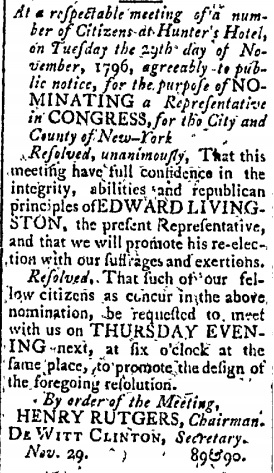
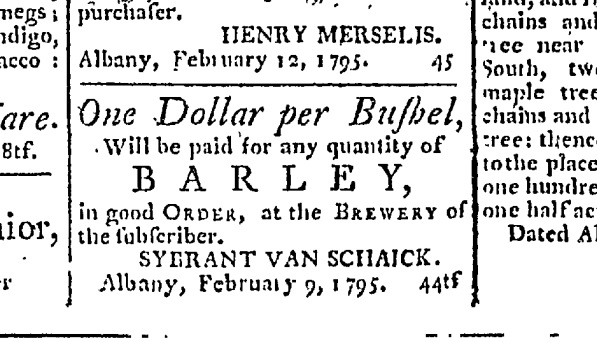
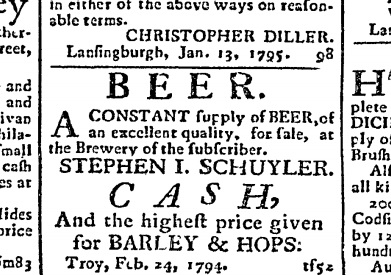
But notice a few things. He is drinking stout. And not just any stout but Guinness Foreign Extra Stout. Jess Kidden has a bit of the story about the relationship between Guinness and its NY importer, E.& J. Burke. But notice a few other things. Five bottles lay about the ground. The beer is being enjoyed. And it’s been delivered packed in a barrel of straw. Over on Facebook, Ethan asked about the use of the word “hamper” in an ad from 1774. In another recent post, I discussed a 1790s ad for a NY porter vault where the drink was available by the “tierce” of quarts. I understand in both these cases the thing being described in the barrel of bottles which is stuffed with straw to keep them from breaking in transit. I think Buck Ewing is working his way through a tierce. Or at least having his fair share.

My favorite quantity of beer… well, after the pottle.

New York: Har(r)ison and Leadbetter, The 1760s Odd Couple

nyc1777herrmao
What an odd story. As we know from our history as well as right up to today, brewers usually go in the direction from rags to riches – starting out in sheds and garages to become multimillionaires all the while pretending they are still small operators working on the level of a craft industry. Oh, how we laugh when that old fib is rolled out, don’t we? Well, it didn’t work out that way for Har(r)ison and Leadbetter, a brewing concern which operated apparently briefly but seemingly quite splendidly in New York City in the last half of the 1760s. It was located on that wee point sticking out in the Hudson River. Click on the image for a bigger version. As you will see, there is a bit of biography involved as well as a bit of mapping if I am to explain this so bear with me.

Let’s start with the man who was born into this world as George Harison but died as George Harrison – adding another “r” to the family name. This guy was exactly the sort of guy the Revolution was all about. Fortunately, he ended up at one point as the Grand Master of the Masons of the Province of New York, as a story in the New York Journal on 24 October 1771 shows – which means there is a reasonable amount written about him and his by, you know, my brothers… if my brothers would, you know, have me… being as lapsed a Mason as one can be. George (b.1719, d.1773) was born to Francis and father to Richard. His father and his son were great political leaders of their day. Francis was an Oxford trained lawyer who comes to New York in 1708 and, in 1720, was made a member of the New York Governor’s Council; in 1721, becomes Judge of the Court of Vice-Admiralty in New York and, in 1724 is Recorder or Clerk of the City of New York. He returns to England in 1735 and dies in 1740. Big time Loyalist power holder and lackey. Two generations later his grandson Richard (b.1747. d. 1829) is a New York born, Oxford trained lawyer who, after the Revolution ends in 1783 is a New York state legislator, a member of constitutional convention, the first US federal attorney under Washington at New York – and also Recorder or Clerk of New York City. Like grandpa, big wig.¹

Sandwiched between Francis and Richard? George.* What can we say about George? It is clear he is very rich. His father dies in 1740 when George is just twenty-one. That same year, George sells off a 1400 acre farm “six miles above of Newborgh” or what is now Newburgh. Later that decade, he sells off more than ten times that much land. In the New York Gazette of 25 April 1748 a notice is placed for the gathering of creditors who owe money to the estate, to meet George as heir and also to sell 15,000 acres of land which have been divided into 100 and 200 acre lots. In 1750, he buys 2,000 acres of Ulster County, NY. Suffice it to say, George as heir is loaded.

What then of Leadbetter? No so much about Leadbetter because he is not a big wig and might not even have been a wig at all. From 1764-65, he appears to be in a brewery partnership at Brooklyn Ferry with Thomas Horsfield brewing English ale, table and ship beer. The Horsfield’s Long Island Brewery was created in the early 1750s and continued into at least the 1780s… but that is for another post.

nymerc12may1766gha

nymerc07july1766gh


nygaz09apr1767gh

nyj12october1769ghjl


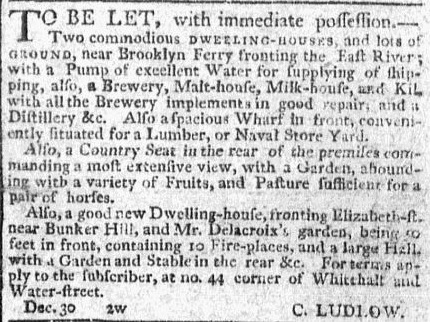
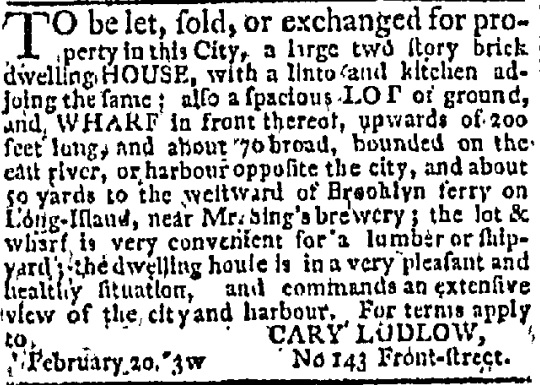
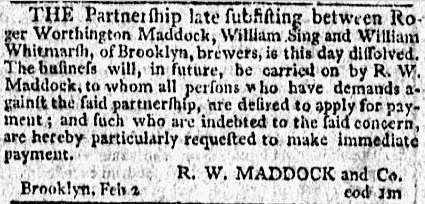
Enough about these people. What about the brewery? The partnership is described in the Masonic history of the George this way: “In 1765 he went into the brewing business with his father-in-law and James Leadbetter, a professional brewer.” Hmm… father-in-law. In the 12 May 1766 edition of the New York Mercury, to the upper left, a notice of the opening of the new brewery is announced, stating that only ship and spruce beer were to be had as yet but that ale was coming. To the upper right is the one from 7 July 1766 from the same paper stating that their ale was for sale. Notice that Harrison is located on Broadway. The next April, we see he has moved. The New York Gazette announced on 9 April 1767, as we see in the lower left above, that George moves from Broadway to the brewery lands. Ale, ship and spruce beer are sold and – interestingly – folk are told to be mindful about returning their empty casks. Was this a sign of problems? Whatever it was, things do not last. As we see in the 12 October 1769 edition of the New York Journal to the lower right, James Leadbetter announces that he is leaving for England and is selling his three-eighths interest in the brewery. The notice has a wonderfully detailed description of the site. There is a brew house of 60 by 30 feet with both a 15 and a 50 barrel copper. There is a mill house for grinding malt and pumping water that is 30 by 25 feet. The malt house of 60 by 31 feet is four stories high with two kilns and two lead cisterns for steeping barley. The store house is 70 by 23 feet and comes with an underground vault. There are stables and a cooperage and four dwelling houses along with land including 18 fenced acres. A significant industrial scale brewing operation. And the brewer is leaving.

What happens next? James Leadbetter appears to become a man of leisure and a bit of the lord of land himself – and he doesn’t leave for England. In 1770, Leadbetter becomes on the the original grantees of the Wallace Land Patent, a group of land speculators getting their hands on 28,000 acres along the Susquehanna, a strip two miles wide. In the New York Gazette of 26 November 1770 he is offering organ and harpsichord lessons to gentlemen and ladies. In the early part of the Revolution, Governor Tryon enlists Leadbetter to spy on the Revolutionaries. A James Leadbetter – late of New York with lands in America – has his will proven in 1799 in England** leaving a son in London and a daughter in New York.

nygaz26april1773gh

nymap1776gh


nymap1789ghnymap1803gh


The brewery and the Harisons went on, still playing with adding the
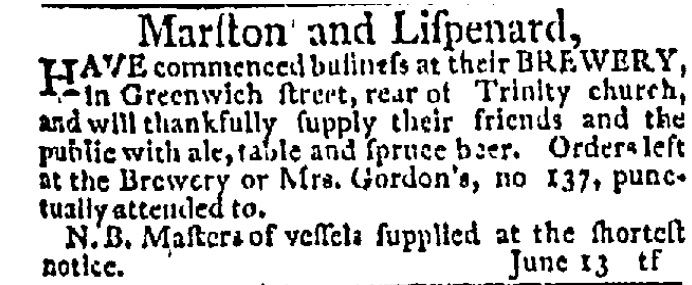
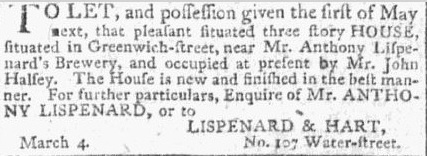
second “r” as they do. Though one for a bit more time than the other. Upper left is the obituary for George in the New York Gazette of 26 April 1773. He was only 54 when he died. Before he left us, he seems to have sold the debts of the partnership to a shopkeeper, David Jones of Broadway, who according to this notice in the New York Gazette of 10 Aug 1772 wanted creditors to show up or he was sending the lawyers after them. The upper right image above is a map from 1776 which shows the brewery on the point but does not name it. The map at the very top of the page was printed in France in 1777 from data collected in 1775 – it names it. Notice how the brewery appears to be strategically placed. Not only is it on the river so able to ship out directly, it is just north of the original site of Vauxhall Gardens, a privately run park for outings. It is just south of the Lispenard brewery also on the Greenwich Road. The area was described in testimony in the 1824 court case Bogardus v. Trinity Church in which the actual ownership of lands in the district were being disputed. One witness Benjamin M Brown described his recollection of the area:

At the period of his earliest recollection, there were but few houses in Chambers, Reade, or Barley (now Duane) streets, or in the lower part of Warren street, where it intersects the Greenwich road, now Greenwich street. North of Warren street was a hill, over which this road passed. After rising the hill, the first building on the west side was Harrison’s brewery, close to the North river, and in or about the block between Jay and Harrison streets. On the east side of the road, nearly opposite the brewery, was Speth’s oil mill, in or near Harrison street. The next improvement was Lispenard’s place of several acres of land, lying along the Greenwich road. His mansion house was east of and at some distance from the road, and near to what is now called Desbrosses street. North of Lispenard’s, was a tavern, a place of public resort, called Brannan’s Garden…

A near rural area of both industry and recreation it seems. The thumbnail to the upper right up there is another map, this from 1789 which again shows the facility to the south of Lispenard’s. The site continues to be associated with the family as noted in their Masonic history where we read that Harrison Street was among the streets named by the Vestry of Trinity Church in 1790, laid out by the Common Council in 1795, and deeded to the City by the church in 1802. The brewery and the lands was put up for sale in 1776 (actually 1775 – see below) but probably stayed in the family as they sold several lots at the site in 1824. In that last thumbnail to the lower right up there you can see that by 1803, the district has been leveled, regularized around the surveyor’s 90 degree angle with just an ornamental rectangle on the shore around where the point of land would have been. Quite charmingly, a Harrison Street still exists, crossing Greenwich at the site of the old brewery, now further inland with the fill from the Hudson river docklands. Houses on the street from the first decade of the 1800s still stand.

Update: A little more research a few days later tells a bit more of the story. Here is the notice in the New York Gazette from 27 March 1775:

nygaz27march1775gh
But the property wasn’t sold. It stayed in family hands throughout the Revolution… well sort of. On 21 March 1788, a letter was published in the Daily Advertiser out of New York which set out a number of defences related to the character of various officials and in particular, Richard Harison, son of George. The anonymous author described how Richard took a neutral stance during the Revolutionary War. While he opposed the taxation imposed on the colonies, he feared the power of Great Britain and feared war would be a disaster. On the other hand he publicly declared early on that

“…he would take no part against this country… This conduct drew on him the resentment of the British, before the arrival of General Carleton, who with-held his house and brewery, at the North-River, for a long time, without paying for the same…

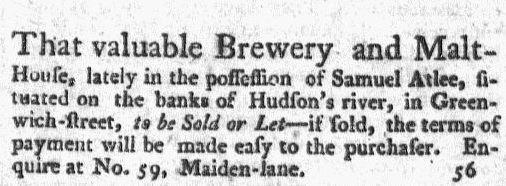
nyindjournal15sept1784ghAfter the peace breaks out in 1784, there was one more kick at the can, one more attempt to make a go of it. Click on that thumbnail. Richard leases the brewery to Samuel Atlee who takes up brewing porter there. In the first weeks of 1785 he adds a pale “transparent” table ale. One of the principals behind the porter operation leaves in June 1785. The malthouse burned in October 1786 and Atlee’s enterprise comes to an end in late 1787 as this notice in the New York Packet of 11 December shows.

[End of Update….]

So a bit of an odd story. A fabulously large scale brewery with seemingly a very short original operating life, a few restarts and not much longer a physical existence. A Loyalist’s dream. “Harison’s folly” maybe even. But a late 1760s brewery built to brew likely at least 250 to 300 barrels a week or 12,000 to 15,000 barrels a year is quite the thing, quite the dream. In a market already well served by the Lispenards and Rutgers as well as Faulkner and Medcef Eden. And likely others. Did it succeed? The family’s other independent wealth makes it a bit hard to know. Wonder if the beer was any good.

¹Like me, a graduate from Kings College though I was over 200 years later after the College relocated to Nova Scotia with the Loyalists. The commander of the British troops in North America, His Excellency General Thomas Gage, did not attend my graduation nor did I, with my sole classmate and pal of John Jay, entertain the audience with a debate on “the subject of national poverty, opposed to national riches.” I did, however, party.
*Note if you are hunting this out, too, that Richard’s son is also George Harison and is also into land but now farther up into northern NY. Federalists are just, after all, pragmatic Loyalists.
** at page 115.

New York: The Elusive Medcef Eden of Golden Hill


nycplan1776a

The latest project without all that much particular point is turning out to identify the brewers of New York City during the American Revolution aka the War of Independence. So far we have learned about:

William D. Faulkner;
The Lispenards; and
The Rutgers.

There are two more that I have noted so far, Harrison and Eden.¹ They are all located (if not all noted) on the clickable map above. A rather large version of the map for obsessive pouring over can also be found here. The breweries appear, as Craig predicted, to be lumped in distinct brewing areas. As we saw in Albany and is I suppose self-evident, these breweries were built near supplies of potable water. And while both New York and Albany are salt water seaports New York in the year 1775 is largely located on the lower tip of an island, Manhattan. Which means that fresh water comes at something of a premium. Important but I will get into that a bit more in a later post. Today it’s about Eden.

I hadn’t heard of this guy until I came upon this map of the Great Fire of 1776. In an essay recalling the world of New York in the early 1790s, we read:

At Number 26 Broadway, might have been daily seen the light-built but martial and elegant form of Alexander Hamilton, while his mortal foe, Aaron Burr, as we have stated, held his office in Partition street. John Jacob Astor was just becoming an established and solid business man, and dwelt at 223 Broadway, the present site of the Astor House, and which was one of the earliest purchases which led to the greatest landed estate in America. Robert Lenox lived in Broadway, near Trinity Church, and was building up that splendid commerce which has made his son one of the chief city capitalists. De Witt Clinton was a young and ambitious lawyer, full of promise, whose office (he was just elected Mayor) was Number 1 Broadway. Cadwallader D. Colden was pursuing his brilliant career, and might be found immersed in law at Number 59 Wall street. Such were the legal and political magnates of the day; while to slake the thirst of their excited followers, Medcef Eden brewed ale in Gold street, and Janeway carried on the same business in Magazine street; and his empty establishment became notorious, in later years, as the ‘ Old Brewery.’

Janeway is a later story in time and an interesting one in its own right, also for another day. What is important today is that Medcaf Eden brewed ale in Gold Street. Long before I got interested in the antecedents of Canadian brewing in the Loyalist world before the American Revolution I fell for the excellent website “Forgotten New York” and, upon reading about Gold Street, I looked again to see if there was anything I could learn. Jackpot. Not only did was there a FNY a post from nine years ago about Gold Street, he had found Eden’s Alley leading from it. He even posted photos. Go have a quick look at the post.

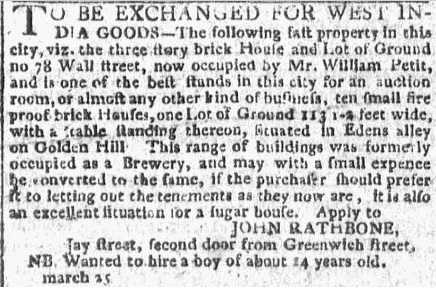
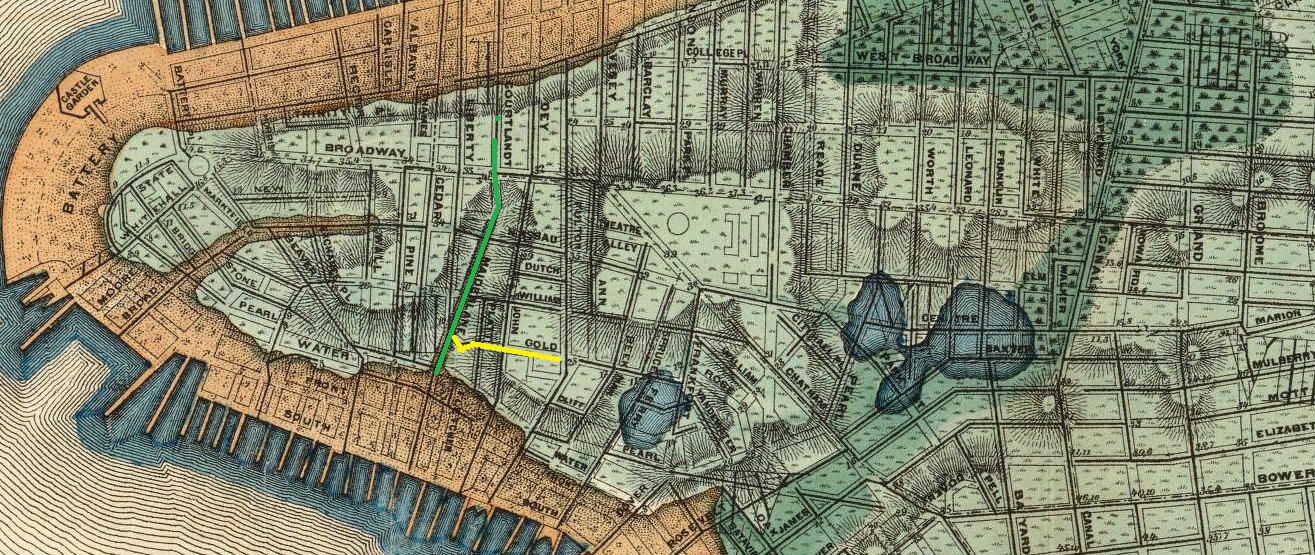
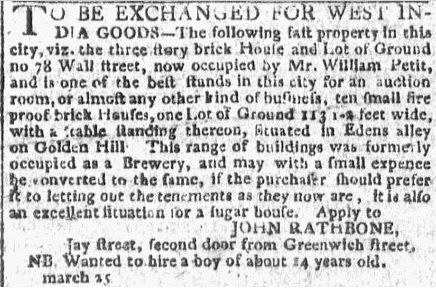
nycforgottenedensNow, click on the excellent FNY photo of the alley so I can point out a few things. So I can review. It is narrow. It is narrower than the narrowest bit of the photos of Gold Street see that? It’s narrower than the still narrow intersection of Beaver and Green Streets in Albany where in 1776 the King’s Arms was the flashpoint of the local insurrection. Eden’s Alley is that narrow because it is very likely not a street at all but the horse cart lane from Gold Street to the actual brewery. It’s probably the driveway. You can actually see it on the map of the 1776 fire. Check the red circle to the right of the other. Notice the break in street’s buildings at the circle’s 11 o’clock position? That’s Eden’s Alley. Notice how on the photo it leads east-ish according to the sun on the face of the north side wall. Parallel to Maiden Lane to the south where the competition in the form of one of Rutger’s breweries was located. See the bullet shaped carriage wheel bumper protecting the building’s corner from traffic pulling in from Gold Street? We have a few of those still in our old town. Notice another thing. It’s an uphill climb from Gold Street into the property of Medcef Eden. Because it’s built on uneven land. Because uneven land is next to the creeks and rivers where the fresh water was. What an excellent wee photo of an unappetizing back alley in one of the world’s great cities. Look at the topography on this map of NYC from 1783. You will find Golden Hill just inland above the “E” in east river. That hill? That’s what Eden’s Alley is climbing. FNY also traces the lane’s later history.

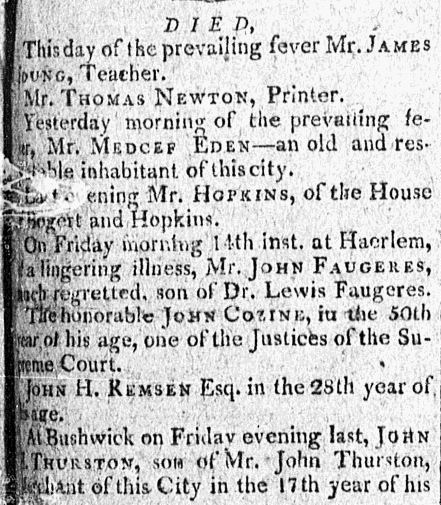
Medcef Eden passes away on 18 September 1798 leaving two sons, Joseph and Medcef Junior who die without children of their own. The will of Medcef Sr provided for this eventuality and, in doing so, tells us something about Eden’s origins.

It is my will and I do order and appoint, that if either of my said sons should depart this life without lawful issue, his share or part shall go to the survivor. And in case of both their deaths without lawful issue, then I give all the property aforesaid to my brother John Eden of Lofters, in Cleveland in Yorkshire; and my sister Hannah Johnson of Whitby, in Yorkshire, and their heirs.

Which means Medcef is very likely a Yorkshireman who immigrates to the new world leaving his own family behind. And what does he do between immigrating and expiring? He brews.

nygaz29sept1777edennygaz02nov1778edennygaz22oct1781edennyindjournal01june1785eden


nydgaz21june1791eden


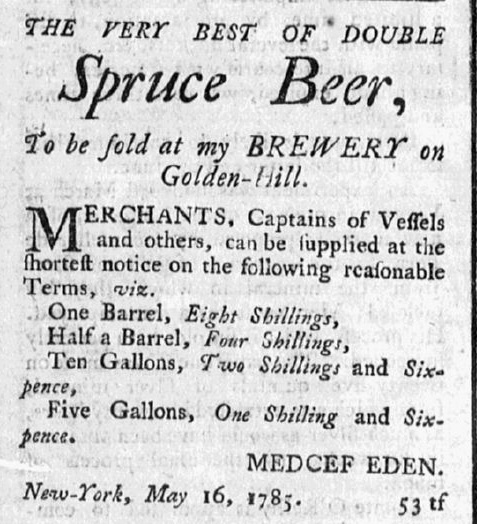
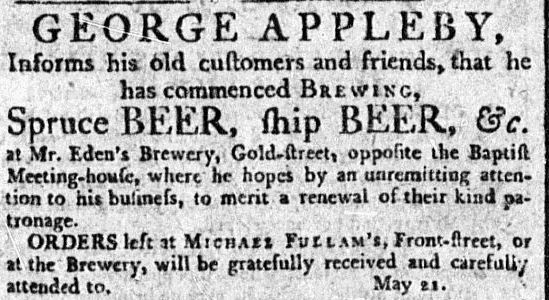
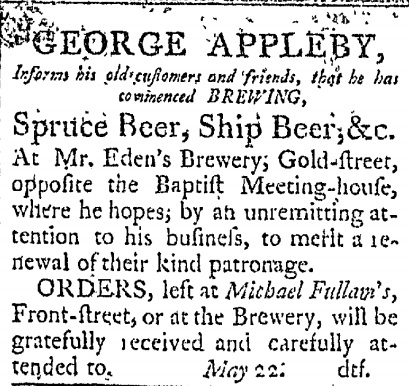
The ad to the upper left is from the The New York Gazette of 29 September 1777. Eden is buying hops and barley while selling strong and ships beer. In the upper middle ad from a year later on 2 November 1778 he is now selling four sorts of beer: ale and strong beer, ship’s beer and spruce beer. Almost three years later, the ad to the upper right from the The New York Gazette of 22 October 1781 focuses on his strong ale which he states “exceeds both in flavour and quality, any that has been brewed since the revolution.” By the time the lower left ad is placed in the New York Independent Journal of 1 June 1785, the war has been over for over a year and a half. He is selling double spruce beer, advertising rates by the barrel, half-barrel, ten gallon or five barrel. Finally, the ad to the lower right placed in the New York Daily Gazette from 21 June 1791 informs the public that George Appleby has taken over the brewing operations and is offering spruce beer, ship’s beer and others.

The immediate thing that strikes me is that Eden appears to have managed the transition from war to peace quite successfully. He stays on in the City during the Loyalist times and stays on after they leave and are replaced by the Revolutionaries. Just two month’s before the inevitable departure of the last of the British, according to the 22 September 1783 edition of the New York Gazette, Eden is buying barley. Eden’s neighbour, the widow Rutgers on Maiden Lane, left with the rest of the “popular party” as soon as the British showed up in 1776 – according to the 1784 court case over British use of her brewery during the war. Eden stays put.

There’s more to be found out of course even if in 1920, The New York Times could find no record of the brewery. Plenty of records likely no one other than a handful of masters students might have bothered looking at over the decades. But for starters that is an introduction to Medcef Eden – Yorkshireman, New Yorker and brewer.

¹Oops. One more. Robert Appleby, a spruce beer brewer on Catherine Street near the Ship Yards on the East River who advertised in the Royal New York Gazette on 19 April 1781.

An Anti-German Anti-Lager* NYC Riot In 1840

nycmap1839bThe map of the city of New York from 1839 shows the extent of development in grey. The streets north of 14th street are newly settled, sitting north of the established municipal wards. They are twice the distance from the tip of lower Manhattan that the rural Lispenard estate and brewery was just fifty years before. The block at 15th street between 6th and 7th avenue is just five blocks below open countryside. Evan’s tweets today on the anti-lager sentiments in the US of the 1850s reminded me of how at that time and in the decades before the setting was not as calm as it appeared. Over a decade earlier, in the Commercial Advertiser of 31 March 1840 reports on an unexpected violent event under the police reports:

RIOT – On Sunday afternoon a serious riot occurred in 15th street, between the 6th and 7th avenues, which caused great excitement, and was productive of serious injuries to many persons before it was suppressed. It appears that there is a public house in the location above mentioned, kept by a German, where it is common on Sabbath afternoons for persons of both sexes to assemble and indulge in music and dancing, after the manner of the people of the country from whence they come. On Sunday afternoon last, such a party assembled for such purposes, a lady playing on the piano, while others of both sexes were dancing. While thus engaged, a party of young men from the eastern section of the city proceeded to the house in question, and marching into the room where the music and dancing were carrying on, commenced a disturbance by tripping up the heels of the male and female dancers, and throwing them down on the floor. This led to acts of resistance on the part of the party assailed and a fight ensued.

You can read the whole story here but suffice it to say that the scene was nasty. Furniture is destroyed, the parties are beaten, women jump from second story windows. Women get caught up on the fences “caught by their clothes and hung suspended in a most painful and exposed situation” to the jeers of the growing mob. Order begins to be restored when the Mayor himself who rides into the crowd on his horse.

The 1840s is an early point in an ugly era. The Old Brewery at Five Points had been converted into a slum warren three years before. Five Points is said to have had the highest murder rate of any slum in the world. The worst of human experience was lived there. Times were tough. A year before, impeachment proceedings were brought against a grossly profane judge for refusing to take on a role in the management of the police. In October 1839, a riot broke out at the scene of a fire… between two companies of fire fighters. To the north, the first new German immigrants were making a better life for themselves along fresh new avenues neat the city’s rural edge. Tensions did not resolve quickly. The Albany Journal reported a deadly riot at a Philadelphia lager beer tavern in July of 1854. On 10 June 1854, a new political movement of anti-Irish and anti-German nativists or “Know-Nothings” was described in The Weekly Herald of New York, which formed to express antagonism against these newcomers and their ways:

The Germans are chiefly agitated about their lager bier saloons, and are very much incensed at the idea that their liberty to drink as much of that beverage, and at any time and place, as they see fit should be in any danger of restriction.

Change was coming. In 1855, the Evening Post published a very positive report on events at a NYC German outdoor gathering… which included a few well placed rifles. By the late 1850s, the question reached the courts with the ruling of Judge Strong that lager was not intoxicating so therefore could be sold on a Sunday. Times were changing and the children of those Germans attacked in the 1840 riot would become a cornerstone of the nation’s prosperous middle class of the latter end of the century. Along with that, lager does not first succeed because it is a technological marvel. It succeeds because it is a key cultural expression of the new immigrants who would not be beaten down.

*Note, 20 Feb 2016: Gary Gillman emailed right after I posted this and pointed out that this was a couple of years before lager actually arrived. Gillig’s story makes it a bit obscure one way or the other. What did he brew from 1840 to 1846 – and what made the lager he brewed lager?The beer could well have been schenck, a low strength German ale, or even good old local Anglo-American ale. Need to explore this as soon as the New York posts get into the middle third of the 1800s. I am still in the 1790s. So… maybe later this year. Maybe.

The Site Of Rutger’s Brewery, New York City, 1776

rutgersbrewery1776

This is quite the thing:

In the summer of 1776 there stood on the northern side of Maiden Lane near where Gold Street now enters it, a large Brewery, with its attendant dwelling, malt-house, sheds, storehouses, etc. The premises extended from Smith, now William,* Street on the west, to Queen, now Pearl Street, on the east; and from Maiden Lane, on the south, to the present line of John Street on the north; and it was one of the most notable features in that part of the city.

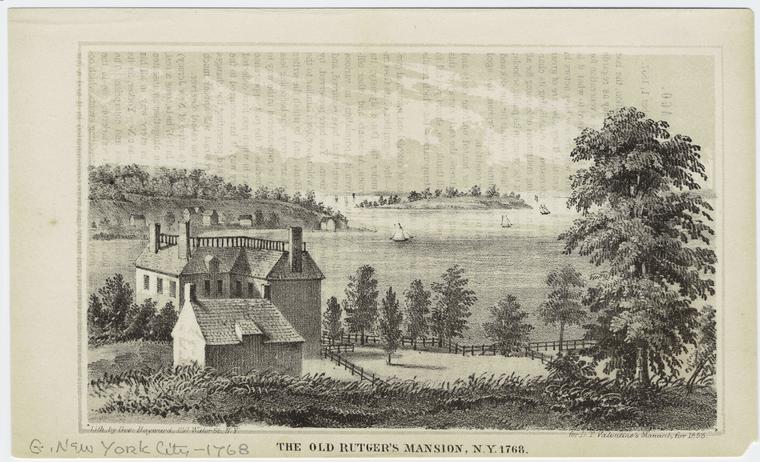
Wow. That’s four full blocks of what is now Lower Manhattan. The red rectangle is roughly the location of the brewery itself according to this map. The text is from the introduction to an 1866 reprint of the ruling in Rutgers v. Waddington, an 1784 ruling of the Mayor’s Court of New York City. The case was about the use of the brewery property by the British during the American Revolution. The first beer had been brewed on that site by Harmenus the father-in-law of the plaintiff, Elizabeth Rutgers, on December 24th, 1711. Elizabeth owned the property at the outset of hostilities with her son, Robert, “who carried on the hereditary business of a brewer” as his father Harmanus had, as his grandfather (yes) Harmanus had before that. The elder Harmanus moved to New York in the late 1600s from Albany. Robert is also the nephew of the Anthony Rutger mentioned in the story of the Lispenards. Which makes him the first cousin once removed to the Leonard Lispenard who is sent to London to train with Barclay in 1783. Which means before the war the Lispenards brewing on the North River near Cortlandt Street are close family with the Rutgers brewing on Maiden Lane. And, like the brewing Gansevoorts of Albany, they all line up with the Revolutionaries.

I need to figure out more of this but suffice it to say that brewing at scale, political power and inter-married Dutch families with a significant lack of diversity in first name use are all key to the story.

*Further formerly Cart and Horse Street.

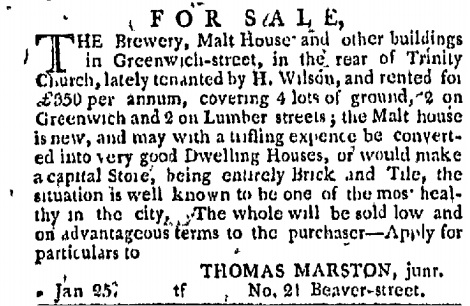
The Brewing Lispenards Of New York City

lispenards

Lispenards. For a few days I have had Lispenards on the mind. We’ve seen them before. I’ve actually had them on the mind for years. In Upper Hudson Valley Beer, Craig and I wrote this:

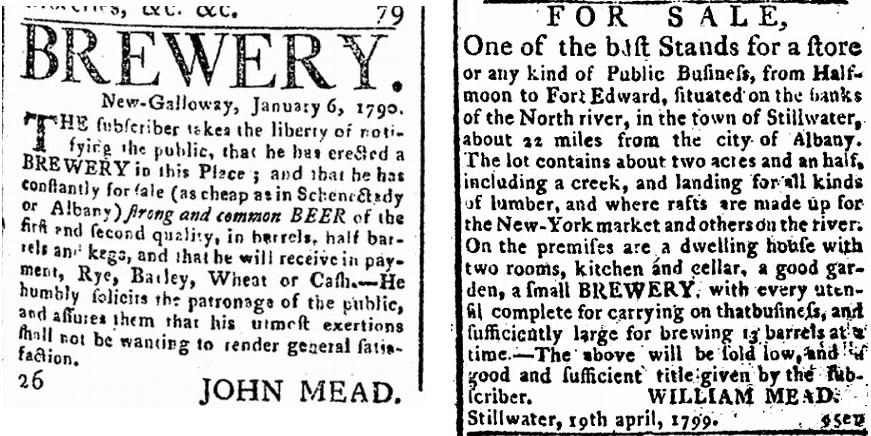
After the war was won and New France conquered in 1760, William Johnson continued to import beer into his western Albany County estate but the records indicate that his choices were not local. He is buying Taunton ale from England as well as beer by the New York City brewer Lispenard. It may reflect his further increased wealth as he is also seeking out port wine and New Jersey cider from his southern supplier, the merchants Hugh & Alexander Wallace. Their invoice to Johnson dated Nov. 3, 1772, shows the extent he would go to pour himself and his guests the range of beers he desired:

6/-/- for 3 Barrl Strong Beer at 40/
4/10/- for 3 Barrl. Ale @ 30/
1/7/- for 6 Barrels at 4/6
7/-/- for 10 Barrels Newark Syder at 14/
0/3/- for Carting ale to the Sloop.

I got deeper into that order placed by William Johnson or rather Sir William Johnson, 1st Baronet of New York and one of the richest, most powerful men in British North America back in 2010 but suffice it to say that what Johnson was buying was the best he could get. And that included Lispenard’s ale.

What, you might ask, was a Lispenard? As the perpetually excellent Colonial Albany Project tells us, the family was founded in the New World by Anthony Lispenard of La Rochelle France who emigrated in 1669 when he was 29 and lived along the Hudson River for the remaining 27 years of his life in 1696. He was a baker, a trader and a government official including Albany’s Viewer of the Corn from 1689. In the Manual of the Corporation of New York for 1856, this founder of the clan, Anthony, was also identified as a brewer. He left three children: Margaret, Abigail and their unhelpfully named brother Anthony. Anthony Lispenard the younger himself passed away leaving not so much in the records department but three children including a son – Leonard born in the 1714 who inherited the family’s estate.

He led a prosperous private and an important public one, too. He also married well and through his wife Alice or Elsie Rutgers came into possession of one third of a grant made by George II to her father, Anthony Rutgers, which they then expanded then named Lispenard meadows and then built a mansion next door on Lispenard hill – all near a swampy area that then sat in the middle of Lower Manhattan in the area is now part of Tribeca. You can seek these lands identified as “King’s Farm” on this map from 1729. As part of his estate, Anthony Rutgers owned “large breweries and mills located on the North River (as the southern branch of the Hudson west of Manhattan was known) not far from the foot of Cortlandt Street His son-in-law, Leonard, continued the brewing operations. They had children including the unhelpfully named Leonard born in 1743 and, yes, his brother… another Anthony. Rutger’s / Lispenard’s brewery is shown above as it was about 1776 according to Manual of the Corporation of New York for 1856.

It gets a bit trickier now. Not because of all the Anthonys. Because of the Leonards. Father and son are both fairly prominent in New York City before, during and after the Revolution. They show up in the news papers. In The New York Mercury of 22 April 1765, a notice was posted on behalf of Leonard Lispenard requesting the return of three indentured servants who had been in the colony for about five months. One, Phillip M’Cardell, was described as being by trade a brewer and distiller. One of the two Leonards was employing brewers. Another notice was placed in the General Advertiser dated 15 May 1776 stated that the house of Leonard Lispenard, Esq in Wall street was being occupied by students of King’s College. Despite such seeming Loyalist credentials, three months later on 17 August, George Washington issued an order that guards be mounted day and night at Lispenard’s brewery. Lispenard Senior (aka 1714-1790) had already thrown his lot into the Revolution. He was a member of the colony’s Committee of Correspondence in 1774 and backed Washington publicly on his return to New York City in 1775 and likely a Son of Liberty.

nyntmerc22april1765nygadv15may1776


nyg1june1791lispenard

nydadv10dec1804


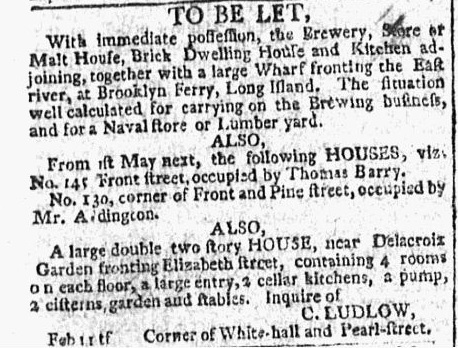
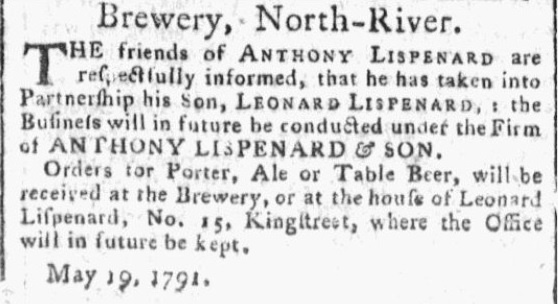
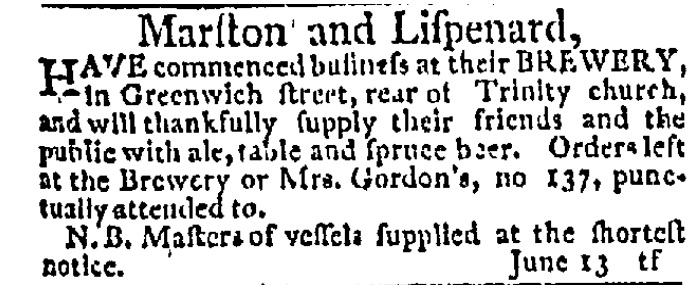
Anthony, brother of Leonard Junior (aka 1743-1800), takes off in the brewing business in his own right. He marries one Sarah Barclay in 1764 and becomes “the proprietor of the extensive breweries on the Greenwich road, near the foot of Canal Street.” I am guessing that this is the Lispenard that Sir William Johnson buys beer from through agents in 1772. In the 1 June 1791 edition of the New York Daily Gazette, a notice was placed under the headline “Brewery, North-River” which stated that Anthony Lispenard had taken his son – yes, of course.. because there was no other choice – Leonard into partnership. Note this map from 1783. Notice that they are still described as sitting on the Hudson. Shipping beer on the Hudson. And father and son – Anthony and Leonard – were inviting orders for porter, ale or table beer. The address for Leonard was given as 15 King Street. This Leonard traveled to England shortly after end of the American Revolution in 1783, and remained some years in London with the Barclays, relatives of his mother and founders of the famous breweries. On 10 December 1804, a short news item appeared in the The Daily Advertiser from New York stating:

At an early hour yesterday morning the city was alarmed by the cry of fire. It proved to be at Lispenard’s brewery, in Greenwich-street. The premises, at present occupied by Mr. John S. Moore, with the content were destroyed. What the probably loss may be we have not learned; it must however be very considerable.

An article in the Commercial Advertiser from the same date stated an entire wing of the building had been destroyed. Notice in the upper left of this map from 1789 how the Lispenard estate sits on the road to Greenwich.

The family name fades. Sons die childless. No one gets named Anthony or Leonard. The next generations in the 1800s also appear to lose interest in brewing. In 1907, the remains of Leonard Lispenard (1743-1800) were uncovered as part of a construction site. A report in The New York Times from 9 April of that year details the find as well as some of the family’s legacy. He had been buried near the farm in New Rochelle near where his great grandfather, the original Anthony, had settled after moving south from Albany. A street is still named after them.

So…There Was An Exporting Albany Brewery Before 1790

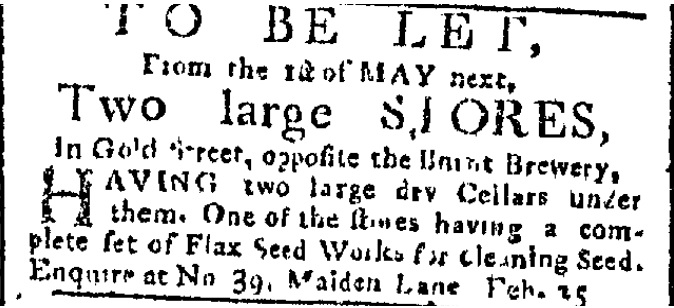
albfaulkalbreg18oct1790It’s been a busy time. Busy at work. A family matter to attend in the States. A federal election to fret about. Baseball playoffs to obsess over. Hardly time to play around with newspaper databases. Ah, well. Winter is coming. There will be time for that. Time to come across things like this ad from The Albany Register of Albany, New York from 18 October 1790. Craig and I told the story of William D. Faulkner in Upper Hudson Valley Beer in this way:

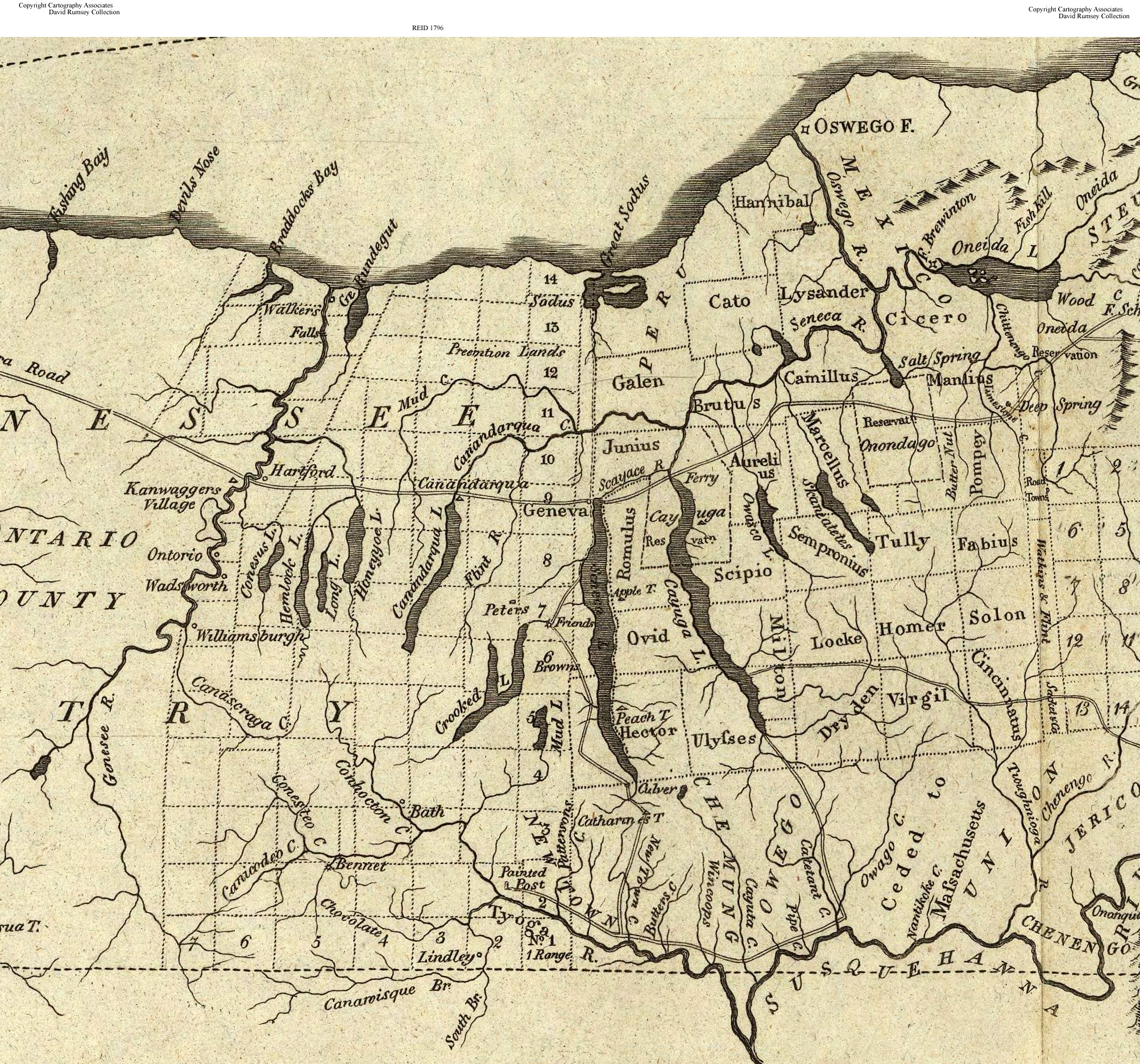
Faulkner began his brewing career in New York City in the late 1760s. Faulkner initially partnered with New York City merchant Leonard Lipsenard—the son of Albany brewer Anthony Lipsenard—to sell bottled ale and beer; then with Stephen Rapalje and Anthony Ten Eyck, but by 1771 had opened his own brewery on Cow-foot hill, in what is now modern-day Harlem neighboorhood of Manhattan. A fire in his New York brewery brought about his relocation to Albany, and in 1790 Faulkner began renting a brewery in the city’s northern neighborhood of Arbor Hill—advertising Ales, Porter, Bottled Ales and Spruce Beer. By 1792, however, William Gibbs, announced that he would be occupying that brewery. No record of William Faulkner after that point has been found.

What more can we learn from the ad? Notice that he is asking for malt, barley and hops. Local hops were both a wild and cultivated crop for over 150 years at that point in Hudson Valley history. We have a record of wild hop picking by members of the indigenous Mohawk community supplying Albany’s Dutch brewers from the first decade of the 1700s. But notice another thing. This is at least his third brewery, the second one local to Albany. He’s in New York City from the second half of the 1760s. Here’s his ad from a New York City paper from 1768. Albany is in Revolutionary hands from 1776 to 1783, cut off from British held New York City during the war. In the spring of 1779 Faulkner is in NYC and he is hiring a gardener and labourers in the middle of the conflict, according to this ad in The New-York Gazette of 22 March 1779. So, his first Albany brewery must have existed sometime during the years 1783 to 1790 after he relocates up the Hudson after peace breaks out. His last ad from the fall of 1791 shows him brewing at least four beers. And during that time not only is he selling down to New York City but he is selling on to Charleston, South Carolina as well as the West Indies. The Dutch empire held what was then named New Netherlands from the second decade of the 1600s until it finally fell to the English in 1674. Trade routes to the Dutch colonies in the Caribbean were established by the Dutch and continued after the establishment of the colony of New York.

Faulkner was sending his beer down a well trod path. Ales and porters were apparently part of that trade after the American Revolution. Remember that Taunton ale was also being sent to Jamaica, even before the declaration of American independence. It shouldn’t come as any surprise. The English had been shipping large quantities of beer across the Atlantic since at least 1577. Did they all bear the “greatest eclar”? Not sure. But if anyone tells you that all beer before lager starting in the in America in the mid-1800s was smokey, brown and crappy – clearly an untruth – why would anyone in their right mind pay to have it shipped so far? Don’t believe it.

#23 – The Kid’s Up

“He’s up by seven,” he shouted to the kitchen through his mouthful of toast, the autumn morning light glinting on the plate and mug on the side table.

“Ketchup and what?”

“No – he’s up by seven! The kid is up by seven points with Nanos, Ekos and all the other Greek gods!!!”

“That’s nice.”

Nice? What’s that supposed to mean. The Governing Party is back on track, at the front steps of kicking the dullards out and all she can muster up is “nice“? He rubbed his chin. Thought for a bit. The Kid’s made a big move in the last few weeks. The commies have faded back just enough to provide the necessary support. Another sip of coffee. A leaf fell outside the bay window. Been a long time. Unfold the Globe. Fold it the other way. And all Hap pulls out of his bag of tricks is a stupid cash register clang. Cornered himself. He’s cut so much he has nothing much left to cut to tempt the 905. Thought he was cornering the others. Folks are ready to spend. Could be. Could be they’re just sick of Hap. Hap looks sick of Hap come to think of it. Toast. Chew.
“More coffee?”

“Sure thing. You splash some caff in the decaff today?”

“Not with your heart.”

“Jeese. No kidding? Got a bit of zip going today.”

Shadow Cabinet.

None

Caleb Haviland Sold Lovely Drinks In 1798

ch1Versions of this advertisement ran in newspapers in New York though the middle of 1798. This one is from the New York Gazette of 12 March. There is a reason the run ended when it did. On November 23 of that year Caleb Haviland’s widow is granted letters of administration after he dies without a will. Which is unfortunate as he seemed to have a good bit of business going for himself. You can go see where his shop was located on 77 John Street in Lower Manhattan but it looks a bit different now. You can see what the district is like at this page from Forgotten New York.

Enough about the geography. Look at the beer he is selling. Nine sorts at least. At least two had been brought into New York from Philadelphia where it had been landed from Britain the previous fall. This business of repackaging and coastal shipping of imported luxury goods is something I’m noticing is fairly common soon after the Revolution. It’s a wonder anyone could tell a Whig from a Loyalist. Porter vaults seem to have been a thing.

It’s one of the last ads I’ve seen listing Dorchester ale. No mention of Bath, Liverpool or Gainsborough ales in Coppinger. Liverpool was not even particularly pro-Revolution. The typo in “Ameriban Porter” is eventually cleaned up in later editions. Hibbert‘s London Porter was still being sold in Mobile, Alabama in 1857. But was it ripe and brisk? Ripe and brisk we are assured are qualities of the best possible order. If the words have the same meaning in the 1850s, ripe appears to mean conditioned, all bubbly like. Not necessarily soured. These sorts of adjectives are rare in ads earlier than this point. This ad from a 1764 edition of the New York Mercury shows how dry they were. You want Dorchester beer? Edward Pollard has some for you.

Rebus Drinking In Scotland and England

bow1

Something very odd has happened to me over these last two months, August and September. I am reading novels. Rebus novels. I haven’t read novels for years. Decades. For some reason, I was driven off fiction by being an usher at a playhouse in undergrad. Perhaps watching plays repeatedly had the same effect as watching sausages getting made. Don’t know. Then a career in reading and writing masses of pages every week put me off pleasure reading of any sort for a long time. I’d browse through histories, graze upon articles and essays and write plenty. Hunting for clues in newspapers of the Georgians to Edwardians took a big part of my time. But undisrupted cover to cover novel reading? Never.

Then we traveled to Scotland twice in a year, spending time with family, looking out the windows of pubs. I’ve since added BBC Scotland to the regular radio playing in the background as life goes on around the house. Followed the news. And then one of the Rebus books came as a gift. Detective fiction set near to the Firth of Forth. I was little worried about it when I unwrapped it. I work with police so I was thinking it wouldn’t be much of a break from working life so it sat from spring to summer. I am now on my sixth novel in seven weeks. Consider this:

In a large pub near the tube station, a barn of a place with walls painted torrid red, Rebus remembered that he had not tried the local brews since coming south. He’d gone for a drink with George Flight, but had stuck to whisky. He looked at the row of pumps, while the barman watched him, a proprietorial hand resting on one pump. Rebus nodded towards this resting hand.
‘Is it any good.’
The man snorted. ‘It’s bloody Fuller’s, mate, of course it’s good.’
‘A pint of that then, please.’
The stuff turned out to have a watery look, like cold tea, but tasted smooth and malty. The barman was still watching him, so Rebus nodded approval, then took his glass to a distant corner where the public telephone stood.

That passage up there is from an early novel, 1992’s Tooth and Nail. Even though it’s from the one book in England, it’s typical of the tone. Plain. Observational. Often a dark corner. Always menace. Always drink. My cousins kept telling me to get to the Oxford Bar when I was in Edinburgh, the favourite of the stories’ main character. Haven’t made it there yet. Plenty of other good pubs saw me crossing the doorstep. Plenty that show up in the Rebus stories, too, both high and low. Well written recognizable realistic descriptions of unadorned pub life. Not always pretty.

It’s the sort of writing that gives you hope. So much that is written about the ordinary course of things – and especially about beer and pubs – is either pumped and puffed up or made stark to attract an audience. And certainly the Rebus stories do the latter through their narrative and pace. But not the setting. The fresh baked baps glow warm in the hands of the officer returning home after a night shift. The pubs have smells. The streets chatter. One hint. I’ve spent reasonable lengths of time in Edinburgh on five or six occasions so far in life so I have a sense of some of its parts. But not others. Bob Steel’s Edinburgh Pub Walks – with its photos, maps and pub descriptions – places a lot of the action in the Rebus novels directly into context. As good a companion guide as I might want even if unintentional.