The Promise Of Every Man His Own Brewer, 1768

I’ve been thinking about Samuel Child’s 1768 work Every Man His Own Brewer, Or, A Compendium of the English Brewery for a few days and particularly its fine narrative flow. Consider this brief passage in the preface:

I was once on an election, at a certain borough in Wiltshire, and, in the course of our canvass, drank sometimes to the amount of two quarts of beer in the forenoon, not only without sensible prejudice, but that it rather mended my health, and gave me brisk spirits. As I had not been used to drinking, especially in the morning, I admired at this, and found, on the most strict scrutiny, that nothing was used in this liquor but malt and hops, and that its happy vinos flavor was merely the result of good ingredients, well cured, a fine a fine chalk water, and not being too much boiled…

What a lovely way to introduce the basic idea of beer, a bit of knowledge that has been repeated in pretty much every book on brewing and good beer in the intervening 249 years but seldom stated so well. I have dug around in brewing texts from before 1800 hunting for facts about fern ale or that fib about smoke-ridden gak that so many beer experts erroneous suggest was the state of affairs back in the era that, you know, the expert never much studied. But I have not thought about the texts as writing or even read them from beginning to end. Maybe only for Coppinger because he was such an odd duck. 

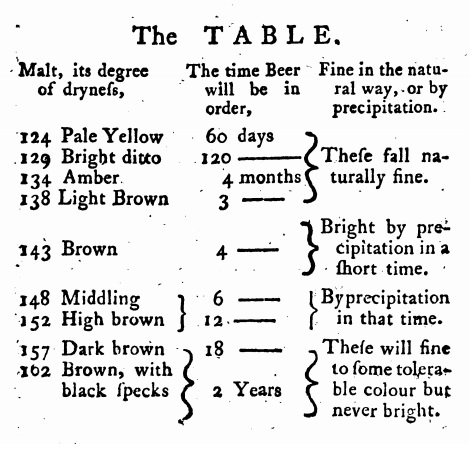
I’ll do that, save the text to a reader of some sort. But right now look at the table up there. It’s from page 37. First, I love its title. The TABLE. As if Child would have added a few exclamation marks. As if he was just figuring out how to make a table out of HTML. Yet… there is another table also titled “The TABLE” just seven pages later. The thing I like next best is how it is immediately bragged up by the author:

These are hints sufficient to guide any one in the choice of his malts, as it respects the color of his beer, and the time it will be fit for use if judiciously brewed; and the experiment is to be made in the kiln as soon as the malt is perfected, and used as soon after as possible to preserve the genial spirit.

Brew with the malt as soon as kilned to attain the desired colour of the beer. Which means nine grades of beer brewed from any given malting should be considered attainable. Child then over pages and pages describes many sorts of beer: “London Beer under the name of Porter,” London Amber, Burton Ale, table beer, oat ale, Marlborough beers, Dorchester beers, Nottingham beers, Western White Ale.

The variety is quite extraordinary. As a whole, the book frames not so much the state of British brewing in the decade before the American Revolution, at a point before traditional brewing shifts to industrial with the shift to steam power starting with Whitbread in the 1780s as it now provides a guide how to go back and recreate them from the few basic elements he first considered on that election campaigning in Wiltshire. Including, towards the end, exotics including three pages on Brunswic Mum  and a shorter passage on Newfoundland spruce and molasses beer.

It would be a great project to annotate and experiment with the techniques described in the book. It is, after all, only through the use of a guide that one figures out if its any good or not.

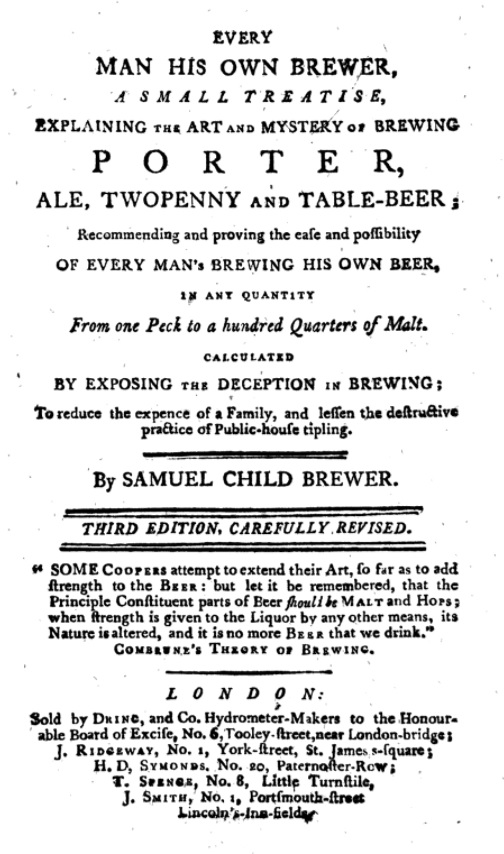
20 December 2017 Update: Martyn has indicated in the comments below that the author is a euphemism for an unknown. Let us examine what we can find out. Below is the frontispiece for the third edition… GO!!!!


Issac Bobin’s Letter, 6 September 1720

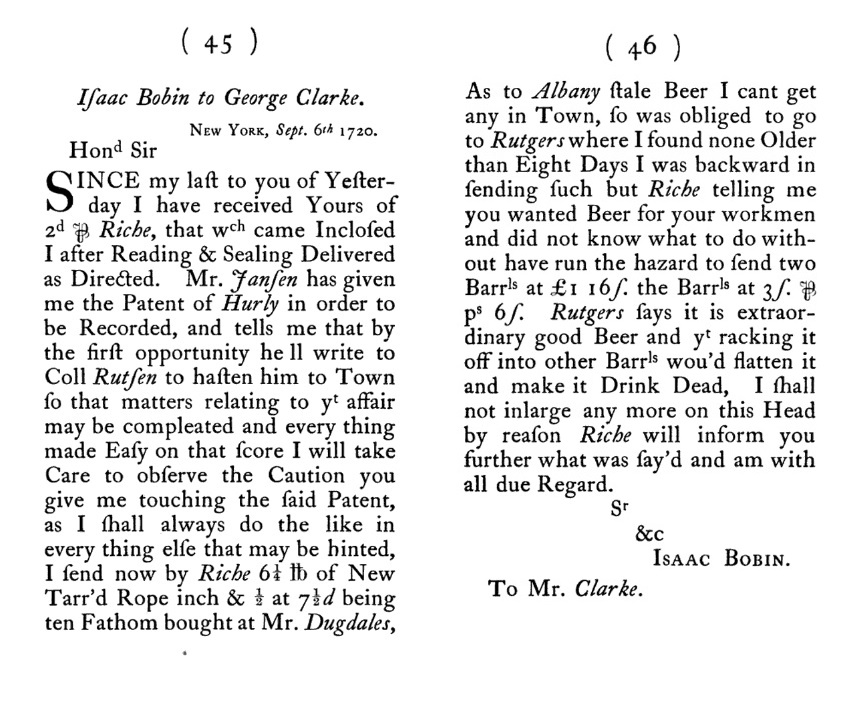
As I was going through the blog posts shifting them over to the new platform for the past few months I realized that I’ve had tight waves of writing enthusiastically separated by other phases of, you know, treading water.  If I had a topic to run with, a new database to explore I got at it. But I also skipped over some things. Failed to suck the marrow. I had in my head that I had a stand alone post on Mr. Bobin’s letter above from 1720 but in fact had only written this in one of my posts about the Rutgers brewing dynasty in New York City from the 1640s to the early 1800s:

In a letter dated 6 September 1720 from Isaac Bobin to George Clarke we read:

…As to Albany stale Beer I cant get any in Town, so was obliged to go to Rutgers where I found none Older than Eight Days I was backward in sending such but Riche telling me you wanted Beer for your workmen and did not know what to do without have run the hazard to send two Barrels at £1 16/ the Barrels at 3/ and 6/. Rutgers says it is extraordinary good Beer and yet racking it off into other Barrels would flatten it and make it Drink Dead…

Isaac Bobin was the Private Secretary of Hon. George Clarke, Secretary of the Province of New York. So clearly Rutgers was as good as second to Albany stale for high society… or at least their workers. And in any case – we do not know if it was from Anthony’s brewery or Harman’s.

The Smithsonian has a better copy of the book of Bobin’s letters. What I didn’t get into were the details of the letter itself. Riche. Albany stale Beer. Drink Dead. Just what a whiner Bobin was. Riche? He seems to be the shipper, moving goods from the New York area to wherever the Hon. George Clarke was located. In another letter dated 15 September 1723, Clarke’s taste in fine good – including beer – is evident:

THERE goes now by Riche (upon whom I could not prevail to go sooner) a Barrel of Beef £1. 17f 6d; a Qr Cask of Wine @ £6; twelve pound of hard Soap @ 6£; twelve pd of Chocolat £1. if; two Barrls of Beer; a pd of Bohea Tea @ £ i.; Six qr of writing Paper. Will carryed with him from Mr. Lanes four Bottles of Brandy with a Letter from Mr. Lane.

In another letter dated 17 November 1719, beer and cider are being forwarded. Bobin’s job includes ensuring Clarke and his household has their drinks and treats. It all is very similar to the shipments for the colonial wealthy and well-placed we’ve seen half a century later from New York City to the empire’s Mohawk Valley frontier where Sir William Johnson received from the 1750s to 1770s: his beer from Mr. Lispenard, his imported Taunton ale and Newark cider .

I find the reference to stale in the 1720 letter interesting as it suggests a more sophisticated beer trade that merely making basic beer quickly and getting it out the door. Albany stale beer. Stale distinguishes as much as Albany does. Plus, Bobin compares to the “Albany stale” to the young Rutgers beer and seems to get in a muddle. What will the workers accept? Or is it perhaps that he is concerned what Clarke thinks the workers will accept. I worry about words like stale like I worry about the livers of the young beer communico-constulo class. We need to do better. Stale seems be a useful word in common usage for (exactly) yoinks but Martyn certainly places it, in the context of beer, as in use around the 1720s so Bobin’s usage is fairly current in England even if at the other side of the Atlantic Ocean. It’s thrown around generously in The London and Country Brewer in 1737 and used by Gervase Markham in the 1660s.

Aside from stale-ness, the dead-ness of the beer obviously is about its condition but why raking off is considered is unclear. Was it just at the wrong point in Rutger’s brewing process or was he operating his business by holding it in larger vessels and selling retail to his surrounding market, like the growler trade today? Again, not just any beer will do. In Samuel Child’s 1768 work Every Man His Own Brewer, Or, A Compendium of the English Brewery we see this passage referencing deadening at page 38:

It has been said before, what quantity of hops are requisite to each quarter of malt, and how the same are to be prepared; but here it must be considered that that if the beer is to be sent into a warmer climate in the cask, one third more hopping is absolutely necessary, or the increased heat will awaken the acid spirit of the malt, give it a prevalency over the corrective power of the hop, and ferment it into vinegar: to avoid this superior expence of hopping, the London and Bristol beers are usually drawn off and deadened, and then bottled for exportation; this really answers the purpose one way; but whether counterbalanced by charge of bottling and freight, &c. those who deal in this way can best determine. 

Just bask in that passage for a moment. It’s (i) a contemporary that British beer was prepared for transport to warmer climates and (ii) among a few other techniques, the intentional deadening a beer followed by bottling was a technique used for export. Burton was, after all, brewed for export. As was Taunton for Jamaica’s plantations. The British simply shipped beer everywhere. IPA was not unique. Was there a beer brewed for Hong Kong that we’ve also forgotten about? Dunno. What we do know is that Bobin is saying is that Rutgers warns against a deadened beer for local use. Would he have been deadening beer for export? In 1720s New York City?  We know that porter was shipped out of town later. We know that late in the century shipments of bottled porter were coming in.

Excellent stuff. I need to think about this more. But, like the seven doors of the Romantic poets, suffice it to say that a good record in itself can open up a wonderful opportunity to chase an idea. In an era of such early and falsely confident conclusion drawing, a useful reminder.

My Local Pub Is Six Miles Away But My Local Brewery Is Closer

Twelve years ago… seriously…

Ah, the pub lunch. It’s Feb Fest,  our municipal winter carnival so we got out of the house and downtown for a pub lunch – well, after watching a bunch of seven year olds playing hockey on the outdoor rink behind City Hall. Surprisingly good game. Yellow against red. A butterfly save was made. Back checking even. The lad we know scored a goal for team red. Knuckle punches given. Goodbyes shared after dinner plans made.

We marched over at the Kingston Brew Pub right after the final whistle. The oldest continuing brew pub in Ontario, they have a newish menu focused around their own smoker out back  – and are carrying about twenty Ontario made good beers in addition to their own. Kale and bacon soup. Veggie tacos. Big burgers. Good to see the owners of another great good beer bar in town having their family lunch in the next booth over. Yellow teamers. I still said hello. We got a front window booth, one of the best spots to sit and have a beer anywhere.

I had a Junction Hey Porter! as well as Nickelbrook’s Headstock, two beers that ask you to explain the point of beer hunting into the States. The exchange rate is enough of an argument now for most but Ontario has done much to stop the grumbling. I think I need to admit that the KBP is my pub. This is at least my 25th year of going there even if we’ve only lived here for fourteen years. We watched Canada lose to the USA in the final of the 1996 World Cup of Hockey. My children have grown up eating there. I am not sure what that means to me but it means something.

I do know a pub man in town, a cheery snappy grumbly Welshman prof now in his eighties, who may now not be so able to get around. He’d have at least double my time in the local pubs. I saw him last in the KBP, holding court. Great guy. He must have seen and amazing shift in the scene given he was here for two decades before the brew pub opened. But the recent news is pretty amazing and now coming at a rapid pace. Just three years ago the nearest breweries were an hour’s car drive away – at least. By the end of this year, we may have eight in town or within a half hour’s drive. And they are good. I have an excellent brewer from western Lake Ontario asking me to introduce him to the guys I know at Stone City. I get a bit frustrated that I can’t get any of the excellent black lager or Belgian pale ale made by Napanee Beer Co. because its all of a 22 km hike away. They opened last spring. I am consoling myself with Kings Town Brewing GPA at the moment. They’ve only open for about six weeks.

I am not sure what that all means to me either but I have planned in better weather how on a Friday I can take the 701 bus from downtown, hit KTB for a growler, then plant myself at a favourite sports bar and wait for a drive home. That’s good. And new.

As Expected The Beer Health News Ain’t Good

In these exciting new times, we are suddenly aware of the need to sift the news, seeking out the alternative facts and hidden interests to cast aside. It’s normal to want to be on the winning side but, as this stuff gets layered by the shed load, we need to take a responsible approach and act like adults.

As much as anything, this applies to the brewing yap-o-sphere. Fortunately some folks are putting their big boy pants on and debunking the fibs, as we see today in Outside magazine’s article “Sorry, Folks, Beer Isn’t a Health Food” in which we find this particularly telling observation:

…sometimes research—especially on nutrition—is overly reductionist. Food writer Michael Pollan opines about the dangers of studying single nutrients in his 2007 book, In Defense of Food, saying, “A nutrient bias is built into the way science is done: scientists need individual variables they can isolate. Yet even the simplest food is a hopelessly complex thing to study, a virtual wilderness of chemical compounds, many of which exist in complex and dynamic relation to one another, and all of which together are in the process of changing from one state to another.” As you’ll see, some of these beer studies look at only a single compound within the beer and extrapolate results from there, when really, there is likely more going on.

Every time some altfactiod blurts out onto social media about the magical properties of beer, the interested mid-rangers gather like sharks to a wiff. Hallelujah!  If life were only that easy.

I thought of that nutrition point when I went through Pollan’s books back then but didn’t make much of it. I thought of it again this week when, again, a saw a photo of a good young keen beer writer with the slightly jaundiced hue. I worry. A few months ago, Maureen Ogle tweeted a link to a study that talked about how beer health studies were so selective, never took the net effect into account. I lost the link but remembered the lesson. Your health? It’s operating on the net effect.

That article? It’s got a great conclusion. Let me ruin it for you. Beer’s pretty okay. Beer isn’t the new kale.

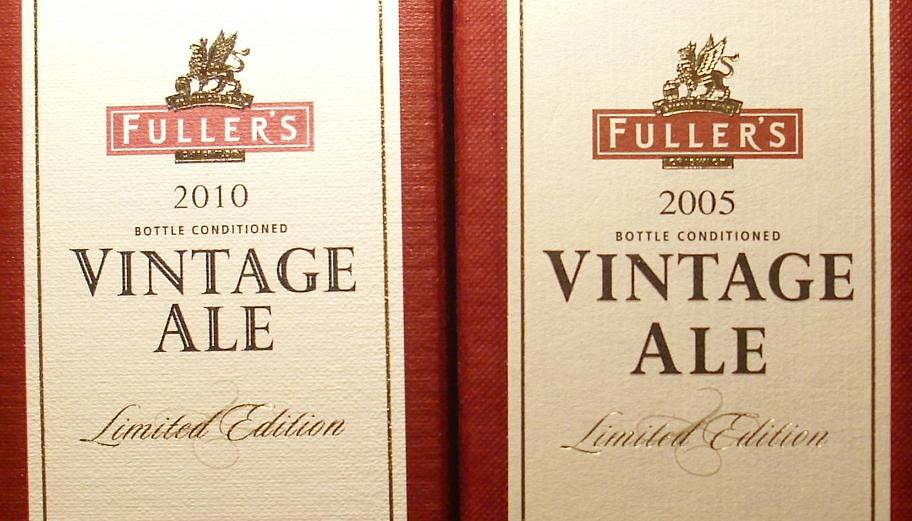
That Musty Box Of Fuller’s Vintage Ales

First conclusion of the experiment: the boxes are far less mould caked
when not left in a corner of a cold room for a decade.

OK, it wasn’t so bad. I was worried there for a bit but its gonna be OK. Turns out I have doubles. I have leeway. But, come to think of it, this box holds ten years of Fuller’s Vintage Ales, 2007 to 2016 and it’s high time I tucked into them. First, I bought them and tucked in right away. Later, I would do some comparing and contrasting, like the .05 v .10 and the ’06 v ’11 but I didn’t keep it up. I just stock piled.

I used to stockpile. Like those Stone Vertical Epic Ale annual releases. Like the Thomas Hardy ales. I ended up giving away Stone’s 05-05-05 to 12-12-12 more out of a sense of boredom than anything. By the end of the project it was a parody of itself. Reports were that a third were great, a third were fine and a few plain sucked. Such is the path of big US craft. Yet, they gave more joy to those gifted than my THA’s are given me now. Yik. Malt reduced to soy sauce. Hops now only offering the residue left after I boiled down my childhood ’45s. So glad I saved them. So, tonight I begin my attack the box at the back of the cellar.

First up and this Fuller’s Vintage Ale 2015 is not giving me the joy. There’s an astringent green vegetable taste in the middle of my pint where, you know, rosy cheeked English youth gathering in autumn’s harvest should be gamboling… cavorting even. But it’s clear and the colour of a love match between a lump of amber and a chestnut – which I will grant you is a bit of a range. And it raises a good head. As ale it is not fouled. BAer review speak of a wooden bitterness. I get that.  Don’t want it. But I get it. Yet… as it sits it moves from astringent green vegetable to astringent exotic orange-like citrus fruit you couldn’t pronounce but thought you would buy anyway because “hey, it’s Christmas!” and then you find it dried out a bit at the back of the shelf weeks later, closer to February than December. Which is better. I now get some husky grain. I can even see Seville marmalade from here. Even if made by my cray cray great-aunt well past her marmalade glory days. Household helpful hint: open this and let it breath for an hour.

I had to wash both bottles of the 2014. The first one I pulled out was stored upside down and it’s showing a need to sit for a bit. Cloudy. And both have stage one designate substance issues on the box and label. In the mouth, again with the musty staleness. Gonna let it sit a bit but at least its not paying homage to a green pepper. Later. Better. Still maybe infanticide as the flavours have not resolved. There is a hay loft grainy dry as well as a a rich earthiness. If my garden compost tasted like this I’d be ecstatic. Thinking about it, Gouda and mushrooms on toast. That would work well with this. Later still, the narrative is adds a dry stone aspect. I am now walking on a path on a hot day through rocky fields like those in our nearby fine wine region.  The hops after an hour have a rich sweet field herb and mint aspect. I once owned a scythe and an acre garden needing tending. This is taking me back there.

[More later. An on-going project… until it’s all gone.]

A few days later, the 2013. Bottle washed and cap popped. Cold. Canadian cellar in February cold. Gotta let it sit but the first sniff and sip are promising. Cream, grain and rich sweetness.  Unlike its two juniors, nothing off yet. Receding beef brothiness shifting towards sweet stewed apple. But mainly a mouthful of husky graininess. And cream. Brie cream, though. The cream made by the Brie cows. There’s something going on there. A Brie thing. Brie-like. Maybe. Thick viscous stuff. But no earthy brooding and nothing like Seville marmalade. Fresh and open an hour later. A lovely beer.

One more week has passed. The 2012 just opened had a far less challenging bottle. Cold from the final few boxes in the beer cellar it is stunning, exemplifying what I absolutely love about great beers. Masses of cream cut orange marmalade.  I curse 49 year old me for not buying cases and cases of this. Kumquat even. I say that as a man who just this very afternoon roasted two chickens stuffed with kumquats. Just saying. Go eat kumquats if you don’t understand. Tangy, fresh, intense, bright citrus. I am pouring half an inch at a time into a dimpled pint mug and ramming my nose in, sucking the aroma in deeply.  [That, by the way, is how to drink fine beer according to me.] As it warms, the graininess starts to assert itself. So now it is like wholewheat bread with a double cream and marmalade spread. I should be graphing this, with different brightly colour lines tracing the taste every fifteen minutes. I am going to leave it there. I am having a moment. OK… ten minutes later weedy herbal notes as well as a nod to beef broth come out. Stunning.

Beer Politics, Policy And Civics

As I had modestly mentioned a couple of times over the last few weeks ago, the election of Mr. Trump to the Presidency could lead to a couple sorts of beer nationalism in support of his muddled form of neo-protectionism: an anti-import reactionism and pro-American jingoism. With the report that he will try to convince a free trading Congress to pass a 20% import tax on Mexican-made goods as a way to pay for his useless wall, my first suggestion now seems to be at least be a possibility. It’s a policy. A bit of a weird one* but one that might, however unlikely the chances, become law. Political victory leading to imposition of policy that shifts the civic reality.

On Monday, Brian Roth published a post entitled “Do You Want Politics in Your Beer?” in which he uses his Tweets’n’Graphs methodology to discuss what he described as “a brewery’s political activism” and then posing, a bit cautiously, whether it is good when breweries share their beliefs in this way. This morning, Michael Kiser posted on a rather similar topic in his “Critical Drinking — The Beer Politic.” While it jumbles the function of his site as a consulto-blog and certain hero breweries in their reaction to Trump, he answers Bryan’s question (without acknowledging the prior post) much more enthusiastically and very much in the affirmative – but still like Roth all a bit too brand focused .

Trouble is, fretting about appearances isn’t really about beer and politics, is it? Almost four years ago Craig posted an excellent survey of the connection between brewing and actual politics over the centuries of New York’s history.  In his post “Albany Ale: The Politics of Beer” he describes how seven Albany brewers from the seventeenth to twentieth centuries engaged with political office and partisanship. Even the great John Taylor got involved:

The 19th century would see the election of not one, but two, brewing mayors of Albany. The first was John Taylor in 1848. Taylor owned what was at the time the largest brewery not only in Albany, but in the country, Taylor & Sons. Upon completion of his tenure as mayor, Taylor served on the board of water commissioners, starting in 1850. He and his compatriots were responsible for overseeing the first municipal water system in the city.

You can read the rest but, as you do, think about whether what Roth and Kiser were driving at: the taking of public positions and its effect on reputation. For my money, while they can wrap it in phrases like “the brewery’s decision to focus on its own measure of authenticity” or “[t]his is why so many of us fought for and supported the rise of local breweries” they still both seem to conflate (i) the brewery as a business with a brand and (ii) the brewery owner as a citizen with a full life beyond the beer and also (iii) the taking of actively advancing a position in favour of either the business or as a citizen through political engagement.  These are different things. Forget worrying about what a small segment of your customers think about your brand’s reputation. Any citizen who is also a business owner who doesn’t engage with the implications of being governed is ignoring one of the greatest dangers to that business’s success. And courting disaster.

Isn’t the reaction of customers to brand secondary where a local craft brewery finds its local municipality, for example, spending taxes to attract big craft competition to town or, for another, supporting fracking and putting the community’s water table at risk? Of course it is. Why wouldn’t the sensible brewery owner protest, pound on the Mayor’s office door or even run for an upcoming council election if their business, their interests were being placed at risk? They all should. That’s about getting beyond the, yes, quite important move from complaisance to complaint that I see Roth and Kiser discussing. That move can and, I would argue, should justify – if not demand – not stalling but then moving on to actual politics.

It doesn’t mean you have to go all 1920s Dan O’Connell take over the Albany County Democratic Committee, rig elections and leverage the Hedrick Brewery to be the town’s boss.  But would it kill you to write or call those who represent you in the political realm?  Would it hurt too much to maybe pass on that next bit of indulgent “beer travel” and the tripping haze of new fun bar after new fun bar and, instead, travel to sit in a committee room where a policy you hate and want stopped is being discussed, waiting your turn soberly to put your ideas on the record for the five minutes they give you at the microphone?

Getting political is about waking up, being adult. Doesn’t really matter where your interests or political preferences lay. You think the big craft carpetbagger brewery that received the regional branch plant tax break wasn’t engaged in politics behind the backs of the local brewers? I bet the local craft community wishes it had laid the earlier groundwork that might have seen them receive the funding for expansion instead. Which would have required them being actively political.

*Given it will mean that Americans and not Mexicans will still pay for the wall as additional markup on their import of Mexican goods. His own party’s leaders are already mocking it.

Nationalistic Jingoism And Your Beer

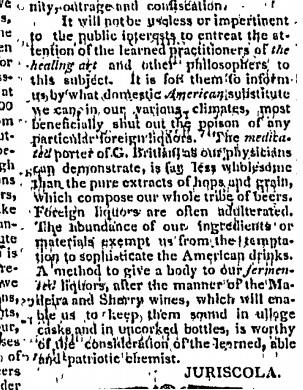
As our neighbours to the south watch the beginning of what I can only consider the death of conservatism by slowly inflicted suicide, it is instructive to note that the role of beer in nationalistic jingoism is something no longer often given its full weight. That clipping to the right is from the 7 September 1810 edition of that most wonderfully named newspaper from Hudson, New York, The Bee, reprinted from the National Intelligencer. The author is arguing that British porter is unwholesome. Common enough claim at the time. It’s the final of a number of arguments made in an essay published under the pen name Juriscola. The man behind the clever tag appears to be Tench Coxe, aka “Mr. Facing Bothways” for his habit of flapping which ever way the wind blows. By 1810, he was pro-tariff and definitely buy American after a career that saw him welcome the British to Philadelphia in 1777 with open arms.

Nationalism is not solely an argument heard from the USA. Pete maps the role of ale and porter in the second British Empire of the Victorian height in his book Hops and Glory at scale, as we have just discussed.  And ten years after Coxe’s essay, a rabble was being roused right here in in what was the Midland District of Upper Canada by brewer Richard Dalton against the importation of those foreign beers from the south. And likely with good cause if the presence of 160 barrels of Albany Ale in 1816 in our small community is evidence enough. Not even an alternate fact, that. Dalton’s argument is pretty specific: stop bringing in foreign barley. Coxe, by comparison, lays it on thicker. Certainly, the argument is made that domestic grain and fruit supports increased domestic manufacturing. And also that domestic production is superior as an expression of American ingenuity. But then he makes a telling argument: the needs of the military.

The most enormous expense of the American revolutionary war and the deepest sufferings of the patriotic army were those produced by the frequent destitution of wine, good distilled spirits and porter. It is therefore of the greatest importance to our possible military operations that we have a quantity of some of these liquors steadily manufactured in our country from our own materials equal at least to ten millions of gallons.

Note: by “possible military operations” he basically means attacking my town.

So, how will this sort of thing manifest itself in these our own confusing times of the vacuum at the top? Will there be a revival of state sanctioned brewing jingoism? Will, as I suggested soon after the election, Corona and other popular imports face backlash as being unAmerican? Or will the odd and newly joint opposition of the left and free traders take up the slack and prop up sales in defiance?  A new 35% tariff might make those modest brands tough to choose from the grocery shelf even for the idealist.

But will people – err, The People – buy into such protectionism given it is essentially a claim to marketplace weakness, a message of failure? Can such alternate truths gain a foothold?  Depends on the presentation, I suppose.

Burton Ale: “…They Brewed Not For Home Consumption…”

I hate… yet love… the small nuggets of information I come across when scanning the news reports from the 1700s. That’s a report from the New-York Gazette and Weekly Mercury of 24 July 1780 describing a debate in the House of Commons in London on a committee report on the taxation of malt. The regional rivalries between the big (or bigg) of Cumberland and Westmoreland as opposed to Scottish malt is one thing but that tidbit about the taxation of Burton Ale is gold… maybe.

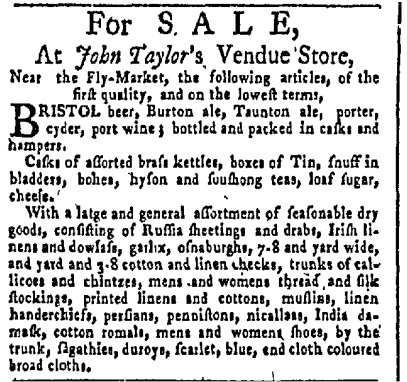
Burton appears to be in the New York City market from 1770 from the notices like this one from the New York Gazette of 12 November of that year that offering it for sale at the Wall Street store of Samuel Hake. Eight years later, according to the NYGWM of 24 April 1778, it is being sold at the Vendue Store of John Taylor near the Fly-Market at the foot of Maiden Lane at the mouth of the stream associated at the time with the breweries of Medcef Eden and two Rutgers.  Taylor is also selling Bristol beer and our beloved Taunton ale along with porter.  Plenty of the results of English brewing is ending up in the colony.

Notice that Sir William Bagot does not deny the argument that Burton is brewed primarily for export, just that it opens a door to other presumably less valid claims – and perhaps illicit domestic sales. About a year ago, Martyn and I exchanged a few thoughts about the lack of understanding about the origins of Burton ale. But this bit of a Parliamentary debate is one of the only references I have found indicating an understanding at the time that Burton – like Taunton, porter and others – was part of large and organized North American export trade during the second half of the 1700s.

I wish I could figure out how to determine its scale.

The Business Case Study Of My Late 1980s

I do not often let out a squeal of giggly delight but I did last evening when I came across this university course business case study from 1995 entitled “Peddler’s Pub and JJ Rossy’s Ltd.” It was written by Professor Jeremy Hall of Saint Mary’s University for the Acadia Institute Of Case Studies and sets out a description of the downtown pub scene from my hometown of Halifax in the years when I was in my mid to later 20s. It lines up well with two early posts of mine for The Session but has masses of detail on the business side of the taverns and bars I knew as second homes. I came across the document when Norm, the Boston Beer Nut, and I were a’tweeting and I was making the case that there is a forgotten phenomenon from the early micro era – the “beers of the world” bar / pub / tavern. The Hall study mentions the principle establishment of this sort in Halifax, the still operating Maxwell’s Plum:

“Nobody is focusing as much as we are.” According to co-owner-operator Scott Little, Maxwell’s Plum had the largest selection of single malt scotch and imported beer in Metro: 21 single malts, three blends, one Irish whisky, five imported draft and dozens of imported bottled beer. Importing so much does have its drawbacks, especially cash drain, as payment was due before delivery for special orders through the NSLC.

The atmosphere of the bar could be best described as traditional – the focus was on a large, well stocked bar with dark hardwood fixtures. Most of the time management played low volume music from a selection of 200 CDs and live jazz on Sundays, without a cover charge. “We want people to be able to talk to each other and be comfortable” (S. Little).

I remember, vaguely, being in a beers of the world bar in Paris in early 1986 and also seem to recall a few years earlier that our undergrad bar having beers of the world nights where you had a passport that was ticked as you bought your syrupy black McEwan’s Export or a thin glassed bottle of Dortmunder Union. Chris Begley reports that there was a place like this in Vancouver called “Fogg n Sudds” about the same time. A version seems to still exist connected to an airport hotel. Calgary seems to have had its own Bottlescrew Bill’s since 1985.

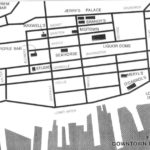
The Hall study has a number of other tidbits of information that frame the downtown scene, starting with this map. I kid myself that I could sketch this blind folded in a isolation tank but most of the locations pop back to mind immediately. The map also illustrates the general university student flow from southwest to north east, the march many evenings being from Your Father’s Mustache to the Lower Deck. And there is a concise description of what “draft” was:

Draft beer could be purchased from the two local breweries, Moosehead or Oland’s (a division of Labatts), and was generally the least expensive form of alcohol. Draft beer was allowed under all categories of licenses. Draft came from the same vats as bottled beer, but did not go through a pasteurization process, and therefore had a short shelf life.

When I started my Halifax pub life, this fresh tasty pale ale was ordered in pairs of eight ounce glasses but by the mid-80s that was being replaced by the 20 ounce imperial pint. I think this might have been started by the opening in 1986 of the Thirsty Duck which had the first keg Guinness in town. The days of the “draft wars” are also fondly recalled. I remember one place that had a horrible business plan based on Monday selling 29 cent draft, Tuesday 39 cent draft, etc. Lasted only a few glorious months.

One thing the report illustrates is how the narrative that micros changed everything is a bit of a fib. There was a bit of that. We certainly could buy New Brunswick’s Hans Haus lager in the stores or go have a Peculiar at the embryonic Granite Brewery, then housed in one half of the early rougher incarnation of Ginger’s on Hollis Street.  They did not, however, set the scene. While society generally has enjoyed a great diversification in all sorts of consumables over the last 30 or 40 years, the drinking experience was still laced with the perception of variety that included, well before micros became popular, a variety of imported beer choices. I’d be interested in learning how many other places like Maxwell’s Plum were out there in other communities but my inclination is to consider imports opened or at least eased the entry to the market for micros.