The Thursday Beery News Notes For The Week We Are All Cape Verdean

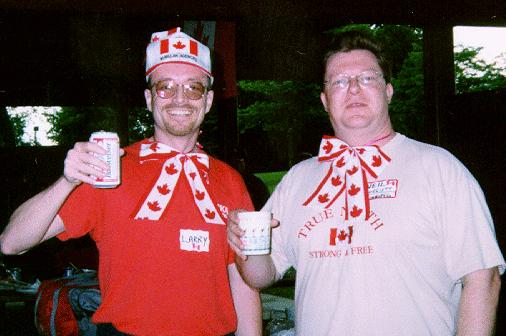
We need a new anthem:

Let’s root root root for Cape Verde
If they don’t win it’s a shame…

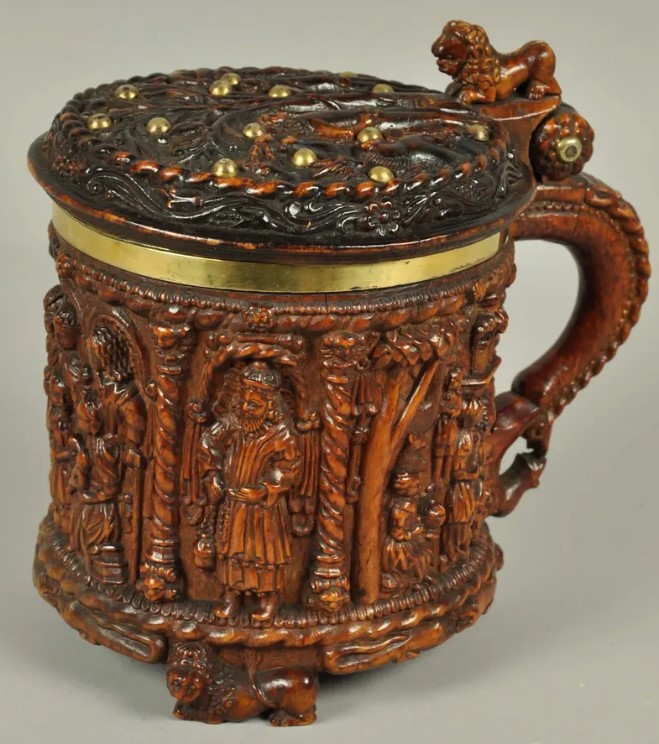
Actually, that tie will do just fine. Just fine. Still, Uruguay has have the best strip. We remember the Graf Spee after all. Isn’t it fun how many old simmering bigotries and grudges come out during international sporting events! Speaking of fabulous cups, Lars shared that image this week: “… carved by a Norwegian farmer… The king bought this mug in 1798 for 60 riksdaler, an absolutely wild amount, equivalent to roughly 10 cows.” The Scandenavian bovine value (SBV) scale to the rescue… again.

How many cows is the World Cup worth? [Ed.: “…crickets...”] Studies have shown that a beer at the stadium might cost you about one-third of a cow. On the other hand, it is pretty clear what inviting the Tartan Army to your town is worth to breweries:

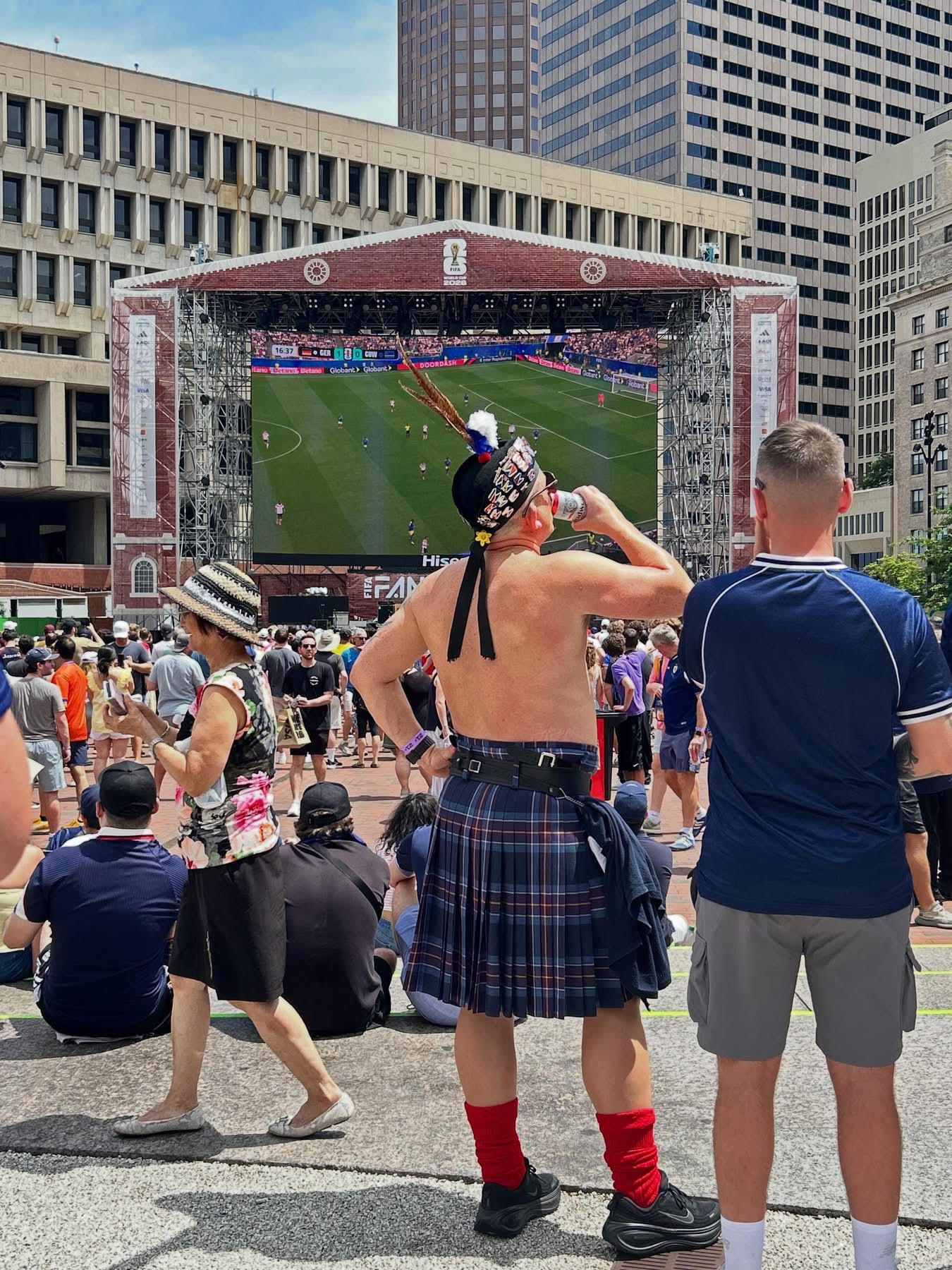
The Tartan Army chartered dozens of school buses from Boston and Providence to get to the game. On the ride with the Scots were many father-son pairs, kilts and even more beer. Organizers brought 10,000 cans of Narragansett Lager for the Foxborough-bound buses from Providence alone. None were left by the end of the night.

Wow. The call has gone out for an extra 100,000 more! My own wee cousin** is out there representing the fam. Seems like the Army is working hard to beat the English in Spain in terms of fluid input, according to one French news source. And Ruvani has also been on the World Cup beat and shared the thoughts of opinions of commentator Roger Bennett what makes for a great fitba focused bars in the US including this good point:

Bennett is keen to emphasize that there are aspects of great American soccer bars that are both unique and essential to the U.S. In other countries, “you commune with fans of your team and everyone else is the enemy, but in the U.S. most fans are young and have come in since the Premier League started being broadcast by NBC in 2013,” he said. “Their discovery and passion have created a unique culture that’s not divided into us-against-you.” This difference means that bars must be ready for and welcoming to multiple fan groups, fostering an inclusive spirit. 

Speaking of welcoming, Ontario’s fading but venerable former retail monopoly The Beer Store is doing something very unusual the days – opening two stores as it closes many more. But its doing so seemingly primarily to receive back more empties as much as to sell beer:

The Beer Store has closed dozens of retail locations across the province over the past two years, citing changing market conditions and the expansion of beer sales to convenience stores, more grocery stores and gas stations. Many of these retailers do not accept empty container returns… As Ontario’s largest beer retailer, The Beer Store recently unveiled a new “Take back what’s yours” campaign aimed to boost awareness of the province’s deposit return system. A recent analysis by the Toronto Star suggested Ontario consumers lost more than $60 million in unredeemed deposit refunds last year by placing empty alcohol containers in their blue box or the trash instead of returning them to The Beer Store.

And Stan has issued his latest Hop Queries and you are all well advised to govern yourselves accordingly. And he’s used a concept that’s been unfamiliar in the brewing world in recent years – stabilized:

After reducing acreage from 60,872 acres in 2021 to 41,654 in 2025 (that’s 19,218 acres), American farmers indicate that total acreage will remain basically the same in 2026 (at 41,642; 12 fewer acres than in 2025, less than three-tenths of one percent lost). The German Hop Growers Association reports that farmers will harvest 5.8% fewer acres in 2026 after slicing 6.5% in 2025 — leaving 44,117 in 2026, compared to 50,136 in 2024…. It should not be a surprise that a press release from the German hop growers about acreage states, “The mood in the hop market is currently poor” and “the oversupply of aroma hops had made production cuts necessary for several years.” 

In amongst some cheeky chat about NA beer, Andreas Krennmair stood up and sensibly explained with semi-cited research why it is that German NA beers are better than elsewhere in the world:

I’m sure the technology will eventually cross the ocean. From what I’ve been told, all the Bavarian breweries launching new and better NA beers basically comes from one guy’s PhD thesis at the Technical University of Munich at Weihenstephan. I’m not sure the thesis has been published yet, but… here’s one paper from the same guy about the impact of different NA production methods on aroma compounds. 

Here’s Dr. Guy’s paper. I like the acronym they use too, NAB. Suits my feels as a consumer some times. Andreas also shared the best beery gross out of the tournament so far, the drink to accompany an early match:

If you’re looking for the perfect drink for today’s Germany-Curaçao match, here’s a 1970’s beer cocktail for you: Isarwasser. In a 1 litre Maßkrug, combine a bottle of Bavarian wheat beer, half a litre of orange juice or orange soda (e.g. Fanta), and a shot of Blue Curaçao liqueur. Enjoy!

I’m all for fighting the hegemony of homigeneity but… I was sure he was joking. Here, however, is independent evidence of this crime against the clinky and the drinky.

Matty C had a good go at the numbers behind the lack of a GBBF this year, the reasons for which have become clearer with time:

… attendance was way down, with 13,000 people attending over five days – far short of the event’s apparent 23,000 target…  both the main GBBF and its winter equivalent have been cancelled. According to one discussion on its members internal forum, the festival made a staggering £320,000 loss. This feels significant, because you don’t plan the largest beer festival of the year and then move on after losing more than a quarter of a million pounds. A loss of this magnitude isn’t made simply by mismanagement – it’s gross negligence.

Wow. Wowsie-wow-wow even. Knut‘s written about another sort of challenge facing those in the trade – finding yourself brwing quality niche brewing in an isolated location. He noted a few interesting strategies to deal with that reality:

Carl brews beers inspired by Belgian classic styles, usually with malt from the Trøndelag region and with Belgian organic hops. I am lucky to have a designated driver, as we sit down to sample a few of his saisons. It’s a tough market these days, there are some beer bars in Oslo and Trondheim who sell his beers, but not many. He has teamed up with a local company that sells high end salmon fishing in the nearby Gaula river, probably a wise choice with guests paying good money for a quality product. The lower alcohol beers are available directly from the brewery, get in touch with him if you are passing by.

As you consider your route to the Gaula River, here some notes:

Note #1: this vid on UK pub habits also is about Canadianness.**
Note #2: “…BUD stock up 29% yr-to-date…
Note #3: Ron on Scottish Sweet Stout.
Note #4: “…stuck in 2016 for a moment… Just like DogHouse Edinburgh.

Question. Horse brasses – history or heritage?*** Boak and Bailey were on the case this week:

Newly built pubs on housing estates and new towns across Britain, desperately in need of instant personality, also often came with horse brasses fitted as standard. For example, when Scottish & Newcastle built The Moorcock at Peterlee, County Durham, in 1973, to provide a “tinge of country atmosphere… in a tasteful blend of ancient and modern” they fitted it out with “beams and timbers and rustic brickwork and horse brasses, sporting prints, and game birds”. (Hartlepool Northern Daily Mail, 15 November 1973.)

So a bit of each. And Alistair has been back home in the UK and has started sharing his thoughts on what he’s missed, starting with a day in Windsor waiting for his flight on to Inverness:

I had been to Windsor all of once previously, but I may have been about 12 years shy of being able to drink legally, and as such I don’t remember much about that visit. There is though a family legend/inside joke that at some point whilst wandering near the castle, I asked my parents why it wasn’t finished yet given the scaffolding that surrounded many of the buildings. I was then somewhat keen to walk by the castle to check up on progress in the intervening 40 odd years – there was still scaffolding to be seen, still not finished then I guess. It was getting pretty bloody warm by this point of the day, even though it was only 9.30 by now, so I took myself off along the river to get to my first planned stop of my tour of the town’s hostelries.

Alistair, being the good saintly lad he is, was well advised to leave out the visit to the city if the latest edition of London Beer City where Will Hawkes explains something I, also being a good saintly lad****, was not aware of… the class of establishment known as the strip pub:

Now – a bit like the Ploughman’s Lunch – strip pubs have almost entirely disappeared. This week the owners of The Nag’s Head in Aldgate submitted plans to Tower Hamlets council which would see this long-established strip pub turned into a “traditional pub” and 24-room hotel…. For younger Londoners – who make up the bulk of my readers, naturally – it must seem incredible that so many pubs once featured women taking off their clothes, but the past was a different country. What was most remarkable, actually, wasn’t the stripping – that still exists, albeit largely in glitzier surroundings – but the low-key, unglamorous, seedy-in-a-specifically-British-way nature of it. No stage, no pole, pounds-in-a-pint-pot for payment… Crucially, these strippers moved whilst naked…

Heavens. Naked people just wandering around the pub among the drinkers? Yik. These places probably reeked of Isarwasser. Speaking of another form of the unfortunately unsavoury, Lesley Chesterman wrote about criticism this week:

When reviewing dishes like that, you can’t lie and say everything was great just to keep things positive. I saw this in my time as a critic as well, this idea of being “mean” when criticizing professionals cooking. People obviously focus on the negative side of criticism, but the truth is, it can be beneficial too. How will any chef improve if you don’t give it to them straight? And how will we uphold a high level of gastronomy here in Quebec if we’re all afraid to call out mediocrity? It is constructive criticism after all, and the goal in cooking should always be excellence. Undercooked frog’s legs and rice are not excellence. 

Agreed. In one of the sillier examples of forecasting yet, the International Wine and Spirits Record (now IWSR) has predicted what the world will be like in 2035… without any reference to the coming global resource wars:

According to the findings, the stabilisation in global volume from 2031 will be driven by two main factors: a “substantial rebalancing” of the global market, and continued growth in the worldwide drinking age population. Over the next decade, the global beverage alcohol market is, according to the analysis, anticipated to be “shifting away from China, North America and Europe to India, South America and Africa”. From a global perspective, this is said to be “most clearly illustrated by looking at consumption by servings” with the research highlighting that “the different serving size volumes of different categories” is a factor to consider.

Serving size? I might have thought fire spewing drones sweeping the landscape into a hell zone might have been a more important factor in the future to come… but I’m like that.

On a similar sort of standard, some attention was drawn to a PR infographic calling itself a summary but being held out as a research study about the NAB drinking habits of the British. Example: “New research from non-alcoholic brewery Athletic Brewing Company and KAM Insight shows that 94% of alcohol-free beer drinkers also consume alcohol.” There seems to be no statement of the research’s definitions, the methodology or the manner in which data was collected. Noce. I’d move to know the criteria for establishing whether one is or is not a “highly active, performance led consumer“! The 94% to 6% split on “alcohol-free drinker” habits is a head scratcher. Is anyone who ever had a NAB included in the 94%? One wag commented that it was akin to this sort of statement:

The Benson & Hedges Wellness Institute reports filtered cigarettes offer a smoother more pleasurable smoking experience.

Oh. That was me! Still, this sort of effort seems to discredit itself from the start. By the way, I’ve been “Zebra Striping” regularly for about four decades. It’s called water.

There you go. That’s enough for now. Another jam packed week in beer and brewing… and the World Cup. As we wade through more and more matches, please take time to check out Boak and Bailey posting on Saturday and adding to their fabulously entertaining footnotes week after week at Patreon. And do look out for more of Stan’s new “One Link, One Paragraph” format including this week’s wisdom: “People need to get out from behind their phones, go to a bar and talk to each other.” Then hunt out something in someone’s archives! Leave oblique comments on someone’s post from 2009!! Listen to a few of Lew’s podcasts and get your emailed issue of Episodes of my Pub Life by David Jesudason on certain Fridays. And Phil Mellows is at the BritishBeerBreaks. Once a month, Will Hawkes issues his London Beer City newsletter (but always never with this week’s NSFW warning) and do sign up for Katie’s wonderful self-governing totes autonomous website featuring The Gulp, too.  Ben’s Beer and Badword remains on pause but there is reading at The Glass which is going back to being a blog. Any more? We have Ontario’s own A Quick Beer and All About Beer is still offering a range of podcasts – and there’s also Mike Seay’s The Perfect Pour. Plus follow the venerable Full Pint podcast! And there’s the Craft Beer Channel on Youtube as well as the archives of the Beer Ladies Podcast.

*The young lad possibly as illustrated on a FB page name of The Boston Calendar. I tihnk that the the City Hall plaza if I remember correctly.
**H/T Gladman. Note the dropping of the terminal consonant at the ends of syllabels.
***Heritage being that approved part of history promoted for present purposes.
****Apparently, according to a key word search, I’ve never told you how at the dinner table one evening when I was about 15 my mother out of the blue advised me “oh, and if you ever think of going to one of those stropper places think of me up there!” She may have pointed her fork at me as she said that. I never have cross the doorstep.

The Charming Disarming And Slightly Alarming Beery News Notes For A Thursday In June

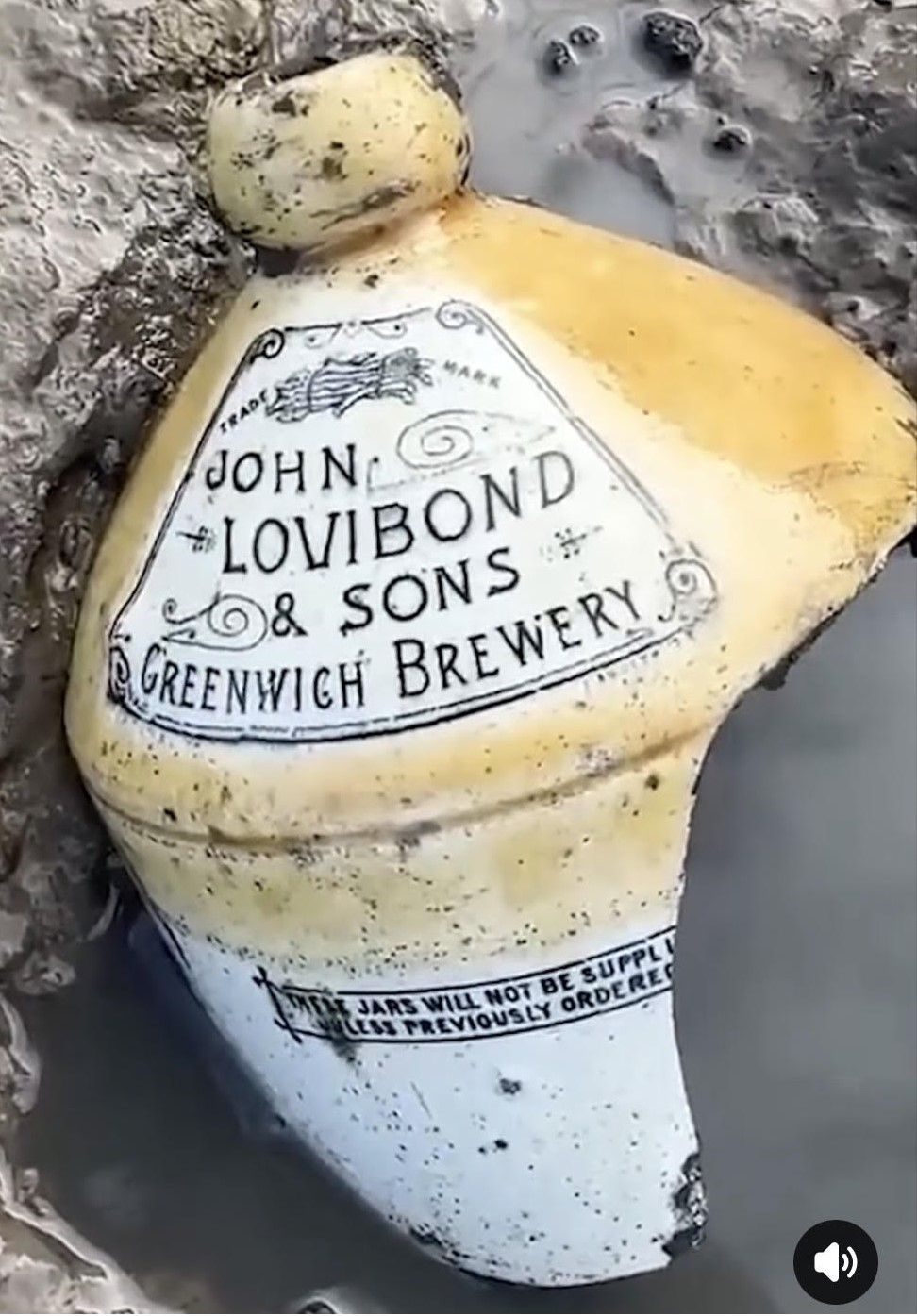
The nice thing about the youngest kid having a job with shifts that end at 11 pm is a fella like me can stay up late for the NBA Finals, listening to 660 AM every second evening when I am waiting out in the parking lot for the kid’s shift to end.*  I am not saying I am some sort of “Mr. Knicks” but this run has been fun. But that’s ending soon and it’s all going to be World Cup naptime late afternoons for the next few weeks. It’s exciting be this idle. And when I am not fixated on bandwagoning basketball or ignoring what FIFA actually stands for, I fill the empty hours with social media where this week I saw that shard up there, a bit of a jug pulled from the mud of the Thames by the ever excellent Nicola White on FB. Obvs I noticed what you notice. Mr Lovibond? Turns out John L. was (maybe*) the father of Joseph L. who was the inventor of the Lovibond scale used to describe the colour of beer. Neato. That jug is no more 150 years old given the trademark registration of 1876. I am but a pup.

What’s else up? Well, for starters, we are coming up is the 150th edition of The Session as Boak and Bailey explained:

On Sunday 28 June 2026 we’re going to post something inspired by the late Martyn Cornell’s final epic work of beer history Porter and Stout. We’d love you to join us. The first problem is that the book is quite expensive. The second is that it is large and intimidating. To make this easy for ourselves – and for everyone else – we’re suggesting that you can join in the Session even if you haven’t read the book. Your post just needs to be in some way a response to it, or to Martyn’s previous work on the subject of porter and stout. If you can read some of the book, though, even if it’s just a few pages or a chapter on some aspect of the history of porter and stout that particularly interests you, that would be great.

Excellent. Perhaps as an aid in your considerations, reflect on what Dr Christina Wade posted an excellent post this week on the need to be aware that choices are made when topics are chosen:

I love beer, in particular, and most especially, I love craft beer. And to add an additional layer to that, I love history. Adore it… So, to be able to combine those interests together into a research topic is a personal favourite of mine. I love both of these elements so much. History and beer. And I have decided, because I love them, that everyone else should as well and I am going to write about them in a way designed to convince you of that. This doesn’t sound particularly sinister, but it can be. Think of all the ways people write to try to convince you of a certain standpoint, or view, or historical ‘fact’. So when you are reading, and indeed, when you are writing yourself, keep this in mind. But even choosing the topic can be this way.

And, perhaps reflecting that, Jeff did just that when he applied a little mathematics to do a fact finding exploration of the obvious this week with his description of the state of big craft breweries since 2021:

Behold this table… The list excludes companies like Tilray, with many brands and breweries. The “Change” column on the right-hand side measures the breweries’ five-year performance. An asterisk indicates a brewery the BA does not designate as “craft.” As you can see, one-third of these larger breweries grew, while two thirds shrank. If you remove Athletic, which actually produces a different product, the overall performance of these big breweries worsens considerably. It’s a collective loss of around 2.2 million barrels, an overall decline of 16%.

You can follow that link to Beervana to check out that table but while Jeff says he didn’t provide any analysis in his post the fact is he didn’t need to. The math is the math. You know, it’s not fun to keep pointing it out but it is necessary given how many trade officials and some trade writers aren’t addressing, aren’t really admitting.  But “chef’s kiss” to that comment about the Athletic… that’s funny… and correct.

And over at the Cleveland Prost, Will Cleveland has provided us an extended explanation of the origin of Genessee Cream Ale, the best old school beer brewed on the south side of my very own lake:

In the late 1950s, Geminn was working with two offerings that each had a ceiling: Dickens Dry Ale, available between 1956 and 1958, which consumers found too spare, and 12 Horse Ale, popular but heavy in a way that limited how much you wanted to drink of it. He needed a middle ground. The influences pulling at him were multiple. Genesee had deep German roots, but brewery owner Louis Wehle had long been drawn to English ales and Burton-style brewing systems. “Clarence was looking for a lighter-drinking traditional ale,” says Tyler Muhs, Genesee’s brewing manager. “We had that German heritage, but Wehle was infatuated with those English ales, Burton systems. So I think that’s what they were looking for when they came up with it.”

And remembrances have been shared for Rob Jones of Dark Star Brewing, that started out at the Pitfield location that I visited back in 1986, hauling back polypins and two of Dave Line’s books on brewing across the ocean in my backpack. Phil Mellows shared his thoughts in the Morning Advertiser:

Rob Jones, the founder of Dark Star Brewery and landlord of the Duke of Wellington pub in Shoreham by Sea, Sussex, has died following illness. A quiet genius of modern brewing, Jones shot to fame when he became the first independent microbrewer to win the Supreme Champion title at Camra’s Champion Beer of Britain contest in 1987 with a hard-to-classify strong ale called Dark Star, created at his Pitfield Brewery in Hoxton, east London.\nHe had started that brewery in 1981 with his schoolfriend and fellow home brew enthusiast Martin Kemp.

Speaking of a classic brewery, Ed visited Sarah Hughes and shared his findings this week:

Having been a fan of Sarah Hughes Dark Ruby Mild since I was a teenager I was determined to visit the brewery when I heard that the Brewery History Society AGM was being hosted by Bathams. Sarah Hughes and Bathams are only six miles apart so it seemed like an ideal opportunity. It took a bit of organising, and I was so looking forward to it I was nervous something would go wrong. But the people at the brewery were very helpful and it all went fine on the day.  Is it’s a small brewery we were taken down in several groups and I wasn’t in the first group. This did make me a bit twitchy as I waited for my turn. But it wasn’t for long. 

Twitchy. Ed has been on a roll recently. I have often wonder what causes a revival of bloggy scribbly but brewing equipment that’s made of wood and copper is one good reason. That and the twitch.

Care of Laura H, we read that the fine municipal curatorial authorities in Wolverhampton have made an excellent decision:

The history of one of the West Midlands most important businesses is being preserved for future generations by Wolverhampton City Archives…  Beer was first brewed in Newbridge in 1874, before the Park Brewery was established in Wolverhampton the following year….  When Park Brewery closed last year, the importance of preserving its history was recognised, and a large and varied archive relating to the brewery and its associated companies has now been donated to Wolverhampton City Archives. The collection spans from the late 19th century through to the early 21st century and… includes a wide range of records, such as brewing and stock books, ledgers, minute books, maps and deeds, annual reports, photographs, packaging and publicity material. There are also employee records including wage books, pension scheme information, and a First World War roll of honour.

Good job. Back to the scene today, Coors Light has rarely been on my radar as a particularly clever culturally sensitive brand but this new use of Québecoise slang in their regional ads is just that:

The campaign, ‘T’en veux une frette?’ (Want a frette one?) leverages a local slang term for ‘colder than cold’ – frette – to remind Québeccers that they don’t just want a cold beer, they want a frette beer, through a series of humorous vignettes showcasing Québeccers’ strong preference of frette. The situations pay off with a twist to the brand’s current tagline, ‘Want a cold one?’ with ‘T’en veux une frette?’

See, me? I would order une frette but never a Coors Light. Sticking with me, once upon a time, I got to negotiate part of a verticle interior leafy greens farming deal. Faces challenges bit it can make a lot of sense in northern Canada where something like a railway container can pump out the stuff of salads when it’s below freezing outside. Interesting, then, to see the idea adapted to hops:

Ekonoke started life as a leafy greens operation, but shifted gears long before that part of indoor agriculture started its brutal and ongoing correction… As with outdoor production, hops inside Ekonoke’s farm grow vertically, wrapping around trellis-like structures that climb eight to 10 meters high. The process is significantly more complex than growing leafy greens indoors, says Sagrario. In addition to longer crop cycles, the process requires constant updates to the nutrient formula pumped to the plants, based on the stage of the crop. Humidification control is also a constant challenge…

All of which is to say that there will be fresh hop beer on Mars in 2063. Again with the me, Knut has written about a Norwegian brewery using Norwegian ingredients and somehow I show up:

There is a side story here. Back in 2007, we were a handful of beer bloggers scattered across the globe. I had the pleasure of having frequent contact with Alan McLeod, who continues his beer writing to this day. I’m thought his blog posts from that golden age were long gone – but look what I found.. He had a bit of advertising on his blog, and decided to spend some of the money to buy a few bottles of Westvleteren 12 from a Dutch web shop to send to a few of his contributors. I was one of them. 

Aaaahh for the days of paying ads on a beer blog. And for customs documents with Belgian ale, shipped from the Netherlands to Norway to pay for the price of an ad on a Canadian beer blog. As you wrap your mind about the way we were, here’s some notes:

Note #1: “Thanks. I hate it.
Note #2: Australian wine prices have collapsed in China.
Note #3: Is beer losing out to wine and spirits?
Note #4: Pellicle’s portrait of Purple Moose Brewery in Porthmadog.

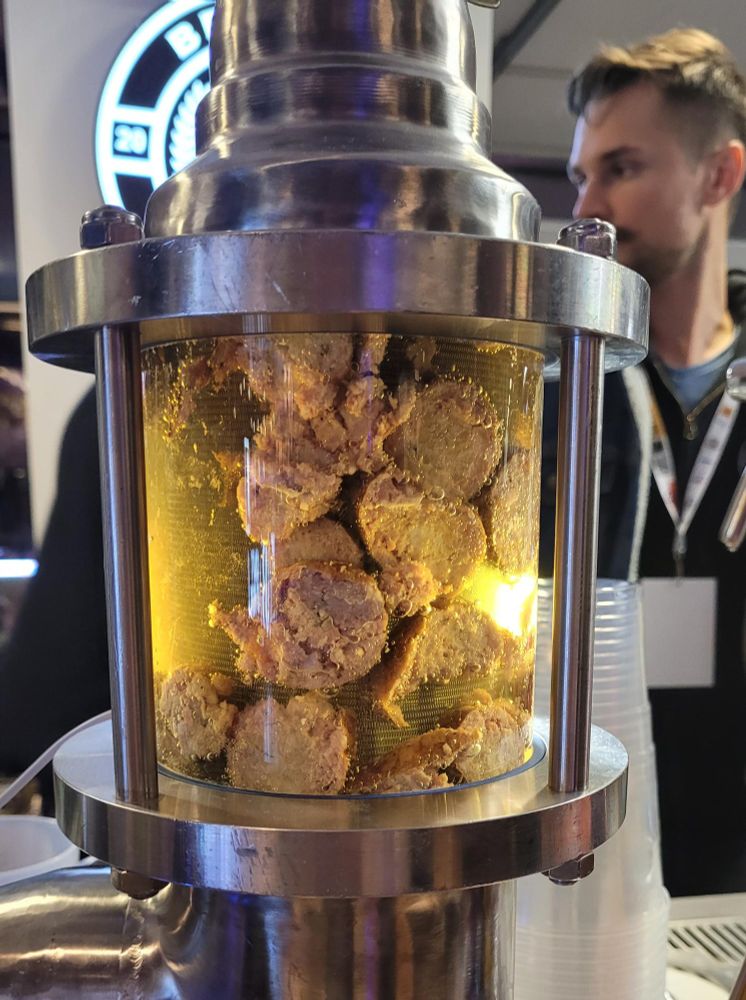
Sausage meat!?!? Mr. Gladman says it is a you thing, not a gin thing:

Sweet summer child, do you know how many shit whiskies there are? Nor is it necessarily any less industrial than buying in and redistilling neutral spirit may sound. I mean good God, some Scotch giants pump the stuff out like so much sausage meat. So no, gin isn’t “just” flavoured vodka. Gin is gin. Like it or don’t like it, that’s up to you, but please don’t kid yourself it’s an inferior category just because it’s not for you. Maybe you just don’t have the palate for juniper.

What’s that? Where’s the World Cup beer news? I can’t find the link to the story that some educator posted “Ten Pastry Stouts to Pair With Haiti v Scotland!” but, yes, Voodoo Rangers is likely the proper order to make on Saturday. “No Scotland No Party” is the song that I have just learned my traveling first cousin (once removed) will be (drunkenly) singing:

 … they live by the motto: No Scotland, No Party. “In Munich (during those Euros two years ago), you saw the impact the fans had. People just seem to love Scotland,” says Duke… People seem to feel at home with us because we don’t take ourselves too seriously”… They thought the estimate of 100,000 travelling Scots was a joke until Munich, the beer capital of the world, was drunk dry before a ball had even been kicked. It was a similar story in Czech capital Prague for a European Championship qualifier in 1999. The Scotland fans had congregated in the old town square, so when the area’s bars ran out of alcohol, the riot police arrived expecting trouble. Instead, when the lorries arrived with more beer, the Scots hopped aboard and helped unload the kegs themselves.

For some of the Home Guard who can’t travel, Imran has shared the best pubs to watch in Edinburgh. Elsewhere, England’s Gus bought beer from every nation. Here in Ontario beer stores’ opening hours have been extended just as have restaurant hours in Boston. Expectations are high for mass consumption:

To reach its 1bn pint estimate, analysts from Jefferies extrapolated beer consumption data from previous World Cups. The extra sales equated to a 3 per cent uplift during the 39-day tournament, which Jefferies annualised to 0.3 per cent, equating to 5.9mn hectolitres, or an extra 1bn pints. Analysts expect the World Cup — which is being hosted across three major beer markets: the US, Canada and Mexico — to boost sales volumes by between 0.2 and 0.3 per cent for 2026. Jefferies analyst Ed Mundy said “match timing is the unsung hero of World Cup beer consumption”, pointing out that games featuring countries in Europe and the Americas had largely been scheduled to coincide with peak local drinking hours of between 5pm and 11pm.

Sadly, as CNN reports, Michelob Ultra will adorn an MVP trophy given to a player after every match. Hopefully that side of the trophy can be turned to the wall. Now, where is my tartan scarf and my copy of that 1978 Scotland World Cup LP?

That is it. A jam packed week of news and cogitations. As you soak it all in, don’t forget to check out Boak and Bailey posting on Saturday and adding to their fabulously entertaining footnotes week after week at Patreon. And do look out for more of Stan’s new “One Link, One Paragraph” format. Then hunt out something in someone’s archives! Leave oblique comments on someone’s post from 2009!! Listen to a few of Lew’s podcasts and get your emailed issue of Episodes of my Pub Life by David Jesudason on certain Fridays. And Phil Mellows is at the BritishBeerBreaks. Once a month, Will Hawkes issues his London Beer City newsletter and do sign up for Katie’s wonderful self-governing totes autonomous website featuring The Gulp, too.  Ben’s Beer and Badword remains on pause but there is reading at The Glass which is going back to being a blog. Any more? We have Ontario’s own A Quick Beer and All About Beer is still offering a range of podcasts – and there’s also Mike Seay’s The Perfect Pour. Plus follow the venerable Full Pint podcast! And there’s the Craft Beer Channel on Youtube as well as the archives of the Beer Ladies Podcast.

*Now, I hear what you are saying: “WTF? New York isn’t part of Canada, Al?!?” But for 23 years I could see the northern edge of the state out my office window. And I’ve listen to WFAN sports radio for decades and, yes, the game is on 880 AM but the freaking fan DJs are on 660 AM. Plus OG Anunoby was my favourite Raptor who went to the Knicks so…
**what about Henry?

The Most Moon In June-y June June-ster Set Of Beer New Notes Of The Year So Far

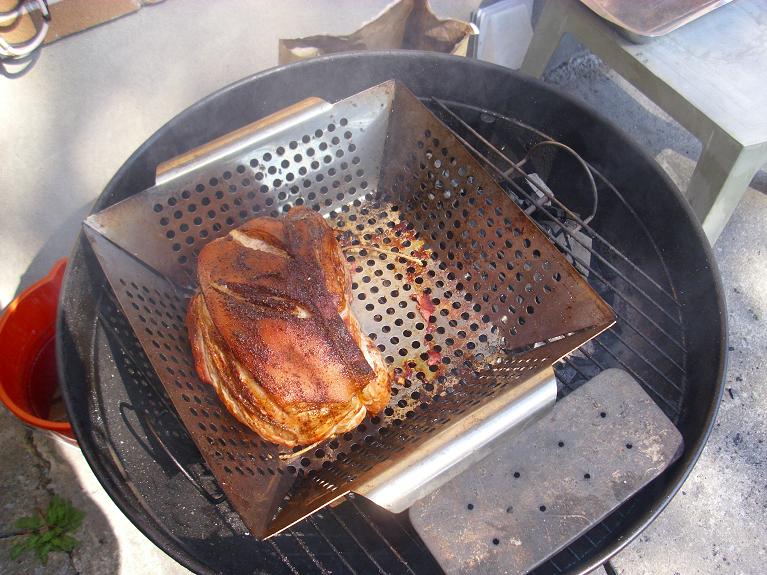
It’s been a fabulous week hereabouts. Hard to suggest otherwise. A whole twelve days since the last close call with frost means I have about 45 tomato plants now out in bigger pots and into plots, one seen above. Last year’s dried garlic stems are one trick to keep the bugs away. You… are welcome. These are the sorts of things that occupy the newly retired mind. Mulch options. It’s a lot like that last summer before I had a job, the one after grade eight. Not quite mindfulness. More like mindlessness. But I suppose that’s the point after 46 years at the coal face. Or I suppose the keyboard. I am betting 50-50 that I will be driven nuts by this idle stuff come September. Maybe.

10 am EST: HOLD THE PRESSES!!!

There’s been a couple of updates arrived in the inbox after the deadline for this here Thursday beery news notes to be released to the unsuspecting.

First, Ron P. has posted a video that debunks a number of Scottish brewing myths. This is an excellent public service which I expect you will fully embrace… but… I have to note… he has chosen the oddest intro theme. Now, to be very clear Ron is a man who has not only excellent taste in music but has been to more concerts of every band I loved as a kid than anyone I have ever met. So… I am not sure why he chose a short tune that sounds like teenage whales practicing new ways of vocalizing while one fin has been clamped into a medium sized vice.

[UPDATE UPDATE: see the comments… Ron is the artist. I am reevaluating my appreciation…]

Then, more seriously, David J. has published a newsletter with his thoughts on the relationship between gambling addiction and drinking:

“Gambling was causing me pain and drink became the thing to numb the pain,” Harj tells me. Harj isn’t a one-off. There’s thousands like him who have been exploited by betting companies and have lost everything. Some have committed suicide because of their addictions, while many have hurt their loved ones by their actions; Harj tried to kill himself in August, 2020 by driving his car into a road’s central reserve. I say thousands of addicts but it’s probably much more than we realise becauseguess whatbetting companies won’t provide data that could lead to us being shocked into calling for radical reform. They won’t even release information on how much revenue they gain from the highest volume gamblers.

There are two things I am eternally grateful that I have not taken up: gambling and smoking. David’s subject Haji is now a spokesperson against gambling addictions and notes that there are few controls around betting machines in pubs where the connection between booze and betting is most direct. Have a read.

[Ed.: Update over. As you were…]

What is going on? First up and in anticipation of the World Cup that starts next week, Eoghan is visiting and establishment of some sort representing each team in the competition – all of which are located in his home of Brussels. The first stop on the tour was an ersatz US diner or milk bar which reminded him that “American cultural hegemony is ebbing” which is fair. But next up was a trip to the “Canadian” site, the qualifications for which is always interesting to a Canadian:

It’s important from the outset to say that La Luck is not a Canadian restaurant, nor does it have I think any pretensions to being Canadian. If it is known for anything, it’s as a board game bar, with the upper floor reserved for game players. There are no Canadian nods in the place’s décor – no maple leafs, no elongated hockey sticks, and certainly no well-loved photos of Wayne Gretzky or Alanis Morrissette. Instead, La Luck’s owners have gone for the vintage market bric-a-brac look, with it stuffed with old mirrors and picture frames and sundry recycled wall decorations. In the hour and half I was there, I failed to hear any Chad Kroeger or Avril Lavigne on the bar’s soundsystem. And the service, of which I will speak of more later, does not appear to reach the level of North American efficiency, or overt Canadian friendliness.

I like it. That is an entirely Canadian approach to Canadian-ness. Wouldn’t want to make a show of oneself. Not to mention they lost his order of poutine for over an hour. Does that speak to my nation? I dunno. Still, my own country is in fact hosting World Cup games and the Old Country has finally made it for the first time in decades… and, even with that, I think the argument made in The New York Times this week is all booze industry wishery:

…for beer manufacturers, the World Cup is a giant, multiweek, Olympics-meets-Super-Bowl sporting event that FIFA, soccer’s international governing body, projects will draw a global audience of six billion. There are early signs that beer orders will rise during the World Cup. In April, a forward-looking indicator of beer purchases expanded for the first time in 21 months, said Lester Jones, the chief economist for the National Beer Wholesalers Association, in an email. “Host cities for World Cup events will certainly experience an increase in both on- and off-premises beer sales as consumers enjoy the games,” he said. Beer industry analysts say Americans’ attention to the tournament will depend, in large part, on how far the U.S. team advances.

I am aware that forecasting and futurism sits somewhere between fantasy and fraud so we will have to see how this all plays out… but… BMI does have some stats that put the anticipation of a bump in context:

Beer industry volume down 6.1% for 4 weeks thru May 16 in NIQ data. That’s far worse than 3.3% drop yr-to-date. So this is yet another data point strongly suggesting industry got much softer in Q2, as consumers undoubtedly feeling the pinch from higher gas prices, among other factors.

Focusing on the smaller scale, Franz D. Hofer welcomed the new month with a post on the smaller beer gardens of Munich including one with bees:

A few beers later I headed west into the woods toward Aubing in search of a fabled beer garden surrounded by beehives. Passing a pond here and a few ducks there, I eventually found this little gem in the forest — Waldwirtschaft Bienenheim, the place where the bees live… About a hundred and fifty years ago, King Ludwig granted this plot of land once used for brickmaking to the Obst und Imker Verein (Fruit Growers’ and Beekeepers’ Association) of Aubing. And the Wirtshaus with its beer garden? It’s the former clubhouse of the beekeepers’ association. To this day the beekeepers of Aubing still hold their club meetings at the Wirtshaus.

And, somewhat similarly but with less charming results, Lisa shared thoughts on Token, a re-opened Dublin bar that left her searching to put a finger on a categorization that fitted the place. Previously at the old spot…

…it felt like a neighbourhood bar that offered something of an alternative to simply ‘sitting at the bar,’ though you could do that as well, if you preferred. This Token, however, feels very much more transactional, and much more, well, bro-y. And it may be that this vibe is a direct result of this new space: surrounded by bland offices and corporate apartments, it now feels like an after work ‘enforced fun’ spot for company meetings. The prices certainly fall into the ‘someone else is paying’ category with an ambitiously-priced pint of Scraggy Bay on offer for €8.20 (and a service charge added to food orders, despite it being relatively difficult to find someone to take your payment when you want to leave, even at the bar).

A “someone else is paying” bar is an excellent label. Hotel bars near industrial parks perhaps? Staying in Dublin, Cian Duffy has described another class of drinking hole, the neo-thatch:

Dublin has a reasonable number of thatched pubs, for a fairly urban environment. There aren’t any in the city centre, but there are plenty in suburbia. However, they are almost all pastiche in style. The thatch is real – very real, very expensive and requiring very skilled trades to install and maintain it; but the pubs were not thatched originally, and some are or were new buildings. As far as I can tell, the trend for this was started by the only thatched Dublin pub to have since been demolished (yet!), the S0440 Stillorgan Orchard, which was thatched in late 1988. A number of other pubs were thatched over the next few years, as this trend proliferated. S0232 Glenside was thatched during a renovation in the 90s, with N0300 Lord Mayors in Swords being thatched during its extension renovation in 1992…

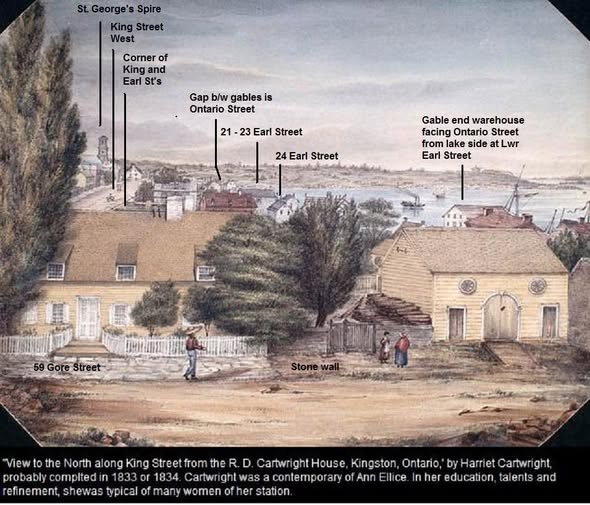
How many times have any of us exclaimed “the thatch is real!”?  It’s not done around these parts, though I have an image that might show a thatched roof or two hereabout in 1833. As you consider that, here some notes:

Note #1: who “placed trust” in the self-reported data the BA uses?
Note #2: Knut on the cost breweries pay to attend beer fests.
Note #3: I’d be checking the corks for tampering before sipping Stalin’s wine.

As you know and as I know you know and as you know I know you know, “A Glass of Handmade” by William Least Heat Moon was published in The Atlantic in 1987. It’s a consideration of the state of microbrewing at the time and contains one of my favourite lines, a statement by Bill Owens of pioneer brewpub Buffalo Bill’s: “…I don’t make ale. I can’t waste time educating Americans about ale…” Owens brewed a light lager that cost him seven cents a glass to make and sold for $1.50. The brewpub is still thereJeff told the tale this week of similar project almost forty years later in Portland, Oregon:

“If we were going to do a light lager, we wanted to do it right.” Sam said. “Let’s not copy another beer, let’s just make the best light lager available”… The brewery can still make a profit on a $3 pint, but it then becomes a volume proposition. But because it’s so cheap, the volumes have really gone up—a virtuous cycle. And just having the beer on the menu has created a halo effect. The typical customer doesn’t come in solely for cheap Clubhauses. Instead, they vary their session with a Clubhaus and other beers, saving them money they then use to spend on more beer or food. That’s why people end up spending more.

Here’s to that beer lasting until about 2064. That would be excellent. Speaing of which last Friday ATJ experienced the excellent if not even the sublime* and shared the moment:

I have finished my beer but such is the mood of completeness, that serenity I mentioned earlier, the tranquility that bathes my soul, I decide on another pint of the same beer. Once again there is a dance to the music of time on my tongue as I take deep sips that are almost transformed into swigs from my glass. There is a sense of mindfulness as I sit on this wooden bench that acts as a living memory of someone called Dave, moments of calmness and reflection as I look out over the river and the landscape stretching away, aware of the high canopy of blue stretched with fluffy white above me. Everything is in order, the beer, the views, the slow susurration of voices behind me, and even though this outdoor space at the Bridge is bordered behind me by a road I don’t even notice the passing traffic.

Two tales of the Isle of Man this week. First up, check out Katie‘s excellent piece in Pellicle on the good beer scene there. Then, add the notes shared by Ed from his time at the biggest and apparently little loved brewery in the dependency, Okells, his former Manx employer:

I briefly worked at Okell’s a few years back. The job was one of the worst I’ve had, a cesspit of office politics. But the beers were the best on the island… I got first hand experience of the distain some Manxie beer geeks hold Okell’s in when I attended an event at the Hooded Ram brewery. It was a microbrewery run by a lovely guy called Rob Storey. He’d invited Okell’s staff over to the event so I  went with one of the lads from work. I had an inkling of the view some held about Okell’s, but I thought it better to be up front about where I was working so wore a branded work t-shirt. I was still a bit put out that someone booed when I arrived though! 

(Neither of them mentioned Kelly.) On the topic of an entirely different sort of search, I don’t know if I am wanting to find the cheapest beer in the world but, yes, it is likely that it might be found in an unrecognized state where Russian troops are both posted and somewhat cut off… perhaps much to their relief these days:

Official Foreign Office guidance advises British tourists against traveling to Transnistria but, in the interest of scientific research, Robbie decided to take the risk. It proved to be worthwhile. Exchanging his remaining Euros for some of the curious Transnistrian currency – which uses plastic coins more like something from a board game than from a bank – Robbie finally managed to find a beer that could compete with Yorkshire prices. He explained: “I’m delighted I managed to beat the 99p pint with this 77p one. It’s a surprising we had to go to such lengths to get a hold of it though.”

More than likely a notch or two higher up the old snack bracket, Ruvani de Silva shared the history and current scene for bitters for The Alchol Professor with a focus on the finer kind which may assist me with my Crown Royal studies:

Contemporary mixologists have an almost unlimited palette of bitters flavors at their disposal, from yuzu, bergamot, and cardamom to Japanese chili and saffron. By incorporating more international ingredients into their bitters, craft bitters brands are helping mixologists introduce more global flavors, which in turn can bring craft cocktails to a wider audience. “When an industry is shaped by a wider range of backgrounds, cultures, and experiences, it naturally leads to new flavor profiles, new use cases, and new ways of thinking about cocktails and hospitality….”

Bitters and soda on a stinking hot day? Anytime. Time may have run out elsewhere. In Will HawkesLondon Beer City this month, he shared the history of the Grove Tavern, a shuttered 1920s pub awaiting the demo ball which sits on the site of earlier establishments before the city moved in:

In the 18th century, the Green Man’s appeal derived from its rural qualities. Dulwich Wells sat beside the pub, noted for its mineral-rich water, the Matcha Latte of its day. The landlord in the 1740s, Francis Cox, also created Cox’s Walk, a tree-lined pathway that runs southwards and still exists today, to connect his pub with Sydenham Wells.  Rural delights remained the pub’s calling card for decades: as late as 1864 – by which time the Grove had been rebuilt by Courage – the pub was advertised on its rural qualities. “If you want to enjoy the country air, go to the Grove Tavern, Dulwich!” readers of the London Daily Chronicle were told. “If you want to ramble amidst rural scenery, go to the Grove Tavern, Dulwich! If you like swings, quoits, bowls or cricket, go to the Grove Tavern Dulwich!”

And from the police blotter this week we have a story of crime out of Hollister California – a crime weaponized with beer:

During the first incident, police said surveillance footage showed a man riding a bicycle who stopped and approached the robot, before knocking the robot to its side before leaving the area. A second incident involved another suspect approaching a robot near 4th and Line streets. The suspect appeared to strike the robot before approaching a second robot that recorded the interaction. Police said the suspect struck the second robot and poured a liquid, believed to be beer, before leaving the area… police chief Carlos Reynoso confirmed two people were arrested following unrelated incidents.

Is pouring a beer on a robot a crime? We will find out. And with that, we are done for another week. While you wait around, drumming your fingers at the dining room table as loved ones ask “what’s wrong?” dont forget to check out Boak and Bailey posting on Saturday and adding to their fabulously entertaining footnotes week after week at Patreon. And do look out for more of Stan’s new “One Link, One Paragraph” format. Then hunt out something in someone’s archives! Leave oblique comments on someone’s post from 2009!! Listen to a few of Lew’s podcasts and get your emailed issue of Episodes of my Pub Life by David Jesudason on certain Fridays. And Phil Mellows is at the BritishBeerBreaks. Once a month, Will Hawkes issues his London Beer City newsletter and do sign up for Katie’s wonderful self-governing totes autonomous website featuring The Gulp, too.  Ben’s Beer and Badword remains on pause but there is reading at The Glass which is going back to being a blog. Any more? We have Ontario’s own A Quick Beer and All About Beer is still offering a range of podcasts – and there’s also Mike Seay’s The Perfect Pour. Plus follow the venerable Full Pint podcast! And there’s the Craft Beer Channel on Youtube as well as the archives of the Beer Ladies Podcast.

*Finally, that 1983-84 honours undergrad English course in Romanticism pays off.

It’s A Thursday In May And Here’s Your Greener Than Green Cheery Beery News Notes

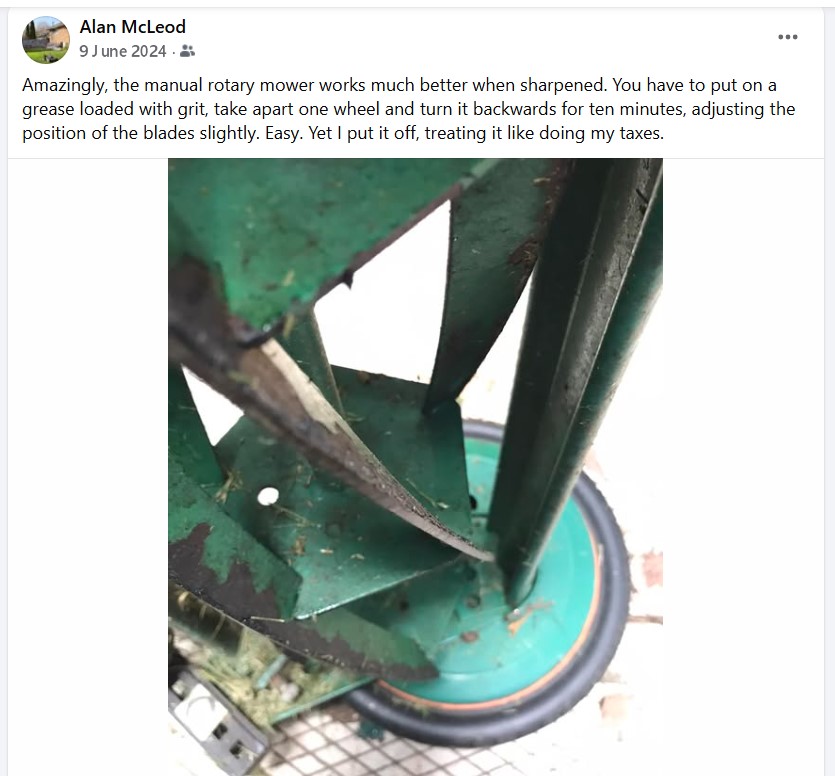
The tide has turned. The seasons have shifted. The dandelions have popped. The penny has dropped. It  is time. So the Beast has been released. I say Beast but it’s really Beast II, Son of the Beast. The Beast is still back there, there at the back of the shed. An over a decade old rotary mower that took five times longer to do the job, was a pain to sharpen and was retired last spring. It’s a terrible thing being cheap and lazy for so many years. Now, my lawn is mowed care of a combination of hydroelecric and nuclear power. Science.

What is going on? Well first up, Alistair is about to travel from Virginia back to the UK and shares a complaint that’s been complained since time itself began – how to narrow down where to go for a pint when the information online is just not there:

My biggest challenge though, and I am sure there are reasons for this, but with so many tied houses in the English part of my trip, it does get really frustrating when there is a shared platform with generic information, and almost universally no list of what is on cask in a given pub – this goes for chains like Wetherspoons as well. Yes, the many Fullers pubs in the city have elegant, beautifully designed websites, but again I can’t find out which beers of the Fullers Brewery range are available, making it pot luck to stumble across less regularly seen beers (at least from what I have been told) such as London Porter. I don’t want to single out Fullers, as I have seen the same with Shepherd Neame, Greene King, and Nicholsons, though several Young’s pubs tend to have at least a list, and occasionally pricing as well.

Is it a realistic expectation after decades of this sort of thing to expect every pub to logging what’s on tap?  I dunno. The failure seems to be the proof. Elsewhere, Pivní Filosof® is back after a few years of quietude. And Max is again on the move with his second post of spring 2026 looking for good beer by tram, with all sorts of obstacles placed in the way… like bad beer scenes:

Here comes the first tram, #5 heading to Vozovna Zižkov. I get on and start counting the stops. Fuck! Hlavní nádraží. All I can remember around there are the two overpriced spots in the station itself, and U Staré Pošty in Opletalova, a hospoda I’ve never liked for some reason. I get off, already resigned to the idea of having a Pilnser Urquell U Staré Pošty, when I tell myself ‘fuck it! I will cheat’, and change direction, towards the the tunnel that now connects the train station with Žižkov and the new building complex that has sprouted there in the last decade or so. Yeah, I’m cheating, in my own challenge, which I play alone – if you disapprove, good luck finding a better beer blog…

[Ed.: I thought he was talking about me. He wasn’t!] Offering a definite upgrade in locales, David Jesudason has the feature in Pellicle this week, a portrait of The Golden Smog of Stockton-on-Tees, County Durham, a pub which started life under the current owners with its own set of more serious challenges:

Their eyes even passed over the anti-fascist football sticker saying “our club, our rules.” When they spoke of how local shops were closing, they didn’t blame globalisation, politicians, or even the internet—the fault was with “immigration”. It was 2014, and owner John Christie sighed after overhearing their chat, wondering if this was the life he had now forged for himself. He had trained as a mechanic and joined the army; after leaving, he opened the pub in a former headstone shop. His goal was building a welcoming, inclusive space founded on his socialist ideals. Was he about to be dragged into their world First, he considered kicking them out. Then he paused. It dawned on him that if they went to another pub, their views would likely be re-enforced, or amplified in an echo chamber. It was at this moment that the unwritten manifesto of the Smog started to take shape in his mind.

On a larger and indoubtably less successful scale of internationalissimmo, we are all now just a few weeks away from World Cup madness. Perhaps not surprisingly, hotel reservations are below expectations. Here in Canada, we have a few of the games – and there’ll no doubt be any number of beer related stories in the coming weeks as there usually are when this rolls around – but this one  about Ermedin Demirovic is one of the best so far:

Back to Demirovic. As everyone will remember, before his country’s World Cup qualification play-off final against Italy at the end of March, Stuttgart’s Bosnia and Herzegovina international forward promised to buy everyone in the city a beer if he and his team-mates made it through. They did, beating the Italians on penalties following a 1-1 draw, and last Monday, Demirovic kept his promise. The event was staged near the Neckarstadion in collaboration with a local brewery, and more than 2,500 people turned up. “I didn’t expect so many of you to come,” Demirovic told the fans who took part. 

Sticking with the people of the grassy pitch, Boak and Bailey unpacked their findings on the disappearance of the retired fitba player as publican:

Historically, you could expect to retire from football before you were, say, 35 years old, with a lot of life left to live. And unlike today, even top flight footballers probably wouldn’t retire rich, even if they did have a little money put away. So, you’d need to find some kind of work. We can well imagine that running a pub was appealing because it’s a job that seems fun adjacent. Back to those headlines above: there’s also a sense that you could parlay your fame as a footballer into publicity for your new venture. Who wouldn’t want to be served pints by a local hero? (And perhaps tut at their fall from grace, and marvel at how fat they were getting, how red faced…)

I guess a key difference between then and now are the far higher wages paid to players in recent decades during their career. As a late teen, my father started out his working life at the firm of Hasties, a marine engineering firm in Greenock. In the lunch room he sat at the same table as local hero and Scottish national team star Billy Campbell whose career was cut short by illness and was given a job. A kindness from the owner, a local supporter.

Something else that is also retired but more often noted is a well priced pint in an London pub. Perhaps a well-trod topic but there was an interestingly specific grip in Tuesday’s daily (free) newsletter from The Telegraph:

We all knew the moment would come, but it was still a shock to read that we had entered the era of the £10 pint. Long gone are the days of venturing out with a tenner, sure of enjoying a few pints of bitter, and perhaps even having enough cash left over for a scallop from the chippy. No, bars in London today are charging as much as £11 for a pint of Moretti and £8 for a half of Heineken. There’s probably no going back – the rising cost of pints is an irreversible trend, like SUVs or smashed avocado – but mercifully you can find relics of the old, pre-£10 world, mostly outside London. Indeed, soon after the news broke, I raised a £3.50 glass of Gunpowder Mild in honour of reasonably priced pints in a pub in Clitheroe, Lancashire.

Hmm… how long ago a scallop and chips was going for the price of the leftovers from a few pints? I also wonder what the price travel to Clitheroe from London is, you know, to save that £6.50. Here are a few notes:

Note #1: Beer skates and sabres.
Note #2: Sue them, Yoko. Sue.
Note #3: Data-less trends are the best trends.

And Ray of B+B has done some solid hypothesizing over at Patreon in a piece entitled “Beer from the Witchwood” about the meaning of Jethro Tull’s album Songs from the Wood:

It’s from an article by Nick Freeman about music inspired by the mythic power of English woods and forests and it feels like a missing link between the Society for the Preservation of Beers from the Wood and Ray’s suggestion from a couple of years ago that real ale and folk horror feel somehow connected: “I don’t think it’s any coincidence that the Campaign for Real Ale, The Wicker Man and the English Morris dancing revival all landed at about the same time.” We think Freeman is right: the title of the album is a definite reference to the concept of ‘beers from the wood’. And on the cover, Ian Anderson looks like an extra from The Blood on Satan’s Claw or Witchfinder General.

Now don’t get me wrong. I think he’s on the right track. But… I am not sure. Not sure of the directness of the relationship* even if an indirect** one could be perfectly admissible. With something of a similar theme, ATJ has been making things up, including his recollections of a perfect beer fest:

I will admit that this summer beer festival is a composite of several I have attended. Some had great lagered beers and well-conditioned cask and an encouragement of children to play and provide a lightness of being, some had excellent food and at one even the Morris made sense to me. Then there was the one which included a beer garden, plus shaded woodland and a cooling river running alongside, plenty of sunshine, a genial intoxication and the amity of friends as well as meeting new people, children and dogs. So if you do know of a beer festival in the summer that has all of this please let me know.

And there is some odd financial news out of Belgian based macro gak producer ABInBev which has been finding sofa nickles and dimes in unexpected places:

Shares in AB InBev gained as much as 6.8% in early trading, adding to a more than 14% rise over the past 12 months. Strong beer demand in Mexico, Colombia and Peru drove volumes in the region up 4.8% in the period, offsetting a 3.1% decline in North America and a 0.4% drop in the region that includes China, amid a broad-based reduction in drinking. Revenue also rose in no-alcohol beer and in the non-beer segment.

Speaking of what is or is not, legal steps are being taken in Montreal to fight against a scourge… or perhaps a few scourges:

A Montreal microbrewery owner says he is being unfairly targeted by Quebec’s Alcohol, Racing, and Gaming Commission (RACJ). Le Saint-Bock, on St-Denis Street, brews specialty beers infused with candy flavours. The commission is accusing him of marketing to minors. “People like this kind of beer,” said Martin Guimond, owner of Le Saint-Bock. “It’s different, but there’s a market for people who don’t like beer and want to have a beer that tastes like candy.” Candy flavoured alcoholic drinks is a trend that other major breweries are hopping on as well. Coors has released a line of slushie flavoured seltzers, and the SAQ now sells a Popsicle vodka soda. “They have never been sued. But me, yes,” Guimond said.

Candy beer. Really? It’s this sort of thing that does make one wonder if there is anything left that can reliabily be called craft. And, speaking of which, Jeff posted about the latest move by the BA to buff up the image of US craft’s prospects, reporting (under a somewhat sheepish portrait of Bart Wilson) on a presentation by his leadership himself:

Two comments struck me. In his opening statement, Bart tried to strike a positive note, saying “This year the vibe is positive. It feels like we’re coming out the other side.” Then, near the end of the breakfast, he encouraged us to consider writing more “happy stories.” For the most part, the session yielded little new information. And, despite these comments, I wasn’t picking up a lot of positive news. Bart is no longer the just-the-facts BA economist who reports the numbers. Now he’s the head of a trade organization in a wobbling industry.

Wobbling indeed. I expect there are still some experts who will be moved by such puff even as production is down 17% over a five year trend to the end of last year.*** But the vibes? They are good. We read “… going to see growth this year – very, very strong growth…” Oh, that was 2021.  And in 2024 it was all about “mood management” and the niche.  Heavens. Stan connects more dots. And Brew York shares another observation:

One of the most positive numbers in the report — that independent breweries’ market share increased by 0.1 percentage points over last year — should be taken with a grain of salt. The Brewers Association’s classification of craft beer means that three breweries owned by MillerCoors for most of 2024 are now considered craft in 2025 after being acquired by the large but independent brewery holding company Tilray. Niche brands that are more likely to market themselves like big beer, like Garage Beer and Outlaw Light, are also defined as craft.

That reference to Tilray is interesting. Fourth biggest US craft brewer in 2025. But we must remember that according to the current version of the shifting sands that are the BA’s definition of “craft brewer” the requirements of actually being, you know, a “brewer” includes the principle that a firm must have “have as its primary business purpose the resale of the brand or brands it controls.” Primary. According to Tilray’s most recent financial statement, its craft beer holdings represent 27% of its activities after its cannabis (31%) and pharmaceutical operations (40%). So… not really that primary. Probably fits squarely in the definition, however, in special BA-nglish. But, you know, happy stories!

That is it for now. Let’s keep an eye out for happy realities instead. With any luck, the tomatoes will start finding their place in the garden and please check out Boak and Bailey who are posting every Saturday and adding to their fabulously entertaining footnotes week after week at Patreon. And look out for more of Stan’s new “One Link, One Paragraph” format. Then hunt out something in someone’s archives! Leave oblique comments on someone’s post from 2009!! Listen to a few of Lew’s podcasts and get your emailed issue of Episodes of my Pub Life by David Jesudason on certain Fridays. And Phil Mellows is at the BritishBeerBreaks. Once a month, as noted, Will Hawkes issues his London Beer City newsletter and do sign up for Katie’s wonderful self-governing totes autonomous website featuring The Gulp, too.  Ben’s Beer and Badword seems to be on pause since November but there is reading at The Glass which is going back to being a blog. Any more? We have Ontario’s own A Quick Beer and All About Beer is still offering a range of podcasts – and there’s also Mike Seay’s The Perfect Pour. Plus follow the venerable Full Pint podcast! And there’s the Craft Beer Channel on Youtube. Check out the archives of the Beer Ladies Podcast.

*Ian Anderson, creative lead of Jethro Tull had a busy 1976. In addition to making (and producing) Songs from the Wood, he got married a rather rich lady and moved into lodgings at Pophleys Estate which sat on 500 acres. The main house was up for sale in 2009 on a lot of 13 acres and was described as being supprounded by “a large belt of woodland” so it could be in addition to the era’s folk-rock theme these songs of his might also be from his wood.
**According to Richard Boston in “Beer and Skittles” at page 95 the Society for the Preservation of Beer from the Wood was founded in 1963. Songs from the Wood came out in 1977. So a bit past the folk-rock revival and four years after The Wicker Man hit the cinemas. During this time – and here is the thing – we move from the era of the First Doctor to Fourth. From Gerry and the Pacemakers to the Sex Pistols. My birth to my teens. Yet if detective shows set in England have taught us anything, it’s always the green man behind the scenes and everyone is down the pub sonner or later.
***And… the numbers are already again down another 2% in 2026, just one third into the year.

And… Finally… Here’s “The Baseball Is Back!!” Edition Of Your Beery News Notes

I mean, let’s face it. The Winter Olympics are all well and good. And the World Cup will fill that gap in June, sure. But… baseball. Baseball: the sport that demands the best in athletes and then asks them to sit around for half the game. When they aren’t standing around in the field. It’s great, isn’t it!  Though, we should also take this moment to remember one of the great Olympic moments from, what, sixteen years ago now when Canada’s gold medal winners took the opportunity to turn the hockey rink into a tavern. And on that topic, here’s a Winter Olympics fact I hadn’t heard before and one that isn’t apparently winning any medals:

The only beer available for purchase at the 2026 Olympic Games is Corona Extra, a Mexican pale lager. This is due to the Olympics only allowing one company to sell its products at the Games, and this time it was Corona who was able to secure a deal. It’s a controversy that may hit closer to home for a lot of Olympic spectators, more so than a few foul-mouthed curlers ever could. It’s fair to say that Corona may not be the most popular beer for fans in Europe, as a photo of a Czech hockey fan went viral last week for his disappointed look while holding his Corona beer.

What a great choice. For the five athletes at the games representing Mexico, I suppose. What else is going on? Plenty to read out there on the chop-shop job coming for BrewDog but The Guardian had a good angle on the pending effect on those who each gave a bit when a lot was needed (or at least wanted with little or now strings attached) early on:

BrewDog’s army of “punk” shareholders have voiced anger and frustration after the Scottish brewer confirmed plans for a possible sale that could render their investments worthless. So-called “equity punks” who spoke to the Guardian or posted on BrewDog’s shareholder forum expressed disappointment and accused the company, which has traded on its upstart ethos, of treatment “bordering on contempt”. One said the plan showed that the small investors, who helped to kickstart BrewDog’s growth after it was founded in 2007, meant nothing to the company.

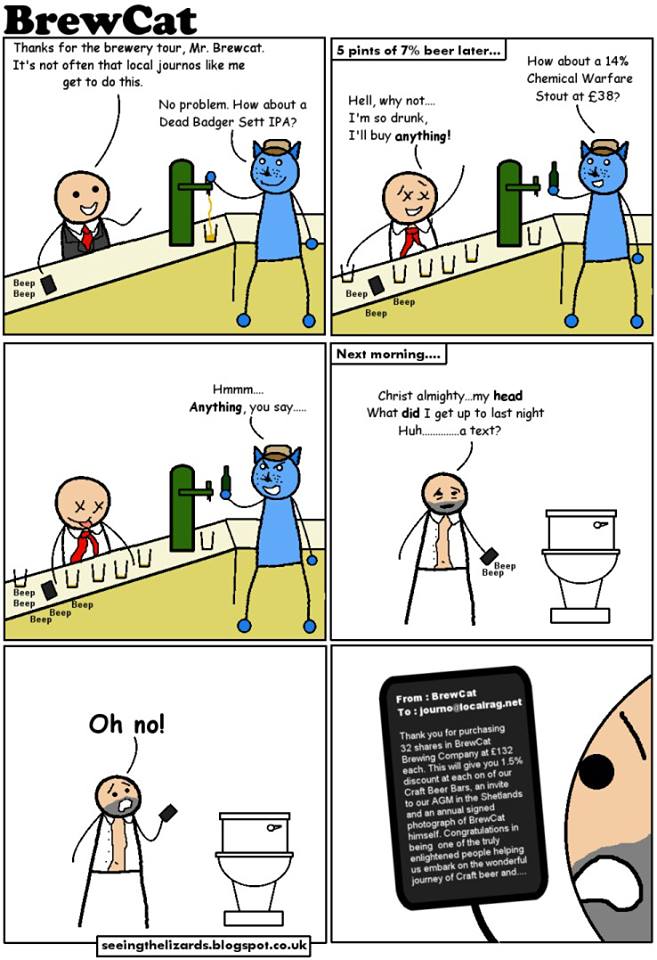
While the effect on individual EP investors can be quite significant, I mention this mainly as a pretext for posting that 2013 parody up there of the plan from one M. Lawrence at Seeing the Lizards.  Speaking of just saying no, The New York Times has run a four-part series by Pete Wells on getting your consumption back to a healthier level and finished off with a back at life with alcohol as well as a look forward:

Sometimes it seemed to me that I had a richer, more rewarding relationship with alcohol than I did with all but a handful of humans. It was an inexhaustible field of study, an incandescent companion during great meals, a reliable consolation on dull ones. And it brought me close to my real friends, at least some of them, some of the time. Over time, though, the rewards had become more equivocal and harder to justify. It wasn’t just the weight I gained, a predictable result of having a cocktail each night followed by about three glasses of wine or beer. They were, by this point, undeniable signs that my liver was overworked. I slept badly with all that alcohol in my system, too, and it got worse as time went on. …

You may be happy to know that he still enjoys his martinis – even if there are fewer of them: “…feeling the hair on the back of my neck stand up as the first sip takes hold, I feel like I’ve been reunited with an old friend…” Another old friend, Liam, reached back just a few decades for his post on the earlier trendy years for NA beer in Ireland, Smithwick’s Alcohol Free Bitter:

The launch was accompanied by newspaper competitions plus promotions, and a strange and repeated focus on how the beer, at 0.5% abv, contained less alcohol than orange juice! Reviews of the product at the time varied a little but it seems to have been generally well received for what it was, with reviewers commenting on how it (ironically) ‘packed a real bite and had good flavour’ and how they could drink it in a pub all night,  although it was also said to be ‘quite gassy and sweet.’ Others said it was ‘pretty good. Smells right and tastes of hops. Quite rich and smooth to drink.’

AKA gak. More positively, Matty C shared his thoughts on some upsides he’s seen in the brewing trade so far in 2026:

A couple of years ago, conversations in beer often centred around the idea that there’s “light at the end of the tunnel”. In reality, I don’t think that chance of daylight is coming anytime soon. Instead, we’ve got to admire the glimmers that are somehow managing to shine through the cracks in the walls around us when we can. Good beer is still being made, and good pubs are still open to sell it in – I’ve seen the proof! 

One of his examples was the tenacity of Jaipur: “… beer, packed with flavour and served at a high strength – seemingly the antithesis of what you would expect to succeed….” Which reminded me of how, in response to recent racist comment from an English oligarch, in The Times Sathnam Sanghera wrote about one of the foundations of the Britain of today:

…the fact that it ran the biggest empire in human history explains lots about Britain beyond its multiculturalism. It explains the popularity of curry. A significant amount of the mahogany furniture, ivory and jewels in our stately homes and royal palaces. Our propensity to travel. A certain amount of our wealth. Our political posturing on the international scene. Our national drink in the form of tea, and our national tipples in the form of pale ale, rum and the gin and tonic. The fact that we don’t feel the need to learn foreign languages because we encouraged/forced large parts of the world to take up English.

Empire of booze! Which, in turn, reminds me of Manitoba’s fabulous Premier Wab Kinew and his cheery fight for my right to Crown Royal after a bit of internal trade tension with Ontario’s Uncle Doug:

Cheers to you Doug Ford for keeping Crown Royal on LCBO shelves . Thanks for doing the right thing. Just like Canadian whiskey, good results take a little bit of time. This is a good day for folks in Gimli, Manitoba and a good day for people in Ontario too. Standing up for workers together is always a big win for Team Canada.

PWK won a lot of support with this bit of good humoured social media savvy. Crown Royal also got about 5,783 times the value of yet another newsletter by email telling breweries about the importance of storytelling.

Note #1: a desperate plea for beer based salad dressings.
Note #2: pairing beer and cussing.
Note #3: democracy in inaction?

Speaking of newsletters by email about storytelling, Will Hawkes was back at the end of last week with his February edition of London Beer City in which he considered the concept of the Irish Pub as illustrated by one new spot, Moylett’s in Clapton:

…I’m confused. What’s Irish about it? According to a report in Broadsheet, the focus is on what owner Moylett calls “the holy trinity of food, music and socialising” – a worthy list, no doubt, although it does seem to be leaving out something quite important (Guinness is £5.50 a pint, btw). As a term, “Irish Pub” is surprisingly hard to define, and particularly in London (and other British cities, arguably, but we’ll put them to one side for now). In much of the rest of the world – indeed, even in London, particularly its once O’Neills-heavy suburbs – the Irish pub is a 1990s phenomenon: flat-packed dark wood decor, pints of Guinness and food options that are often only very vaguely Irish (satay sticks, curry, chicken wings of varying heat levels; Spice Bags are less common, although you can get them at Moylett’s). But Irish pubs in London are, historically at least, quite different, and much less easy to pin down. 

Similarly but further afield, ATJ shared his thoughts on Cologne/Köln, the river there and its crossers:

…leaving Hauptbahnhof I crossed the Rhine, slow-moving, the colour of mud, upon which an elongated, snub-nosed barge was slowly making its way downstream. I stopped and took a photo, a snapshot of slothfulness perhaps and continued along the historic Hohenzollern Bridge. It was crammed with people through which bicycles and the occasional skateboarder cleaved their way, imperious and ‘get out of my way’ seemingly stamped on their features. Some people, were in groups whose colours defined their tribal affiliations — red and white for FC Köln, black and white for Eintracht Frankfurt. Sporting rivals presumably…

And here’s a new insult for craft beer.  If Jeff’s exhaustive listicle is correct, IPA is what it is all about and what it says is “meh, new money..“:

When it comes to beer, the etiquette guru revealed that “new money” consumers “don’t touch the more traditional ales or stouts – it’s all about IPAs that set you back at least £5 a pint. Anything involving the word ‘traditional’ simply doesn’t feature in your vocabulary. “If it doesn’t sound trendy, artisanal, limited-edition, or come with a deliberately obscure name, you simply aren’t interested.”

I actually find it really funny that anyone thinks anything related to beer is about new or old money… other than owning the brewery that great-grandpa built I suppose.  Almost as good as if grandpa owned a country… which is a seque to the next tale of skulduggery – perhaps – in China’s Jilin province:

The marketing materials identify the beer as produced by Rason Ryongson General Processing Factory in the Rason Special Economic Zone, located near North Korea’s borders with China and Russia. …[T]he Chinese distributor is Yanbian Xinyuequan Trading Co., Ltd. The company is based in Yanbian Korean Autonomous Prefecture in Jilin Province, a key gateway for cross-border trade with North Korea. Additional social media posts show boxes bearing the Pado label being unloaded from trucks and delivered to local restaurants in Jilin Province, indicating the beer has entered local distribution channels “…[N]ame changes are largely driven by export considerations, particularly to reduce the risk of sanctions-related flagging when the product circulates in Chinese wholesale or grey market channels…”

Mmmm… grey market North Korean Pado beer…  Quite the opposite in every way are Boak and Bailey who asked about what a drinker wants from a pub’s internet presence.

… we want to know what beer the pub is serving today, right now. Working that out can be surprisingly tricky. Again, Instagram or Facebook can help, but it’s often more reliable to snoop on Untappd and see what’s been logged in the past 24 hours. Pub websites are rarely of any use for this at all, presumably because updating a website feels like a big job, and a job for the Big Computer at that, so it just doesn’t happen.

Great comments followed… but I wonder if the easier solution is a camera aimed at the chalk board at the bar which is already updated daily… all sorta a la last week‘s remote pub experience story. It worked for the Cambridge coffee pot cam. The best way to get a job done is to find a way to make it a not-a-job job.

Finally, the Pellicle feature this week is accompanied by many photos with many many strings of bunting. It’s a story about Steam Machine Brewing of  County Durham – but without saying the word it’s really all about the bunting. Not including reflections in the windows (which would be unethical, of course) I counted thirty-six strings of bunting. That’s a significant contribution.

That’s it! That is all for now. But we are one step closer to spring. Pre-season Grapefruit League baseball on the TV time. Huh. Zah. Until next week, please check out Boak and Bailey who are posting every Saturday and adding to their fabulously entertaining footnotes week after week at Patreon. And look out for more of Stan’s new “One Link, One Paragraph” format. Then hunt out something in someone’s archives! Leave oblique comments on someone’s post from 2009!! Listen to a few of Lew’s podcasts and get your emailed issue of Episodes of my Pub Life by David Jesudason on certain Fridays. And Phil Mellows is at the BritishBeerBreaks. Once a month, as noted, Will Hawkes issues his London Beer City newsletter and do sign up for Katie’s wonderful self-governing totes autonomous website featuring The Gulp, too.  Ben’s Beer and Badword seems to be on pause since November but there is reading at The Glass which is going back to being a blog. Any more? We have Ontario’s own A Quick Beer and All About Beer is still offering a range of podcasts – and there’s also Mike Seay’s The Perfect Pour. Plus follow the venerable Full Pint podcast! And there’s the Craft Beer Channel on Youtube. Check out the archives of the Beer Ladies Podcast.

Your Thrilling Thursday Beery News Update For The First 1/48th Of 2026

We are in the lull. Not a lot of beer news out there. Well, there are other things going on, aren’t there. Grim things. In case you didn’t realize it, we are already 1/48th into 2026. It’s practically 2027 already. (Ah, 2027… impeachment proceedings… or Greenland ablaze… err…. best not look too far into the future.) That there photo to the right? A contest submission from 2009 sent in by Jeremy Craigs of North York, Ontar-iar-iar-io. It’s a view from within the Heineken Keg Yard in Cork, Ireland. Click for the full experience.

Yes, despite the lack of beer news we all know that the first week of January has a lot to offer. You can do some looking back, like Barry did. Or looking back to a number of futures like Stan did. Or patching together what really happened on New Year’s Eve like Cookie did. Proclaiming resolutions that are bound to fail by next week… or maybe not. And, ahhhh, Dry January. Dry. January. There are those who are praising it. Others offer alternatives like Jeff who asks us to remember the pub. Alistair finds his own path:

 I am 50 years old and as might be reflected in the paucity of posts on Fuggled over the last several years, my drinking is slowing down… it was as a result of my annual physical that it became clear that certain lifestyle choices needed to be changed. I need to get healthier in order to get certain numbers more on target than they were in October. To that end, I have already lost about 22lbs/10kg, which brings me back to my justification for taking a month off away from alcohol, it being the best way to lose the festive season weight gain…  I was sat pondering the shopping trip to World Market to stock up on the German Christmas treats that transport me back to my childhood in Celle – pfeffernuss, lebkuchen, stollen – when a thought popped into my head. How about just not gaining as much weight over the holidays, and not bothering with Dry January?

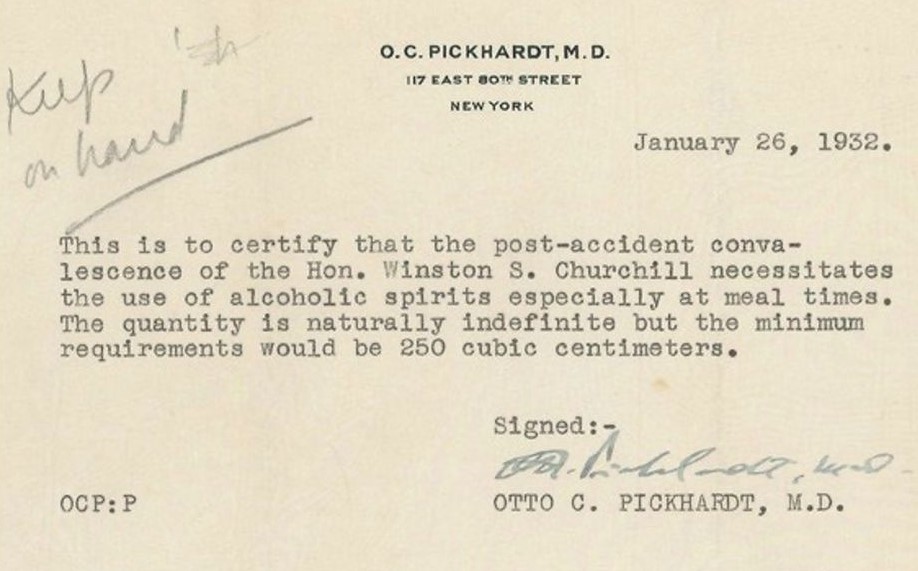
Our little Alistair is growing up!  I am myself over four years into intermittent fasting and a more and more robust approach to my health, too, so I get it. Beer is not so much like cake as like icing. Mmm… a pint of icing please. No wonder it once required a doctor’s note. And it’s not even that old a thing, Dry January:

Dry January started with the group’s former deputy CEO, Emily Robinson in 2011. At the time, she was reading more about the harms of alcohol consumption – at the same time as her half marathon training. Piper says Robinson “wondered what would happen if she had a whole month not drinking” and how it could benefit her running. “Spoiler alert: It really improved her running performance, but she gained other benefits as well,” Piper adds. In 20313 Alcohol Change UK made its Dry January challenge official and trademarked the name. 

What I like about Dry January is just that. When people take a break from anything they come back to it with fresh perspective. Or they never comeback to it, preferring just that fresh new thing. ATJ takes another tack on the whole idea as he looked back on looking back with Bowie and Bing:

I have a vague memory of it and ponder on the weirdness of the Thin White Duke doing a duo with the Old Groaner. I take a brief pause from the beer but then another mouthful is embarked on, followed by more crisp coldness that refreshes the mouth and wakes up the somnambulant parts of the palate, wake up, sound the reveille! The alarm clock shock to the palate continues as I pass down the glass. Mindful drinking? I’m focusing on the beer and how comfortable I am in my chair and how it has just passed 3pm. As the glass reaches the state of emptiness, a slight suggestion of melancholia flits through my mind, Christmas and its thoughts, memories of those no longer with us, grandparents, parents, friends, dogs, health, but the crispness is still there as I come to the end of the glass and decide to head out into the gleaming lights that bring on the emerging city night. Mindful drinking.

Mindful. My mind full. Me, I am a sober daydreamer myself. And I am not doing Dry January. I just haven’t had a drink since 2025. Might have one or two this weekend. Might not. Speaking of one or two, my fellow public service lawyer Teddy Pasketti of Baltimore shared one of the best “I am an idiot” story the other day:

I’ll tell it again. Once in law school I was 23 and really drunk and obnoxious and the owner cut me off and the bouncer told me I needed to go, and I told him, “I’m going to be a lawyer and you’re always going to be a bouncer,” and that bouncer was Mike Tomlin.

Perhaps for those in other continents, this is Mr. Tomlin. Note time!

Note #1: A defiant stand against the slump in Colorado.
Note #2: While one might blame the neo-temperate for the slump one needs to consider the family, too.
Note #3: Is this the greatest example of a lovely interior within a plain pub exterior?
Note #4: A strengthening of the team at Brewery History as Dr Christina Wade joins the editorial board.

We have had a new euphemism appear!  The years’ long decline in the booze trade has been called many things (other than, you know, a decline) so as to distract folk from the fact of, you know, the decline. That old chestnut from years ago – “cyclical” – is still used a lot by boosters and believers.  Then in 2025 we got the mystifying “maturing” market as well as the sometimes even appropriately applied  “consolidation“. And now we have plain old “burnout” and even that new entrant – a “cleansing“:

A well-publicised surplus in the global wine trade is causing a ‘cleansing’ of the sector – but consumers won’t ever mark major celebrations with soft drinks, believes industry veteran and Joseph Phelps CEO David Pearson… Beginning his answer, he admitted that “the market is oversupplied” before commenting that while this is undesirable, it’s not new. “We’ve had oversupply situations before,” he stated, referring particularly to the Californian wine industry, before drawing attention to reasons for their disappearance.

I think I am waiting for “the cull” to come into fashion.* What will save the industry?  Fitba!

“The volume of beer and the increase in revenues from World Cups have consistently driven a strong increase in beer consumption in host cities, far exceeding pre-tournament trends,” Barclays strategists wrote. The tournament’s summer timing in high-consumption months adds to the opportunity. “This is a clear signal of the scale and opportunity this event represents,” they added. North American hosts rank among the Top 15 global beer consumers per capita. Of the 20 leading per capita consumers, 14 have qualified, potentially rising to 16 with Poland and Italy by March 2026. “The combination of large venues, regulatory boosts and greater fan participation creates a perfect context for beer sales growth,” the strategists stated.

You ever feel… forecast to be used? Me, I am looking forward to the actual soccer and, you know, the hairy tartaned folk.

You know how people used to try to explain good beer to wine people they write really insightful things like “lager is like white wine“? It’s a good thing for us all that that dumber era – let’s call it the reign of terroir – is well and truly over. Still, information is power and, well, Eric Asimov of the NYT has some hints for new wines to try in 2026, including this hint that I would suggest should work better for a beer fan:

Stereotypes are not the problem with port and Madeira so much as how and when to drink them. The era of cigars and after-dinner drinks is long gone. The French enjoy white port as an aperitif, but I prefer vermouth or fino sherry. Occasionally, though, it’s worth having a glass with cheese as a reminder of how glorious sweet fortified wines can be. Of the various types, I will recommend aged tawny port and bual Madeira. If you store an open bottle of tawny port in a cool, dark place, it will last a couple of months, while an open bottle of Madeira will last forever.

If you like grapefruit tang in your IPA, try Madiera. Sweet, oaky and white grapefruit pith. I worked my way though a bottle of Blandy’s Duke of Clarence Rich Madeira over the holidays and if I was a cashew I would consider this stuff Enemy #1. But, perhaps for Boak and Bailey, something else is Enemy #1:

On a recent trip to an otherwise peaceful pub we were treated to squawking phones by two separate groups. First, a pair of men in their forties decided to share some ‘funny videos’ they’d found, at full volume. This sent scratchy, distorted noises and bursts of music echoing through the pub, which they further enhanced with their own loud live commentary. Then, a little later, a party of couples in their sixties took the table next to ours. When a friend phoned one of them, he immediately said: “I’ll put you on speaker, mate.” For a full five minutes, the phone shouted at them, and they all shouted at the phone, and we gave up on trying to have a quiet conversation between ourselves.

It’s a cry for help! Is this ever acceptable? Alistair drew his line slightly to the side: “[p]ubs should never become monastic scriptoria.“** Happily, B+B also discovered a possible new form of pub this week, too.In The New Statesman, we have a description of the perfect pub

Most of all, a pub must be what Hemingway described as a “clean, well-lighted place”. It is not a bar. It is not a club. It is not a hotel. It should comfort, relax, lift the spirits and loosen the tongue. A place to settle in. As at home, TV is allowed, and so too music, so long as they do not intrude. The landlord must guide the atmosphere towards homeliness. Think of Mr Banks in Mary Poppins: “A firm but gentle hand, noblesse oblige.” Publicans are to England what head waiters are to France: respected members of the social order.

Hmm: “…so long as they do no intrude…” As you think on that… more notes!

Note #5: Duffman done.
Note #6: Big Sale at ‘Spoons.
Note #7: Soon be time to Wassail.
Note #8: Craig the Elephant and Tusker’s icon passes.

Maybe my problem finding enough to write about is me including all these notes. I could stretch out the beery news notes if I just cut and past every story linked uner a note.*** As I ponder that opportunity, let me ask you thing: how are your telomeres? “My whatsits!?!Telomeres:

“Telomeres are the ends of your chromosomes,” explains Topiwala. “Our DNA is organised into chromosomes, and when our cells divide, these chromosomes are copied. But the copying is incomplete at the ends of the telomeres. “So, over time, these telomeres get progressively shorter. When they reach a critical shortening, the cell dies.” That means scientists can measure the length of someone’s telomeres to work out how many times their cells have divided and thereby estimate how old they might be – biologically speaking. Back in 2022, Topiwala and her team at the University of Oxford researched the link between alcohol and telomere length in more than 245,000 UK adults. “We found that the more people drank, the shorter their telomeres,” says Topiwala. “The drinkers had accelerated their biological ageing.”

Yikes. I don’t think I needed that level of detail, frankly.  As I said, it’s a slow week in beer so… we get to add telemere shortness anxiety to all the other grim anxieties of this age. Fabulous.

STOP THE PRESSES UPDATE 7:48 am Eastern: well worth the wait, Pellicle published Courtney Iseman‘s piece on New Orleans a day later than normal. The story is about taking a break from a drinks conference to explore the city:

It’s my third day at the annual Tales of the Cocktail bar and beverage alcohol industry convention; it’s exhilarating but exhausting, day after day of back-to-back seminars, tastings, and parties where the booze flows can make any introvert like myself feel their battery depleting. My head is spinning with the information and socialisation overload of the day, my bones are tired, my skin is melting into the thick air. I need to cool off, to decompress. I know exactly where I’m going: Brieux Carré.

Good stuff. Another bit of good news is that Boak and Bailey are back posting every Saturday but, still, remember to fulfill make it your New Year’s resolution to sign up for their fabulously entertaining footnotes at Patreon. And look out for more of Stan’s new “One Link, One Paragraph” format. Then hunt out something in someone’s archives! Leave oblique comments on someone’s post from 2007!! Listen to a few of Lew’s podcasts and get your emailed issue of Episodes of my Pub Life by David Jesudason on certain Fridays. And Phil Mellows is at the BritishBeerBreaks. Once a month, as noted, Will Hawkes issues his London Beer City newsletter and do sign up for Katie’s wonderful self-governing totes autonomous website featuring The Gulp, too.  Ben’s Beer and Badword seems to be on pause since November but there is reading at The Glass which is going back to being a blog. Any more? We have Ontario’s own A Quick Beer and All About Beer is still offering a range of podcasts – and there’s also Mike Seay’s The Perfect Pour. Plus follow the venerable Full Pint podcast! And there’s the Craft Beer Channel on Youtube. Check out the archives of the Beer Ladies Podcast.

*To be fair, it’s not only breweries that are suffering, as Dave Infante pointed out: “A quarter-century ago, there were 40 journalists for every 100,000 people in this country, compared to just eight journalists for every 100,000 people today, per a 2025 report by MuckRack and Rebuild Local News. Maybe the reason I’m not overly sentimental about the brewers, winemakers, and distillers struggling against and succumbing to stiffening headwinds in the beverage-alcohol industry is because doom and gloom has been my own professional milieu for virtually my entire career and I’ve grown inured to it. What a cool and normal thought!
**Let me assist you with that.
***Or just add more gratuitous footnotes, I suppose…

This Week’s Fantastically Even Dramatically Encouraging Beery News Notes For W3Oct25

Usually I have something to share at the outset. Something cheery. But as the garden is on its last legs, as the month slips toward Halloween and then we deal with the changing of the clocks, it seems that any pretense that the year isn’t beginning the final act is fading fast. But… but… before all that, there is one more bit of baseball. One of the most exciting ALCS runs ever now turns into the World Series between a startlingly strong Blue Jays against the defending Dodgers led by the semi-deity known as Mr. Ohtani.  Look at him!  He’s the perfect player. Kyusung Gong of the AP took it and it sums up Ohtani neatly. He barely looks like he’s putting in any effort. His batting is the same. Yet… the Jays look good. So, even though neither of the two are my team, I will be feet up this Friday evening for game one. If you have never watched baseball you may want to watch this. One more thing. The Jays celebrate with US beer brewed under license in Canada. Lordy:

The Toronto Blue Jays are sponsored by Labatt Brewing Company, the Canadian-headquartered brewery that represents big-name booze brands like Corona, Stella Artois, Palm Bay and, yes, Budweiser. That’s why, upon the win, you could see an icy barrel stocked to the brim with bottles and cans of Budweiser within an arm’s reach of every Blue Jays player at any given time.

As I say, not my team. Next, some beery news from the world of British fitba. First up, we have Jessica Mason’s report on the new brewery being build at second tier Wrexham, Wales care of those struggling team owners Reynolds and McElhenney:

Since the duo bought Wrexham AFC five years ago, the club has risen up the ranks from the non-league to England’s second tier. Added to this, the brand has also found fame via a Disney+ documentary Welcome to Wrexham, which followed the club’s story and focused global attention on the area, also boosting tourist numbers. Then, last year, Reynolds and McElhenney acquired a majority stake in local brewery Wrexham Lager…. now there are plans afoot for other drinks brands, including Wrexham Lager to have a boosted presence with the proximity of the new brewery being developed nearby. The application reads: ‘The Wrexham Lager proposals, consisting a brewery and associated taproom and museum, will utilise existing buildings on the site.’

But then we read of the news out of England’s seventh tier as reported by Phil Hay of the newsletter, The Athletic FC:

The club were Bracknell Town, based 35 miles to the west of London. Their video drew attention because in it, their coach — the recently-appointed Matt Saunders — hammered a number of his senior players, criticising their conditioning, their attitude and their tendency towards alcohol. “I’m not going to let this football club be dragged down by people that can’t run, can’t look after their body, want to go and drink after games,” he said. “It ain’t happening.” Bracknell are having a time of it. They’re bottom of the Southern League Premier South with six points from 11 matches, and Saunders’ arrival hasn’t picked them up. 

Difference? Maybe five tiers? Boak and Bailey have also made a call via an alert on Patreon, asking for a boost to the next level:*

It’s been a while since we tackled a big question like where did lager louts come from, what’s the deal with nitrokeg beers or when did video games in pubs become a thing? We’ve got an idea to write something about The Prospect of Whitby but beyond that, what are some other questions we might tackle? We like to add the sum of collective knowledge – to pull facts together into one place where they can be found. Suggestions welcome.

In a time when some other voices have gone a bit silent or seem a little discouraged, this reminder of the need to add to the sum of collective knowledge is encouraging. Solidarity friends! Send then your ideas or even scribble your own somewhere and let us know. Similarly, The Pellicle feature this week is by Lily Waite-Marsden, a portrait of Macintosh Ales of London which, at the outset, does not offer an initial encouraging prospect:

There’s a small yard a moment away from Stoke Newington Church Street in North East London. At its entrance an entirely perfunctory and heavily battered railing protects the square of overgrown cobbles from the pavement beyond. On the first floor of the old stable buildings on three sides, four green doors lead to nothing but a 10-foot drop; the yard is hemmed with various shades of green paint—faded and flaking patchwork grass, darker, glossier army-surplus vehicle paint. But for a hand-painted sign and a number of planters giving the game away, passing on a quiet morning or late at night it might look a little tired, unloved.

But then… it was encouraging. And, turning to brewing history, Andreas Krennmair wrote about a favourite topic of mine, Schenkbier. Except when I looked at the stuff it was from the perspective of what was brewed by German speaking immigrants to the USA. Schenk was referenced regularly descriptions of the brewing trade in the third quarter of the 1800s and was described as one of three species of German beer which had crossed the ocean: lager, bock and schenk.  Andreas found some information from a few decadeds earlier that helped him unpack what was in the glass:

What’s surprising is how different the beers were in terms of original gravity and attenuation. OGs between 11 and 12.6 °P are absolutely solid, and while some of these beers didn’t have nearly as much alcohol as modern lager beers, they’d still be alright to drink, although probably on sweeter side for modern tastes. Especially the beer from Heller stands out, with a respectable 11.5 °P but only 2.9% ABV and a very high residual extract. Doing the calculation, the real attenuation was less than 40%, so this beer must have been a sweet mess. Compare this with modern lager beer, with real attenuation around 65%.

Perhaps syrupy low kick gak is the next big thing. It could be already. There is going to be a next big thing, right? Maybe not. North America’s oldest brewer, Molson, is laying off staff. And not just any staff – the white collar staff of MCBC:

Beer maker Molson Coors Beverage Company said on Monday it would cut about 400 jobs, or nine per cent of its salaried workforce in the Americas by year end as part of a corporate restructuring plan. The company’s Americas workforce consists of employees in the U.S., Canada and certain countries in Latin America. A spokesperson for the company told CBC News in an email that the restructuring “only applies to salaried non-union employees across the Americas.” The company is not providing a breakdown by country or province at this stage, and no offices or breweries will shut down as part of the restructuring, the spokesperson added.

It’s always the suits who suffer. The trends in beer are not comforting. Last week’s noting that craft might need saving** not only got some chatter going but I played Mr Smil and dipped my toe into the math that we are living with seeking to compare those apples to apples:

Interesting to note that 2024, Athletic NA beer alone was 400,000 bbl. Is NA beer a comparable to other booze? Is it booze? We should probably compare alcohol sector to alcohol sector. Take just that one brewery’s production out, the drop is more like 14%…  Worse news if we believe Beer Marketers Insights (Oct 1): “Craft beer trends (ex non-alc) steepened over the summer to volume -8.4% and $$ -6.4%; several pts below total beer volume -5.6% and $$ down 5.1% for 18 wks thru Sep 20 vs yr ago.” So 2019-24 at -14% (non-NA) could be down -20% for 2019-25.

Or more *** The Guardian wrote about another aspect of the retraction from alcohol – the loss of a cornerstone element of overall profitability for restaurants:

The industry standard markup on alcohol in a high-end restaurant is anywhere from 150% upwards, making it one of, perhaps the only, high-margin products on the menu. As people drink less, it could leave restaurants in a precarious position. For every restaurateur willing to go on the record to discuss the shifting tide, there were an equal number who refused to be interviewed for this story. Some because they say they’ve witnessed no change in customer behaviour, and others because the subject matter is at odds with promoting a hospitality business. While it doesn’t necessarily do wonders for the bottom line, diners drinking less at the table does create a more harmonious environment for restaurant workers. Fewer drunk bodies means less risk overall.

Me, I usually just have water but still try to tip like I’ve had a bit of booze. Where will this all lead?  What can be relied upon to get the attention of the public. Innovation? The Beer Nut himself spent last weekend in Warsaw and spotted one of the more innovative cultural expressions of beer culture – a sausage randall as illustrated in thumbnail format… in consideration of some of your delicate constitutions. Much consternation was found in the comments which followed his Bluesky post – but I really can’t see the difference between a lager washed through sausages and sausages washed down with lager. Much depending of course on the quality of the sausage.

Speaking of quality, Matty C. has written about the return of Boddingtons for CAMRA’s What’s Brewing and has placed it in the moment:

Being honest for a second, this beer is not reinventing the wheel – there are far more interesting and flavourful pints available, even from JW Lees itself. But I consider the resurgence of Boddingtons is about more than flavour. Reports are already coming in from Manchester venues that are not able to keep up with demand, turning away disappointed drinkers who want to be seen with a pint of it in hand. This is significant, because those who are drinking it are young, fashionable, and about as far away from the cask beer stereotype as you can possibly get. This can only be considered a positive. For many drinkers, especially younger ones, a row of handpulls featuring a range of products they’ve never heard of can be incredibly intimidating. In Boddingtons, a brand has been revived that people can easily trust.

Heritage as maybe heritage? Maybe. Speaking of maybe, there is always the potential for maybe not – as one liquor dome in Northern Ireland found out recently:

Planners order the business to remove shipping containers used as a bar and storage, as well as a takeaway food cabin with a serving hatch on a Skipper Street – a side road that runs past the beer garden. Also to go are steel boundaries with wood covering that include an access gate and windows, an enclosed walkway entrance, a “tent structure”, boundary fencing in excess of two metres in height not adjacent to a road, and storage areas for bins and beer kegs. City planners say they’ve reached their verdict as “it appears there has been a breach of planning control” on the site.

Finally and probably relatedly, here is an interesting snippet of an unlocked article from the Financial Times written by Charles Spencer (Princess Di’s brother) on the question of authenticity which includes this:

When, in 1992, I inherited Althorp, my family’s ancestral home, I felt a responsibility to return it to how it had been for much of its 500-year history. For, over the previous decade and a half, the interior had been lavishly redecorated by my stepmother, Raine, whose taste and palette were inherited from her flamboyant mother, romantic novelist Barbara Cartland… I turned to John Cornforth, perhaps the leading British architectural historian of the time, to help me return things to how they should be. We toured Althorp’s principal rooms, assessing them for Raine damage. Cornforth’s kind reassurances dwindled as we went. Finally, on entering the South Drawing Room — a cacophony of clashing pinks (on the walls, on the floor, in the curtains) — Cornforth rocked back in his tightly drawn lace-ups. “Goodness,” he mused. “I really can’t help you here .  As he departed Althorp that afternoon, he lobbed me a catch-all mantra that he hoped might help: “Good taste is authenticity — and authenticity is good taste.”

The point is excellently made. But what does this have to do with beer? Only on the idea of how his hunt for authenticity based on that saying became for Spencer a no-doubt very expensive exercise in conformity. Realizing that, he argues for a balance between respect for what has come before with a realization that you need to live in the present, too. Can we compare the return of Boddingtons or the sweet mess that was historic schenk or that sausage randall with the clashing pinks of a devotee Barbara Cartland’s fashion sense?  Obviously even the “don’t yuk their yum” level of junior beer expert might balk at the more garish, the most lurid of these pleasures. But where to draw the line?

While we consider that over the week ahead, please also check out, Boak and Bailey on this and every Saturday and then sign up for their entertaining footnotes, too. Look out for Stan when he feels the urge now that he’s retired from Monday slot… maybe … maybe not. Then listen to a few of that now newly refreshed Lew’s podcasts and get your emailed issue of Episodes of my Pub Life by David Jesudason on certain Fridays. And Phil Mellows is at the BritishBeerBreaks. Once a month, as noted, Will Hawkes issues his London Beer City newsletter and do sign up for Katie’s wonderful self-governing totes autonomous website featuring The Gulp, too.  Ben’s Beer and Badword has been on hiatus since April but the archives are out there with the all the sweary Mary! There is new reading at The Glass which is going back to being a blog. Any more? We have Ontario’s own A Quick Beer and All About Beer is still offering a range of podcasts – and there’s also Mike Seay’s The Perfect Pour. Plus follow the venerable Full Pint podcast! And there’s the Craft Beer Channel on Youtube. Check out the archives of the Beer Ladies Podcast. That’s quite good and after a break they may well be are back every month!

*Formatted to fit, to protect the innocent perhaps but mainly to fit.
**Jeff updated his thoughts, by the way, but it did make me wonder why what one wants should be limited to what some producers feel they can provide. Perhaps the former suits of Molson now share that feeling.
***A bear of beer! 

Your Totally Excited And Entirely Distracted Beery News Notes For Wildcard Week

Just in case, you didn’t know the baseball playoffs are brutal. Four rounds of MLB games take place between last Tuesday and end no later than November 1st. By way of comparison, hockey takes months and months and months to figure out who gets their names on the cup. So… I have been distracted and annoyed. Distracted because my Red Sox are playing October baseball for the first time in a while and annoyed by all the instant Toronto fans who think Canadians all have to root for the Jays. If the gods will it so, the Sox will get past the Yankees* and will then see off Toronto around about October 10th. If not… oh well.

Sticking with sports, over at Real Ale, Real Music the story from Chris was about a trip away to a fitba match at Southend and all the beers along the way:

We finished our beers, and set off walking to the football ground. It was about a 20 minute walk as we moved out of the city centre into the suburbs, passing modern blocks and more traditional housing as we approached the ground. We were directed around to the away end by a couple of friendly bobbies, and we got in pretty quickly, and immediately spotted one or two familiar faces. Roots Hall is very much a traditional football ground, with individual stands on each side of the ground with the one behind the goal opposite the away end having an upper level.   The club though would win no awards for their catering, the cheeseburger we sampled having the consistency of a hard rubber disc, and it was presented in a dried-out, crumbling defrosted bun.

I really like the pace of those pieces. On the other hand, the Netflix series “The House of Guinness” has received some disappointed reviews from those well placed like Liam – “ludicrous and pointless” – but perhaps none so well placed as the one provided by Ms. Molly Guinness as reported in The Times:

We hooted with laughter through the first two episodes. As Sean Rafferty, Norton specialises in lines such as “Oi’ve worked for your family for 20 years and I know that inside every one of yous there’s a woild, woild black cat.” Alas, I suspect this characteristic has been bred out of us over the generations. When a corseted lady (great-great-aunt Olivia, since you ask) says, “I can take your money, but I don’t have to take your cock,” unlike all modern Guinnesses, she is not talking about poultry.

Speaking of disputes, another week and another question of law in the world of beer, this time over the right to the word “wor” – if, you know, it is even a word and not a sound… ok, fine… it’s a word:

A dispute has erupted between two breweries over the trademark of the word Wor on beer associated with a group of football fans. Tyneside-based Wylam Brewery re-branded its Wor Flags beer to NCL Flags last week – the sales of which support the Wor Flags fan group best known for creating Newcastle United banner displays. Anarchy Brew Co, also based in Tyneside, said it registered the trademark for beer products in 2022 during its own similar partnership with Wor Flags, which ended before the start of the new season. Wylam Brewery said it was “disappointed” to be put in that position. Anarchy said it could have been avoided if the other company did its due diligence.

Conversely and more about getting it right, I enjoyed this excellent and detailed potrait of Master Sommelier Agnieszka Swiecka in The Buyer which describes the years of work it took for her to earn the designation this year:

I was fortunate to pass the blind tasting and practical parts of the MS exam at my first attempt in 2023, but the theory was my achilles heel. I have created self-limiting beliefs in my head that hindered my chances to pass. For example, I was telling myself that, to pass the exam I don’t need to have a deep knowledge of spirits and cocktails, as this is a sommelier not a bartender certification. It wouldn’t be fair to ask too many spirits questions. Or things along the lines – if last year there were questions about Chile maybe it’s better to focus on Argentina for this year’s exam? Can I skip studying about Bulgaria? It’s likely that I will get one question if any, and I need 75% to pass. You get the idea.

Skip Bulgarian wine? Come to think of it, as a teen I often thought somewhat after the fact that it might have been wise for me had I done just that.

Speaking of unpleasant drinking habits, I found this graph from the AAWE on BlueSky useful in detailing how big wine coolers were in the 1980s. It also got me thinking of where that segment of drinker preference has gone, say, since the early 1990s. People who want sweet trendy gak.  Jordan helpfull reminded us back in 2020 how Mike’s Hard Lemonade arose starting around 1996:

Michelle Shephard, writing in the Toronto Star on April 19, 1998, clutches pearls magnificently: “It looks like lemonade. It tastes like lemonade…” Shephard interviews two female Ryerson students who are quoted as saying “we went to the bar downtown and just decided it was a night to drink Mike’s. We had one then oh, this is gone. Then, oh this one’s gone so let’s get another…” and “They’re just so easy to drink you don’t even know you’re getting drunk.” One feels as though this might have backfired somewhat.

Jordan was comparing Mike’s to the White Claw boom of the early pandemic months of 2020. But haven’t the fruit flavoured craft alcopops called kettle sours also played that same role? Discussed in VinePair in 2018, I know from the archives that I had my first overly fruity IPA in 2014 and maybe the first sweetie pie kettle sour around 2016 at Folly Brewing, both in Toronto.** So were there gaps in the candy coated timeline or has there always been a form of sweet gak that lets kids say “oh this one’s gone so let’s get another” while having fun? Or put it this way… was there ever not a cheap sweet gak of choice and head cracking aches?***

Slightly related, I had never heard of the UK’s Boring Beer Index until this week which I suppose is good. But as it appears to be some sort of PR counter-insurgency I suppose that indicates something about it isn’t all that good, as perhaps clarified in the Morning Advertiser:

Some premium lager brands have seen sharp increases, such as Madri, which has seen the number of respondents claiming to be bored of it almost double since the previous report. John Smith’s topped the survey’s list of so-called boring ales while Guinness was cited as the most unexciting stout brand…

Very unpopular, that Guinness stuff. Out and about the planet, The Beer Nut was in Germany and hunted out some beers in Dusseldorf other than their famous Alt with much success except at…:

…Schumacher. This was my first time in their downtown pub, Im Goldenen Kessel. It was crowded, the service surlier and less responsive than anywhere else in town, and I got stuck at a table where there probably shouldn’t be a table. To top that off, their Alt alternative was… an Alt. Now, 1838er is 5% ABV and claims to be brewed with Cascade hops, but it’s the clear dark brown of an Alt and has the same medium-roast base. Unfortunately, it also has diacetyl in spades, and tastes more like a Danish butter cookie than anything else. This smacks up against a sharp gastric acidity, rendering it a complete mess and somewhere close to undrinkable. The brewery advises us to look out for the hint of lemon in the aroma. Nah mate; that ship has sailed. It’s just as well Schumacher’s proper Alt is pretty decent.

And Ron was on the road again, this time (again) he headed to Singapore to judge (again). His description of his arrival on the otherside of the planet leaves me a bit boggled myselg given, you know, I’d be more inclined to nap for 36 hours:

The arrival gate isn’t quite in Malaysia this time. It’s not so far to immigration and baggage retrieval. My bag comes out pretty quickly. Soon I’m speeding towards my hotel in a taxi. I’ve a couple of hours before the welcome dinner. Which I kill with some internet fiddling and duty-free whisky. It’s a pretty nice hotel with a decent-sized room. At 18:30, we take a bus to the venue. Which is a rooftop restaurant in a small hotel. With stunning views of the city. There’s just the one downside: no bogs. You have to go down to the ground floor for toileting purposes. Which is a bit inconvenient. Especially for oldies like me.

Back here at home, an interesting discussion is going on hereabouts about the retail rules. It’s on the question of whether big grocery chains in Ontario are going to be forced into participating in the return of recyclable empty beer bottles as part of their right to sell beer, cider and wine, as reported on by TVO Today:

…there are, legitimately, some small grocers who face some real hardship from being forced to choose between stocking beer and wine or accepting empties. That’s why the province’s current policy exempts stores under 4,000 square feet — if your local convenience store or small green grocer has added some beer fridges in the past year, they’re almost certainly fine. Nevertheless, maybe that number needs to be modestly increased; I’m certainly not going to vouch for the Ford government’s perfection in rule-making. Ultimately, however, the question of what to do about small stores is a distraction. The actual fight in Ontario this year is over whether big grocers will, once again, get the province to bend and relieve them of any obligation to collect empties.

And ATJ got the nod for Pellicles feature this week and provided a protrait of Proper Job, an early English clone of a hoppy US IPA. I really like this description from the brewer who makes it now:

“If you want an IPA but have never had one, this is the one to get,” Georgina Young, Roger’s successor as St. Austell head brewer, tells me when we meet at one of St Austell’s Exeter pubs, the Mill on the Exe. “It’s a great example of a punchy, hoppy IPA. To me it represents a real ‘god I really want a Proper Job lightning hop tingling on the tongue’ moment, it’s an exciting beer to drink and I think that is the draw of it.” “If I am going out for a ‘watering’ pint I will go for a Tribute,” she adds. “If something is going to excite me then it will be a Proper Job. Roger was very much into his Def Leppard, AC/DC, metal, he loved it. When you sit and drink Proper Job you can feel that. It is quite heavy metal, a bit scratchy.”

Finally, Japanese brewer Asahi has been hit with a pretty dramatic cyber attack which has led to some serious consequences:

Asahi Group Holdings has not been able to resume production at domestic factories a day after a cyberattack and cannot foresee when it can be resumed, a company spokesperson said on Tuesday… The maker of Asahi Super Dry Beer, Nikka Whisky and Mitsuya Cider last night said its group companies in Japan suspended operations, including order processing, shipping and call centre functions, due to a cyberattack-caused system outage, although no personal information leakage has been confirmed.

How odd. Who gains from that? Economic terrorism or just pesky teens messing around on the internets. Gotta keep an eye on that one. But now I need to get back to the baseball. As you root root root for whichever is your home team of choice, please also check out Boak and Bailey every Saturday and sign up for their entertaining footnotes, too. Look out for Stan when he feels the urge now that he’s retired from Monday slot… maybe … maybe not. Then listen to a few of that now newly refreshed Lew’s podcasts and get your emailed issue of Episodes of my Pub Life by David Jesudason on certain Fridays. And Phil Mellows is at the BritishBeerBreaks. Once a month, as noted, Will Hawkes issues his London Beer City newsletter and do sign up for Katie’s wonderful self-governing totes autonomous website featuring The Gulp, too.  Ben’s Beer and Badword has been on hiatus since April but the archives are out there with the all the sweary Mary! There is new reading at The Glass which is going back to being a blog. Any more? We have Ontario’s own A Quick Beer and All About Beer is still offering a range of podcasts – and there’s also Mike Seay’s The Perfect Pour. Plus follow the venerable Full Pint podcast! And there’s the Craft Beer Channel on Youtube. Check out the archives of the Beer Ladies Podcast. That’s quite good and after a break they may well be are back every month! Such is life. Such is beer podcasting and newslettering… which, as Ray says, are blogs! And he’s right.

*Tuesday’s Game 1 result? Sox sorta evicerate the Yanks after seven innings of a pitcher’s duel. UPDATE: Wednesday had a similar plot but the Yanks were the beneficiaries. Great baseball.
**No comment as to the relation to the 2025 Blue Jays… perhaps…
***I am reminded of my late great parents and confirming the nickname for cheap sweet gak in the 1950s just to the west of Glasgow was “electric soup”!

Your Beery News Notes For A Thursday When The Deep Dark Recesses Get Examined

What does that headline mean? More BrewDog financial disclosures? Another exposé of some distasteful behavious be a well known brewer. Nope. Not this week. No, the real news is it’s my regular quinquennial colonoscopy day! Today!! When I got the call I laughed “YES!” into the phone much to the clinics receptionist’s surprise. This’ll be my fifth. Or maybe sixth. Lost count. It’s good to have your innards examined, folks. And trimmed by the little clippers that show up on screen once in a while. Like a good dental cleaning… just at the other end. I wish you all your own happy colonoscopy days.

Note: up there in other health news, in 1936, tonic wines work for smokers too! I’ll take the c-scope, thanks.

Not at all related, Barry filed an article for Cider Review with himself on the Kemker Kultuur ciders of Münsterland:

Rather than emulating mass-produced, filtered and sweetened ciders that would probably sell more easily in northern Germany, the Kemkers draw inspiration from the rustic ciders of northern and central Europe: dry, unfiltered, with a sense of place in every bottle. Each batch is a reflection of that year’s harvest, the varieties of apples available, and the unpredictable beauty of wild yeast. And it is this that is perhaps the most defining aspect of Brauerei Kemker’s cider, their commitment to spontaneous fermentation. This wild process takes time, and the results are never entirely predictable, which is exactly as intended. Wild fermentation can yield ciders that are complex, dry, sometimes funky, with layers of flavour that reveal themselves gradually, though it is not without risk.

This is no puff piece. Barry’s ensuing notes include “…luscious yet arrestingly bitter…” and “…Like engine oil, so, so dark, like undiluted Ribena…” and “…an astringent, tannic grip hits the throat on the swallow, and does not release easily…” not to mention “…ciders that are reminders of what is possible when nature is allowed to lead…” And ATJ also shared a nice bit of honest observation this week:

On another table I spotted a man in a suit who still had his bicycle clips on. He was humming and then stopped to talk to a woman sitting on a stool at the bar. A man at the fruit machine next to the bar joined in. By the time I left, the man at the fruit machine was standing at the bar next to the woman on the stool and had swapped his half-pint for a pint. Walking back up the hill I wonder how their evening progressed. I never saw them again. A pub is nothing without people

In other international news, Auntie Beeb has reported on the collapse of the bourbon market which warmed my heart – almost as neatly as a glass of Makers Mark:

…most provinces in Canada have stopped importing American alcoholic beverages in retaliation. The country accounts for about 10% of Kentucky’s $9bn (£6.7bn) whiskey and bourbon business. “That’s worse than a tariff, because it’s literally taking your sales away, completely removing our products from the shelves … that’s a very disproportionate response,” Lawson Whiting, the CEO of Brown-Forman… said back in March when Canadian provinces announced their plan to stop buying US booze… In Canada, where bourbon imports have slowed to a trickle, local distilleries have started experimenting with bourbon-making methods to give Canadian whiskey a similar taste. “The tariff war has really done a positive for the Canadian spirits business…”

And, perhaps relatedly, from the ever reliable Beer Marketer’s Insight weekly newsletter, there was this interesting info during the time of tariffs:

Leading aluminum packaging supplier Ball Corp posted one of its strongest qtrs in yrs with high rev growth and solid volume growth vs yr ago across all regions in Q2 2025. Global net revs jumped nearly 13% to $3.3 bil for the qtr off of 4.1% volume increase in aluminum packaging shipments, benefitting from a sizable price increase. North & Central America region revs rose 9.5% to $1.61 bil in Q2 and volume up “mid-single digit percent” vs yr ago. Tho oper margin in the region slipped 140 bps as oper profit dipped to $208 mil vs $210 mil yr ago, “primarily” due to price/mix and higher costs.

One thing we have learned in 2025 is that Canada supplies most of North America’s aluminum much of which is shipped south to be turned in to cans to be sent back to Canada to be filled with beer. Which makes me wonder if the unexpected bump in revenue described above which was twinned with a drop in operating margin is a sign of the two sides of an increased tariff regime. We are now buiding the tin can factories of liberty.

Speaking of freedom, over at Pellicle, Eoghan Walsh has given us a bit of treat just as the European fitba seasons take off with a story of good local beer at good local matches in Ireland:

Dublin’s breweries and its football clubs would have been successful without their respective collaborations, but that they’ve experienced their twin revivals in parallel but interconnected journeys like a double helix speaks to a more fundamental change in Irish attitudes, a renewed self-confidence and a reaction to the flattening impulses of globalisation, that encompassed not just sport but also the creative arts and the wider culture.  “I wouldn’t call it a cultural reawakening,” says Barry Crossan, friend of Donnchadh, fellow ‘Riversider,’ and editor of club fanzine Red Inc. “But there is a bit of a feeling of, ‘These are our bands, these are our clubs.’ It’s phenomenal.”

Sports can define identity. Which sorta reminds me of Big Pappy.  And along the lines of language usage, Mikey Seay asks us all the question “Are you a Private Brewer?” and in doing so coins a handy phrase:

Home Brewer sounds too much like just a hobby – a goof in a garage. PRIVATE Brewer sounds more legit. It puts you, the home brewer, and the person who drinks beer from home brewers, in a more sophisticated space. Same as Private Chefs. Home Chef doesn’t sound all that cool. But PRIVATE Chef does. I want to commission a Private Brewer. A Home Brewer? Not so much. Do Home Brewers sell their beer under the table? I am sure they must, I have just never heard of it. Home Brewers are always too eager to have you try their beer and end up giving it to you.

And, speaking of laying down the law, Phil Mellows brought a recent ruling by the shadowy Portman Group on, of all things, Radler can branding:

The Panel assessed the front label of the drink which included the word ‘Radler’ in a prominent large font. The Panel discussed that while the term ‘Radler’ may be recognised by some consumers as a citrus-based beer, this was not a universally recognised term to denote alcohol in the UK.  The Panel acknowledged that the term was better known with a younger drinking demographic but noted that it had not been understood by the underage person who had accidentally consumed the drink. Therefore, the Panel considered that ‘Radler’ on its own did not sufficiently communicate the product’s alcoholic nature.

As usual, the ruling is weird. The complainant is identified as “underaged” but no actual age is provided. It is a very diferent thing if the person was nine years old and drank a radler as opposed to someone who is seventeen. The label clearly indicated the alcoholic strenth of 3.4% and also had the words “beer” as well as “brewing” – but the shadowy panel found the label “was predominantly focused on fruit-flavours and bore resemblance to a soft drink.” Most oddly, the panel did not consider the absence of indicia that the drink was a soft drink as they claimed. The ruling lacks obvious evidentiary foundations. The British Soft Drinks Association, for example, has a code related to labeling of their products. Food Standards Scotland also offers guidance. The SPG’s failure to consider these obvious sorts of rules for what they consider the packaging looked like leaves one scratching the old hockey helmet holder. But, you know, I’m just a lawyer so…

And, finally, there was a lot of response to a greasy pervy tone found at the Great British Beer Festival this year, including from Kimberley in her piece “It’s a nice day for a beer festival (if you’re a man)“:

As soon as I got my festival glass I made a beeline for a bar that didn’t look crowded, so I could get my back against a nearby table/bar so I didn’t feel so vulnerable. The vast open space and the weird “welcome” got me off to a ropey start. I didn’t even feel comfortable making the long walk to the bathroom in that wide open space.  I knew I needed a gameplan to get through the trade session and because I was late, I wanted to stay a few more hours after because there were breweries I wanted to connect with and support. I’ll provide more context on why I was late to GBBF later – it’s relevant to give a whole picture of the day.  In the first hour of being there I had several interactions that made me feel uncomfortable. I nearly left after just one hour – a friend reassured me I’d be ok staying.

Fests. David J. also says he avoids them for similar reasons. I do not go to beer fests. I’ve hit a few where the transportation failed the amount of drinking by shitfaced strangers. Rachel H. is really ticked that there was no outreach to people who actually know how to plan for bad behaviours and role out anti-sexist strategies. Hopefully more useful than the admittedly successful “designated boyfriend” role I sometimes happily played in bars in the 1980s. Boak and Bailey asked “what can be done?” given “the easy fixes have been tried.” Lillput at What’ll You Have might be on to something as explained in her piece “Don’t Be A Dick” at :

I work with young people – mostly young men, most of whom are socially somewhat awkward and at risk of missing social cues.  We have an extensive “Code of Conduct” which everyone has to read and understand.  “So what you’re saying is – don’t be a dick – in essence”?  Said one lad.  Yeah, that’s it – and everyone knows really what it means – they don’t really need a list.  I don’t believe any poor behaviour is because they don’t understand the rules.  They understand, but they choose – for whatever reason – to ignore or flout them.

Lordy. Which is one reason why I avoid fests. The arseholes.

Well, I am going to leave it there this week. Alpha-ed and Omega-ed, I did. Being Wednesday as this is writ, I now need a drink. No, not that sort of drink, this sort of drink.  Friday? Friday I may drink. As you ponder these inevitables, please also check out Boak and Bailey every Saturday and sign up for their entertaining footnotes, too. Look out for Stan when he feels the urge now that he’s retired from Monday slot… maybe … maybe not. Then listen to a few of the now rarely refreshed Lew’s podcasts and get your emailed issue of Episodes of my Pub Life by David Jesudason on the (sometimes even but never) odd Fridays. And Phil Mellows is at the BritishBeerBreaks. Once a month, Will Hawkes issues his London Beer City newsletter and do sign up for Katie’s wonderful self-governing totes autonomous website featuring The Gulp, too.  Ben’s Beer and Badword is out there with the all the sweary Mary! And check out the Atlantic Canada Beer Blog‘s weekly roundup. There is new reading at The Glass which is going back to being a blog. Any more? We have Ontario’s own A Quick Beer featuring visits to places like… MichiganAll About Beer has given space to some trade possy podcasts and there’s also The Perfect Pour. Plus follow the venerable Full Pint podcast with an episode three weeks ago!. And there’s the Craft Beer Channel on Youtube. Check out the archives of the Beer Ladies Podcast. That’s quite good and after a break they are back every month! Such is life. Such is beer podcasting and newlettering… which, as Ray says, are blogs! And he’s right.

The Much Abbreviated But Apparently Almost Drought Resistant Beery News Notes For A Thursday

Welcome to August. No rain to speak of. Not for weeks. Lawns look like Nabisco Shredded Wheat testing plots. I’ve spent days and days schlepping the garden hose and watering can all over the estate. Which has reminded me  of how wise it was to buy 6,500 square feet of land back in 2006. Once upon a time I had four acres to take care. Now? No mow no mo… practically speaking. As a result, I have barely looked at the beer news which is good as there is barely any beer news these days. That up there? A very nice ferry last Saturday night, a side trip I took on 87 seconds notice after a desperate call from across the waters. A very pleasant inconvenience.

First up… is there history in North America?  I ask this as a writer, if lapsed, of history. So first, consider this unexpectly deep and oddly twisty history of the word “dude“:

“They were young. They were vacuous. They were effeminate — and they were drawing a bit of attention from the humorists and the cartoonists,” Cohen told NPR. He says this crowd had a certain way of dressing — usually over-the-top and fancy — and leaned into an Anglophile lifestyle that was often perceived by many as fake or trying-too-hard. Eventually, these men became known as “dudes,” likely in reference to Yankee Doodle, who, as the old war song goes, was an unsophisticated American who “stuck a feather in his cap” in an attempt to parade as a kind of European “dandy” in high society.

The very next paragraph or two takes you through cowboy dude ranches and then on to slacker dudes of today, each phase of the word’s meaning being largely unrelated to the last. None of which is retained culturally knowledge. Which makes one wonder about one’s awareness of such things. I raise this in relation to beer by way of intro to Jeff’s lamentations on the state of US brewing history:

“Craft breweries” were a peculiarly American kind of thing. If you don’t have a past, you’re not bound by it. Lacking a native beer tradition—domestic lagers were functionally German beers—Americans were freed up to do what they do. We made beer styles from elsewhere, borrowing and almost immediately riffing on them. This improvisational style would become hugely influential, and it was never going to start the way it did in a traditional brewing country like Germany or Britain. Much like Americans were never going to found a club that merely venerated an old brand of beer.

What is weird is that the land mass that is now the United States has over 400 years of brewing history but, as Jeff says, has no sense of brewing tradition. So it is possible to speak of IPAs being new even though they have been brewed for coming up on a couple of hundred years, winning awards overseas in the early 1900s and at least as good a continuity as Belgian strong ales. Why does no one care? Because no one cares. It’s that deep. A tradition of amnesia.

Speaking of forgetting, someone in Dalton, England has been breaking the law and the neighbours aren’t having it:

People living near a pub have claimed that their privacy is “under threat” after the business began expanding its beer garden without permission. Residents of Dalton, near Huddersfield, have complained to Kirklees Council after the Brooks Arms began extending its garden towards the pavement, including erecting fencing and 10ft poles with fairy lights. Stonegate Group, which owns the pub, said it was in contact with the council and contractors had paused work while they “reviewed the next steps”. Kirklees Council confirmed there was no planning permission in place for the works.

Interestingly, the property owners have claimed the “works undertaken relate to fencing and posts to hang festoon lighting” which leads to that important legal question – are they fairy or festoon lights?

Do you stand up against bigots in pubs or elsewhere? I am lucky because I am such an ox that I’ve always been able to grunt some version of fuck off and people generally, you know, fuck off. But I am older now so paid attention when noted thoughtful folk who may well be less ox-like than me considered this the other day. I admired this exchange:

DJ: “The idea of challenging someone being anti-inclusionary is really interesting. A friend was in a Kent pub and a landlord used a racist slur about an East Asian in conversation. He said you ‘can’t say that’ and left it at that. That’s all that’s needed tbh to make sure it’s not ever unchallenged”

B+B: “We would certainly be quicker to do it if we were actually in conversation with the person. We’ve had some practice at that. When it’s happening on the other side of the pub, getting up and going over to have a word with a stranger takes some nerve.”

Speaking of standing up, Anaïs Lecoq wrote on the poor conditions brewery workers in France can find themselves working under. There is a paywall on this one but, especially as I am working on my French, I thougt it worth noting in case any of you lot have a work around:*

Quand je dis que je suis brasseur, tout le monde trouve ça stylé, mais quand je rentre dans le détail, beaucoup ne se rendent pas compte de ce qu’implique le métier », déplore Sam*. En 2022, le trentenaire a quitté un travail de bureau dans lequel il ne trouvait plus de sens pour une brasserie située en Île-de-France.

Update!! Paywall begone! Here is the full story care of the author herself.

Question #1: did craft try to be champagne? Above a beer?

Question #2: Ron’s been in Australia… did he try the beer?

Question #3: was the GBBF really as dead on trade day as Will Hawkes felt it was? (Another Update: correction on my assumption from Will received vai Bluesky!)  Some were doing their part, according to Bluesky after the trade day events…

Forget the adults… what is up with teens today? Apparently not levels of drinking of Beer Marketer’s Insights is to be believed:

The largest federal survey on alcohol consumption confirmed continued declines in underage drinking alongside relatively consistent levels of adult use. The National Survey on Drug Use and Health, fielded to tens of thousands of Americans aged 12 and up, once again found a substantial decline in the prevalence of past month alcohol consumption by 12-20 year olds. Reports of any past month alcohol consumption by 12-20 year olds steadily declined from 15.6% in 2021 to 13.3% in 2024.

That’s crazy. I mean it’s not a crisis and it’s probably good but, speaking as one who drive the kids to Quebec to drink legally at 18, it’s still a bit crazy.

Who will take our empties? That’s the question in Ontario these days as the expansion of the retail market to grocery stores has left the good old Brewers Retail aka The Beer Store rapidly shutting down locations. Will charities benefit?

With more and more Beer Stores closing across Ontario, charities and non-profits that rely on bottle collection are hoping to cash in on your empties. The Beer Store currently processes about 1.6 billion empty alcohol containers per year. But it has closed dozens of locations across the province since the arrival of beer in convenience stores, and plans to shutter still more this September. At least five of the actual or planned closures are in Ottawa, including one in the Glebe, where Operation Come Home runs a bottle drive as part of its BottleWorks social enterprise. Executive director John Heckbert hasn’t noticed any impact yet — but he’s hoping more residents will call on BottleWorks to collect their empties.

Hockey? Who the hell talks about NHL hockey in August?  The Athletic, that’s who. And the talk is about beer:

Charlie Coyle had yet to be drafted when Tony Amonte, his cousin, concluded his NHL career in 2007. But what the veteran of 1,174 NHL games shared years ago with Chuck Coyle, the center’s father, left an impression. “You go out, you drink, you have a good time, you won’t be the same for a month. That’s what I always remember him saying when I was younger,” the Columbus Blue Jackets forward recalled his dad’s telling of Amonte’s belief. “Maybe that’s an exaggeration. Maybe not. But I have that in my head.” Amonte’s formula may not be scientific. But part of the reason the 33-year-old Coyle rarely drinks during the season is that he wants to avoid, whenever possible, any disruption to a key part of his life as an athlete: sleep.

Bad sleep for a month?!? Who do they think they are? Gordie Howe?

Martin came across an odd scene in Stannington, a district of Sheffield when he was hunting out new spots:

Of the 3 Stannington pubs, this looks the smartest, like an M & B all day diner, and perhaps at 3:30pm the lunch trade has gone home, as it’s empty. Completely empty, bar me. Two bars, no-one behind them, or any sound at all. If I was still ticking the GBG I’d have been panicking, but “finishing a Sheffield suburb” isn’t that important, and after five minutes I consider starting the 40 minute walk home. But then I notice the bell. And ring it, instinctively deadening the noise almost immediately like I do in my Waterbeach local. Nothing. I walked out, stared into the distance, then returned, unwilling to be beaten. Oooh, they’re out of Guinness. And Moretti. That’s worrying. And at that moment, a young man emerged from the kitchen, replete with tales of minor injuries I probably shouldn’t trouble you with. He puts on Aerosmith “Love In An Elevator“, then turns it down. Good lad.

Speaking of finding oneself in a pub, Jess aka the B in B+B returned to their former home of Cornwall to report on the role that popular new brewers Verdant have changed the scene and in doing so made a confession:

Now close observers of our blog and social media, or subscribers to our Patreon, will know that I have a particular aversion to beers with mosaic hops and similar. At best, I find they taste of onions and, at worst, something I can only describe as rank armpit. And that’s all I can taste, with none of the juicy tropical fruit flavours that people talk about. I get that this is a me problem, that other people don’t taste these hops this way, and that Verdant are an extremely popular and rated brewery. However, they do tend to like using these hops and as a result I’ve never really got on with them. And the first evening, I’m afraid, did little to convince me otherwise. That the beers looked like water that had been used to clean paintbrushes didn’t help.

And Pellicle‘s feature this week is an interesting story by Mike Clarke of a pub that was lost and reborn, demoished and rebuilt – the Vulcan of Cardiff in Wales:

Until 2012, this building housed a pub in Cardiff City centre—a very ordinary pub that had stood for over 150 years serving an eclectic urban community. Its interior, crammed full with fruit machines, a jukebox and an outsize ship’s wheel on the wall, was a sanctuary from the relentless redevelopment and expansion of the capital city—development that eventually forced its demolition… The Vulcan Hotel reopened in May 2024, having been demolished, transported, and rebuilt brick-by-brick in the museum, restored to its appearance a century ago within the curated historic village. Even though rebuilding it took just over a decade, the Vulcan still holds fresh memories. Many visitors around me point out familiar architectural features, like the two front doors or the two-room layout, and remark that it feels like “only yesterday” since they last visited.

It’s an interesting approach to pub preservation but has led to questions about whether the urinals are correctly glazed (yes) and what beer should be sold (Ron sticks his toe in… not in the beer, in the topic) and whether it is still a pub or has that changed.

Well that is it. Not as short as I feared and there was plenty of reading once I had a look. While there is a lot up there, please also check out Boak and Bailey every Saturday and sign up for their entertaining footnotes, too. Look out for Stan when he feels the urge now that he’s retired from Monday slot… maybemaybe not. Then listen to a few of the now rarely refreshed Lew’s podcasts and get your emailed issue of Episodes of my Pub Life by David Jesudason on the (sometimes even but never) odd Fridays. And Phil Mellows is at the BritishBeerBreaks. Once a month, Will Hawkes issues his London Beer City newsletter and do sign up for Katie’s wonderful self-governing totes autonomous website featuring The Gulp, too.  Ben’s Beer and Badword is out there with the all the sweary Mary! And check out the Atlantic Canada Beer Blog‘s weekly roundup. There is new reading at The Glass which is going back to being a blog. Any more? We have Ontario’s own A Quick Beer featuring visits to places like… MichiganAll About Beer has given space to some trade possy podcasts and there’s also The Perfect Pour. Plus follow the venerable Full Pint podcast with an episode three weeks ago!. And there’s the Craft Beer Channel on Youtube. Check out the archives of the Beer Ladies Podcast. That’s quite good and after a break they are back every month! Such is life. Such is beer podcasting and newlettering… which, as Ray says, are blogs! And he’s right.

*Here’s the blurb in English: “Precarious and dangerous working conditions, unpaid overtime and exploitation: the daily lives of employees producing artisanal beer are sometimes at odds with the values conveyed by the sector and the positive image it enjoys.”