
The Last Thursday Beer News Notes Before The UK General Election

It’s not often that I get to headline the weekly update with something so.. so… unbeery – but is beer ever really that much removed from politics? Consider this photo to the right that circulated about a man to the left. I was as sad that it was Coors Light, the faceless multinationals of beer that he was pouring as much as I was saddened by the mleko* pour.  The Late Great Jack Layton held the red banner high here in Canada for years and he also knew how to pour a beer with a bit of style.

Given it is Yule, I will start with Ben Johnson and his list of ways to avoid the Christmas party hell you fear most, other drinking your good stuff:

Hosting at home guarantees my own access to good hooch but it also opens the door to the undesirable possibility that my guests might assume that they will be graced with the same luxury, which of course they are not. Indeed the one downside to hosting is that it means people might drink my beer. Thankfully, over the years, I’ve learned ways to keep my guests from dipping into my stash and I’m here to pass that wisdom on to you.

Speaking of Yule, Merryn in Orkney and Lars in Norway were discussing Christmas brewing obligations in Norway when Lars made this extraordinary statement:

This was not even the law for all of Norway: it only applied in western Norway (the Gulathing area). The other regional laws did not have this provision. (The Frostating law required brewing for midsummer.) Neither did the Swedish regional laws.

The Frostating law? Now I have to get my brain around the legal brewing requirements of other jurisdictions. It would be interesting to have a great big list when folk had to brew and why.

Katie of the shiny and the biscuit gave us a wonderful portrait of and an interview with two Mancunian fans leading the cause of cider from their demand side of the commercial transactional teeter totter, this week at Pellicle:

With Dick and Cath leading the march, Greater Manchester has become the centre of “real” cider in the North in the space of two years. Together, they created the Manchester Cider Club, and in doing so have brought cidermakers like Tom Oliver, Albert Johnson (Ross-on-Wye) and Susanna and James Forbes (Little Pomona) to the city. At regularly sold-out ticketed events and inclusive meet-ups, they are encouraged to answer questions and share their cider with a new, northern audience.

From further east, the tale of Vienna Lager was told at scale in the seven days at A Tempest in a Tankard:

Four hours east of Munich as the RailJet flies, the Viennese were marking a milestone anniversary of their own, albeit with much less fanfare: 175 years of Vienna Lager. Even if no museums commemorated the fact, and even if the media resonance was akin to the sound of one hand clapping, Vienna had good reason to celebrate its contribution to the culture of brewing. Bottom-fermented beer had been produced for centuries in Europe’s Alpine regions, but it wasn’t until Anton Dreher, owner of the Brauhaus zu Klein-Schwechat, brought together technological advances he learned in Britain and Bavaria that he was able to produce the first lager beer that could be brewed year-round. That happened in 1841. **

Big Beer Corporate News? Apparently darling of a decade ago Stone is maybe up for sale, a rumour of a story almost entirely confirmed by the denials of the brewery. In another sort of bad brewery news reporting… or rather reporting on bad news for a brewery… it appears that New Belgium may have new clients amongst the authoritarian military elite!

The New Belgium Brewery insists it is not like other companies. Its owners, who are also its employees, are devoted to fighting social inequity and climate change, proving business can “be a force for good,” its website says. Their CEO Kim Jordan was honoured among 30 “World-Changing Women in Conscious Business” last year. Employees even get free bicycles. But those ethical credentials have not stopped them planning to sell their firm, which has breweries in Colorado and North Carolina, to a beer giant accused of funding genocide against the Rohingya in Myanmar.

Wow. Too bad there was no way for the governing hands on the nNew Belgium transaction to be warned of the situation, like a hearing of the International Court of Justice or anything. Speaking of things end-timesy, beer in the U.S. of A. is dying again:

The trend doesn’t appear to be reversing itself. Sales of domestic beer slipped 4.6% between October 2018 and October 2019, according to Nielsen. Microbrew and craft beers are also in a minor slump, down 0.4%, despite Big Beer companies scooping them up left and right (AnheuserBusch just purchased Craft Brew Alliance, which makes Redhook Ale).

“Microbrew” can only be a word used by someone who knows very little about microbrewing, rights? Aside from that, the story is White Claw and, if we had any sense, no one would care as that is something other people buy like purple velvet trousers or quadrophonic stereo systems. So why do we care? I don’t care. Affects me in no way. Nada.

All of which leads to the news in Ontario that the national brewpub chain Les 3 Brasseurs has announced that four of its locations in Ontario are closing:

Ten years ago, we entered the strategic market of Ontario and, over that time, experienced some great victories, notably our Yonge and Oakville restaurants, but also some challenges,” said Laurens Defour, CEO of 3 Brewers Canada, in a statement. “This is a difficult decision, but we have concluded that we need to close some sites in order to support the evolution of our business.

Careful readers will recall that I happily attended on of the busier outlets in Oakville last year and was quite happy with the carrot pale ale I was served.

Barry in Germany posted an afternoon’s worth of photos of old apple and pear trees taken during a walk with his dog. Elsewhere in Germany, there is a pub branded with the likeness of Roger Prozt but denying it is a pub branded with the likeness of Roger Prozt. Protz commented thusly:
I’m not even allowed to be flattered. They deny any connection to me because they think – wrongly – I’m going to sue them. I recall the image that was produced for a beer event, same style for all participants.

Note: of the two being depicted, I’d suggest the dandy, the fop, jack the lad was more mocked than Peg. Interesting that the powdered wig was not a wig at all. And speaking of the Irish of yore, here is the tweet of the week:

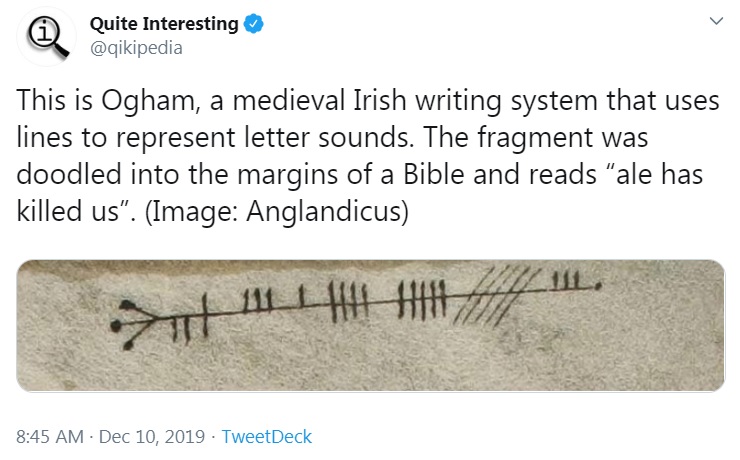
“Ale has killed us”? Short memories of the Vikings apparently. But enough! I have a long day’s work ahead of me then need to settle in for the the election results. Don’t forget that there’s more news at Boak and Bailey’s on Saturday, at the OCBG Podcast on Tuesdays and sometimes a mid-week post of notes from The Fizz as well. And sign up for Katie’s weekly newsletter, too.

*A teacher in Poland I once was…
**I used a slightly different quotation than Boak and Bailey so I feel justified.

Your “Is It Now Yule?” Edition Of The Beery New Update For A Thursday

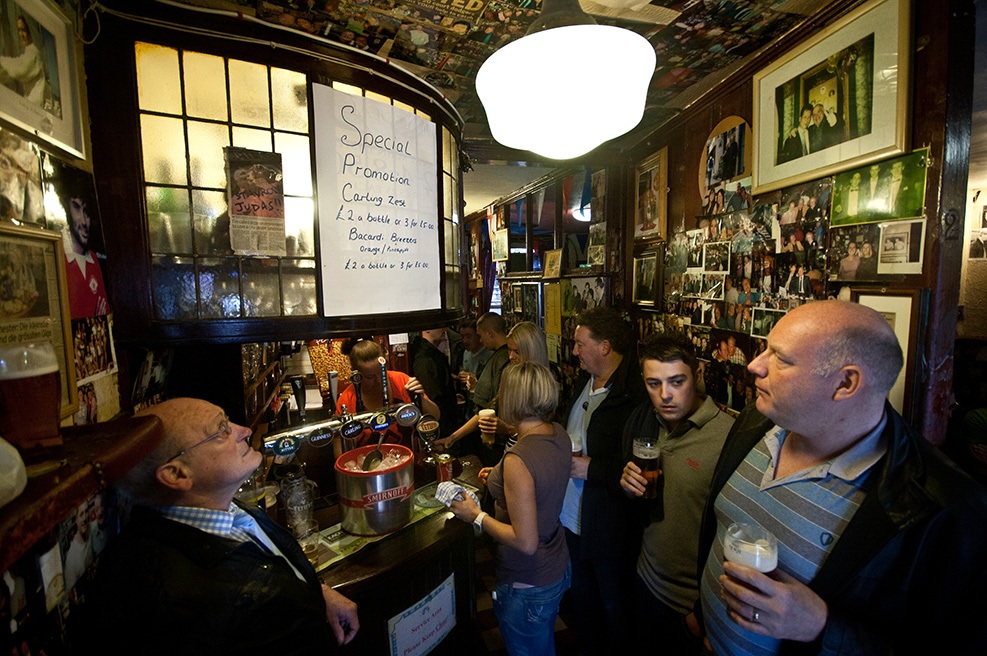
December. The month that is three weeks long followed by two weeks of blur before real winter sets in. Winding up the year’s work is the main thing on my plate. From 2006 to 2015 this would have been the culmination of the annual Yuletide Kwanzaa, Hogmanay, Christmas and Hanukkah photo contest but I have long come to my senses. You can see the annual winners here. That is the 2012 Champion up there by Robert Gale of Wales. As I wrote then, click on the photo so you can see the full scale and explore all the detail for yourself. Robert explained in his email where the photo was taken:

Located in Manchester, England, the Circus Tavern apparently has the smallest bar in Europe. It’s also located in the hallway of the pub near the entrance which means it very easily gets crowded.

Well, did anything happen this week in beerland? OK, fine: the big news in craft was not just a buyout this week but that a minnow was seemingly swallowing a whale. The billion dollar baby that is Ballast Point was sold seemingly to a mere brewpub. It is not quite what it appears as the purchase was made with a bucket of moolah earned from a sale four years ago in the hospitality industry along with input from other friendly and wealthy investors. Within minutes of the announcement, Josh Noel on the scene in Chicago noted the reasons why the sale was made from the view of Constellation brands:

… on maximizing growth for our high-performing import portfolio and upcoming new product introductions, including Corona Hard Seltzer, scheduled to launch this spring.” That’s right. It all comes back to hard seltzer.

Excellent. Hard seltzer. The future is now. Anyway, Noel’s story in Wednesday’s edition of the Chicago Tribune will be your best starting point for the background. Me, I suspect that (even if not Plan A but at the fallback Plan C level of the original Ballast Point purchase) there was the opportunity for significant tax write offs down the road.

Elsewhere, I declared that one particular story was one of the best bits of beer writing I’ve read this year and I meant it. Just look at this:

The ditching of big-brand lagers was similarly controversial and Ashley’s attitude reveals the gulf between traditional attitudes and those of the modernisers. There is still lager on offer but it’s from Moor and Lost & Grounded. Though you might think these would appeal to Bristolian drinkers, there’s a weird loyalty to international brands brewed under licence, and these sometimes hazy, fruity, characterful beers bear little practical resemblance to Foster’s or Stella, despite the shared family tree.

An actual investigative research and writing piece from Boak and Bailey that takes a very immediate specific example of the life of a pub in our times and makes it a universal question cut with a strong note of sympathy: “it’s drinkers who prefer a more traditional, unpretentious atmosphere who have to schlep or catch the bus.” Fabulous.

Others have commented but I was – perhaps oddly – reminded of this when I read Matt Curtis and his reasoned argument for more UK breweries joining SIBA to promote independence. While he is correcting in stating this:

This still means that at least 86% of beer sold within the UK is produced by the multinationals. As such I am eager to see the next step in the discussion of independence, and some real progress in terms of presenting this argument to a greater number of industry members and bringing them together to form a unified front against increasingly tough competition and unfair access to established routes to market… 

I am mindful of the beer drinker of modest means seeking their refuge from craft. Is that not as much a cry for independence? For autonomy from the gaping maw of gentrification into which craft beer is poured?

Bad Guinness pours. All day. All bad.

I am never sure of anything that is based on the concept of “wine drinkers” and “beer drinkers” as being subsets of the population but I found this bit of discussion from Danielle Bekker of Good Living Brewing failure interesting. She asks whether it wouldn’t be better to describe beer according to flavour profiles as opposed to more familiar methods. Being a hearty believer in the uselessness of style as a construct I like the idea but then hit a wall with the notion of a beer that “will appeal to wine drinkers as well as women.

Sadly and as reported on this week’s edition of the OCBG, Waterloo Brewing Ltd. from Ontario says it has lost $2.1 million to a cyber scam:

The Ontario brewery says the incident occurred in early November and involved the impersonation of a creditor employee and fraudulent wire transfer requests. Waterloo Brewing says it initiated an analysis of all other transaction activity across all of its bank accounts, as well as a review of its internal systems and controls that included its computer networks, after becoming aware of the incident this week.

Martyn made a confession

I know there are beer writers who eschew any involvement with corporate freebies, but my argument has always been that I’m very happy to accept free stuff, from beer to trips abroad, when it enables me to put information in front of my readers that I would not be otherwise able to give them. Certainly I do not believe I have ever held the boot back because someone had dropped off a case of beer. 

At the risk of someone searching the blog’s archives, I don’t think this is ever the key points. My concerns are always two-fold: (i) you are telling the story that the brewery provides for you, even if you do put the boot in and (ii) you are not telling the story of the brewery which does not pay for the trip. So they all go to Asheville and then they all go to Carlsberg. Bo. Ring. There is a third point. You do not go to these junkets alone. Even if “it enables me to put information in front of my readers that I would not be otherwise able to give them,” well,  the same information will be put in front of same readers by the other members of the same traveling hoard sent the airplane tickets, the hotel room reservations and the buffet passes. There is no special story attached to a junket. Go find a unique story instead.

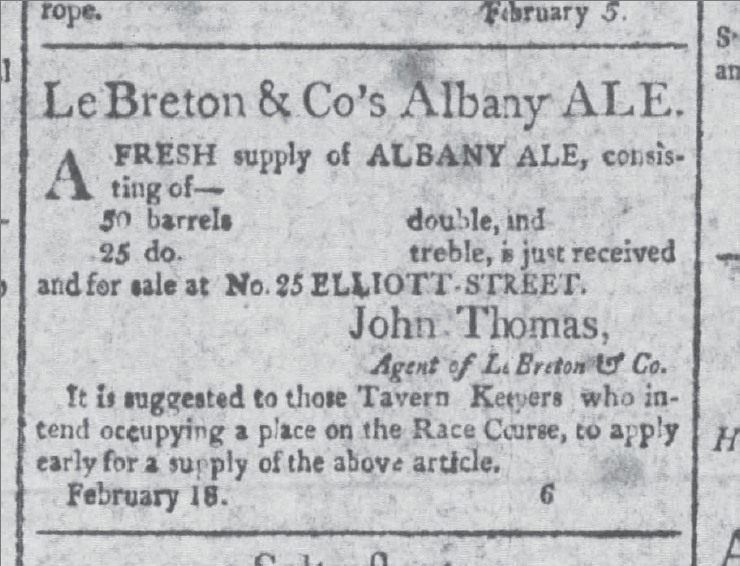
Two items from the co-authors. First, Craig has been digging more and found two very early advertisements for Albany Ale in the Charleston Daily Courier of 1808. Which not only means triple was being brewed in 1808 but it was being shipped to Charleston. Which is cool. I have seen “treble” spruce beer in New York City in 1784 but never a pale ale at that weight with that name.

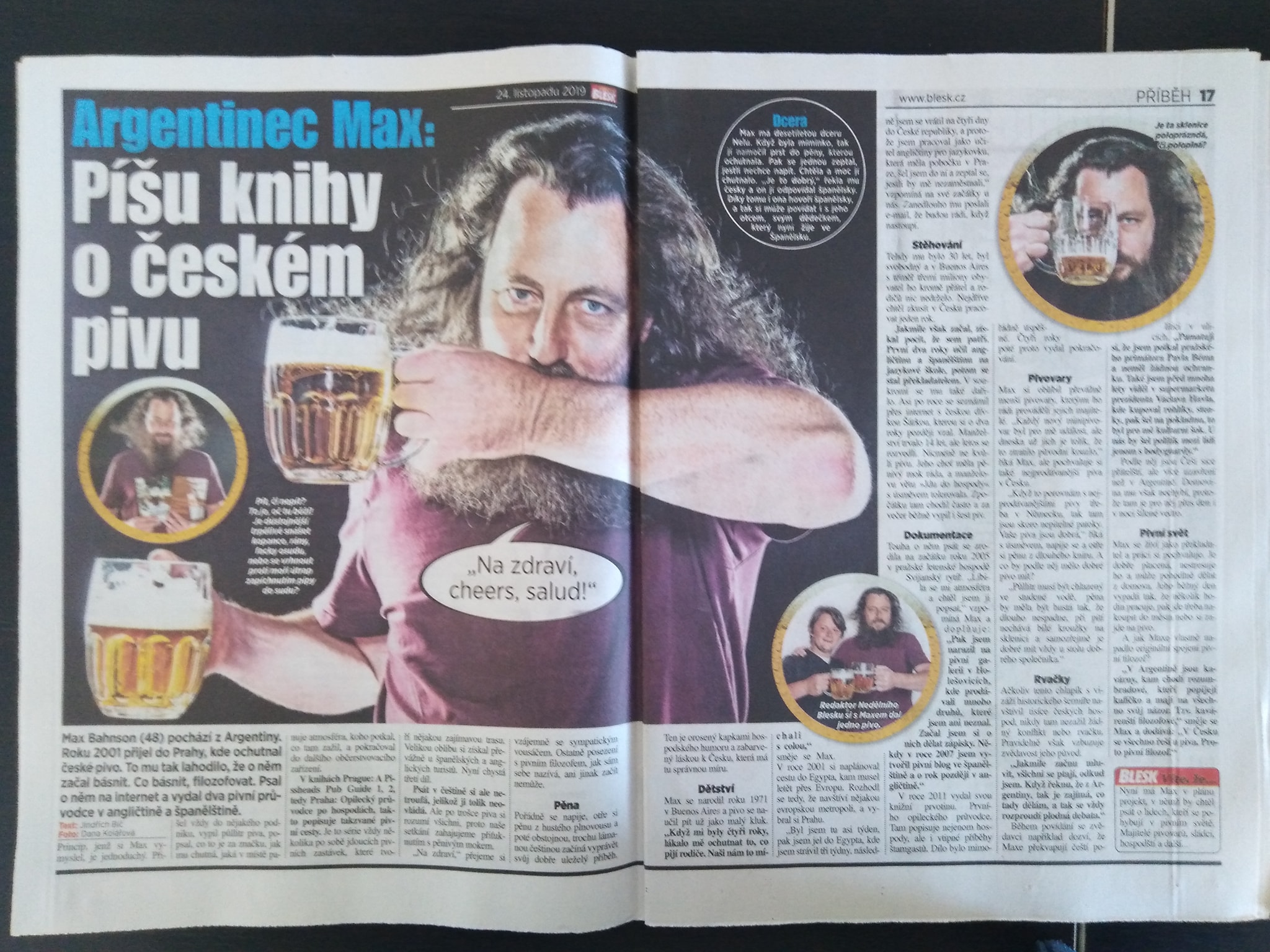
Second, Max. Max was the centerfold cheesecake pin up in a Czech newspaper this week. A very hairy centerfold. Wonderful.

The DC Beer 2019 year in review post is up.

That is it. I am on a train as you read this over your morning coffee. I’ll be back tomorrow. In the meantime,  there’s more news at Boak and Bailey’s on Saturday, at the OCBG Podcast on Tuesdays and sometimes a mid-week post of notes from The Fizz as well. And look for Katie’s weekly newsletter, too.

These Are Ye Beere News For Yon Thursdayish This Month From Yuletide

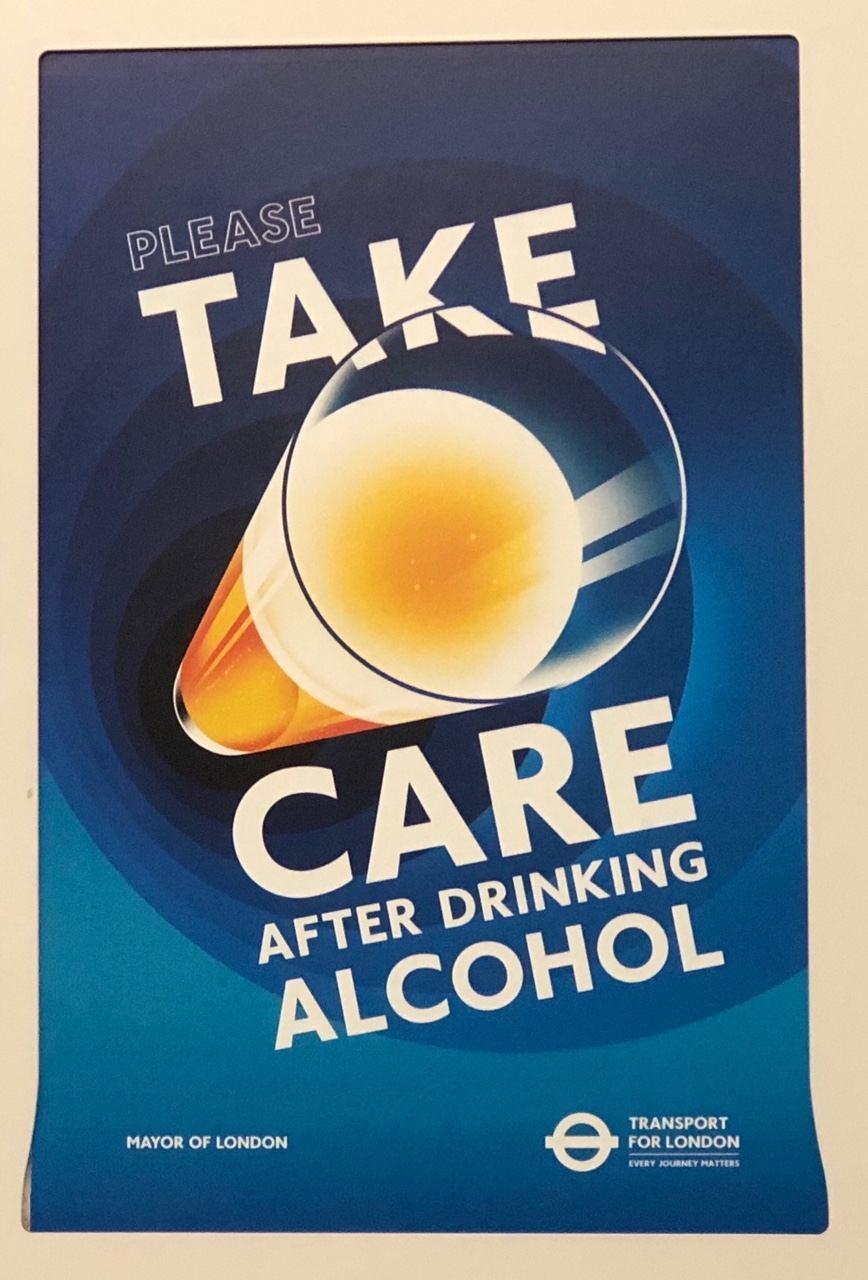
And I suppose the lead up to US Thanksgiving. I am not in the US and, honestly, does it feel a bit late for a harvest fest. The parsley is under snow now around these parts. But the Grey Cup is on this Sunday so that’s good. Hamilton versus Winnipeg.  Oskeeweewee Oskkeewahwah! Say that out loud a lot this weekend – wherever you are. And whether it’s Canada’s autumnal glory* or turkeytime down south, do take care. I didn’t… by which I mean I forgot to note whose tweet I grabbed this lovely common sense public health poster from last Friday. D’uh. [I lie. It was Martyn.]

I was complaining (again)** about the lack of interesting beer writing last week and immediately I was hammered by some fine examples. Consider this realistic vision of Brussels from Eoghan Walsh at Brussels Beer City:

Brussels stinks. It really stinks. Some days it smells glorious, of skewered rotisserie chickens dripping their paprika-stained grease onto the footpath or of the sweet scent of mashed-in grain that marks a new lambic season. On other days it is repellent – the amoniac fug of warming piss rising from pavements heralding summer’s arrival, or the damp choking fumes of the city’s unending winter congestion. 

Lovely stuff. In another hemisphere, Jordan St. John painted another sort of truthful picture of the start of affairs off the Mimico station platform a few stops to the west of downtown Toronto:

…I get the sense that 18 beers would be a lot to maintain. Some of these beers are re-using constituent elements and are not unlike each other. Take the Steampunk Saison, my notes verbatim: “Quite Sweet, Graham Cracker malt character, a little golden raisin or apricot jam character here. Low carbonation for a Saison. Mild notes of spicy orange peel amidst that.” It struck me as closer to Fuller’s ESB with the yeast switched out than a classic Saison. The Belgian style Tripel struck me as a larger version of the same beer. Still stone fruit and graham cracker, but with the intensity dialled up, reaching towards peach nectar. Checking in with the brewmaster, Adam Cherry, he confirmed that the ingredient builds were similar.

It’s a lovely portrait of the sort of locally successful, regionally recognized but also somewhat ordinary brewery that unfortunately rarely gets noted in the rush for the next amaze-balls moment. My immediate response was that Jordan had deftly displayed how to be both fairly critical and warmly encouraged – and encouraging – simultaneously. Exactly the best sort of analysis that, like Eoghan’s olfactory piece, places you by the writer’s side senses engaged.

An excellent and not unrelated discussion took place this week between Beth D and Crystal L as well as others on the role of judging and judges. I took my usual coward’s stance but went back to consider both the challenges of seeking and independent voice while wanting to be recognized as a peer. I’m grateful that they shared their thoughts.

Elsewhere, humility not being their strong suit, I am not surprised by the puffery. But would you really pay for the ever-loving cattle branded “two sides to every story” approach? Real money? Me neither. No doubt in response to the other subscriber offering mentioned a few weeks ago. God love ’em.

2020 is coming. Are your ready? I’m not. But I might feel better if I was heading to the Alcohol and Drugs History Society’s meeting on Friday, January 3rd and 4th, 2020 at the New York Hilton, Concourse Level.  I’d want to be there if only for the presentation by Stephen N. Sanfilippo, of the Maine Maritime Academy, of his paper “It’s My Own Damn Fault; or Is It?” Alcohol and the Assignment of Blame in Mid-19th-Century Maritime Songs and Poems. Being a lad raised by the sea in Nova Scotia, the only place cooler than Maine, I eat this stuff up:

Many nineteenth century seamen’s songs praise consumption of alcohol. Naval victory ballads often end with a toast by the victors, and sometimes include the sharing of liquor with the vanquished. Jack-Back-in-Port ditties also sing the praise of alcohol. This paper will give only passing attention to such songs. Instead, attention will be given to those seamen’s songs, and temperance reformers’ poems, in which alcohol consumption leads to disaster. Such songs and poems always involve the placing of blame. This placement is often not what might be expected, and is frequently complex and illusive.

In their monthly newsletter, Boak and Bailey sought to calm the waters of beer’s social media effect on those caught in its grasp:

Twitter in general can be frustrating, of course, but the conversation around beer is so much better now for us than it was a few years ago when the volume of trolls and bullies felt overwhelming at times. But this is a genuine request: if you think Beer Twitter is particularly terrible, if it really gets you down, can you drop us a line to explain why? Maybe there’s something we’re missing, and maybe there’s something we could do to help.

I think I agree. My behaviour has particularly improved. Far less bastardliness going around these days. At least amongst the scribblers as not all sorts of bad behaviour in beer is gone as Matt let me know of the crime and punishment of a figure in the UK’s craft beer scene.

The founder of a Norwich brewery who duped a businessman into paying £30,000 for equipment he never owned showed a “cavalier” approach to business, a court has heard.  Patrick Fisher, 39, has been jailed after he pleaded guilty to two fraud charges, including one which saw him submit false invoices. Fisher, of School Avenue, Thorpe St Andrew, who was previously a director of Norwich’s Redwell Brewery, admitted one count of fraud by making a false representation to Russell Evans between January 1, 2015, and January 31, 2017, when he claimed to own brewing equipment, when he did not.

That seems to be a bit unfair to Cavaliers, doesn’t it. No, he showed a criminal approach to business. Nice sort of old school larcenous heart to the court case, however.  Very Greene v. Cole, circa 1680-ish.

You might think the same thing is going on with the news about New Belgium being sold into the Kirin universe.  Yawn, I thought. So four years ago. And  the workers got a big payout, right? But then I read this one Facebook from a (former?) employee:

…please don’t lose your “dangerously unbridled in my passion for craft beer” I still have mine. That is the saddest part of this, I feel like everything I was taught, believed and shared at NBB was a fucking lie. I still love this industry and am proud to be working with new, small independent and innovative breweries everyday! It’s not OK to tap out! We need to remain CRAFT to the core. Watch your growth, listen to your employees and don’t chase trends continue to be a trendsetter. The industry needs you stay strong!!

Hmm… has that ship sailed? Maybe. Anyway, that is the week that was. For further beery links, your weekend starts with the Boak and Bailey news update on Saturday and then turn the dial on the wireless to the OCBG Podcast on Tuesdays. And look to see if there was a mid-week post of notes from The Fizz as well. And sign up for Katie’s weekly newsletter. It’s usually got even more linky goodness.

*Not unrelated to my own glory days… because they pass you by… glory days
**Even Jeff noticed with concern.

Your Thursday Beery News Updates For Mid-November

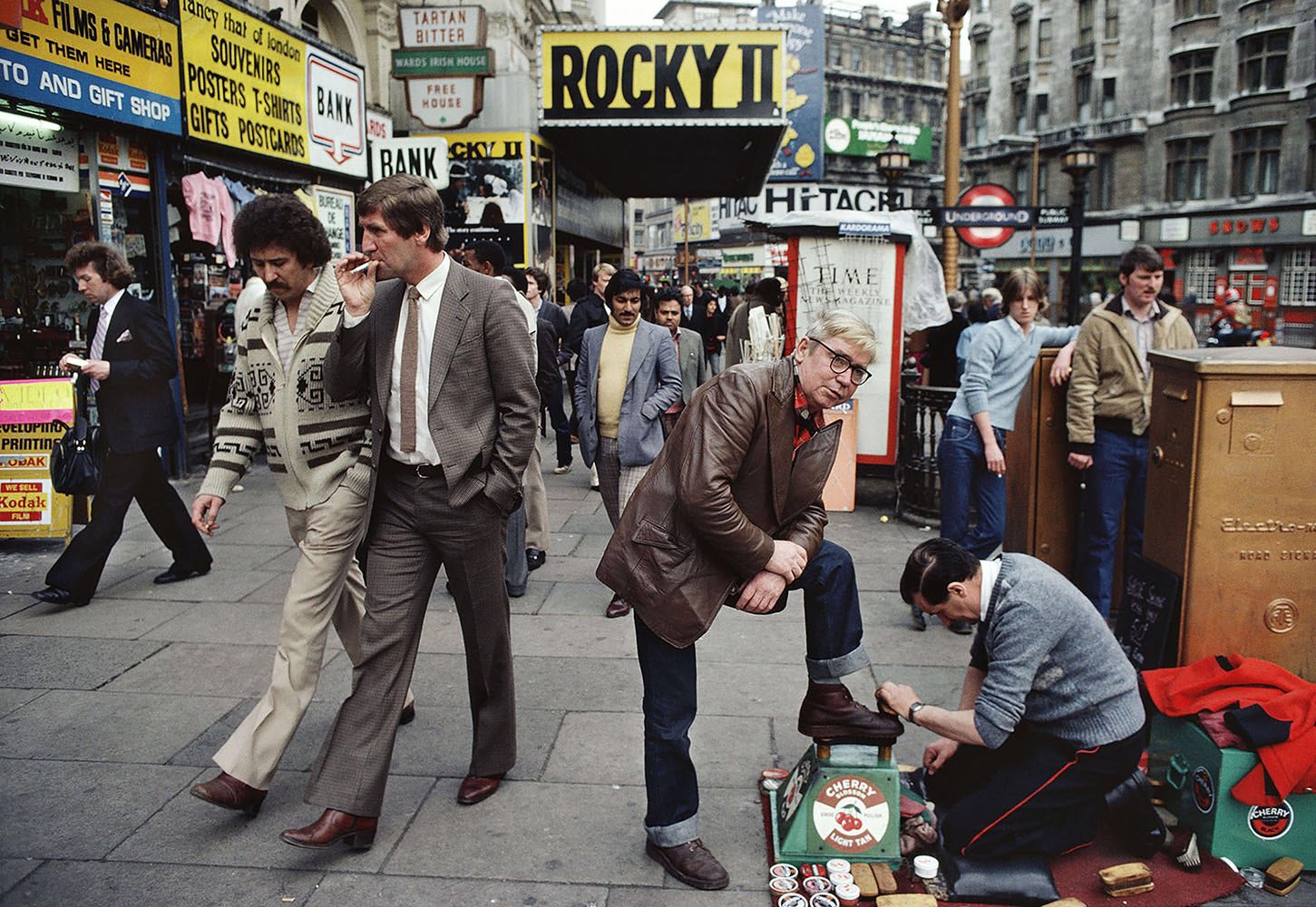
The last of birthdays, anniversaries and public holidays over the last four weeks has finally passed. And it has snowed. Wednesday was as sharp as deepest January at -16C even if it was +8C last Saturday. Five weeks before the solstice. So, I am buried in wool blankets at home this week, covered as soon as I get through the door, hugging the wood burning internet server looking for answers.  Which is where I found the image above, from 1979 when Rocky II came out. It’s from Piccadilly Square in London. Notice the sign for Wards Irish House, mentioned by Boak and Bailey in 2014.  Another report, two years later describes the entertainments:

Wards Irish House. Used to drink there in the ’70’s. Great Guiness with shamrock carved in the head. Once watched a group of people torturing a rat to death on their table top. Great seedy memories!

Conversely, Retired Martin has had a happier experience in his unending pub travels, especially with his visit to The Old Ship Inn in Perth, Scotland which he has shared in a lovely photo essay:

“How are ya ?” says the lovely Landlady. “Thirsty I bet“. Little things make a pub. It was Jarl, of course, a cool, foamy gem of a beer… 

Perhaps somewhere in the middle, Boris Johnson has apparently failed to keep his word, this time related to staying out of the pub until Brexit is sorted:
…the prime minister had claimed he would not drink until Brexit is sorted – with the first phase of the UK’s withdrawal set for January 31. But he failed to show restraint and maintain his “do or dry” pledge after pulling a pint in a Wolverhampton pub… Asked if he would taste the beer, he replied: “I’m not allowed to drink until Brexit is done.” He added “I’ll whet my whistle” before indulging in a sip.

Beth Demmon also told a tale this week – but one with more integrity – about Michelle McGrath, executive director of the United States Association of Cider Makers:

…she hobnobbed with agricultural producers, including a small cluster of organic orchardists operating in the mineral-rich Columbia River Gorge in the rural north of Oregon. They were looking for ways to diversify their income streams, and cider was “just taking off,” according to McGrath. This was the future, she realized. “I just happened to be in the right place at the right time and have the right passion.” 

Speaking of the right place at the right time and have the right passion, the rumours are true! Prague: A Pisshead’s Pub Guide – 3rd Edition is being written! And if you give to Max he might stop hitting me up for spare cash.

The Simpsons on beer and also on beer.

There has been a small somewhat odd protest in England related to Paul:

…bring back Paul! Paul worked at #Beavertown Brewery until he was sacked without reason and without warning. Paul is a well-respected member of staff who always supported his workmates! Reinstate Paul!

Katie is on the case, as usual. She has asked if anyone at all can tell her more about the sacking of a team member named Paul Shaw. Oddly, no deets yet.

In perhaps bigger news, Josh Noel gave the heads up on the swallowing up of the Craft Brew Alliance by Anheuser-Busch. AB now acquires full control of craft brands like Kona, Redhook, Widmer, Omission, Square Mile Cider, Wynwood, Cisco, Appalachian Mountain – making it the largest craft beer company in the United States. Nutty. Diana Barr in the Puget Sound Business Journal explained how this is the end of a process that started some time ago:

Anheuser-Busch InBev owns 31.2 percent of Craft Brew Alliance and agreed to pay $16.50 per share in cash for the remaining shares, the companies said Monday. The deal — which Reuters valued at $321 million — is slated to close next year, pending approval by regulators and a majority of CBA shareholders not affiliated with A-B, officials said. Most of CBA’s brands… already are distributed through A-B’s independent wholesaler network. 

MarketWatch argued that what looked like a premium price might actually have been a bit of a steal given recent stock price fluctuation. Jeff provides a brief boatload of background:

Originally called Craft Brands Alliance, it began in 2008 as a loose partnership with Seattle’s Redhook, which like Widmer had sold a minority stake to Anheuser-Busch, to combine sales and marketing operations. In 2008, it became a single company (called Craft Brewers Alliance) headquartered in Portland. The two companies were of a similar size at that point, but Widmer Brothers soon eclipsed Redhook. CBA had been contract-brewing Kona beer for the mainland since 2001. In 2010 the company acquired Kona outright. It owned a portion of Goose Island and sold it to ABI in 2011. In 2012 it launched a gluten-free brand and in 2013 a cider brand. More recently it began acquiring smaller breweries.

Perhaps as an antidote, a tale of restoration in the form of one last post on a pub in England – and a splendid one from Boak and Bailey who recently revisited The Fellowship Inn at Bellingham, south east London:

It was designed in glorious mock-Tudor style by Barclay Perkins’ in-house architect F.G.Newnham. On the opening day in 1924, Barclay Perkins reported that over a thousand meals were served. Again, check 20th Century Pub for more contemporary accounts of the life and colour of this and other big interwar estate pubs. When we visited in 2016, a small part of the pub was still trading, though most of it was empty and and terrible disrepair…

In happy news, the British Guild of Beer Writers:

…has shortlisted 28 writers, journalists and bloggers in its Annual Awards. The winners in 11 categories as well as the overall Beer Writer of the Year and Brewer of the Year will be unveiled at the Guild’s Annual Awards presentation and dinner on 3 December. Judges read, viewed and listened to some 150 entries which included books, newspaper and magazine articles, both printed and online, as well as blogs, radio broadcasts, films and podcasts.

I was unaware of the three nominees for Guild Award for Best Citizen Beer Communicator but see one writes mainly in Russian and another has a very shouty vid channel. Hmm… are they EU or just British citizens? Frankly, I find the total entry pools of 150 a bit sad comment but there we are. While someone will send out the attack dogs for merely mentioning, as both the BGBW and the NAGBW have placed themselves into the fairly generic good newsy trade journalesqueism niche – aka “beer and brewing industry coverage” – pretty squarely with this years award structure it might be time for a broader garage band level revival of creative and consumer focused writing. But that’s me. Remembering.

Gary takes up the challenge in a pre-facto sort of way and wrote my kind of post – history, beer and law from 1887:

Here’s what happened. A public house in Brick Lane, London was shown to have mixed two beers. One from Barclay’s was – my calculation from gravity numbers in the case – 5.7% abv, the other, a “small beer” from a dealer, only 2.4% abv… The mixing statute prohibited adulterating or diluting “beer” or adding anything to it except finings. The key issue was, did Crofts dilute beer by mixing a weaker beer with a stronger? The magistrate held yes; the appeal judges agreed, although not without some difficulty in the case of one judge.

It’s a start.

UPDATE #1: want a model of how to write about a business from a impassioned consumer’s perspective, look no further than these HATS IN CHIGAGO!!

UPDATE #2: I’ve discovered a new interest: alt forms of beer competition. This week – the curling bonspiel model:

Judging reform: (1) entries only nominated by others, (2) judging by panels with multiple tastings over time, (3) regional play downs leading to multiple progressive winnowing, (4) independent accredited controls. Allows more participation without one shot beers no one can buy.

There… enough for now. I have to go hibernate, to sob quietly for the summer of 2019 that I could pretend was just, you know, taking a break… until now. For further beery links, check out the Boak and Bailey news update on Saturday and then tune your dial to the OCBG Podcast on Tuesdays. And look to see if there was a mid-week post of notes from The Fizz as well.

A Few Exciting New References To Albany Ale… Which I Looked Up Now That Baseball Season Is Over

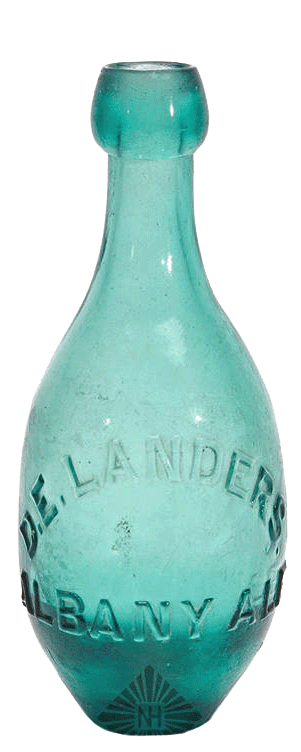
One of the things about the world we live in is that Google Books is being updated constantly. When I co-authored the histories of brewing in Ontario and the Upper Hudson Valley with Jordan and Craig, now over five years ago, we were very aware of the horrors earlier pop historians faced putting together an idea of regional brewing’s past. Google Books has been a particular blessing to us all. So, every once in a while you have to go back, as I did in August with Lambeth Ale, to see what has been added since you last wrote about a topic. Today, then, let’s look at the references to Albany Ale which have popped up since I last had a proper scan, including this image up to the right from the excellent Soda & Beer Bottles of North America website’s 2018 notes.*

By way of summary introduction to Albany Ale and in addition to my own tagged posts, I offer Craig’s observation posted last February on our Albany Ale Project‘s Facebook page on the scope of the drink’s travels:**

Regardless of the numbers of papers available on the site, it’s clear that Albany Ale was fairly common in the south, and specifically during the antebellum period. Of the roughly 3,500 hits from 1800 to 1900 (with New York papers eliminated) for “Albany Ale”, “Albany Cream Ale”, “Albany Double Ale” and “Albany XX Ale”, seven out of the top 10 returns were from southern states. Louisiana showed the most hits in the database (94) as well as the earliest (of the southern states) mention, in the Louisiana Gazette in 1819. Pennsylvania, is the first northern state on the list and it ranked fourth behind Mississippi and North Carolina. Connecticut missed the top 10 by one, but the Hartford Courant’s April 30, 1806 edition boasts the earliest mention of Albany Ale outside of New York.

Brewing in Albany (as the attentive amongst you who have a well-thumbed copy of Brewery History (2014) 157 by the bedside will know) goes much further back in time than 1806.  Harold A. Larrabee in his April 1934 personal and municipal biographical article “Herman Melville’s Early Years in Albany” in New York History Vol. 15, No. 2*** spends a generous amount of time on the maternal side of Melville’s ancestry going back well into the 1600s – aka the brewing Gansevoorts. Larrabee confirms that the site of Stanwix Hotel (aka Stanwix Hall) was the site of the family’s first brewery in Albany at Maiden Lane and Broadway run by Melville’s namesake, Harmen Harmensen Van Gansevoort. It also includes this recollection from the fiftieth anniversary of the building of the Stanwix Hotel:

Many a barrel of good beer, made of wheat, [says a newspaper account of 1883] has been brewed upon that spot. It was a pleasantry with the old people of those times, to say that when a brewer wanted to give a special flavor to a choice brewing, he would wash his old leather breeches in it; showing that slanders against Albany brewers and Albany Ale are not a new thing but of considerable antiquity. So as late as 1833, when the dome of Stanwix Hall was raised, the Dutchmen of that day called it Old Harme Gansevoort’s brew kettle turned upside down.

Bonus confirmation of Albany’s wheat malt based reality!

From 1840, we find in the likely temperance leaning publication The Ladies’ Companion and Literary Expositor this vision of the Albany ale drinking gent of the times:

An irreligious man—one who professes to be so, and glories in his own shame—who considers it an honorable distinction to be ranked among unbelievers, and who mouths blasphemy among his acquaintances as a sort of accomplishment to be proud of, is unquestionably disgusting enough; he takes decided precedence of the porter-house drunkard who blurts blasphemy over his mug of Albany ale without knowing what he says, and is merely vulgar and profane amidst an association whose whole object is a forgetfulness at once of self-respect as well as of respect for every thing else. 

Before you go all finger pointy at our prohibitionist forefathers and foremothers, I would note that this description roughly lines up with the 1832 diary entry of a traveler passing through Albany who, diving into a cellar, found a 3:00 am party described as “a good sample of low life in Albany” where they shared a feed of biscuits washed down by what was likely Albany Ale: “…there was no brutal drunkenness nor insolence of any kind, although we were certainly accosted with sufficient freedom.

In the 1841 publication A Brief History of the Origin, Progress, and Effects of the Present Astonishing Temperance Movement, and of the Life and Reformation of John H.W. Hawkins, the Distinguished Leader. Embellished with a Correct Likeness of Said Hawkins, we read this about the habits of pre-reformed Mr Hawkins when he was just twenty-one:

When once he got taste of liquor, after long abstinence, all power of resistance forsook him, and, as is the case with other inebriates, he gave himself up without restraint, till his health and strength for the time being became exhausted with intoxication. Albany ale, or “cat soup,” as it was termed, was a favorite beverage, to which he was particularly partial. He would sometimes begin with this, when at a public house; call for a pint tumbler, and, while reading a newspaper, drink a little at a time, till it was drained; then, feeling his appetite sharpened for more, would call for a second tumbler, and, without waiting, toss it all down at one drink. By this time, his rage for more became so violent and irresistible, that he has sometimes drunk many quarts in a few hours. 

We are told that prohibitionist “John H. W. Hawkins was born of respectable parents in Baltimore, September 28, 1797” and was alive at the time of the book’s publications which means his recollection of the slang for Albany Ale is reasonably reliable and dates to about 1818. Which is fabulous. Cat Soup. Love it.

Also from 1841, in the Western Temperance Journal, we find an article on all the meanings of the very newly coined slang “O.K.” which at the very last of a long list states: “O. K. Oil of Karrion—or Albany Ale.” Excellent! The greasy residue of the rotting dead. Which is a pretty cool actually contemporary goth or steam punk attribution when you think about it. Which also means Oil of Karrion now stands as a neato second name, along with Cat Soup, for a modern craft brewery’s recreation of an actual 1841 Albany Ale.

It’s important to note that there was good reason that the prohibitionists took aim at Albany Ale. By mid-century, it was a huge industry as this reference from an 1849 edition of The Merchants’ Magazine and Commercial Review illustrates:

The business of malting and brewing is carried on to a great extent in Albany, and employs a large amount of capital. Six breweries and malt-houses of the largest dimensions were erected in this city the past year, and the whole number of such establishments is about twenty. The demand for malt liquors is daily increasing in the United States, and Albany ale and beer are found not only in every city in the Union, but likewise in the West India islands, in South America, and in California.

In 1871, it could still be stated that “Albany ale and Albany lumber are known everywhere.” But it did not last. Times change and change can come quickly. From 1884, we see something of the beginning of the end in this brief but telling observation on time’s cruel march from The Albany Hand-book: A Strangers’ Guide and Residents’ Manual:

…Albany ale, at one time was on tap in all the large cities of the country, but of late has been displaced, to some extent, by lager beer which is also brewed here in large quantities…

Ah, Albany Ale. I am glad I played a part bringing it and the pre-lager history of American brewing back into the spotlight. One day far into the future if someone is looking up me on Google Books, it will likely be one of the few things I will be known for. And rediscovering that “Cat Soup” was once slang for the stuff. That’s just excellent.

*Of course, Craig may have seen all these but that is the reality of having keeners for co-authors. PS: I want that bottle. PPS: Craig likely has one and is keeping it from me. 
**Probably time we updated the book what with all this new information.
***Free at the wonderful JSTOR archive with a simple sign up as a researcher.

The Thursday Beer News Update For A Week When My Mind Was Elsewhere

On Tuesday, I had a great joke all prepared for my proctologist, analogizing with him or her over the election results. But… well, at least in the end, we seem to have had a good result. In both senses. Not much time for me to focus on the beer industry, however, which makes this week’s beer update as much news to me as to you. Let’s see what’s been going on.

First, speaking of biological science, Stan sent out his regular hops newsletter this week and, as exemplified by the photo up at the top, decided to provide some photos from the Hop Research Center in Hüll, Germany that Evan recently wrote about, as mentioned in last week’s news update. Up there, that’s a picture of some of the Center’s germ plasm collection of long-held varieties. Want more? You will have to pay Stan for back issues of his newsletter now if you want to see the images but haven’t subscribed already.*

The biggest story has to be the member of management at Founders giving testimony in a disposition that he did not know if someone who was… well, let’s see see how the story was covered:

A transcript of the exchange between Founders’ Detroit general manager Dominic Ryan and Evans’ attorney, Jack Schulz, shows Schulz shifting from shocked to incredulous and perhaps a bit angry as Ryan claims he had no idea Evans is Black. Instead of just answering the question and moving on, Ryan digs in deeper and deeper, repeatedly asking for clarification when Schulz asks questions like “Are you aware Tracy is Black?” At one point, Ryan even claims that he doesn’t know if former President Barack Obama, Kwame Kilpatrick, or Michael Jordan are African-American, because he has “never met them.”

The Beer Law Center tweeted: “This is stupid. The “if I didn’t say it, you can’t prove it” strategy – quite simply – sucks. The law, justice, trials, and courts, just don’t work that way. Shame on Founders.” As a practicing lawyer a quarter century into his career, I can’t disagree. The person diving the testimony did themselves no favours. Plenty of rightly offended folk now rejecting the brewery like Beery Ed: “if you still drink founders , you suck.” Which is true.

Boak and Bailey proposed a scoring system this week to determine if a British pub is in fact a pub.

Monty Python’s Terry Jones was on the BBC in 1984 and discussed both dental hygiene in medieval Britain and his brewing. Wogan preferred keg to cask. Jones, having a multi-faceted shirt malfunction announced: “real beer can only be made on a small scale.” Heed ye all!

Lisa Grimm has had a timely article published in Serious Eats about the haunted history of the Lemp family of brewers out of St. Louis:

Today’s beer history installment is something of a micro-level view of my previous column on German-American brewers—but this one has a Halloween twist. The story of the rise and fall of the Lemps, once one of America’s most powerful brewing families, reads like something out of gothic fiction; and, as would be entirely appropriate for that genre, some say that they’ve never left. The story begins familiarly enough…

A great technical article on barley came my way entitled “Characterising resilience and resource-use efficiency traits from Scots Bere and additional landraces for development of stress tolerant barley” I believe from @merryndineley. Now I have to go and look again at the standard for “landrace” when it comes to barley as I’ve seen husbandry in the 1600s but when we are talking bere we are talking about something much older than that as the abstract suggests:

Potential sources of viable resilience and resource-use efficiency traits are landraces local to areas of marginal land, such as the Scots Bere from the Highlands and Islands of Scotland. Bere barley is a deeply historically rooted landrace of barley that has been grown on predominately marginal land for the last half millennia. The landrace yields well in these conditions. The project aim was to assess and genetically characterise traits associated with enhanced resistance/tolerance, and to identify contributing genomic regions.

Speaking of great technical articles, I was blessed with a copy of an article on the history of Fuggles hops by the perennially referenced Martyn which, this time, appeared in Technical Quarterly published by Master Brewers Association:

The Fuggle hop is one of the most important varieties on the planet, not only in its own right as a contributor to the flavor of classic English beers for more than a century but also for the genes it has given to almost three dozen other hops… It is surprising, therefore, that until this year there was considerable mystery over the parentage of the Fuggle—it seemed to be unrelated to any other English hop type, with a hop oil profile much closer to the German landrace variety Tettnanger—and a fair amount of doubt and confusion over exactly who developed the hop and when it was first commercially available. Now, however, research in England and the Czech Republic has convincingly answered all the questions…

Nice article in Pellicle on the realities of the beer scene in Iceland:

We had moved up to the bar at Kaldi, and the low-hanging bulbs made the copper bar top and our bartender’s shaved head shine in the dim light. I had just ordered the Borg Garún Icelandic Stout Nr. 19, an 11.5% behemoth. If you haven’t heard, beer and food are pretty expensive Iceland. Pints of basic craft styles were $12-$15 (£9-£12) everywhere, and the higher in alcohol pours were $20-$30 (£15-£23).

Even at those prices, beats the hell out of an vaguely described essay on (what Canadians properly spell as) bologna.  Sums something up.

Katie tweeting on junkets triggered that a discussion wasn’t the usual monocrop of defensiveness.

There was a discussion on Facebook on the early days of the British Guild of Beer Writers awards dinners with some entertaining recollections. Martyn** recalled a night 22 years ago:

The earliest awards dinner menu I have is from 1997 – ham cured in Newcastle Brown Ale (!), accompanied by figs steeped in Old Peculier, breast of guinea fowl braised in Fraoch heather ale, pears in porter and cheese served with McEwans Champion Beer. Dinner sponsored by Tesco …

Ah, the romance… Related perhaps is this thread about traditional brewing in today’s alcopop world.

That’s it? Yup. For further links, check out the Boak and Bailey news update on Saturday and then bend an ear towards the OCBG Podcast on Tuesdays. And look for mid-week notes from The Fizz as well.

*I don’t make the rules. Stan does.
**Again with the Martyn!!!

Now That It’s March It Must Be Thursday So Here’s The News

Well, here we are. March. -15C this morning with the wind chill but at least it’s March. Things could be worse, I suppose. I could find myself at what the British call a hen party like we see in the photo of the week captured by temporarily angry Katie apparently practicing her mind control in the attached photo… except I’m not in Britain so she can’t reach me… and… I’d be at a Rooster Do or whatever they call it to make sure we are not getting all inter-species. The rural Ontario stag and doe makes so much more sense. But I am struck how fabulous Katie is… for some reason… give her money… give her power.

We continue with a rather odd tale out of Syracuse NY where we find a craft beer bar shut down due to a rather firm boycott:

Talisman struggled to attract business after its August opening due, at least in part, to a boycott effort from former J.Ryan’s regulars and bartenders. They blamed Carvotta for J.Ryan’s sudden closure and the firing of bartenders and other staff. Former J.Ryan’s fans also posted false negative reviews on the Talsiman Facebook page, attempting to make it difficult for the new bar to get off the ground. They derided the new bar as the “Taliban Tap Room.”

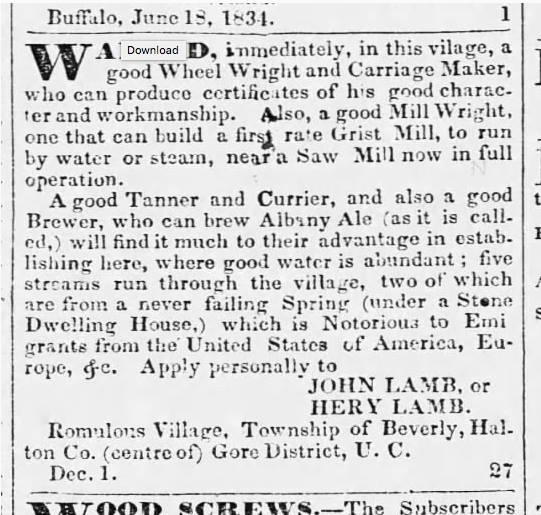
Yikes. Staying in upstate New York, Craig has proved again how flammable he is… and the answer is very… because his FB posts and new findings relate to Albany Ale are on… wait for it… fire. This clickable one to the right from 1832 is my current favourite notice related to Albany ale because it’s from a notice for immigrants to a frontier village in what is now suburb or city to the west end of Lake Ontario, then in Upper Canada, seeking specifically a person who is a tanner, currier and brewer of Albany Ale. Fabulous.

Back in Britain, there was another sort of unhappiness with CAMRA facing apparent or at least alleged revolt from within based on generational shift in appropriate standards:

A war is brewing among members of a real ale campaign group after younger reformers accused the ‘sexist’ old guard of treating the organisation like a ‘pensioners drinking club’.  The feud has been made public after seven reformers – all in their early forties or younger – of Campaign for Real Ale wrote a scathing letter claiming the organisation was ‘riddled with allegations of sexism and cronyism’.  In the letter published in this month’s newsletter, they wrote: ‘We need to see a campaign thinking more seriously about the next generation of pubgoers — a campaign whose public image is not riddled with accusations of sexism…’

Good. Very good. But how many old guard members are there really out there? You’d know better than me. ATJ knows more and he wrote an article for The Telegraph. Here’s a handy Twitter search for “CAMRA sexism” to measure the temper of today.

Crystal takes one of more obligatory sort for the team.

Jordan on why his beer appreciation college course is the best beer appreciation college course:

Luck doesn’t have a whole lot to do with it. I basically started from the proposition that I’ve got to be more useful for less money than both established programs. Cicerone can’t customize their content. Prud’homme can’t customize their content. I can tell the students what happened last week and change out recipes between semesters. 

Martyn has written a cheery attack on the shadowy Portman Group, all over its stance on strong ale:

Among the beers that break the new Portman Group guidelines, and therefore face a potential ban, by being stronger than eight per cent and sold in 75cl bottles, are beautiful brews from the US, such as Brooklyn Brewery Black Ops, or Local 2, Rogue’s XS Old Crustacean barley wine and Lost Abbey’s 10 Commandments; a rake of great beers from Italian craft brewers, who go for 75cl bottles in a big way – pun semi-intended – including the wonderful Xyauyù Barrel from the Italian brewer Baladin; and a fair number of beers from the Netherlands and Belgium… and Dupont Avec Les Bons Voeux.

The bastards. The only thing that lets me go on is knowing that there’s Avec Les Bons Voeux out there. Matt took an interesting take on the subject via tweetfest:

…there are thousands of videos of people chugging cans of DIPA on Facebook and Instagram like it’s a game. If we want to encourage responsible drinking of a premium product, perhaps we start by addressing the reality of the situation.

In very happy news… Go Ray… go Ray… go go go Ray!!!

More great news, this out of CBN and the east coast Canadian fabrication scene:

Diversified Metal Engineering (DME) in Charlottetown ceased operations and went into receivership last November along with its sibling business, Newlands Systems (NSI) in Abbotsford, BC. The company and brands have been bought by CIMC Enric Tank & Process B.V. (CETP) of the Netherlands, and the Charlottetown facility has been reopened under the name DME Process Systems. Previous DME staff members have returned to work, and the plant will continue to manufacture DME and NSI equipment, as well as provide parts and technical support to previous DME and NSI customers.

There’s background on the DME story in former weekly news.

I had no idea that there was a German tradition of drinking beer and throwing political insults on Ash Wednesday but state radio folk Deutche Welle says there is:

…every Ash Wednesday the gloves come off, and political leaders are allowed to push the rhetoric to the limits of fairness — and sometimes beyond. That’s been the case this year, too, in the centenary edition of the ritual. Here are some best zingers from the 2019 edition of the political roast day Germans call “political Ash Wednesday.”

The zingers include such winners as “Good PR isn’t going to lift one single child out of poverty” and, of a leader of another political stripe “In her heart of hearts, she’s a Social Democrat.” Wow.  Consider my knee well and truly slapped.

That’s it for this week. A little thin… unlike me in either respect. I got through a kid’s 19th birthday and the intro to drinking legally as well as an radical expansion of the life at work and survived. By next week, the clocks will have changed and the snow will be muchly melted. Check out Boak and Bailey on Saturday and Stan on Monday as well as the slowly simmering #MoneyMakerMarch that everyone… well, Stan… is talking about.

As January 2019 Dies Off Another Set Of Beery News Is Born

A surprisingly long set of links face me in my inbox today. Folk send me suggestions all the time… well, some of the time… OK, once in a while. Honestly, for the most part to make this weekly update of the news in good beer I just email myself links as I notice a story through the week. Usually there are seven or nine by early in the week. This week, I had over twenty by Monday. And, yes, emails. So… let’s dive right in.

First off, if you are in Toronto this evening (and I will be if only passing through via VIA) you can pop over to this fabulous fundraiser for an important cause to witness some top notch curling action (like that to the right from last year) at the Beer Sisters’ Charity Hopspiel:*

On January 31st, brewers from across Ontario will gather at the Royal Canadian Curling Club in Toronto’s east end. Clad in array of plaid, denim, light-up shorts, toques and matching jerseys, 24 brewing industry teams will face-off to raise money for the Native Women’s Resource Centre in Toronto. The Beer Sisters’ Charity Hopspiel, hosted by beer writers and educators Crystal and Tara Luxmore, is in its 7th year. The event has raised over $32,000 for the centre, and the sisters hope that this year they’ll cross the $40,000 mark.

Fabulous! And at the Royal Canadian Curling Club! An actual place I am assured, not just a mid-range brand of rye whisky from the 1950s.

Next, Katie wrote a wonderful piece on heritage barley published in Ferment that explores the use of Chevallier, the darling English malting from around 1820 to WWI. I immediately started badgering her about joining my Battledore revival crusade.

Note: Victorians represented in under 1% of the graph and the most striking thing is not their habits so much as the near replication of the feat right before the economic meltdown of 2007-08. Nonetheless, a very handy set of charts and who doesn’t like handy sets of charts?

Not journalism.  Or at least not good journalism.** Just badgering. Easy enough to get a quote from someone but it usually requires letting them speak.

An clear and accurate guide to tipping in Canadian tavs, pubs and bars.

Beer Ramen. Kill me now.

Update: We’ve had an actual update on #FlagshipFebruary and I couldn’t be more grateful for the clarification:

…it is in our and the industry’s best interest if we take a moment occasionally to appreciate the flagship beers of the industry’s foundational breweries…

So, the brewery has to have continued through the good beer era and the current flagship is the brewery hallmarks to recognize. Andy Crouch wrote a wonderful dense poem of a tweet on the same topic:

Revisiting long established flagships tastes of antiquity, success, failure, unfulfilled dreams of resurrection, and ultimately nostalgia. A place in time to momentarily revisit if only to remind you how far you’ve come but rarely a place to linger long.

I noticed this statement in a piece on German brewing culture and I thought it was extraordinary for suggesting agricultural capacity of a landscape is not the governing factor in whether beer was made or not:

Alsace is on Europe’s religious faultline. Beer is often thought of a drink of the Protestant north, but the facts don’t really bear that out. Belgium, Bavaria and Bohemia are historically Catholic (even if that religious attachment has faded); only Britain, of Europe’s foundational beer cultures, is Protestant. Does this suggest beer is less Protestant than thought? Perhaps, but I also think Catholic cultures are (as you might assume) better at preservation.

Well, I suppose someone has created a jam/jelly faultline based on religion. Me, I’d suggest many western and central European brewing traditions were pretty much established before the Reformation.

The effect of the US government shutdown on the brewing trade is measurable. Why the difference in processing wines and spirits? I blame the slackers attracted to a career in the beer label branch.

Gary’s piece on Watney’s Red Barrel as experienced in eastern North America at the time contains plenty of those links to contemporary primary documents that leave you persuaded. By way of contrast, this could really be read in two entirely opposite ways:

“I actually am mystified myself,” says Jeff Alworth. He should know…

Fine. I’ve held on long enough. Let’s talk Fuller’s or at least the highlights of the discussion. Promethean Jordan found a very helpful Brexit angle on the timing based on last year’s visit. Martyn argued convincingly that the whole sale spoke of business success and a strong future going forward. Then he added a bonus history of Asahi to deal with, you know, the legitimacy issues. Jeff at distance took it as a hefty body blow and mainly sees that it poses great risk to the English cask ale scene. Boak and Bailey wrote from their semi-characteristic personal perspective, supposing they are facing another long goodbye to a treasured relationship. Matt sided with the corporate success group and then started blatantly and publicly gambling with Boak and Bailey over the matter. Pete wrote first about his lack of levelheadedness when faced with the news and then got level headed and then sorta wobbled again in the semi-revisionist Book of Genesis stuff.***

My take? First, Fuller’s has been masterful in building up its reputation with good beer conversationalists over the last ten years. Remember how fun it was when @FullersJohn started tweeting? How beer writers were brought in and got their names on the label? What is really being noticed now is how the emotional credit Fuller’s they earned through that clever outreach has been truly a rich investment. And notice how none of the commentary comments upon that even though it was all done openly and with integrity.  Second, the only constant about the beer business over the centuries has been the goal of continuous growth, merger and acquisition. Brewing has two great outputs: beer and wealth. This is just the latter being successfully served after a long stretch merrily servicing the former.

I love this tweet by Jancis R:

Never ceases to amaze me when we get messages like this: ‘We’d like to find out how to go about having our wines scored by Jancis Robinson, as well as the costs involved.’ Who charges to taste wine?

Who charges to taste beer? I know some but it would be rude to mention, no? Conversely, there is a craft beer fraudster working the US south:

“The phone rang and rang and rang…I checked the house and it was empty. The door was unlocked,” Brandon Oliver says. “His chickens were still in the backyard…about 90% of his clothes were gone…he left as if he only had six hours to leave.” Foster left his tools out at the unfinished beer garden. He and his family left town overnight.

The abandonment of the chickens is a sweet detail.

As someone with hearing that will never get any better, I really like this inordinately nice idea from a campaign under the heading Quiet Scotland:

Ever left a shop or been unable to enjoy a meal or drink because the background music has been so loud? Don’t like complaining? Try leaving one of our polite cards to get your point across.

An email went around from NAGBW HQ about the impending demise of the All About Beer web archive and I first thought it was an oddly presumptuous thing to send… and then I thought it was kind to alert me. I did not save any of my own work as anything I pitched was not dubbed worthy – which made me happy. I really hate editors and others paid to make things duller. But I did save Stan’s story How Craft Became Craft for very obvious reasons.

And, finally, let’s just watch this**** and listen to the screams of those precious darlings witnessing a part of their personal emotional foundations, the rebellious idols of their youths, being washed away out from underneath their feet:

That’s it! A big week in the contemporary detritus of good beer culture. Please check out Boak and Bailey on Saturday and then Stan on Monday for more sensible and refined responses to the week in good beer.

* For those not in the punny know, see Bonspiel.
**Which is quite another point we never explore when a writer claims the journalism label… or at least the helpful bits. Seldom the adoption of the concurrent ethics lead at that moment.
***“Sierra Nevada’s Pale Ale began life as an attempt to imitate Fuller’s ESB.” Really? How many beers is SNPA an clone of? Ballentine IPA. Burt Grant’s work. What else?
****And this, for that matter.

When Did The United States First Export Hops?

Above is a table published in The Republican Watch Tower of New York on 4 July 1804.  I went looking for this sort of thing after reading Martyn’s excellent post of this week “How Long Have UK Brewers Been Using American Hops? 200 Years, You Say…” Initially, I was interested in the Hesperus, the ship that brought the hops in question to New York to Belfast in 1818. I found notices in the New York newspapers for the same ship bringing Irish linens to the American market on its return voyage. I love ships.

But then I wondered when the first exports of hops from the young United States occurred.  And I say “United States” as there is no reason to believe there might not have been colonial exports here and there but I would suggest that is another story. That being said, if the table above is to be believed, hop exports would have begun at least in 1797. But where did they go? One often reprinted 1802 article under the title “To The People of the United States” authored under the  name Franklin originally in The Aurora on early US export prospects – the one to the right quoted from The Bee of Hudson, NY –  specifically addressed the hop trade and gave a sense of the realities and goes on to conclude:

The profits of raising hops are such that the great brewing countries of Europe impose heavy duties on their importation from America or elsewhere.

So, soon into the new century US hops were needed at home and subject to European protectionist tariffs. The hop trade to Europe was subject to a prohibition. Which means it had been happening and then was stopped. Which makes one wonder where all those pounds of hops were going, the ones shown in the 1804 table from The Republican Watch Tower. Hmm.

It is clear that there is a market for hops at the time. The internal inter-state beer trade was certainly robust between New York and New England. Here is a notice that includes 35 sacks of hops on sale in NYC in 1795. In this notice to the right in the New York Gazette of 27 August 1805, 20 bags of hops are on offer. If they are 50 pound bags, that is the same volume of hops listed as the entire export from the nation in 1797.  In this edition of Ming’s Price Guide* from New York in August 1810, there are prices for both American and English hops. Still, the international market for commodities like hops has to be understood in the context of tariffs and even international relations during the Napoleonic Wars and at this time we have to be reasonably aware of the Jay Treaty of 1795 opening up trade from the US to Britain and the Embargo Act of 1807 shutting it down again. So if we are looking for an export of hops to Britain from the United States we should keep those dates in mind.

The other thing to remember is that hops are not only native to New York but also grew prodigiously. To the right is a notice for the sale of certain lands in central New York. It was placed in the New York Gazette on 3 May 1805 and notes that “the soil is rich and fertile to produce any species of grain, hemp, etc. – the climate moderate (testified by the abundant growth of vine and hops); the water is good, the salmon and other fisheries great…” So while Craig may be correct in relation to the dates of commercial growing and selling of New York hops, their pre-existing natural abundance was an obvious characteristic of the state. It is also worth noting that when he and I were putting together Upper Hudson Valley Beer, I came across a record from the first decade of the 1700s of Mohawks selling hops to Albany brewer, Evert Wendell.

And hops were not just picked wild at the time. In
The New and Complete American Encyclopedia, 1808 edition, there is an extensive section on the propagation and selling of hops including information taken, it is cited from a document published by the Agricultural Society of New York… no, the Society for the Promotion of Agriculture, Arts and Manufactures, instituted in the State of New York.** The cultivation in New York is especially encouraged:

The cultivators of land in this state have every inducement which policy or inducement can afford, to enter, in spirit, into the cultivation of hops. We shall therefore be enabled to supply our own demand, and export this article; instead of sending abroad for all we use; and no crop that can possibly be put on land will yield an equal profit…

Were the hops loaded on the Herperus in 1818 destined for a Belfast brewery the first hops sold into the British market? It’s quite unlikely given the abundance of native hops, the records of an export trade, public marketplace pricing and the general regular European trade in many commodities going back a couple of centuries. Was there a Caribbean market for hops along with the wheat and biscuit shipments we see bound to supply an aspect of the slave trade? Could be but southern brewing of beer was a very dodgy thing.

It’s also likely that it was a little remarked upon activity, like the export of casks of beer from Albany and New York City. Likely modest supplies of infilled cargo rounding out a vessel’s hold. As usual, we are at the whim of the vendor from the time – was there enough demand to spend the money to place the notice in the newspaper? Without someone making that decision then it is difficult to know now what they were particularly up to. But such is life, the record of the activity never being proof of the fact of the activity.

Still, there is likely more to be found out there – especially in relation to activities such as Strictland’s study in the years after the end of the Revolution when interest in trade between the newly independent nation and the home of its often Loyalist heart in the old country seemed to tick up before the laws came down. So let’s consider this an introduction to the idea.

*aka Dickinson’s (Formerly) Ming’s New-York Price-Current, Ming and Young’s New-York Price-Current, Ming’s New-York Price-Current, Oram’s New-York Price-Current, Oram’s New-York Price-Current, and Marine Register, The New-York Prices Current.
**The NY Agricultural Society as it exists today only comes into being in 1832… which seems a bit late given the county ag fairs start up years earlier.


The Blink And May Is Gone Edition Of Your Beery News Links


To start, I have done what every good beer writer does – I have stolen something. The image above is the lower slice of the cover image used by Boak and Bailey for last Saturday’s edition of “News, Nuggets & Longreads” and it snapped my head immediately to attention. Wow! See what is going on there is in the anonymous 1890s pub? Careful readers will recall my 2012 search for better drinking vessels and in particular my love for my pewter quart pot* which is happily put into periodic use. When conducting that search care of Messers E & Bay**, you see these quart pots with spouts that I figured were altered and re-purposed for household reuse after the era of quart in the pub normality left this Earth.  But NO! They are for pub use, the buyer purchasing a quart measure but serving himself with it but drinking from the smaller glass instead of the pot. No wonder the spouts are all at 9 o’clock to the handle’s 6 o’clock. So the right hand can pour to the left. A jug built for serving someone else is always spout at 12 o’clock to the handle’s 6 o’clock. Perhaps this was a quart of strong ale compared to to a quart of a lighter weight beer? Now I want one of those, too.  And so should you all.

James Beeson on a year writing about beer from the rare perspective of journalism. Also see Jeff on the same. J + J are both correct.  Certain brewers and many PR folk have an issue they have to deal with. We might call it “greater society.”

One week until the vote is in for Ontario’s election and NDP leader Andrea Horwath has given us another “candidate with a beer” photo. The scene is Brothers Brewing in Guelph. I prefer the Canadian standard “politician beer pour” pics personally but seeing as this was actually tweeted on the official party feed, I’m more than pleased. Unlike the last national election in 2015, beer is an inordinately active topic in the election so far – and is being picked up by the news organs covering the race. In fact, they are being even so clever as to seek out knowledge such as in this article where Macleans magazine quotes from and even includes a hyperlink to the blog of Jordan St. John! In one of the oddest Ontario election promises ever, conservative leader Doug Ford has promised the return of buck-a-beer cheap lager. That was a thing until 2010. Jordan unpacks the many many ways that this is never going to happen. My tweet:

Ontario’s “buck a beer” went away when a big corporation bought a smaller corporation, shut it down and sold off the equipment. Not a policy matter. And government can’t force brewers to make cheaper beer.

Mr Ford may well be our next premier but no one has accused him of being all that bright. Five years ago, The Globe and Mail*** accused him of  selling hashish for several years in the 1980s but no one has accused him of being all that bright. Dumb.

Hail in Bordeaux on May 26th. One-third of Blaye heavily hit. Drag.

Martyn Cornell posted about running ads on his blog. I used to do that a decade ago. Good money. Folk are always seeing us there is a way to recoup the cost of all this. And they should. Hilarious observation in the comments from a reader remarking on folk jabbing about the ad selection:

Other posters — the ads you see *might* be determined by cookies on your machine indicating what you’ve previously been viewing so maybe be a *bit* careful before announcing what’s showing up for you…

Me, I don’t really care about the financing of this here publication any more as digital historic research is less expensive than my other hobby, sewing suspender buttons on trousers for work.****  Seeing as, me, I don’t travel and don’t hang out in pubs I really don’t have a love-hate relationship with my problem writing anymore. I have a backyard. I have a rec room with an old Lay-Z-Boy. It’s all working out.

Note: any brewery drawing water from the Great Lakes south of Sarnia is pretty much making a dilute processed sewage water beer as well. Not to mention it all being DINOSAUR PEE!!!!

Folk are still waiting for the apology that will never likely come. See, Beavertown has been talking to Heineken after all. As noted in your May 17, 2018 edition of the Thursday news, those who saw this coming were “rumour mongering” and spreaders of “falsehood” – which have to be two of the most infantile over-reactions in hard scrabble beer consulto history. Way to go. The fun continues as Beavertown lands a deal with Tottenham football club serviced no doubt with approval of Heineken, the club’s official beer sponsor – but wait! One tiny voice shouts “HOLD THE PRESSES!!!”:

Nothing has been confirmed. Could be completely unrelated – collaboration could be within the stadium only – but there are no sources saying either of these things are true.

And monkeys might be circulating in trousers. What a mess. Having negotiated sports stadium bevvy deals, it is pretty obvious that there is a connection… as it would be to most. Does anyone think that Beavertown or Heineken have two law firms isolating these sorts of deals with the same parties from each other? Yeah, that make sense. Plenty of sense. But no: the last few weeks’ simmering sneer of discredit suddenly has an implicit claim of special access “the sources“! And, suddenly, now rumour mongering is in!! The core self-branding strategy prime directive is pretty obvious… still, I like to read along these sorts of aggrandizement cub reporting mongers with the sound of a teletype or stock ticker clacking along in my mind. It helps.

By contrast, the ever excellent Ben Johnson has written about a wonderful new addition to the Ontario beer scene – the Toronto East End brewers collective. One of the dumber things about the “independent” aspect of the craft beer movement is how it depends on followers aligning into lock step with messaging coming from the tenured staff of centralized national scale trade associations located far far away. The Orwellian scenes at the keynote speeches of the annual Craft Beer Conference look like something out of a mass reeducation session. I hear they chanted “Gose is Good! Gose is Good!” at the end of one of these back in 2016. Newsflash: it often isn’t. Far better it is, then, to read how some are fighting back against mindless homogeneity even in a local scene:

“Most of the breweries in Toronto who have been the beneficiaries of media hype (deserved though it may be) are all clustered in the west end,” he says. “There’s already this ridiculous ‘cultural divide’ that makes people in the west end feel like traveling east of the Don Valley requires a full day of logistics planning and we’re hoping to dispel much of that nonsense.”

Fight the power. Fight the good fight. Fight! We need more of this. Dump those who aspire to “big and controlling” whether in association or in distribution or beer writing or whatever. This nano-political statement is the next logical step for “local” and it is welcome if not long overdue.

And with that, I leave you. Once again the goodness in craft is defined by the local, ungrasping, interesting and kind. Alcohol and money have their powers for sure – but peril lies that way. Both for those who speak in that fashion and those who bother to listen. Much more fun is the real. Next Thursday is election day! I even have an orange sign on the lawn.

*You do all know that a tankard has a lib but a pot does not, right?
**Stolen this time from Norton of Morton.
***Toronto’s national newspaper.
****Good set of buttons costs about $3.50. Tops. Lots of colours and sizes, too. Don’t get me  started on vintage buttons made of deer antler…