For The True Beer Gent, A Hopsack Suit Perhaps?

From Sessional Papers, House of Lords, 1840

—-

The following was recorded in evidence at the Old Bailey on 9th December 1778 in a case of grand larceny.

Mr. PETER CORBETT sworn.

I am Bengal warehouse-keeper to the East-India Company. I have in my hand the invoice of the Duke of Portland; this was delivered to me from the company when the ship arrived, and it is my duty to see that every thing comes out clear from these packages into the warehouse agreeable to the invoice sent from the company’s servants at Bengal . In the second page, here is a No. 4. S. Taffety, which means striped taffety. Upon the opening of this chest, the servants under me gave me what we call a piling bill; they found only 176 pieces and a small bale containing ten, and this piece, which was kept for evidence. These goods were in a strong chest, nailed down, and there was a strong gunny or hopsack sewed upon it.

Hopsack. I know a bit about hopsack now as I own a blue blazer made of the stuff as well as a pair of black trousers. Neither Mr. Corbett in 1778 nor Mr. Lidbetter likely did. For them hopsack was definitely a packing or wrapping material. It’s formed by making your cloth in a basket weave. Often wool for clothes. Hemp and jute for bagging. Made into a jacket, it’s light summer weight cloth, the open weave letting the air flow. Fine fashion by the 1890s. For sacks and bags it’s strong, perhaps a grade or two above burlap.

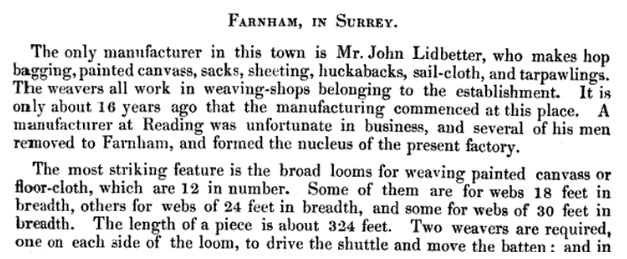
The House of Lords was inquiring into the general economic circumstances when it was considering hopsack during its 1840 session, J. Mitchell, Esq., LL.D., Assistant Commissioner of the Hand-Loom Inquiry Commission reporting from the east of England. They learned about sacking and floor-cloth weaving in Reading, Berkshire and specifically Mr. William Harris of the delightful address, the “Hit or Miss beer-shop in Boarded-lane” who described the sad local state of affairs:

In the year 1815 there were as many as 11 masters and about 200 looms; now there are not 12 looms. The trade began to fall off in 1821, and has gradually become less and less, and when the old men, the present weavers, are gone, it is supposed this trade will be at an end in Reading. No person has learned the trade for years past. The price paid for weaving in 1815 was 2 J d. the square yard; this was reduced to 2 4 d., and afterwards to 2 d. per square yard. The sacking is three-quarters wide, or a little more. There is a great deal of time lost for want of regular employment.

There is now only one loom at work making floor-cloth. The web is six yards broad. There are looms which make floor-cloth eight yards wide, and even 10 yards wide. The cause of the want of employment in this branch is inability to manufacture the goods, and come into the market at the same price as the manufacturers of Dundee. The local advantages of that town in obtaining the raw material, in spinning and weaving and sending the goods to market, are such as to leave no chance for competition. The remnant of the business still lingering in Reading is the supply of the neighbouring farmers with sacks. There is no remedy, and with the present race of weavers the trade becomes extinct.

As stuff in demand, locally made Reading coarse packing cloth was on the way out. Why? Trains. It’s always the trains. Or the canals before them bringing in that cheap Dundee sacking… or a cheaper or tastier strong ale. Secondary manufacturers making the packing for the primary producers don’t need to be local when the trains can bring in stuff that’s as good for less. Mr. Lidbetter up there up top? He seemed to still be bucking the trend. He had a market the lads of Dundee couldn’t crack:

There is one article in which there is a decided advantage, that is hop bagging. The town is the very centre of a rich hop district. The consumer, therefore, is close at hand. The hop bagging is made very substantial. As it is the custom when the hops are sold to pay by the pound of the gross weight, hops and bag together, the hop grower has no interest in using a slight fabric. 

See the trick? Heavy sacking for the hops, higher price for the sack of hops. You don’t get that advantage by the train load.
When In Doubt, Consider A Simpler Answer

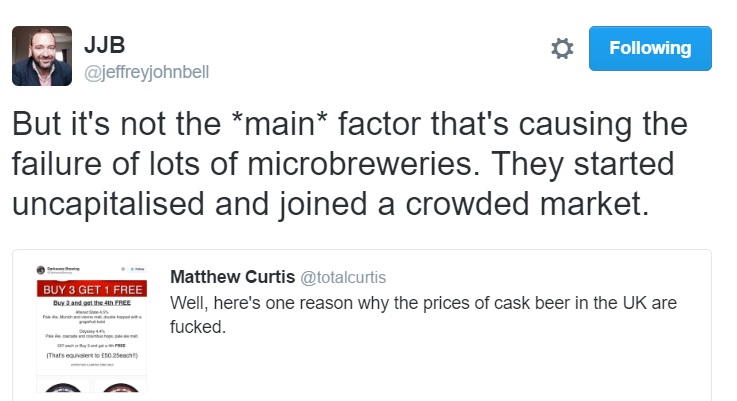
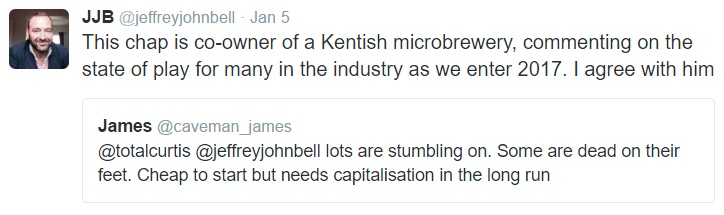
I left a comment over at Boak and Bailey in response to their noting this week of that Cloudwater cask story which whipped the British beer discussion out of its holiday slumber. That being said, I am still not sure the Cloudwater story has been properly framed so I am unpacking the comment a bit more here.  For starters, here are two tweets from Jeff that I think better get to a key factor underlying the situation:

 —

The Cloudwater press release was issued on 1 January 2017. They’ve been brewing for 22 month and have announced they are stopping cask production, stating:

We worry that cask beer has backed itself into a corner that risks becoming unattractive to modern breweries. 

I never trust that sort of use of “modern” as it smacks a wee bit of assumed superiority, echoing the new e-conomy of the late 1990s or at least a shortcut being taken. Especially as they don’t quite say they don’t make a profit – just an “insufficient” margin. Then, as you consider that, compare it to the to the brutally honest but tougher news from Dave at Hardknott on the one hand and how under capitalization can force a good brewery to face difficult decisions. Next, consider the positive story from Hawkshead which runs 65% cask that they also call modern beers.

It seems from those business stories that the question could be better asked as why Cloudwater took on cask without the full resources – or apparently a full plan to make it succeed as other success. Is it as simple as that?  I did find Eddie Gadd of Ramsgate Brewery’s tweet a bit telling:

…most new brewers (inc me) don’t look too closely at the numbers during start-up – we don’t want to be put off the dream!

I notice that the Cloudwater press release mentions they are working with Shelton Brothers and I have a suspicion that I have had their beer at the Allen Street Pub in Albany, a cask specialist, where, due to actual friendships, I do not seem at risk of ever being shelted.  Perhaps it was that pint of Black IPA with a balancing splash of someone else’s brown ale to give it some joy.

In any event, the idea that a firm representing about 1/3000th of British cask production not succeeding is cause to raise prices generally is a bit off. It seems from what we are actually being told is that cask places natural productiondistribution and even geographical constraints on the market that the ambitions of international craft can’t overcome or at least cannot easily reconcile without focus and extra capitalization. Makes sense. It is a thing unto itself. Should have been self-evident from proper initial market research.

There is nothing wrong with changing course. Do what makes you money and what you are interested in. But don’t slag the successes of others or blame the market. Congratulate others who succeed where you can’t or shouldn’t have tried.

Session 119: My Discomfort Beer

This month’s version of The Session is being hosted at the English blog  Mostly About Beer…… where this question was posed:

For Session 119 I’d like you to write about which/what kind of beers took you out of your comfort zones. Beers you weren’t sure whether you didn’t like, or whether you just needed to adjust to. Also, this can’t include beers that were compromised, defective, flat, off etc because this is about deliberate styles. It would be interesting to see if these experiences are similar in different countries.

This is an interesting question – even with this head cold. No need to pull out a beer as part of the challenge. The question reminds me how we are told we need to learn to appreciate all styles within the construct of the brewer’s intention. But that is the path of the dweeb – but not one without at least a lesson or two to share. I was taunted over a decade ago into teaching myself more about sour beers before they were really showing up from anywhere other than Belgium. Cantillon’s Bruocsella 1900 Grand Cru struck me as gak:

Quite plainly watery at the outset then acid and more acid…then one note of poo. Not refreshing to slightly sub-Cromwellian stridency.

I still like that review as the only think I would change is that I now like that taste which I described so accurately. Yet I would not hunt it out. Same with most gose, most smoked beers and any number of the other experimental or niche styles that depend heavily on a quirk. Once one has moved past the chase for novelty, you find that you come back to favourites. For me these are still varied: gueuze, real saison, brown ales all fit the bill when they fill the glass. I could happily drink gueuze most days though I can’t buy it here regularly. My studies of sour opened my world. I am glad I took them on.

If something could be a style that makes me uncomfortable I suppose it might be contemporary IPA where you need to pack a hop directory to figure out what’s in your mouth. They are today’s darling but I’ve never caught the fever.  Again a decade ago, I even sat down with eleven of them to try a wide range of them. I discovered… there was a wide range. Their many many siblings before and since then hasn’t altered my creeping suspicion that while the three letters are a brilliant marketing trick they are also a tool for obfuscation. You never know what you are going to get in your glass. So I tend to stick with a familiar quality IPA like Nickle Brook’s Headstock with feel the urge but if I am out and about I am more likely to hunt out a beer more daring – yet more reliable – than whatever they are serving that’s called an IPA.

Does that answer the question? It’ll have to. Cold meds a’callin’!

What A Difference A Year Makes – 2017 Edition

Over the holidays, I was thinking about what to do with this blog in 2017. It’s been a heavy slog over the last few months ensuring the important and favorite and representative bits of bits of 10,000 posts get across the River Jordan to the next bloggy life but that’s largely behind me now. What I need to do now is look ahead and take on the new opportunities that the coming year offers in style. It a bit of panache. Even. Maybe.

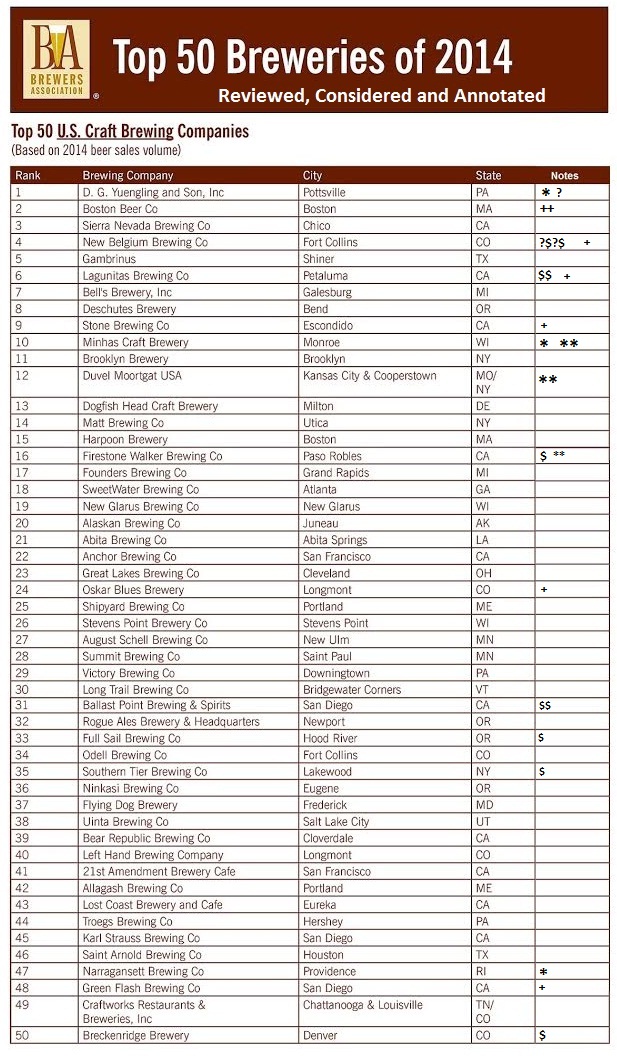
A lot can happen in a year. Last year this time we were still in the grip of learning that US craft brewery owners were (horrors!) not all evangelists willing to starve for the cause. No, the sweet taste of gravy was too much for many – or the actual goal all along. Click on the score card and have a look. You’d have a hard time filling that chart out properly now. You might need different colour pens. Funny thing –  no one really cares now. As is often the case with the leadership clique within even a small circle, they are barely missed as others are ready and willing to fill the gap. Beer is nimble like that. Beer itself is a survivor. The survivor. The rest of it all comes and goes.

Not sure blogging is surviving along with it. I could try out a new structural twist like the B+B “Breakfast Debate”… except I am only one person and I wrote my homage in two-fisted dialogue to The Compleat Angler with Max a few years back. But I like the idea. Keeping it fresh. These winter months are great for working on an historic era, for working through a data base. I have a notion to work away at the erroneous ideas that (1) temperance was some sort of trick played on the many by the few and (2) that, contrarily perhaps, it was all that effective. And greater early 1900s social history. I sit above a small outdated law library. It’s great stuff and holds masses of facts proven by evidence, tinged with authority. Rare.

I would also like to figure out a way to crack the nut of getting into the ledgers of contemporary craft brewing. What are they actually up to as businesses? It’s the only way to break the cycle of brewery owner cheery pozzy obvsy bios we’ve been stuck with for the last few years.* You would have thought that the craft sellouts would have taught a lesson but gate-keeping editors will have their way. The narrative must go on. And it will be even more popular in the new Trumptastic era. Boo to the questioners! Down with those losers asking “why?”!  Hmm. I would need to present it at a statistical abstraction. And I would need some helpful assistants in the business offices of craft breweries. Any takers? You can voice flabbergasted serious objections in the comments below and send me your non-disclosure agreement template to beerblog@gmail.com. Let’s talk.

What else can I do? We do? I am interested in another unpopular idea. What is it that makes us lose interest in novelty, makes us find a home in certain pop culture things like beer? Most folk I know have packed in chasing the beery tail. Novelty is for novices. Some lasting things are actually better. Think of it this way. I am a lucky man. I was 14 to 24 from 1977 to 1987 which means I was in the front row to a very strong point in pop and alt** music history. I have not been persuaded since that another period is superior but I also realize its not only the music I heard but that I was that age in my life when it was popular. I would hope those years were golden for each of us – though being 14 in 1977 was pretty sweet. Does the same idea work for good beer? Will we all just end up accepting Rochefort is fabulous or will today’s twenty somethings actually get a bit verklempt over memories of weird fruit flavoured gose thirty years from now? Could you imagine? It’s be like getting nostalgic over Mumford and Sons.

So. Any suggestions? Any idea I might explore? Conversely, any lakes you might, perhaps, direct me to jump into? I am for too entrenched to care if you take offense. Last year saw a peak in the “how dare you!” emails suggesting a personal slight directed to folk I really never thought that much about. Could you imagine thinking that much of yourself that you took the minute and 27 seconds of deep consideration it took from outrage to pressing send? Well, we won’t be having any of that in 2017, will we. Nope! And that is because this is the year where people get a grip, learn we are not each the centre of the beery world and get about doing what needs to be done!

Remember: it is only beer and, by way of corollary, you are only you. Well… fine. Can we at least start with this is the year we give it a try?

*aka “it’s amazing work – but, trust me, everyone is broke.”

**Is it too soon to use “alt” again?

Kingston Chronicle, Friday Afternoon, 1 September 1820

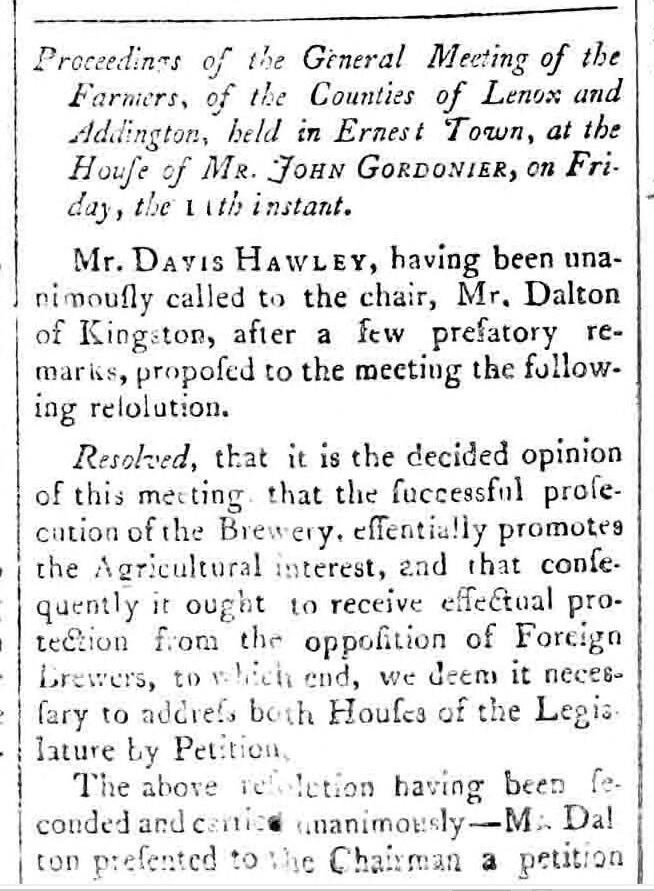
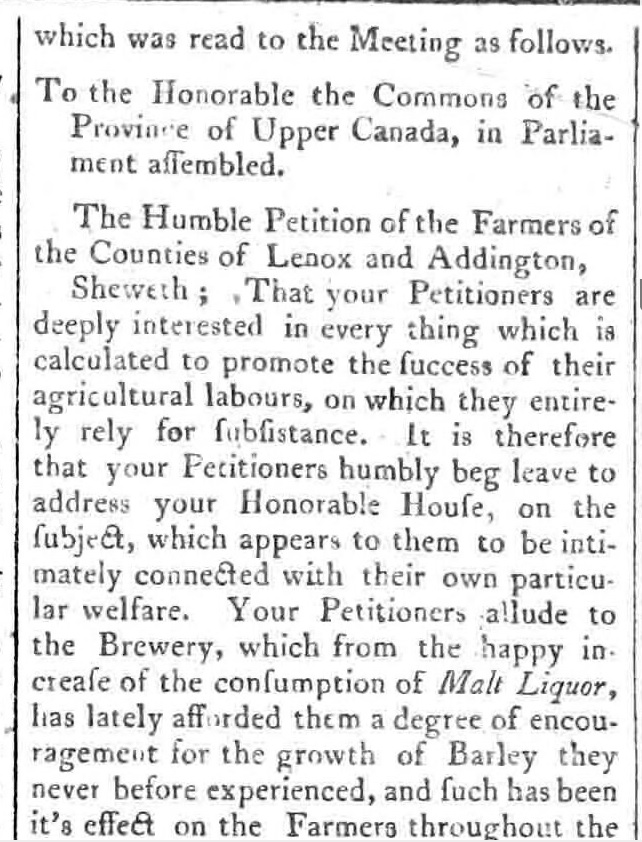
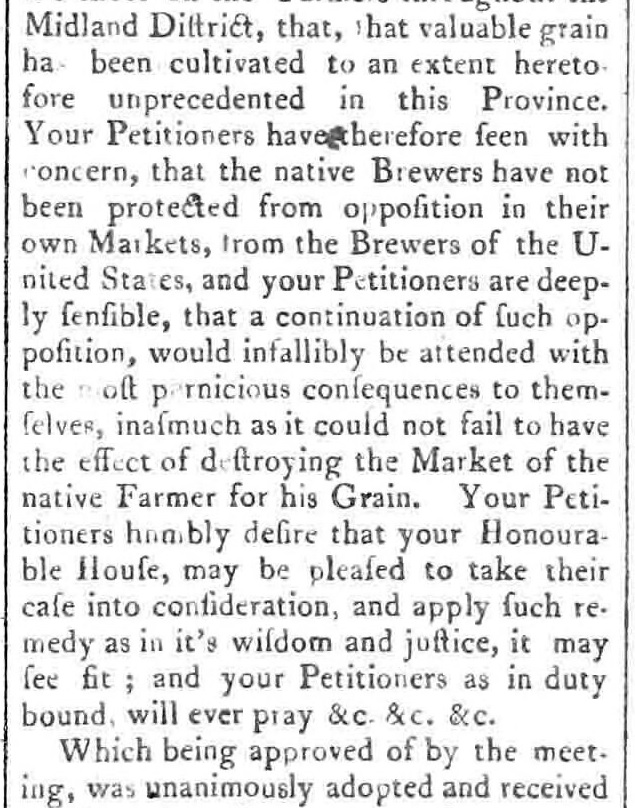
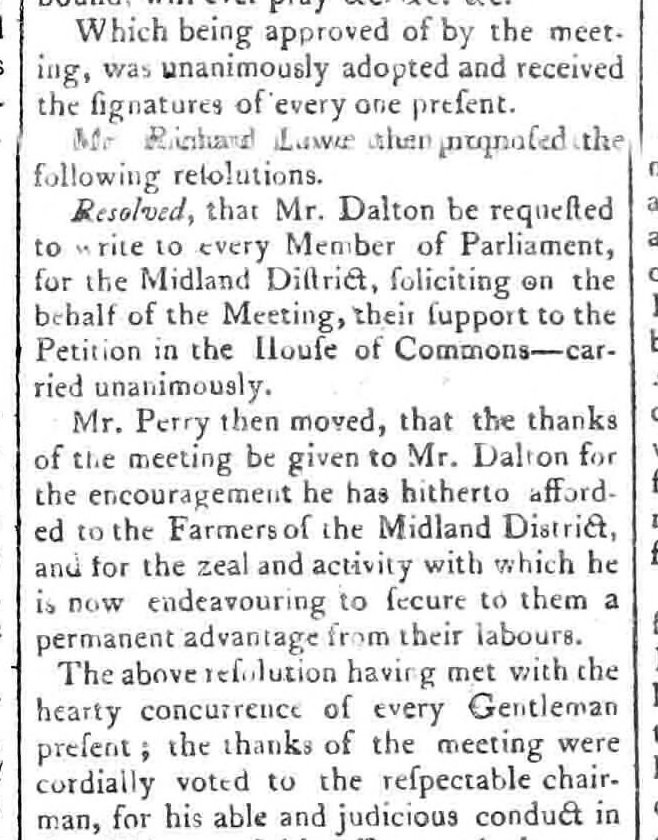
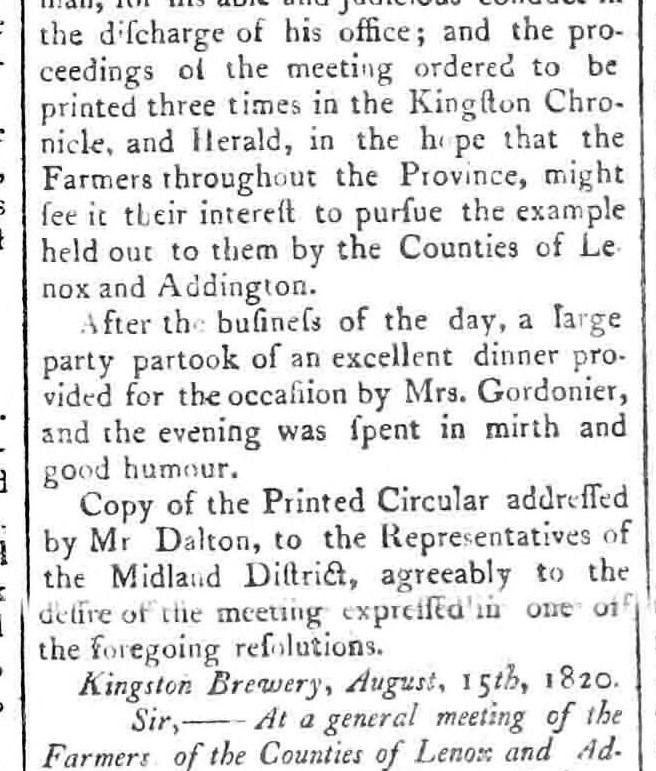
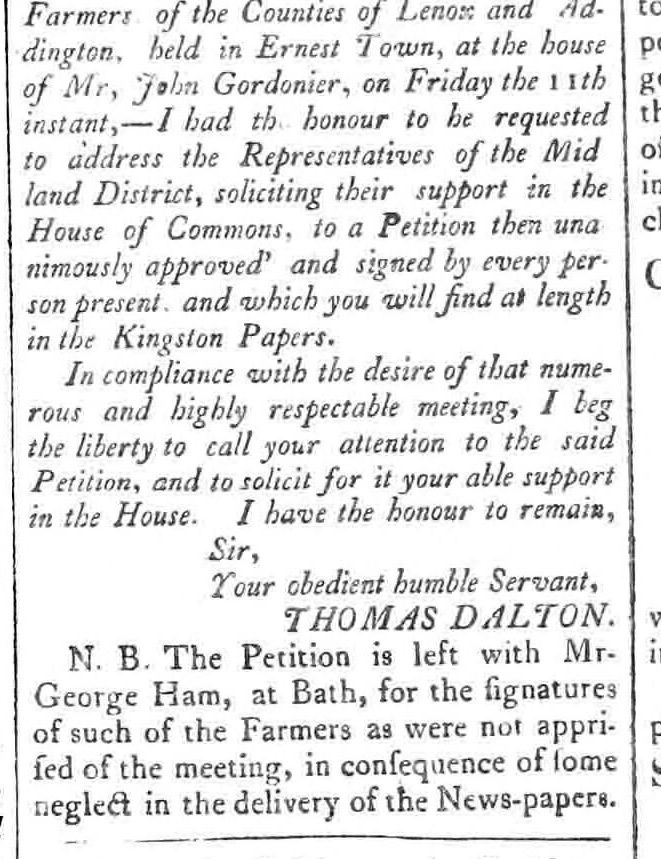
Below are six thumbnails which form an article printed in the Kingston Chronicle on Friday, 1 September 1820. It’s the record of a meeting held at Ernest Town, about 30 miles to the west of Kingston, led by Richard Dalton of the the Kingston Brewery.  Dalton was out rabble rousing and lobbying in order to “receive effectual protection from the opposition of Foreign Brewers.” The thing of note that pops out at me is how barley is being described as a new crop or at least a newly encouraged one that needs fostering to ward off those “Brewers of the United States.” Prior to that time, wheat was king – wheat for the Empire.  W.S. Herrington noted the same thing in his diary. He also notes that ten years later, “Ernesttown” had at least a dozen taverns so something must have been done to get the drinks based economy on the right road.

The early 182os were a time of downturn in the USA. Maybe New York grain was getting dumped in the northern marketplace. The meeting comes at the end of the brief period of open trade after the War of 1812 with the USA was over and the shutting of the border was undertaken by the new post-Napoleonic administration of Upper Canada. Upper Canada was buffeted by such international force. The border only truly reopened in the 1860s until the 1890s when the barley flowed the other way, south into the thirsty expanding Republic, known as the Barley Days. If the farmers at the meeting in 1820 had been told that this would be their grandchildren’s future they likely would have laughed.

Towards A Tree Of Brewing Traditions

Lars and I are talking on twitter at the moment about a construct which would better define the diversity and generation of brewing traditions than style. The style construct is prone to too many weaknesses, such as:

a. artificiality: a style is what is accepted to be a style as opposed to when one asserts itself as one and operates best only in the last 40 years since its early first steps,
b. lack of relative scale: each style is presented as an equal,
c. independence: style lack the key expression of chronological dependency and contemporary cross-influence, and
d. over distinction: styles present themselves as being too separate, ignores the normal sort of overlap and blurred lines.

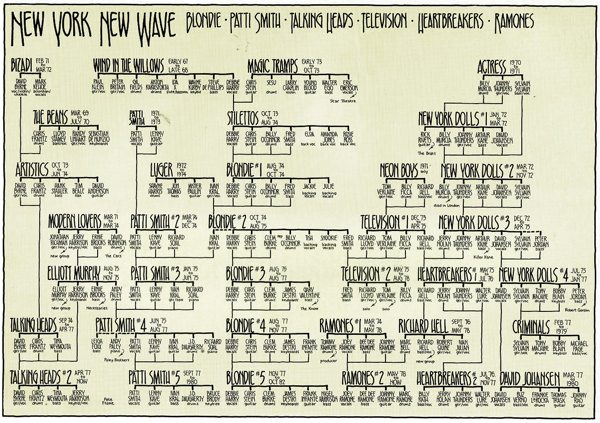
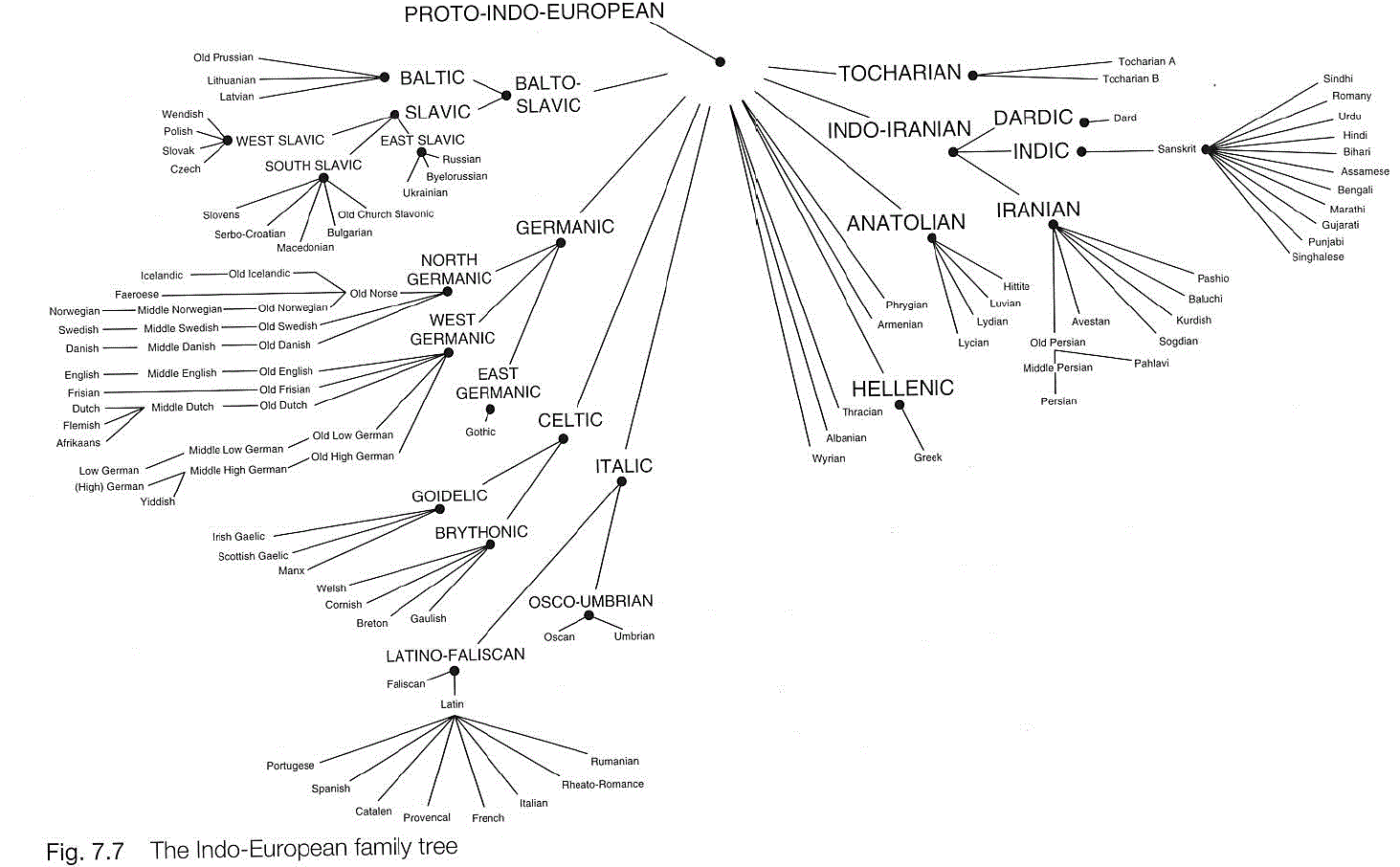
Could a tree diagram better express the organic aspects of brewing? Think of those rock family tree posters or a chart setting out a linguistic tree. Could such a construct better describe the dynamic nature of brewing history? I was playing with the idea of a poster based on a Gantt chart for the histories of breweries in a specific region, like perhaps this handy spiral version describing geological time but that doesn’t seem reasonable above a certain scale. The tree would express time on the X access, diversity on the Y. Ideally, like Google maps, one could drill down into it to find finer levels of relationship or draw back to higher levels of abstraction.

These need not replace style but could go some way to break its tyranny or at least give it context and competition.

Moses Granger of Lowville NY Had A Patent

The title of the patent from 1832 is titillating: “US Patent: 6,894X – Restoring sour or musty beer or ale to its original purity by rebrewing.” Sadly the note at the DATAPM data base tells the rest of the story:
Most of the patents prior to 1836 were lost in the Dec. 1836 fire. Only about 2,000 of the almost 10,000 documents were recovered. Little is known about this patent. There are no patent drawings available. This patent is in the database for reference only.

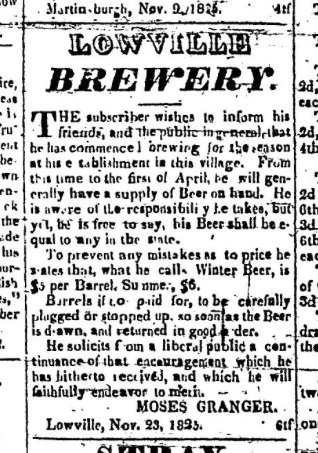
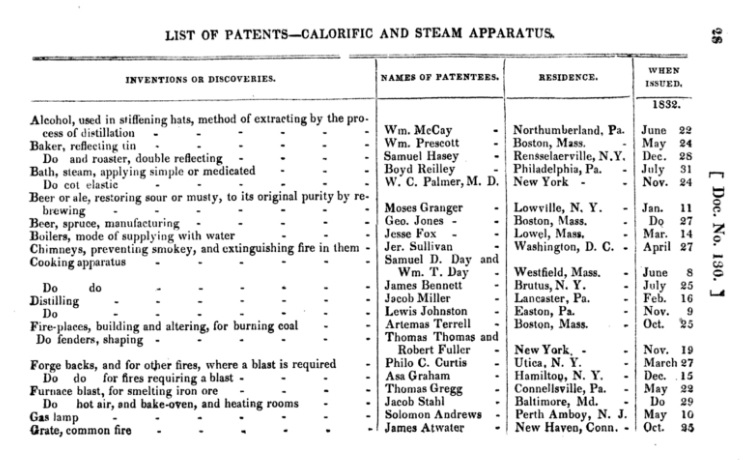
This is sad for us now as well as sad for the inventor, Moses Granger. As you can see above, he started his brewery in Lowville, New York seven or so years before registering his mysterious patent for improving bad beer. The announcement is from the Black River Gazette of 14 December 1825. You can see below from page 28 of the Congressional Series of United States Public Documents, Volume 235 that his patent was issued on 11 January 1832 which means he had to have invented it and then worked on the patent application sometime before that. Notice also that his patent is in a list of “Calorific and Steam Apparatus” which again is a reminder that Steam Beer is a reference to the general introduction of steam powered motors into the brewing trade and not something about the beer itself.

Unlike most of you, I have visited Lowville, New York. It is just about an hour and 45 minutes drive to my south east sitting in Lewis County, the next NY state county to Jefferson which I can see out my office window. It is the home of Lloyd’s of Lowville.  My 2005 post on neighbouring Denmark, NY on the hill north of Lowville gives you a sense of the area. Rural limestone Federalist buildings, analogous to our larger urban and military Georgian ones.

Gary mentioned Moses Granger and this patent in the latest of his further explorations of the odd later 1800s eastern US use of “musty” as a positive term for a class of ale. The patent from an earlier point in time, however, is clearly about the correction of poor beer – restoring it by rebrewing sayeth the patent’s title.  “Rebrewing” is an interesting word. In 1818, another two hours modern travel to the southeast in Schenectady, there was rebrewing going on – the last reference I have found to the ancient and famed double double immortalized by Shakespeare. Beer made by reusing beer as sparge water, ramming more power into the wort. It makes a brain smackingly strong drink.

Lewis County, NY in 1825 was still the frontier. See those military installations in my dear old British fort town? Kept back interest in settling NNY as the Erie Canal was opening up WNY.  It was settled by the generation after the Revolutionary one, as places like Cooperstown and then CNY started filling up and interests became fixed. Spafford described the place in his 1813 Gazette – and he can be trusted as he was born there. One might read the notice posted by Moses Granger in 1825 that he was the first brewer in Lowville. Spafford shows (at page 50 and 51) that in 1813 there were no brewers in Lewis Co. compared to seven distillers. Jefferson Co. had a ratio of two brewers to sixteen distillers. In 1828, Watertown, Jefferson Co. only had one brewery. The area was awash in rot gut whisky. A rebrewed super strength brewing process might well be worth protecting by way of patent.

I will dig a bit more and maybe post more – and wait for Gerry… again… to correct and add to the story. An excellent thing, too, as by collaboratively assembling what we know the history unfolds.  The strange thing is why one would invent such a thing in a frontier setting and then seek the protection of the law – on the one hand just thirty years removed from that log house brewery in Geneva, NY but, on the other, in the era of the scientific brewing of Vassar. An era of great change.

“Preserve Your Health and Drink Nothing Else…”

As Stan pointed out this morning in his weekly links… aka apparently for the next two weeks his weakly links…. Gary G has been posting what he has learned about about musty ale, musty ale, musty ale, and musty ale.

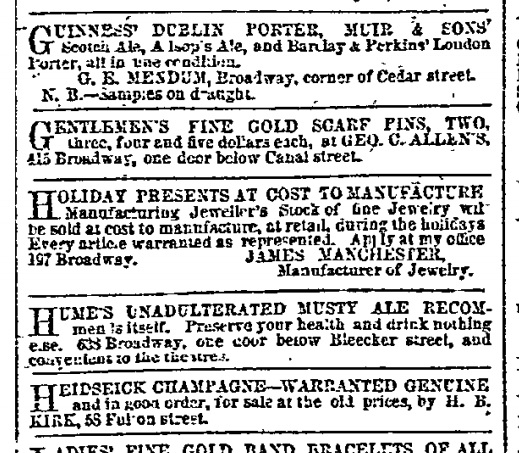
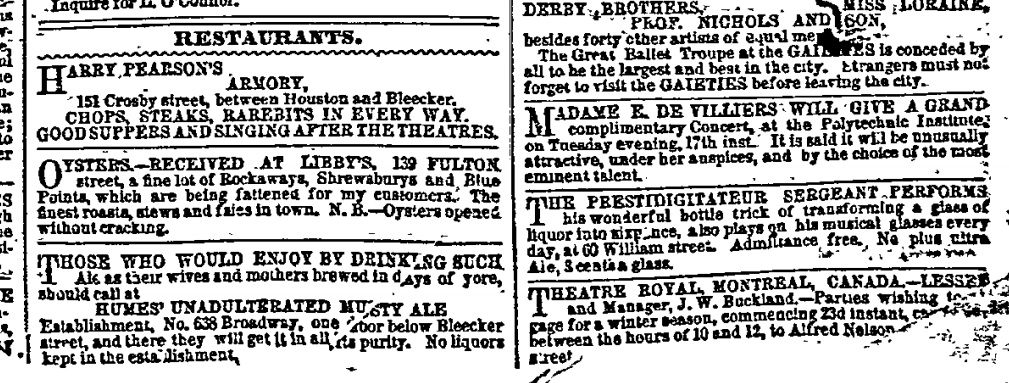
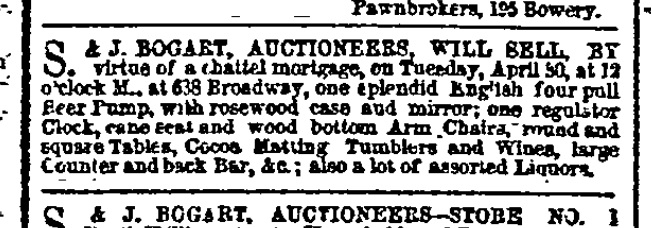
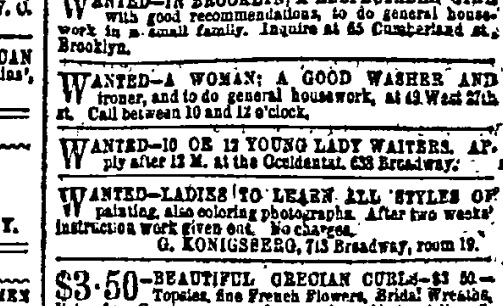
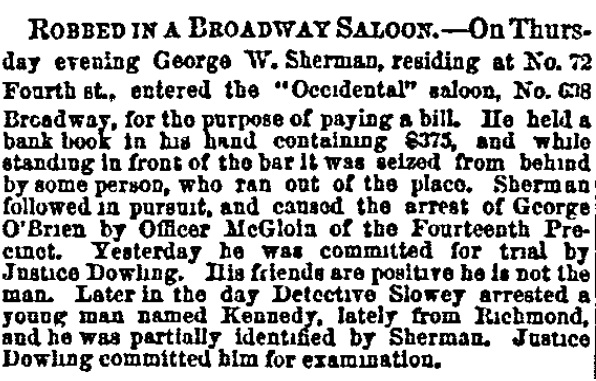
I have little to add. I get all confused once we get any distance past the first third of the nineteenth century. Lager history seems to give me the yips. But I will add this. That is an ad from the New York Herald of 22 December 1861 offering Hume’s Unadulterated Musty Ale. Hume’s ad locates the brewery at number 638 Broadway. Ten days earlier, the notice was a little different. The address is at the corner of Broadway and Bleeker Streets, an intersection in NYC that still exists – where the Swatch ship is now. Maybe it was just a bar, not a brewery. In April 1861, there was an auction at the location offer “one spendid English four pull Beer Pump.” A few years later, the Occidental is looking for 10 or 12 young lady waiter at the same address. There was a robbery there the next year. Bleeker Street, by the way, is named after Anthony Lispenard Bleeker, a cousin to the brewing Lispenards of pre-Revolutionary New York City, the fact of which just cost me 30 minutes of my life in tangential searches which will come to nothing.  Nothing.

I can’t find anything on Hume. Gary has a Hume, J.B.,  brewing musty ale in Cincinnati in 1859. Bet Gerry has a binder on Hume. Gerry, not Gary. Binders. On Humes. Me? Nuttin. Was Hume bringing in Cincinnati beer into NYC? Maybe. Seems odd. But that’s Hume for you. Maybe. Whoever he was, he was selling musty ale in NYC in 1861. Whatever it was. He had it. Right there.

Would I Go To A Tap-and-Pay Beer Pump Place?

This is news? This is what folk want?

Pay@Pump allows drinkers to order and pour their own pint and pay with a contactless card or device touched on a pad at the base of the pump. The technology has been devised by Barclaycard – and a prototype designed and installed in a Central London pub, Henry’s Café Bar – to help reduce queuing time for customers buying drinks during busy periods.

What is a place like that even called? A tap room? No, a tap room is the sorta thing you find in a back room at a place like the Laxfield Low House. This is just a tap. And, the weird thing, is that its is only that – a tap. One. Click on the photo. So you are getting the last guys beer left overs in the space between the one spigot works its way back into the stand. That might be an ounce. Fine if its all macro gak but, like one of those soda guns behind a bar, everything is getting served through the same nozzle. A bit of stout in your wit? One nozzle. Which no one wipes down between fill-ups. Which means it’s like an elementary school water fountain that spews beer. And whatever else is on that nozzle.

Yum.

Hello From The Blog’s Back End – And The Road…

It’s been busy at the system admin end of the blogging life even if not so active here out front. Since mid-October, I have happily shifted over 650 posts to the new WordPress platform and am starting to see a bit of daylight. There will be an opportunity to receive a bulk loading of posts in a few weeks but I wanted key posts well in place before that happens. To get the house in order. In doing so, I have had the experience of reliving my last 14 years or so as a public writer. It’s very instructive. There seem to be clear phases to my – and our – beer blogging, the fourth or fifth of which we are in now.

a. The first from maybe 2003 to 2006 was marked by reviews, by news items about beer taken from the news, by figuring out the lay of the land.

b. Then the beer blogging explosion of 2007 to, say, 2010 saw a lot of active discussion including plenty about the role of beer blogging. And the Xmas photo contest going full speed. Participation was riding high.

c. Next, we have the difficult period. The Oxford Companion to Beer was a problem faced in late 2011. In May 2013, we lost Simon, one of the brightest beer bloggers, the bringer of viciously accurate humour.

d. An about turn led me more deeply into history in 2013-15, building on the Albany Ale Project, as well as utter dissatisfaction with the state of things. The self appointed consulto-expert. The acceptance of the shoddy. The rise of unaffiliated certificate programs. Three books resulted. New York City history in the 1700s began to get unpacked.

e. Next and up to today, the sudden great collapse brought on by a number of things like the great buyout phenomenon, murk, short form social media, long long form amaze-balls storytelling, the deletion of old blogs and All About Beer sucking up all the beer bloggers ideas and then dulling them down for general non-boat rocking comfortable digestion without much resulting chitchat. Yet, despite this, this is now the time of the wonderful rise of the many and tiny and clever as well as, perhaps, a return to more of the substantive sort of books 2010 promised.

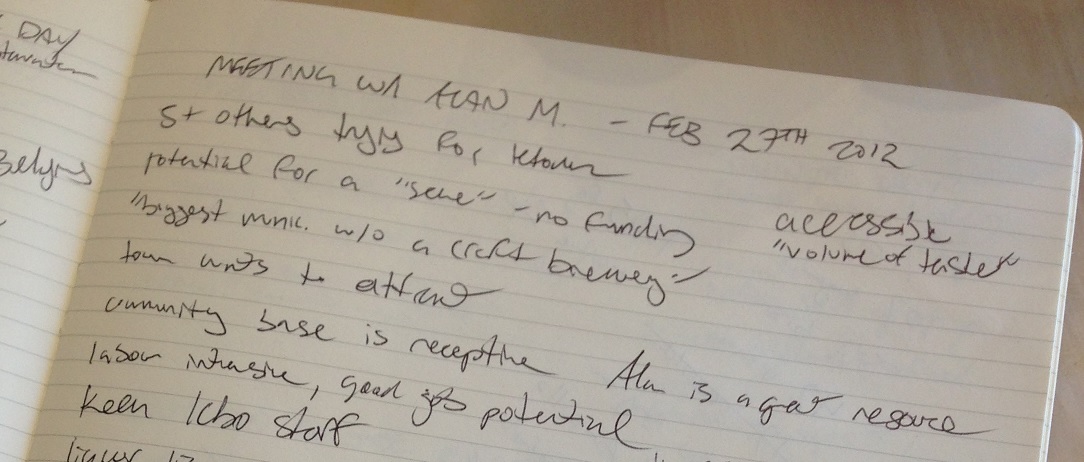
That image up there? It’s from the journal of the Napanee Beer Company’s Geordan Saunders. When I stopped in there yesterday while on the road for the first time to see how things were going since they opened last spring, we immediately had a “I know your face” and “And I know your face” moment. Four and a half years before he had popped into my office to ask me what I thought of his dream to be a small town brewer. Good thing I was helpful (or at least not a big wet neg) as their beers are fabulous – in particular their Blacklist, a schwarzbier. When I thought about it, at least three of those chats have now been followed by brewery openings in my area.

I don’t know if I am a great resource.  Geordan was kind to think I was. I do know, however, that reviewing all these posts and ensuring my favorites are well manicured and comfortably housed has led me to realize there is a point to it all. The collection as a whole traces the arc of something. Something continuously moving forward inveigling itself into the culture. It’s reminded me to be very hopeful.