Your Mid-January Thursday Beery New Round-Up

It’s been a big week. The Arctic air mass has left us so Easlakia once again is a ball of slush. It’s been a dryish January around these parts but only “-ish” – so don’t go all hostile. Much more veg. No fries. Walks as walks can be walked. It’s good for you. Hmm. Ice storm coming Friday. That should be sweetly end-timesy. Like what Lars just went through recently… maybe. You and I? We have done nothing for good beer. Not like Lars. Speaking of getting off the kookoo juice, I like this: “…waking up fresh at 8am on a Saturday morning after 8 hours uninterrupted sleep.” Try it. It’s good.

I was very sad to read a Ed’s blog about the passing of Graham Wheeler. During my home brewing years his book (with a drizzle of R. Protz) Brew Your Own British Real Ale was a constant companion. One thing I will always appreciate having learned from him was how small differences between recipes created remarkably different ales.  A great loss.

This is the national anthem of beer.

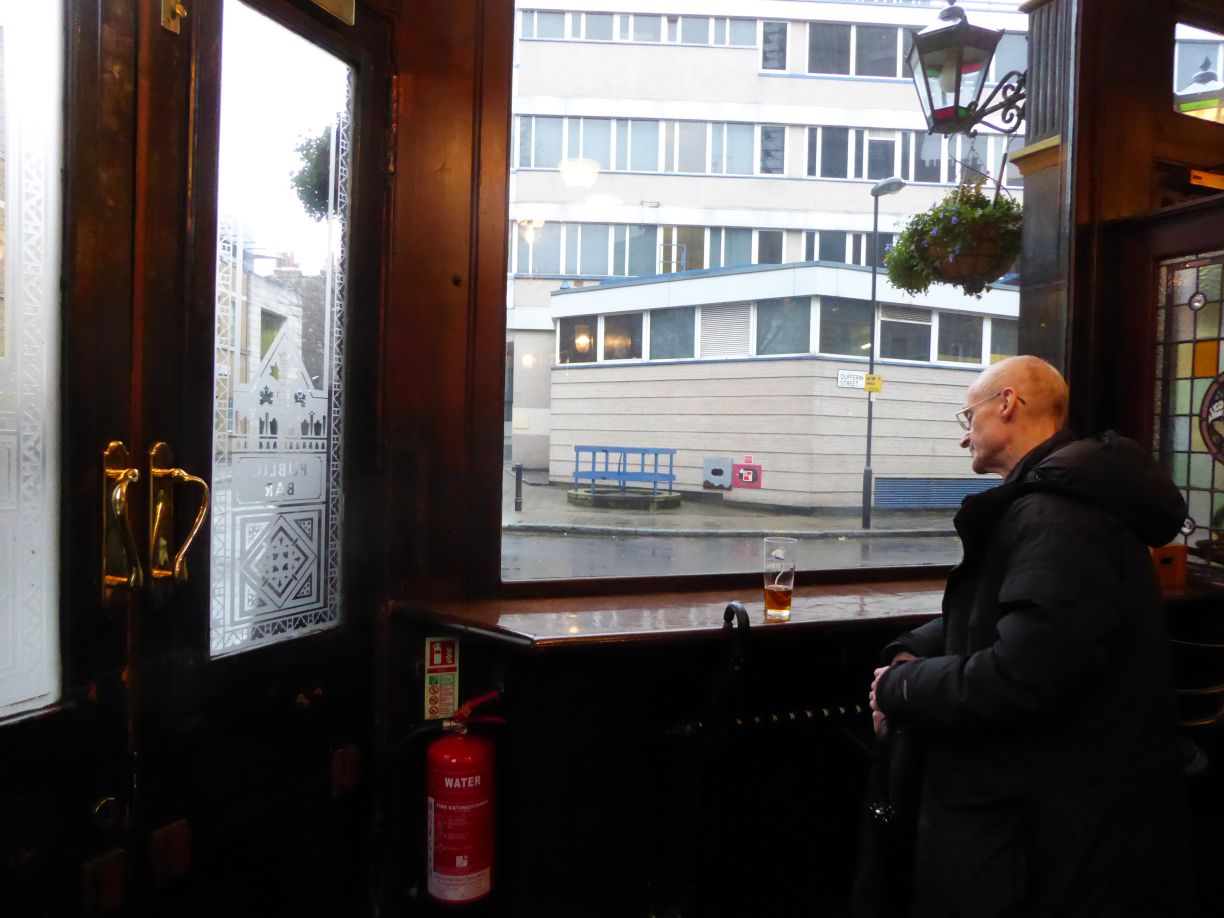
Caption contest! What the hell was Mr. B saying with that expression? It’s a third of an Elvis, clearly. Click for the full view. Was Jordan using that dab of tuna fish juice behind the ear as cologne – again? Robin caught the moment* at a beer dinner Wednesday night in the centre of the universe which famously included house made gentleman’s relish, the only relish a gentleman ever needs. Perhaps Mr. B was musing on the qualifications JSJ brought to the table, gentlemanly-wise. Surely not.

Speaking of hostile, it was a bit odd reading the follow up this week to Eric Asimov’s bit in The New York Times on brown beer. His column was just a round up of the brown ales you can try in the New York market with, yes, a little jig and jag about beer nerds. Then…. accusations, handbags and recriminations. Reminded me a lot about last week’s crisis over pointing out – “theatrical gasp” – sexism in craft beer.** What a round up of “the superior gathered to get the boot in” that was. And now, while it is clear that it’s probably never going to be a good idea to go all “bored quasi-intellectual snobbery intro is the tiredest of journalistic tropes” if you want to be taken seriously, I was quite happy Jeff told his what his actual issue was with this week’s panic. Not my issue but a reasonable issue as he framed it. Still, Asimov’s a fabulous wine writer who makes complex things make sense – and successful enough to have no interest in making his own status an issue. Me, I liked the piece. And, tellingly, so did a lot of the paper’s readership if the many many comments are anything to go by. So say it loud and say it proud: brown ale is go! As in other hobby interests, this again goes to show that good beer still needs a bit of aging to get past these angst-ridden teenaged years. Yes, these may still be the times of doubtful mild cheddar. As I say to my own kids, it gets better. I hope.

700 employees! Damn good thing they are still small.

Nearby, Robsterowski in Glasgow posted an interesting pit on those little knives or tongue depressors used to smack the head of a fancy beer pour – skimmers. I’ve never thought much about them so his work has added to my understanding by about 1237382%.

Not beer: King Crimson’s Larks Tongues in AspicThis was 45 years ago now. Talk about gentleman’s relish.

There, another 23 minutes I can’t get back. Don’t forget to lay your bets on next week’s crisis in the shrinking good beer writing marketplace. Who lashes out next? Stay tuned. Meantime I will likely be back on the weekend with something about brewing in the 1500s you won’t care about. See you then.

*Shared without consent.
**Was it only last week? Nate S. uncovered this weeks Pigs Of Craft award winners. Folks just don’t get it.

“There Is Slow Lading Of Beer At Portismouth”

Exciting times. Hunting for more information about those four Tudor brew houses at Portsmouth introduced a few posts ago,  I came across a number of documents* including this dramatic report from Lord Howard to Lord Wolsey, 6 June 1513:

The premises heard, I took horse and rode hither to tell my lord of Winchester and Lord Lizle, and will forthwith return to the ships. I look hourly for news from Brytayne, where I have three ships. Cannot yet certify the time of my departure, for “there is slow lading of beer at Portismouth”…

At that moment, Henry has only been monarch for four years. Wolsey is two years short of becoming Cardinal but is Henry VIII’s first minister. Howard appears to be quite arguably second. So, there is a lot of political power getting into the question of beer being brought onboard ships.  From 1512 to 1514, England is at war with (who else?) France.  It was part of the broader anti-Venetian War of the Holy League which, as leagues go, must have been right up there. I will let you run down that rabbit hole on your own time.

I take “Brytayne” to be Brittany. Ships are being prepared to hit the open sea. In fact, the very next day a note is recorded to the effect that:

“Victuals delivered, for 6 weeks beginning” 7 June 5 Hen. VIII., to the Trinity Sovereign and 18 other ships; giving for each the purser’s name, the number of men and the quantity of beer delivered by Richard Palshid.

And again we read on the 8th of June another note to Wolsey this time sent by “Fox” who I take to be Richard Foxe at the latter end of his career as a key advisory to the monarch:

…to-morrow to Portesmowthe to see how the brewhouses go forward. Because much victual goes to the army out of Thamys and also from hence and out of the west country, order should be taken for its distribution to each ship: and the Admiral should be written to to despatch the victuallers hither again with empty vessel or else they cannot be served with beer, as Dawtrey will certify. Without wafters “there is good likelihood that they shall be take up by the way.” Much old piped beef is left here by Edward Ratclif which is like to be lost. You should command Ratclif to come hither and do the best that can be done with it.

Interesting stuff.** Provisioning is being directed no only to Portsmouth but also out of the Thames as well as the West Country… Bristol? “Wafters” might be similar to barges or bulk goods ships. And it is from Portsmouth that wafters with empty vessels must be brought to load with beer. Because Portsmouth has the brew houses.

Lord Howard reports the situation to the entire Privy Council as of 8 June in this way:

Lading of beer alone delays his departure; for there are but two cranes and the crayers can only come in and out to them at full sea. On consultation with Wm. Pawne and Palshide, suggests the use of lighters as in the Thames. Two or three of the greatest in Thames should be towed hither by crayers, “and with making them higher with a strake of board we doubt not they shall come safe hither.” The brewhouses here are the goodliest he ever saw, and already brew 100 tun a day. As there is no place to store it but the streets, where hot weather would destroy it, he has commanded Wm. Pawne to have great trenches digged and covered with boards, turf and sedges. The beer which came for Lord Lisle has been assayed by Howard, the Treasurer and the Clerk Comptroller and mostly sent back to London; for Heron’s servants, who deliver it, say that the brewers are bound to take back “unable stuff.” I know not what the King pays, but “much of it is as small as penny ale and as sour as a crab. I doubt not your Lordships will see the brewers punished.”

Two cranes? Who set up this situation with all the beer and not haulage ships and two cranes for loading? Oh, likely Henry VIII. Never mind.

Still, there is the key fact I wanted to establish related to the four brew houses. One hundred tun a day. So much it is stored in the streets. You will recall that I was not able to put my hand on the cited secondary source “Eley 1988” for the statement that they brewed “500 barrels per day in 1515.” This is even better. Not only does the 1513 figure apparently corroborate Eley’s 1515 one, it is a primary source – or at least a trusted recital of one – AND according to my calculations is bigger, a tun being more like 5.83*** UK beer barrels. Which makes the production level 116,600 barrels a year based on a modern 200 working day year of fifty work weeks five days each. If it was 52 weeks of six days, that becomes 181, 896 barrels a year.

If that is the case, then this four brew house brewery infrastructure was four to six times the size of Thrale’s brewery when he acquired it in 1758. The entire beer brewing production of the United States in 1810 was 182,690 barrels. The production of the four brew houses of Portsmouth is a bit mind boggling given how it seems to be both (i) a trustworthy stat and (ii) from hundreds of years before any facility at that scale had been at least brought to my attention. Neato.

More to come I am sure.

*This one set of documents is to be referenced for the quoted bits in this post where no other reference is given.
**Note to self: definitely take a pass on the piped beef whenever in Portsmouth.
***See comment from Martyn about my crummy use of decimal points.

The Session 131: Emergency 1-2-3!!!

One of my favourite things about The Session is a good crisis edition of… The Session.

Let’s be honest. The ball has been dropped about three times in the decade and more of this monthly beer blogging session on a common topic leaving thousands and thousands world wide distraught at the idea that there would not be any single thing to read on the topic of beer… well, posted by a beer blogger… in unison with other beer bloggers… you remember beer bloggers?

Fortunately, the world’s first beer blogger noticed and this beer blogger, the world’s second, is not going to let down the side. Jay whipped together a splendid topic entitled “New Session: Three Things In 2018“:

For our first question of the new year, what one word, or phrase, do you think should be used to describe beer that you’d like to drink?
For our second question of the new year, what two breweries do you think are very underrated? 
For our third question of the new year, name three kinds of beer you’d like to see more of. 

Hmm. Let’s see.  Well, you can tell it is a crisis topic as the three questions require five answers. What are my answers?

Word? Clear. It’s very fashionable to suggest no one has a right to note that a bad fad is a bad fad but 96% of all the nouveau cloudy beer is, as one would expect, bad cloudy beer. It takes a semi-pro PR specialist to suggest otherwise but, really, if you stuck to clearer beer would the world be worse off? No.

Under rated? In the 10,000 brewery universe that is an impossible question as they are not subject to any rating system which reflects their actual quality. No one knows them all. So, classes might be the next thing I can rely upon. Regionally, I would suggest Quebec breweries are under rated. In North America, La Belle Province is an enclave of another language, another culture. The beers reflect that culture. And it’s under explored. A second class? Corn based craft beer. Really? Grow up.

Three kinds I want to see more of? I like the word “kind” when it refers to a category, a class. A kind of beer is better when it gives comfort. So – maybe mild, dubbel and… 1700s porter. Made with diastatic malted Battledore barley. Yum.

Crisis averted. Again.

Another Year, Another Bunch Of Beer News For Thursday

OK, I still seem to be doing this. I did regular weekly news blog post years ago but never thought I’d find myself coming back to it. It’s like 2011 again. Is it because beer news is less boring? Not really. Is it because I am a slacker? Likely. Let’s see what the lazy man sees this week.

Very oddly, a Super Bowl beer and cheap snack crap pairing article a published a full month too early. It’s such a useless thing it’s rather sweet: “Barbecue chips give you the sauce without the meat“? Wow!

Story of 2018? More breweries are failing as more come into being. I am quite content to understand that we have moved from an era of growth to one of stasis and churn. The story of closure linked above does give concern whether we have given false hope through funding flawed dreams from the public coffers. Could it be that we, the people will be holding the bag as more come and go? Good chance that’s the case.

Two years ago.

Looking less further back, Pete gave us the best farewell to 2017 by cutting and pasting stuff accumulated through the year. Good to see that he has to note in passing the question of junkets and, let’s be honest, not all that convincingly.*  A gaffaw at an annual shareholders’ meeting. It remains a question needing questioning even if, in a pleasure trade like beer, no one really loses an eye. Sure sure. Is it that junkets don’t matter because good beer ultimately is not that important? Could well be. Why not? And it that is the case, can we really care if the ownership of a pub chain expresses a political point of view? Who cares?

Speaking of “no one cares” news: Hanson.

Two excellent observations on beer history writing from merryn: (i) errors – I presume we are burdened by errors because, in case you didn’t notice, we are writing about alcohol; (ii) The history of civilization? Because maybe we needed to gather and gorge and not kill each other.

“No more highly viscous wort” news.

Bryan Roth has written the piece of the week, exposing in some detail the intense culture of the shit-wallowing pigs inflicting itself upon a corner of craft beer and… apparently a shadow social media world of mock piggery. Hmm. [Ed.: The Beer Nut has actually captured an image of events in progress.] Though I still am a bit unclear on the slight hesitancy to draw obvious final conclusion – I would not have written “building friendships through participation in memes and challenges for fun” so unadorned – Roth’s take is at least brave if messy and frenetic especially in the tight world of US craft Caucasoid maleness. The pressure to stroke the buffer of phony “community“, to toe the line imposed on self-evident observation is often sad if impressive. Backlash. For a view from another, read this: “That was a nice chat, honey. Now send Tom over. I want to actually order a beer.” Now, that was pretty clear.

Best non-beer thing? The Telharmonium.

There you are. Good things and bad things. A normal week. Adjust your perspectives accordingly.

I had also meant to praise Pete in equal measure his identification that there is no such thing as a beer expert, something I raised three years ago. Stan caught it in his blog post today. Which makes me wonder if Stan is now moving in on Thursdays. (By the way, I just realized I have the power to update Thursday bullet point news all the way though each Thursday. So good to self-publish.)

A First Good Beery Question In 2018 To Ponder This New Year’s Day

People complain. People complain that folk complain. It’s quite odd given people complain all the time about the value of this or the value of that. From donuts to computers to cars to the location of your house, people question and complain every time that feeling creeps up where what was assumed to be worth it turns out to have been a bit of a bust. Given most don’t get a regular supply of vintage samples (or, for that matter, quietly get paid by brewers to review and comment back on the QT as a trade consultant) but, no, actually have to live with a limited set of bank notes from which to draw upon, the question of value is always relevant. Beer isn’t all that special. So, it was good to see this topic bust out over New Year’s Eve:

What are they talking about? Well, late model Fuller’s Vintage Ales, of course. See, yesterday a few hours before that tweeting session started by Boak and Bailey (but with an image which would have destroyed my thin veneer of dramatic tension just now) I opened and started writing about a FVA dated 2008 which led me to exclaim this:

Crash the Stash Day #2: Fuller’s Vintage Ale. Let me check around to see what to expect. Seriously? The brewery is selling these for £100 each? £100?!?!? Glad I spent $6.95 CND almost a decade ago.

This was only news to my conscious self as Martyn had alerted me to the fact almost a year ago when I started a post about working my way through my stash of maybe 16 or so bottles of the stuff from 2007 onward. So subconsciously, I was at least prepared. And I girded myself for the question through drinking these beers, aged and new, since at least 2005. But the reality is that at least from a theoretical point of view, even after having a pleasant enough 2008 era bottle yesterday, I have eight bottles left with an alleged value of around $750 Canadian.

I was pretty clear in my mind that the 2008 was not worth $170 CND or £100 that the brewery was asking. Don’t get me wrong. It was a very good beer and I am delighted that my 45 year old self left such a treat for my 54 self to enjoy over a New Year’s Eve afternoon. Don’t get me wrong. It was yummy. But it had no value which corresponded to what was being asked when I look at it from a few points of view.*

On a relative value scale, were I magically able to use it as free currency $170 would get me and the family a very nice dinner out with drinks at a reasonably good restaurant here in my fair city. Or five tickets to our OHL hockey team with beers and hot dogs and maybe a t-shirt. I would have much preferred those achievable experience to my 90 minutes solo with the ale in a tulip glass. Even though it was a very nice beer in a tulip glass.

As an opportunity cost consideration, I could have left the beer capped and watched its theoretical price rise over a few more years.  By drinking it I am destroying the future increased value, racing well past actual inflation. But that depends on the future buyer being there and the beer not only holding its intrinsic value as a consumable but increasing in sheer tastiness over time. One issue was it started to feel like it was past its best at nine years. Folk would be noting this in the G.D. social media therefore ruining my prospects. How dare folk chat freely?

On beer trading marketplace, if it truly had that value I should be able to sell it back to Fullers or at least my government retailer for something expressing the wholesale current value. It’s been kept in a cool dark cellar and subject to optimum protection. As usual, my claims to provenance were impeccable. If I go back through my tax records I would likely be able to find the receipt for buying it. I expect it would say I spent something like $6.95 CND. Yet… the box was gone and the label encrusted with a bit of mould. Who would want that? I couldn’t sell my Captain Scarlet Dinkie toys in that condition – and I wouldn’t anyway so stop asking. Any in any event, there isn’t actually a buy-back program. Because there isn’t actually a market for the inflation-laced price.

As for the bottle itself, it was a bit like me facing my fifty-fifth later this year. Maybe a bit past it but still performing well. Took a long time in the glass for the bitterness to face a bit to reveal the toffee and pale malt below. I noted as follows:

Plenty of pith, orange zest and minty bitter hops over toffee malt. Lingering bitter finish with a hint of licorice. Less of a cream heart than the 2007 opened a few weeks ago… I have the end of it in a tulip glass now an hour and a half in. It could easily be a very well-made well-designed fresh strong ale that I might buy for a regular price. In no way a disappointment like that sad Stone vertical.

Frankly, I enjoyed the 2007 I had a few weeks ago a bit more. So, is the idea that the brewery is selling at that value a good one or a bad one? Is this a rip off or a smart advertising campaign? One thing I like about it is how the sticker price gives me confidence that I did the right thing by sticking a few aside as I did. They are also saying, screw you white whale hunters – we control this marketplace ourselves. But that is like the silly idea of “brewer’s intention” or, if we are already mocking 2017, “brewery’s cartoonish can label designer intention” in that it doesn’t really give me much value related to the price point being offered. The drink itself has to stand up for itself. And it did. To a degree. But not that degree.

No, in the end the price being sought now is not reasonable. But it does give me the warm conceit that I was once a clever lad. And I can drink to that. And I might just as that 2009 is up next.

*And, frankly, can you disagree with me unless you’ve bought one at current offered prices? Hmm?

Thursday Beer Links For Year’s End, Hogmanay and New Year’s Eve 2017

What can we say about 2017? Not as many celebrity rock star deaths as in 2016, I suppose. And we are not yet into the Putin war years. So, all in all a year to look back upon fondly.  It is the time of triumphalist beer pronouncements, whether by blogger or brewer, at bit at odds with the infantalization, death on the shelf and often resulting profiteering that really misses the key point: that being that the beer drinker really needs to be at unending war with the breweries she or he supports. If I have any message for you during this holiday season, it is that.

What else is going on out there? The Braciatrix has a very good piece about Vikings, brewing and Yuletide. One of the things I like best about her point of the post, which focuses on the roles of women in Norse brewing, is how there is a weaving with the roles of men in brewing. Given what I have learned and am still learning about Renaissance brewing in Tudor England and the Hanseatic Baltic, I suspect that the range of intimate scale household brewing to the ale house to public festive celebratory consumption to early industrial export brewing held places for both women and men, in contexts likely quite strange to we moderns. Fabulous stuff.

Also fabulous? Any post by Ron where he is wandering in and out of pubs. And any post by TBN where he is proving again that no more than about 50% of craft beer is worth it given the other better and often cheaper 50% of craft beer. Or a brewery tour post when Ed has to use the washroom.

Mr. Lawrenson has posted a rather special year in review,  one a bit unlike the others – not the least of which was him noting his own lack of activity. I quite like his Teletext tweets, especially how the medium de-aggrandizes the puff he like to waft away. There is so little rejection of the brewery owner as wizard theme going around in these days of the great schism and resulting gap filling that his commentary is always welcome relief. I look forward to more editions of his News in Brief in 2018.

Remember: pay your taxes. And quit complaining about paying taxes with your beer while you are at it. You want western civilization? Pay for it.

You know, much is being written on the murk with many names. Kinderbier. London murk. NEIPA. Gak from the primary. Milkshake. It’s gotten so bad in fact that even Boston Beer is releasing one, a sure sign that a trend is past it. Some call it a game changer, never minding that any use of that term practically guarantees something isn’t. They need to live as the hero in an exceptional time, I suppose. No such luck. My comfort is that the sucker juice of 2017 is so identifiable and so avoidable. My prediction? Clarified murk will be the hit of 2018. Which will take is full circle. To Zima. Then on to the low and no-alcohol ones.

Boom: “The late, great Don Younger (founder of the Horse Brass Pub) used to encourage beer competition by saying that a rising tide raises all boats, if that’s true than 2017 may be the year those boats began taking on water.

And keep your US craft in the US, thanks very much. We have more than enough of our own elsewhere.

Finally… you know, time was this would be when I was rushing around getting the Yuletide Kwanzaa, Hogmanay, Christmas and Hanukkah photo contest results are. How happy is the house that the tears and denunciations that went along with that are over. I found the prospect of transferring the entire set of contest posts to this the new site too daunting. Fortunately, the wonderful Wayback Machine has saved about 379 versions of the original website over the years and you can go browse the decade of 2006-15’s worth of the photo contest posts. To pique your interest and as a Yuletide treat, here are all the winners from the ten years including the favourite of all time from 2007 above which Stonch, then co-contest administrator, described this way:

First, the best image depicting some element of beer culture comes from John Lewington. He calls it “Two pints of bitter”. This is candid photo John took of two old boys enjoying their Sunday afternoon ale in a 17th century pub in Aldeburgh, Suffolk. Perhaps they’re old friends, or maybe they barely know each other. When this photo was taken, it didn’t matter: they were immersed in their own worlds for a moment. It’s a beautiful photo, and my favourite overall.

Click on the image for a larger version of each year’s winner.

Contest Year
Photograph
Artist
2006
Dave Selden of Portland, Oregon
2007
John Lewington of England
2008
Matt Wiater of Portland Oregon
2009
Kim Reed of Rochester, New York
2010
Brian Stechschulte of San Francisco, California
2011
Jeff Alworth of Portland, Oregon
2012
Robert Gale of Wales
2013
Fabio Friere of New York City
2014
Thomas Cizauskas of Virginia (co-winner).
2014
Fabio Friere of New York City (co-winner).
2015
Boak and Bailey

There you are. Another year over and deeper in debt. Don’t go crazy at New Year’s Eve. There’ll be another one in 12 month’s time.

The Dragon, The Lyon, The White Hart and The Rose

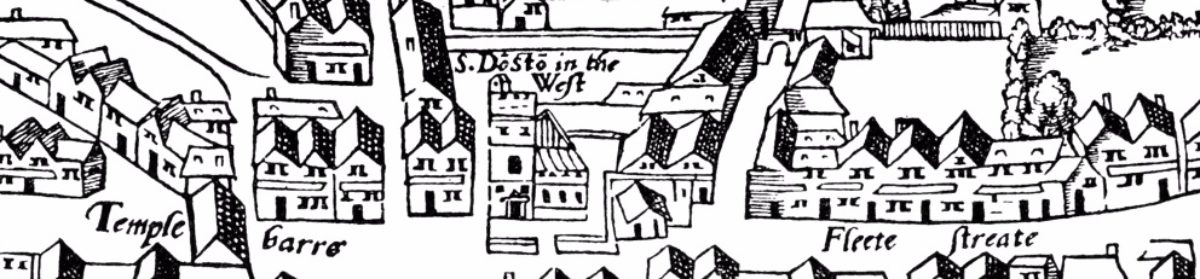
What a charming image. It is a tiny bit of a map of Portsmouth, England from 1552. These four structures are  The Dragon, The Lyon, The White Hart and The Rose – the four brewhouses built in 1515 by Henry VIII that I mentioned in my blog post on my first scratching about (what I should have called) Tudor brewing and Tudor naval victualing from earlier this month. There is much written* about Portsmouth, the Tudors and navel power but I am thinking about only one corner of it all. That being the corner in the image above. and these four brew houses. They are consistently illustrated throughout the 1500s as this passage from an academic article by one Dominic Fontana describes:

The four brewhouses are labelled on the 1584 map with their names; The Dragon, The Lyon, The White Hart and The Rose, and are clearly shown as being located around a pond, probably a freshwater spring providing the significant quantities of water essential for brewing. The four brewhouses were established in 1515 by Henry VIII to provide beer for his ships. They produced considerable quantities, making 500 barrels per day in 1515 (Eley 1988). Provisioning of Henry’s fleet and shore forts was an enormous task requiring significant organisation and by 1547 naval victualling was regularly accounted to the Exchequer (Knighton and Loades 2014). The engraving shows the brewhouses as timber framed buildings located almost as though they were mounted on stilts above a pond which extends underneath and around the buildings. Evidence for the brewhouses is also provided in the maps of 1545 and 1552. In the 1545 map they are shown as four rectangular buildings with a small square extension added to one side of each building, with the four brewhouses being grouped around a square pond. In the 1552 map the buildings are presented in bird’s-eye view as a group of low buildings with pitched roofs set around an irregularly shaped pond.**

The 1545 map of Portsmouth mentioned above illustrates the same brewhouses with a little less of a lyrical touch but perhaps more to scale. The red arrow is mine, in case you were wondering. This handy tool allows an overlay of the 1545 upon a map showing Portsmouth today. So regularly they sit. Clearly a work of joint undertaking. One thing I notice is how four regular standardized breweries would have had more fire resistance that one single larger brewery. They are spaced as well. Embers from one might not reach the roof of another.

There is another image, the Cowdray Engraving which is a copy of painting from between 1545-1548 depicting the Battle of the Solent and the sinking of the Mary Rose. Almost a pictograph. Whatever a pictograph is. The relevant wee snippet of the 1545 map-like diagram*** can be viewed with the merest click on the thumbnail to the right. As you can see, it is more than a map in that there are all sorts of folk well out of scale because it is not really about the mapping of Portsmouth but a description of the naval battle that was occurring right outside the mouth of the harbour. Again, it gives a sense of uniformity but also notice they seem to be on stilts and over the pond in this image. That would not jive with the two maps.

The pond itself was described in a modern footnote to an edict issued by Elizabeth I on 7 December 1562 included in the Extracts from Records in the Possession of the Municipal Corporation of the Borough of Portsmouth and from Other Documents Relating Thereto:

These springs of remarkably fine fresh water from which the inhabitants at this time derived their chief supply, were situated within the ancient walls in a triangular shaped meadow at the upper or eastern end of Penny and St. Nicholas Streets: the meadow was called ” Four House Green,” from its proximity to the Four Houses, which were erected by Henry VII. as Brewing Houses for the supply of his Navy; this site is now occupied by the Clarence Barracks. In the time of Charles the II., when the fortifications were reconstructed, in the star like form as they remained until their recent demolition, Four House Green was absorbed, and the greater part of it excavated to form the moat, and cast ravelin which was opposite to what is now known as King’s Road, Southsea. The springs were then enclosed in stone cisterns, which were approached by a postern through the rampart, and an iron bridge across the moat, and were used by some of the older inhabitants until a recent period.

So the site was restructured to the point no archaeology can be expected. Hmm. Notice up there the statement about the scale of production: “[t]hey produced considerable quantities, making 500 barrels per day in 1515 (Eley 1988).” I have not laid my hands upon a copy of Eley 1988 but have identified it as  Portsmouth breweries, 1492-1847 by Phillip Eley, published by Portsmouth City Council in, yes, 1988.**** It is comfortingly affirmed by Dr. Fontana but, still, I checked with my man who sits in the same buildings as one of the world’s great libraries, the New York State Library, in Albany but no luck. If you have a copy, let me know. I say this because I find the scale extraordinary. Even on a 200 working day year that is 100,000 bbls a year. Kristen D. Burton in this 2013 article describes the scale of brewing being undertaken in the whole of the City of London during Tudor times:

The beer brewers of London established England’s capital city as the leading producer of beer throughout Europe by the end of the sixteenth century; a notable feat considering the late arrival of hopped beer to England. In 1574, London beer brewers produced 312,000 barrels of beer and by 1585 that had increased to 648,690 barrels. This stood in addition to the beer produced for local consumption, which made up the bulk of the brewers’ business…

I am not suggesting there is anything wrong with these numbers so much as they mean the four naval brewhouses of Portsmouth were operating at a fabulous scale. I even saw one reference that suggested that each produced 500 barrels a day. Now, that would be scale and in the pre-scientific pre-industrial era certainly something that. Within sight of the porter breweries of the 1830s.

Again, I am going to leave this at that for now. I need to scratch around a bit more. Do let me know if you have a copy of that book by Eley under a table leg. I would love to see the primary record behind that number.

*You may wish to start here.
**See: “Charting the Development of Portsmouth Harbour, Dockyard and Town in the Tudor Period” Dominic Fontana, Journal of Maritime Archaeology, Vol. 8, No. 2, Special Issue: The Social Archaeology of Ports and Harbours (DECEMBER 2013), pp. 263-282. Abstract: “Portsmouth was crucial to the defence of Tudor England and consequently it was mapped for military planning purposes throughout the Tudor period from 1545. The resulting sequence of maps records much of the town and harbour. The maps offer opportunities for furthering our understanding of Tudor Portsmouth and its population Additionally, images of the urban landscape provided by the ‘‘Cowdray Engraving’’, which depicts the loss of Henry VIII’s warship Mary Rose on the 19th July 1545, may also be considered and compared with those presented in the early maps of the town. This paper considers the Portsmouth maps of 1545, 1552, 1584 and the chart of Portsmouth Harbour dating from between 1586 and 1620. These are examined in relation to one another and compared with evidence from the Cowdray Engraving.” The author is, in fact, Dr Dominic Fontana, FRGS, of Portsmouth University.
***Most fabulously of all, while the original painting burned in the 1790s, “in the 1770’s the Society of Antiquities became interested in the paintings and commissioned James Basire” to engrave it and make notes on the colours… AND between 1772 and 1778 the same “Basire had a young apprentice who most likely also helped with these engravings, his name was William Blake.” Wow!!! You can play a bit of Where’s Waldo on this bigger snippet.
****ISBN 10: 0901559733

Your Beery News For A Yuletide Thursday

Ah, December 21st. The kids’ Christmas pageant at church was already a few weeks back now. Gifts are bought and parcels have been mailed. Mainly. I will go out for a pint after work tonight but generally this is the time of sweet sherry and cups of tea. Times are a bit too Dad-ly to get overly tinseled. I’ll take a moment to think of Zimbabwe.  Play a few tunes. Then I’ll check in with the news.

Starting on a very cheery note, there is nothing better than accusations of marketplace corruption and political underhandedness in Canada’s tiniest jurisdiction – not that I’d have any idea of why this would be the case.:

Now you take your kid’s to a grocery store, and not only can adults purchase Gahan beer, they can even sample it. Why not sell Gahan beer in the emergency waiting rooms across the Island. Also, a keg of beer (Gahan) would be nice for patients in the back of an ambulance to take their mind off their issues. I am only using Gahan, since they are currently the only ones allowed to sell privately here on the Island. Maybe the other brewers never thought of this idea or are not Liberal donation givers

Frankly, I blame them getting rid of the bootleggers in 2004.

Next, apparently elsewhere in this fine nation the Canadian craft brewer alert status about the impending implosion of their entire industry has been raised to an alarming all time high: concerned. Let that give you pause, global brewing industry.

South of the border, it’s funny watching the brewing trade groups go on and on about the tax cut benefits the ownership class has received without any apparently awareness that these savings are built on relieving 13 million of their fellow citizens from access to health care. Andy has the right take as does Jason: a gratuitous three and a half bucks a barrel back in the owners’ pocket.  Forbes has the extraordinary details on the windfall that has fallen in the laps of the brewery ownership class. Just in time for Dunkin’ Donuts beer.

Antipodeanly speaking, you will be please to know that one retail business in New Zealand considers non-alcohol beer a gateway drug. Reminds me of how, as an undergrad in a college half-run by clerics, we learned how High Anglicans thought the danger with stand up… relations are that they could lead to dancing. Fabulous. Remind me to never shop there.

I love how one farming publication seems to suggest we set the birth of Jesus aside at this time of year to remember… the farmer. Friggin’ farmers.

One last thing. You really will have to pardon me. I really don’t care about the best beers for Christmas. I don’t. Not for me. Not for you. I hope you find something else to do like being happy, annoying little nieces and nephews, doing something good and not telling anyone, staring at the conifer in the living room and eating unfamiliar poultry. Or find a 45. Or listen to this. And, for God’s sake, don’t do this. Try this. Have a holly. Have a jolly. But enjoy yourselves and don’t fret about the beer.


Your Thursday Bullet Points For A Beery Yule

Are we in Yule yet? I think we are. The old town is at least looking wintery as you can see above. Our warm spell has flipped to cold snap so fast that the last of our garden tomatoes ripening on the window sill looked out at -17C this morning. But enough about comfort and joy. This blog is about beer, not… not beer.

First up in the news is all this  fuss about the shadowy Portman Group telling a brewery with childish colours and cartooning in their branding that childish colours and cartooning might be attractive to children. Infantilization indeed. I am pleased that the response of the UK brewery in question is so sensible and support the take by  in large part. BUT… a bit shocked was I by the (i) weepy hand wringing over the decision, (ii) weepy hand wringing over the process, and (iii) the collective amnesia about the Portman Group rulings on 2008. So much #poohwiddowcwaft! Now, I realize that the demise of most actual beer blogging has left an imprint on the minds of some that beer blogging was never all that good but it is rewarding to reach back in the archives to find sensible discussion about those events in a way that neither social media or trade-based beer journalism can apparently cope with these days.

Speaking of sensible application of the law, good to see that Beyoncé got here reputation unshackled from those freelancers who would attach their profit making to her hard earned fame.  It is quite stunning how we see this appropriation by craft brewers of the intellectual property of others. I still haven’t heard who drew and, so, owned or owns the copyright as opposed to the trademark as it relates to that White Stag. Yes, yes… it’s all a bit of fun. But that’s what the sexists and racists say, too, right?

Gerald Comeau, hero.

Robin and Jordan got a generous amount of coverage by TVO, Ontario’s public TV and interwebs broadcaster this week. My only sadness is the entire misrepresentation of the sixty years from 1927 to 1987 and the glory that was E.P. Taylor’s contribution to the world of brewing with his war on waste under the banner of lightness and modest price. The point, however, on “local” is especially well made and avoids our muddiness about all of Ontario being “local” to the entire 13,000,000 persons province.

Finally, interesting news about the jump in Canadian malting barley sales to China including this tidbit:

Canadian malting barley commands a higher price, especially for China’s premium beer market, because of its dark color and higher protein, which allows for better foaming, Watts said.

Because its all about the foaming. Good to see us kicking some Argie-Aussie-Euro butt for one in something other than curling.

I am off. Not like Stan is off. I should be back sooner than he is. I am going to think about Thursdays. Gonna think some more.

A Short Update On That Apparently Very Fine Thing, Lambeth Ale

This is a real puzzle. As discussed a few weeks ago, we are largely unaware of what was Lambeth Ale in the second half of the 1600s in England and how it set itself in the hierarchy of drinks. I am just going to note a few more findings in this post with the hope of narrowing the uncertainties. First, this is the account of the costs related to the horses required for a Royal weekend jaunt from the 1680s:

In this series we find the subjoined computation ” of the charge and expence of the Horse Liveries, according to the following rates,” viz. : Hay £4 per load, straw 30.S’. per load, oats 24.9. per quarter, beans 6s. per bushel, shoeing and medicining 2.f. per day ; more for each hunting horse 205. per annum. Each horse was allowed 1 bottle of hay, 1 peck of oats and 1 peck of beans per day, and 8 trusses of straw per month. Four “hunting horses” and 36 “hunters coursers and pads” was the established yearly allowance in the royal stables. The total cost of keeping each horse is set down at £52 10s. a year. Yearly charge for diet, etc, commencing April 1, 1689. Yeomen of the field to the King and Queen on hunting days were entitled to receive from the royal larder 2 manchets of bread ; 2 bottles of Lambeth ale ; 1 bottle of champagne, 1 bottle of Rhenish, and 1 bottle of Spanish wines…

What sort of bread is a manchet? A snazzy sort, I suppose. Anyway, it is clear that Lambeth ale is something kept in the Royal larder, the only beer or ale mentioned, next to the bread of the elite not to mention the champers. Its high status nature is confirmed by this account of another 1680s gesture at court:

In 1687, the French ambassador in London was sending to the marquis de Seignelay regular consignments of English ale, “known as Lambeth ale” and not “strong ale, the taste of which is not much liked in France and which makes men as drunk as wine and costs just as much.”

Interesting comment. It was not as strong as strong ale. A lighter thing. We see it referenced from the same decade again in a discussion of alms as recorded the account books from 1689 for the court of William and Mary compared to that of Charles II from a few years before:

…the alms are set forth as a money payment, and we do not see gifts to the poor mentioned as of yore amongst ” daily liveries of bread, beer and wyne for the several dyetts,” but, in company with wages and pensions and “board wages to old servants,” we notice that the sum of £219 is set aside for these” Daily Alms.” It crosses our minds that this allocation of £219, larger than that of Charles II, who had almost doubled the yearly allowance for “Daily Alms” made by the Tudors, may have been so expended by William and Mary partly in compensation for the dwindling contents of the alms-tubs under the economical regulations of the semi-Dutch Court. Careful record is kept of the ” manchets” or small rolls of bread and of the loaves required by the entire household. The King, Queen and Court were obliged to content themselves with 136 1/2 gallons of beer and 30 bottles of Lambeth ale as against 240 gallons which, under Charles II, had been distributed to the” poor at the Gate,” and we have only the item of I gallon of beer and a loaf per day for the porter. But as regards the consumption of beer at Court, we must bear in mind that ale and wine were no longer the exclusive beverages in the fashionable world…

Well, now we know what a manchet was. A small loaf. A bun. I shall order them accordingly in the future. Notice that Lambeth ale is reserved for the top dogs and measured by the bottle even if it might have been consumed by the stoneware mug. Its finesse did not mean it was consumed only in a dignified manner, if this passage from the 1693 farce The Richmond Heiress: Or, a Woman once in the Right is to be believed. Here we see the character Sophronia confronting a group of young privileged men including one named Hotspur and comments on their average day:

Sophr. Come, Sir, for once I’ll be a little satirical, and venture to describe the course of life of all you Men of the Town: In the Morning the first thing you do is, to reflect on the debauch of the Day before; and instead of saying your Prayers as you ought, relate the lewd Folly to some other young rakehelly Fellow, that happens to come to your Leve: The next thing is to dine, where instead of using some witty of moral Discourse that should tend to improvement, you finish your Desert with a Jargon of fenceless Oaths, a relish of ridiculous Bawdy, and strive o get drunk before ye come to the Play.

Hotsp. The Devil’s in her; she has nick’d us to a Hair.

Sophr. Then at the Play-House ye ogle the Boxes, and dop and bow to those you do not know, as well as those you do. Lord! what a world of sheer Wit too is wasted upon the Vizard-Masks! who return it likewise back in as wonderful a manner. You nuzzle your Noses into their Hoods and Commodes, just for all the world like the Picture of Mahomet’s Pigeon, when he gave the false Prophet his ghostly Instructions. Fogh! how many fine things are said there, perfum’d with the Air of four Claret! which the well-bred Nymph as odoriferously returns in the scent of Lambeth-Ale and Aqua vitae.

Hotsp. ‘D’s heart, what shall I do! I shall ne’er have patience to hear this.

Sophr. Then at Night ye graze with the hard-driven Cattel you have made a purchase of at the Play, and strut and hum up and down the Tavern with a swashy Mien, and a terrible hoarse Voice, which the Lady (to engage your liking) returns with some awkward Frisks, instead of Dancing, and a Song in a squeaking Voice, as untenable as a broken Bagpipe. Then supper coming in, the Glasses go about briskly. The Fools think the Wenches heavenly Company, and they tell them they are extream fine Gentlemen; ‘till at last few Words are best, the Bargain’s made, the Pox is cheaply purchas’d at the price of a Guinea, and no repentance on neither side. What think ye, Sir, am I not a rare Picture drawer?

I quoted from that extended passage mainly to capture the endearing Jeeves and Bertie aspect of it all – and not at all like Tom and Bob in 1821. Which again confirms its elite nature even if those of the elite, as is often seen, have charms which are less to be desired than they might think. If you add that to the suggestion that it is lighter than strong ale and served in a bottle and kept in royal larders next to the champagne, I am thinking that it sounds a lot like the role porter played one hundred years later in New York City, perhaps another drink which was also “ripe and brisk“?

Did the bottling make it more bubbly? More charming? Dunno. But that would certainly explain its particular attraction just as the paleness of Derby ale set it apart perhaps a few decades earlier. Soon, Burton comes alone and steals the spotlight but for now, in the last two decades of the 1600s, Lambeth seems to hold a very high spot amongst the available offerings.