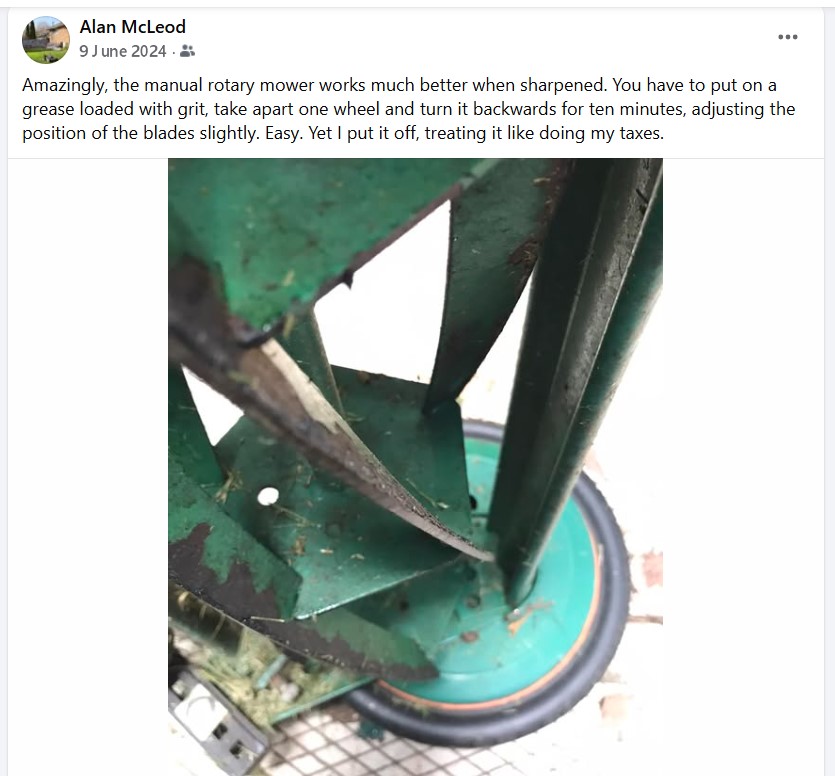
 The tide has turned. The seasons have shifted. The dandelions have popped. The penny has dropped. It is time. So the Beast has been released. I say Beast but it’s really Beast II, Son of the Beast. The Beast is still back there, there at the back of the shed. An over a decade old rotary mower that took five times longer to do the job, was a pain to sharpen and was retired last spring. It’s a terrible thing being cheap and lazy for so many years. Now, my lawn is mowed care of a combination of hydroelecric and nuclear power. Science.
What is going on? Well first up, Alistair is about to travel from Virginia back to the UK and shares a complaint that’s been complained since time itself began – how to narrow down where to go for a pint when the information online is just not there:
My biggest challenge though, and I am sure there are reasons for this, but with so many tied houses in the English part of my trip, it does get really frustrating when there is a shared platform with generic information, and almost universally no list of what is on cask in a given pub – this goes for chains like Wetherspoons as well. Yes, the many Fullers pubs in the city have elegant, beautifully designed websites, but again I can’t find out which beers of the Fullers Brewery range are available, making it pot luck to stumble across less regularly seen beers (at least from what I have been told) such as London Porter. I don’t want to single out Fullers, as I have seen the same with Shepherd Neame, Greene King, and Nicholsons, though several Young’s pubs tend to have at least a list, and occasionally pricing as well.
Is it a realistic expectation after decades of this sort of thing to expect every pub to logging what’s on tap? I dunno. The failure seems to be the proof. Elsewhere, Pivní Filosof® is back after a few years of quietude. And Max is again on the move with his second post of spring 2026 looking for good beer by tram, with all sorts of obstacles placed in the way… like bad beer scenes:
Here comes the first tram, #5 heading to Vozovna Zižkov. I get on and start counting the stops. Fuck! Hlavní nádraží. All I can remember around there are the two overpriced spots in the station itself, and U Staré Pošty in Opletalova, a hospoda I’ve never liked for some reason. I get off, already resigned to the idea of having a Pilnser Urquell U Staré Pošty, when I tell myself ‘fuck it! I will cheat’, and change direction, towards the the tunnel that now connects the train station with Žižkov and the new building complex that has sprouted there in the last decade or so. Yeah, I’m cheating, in my own challenge, which I play alone – if you disapprove, good luck finding a better beer blog…
[Ed.: I thought he was talking about me. He wasn’t!] Offering a definite upgrade in locales, David Jesudason has the feature in Pellicle this week, a portrait of The Golden Smog of Stockton-on-Tees, County Durham, a pub which started life under the current owners with its own set of more serious challenges:
Their eyes even passed over the anti-fascist football sticker saying “our club, our rules.” When they spoke of how local shops were closing, they didn’t blame globalisation, politicians, or even the internet—the fault was with “immigration”. It was 2014, and owner John Christie sighed after overhearing their chat, wondering if this was the life he had now forged for himself. He had trained as a mechanic and joined the army; after leaving, he opened the pub in a former headstone shop. His goal was building a welcoming, inclusive space founded on his socialist ideals. Was he about to be dragged into their world First, he considered kicking them out. Then he paused. It dawned on him that if they went to another pub, their views would likely be re-enforced, or amplified in an echo chamber. It was at this moment that the unwritten manifesto of the Smog started to take shape in his mind.
On a larger and indoubtably less successful scale of internationalissimmo, we are all now just a few weeks away from World Cup madness. Perhaps not surprisingly, hotel reservations are below expectations. Here in Canada, we have a few of the games – and there’ll no doubt be any number of beer related stories in the coming weeks as there usually are when this rolls around – but this one about Ermedin Demirovic is one of the best so far:
Back to Demirovic. As everyone will remember, before his country’s World Cup qualification play-off final against Italy at the end of March, Stuttgart’s Bosnia and Herzegovina international forward promised to buy everyone in the city a beer if he and his team-mates made it through. They did, beating the Italians on penalties following a 1-1 draw, and last Monday, Demirovic kept his promise. The event was staged near the Neckarstadion in collaboration with a local brewery, and more than 2,500 people turned up. “I didn’t expect so many of you to come,” Demirovic told the fans who took part.
Sticking with the people of the grassy pitch, Boak and Bailey unpacked their findings on the disappearance of the retired fitba player as publican:
Historically, you could expect to retire from football before you were, say, 35 years old, with a lot of life left to live. And unlike today, even top flight footballers probably wouldn’t retire rich, even if they did have a little money put away. So, you’d need to find some kind of work. We can well imagine that running a pub was appealing because it’s a job that seems fun adjacent. Back to those headlines above: there’s also a sense that you could parlay your fame as a footballer into publicity for your new venture. Who wouldn’t want to be served pints by a local hero? (And perhaps tut at their fall from grace, and marvel at how fat they were getting, how red faced…)
I guess a key difference between then and now are the far higher wages paid to players in recent decades during their career. As a late teen, my father started out his working life at the firm of Hasties, a marine engineering firm in Greenock. In the lunch room he sat at the same table as local hero and Scottish national team star Billy Campbell whose career was cut short by illness and was given a job. A kindness from the owner, a local supporter.
Something else that is also retired but more often noted is a well priced pint in an London pub. Perhaps a well-trod topic but there was an interestingly specific grip in Tuesday’s daily (free) newsletter from The Telegraph:
We all knew the moment would come, but it was still a shock to read that we had entered the era of the £10 pint. Long gone are the days of venturing out with a tenner, sure of enjoying a few pints of bitter, and perhaps even having enough cash left over for a scallop from the chippy. No, bars in London today are charging as much as £11 for a pint of Moretti and £8 for a half of Heineken. There’s probably no going back – the rising cost of pints is an irreversible trend, like SUVs or smashed avocado – but mercifully you can find relics of the old, pre-£10 world, mostly outside London. Indeed, soon after the news broke, I raised a £3.50 glass of Gunpowder Mild in honour of reasonably priced pints in a pub in Clitheroe, Lancashire.
Hmm… how long ago a scallop and chips was going for the price of the leftovers from a few pints? I also wonder what the price travel to Clitheroe from London is, you know, to save that £6.50. Here are a few notes:
Note #1: Beer skates and sabres.
Note #2: Sue them, Yoko. Sue.
Note #3: Data-less trends are the best trends.
And Ray of B+B has done some solid hypothesizing over at Patreon in a piece entitled “Beer from the Witchwood” about the meaning of Jethro Tull’s album Songs from the Wood:
It’s from an article by Nick Freeman about music inspired by the mythic power of English woods and forests and it feels like a missing link between the Society for the Preservation of Beers from the Wood and Ray’s suggestion from a couple of years ago that real ale and folk horror feel somehow connected: “I don’t think it’s any coincidence that the Campaign for Real Ale, The Wicker Man and the English Morris dancing revival all landed at about the same time.” We think Freeman is right: the title of the album is a definite reference to the concept of ‘beers from the wood’. And on the cover, Ian Anderson looks like an extra from The Blood on Satan’s Claw or Witchfinder General.
Now don’t get me wrong. I think he’s on the right track. But… I am not sure. Not sure of the directness of the relationship* even if an indirect** one could be perfectly admissible. With something of a similar theme, ATJ has been making things up, including his recollections of a perfect beer fest:
I will admit that this summer beer festival is a composite of several I have attended. Some had great lagered beers and well-conditioned cask and an encouragement of children to play and provide a lightness of being, some had excellent food and at one even the Morris made sense to me. Then there was the one which included a beer garden, plus shaded woodland and a cooling river running alongside, plenty of sunshine, a genial intoxication and the amity of friends as well as meeting new people, children and dogs. So if you do know of a beer festival in the summer that has all of this please let me know.
And there is some odd financial news out of Belgian based macro gak producer ABInBev which has been finding sofa nickles and dimes in unexpected places:
Shares in AB InBev gained as much as 6.8% in early trading, adding to a more than 14% rise over the past 12 months. Strong beer demand in Mexico, Colombia and Peru drove volumes in the region up 4.8% in the period, offsetting a 3.1% decline in North America and a 0.4% drop in the region that includes China, amid a broad-based reduction in drinking. Revenue also rose in no-alcohol beer and in the non-beer segment.
Speaking of what is or is not, legal steps are being taken in Montreal to fight against a scourge… or perhaps a few scourges:
A Montreal microbrewery owner says he is being unfairly targeted by Quebec’s Alcohol, Racing, and Gaming Commission (RACJ). Le Saint-Bock, on St-Denis Street, brews specialty beers infused with candy flavours. The commission is accusing him of marketing to minors. “People like this kind of beer,” said Martin Guimond, owner of Le Saint-Bock. “It’s different, but there’s a market for people who don’t like beer and want to have a beer that tastes like candy.” Candy flavoured alcoholic drinks is a trend that other major breweries are hopping on as well. Coors has released a line of slushie flavoured seltzers, and the SAQ now sells a Popsicle vodka soda. “They have never been sued. But me, yes,” Guimond said.
Candy beer. Really? It’s this sort of thing that does make one wonder if there is anything left that can reliabily be called craft. And, speaking of which, Jeff posted about the latest move by the BA to buff up the image of US craft’s prospects, reporting (under a somewhat sheepish portrait of Bart Wilson) on a presentation by his leadership himself:
Two comments struck me. In his opening statement, Bart tried to strike a positive note, saying “This year the vibe is positive. It feels like we’re coming out the other side.” Then, near the end of the breakfast, he encouraged us to consider writing more “happy stories.” For the most part, the session yielded little new information. And, despite these comments, I wasn’t picking up a lot of positive news. Bart is no longer the just-the-facts BA economist who reports the numbers. Now he’s the head of a trade organization in a wobbling industry.
Wobbling indeed. I expect there are still some experts who will be moved by such puff even as production is down 17% over a five year trend to the end of last year.*** But the vibes? They are good. We read “… going to see growth this year – very, very strong growth…” Oh, that was 2021. And in 2024 it was all about “mood management” and the niche. Heavens. Stan connects more dots. And Brew York shares another observation:
One of the most positive numbers in the report — that independent breweries’ market share increased by 0.1 percentage points over last year — should be taken with a grain of salt. The Brewers Association’s classification of craft beer means that three breweries owned by MillerCoors for most of 2024 are now considered craft in 2025 after being acquired by the large but independent brewery holding company Tilray. Niche brands that are more likely to market themselves like big beer, like Garage Beer and Outlaw Light, are also defined as craft.
That reference to Tilray is interesting. Fourth biggest US craft brewer in 2025. But we must remember that according to the current version of the shifting sands that are the BA’s definition of “craft brewer” the requirements of actually being, you know, a “brewer” includes the principle that a firm must have “have as its primary business purpose the resale of the brand or brands it controls.” Primary. According to Tilray’s most recent financial statement, its craft beer holdings represent 27% of its activities after its cannabis (31%) and pharmaceutical operations (40%). So… not really that primary. Probably fits squarely in the definition, however, in special BA-nglish. But, you know, happy stories!
That is it for now. Let’s keep an eye out for happy realities instead. With any luck, the tomatoes will start finding their place in the garden and please check out Boak and Bailey who are posting every Saturday and adding to their fabulously entertaining footnotes week after week at Patreon. And look out for more of Stan’s new “One Link, One Paragraph” format. Then hunt out something in someone’s archives! Leave oblique comments on someone’s post from 2009!! Listen to a few of Lew’s podcasts and get your emailed issue of Episodes of my Pub Life by David Jesudason on certain Fridays. And Phil Mellows is at the BritishBeerBreaks. Once a month, as noted, Will Hawkes issues his London Beer City newsletter and do sign up for Katie’s wonderful self-governing totes autonomous website featuring The Gulp, too. Ben’s Beer and Badword seems to be on pause since November but there is reading at The Glass which is going back to being a blog. Any more? We have Ontario’s own A Quick Beer and All About Beer is still offering a range of podcasts – and there’s also Mike Seay’s The Perfect Pour. Plus follow the venerable Full Pint podcast! And there’s the Craft Beer Channel on Youtube. Check out the archives of the Beer Ladies Podcast.
*Ian Anderson, creative lead of Jethro Tull had a busy 1976. In addition to making (and producing) Songs from the Wood, he got married a rather rich lady and moved into lodgings at Pophleys Estate which sat on 500 acres. The main house was up for sale in 2009 on a lot of 13 acres and was described as being supprounded by “a large belt of woodland” so it could be in addition to the era’s folk-rock theme these songs of his might also be from his wood.
**According to Richard Boston in “Beer and Skittles” at page 95 the Society for the Preservation of Beer from the Wood was founded in 1963. Songs from the Wood came out in 1977. So a bit past the folk-rock revival and four years after The Wicker Man hit the cinemas. During this time – and here is the thing – we move from the era of the First Doctor to Fourth. From Gerry and the Pacemakers to the Sex Pistols. My birth to my teens. Yet if detective shows set in England have taught us anything, it’s always the green man behind the scenes and everyone is down the pub sonner or later.
***And… the numbers are already again down another 2% in 2026, just one third into the year.
Typo? The “Alistair” link is pointing at pivni-filosof.
On the right page at Fuggled somebody points out that you can usually use the Wetherspoon’s app to see what beers are on now and next.
Fixed! Thanks…