
Your Summer’s Lease Sure As Hell Hath All Too Short A Date Beery News Notes For A Thursday

“Bud By The Bay“

Welcome to autumn. The burning of fossil fuels within my home has already begun. And the wearing of more layers. It’s madness all this circling of the sun. A few days ago, it was too hot. Now… I wonder if it will be too hot ever again. I think deep thoughts like that from time to time because, as the poet wrote, I am a sensitive man. So sensitive that I took a photo of the scene above when I came upon a can of Bud sitting quite upright by a familar path, looking out upon the waters. I am also, apparently, a student these days. Forty five years after starting the FYP program at Kings College (aka Bings Bollege), I signed up for the new mini version. So I must be extra clever this week having studied Ajax for minutes on end. Right? Well, we and the gods shall now have to see if anything actually sinks in.

What’s up in beer news? First up: when did the copper age end and the bronze age begin… in Bulgaria? What ever the label, apparently there was wheat ale brewing 6,500 years ago in that corner of Europe:

 Bulgarian archaeologists found evidence that beer was produced at “Provadia-Solnitsata” (5600–4350 BC)-Europe’s oldest salt-production and urban center. This was announced by the leader of the archaeological works, Academician Vasil Nikolov, who presented the team’s summer findings to journalists, BTA reported. According to Nikolov, this likely represents the earliest production of the beverage in the region and possibly in all of Europe. He noted that botanist Elena Marinova contributed to the discovery. A broken vessel was found containing wheat that had sprouted in the manner required to produce malt. The vessel was discovered in a house that had burned down.

I know that Merryn will be pleased with that sort of residual organics analysis. I like that the house burned down. Breweries were always burning down around here 240 years ago. Good sign.

Perhaps another good sign is how, as Jessica Mason reports, it seems that the Canadian and US administations’ mutual tariffs on aluminum products are having an important effect… though likely not the one the White House intended:

Southern Ontario’s Caravan Bev Co’s owner Shane Vear had also admitted that he also imports and distributes Chinese cans and since then his business has risen 30% since last year. Vancouver Island’s Strait & Narrow president Yuri Akeroyd told the publication that his company moved most of its can purchases to China over the past eight months and insisted that the decision was about “survival”. Akeroyd also stated that “cost” was not the only reason for the shift and added that following nearly two years of policy swings that buying from overseas felt “less volatile”.

Import… get it?  Fine. Well, there is someone out there seeking to promote stability. You know the guy working on the creation of cybermen or some other sort of robot army.

Speaking of laying waste, VinePair published a great article by Aaron Goldfarb on the regret and shame and bad feelings and waste of one’s life you can feel when you have a cellar full of beer that was promised to age:

I was saving these beers for some special occasion. But plenty of special occasions came and went and I never drank them. And there they sit: too worthless now to sell, too heavy to haul upstairs on a whim, too fraught to simply throw away because tossing them would mean admitting my wife was right a decade ago, when she kept asking why I needed to buy more beer when I already had so much. I only had one choice, and Leslie’s advice kept ringing in my head: “They’ve all passed their prime, and at this point you might as well just crack them.”

I think it was about ten years ago the I gave away most of the “important” beers I started aging about twent years ago. I probably have more down there in the cellar like my two panic bottles of Girardin Gueuze. I don’t even want to think what they are like given I bought them in the first term of the Obama administration.  Another more serious sort of crime against booze was discussed by Jason Wilson this week with a seriously hefty fine on the line:

On September 10th, the federal government announced that Southern Glazer’s Wine & Spirits—which controls about one third of all U.S. wine and spirits distribution—agreed to pay $12.5 million in fines over bribery and false invoicing practices. Southern Glazer’s entered into a “non-prosecution agreement” with federal prosecutors for “executives and employees funding and concealing improper payments and benefits to employees of alcohol retailers, including chain grocery stores in California and elsewhere.”

Wilson shares the opinon that the fine is a “rounding error” for the firm that takes in $26 billion USD a year and especially insufficient for an eight year long pattern of infraction. He calls for drinkers to rise up! As you think on that call to action, here’s some notes! Here’s some notes as you plan the revolution.

Note #1: Matty C on some hop parlance.
Note #2: “…3.5% more than in the same period last year…”
Note #3: part beer shop, part radio station.
Note #4: Lars has a new book – The Power of Beer!

What else is going on? Well, David Nilsen in CB&B has provided us with a helpful primer on the French hop industry:

When we think of French hops, we typically think of Strisselspalt, a delicate Noble-adjacent hop with fine herbal-floral aromas and restrained bittering. That classic variety took up most of the Alsace’s 400 hectares under trellis until nearly 20 years ago, and most of that crop was contracted to Anheuser Busch. When InBev purchased the company in 2008, it also abruptly terminated the Strisselspalt contract. That not only meant an immediate loss of sales, but it also left the French hop industry with a visibility problem. Few brewers were familiar with French hops because Anheuser Busch had been using most of them. Yet the rhizomes for a possible future had already been planted. Hop France had begun a hop-breeding program in 2001 with the primary purpose of improving—or replacing—the bittering performance of Strisselspalt…

Frikkin Strisselspalt…. just… don’t ask. And from New Zealand, Kieran Haslett-Moore has shared the idyllic story of a beer fest by a southern sea:

The sun is setting over the alps and is catching the clouds, setting them alight with glorious flaming reds set against the over ripe blue of the heavens. The spectacle is a Salvador Dali painting animated to reality. Beneath the spectacle of the natural world sits one from the realm of human endeavour. Cobbled streets of ornate Victorian white stone have weathered 150 years of southern ocean storms and Kiwi lust for the wrecking ball. Within two of the old buildings Bruxelles Oamaru is in full swing. It is like there is a portal from the sleepy southern town straight into the back streets of Brussels. Goblets of oaky spontaneous ale, various tart, fruited concoctions, lemon-flavoured blonde ales, saison and even a Belgian stout are drunk, discussed and enjoyed. 

What a scene. It’s like good beer was starting fresh all over again. Similar too was the report from Imran Rahman-Jones who has been slumming by the Mediterranean:

I am writing this from the heel of Italy’s boot, otherwise known as Puglia, where it’s still shorts weather and the Nivea factor 50 continues to be sprayed every few hours. The Italian beer here has generally ranged from “not to my taste” to “objectively poor”, with a couple falling into the “very nice served ice-cold but make sure you get it finished before it starts tasting of anything” category. The supermarkets here seem to have as many German and Belgian beers on the shelves as Italian ones. It seems Italy has, like France, decided it should stick to doing what it does better than anyone else (wine), and happily imports the good beer from its European friends.

Blunt but now doubt accurate. And, to be fair, there is a place for the utility of a well placed “very nice served ice-cold but make sure you get it finished before it starts tasting of anything” beer. Similarly, there were some refreshingly simple business truths this week from at Breweries in Pennsylvania:

If you’re walking into an industry with a high failure rate, you should probably be ready to face that day when it comes. The data is telling you that you will most likely close… it shouldn’t then come as a surprise. The craft beer boom of 2017/2018 in PA had a lot of different impacts. While most of them were positive (more locally made beer on the market, more jobs added to communities), we are seeing a fair share of negatives as well. One of the biggest downsides of the rise in craft beer are people who probably should have never entered the world of small business ownership. From cutting costs, employee mistreatment (*cough* Bald Birds/ Tired Hands *cough*) and just closing with no notice the industry is still riddled with poorly run businesses.

Naming names and pointing fingures?!?! How refreshing. And professor and historian Dr. Dan Malleck has posted some thoughts on the relatively low risk of  harm caused by moderate alcohol intake over at LinkedIn:

For many people, drinking does have value. I don’t need to re-litigate this, but from socialization, to creativity, to relaxation, alcohol brings value to many people’s lives. Even if you just really like the taste, there is a value. (Is there a risk? Yes, just like a risk in driving excessive speeds, eating way too much beef, chronic sun exposure, or … getting really into cutting wood (I guess) there is a harm of excess.) The difference here is when we talk about alcohol we always need to frame it harm-forward. We can’t just say it’s ok to drink without saying something like “but know your limit” or “if you are worried about your drinking, seek help.” That’s an interesting social convention that we don’t have to use when offering people a ride, cooking them a steak, inviting them to go for a walk, or asking them to help you cut some wood.

It’s a lucid argument but it does invite my mind to wander towards the consideration of the other non-intoxicating pursuits in life that also may enhance socialization, creativity and to relaxation. Are there such medical studies on the risks associated with birdwatching? Doubt it. On napping? Not so much. And if we are being honest, I would worry if socialization, creativity and relaxation were mainly enjoyed by someone after a drink or two. We need to, yes, think of relative risk but really be thinking of relative risk/benefit.

Finally and for the double, David Nilsen has the feature in Pellicle this week, a portrait of Off Color Brewing in Chicago:

Off Color opened in 2013 with two beers: Troublesome—a classic, unfruited gose—and Scurry, a kottbusser. Launching with two obscure German styles was less a statement of defiance than an indication of intent: They were going to brew delicious, approachable beer, but it wasn’t going to be everyone else’s delicious, approachable beer. As unorthodox as Off Color’s beer was, it was matched by the quirky, black-and-white label art. Craft beer branding at the time was rarely subtle, and John and Dave opted for contrast from the prismatic norm rather than competing with a cornucopia of colorful labels. “We ended up on black-and-white just because it really stands out on liquor store shelves,” John says.

Well, that is it for now. It’s been a bit of a quiet week or at least one that had distraction. For me the main one being the arrival of a team of masons who responded to the call and spent a couple of days parging, capping and rebuilding the front step which (in accordance with the Ontario’s Building Code circa 1964) houses the cold room that houses my stash. As with the furnace and the roof, I know enough about concrete to avoid my own advice and certainly my skills. And it always amazes me when capable folk arrive at the house, totally fix problems that visit one’s mind in the hours before dawn night after night –  and only want money. Isn’t money great? Now I can get back to just worrying if I have enough for the next crisis.

As you think on that, please look to Boak and Bailey’s postings on each and every Saturday along with the coincidenal and fabulously entertaining footnotes week after week at Patreon. They do put in the effort. And do look out for more of Stan’s “One Link, One Paragraph” format. Then it’s your turn. Read and recommend, please. Scour the world for news tips – then let me know. Then hunt out something in someone’s archives! Leave oblique comments on someone’s post from 2009!! Listen to a few of Lew’s podcasts and get your emailed issue of Episodes of my Pub Life by David Jesudason on certain Fridays. And Phil Mellows is at the BritishBeerBreaks. Once a month, Will Hawkes issues his London Beer City newsletter. Do sign up for Katie’s wonderful self-governing totes autonomous website featuring The Gulp, too.  Ben’s Beer and Badword remains on pause but there is reading at The Glass which is going back to being a blog. Any more? We have Ontario’s own A Quick Beer and All About Beer is still offering a range of podcasts – and there’s also Mike Seay’s The Perfect Pour. Plus follow the venerable Full Pint podcast! And there’s the Craft Beer Channel on Youtube as well as the archives of the Beer Ladies Podcast. What else?

*No footnotes this week. Not one.
These Are The Melancholy But At Least Not Mundane Last Beery News Notes Of The Summer

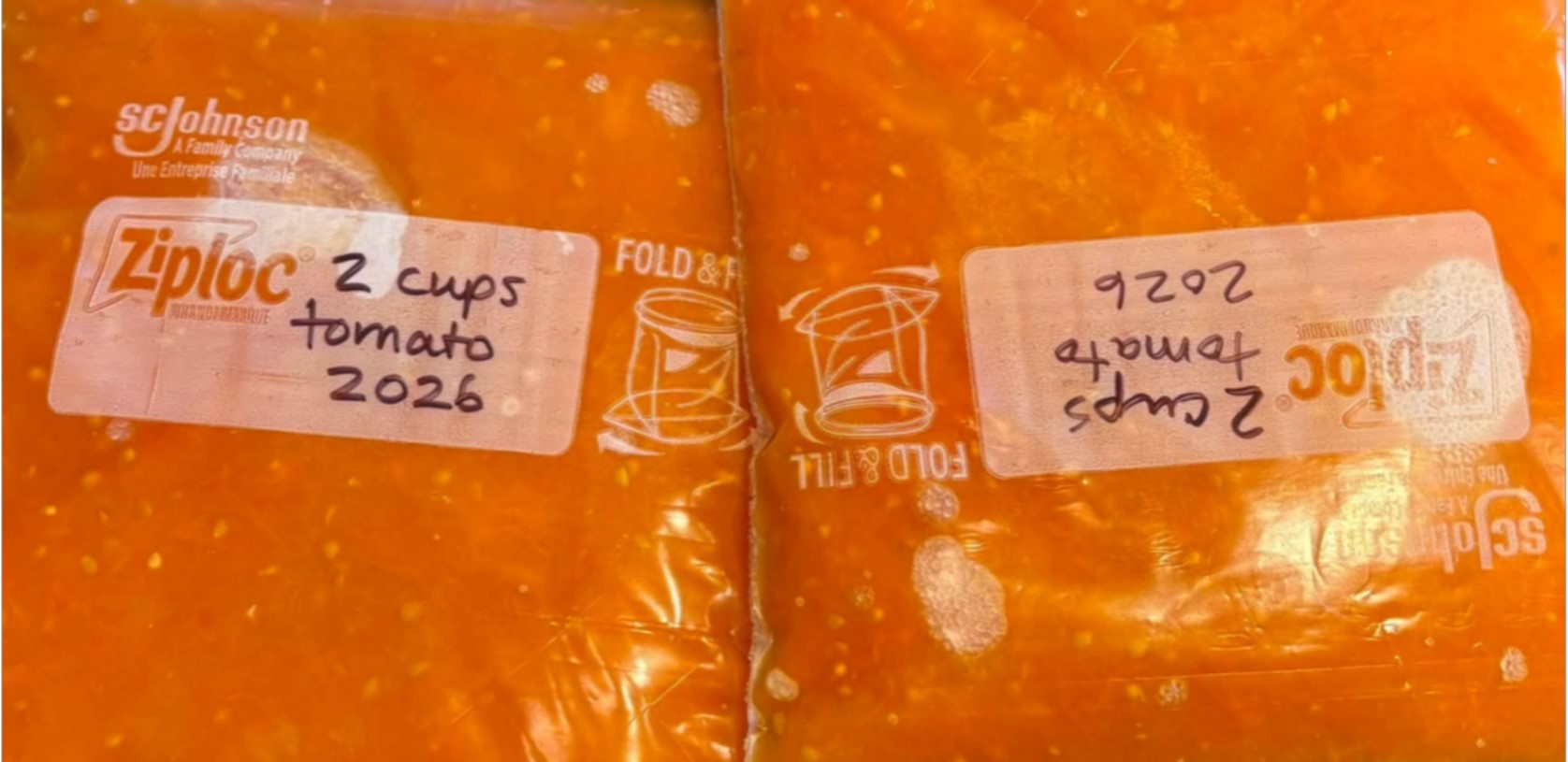
The end of summer. The last stragglers back from holidays. Yellowjackets everywhere. Tired sweetpeas starting to show their age. Tomatoes ripening faster on the vine, some going soft before I get to them in the sauce pot, then into ziplock bags destined for a spot deep into the freezer. I’m even starting to think about getting the garlic ready to plant before the first frost. It all starts to move pretty fast right around now.

Speaking of fast, as Canada is suddenly accused of nuzzling up to the EU, asking if we can spend the weekend – or is it the other way around –  it’s funny to see a politician in France castigated for doing the one thing even a t-total conservative candidate here must always do if they hope to have a hope:

A French presidential hopeful has been accused by leftwingers of encouraging alcoholism after he released a campaign video showing him with a beer. In the video, Gabriel Attal, 37, who was President Macron’s prime minister in 2024, announced plans to hold debates with voters in bistrots across the country. He said he wanted to revive tradition: Enlightenment philosophy had emerged in France’s small dining establishments in the 18th century, he said, as had the call to storm the Bastille in 1789…. The launch of Attal’s “1,000 Bistrots” initiative, as he is calling it, seems unlikely to boost his standing among voters, according to commentators. They noted that it had been widely mocked on social media, with one user saying that the candidate looked more like a spritz than a beer drinker.

Not to worry. He’s way behind in the polls. Speaking of not doing so well, let’s get these interesting numbers from BMI out of the way early this week:

Close to $120 mil in craft $$ tracked by NielsenIQ thru Aug 8 came from 138 craft brands with at least $150K in sales this yr and no sales this time last yr. But it’s top heavy, natch. The top 25 new craft brands generated about 2/3 of that total, each racking up around $1 mil in retail sales. With total craft $$, including craft non-alc, down 4.2% yr to date, existing brands are off over 6% as a group. 

Yikes. So has US craft beer – which told us it came into being to defeat the monoglot of macro – become what it abhored? Fewer and fewer brands, limited in difference hogging more and more of the shelf space? Apparently, not only have fruit flavoured beers chased the tail of coolers but apparently New Belgium’s 11% ABV Voodoo Ranger is the top new beer. Taking on the “electric soup” RTD competition. As Knut notes:

Most Norwegians buy their beer at a supermarket, but the range available has dwindled over the years, with fake cider, hard seltzer and ready mixed drinks taking over much of the shelves.

Tomorrow belong to the gak. Not everyone has noticed. Ontario’s Peterborough Examiner published an opinion piece by apparently self-published author Bruce Gravel that reads like it was defrosted from a glacier that formed around the good beer conversation around 2006 to 2012:

He finally took a sip. He didn’t swallow. Instead, he held the beer in his mouth, churning it around his gums like mouthwash. He made a loud, wet aerating sound — slurrrrp — that caused people at the next table to look over in disgust. He swallowed, closed his eyes, and performed a full 60 seconds of silent contemplation to measure the “finish.” The ultimate annoyance of the beer snob is their complete inability to let anyone else enjoy their drink. When our friend Sarah arrived and ordered a cider, Sebastian spent 10 minutes explaining why her choice was a sugary insult to fermented beverages.

You know, that New Yorker cover is now twelve years old. I thought news editors by definition were up to date on the booze scene, you know, from personal experience.  Speaking of which, here’s some notes with the first one on the better approach in such matters.

Note #1: Advice to journalists.
Note #2: Don’t most people at cricket matches drink beer?
Note #3: Belgium… “if it isn’t poison, it goes into the beer.”
Note #4: All you need to know… twenty something words…

Speaking of simplification, here’s a central European leaning timeline of brewing history. It’s a pretty good effort but, again, pale malt was not first made upon the adoption of coke. Straw fired pale malt drying was common well before coke. Conversely, Katie Mather won a writing prize. And she wrote about winning a prize. And thanked her editor:

Last year, Claire Bullen edited a story I wrote for Pellicle about wine in Tenerife and the Orotava region. It started as an off-the-cuff idea borne from sheer enthusiasm—I had just visited the island and fallen in love with Mount Teide. I have a thing for tall, brooding guys. Most of my best stories come from a small, sharp inkling that I’ve seen or tasted something life changing, and that little feeling gets worked into every thought. Working out the story is part of the fun. Why do I want to tell this tale? How would I even begin? Editors get the hardest job and the least credit. I worked away on my story, did the research, painstakingly rewrote the drafts, but were it not for the editorial process, it wouldn’t be half as good as I think it is now. And I happen to think it’s the best thing I’ve ever written, still, over a year later.

You know what’s not the best thing? The price of beer at Oktoberfest according to German broadcaster Deutsche Welle:

A Mass, the traditional 1-liter (2.1-pint) serving at Oktoberfest, will cost an average of €15.61 ($18.50) this year. In 1985, it cost about 6.25 Deutschmarks, equivalent to €3.20 after conversion at the fixed euro exchange rate. The figures were analyzed by UniCredit economist Andreas Rees ahead of the opening of the world’s largest beer festival on Saturday. Beer prices at Oktoberfest have increased by around 400% since 1985, according to Rees, using data from Munich’s statistical office. Consumer prices across Germany, by comparison, have risen by around 120% over the same period.

Next, we were off to New Zealand this week with Pellicle‘s feature by Martin Bridges on the Garage Project:

…the plain white box—adorned with nothing but the word “BEER” in a bold, black font—stands out. This classic pale lager, which has been a mainstay of Garage Project’s core range since 2014, is an ode to the power of subtlety and simplicity. Pilsner malt, Saaz hops, Czech yeast. No more, no less. Does exactly what it says on the tin… “It was a bit of a ‘screw you!’ to the big breweries to show that yes, we can do a lot of progressive beers with a lot of adjuncts and flavours and spice and unusual techniques—like hot rocks and making our own cryo hops from liquid nitrogen—but we can also do a fantastic, straight, Czech-inspired lager,” he says.

And, once we’ve had all that, there are the consequnces to be endured. Joan Fitzpatrick at The Conversation wrote aabout the ancient, medieval and early modern ethics and cures for over drinking:

Classical authorities were regularly cited as recommending the consumption of certain foods before a drinking session, with almonds, cabbage, baked quinces, wormwood (absinthe) and even the lungs of a goat being thought beneficial.  They had tips on how to feel better after a surfeit of food and drink. Dietary authors recommended the benefits of moderate exercise, specifically walking, and sleep, with purging by vomit as a last resort. The medieval dietary authors had praised cloves as restorative and good for stomach trouble. But perhaps any notion of a “cure” for a hangover is based upon the questionable premise that one can undo the self-induced damage to body and mind caused by a bout of heavy drinking.

Perhaps some Korean hangover soup would suit you better. David Jesudason shared another sort of tough story in The Greenwich Wire this week, one about Stacey Ayeh of the Bouldr Bar taproom in southeast London and the struggle to get the doors open… and keep them open:

Bouldr Bar’s launch faced delays with wrangling over planning issues, such as increasing the number of toilets. The biggest headache was finding a way for a bar, planned brewery and food offering to meet Bexley Council’s requirements, because it is housed at ground level under new-build flats… The unit next door to Bouldr Bar remains empty. Stacey believes this was going to be occupied by Starbucks. Stacey believes that to create more food options, Peabody needs to build a tower vent system to keep the council happy. Bouldr Bar is in a state of flux until it can be installed – a new wall has been built but not painted. 

At the other end of the economic scale, Heineken is making a claim to an “A.I.” powered beer tap… which might be the fibberfibberony of the year so far:

According to a statement from the brewer, the technology uses “a combination of tastes, moods, and occasions to create more than 100 tailored beers”. Most intriguingly, the new technology means that, from a single tap, drinkers can now choose from 135 different Heineken expressions, each shaped by a combination of traditional brewing characteristics, such as strength, intensity, with options ranging from 0.0% to 5% ABV.  Consumers simply need to scan a QR code, customise your taste preferences on their phones, and then the kit blends their perfect brew using its “integrated barrels”.

Who buys into this sorta guff? Drunk computer sci frosh? The falsification of beer continues with the rise of “protein beer” as reviewed by Adam Campbell-Schmitt at The Food Network:

The protein drink is actually a nonalcoholic beer boasting 10 grams of plant protein (sourced from pea and rice) per 16-ounce can. That’s about five to ten times as much protein as a regular, alcoholic brew. (If you’re counting carbs and calories, each can of ChampionSips contains 90 calories and 11 grams of carbohydrates.) However, like many NA beers, it should be noted that ChampionSips “contains less than 0.5% ABV.”… As someone who has tried a lot of protein products, I could detect a bit of the pea protein. But largely what I tasted was a very malty pilsner, heavy on the caramel and toasted notes. While it may not pass as your favorite beer, it does its job of swapping some pretty palatable protein into a pleasant beer drinking experience.

Grim. What would the Senators of New York State circa 1835 who gathered in committee to respond to public alarm about the adulteration of beer think about such things. Me, I find that a rib steak or a smash burger injects some pretty palatable protein into my beer drinking experience.

Finally and speaking of falsification, Boak and Bailey took a comment on A.I. writing that I made last week and then, at their Patreon newsletter, made more of it:

… we think we can see the tell-tale signs. For example, a sudden change in writing style, with entire paragraphs adopting a strangely flowery, elaborate tone of voice while, at the same time, being devoid of any real substance. While both of us broadly subscribe to the idea that “if you can’t be bothered to write it, I can’t be bothered to read it” we’re not going to take a totally hard line. It’s also difficult for us to know for sure whether someone has used AI to write some or all of a blog post, even if we suspect it. We don’t want to write people off because we get a vibe. (This unfortunate ambiguity is, of course, how AI ends up worming its way into our lives.) It’s especially tricky with writers who are new to us and whom we haven’t been following for years. We don’t know how they usually write and so can’t spot when their style changes.

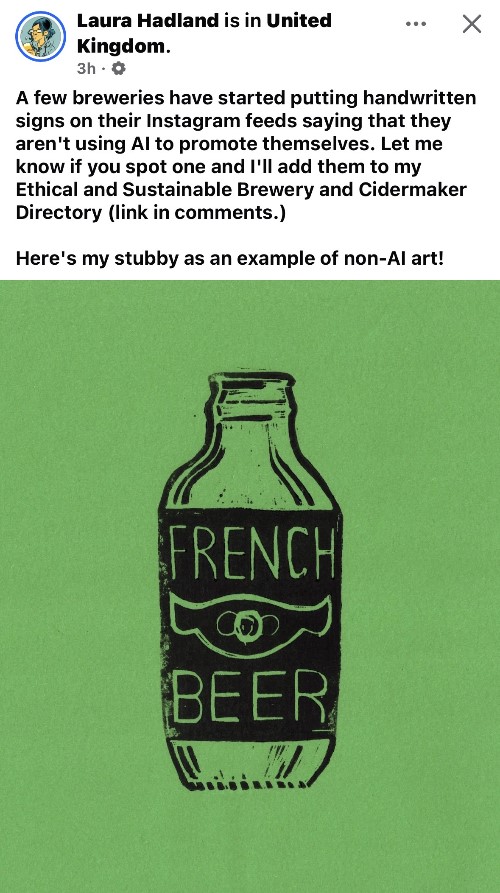
I commented* but… but… what I didn’t mention is related to what they wrote: “if you can’t be bothered to write…” I know someone who has found a niche that may make him a bit of side cash that relies almost entirely on innoquous A.I. use. It’s a form of design creativity that results in absolutely throw away content. So who cares? It’s just about the extra cash for him. But look at what Laura wrote over on FB. Because it’s good to care. So if you really do care, if you want to put your name on something? Well, you are drinking out of the dog’s water dish if what you put out relies on crap A.I. tech. “Relies” carries a lot of work in that sentence for sure… but if that’s what you’ve done your name bears the shame.

That’s it for now. I gotta get back out to the garden. While I do, please look to Boak and Bailey’s postings on each and every Saturday along with the coincidenal and fabulously entertaining footnotes week after week at Patreon. They do put in the effort. And do look out for more of Stan’s “One Link, One Paragraph” format. Then it’s your turn. Read and recommend, please. Scour the world for news tips – then let me know. Then hunt out something in someone’s archives! Leave oblique comments on someone’s post from 2009!! Listen to a few of Lew’s podcasts and get your emailed issue of Episodes of my Pub Life by David Jesudason on certain Fridays. And Phil Mellows is at the BritishBeerBreaks. Once a month, Will Hawkes issues his London Beer City newsletter. Do sign up for Katie’s wonderful self-governing totes autonomous website featuring The Gulp, too.  Ben’s Beer and Badword remains on pause but there is reading at The Glass which is going back to being a blog. Any more? We have Ontario’s own A Quick Beer and All About Beer is still offering a range of podcasts – and there’s also Mike Seay’s The Perfect Pour. Plus follow the venerable Full Pint podcast! And there’s the Craft Beer Channel on Youtube as well as the archives of the Beer Ladies Podcast. What else?

*Fine, this was my comment: “I am afraid that A.I. is a bit like men’s cologne. You think you will just use a little, no one will really notice but it makes someone feel better about oneself. To the contrary, it’s like wearing some bit of orange clothing. It does stand out, it never really works and it usually ruins whatever effect you were going for. It’s also lazy because it’s unnecessary. If you are going to pretend you are a writer then do the frigging writing. Put in the time. Like any effort, you improve by error and succeed through the individual quirk of personal expression. A.I. editing is like claiming you cooked the meal when you got take away.” 

The Very Last… Summative Even… Fresh Yet Thoughtful Beery News Notes For Winter 2025-26

Spring!  Tomorrow is spring!! On a Friday even. How swell. The sort of moment that always reminds me of some lyric or another from Old Blue Eyes himself:

Spring is here
Why doesn’t my heart go dancing?
Spring is here
Why isn’t the waltz entrancing?
No desire, no ambition leads me
Maybe it’s because nobody needs me?

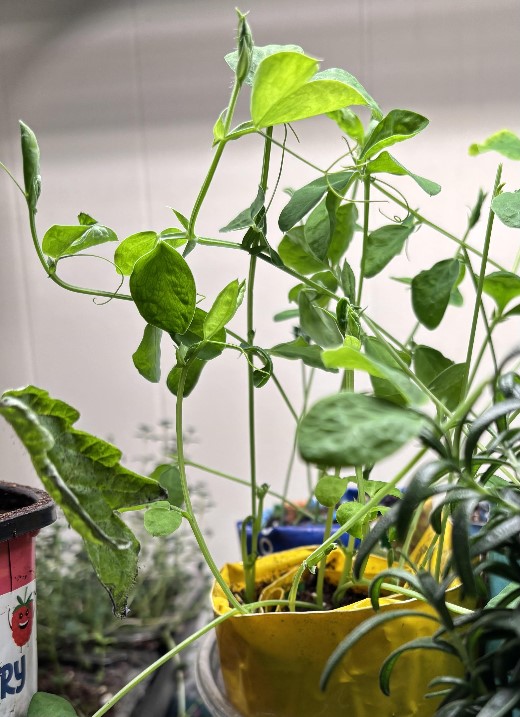
Wow. Not what I was expecting… gee, Frank. Lighten up a bit, wouldja? Me, I am all zippiddy doo dah myself. Look at those sweet peas under the grow lamp! The waltz entrances. Hmm. Why Frank? Why? Could it be it’s the fading night life scene that the man once knew and loved that has him lost and wandering, as the news The New York Times shared this week tells us:

…it’s a complicated prospect for restaurants, which traditionally make their highest profit margins on alcohol sales. Preparing food requires perishable ingredients and a large amount of labor, while alcohol is shelf stable and, except at the most dizzying heights of mixology, requires less work than cooking. As independent restaurants struggle with higher costs of all kinds — rent, labor, ingredients — the hollowing out of the most profitable part of the menu couldn’t come at a worse time. According to David Henkes, a senior principal at the food service research firm Technomic, alcohol sales are slumping in every category of the restaurant industry, from fine dining to casual establishments, with 31 percent of operators reporting “severe declines” in alcohol sales in 2025.

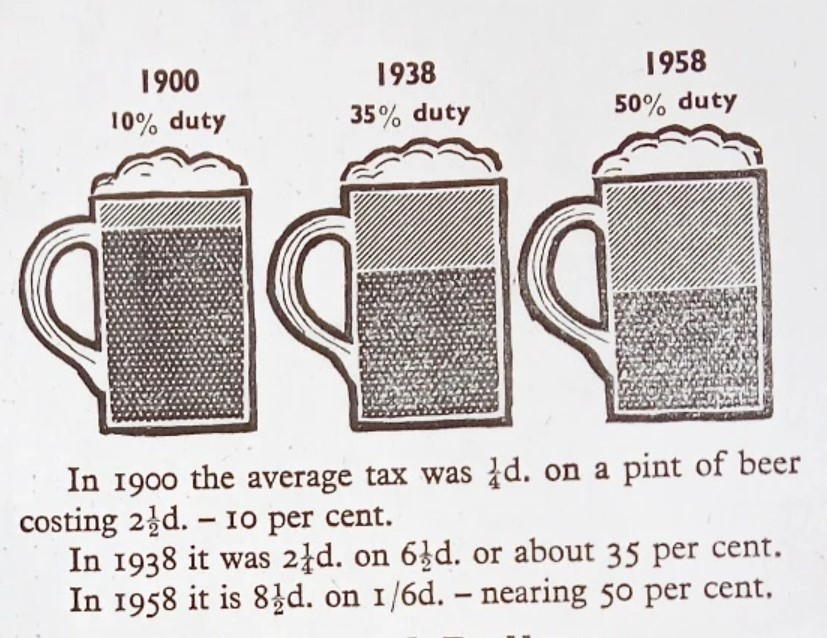
Yikes! We always here about the younger folk laying off the hootch – but even the set that clinks and drinks is clinking a lot less. But when was it ever the way it used to be? 1910 apparently. Nigel Sadler posted some images from The Times ‘Beer in Britain’s Supplement from April 1958, including the fascinating tale of the creation of the Hops Marketing Board as well as this infographic on the increase in duties on beer from 10% in 1910 to 50% in 1958.  Winning two World Wars as your empire collapses will do that for you.

Note#1: Michael Caine before he was famous.

Boak and Bailey unpacked their approach to writing a bit this week as they closed down one of their outlets, a newsletter by Substack where they unpacked their personal impressions perhaps a bit more. They shared that approach on one post this week, describing a scene Ray encountered when he would out and about with pals:

You know how you sometimes know something is going on, even before you see anything yourself, because people around become restless and twitchy? Even before the sword dancers entered the pub people noticed them in a group, standing outside peering in. Then their leaders, white haired with red neckerchiefs, entered and negotiated permission with the bemused young bar staff. Dancers and musicians shuffled in and found space for their display among the drinkers and diners. Then, off they went, stamping and twirling with berzerker energy, accompanied by fiddle and recorder… There were whoops and applause after the final somersault and, after they’d jogged out of the pub in single file, it felt as if the crowd had been injected with fresh energy. Between amusement, disbelief and admiration, it woke everyone up.

Whoops!* I have no idea what and who these sword dancers are. Clearly not, you know, the Highland lassies. Is this some sort of militant branch of the Morris dancer set? Speaking of militant hobbies, Phil Cook has been tracking the use of beer related answers to crossword clues in The New York Times and has released his report on the 2025 season:

The over-reliance on ale and ipa (and their plurals) has increased. They were about a quarter of last year’s references; now it’s 40%. That kind of frequency means there’s an impossible choice between repeating the same clue over and over, or reaching for one that’s only less common because it’s not very good. ale appeared on successive days several times — often with grim setups like ‘Pub drink’ or ‘Pub order’ — and one bleak fortnight3 had five of them, interspersed with two ipas, none with great clues.

I’m a Monday and Mini sort of crossword guy so I don’t see as much of this but Phil’s obsessive dedication to detail is impressive which backs observations like “there weren’t any debuts of new terms that seemed to signal any kind of shift in the zeitgeist.” Perhaps this year we will see a four letter answer for the clue “going out of style” which offers direction in at least two ways.

Speaking of style, Gary Gillman had his research on the founding of the green beer phenomenon in the USA published in Craft Beer & Brewing, reaching back ever so slightly into the 1800s:

In 1899, Milwaukee’s Pabst Brewery already was well known for its Blue Ribbon Beer, its bottles at that time festooned with a real blue ribbon. That year, as a marketing gambit, Pabst replaced the blue ribbon with a green one on a portion of its beer packaged ahead of the holiday. It also put a shamrock on the label in lieu of the usual hop leaf, with marketing that proclaimed, “Hibernians to celebrate St. Patrick’s Day.” (That’s according to Printer’s Ink, an advertising trade journal from that time.) However, the beer itself was the usual pale lager—it wasn’t colored for the special day. 

Which brings us to three more notes on St Paddy’s Day:

Note #2: “…all good-humoured, not messy yet…”
Note #3: “…a local bar owner to invite me to meet him for “a chat…”
Note #4: “...I’ve seen things you people wouldn’t believe…”
Note #5: “…Liverpool is carnage…“

Those last two notes are more along the lines of what was experienced the weekend before the day over in Waterloo, Ontario – a university city:

People living at Oakwood Manor, an apartment building near Marshall Street, said large crowds surrounded the building. Residents described partygoers climbing over fences, knocking some down entirely and leaving garbage behind. “They’re destroying private property, but they don’t care,” said Debra Hines, who lives in the area. Residents also said they saw people urinating in the parking lot. “They were [also] coming and stepping on people’s cars,” said Janet Peterson, another resident. Bridget Kocher, who also lives in the building said the repeated street parties leave residents confined to their homes several times a year.

Kids today! On a far more civil note, we don’t write about homebrewers enough. Something the coming recession will cure I am sure. But the Windsor & Eton Homebrewers Club described how the group did some compare and contrast of a few clones and made some… well, to be honest, observations on the state of Pilsner Urquell in the retail marketplace:

 I wish no disrespect or sleight to the founding fathers of Pilsner, but we were scratching our heads a bit. We used Pilsner Urquell as our reference for all our clones.  We found PU to have great bready richness with a great soft rounded mouthfeel.  A slightly sulphur smell and flavour – as is characteristic and a touch of ester, but also we found it with a sticky almost stodgy sweetness, not crisp as we were expecting.  However, it transpires that Ian found some bottled Urquell somewhere up North, which was apparently much better, so maybe the canned Asda variety isn’t a good comparator?

Frankly, I had already bookmarked this piece by Kieran Haslett-Moore from well before the Beer Nut unleashed the stinging taunts urging folk take notice of the death of the themed pub, once a cross-cultural cornerstone:

At the start of this year the Wellington Belgian Beer Café, Leuven, announced it was closing its doors after 25 years. Back in 2000, Lion started to brew Stella Artois under license and all of a sudden Belgian beer culture was in vogue. Leuven in Wellington and De Post in Auckland both opened, offering the full tourist-style Belgian beer experience with mussels, frits, draught Stella, Hoegaarden, Leffe and assorted bottled beers from the lowlands… At the start of this year the Wellington Belgian Beer Café, Leuven, announced it was closing its doors after 25 years….  In 2004 Christchurch got Café Torenhof which limped on after the earthquakes before running out of steam in 2020… Café Torenhof lives on in the way your great aunt does because you inherited her Welsh dresser and it sits in the corner of the living room. When the Christchurch café closed, its interior kit was sold to Craftwork in Oamaru…

While things go out of style, other things arise as Ruvani shared recently when she discussed the “Spaghett”:

For those not already in the know, a Spaghett is a simple two or three ingredient (depending who you ask) beer cocktail involving a light lager, a bright bittersweet amaro and either a slice or splash of fresh lemon (optional). The OG Spaghett consists of a Miller High Life bottle minus an inch or two and topped off with Aperol and lemon… a ‘poor person’s Aperol Spritz’ where the champagne is replaced with the Champagne of Beers. Until recently Spaghett enjoyed under-the-radar industry-insider status but a combination of social media and the cost-of-living-crisis have brought it into the mainstream, as drinkers nationwide are discovering the delicious pop of tangy, herbaceous aperitivo against clean, gently sweet and super-carbonated light lager finished up with a refreshingly sharp citrus twist.

Jeff published a piece on the ABSs of malt this week or, more specifically, the question of whether a base malt’s flavor come from the barley variety or the malting process:

 …it’s better to think of malting and brewing as connected processes. If you recall our previous conversation, the maltster has many choices to make, all related to the “biochemical levers” Matt referenced. It’s very much like the choices a brewer makes on mash pH, mash temperature, the number of rests and so on. It’s not like there’s a “correct” mash temperature; brewers make choices based on what they want out of a beer. The same is true with malting, and it’s why one brewery might choose a malt where one set of choices was made, while another brewery would want a different set. 

Speaking of grain, there was a Kernza sighting this week, about a year and a half since the last time the branding for thinopyrum intermedium passed by my eye. The Guardian reported on its use as Deschutes:

The secret ingredient is a grain called Kernza. It’s a perennial wheatgrass with a slightly nutty flavor and a climate-friendly reputation. Deschutes teamed up with the outdoor clothing brand Patagonia to craft a new beer using the grain. When asked how customers react, brewer Ben Kehs laughs: “They say what’s Kernza?” Kernza has deep roots that pull carbon from the atmosphere and require less water. There is less tilling and fuel use because it doesn’t have to be replanted each year. Kernza can be used as an alternative to barley, which along with hops and water, is one of beer’s three core ingredients. “All of them in one degree or another I would say,” Kehs explains when asked which ingredients face climate threats.

Finally and speaking of the exotic, Ron has been back in Brazil judging at a competition where he seems to have been quite happy with the set up:

I have my usual breakfast. Call me Mr. Boring. I don’t care. It’s what I want to eat. And I’ll fucking eat it. That’s the great thing about being old. Not really having to give a fuck what anyone thinks…  I’m on the same judging table as yesterday, with Suzanne and Alan. I’m happy with that. We rattled through the flights yesterday. Coming to a consensus without much argument. Which saves much time. And annoyance. Especially annoyance. The last thing I need is extra stress… After lunch, there’s a real treat. Non-alcoholic beers. Six samples. All three sour styles are pretty good. With the Catharina Sour the pick of the bunch. The best non-alcoholic beer I’ve ever drunk. Which may be quite a low bar. Or was. It’s been raised considerably now. That was much better than expected. Some flights of alcoholic beers were far worse. Not sure what that tells us. There’s then a long wait for the pre-BOS. Like two fucking hours. Such fun sitting and sweating. Watching Match of the Day helps pass a little time. 

Good to see that while his language hasn’t mellowed, his relationship to booze has. And he’s learned a bit of Portuguese on these trips, too.**

Is that it? That’s it! Another week and another winter moves into the history books. While we see what the spring may offer, please check out Boak and Bailey who are posting every Saturday and adding to their fabulously entertaining footnotes week after week at Patreon. And look out for more of Stan’s new “One Link, One Paragraph” format. Then hunt out something in someone’s archives! Leave oblique comments on someone’s post from 2009!! Listen to a few of Lew’s podcasts and get your emailed issue of Episodes of my Pub Life by David Jesudason on certain Fridays. And Phil Mellows is at the BritishBeerBreaks. Once a month, as noted, Will Hawkes issues his London Beer City newsletter and do sign up for Katie’s wonderful self-governing totes autonomous website featuring The Gulp, too.  Ben’s Beer and Badword seems to be on pause since November but there is reading at The Glass which is going back to being a blog. Any more? We have Ontario’s own A Quick Beer and All About Beer is still offering a range of podcasts – and there’s also Mike Seay’s The Perfect Pour. Plus follow the venerable Full Pint podcast! And there’s the Craft Beer Channel on Youtube. Check out the archives of the Beer Ladies Podcast.

*Remember: you can’t have whoops without an oops!
**Ron’s honesty when on these things is what makes his reports so worthwhile if only as a deterrent: “I’m so fucking knacked. We’ve judged so many beers today. And lots of strong ones. I never want to drink beer again. I’m so done with it. I just want to drink some cachaça and sleep.” 

Your Fascinating But Still A Bit Sticky And Humid Mid-July Beery News Notes

Summer. Heat waves. Heat warnings. Smoke warnings. Drought. We got it all. Including sugar snap peas. I’ve adoped the Canadian old fart posture this week, when facing a comment on the blistering sun, as I just reply “at least I ain’t shoveling it!” Which is, of course, hilarious. Roar! Tape me ribs! No wonder all of comedy in Hollywood is run by Canucks! The heat in England heat has even driven Boak and Bailey off the beer, according to themselves in their monthly supplement:

…we had some beer at home, so it wouldn’t be too bad, right? Except however much we chilled it, it never quite seemed to refresh us. After a couple of lagers we gave up and switched to iced water. Apparently our bodies were telling us to hydrate and beer, unfortunately, has very much the opposite effect. When we have made it to the pub during heatwaves, we’ve often found cask ale to be a write off. Partly because not all pub cellars are capable of withstanding extreme heat, and partly because people switch to lager leaving ale to lose its sparkle.

Reporting from a land more used to the stinking heat, Pellicle‘s feature this week is a feature by Ruvani de Silva on the Green Bench Brewery in St. Petersburg, Florida. Which is, of course, another part of American utterly infested with we Canadians including, twenty years ago, by my late parents who would occassionally lunch at the welcoming Don CeSar with other welcomed snowbirds from all over. Wasn’t always like that:

Rewind seventy years or so, however, and our experience of St Pete’s would have been very different. The Sunshine City might have been a holidaymakers’ paradise, but only if you were the right kind of visitor. The city’s unwritten law that people of colour were not permitted to sit on its famous green benches evidenced how St Pete’s did not escape Florida’s vicious segregationist policies of the time. This unofficial ordinance was more than simply a physical imposition—it was a restriction that entrenched systemic racism for generations of Black Floridians. It’s for the memory of this injustice that Khris Johnson, founding brewer and co-owner of Green Bench Brewing and Florida’s first Black brewery owner, chose to name his business.

Speaking of establishments, one of the swellest images that passed before my eyeballs this week was this one to the right. At first I thought it was a fire insurance map but there isn’t enough detail.  It’s was posted at a local history group over on FB, Woodlesford and Oulton History, and seems to be a diagram that accompaned a 1933 planning application to update the New Masons in Oulton:

In October 1933 Fred applied to the Hunslet Rural District Council to make major alterations to the layout of the pub and add a new frontage and windows. The work involved knocking down part of the old front wall and fitting a rolled steel joist to support the upper floor. The new layout was then much the same as it remains today.

And here is the pub, still there. The photos help explain the map including the location of the fireplaces, the scale of the room. But the one thing I don’t understand is why the bar is in the passageway. Did you go there from one of the three rooms, get your pint and go back in to find your chair or was the passageway itself a drinking area? These are the things that haunt me.

In more somber news, we have received the sad news the passing of Jack McAuliffe. In remembrance, John Holl has republished a tribute from All About Beer from 2017 to the founder of the New Albion Brewery Company in California which opened in 1977.  And Maureen‘s comment on BlueSky is a wonderful tribute that tells a lot about the man:

Ah. This saddens me. Not unexpected, but I’m sad i won’t see him again. He was hilarious, among other things. I was humbled by the fact that I was one of the very few people Jack likes and respected. That meant a lot to me. Godspeed, Jack. 

Just two weeks ago, Gary shared an anecdote from the earliest days of Jack’s brewery which is worth revisiting to get a sense of how this brewer helped start the change that led on to micro and craft brewing working with very basic resources.

Stan has shared the latest edition of his Hop Queries and explained the dire situation facing hop growers in the Tasman region of New Zealand, including Brent McGlashen of Mac Hops:

“Statistically and visually, we hit above the 1 in 100-year flood level, with also highest ever recorded river flows in a number of parts in the Motueka river… Both our farms have water everywhere, fences with damage and some debris scattered around, but we are fortunate compared to others who have had significant damage and loss due to the flooding. Was this predicted, well yes it was. Forecasters said over 200mm and we sure got that. We have had a wet winter and the ground can’t absorb more so it has to go somewhere.” One hop farmer died as a result of the storm. Peter Lines was clearing flood damage from his property in Wai-iti, southwest of Nelson, when he was hit by a tree.

Rain came again the next week “leaving fields under water and dumping mud, gravel and sand on facilities that had just been cleaned up…” 

Writing about disasters of the unnatural sort, The Beer Nut brought his lucidity to a review of an unknown Dutch brewery, to which he added a key question on BlueSky: “how long can a brewery keep up a sequence of nautical-themed beers flavoured with fruit syrup?” The answer is apparently “too long“:

My report card for Stadshaven says “must try harder”. A sampler pack of fruit syrup does not make for a vibrant range of modern beers, for one thing. I sense an ability to do plain-spoken beers quite well, testified by the red and blonde in particular. Whether the decision not to steer that course is a creative one or a management one, I cannot say. The low price point is very much in these beers’ favour, though I’m still not sure I got my money’s worth from them. 

Speaking of the low, Matty C wrote for What’s Brewing on the most obnoxious retort around: “stick to…” with the line filled in by the obnoxious. In this case, it was about the position being taken him and by many other drinkers in the UK on the Palestinian-Israel war – and in doing so makes this very lucid argument:

In modern political discourse it’s perhaps the first approach to go out the window when things get a little spicy. But it is because of compassion, not malice or spite, that the volunteers of Trafford and Hulme CAMRA opted to have the donation box in the first place, and it is compassion that motivated attendees to make a donation as they leave. It is compassion that triggered the response from customers when they found out beer from breweries they admired were selling beer into a market they didn’t. And it is because of compassion that you’ll struggle to find Moor Beer on tap in Bristol at this very moment. It would be far easier, surely, to stick to beer, and leave the politics to the politicians. But in fact, sometimes the most compassionate thing you can do is stick your head above the parapet and say, “I don’t think this is okay.”

Politics is for the people. All the people. No matter what the cause or the position, being active and acting on compassion is a good thing.

You know what also gets people losing their composure, their perspective? Beer glassware. Do you have a go to glass for beer? I do… well, one for inside and one for the yard. Kevin at Casket Beer advocated in favour of simplicity and recommended a basic four:

…while the shaker isn’t as bad as many make it out to be, it really shouldn’t be a major player either at a beer bar or your home bar. But having a respectable selection of glassware doesn’t need to break the bank or become unmanageable. There are four widely available glass styles that are affordable, cover a wide array of styles, and will satisfy the most discerning beer drinker. Here they are.

You can go see which four they were. Jeff then picked up the theme and advocated for one fewer: “Give me a mug, a goblet, and either a snifter or tulip—both is overly fussy…  I like a handle, and I find a beer looks great when it’s in a wide vessel—the clarity and color is easier to see. Facets bedazzle and please me (recall, I am one of the few fans of glitter beer).” Wow. I was with him there until those two last words. Just… wow.

And staying with the wow,* Alistair has been staying (practically) true to his promise to bust his writer’s block by writing every day (almost) over at Fuggled. Wednesday’s story this week was about the Austrio-Hungarian schnitt of 1900:

The writer continues to berate their fellow German Austrians that a single “schnitt” fewer every day wouldn’t be so bad and that the savings would build up to a sizeable fund for civic associations tied to the ethnically German population of the Empire. And here we have again an example of the cross pollination of cultures that was Bohemia and Moravia in the 19th century, evidenced today through the use of a transliteration of “schnitt” into Czech, “šnyt” as the name for effectively a half pour of beer and lots of foam. “Schnitt”, if you know your German means “cut”, because it is a cut down pour of beer, that is “better than nothing”, at least according to Bohumil Hrabal, or was it Karel Čapek, when he wasn’t inventing the word “robot”?

And the colonial history of the beer gardens of Bulawayo, Zimbabwe was the subject of research for Prof Maurice Hutton of the Global Development Institute, University of Manchester who shared some findings for The Conversation:

The more picturesque beer gardens began to emerge in the 1950s, reflecting the developmental idealism of Hugh Ashton. The Lesotho-born anthropologist was educated at the Universities of Oxford, London and Cape Town, and took up the new directorship of African administration in Bulawayo in 1949. He was tuned into new anthropological ideas about social change, as well as developmental ideas spreading through postwar colonial administrations – about “stabilising” and “detribalising” African workers to create a more passive and productive urban working class. He saw a reformed municipal beer system as a key tool for achieving these goals. Ashton wanted to make the beer system more legitimate and the venues more community-building. He proposed constructing beer garden complexes with trees, rocks, games facilities, food stalls and events like “traditional dancing”. So the atmosphere would be convivial and respectable, but also controllable, enticing all classes and boosting profits to fund better social services. As we shall see, this strategy was full of contradictions…

Finally, like you, I am a regular reader of the Greenock Telegraph the newspaper of record of my paternal peeps. This week they publised an editorial from by the local member of the Scottish Parliament Stuart McMillan on alcohol in the workplace:

Too often there is a conception that people living with drink dependency can’t hold down a job – but when one in four people in the UK worry about their drinking, it’s clear this is a myth. I’m not suggesting 25 per cent of the adult population in the UK have an alcohol addiction. However, these figures indicate that increasing numbers of people are concerned about the impact alcohol has in their lives… For most of us, though, we don’t need specialist support. But we do need to be more open about how alcohol impacts us, and try to foster healthier habits. The popularity of alcohol-free products shows that many people are looking for alternatives – whether that’s alcohol-free beer, wine, spirits or mocktails. Locally, one idea that has been suggested to me is a ‘sober bar’ – which would give people a place to go that feels like a pub, but without the presence of alcohol.

I decided to include this piece not because I agree or disagree. Not even because health and booze is always a worthwhile conversation. But… I can’t imaging a Canadian politician writing this. Because I can think of many other alternatives to alcohol which include, say, playing a banjo or reading a book or going for a walk or staring at a bird in a tree or making a pot of tea – none of which need to simulate the drink or the pub. Which is one of my things about pricy NA not-booze. Just go for a soda. We even have a song about it.

So there you are. Staring at the little screen in your hand as the A/C hums. Until the weather breaks, please check out Boak and Bailey every Saturday. Look out for Stan when he feels the urge now that he’s retired from Monday slot… maybe. Then listen to a few of the now rarely refreshed Lew’s podcasts and get your emailed issue of Episodes of my Pub Life by David Jesudason on the (sometimes even but never) odd Fridays. And maybe The British Food History Podcast. Maybe? And Phil Mellows is at the BritishBeerBreaks. Once a month, Will Hawkes issues his London Beer City newsletter and do sign up for Katie’s wonderful newsletter, The Gulp, too.  Ben’s Beer and Badword is out there with the all the sweary Mary! And check out the Atlantic Canada Beer Blog‘s weekly roundup. There is new reading at The Glass which is going back to being a blog. Any more? We have Ontario’s own A Quick Beer featuring visits to places like… Michigan! All About Beer has given space to some trade possy podcasts and there’s also The Perfect Pour. Plus follow the venerable Full Pint podcast with an episode just last month!. And there’s the Craft Beer Channel on Youtube. Check out the archives of the Beer Ladies Podcast. That’s quite good and after a break they are back every month! The rest of these are largely dead. And the long standing Beervana podcast …except they have now stood down.  As has We Are Beer People. The Share looked to be back with a revival but now its gone quiet. And the Boys Are From Märzen podcast appears suspended as does BeerEdge, too. VinePair packed in Taplines as well. All dead and gone.  There is more from the DaftAboutCraft podcast, too. Nope – that ended a year ago.   The Moon Under Water is gone – which is not surprising as the ask was $10 a month. Pete Brown’s one cost a fifth of that – but only had the one post. Such is life. Such is beer podcasting and newlettering… which, as Ray says, are blogs!

*Forced, I know. I’ll try to do better. My footnote game isn’t the best either. It’s the heat. Well known fact. Asides suffer in the summer. Researchers are on it.

The Woooooooooo Scariest Hellbound Beery News Notes Ever Unleashed From The Bowels Of Hell!!!

Ha-ha!  I wrote bowels.  If you’re not born of Scots, that might not be daily dinner table language so I apologize as I refer you in the alternative to the basso loco of Dante’s Inferno for a clearer sense of the reason for the season. But if you are Canadian of a certain age, however, there is only one true representation of the hellscape of pure evil – SCTV’s Monster Chiller Horror Theatre from around forty years ago. Wooooohooo. Scary.  Lots of beer content on SCTV: Biller Hi-Lite, Moose Beer and twist off beer caps on American beer bottles. Not at all horrible is my new plan for Halloween… which I can’t believe I have not come up with before… a plan to buying candy I like, keep it to myself  and eating it as I hand out the crap candy I don’t like so much to the kids. Except I don’t like candy all that much. More extreme measures will not be necessary… unlike apparently in Japan:

In other news, Tokyo’s Shibuya district has banned public drinking, hiring 300 private security guards and urging local stores to stop selling alcohol to ward off revelers this Halloween.

What? That’s some sort of crazy. Are nutty Halloween pub crawls a thing where you live? They seem to be a thing in Buffalo, NY, Milwaukee, Wisconsin and Lexington, Kentucky. I like it. Pack the streets. We did a similar thing in the Halifax of my 1980s youth at Halloween – but we called it Mardi Gras for some reason. Tens of thousands of us. Once I went as junk mail (my best costume ever if I am going to be honest with you) with a buddy who went as a breakfast nook – that could actually toast toast. Out there. On the street. Street toast. Class.

Anyway, have you ever seen a lede buried as deep as this one was in GBH? In a neat and tidy piece on a rebranding at the Chicago Brewseum this little bomb is dropped in the middle of paragraph ten:

Theresa McCulla, curator of the American Brewing History Initiative at the Smithsonian’s National Museum of American History, will leave that post in early November, and the role will no longer exist after her exit.

The Smithsonian program, largely funded and framed in terms of narrative  by the Brewers Association’s involvement, started up in 2016. While I was disappointed in the periodic press releases highlighting things like Papazian’s paddle from the great white male hero era of craft, I trust that records and objects from throughout the over 435 years of brewing in the what are now the United States have been protected.  Wonder why the Brewers Association gave up on their affiliation? A special thanks to all those beer journalists getting on that story even as I type these very words.

Speaking of endings, Stan discussed the piece in VinePair on the declining influence of US craft beer in Europe, asking if “the story totally supports an assertion that beers from America aren’t influencing change” which I get but, still, I like the arguments set out in this well thought out piece by Will Hawkes:

California-founded Stone’s failure in Europe is symbolic of a wider issue. Craft beer has made a huge splash across the Atlantic, but American breweries, for the most part, have not prospered as they might have expected — and things don’t appear to be getting better. Extrapolating from Brewers Association (BA) figures published by the organization and in Forbes, the overall craft beer volume exported to Europe declined from 78,994 barrels in 2021 to 63,755 in 2022. The reasons for this are complex, but they get to the heart of Europe’s beer market and the limitations of American craft breweries in a place where their economic power has rarely matched their cultural cachet.

TL;DR? Reasons not so much complex as just numerous… BrewDog being everywhere, other Euro brewers holding branding rights,  uncompetative pricing and the botch by Stone diluting the value. Brutal line: “[at] this year’s Berlin Beer Week, Stone beers featured in a tap takeover at a pizzeria.” Perhaps relatedly, things are also not going well for brewers in New Zealand:

“I was talking to a brewer recently and he said: ‘It’s all just beer now.’ The problem with craft is it’s always been ill-defined. Does it mean small scale? Does it mean independent? Does it mean flavoursome?” Without that clear definition, the territory was ripe for major beer companies to step into – and all the big breweries have done exactly that. “You now have Lion with their Mac’s brand, DB with Monteith’s and Asahi with Boundary Road. Those are the three main ones in that area, and what they’re doing is just pumping up the flavour in those brands. They’re making great beer at a more affordable price.”

I know that this is all a bit of a downer – even though this is the “scary” season – but at least things are not as bad as they are in Rioja according to the newsletterist Jason Wilson of Everyday Drinking who includes this summary of recent findings:

I was shocked to read Tim Atkin’s piece about serious problems in Rioja — “Rioja on the Rocks” — a couple of weeks ago. I knew that Rioja had issues, but Atkin (the foremost English-language expert on Rioja) paints a dire picture of a region in crisis. As Atkin reports, the regional governments of La Rioja and the Basque Country plan to detroy 30 million liters of surplus wine to try to balance supply and demand. Another 150 million liters, unwanted by the market, is sitting in cellars. The 2023 harvest has been terrible, and grape prices are at unsustainable lows—in fact, many growers cannot sell their grapes. Reportedly, one major co-operative is on the verge of bankruptcy, two large bodegas are in administration, and Campo Viejo, Rioja’s largest winery, is allegedly up for sale. There are threats by large groups of growers and producers to leave the consortium altogether as they argue over whether to focus on quantity or quality.

Yikes! Just last year things were looking up.

Better news? How about the best big brewery marketing of the moment? Heineken making fun of its own name and using Plastic Bertrand for the soundtrack. That good. And The Brewnut has proven once again how he is the best commentator on what’s actually in the glass, illsustrated by this review of the offerings by Wicklow Wolf:

This year’s twist on the all-local ingredients spec is the inclusion of Kilmacanogue raspberries in a sour ale. Shame they didn’t have a go at spontaneously fermenting it, for extreme local character. Regardless, it’s very nice. The raspberries taste fresher and realer than they do in most raspberry beers, almost bursting on the tongue the way the fruit does. There’s no sugary, syrupy jam here, just a cleanly medium-pitched tartness, again similar to what you’d get from actual raspberries, building to a slightly puckering finish. While it’s only 4.2% ABV, I can’t see this working well as a refreshing summer beer — it’s too intense, with lots going on it. While I definitely liked it, I’m glad I waited until a dull day in October to drink it.

See that: not fawning, explains how it stands out, explains what might be done to improve. I’d buy that beer. Speaking of buying beer, David Nilsen wrote an homage to “Brouwerij Van Steenberge’s Tripel Van De Garre” in Pellicle this week and how it illustrates a few trends:

“In today’s market, imports are struggling against the locavore movement,” says Michael, noting the plethora of local options. “We have 97 breweries in the city limits [of Chicago].” Sara Levin, the package beer buyer for The Barrel House, a beloved beer bar and bottle shop in Dayton, Ohio, has been a professional beer buyer for close to a decade and says the current attitude toward Belgian beer among many American craft devotees had already begun to take shape when she started in the industry in 2014. “Before me it was a little different, but in my time I feel like Belgian beer has always been the old money craft beer,” Sara says. “It’s been the OG beer geeks who really respect the old school styles.”

That right there is one of the sadder things about the craft beer movement’s rush to chase the tale of novelty, the loss of interest in hounouring Belgian styles. Got an opinion on that? You can explain how you feel about such things if you take part in this week’s study on the habits of craft beer and real ale drinkers? Do you have habits?  They want to study you. In a similar note, Gary came across a study of real ale drinking in England from 1866… with some very and sadly familiar themes:

Less than one-half of it is drunk in perfection, or at its best condition, the larger percentage becoming more or less flat, hard [tart], and unpalatable, or even sour before it is consumed. From the day of the tapping of the cask, with the gradual entrance of atmospheric air, the liqour undergoes progressive deterioration, first becoming flat and unpalatable, from the loss of its carbonic acid, and then sour from having its spirit converted in acetic acid by the absorption of oxygen. In fact, day by day, as the palate unplesantly detects, it may be said to advance one step further on the road to vinegar.

Yik. Too much OG old school right there. And sorta samesies [h/t] at the blog run by Triskele Heritage, an archaeological consultancy, there was a sweet disassembling of the claim made by an Irish pub as to its status as the world’s oldest tavern:

The problem here is that the fabric of the building is claimed to date to the ninth century, and this is repeated from one website to another, but no archival or archaeological evidence is ever offered as the root source of the information. Instead, the listed entry for Sean’s Bar on the National Inventory of Architectural Heritage… notes that the current standing building was constructed c 1725 as a coaching inn which was known as The Three Blackamoors Heads by 1738. The record goes onto confirm that renovations were indeed carried out c 1970 but, instead of finding ““wattle and wicker” dating back to the ninth century”, the walls in question were dated to the seventeenth century. That is a potential exaggeration of at least seven centuries.

Speaking of even more not quite right, perhaps that green bottle of Tsingtao isn’t just skunky:

In the clip which appeared online on Thursday, a worker, dressed in uniform with a helmet on, can be seen climbing over a high wall and into the container before urinating inside it. The location tag of the clip reads “Tsingtao beer No.3 factory”, local news outlet The Paper reported on Friday. Business outlet “National Business Daily” later cited an internal source as saying both the person who took the video and the person appearing in it were not direct employees of the company… Shares in Tsingtao Brewery fell sharply when the Shanghai Stock Exchange opened on Monday morning but were trading broadly flat by the afternoon.

Boo-tastic. Now we have pee in the stuff. In other scary health news, the Time of Londinium shared a story on the problems with a certain sort of stress drinking and had this very interesting fact:

A recent study… found that women with high levels of cardiorespiratory fitness are between 1.5 to 2 times as likely to drink moderately or heavily as those who are sedentary. Charlotte considered herself to be healthy. “I’d go running on Saturday at 8am with my friends after drinking two bottles of wine on Friday. Parker tried all the right things to manage stress. “I went to a meditation teacher, I was looking at my diet, I ran a lot” — everything except quit drinking.”

That is interesting. Fact filled and interesting. And scary.

Enough!!! I leave you there for this week. As per always and forever, you can check out the many ways to find good reading about beer and similar stuff via any number of social media and other forms of comms connections. I have yet another update on the rankings. TweX is now really starting to drop in the standings. I am deleting follows there more and more in favour of mirroring accounts set up by favourite voices elsewhere. Now, for me Facebook is clearly first (given especially as it is focused on my 300 closest friends and family) then we have BlueSky (74) rising up to sit in a tie with Mastodon (899) then the seemingly doomed trashy Twex (4,344) hovering somewhere above or around Instagram (167) with Threads (41) and Substack Notes (1) really dragging – and that deservedly dormant Patreon presence of mine just sitting there. Seven apps plus this my blog! That makes sense. I may be multi and legion and all that but I do have priorities and seem to be keeping them in a proper row. All in all, I still am rooting for the voices on the elephant-like Mastodon, like these ones just below discussing beer, even though it is #Gardening Mastodon that really wins:

Alan McLeod | A Good Beer Blog (… me…)
Stan Hieronymus | The Man!
Boak & Bailey | The B² experience
Curmudgeon Ale Works | Jonathon is Brewing
Katie Mather | Shiny Biscuit and Corto
David Jesudason | “Desi Pubs” (2023) author
BeoirFest | They say “Let’s Talk Beer”
Ron Pattinson | The RonAlongAThon Himself
Al Reece AKA Velky Al | Fuggled
Jennifer Jordan | US hops historian
Andreas Krennmair | Vienna beer and lager historian
Beer Ladies Podcast | Lisa Grimm and colleagues
The Bar Towel | Toronto’s chat zone for beer lovers
Chicago Beer Society | Folk in Chicago getting social over beer
Jay Brooks | Brookston Beer Bulletin
Joe Stange | Belgian beer expert, beer magazine editor
Cider Bar | Barry makes Kertelreiter cider
Laura Hadland | CAMRA historian and beer writer
Brian Alberts | US beer historian
Jon Abernathy | The Beer Site
Maureen Ogle | US Beer Historian
Lars Garshol | Norwegian Beer Historian and Kveik Hunter
James Beeson | Beeson on Beer
Carla Jean | MAINER!!!
Thandi Guilherme | Beer Ladies Podcast Co-host
Lisa Grimm | Beer Ladies Podcast Co-host
Roy of Quare Swally | Beery ramblings from Northern Ireland
Rob Talksbeer | Podcaster and Youtuber
Anthony Gladman | UK Drinks Writer
Jeff Alworth | Manna Of Beervana
Northwest Beer Guide | Fairly self explanatory… but not NW Latvia…
Evan Rail | Prague based GBH editor, freelance writer, NYT etc.
Todd Alström | 50% of the Alströms
Jacob Berg | Beer talking librarian

Anyone else? And, yes, we also check the blogs, podcasts (barely!) and even newsletters to stay on top of things including the proud and public and certainly more weekly recommendations from Boak and Bailey every Saturday and Stan at his spot on those Mondays! Here’s a new newsletter recommendation: BeerCrunchers. And  get your emailed issue of Episodes of my Pub Life by David Jesudason on many Fridays. And Phil Mellows is at the BritishBeerBreaks. Once a month, Will Hawkes issues his London Beer City newsletter and do sign up for Katie’s now much more occassional but always wonderful newsletter, The Gulp, too. Ben’s Beer and Badword is back with all the sweary Mary he can think of! And check out the Atlantic Canada Beer Blog‘s weekly roundup. There is new reading at The Glass. Any more? Yes! Check to see the highly recommended Beer Ladies Podcast. That’s quite good. And the long standing Beervana podcast . There is the Boys Are From Märzen podcast too and Ontario’s own A Quick Beer. There is more from DaftAboutCraft‘s podcast, too.  All About Beer has introduced a podcast… but also seems to be losing steam. And there’s also The Perfect Pour. Plus follow the venerable Full Pint podcast. And the Craft Beer Channel on Youtube and remember BeerEdge, too, and The Moon Under Water… if you have $10 a month for this sort of thing… I don’t. Pete Brown’s costs a fifth of that. There was also the Beer O’clock Show but that was gone after a ten year run but returned renewed and here is the link!

The Absolutely Final No Returns Accepted News Notes Of April 2023

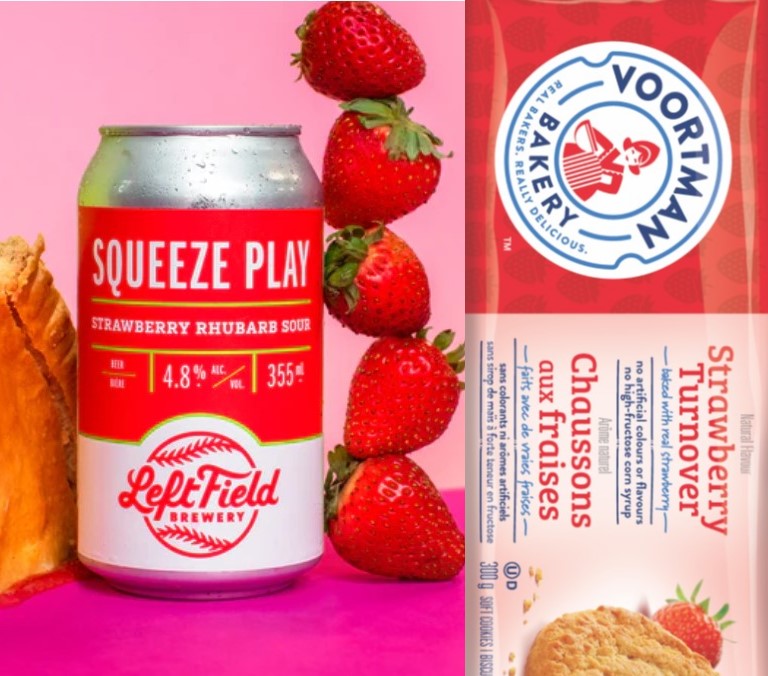
OK, so what’s going on. I am still a bit stunned from the residual effects of da ‘Vid but I also got my taxes done last weekend as opposed to my usual next weekend deadline date with the docts. I have no idea why I didn’t wait for the last minute like usual. To celebrate or maybe just to get me through the filing process, last weekend I finally found a way to get a kick out of a fruity kettle sour. Eat cookies with them. Specifically, the coconut laced Voortman Strawberry Turnover known throughout Ontario when chased by a Left Field Strawberry Rhubarb Sour. YOWSA!!! Any bar that doesn’t stock up the $3.25 grocery store find and then resell to aspiring drunks for $6 is NUTSO!!! Candy. Baby. Boom.

9:20 AM Update: David Jesudason has published another teaser for his much anticipated book on Desi Pubs called Desi Pubs (to be published BTW in a few weeks on May 17th) this time in the newsletter Brown History:

“I must admit I’m a bit nervous. There will be a few difficult customers, no doubt, but I think I shall be able to manage.” Few remember the modest man who spoke these words about the Leicester business he was about to take over in 1962, but unknowingly he was to become a British-Indian trailblazer who paved the way for many others. His name was Soham Singh and he was being interviewed by local newspapers because he was deemed Britain’s first “coloured innkeeper” after he started running the Durham Ox pub with his wife Janet (described as an attractive 28-year-old English woman, “whom he married in a Sikh Temple five years earlier”). 

I have to admit I find these writings of his torturous to the point of being tortious – but never, of course, tortuous – as I have no access to a good Desi Pub but expect I would love having access to a good Desi Pub.

First up, Pellicle published an interesting article on a not very hot topic – the effect of a closure of local brewery:

I grew up in weather-beaten pubs like these, as did my father and his father before him. If you were local, you would say we were hefted to the land, such is our family’s connection to this obscure north-western part of this obscure north-western English county. Until recently, when it was closed by parent company Carlsberg Marston’s, there was a brewery hefted to this land too. A brewery called Jennings.

Semi-spoiler: “…the disastrous rebrand…”

And, Stan is back from the Antipodes and reported on the New Zealand hop scene in his latest edition of Hop Queries – including on one matter I might not have noticed myself:

Equally surprising was to see that most often the hops are strung to 4.8 meters (less than 16 feet) on 5.4 meter trellises, so not as high as in other hop growing regions. Farmers in the American Northwest grow hops on 18-foot-high trellises, while in Europe seven meters is standard outside of the Tettnang region of Germany. In Tettnang, older varieties are strung to eight meters and newer ones to seven. I heard several suggestions about why New Zealand farms have lower trellises, and will report back once I sort out if there is a definitive answer.

The Beer Nut undertook a bit of market research by studying the JD Wetherspoon Spring Fest 2023 so you don’t have to and seems to have appreciated the experience as…

then, instantly, all the festival beers disappeared from the Dublin branches a day before the event was due to end. Maybe they bought exactly the right amount of beer, though I would be surprised. Overall there was enough decent stuff in the above to keep me happy, and no outright disasters. I still miss the token 7-8%er that used to lurk at the bottom of every programme. Bring that back.

And, like The Beer Nt, as we look forward to the Coronation next weekend, when 17 million extra pints will be downed, this story in the Scotsman about the role one pub played in the protection of the Stone of DESTINY!!!

According to pub legend, the real Stone of Destiny resides in the historic bar, The Arlington which has been operating since 1860, as this was where the students who stole it hid it. The story goes that the Stone of Destiny that was returned was a replica that had been fashioned by the students. The Arlington bar, which is located on Woodlands Road, displays the ‘real’ Stone of Destiny prominently in a glass case on the bar.

Speaking of Scotland, this tweet was maybe interesting. Apparently, at least on the books, BrewDog is losing money… well, lost it in 2021 when, you know, everyone was losing money. They ended up with almost £14m less in year end cash after taking in almost £20m in share sales… ie non-earned income. All on an net operating cash flow of £12.5m.  But they spent £21m on property and equipment which is usually good. But then lent £20m to subsidiaries… which is… perhaps speculative. Maybe.

Speaking of 2021, stats for alcohol use on the isle of Jersey were released and the societal effects are a bit staggering even if drinking is down 25% since 2000:

…in 2021, there were 725 hospital admissions specifically related to alcohol per 100,000 population, similar to the English rate of 626 per 100,000. Two thirds of alcohol-specific hospital admissions were men, the report showed. The report said alcohol played a role in almost one in six of all crimes recorded in Jersey in 2022, with 32% of assaults and serious assaults, 11% of domestic assaults and 23% of offences in the St Helier night-time economy.

I have a pal named Dave who is the CBC afternoon radio guy in Yukon. This week he had an interesting interview with sake importer Patrick Ellis which helpfully unpacks a lot of the basics of the drink.

Did you know that Brazilians over a certain age can now buy decade specific beer brands? I read about it on the internet, myself:

Beck’s 70+ offers a chance to start “a dialogue with the pro-aging culture movement, which understands that age does not limit people’s desires and aspirations,” he says. Well, that’s probably aiming a bit too high. Still, it’s a smart nod to an oft-marginalized audience, a welcome respite from the think/act/feel/dress/drink young ethos that’s getting so darn old already.

Jeff speculated on the implications of the “not at all news” that craft beer has become incredibly boring. We know that because appartently the Brewers Association says sales are flat… which really means they really are BZZZZZzzzzzmmmm….(….’fssst…)…zzzblubt……flpt… KABOOM!  Regardless, Jeff suggests a few things including:

With so much excess capacity in the industry, contract brewing is an attractive way to launch a brand cheaply. A slightly different model gaining traction is the alternating proprietorship—basically, a shared brewery. The two or more separate companies schedule time on one brewhouse and then have devoted tanks on the cold side. I’d never heard of this until Ruse launched their brand that way at Culmination. Some time later, Pono did the same with Zoiglhaus. Both Ruse and Pono had their eyes set on using these arrangements to bootstrap up to their own breweries and taprooms, and both have since done so.

I have known contract brewing where there is an expansion. Where there are hopes and dreams. And, in a way maybe, brewing co-operatives where the best stout known to humanity was made. Who knows? Could be.

What else is going on? Lisa‘s off being a weirdo again this time sharing her very own 2023-esque and rather dramatic Guinness story:

Glances were exchanged all around the bar – after all, many of the tourists were here specifically to try other local beers – but she wasn’t done yet. ‘Are you SERIOUSLY SUGGESTING I cannot get a Guinness – IRELAND’S NATIONAL DRINK – at this so-called Irish pub?’ There was a pause, as she looked around for support, and she continued, at a further-increased volume, ‘do any of you here find this AT ALL ACCEPTIBLE?’ To the credit of absolutely everyone in the pub, not a single person responded directly, though there was a light chuckle toward the back of the room. After another dramatic pause, she tried once more to garner some kind of support – once again, upping the decibels: ‘I cannot BELIEVE that a business like this can exist, in this day and age, calling itself an IRISH PUB without Guinness.’ And with that, she turned on her heel and flounced out of the pub.

You know, Lisa really needs to get me interviewed on that podcast. I nkow it’s a group decision but I really could answer questions like “seriously, Al, what the hell?” and “when does the song ‘Time the Avenger’ start meaning different things?”  and stuff like that.

What else… Miller cans crushed in Europe? Don’t care. Heineken not caring about poor widdle cwaft beer’s feelings? Who cares?  But, hey, what’s that? Could that be true? The white lab-coated nerds at the Brno University of Technology in the Czech Republic are at it again… with ROBOTS FILLED WITH YEAST:

Millimetre-sized robots made of iron oxide and packed with yeast speed up fermentation of beer by swimming around in the fermenting container and can be removed with a magnet, eliminating the need for filtering out yeast

That’s extra nutso. Here’s a 2020 paper published by the Europeans Chemistry Society explaining the process. Egg. Heads.

That’s enough from me. Back to social media scrolling and fretting over the risk of frost. BTW… fine. Mastodon not taking off like you expected? Do what you like. But here’s your Masto-newb cheat sheet. Because… because… things work best when folk get tucked in… Substack notes ain’t anyone’s saviour. I’m getting  t-shirt made that says that. You wait… I will…

Stan Hieronymus | The Man!
Boak & Bailey | The B² experience
Katie Mather | Shiny Biscuit and Corto
David Jesudason | “Desi Pubs” (2023) author
Ron Pattinson | The RonAlongAThon Himself
Al Reece AKA Velky Al | Fuggled
Jennifer Jordan | US hops historian
Alan McLeod | A Good Beer Blog (… me…)
Andreas Krennmair | Vienna beer and lager historian
Beer Ladies Podcast | Lisa Grimm and colleagues
Jay Brooks | Brookston Beer Bulletin
Joe Stange | Belgian beer expert, beer magazine editor
Cider Bar | Barry makes Kertelreiter cider
Laura Hadland | CAMRA historian and beer writer
Brian Alberts | US beer historian
Jon Abernathy | The Beer Site
Maureen Ogle | US Beer Historian
Lars Garshol | Norwegian Beer Historian and Kveik Hunter
James Beeson | Beeson on Beer
Carla Jean | MAINER!!!
Thandi Guilherme | Beer Ladies Podcast Co-host
Lisa Grimm | Beer Ladies Podcast Co-host
Rob Talksbeer | Podcaster and Youtuber
Anthony Gladman | UK Drinks Writer
Jeff Alworth | Manna Of Beervana
Northwest Beer Guide | Fairly self explanatory… but not NW Latvia…
Evan Rail | Prague based GBH editor, freelance writer, NYT etc.
Todd Alström | 50% of the Alströms
Jacob Berg | Beer talking librarian

Anyone else? And, yes, we also check the blogs, podcasts and newsletters to stay on top of things – including more weekly recommendations from Boak and Bailey every Saturday and now definitely from Stan at his spot on those  Mondays! Get your emailed issue of Episodes of my Pub Life by David Jesudason every Friday. Once a month, Will Hawkes issues his London Beer City newsletter and do sign up for Katie’s wonderful newsletter, The Gulp, too. Ben’s Beer and Badword is back! And check out the Atlantic Canada Beer Blog‘s weekly roundup. There is new reading at The Glass. Any more? Yes! Check to see the highly recommended Beer Ladies Podcast. And the long standing Beervana podcast . There is the Boys Are From Märzen podcast too and check out the travel vids at Ontario’s own A Quick Beer. There is more from DaftAboutCraft‘s podcast, too. Ben has revived his podcast, Beer and Badword. Still gearing  up, the recently revived All About Beer has introduced a podcast, too even if it’s a bit trade… and by “a bit” I think mean not really just a bit.  There’s also The Perfect Pour. Plus follow the venerable Full Pint podcast. And the Craft Beer Channel this week on Youtube.   And remember BeerEdge, too, and The Moon Under Water… if you have $10 a month for this sort of thing… I don’t. Pete Brown’s costs a fifth of that. There was also the Beer O’clock Show but that was gone after a ten year run but returned renewed and here is the link!*

*And finally the list of the departed newsletters and podcasts or those in purgatory. Looks like  both Brewsround and Cabin Fever died in 2020, . We appreciate that the OCBG Podcast is on a very quiet schedule these days – but it’s been there now and again.  The Fizz died in 2019.  Plus Fermentation Radio with Emma Inch seems done and the AfroBeerChick podcast is gone as well! The Fingers Podcast packed it in citing, umm, lack of success… as might have been anticipated, honestly. Did they suffer a common fate? Who knows?

Your Beery News For A Yuletide Thursday

Ah, December 21st. The kids’ Christmas pageant at church was already a few weeks back now. Gifts are bought and parcels have been mailed. Mainly. I will go out for a pint after work tonight but generally this is the time of sweet sherry and cups of tea. Times are a bit too Dad-ly to get overly tinseled. I’ll take a moment to think of Zimbabwe.  Play a few tunes. Then I’ll check in with the news.

Starting on a very cheery note, there is nothing better than accusations of marketplace corruption and political underhandedness in Canada’s tiniest jurisdiction – not that I’d have any idea of why this would be the case.:

Now you take your kid’s to a grocery store, and not only can adults purchase Gahan beer, they can even sample it. Why not sell Gahan beer in the emergency waiting rooms across the Island. Also, a keg of beer (Gahan) would be nice for patients in the back of an ambulance to take their mind off their issues. I am only using Gahan, since they are currently the only ones allowed to sell privately here on the Island. Maybe the other brewers never thought of this idea or are not Liberal donation givers

Frankly, I blame them getting rid of the bootleggers in 2004.

Next, apparently elsewhere in this fine nation the Canadian craft brewer alert status about the impending implosion of their entire industry has been raised to an alarming all time high: concerned. Let that give you pause, global brewing industry.

South of the border, it’s funny watching the brewing trade groups go on and on about the tax cut benefits the ownership class has received without any apparently awareness that these savings are built on relieving 13 million of their fellow citizens from access to health care. Andy has the right take as does Jason: a gratuitous three and a half bucks a barrel back in the owners’ pocket.  Forbes has the extraordinary details on the windfall that has fallen in the laps of the brewery ownership class. Just in time for Dunkin’ Donuts beer.

Antipodeanly speaking, you will be please to know that one retail business in New Zealand considers non-alcohol beer a gateway drug. Reminds me of how, as an undergrad in a college half-run by clerics, we learned how High Anglicans thought the danger with stand up… relations are that they could lead to dancing. Fabulous. Remind me to never shop there.

I love how one farming publication seems to suggest we set the birth of Jesus aside at this time of year to remember… the farmer. Friggin’ farmers.

One last thing. You really will have to pardon me. I really don’t care about the best beers for Christmas. I don’t. Not for me. Not for you. I hope you find something else to do like being happy, annoying little nieces and nephews, doing something good and not telling anyone, staring at the conifer in the living room and eating unfamiliar poultry. Or find a 45. Or listen to this. And, for God’s sake, don’t do this. Try this. Have a holly. Have a jolly. But enjoy yourselves and don’t fret about the beer.