The Thursday Beery News Notes For The Week We Are All Cape Verdean

We need a new anthem:

Let’s root root root for Cape Verde
If they don’t win it’s a shame…

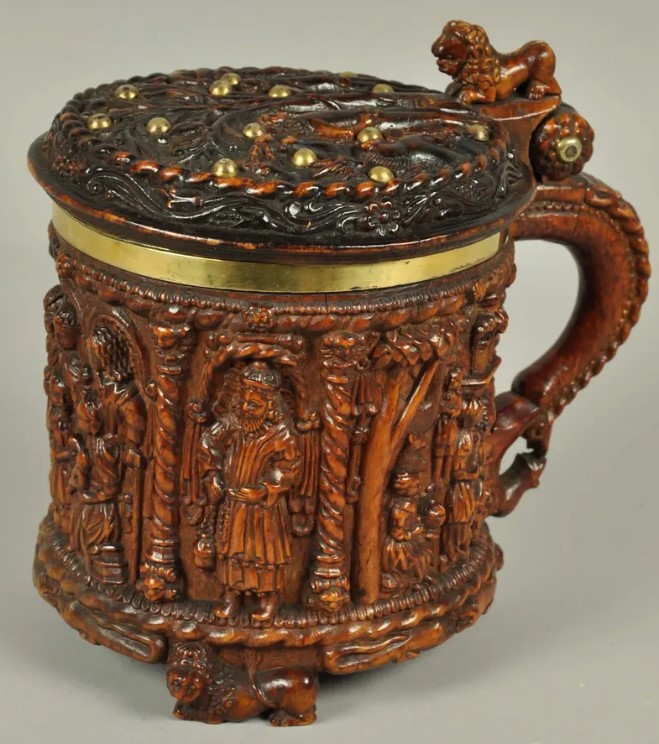
Actually, that tie will do just fine. Just fine. Still, Uruguay has have the best strip. We remember the Graf Spee after all. Isn’t it fun how many old simmering bigotries and grudges come out during international sporting events! Speaking of fabulous cups, Lars shared that image this week: “… carved by a Norwegian farmer… The king bought this mug in 1798 for 60 riksdaler, an absolutely wild amount, equivalent to roughly 10 cows.” The Scandenavian bovine value (SBV) scale to the rescue… again.

How many cows is the World Cup worth? [Ed.: “…crickets...”] Studies have shown that a beer at the stadium might cost you about one-third of a cow. On the other hand, it is pretty clear what inviting the Tartan Army to your town is worth to breweries:

The Tartan Army chartered dozens of school buses from Boston and Providence to get to the game. On the ride with the Scots were many father-son pairs, kilts and even more beer. Organizers brought 10,000 cans of Narragansett Lager for the Foxborough-bound buses from Providence alone. None were left by the end of the night.

Wow. The call has gone out for an extra 100,000 more! My own wee cousin** is out there representing the fam. Seems like the Army is working hard to beat the English in Spain in terms of fluid input, according to one French news source. And Ruvani has also been on the World Cup beat and shared the thoughts of opinions of commentator Roger Bennett what makes for a great fitba focused bars in the US including this good point:

Bennett is keen to emphasize that there are aspects of great American soccer bars that are both unique and essential to the U.S. In other countries, “you commune with fans of your team and everyone else is the enemy, but in the U.S. most fans are young and have come in since the Premier League started being broadcast by NBC in 2013,” he said. “Their discovery and passion have created a unique culture that’s not divided into us-against-you.” This difference means that bars must be ready for and welcoming to multiple fan groups, fostering an inclusive spirit. 

Speaking of welcoming, Ontario’s fading but venerable former retail monopoly The Beer Store is doing something very unusual the days – opening two stores as it closes many more. But its doing so seemingly primarily to receive back more empties as much as to sell beer:

The Beer Store has closed dozens of retail locations across the province over the past two years, citing changing market conditions and the expansion of beer sales to convenience stores, more grocery stores and gas stations. Many of these retailers do not accept empty container returns… As Ontario’s largest beer retailer, The Beer Store recently unveiled a new “Take back what’s yours” campaign aimed to boost awareness of the province’s deposit return system. A recent analysis by the Toronto Star suggested Ontario consumers lost more than $60 million in unredeemed deposit refunds last year by placing empty alcohol containers in their blue box or the trash instead of returning them to The Beer Store.

And Stan has issued his latest Hop Queries and you are all well advised to govern yourselves accordingly. And he’s used a concept that’s been unfamiliar in the brewing world in recent years – stabilized:

After reducing acreage from 60,872 acres in 2021 to 41,654 in 2025 (that’s 19,218 acres), American farmers indicate that total acreage will remain basically the same in 2026 (at 41,642; 12 fewer acres than in 2025, less than three-tenths of one percent lost). The German Hop Growers Association reports that farmers will harvest 5.8% fewer acres in 2026 after slicing 6.5% in 2025 — leaving 44,117 in 2026, compared to 50,136 in 2024…. It should not be a surprise that a press release from the German hop growers about acreage states, “The mood in the hop market is currently poor” and “the oversupply of aroma hops had made production cuts necessary for several years.” 

In amongst some cheeky chat about NA beer, Andreas Krennmair stood up and sensibly explained with semi-cited research why it is that German NA beers are better than elsewhere in the world:

I’m sure the technology will eventually cross the ocean. From what I’ve been told, all the Bavarian breweries launching new and better NA beers basically comes from one guy’s PhD thesis at the Technical University of Munich at Weihenstephan. I’m not sure the thesis has been published yet, but… here’s one paper from the same guy about the impact of different NA production methods on aroma compounds. 

Here’s Dr. Guy’s paper. I like the acronym they use too, NAB. Suits my feels as a consumer some times. Andreas also shared the best beery gross out of the tournament so far, the drink to accompany an early match:

If you’re looking for the perfect drink for today’s Germany-Curaçao match, here’s a 1970’s beer cocktail for you: Isarwasser. In a 1 litre Maßkrug, combine a bottle of Bavarian wheat beer, half a litre of orange juice or orange soda (e.g. Fanta), and a shot of Blue Curaçao liqueur. Enjoy!

I’m all for fighting the hegemony of homigeneity but… I was sure he was joking. Here, however, is independent evidence of this crime against the clinky and the drinky.

Matty C had a good go at the numbers behind the lack of a GBBF this year, the reasons for which have become clearer with time:

… attendance was way down, with 13,000 people attending over five days – far short of the event’s apparent 23,000 target…  both the main GBBF and its winter equivalent have been cancelled. According to one discussion on its members internal forum, the festival made a staggering £320,000 loss. This feels significant, because you don’t plan the largest beer festival of the year and then move on after losing more than a quarter of a million pounds. A loss of this magnitude isn’t made simply by mismanagement – it’s gross negligence.

Wow. Wowsie-wow-wow even. Knut‘s written about another sort of challenge facing those in the trade – finding yourself brwing quality niche brewing in an isolated location. He noted a few interesting strategies to deal with that reality:

Carl brews beers inspired by Belgian classic styles, usually with malt from the Trøndelag region and with Belgian organic hops. I am lucky to have a designated driver, as we sit down to sample a few of his saisons. It’s a tough market these days, there are some beer bars in Oslo and Trondheim who sell his beers, but not many. He has teamed up with a local company that sells high end salmon fishing in the nearby Gaula river, probably a wise choice with guests paying good money for a quality product. The lower alcohol beers are available directly from the brewery, get in touch with him if you are passing by.

As you consider your route to the Gaula River, here some notes:

Note #1: this vid on UK pub habits also is about Canadianness.**
Note #2: “…BUD stock up 29% yr-to-date…
Note #3: Ron on Scottish Sweet Stout.
Note #4: “…stuck in 2016 for a moment… Just like DogHouse Edinburgh.

Question. Horse brasses – history or heritage?*** Boak and Bailey were on the case this week:

Newly built pubs on housing estates and new towns across Britain, desperately in need of instant personality, also often came with horse brasses fitted as standard. For example, when Scottish & Newcastle built The Moorcock at Peterlee, County Durham, in 1973, to provide a “tinge of country atmosphere… in a tasteful blend of ancient and modern” they fitted it out with “beams and timbers and rustic brickwork and horse brasses, sporting prints, and game birds”. (Hartlepool Northern Daily Mail, 15 November 1973.)

So a bit of each. And Alistair has been back home in the UK and has started sharing his thoughts on what he’s missed, starting with a day in Windsor waiting for his flight on to Inverness:

I had been to Windsor all of once previously, but I may have been about 12 years shy of being able to drink legally, and as such I don’t remember much about that visit. There is though a family legend/inside joke that at some point whilst wandering near the castle, I asked my parents why it wasn’t finished yet given the scaffolding that surrounded many of the buildings. I was then somewhat keen to walk by the castle to check up on progress in the intervening 40 odd years – there was still scaffolding to be seen, still not finished then I guess. It was getting pretty bloody warm by this point of the day, even though it was only 9.30 by now, so I took myself off along the river to get to my first planned stop of my tour of the town’s hostelries.

Alistair, being the good saintly lad he is, was well advised to leave out the visit to the city if the latest edition of London Beer City where Will Hawkes explains something I, also being a good saintly lad****, was not aware of… the class of establishment known as the strip pub:

Now – a bit like the Ploughman’s Lunch – strip pubs have almost entirely disappeared. This week the owners of The Nag’s Head in Aldgate submitted plans to Tower Hamlets council which would see this long-established strip pub turned into a “traditional pub” and 24-room hotel…. For younger Londoners – who make up the bulk of my readers, naturally – it must seem incredible that so many pubs once featured women taking off their clothes, but the past was a different country. What was most remarkable, actually, wasn’t the stripping – that still exists, albeit largely in glitzier surroundings – but the low-key, unglamorous, seedy-in-a-specifically-British-way nature of it. No stage, no pole, pounds-in-a-pint-pot for payment… Crucially, these strippers moved whilst naked…

Heavens. Naked people just wandering around the pub among the drinkers? Yik. These places probably reeked of Isarwasser. Speaking of another form of the unfortunately unsavoury, Lesley Chesterman wrote about criticism this week:

When reviewing dishes like that, you can’t lie and say everything was great just to keep things positive. I saw this in my time as a critic as well, this idea of being “mean” when criticizing professionals cooking. People obviously focus on the negative side of criticism, but the truth is, it can be beneficial too. How will any chef improve if you don’t give it to them straight? And how will we uphold a high level of gastronomy here in Quebec if we’re all afraid to call out mediocrity? It is constructive criticism after all, and the goal in cooking should always be excellence. Undercooked frog’s legs and rice are not excellence. 

Agreed. In one of the sillier examples of forecasting yet, the International Wine and Spirits Record (now IWSR) has predicted what the world will be like in 2035… without any reference to the coming global resource wars:

According to the findings, the stabilisation in global volume from 2031 will be driven by two main factors: a “substantial rebalancing” of the global market, and continued growth in the worldwide drinking age population. Over the next decade, the global beverage alcohol market is, according to the analysis, anticipated to be “shifting away from China, North America and Europe to India, South America and Africa”. From a global perspective, this is said to be “most clearly illustrated by looking at consumption by servings” with the research highlighting that “the different serving size volumes of different categories” is a factor to consider.

Serving size? I might have thought fire spewing drones sweeping the landscape into a hell zone might have been a more important factor in the future to come… but I’m like that.

On a similar sort of standard, some attention was drawn to a PR infographic calling itself a summary but being held out as a research study about the NAB drinking habits of the British. Example: “New research from non-alcoholic brewery Athletic Brewing Company and KAM Insight shows that 94% of alcohol-free beer drinkers also consume alcohol.” There seems to be no statement of the research’s definitions, the methodology or the manner in which data was collected. Noce. I’d move to know the criteria for establishing whether one is or is not a “highly active, performance led consumer“! The 94% to 6% split on “alcohol-free drinker” habits is a head scratcher. Is anyone who ever had a NAB included in the 94%? One wag commented that it was akin to this sort of statement:

The Benson & Hedges Wellness Institute reports filtered cigarettes offer a smoother more pleasurable smoking experience.

Oh. That was me! Still, this sort of effort seems to discredit itself from the start. By the way, I’ve been “Zebra Striping” regularly for about four decades. It’s called water.

There you go. That’s enough for now. Another jam packed week in beer and brewing… and the World Cup. As we wade through more and more matches, please take time to check out Boak and Bailey posting on Saturday and adding to their fabulously entertaining footnotes week after week at Patreon. And do look out for more of Stan’s new “One Link, One Paragraph” format including this week’s wisdom: “People need to get out from behind their phones, go to a bar and talk to each other.” Then hunt out something in someone’s archives! Leave oblique comments on someone’s post from 2009!! Listen to a few of Lew’s podcasts and get your emailed issue of Episodes of my Pub Life by David Jesudason on certain Fridays. And Phil Mellows is at the BritishBeerBreaks. Once a month, Will Hawkes issues his London Beer City newsletter (but always never with this week’s NSFW warning) and do sign up for Katie’s wonderful self-governing totes autonomous website featuring The Gulp, too.  Ben’s Beer and Badword remains on pause but there is reading at The Glass which is going back to being a blog. Any more? We have Ontario’s own A Quick Beer and All About Beer is still offering a range of podcasts – and there’s also Mike Seay’s The Perfect Pour. Plus follow the venerable Full Pint podcast! And there’s the Craft Beer Channel on Youtube as well as the archives of the Beer Ladies Podcast.

*The young lad possibly as illustrated on a FB page name of The Boston Calendar. I tihnk that the the City Hall plaza if I remember correctly.
**H/T Gladman. Note the dropping of the terminal consonant at the ends of syllabels.
***Heritage being that approved part of history promoted for present purposes.
****Apparently, according to a key word search, I’ve never told you how at the dinner table one evening when I was about 15 my mother out of the blue advised me “oh, and if you ever think of going to one of those stropper places think of me up there!” She may have pointed her fork at me as she said that. I never have cross the doorstep.


The Most Moon In June-y June June-ster Set Of Beer New Notes Of The Year So Far

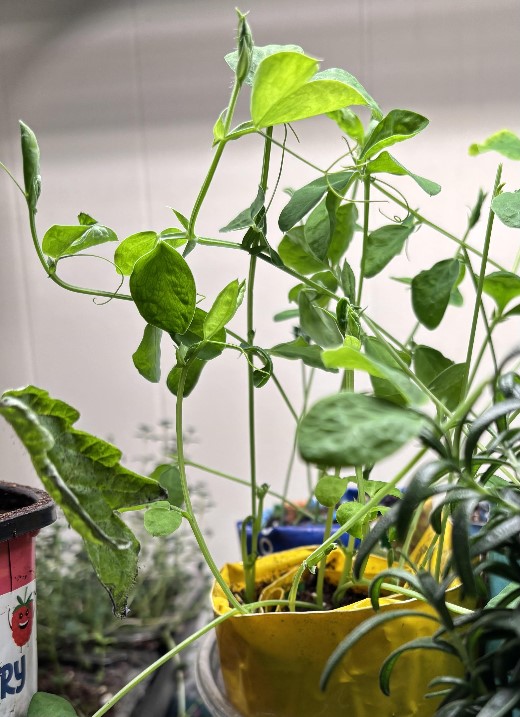
It’s been a fabulous week hereabouts. Hard to suggest otherwise. A whole twelve days since the last close call with frost means I have about 45 tomato plants now out in bigger pots and into plots, one seen above. Last year’s dried garlic stems are one trick to keep the bugs away. You… are welcome. These are the sorts of things that occupy the newly retired mind. Mulch options. It’s a lot like that last summer before I had a job, the one after grade eight. Not quite mindfulness. More like mindlessness. But I suppose that’s the point after 46 years at the coal face. Or I suppose the keyboard. I am betting 50-50 that I will be driven nuts by this idle stuff come September. Maybe.

10 am EST: HOLD THE PRESSES!!!

There’s been a couple of updates arrived in the inbox after the deadline for this here Thursday beery news notes to be released to the unsuspecting.

First, Ron P. has posted a video that debunks a number of Scottish brewing myths. This is an excellent public service which I expect you will fully embrace… but… I have to note… he has chosen the oddest intro theme. Now, to be very clear Ron is a man who has not only excellent taste in music but has been to more concerts of every band I loved as a kid than anyone I have ever met. So… I am not sure why he chose a short tune that sounds like teenage whales practicing new ways of vocalizing while one fin has been clamped into a medium sized vice.

[UPDATE UPDATE: see the comments… Ron is the artist. I am reevaluating my appreciation…]

Then, more seriously, David J. has published a newsletter with his thoughts on the relationship between gambling addiction and drinking:

“Gambling was causing me pain and drink became the thing to numb the pain,” Harj tells me. Harj isn’t a one-off. There’s thousands like him who have been exploited by betting companies and have lost everything. Some have committed suicide because of their addictions, while many have hurt their loved ones by their actions; Harj tried to kill himself in August, 2020 by driving his car into a road’s central reserve. I say thousands of addicts but it’s probably much more than we realise becauseguess whatbetting companies won’t provide data that could lead to us being shocked into calling for radical reform. They won’t even release information on how much revenue they gain from the highest volume gamblers.

There are two things I am eternally grateful that I have not taken up: gambling and smoking. David’s subject Haji is now a spokesperson against gambling addictions and notes that there are few controls around betting machines in pubs where the connection between booze and betting is most direct. Have a read.

[Ed.: Update over. As you were…]

What is going on? First up and in anticipation of the World Cup that starts next week, Eoghan is visiting and establishment of some sort representing each team in the competition – all of which are located in his home of Brussels. The first stop on the tour was an ersatz US diner or milk bar which reminded him that “American cultural hegemony is ebbing” which is fair. But next up was a trip to the “Canadian” site, the qualifications for which is always interesting to a Canadian:

It’s important from the outset to say that La Luck is not a Canadian restaurant, nor does it have I think any pretensions to being Canadian. If it is known for anything, it’s as a board game bar, with the upper floor reserved for game players. There are no Canadian nods in the place’s décor – no maple leafs, no elongated hockey sticks, and certainly no well-loved photos of Wayne Gretzky or Alanis Morrissette. Instead, La Luck’s owners have gone for the vintage market bric-a-brac look, with it stuffed with old mirrors and picture frames and sundry recycled wall decorations. In the hour and half I was there, I failed to hear any Chad Kroeger or Avril Lavigne on the bar’s soundsystem. And the service, of which I will speak of more later, does not appear to reach the level of North American efficiency, or overt Canadian friendliness.

I like it. That is an entirely Canadian approach to Canadian-ness. Wouldn’t want to make a show of oneself. Not to mention they lost his order of poutine for over an hour. Does that speak to my nation? I dunno. Still, my own country is in fact hosting World Cup games and the Old Country has finally made it for the first time in decades… and, even with that, I think the argument made in The New York Times this week is all booze industry wishery:

…for beer manufacturers, the World Cup is a giant, multiweek, Olympics-meets-Super-Bowl sporting event that FIFA, soccer’s international governing body, projects will draw a global audience of six billion. There are early signs that beer orders will rise during the World Cup. In April, a forward-looking indicator of beer purchases expanded for the first time in 21 months, said Lester Jones, the chief economist for the National Beer Wholesalers Association, in an email. “Host cities for World Cup events will certainly experience an increase in both on- and off-premises beer sales as consumers enjoy the games,” he said. Beer industry analysts say Americans’ attention to the tournament will depend, in large part, on how far the U.S. team advances.

I am aware that forecasting and futurism sits somewhere between fantasy and fraud so we will have to see how this all plays out… but… BMI does have some stats that put the anticipation of a bump in context:

Beer industry volume down 6.1% for 4 weeks thru May 16 in NIQ data. That’s far worse than 3.3% drop yr-to-date. So this is yet another data point strongly suggesting industry got much softer in Q2, as consumers undoubtedly feeling the pinch from higher gas prices, among other factors.

Focusing on the smaller scale, Franz D. Hofer welcomed the new month with a post on the smaller beer gardens of Munich including one with bees:

A few beers later I headed west into the woods toward Aubing in search of a fabled beer garden surrounded by beehives. Passing a pond here and a few ducks there, I eventually found this little gem in the forest — Waldwirtschaft Bienenheim, the place where the bees live… About a hundred and fifty years ago, King Ludwig granted this plot of land once used for brickmaking to the Obst und Imker Verein (Fruit Growers’ and Beekeepers’ Association) of Aubing. And the Wirtshaus with its beer garden? It’s the former clubhouse of the beekeepers’ association. To this day the beekeepers of Aubing still hold their club meetings at the Wirtshaus.

And, somewhat similarly but with less charming results, Lisa shared thoughts on Token, a re-opened Dublin bar that left her searching to put a finger on a categorization that fitted the place. Previously at the old spot…

…it felt like a neighbourhood bar that offered something of an alternative to simply ‘sitting at the bar,’ though you could do that as well, if you preferred. This Token, however, feels very much more transactional, and much more, well, bro-y. And it may be that this vibe is a direct result of this new space: surrounded by bland offices and corporate apartments, it now feels like an after work ‘enforced fun’ spot for company meetings. The prices certainly fall into the ‘someone else is paying’ category with an ambitiously-priced pint of Scraggy Bay on offer for €8.20 (and a service charge added to food orders, despite it being relatively difficult to find someone to take your payment when you want to leave, even at the bar).

A “someone else is paying” bar is an excellent label. Hotel bars near industrial parks perhaps? Staying in Dublin, Cian Duffy has described another class of drinking hole, the neo-thatch:

Dublin has a reasonable number of thatched pubs, for a fairly urban environment. There aren’t any in the city centre, but there are plenty in suburbia. However, they are almost all pastiche in style. The thatch is real – very real, very expensive and requiring very skilled trades to install and maintain it; but the pubs were not thatched originally, and some are or were new buildings. As far as I can tell, the trend for this was started by the only thatched Dublin pub to have since been demolished (yet!), the S0440 Stillorgan Orchard, which was thatched in late 1988. A number of other pubs were thatched over the next few years, as this trend proliferated. S0232 Glenside was thatched during a renovation in the 90s, with N0300 Lord Mayors in Swords being thatched during its extension renovation in 1992…

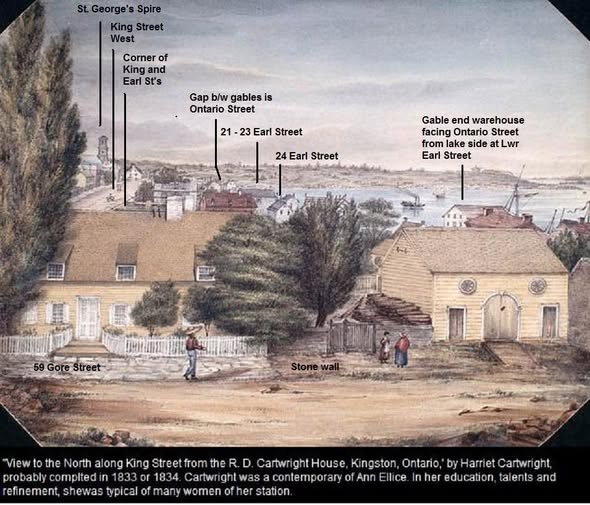
How many times have any of us exclaimed “the thatch is real!”?  It’s not done around these parts, though I have an image that might show a thatched roof or two hereabout in 1833. As you consider that, here some notes:

Note #1: who “placed trust” in the self-reported data the BA uses?
Note #2: Knut on the cost breweries pay to attend beer fests.
Note #3: I’d be checking the corks for tampering before sipping Stalin’s wine.

As you know and as I know you know and as you know I know you know, “A Glass of Handmade” by William Least Heat Moon was published in The Atlantic in 1987. It’s a consideration of the state of microbrewing at the time and contains one of my favourite lines, a statement by Bill Owens of pioneer brewpub Buffalo Bill’s: “…I don’t make ale. I can’t waste time educating Americans about ale…” Owens brewed a light lager that cost him seven cents a glass to make and sold for $1.50. The brewpub is still thereJeff told the tale this week of similar project almost forty years later in Portland, Oregon:

“If we were going to do a light lager, we wanted to do it right.” Sam said. “Let’s not copy another beer, let’s just make the best light lager available”… The brewery can still make a profit on a $3 pint, but it then becomes a volume proposition. But because it’s so cheap, the volumes have really gone up—a virtuous cycle. And just having the beer on the menu has created a halo effect. The typical customer doesn’t come in solely for cheap Clubhauses. Instead, they vary their session with a Clubhaus and other beers, saving them money they then use to spend on more beer or food. That’s why people end up spending more.

Here’s to that beer lasting until about 2064. That would be excellent. Speaing of which last Friday ATJ experienced the excellent if not even the sublime* and shared the moment:

I have finished my beer but such is the mood of completeness, that serenity I mentioned earlier, the tranquility that bathes my soul, I decide on another pint of the same beer. Once again there is a dance to the music of time on my tongue as I take deep sips that are almost transformed into swigs from my glass. There is a sense of mindfulness as I sit on this wooden bench that acts as a living memory of someone called Dave, moments of calmness and reflection as I look out over the river and the landscape stretching away, aware of the high canopy of blue stretched with fluffy white above me. Everything is in order, the beer, the views, the slow susurration of voices behind me, and even though this outdoor space at the Bridge is bordered behind me by a road I don’t even notice the passing traffic.

Two tales of the Isle of Man this week. First up, check out Katie‘s excellent piece in Pellicle on the good beer scene there. Then, add the notes shared by Ed from his time at the biggest and apparently little loved brewery in the dependency, Okells, his former Manx employer:

I briefly worked at Okell’s a few years back. The job was one of the worst I’ve had, a cesspit of office politics. But the beers were the best on the island… I got first hand experience of the distain some Manxie beer geeks hold Okell’s in when I attended an event at the Hooded Ram brewery. It was a microbrewery run by a lovely guy called Rob Storey. He’d invited Okell’s staff over to the event so I  went with one of the lads from work. I had an inkling of the view some held about Okell’s, but I thought it better to be up front about where I was working so wore a branded work t-shirt. I was still a bit put out that someone booed when I arrived though! 

(Neither of them mentioned Kelly.) On the topic of an entirely different sort of search, I don’t know if I am wanting to find the cheapest beer in the world but, yes, it is likely that it might be found in an unrecognized state where Russian troops are both posted and somewhat cut off… perhaps much to their relief these days:

Official Foreign Office guidance advises British tourists against traveling to Transnistria but, in the interest of scientific research, Robbie decided to take the risk. It proved to be worthwhile. Exchanging his remaining Euros for some of the curious Transnistrian currency – which uses plastic coins more like something from a board game than from a bank – Robbie finally managed to find a beer that could compete with Yorkshire prices. He explained: “I’m delighted I managed to beat the 99p pint with this 77p one. It’s a surprising we had to go to such lengths to get a hold of it though.”

More than likely a notch or two higher up the old snack bracket, Ruvani de Silva shared the history and current scene for bitters for The Alchol Professor with a focus on the finer kind which may assist me with my Crown Royal studies:

Contemporary mixologists have an almost unlimited palette of bitters flavors at their disposal, from yuzu, bergamot, and cardamom to Japanese chili and saffron. By incorporating more international ingredients into their bitters, craft bitters brands are helping mixologists introduce more global flavors, which in turn can bring craft cocktails to a wider audience. “When an industry is shaped by a wider range of backgrounds, cultures, and experiences, it naturally leads to new flavor profiles, new use cases, and new ways of thinking about cocktails and hospitality….”

Bitters and soda on a stinking hot day? Anytime. Time may have run out elsewhere. In Will HawkesLondon Beer City this month, he shared the history of the Grove Tavern, a shuttered 1920s pub awaiting the demo ball which sits on the site of earlier establishments before the city moved in:

In the 18th century, the Green Man’s appeal derived from its rural qualities. Dulwich Wells sat beside the pub, noted for its mineral-rich water, the Matcha Latte of its day. The landlord in the 1740s, Francis Cox, also created Cox’s Walk, a tree-lined pathway that runs southwards and still exists today, to connect his pub with Sydenham Wells.  Rural delights remained the pub’s calling card for decades: as late as 1864 – by which time the Grove had been rebuilt by Courage – the pub was advertised on its rural qualities. “If you want to enjoy the country air, go to the Grove Tavern, Dulwich!” readers of the London Daily Chronicle were told. “If you want to ramble amidst rural scenery, go to the Grove Tavern, Dulwich! If you like swings, quoits, bowls or cricket, go to the Grove Tavern Dulwich!”

And from the police blotter this week we have a story of crime out of Hollister California – a crime weaponized with beer:

During the first incident, police said surveillance footage showed a man riding a bicycle who stopped and approached the robot, before knocking the robot to its side before leaving the area. A second incident involved another suspect approaching a robot near 4th and Line streets. The suspect appeared to strike the robot before approaching a second robot that recorded the interaction. Police said the suspect struck the second robot and poured a liquid, believed to be beer, before leaving the area… police chief Carlos Reynoso confirmed two people were arrested following unrelated incidents.

Is pouring a beer on a robot a crime? We will find out. And with that, we are done for another week. While you wait around, drumming your fingers at the dining room table as loved ones ask “what’s wrong?” dont forget to check out Boak and Bailey posting on Saturday and adding to their fabulously entertaining footnotes week after week at Patreon. And do look out for more of Stan’s new “One Link, One Paragraph” format. Then hunt out something in someone’s archives! Leave oblique comments on someone’s post from 2009!! Listen to a few of Lew’s podcasts and get your emailed issue of Episodes of my Pub Life by David Jesudason on certain Fridays. And Phil Mellows is at the BritishBeerBreaks. Once a month, Will Hawkes issues his London Beer City newsletter and do sign up for Katie’s wonderful self-governing totes autonomous website featuring The Gulp, too.  Ben’s Beer and Badword remains on pause but there is reading at The Glass which is going back to being a blog. Any more? We have Ontario’s own A Quick Beer and All About Beer is still offering a range of podcasts – and there’s also Mike Seay’s The Perfect Pour. Plus follow the venerable Full Pint podcast! And there’s the Craft Beer Channel on Youtube as well as the archives of the Beer Ladies Podcast.

*Finally, that 1983-84 honours undergrad English course in Romanticism pays off.

The Dreamy But Sadly Last Beery News Notes For May 2026

I have liked May so much this year that I am already missing it. Forty-eight weeks to May 2027.  I’ve already circled it in my calendar. Just in the last few days it finally feels like spring. I’ve got more twenty tomatoes outside into the spot where they’ll be sitting until November. Isn’t that twine tying action photo there to the right interesting? I really outstripped myself with that one. That is one snugly tucked in beefsteak, if you know what I mean. And there’s been more. I’ve mowed and then mowed again. Got a few semi-sunburns and even listened to a Blackcapped Warbler as it stayed just out of view. Not that it’s been Euro-hot but I will take 23C and sunny any time. Err… give me a sec. That knot. Wow. OK, let’s go.

First up, the residue in 4,500 year old clay pots from the Masovian Lowland in northeastern Poland have been analyzed and certain conclusions have been drawn:

These findings represent the earliest chemical traces of fermented alcohol beverages in this region, dating to the second half of the third millennium BCE,” the researchers wrote in the publication. The study also identified biomarkers linked to grain processing, including azelaic acid and plant sterols, suggesting the use of cereals such as wheat or barley, fruits and possibly resins used to preserve or flavour beverages. Researchers said the apparent use of wheat and barley is significant because the oldest known evidence of cereal cultivation in the region dates to the Late Bronze Age. “This suggests the possibility of importing raw materials for alcohol production from other regions where cereal cultivation was already well-developed…”

See also the 2,300 year old beer bottle from China. Do ancient jam jar findings get such rapt attention from archaeologists? Not a chance. And speaking of the sciences, The Beer Nut made a quality observation this week about one of the adjectives that gets tossed around rather freely – “tropical”:

I’ve voiced my concerns before about the t-word being rarely indicative of actual tropical fruit flavours. So it goes with this one, but that’s not a problem. In lieu of mangoes and pineapples, this 5.7% ABV hazy IPA has a bright pithy bitterness, pushing mandarin zest and lime rind. There’s an almost earthy tang on the finish, where the bittering compounds concentrate together on the palate. Despite the haze and the claim of tropicality, this tastes like an IPA from the classic era of Eight Degrees: big flavoured and technically proficient. I’ve missed that.

I don’t have an issue with degrees of abstration in the game adjectival. As a result “hoppy” is perfectly fine as a high level quantiative descriptor. But “tropical” has that next level general category aspect that TBN unpacks neatly up there through a winnowing to find out what is really going on. Mango? There ain’t no stinkin’ mango!

Speaking of getting to the specifics, Boak and Bailey examined a trade publication from 1960 called 200 Years of Brewing in the West Country, a 40-page booklet produced by West Country Breweries on the subject to West Country Breweries and found a firm in transition – whether they knew it or not:

From the first page, though, it’s clear that something unusual was going on. The obligatory foreword from the chairman is signed by… Colonel W.H. Whitbread. He was also chairman of Whitbread itself and his presence here signals that West Country Breweries was under the larger brewery’s protection as part of the so-called ‘Whitbread Umbrella’. The Whitbread Umbrella was “a novel structural arrangement that incorporated a dual-voting shareholding structure aligned to a controlling interest in the publicly listed Whitbread Investment Company (WIC), an investment trust that housed minority shareholdings in some twenty regional brewers” (Julie Bower, 2016.) Protection is an interesting word, isn’t it? In organised crime it’s a euphemism for extortion and predatory behaviour by criminals. 

This excellently illustrates and avoids the presistent problem of drinkers, trade association and beer writers confusing ownership with control that we have seen play out in the last decade or come of US craft brewery shell game. Show me the shareholders’ agreement!!

For Craft Beer & Brewing, Kate Bernot has a detailed update on Fonio, an small-scale farmed African cereal malted for brewing purposes that has gained acceptance since the 2018 introduction to Garrett Oliver described in this article in The Guardian as noted hereabouts back in 2023. Bernot shares some obervations that give a sense of what Fonio adds to a beer:

Vinnie Cilurzo, owner and brewer at Russian River in Windsor, California, agrees that fonio’s vinous, lychee-like contributions defy what most people—brewers and drinkers alike—expect from malt. A Belgian-style blonde ale brewed with 30 percent fonio has become a semiregular beer at Russian River’s taprooms—particularly during the warmer months, when its lean body and bright fruitiness feel especially appropriate. Cilurzo says it doesn’t take much fonio in the grist for it to have an impact. “My advice: You don’t have to go all the way to 30 percent,” he says. “Fifteen to 20 percent will also leave a thumbprint on the beer.”

What really struck me is how pale the beer in the accompanying image is. Pale as Zima. When my crime novels set in the early 1990s come out you’ll see me using that image: “I could tell he was guilty – he’d turned as pale as Zima.

Never that way at all, we saw Stan’s latest Hop Queries hit the inbox last Friday including this note on production levels in Australia after the harvest there:

Reacting to diminishing worldwide demand for hops, Hop Products Australia continued to reduce acreage for 2026. Farmers strung 8.3% fewer acres and produced 11.7% fewer hops. They harvested almost 2.9 million pounds. For perspective, that’s equal to 3.4% of the US crop or to the amount of Mosaic farmers in the Yakima Valley harvested. 

As you consider the “season of mists and mellow fruitfulness” antipodean, here’s the notes:

Note #1:…craft beer off 8% for latest 4 wks thru May 9…
Note #2: a beer blog becomes, what, a booze blog?
Note #3: a return to beer writing?
Note #4: another return I’m pretty sure I don’t care about.

What is it with otherwise sane folk trying to scratch a living from a niche topic that leads them to speak of praise the niche’s given opp – the necessary “evil empire” to the purity of the niche – with all the eloquence of a six year old with stomach flu talking to Beulah on the big white telephone? I thought of that when I read this grab bag of sneering cliché:

“The Bad Beer That’s an Incredible Beverage” by Tyler Austin Harper is a bad piece that’s an incredible prism for understanding how beer can continue to thrive as a symbol of populist Americana even as it continues to lose market share to flavored malt beverages, canned cocktails, and whatever we’re calling Cayman Jack these days. Much like the New York Times Opinion section’s hackneyed forays into thinking critically about the trade, Harper’s take advances the argument that the craft brewing “movement” (such as it is) has gone too far. It’s a mixture of personal preference and surface-level cultural observation of a piece with the dreck David Chang was pushing in the pages of Esquire literally a dozen years ago.

If you’re going to shit on someone else’s writing it might be good to be interesting yourself as you do. Why is it so hard to understand that very few care about your chosen drinking hobby? With far greater clarity, ATJ has been trying to put his finger on what makes Belgian beer culture unique and, after years of looking beneath the surface, is not quite sure he’s been successful:

… thinking about Belgian beer culture I thought about beer and its associated obsessions — metal, gaming, men’s solitary hobbies, loneliness, the need to be someone else which ends in self-immolation (Brunhild trying to burn down the hall with Hagen and associates still inside perhaps?). Belgian beer culture, like beer culture, whether out in the cities and towns or in traditional bars or specialist beer joints, could be confusing, and I am not sure I found what I was looking for. Or did I?

And sticking with beer joint culture, a great barman has passed away in Chicago, Sam Sianis of the Billy Goat Tavern:

Millions of Americans knew of Mr. Sianis and his bar without ever crossing Chicago city limits, thanks to one of its most famous regulars, the syndicated columnist Mike Royko… Mr. Sianis made it an equal-opportunity establishment: Prolific drinkers, wayward pols, off-duty cabbies and the occasional celebrity all received the same friendly beer and a shot, often from Mr. Sianis himself. “Sam was the perfect host,” Don Rose, a journalist, said in an interview. In Mr. Royko’s columns, the Billy Goat became a font of tales, true and tall. Mr. Sianis once kicked out the same customer six times in one night for fighting while drunk. And Mr. Sianis swore he witnessed another man down 150 drinks in a sitting.

Another sort of fluid based establishment was the topic of Every Pub in Dublin‘s focus last Friday – pubs on islands you can only reach by boat and not via a bridge:

Arranmore’s 6 pubs is quite a lot for one island, and it has made me wonder about what other offshore (before someone comes and lists most of the pubs in Cork City…) island pubs there are. And also if I can actually tick all of those off too. This is not a promise to do that. I might, but I’m not guaranteeing I’ll do it it like I have with Dublin and also The Rosses. I’m going off the 2024-5 full licence file here, so there is a very high chance I’m missing somewhere, but I made a reference back to the 2010-11 file to try find any lost pubs too. I’m going to start North and work my way counter-clockwise here, so places I’ve been mostly work their way to the top…  I am also only counting islands you still need a boat to get to – I may have an Achill great-grandfather, but you’re basically mainlanders now!

It is even an island if there’s a bridge? Which leads to this interesting piece from BBC Worchestershire on the state of small breweries and what may be keeping some open:

Sarah Saleh, owner of The Hop Shed Brewery, in Suckley, Worcester, said: “Without the tap room we wouldn’t still be here. I think the breweries that are closing are the ones without a direct outlet for their beers.” Saleh continued: “I know when we set up here, 10 years ago, I can think of two breweries locally that were set up but didn’t have tap rooms, and they’re now no longer here. “It always amazes me that on a Friday night when the tap room is open, and we stand here in a barn in the middle of nowhere, and before you know it there’s 200 people here. “They’re enjoying food from local providers and enjoying the beer that’s been brewed here on site.

It is even a community brewery if there isn’t a taproom? Maybe. What else can make a brewery part of the community? Reporting from Norway, Knut attended a gathering of five Danish breweries invited by local Haandbryggeriet to show off their stuff… and one of the attendees had a particularly interesting back story:

Together with the Danish employment authorities, Stepping Stone has developed a program aimed at improving the conditions for refugees entering the Danish workforce. It is deliberately flexible — designed around the individual rather than the system. Each participant’s working hours, responsibilities, and workplace are shaped by their skills, needs, and current life situation, creating a more realistic and supportive path into employment. But the program doesn’t stop at work placements. Alongside hands-on experience at the brewery, participants are offered opportunities to build skills that extend beyond the job itself.

And also out and about has been Ed, who continues his reports from his trade mission to Austria, this time with his stop at Trumer of Saltzberg where he witnessed a method:

They have a six roller mill from 1965 and use the Kubessa method when brewing. Named after the brewer from Cologne that patented it in 1903, in the Kubessa method the husk is separated from the endosperm during milling. It is not added to the Mash Conversion Vessel during the early stages of mashing, only being added prior to lautering so it can help with wort separation. It means less husk polyphenols get in the beer. It’s said to make a beer taste more elegant, and certainly the Trumer Pils in Vienna was very smooth. We had John Brauer, EBC grand fromage, explain to us on the coach that in fact little difference can be detected in fresh beer, but the Kubessa method give greater flavour stability so its advantages become more apparent over time. 

That’s a lot of specific technical information. Mr. Gladman has shared some very specific emotional information, facts which he believes form the foundation for his love of Pastis:

On Saturdays I would walk the half-hour round trip there and back to spend my pocket money. I still remember filling the small white paper bag each week. It started off smooth and stiff then slowly softened and rumpled over the rest of the morning as I dipped into it for treats.I remember the aniseed balls best of all. I never bought too many — I didn’t want to spoil my enjoyment. The immediate pleasure of fizzy cola bottles was showy but no match for the deep joy of a well-sucked aniseed ball with its slow reveal, layer after intense layer, leading to that tiny black kernel of anise almost too challenging but all the better for it. I saved them for last because they would perfume the bag itself — you could smell them even after they were gone.

And, speaking of lingering aromas, Jeff gave us a history of the Cascade hops with his thoughts on what have made them so successful:

I’d add that Cascades have, ironically, come to achieve that quality of “nobility.” It’s true they’re more intense and robust than the old landrace varieties from Europe, but they’re also incredibly balanced and elegant. They offer a lovely bitterness, and are versatile as aroma hops (we’re going to get a taste of that in this year’s Oregon Homegrown collab.) When people taste Cascade, they’re tasting the same thing, too, which isn’t always the case with modern hops.

There. We will leave it there for this week and for this month. Soon it will be June with all that entails. Live it up. And again with this one last thing thing. Your weekly reminder that there will be an edition of The Session next month celebrating Martyn Cornell’s final book Porter and Stout: A Complete History. Boak and Bailey will share an update soon on when you need to get your thoughts organized in preparation.

Which means you, please, need to keep an eye on Boak and Bailey postings every Saturday and adding to their fabulously entertaining footnotes week after week at Patreon. And do look out for more of Stan’s new “One Link, One Paragraph” format. Then hunt out something in someone’s archives! Leave oblique comments on someone’s post from 2009!! Listen to a few of Lew’s podcasts and get your emailed issue of Episodes of my Pub Life by David Jesudason on certain Fridays. And Phil Mellows is at the BritishBeerBreaks. Once a month, Will Hawkes issues his London Beer City newsletter and do sign up for Katie’s wonderful self-governing totes autonomous website featuring The Gulp, too.  Ben’s Beer and Badword remains on pause but there is reading at The Glass which is going back to being a blog. Any more? We have Ontario’s own A Quick Beer and All About Beer is still offering a range of podcasts – and there’s also Mike Seay’s The Perfect Pour. Plus follow the venerable Full Pint podcast! And there’s the Craft Beer Channel on Youtube as well as the archives of the Beer Ladies Podcast.*

*No footnotes this week.

Another Fabulous Set Of Thursday Beery News Notes For The Marvelous Month Of May

Was I always a May-man? Attending graduation ceremonies were never my thing when I was young or when the kids were. I spent most of the time, as with the movies, counting up the crowd’s investment in cut flowers… coming as I did from that family business. But it is otherwise extremey pleasant, what with the windows open and the furnace off, the idle mowing and the slow pace of digging and planting as well as the imagining (but not yet doing) of projects needing to get accomplished before the snow flies. The weeks before the biting bugs, the forest fire smoke, the doing of the projects. The weather now warm enough for a beer outside. Or, you know, maybe a bit of gin… Ahh… gin time.

What else is going on. What’s that? WHAAATTT IS THAT ?!?!? Freakish news out of France this week as reported in The Times:

For centuries, wine drinking has been at the heart of French identity. Now, however, in a development that will have traditionalists spluttering, it has emerged that last year for the first time, the French drank more beer than wine. Beer consumption outstripped that of wine by ten million litres, according to figures released this week by the International Organisation of Vine and Wine… Martin Cubertafond, of Sciences Po university, said wine was usually served at formal family meals at home, but the number of single-parent families had risen. More than two thirds of households now consist of only one or two people. Big Sunday lunches at which a bottle naturally appears are less common. “Wine isn’t an option with takeouts or lunches that take less than 30 minutes,” Cubertafond said.

I suppose that is a point – gathering around the table is less of a regular occassion – but France’s wine industry was as much built on workers drinking it out of jam jars as the haute stuff. Me thinks there needs to be a “Viva Les Plonks!!” ad campaign. Everywhere. All the time.

Tighten your seat belt. We are off on a bit of a quest this week. Where else in the world are we headed? Next up, Ed wrote us all a note this week, telling a story of Ried brewery in Ried im Innkreis, Austria in which he shared many pictures of stainless steel objects before disclosing this vital bit of information if you were to follow in his footsteps:

We stopped for refreshments after the tour in the bräustüberl (brewery tap). I can’t say I was disappointed the grey sausages ran out before I got to them, the brown sausages I had were fine. They looked like frankfurters to me, but having once caused outrage in Italy by incorrectly calling something salami I’m not taking any chances. 

When have we all not been disappointed with the grey sausages. Moving along and further afield, Ruvani has also been on the road and reported back this week in great detail on her trip I believe in April to Tblisi Georgia including these notes from Agara Brewing:

Beer styles keep it straight with two notable exceptions: the ubiquitous tomato gose (the owner tells me the style originates from Russia) and a tarragon sour whose moss-green appearance may be unusual but harbours an exceptional gentle umami flavour that had me coming back for more. Tarragon is, we are told, a very popular flavour here and it works perfectly with a subtle kettle sour base. While the WCIPA was a bit on the heavy and sweet side, the tomato gose leaned into a strong garlic-herb profile giving it full gespacho characteristics. While pretty far out of the way, I’d consider this a must if hitting up the incredible Abkhazian regional cuisine at nearby Amra, the only restaurant to serve this variety of food from this contested area in Tbilisi. Being in the sticks isn’t always a bad thing (Londoners will know the importance of having proper local craft beer sources) and while you can Wolt it, it’d definitely recommend a short taxi ride out to the mothership. Side note, this is not a tourist area – be prepared for some staring.

Ubiquitous Tomato Gose” would make for a good folk tune title. No really. Now… have you been in the Faroes? I haven’t. My ancestors may have but I have no record of their wanderings that a’way. Well wonder what the wander would be like not more as Knut has reported from the scene:

There are towns with a more thriving nightlife than Torshavn in the Faroe Islands, so don’t go there for a stag weekend. But I found a little gem of a café that combines local food and drink with international inspiration – and a nod to big brother Denmark… Think upmarket versions of Danish smørrebrød. There are vegetarian options, roast beef, cheese – and my favorite, Fiskaflak vid turrum fiski – Fried fillet of haddock, remoulade, pickled onion, capers, dill, and a lovely and tasty garnish of shredded dried fish.

Mmm… a tasty garnish. Sounds a bit “grey sausages” to me. Similarly perhaps, wine in cans has apparently discovered a need to tell its own happy story* which is definitely veering off the “Viva Les Plonks!” initiative:

Some of my favorite accounts are, like, the Metropolitan Museum of Art, which is one of our best accounts. It’s such an amazing cultural institution, and it’s so cool that people are walking around seeing the greatest art of all time, and drinking our wines. We’re in places where it’s really fun for people to drink. And we’re in alignment with our target customer: a cool, interesting person who likes cool, interesting stuff, and is involved in cool, interesting cultural or social events.

I too like cool interesting stuff. And bottles. From a single vantage point, Emma Inch revisited a space in 2006, 2016 and 2026 and found traces as well as distinctions:

Sometimes, it’s in those places where there is the most life, that the most phantoms are to be found: the pubs in which you waited alone for a lover who no longer loved you back; the pubs in which you laughed out loud at the joy of discovering an understanding of new flavours; and the pubs in which you found a surge of celebration and a sense of belonging. Some pubs – given time – can do all of those things, but maybe not all at once. Because the truth is, though very different pubs, The Princess Victoria, Craft Beer Co., and Crossbar are, in fact, the same place. They each have the same walls, the same doorways, the same windows, and they each occupy the selfsame patch of ground. I don’t just mean metaphorically: they’re spatially identical though, of course temporally, they might as well be eons apart.

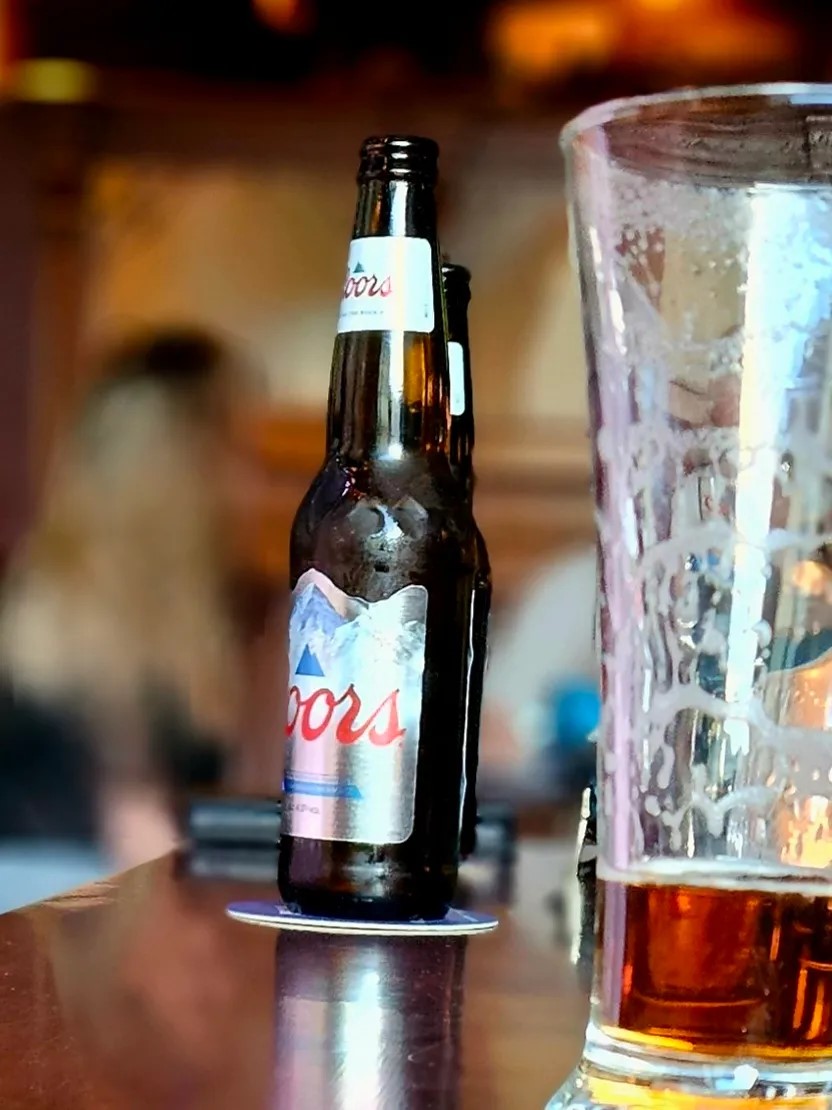
A bit further west, Liam posted a lovely vignette on settling into another unfamilar pub in Cork … errr Carlow on a Saturday night, giving this photo of the banal a lovely context:

Decompressing in the ‘oldest’ pub in the town, after trying 3 others for a quiet seat. My Macardle’s is pushing it on the best before date, and why I normally go for one from the fridge these days. At this stage it could be Pliny the Elder for all my palate would know, so it’s back to rituals. Two little old ladies have joined me, pleasantly smelling of lavender and gardenia. I think I may be in there Saturday night spot! They are drinking Coors from the bottle and bitching about other pubs, and I think they’re great…

Viva ladies smelling of lavender and gardenia! Speaking of which in words but perhaps not in experience, Matt Gross introduces us to the prospects of what is unexpectedly presented as a favourite NYC bar:

Until a few years ago, there was a bar in my Brooklyn neighborhood called Lavender Lake. It was named, of course, for the adjacent Gowanus Canal, famous as one of the most polluted waterways in the United States, where we treat polluting our waterways as a competitive sport, like baseball and tax evasion. For well over a century, nearby oil depots dumped their waste into the canal, hard rains pushed sewage overflow into it, and generous citizens did their part by tossing in handguns, bodies, and automobiles. Over time, the Gowanus developed an unmistakable aroma, not to mention a variety of hues that earned it that nickname: Lavender Lake.The bar was about what you’d expect a canal-side bar with a name like Lavender Lake to be. Affordable, dark, crowded, with a back deck that looked out on the canal, suffused with various odors.

Perhaps also suffused with odors, from late last week (and for Stan) in France the deer are drunk and causing traffic issues as reported in The New York Times:

It is inebriation season for wild animals, according to the agency, the Gendarmerie de Saône-et-Loire, which is based in a rural region in central-eastern France. “In the spring, some wild animals consume buds, fermented fruits, or decaying vegetation — and may exhibit completely unpredictable behavior,” the agency wrote last week on social media. The police force noted that tipsy animals can quickly cause collisions if humans are not vigilant. To prove this point, the authorities in the picturesque Burgundy region, known for its berries and wines, posted a video of what appeared to be a very drunk deer that has captured international attention.

I think in my youth, “inebriation season for wild animals” meant something different. Here’s some notes:

Note #1: doesn’t this look a lot like this?
Note #2: “…the low-priced, unprofitable, “unpretty,” côc…”
Note #3: “…Nielsen data that shows a 6% drop in beer for 4 weeks thru 5/2…

Building on that last point, I saw this interesting admission and even a fresh new retroactive pivot at Food in Canada in this story on the challenges facing brewers including this passage focussing on Toronto’s Collective Arts:

“We started in craft beer 13 years ago, but from the get-go, we always believed our brand would expand beyond craft beer,” says Toni Shelton, VP brand and strategy. “We have options for everyone, wherever they are in their drinking habits.” Today, Collective Arts’ portfolio includes craft beer, non-alcoholic beer, ready-to-drink cocktails, spirits, cider and wellness beverages. Its foray into the latter started with sparkling waters that were initially designed as mixers. Positive feedback led the company to position them as standalone refreshments, which eventually evolved into Botany, Collective Arts’ functional wellness brand.

This seems to suggest that the way forward for craft beer is to make “not craft beer” and that, in fact, that was always the understanding as in 2013 it was possible to guage the market and plan for the future. I seem to have misplaced my Believe-o-Meter so I will have to get back to you on that one.

As foreshadowed, I went out a bought a bottle of gin last Monday, reminded by this comment below in The Telegraph’sDevil’s Advocate” column** by Evgenia Siokos:

Gin can’t even defend its own integrity. You would never have it neat, as you would a good reposado or even, in exceptional circumstances, vodka; I recommend Black Cow or Tito’s. From the hobgoblin-green shape of Gordon’s – loved by Queen Elizabeth, the late Queen Mother; hated by teenagers left hanging over the porcelain – to its other wily guises – sloe gin, pink gin, dry gin, craft gin – all gin is beyond salvation.

Heavens. You would think Ms. Siokos was thinking of Sambuca. No good has ever come of Sambuca, as one old pal says. The eldest is in the Western Hemisphere for the next ten days so one must have gin. May, after all, is the beginning of gin season.

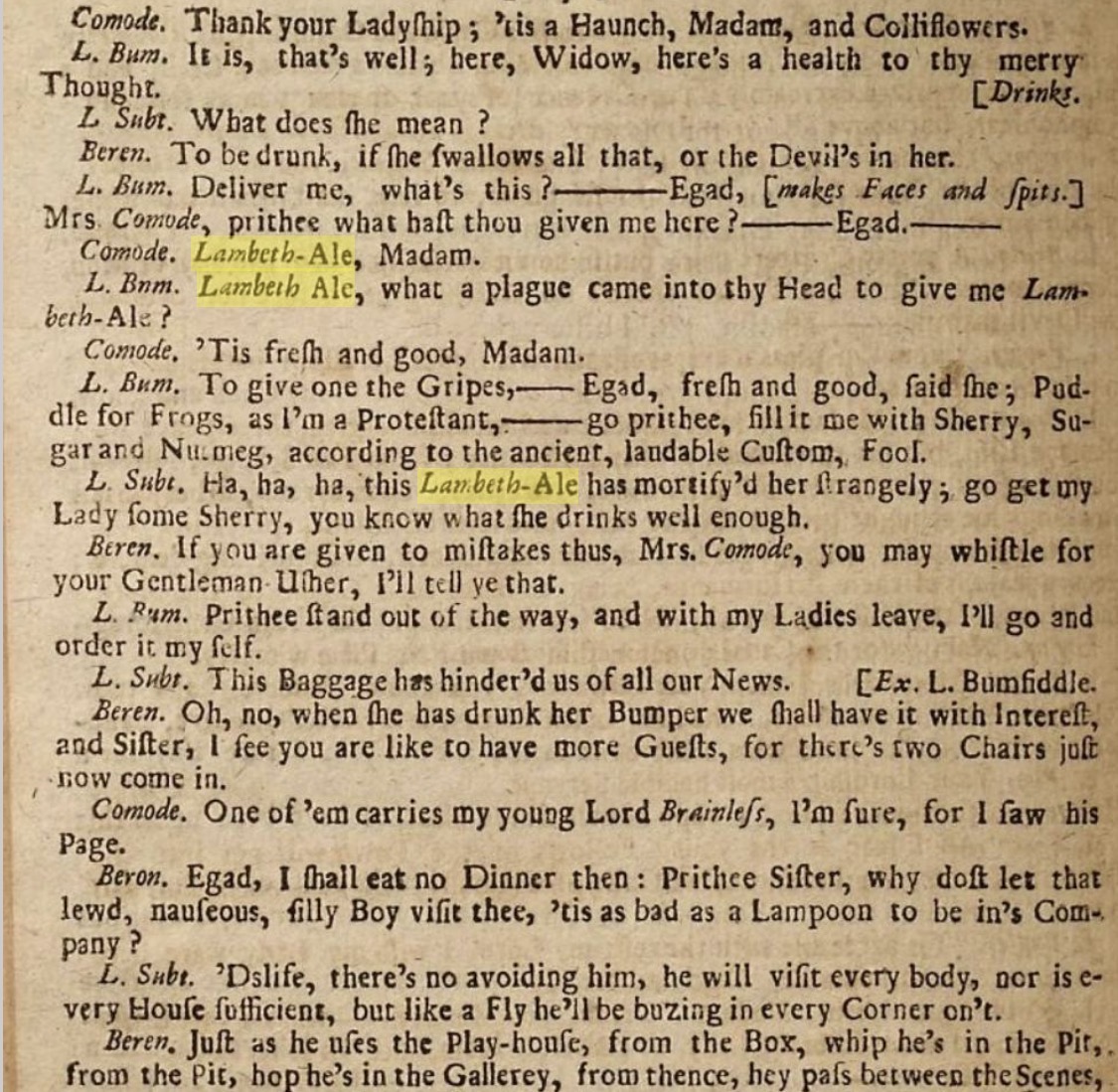
Further back in time and perhaps due to the news that Jeff shared, from the archives attentive readers will recall a few posts on a 1600s beer called Lambeth Ale which left a bit of a puzzle as to what it was. It was included in lists like that of John Lock from 1679 but I believe I found only a few references to what it tastes like other than coy mentions like “she is pert and small like Lambeth ale” and that it may have been bottled and kept like champagne. Lordy.  I’ve come across one more reference in The Marriage-Hater Matched, a rude Restoration comedy by Thomas D’Urfey from 1693 where the character Lady Bumfiddle vigourously objects to be being served it:

Lady Bumfiddle: Deliver me, what’s this? [Makes faces and spits.] Egad. Mrs. Commode, prithee what hast thou given me here ? Egad!
Commode: Lambeth-Ale, Madam.
Lady Bumfiddle: Lambeth Ale, what a plague came into thy Head to give me Lambeth Ale?
Commode: T’is fresh and good, Madam.
Lady Bumfiddle: To give one the gripes! Egad, fresh and good, said she. Puddle for Frogs, as I’m a Protestant. Go, prithee, fill it me with sherry, sugar and nutmeg, according to the ancient, laudable custom, Fool.
L. Subt: Ha, ha, ha, this Lambeth Ale has mortified her strangely. Go get my Lady some sherry, you know what she drinks well enough.***

Is “puddle for frogs” a slur for drink fit for a Frenchman? It was, after all, the middle of the Nine Years War.**** And is Lambeth so fresh light and bubbly that it is newish and continental and not at all an ancient custom? Is it… hipster beer circa 1693? Seeing as Pepys drank it in the 1660s I don’t see that being the case but I’d love to learn more.

Speaking of sherry, in 2005 – that’s (yikes) 21 years ago – I joked about starting another blog on the benefits of that fine wine. And here, just like that, Pellicle is featuring the drinking in its natural setting with this piece by Michael Fabro reporting from Jerez:

I arrive at half past one on a mild spring afternoon. Javi, the bartender, taps his knuckles on the old wooden bartop, a bulería—the last act of a flamenco show—still sounding in his ears. “Copa de fino, porfa,” I ask. I’m a bit early and the impending rush has not yet begun. For the moment, it’s me and a group of three Spanish guys, content with drinks in their hands after slipping out of work early. Some traditions haven’t changed. The walls are decorated with metre-high posters of bullfighters and portraits of great flamenco singers from decades gone by, alongside religious imagery. The Virgin’s weeping eyes stare back at me as I sip fino from my small vasito.

One last thing. Again a reminder that there will be an edition of The Session next month celebrating Martyn Cornell’s final book Porter and Stout: A Complete History. Boak and Bailey will share an update soon on when you need to get your thoughts organized in preparation. Which means you, please, need to keep an eye on Boak and Bailey postings every Saturday and adding to their fabulously entertaining footnotes week after week at Patreon. And do look out for more of Stan’s new “One Link, One Paragraph” format. Then hunt out something in someone’s archives! Leave oblique comments on someone’s post from 2009!! Listen to a few of Lew’s podcasts and get your emailed issue of Episodes of my Pub Life by David Jesudason on certain Fridays. And Phil Mellows is at the BritishBeerBreaks. Once a month, Will Hawkes issues his London Beer City newsletter and do sign up for Katie’s wonderful self-governing totes autonomous website featuring The Gulp, too.  Ben’s Beer and Badword remains on pause but there is reading at The Glass which is going back to being a blog. Any more? We have Ontario’s own A Quick Beer and All About Beer is still offering a range of podcasts – and there’s also Mike Seay’s The Perfect Pour. Plus follow the venerable Full Pint podcast! And there’s the Craft Beer Channel on Youtube as well as the archives of the Beer Ladies Podcast.

*“Happy stories!” is the gift that will give all year.
**Shared via the free daily newletter summary.
***Yes, I modernized the puncuation and replaced the long “s” with a standard one. My BA’85 in English complained but shut up after I asked what it had ever done for me.
****Fine – I missed the whole “Nine Years War” stuff, too. 1693 was not exactly when one would be chucking around Francophile sayings.

A Magnificently Monarchist League-less Mid-May Beery News Note Extravaganza For Victoria Day Weekend

Victoria Day weekend.* A most welcome springtime Canadian holiday about something and someone not a lot of Canadians take much time thinking about but, still, many don’t mind it – as long as we don’t pay the bills. And more birds are back as my new pal, one of a pair of Rose-breasted Grosbeaks proved. Aaaannnnd the weather is looking warmer than earlier in the week, which is good. Those are all good reasons for a long weekend in my books. Me, I shall sing the fabulous song about her by the The Kinks to myself as I go about doing nothing all holiday Monday:

Canada to IndiaAustralia to CornwallSingapore to Hong KongFrom the west to the eastFrom the rich to the poorVictoria loved them all

Speaking of the Victorian, first up we have Chris Dyson of Real Ale, Real Music starts us off this week with a pretty detailed description of the interior architecture at the Agricultural Inn of Penrith:

…one of the finest surviving Victorian shuttered and panelled bar serveries in the country with working sash screens which reach right up to the ceiling. It is two-sided, of three bays length, two bays on the return, and has a curved bay at the corner. The five main bays have lower sliding screens with the corner bay and upper ones having fixed glazed panels. The bar-back fitting is mainly old with some wood and modern colourful stained glass.

My main concern would be whacking my forehead on the screen but he didn’t have good luck with the beer on the day… but at least he got full pints. Does the average beer drinker even care if they get a full serving anymore? Stan guided us to this story which lead to this study out of HaaaVaaad which may indicate little consumer pressure to pour correctly:

The investigation began in November 2025 in Harvard Square, Cambridge—about three miles from home, a short bicycle ride or an easy trip on the bus. The first round of measurements surveyed the pubs of the Square: Charlie’s Kitchen, Grendel’s, Felipe’s, Toscano’s, The Sea Hag, Russell House, and McCarthy’s… The original plan was to survey all the squares of Cambridge, but as the investigation progressed the strategy shifted to breweries. McCarthy’s, in Porter Square, was the one measurement taken outside Harvard Square before that pivot. The realization came quickly. Most bars in Harvard Square used the ubiquitous shaker pint glass, and it was clearly a short pour by design. Charlie’s Kitchen gave me one as full as could be—right to the brim—and it still came up short. 

Hmm… that’s one way to make an extra buck. Relatedly, does the beer drinker care if pub chain profits are somewhat moderated? Not eliminated. Just not earning as great a profit. The alternative would be paying more, right?

Pubco JD Wetherspoon has warned profits could come in slightly below expectations after a fresh surge in costs hit the pub giant, despite continued growth in sales. The group, which operates 794 managed pubs and 21 franchise sites across the UK, said it had experienced “substantial increases in costs” in recent months, putting pressure on margins even as trading remained broadly resilient. Chairman and founder Sir Tim Martin (above) said the rise in employment-related and regulatory costs could result in “profits slightly below market expectations”, marking a cautious tone from one of the UK’s best-known pub operators.

The same story could be shared as a good news piece: “Wethering the Storm!” Speaking of moderation in all things (except for the seating) Retired Martin has also been avoiding the inflationary effects of today’s economy in London reasonably successfully:

… the Pelt Trader under the arches at Cannon Street is possibly the ugliest pub in London, though the Spoons in the station runs it close. It wasn’t heaving today, which presumably is because Thursday is the new Friday but Wednesday is the old Thursday, or something profound. You’ve no doubt read about the £10 pint in London, which is nothing as Sheffield has £27 pints; Sheffield leads in all things. Well, the pint of Southwark Porter here was £5.20, which would have been even more of a bargain if it had that last degree of crispness it patently lacked…

As beer in pubs moves up in price point for those paying less attention, an interesting observation by guest writer Caroline Lamb at Everyday Drinking in response to a piece in Wine Spectator on Gen Z and wine:

…the elitism framing is just lazy—a tired recitation of wine culture’s snobby past. The real barrier is economic. Wine is expensive to experiment with on the average young person’s income in the age of inflation, tariffs, crushing housing costs, and student debt that undermines discretionary spending in ways previous generations simply didn’t face. That is a fundamentally different problem than intimidation, and conflating them leads the industry exactly where it keeps ending up: Apologizing for wine’s depth to people whose real problem isn’t that wine is too elitist—it’s that it’s too expensive to gamble on.

Ten years ago or so, craft beer was doing its best to go in the opposite direction, creating complexities that weren’t really there** to manufacture a boosted price point and all they got in the end was sell outs and years of samey fruit gak IPAs.  See also premium name brand boredom. Will US craft beer learn? Or… happy stories! *** Perhaps as illustration is a piece B+B drew my eye to in their footnotes last weekend, California-based Sayre Piotrkowski arguing folk complain too much without understanding the realities:

If beer is consistently framed as a struggling industry, a re-consolidating market, or a category in search of its next gimmick, then it becomes easier to believe that our best days are behind us. But that is simply not true.  The quality of American beer has never been higher, and it has never been easier for consumers to access beer in brewery-fresh condition. The same is true upstream: hops, malt, yeast, and process have all improved in ways that would have been hard to imagine just two decades ago.

graph showing by 2024 airline travel was up 5% compared to pre-pandemic levelThe problem with that reach for the happy story is that fewer problem actually care. That’s not negativity. It’s reality. By the end of this year US craft production may well be down over 20% from 2019 and it’s far too late to blame the pandemic. There is no analogy to the airline industry’s rebound as illustrated by the graph under the thumbnail to the right. Somethings just go away. There may be a welcome upturn one day soon but that will not be based on replicating the factors that led to the downturn.

One way good beer could boost revenues is to go old school – as in Sammy Pepys old – and reintegrate beer back into the workplace. For Esquire, Eric Fransisco explores the opportunity for NA beer as part of a rebalanced work experience:

Despite NA beer’s explosion in popularity, I never thought about drinking it during work hours, let alone at the office. It seemed harmless on the surface. But something changes when you march past your bosses in the mid-afternoon with a Heineken in hand. Suddenly, I felt 13 again, absconding to my room with a nudie mag in my jacket. Little did I realize that what I was doing wasn’t all that out of the ordinary.

To be fair, I have never assocated porn and being a tween with NA beer. But, unlike the author, I also don’t sweat consuming the 69 calories per can which convinced him to give up the habit. Also considering a balance act, Pete Brown’s column this week was about the ups and downs of the manners of those who bring dogs into a UK pub and shared some clear guidance to why its not always a great idea:

Dog owners are also guilty of forgetting that some people in the pub might be allergic to their little darlings (Captain was and Mildrid is non-shedding and hypoallergenic). If you’re sitting there enjoying a pint and suddenly you’re sneezing and your eyes are streaming, your haven from the world has become a hostile environment. Ditto if you’ve discovered too late in the pub garden that an owner forgot to bring poo bags. Perhaps the most persuasive argument I’ve heard against dogs in pubs comes from a publican I spoke to recently. “I don’t like dogs and I don’t like kids,” he said. “We allow both, but neither are coming to the bar to buy drinks. 

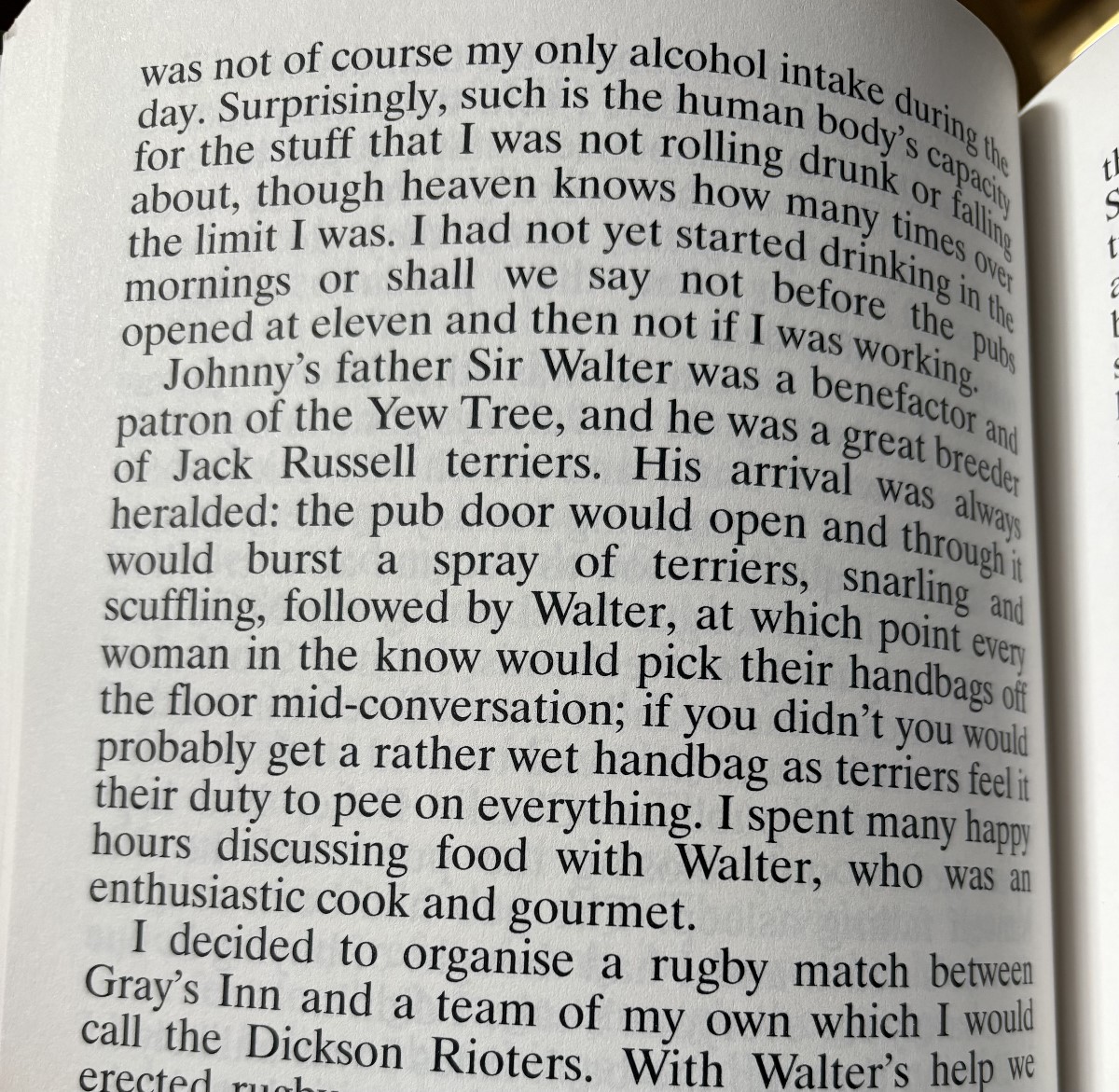
She watched as terriers pissed on handbags left of a pub floor and thought it charmingNot being a fan of dogs, my face having an encounter with a husky forty years ago, I could offer an additional category but I would add one more argument against them which was shared by Clarissa Dickson Wright in her book Spilling the Beans**** at page 130 which you can see under that thumbnail. Oddly it seems to be presented as a jolly positive.

Note #1: A discussion of XPA.
Note #2: Brew a Victorian Mild.
Note #3: Knut in Stockholm.
Note #4: Toronto’s Left Field Brewery makes the New York Times.

There are questions being raised which may lead to pointy fingers, too, about the proposal to stop unlimited 24 hour drinking at UK airports:

This week Michael O’Leary, the boss of Ryanair, made a bold suggestion. What if, he said, we applied the law that exists outside airports, inside airports? “I fail to understand why anybody in airport bars is serving people at five or six o’clock in the morning,” he said. Too often, he said, his flight attendants had to deal with drunk passengers. “Who needs to be drinking beer at that time?” Well, Lindzi Percival, 34, for one. The bride-to-be — who swears that is her real name — has arrived from Oxford, bound for Tenerife. She is wearing a wig with a bald patch, and is using a wheelchair thanks to a drinking-related injury at a recent wedding. The pint, for her, is a signal that the holiday has begun. “You start getting relaxed at the airport,” she says. “Also, it helps you not to feel silly wearing this outfit.”

Or wearing that wheelchair, Lindzi! Note also how the word “needs” is doing a lot of work up there.  The UK opposition shadow transport secretary, called it all “slightly draconian” which is sorta like saying slightly murderous if one knows one’s Draco. Wetherspoons’ profitable cash receipts depositor-in-chief, Timbo, is nearly apoplectic, describing the plan as “an overreaction”!!! Lordy, what language…

Conversely perhaps – and certainly calmer – from Imran Rahman-Jones at Edinburgh Pub Reviews, we have a keen eye on what makes a good pub like the Iona Bar special:

…there’s no real ale here. In fact, I can only really see two drinks wherever I look: It seems we’re all either seeing to a portly, white-haired Guinness, or a rakish tower of Tennents, its loops of bubbles excitedly rising. The lady sitting at the bar gets up to put something on the jukebox and Lola Young starts playing. The music causes everyone to raise their voices a few decibels and the atmosphere livens. It’s nothing too raucous, still being early in the evening before the football’s started on TV. But we’re all in a good mood sharing this living room-style space. The decoration is limited to a dart board, a few tasteful framed beer posters on the white walls and a swirly red and yellow pub carpet.

Ahh, that’s better. Plus, a very deft placement of the word “swirly” if you ask me. And, finally, just a reminder that there will be an edition of The Session next month celebrating Martyn Cornell’s final book Porter and Stout: A Complete History. Boak and Bailey shared the news in an update last month and this is another heads up that you need to get your thoughts organized in preparation.

That is it for another week. What will havoc will the new rules cause for Victoria Day celebrations this year? Will the North American edition of the World Cup wise up and lighten the burden placed on fans in response to low interest? Will I finally stop running the furnace? For these and many other stories ,hceh in next week. In the meantime, please check out Boak and Bailey who are posting every Saturday and adding to their fabulously entertaining footnotes week after week at Patreon. And look out for more of Stan’s new “One Link, One Paragraph” format. Then hunt out something in someone’s archives! Leave oblique comments on someone’s post from 2009!! Listen to a few of Lew’s podcasts and get your emailed issue of Episodes of my Pub Life by David Jesudason on certain Fridays. And Phil Mellows is at the BritishBeerBreaks. Once a month, Will Hawkes issues his London Beer City newsletter and do sign up for Katie’s wonderful self-governing totes autonomous website featuring The Gulp, too.  Ben’s Beer and Badword remains on pause but there is reading at The Glass which is going back to being a blog. Any more? We have Ontario’s own A Quick Beer and All About Beer is still offering a range of podcasts – and there’s also Mike Seay’s The Perfect Pour. Plus follow the venerable Full Pint podcast! And there’s the Craft Beer Channel on Youtube as well as the archives of the Beer Ladies Podcast.

*Previous observations on the observations from 2025, 2024, 2019, 2018, 2011, 2008
**Please sir, may I have some more off-flavour seminars? I’ll pay…
***For all the alt definitions of craft, this is a new one: “…some weirdo somewhere is the only person carefully preserving the memory of a particular technique or flavor profile is the essence of craft…
****She of Two Fat Ladies Fame. A book that will convince you that you may not have an alcohol problem after you read of what gin meant to her from age 25 to 40 or so. Which may lead you to believe terriers pissing on the clientele is a good thing for a pub.

It’s A Thursday In May And Here’s Your Greener Than Green Cheery Beery News Notes

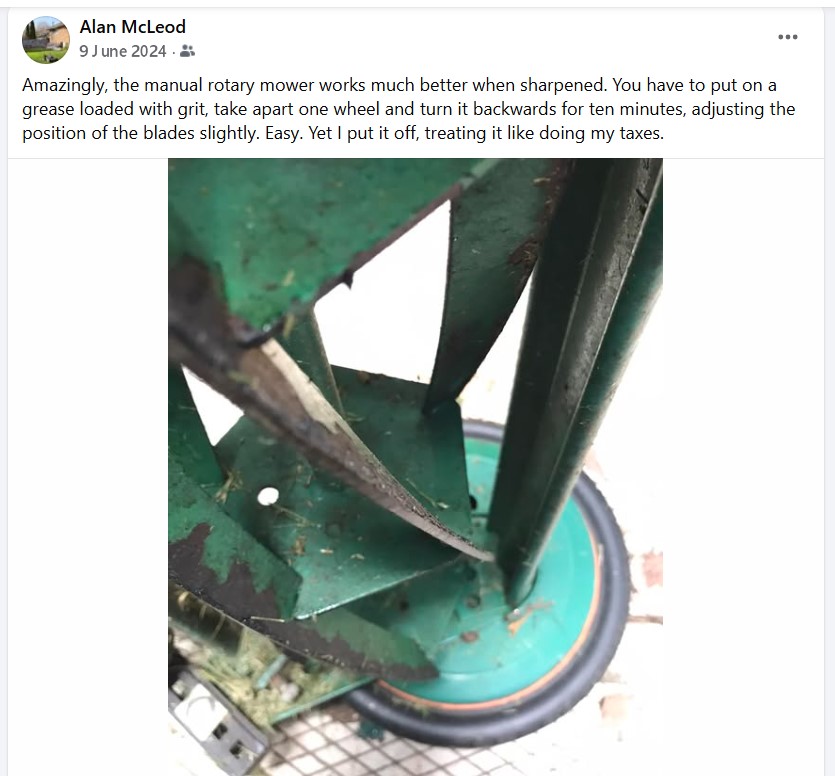
The tide has turned. The seasons have shifted. The dandelions have popped. The penny has dropped. It  is time. So the Beast has been released. I say Beast but it’s really Beast II, Son of the Beast. The Beast is still back there, there at the back of the shed. An over a decade old rotary mower that took five times longer to do the job, was a pain to sharpen and was retired last spring. It’s a terrible thing being cheap and lazy for so many years. Now, my lawn is mowed care of a combination of hydroelecric and nuclear power. Science.

What is going on? Well first up, Alistair is about to travel from Virginia back to the UK and shares a complaint that’s been complained since time itself began – how to narrow down where to go for a pint when the information online is just not there:

My biggest challenge though, and I am sure there are reasons for this, but with so many tied houses in the English part of my trip, it does get really frustrating when there is a shared platform with generic information, and almost universally no list of what is on cask in a given pub – this goes for chains like Wetherspoons as well. Yes, the many Fullers pubs in the city have elegant, beautifully designed websites, but again I can’t find out which beers of the Fullers Brewery range are available, making it pot luck to stumble across less regularly seen beers (at least from what I have been told) such as London Porter. I don’t want to single out Fullers, as I have seen the same with Shepherd Neame, Greene King, and Nicholsons, though several Young’s pubs tend to have at least a list, and occasionally pricing as well.

Is it a realistic expectation after decades of this sort of thing to expect every pub to logging what’s on tap?  I dunno. The failure seems to be the proof. Elsewhere, Pivní Filosof® is back after a few years of quietude. And Max is again on the move with his second post of spring 2026 looking for good beer by tram, with all sorts of obstacles placed in the way… like bad beer scenes:

Here comes the first tram, #5 heading to Vozovna Zižkov. I get on and start counting the stops. Fuck! Hlavní nádraží. All I can remember around there are the two overpriced spots in the station itself, and U Staré Pošty in Opletalova, a hospoda I’ve never liked for some reason. I get off, already resigned to the idea of having a Pilnser Urquell U Staré Pošty, when I tell myself ‘fuck it! I will cheat’, and change direction, towards the the tunnel that now connects the train station with Žižkov and the new building complex that has sprouted there in the last decade or so. Yeah, I’m cheating, in my own challenge, which I play alone – if you disapprove, good luck finding a better beer blog…

[Ed.: I thought he was talking about me. He wasn’t!] Offering a definite upgrade in locales, David Jesudason has the feature in Pellicle this week, a portrait of The Golden Smog of Stockton-on-Tees, County Durham, a pub which started life under the current owners with its own set of more serious challenges:

Their eyes even passed over the anti-fascist football sticker saying “our club, our rules.” When they spoke of how local shops were closing, they didn’t blame globalisation, politicians, or even the internet—the fault was with “immigration”. It was 2014, and owner John Christie sighed after overhearing their chat, wondering if this was the life he had now forged for himself. He had trained as a mechanic and joined the army; after leaving, he opened the pub in a former headstone shop. His goal was building a welcoming, inclusive space founded on his socialist ideals. Was he about to be dragged into their world First, he considered kicking them out. Then he paused. It dawned on him that if they went to another pub, their views would likely be re-enforced, or amplified in an echo chamber. It was at this moment that the unwritten manifesto of the Smog started to take shape in his mind.

On a larger and indoubtably less successful scale of internationalissimmo, we are all now just a few weeks away from World Cup madness. Perhaps not surprisingly, hotel reservations are below expectations. Here in Canada, we have a few of the games – and there’ll no doubt be any number of beer related stories in the coming weeks as there usually are when this rolls around – but this one  about Ermedin Demirovic is one of the best so far:

Back to Demirovic. As everyone will remember, before his country’s World Cup qualification play-off final against Italy at the end of March, Stuttgart’s Bosnia and Herzegovina international forward promised to buy everyone in the city a beer if he and his team-mates made it through. They did, beating the Italians on penalties following a 1-1 draw, and last Monday, Demirovic kept his promise. The event was staged near the Neckarstadion in collaboration with a local brewery, and more than 2,500 people turned up. “I didn’t expect so many of you to come,” Demirovic told the fans who took part. 

Sticking with the people of the grassy pitch, Boak and Bailey unpacked their findings on the disappearance of the retired fitba player as publican:

Historically, you could expect to retire from football before you were, say, 35 years old, with a lot of life left to live. And unlike today, even top flight footballers probably wouldn’t retire rich, even if they did have a little money put away. So, you’d need to find some kind of work. We can well imagine that running a pub was appealing because it’s a job that seems fun adjacent. Back to those headlines above: there’s also a sense that you could parlay your fame as a footballer into publicity for your new venture. Who wouldn’t want to be served pints by a local hero? (And perhaps tut at their fall from grace, and marvel at how fat they were getting, how red faced…)

I guess a key difference between then and now are the far higher wages paid to players in recent decades during their career. As a late teen, my father started out his working life at the firm of Hasties, a marine engineering firm in Greenock. In the lunch room he sat at the same table as local hero and Scottish national team star Billy Campbell whose career was cut short by illness and was given a job. A kindness from the owner, a local supporter.

Something else that is also retired but more often noted is a well priced pint in an London pub. Perhaps a well-trod topic but there was an interestingly specific grip in Tuesday’s daily (free) newsletter from The Telegraph:

We all knew the moment would come, but it was still a shock to read that we had entered the era of the £10 pint. Long gone are the days of venturing out with a tenner, sure of enjoying a few pints of bitter, and perhaps even having enough cash left over for a scallop from the chippy. No, bars in London today are charging as much as £11 for a pint of Moretti and £8 for a half of Heineken. There’s probably no going back – the rising cost of pints is an irreversible trend, like SUVs or smashed avocado – but mercifully you can find relics of the old, pre-£10 world, mostly outside London. Indeed, soon after the news broke, I raised a £3.50 glass of Gunpowder Mild in honour of reasonably priced pints in a pub in Clitheroe, Lancashire.

Hmm… how long ago a scallop and chips was going for the price of the leftovers from a few pints? I also wonder what the price travel to Clitheroe from London is, you know, to save that £6.50. Here are a few notes:

Note #1: Beer skates and sabres.
Note #2: Sue them, Yoko. Sue.
Note #3: Data-less trends are the best trends.

And Ray of B+B has done some solid hypothesizing over at Patreon in a piece entitled “Beer from the Witchwood” about the meaning of Jethro Tull’s album Songs from the Wood:

It’s from an article by Nick Freeman about music inspired by the mythic power of English woods and forests and it feels like a missing link between the Society for the Preservation of Beers from the Wood and Ray’s suggestion from a couple of years ago that real ale and folk horror feel somehow connected: “I don’t think it’s any coincidence that the Campaign for Real Ale, The Wicker Man and the English Morris dancing revival all landed at about the same time.” We think Freeman is right: the title of the album is a definite reference to the concept of ‘beers from the wood’. And on the cover, Ian Anderson looks like an extra from The Blood on Satan’s Claw or Witchfinder General.

Now don’t get me wrong. I think he’s on the right track. But… I am not sure. Not sure of the directness of the relationship* even if an indirect** one could be perfectly admissible. With something of a similar theme, ATJ has been making things up, including his recollections of a perfect beer fest:

I will admit that this summer beer festival is a composite of several I have attended. Some had great lagered beers and well-conditioned cask and an encouragement of children to play and provide a lightness of being, some had excellent food and at one even the Morris made sense to me. Then there was the one which included a beer garden, plus shaded woodland and a cooling river running alongside, plenty of sunshine, a genial intoxication and the amity of friends as well as meeting new people, children and dogs. So if you do know of a beer festival in the summer that has all of this please let me know.

And there is some odd financial news out of Belgian based macro gak producer ABInBev which has been finding sofa nickles and dimes in unexpected places:

Shares in AB InBev gained as much as 6.8% in early trading, adding to a more than 14% rise over the past 12 months. Strong beer demand in Mexico, Colombia and Peru drove volumes in the region up 4.8% in the period, offsetting a 3.1% decline in North America and a 0.4% drop in the region that includes China, amid a broad-based reduction in drinking. Revenue also rose in no-alcohol beer and in the non-beer segment.

Speaking of what is or is not, legal steps are being taken in Montreal to fight against a scourge… or perhaps a few scourges:

A Montreal microbrewery owner says he is being unfairly targeted by Quebec’s Alcohol, Racing, and Gaming Commission (RACJ). Le Saint-Bock, on St-Denis Street, brews specialty beers infused with candy flavours. The commission is accusing him of marketing to minors. “People like this kind of beer,” said Martin Guimond, owner of Le Saint-Bock. “It’s different, but there’s a market for people who don’t like beer and want to have a beer that tastes like candy.” Candy flavoured alcoholic drinks is a trend that other major breweries are hopping on as well. Coors has released a line of slushie flavoured seltzers, and the SAQ now sells a Popsicle vodka soda. “They have never been sued. But me, yes,” Guimond said.

Candy beer. Really? It’s this sort of thing that does make one wonder if there is anything left that can reliabily be called craft. And, speaking of which, Jeff posted about the latest move by the BA to buff up the image of US craft’s prospects, reporting (under a somewhat sheepish portrait of Bart Wilson) on a presentation by his leadership himself:

Two comments struck me. In his opening statement, Bart tried to strike a positive note, saying “This year the vibe is positive. It feels like we’re coming out the other side.” Then, near the end of the breakfast, he encouraged us to consider writing more “happy stories.” For the most part, the session yielded little new information. And, despite these comments, I wasn’t picking up a lot of positive news. Bart is no longer the just-the-facts BA economist who reports the numbers. Now he’s the head of a trade organization in a wobbling industry.

Wobbling indeed. I expect there are still some experts who will be moved by such puff even as production is down 17% over a five year trend to the end of last year.*** But the vibes? They are good. We read “… going to see growth this year – very, very strong growth…” Oh, that was 2021.  And in 2024 it was all about “mood management” and the niche.  Heavens. Stan connects more dots. And Brew York shares another observation:

One of the most positive numbers in the report — that independent breweries’ market share increased by 0.1 percentage points over last year — should be taken with a grain of salt. The Brewers Association’s classification of craft beer means that three breweries owned by MillerCoors for most of 2024 are now considered craft in 2025 after being acquired by the large but independent brewery holding company Tilray. Niche brands that are more likely to market themselves like big beer, like Garage Beer and Outlaw Light, are also defined as craft.

That reference to Tilray is interesting. Fourth biggest US craft brewer in 2025. But we must remember that according to the current version of the shifting sands that are the BA’s definition of “craft brewer” the requirements of actually being, you know, a “brewer” includes the principle that a firm must have “have as its primary business purpose the resale of the brand or brands it controls.” Primary. According to Tilray’s most recent financial statement, its craft beer holdings represent 27% of its activities after its cannabis (31%) and pharmaceutical operations (40%). So… not really that primary. Probably fits squarely in the definition, however, in special BA-nglish. But, you know, happy stories!

That is it for now. Let’s keep an eye out for happy realities instead. With any luck, the tomatoes will start finding their place in the garden and please check out Boak and Bailey who are posting every Saturday and adding to their fabulously entertaining footnotes week after week at Patreon. And look out for more of Stan’s new “One Link, One Paragraph” format. Then hunt out something in someone’s archives! Leave oblique comments on someone’s post from 2009!! Listen to a few of Lew’s podcasts and get your emailed issue of Episodes of my Pub Life by David Jesudason on certain Fridays. And Phil Mellows is at the BritishBeerBreaks. Once a month, as noted, Will Hawkes issues his London Beer City newsletter and do sign up for Katie’s wonderful self-governing totes autonomous website featuring The Gulp, too.  Ben’s Beer and Badword seems to be on pause since November but there is reading at The Glass which is going back to being a blog. Any more? We have Ontario’s own A Quick Beer and All About Beer is still offering a range of podcasts – and there’s also Mike Seay’s The Perfect Pour. Plus follow the venerable Full Pint podcast! And there’s the Craft Beer Channel on Youtube. Check out the archives of the Beer Ladies Podcast.

*Ian Anderson, creative lead of Jethro Tull had a busy 1976. In addition to making (and producing) Songs from the Wood, he got married a rather rich lady and moved into lodgings at Pophleys Estate which sat on 500 acres. The main house was up for sale in 2009 on a lot of 13 acres and was described as being supprounded by “a large belt of woodland” so it could be in addition to the era’s folk-rock theme these songs of his might also be from his wood.
**According to Richard Boston in “Beer and Skittles” at page 95 the Society for the Preservation of Beer from the Wood was founded in 1963. Songs from the Wood came out in 1977. So a bit past the folk-rock revival and four years after The Wicker Man hit the cinemas. During this time – and here is the thing – we move from the era of the First Doctor to Fourth. From Gerry and the Pacemakers to the Sex Pistols. My birth to my teens. Yet if detective shows set in England have taught us anything, it’s always the green man behind the scenes and everyone is down the pub sonner or later.
***And… the numbers are already again down another 2% in 2026, just one third into the year.

I Declare! These Beery News Notes Are Extra Interesting! Fascinating Even!! Aren’t They… They Are, Right??

Is this fascinating? I think about that at certain quiet moments. I mean I do my best but I can’t answer that question. Only you can. That is the one thing writers don’t talk that much about. The readers. 1.7% of me fully believes that any attention I receive in response to these scratchings is by sociologists asking “why?!?!?” But that is fine. They… like you… are readers. You will weigh the evidence and make your judgement. We just have to remember as our friend Laura H. learned this very week: “it was revelatory to them that beer people exist.” As least I acknowledge you exist. I do. That’s gotta be worth sumthin’.

Where to start? Big news from the seven seas to start with. I love this story about a brewery on a boat, continuing the fine tradition reaching back to the 1660s and again in the 1850s. Except this time it was not Arctic explorers wiliing away the winters when the seas were frozen, as Jessica Mason reports:

…the cruise’s bar manager Giulio Giannini said: “Basically, we desalinate seawater through osmosis. The resulting water is pure H2O, nothing more. From there, the entire brewing process begins.” According to Giannini, all production takes place entirely on the vessel, this encompasses milling and brewing right through to fermentation and maturation. A feat that puts the task into the realms of challenging, but not impossible. Speaking to the drinks business, beer fan Mark Cole admitted that, for him, the move to house a microbrewery onboard “might make me actually consider a cruise,” showing that the positives for the sector are that it will help broaden the audience for cruises in general, attracting beer drinkers.

Would that swing the decision to take a cruise for you?  All a bit too busy for me. Me, I am more attracted by these excellent observations of a moment of quiet from ATJ:

I am not the first person in the bar, there is another drinker to the right of me, sitting on a banquette against the wall, next to the fire burning in the grate, white wispy hair hoping to reach his shoulders, perhaps a memory of his youth as a rocker. His glass is half full, beer, amber and what he has drunk so far has left a playful trace of lacing on the glass. He is not reading, neither looking at his phone; he is just looking ahead, and doesn’t seem to have that eagerness on his face, a pushing forward of the upper part of his body, that might indicated that he wants to talk. He seems happy with the stillness of the bar, and like him I am also contented.

I like the stillness of a bar. It’s like taking a nap but you aren’t even at home. Speaking of things that aren’t like other things, I was lobbied to review what I had already noticed, Ben Gibbs‘ piece (at his newsletter with the excellent URL “soberboozersclub”) on alcohol free beer being offered by Bathams:

Alcohol free beer often arrives with messaging attached to it. Moderation and improvement. It’s framed as a better choice, or at least a more considered one. That language doesn’t land here. These pubs aren’t built around self-improvement, they’re built on ritual. The same pint, the same place, the same faces, the same small actions repeated over time until you don’t have to think about it anymore. For anything new to settle into that environment it has to feel ordinary. That is what Bathams alcohol free does. It sits on the bar without drawing attention to itself. It arrives in the same shape and occupies the same space in your hand. Nothing else in the room shifts to accommodate it.

That fits. Just as being “still” means quiet is can also suggest continuity.  Next, Knut. Knut? Knut! Knut was once a travel correspondent for this here publication, back when we had a few more voices than just me. Recently, Knut has picked up his pen again… or his keyboard I suppose… and has been writing on his newsletter, this time about the difference between what was Norwegian March Beer, then Easter Beer, then Spring Beer and then Export Beer:

The name was later changed to Påskebrygg (“Easter Brew”), and the sales period ran from March 1 to March 31. The name Påskebrygg met strong opposition from Christian groups, particularly the organization Kristenfolkets Edruelighetsråd (the Christian Temperance Council). The brewing industry decided to change the name, stating that it wished to respect the feelings of those who supposedly took offense at it. The motives in the ads and the bottle labels focused on a new activity – domestic ski tourism. We enter a new period with more leasure and, at least for some people, more disposable income. Following a naming competition, the beer was released in 1939 under the name Vårøl (“Spring Beer”). Påskebrygg and Vårøl were sold from 1934 to 1940. In the postwar years, Eksportøl (“Export Beer”) became their successor.

Make sense? Good. Me, I miss my tenuous access to Easter Beer. What else is going on? I need to pick up tips from Retired Martin who has been on the road again, this time wandering around Cologne, Germany – or, rather, standing around:

I knew I had to visit Gaststätte Lommerzheim (“Lommi’s“) at some point, why not now ? “It’s like the Hare and Hounds” I tell Matt. Frankly, you queue for opening, either for lunch (11) or teatime (4.30), or you miss out. James and Matthew weren’t convinced by the appeal of standing outside a suspect looking building on an unpromising street for a quarter of an hour when nicer looking open options called out across the Rhine. But as we chatted to two lads who’d travelled from Chicago (again !) with Lommies top of their list they began to succumb. And then at 16:30 the back door (the one marked “Keller”) opened, leaving those of us staring at the front door to make a dash for a table.

Staying in Germany but waiting much longer in the line up, Andreas Krennmair has been able to clarify a question that has bothered him for sometime about Munich’s Oktoberfest:

…the current restrictions on beer at Oktoberfest, namely that it can only be from one of the “traditional” breweries from Munich whose beer conforms to the Oktoberfestbier PGI regulations, which requires them to have a well going several hundred metres deep down, are not rooted in the festival’s own history. It is essentially a form of regulatory capture to make it exclusive to Munich’s big 6 beer brands that has been successfully defended in court before.

Andreas located documents showing that in 1895 there were 19 breweries with stalls at the festival. It’s a scam! Fight the power!! Leaving Germany with a few last stops, Franz Hofer wrote this week about the breweries in the towns and villages along the trainline crossing the border between Munich and Salzburg – like Privatbrauerei Schnitzlbaumer in Traunstein:

Renovated recently, Schnitzlbaumer boasts vaulted ceilings and large feature windows with views of the valley. The bar is backlit in that early 2000s atmospheric kind of way, and copper kettles glimmer in the subdued light. It’s a nice, airy space perfect for whiling away the early evening with a few beers. As for those beers… the best of the lot is their Weissbier, a richly textured beer that, with its elegant notes of banana custard and sprinkle of allspice, drinks almost like a Vitus. For what it’s worth, Schnitzlbaumer’s beers aren’t my favourite among Traunstein’s three breweries — a few hits, a few misses.

Reading that, I suddenly realize I only picked that passage so I and now you can say Schnitzlbaumer. Schnitzlbaumer. Schnitzlbaumer. As I approach retirement, I am never that surprised what I knucklehead I am. (Was that why the boss gave me that big pat on the back?) Still, probably more likely to see me on a train holiday like that compared to a cruise. But that’s me.

Note #1: A.I. sourced? Or just drifty and even a bit presumptuous?
Note #2: “It’s like K-Pop…
Note #3: OK Zedder.

For me, beer is like sports. Some folk drill down into the OBP, SLG and OPS of baseball players. Me? I just liked the Expos and now just like the Red Sox. They have sucked. They have won it all. So I do find it odd when beer writers call those at a different level of fandom abstraction “mansplainers” when they are clearly just shit talkers. If we accept that people like what they like they will also talk shit about what they like. ‘Twas ever so. In fact, there is so much shit talked about beer one can wonder where the facts may be found. But sometimes a study is revealing in terms of both ends of the research as Pete showed this week in his review of 15 mass market mainly lighter beers:

Many drinkers do unite in insisting that all the big multinational brands taste the same. This is not true. Some taste faintly of beer. Others taste of nothing. A sad few taste so bad, you wonder if you might have run over the brewer’s dog years ago and they’ve been plotting their revenge ever since. Nonetheless, I’ve tried all the most popular beers myself and ranked them from best (or least worst) to worst. Here’s hoping this helps you next time you’re faced with nothing but the usual pub suspects. 

The findings are solid. Asahi is “clean and crisp, designed to cut through fatty fried food“, #3 Guinness “kept well… it is much better than this faint praise suggests” and #4 Heineken is a “little sweet, but it has integrity.” One thing I have always disagreed with is the idea that light beers are distinct from good beers. As homebrewers know, making something subtle is both more difficult and more rewarding than a bombastic brew. I’m quite happy with anything on the upper end of Pete’s list.

Going for something a bit more haute, Alistair checked one tick off his list when he headed to the hills of Virginia and Alpine Goat Brewing:

To get to Alpine Goat there is a little bouncing along a gravel track, but the views from the brewery and its beer garden over to the Shenandoah National Park are more than worth it. Seriously, if there is a more picturesque brewery in Virginia, I haven’t been there yet. Having packed the kids off with a ball, frisbee, and boomerang to snag a table with space for them to play, we went to the bar and naturally I ordered the pilsner…

Frisbee and boomerang? Lordly. Next, why did I think “PelliProtz!!!” when I checked my emails this morning?  Because this week’s feature in Pellicle is by Roger Protz who wrote about Bodger’s, a barley wine from The Chiltern Brewery which has been branded in honour of Roger Protz:

A “bodger” today means someone who does a shoddy job, cuts all available corners, takes the money and runs. But centuries ago, in rural Buckinghamshire, it meant something quite different. It referred to craftsmen who built chain-link fences for farmers to safeguard their crops and animals. Bodger’s, a barley wine from The Chiltern Brewery, celebrates that tradition. As mentioned, the brewery has recently released a special edition of the beer—one with my name and image on the label. It’s Chiltern’s generous way of thanking me for my support towards the brewery, and the wider independent brewing sector, over a writing career that has spanned several decades. The beer is a powerful 8.4% ABV, and has helped to restore a beer style with its roots in the 18th and 19th centuries.

Worthy. And I see that Katie Mather made the news this week, sharing her analysis of the differences with recent brewery closings in the UK with Jo Gilbert:

Speaking to Drinks Retailing, beer expert Katie Mather noted that “each brewery has different issues.” Regarding Molson Coors’ acquisition and subsequent closure of Sharp’s, she said: “This is a common pattern in the beer industry. Small breweries are picked up by bigger ones to extract value and ultimately crash the brand into obscurity.” Conversely, she added: “Brewdog was gutted by its owners’ greed and hubris and, sadly, it’s the workers let go on a 15-minute Teams call and the ordinary people who thought they’d be able to make some money from Equity For Punks who are left with nothing.”

Correct. And there is a great story of another sort death of craft brewing’s irrational and perhaps also manufactured exhuberence in the stock valuation of Boston Beer over the last five years, as reported in Seeking Alpha:

And there’s even another sort of interesting change in the beer market in Korea these days, too, as reported in The Korea Times:

A man in his 20s agreed, noting the appeal. “Japanese beer has a premium feel,” he said. “When I want something different from what I usually drink, Japanese beer is my first choice.” The current boom stands in sharp contrast to recent years. In 2018, Japan exported 12.5 billion yen (about 118.2 billion won) worth of beer to Korea. Exports then plunged to 900 million yen (about 8.5 billion won) in 2020 following the launch of the ‘No Japan’ boycott. The movement began in 2019 after Tokyo restricted exports of vital semiconductor materials, viewed by Korea as an economic retaliation against a Korean Supreme Court ruling that ordered Japanese companies to compensate victims of colonial-era forced labor. 

Finally, speaking of politics and division, the Minocqua Brewing Company in Wisconsin has made an offer that one day is guaranteed to pay off:

“Our notorious offer of free beer when ‘he’ dies is still on the table, and for all those who thought that internationally viral post was a little too dark or ‘classless,’ here’s exhibit ‘A’ on what’s good for the goose is good for the gander,” the statement there read. “For the Fox News and Daily Mail reporters who shamed us cuz he’s ‘still the President,’ will you be shaming ‘Shitler’ as well about his most recent post?”… The brewery added an update, “we meant the Madison Taproom because that’s open all year, if he dies in the summer, then it’s gonna be the Minocqua Taproom.”

That’s a date! I mean it would seem petty and even crass but, jeese, how many other breweries are going to do the same thing? Do you agree? Is going low a no go? As you consider that, please check out Boak and Bailey who are posting every Saturday and adding to their fabulously entertaining footnotes week after week at Patreon. And look out for more of Stan’s new “One Link, One Paragraph” format. Then hunt out something in someone’s archives! Leave oblique comments on someone’s post from 2009!! Listen to a few of Lew’s podcasts and get your emailed issue of Episodes of my Pub Life by David Jesudason on certain Fridays. And Phil Mellows is at the BritishBeerBreaks. Once a month, as noted, Will Hawkes issues his London Beer City newsletter and do sign up for Katie’s wonderful self-governing totes autonomous website featuring The Gulp, too.  Ben’s Beer and Badword seems to be on pause since November but there is reading at The Glass which is going back to being a blog. Any more? We have Ontario’s own A Quick Beer and All About Beer is still offering a range of podcasts – and there’s also Mike Seay’s The Perfect Pour. Plus follow the venerable Full Pint podcast! And there’s the Craft Beer Channel on Youtube. Check out the archives of the Beer Ladies Podcast. See you next week when I will be retired. Hence that photo up there. If you come back next week we’ll play a game called “did Al just screw up his future finances putting him in the poor house by when he hits 76 in 2039?” Oh. Me. Nerves.

The Very Last… Summative Even… Fresh Yet Thoughtful Beery News Notes For Winter 2025-26

Spring!  Tomorrow is spring!! On a Friday even. How swell. The sort of moment that always reminds me of some lyric or another from Old Blue Eyes himself:

Spring is here
Why doesn’t my heart go dancing?
Spring is here
Why isn’t the waltz entrancing?
No desire, no ambition leads me
Maybe it’s because nobody needs me?

Wow. Not what I was expecting… gee, Frank. Lighten up a bit, wouldja? Me, I am all zippiddy doo dah myself. Look at those sweet peas under the grow lamp! The waltz entrances. Hmm. Why Frank? Why? Could it be it’s the fading night life scene that the man once knew and loved that has him lost and wandering, as the news The New York Times shared this week tells us:

…it’s a complicated prospect for restaurants, which traditionally make their highest profit margins on alcohol sales. Preparing food requires perishable ingredients and a large amount of labor, while alcohol is shelf stable and, except at the most dizzying heights of mixology, requires less work than cooking. As independent restaurants struggle with higher costs of all kinds — rent, labor, ingredients — the hollowing out of the most profitable part of the menu couldn’t come at a worse time. According to David Henkes, a senior principal at the food service research firm Technomic, alcohol sales are slumping in every category of the restaurant industry, from fine dining to casual establishments, with 31 percent of operators reporting “severe declines” in alcohol sales in 2025.

Yikes! We always here about the younger folk laying off the hootch – but even the set that clinks and drinks is clinking a lot less. But when was it ever the way it used to be? 1910 apparently. Nigel Sadler posted some images from The Times ‘Beer in Britain’s Supplement from April 1958, including the fascinating tale of the creation of the Hops Marketing Board as well as this infographic on the increase in duties on beer from 10% in 1910 to 50% in 1958.  Winning two World Wars as your empire collapses will do that for you.

Note#1: Michael Caine before he was famous.

Boak and Bailey unpacked their approach to writing a bit this week as they closed down one of their outlets, a newsletter by Substack where they unpacked their personal impressions perhaps a bit more. They shared that approach on one post this week, describing a scene Ray encountered when he would out and about with pals:

You know how you sometimes know something is going on, even before you see anything yourself, because people around become restless and twitchy? Even before the sword dancers entered the pub people noticed them in a group, standing outside peering in. Then their leaders, white haired with red neckerchiefs, entered and negotiated permission with the bemused young bar staff. Dancers and musicians shuffled in and found space for their display among the drinkers and diners. Then, off they went, stamping and twirling with berzerker energy, accompanied by fiddle and recorder… There were whoops and applause after the final somersault and, after they’d jogged out of the pub in single file, it felt as if the crowd had been injected with fresh energy. Between amusement, disbelief and admiration, it woke everyone up.

Whoops!* I have no idea what and who these sword dancers are. Clearly not, you know, the Highland lassies. Is this some sort of militant branch of the Morris dancer set? Speaking of militant hobbies, Phil Cook has been tracking the use of beer related answers to crossword clues in The New York Times and has released his report on the 2025 season:

The over-reliance on ale and ipa (and their plurals) has increased. They were about a quarter of last year’s references; now it’s 40%. That kind of frequency means there’s an impossible choice between repeating the same clue over and over, or reaching for one that’s only less common because it’s not very good. ale appeared on successive days several times — often with grim setups like ‘Pub drink’ or ‘Pub order’ — and one bleak fortnight3 had five of them, interspersed with two ipas, none with great clues.

I’m a Monday and Mini sort of crossword guy so I don’t see as much of this but Phil’s obsessive dedication to detail is impressive which backs observations like “there weren’t any debuts of new terms that seemed to signal any kind of shift in the zeitgeist.” Perhaps this year we will see a four letter answer for the clue “going out of style” which offers direction in at least two ways.

Speaking of style, Gary Gillman had his research on the founding of the green beer phenomenon in the USA published in Craft Beer & Brewing, reaching back ever so slightly into the 1800s:

In 1899, Milwaukee’s Pabst Brewery already was well known for its Blue Ribbon Beer, its bottles at that time festooned with a real blue ribbon. That year, as a marketing gambit, Pabst replaced the blue ribbon with a green one on a portion of its beer packaged ahead of the holiday. It also put a shamrock on the label in lieu of the usual hop leaf, with marketing that proclaimed, “Hibernians to celebrate St. Patrick’s Day.” (That’s according to Printer’s Ink, an advertising trade journal from that time.) However, the beer itself was the usual pale lager—it wasn’t colored for the special day. 

Which brings us to three more notes on St Paddy’s Day:

Note #2: “…all good-humoured, not messy yet…
Note #3: “…a local bar owner to invite me to meet him for “a chat…
Note #4: “...I’ve seen things you people wouldn’t believe…
Note #5: “…Liverpool is carnage…

Those last two notes are more along the lines of what was experienced the weekend before the day over in Waterloo, Ontario – a university city:

People living at Oakwood Manor, an apartment building near Marshall Street, said large crowds surrounded the building. Residents described partygoers climbing over fences, knocking some down entirely and leaving garbage behind. “They’re destroying private property, but they don’t care,” said Debra Hines, who lives in the area. Residents also said they saw people urinating in the parking lot. “They were [also] coming and stepping on people’s cars,” said Janet Peterson, another resident. Bridget Kocher, who also lives in the building said the repeated street parties leave residents confined to their homes several times a year.

Kids today! On a far more civil note, we don’t write about homebrewers enough. Something the coming recession will cure I am sure. But the Windsor & Eton Homebrewers Club described how the group did some compare and contrast of a few clones and made some… well, to be honest, observations on the state of Pilsner Urquell in the retail marketplace:

 I wish no disrespect or sleight to the founding fathers of Pilsner, but we were scratching our heads a bit. We used Pilsner Urquell as our reference for all our clones.  We found PU to have great bready richness with a great soft rounded mouthfeel.  A slightly sulphur smell and flavour – as is characteristic and a touch of ester, but also we found it with a sticky almost stodgy sweetness, not crisp as we were expecting.  However, it transpires that Ian found some bottled Urquell somewhere up North, which was apparently much better, so maybe the canned Asda variety isn’t a good comparator?

Frankly, I had already bookmarked this piece by Kieran Haslett-Moore from well before the Beer Nut unleashed the stinging taunts urging folk take notice of the death of the themed pub, once a cross-cultural cornerstone:

At the start of this year the Wellington Belgian Beer Café, Leuven, announced it was closing its doors after 25 years. Back in 2000, Lion started to brew Stella Artois under license and all of a sudden Belgian beer culture was in vogue. Leuven in Wellington and De Post in Auckland both opened, offering the full tourist-style Belgian beer experience with mussels, frits, draught Stella, Hoegaarden, Leffe and assorted bottled beers from the lowlands… At the start of this year the Wellington Belgian Beer Café, Leuven, announced it was closing its doors after 25 years….  In 2004 Christchurch got Café Torenhof which limped on after the earthquakes before running out of steam in 2020… Café Torenhof lives on in the way your great aunt does because you inherited her Welsh dresser and it sits in the corner of the living room. When the Christchurch café closed, its interior kit was sold to Craftwork in Oamaru…

While things go out of style, other things arise as Ruvani shared recently when she discussed the “Spaghett”:

For those not already in the know, a Spaghett is a simple two or three ingredient (depending who you ask) beer cocktail involving a light lager, a bright bittersweet amaro and either a slice or splash of fresh lemon (optional). The OG Spaghett consists of a Miller High Life bottle minus an inch or two and topped off with Aperol and lemon… a ‘poor person’s Aperol Spritz’ where the champagne is replaced with the Champagne of Beers. Until recently Spaghett enjoyed under-the-radar industry-insider status but a combination of social media and the cost-of-living-crisis have brought it into the mainstream, as drinkers nationwide are discovering the delicious pop of tangy, herbaceous aperitivo against clean, gently sweet and super-carbonated light lager finished up with a refreshingly sharp citrus twist.

Jeff published a piece on the ABSs of malt this week or, more specifically, the question of whether a base malt’s flavor come from the barley variety or the malting process:

 …it’s better to think of malting and brewing as connected processes. If you recall our previous conversation, the maltster has many choices to make, all related to the “biochemical levers” Matt referenced. It’s very much like the choices a brewer makes on mash pH, mash temperature, the number of rests and so on. It’s not like there’s a “correct” mash temperature; brewers make choices based on what they want out of a beer. The same is true with malting, and it’s why one brewery might choose a malt where one set of choices was made, while another brewery would want a different set. 

Speaking of grain, there was a Kernza sighting this week, about a year and a half since the last time the branding for thinopyrum intermedium passed by my eye. The Guardian reported on its use as Deschutes:

The secret ingredient is a grain called Kernza. It’s a perennial wheatgrass with a slightly nutty flavor and a climate-friendly reputation. Deschutes teamed up with the outdoor clothing brand Patagonia to craft a new beer using the grain. When asked how customers react, brewer Ben Kehs laughs: “They say what’s Kernza?” Kernza has deep roots that pull carbon from the atmosphere and require less water. There is less tilling and fuel use because it doesn’t have to be replanted each year. Kernza can be used as an alternative to barley, which along with hops and water, is one of beer’s three core ingredients. “All of them in one degree or another I would say,” Kehs explains when asked which ingredients face climate threats.

Finally and speaking of the exotic, Ron has been back in Brazil judging at a competition where he seems to have been quite happy with the set up:

I have my usual breakfast. Call me Mr. Boring. I don’t care. It’s what I want to eat. And I’ll fucking eat it. That’s the great thing about being old. Not really having to give a fuck what anyone thinks…  I’m on the same judging table as yesterday, with Suzanne and Alan. I’m happy with that. We rattled through the flights yesterday. Coming to a consensus without much argument. Which saves much time. And annoyance. Especially annoyance. The last thing I need is extra stress… After lunch, there’s a real treat. Non-alcoholic beers. Six samples. All three sour styles are pretty good. With the Catharina Sour the pick of the bunch. The best non-alcoholic beer I’ve ever drunk. Which may be quite a low bar. Or was. It’s been raised considerably now. That was much better than expected. Some flights of alcoholic beers were far worse. Not sure what that tells us. There’s then a long wait for the pre-BOS. Like two fucking hours. Such fun sitting and sweating. Watching Match of the Day helps pass a little time. 

Good to see that while his language hasn’t mellowed, his relationship to booze has. And he’s learned a bit of Portuguese on these trips, too.**

Is that it? That’s it! Another week and another winter moves into the history books. While we see what the spring may offer, please check out Boak and Bailey who are posting every Saturday and adding to their fabulously entertaining footnotes week after week at Patreon. And look out for more of Stan’s new “One Link, One Paragraph” format. Then hunt out something in someone’s archives! Leave oblique comments on someone’s post from 2009!! Listen to a few of Lew’s podcasts and get your emailed issue of Episodes of my Pub Life by David Jesudason on certain Fridays. And Phil Mellows is at the BritishBeerBreaks. Once a month, as noted, Will Hawkes issues his London Beer City newsletter and do sign up for Katie’s wonderful self-governing totes autonomous website featuring The Gulp, too.  Ben’s Beer and Badword seems to be on pause since November but there is reading at The Glass which is going back to being a blog. Any more? We have Ontario’s own A Quick Beer and All About Beer is still offering a range of podcasts – and there’s also Mike Seay’s The Perfect Pour. Plus follow the venerable Full Pint podcast! And there’s the Craft Beer Channel on Youtube. Check out the archives of the Beer Ladies Podcast.

*Remember: you can’t have whoops without an oops!
**Ron’s honesty when on these things is what makes his reports so worthwhile if only as a deterrent: “I’m so fucking knacked. We’ve judged so many beers today. And lots of strong ones. I never want to drink beer again. I’m so done with it. I just want to drink some cachaça and sleep.” 

Your Thursday Beery News Notes For The Week Of The Green And The Black

It’s that time of year. When being born of Scottish parents means nothing. Nothing!!! I think that is what Governor Kathleen Mary Courtney was actually saying when my FB pal (and fellow garlic grower) Sean took this photo at the Executive Manstion in NYC the other day. The Governor even has a pint of stout. Stout is in. Everybody says so. And see me, I am buying that black can of the 0% stuff quite happily. But what even is a stout? Does the Beer Nut have clarity on the question he might share? Let’s see:

Though a full 7% ABV, it looked a little thin on pouring, and is red-brown in the glass, rather than black, with a fast-fading head. The aroma is sweet, with lots of caramel plus an aniseed-candy herbal side. It’s not thin, I’m happy to say, but it doesn’t quite reach the realm of creaminess, and I wouldn’t have guessed it’s as strong as it is. The flavour is plain. Chocolate forms the centre and then doesn’t go anywhere especially interesting from there. There’s a little buttery toffee and a slightly acrid smoky side. Some coffee roast would have been nice; likewise proper hop bittering to take the edge off all the sugar, but neither materialises. 

That’s helpful. It’s not that. It’s not that. And it’s really not that. But still it sells. One question we saw this week on the question of stout is this: why are the Irish turning to Beamish in their hunt for stout? Well, one reason certainly makes common sense:

Another undeniable draw is that Beamish is often the cheapest stout available in pubs.  A pub in Dublin, a county where pints have become infamously expensive, recently advertised a pint of Beamish for only €5.40. Ciarán said the drink is generally at least 50c cheaper than other stouts, one of the reasons he said students have always been fond of it. Another Beamish fan, Richard, thinks the popularity of the stout solely comes down to its price and availability. “It’s consistently €1 or 50c cheaper than Guinness,” he said, adding that as it is owned by Heineken it is also widely available in bars. “I don’t think they’re doing anything special other than being a small bit cheaper,” he added.

Always looking for value is The Tand who has found renewed blogging energy with five posts so far in March after taking a break since last November. Which post to choose as a classic of the man’s oeovre? Consider these comments on the Hand and Marigold in Bermondsey and how they reflects both his careful observations and his established standards:

The pub itself is handsome, well laid out inside and the staff in my experience are helpful. Glasses are oversized ensuring a full pint and the cask beer is well-chosen, and by and large has been in very good condition when we’ve visited. Perhaps it is the times we’ve chosen, but it hasn’t been very busy when we call in, but us being a bit older (ahem) it tends to be during the day.  They are however extending it by opening a room downstairs, so hopefully it is doing fine. One observation is that twice we’ve called in winter and both times the pub has been pretty cold.  Maybe that’s a money saving exercise, but it doesn’t really do it for me.  I expect to be warm in the pub.

It’s good to know what you want and what you like. Conversely, a check with the archives tells me that as early as 2011 I was somewhat ambivalent when it came to Innis & Gunn beers. After fifteen years, has the rest of the marketplace has caught up? We have learned that the administrators have begun to break up the assets:

The brand and its intellectual property has been included in a £4.5 million sale to Tennent’s lager owner C&C Group. However, the Perth brewery at Inveralmond Place is not included as part of this deal. C&C Group was a minority shareholder of Innis & Gunn and brewed its lager. Administrators said the collapse of the company was due to a combination of factors including a “decline in consumer spending and rising cost pressures”. “It is with deep regret that redundancies will need to be made,” they said in a statement. “The administrators would like to thank all the employees of the companies for their hard work.”

Imran Rahman-Jones had fonder memories from a happier time for I&G:

My introduction to craft beer came from my eldest brother. In the late 2000s, when I was still a teenager, small brown bottles started appearing on the top shelf of the fridge. He’d discovered this Edinburgh brewery called Innis & Gunn and their bourbon barrel-aged beers. I was allowed to try a few sips and was surprised at what hit my tongue. My experience with beer up until then had been the odd warm can of Carlsberg in the park, or a taste of my dad’s bitter, which rarely breached the 4% ABV mark. This stuff was intense and alcoholic, like drinking boozy butterscotch. I could only really get through half a glass.

Maybe it was the moment. Boozy butterscotch was sort of where I was going, too. Was I wrong? Or was it an acquired taste? What even is that?

Is there a more backhanded compliment, a more passive-aggressive judgment, a more of kiss-of-death phrase, than “Well, I guess that’s an acquired taste”? It’s also rather centering of a certain type of American suburban taste mindset. I mean, if you grew up in another culture, black salty licorice, anchovy, sea urchin, espresso, fish sauce, huitlacoche, kimchi, vegemite, lutefisk, curry and scores of other so-called “acquired tastes” would not be acquired tastes at all. They would be innate. I grew up eating Scrapple, for god’s sake—an “acquired taste” for anyone but a person born in the Philadelphia metro area. Anyway, my point is this: Try pastis. Open your mind. Grow up. Make peace with your childhood dislike of black jellybeans.

I had no idea. I thought everyone went through a boring sophmoric late teen phase, reading Hemingway and drinking Pernod in the 1980s. You know, the one that preceded the boring sophmoric late teen phase, reading Waugh and drinking Pimms in the 1980s?  What!!?!! It was only me?!?!? Time for notes as I cope with that realization.

Note #1: “Drinking trash NA beers so you don’t have to…
Note #2: no, not regulations and, no, nothing set.
Note #3: “…it is just a widget.

It may be just a widget but the unexpected upswing in widgettery seems to be continuing according to BMI:

…craft beer remains up 0.3% by $$ with volume down just 1.6% yr-to-date thru Feb 22 in Circana multi-outlet + convenience data. That’s still lagging total beer, which grew 1.6% by $$ with volume off just 0.1%. So craft shed 0.1 share. But trends are much healthier for craft and total beer than they were thruout last yr…

Still… “where’s the Allagash White?” asks Michael Stein in DC:

So what’s replaced Allagash White? Hard to say exactly. What wasn’t there in 2021? Unsure. And what’s there in 2026? Now that question I’ve got answers to. There’s Mickey’s Fine Malt Liquor and there’s Schlitz Bull Ice. There’s Coors Banquet and Coors Light. There’s Pabst Blue Ribbon, and there’s Steel Reserve. And while I just listed six brands, there’s only two breweries that own these / have these brands as subsidiaries: MolsonCoors and Pabst. There’s Modelo, Modelo Michelada, Budweiser, Bud Light, Busch Light, Michelob Ultra, Devils Backbone, and Stella Artois. These are all owned by Anheuser Busch InBev. Then there’s Lagunitas, Tecate, Heineken, and Heineken Silver. Guess who owns all these?

That’s a bit of reality right there. But not everyone wants the real when it comes to drinking, as B+B found out:

We were astonished recently to see someone sitting in the pub wearing a virtual reality (VR) headset waving two controllers around to manipulate objects in a virtual world.It just looked so weird and incongruous. His eyes were covered for one thing which immediately gets you into uncanny territory. Then there was the vigour and weirdness of his movements… At one point, he got up to go for a cigarette while still wearing the headset. We later learned that he could, in fact, see the entire room through the magic of augmented reality – something subtly different to virtual reality. But in the moment, it really looked as if he’d just decided to stroll through a busy pub while effectively blindfolded.

Young people today!  At least this isn’t the sort of thing that’s being seen in Bermondsey according to The Londoner:

If you speak to any of the owners on the mile, they now draw an almost church-and-state style separation between the “beer people” and the “Saturday crowd”. The former are who the Mile first started for: the craft beer nerds who can tell the difference between different subspecies of Sussex hops. The latter come in and ask for eight pints of lager before throwing up in your urinal. The problem is, the latter far outweigh the former — to the tune of thousands a week. The chaos they bring can be extreme: swastikas carved into toilet doors, glasses filled with vomit left on tables, old ladies in dry robes getting into fights. One bar manager tells me they’ve dealt with at least two different punters defecating on the floor, in one case in protest at being denied service. 

It’s enough to take a pass. Speaking of which, has the era of a dry generation youth moved on, leaving their kid brothers and sisters the opportunity to redefine their lifestyle? The Guardian reports from the UK:

Binge drinking rates among gen Z have risen sharply since their teenage years, according to research that challenges their reputation as “generation sensible”. Almost seven in 10 (68%) 23-year-olds reported binge drinking in the past year, while nearly a third (29%) said they did so at least monthly, up from 10% at age 17. While drug use is relatively limited in the teenage years, by their 20s almost half (49%) have used cannabis and a third (32%) have tried harder drugs such as cocaine, ketamine and ecstasy, analysis by University College London (UCL) found.

Assumptions refuted?  It isn’t always that clear. Whenever that old myth is trotted out that before a certain point beer was foul, smoky and dark – despite all evidence – I wonder what people are missing. Well, not dissimilarly,  science has now determined that contrary to previous assumptions, early humans were good cooks:

… at least some people living in Europe between 5,000 and 8,000 years ago were deft chefs. Stone Age cooks skilfully combined meat, fish, fruit and vegetables in cooked meals that followed local recipes, according to new research. Using chemical analysis and sophisticated microscopes, researchers…  examined residues found on 58 pieces of pottery unearthed at 13 sites across northern and eastern Europe dating from the last millennia of the Stone Age, before the dawn of the Bronze Age. The residues survive as charred “foodcrusts” left on pots and bowls. Mixed in with meat, mainly freshwater fish and shellfish, scientists found “wild grasses and legumes, fleshy fruits or berries, green vegetables and roots/tubers from plant species”. These plants included barley, wild oats, types of brome grass and other wild greens such as goosefoot, pigweed and saltbush leaves, as well as viburnum berries such as guelder rose berries.

An interesting perspective. And, from the “too much fucking perspective” file, human trafficking in the fields of Champagne has hit the courts in France with sentences upheld on appeal:

Convicted in the first instance to four years in prison, two of which were suspended, the main defendant, who headed the former wine service company Anavim, had her sentence confirmed for human trafficking, concealed work, and employment of foreigners without authorization. This woman in her forties from Kyrgyzstan was kept in detention. Her lieutenants, two thirty-somethings mainly in charge of recruitment, saw their sentences slightly reduced to one year in prison with a suspended sentence each. The court of appeal ordered the defendants to pay 4,000 euros to each of the 53 victims for their moral damage. However, the company of the winegrower who had called on Anavim for harvesting, the SARL Cerseuillat de la Gravelle, was acquitted on appeal.

While one can acknowledge the acquittal, one would also want to ask whether there has been an unjust enrichment of all those who received the benefit of the trade in these slave-made wines. Especially as inspectors had “found conditions that seriously endangered workers’ health, safety and dignity. The local prefecture later closed the site after finding makeshift bedding, filthy toilets and common areas, and dangerous electrical installations.” Bastards.

Finishing up on a happier note, the feature in Pellicle this week is by Will Hawkes, a portrait of the Sutton Arms in Clerkenwell, London:

The door at the Sutton Arms swings open and six Americans come bounding in like cocker spaniels just off the leash. After securing a table in the corner, they send emissaries to the bar. Lunchtime food options (“I’ll do a minted lamb pie”) and beers, from pints of cask ale to a half of Vault City’s triple-fruited mango sour, are discussed, and promptly purchased. Landlord Jack Duignan, who has stepped behind the bar to help out, takes in the scene. “Where are you from?” he asks, his gaze focused on the pint he’s pouring. “America,” one replies, perhaps a touch cagily. A pause. “Well I didn’t think you were fucking French!” Jack retorts. There’s momentary silence, then a burst of exuberant laughter, then clarification: Missouri, “right in the centre.”

Such language! And me a preacher’s son. I don’t know how people cope. As you consider that, please check out Boak and Bailey who are posting every Saturday and adding to their fabulously entertaining footnotes week after week at Patreon. And look out for more of Stan’s new “One Link, One Paragraph” format. Then hunt out something in someone’s archives! Leave oblique comments on someone’s post from 2009!! Listen to a few of Lew’s podcasts and get your emailed issue of Episodes of my Pub Life by David Jesudason on certain Fridays. And Phil Mellows is at the BritishBeerBreaks. Once a month, as noted, Will Hawkes issues his London Beer City newsletter and do sign up for Katie’s wonderful self-governing totes autonomous website featuring The Gulp, too.  Ben’s Beer and Badword seems to be on pause since November but there is reading at The Glass which is going back to being a blog. Any more? We have Ontario’s own A Quick Beer and All About Beer is still offering a range of podcasts – and there’s also Mike Seay’s The Perfect Pour. Plus follow the venerable Full Pint podcast! And there’s the Craft Beer Channel on Youtube. Check out the archives of the Beer Ladies Podcast.

Well… Welcome To Your “It Is March And The Good Times Are Here Again!!!” Beery News Notes

For well over 20 years, I have lost my marbles over March arriving as it did again last Sunday.   I may have created that image to the right in 2004. Such a clever boy! So well centered. Why do I love March, you ask? Not the green beer. Maybe not the green grass which might pop out soon. It’s the first seeds in the soil. The green green peas in loam. Soon, my precious. Soon. Otherwise, this is a bit of a scattered mix this week as I rush. See, I played taxi driver for folk going to a concert, spending about 21 hours in Montreal Tuesday to Wednesday. On the way out, hit Atwater Market as usual. Got my chicken cretons. Got my duck rillettes. The toast won’t know what hit it. And when toast wins, the beery news update suffers. Such is the way of the world.

Enough about me! First up, Jeff* has shared a retrospective on his writing career and how important blogging was to getting to the next step. Twenty years ago he started on a path (like Matty C a decade ago) towards  a number of leaps of faith. Leaps I avoided. I have my name on four modest books but didn’t see a future in that direction. Me, I can show you instead the bridge I had a large part in building. But they can show you publishing sales figures that put food on the table. It’s good to see that we were all right in our different choices.

Speaking of Matty C, for “Get ‘Er Brewed” he looked around his particular environment through the last holiday season and asked where the future may lie for a trade facing tough times:

I can face the hard facts and admit pubs are dealing with some of the worst trading conditions they’ve ever known. But I also believe that they will continue to persist, whether that’s through innovation and listening to what their customers want from them, or by sheer bloody-mindedness. Despite all the doomsaying I consider that there are still positives for pub owners. However, in order to extract these an equally optimistic outlook is required from publicans. Yes, prices are going to have to go up. Customers are going to have to get used to them and measure their spending accordingly. But I don’t think this will mean that people will stop using pubs, and that they’ll simply vanish off the face of the earth.

I tihnk that is a good baseline position to take. Beer does not go out of style even during an inflationary period… or even in a very localized deflationary one. The BBC had a story about another sort of good value care of one pub in Leeds:

A pub which was told selling a pint of beer for 25p during a promotion was “irresponsible” and a breach of its licence has instead begun giving them away. Leeds city centre pub Whitelocks offered customers their first pint of revived 1970s pale ale brand Double Diamond at the retro price as part of the four-day scheme, which began on Thursday. However publican Edward Mason said the council pulled the plug on the offer later the same day, saying it was in breach of mandatory licence conditions on minimum alcohol pricing. After seeking legal advice and discussing it with the local authority on Friday, the pub then commenced offering the initial pint for nothing. Unlike Scotland or Wales, England does not have a defined minimum price for alcohol.

A bit more scientifically we see that Kendall Jones at the Washington Beer Blog ran a very detailed survey on the place of IPA in his readership’s current mindset and had a significant response:

A few weeks ago, I posted a survey about IPA to gauge how people feel about craft beer’s most popular style. I was wondering if breweries are hitting the mark. Do the beers align with what people want? Have people’s preferences changed? Stuff like that. If you haven’t taken the survey, it’s still up there gathering data. I encourage you to participate! When the survey received 1,000 responses, I gathered the data. I will continue to do so as time moves on, but this report covers that first round of responses. Likely, this round of data comes from a pretty enthusiastic craft beer crowd, not the general beer-drinking public. Take that for what it is. In addition to the results, we also collected a large number of comments, which we rounded up at the end.

One of the particular results that surprised others is the result that Kendall noted: “Really? Nearly 80% of respondents say they understand the differences among IPA styles. I am not sure 80% of professional brewers understand the differences between IPA styles.”  This can certainly reflect the Washington marketplace as well as his readership but I do wonder if there is a difference between detecting the difference between styles and understanding them. I mean I can tell a Black IPA from a White IPA but I still left with questions like “why?” as well as “WHY????”  Go have a look and even add your responses as the survey is still open.  This is an excellent example of how a blog excels at some many sorts of beery writing that other formats can’t touch.

Speaking of excellence, Boak and Bailey placed another sort of question out into the ether – “Do you really want to visit the best pub in town?“:

Before Christmas we found ourselves in a pub surrounded by a group of people grumbling about the seating, the atmosphere, the beer, and everything else. It became apparent that a couple of members of the group had put together an itinerary for a crawl based on their preference for craft beer. We felt quite sorry for them as they tried to enjoy their pints while surrounded by moaning pals – but then what did they expect? What’s funny, we suppose, is that much of the discomfort and discontentment described in the various anecdotes above could be avoided if people just went to normal pubs, of which most towns and cities have plenty.

There is a lot to unpack in the phrase “the excellent is the enemy of the good” and this might be a very instructive context. I mean, I have sat myself in the Cafe Royal and it is utterly wonderful. But could it ever be as “mine” as many other pubs and tavs and dives have been over the years?

Also excellent and perhaps for Katie in particular, I saved this image of the Nahe Valley that pass by my eye this week. Shared by the AAWE, the no doubt authentic colours are surreal:

Erich Heckel (German 1883-1970), Landscape in the Nahe Valley, 1930. Many vineyards. Heckel was a painter and printmaker, and a founding member of the group “Die Brücke.”

According to the wikiborg, in 1937 the Nazi Party declared his work “degenerate” and confiscated his work, destroying much of it. Good to see one that was saved. Time for notes!

Note #1: Ottawa’s Kippisippi to close.
Note #2: BrewDog sale confused yet swift.
Note #3: 1690 brewing text restored.
Note #4: 1978 Joe Piscopo sighting.
Note #5: “Beer with Pals” is the best one.
Note #6: the A.I. bot that wrote this clearly has no idea what “craft beer” is or is it the guy interviewed who doesn’t.

What’s next? Well, I suppose the big news is the surprise takeover of a deadend business location:

A brewery has been allowed to open a new beer café in a former funeral directors site. West Suffolk councillors have given Charles O’Reilly planning permission to turn the former funeral directors at The Shutters, in St John’s Street, Bury St Edmunds, into a beer café and tap room, during a development control committee meeting earlier today… Jane Marjoram, a resident, recognised the importance of such establishments but told councillors the area was a ‘quiet, friendly community’.

 “Very quiet…” said Jane as they leaned forward winking at the committee members. What else? Oh. Yet another, yawn, tale of a forgotten wine cellar under a golf course (h/tKM):

“So we’re thinking it’s just a drain that needs digging out and clearing and repairing but as we dug deeper the chasm underneath just opened up.” Steve said he and his colleagues then noticed a brick structure. He was able to climb inside and look around with a torch and found dozens of empty glass wine bottles. “They’re all odd shapes and stuff so they’re obviously extremely old bottles,” he said.

Speaking of being under, similarly attractive are the summaries of the US beer market in 2025, as this from BMI:

US beer shipments were down more than 5% to ~183 mil bbls for full year 2025 vs 2024, Beer Inst, TTB and US Dept of Commerce data suggests. That amounts to a 10-mil-bbl drop in one year, the 2d tuffest decline in US beer history (post-prohibition) only behind brutal yr in 2023 when shipments sank 5.2%, 10.8 mil bbls. But unlike 2023, beer price increases didn’t come close to offsetting volume loss with CPI for beer at home up just 1.1% for the year, suggesting brewers’ collective revenue likely posted the largest drop ever in a single year post-prohibition.

And Stan raised shared an interesting observation that I suspect might well be connected to those stats:

“If it is beer flavored beer it comes from the brewing side. If it is not, it comes from the marketing side. (FW’s) Michelada did not come from the brewing side,” answered Firestone Walker brewmaster Matt Brynildson.

More grim news. Yet… here was have another trip to France care of Anaïs Lecoq in this week’s Pellicle which unpacks another cultural touchstone, the bar Pari Mutuel Urbain or PMU:

A rade was originally slang for a bar counter, though it’s come to define a popular neighbourhood bar with a somewhat dated look, but a warm and lively atmosphere. Do not imagine the brown-wood aesthetics of a British pub: Think mosaic tiles on the floor, flashy paint on the walls, a Formica bar dented by years of glasses sliding across it, and worn-out faux-leather booths. … The bar PMU is the epitome of the rade. These spaces will never be advertised as places worth visiting if you’re a tourist. You won’t find them listed as hotspots on the internet, because they don’t look good enough for an aesthetically pleasing Instagram feed. Their history, deeply rooted in the working class, labour struggles, and immigrant communities, is not designed for glossy consumption. 

And also yet yet… in this comparison of health effects in The Harvard Gazette at least beer does not find itself at the bottom of the beverage ladder:

The mixed picture for alcohol consumption was in contrast to what panelists agreed is a much clearer one for soda, energy drinks, and other sugar-sweetened beverages, including sugary fruit juices. A 12-ounce can of a popular soda brand has 10 teaspoons of sugar, an amount almost nobody would add to a cup of coffee or tea, Rimm said. Sugar-sweetened beverage consumption is linked to rising obesity, which itself raises cancer risk, and diabetes, which increases risk of heart attack and stroke. “When you compare a soda to water, or soda to coffee, or soda to tea, whatever you’re comparing it to always wins,” Rimm said.

Finally and… finally especially for me, one more inter-provincial trade barrier has fallen and, for me at least, an important one. Soon I will be able to directly buy Nova Scotian beer from the homeland of my youth and have it shipped to me here in Ontario the homeland of my… umm… post-youth:

Ontario and Nova Scotia have agreed to let their residents buy alcohol directly from the other’s province, part of the premiers’ ongoing work to bolster interprovincial trade. Producers of beer, wine and spirits can start applying Tuesday to the province’s liquor corporation for authorizations to do the direct-to-consumer sales, a process the premiers say will only take a matter of days. Ontario Premier Doug Ford says strengthening interprovincial trade is a way to counter the effects of U.S. President Donald Trump’s economic attacks on Canada. Nova Scotia Premier Tim Houston says… knocking down interprovincial trade barriers is “a bit like whack-a-mole,” but that direct alcohol sales is a great one to tackle because it is so visible for consumers and producers.

Please sign up every single Nova Scotian producer, please. Then I will be able to hover the fickle finger of fate over your webstores.

There. I achieved my second goal this week. After buying sausages at Atwater Market, that is. I largely avoided mentioning the new assets added to the Tilray portfolio, the second strangest story involved those assets after… you know.  From this point on, it is all now officially just a boring story at least in my office. So with that until next week, please check out Boak and Bailey who are posting every Saturday and adding to their fabulously entertaining footnotes week after week at Patreon. And look out for more of Stan’s new “One Link, One Paragraph” format. Then hunt out something in someone’s archives! Leave oblique comments on someone’s post from 2009!! Listen to a few of Lew’s podcasts and get your emailed issue of Episodes of my Pub Life by David Jesudason on certain Fridays. And Phil Mellows is at the BritishBeerBreaks. Once a month, as noted, Will Hawkes issues his London Beer City newsletter and do sign up for Katie’s wonderful self-governing totes autonomous website featuring The Gulp, too.  Ben’s Beer and Badword seems to be on pause since November but there is reading at The Glass which is going back to being a blog. Any more? We have Ontario’s own A Quick Beer and All About Beer is still offering a range of podcasts – and there’s also Mike Seay’s The Perfect Pour. Plus follow the venerable Full Pint podcast! And there’s the Craft Beer Channel on Youtube. Check out the archives of the Beer Ladies Podcast.

*He also shared his thoguhts on the weird we have witnessed over the last two decades.