
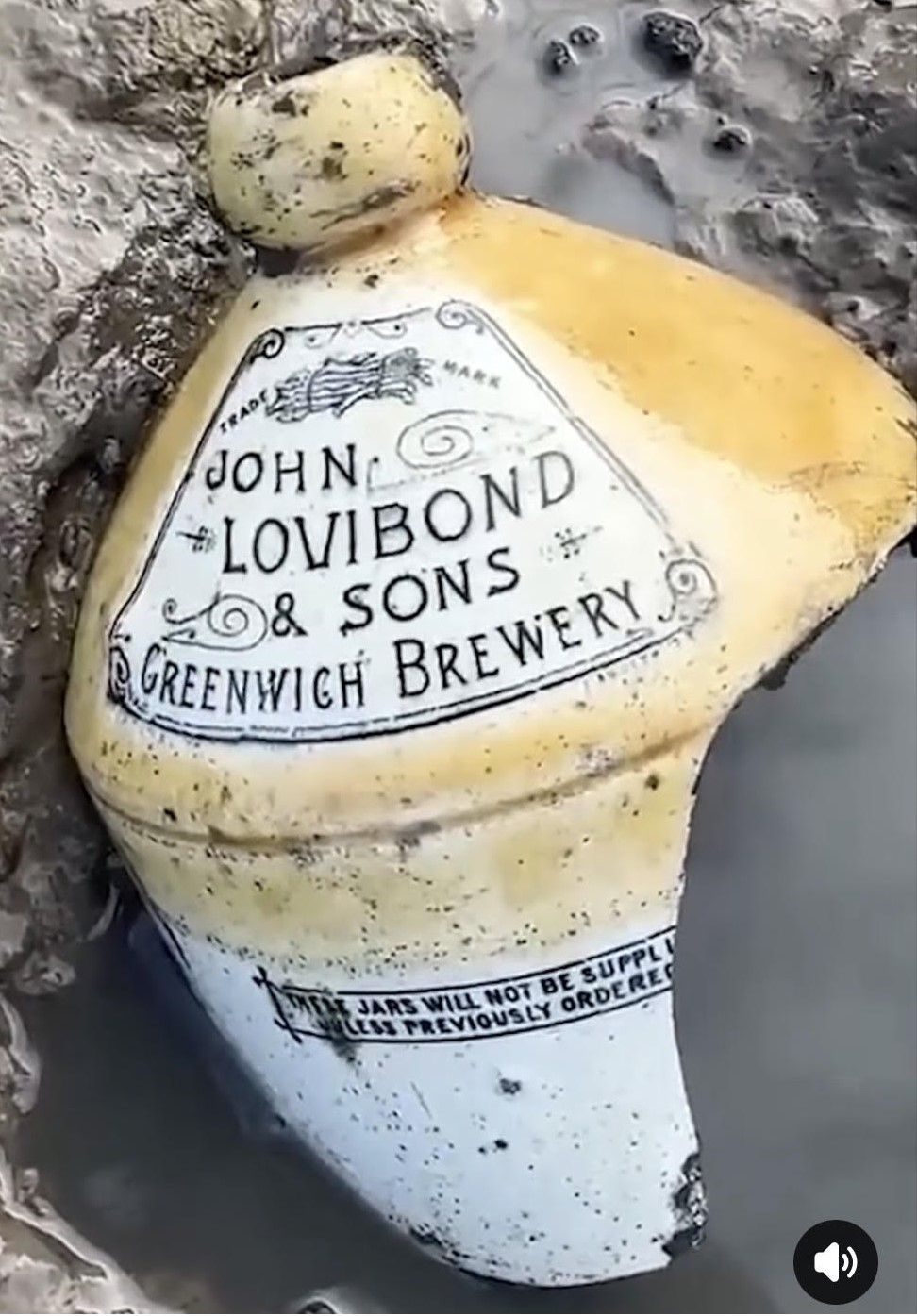
 The nice thing about the youngest kid having a job with shifts that end at 11 pm is a fella like me can stay up late for the NBA Finals, listening to 660 AM every second evening when I am waiting out in the parking lot for the kid’s shift to end.* I am not saying I am some sort of “Mr. Knicks” but this run has been fun. But that’s ending soon and it’s all going to be World Cup naptime late afternoons for the next few weeks. It’s exciting be this idle. And when I am not fixated on bandwagoning basketball or ignoring what FIFA actually stands for, I fill the empty hours with social media where this week I saw that shard up there, a bit of a jug pulled from the mud of the Thames by the ever excellent Nicola White on FB. Obvs I noticed what you notice. Mr Lovibond? Turns out John L. was (maybe*) the father of Joseph L. who was the inventor of the Lovibond scale used to describe the colour of beer. Neato. That jug is no more 150 years old given the trademark registration of 1876. I am but a pup.
What’s else up? Well, for starters, we are coming up is the 150th edition of The Session as Boak and Bailey explained:
On Sunday 28 June 2026 we’re going to post something inspired by the late Martyn Cornell’s final epic work of beer history Porter and Stout. We’d love you to join us. The first problem is that the book is quite expensive. The second is that it is large and intimidating. To make this easy for ourselves – and for everyone else – we’re suggesting that you can join in the Session even if you haven’t read the book. Your post just needs to be in some way a response to it, or to Martyn’s previous work on the subject of porter and stout. If you can read some of the book, though, even if it’s just a few pages or a chapter on some aspect of the history of porter and stout that particularly interests you, that would be great.
Excellent. Perhaps as an aid in your considerations, reflect on what Dr Christina Wade posted an excellent post this week on the need to be aware that choices are made when topics are chosen:
I love beer, in particular, and most especially, I love craft beer. And to add an additional layer to that, I love history. Adore it… So, to be able to combine those interests together into a research topic is a personal favourite of mine. I love both of these elements so much. History and beer. And I have decided, because I love them, that everyone else should as well and I am going to write about them in a way designed to convince you of that. This doesn’t sound particularly sinister, but it can be. Think of all the ways people write to try to convince you of a certain standpoint, or view, or historical ‘fact’. So when you are reading, and indeed, when you are writing yourself, keep this in mind. But even choosing the topic can be this way.
And, perhaps reflecting that, Jeff did just that when he applied a little mathematics to do a fact finding exploration of the obvious this week with his description of the state of big craft breweries since 2021:
Behold this table… The list excludes companies like Tilray, with many brands and breweries. The “Change” column on the right-hand side measures the breweries’ five-year performance. An asterisk indicates a brewery the BA does not designate as “craft.” As you can see, one-third of these larger breweries grew, while two thirds shrank. If you remove Athletic, which actually produces a different product, the overall performance of these big breweries worsens considerably. It’s a collective loss of around 2.2 million barrels, an overall decline of 16%.
You can follow that link to Beervana to check out that table but while Jeff says he didn’t provide any analysis in his post the fact is he didn’t need to. The math is the math. You know, it’s not fun to keep pointing it out but it is necessary given how many trade officials and some trade writers aren’t addressing, aren’t really admitting. But “chef’s kiss” to that comment about the Athletic… that’s funny… and correct.
And over at the Cleveland Prost, Will Cleveland has provided us an extended explanation of the origin of Genessee Cream Ale, the best old school beer brewed on the south side of my very own lake:
In the late 1950s, Geminn was working with two offerings that each had a ceiling: Dickens Dry Ale, available between 1956 and 1958, which consumers found too spare, and 12 Horse Ale, popular but heavy in a way that limited how much you wanted to drink of it. He needed a middle ground. The influences pulling at him were multiple. Genesee had deep German roots, but brewery owner Louis Wehle had long been drawn to English ales and Burton-style brewing systems. “Clarence was looking for a lighter-drinking traditional ale,” says Tyler Muhs, Genesee’s brewing manager. “We had that German heritage, but Wehle was infatuated with those English ales, Burton systems. So I think that’s what they were looking for when they came up with it.”
And remembrances have been shared for Rob Jones of Dark Star Brewing, that started out at the Pitfield location that I visited back in 1986, hauling back polypins and two of Dave Line’s books on brewing across the ocean in my backpack. Phil Mellows shared his thoughts in the Morning Advertiser:
Rob Jones, the founder of Dark Star Brewery and landlord of the Duke of Wellington pub in Shoreham by Sea, Sussex, has died following illness. A quiet genius of modern brewing, Jones shot to fame when he became the first independent microbrewer to win the Supreme Champion title at Camra’s Champion Beer of Britain contest in 1987 with a hard-to-classify strong ale called Dark Star, created at his Pitfield Brewery in Hoxton, east London.\nHe had started that brewery in 1981 with his schoolfriend and fellow home brew enthusiast Martin Kemp.
Speaking of a classic brewery, Ed visited Sarah Hughes and shared his findings this week:
Having been a fan of Sarah Hughes Dark Ruby Mild since I was a teenager I was determined to visit the brewery when I heard that the Brewery History Society AGM was being hosted by Bathams. Sarah Hughes and Bathams are only six miles apart so it seemed like an ideal opportunity. It took a bit of organising, and I was so looking forward to it I was nervous something would go wrong. But the people at the brewery were very helpful and it all went fine on the day. Is it’s a small brewery we were taken down in several groups and I wasn’t in the first group. This did make me a bit twitchy as I waited for my turn. But it wasn’t for long.
Twitchy. Ed has been on a roll recently. I have often wonder what causes a revival of bloggy scribbly but brewing equipment that’s made of wood and copper is one good reason. That and the twitch.
Care of Laura H, we read that the fine municipal curatorial authorities in Wolverhampton have made an excellent decision:
Good job. Back to the scene today, Coors Light has rarely been on my radar as a particularly clever culturally sensitive brand but this new use of Québecoise slang in their regional ads is just that:
The campaign, ‘T’en veux une frette?’ (Want a frette one?) leverages a local slang term for ‘colder than cold’ – frette – to remind Québeccers that they don’t just want a cold beer, they want a frette beer, through a series of humorous vignettes showcasing Québeccers’ strong preference of frette. The situations pay off with a twist to the brand’s current tagline, ‘Want a cold one?’ with ‘T’en veux une frette?’
See, me? I would order une frette but never a Coors Light. Sticking with me, once upon a time, I got to negotiate part of a verticle interior leafy greens farming deal. Faces challenges bit it can make a lot of sense in northern Canada where something like a railway container can pump out the stuff of salads when it’s below freezing outside. Interesting, then, to see the idea adapted to hops:
Ekonoke started life as a leafy greens operation, but shifted gears long before that part of indoor agriculture started its brutal and ongoing correction… As with outdoor production, hops inside Ekonoke’s farm grow vertically, wrapping around trellis-like structures that climb eight to 10 meters high. The process is significantly more complex than growing leafy greens indoors, says Sagrario. In addition to longer crop cycles, the process requires constant updates to the nutrient formula pumped to the plants, based on the stage of the crop. Humidification control is also a constant challenge…
All of which is to say that there will be fresh hop beer on Mars in 2063. Again with the me, Knut has written about a Norwegian brewery using Norwegian ingredients and somehow I
There is a side story here. Back in 2007, we were a handful of beer bloggers scattered across the globe. I had the pleasure of having frequent contact with Alan McLeod, who continues his beer writing to this day. I’m thought his blog posts from that golden age were long gone – but look what I found.. He had a bit of advertising on his blog, and decided to spend some of the money to buy a few bottles of Westvleteren 12 from a Dutch web shop to send to a few of his contributors. I was one of them.
Aaaahh for the days of paying ads on a beer blog. And for customs documents with Belgian ale, shipped from the Netherlands to Norway to pay for the price of an ad on a Canadian beer blog. As you wrap your mind about the way we were, here’s some notes:
Note #1: “Thanks. I hate it.”
Note #2: Australian wine prices have collapsed in China.
Note #3: Is beer losing out to wine and spirits?
Note #4: Pellicle’s portrait of Purple Moose Brewery in Porthmadog.
Sausage meat!?!? Mr. Gladman says it is a you thing, not a gin thing:
Sweet summer child, do you know how many shit whiskies there are? Nor is it necessarily any less industrial than buying in and redistilling neutral spirit may sound. I mean good God, some Scotch giants pump the stuff out like so much sausage meat. So no, gin isn’t “just” flavoured vodka. Gin is gin. Like it or don’t like it, that’s up to you, but please don’t kid yourself it’s an inferior category just because it’s not for you. Maybe you just don’t have the palate for juniper.
What’s that? Where’s the World Cup beer news? I can’t find the link to the story that some educator posted “Ten Pastry Stouts to Pair With Haiti v Scotland!” but, yes, Voodoo Rangers is likely the proper order to make on Saturday. “No Scotland No Party” is the song that I have just learned my traveling first cousin (once removed) will be (drunkenly) singing:
… they live by the motto: No Scotland, No Party. “In Munich (during those Euros two years ago), you saw the impact the fans had. People just seem to love Scotland,” says Duke… People seem to feel at home with us because we don’t take ourselves too seriously”… They thought the estimate of 100,000 travelling Scots was a joke until Munich, the beer capital of the world, was drunk dry before a ball had even been kicked. It was a similar story in Czech capital Prague for a European Championship qualifier in 1999. The Scotland fans had congregated in the old town square, so when the area’s bars ran out of alcohol, the riot police arrived expecting trouble. Instead, when the lorries arrived with more beer, the Scots hopped aboard and helped unload the kegs themselves.
For some of the Home Guard who can’t travel, Imran has shared the best pubs to watch in Edinburgh. Elsewhere, England’s Gus bought beer from every nation. Here in Ontario beer stores’ opening hours have been extended just as have restaurant hours in Boston. Expectations are high for mass consumption:
To reach its 1bn pint estimate, analysts from Jefferies extrapolated beer consumption data from previous World Cups. The extra sales equated to a 3 per cent uplift during the 39-day tournament, which Jefferies annualised to 0.3 per cent, equating to 5.9mn hectolitres, or an extra 1bn pints. Analysts expect the World Cup — which is being hosted across three major beer markets: the US, Canada and Mexico — to boost sales volumes by between 0.2 and 0.3 per cent for 2026. Jefferies analyst Ed Mundy said “match timing is the unsung hero of World Cup beer consumption”, pointing out that games featuring countries in Europe and the Americas had largely been scheduled to coincide with peak local drinking hours of between 5pm and 11pm.
Sadly, as CNN reports, Michelob Ultra will adorn an MVP trophy given to a player after every match. Hopefully that side of the trophy can be turned to the wall. Now, where is my tartan scarf and my copy of that 1978 Scotland World Cup LP?
That is it. A jam packed week of news and cogitations. As you soak it all in, don’t forget to check out Boak and Bailey posting on Saturday and adding to their fabulously entertaining footnotes week after week at Patreon. And do look out for more of Stan’s new “One Link, One Paragraph” format. Then hunt out something in someone’s archives! Leave oblique comments on someone’s post from 2009!! Listen to a few of Lew’s podcasts and get your emailed issue of Episodes of my Pub Life by David Jesudason on certain Fridays. And Phil Mellows is at the BritishBeerBreaks. Once a month, Will Hawkes issues his London Beer City newsletter and do sign up for Katie’s wonderful self-governing totes autonomous website featuring The Gulp, too. Ben’s Beer and Badword remains on pause but there is reading at The Glass which is going back to being a blog. Any more? We have Ontario’s own A Quick Beer and All About Beer is still offering a range of podcasts – and there’s also Mike Seay’s The Perfect Pour. Plus follow the venerable Full Pint podcast! And there’s the Craft Beer Channel on Youtube as well as the archives of the Beer Ladies Podcast.
*Now, I hear what you are saying: “WTF? New York isn’t part of Canada, Al?!?” But for 23 years I could see the northern edge of the state out my office window. And I’ve listen to WFAN sports radio for decades and, yes, the game is on 880 AM but the freaking fan DJs are on 660 AM. Plus OG Anunoby was my favourite Raptor who went to the Knicks so…
**what about Henry?