Craft Or Kraphtt: Sam Adams Scotch Ale, Boston Beer, Mass

Stan was rightly giving me grief the other day or at least a lesson in life when I spoke of the Sam Adams line of beers. I didn’t mean to be mean and I am a delicate flower in the face of such dressings down – but, as you all know, I am working with what I am thinking about beer pricing and value. To that end, I’ve suggested five general categories of beer quality. What is the goal of the five point scale? I suppose it is as useful as a Top 25 Brewers list or using the numbers 1 to 10 to rate a beer: it is a means to give order to things. And it is supposed to give order based on deeds not claims – sure, subjectively (as that is the essence of the experience of beer) but not to bash as I live in a post-sticks-and-stones universe. Further, taking up the challenge of Matt at Rutgers, I drove into another country and bought up not six not eight but seven different Boston Beer brews to make sure I had a clue.

Scotch ale is something one would think is very important to a Scot yet it is neither the national drink or the other national drink. There are plenty of examples in the archives and they share that sweet, toast and smoke malts the style is known for. Surely a nod to style that is otherwise defective can send a beer teetering from craft down into kraphtt, no? So – what with this one, 5.4% with a best by date of April 2008? If smell alone could win the day (and who amongst us has not thought that thought before?) this one would surely stand proud as craft with the deep apple butter aroma it gives off. Chestnut ale under a rocky lacing tan head, goes down in a rich wave of sweet malt (butterscotch, pear, apple butter, licorice, and maybe even blackcurrent) tempered by the burnt toastiness of blackened malt with a hint of twiggy hops, perhaps Fuggles, in the end. A lovely brew. “Tha’s a braw bricht brew the noo!” Oor Wullie would say…if he ever grew up to be old enough to try one.

A solid effort and one that makes me offset the same brewer’s white ale over there on the other side of line between craft and what is not quite craft. And, as part of a variety twelve pack for 14.99, great value. 19/20 BAers agree.

Lake Placid Craft Brewing Sold

Hey, seems I am not the only Canada who loves upstate New York craft brewing. One of my favorites has been bought up:

Montreal’s ICBS Ltd. said Wednesday it is buying New York`s Lake Placid Craft Brewing Co. The 10-year-old Lake Placid Craft Brewing Co. has created a market demand for their Craft beers, such as UBU and Frostbite ales, ICBS said in a statement.

More here. Here are my reviews of their 46’erUbu and Frostbite. I think I also had a brown of theirs at Clark’s last October. Lake Placid Craft Brewing has some of the best branding of a strong beer line up that I know of and their pervasive placement in North Country grocery stores is likely the envy of many micros. You’ll want to hug (or perhaps lick) the screen when you see their flash intro page to their website. [Flash intro pages are usually a nightmare but this one works.]

Lake Placid joins a very southern NY brewer, Ramapo Valley Brewery just bought in June, in the ICBS Ltd portfolio. Last week ICBS bought a lab that works in the beer industry. Hmm…is someone somewhere sitting behind a desk, rubbing their hands and saying “bwa-ha-ha”?

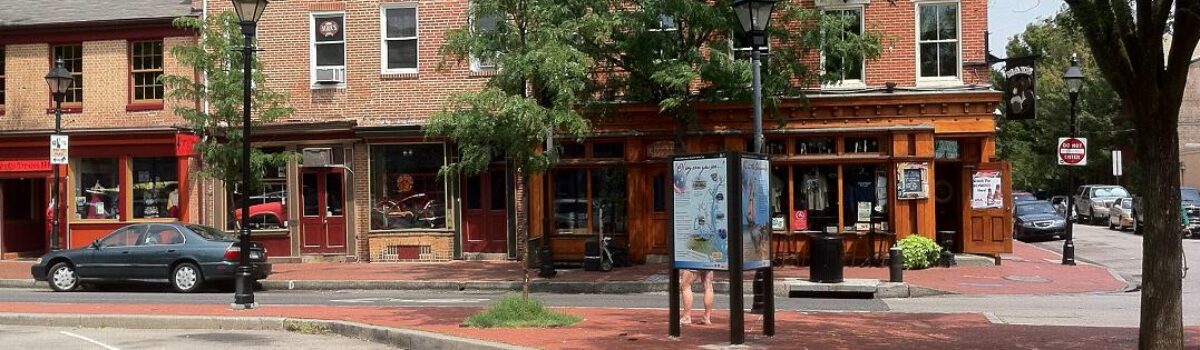
Update: I added the excellent photo above from the excellent Maltblog maintained by Jim of Cazenovia, New York. The photo is from the trip Jim took to Lake Placid’s brewpub last fall and it is excellent.

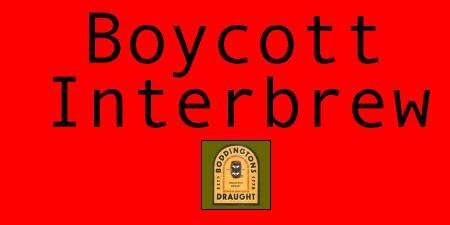
Boycott!!!

The exceptionally well-named Yates on the States, the tale of a family man from Manchester, England living in Minnesota, has raised this banner. It leads to an interesting consideration of the global brewing industry.

Yates’s complaint is that cask conditioned Boddington’s ale will no longer be made as the Manchester, England factory – the Strangeways Brewery – that makes it is being shut by its Belgium based parent, Interbrew. For 200 years, Boddingtons has only been made at Strangeways. From what I read, I understand what is at risk is the cask conditioned version of the brew, the real ale with live yeast in it, as opposed to the industrial kegged or canned versions with forced C02 carbonization we see on our shelves around the world. As a general rule, real ales take time to make, do not travel well and, if they do travel, they are expensive, like the six bucks Canadian I pay for a quart of Rogue. Kegged and canned beer is built for the tractor trailer ride.

If my reading on the brewing industry has taught me anything it is that mergers and consolidations have been the stock in trade for brewers for ever. I noted this as a complaint in my review of Martyn Cornell’s excellent Beer: The Story of the Pint but now I see it as simple reality, the nature of the flux in one end, the industrial end, of the industry. Consider this. I go to check the Interbrew website and the company itself has consolidated and is now called InBev, which is about as imaginative as LiqCo or HoochInc. It brews 13% of the world’s beer. It owns the Keiths I drank as a kid but which now gives me the willies when I smell it, the Rolling Rock in portland’s fridge, and the Hoegaarden and Leffe which have both been praised here. On the one hand, if it were not for the efforts of Interbrew, I would never have tried brews like Boddingtons or Leffe. In fact, the LCBO shelves are stocked with many InBev products, making the purchaser’s job an easy one. On the other hand, I would have had a chance to try other smaller brands since killed off in the churning mill that is the merger game – but only if I travelled to where those products are made. So, when brewery mergers kill off your local favorite, either an entire brand or a real ale version of it, it is an actual but local crisis; when it adds a great new style to your shop, it is a blessing but, really, only as a start to new hunting when travelling.

The conundrum of standardization and globalization. I will leave it to you to consider Yate’s call when deciding what you reach for when you reach for a beer.ill leave it to you to consider Yate’s call when deciding what you reach for when you reach for a beer.