
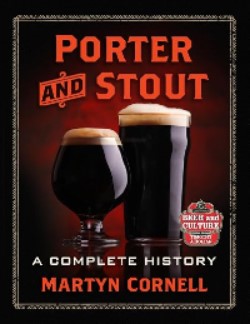
 It is difficult to write about Martyn Cornell’s last book, Porter and Stout: A Complete History without being caught up by the sad fact of his passing a little over a year ago now. As many had written after the news of his passing circulated, he seemed always able to be available at the other end of an email or a chain of comments at a blog, an encouraging and cranky mentor as well as loyal and frankly honest friend to anyone who took writing about beer seriously. Even when, as certainly was often the case with me, he had no idea what I was going on about. He is missed.
But this is The Session – or rather The Session – and that offers the helpful constraint of the question that has, in this case, been posed by Boak and Bailey:
Your post just needs to be in some way a response to it, or to Martyn’s previous work on the subject of porter and stout. If you can read some of the book, though, even if it’s just a few pages or a chapter on some aspect of the history of porter and stout that particularly interests you, that would be great. If you don’t fancy buying it, you might be able to get a copy via your local library. And if they don’t already have it in stock, your request might trigger them to acquire a copy.
OK, that is not too constraining. Which is fine, of course. Well, we can certainly say that Porter was a topic Martyn returned to regularly. In 2004, he adapted a portion of his book Beer: The Story of the Pint on Porter for Brewery History magazine.* In 2009, Martyn posted his thoughts on the difference between Porter and Stout. His response was this:
None. Not now, anyway, not in any meaningful way.
He clarifed with saying the question was like “what’s the difference between dogs and Rottweilers?” Stout is a sub-class of porter, originally at the stronger end of the scale but now no longer true. So, the study of the two is really the study of the one, Porter.
And so… the book. I have the book. I have not read it from beginning to end. Before I received the book, I read the review by John Duffy over at the Beoir, “Porter & Stout: A Complete History – Review” who wrote:
It’s not an easy read, and is probably best handled in small doses. It will make for a first-rate reference source, and of course every fact and quote is meticulously referenced, for those, like the author, who insist on original sources.
I take such advice seriously and have to admit that I have only dipped. Not unlike how I’ve dipped into one of Martyn’s earlier books, Amber Gold & Black. I need a fact? He got a fact. A practical and guilt-reducing approach, dipping. So today again I dip. And what did I find? Well, being me… I found me. There I am in the index:
McLeod, Alan, Canadian beer historian, 232
What? Me? No false modesty, I say I say. I don’t think I have ever written all that much about porter. But apparently once upon a time I did. And it illustrates a point about the obsessive completeness that is found in the book. The reference in the index is to a passage about “Sand Porter” where I am quoted as suggesting a certain etymology for the phrase. I have no idea that I ever said such a thing. But Martyn also quotes Gary Gillman with an alternative view of the same question. Turns out Gary wrote a series of posts on Sand Porter and I made my observation in the comments. I think Gary’s suggestion is the better view given, you know, he has written plenty about Porter.
But that’s the point. Martyn noticed and snuck the idea away. Like he snuck away the thousands of other ideas away, ideas that fill the over 400 well organized pages of the book. I can’t speak to the other regions but the text in chapters 36 and 37 on Porter brewing in Ontario are clear and accurate. A tidy summary of the province’s brewing history, in fact, which is reasonable given how pervasive Porter brewing was herabouts. Chapters 27 to 34 on brewing in the USA before 1800 – or even 1840 – may be the first comprehensive modern history published on the subject.** No one can ever say again that US brewing history starts with lager.
So that’s my dip. I can only presume the bits I don’t know much about are as well grounded as the ones with which I am familiar. Which is what something this encyclopedic should do. Which is why you should own this book. Porter came into being almost 300 years ago and played such a major role in brewing in the English speaking world it serves as an excellent entry point for the topic as a whole. As Mr Protz wrote, it’s a superb legacy that Martyn left us all.
*Which led to Ray Anderson writing “Microbes and the Origins of Porter” in the following issue of BH in a fine example of Martyn’s way of making others think.
**Having whole chapters on the brewing history of just New York and Quebec is wonderful.