Your Beery News Notes For Turning The Calendar Page From Zeptember to Rocktober

Happy autumn!  Did you find any September Ale yet? Nope, me neither. But as I probably say this time every year – it was a thing! Whatever it was.  Defo. A certain thing for a certain time:

Season of mists and mellow fruitfulness,
Close bosom-friend of the maturing sun;
Conspiring with him how to load and bless
With fruit the vines that round the thatch-eves run;
To bend with apples the moss’d cottage-trees,
And fill all fruit with ripeness to the core…

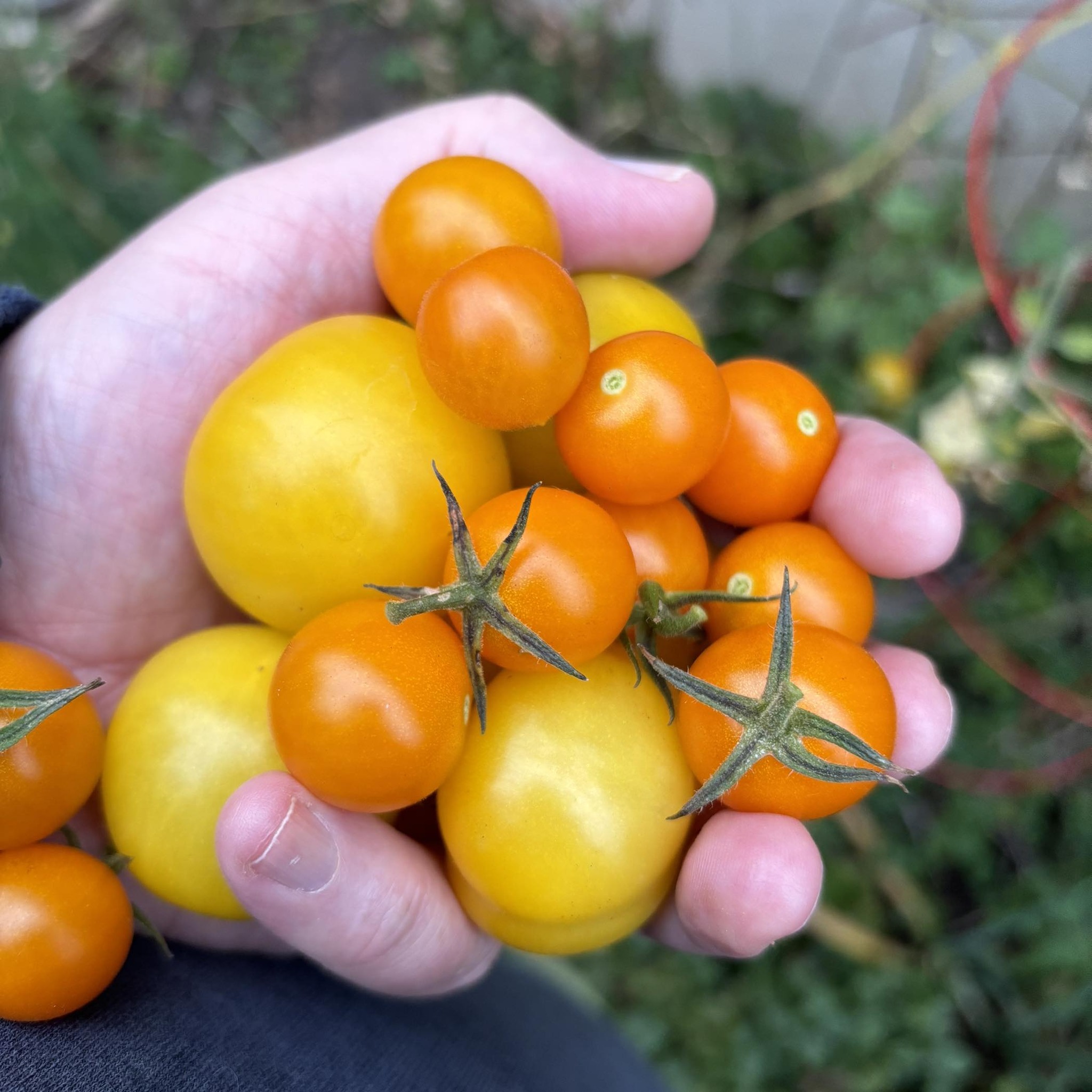
Ah, poetry. Autumn wasn’t all about Halloween candies and scaring the kiddies. It was the harvest – as Big Johnny K told us right there. To the core, baby! Just look at my meaty paw loaded with tamayddies. And just look at this bit of harvest Pr0n from Barry. And speaking of the arts poetic, I was listening to NPR’s Mountain Stage on Sunday as I usually do and heard a bit of a band by the name of The Brothers Comatose and these their lyrics:

You look at me like I’m crazy
But that stuff is bitter and gross (So gross)
I just wanna enjoy myself
I don’t wanna be comatose
Well, after a day of working hard
I’ll belly up at the bar
You can keep your hoppy IPA’s
I’ll be sipping on my PBR

The title of the song is “The IPA Song” which has some pretty clear messaging. The concerns are plainly stated: “When I drink a half dozen, I’ll be winking at my cousin…” And the ecomomics is addressed: “…you can keep your bitter brew / That costs you twice as much…” On that last point, Ron found a similar theory on why certain beers are trendy in an article from over fifty years ago:

Mr. Claude Smith, President of the Incorporated Brewers’ Guild, puts it down to cash. “It all down to people having more money,” he says. “At the bottom of the pile you get mild drinkers. When they get paid more, they drink bitter. When they get paid even more, they drink lager, It’s sort of fashionable and up-market. They want to prove they can afford it.”

All reasonable points. So, when people want to be seen they get that IPA.  While still on vacation Stan, however, argued to the contrary and even made the news as reported in Bloomberg praising that “bitter brew” with a focus on what really makes the most popular US hop so… popular:

“The popularity of Citra is directly linked to the popularity of IPA, and the proliferation of IPAs that were brewed with more hops than in the past, notably dry-hopped beers,” says Hieronymus, referencing the process by which even more hops are added late in brewing to boost aroma and flavor without increasing bitterness. “Citra thrived because it works well on its own, but also both compliments and complements the character of other varieties… IPAs are becoming less bitter,” says Hieronymus. “There are three types of hops: aroma hops, high-alpha hops that add bitterness, and now dual-purpose hops that can do both. Citra is the latter. The shift from the qualities of Cascade to those of Citra has led to interest in more expressive hops with higher impact.”

Still… there are so many stories out there about how to avoid beer when having beer. Is an “give me even less than a PBR!” movement? We’ve waded through the zero alcohol stories for a while now but the zero pints stuff is a new twist on how to get less for your beer buying bucks. In The Guardian Eleni Mantzari, a senior research associate from the Behaviour and Health Research Unit at the University of Cambridge, explained the logic behind the study that experimented with smaller portions to capture the reaction:

She explains that there is not a lot of evidence about the impact of serving sizes when it comes to alcohol, but there is lots of research into food portions. “Larger portion sizes are linked to obesity. When portion sizes are smaller, consumption is lower,” she says. Regarding beer, “we just wanted to get the evidence. It’s up to the people in charge what they do with it.” Mantzari spoke to managers and owners from the participating pubs at the end of the study to find out how customers had reacted. “People didn’t tend to order two halves on the spot,” she says. “Some venues got complaints – mostly those outside London and mostly from older men. The complaints subsided over time, whether because people got used to the two-thirds, or because they knew the pints were coming back.”

Yup, there’s a certain sensitivity there. [Was the loss of the Canadian stubby in the 1980s our cultural equivalent? They never really came back. Gary’s been checking for them in Owen Sound. None there. (But there used to be bootleggers.)] And, you know as I get back to the point, it’s not just the ability to have that pint, it’s about where to have one as the number of pubs keeps shrinking, as Jessica Mason summarized:

The analysis showed that number of pubs in England and Wales fell to 39,096 at the end of June with industry experts warning that tax rises in 2025 could result in further closures across the industry. The data additionally highlighted how the total figure also included pubs that currently stood vacant and were being offered to let, which meant that the number of operational pubs was in fact even lower… In the first half of 2023, 383 pubs also closed, the equivalent to 64 pubs closing every month, showing that the situation is dire.

And it is not about how much or where you have one – it’s also about when and how the pint is even pictured. There is a fixation with British beer writers about certain photos being used for certain purposes. David J. picked up the theme for CAMRA’s What’s Brewing but added an insider’s view:

Working as a sub editor at the Guardian around the time web stories started to become very popular – and the newspaper was losing £1m a week as print sales started to fade – was a quick education. The volume of work we had to publish was so punishing that very little attention was given to details that were vital to make a story appeal to a reader. Captions, headlines, and, crucially, photos were slapped on quickly because senior editors would shout and curse for us taking too long… Now 15 years later, I’d like to hope that things have changed, but when I read national health stories about alcohol abuse, I doubt it. This is because nearly every time a sub publishes a story that looks at the harm alcohol causes, or the impact abuse can have on our society… a photo of a pint is used.

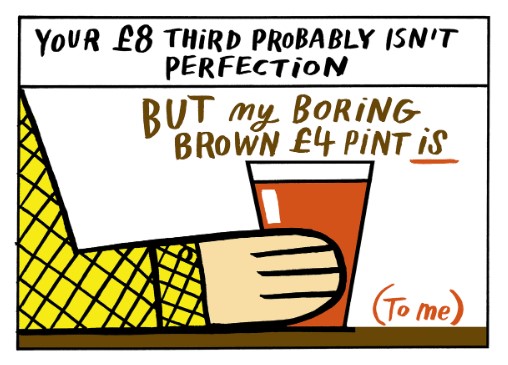
He calls it “lazy caricaturing” which is fair enough but is beer really more beautiful to the eye than wine or spirits? Could the average British beer drinking person in an slightly, err, obsessive relationship? I am pretty sure that it is no more healthy or less heathy than other booze. They are just different outfits for the same paper dolls. But, yes, they could get about four more stock images to add to the three that get heavy rotation.*

Not unrelatedly in terms of how and why the beer is presented, The Conversation published an interview with Dr. Jordanna Matlon of American University on what is described as the exploitation of lower income men in Africa by Guinness through leveraged advertising:

Guinness needed to speak to the experiences of real consumers: men who had long abandoned the prospect of a job that would have required a tie and a briefcase… I borrow this idea of the “bottom billion” from the business world, where emerging markets are a final frontier for corporate profits. It is supposed to celebrate the wealth potential of the poorest people on Earth: as the argument goes, the minuscule “wealth” of a billion people is really a fortune. Of course if we pick this apart just a bit it is clear that the wealth belongs not to the poor but to the corporations that sell them things. There is no real “Africa Rising” in this vision, no plan for enlarging an African middle class. Reflecting a longer colonial legacy, wealth here is something to be extracted.

It’s the whole bonding thing. Does beer and other bonding agents get taken advantage of?  For example, I like this analysis, as discussed in TDB, of the cost of being an English football fan which not only compared the price of a pint at a game but added another six factors to come up with a more wholistic sense of how the fan is squeezed:

Ipswich Town came out top, with an average beer costing just £3.50. In second were Wolves and Brentford, where the average cost of a beer was £4 – although the overall second cheapest team including tickets and other goods was Southampton, where the price of a pint was £4.55. At the same time, bitter North London rivals Arsenal and Tottenham were the two most expensive teams to follow. A pint at Arsenal cost £6.30 and pies cost almost a fiver (£4.80). Spurs pint was considerably cheaper, at £5.10, but it performed poorly in other goods and ticket prices, with shirts costing £85.

I always like me a good methodology. Brings out considerations of integrity. In Pellicle, Anna Sulan Masing wrote about another sort of integrity, transparency in spirit making:

Are sustainable changes happening because of consumer demand, or because businesses think it is the right thing to do? I believe it should be a combination of political structure, business desire and consumers wanting to drink better. Wong thinks there is real change happening. “Since lockdown people have had a bit more time to think, consider what they buy, invest (time and money) as well as what they put into their bodies.” She says it is akin to eating organic, sustainable foods. “People are more curious.”  She sees a correlation with the growth in agave spirits—people are coming to the category with an interest and understanding about the growing process, and the farming and the farming community is very much a part of the narrative of understanding the quality of the liquid.

Are these things, as she wrote, “rich, white person’s badge of honour”? Why do we associate so strongly about these things? Speaking of which, Boak’s and Bailey’s emailed monthly newsletter is a goodie this time, with the interesting results of questions they had posed about the effect of change of management in pubs as well as this line which sort of summarizes the arc of their last twenty years of beer writing:

It’s easy to romanticise pubs. This makes clear how crap they can be while still, somehow, being enchanting…

Is that it? You’ve been enchanted?

In the health section this week, we revisit whether there is any aspect of alcohol drinking that legitimately is a boost to your health? Did I ever mention my 2012 kidney stone? What fun. Well, there may have been a reason it was not as bad as it might have been:

In a study that included 29,684 participants in the National Health and Nutrition Examination Survey 2007-2018, mean alcohol intake was significantly higher among non-stone formers compared with stone formers (42.7 vs 37.0 g/day). Beer-only and wine-only drinkers had significant 24% and 25% reduced odds of kidney stones compared with never drinkers or current drinkers who did not report alcohol intake by dietary recall, after adjusting for multiple variables, Jie Tang, MD, MPH, of Alpert Medical School of Brown University in Providence, Rhode Island, and colleagues reported in Nutrients. The investigators found no association with liquor-only intake.

Finally, if kidney stones weren’t uncomfortable enough for you to add to your worries of the week, Jeff posted an excellent and extended consideration of the implications of arguments made by a lobbyist group advocating for increased beer taxation in Oregon – with some interesting candor:

Beer tax proponents should be honest about their goals, which mirror anti-tobacco efforts to marginalize smoking by making it so expensive. That’s a fine goal! I would be completely happy to see cigarettes completely vanish from the earth, and I’ve supported taxes that make it so expensive that people have to be really committed to continue. Not everyone agrees with the position, but that’s the way of politics. Oregon Recovers wants to cripple the beer industry much as I wanted to cripple Philip Morris. I’d be happy to put it out of business and I’m willing to own that.

But if that is the case, if you have a certain understanding that alcohol is detrimental to health and to society… should we be listening or opposing?  Do you associate so deeply with the booze you drink that it is a political platform?

As you think about that… until next week for more beery news, check out Boak and Bailey every Saturday and let’s see if Stan cheats on his declared autumnal break on Mondays. Then listen to Lew’s podcast and get your emailed issue of Episodes of my Pub Life by David Jesudason on the odd Fridays. And Phil Mellows is at the BritishBeerBreaks. Once a month, Will Hawkes issues his London Beer City newsletter and do sign up for Katie’s wonderful newsletterThe Gulp, too. Ben’s Beer and Badword is thereback with the sweary Mary! And check out the Atlantic Canada Beer Blog‘s weekly roundup. There is new reading at The Glass which is going back to being a blog. Any more? Check out the Beer Ladies Podcast. That’s quite good. And the BOAS podcast for the bro-ly. And the long standing Beervana podcast …except they have now stood down.  Plus We Are Beer People. The Boys Are From Märzen podcast appears suspended as does BeerEdge, too. But not Ontario’s own A Quick Beer. There is more from DaftAboutCraft‘s podcast, too.  All About Beer has podcasts and there’s also The Perfect Pour. Plus follow the venerable Full Pint podcast. And the Craft Beer Channel on Youtube.  The Moon Under Water is gone which is not surprising as the ask was $10 a month. Pete Brown’s costs a fifth of that but is writing for 47 readers over there.

*Just click on that zero pints link up there for one of them.
*Just consider this on the two-third portion in their footnotes this week: “But what problem are they solving that half-pint glasses don’t? Well, half-a-pint does feel a bit too small sometimes – especially if the glassware is really nasty, like something you might find in a hotel bathroom. We used to love drinking Brooklyn Lager out of branded glass that was about two-thirds-of-a-pint. It felt nice in the hand, swiggable but not over facing. Again, more choice, by all means. Let’s have options.” I now want a t-shirt that says “swiggable but not over facing”! I don’t really know what it means – but I like it.
***Me, I’m all about the social medias. Facebook still in first (given especially as it is focused on my 300 closest friends and family) then we have BlueSky (185) rising up to maybe… probably… likely pass Mastodon (931) in value… then the seemingly doomed trashy Twex (4,455) hovering somewhere well above my largely ignored Instagram (153), crap Threads (52) with Substack Notes (1) really dragging up the rear.

Your Definitely Final And Last Chance End Of Summer 2024 Beery News Notes

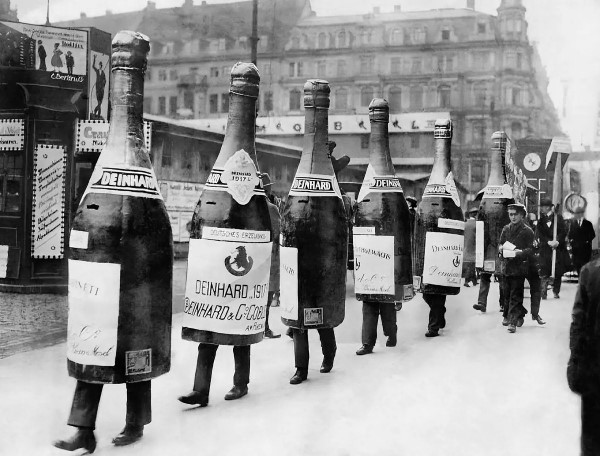
The next time we meet it will be autumn. Who submitted the requistion for that? Thanks. A lot. At least we get one more Saturday in. We’ve had a good run of weather to see us out, picking a couple of pounds of tomatoes a day.  I’ll need a new hobby once the garden slows down. Maybe I could join a men’s pie making groups or something. The American Association of Wine Economists is one of my favourite BlueSky feeds to follow. They seem interesting. That up there? Germany 1920s. Men with a hobby. Comparatively speaking, a better sort of marching in those times.

Speaking of weird, Stan’s monthly newsletter Hop Queries is out for another month and, under the surprising heading “Bitterness and Attitude”, he wrote:

When we moved from the low-altitude flatlands of Illinois 700 feet) to New Mexico (5,320 feet), a professional brewer told me to just throw in a few more pellets when I brewed an IPA. I hope the information in the archives is more useful.

Oh!  Altitude. He wrote altitude.  That makes waaaaay more sense. Note: rumours of Stan O’Eire. Another bit of a puzzle was encountered in this story of the passing of a venerable Mancunian:

…for ten years straddling both decades there was one constant on the streets of Moss Side and Old Trafford – George Powell, the self-syled Ginger Beer Man. He became a legend too selling his home made brew from his bike. George has died, aged 97, and later this month 500 people from all over the country and abroad are expected to pay their respects and attend his funeral. And his son Glen is going to ensure he will get the send-off the big family man deserves after his perfectly timed win at bookies Betfred. Self-employed handyman Glen won £20,000 from a £4 wager… much of his winnings will be spent on George’s funeral at the Church of God of Prophesy in Moss Side, burial at Southern Cemetery followed by the wake at Bowden Rugby Club.

Would that have been an alcoholic ginger beer? I used to brew one based on the CloneBrew recipe. This January 1978 edition local CAMRA newsletter “Whats Doing?” from Manchester suggests (at page 9) that the Salford brewers Walker & Holmfreys brewed a ginger beer along side ale brewing.

Staying there about, you know some things are worth repeating. This same passage in Katie’s edition of The Gulp at the end of last week was quoted in the Boak and Bailey Saturday update but I have to note this fabulous bit of stream of consciousness too:

…I have to check myself before I wreck myself. Tonight is going to be a late one. But it’s just so delicious, so perfect in this moment. Savour it, I tell myself, knowing that I can’t. I’m not a savourer. I eat in big bites, drink in big gulps. I want the best things all in one go, now.

There go I, too. Back here at home, Ontario’s new booze sales in corner stores have attracted all sorts of attention… including the independent accountants:

When the Ford government expanded sales of beer, wine, cider, and ready-to-drink cocktails into Ontario convenience stores and gas stations on Sept. 5, it did so ahead of schedule. A master framework agreement (MFA) signed under the Liberal government in 2015 gave the privately run Beer Store exclusive rights to sell 12—and 24-packs of beer. It was set to expire in 2026, but the government’s expedited plan involves an “early implementation agreement” with the beer retailer that will see the province pay the company up to $225 million. The FAO report will estimate the financial costs and benefits of accelerated expansion “and compare these fiscal impacts to a scenario where the Province expanded alcohol access at the expiration of the MFA on Dec. 31, 2025.”

Listening to CBC Radio 1’s Ontario Morning the other day, they played an audio reworking of this story including interviews with convenience store clerks and customers about the new rules and heard some interest points of view. Shop owners have not been informed about expired product returns so many only place small orders. And a portion of product has to come from small producers – 20 per cent for beer, ciders, and ready-to-drink cocktails, and 10 per cent for wines. Which is not a bad guaranteed return. But there are supply chain issues getting all the stores stocked up. Me, I have not taken advantage of the new world order yet.

Conversely, over on FB, Max has been out and about posted a brief report on his trip to Vorkloster, a brewery in Predklasteri, Czechia… using many words I do not know:

Vorkloster’s pivnice is cute and friendly, it does feel like part of a monastery, and many of the punters are locals dropping by for a pifko. The kulajda was just luvly. The Výčepní tasted jaded, like the feeling of an afternoon after a couple of very rough days at work. Jantarový Ležák is like an otherwise very good sauce that’s just not thick enough. Tmavý ležák has the right balance of coffee and milk chocolate.

Breaking news out of Albany, NY:

Free pizza is almost dead at the City Beer Hall! Long live pizza at CBH! A promotion in place since the City Beer Hall opened in spring 2011 at Howard and Lodge streets downtown provided a small individual cheese pizza for free with every pint of beer sold. The practice is being sharply curtailed, now available only after 10 p.m. on Friday and Saturday.

I will have to check in with Craig to find out of I was ever there. Over at Pellicle, Katie (for the double) wrote about a beer that I used to cross provincial borders* to buy, Theakstons’ Old Peculier:

If it wasn’t for the Steel’s Masher, Old Peculier would not be the beer it is today. The way that the malt is hydrated and mashed by the machine is incredibly efficient, releasing enzymes and raking through the grist before it can form dry-centred clumps. This machine makes short work of stiff mashes. It was invented in Scotland by James Steel, a brewer who, like many of his peers in industry, was making a lot of Scotch Strong and Wee Heavy beers—high malt content, low water content mashes. Getting the paddles around a mash like that is like stirring six tons of day-old porridge, in intense steam heat, in cramped conditions.

Speaking of the good stuff, Matty C wrote about cask ale for What’s Brewing (apparently a play on words of the 1978 Mancester journal of note mentitoned above, What’s Doing) and makes a very good point about the enjoyment of things in the abstract:

I tend to find that foreign visitors who appreciate their beer genuinely revere the cultural significance of cask dispense. But they also find only disappointment when, after months of anticipation, they arrive at last only to be served a tired pint of London Pride that is, well, warm and flat. We’re responsible for that reputation because in so many places where cask beer is served it’s not treated with the care it deserves. I don’t believe in the notion that cask should be some sort of protected appellation though. For me, the problem exists because advocates too often tend to raise cask beer on a pedestal, when really it should be treated like the most normal thing in the world. Yes, it’s a wonderful way to drink beer, but it’s not that special, really, it’s just beer, after all. Care and reverence are not the same thing.

On the topic of keeping the beer cool, one award winning pub has a related issue on its hands with the authorities due to a noisy fan:

Mr Bull took over the listed corner boozer in Gosport, Hants, in 2022. The previous landlady had the cooling unit located in a door cavity close to the beer cellar but after receiving safety advice, he moved it into the courtyard. Following a complaint, he was visited by a planning department enforcement officer last summer and later informed he would need planning permission for the unit. As part of the application, Mr Bull spent £1,500 on a sound survey as part of this in order to prove that the unit was not noisy. However, the survey found that the unit was loud enough that “it would cause sleep disturbance” to someone sleeping on the ground floor of the house next door, and ‘may’ do so for someone sleeping in the upstairs room.

Speaking of a proper pub, I have seen such things in histories of Victorian saloon hellholes… but never in real life:

…see that trough in the pub? That was so blokes didn’t have to leave the bar to relieve themselves. People in London are posh now though; they go to the gents for a piss.

Want a job in beer? Perhaps an open position with the Anderson County Beer Board is for you!

The three members would serve a three-year term expiring in September 2027. The Beer Board was established for the purpose of licensing, regulating and controlling the transportation, storage, sale, distribution, possession, receipt and/or manufacture of beer, according to a county government information. Interested residents can send a resume or pick up a request-to-serve form at the County Commission Office, 100 N. Main Street, Room 118, Clinton, TN, posted outside the office door. 

Will Hawkes is doing an excellent job in London Beer City with his extended series on the history of the biggest pub in London from the 1930s to the 1990s, reminding us that the past is a foreign country and that includes the fairly recent past including the era of the rave:

…Fascination at the Downham Tavern took place on Sunday afternoons, taking in not only DJs but also live bands like Natural Life. These all-dayers quickly became a huge thing, according to Wilson, who always played the last three hours, and who played at Bonnie’s on Saturday nights.  “We had the best laser show, we had the first gyroscope in [a dance] venue,” says Wilson. “When we first started [in 1988] we had 300, 400 people but it just took off. It got to stage where we had ticket touts … the build-up was massive, ‘I can’t wait, I can’t wait!’” Unusually for a pub, all this excitement was not fuelled by beer. Ecstasy arrived in the UK in a big way in the late 1980s, and it’s fairly safe to assume it was a key part of the Fascination experience. “Oh yeah,” says Wilson with a chuckle. “That was flying about.” The Downham Tavern all-dayers ended in 1990. By that stage, media hysteria about rave culture had reached fever pitch, and policing had become much stricter…

There was a good piece in the Manitowoc Herald Times on a 71 year old ship that has helped make that fine community the “Specialty Malt Capital of the World”, the self-unloading freighter SAGINAW:

The name was changed to SAGINAW on Nov. 20, 1999, in honor of Michigan’s Saginaw River. By 2008, the vessel was repowered from steam propulsion to diesel. Today, the 14,000-ton SAGINAW routinely transits between the ports of western Lake Superior and the Port of Manitowoc at least twice a year. Briess confirmed we can expect to see one more shipments of grain this year aboard SAGINAW. With up to 25 million pounds of raw barley in each delivery, that equates to about 40 million 12-ounce bottles of beer.

Finally, word of two more passings. Many remembrances followed up the announcement of the passing of drinks writer and cider maker, Susanna Forbes:

Forbes, whose long fight with cancer had been known by those close to her, had not faltered over the past few years in her dedication to the industry she loved. Speaking to db last year, she outlined how much she “appreciated people and cherished the perspective that treatment and its challenges had uncovered”. Her generosity of spirit showcased by her constant reminder that “in times of hardship you recognise the people who go out of their way to really make a difference”. Friends and colleagues have come from far and wide to pay their tributes to Forbes for her personality and kindness being at the forefront of their descriptions.

And there was another passing this week of particular note for me, of a craft beer pioneer in my old hometown of Halifax NS, Kevin Keefe of the Granite Brewery:

When Keefe opened the Granite Brewery, it was the second microbrewery in Canada — and first east of the Rockies. That’s a far cry from today as there are dozens in Nova Scotia alone. Keefe first became interested in craft brewing after reading an article about it. In 1984, he went to the U.K. and learned how to do it at a brewery. Not only was Keefe a brewer, he was a savvy businessman. “If I retailed it to the liquor commission, I’d get 50 cents a bottle, but if I sold it in a glass to you, I’d get almost two bucks a bottle, so it didn’t take very much for me to figure out, well, what I want to do is sell it to you,” Keefe told the reporter in a 2017 interview for Halifax Magazine. And thus the Granite Brewery operated out of Ginger’s Tavern.

The Granite of Halifax was a big part of my good beer education. I was a bar rat there in my early twenties as soon as he opened the place. I can smell the Ringwood yeast in my mind’s schnozz this very minute.

There. Until next week, check out Boak and Bailey every Saturday and let’s all see if Stan cheats on his declared early autumnal break from his updates on Mondays. Then listen to Lew’s podcast and get your emailed issue of Episodes of my Pub Life by David Jesudason on the odd Fridays. And Phil Mellows is at the BritishBeerBreaks. Once a month, Will Hawkes issues his London Beer City newsletter and do sign up for Katie’s wonderful newsletterThe Gulp, too. Ben’s Beer and Badword is thereback with the sweary Mary! And check out the Atlantic Canada Beer Blog‘s weekly roundup. There is new reading at The Glass which is going back to being a blog. Any more? Check out the Beer Ladies Podcast. That’s quite good. And the BOAS podcast for the bro-ly. And the long standing Beervana podcast …except they have now stood down.  Plus We Are Beer People. The Boys Are From Märzen podcast appears suspended as does BeerEdge, too. But not Ontario’s own A Quick Beer. There is more from DaftAboutCraft‘s podcast, too.  All About Beer has podcasts and there’s also The Perfect Pour. Plus follow the venerable Full Pint podcast. And the Craft Beer Channel on Youtube.  The Moon Under Water is gone which is not surprising as the ask was $10 a month. Pete Brown’s costs a fifth of that but is writing for 47 readers over there.

*When we lived in PEI in eastern Canada, I would stop in Sackville NB when returning from Halifax NS just to grab a few Peculiers.
**Me, I’m all about the social medias. Facebook still in first (given especially as it is focused on my 300 closest friends and family) then we have BlueSky (183) rising up to maybe… probably… likely pass Mastodon (932) in value… then the seemingly doomed trashy Twex (4,457) hovering somewhere well above my largely ignored Instagram (152), crap Threads (52) with Substack Notes (1) really dragging up the rear.
The Beery News Notes For – What – Another “Red Sox Suck” Season?

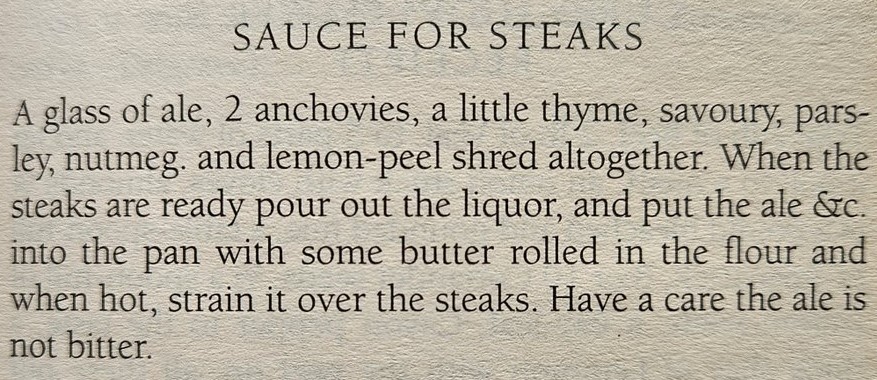
It’s hard being a fan. One of the reasons I am not a big booster for this or that drinks category is I have already invested heavily in terms of emotes in other areas of life. The Pellicle-run Fantasy Premier League surprised me with its grip last season. Plus, as you know, there’s all that gardening stuff that I tend to tend to. But those Red Sox. My team. Mine. They have won 4 World Series in the first quarter of this century but now are mid-pack grinders this decade. There’s little chance they get to the playoffs but they are irritatingly near the chance to… maybe to… couple possibly…  Oh well. But even before all of those obsessions, all those fanboy obsessions… there is good food. Making. Eating. So happy was I to read Liam‘s tweet about the sauce above:

An ale and anchovy sauce recipe for steak written by Thomas Gray in a copy of William Verrall’s Complete System of Cookery – via Penguin’s Recipes from the White Hart Inn.

That’s a book from 1759 as I understand it. Imagine living in a time when membership in a fan base of mid-pack grinders was not even possible. Except, you know maybe if you lived in one of the smaller player in the Seven Years War. Perhaps under the rule of Augustus III of Poland. Anyway, anchovies and ale… anchovies and ale.

Back to a semblance of a plot, there was a good story in Blog TO checking out the prices in Ontario’s newly licensed corner stores. It is a little spoken of aspect of the retail booze trade in Ontario that not only are prices stable because of the massive monolithic twins, the LCBO and TBS – but those prices are standard in every store province-wide,  no matter how distant and expensive the shipping costs. Not so in the 7 am to 11 pm new world order. Not that I would buy one – but a 12 pack of White Claw is 30% higher in corner stores compared to TBS retail. Sounds like that one mistake can easily turn into two for the unwary.

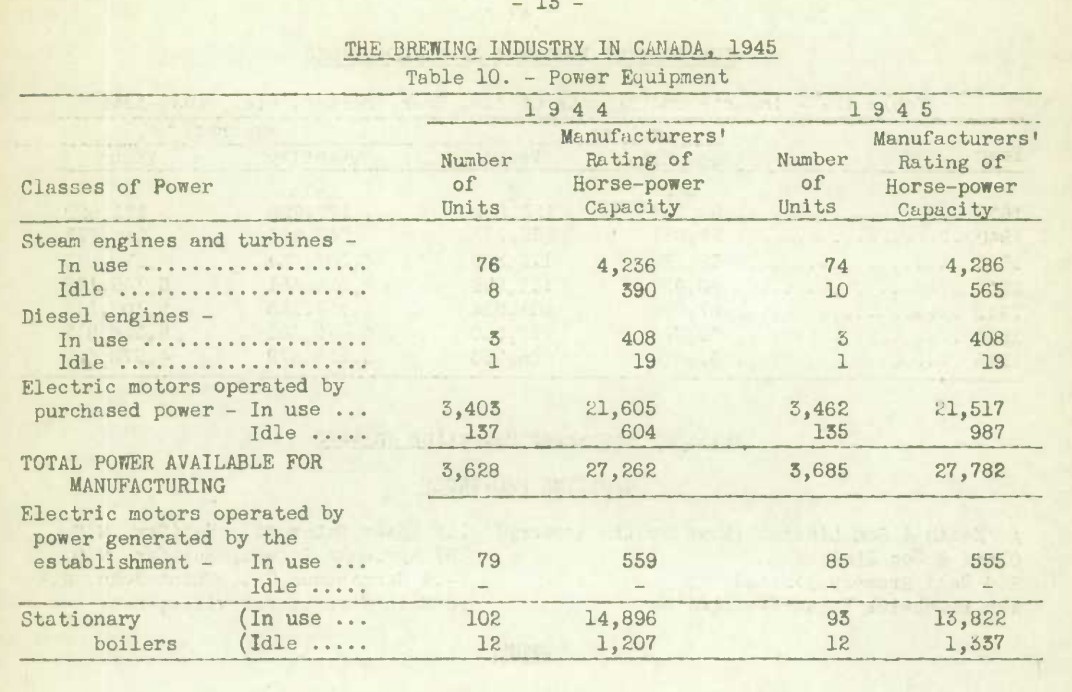
Speaking of prices and price inputs, Gary has a great series going on the Canadian brewing trade in WW2 and this week posted this great bit of tabular information detailing all materials used in brewing production in 1944 and 1945. By reverse engineering his Google image search, I found the same record at a Government of Canada site and saved it for perusal. Just look at page 13!

“Grandpa? What was the ratio of steam, diesel and electric power used in Canada’s wartime brewing as part of the war effort against the Nazis?” “Well, little Jimmy, let’s see…”

Excellent stuff. Speaking of which, Katie Mather has been out and about – especially on the Isle of Man – and has sent out a portrait of a favourite pub there, the The Woodbourne Hotel:

This snug in the centre of the building feels like an Edwardian train carriage, everyone packed in together amicably, its little booth seats overlooked by cartoons and paintings that know the secrets of this town, and well-used hand pulls that serve Woodbourne Street’s locals the beer they need to do some much-needed gossiping. We weren’t staying in the Gent’s Room though. It’s too small, and we were too noisy. I was led further down the corridor to the back bar, where somehow we’d multiplied into a rowdy bunch of 12. Basic white walls and a well-stocked bar on first glance became signed photographs of TT racers and etched glass windows. It took my eyes a little time to adjust from the burnished glory of the Gent’s Room, but once I could see it for the perfect little boozer that it was, I was at home.

By the way, Katie is offering self-editing lessons.  Yes, yes. I know. I know. I KNOW!!!

In a year where much of the beer trade news is not necessarily positive, we have also heard that a lot of men spend a lot of time thinking about the Roman Empire. Curiosity is good. Not my thing given all those other things – except, you know, all that Christ on the cross stuff – but Ray of B+B has admitted he has joined the legions and asked some questions this week:

After visiting Roman ruins in Colchester and the City of London in early August I found myself frustrated at my lack of solid knowledge about Rome. So, I decided to do my homework. Fortunately, Mary Beard’s 2015 book SPQR offers a relatively concise, extremely clearly-expressed history of Ancient Rome that even I could follow. The Kingdom, the Republic and the Empire made sense, and I understood for the first time which emperor followed which. With my beer blogging hat on, though, the section that really grabbed me was about the decor of a bar in the port of Ostia in the 2nd century CE (formerly AD)…

Back to the now, Eoghan shared some shocking news on the state of Belgian beer this week:

“…outside Europe the export [of Belgian beer] declined by as much as 22.2%” IN ONE YEAR A stat (from the Belgian Brewers Federation) to really set the alarm bells going about the future of Belgian beer. A fairly telling quote, in the same report: “In the past, Belgian brewers were able to compensate this decline largely through export, but last year, for the first time in history, export declined by nearly 7.5%.” Belgian beer’s safety net has some pretty large holes in it…”

Long suffering readers would recall that 15 to 20 years ago, driving distances to find Belgian beers in the northeastern part of the United States was a bit part of one’s stash maintenance. Seems like a third of a lifetime ago… oh… it was. To quote the lads back in Rome sic transit gloria cervisiārum… as Jeff discussed last week:

“Craft beer” is a conceptual cul de sac. We started using it with good intentions, but with a naïveté about how brewing works and how markets function. It now causes more trouble than it’s worth.

In VinePair, David Infante took it a step further and argued that just as craft it no longer relevant as a concept, it isn’t really relevant as a substance:

With the segment struggling to shore up slipping sales figures in the face of increased competition from other categories and shifting preferences from American drinkers, craft breweries have been uncoupling brands from the brewhouses with which they were once synonymous, shedding overhead costs and further muddying what makes a craft beer craft.

Jon Chesto of The Boston Globe wrote a fresh take on the craft shake out that is a bit more visceral in tone, sharing the excellent term “slusheteria” for the craft brewers who chase the tail of other targets. The quitters one might say reading between the lines. Or are they just practical realists racing away from the crushing alternative?  The Chesto story’s punchline, however, is saved for Sam Hendler of Jack’s Abby in Framingham who takes an optimistic approach to the reality of short term shakeouts:

Hendler said many brewers built larger operations than they needed with the anticipation that double-digit sales growth would continue well into the future. Now the industry has far more production capacity than it needs. “We are investing very heavily in craft beer and believe in its long-term future. This isn’t a ‘sky falling’ scenario,” Hendler said. “There might be a challenging period that we’re going to have to navigate through but we see a really bright future for those who figure out how to navigate that successfully.”

Stan also had his own thoughts about the idea that the small and local brewer is going to way of the dodo. But he was heading out the door and just said he’s “…not prepared to abandon the thought embracing efficiency means abandoning inefficiency altogether.” Just strikes me that this sort of trend is an economic reality – but one borne of the pretense that there was something once upon a time called craft that stood there separate and distinct, between microbrewing and today. I dunno. It’s been slipping away for a long long time for this to be news. The glitter. The kettle sours. The identi-haze. But does that necessarily lead inevitably to the horrors of the slusheteria? I am encouraged by Hendler that it does not.

Speaking of slipping further into the sub-standard, MolsonCoors is ditching inclusion in preference for old school capitalist exclusion according to TDB:

…the business would be ending its DEI-based training for its staff members, claiming that it has been “completed”. According to reports, future training initiatives at Molson Coors will now undergo an audit to ensure that they are all focused on the company’s “key business objectives.” In addition to this, Molson Coors is renaming its “employee resource groups” to call them “business resource groups” in a bid to illustrate how the company is focused on “business objectives, consumer dynamics and career development”. Molson Coors also highlighted how its future charitable endeavours will now solely support “hometown communities” aligning to its “core business goals”.

Interesting, too, is how a story can be written about celebrity sports guys building a beer brand by leveraging the excess capacity of Founders Brewing without mentioning the whole bigotty discriminatory scandals thing:

Garage Beer is a fun example of small brand, going big, and making moves quickly. Their connections to two of the NFL’s biggest personalities and even an indirect connection to Taylor Swift make it an extra fascinating story to follow. But beer isn’t sold on podcasts or YouTube, it’s sold in stores and needs to flow through the complex three tier system to reach a national audience. Aligning with Founders Brewing for production and potentially distribution alignment has the ability to execute the hurry-up offense that Garage Beer will need to march across the country.

What’s that? Is it white-white-washing? Dunno but apparently, the inclusion blip has blopped and some want to go back to the old ways. Remember the old ways? Last Friday, David Jesudason published another story of racism in the UK pub trade, this  that 1980s club entertainer Alex Samos faced and pushed back against:

…the club wanted Alex to leave the premises when he arrived and his agent George Fisher was told Alex needed to be replaced because of his colour. This time the club “won” and Alex was barred for not being white. He took legal action against the club and, in a case backed by the Commission for Racial Equality and Equity, won £500 (£1,500 in 2024) compensation for injured feelings and loss of earnings in August 1985.  I hope this would stamp out discrimination by clubs against coloured performers,” Alex told the press at the time. “I thought it was an affront to my dignity. I was outraged.” Club secretary Michael Riordan confirmed none of the 500 members were non-white but feebly retorted that “no coloured people had applied to join”.

Finally and to end on a happier note, Pellicle‘s feature this week was by Martin Flynn on the  Donzoko Brewing Company, a name which I think Augustus III himself might approve if only for having had also to deal with the Austrians but in a slightly different context:

Following calls in pidgin German and some online bids, not long after the search began Reece found himself in Vienna, where gleaming copper brewing vessels and 13 fermentation tanks awaited him. As things transpired, the whole ensemble would spend two days outside on a city centre street, but, somehow, it miraculously remained unharmed and still in one piece. Unfortunately, Reece’s finances were similarly static. A hurried call from the auction house revealed that, for reasons unknown, his funds had been blocked by the UK’s Financial Crimes Authority. “I put the phone down and had a panic attack,” he says. “The head of the auction house was literally walking after me in Vienna, shouting at me.

Heavens! Steer clear of Vienna, that’s what I say. Every. Time. (Did I mention I know a man in Vienna?) Well, we will leave it at that for now. Busy week. Had to retrieve a cat from Springfield… as one does. Until next week for more beery news, check out Boak and Bailey every Saturday and see if Stan cheats on his declared autumnal break on Mondays. Then listen to Lew’s podcast and get your emailed issue of Episodes of my Pub Life by David Jesudason on the odd Fridays. And Phil Mellows is at the BritishBeerBreaks. Once a month, Will Hawkes issues his London Beer City newsletter and do sign up for Katie’s wonderful newsletterThe Gulp, too. Ben’s Beer and Badword is thereback with the sweary Mary! And check out the Atlantic Canada Beer Blog‘s weekly roundup. There is new reading at The Glass which is going back to being a blog. Any more? Check out the Beer Ladies Podcast. That’s quite good. And the BOAS podcast for the bro-ly. And the long standing Beervana podcast …except they have now stood down.  Plus We Are Beer People. The Boys Are From Märzen podcast appears suspended as does BeerEdge, too. But not Ontario’s own A Quick Beer. There is more from DaftAboutCraft‘s podcast, too.  All About Beer has podcasts and there’s also The Perfect Pour. Plus follow the venerable Full Pint podcast. And the Craft Beer Channel on Youtube.  The Moon Under Water is gone which is not surprising as the ask was $10 a month. Pete Brown’s costs a fifth of that but is writing for 47 readers over there.

*Me, I’m all about the social medias. Facebook still in first (given especially as it is focused on my 300 closest friends and family) then we have BlueSky (174) rising up to maybe… probably… likely pass Mastodon (933) in value… then the seemingly doomed trashy Twex (4,460) hovering somewhere well above my largely ignored Instagram (160), crap Threads (52) with Substack Notes (1) really dragging up the rear.
Your Beery News Notes For The Return Of Sweater Weather For 2024

September. The grapes are ripening. And evenings are cooler. And those nightmares about having to go back to grade 11 math class even though that was 45 years ago are back. The rest of the day, you daydream about college days when you were two months away from having to pass in any classwork. And thoughts turn to sweater vests. Over a white t-shirt… if one’s yuff was from that WHAM / Ferris Bueller era forty years ago.* Labour Day Monday was the end of the humidity around these parts. Evenings are cooler. Sweater weather.

First up, in the unending ping-pong game of whether alcohol is good for you or bad for you, Drinks Business summaried the powerful and damning critique of Prof. David Spiegelhalter of Cambridge University appeaing of the BBC’s World Service The Food Chain programme:

He said that statistically the overall risk of one beer or wine per day on your life expectancy — which is within current UK government guidelines — has no higher impact than driving a car or eating bacon. Spiegelhalter said that research showed the health benefits of drinking in small amounts, as previously highlighted by the drinks business. He added: “Frankly, I get irritated when the harms of low levels are exaggerated, particularly with claims such as ‘no level of alcohol is safe’. For a start I don’t think the evidence supports that, but also there’s no safe level of driving, there’s no safe level of living, but no one recommends abstention.”

Much, of course, turns on the fuzzy concept of “safe” given that these sorts of statements do not characterize the degree of safety that is, you know… safe. It’s a form of argument that would make the evangelical at the door proud. Fortunately, at least one solid opinion is shared. Spiegelhalter “described the current NHS guidance on levels as ‘ideal’ .” That being…  David Morrison, data-driven wine blogger at The Wine Gourd makes a detailed and well footnoted argument against WHO guidance which unfortunately starts with that sad car driving safety analogy (yes, there is a warning… it is called the licensing process) but then making a good recovery:

…as Robert Joseph has noted: ‘we need to promote the unique, historic qualities of wine that make it such a great convivial product and such a delicious partner to food.’ That is, in the words of Erik Skovenborg, we need to note: Wine as part of a healthy lifestyle; and Drinking with friends: wine’s role as a social lubricant. If the wine label has to list the risks (as is being suggested for the new USA guidelines), should it also list the benefits?

And there was much talk in the UK is about the new government’s plan to enforce a ban on smoking in beer gardens and on pub patios. The Independent discusses the implications:

If implemented, the outdoor smoking ban would make it an offence for people to smoke in certain spaces such as pub gardens or outside sports venues. Should it be enforced in the same way as the 2007 indoor smoking ban, smoking in certain outdoor spaces would carry a Fixed Penalty Notice of up to £150. If you refuse to pay this, you are liable to be prosecuted. According to Action on Smoking Health (ASH), the 2007 ban led to a 2.4 percent reduction in hospital admissions for heart attacks, and a 12.3 percent reduction in admissions for childhood asthma.

This is something we have had this sort of ban in Ontario for quite a number of years now – and we’ve expanded it over time – with the result that no one misses breathing in the neighbouring table’s ciggie gak. But these things are local. Apparently elsewhere, not so gak. The Guardian covers some of the frustrations with the proposal:

…Sean Short, 54, was smoking on the pavement outside a Wetherspoon’s pub – there is some suggestion that pavements outside venues could also fall under a new ban. “I think it’s ridiculous. As if there’s not enough pubs being closed anyway at the minute,” he said. “I can understand them banning it outside hospitals, that makes sense, but not outside pubs.” He said an outdoor ban would not stop him from coming to the pub, but he could see that it would for other people, especially when alcohol is cheaper to buy in supermarkets.

Still, will any of this matter if, as The Guardian also asks, the kids ain’t even drinking the stuff:

A seemingly endless stream of recent reports have warned that baby boomers, who have fueled the industry, are retiring and spending less, and millennials aren’t picking up the slack. “You’re looking at a cliff,” the industry analyst Rob McMillan told the San Francisco Chronicle in 2022, following a key report that showed wine consumption in the US hadn’t grown in 2021 – despite bars and restaurants reopening. McMillan foresaw wine consumption by volume declining 20% in the next decade, with millennial habits key to the shift. Last year, Nielsen data showed 45% of gen Zers over 21 said they had never drunk alcohol.

Not all that relatedly, Jordan has been doing his annual stint at the Canadian National Exhibition – aka the CNE – selling beer tokens in a booth, acting as huckster to both carnies and marks alike. Observations include: (i) “Big Boi didn’t draw the crowds”; (ii) a pickle shot is “a pickle, cored out, filled with tequila”; and (iii) someone asked “What is tokens?”

Note: Gary is not linking over at Twex anymore so keep and eye on hiblog for updates. This week he explains why some Canadian troops in WW2 fighting in Italy drank British beer while some of the British fighting there drank Canadian beer.

Boak and Bailey in their footnotes posed a question about the cartoon in Pellicle last Friday:

…cartoonist David Bailey seems to be arguing that confusion, jargon, and being pushed around by expert staff, is part of the fun of artisanal drinks. But maybe he’s also asking: really? Is that how you want it?

Me, I took the cartoon as pure mockery. I felt badly for the poor beer buyer, there in her tiny version of Pilgrim’s Progress facing the craft carny. Could it be that the craft carney stuff is also off putting… or mid… from the perspective of Gen Zers?

Never mid, Ron introduced me to a new word this week… no, not that sort of word, a brewing related word:

… what’s odd, is that there isn’t a full fermentation record for the “Double Stout”. Just one or two entrie. While there is a full record for Single Stout, right up to racking. Why would that be? Eventually I twigged. There’s a reason there isn’t a full fermentation record. Because that wort wasn’t fully fermented. At least not on its own. I’m pretty sure that this is “heading”. One of the elements of Irish Stout. It’s a strong wort in a high degree of fermentation which was blended in at racking or packaging time. It’s effectively a sort of Kräusen.

Now, I had understand that certain Irish stout had a lesser portion of stale for tang as well as fresher for the body in a blend so, if Ron is listening, does this mean that three different agings including a heading as part of finishing were used? Or am I, as per, wrong?

Laura Hanland posts an interesting set of questions which popped to mind after a certain sort of restaurant experience:

In essence then, my food was deeply “not too bad” – usually enough for me to decide not to return for a repeat visit – but I loved the restaurant so much that I really think I am going to go back and give their pasta a go! And this is my conundrum. If you’re reviewing food, then the food must be good. Surely? But the lovely team, the genial surroundings… these were charming elements that I couldn’t ignore. Also I was a little bit taken by the scowling Italian elder who peered out at me from the kitchen. He gave the whole thing a very authentic feel of a family business. This review makes no sense. I don’t know if it will help you decide whether to visit or not. But I’ll be sure to tell you if I do get back for the pasta.

I think it makes perfect sense. One of the problems in the social media age with its instantly curated expertise (just add water… or, as with the craft carney, booze) is the expectation of mind blowing experiences. They rarely actually happen. For example, my chicken burger was actually a bit bland when we were out this week. Could have done with some chopped green onion in there. Or something. But the server was great as was the sharable carrot cake dessert. Look for the good in things. And put a little black pepper on the burger yourself. Don’t be lazy.

Pellicle‘s feature this week is by Jacob Smith – a discussion with and of the definitely not lazy Judith Gillies, co-founder of Cairn o’ Mohr, a Scottish producer of fruit wines and ciders:

There was little money to spare—Judith fondly recalls a cupboard acting as their only shop—yet, the couple enjoyed something far more valuable than excess cash: access to some of the country’s best fruit. Thanks to its loamy soils, moderate temperatures and—for Scotland—dryish weather, Perthshire is home to an array of world class berries, apples and flowers. As head of production at Cairn o’ Mohr, Judith puts this bounty to good work, producing around 18 different wines, three alcohol-free beverages and five ciders. While popular fruits like strawberries, brambles and raspberries are central figures in several of Cairn o’ Mohr’s wines, less appreciated ingredients like elderberries, oak leaf and gorse are just as commonly used.

I like this line, too: “We tend to take knobbly fruit,” Judith says. “The ones that are too big, too small, too ripe for the supermarkets, things like that.” And speaking of seeking out new tipples, Jancis R reported from a tasting of independent wineries from 15 central and eastern European nations:

Of the other countries whose wines I tasted, Croatia was the most stimulating. The wines, especially those from Istria in the far north of the country, seemed to have an extra layer of sophistication. The region’s special white-wine grape Malvazija Istarska (nothing to do with most other Malvasias) produces full-bodied wines with an apple-skin character, real grip and ageing potential. My favourite examples at the tasting were made, respectively, by the well-established Kozlović winery and the much younger enterprise owned by the unfortunately named Fakin family.

Beating us to EuroEast for drinks, The Beer Nut has been reporting live from Bulgaria this week. It sounds so good:

80% of being on holiday is a random bottle of something that’s €8 in a supermarket and has a picture of a fruit on the label. To my veins, please. Directly…  The next song will be performed by a man who looks like he should be on the sex offenders’ register but has sufficient connections to have avoided it… This open-air bar is opposite my hotel. On beautiful sunny days I’ve been looking across and thinking it would be nice for a drink. Here I am and my beer tastes like it was triple-filtered through a skunk’s anal gland… 

And for Labo(u)r Day, Dave Infante in VinePair was fairly free with the finger pointery over craft beer’s record in labo(u)r relations:

Substandard products, dangerous equipment failures, hell, even terrible rebrands — workers can help owners solve these problems with union training programs, higher self-enforced safety standards, and honest feedback from outside the boardroom bubble. But they need a voice on the job, and protection to use it even when it’s going to piss the boss off. This industry is getting left behind by drinkers. It cannot afford to be left behind by its workers at the same time. Like the Teamsters organizer at Stone this past Monday, I have a message to deliver this Labor Day weekend. This one is for brewery bosses and workers alike. The country is changing, and so is this industry. Which side are you on?

I know what side I am on when it comes to beer cocktails (because port and stout is not a beer cocktail… even though I called it just that in 2012) but the National Post shared a very extended article on beer cocktails that lingered over something from the 1990s built around a recollection of youth as part of creating the argument that one should not overthink… or even, really, think about these matters:

…Dad mentioned that I’d left some beer in the basement fridge that I might want to take home to drink. Investigation revealed that the bottles in question were the remainders of a six-pack of Tequiza. Some of you may recall this late-’90s-era beer brand, juiced with “the natural flavour of lime” and sweetened with agave nectar, a brand that lots of people in flannel shirts and Doc Martens used to consume while listening to Pearl Jam and waiting for our dial-up modems to connect to the internet. The portmanteau name was supposed to suggest a marriage of tequila and cerveza…

Never thought Tequiza would get that much media footprint but there you go.  Finally and definitely in the Tequiza zone, today is the day here in Ontario when I can walk to the corner store and get beer… probably a macro brand I don’t want and at a higher price than elsewhere. But I can get it at 7 am. So that is excellent. Does this mean death to the near century old macro brewers’s run retail monopoly aka “The Beer Store”? Can you say supply chain?

“Bring it on — we’re ready,” Roy Benin, president of The Beer Store, said in a statement. “We see this as a new chapter for The Beer Store and we’re excited to compete. All of our channels – from distribution to retail to deposit return will continue to deliver for Ontario.” The beer conglomerate said it has also expanded its distribution fleet, helping to bring close to 4,000 convenience stores online to sell beer. The retail giant is involved behind the scenes in stocking many of those locations, and grocery stores, as well as its own storefronts.

That being the case – is The Polk right? Is it all politics and money?

It’s not about access. It’s about Dougie needing more bread & circuses distractions for the low information voter to drive more votes his way when he calls the election. He wants to get into another majority before the RCMP gets deeper into the Greenbelt. He’s gonna win, too…

Maybe. Maaaaaybe. Hmm. In the meantime, if you want to keep up with the news before next Thursday? Check out Boak and Bailey every Saturday and Stan back each Monday. Elsewhere go look at then listen to Lew’s podcast. And get your emailed issue of Episodes of my Pub Life by this year’s model citizen David Jesudason on the odd Fridays. And Phil Mellows is at the BritishBeerBreaks. Once a month, Will Hawkes issues his London Beer City newsletter and do sign up for Katie’s now revitalised and wonderful newsletterThe Gulp, too. Ben’s Beer and Badword is back with all the sweary Mary he can think of! And check out the Atlantic Canada Beer Blog‘s weekly roundup. There is new reading at The Glass which is going back to being a blog in this weeks best medium as message news. Any more? Yes! Check to see the highly recommended Beer Ladies Podcast. That’s quite good. And the BOAS podcast for the bro-ly. And the long standing Beervana podcast …except they have now stood down.  Plus We Are Beer People. The Boys Are From Märzen podcast appears suspended as does BeerEdge, too. But not Ontario’s own A Quick Beer. There is more from DaftAboutCraft‘s podcast, too.  All About Beer has introduced a few podcasts… but some may be losing steam… until… Lew’s interview! And there’s also The Perfect Pour. Plus follow the venerable Full Pint podcast. And the Craft Beer Channel on Youtube.  The Moon Under Water… is gone which is not surprising as the ask was $10 a month. Pete Brown’s costs a fifth of that but is writing for 47 readers over there. There was also the Beer O’clock Show but that was gone after a ten year run but returned renewed and here is the link! Errr… nope, it is gone again.

*Ahh… we the drifty, Gen Xers in the era of the X: “What are you interested in?” “Nothing.” “Me neither.
**Me, I’m all avout the social medias. Facebook still in first (given especially as it is focused on my 300 closest friends and family) then we have BlueSky (166) rising up to maybe… probably… likely pass Mastodon (931) in value… then the seemingly doomed trashy Twex (4,466) hovering somewhere well above my largely ignored Instagram (160), crap Threads (52) with Substack Notes (1) really dragging up the rear.

The Chores… More Chores… It’s The Weeks Of Chores Along With Some Beery News Notes

When last we met, I was happy as anything, wandering around Montreal on a few days away. That’s so last week. The first week of vacation. Then I came home to folk building the new fence and the related 24 foot tall tree removal on my side of the line. The fencing guys did a couple of the main branches with their power saws but I’m doing the rest by hand, sorting* and hauling most of the stuff away. Which is why this week’s beery news notes are brought to you by my Japanese pruning saw. It is the only thing I have ever bought which has each and every promised attribute. Forget that claim that beer makes you feel exactly like you wanted to feel like just before you had that beer. This beauty sits neatly in the cut, eats into the wood in both directions, stays sharp, creates minimal blisters. Japanese pruning saws. Get yours today.

First off, I am really grateful for Stephanie Grant‘s piece on her changing relationship with alcohol. She puts things so clearly, things that I have thought about myself and others over the years – especially this bit:

I haven’t dived into non-alcohol beers or mocktails, and I’m not sure that I will. I’m not someone who necessarily needs to replace beer with a non-alcoholic version. I know that there are some great options out there today, but when I am abstaining from alcohol, I don’t really feel the need to replace it with something that is similar to alcohol. I also feel the same way about meat substitutes. If I want to eat meat, I will eat meat, but if I want something vegetarian, I don’t necessarily need a meat-like substitute… if I really want a beer during the week, I have no problem drinking a beer and have no trouble sticking to one. That level of flexibility feels good to me and has made this new adventure feel even more doable…. It helps that I know other people who work in beer and the beverage industry as a whole that have also cut back on their drinking. I look to them for inspiration. Because of them, I know it’s possible.

For as long as I have been writing about beer my interest in drinking a lot of beer has slowly slipped away… well, maybe let’s say it has reduced. (Apparently, not unlike Ireland.) For a while now, I’ve been a none or maybe one with meals or maybe after mowing sorta person now.  I know, sounds like Old Man Day Napper. But that’s now due, you know, to hauling the boughs and branches to the yard waste depot.

Yet… when I do have a drink, I like to drink the swell stuff. So what are you drinking when in Lisbon? Not what you expect you might be, if Jason Wilson is right:

My choice for the first stop of the evening would be Quattro Teste, one of the best cocktail bars I’ve visited in any city. Run by Alf del Portillo, from Spain’s Basque Country, and Marta Premoli, from Lombardia, Italy, at Quattro Teste you can start with a shot of cider straight from the barrel, Basque style. Then move on to Alf’s take on the low-brow classic kalimotxo. It’s usually just a mix of red wine and Coke, but his version has a healthy pour of Amaro Lucano and a splash of Branca Menta to make it a kalimotxo revelation.

I am not sure my meagre daily ration would go in the direction of a kalimotxo but, go ahead, make the case for it. Jeff made the case, unpacking his thoughts on our conversation about the economics of local v regional noted last week as Question #7:

The regional breweries can’t compete with the giants on price, and lose the advantage of “local” affection the further they try to send beer. I recently got to see the barrelage of those regional breweries, and it is mostly sinking as this dynamic squeezes them more. And yet if you zoom in a bit, something interesting is going on as well. If you surveyed the beer cooler at the local grocery store in different regions (not just the U.S., but anywhere), you’d see different retail space given to local, regional, and national brands. Some places I visit have mostly national brands and a sad little pocket of local brands. In other places, the reverse is true.

There was also follow up over at their Patreon-based footnotes this week, when Boak and Bailey (Hello Jess and Ray!) looked for just the right word:

The idea of national-regional-local that Jeff Alworth writes about, after a discussion with Alan McLeod (hello, Alan!) feels like an important one. We look here at breweries like Butcombe, which are definitely tied to the West Country, but which don’t feel especially… loyal? Is that the word? They’re not national, exactly, but they’re too big, too remote, and too slick, to feel quite part of the scene. In Bristol, local means from the city. And ideally from the neighbourhood. Somerset and Gloucestershire too, at a push. We need to think about this some more.

I like that reference to “the scene.” A scene is something to which you can have personal affinity. My scene, for example, for a long time pre-pandemic extended much more to the south into central New York than to Toronto to my west.  It is about identity as much as anything but there is a clear tension between the economics and the identification with regionality. Put it this way. I support local breweries as much as I do because I can drive to them all. That is a distinct relationship where the economics and identity of local might look like loyal but perhaps it is only practical. At the regional level one needs to make more of an effort, both the brewer and buyer. I probably put a premium on spotting a Great Lakes zone beer. National craft? Might as well be ketchup. I’ll buy it but mainly on based on the price with hard eye on the best before date.

On the subject of scene, it has many facets. We see that in the piece Laura Hadland had published in What’s Brewing which explored the history of beer serving measurements below the pint. It illustrated the hazards to be encountered in place to plane and time to time – as illustrated by the “schooner”:

The two-third pint measure was not legally recognised as a specified measure until October 2011. Despite this late introduction, the measure was not new. A publican in Greenock, Scotland, is recorded as testing the market for the schooner – a glass of American invention – in the 1870s. His tuppeny drink was described by locals as the Wee Pint and seems to have met with relative success, spreading to other venues in the area. The two-third schooner for beer is not to be confused with the sherry glass of the same name – a tall, waisted 3.5oz glass that was popularised in the UK in the 1960s, alongside its smaller cousin, the clipper. To add another layer of bemusement, a Canadian beer schooner is a 32oz super-sized affair!

I like that, the “wee pint” – basically the size you get in the US now when you ask for a pint. What else is going on? Pete Brown posted his take on George Orwell’s perfect urban pub “Moon Under Water” but with the perfect English country pub in mind:

There’s a big open fire at one end of the room. In winter, you have to be here at opening time to claim the table next to it. There’s also a large, shiny-seated wooden chair opposite. It’s the kind of chair you don’t sit in unless you’ve been drinking here since the pub was built. The walls and ceilings are decorated with random stuff – nothing as obvious as horse brasses or old black-and-white photos of the pub. A lot of the décor relates to the name of the pub (which isn’t really the Old Stone House.) But on top of that (sometimes literally) there’s a collection of old scythes. A bowsaw. A 1930s policeman’s helmet. A case full of arrows.

And… wait for it. There is a twist. By the way, R+J of B+B may have found their own new perfect pub even though the first dealt with some well-founded doubts:

…people who are much more clued into Bristol pub gossip than us told us they’d heard Sam Gregory, landlord of The Bank Tavern, was interested in taking it on. You might have heard of The Bank, even if you don’t know Bristol: it’s the one with the four-year waiting list for reservations for Sunday lunch. We filed this news under “We’ll believe it when we see it”. So much can go wrong with plans to revive pubs, as we’ve seen with successive attempts to take on The Rhubarb.

Also extolling the ideal pub this week was ATJ whose A Pub For All Seasons comes out soon. He summarized the goal of the book:

Deep breath, then: A Pub For All Seasons is a narrative non-fiction travel book about my journey through the UK over the four seasons in search of how pubs change organically, unconsciously, without fanfare, almost with nobody noticing. It is about how pubs echo the seasonal drinks and dishes we fancy throughout the year — as they change a pub also changes.

Speaking of which, I received my copy of Martyn’s new book, Around the World in 80 Beers: A Global History of Brewing, a study of brewing history through 80 beers from around the world. Very oddly, exactly 2.5% of the beers discussed were from my homeland, the Canadian Maritimes. The entry on Keith’s IPA is (shall we say) kind but does highlight, as do a number of others, the imperial reach of British brewing.  My first skim though did raise one question. Has anyone actually seen that receipe for great-grandpaw’s beer that was the foundation for Sam Adams Boston Lager?

Other than witnessing the praising of glitter beer well after it “glit-ted” its last “-ter“**, I was interested in the thoughts Doug Veliky shared on the effect of Hazy with about a decade’s reflection – and expectually its effects on other style as well as style itself:

The term “American IPA” appears to mean little that can be trusted anymore, at least consistently and nationally for someone traveling, and might as well be shelved completely by the US brewing scene. It’s turned into a filler word to show more intention to the style, but that intention is now be muddy and misleading. The reason I used to like the descriptor is because it could serve as a way to communicate clear and bitter, while letting West Coast IPAs be their more specific versions, still leaving a wide range of variables to incorporate and differentiate with.

In Pellicle, Will Hawkes explored other sorts of fundamental changes in his excellent biography of an important figure in mid-1900s British brewing, Dr. Dora Kulka, and her escape from the Nazi we well as how her work in yeast biochemistry supported the early adoption of lager brewing:

Dora produced a stout (“Your vitamin stout is good,” Erna Hollitscher, to whom she sent a bottle, told her; “In spite of the protest of some English people I still don’t think it is so very different from beer!”), a pale ale and, most significantly, a lager. She probably thought little of it, but for the powers-that-be at The Hope Brewery it was like a lightbulb flickering on. Just a few years later, Claywheels Lane became the first British home of Carling Black Label, the beer that started the British lager revolution, and that has been the nation’s favourite since the early 1980s…. Hope & Anchor began making their own lager—Anchor Lager—very soon after the War ended. “Dr Kulka got us brewing a lager. She noticed Sheffield water was similar to that of Pilsen in Czechoslovakia, where her family came from, and suggested we make one. That’s what set us going.”

It will be harder to find a lager in some communities in northern Ontario now that the implications of the new beer sales in private stores are playing out:

The Beer Store has confirmed that the 8 James Bay Rd. location in Cochrane is permanently closing on Sept. 9… In Cochrane, the Alcohol and Gaming Commission of Ontario (AGCO) has approved two licences for convenience stores that will be able to sell alcohol — the Cochrane Truck Stop at 99 Hwy. 11 S., and COSTCAN Liquor at 143 Fourth St. W. Unit B. The Beer Store locations in Geraldton and Nipigon are also set to close next month.  Gordon Mackenzie, a former Nipigon councillor wrote to The Beer Store president, highlighting the impacts of the closure on the community, noting his concerns that the closure will add to the long-standing issues of vacant buildings populating the downtown core and the loss of job opportunities. The community has also noted that The Beer Store is the only location to return empties to.

Note: “My bet is the price of beer will go up, especially in northern Ontario.” In suburban southern Ontario, the issues are different, as over licensing as 350 new retailers will open up in one municipality on the same day. Plus: “stores will be allowed to sell starting at 7 a.m. and up to 11 p.m., two hours earlier in the morning and later at night than the current operating hours.” Really? Pre-school beers? How long until we read the “drunk guys in grade 12 first class home room” story?

And, relatedly perhaps in terms of change, in his Hop Queries, Stan shared some news about the German hop harvest that ended up with a bit of an odd conclusion:

Each of Germany’s five hop growing regions (Hallertau is by far the largest) provided estimates as harvest began. Production in the Hallertau increased 21 percent over 2023, to 42,350 metric tons, while overall German production grew 18.8 percent to 48,964 metric tons (98.1 million pounds). Why? Yields in Germany were up 20.5 percent. Although yields in 2023 had improved on 2022’s particularly disappointing harvest, they were still below average… The overall harvest yielded about nine percent more hops than an average crop the last 10 years, which a press releases notes will be sold into a market that is “. . . oversupplied.”

“Oversupply” does no lead to cheering as it turns out. A bumper crop causes concerns in a retracting marketplace for beer.

I am sure there is a bit of a punning opportunity related to the exhuberent abundance of my week’s chores there but I am a bit too tired to try. Timber depot, yard waste yard, worn out fabric drop off, vee vee boutique and, most excitingly, the hazardous waste receiving area. Touched all the bases. So… that being the case… here are the credits, the stats the recommends and the footnotes and the many ways to find good reading about beer and similar stuff via any number of social media and other forms of comms connections.*** Want to keep up with the news before next Thursday? Check out Boak and Bailey every Saturday and Stan back each Monday… with a top drawer effort this week. Elsewhere go look at then listen to Lew’s podcast. And get your emailed issue of Episodes of my Pub Life by this year’s model citizen David Jesudason on the odd Fridays. And Phil Mellows is at the BritishBeerBreaks. Once a month, Will Hawkes issues his London Beer City newsletter and do sign up for Katie’s now revitalised and wonderful newsletterThe Gulp, too. Ben’s Beer and Badword is back with all the sweary Mary he can think of! And check out the Atlantic Canada Beer Blog‘s weekly roundup. There is new reading at The Glass which is going back to being a blog in this weeks best medium as message news. Any more? Yes! Check to see the highly recommended Beer Ladies Podcast. That’s quite good. And the BOAS podcast for the bro-ly. And the long standing Beervana podcast …except they have now stood down.  Plus We Are Beer People. The Boys Are From Märzen podcast appears suspended as does BeerEdge, too. But not Ontario’s own A Quick Beer. There is more from DaftAboutCraft‘s podcast, too.  All About Beer has introduced a few podcasts… but some may be losing steam… until… Lew’s interview! And there’s also The Perfect Pour. Plus follow the venerable Full Pint podcast. And the Craft Beer Channel on Youtube.  The Moon Under Water… is gone which is not surprising as the ask was $10 a month. Pete Brown’s costs a fifth of that but is writing for 47 readers over there. There was also the Beer O’clock Show but that was gone after a ten year run but returned renewed and here is the link! Errr… nope, it is gone again.

*Those straight branches to the right are all around ten feet long and will be next year’s tomato poles.
**Not sure if or even how my disinterest in glitter beer translates into sexism but there you have it. Adulterations and adjuncts are simply gak.
***This week’s update on my own emotional rankings? Facebook still in first (given especially as it is focused on my 300 closest friends and family) then we have BlueSky (151) rising up to maybe… probably… likely pass Mastodon (930) in value… then the seemingly doomed trashy Twex (4,469) hovering somewhere well above my largely ignored Instagram (160), crap Threads (52) with Substack Notes (1) really dragging up the rear.
A Perhaps Much Abbreviated Thursday Beery News Notes For My Big Week Off

Off. It’s not like I’m off doing very much but, you know, I have actual chores to do, a couple of nights in Montreal… and other day trips to take… and summer’s slipping away so maybe there won’t be so much in this week’s beery news notes.  And I am going to have limited access to scribbling time during the middle of this week so let’s see what I can come up with… no one wants someone to get that sad and lonely feeling if there isn’t something to read as they slurp down their Froot Loops early this Thursday morning. Hmm. How to cover up my half arsed effort? Perhaps another slightly different format will suffice. Let’s have a Q+A session!

Question #1: Does anyone do social media as well as Lars does? It was on display in this week’s photo essay on a little historical brewing recreation he did last weekend at a museum:

Had to clean the inside of the rost (lauter tun, the wooden vessel), because it was mouldy. Hard to avoid with wooden gear… Foundation of the filter is alder sticks. For color, flavor, and to give the wort space to run underneath the real filter, which comes on top…

My observations: I hates me a mouldy rost.

Question #2: do we care if we use the original language’s grammar and spelling when referring to beer related things? I am disinclined to worry about this all that much but that is not a universal thing. There’s a thread:

Not to nitpick the thriving transatlantic linguistic exchange through l/Lager, but for anyone not writing bilingual #WhatsBrewing blurbs, what generally would be pro-copy guidelines for US-ENG capitalisation in writing keller, kellerbier, but: Kellerwald?[…] My remark goes beyond the basics of why other natural languages should/can drop German capitalisation when importing, trying to get at the desired branding (“auratic”) effects of opting back in when it creates perceived authenticity, say for Scandinavian or Czech diacritics.

My thought: be consistent but be prepared for people to think you are weird when you talk about Poland’s capital amongst English-speakers.

Question #3: why should I care about NA beer? NA beer to me is expensive fancy soda pop that is made in an unnecessarilily convoluted manner. I thought of that on Monday when Stan reported from the World Brewing Congress:

Today there will be three presentations related to making sure non-alcoholic beers are safe to drink. This is important and was already on my radar when I read “How Mash Gang is Breaking the Alcohol Free Mould.” That is not to imply that Mash Gang beers are not safe, or that the story should address what the company is doing to assure the beers are free of pathogens. It simply reflects my current fascination with what brewers might do to make non-alcoholic beer better without the many useful functions ethanol performs. One of those is making beer safer to drink.

My concerns: in addition to a swath of cheaper established competition, the idea that NA beer has not solved the sanitation issue is decidedly off-putting. And this may well explain in part last week’s omission. Plus it was a very bobby B.O.B.

Question #4: do you miss RSBS as much as I still do, all these years later?  Answer: well, we may have a form of this care of Boak and Bailey tinkering around at BlueSky. They have set up a list that allows you to follow all added on that list to effectively create a aggregator displaying those who sign up for those who follow. Have a look.

Question #5: do any of you not draw lines in the sand? I am 100% on board with Laura Hadland this week in The Drinks Business:

I have a personal blacklist of the companies I will not deal with because of their past actions. I don’t write about them, I don’t spend my money on them, I don’t visit them. This quiet boycott is a private affair. If I don’t agree with someone’s ethics, I don’t fan their flames. There are so many fantastic businesses out there that I do want to shout about, it’s rarely an issue. Last week, however, I was approached by a PR company offering me a spot on a very interesting project. I was feeling pretty excited as I scanned through the details. Until I spotted one of the toxic names from my blacklist. Deflated, I immediately replied to the email letting them know that I could not participate. I told them why too. That was that. It felt quite good for a minute.

My total concurrence: I won’t ruin the punchline but, again, go have a look.

Question #6: so if the CBHOF is using the Baseball Hall of Fame nomination process, will the “good character” rule also apply? That states:

Voting shall be based upon the player’s record, playing ability, integrity, sportsmanship, character, and contributions to the team(s) on which the player played.

So, given the recent years’ allegations of sexism, racism and a bunch of other serious -isms in craft beer… how will that be taken into account? See, working as I do in governance, I can assure you that there is always a set of process rules that run along side the substance rules in these things. You can have the greatest process in the world but they only affirm the substantive standards which have to be set out before any nominations are considered. Do we know what they are?

Question #7: does my national, regional and local construct for North American craft hold water? Jeff asked for more:

I think we should talk about local and regional, since you hinted at it and Stan picked it up but didn’t elaborate. I am hesitant to respond without understanding your fuller take.

My point: all those nice cans from the like of Sierra Nevada and Sam Adams fill grocery store and gas station shelf space where other distributed beers used to be found.  As I said, “basically I see that one of the tensions is framed by the economics of investment required for scale. Locals have done well. Turns out there was space for a few big grocery store national craft breweries but at the expense of those intercity / interstateers.” See, I think that the mob of ankle nipping locals can defend themselves from big craft in each market but regionals have found themselves, for a few years now, neither here nor there.

Question #8: Maybe related, is there any passing of a micro era brewery more shocking than the closing of Cambridge Brewing C0mpany which will serve its last beer on December 20th? The notice was on Instagram:

We were the first commercial brewery to produce a Belgian Style beer in this country and one of the first to embrace multiple yeast strains in-house and even to intentionally invite wild organisms into our brewery…. A heartfelt thank you to all who have participated in our dream. To our customers that have joined us time and again over the years, your support and friendship enabled our success. To all that are working or have worked here, you guys are what made this place so great. What an honor and a joy it has been to work alongside you! So please join us often over the next 4 months! We still have Patio Season, Festbier, Fall Menu and more coming. 35 years, one hell of a run. 

My thoughts: Perhaps it’s an east coast thing but I heard about CBC long before I had ever visited. Along with Shipyard and Gearys in Maine, it was a name I heard when I was a young beer fan in Nova Scotia, a name spoken with reverence by those coming back from the Boston states.  Then in 2013, we found ourselves right there and witnessed the making of pumpkin ale with the actual pumpkin harvest and made a bit of a photo montage over at FB.  Get over to CBC while you still can.

Question #9: What the heck is “hop preparedness” anyway?

Question #10: Has Ron out-Ronned himself with this dialogue? It’s a two-part play between father and son as they recall visiting Dad’s old home town:

“Marks and Woollies next door to each other and Boots over the road. Used to be typical of a UK high street.”
“But now they’re all gone. I’ve heard this story before.”
“They aren’t, though. Boots is still there and Marks has moved to by the old Warwicks brewery.”
“Loads of pub pictures coming up, I suppose.”
“There sure are, son. There sure are.”
“Don’t talk like John Wayne, Dad.”

My response to these things is always that Ron missed his calling as an author, getting sidetracked into a pub as he was at age twelve. Fabulous bit of writing.

Question #11: did you have any beer in Montreal? Yes, on Tuesday a cask brown ale at a funky fermented veg place called Poincaré and also a Mexican style lager at La Capital Tacos. Both were local beers but to be honest the food outshone them. Fish terrine at the first place before crossing St. Laurent to the other for Pastor tacos. We walk, we eat. We eat, we walk.

Last question, #12: why did it rain all Wednesday? We still saw the penguins and marched around town but I feel like moss is growing behind my ears. My nooks and crannies felt a certain alliance with the wild managed orchards of Cidrerie du Golfe in Brittany as featured in Pellicle this week which contained this excellent facts:

Their emphasis on nature is a way for them to preserve cider’s heritage, they say, strongly attached to rurality and peasantry. A tradition partially lost since the World Wars, when cider was relegated to second place in the region. “Soldiers were given red wine in the trenches while cider was distilled to be used in weaponry, it changed people’s habits,” Virginie says. “Before WWI, people in Rennes were drinking up to 400 litres per year!”

Used in weaponry! Heavens. Well, that’s it. Enough of this inquisition! I wrote half of this on an iPhone. So it is what it is and we all will simply have to live with that. Here are the credits, the stats the recommends and the footnotes and the many ways to find good reading about beer and similar stuff via any number of social media and other forms of comms connections.* Want to keep up with the news before next Thursday? Check out Boak and Bailey every Saturday and Stan back each Monday… with a top drawer effort this week. Elsewhere go look at then listen to Lew’s podcast. And get your emailed issue of Episodes of my Pub Life by this year’s model citizen David Jesudason on the odd Fridays. And Phil Mellows is at the BritishBeerBreaks. Once a month, Will Hawkes issues his London Beer City newsletter and do sign up for Katie’s now revitalised and wonderful newsletterThe Gulp, too. Ben’s Beer and Badword is back with all the sweary Mary he can think of! And check out the Atlantic Canada Beer Blog‘s weekly roundup. There is new reading at The Glass which is going back to being a blog in this weeks best medium as message news. Any more? Yes! Check to see the highly recommended Beer Ladies Podcast. That’s quite good. And the BOAS podcast for the bro-ly. And the long standing Beervana podcast …except they have now stood down.  Plus We Are Beer People. The Boys Are From Märzen podcast appears suspended as does BeerEdge, too. But not Ontario’s own A Quick Beer. There is more from DaftAboutCraft‘s podcast, too.  All About Beer has introduced a few podcasts… but some may be losing steam… until… Lew’s interview! And there’s also The Perfect Pour. Plus follow the venerable Full Pint podcast. And the Craft Beer Channel on Youtube.  The Moon Under Water… is gone which is not surprising as the ask was $10 a month. Pete Brown’s costs a fifth of that but is writing for 47 readers over there. There was also the Beer O’clock Show but that was gone after a ten year run but returned renewed and here is the link! Errr… nope, it is gone again.

*This week’s update on my own emotional rankings? Facebook still in first (given especially as it is focused on my 300 closest friends and family) then we have BlueSky (+13=146) rising up to maybe… probably… likely pass Mastodon (929) in value… then the seemingly doomed trashy Twex (-2=4,464) hovering somewhere well above my largely ignored Instagram (160), crap Threads (52) with Substack Notes (1) really dragging up the rear.

The Mid-August 2024 “No, You’re The One Dreaming Of Sweater Weather” Beery News Notes

Great. Stan took this week off. And probably next week too. He may hover in my mind like the absentee desk editor like I mentioned a few weeks ago. But he also has a nickname, too: cheat sheet. Stan “The Cheat Sheet” Hieronymus. Yup. See, come Monday when I can’t think of anything to go look for in the world of beer to think about, I can go see what Stan has been thinking about first. He’s a bit like that nice smart left handed kid in grade 11 math class with really good posture that I sat one row back of and one seat over to the right. Gave me a good view. Made tests just a bit easier.

By the way, there is little beer related in that photo up there. Took the image Monday evening looking due south, down over central New York State. A pinhole sunset catching the anvil cloud from below. Right about in the middle of that horizon is Oswego, NY.  On still days in winter, you can see the plume rising from Nine Mile Point Nuclear. Also, home of Rudy’s. Where you can skip stones and drink Genny Cream Ale.

Did someone mention beer?  Starting hereabout, as we face almost 4,000 new beer retailers in these parts in a few weeks, Ontario’s public broadcaster TVO published a great piece by Matt Gurney about the shock of the new he has experienced in the last few years of deregulation of the provincial booze market, with a particular focus on that one odd rule that allows 7-Eleven to qualify as a restaurant:

Seeing someone drinking in a 7-Eleven or walking out of my local variety store with a bottle of wine will probably feel exactly the way seeing people openly smoking cannabis felt like for the first few years after legalization. I have a specific memory of standing at an intersection, waiting for a light so I could cross, and noticing two young men standing on the corner passing a joint back and forth. I thought to myself, huh, that’s unusually brazen. And then, seconds later, my brain caught up with reality: it would have been brazen a few years earlier, but that day, it was simply two law-abiding citizens engaging in a legal activity in public. 

On undoubtedly similar sorts of offerings, Doug Velky of Revolution Brewing in his newsletter Beer Crunchers, unpacks how craft has turned full circle with craft’s adoption of “cold” in the race to make light generic lagers:

…we also recognized that Cold Time, whose model focuses more on volume than margins, would require broader adoption than just our loyal Revolution customers to ever be considered a success. To achieve this greater scale, early investments would be crucial to get Cold Time into new places to find audiences who don’t currently think of themselves as craft beer fans, but are very open to a great, locally made lager.

Volume. Hmm. Disclosure. I’ve been buying Ice Cold Beer from Toronto’s Left Field Brewing for at least three years so there is no news here. But that branding had at least a level of self-parody in the mix along with the tasty within. Is that self-effacing sort of joke now all so… what… 2021? They may not be dipping as low as the macro-lags but aren’t they fighting for the Centro-Euro buyer‘s attention? Given how well “beer from anywhere you like” can sell, can we blame them?

Interesting bit of history over from Katy Prickett at Auntie Beeb this week on industrialization of England during the Roman Era, including brewing at scale:

“At Berryfields, we found evidence of malting and brewing and the tanks used to steep the grain before processing,” he said. “We tend to think of the Roman world as being very much a wine-loving place. “But actually a lot of the population in Roman Britain were drinking beer and we see that in the pottery they were using, large beakers in the same sort of sizes as modern pint glasses.”

Being someone who never gives a second thought for the Roman Empire, this was all news to me. I am told that Barryfield was located “at an intersection along a major routeway” and was “the location of multiple roadside industries, such as brewing, woodworking, and metalworking, aimed at supplying the travellers passing through.” Here, too, is an archaeological report on a neighbouring site complete with maltings and even malted spelt deposits along with some barley and even some apples and beets.*

In an exploration of more recent history and in light of far more recent racist events in the UK, David Jesudason published the story of a hopeful scene in late 1940s Wales as recoujnted by historian Kieran Connell, the story of an event that showed how working class people rejecting racist hostility are always as he says the vanguard of multiculturalism:

In 1948, the CIAC organised a black-tie event to celebrate Douglas’s success after he made 39 first-team appearances for the team, with the CIAC inviting white members of Cardiff Rugby Club. Announcements were placed in Tiger Bay shop windows and St Clair attended the night which was held ‘not at a dingy clubhouse’ but in the convention room of a city-centre hotel rented for the occasion. “He [St Clair] entered the hotel,” writes Kieran, “without any of the stares or comments that might ordinarily greet someone from an ethnic minority in central Cardiff. In the hotel lobby, he spotted five white girls and two black girls chatting with a group of four white boys. Further on, four or five boys of mixed ethnicity were trying to set up a large keg of beer.”

Table tennis? Bun fight? A bit of both? That’s the theme in an article by Ted Simmons in The Spirits Business about the dispute between the  American Craft Spirits Association (ACSA) on the one hand and, on the other, the Wine and Spirits Wholesalers of America (WSWA) over what is causing the great retraction. We join the debate half way in progress:

WSWA released a second statement [:]… “Blaming wholesalers for the industry’s challenges is shortsighted. The focus should instead be on how the entire supply chain, including wholesalers, can adapt to changing market conditions and support each other in navigating economic pressures,” it read…  ACSA cites a study that found that 87% of craft spirits drinkers want to legally purchase via DTC, and 82% of craft spirits drinkers support laws changing in order to expand DTC… The WSWA calls for an end to any finger pointing… 

Speaking of handbaggery, Ed had a posted about the redistribution of CAMRA branches which so far has not yet popped up into the general finger pointery zone but might be heading that way:

CAMRA currently has a plan to change its branch structure so no branch straddles CAMRA region or county boundaries. From what I can gather it’s a top down proposal from the National Executive… I’m a bottom up man so am dubious about the proposal. Though a devout member of our Mother Church I’m not very active in the branch, but it is the branch I’ve been in since I was a teenager so I would be sad to see it end. Our branch chairman has written a long reply detailing how the branch came to be and why its current structure works.

BREAKING: Ron + Uruguay: one, two, three, four plus one alarming admission: “I want a rest from being Mr. Beer“!!! Heavens. Jings even.

And Jessica Mason shared details on the losses left in the wake of the failure of one brewery, the unfortunately** named Anarchy Brew Co of Newcastle:

Following the pandemic, the business also reportedly fell into financial difficulties after being unable to pay back loans and financial obligations on top of rising supplier costs. Reports have outlined that the trouble began when directors of the company took out Covid support loans and used tax deferrals to manage finances. FRP Advisory has since put together estimates with a breakdown, showing the shortfall owed to creditors stands at approximately £492,413 and an additional £158,016 still being owed to HMRC. Many in the sector with debts currently unpaid by Anarchy are set to lose out with 22 businesses in the industry, including malt and hop suppliers, still being owed thousands of pounds. 

In the referenced reports, it is stated that unsecured creditors such as trade creditors, the landlord and loans and finance agreements are owed £261,468. Assets came in at about one-third of that fugure. What to take away from all that? Certainly the interconnectedness what with so many others dependent on the success of the brewery. Plus… would it have been a kindness had the pulg been pulled earlier?

Perhaps speaking of which but definitely for the double, makring the Molson Coors cutting of losses Doug Velky posted a neat and tidy summation of the recent string of ditchings of unwanted craft brands which has seen one firm… consortium (… collector… aggregator…) named Tilray picking up the pieces to perhaps slide up to fourth place in the contracting US craft brewer market:

For Molson Coors’ there’s no growth potential looking forward for these brands as each posted negative trends in 2023. The brands aren’t dead as nearly 200,000 BBLs across four regional breweries is nothing to sneeze at, but in order to reverse these trends it would take focus, vision, energy, and dollars. As a public company focused on growing shareholder value, cutting these brands and focusing on positive trending formulas is where they’ll head instead. We saw the same of Anheuser Busch who dumped more than half of their crafty brands to Tilray in 2023 and Constellation Brands who quickest to take their “L” in craft and move on when they cleaned house and sold off Ballast Point, Funky Buddah, and Four Corners.

Jeff asks some good questions and triggers good thoughts – but there seems to be an assumption that “local” and “regional” are similar constructs. I don’t think they are. By the way… does one now cheer in 2024 as much as one booed in 2016? Such a long time ago, isn’t it? Wasn’t it? My thought it that it all such a case of corporate deck chair shifting that it really no longer matters. Macro abandoning craft at the same time craft is seeking to mimic macro. Whoda thunk it? What an odd scene this is for so late in the play.

Headline for these times: “World Of Beer Has Filed For Bankruptcy, Here Are The Details.

Interestingly and conversely, the government of Western Australia has created a ten-year economic development plan to boost the state’s craft beer industry:

The plan was put together by the state’s Department of Primary Industries and Regional Development, the Independent Brewers Association (IBA), West Australia Brewers Association (WABA) and South West Brewers Association (SWBA). As part of the strategy, the four parties’ two main goals are increasing the volume and value of locally produced beer threefold by 2034 from a 2023 baseline and creating “greater vertical integration of the craft beer value chain” in the region. Over 120 craft breweries exist in Western Australia, representing 20% of total craft beer production in the country.

A ray of hope? A futile effort given the bigger picture? Who knows. Finally – and as a welcome night cap if you get my analogy – ever the optimist or at least open to the possibility, The Beer Nut gave credit where credit was due in his piece this week on a brewery that has turned its luck around:

There’s hope for us all, I like to think. Today’s beers aren’t the first to come from a brewery premises whose earliest wares I didn’t care for and thought poorly made, but under new management seem to have been turned around. Investment in better equipment? Less corner-cutting? Or just a more highly skilled brewer? I don’t know. I do know that the beers from the Hillstown brewery in Co. Antrim were usually a raft of off-flavours, of the homebrew rookie sort. It seems that there’s a new broom about the place now, going by the friendly and approachable name of Modest Beer.

PS: I like shameless. I can work with shameless.

Here are the credits, the stats the recommends and the footnotes and the many ways to find good reading about beer and similar stuff via any number of social media and other forms of comms connections.*** Want to keep up with the news before next Thursday? Check out Boak and Bailey every Saturday and Stan back each Monday… with a top drawer effort this week. Elsewhere go look at then listen to Lew’s podcast. And get your emailed issue of Episodes of my Pub Life by this year’s model citizen David Jesudason on the odd Fridays. And Phil Mellows is at the BritishBeerBreaks. Once a month, Will Hawkes issues his London Beer City newsletter and do sign up for Katie’s now revitalised and wonderful newsletterThe Gulp, too. Ben’s Beer and Badword is back with all the sweary Mary he can think of! And check out the Atlantic Canada Beer Blog‘s weekly roundup. There is new reading at The Glass which is going back to being a blog in this weeks best medium as message news. Any more? Yes! Check to see the highly recommended Beer Ladies Podcast. That’s quite good. And the BOAS podcast for the bro-ly. And the long standing Beervana podcast …except they have now stood down.  Plus We Are Beer People. The Boys Are From Märzen podcast appears suspended as does BeerEdge, too. But not Ontario’s own A Quick Beer. There is more from DaftAboutCraft‘s podcast, too.  All About Beer has introduced a few podcasts… but some may be losing steam… until… Lew’s interview! And there’s also The Perfect Pour. Plus follow the venerable Full Pint podcast. And the Craft Beer Channel on Youtube.  The Moon Under Water… is gone which is not surprising as the ask was $10 a month. Pete Brown’s costs a fifth of that but is writing for 47 readers over there. There was also the Beer O’clock Show but that was gone after a ten year run but returned renewed and here is the link! Errr… nope, it is gone again.

*How do you say “ooh, look, my pee’s gone all pink” in Latin?
**Although perhaps not as unfortunate as Jolly this week.
***This week’s update on my own emotional rankings? Facebook still in first (given especially as it is focused on my 300 closest friends and family) then we have BlueSky (+1=133) rising up to maybe… probably… likely pass Mastodon (-1=929) in value… then the seemingly doomed trashy Twex (plummeting a bunch to 4,466) hovering somewhere well above my largely ignored Instagram (160), crap Threads (52) with Substack Notes (1) really dragging up the rear.
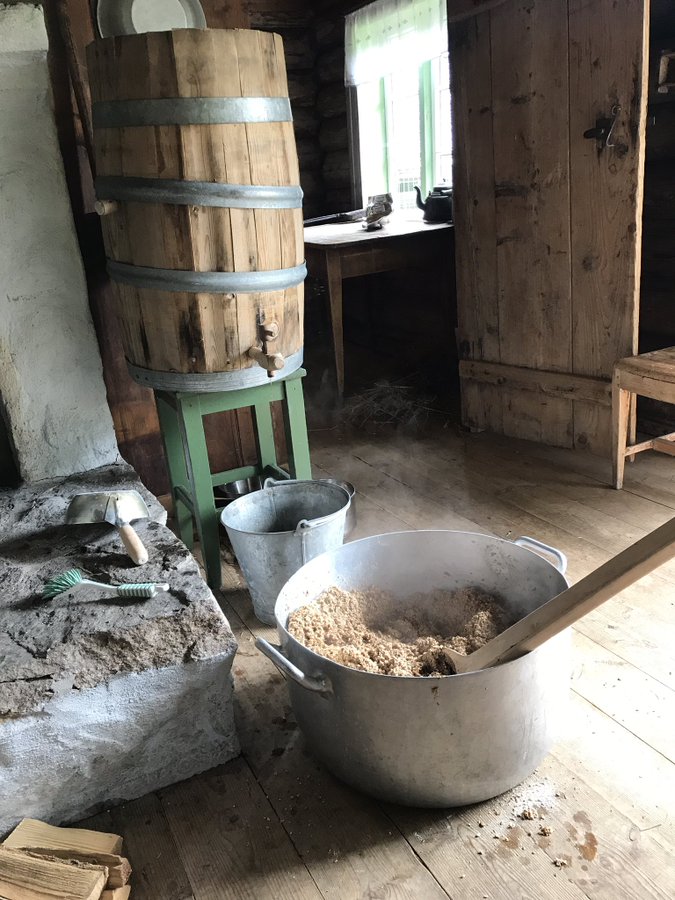
The “We Are Only Now Actually Halfway Through Summer 2024 This Week” Beery News Notes


Midsummer. This week. It’s now been 48 days since the summer solstice and the autumnal equinox is still a whole 45 days away. Mid. Summer. I blame public education for the false impression. The months of harvest are really just getting in gear. Moved: school should only be held in the months which are not summer gardening months. Approved. And Pete‘s #1 beer is exactly right. Beer after garden or yard work. Except… beer during garden or yard work. Or after coming back from the hardware store, I suppose.

What’s up? First off, I know my people can be a dour lot but I have never heard of it being a selling point in the hospitality trade until now in Inverness:

Dog Falls Brewing Co has applied for change of use to convert the long-closed Semi-Chem chemists’ to a beer “taproom” selling its product and other selected beers – but without music or entertainment. The brewery through planning agents Davidson Baxter Partnership Ltd, say in a supporting document to Highland Council: “The concept revolves around experiencing fresh beer from Dog Falls and selected other breweries in a setting where locals and visitors can talk, laugh, and interact with each other rather than being distracted by loud music or entertainment.” Dog Fall proprietor Bob Masson explained the concept further saying: “We want to encourage a convivial atmosphere among the customers without the entertainment add-on…

Got that? No need to repeat the point again. No entertainment. None. Nada. Don’t be looking to be entertained at this place. No way. Don’t. Not apparently related at all, I have never really needed twenty-four drinking each day in my life. Once forty years ago I got hammered starting at 4:30 am but that is only because I was a campus police officer at my small college and I arrested a guy breaking into cars at 3:30 am. After the fist fight in the wee hours and after handing the over to the actual cops, me nerves were a bit shot. So when I was offered unending tequila sunrises by my pal Bruce who was also technically my managing supervisor at that moment, I took up the opportunity.  Anyway, all that is to say, by way of intro, that the entire City of Montreal is now acting like my pal Bruce and is offering drinks around the clock for interesting reasons – and the BBC took notice:

Montreal will become the first city in Canada to allow 24-hour drinking. In Toronto venues have to close by 2am, and it is 3am in Vancouver. In the US, Las Vegas and New Orleans have long allowed bars and clubs to stay open all night. While in New York the cut off time is 4am, and in Los Angeles it is 2am. On the other side of the Atlantic, pubs in London still typically close at 11pm… Ms Alneus agrees. She says the fact that so many bars and clubs all currently close at 3am presents problems for the police. She believes by allowing 24-hour drinking, those venues that don’t wish to stay open all night will be able to close at different times across the night.

I will be over there in a few weeks but I am pretty sure I won’t be checking out that scene.  Yet a few hours after the party ends, in the UK for some on the move it starts up:

“Whether it’s 3am, 6am or 5pm, we all know that having a pre-holiday beer is a true British tradition. “Most of the time it’s a Fosters or a Carling and we all know they don’t exactly hit the spot. So, we decided to work with a local brewery and create the ultimate breakfast beer – the first of your holidays that matches perfectly with breaky.” Further findings from the research also revealed that a large majority of Brits (72%) believed a beer pre-10am is a “must” on our holidays.

Really? Honestly, I though it was just Ron. He’s been on the road in South America, as mentioned a couple of weeks ago, but he has finally gotten around to sharing the deets as well as the breakfast buffet experiences not to mention the glimpses into family life on holidays:

It’s quite chilly inside. Feeling a little cold, I put my coat back on. And notice no-one else has taken theirs off. They aren’t great on indoor heating here in Santiago. There’s a TV showing non-stop heavy metal videos… “Would you like to climb Mount Fuji, Dad?” Alexei asks. “No.” “Why not?” “For obvious fucking reasons. Like age and not wanting to die on a fucking mountain.” “If you weren’t old and scared, wouldn’t you want to climb it?” “No. I probably wouldn’t be able to breathe at the top of it.” “Well, apart from that?” “Just leave it.” After our first drink, it’s time for food.

In opposition to both Montreal and Ron, TDB reports that India is continuing its tightening of the prohibitions against liquor advertising after it became clear that there were efforts to circumvent the ban which already “outlaws direct advertising” by adding laws against “surrogate commercials and the sponsoring of events…” Examples:

Carlsberg would no longer be permitted to promotes its Tuborg drinking water in India by showing film stars at a rooftop party using the slogan “Tilt Your World”, which echoes its beer commercials. Nor would Diageo’s YouTube ad for its non-alcoholic Black & White ginger ale [which] features the iconic black-and-white terriers used to promote the scotch whisky brand of the same name.

Speaking of things that make you go “…hmmm…“, Jeff did some interesting data collection this week which has raise questions about some other data collection:

I found many of the breweries were no longer around. It wasn’t a marginal number. Despite the ambiguities in identifying what a brewery is, the number I ended up with was about 30% less than the Brewers Association’s official tally. For a number of reasons, this may be higher in Oregon than elsewhere: we have a more mature market, which means a lot more breweries have taprooms, which confounds things, and we also have more breweries closing because competition is so fierce. Nevertheless, it seems almost certain that the number of breweries in the US is thousands fewer than the regularly-cited figure of 10,000.

Which leads one to ask, of course, if that number is that wobbly – what else is? I mean, it’s not like any of this stuff is peer reviewed and footnoted.

Displaying far more solidity, The  Guardian had a pretty good interview with ‘Spoon owner, Tim Martin, who shared some interesting information about his approach to business including this early decision:

He wanted to be a barrister and studied law at Nottingham University, but was paralysed by a fear of public speaking. “I went to my first law of contract lecture and the professor started asking questions, so I didn’t go back. It made me very nervous. It sounds pathetic but you can get these little phobias.” The solution, it turned out, was getting into the pub trade, which he did in 1979 with the opening of Martin’s Free House. The JD Wetherspoon name came later, a mashup of JD Hogg, a character in The Dukes of Hazzard, and Wetherspoon, the name of a teacher who did not think much of  him.

And Jessica Mason has taken a cheeky approach to a piece which at the outset appeared to be about the place of fruity hazy IPAs in your fridge this summer as illustrated by one brand’s offering of something that is “effortlessly drinkable with a fresh watermelon taste and a pink haze” – and then is smartly turned on its head with the help of a couple of colleagues:

Tierney-Jones explained: “There’s a market for them and beer should have an element of fun but personally I tend to regard them as baby food for adults, the infantilisation of a great and noble beverage, it’d be a bit like a great wine producing chateau around Bordeaux adding mangoes or preserved lemons to their vintages.” Author and beer writer Pete Brown added: “I talk to so many brewers who say they brew hazy, fruity beers because that’s what the market wants. Then I look at the total share that hazy, fruity beers have in the market and think….’really? Looks to me like they want Guinness and ‘Spanish’ lager’.”

Brutal. Speaking of honest truths, Martyn has a book he wants you to buy and, as always, I was most obedient to the call. It sounds a bit like a reverse engineering of that earlier Jacksonian idea of classics:

There are certain classical examples within each group, and some of these have given rise to generally-accepted styles, whether regional or international. If a brewer specifically has the intention of reproducing a classical beer, then he is working within a style.

I say a reversal as Martyn is taking each of these eighty beers and expanding on their inherent implications – and not without peril as he explains:

One big problem with writing a book about beer with one foot firmly in the present is that the present is constantly changing. After I submitted the manuscript, it was announced that the Anchor brewery in San Francisco was shutting down. I hesitated for some time over whether to take the chapter on steam beer out, decided it was too interesting a style to ignore, and was saved by the announcement that the brewery had – at the time of writing – found a buyer. Similarly the chapter on Gale’s Prize Old Ale had to be rewritten twice, first after the closure of the Dark Star brewery, where POA was revived, and then after the closure of the Meantime brewery, where the brewing of POA was transferred. 

Speaking of wordcraft – and for the double – Jeff wrote about a subject that never has left me with much satisfaction – authenticity. What is that you say? He summarizes: “Authenticity is a self-referential quality. We associate ourselves with products that have the social currency of authenticity because it reflects well on us. We become authentic when we consume the right products.” It has always seem circular like that to me. A vessel of an adjective into which pretty much anything  can be placed. And Stan provide some more context particular to one beer related point:

In 2003, Holt and Cameron created a commercial that features a character they called The Tinkerer, who finds an old bicycle at a garage sale, carefully restores it, and then happily rides it into the Colorado countryside.  They outline their strategy for New Belgium in a chapter called “Fat Tire: Crossing the Cultural Chasm” within their book, “Cultural Strategy: Using Innovative Ideologies to Build Breakthrough Brands”… The word authentic comes up in most chapters, but usually as a given and without a definition of what it means to be authentic. What is clear is how important whatever they label authenticity is to those focused on marketing.

This has not been my sneaking suspicion so much as my clear understanding for years. I think we three are all on the same page so we can be honest. The call to generic authenticity is a useful call to nothingness, a warming abstraction which is is nothing more than a vacant space for marketeers. The sibling of “effortlessly drinkable” when you think about it. This is where we are. Craft beer has long abandoned the firmer footholds of traditional techniques and smaller scale* – but will current welcome interest in Czech lager and perhaps a building upwards blip in English cask now act as a counterweight to the mess big craft has made of itself?  If so, isn’t there a better word then authenticity? Perhaps credible. A credible rendition of something is a simple direct take – in the X=Y sense – without adding any intermediate generic analytical steps. I’d much rather have a credible take on a Světlý Ležák than an authentic one. Must now consider the other applications for the word in the beer world.

Finally, Matthew has written a personal essay about the pubs of his hometown of Lincoln and how his parents’ divorce when we was a teen affected his relationship them. To do that, he visits his Mum to spend a day about town:

The day starts off well. Mum has a hairdresser’s appointment on the other side of town and has offered me a lift. This means I have to leave early, burdening me with an extra hour to kill before the pubs open. No matter, I thought, this would give me a rare opportunity to play tourist in my birthplace. Mum, however, is running late, so puts her foot down. She banks hard down a side street, hitting 40 in a 20 zone. I grip my seat, before reassuring myself that she has spent her entire life driving on these roads, and probably knows them better than anyone. She drops me off close to my first stop and reminds me I need to be home before 7pm. It’s her choir practice this evening and she wants to make sure I’m back in time for tea.

We’ll have to tune in next week to find out if he made it back in time for tea. See, he ends the story in the last pub. I just hope his Mum wasn’t late for choir practice.

Enough! Here are the credits, the stats the recommends and the footnotes and the many ways to find good reading about beer and similar stuff via any number of social media and other forms of comms connections.** Want to keep up with the news before next Thursday? Check out Boak and Bailey every Saturday and Stan back each Monday… with a top drawer effort this week. Elsewhere go look at then listen to Lew’s podcast. And get your emailed issue of Episodes of my Pub Life by this year’s model citizen David Jesudason on the odd Fridays. And Phil Mellows is at the BritishBeerBreaks. Once a month, Will Hawkes issues his London Beer City newsletter and do sign up for Katie’s now revitalised and wonderful newsletterThe Gulp, too. Ben’s Beer and Badword is back with all the sweary Mary he can think of! And check out the Atlantic Canada Beer Blog‘s weekly roundup. There is new reading at The Glass which is going back to being a blog in this weeks best medium as message news. Any more? Yes! Check to see the highly recommended Beer Ladies Podcast. That’s quite good. And the BOAS podcast for the bro-ly. And the long standing Beervana podcast …except they have now stood down.  Plus We Are Beer People. The Boys Are From Märzen podcast appears suspended as does BeerEdge, too. But not Ontario’s own A Quick Beer. There is more from DaftAboutCraft‘s podcast, too.  All About Beer has introduced a few podcasts… but some may be losing steam… until… Lew’s interview! And there’s also The Perfect Pour. Plus follow the venerable Full Pint podcast. And the Craft Beer Channel on Youtube.  The Moon Under Water… is gone which is not surprising as the ask was $10 a month. Pete Brown’s costs a fifth of that but is writing for 47 readers over there. There was also the Beer O’clock Show but that was gone after a ten year run but returned renewed and here is the link! Errr… nope, it is gone again.

*A movement perhaps so spent that there’s only one move left – a Hall of Fame for the same approved names to give themselves a good old pat on the back! Will the nominating committee weigh each candidates downsides along with the PR pluses? Will “Sex for Sam” be to this HOF be what the steriod era is to another?  If not, what is the committee doing? Something authentic perhaps.
**This week’s update on my own emotional rankings? Facebook still in first (given especially as it is focused on my 300 closest friends and family) then we have BlueSky (132) rising up to maybe… probably… likely pass Mastodon (930) in value… then the seemingly doomed trashy Twex (4,483) hovering somewhere well above my largely ignored Instagram (160), crap Threads (52) with Substack Notes (1) really dragging up the rear.
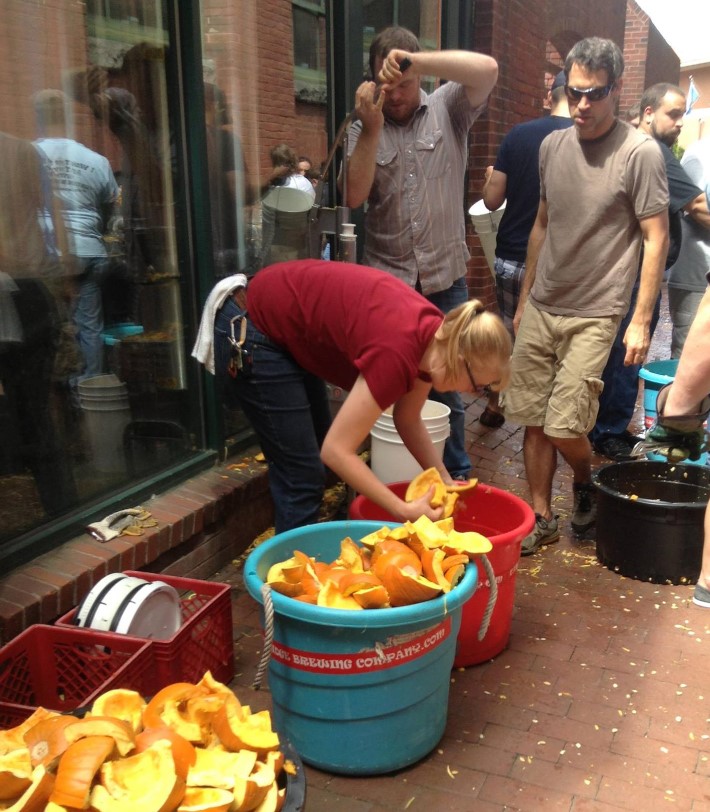
A Most Thoroughly August Edition Of Your Beery News Notes

What can you say about August that we each haven’t thought in our hearts of hearts? We are now well into the downside of the year, four months and three weeks and a bit until Christmas. It’s always struck me as odd that the first half of the year has seven months while the second only has five. August. Hmm. Plus it all gets a bit endtimesy around now. The garden gets weedy and a bit tired in the corners. We even got forest fire smoke from Pennsylvania this week, for God’s sake! Looks!! Good thing there’s all those fit folk at the Olympics in Paris, over there throwing themselves against the track, against the ball, against ocean waves and against each others fists to give us all at home cheering on the sofa an endorphin boost. Speaking of the Olympics, how’s the beer?

Anyone who was planning on heading over to Paris for the 2024 Olympics and expected to be having a boozy jaunt in a stadium is going to be sorely disappointed. Almost everyone who has got tickets to see bits of the 2024 Olympics will not be allowed to buy alcohol at the venues where the sporting competitions are taking place… if you must drink beer inside the venues then you’ll have to stick with the non-alcoholic stuff. For half a litre of non-alcoholic beer you’ll need to be spending €8 (£6.74), while if you want a 400ml drink of zero alcohol beer with some lemon juice in it that’ll cost €6 (£5.05).

Whhhaaaaat?!?!? Really? I’d be tempted to get me a robot but I suppose that makes sense in the keeping the eye on the ball sense for spectators but, more importantly, what is the point of cutting NA beer with juice? Don’t worry, however, as the rich in catered VIP zones will be able to drink… because… France… or the Olympics… or…

Same as it ever was? Things go around and around. Consider this piece from Jessica Mason in TDB on salting your beer:

According to the reports via Parade, the trendsetters claimed that “adding a bit of salt to your inexpensive brew will enhance the flavour” and described how “some people add salt to certain beers, like sours or IPAs, to enhance the fruity notes and reduce the bitterness” and suggested that “for those ‘cheaper’ beers, it’s supposed to make the brew taste a bit more highbrow”. The report emphasised how “Texans take beer salt so seriously” and said that drinkers were “likely to find lots of flavoured beer salt options when you want to crack open a cold one”.

Taverns when I was a lad in Halifax, Nova Scotia in the 1980s had shakers of salt on the tables. It was an old guy thing even back then, used by the hard cases in the back corners, but soon a little rattle of the shaker was a habit at the Seahorse or the Lower Deck when the unpasturized generic draft was a little off. Definitely done at the Midtown.

More information has been released on experimentation with the hotest new brewing grain in town, fonio. Interesting news even if this was a rather silly statement from Carlsberg director of brewing science and technology Zoran Gojkovic apparently (but I hope incorrectly) recalling a past discussion with Garrett Oliver:

“The internet says it is millet, but there are lots of millet grains and this one comes from Africa. But, back then, I misunderstood was what it really was all about. If someone tells you something is beef, but really it is like a variety, like wagyu steak, then it can be more easily understood. What I didn’t know was that fonio, compared to other kinds of millet, is like the wagyu steak of grains. Millet, as a cereal could be quite boring, but this in its pure formula is not boring. It is elegant.”

I’m more comfortable with it being the warp drive of millets – but only because that is obviously even more silly. Or is it the warp drives of wagyu? Or the wagyu of warp? That’s the fonio beer name I want to see: Wagyu of Warp!

And, speaking of silly, we have yet another study that resulted from the study of studies that studied booze and, again, it has been determined that there has been a lack of studiouness about that J-Curve fibbery:

…a new analysis challenges the thinking and blames the rosy message on flawed research that compares drinkers with people who are sick and sober. Scientists in Canada delved into 107 published studies on people’s drinking habits and how long they lived. In most cases, they found that drinkers were compared with people who abstained or consumed very little alcohol, without taking into account that some had cut down or quit through ill health. The finding means that amid the abstainers and occasional drinkers are a significant number of sick people, bringing the group’s average health down, and making light to moderate drinkers look better off in comparison.

I mentioned how dodgy the concept was at least as far back in 2018 but this newer focus on the problem of including “people who had stopped or cut down their drinking for health reasons in the comparison group” is critical. Note: not drinking because you are sick is different that being sick due to not drinking.

Note too: “golloping beer with zest” was a thing. Gary explains.

In Pellicle, David Jesuason wrote about one of the the tougher aspects, the mental health implications, that can go along with setting out to run a small brewery. This is how he set the scene at McColl’s Brewery of Evenwood, County Durham before help arrived:

“I came here thinking all I have to do is 150 casks a week and it didn’t happen,” Danny says. “Because I did it [before] I thought I was capable of doing it and not even knowing it was the wrong [thing to do] as well.” Danny’s mental health suffered because there was no long-term strategy, just day-to-day drudgery. Graft instead of focus. “I couldn’t make good decisions,” he tells me. He was running the entire operation by himself: brewing, selling and even delivering the beer to customers. It was far too much to take on, his mental health suffered and Gemma, his wife, became worried about him having suffered from depression herself.

That piece reminded me of the life of a farmer, alone with their business subject to the whims of nature and the trade. Should brewing trade associations provide mental health support programs similar to those being set up for agriculture?

Also on the ag beat, Stan has given us something to chew on with his July 2024 edition of Hop Queries, Vol. 8, No. 3 for those who are trying to collect a full set. He mentions that harvest time has begun, triggering images of golden light on hedgerow graced horse plowed scenes, perhaps mixing with Beethoven’s 6th wafting quietly in from somewhere then – WHAMMO – the invasion of the lab-coated eggheads begins:

Scientists at Sapporo in Japan used headband sensors to measure the brainwaves of participants… The subjects reported feeling relaxed by the aromas of linalool and geraniol because they provided floral and green impressions… An increasing tendency in the rhythm regularities of the frequency fluctuations of the right frontal alpha-waves while drinking a European pilsner-type beer with aromas characterized by hops. 

HEADBAND SENSORS!!! And, for the double, Stan pointed to this number crunching post from Phil Cook on Monday but (even though I may risk breaking an unwritten weekly updating rule) I want to unpack this point in more detail – one key difference between Australian and other beer judging events:

Because there’s a list of every beer entered, not just those that win medals, we can calculate some ‘batting averages’ to better compare how each brewery fared. So, I’ve worked out each entrant’s medal percentage (MPC: how many of their beers won a medal, of any kind) and their points per entry (PPE: adding 3 for gold, 2 for silver, 1 for bronze, then dividing by number of entries submitted). Bigger numbers are better in both cases; overall about 74% of beers entered earned a medal,2 and if your PPE was 1.00 or higher your brewery was in the top half of the competition. 

This would be a huge step towards making the results of these events more meaningful that those of the moveable buffet of the international circle of they who judge. Being able to figure out brewery top rankings as well as those surprising disappointments would be a great benefit to consumers. But who in beer puts the buyer first?

Perhaps connected, Jeff shared his thoughts on the financial perils of being a freelancer writing about the brewing trade without separate income:

Writing is a terrible way to make a living. It’s why people end up going into marketing. You could spend your days scrambling after $600 articles, or you could get a job for $60k with benefits. This is why we bleed great writers, who take their services to companies who will pay what their work is worth. It’s not just that the money’s bad—it’s also hard to get. If you could somehow stack up your articles and get a couple in every week, you could make a decent living, maybe fifty, sixty grand a year before taxes… Trying to pitch stories, and then research, report, and write a hundred of them in a year? I’m not saying it’s impossible, but again, you’d be barely making more than working at McDonald’s if you somehow enjoyed that level of “success,” which perhaps 2-3% of working freelancers enjoy.

The best line was near the end: “If you have any other choice, don’t write.” What he means (of course… or rather I hope!) is don’t write for money but this isn’t news.* Still… write. Writing a free, joyful and easy experience of expression. Scribble, jot, draft, forget and rediscover – and, yes, even submit. Just don’t think you’re going to be buying the kiddies shoes with the income.

Joyful, too, is Dave “Still No Relation” Bailey’s cartooning, also in Pellicle, which this month explored the notion of perfection.  And if you want an example of writing for joy, ATJ has been working on one particular theme quite a bit over at his Substack, that being ATJ sitting in a pub and looking at the details of the scene around him. Second or third time I read one of his I thought “hmm…now, that sounds familiarBUT as this week’s edition testifies its his process being worked out before our eyes:

My eye was caught by a faded photo of the pub, sometime before World War I. Outside it, there stood a line of long dead regulars, mainly men, standing still, a couple smiling, the rest sombre and holding themselves stiffly as if on parade, which several years later many of them would be, ready to march off to war. A long ago day, the sun shining maybe, though given the quality of the photo it was hard to say. Bowler hats, cloth caps, none of them bareheaded for that was not how they presented themselves to the world then. I’d like to think that once the photographer finished, off the men went into the pub, glasses of ale and cider purchased and amid the hubbub there would have been little time for reflection.

Sharp stuff. And it sure beats the sort of cash-focused writing that has recently given us such gems as “deepest echelons of the industry” and “with demand being high, the category has continued to thrive, despite the sector struggling” and the astoundingly poorly thought out alleged expression of expertise “Liquids within the same ‘competitive set’ are not distinctive from one another as liquids.” Bring on the robots of A.I.! Viva Robots!!

No, I didn’t mean that. There are no robots of joy. It’s actually all around us already now if you look for joy. We see it in a long wandering piece about wandering at length. And we also see it at home as when Rachel Hendry in her emailed newsletter J’Adore Le Plonk shared some thoughts on the role and value of the leftover bottle of wine there in the kitchen that was opened a few days ago… and may have lost whatever finesse it had:

Service work should neither be seen nor paid, tends to be the general consensus and when my wine joins me in a position of domestic work I attach the same framework to it. Why add this beautiful, evocative glass of wine to my dish when I can reach for something leftover, or looked down on, fuck it, why not just add water instead? The recipe provides a role for a wine that is past its best, that may otherwise be retired down the drain and into the bin. It doesn’t, however, mean the wine isn’t important. Wine has many roles in our lives and contributor in the kitchen can be one of them. As I work through my hesitation and add a splash of my wine to the courgettes slowly melting into butter I notice I have not lost anything in the process. The wine is still mine to enjoy, I have placed value on an ingredient as I would like to be valued myself and the meal tastes better for it.

And I should have mentioned that Katie wrote a few weeks ago about trying Italian wines with any sorts of unexpected flavours to see what works for you. My tip? Chianti with roast turkey. It can have a swell cranberry vibe going on. Try a turkey and blue cheese sandwich with slices of pear and a cold glass of Chianti. Could sound weird but it works. Not this weird, mind you, but there that gets a lot going on.

That is it. Enough! Here are the credits, the stats the recommends and the footnotes and the many ways to find good reading about beer and similar stuff via any number of social media and other forms of comms connections.**** Want to keep up with the news before next Thursday? Check out Boak and Bailey every Saturday and Stan back each Monday… with a top drawer effort this week. Elsewhere go look at then listen to Lew’s podcast. And get your emailed issue of Episodes of my Pub Life by this year’s model citizen David Jesudason on the odd Fridays. And Phil Mellows is at the BritishBeerBreaks. Once a month, Will Hawkes issues his London Beer City newsletter and do sign up for Katie’s now revitalised and wonderful newsletterThe Gulp, too. Ben’s Beer and Badword is back with all the sweary Mary he can think of! And check out the Atlantic Canada Beer Blog‘s weekly roundup. There is new reading at The Glass which is going back to being a blog in this weeks best medium as message news. Any more? Yes! Check to see the highly recommended Beer Ladies Podcast. That’s quite good. And the BOAS podcast for the bro-ly. And the long standing Beervana podcast …except they have now stood down.  Plus We Are Beer People. The Boys Are From Märzen podcast appears suspended as does BeerEdge, too. But not Ontario’s own A Quick Beer. There is more from DaftAboutCraft‘s podcast, too.  All About Beer has introduced a few podcasts… but some may be losing steam… until… Lew’s interview! And there’s also The Perfect Pour. Plus follow the venerable Full Pint podcast. And the Craft Beer Channel on Youtube.  The Moon Under Water… is gone which is not surprising as the ask was $10 a month. Pete Brown’s costs a fifth of that but is writing for 47 readers over there. There was also the Beer O’clock Show but that was gone after a ten year run but returned renewed and here is the link! Errr… nope, it is gone again.

*My full sympathies (though I might have used the phrase “good writers” to convey a sense of realism.) I wrote this in an email to Max, now eleven years ago: “It is tough. There is no money in beer writing so if that is all you have to go on… I have met with pro writers over beer and always find them bagged out and drained from the nights of PR work in pubs to keep the wolf from the door. I complained once somewhere about how craft brewers should be supporting good beer writers directly without expectation of return and this was met with howls – even from writers. Earn your way as a freelancer, said the freelancers. Suck it up and take the junkets, said those on the junkets.” Is that the macho forehead + wall thinking part of the freelancing problem?
**This week’s update on my own emotional rankings? Facebook still in first (given especially as it is focused on my 300 closest friends and family) then we have BlueSky (132) rising up to maybe… probably… likely pass Mastodon (930) in value… then the seemingly doomed trashy Twex (4,483) hovering somewhere well above my largely ignored Instagram (160), crap Threads (52) with Substack Notes (1) really dragging up the rear.

Fine… The Dog Days Of Summer Beery News Notes Have Begun

Is it me? It’s not you… is it? No, it’s beer. When beer sales peak, the news gets a bit sleepy or at least played out as expected. LCBO strike got settled. Beer in Canada is still expensive. Biden stepped aside. The French fascists were humilated… again. Sure, the back channel comments about the winding up of GBH continue to flow in – but nothing I would share to you lot. Some write for pay. Me, I write for gossip. I think Martin captured the zeitgeist of the week perfectly with this image above from his trip to take in the delights of the Church of St Mary Magdalene in Yarm.

Which leads to the question of the week, as posed by Stan on Monday when he responded to my comment last week that I think of him as my ever absent desk editor:

I am embarrassed, flattered, and a little surprised (perhaps skeptical) by the idea he does the sifting for me. The takeaway, to his credit, is a reminder of something all writers should remember: who the heck they think they are writing for.

Who or what do you write for? The reader? The commissioning editor? The next commissioning editor? The bills? The long dead relative who told you that you’d never amount to anything? I joke about things but I really have only been writing for myself for years. The beer trade is a benign sideshow that lets me explore ideas in an innocuous way. Ideas about life, business, quality, ethics… the whole shebang. It’s all right there. By the way, did you know a shebang was a rough hut of the Civil War era or a frontier settler? Me neither. One has to be careful about certain words.

Speaking of words, Jordan was out there recently wandering lonely as a cloud, not hunting out daffodils so much as dandelions to do some unpacking, dissecting and extractions to ‘splain a thing or two:

Dandelion has GLVs (hexenol), but that is to be expected since it has green leaves. It’s complex in that the different parts of the plant have their own properties. Harold McGee refers to the component smells as “light, fresh, and watery,” but we’re thinking about the entirety of the palate and not just the aroma. In terms of aroma, we have some of the same makeup as clover. Phenylethanol and benzaldehyde. There’s also Nerolidol, which is slightly woody and barky, which makes sense when you think of the rigidity of the stem. When the stem breaks, the dandelion’s defense method is to secrete latex, which is found mostly in the root system of the plant. The latex is not only bitter, but alkaloid, and polyphenolic. If you pick a dandelion to hold under someone’s chin, you’re going to get aroma from both the flower and the stem.

Yes, yes… outside of the Greater Toronto Area kids used buttercups to hold to a chins. But the point is made. There is science right there. Smelly tasty  science. Yes, there. And there as well…. ‘s’tru’. Even if “…phenylethanol and benzaldehyde… There’s also Nerolidol… “ sounds like a particularly challenging point in a Gilbert and Sullivan libretto.

Before the doors close, GBH published an interesting story by  Yolanda Evans on the practice of giving “libation” globally and also particularly in Black American culture:

“I think hip-hop just popularized [libations] in a way where we were given the language to talk about the celebrations of life that maybe we didn’t have before,” says Gates. “It’s not specific to a particular generation—hip-hop only happened 50 years ago, while we’ve been in this country for centuries,” she adds. In some ways, the genre transformed the ritual from a private and personal thing to an act so popular it eventually became removed from its roots—eventually, people everywhere, and especially in the African-American community, would pour one out for their homies without knowing they’re performing an old boozy ritual with roots that go back several thousands of years.

The piece expands much on the 2015 article in VinePair and, for me, it’s an interesting exploration a familiar thing because we Highland Scots do it, too. But it’s part of what my Reverend father would call the greater  “heedrum hodrum” aka the pre-Christian rituals that hang on. But in that context it’s not so much about remembrance as thinning the ether between here and there, now and then. Want to have a moment with Grannie to share a thought? Pour a little of the good stuff on the ground.

Tasting note of the week: “…distressingly grey…

Speaking of VinePair, David Jesudason wrote an interesting piece for that fine journal in which his powers are on full display. I love how he places himself in stories, rejecting that more formulaic approach that we suffer along with too often. Consider this passage:

He’s all for mixing Guinness when done well but prefers to use bottled Guinness over widget beer cans or draft kegs in pubs for logistic reasons, such as lower carbonation. “Bottled Guinness has a different bite, of course,” he adds. When I press-gang Gaurav Khanna, the publican at the desi pub Gladstone in south London, into mixing numerous Guinness with soft drinks, he at first struggles with wastage caused by the stout’s carbonation. After a few pints mixed with Irn-Bru and some Gonsters, though, he nailed it. (At the end of the session we had to negotiate hard over my tab because we lost count of the amount of Guinness that was “tasted,” drunk or discarded.)

But no mention of stout and port, 2012’s sensation. Why?

News out of the UK related to the affirmation of the new government’s intention to impliment its predecessor’s public venue protection standards in Martyn’s law. Sarah Neish in The Drinks Business shared the likely implications for pubs and other parts of the UK hospitality industry:

… premises are unlikely to be expected to undertake physical alterations or fork out for additional equipment… measures are expected to include: Evacuation – how to get people out of the building; Invacuation – how to bring people into the premises to keep them safe or how to move them to safe parts of the building; Lockdown – how to secure the premises against attackers, e.g. locking doors, closing shutters and using barriers to prevent access; and Communication – how to alert staff and customers, and move people away from danger. “Additionally staff will need to understand these measures sufficiently to carry them out if needed,” Grimsey tells db, which suggests there will need to be an element of staff training for front-of-house employees of Standard Tier venues.

Sensible stuff. These are different times. Speak of these times, Katie wrote an explanation of “underconsumption core” this week in her newsletter The Gulp, a concept which may explain my dedicate use of a dull manual rotary lawnmower:

Underconsumption core exists because even the most exuberant of haulfluencers are starting to feel the constrictions of what is basically a national money shortage. When Broccoli is £1.20 a head in Lidl (one pound twenty pence!! for broccoli!!), there are many other things that have to get cut from our monthly budgets. Nights out become more infrequent. Takeaways become frozen pizzas. Beer turns into slabs of whatever tinnies are on offer at Tesco. We do what we can to keep ourselves afloat when the weekly shop increases by more than 20% over a year.

Reality. It may be a variation on another thing – the return to basic beer. Don’t tell Forbes, by the way, which published a piece by one of the 198,349 beer columnists (no, not AI generated at all, no way) they seem to have on the payroll that offered this astounding statement:

Researchers highlighted the increasing popularity of craft beer and the emergence of more independent breweries, reflecting evolving consumer preferences, especially among younger consumers of legal drinking age in local markets. These breweries are often at the forefront of innovation, offering more flavors and styles that appeal particularly to millennials and Generation Z.

Right. Back on planet Earth, when someone not really at the core of a scene like the former style director of Esquire, Charlie Teasdale, takes the time to give craft beer a mocking kick it is starting to feel like the proper response is, what… pity?*

… like supporting a football team through a massive, slightly grubby commercial takeover, I stayed the course. I never wavered in my dedication to stupidly named pale ales and unorthodox beers. Even a jug of pseudo-craft – a beer brewed by a corporate outfit but marketed as a local endeavour – was better than, say, a Moretti or a Heineken. They were for drinkers, and I was a gourmand.

VinePair may well have gone next level… again, joining this latest pile-on according to Maggie Hennessy. And whereas Mr. Teasdale has moved back to popular lagers, Ms. H is touting something called “lifestyle” beer but mainly to beat the word “hipster” wtith a very big stick… over and over.** Strike me as all a bit of excessively early liminal labeling syndrome. Perhaps best to leave this phenomenon alone until it all settles down a bit and clarifies. By contrast, Courtney Iseman slides a more deftly phased zing in the larger context of her very comprehnensive survey of the use of rice by better brewers:

That industry maturation, and the decreased pressures of toxic fandom—no one’s boycotting your brewery anymore if you sell shares to a corporate overlord, nor if you put rice in your beer—has allowed craft brewers more freedom to find a place for the grain.

Toxic fandom! We are now a long way from the “beer community” fibbery. [Note: as stated in the story, it was the craft brewers were the ones who shit on rice but now it’s us beer buyers who were being toxic for taking up the brewers’s PR (touted by beer writers) as the great cause.] Ron don’t care. Ron is spending much of the month with family in South America. He is sending in posts from the field that look like he’s tied up the radio operator and highjacked a distant railway station deep inland, relying on only direct current and Morse Code to send out terse missives like this one entitled “Loving Santiago“:

The kids, too. We get to ride the metro everywhere. They drink beer, I drink pisco sour. We get to shiver together in the unheated pubs. It’s like being back in the 1970s. But in a good way. Montevideo tomorrow.

That’s the whole post? So unRon, Ron is being. Where the hell are the breakfast buffet photos, Ron?!?!?!

Speaking of a buffet, Rachel Hendry has studied the world of (call them what you will) thin bits of potato fried in oil and shared the extensive results in Pellicle this week. I particularly like the polite “don’t be an arsehole” notice to readers:

I have then chosen ten styles and flavours to explore within each section, with more precise pairings given as examples for each. I have defined crisps as a potato or potato adjacent snack that tends to be found behind the bar or in the crisp aisles of a shop, and I have defined beer styles as you might see indicated on the list displayed in a pub or taproom. There is only so much one woman can cover and I have forgiven myself for the detail and genres missed. I trust you to have the grace to forgive me, too.

And… when did PBR become hipster cool? I was interested for what I consider pre-hipster reasons in 2006. This 2014 HuffPost article traces the story… with graphs!

…something changed, and PBR was suddenly the hipster’s choice at bars and barbecues everywhere. Sales jumped by 20.3 percent in 2009 and continued to rise steadily over the next few years, according to Beer Marketer’s Insights. By 2013, Americans drank more than 90 million gallons of PBR, according to data from Euromonitor, which is nearly 200 percent more than they did in 2004.

“Rise Steadily” is one of those hints that the tipping point people can just remain seated.

Fine. That is it. And with that this and those other thats too … now we roll the credits… well, the credits, the stats the recommends and the footnotes and the many ways to find good reading about beer and similar stuff via any number of social media and other forms of comms connections.** Want to keep up with the news before next Thursday? Check out Boak and Bailey every Saturday and Stan on the job each and every Monday. Elsewhere go look at then listen to Lew’s podcast. And get your emailed issue of Episodes of my Pub Life by this year’s model citizen David Jesudason on the odd Fridays. And Phil Mellows is at the BritishBeerBreaks. Once a month, Will Hawkes issues his London Beer City newsletter and do sign up for Katie’s now revitalised and wonderful newsletterThe Gulp, too. Ben’s Beer and Badword is back with all the sweary Mary he can think of! And check out the Atlantic Canada Beer Blog‘s weekly roundup. There is new reading at The Glass which is going back to being a blog in this weeks best medium as message news. Any more? Yes! Check to see the highly recommended Beer Ladies Podcast. That’s quite good. And the BOAS podcast for the bro-ly soon celebrating a 10th anniversary… or really a 9 1/2th given the timeline . And the long standing Beervana podcast …except they have now stood down.  Plus We Are Beer People. The Boys Are From Märzen podcast appears suspended as does BeerEdge, too. But not Ontario’s own A Quick Beer. There is more from DaftAboutCraft‘s podcast, too.  All About Beer has introduced a few podcasts… but some may be losing steam… until… Lew’s interview! And there’s also The Perfect Pour. Plus follow the venerable Full Pint podcast. And the Craft Beer Channel on Youtube.  The Moon Under Water… is gone which is not surprising as the ask was $10 a month. Pete Brown’s costs a fifth of that but is writing for 47 readers over there. There was also the Beer O’clock Show but that was gone after a ten year run but returned renewed and here is the link! Errr… nope, it is gone again.

*h/t The Tand.
**Stan gave sound advice (see what I did there?): “I think the relationship, if there is one, between hip and hipster has me confused. Were the bike messengers who drank PBR hip, hipsters, or something else? What PBR itself ever hip?
***This week’s update on my own emotional rankings? Facebook still in first (given especially as it is focused on my 300 closest friends and family) then we have BlueSky (132) rising up to maybe… probably… pass Mastodon (932) in value… then the seemingly doomed trashy Twex (4,485) hovering somewhere well above my largely ignored Instagram (160), crap Threads (52) with Substack Notes (1) really dragging up the rear.