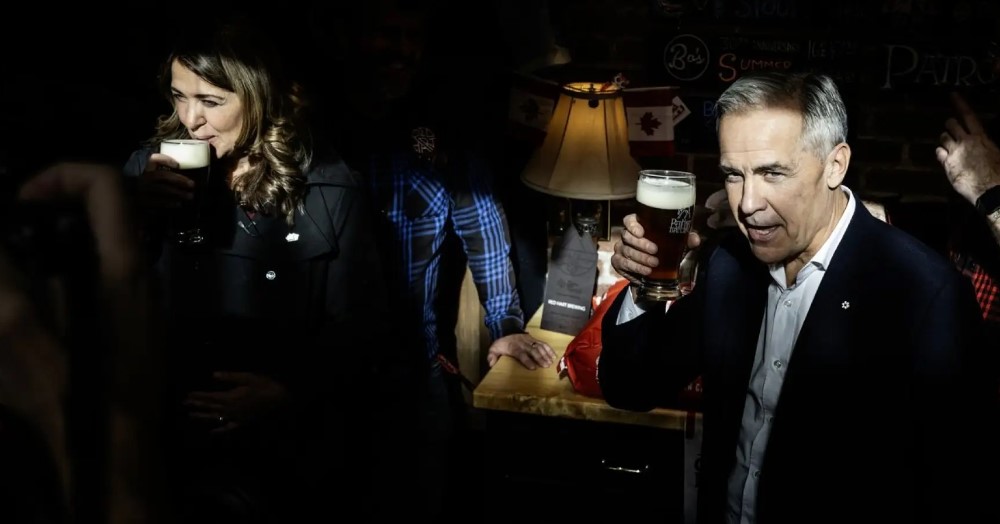
 It’s a big week around here. I have that presenation I mentioned. Plus I have my mini-university lecture and turorial on the Stoics. Plus… the third referendum on separation in my time on this earth. Up there? In the moody light and the sweet way both the faces and the foam are highlighted by CP’s Jeff McIntyre, proof that when the political moment looms more than anything else Canadian politicians need to be seen holding a pint of beer:
Albertans are being asked whether the province should remain in Canada or hold a second, binding referendum on separation. Smith has said it’s time for Albertans to decide on the issue and that she prefers a sovereign Alberta in a united Canada. She said earlier this week that she voted at an advance poll for Alberta to stay. At the brewery, she and Carney praised each other as sharp-eyed, flinty negotiators who fight for their positions but want the best for Canada. They said they’re making progress, including with a proposed fast-tracked oil pipeline from Alberta to the B.C. coast.
Polls closed at 10 pm my local time on Tuesday. I went to bed at 1 am, before the first results were announced. The losing cause didn’t hit 25% support even with social media support from the Kremlin.* I had a wee well placed tot of Crown Royal in celebration.
What else is going on? Well, speaking of disinformation campaigns that may have failed, there was an interesting anecdote from the recent and apparently mini-GABF shared in BMI this week:
At annual brunch hosted by Boston Beer, BA prexy/CEO Bart Watson, Boston founder/CEO Jim Koch and Dogfish Head founder Sam Calagione all expressed hope that the afternoon’s first GABF session would be a success after the festival was literally turned inside out, from 3 days inside the city’s convention center to 2 days outdoors. And while there was an extensive menu of food and drink to be had, mincing words wasn’t on it. Last yr, the trio paced the same stage, outwardly confident that craft culture was making a comeback, borne of observations from the previous night’s session. This yr, seated behind a table, the three instead offered cautious optimism about the new format while acknowledging straightaway that “the status quo sucks,” in Sam’s pointed telling.
“A comeback“! That’s a good one. It’d be nice if there was ever a debrief on why even these gents have lost the blind faith. Or the merest analysis. “Craft culture” selling out to every fad that came along perhaps? The repeated ditching of the elements of the definition of “craft” itself? Nevermind. But on that note, The Beer Nut provided perhaps an example of his writing if he was ever retained on such an analytical report:
…the flavour doesn’t taste like any of the advertised fruit. Instead it’s pure candyshop. I’m getting Jelly Babies, with overtones of Fruit Pastilles and the saccharine tang again, here calling to mind some weird off-brand chew sweets from the more disreputable sort of convenience store. Ghastly business. It’s honkingly sweet, messily flavoured and utterly artificial. I defy anyone but the most hardened Kopparberg drinker to get through more than one of these. Ack. I’ve honestly tried to give all of these a fair assessment, and point out their positive sides. This has none. I take back any suggestion that going “all in with the syrup” is a good idea.
Did the Peter Pans lead us all to this and then take off? No, nevermind. Still, it’d be nice if the who thing got back to the real. You know, like when we lived in Poland in 1991-92 and were offered the opportunity to meet a great boar hunter who only used a lance when stalking in the nation’s dense eastern forests. Really real. Really. Even though it was explained that the man would be the equivalent to a hockey star in Canada, we declined and I’ve sorta regretted it ever since. While I do not hunt myself, I find foody hunting cultures very compelling. Like this tale in Everyday Drinking:
In those days, Olivier often waxed nostalgic for the elemental, primal roots of the cooking he knew back in hardscrabble Picardy — rustic and earthy, based on things like beets, turnips, endives, leeks, foraged mushrooms, stinky Maroilles cheese, so-called “pre-salted” lamb (“they graze on salt marshes”), and lots of game, particularly boar. Olivier was convinced people would love a cookbook about this cuisine, and so one autumn he invited me to go on a wild boar hunt with his uncle. On the morning of the hunt, when Olivier and Uncle Jean showed up at the hotel before dawn, Jean wore his brimmed hat cocked to one side, and with his trimmed mustache looked a little like Ernest Hemingway. “I’ve been up early salting the lamb for lunch!” Olivier said. I was still full of horse and hungover from all the Champagne. “I thought the lamb was pre-salted,” I said.
Yum. Fair bit of real right there, too. And on a role after the announcement of his new book, Lars shares a bit about the itches that drive his curiosity** to figure out what is real:
I started looking into farmhouse ale back in 2010, and one of the first things that struck me was that so many brewers were using juniper branches. By 2014 I had gotten more seriously interested, and had even visited brewers to see their brewdays, and started digging into what little literature there was on spice use. To my surprise, the literature was mostly focused on gale, and gave little attention to juniper, even though by now it was very clear to me that juniper was very important in traditional brewing. Then, also in 2014, I got hold of the answers to the Norwegian ethnographic questionnaire on farmhouse brewing, and again I was struck by how just about everyone seemed to be using juniper in the beer. And by how few of the answers mentioned gale, in contradiction to the existing literature.
Speaking of the wrong flavour, Mike Seay on the truth about the limits of flavour adjuncts:
Urban Roots makes excellent IPAs and then you add a cool label and name, I am all about that. It was as good as I thought it would be. And no, there is no guacamole flavor, just one of those deceptive beer names. Usually I don’t like when a beer uses a food flavor in its name but doesn’t have it in the beer, but this one is an exception. There has got to be an IPA out there that has guacamole in it somehow, yeah? Maybe I’ll check Untappd.
Guacamole Yukamole. You heard me! So… why is the whiff of misinformation so prevalent? Maybe meaninglessness is just part of the culture! Is it or isn’t it? Apparently it can be both at the same time. To wit, BeerToday has shared a number of statements by Jamie Allsopp on a project to create a beer “brewed to a recipe inspired by the very first viable IPA, a beer devised by us in 1822 in Burton-on-Trent… [w]e did not want to produce a museum piece…” Allsopp also said his team took “the defining characteristics of the original Allsopp’s IPA and brewing them for today’s drinker.” On this, B+B stated “…inspired (yes, we know…)” and Liam observed:
Between the ‘yes, we know’ here and the name-check in the footnotes ye know me too well. And yes, ye are correct, especially after reading some of the comments in your link to the beer! Sheesh… If they said a ‘modern take’ on the IPA I’d say fair enough but they are leaning too hard into their history maybe? Are they guilty of degrading variants of the original beer, or dumbing it down to what they think customers want? If that’s the case hazify it! Also, Golden Promise and Challenger? …
But outside the beery bubble, the BBC sets out the claim made in broader terms with perhaps suprising statements in support:
More than two centuries on, the ledger containing over 100 handwritten recipes, including IPA, Pale Ale, Double Diamond, Stout, Arctic Ale and dozens of forgotten brews, was found in an attic in Leeds. Jamie added: “Without the recipes I wasn’t interested in producing guesswork.” He said he was not looking for “historical interpretations of IPA”. “It had to be the real deal – with the right malts, hops, and style that could make our beer revered once again,” he said.
It’s the “real deal“, is it? Doesn’t producing the “real deal” seems to contradict the “not a museum piece” statement? Can the two claims coexist? Why not? It’s beer! Seriously, this sort of thing, for me, is not helpful. Here’s some notes:
Note #1: interesting local initiative on alcohol misuse in nearby NNY.
Note #2: Braciaca… god or goddess of malt?
Note #3: Police station pubs of the Caribbean.
Note #4: Does ramen have a flavour?
Speaking of “is it or isn’t it?” we see, for The Grocer, that James Beeson has noted one way economic conditions are affecting breweries:
Adnams CEO Jenny Hanlon is understood to have told staff the brewer needed to find a more cost-effective way to produce and package its small-pack beers. Adnams is exploring outsourcing the production and packaging of its bottled and canned beers, as the Ghost Ship brewer seeks to navigate increasingly choppy trading conditions in ale.
That’s quite real isn’t it. But no need for the cutsy maritime pun. And this piece in The Times has a bit of a chin trembly vingette at the window of a closed pub in the Scottish Highlands, parts of which are becoming pub deserts:
Squinting through the glass, his nose almost touching the panes, Reed, a 62-year-old retiree, could see the Victorian bar, its pumps still marked up with brands like Tennent’s, Scotland’s ubiquitous lager; Belgian Heverlee, Irish Guinness and Caledonian Best. “It was really an old man’s pub, just a nice wee country pub,” the former senior BBC TV journalist said. “It is so sad to see it shut. It feels like the heart has been pulled out of the village.” His partner Anne McLean, 60, joined him at the window. She pointed out a stool at the bar. “There was one guy who always sat there,” she said. “If he came in and anybody else was in his seat, they would move. Because it was his spot. It was that kind of place.”
More optimistic was the tone from Knut who took part in a recent new product tasting at the government store, Vinmonoplet, where an obvious truth or two is observed:
Twice a year we are invited to taste special releases. The room is bright and airy. The view is to one of the most iconic landmarks of boomtown Oslo – the roof of the Opera House. Unbeknown to the tourists taking their selfies on the marble slabs, we are presented with a row of glasses and a sink for spitting and rinsing… A long line of vintages of the Bourbon County Brand Stout, ranging from 2018 to 2023. To top it up, we get Reserve Bourbon from 2018, Vanilla Rye Stout and Night Cap Cuvee. Three samples at a time. Sip. Taste, spit. Rinse glass, rinse mouth. Of course, it is interesting to try such a long list of variations on the same beer. These bottles are well suited for aging; there are no off flavors or other flaws. But it is extremely hard to tell them apart.
Is this a brewing success but a procurement manager’s scheduling failure? There is, however, perhaps another way to tell them apart as the organisers of Gloucester‘s Sheriff’s Assize of Ale very well know:
The Sheriff, Councillor Anne Radley, pours a small amount of ale onto a wooden stool, which the ale conner then sits on while wearing a pair of leather breeches. After three minutes, the ale conner stands up. If their shorts do not stick to the stool, the ale passes the test and is of acceptable quality. If the shorts do stick to the stool, it means that not enough of the sugar has turned into alcohol and the ale is dubbed “inferior”.
And on the topic of government administration of booze, I listened to an interview on CBC’s Ontario Morning*** about the economics of expanded liquor sales in Ontario through an additional 6,700 retailers and how that decision has lost the government hundreds of millions of dollars. The interviewee was Prof Brock University who recently reported his findings for The Conversation:
The decline follows the Ontario government’s 2023 decision to expand alcohol sales to grocery stores, convenience stores and other retailers. The LCBO also incurred an estimated $33.4 million in costs associated with holding unsold American alcohol. The provincially owned LCBO consequently generated $1.2 billion less for taxpayers over the past two years than its 2023-2024 results might have suggested. That shortfall is five times larger than the $229 million previously forecast by Ontario’s Financial Accountability Office. Meanwhile, private retailers have added $911 million in annual sales, whereas some LCBO stores may close.
The report also confirmed that pulling US booze off the shelf has led to that inventory write-downs of $20.4 million due to stuff like coolers going out of date, warehousing costs approaching $10 million to hold on to the remaining US bottles and cans as well as an implied interest cost nearing $3 million to hold the stock but not make money off of it.
Finally, for Pellicle Imran Rahman-Jones tells the story of the other other national drink of my peeps, 80/- ale:
The Athletic Arms—better known as The Diggers, because gravediggers from the two nearby cemeteries would drink there—is a beautiful Victorian corner pub near Edinburgh city centre, with stained-glass windows and a white-marble-topped bar dominating the room. Despite the opulence, it’s a real local’s local, where prices have been kept low. It’s the kind of place where landlord Kev McGhee knows his regulars by name, often pouring their drinks before they’ve even asked. Many of these drinkers are served 80 shilling, commonly written as “80/-”. It’s a rich, slightly sweet and malty pint. Nathan uses words such as “raisin,” “fruit loaf,” and “toffee” to describe it, and notes its “slight smoky roastiness on the edge of the palate.”
There you are! Another busy week with a bit of the positive woven into these troubld times. Until we meet again, please check out Boak and Bailey’s postings on each and every Saturday along with their fabulously entertaining footnotes week after week at Patreon. And do look out for more of Stan’s “One Link, One Paragraph” format. Then it’s your turn. Read and recommend, please. Scour the world for news tips – then let me know. Then hunt out something in someone’s archives! Leave oblique comments on someone’s post from 2009!! Listen to a few of Lew’s podcasts and get your emailed issue of Episodes of my Pub Life by David Jesudason on certain Fridays. And Phil Mellows is at the BritishBeerBreaks. Once a month, Will Hawkes issues his London Beer City newsletter. Do sign up for Katie’s wonderful self-governing totes autonomous website featuring The Gulp, too. Ben’s Beer and Badword remains on pause but there is reading at The Glass which is going back to being a blog. Any more? We have Ontario’s own A Quick Beer and All About Beer is still offering a range of podcasts – and there’s also Mike Seay’s The Perfect Pour. Plus follow the venerable Full Pint podcast! And there’s the Craft Beer Channel on Youtube as well as the archives of the Beer Ladies Podcast. What else?
*Here are some observations by one of Canada’s more trustworthy observers.
**In refreshing controdiction to the booze bleg phrases of the week: “…wine-media elite…“, “…do more than learn sensory vocabulary…“, “…complex and strong, often like wine…” or a definite favourite “… debunk a beer myth!” when it’s not any sort of myth, just an error, a misunderstanding or sometimes only a different point of view. What would Martyn have said!?!
***Meaning I was wide awake at 7:40 am even though I am retired!