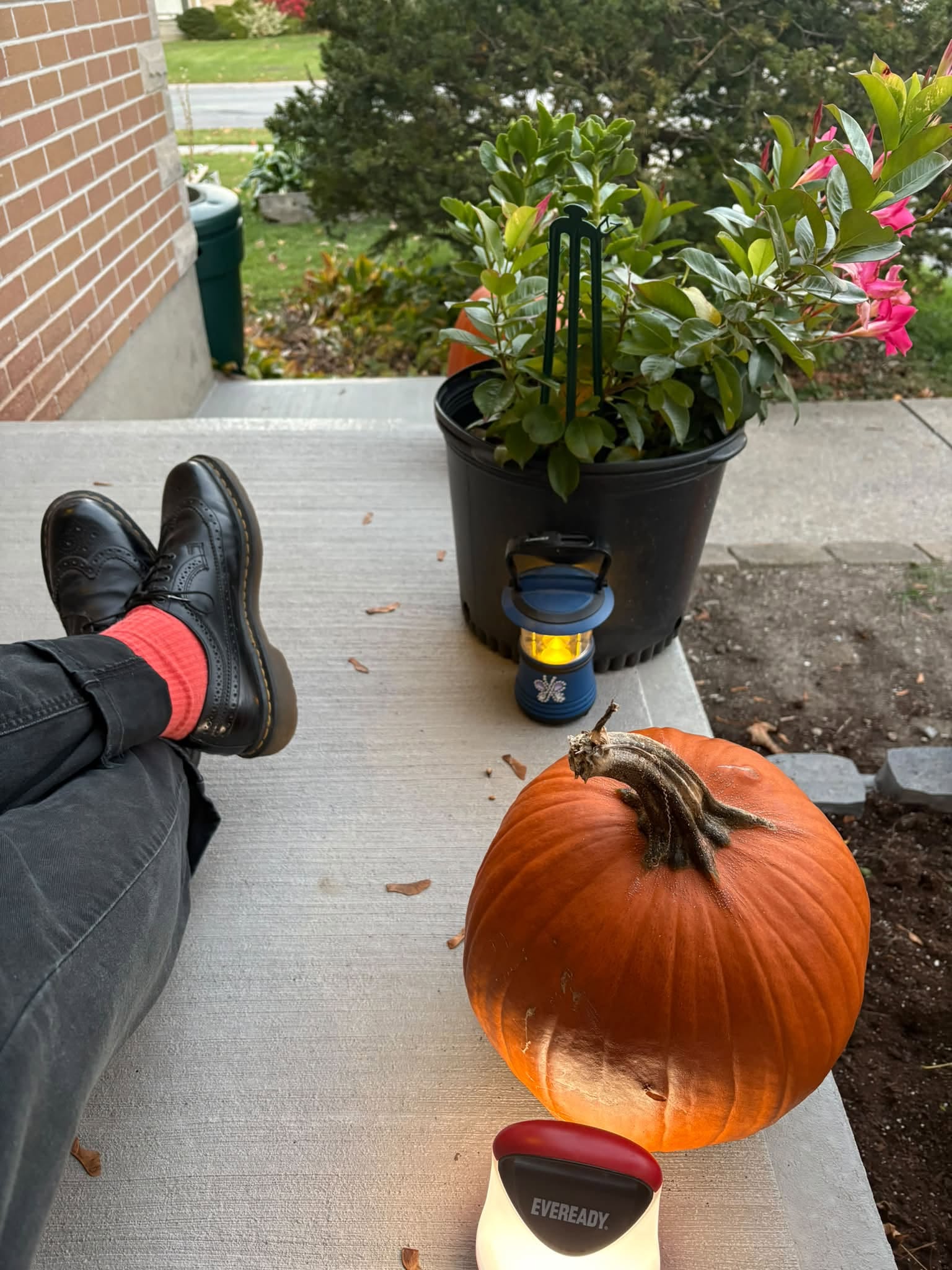
 Well, that was exciting and perhaps the beginning of a whole new era. The results are in and the happy winners will be taking their seats after Monday’s vote. Monday? Yes, of course. The municipal elections in Prince Edward Island were Monday… what you talking about? Oh, that. Sure. Fine. Well, yes it was fun. Halloween was fun, too. Got dressed up in orange and black and sat out on the front step. Just to be clear, that is a Mandavilla still alive outside with two months left to go in the year. Viva global warming… for now. Like the new concrete pour? Two or three inches were added this fall to cap the stash. Viva that, too.
Turning to the real news, Ron has an interesting new feature, “Beers I Really Miss” and his post this week neatly captures a time in Prague:
I was lucky enough to visit Prague a few times in the mid-1980s. Before capitalism returned and fucked everything up. The pubs were wonderful. Multi-roomed and very atmospheric. There was only one negative feature: most only sold one draught beer. Every now and then, I’d come across a pub with Staropramen 10º and 12º on tap. But that was about it as far as multi-tap pubs went… Other than in brewpub U Fleku, draught Dark Lager was pretty rare in Prague. But there was one little place, in the Old Town close to Charles Bridge, that had Branik 12º Dark Lager on draught. What a great place to find by chance. Because that beer was wonderful. The classic Prague Dark Lager. Not too sweet, full and well-balanced. In short, a great drinking beer. Inviting gulp after gulp, pint after pint. Then back came capitalism. All the Prague breweries were sold off as a job lot.
And racing forward to the now, Alistair had a good work trip to Denver recently, though it started out poorly:
I was working at the annual meeting of the Geological Society of America, in Denver, where the organisation I work for was exhibiting. While I had attended the Sunday session of the Great American Beer Festival, I had given it up as not my kind of thing, decided to wander off, and find a brewery to sit in for a few hours on a beautiful sunny afternoon. Thus it was, after the saddest pint of cask brown ale I have ever had in my life, I found myself in an Uber on my way to the one brewery in Denver that I regretted not getting to on my last trip to the city, in 2022, Hogshead Brewery.
What follows that ditching of whatever shadow is left of the GABF is pure reverie: “I reveled in the interplay of biscuity malt, with a touch of toffee, and lovely earthy, spicy, English hops…” He even uses the word “dreich”! Top points for anyone who pronounces it correctly.
Alistair was on a road trip. And I do enjoy following those we read who write about beer when they also write about their jobs and other interests. Contextualizes their skill sets and also allows for a familiar entry into new territories. For example is this neatly written comment by Jess of B+B over at LinkedIn about how her view of A.I. has shifted from the perspective of her work in finance:
If AI is the thing that gets people asking the question and investigating how they can finally use a computer to automate the bits of their work that ought to be then… hooray! I’ve been on a cycle with AI of initial excitement three years ago to deep disappointment, to anger at all the hype and am now coming round to “oh, that surprised me, that actually was quite good”. We are at the stage where someone who doesn’t have that great knowledge of Excel could ask Copilot or other tools for help and get a reasonable and fairly safe answer.
That is heartening and a realistic view of where we are at. I am taking a mini course from my tiny undergrad college that’s run by one of my undergrad classmates and finally finding Google’s A.I. summaries of dark ages shifts in history helpful entry points.* Anyway, if A.I. helps with structuring such understandings for B sudents like me at an initial stage of problem solving, maybe populating Mars with A.I. driven autonomous robots driving Telsas powered with solar panels as a counterweight to human existance won’t be so bad. Right? Right???
Speaking of brainy things, there was some good geolocating going on over at A London Inheritance in the photo and mapping essay on the demolition of the Lion Brewery on the South Bank of London in the years after WWII:
The tall buildings in the background to the left all remain to this day. The church is St. Johns at Waterloo, the building to the left of the tall office block is the old Royal Waterloo Hospital for Women and Children. I featured the following photo in my post on Sutton Walk. This was taken outside the pub with Sutton Walk running off to the right and part of the Lion Brewery directly opposite. I have repeated this photo as the following photo was taken from roughly the same position after the brewery buildings had been demolished. The bollards confirm the location. This is looking from point 2 on the 1940 map.
I love me some annotated mapping. Ron has discussed the importance of the Lion Brewery here and here. My main interest in the Lion is whether deep down in the foundations there would have been something left of the local Lambeth Ale that faded over 300 years ago I believe right around that spot. Maybe I am thinking of another bend in the river but that is one itch that won’t go away. Maybe I will ask A.I. because AL can’t figure it out.
Fermenting raspberries?!? Who can resist a story about fermenting raspberries? Not Pellicle which has pubslished this piece by Claire Bullen herself:
The raspberries are gurgling. All 600 kilograms of them, packed into the plastic fermenter that’s been sitting outside under a carport for the last two-and-a-half weeks. When the lid is sucked clean of its water seal, the fruit is revealed: a tight mass, faded pink and stippled with drupelets. It’s only when the cap is punched down with a shovel that they hiss and seethe. The raspberries are possessed by wild fermentation, carbonation racing through the bloody juice they’ve let. Their aroma billows promiscuously across the lawn, heady with carbon dioxide.
Reminds me that, care of global warming, I still have raspberries on the vine out back. Some getting a little tangy. I will be right back.
Speaking of the wonderful, David wrote about restaurants with touring sporting clientel for Vittles including Tharavadu, a Keralan restaurant in the Mill Hill area of London and how it became a stop for some of the world’s great cricketers:
Samson’s guest was Virat Kohli, soon-to-be-captain of the Indian team. Mendonca quickly ushered them to a corner table so the other customers wouldn’t disturb them, although one member of staff was so nervous she could barely hold the tray without shaking. Kohli, then in his pre-vegetarian days, dined on chicken, fish and egg dishes, with a particular liking for the curries paired with appams and a side of masala dosa – an order Mendonca reels off without having to think. At the end of the meal, Kohli presented the restaurant with a signed bat. By Kohli’s next meal at Tharavadu, during the 2019 World Cup, it had become a must-visit restaurant for cricketing royalty, with guests like Ravi Shastri, Michael Holding and Mike Atherton.
Now I want dinner. Here’s some notes!
Note #1: Which came first? The Green Man or The Green Man?
Note #2: BuzzBall’s owners kill off legacy Oregon brewer Full Sale.
Note #3: The Wally Dug needs an upgrade.
Have you ever sent a trepedacous big toe stretching out into the waters to find out if we’ve finally close to hitting rock bottom? Well, there could be a connection to that question with what pleasure trade conglomerates Tilray and Sam Adams are up to in terms of their beer production? Are they any sort of bellwether for something or other? Let’s see. BMI says Tilray is:
…reshuffling: it’s aiming for ~$20 mil in annualized cost savings by end of fiscal ’28 (May 2028); since Jan 2025, Tilray reduced its US distributor network by “approximately 9%” while reducing its SKU count by about 28% over the same timeframe…
Motley Fool says US investors are missing big profits in Europe yet the stock is down a stunning 98% over five years and one drinks commentator is rationally pessimilistic. The larger organization by a factor of about eight, Boston Beer stocks sees its shares down 57% over five years. Also at BMI, we see that beer is not being considered either the main problem or a solution it seems:
…hard seltzer and craft beer [are] the softest spots in Boston Beer’s craft portfolio, Q3 earnings call showed. Truly remains the biggest drag, leading ceo Jim Koch and co to put “everything on the table” to figure out how to fix it. Message on craft wasn’t nearly as drastic, plugging away with various tweaks and additions.
Motley Fool has indicated some optimism for Bostom Beer too but “consumer demand continues to shift away from traditional beer.” So both firms coping, consolidating, rolling out more plans. But not sure how either is doing something to make folk to just want more of their beer. Relatedly perhaps, the head of AB, the NAm division of AB Inbev, just quit.
Never the quitter, over at Facebook Laura has undertaken a solid bit of critical thinking about certain limits some would impose on beer and politics in the UK:
The Morning Advertiser reports that the founder of ART Hospitality (no… me neither), Dorian Kirk, has called for Westminster City Council to investigate the circumstances around the Chancellor downing a pint in the Two Chairman on Wednesday after the Budget. He says that licensing conditions prohibit irresponsible promotions and encouraging customers to drink a quantity of alcohol within a certain time or in excess qualities.Talk about a cheap shot to grab headlines. There’s a lot that you can pick the Chancellor up on without such pointless gripes. I saw that the Chancellor had downed a pint and thought ‘so what?’ and moved on with my life. Obviously, this press stunt wasn’t a promotion organised by the pub. It was his choice, and probably his team’s idea.
We need more critical thinking like that.** In a same or similar situation, and as I have noted on many occassions, a Canadian politician must be seen with a beer if they have any hope of election. The idea that a pub should suffer for a candidate’s or elected official’s decision to drain a pint is nutso. But we are we and not necessarily ye. See Paul Theroux on Canada:***
Theroux’s father spoke French and his ancestors have lived in the village of Yamaska, north of Montreal, since the early 18th century. But temperamentally, Theroux feels American. “Politically, culturally, I was raised differently. I don’t feel aggrieved the way they do. I couldn’t make it through a Canadian winter.” The isolation would get to him. “They live in little bubbles. One of the great things about driving through the States is that every mile is different. Sometimes, in Canada, you’re a whole afternoon in the prairie and it’s unvarying.”
I really really wish he had said tiny bubbles instead… which would have, you know, captured the mood of a kitchen party in late January a bit better. Doncha know.
Checking in around the world, for The Baffler Peer Schouten reports on a corner of the planet we don’t hear from very much, the DRC:
There is a saying in the Democratic Republic of the Congo: “You can bomb a hospital, but not Bralima.” Short for Brasseries, Limonaderies et Malteries S.A., Bralima is the DRC’s oldest brewery and one of the largest beer producers in Central Africa, and, until recently, a subsidiary of the Dutch beer giant Heineken. Every day, countless bottles of Primus lager roll off Bralima production lines in major cities across the country, and by year’s end, they are converted into hundreds of millions of dollars’ worth of revenue. Dozens of armed groups may roam the DRC countryside conquering mining sites, looting health clinics, and committing atrocities against civilians, but even to them Bralima is sacred.
It’s the story about the trekking of cases of beer taken overland to mining sites and distant village watering holes called ngand. For five days in from the road. By foot. Wow.
In health news, I was reminded of my yuff in Nova Scotia by this policy piece on combatting alcohol dependency and homelessness in the UK:
…the relationship works both ways. Living without a safe, stable home can make alcohol-related harm worse and make it much harder for someone to improve their health or reduce their drinking. People find themselves trapped in a catch 22. There are an estimated 650,000 people who are alcohol dependent in England and Wales. Around 70,000 of those are homeless or at immediate risk of homelessness. Yet people with the most complex needs can find themselves with the fewest accommodation options.
Those are rational numbers. About 1% are alcohol dependent and about 10% of that have associated homelessness risk or reality. I say I am reminded of my Nova Scotia of the 1980s as every case of beer said “includes health tax” on the box. Which we all knew meant “if you want this now, you’ll want funded health services later.” Connecting tax to need is good policy.
Finally, in response to Jeff‘s post confirming he is moving away from freelancing while keep writing on beer, Boak and Bailey shared this thought with their Bluesky footnote merged in at the end for completeness:
…there’s no shortage of great beer writing in 2026. As we expressed it on BlueSky, part of the problem is too much competition for too little paying work. It’s like when a second specialist cheese shop opened in Bristol and immediately put the original cheese shop out of business. How much cheese do people need? BlueSky: It’s always felt to us as if there’s a living to be had for about, say, 8 beer writers. And there are about 150 competing for that work.
First, many cheese shops please. [Ed.: isn’t that why one travels the day trip to Montreal roundtrip twice a year without staying overnight?] Why yes it is, voice from off stage left. But to the point, I looked back through the archives as I am pretty sure I have also maintained reasonableness of the eight to ten beer pro writer limit, too. And by this I mean primary household income. Most writers only writing on the topic of beer and brewing do not make enough to keep the lights on and never will. It’s the nature of the beast But a few will. And additional consulting, a bit of PR, working behind the scenes at beer judging events, teaching classes, publishing ads are all good ways to make the money that by-the-word rates do not. Fourteen years ago Stan and I shared emails on that tough road, me sharing my line from back then “…for all the money in beer, there’s no money in beer…” which led me back to his 2009 post “The End of Beer Writing as We Know It?”:****
In commenting on the demise of the British-based magazine Beers of the World writer Adrian Tierney-Jones has written such a lovely headline that I have to find an excuse to repeat it: “Beers Of The World finito: the end of beerwriting as we know it?” If you live in the U.S. you likely never read this magazine, which could be found occasionally at the random Barnes & Noble… Adrian concludes that magazines devoted to beer have no future in the U.K. and that “makes me think that maybe this is the end of beer-writing as we have known it since the 1970s. We are all beer bloggers now.”
Yup, it comes in waves. Stan went on to quote from Alice Feiring, the wine writer:
As I’ve been saying for a while now: blogs didn’t kill journalism. blogs killed writing. The art of writing is now essentially fully devalued. It’s a hobby.
That’s seventeen years ago. An earlier wave. And that was a thing in 2009: “beer bloggers ruin everything!” [Note: bloggers ruined movies about beer, too, apparently by noting they were not very interesting. Frigging bloggers.] Writing doesn’t give a crap about the medium. And, well, most of the few paid pro writers around now got where they are through blogging so not sure that Feiring’s logic has held up well. There’s always been other troubles. Folk feeling free to take content in 2011. In around 2018 there was still a problem for folk wanting to write about beer as well as Mr. Beeson noted:
Casual observation: there’s a lot of beer writers/ photographers/ communicators out of or looking for work at the moment. If you’re in the industry and looking to improve your communications/ marketing you should really consider hiring some of these very talented individuals… A lot of people see what people like us do for a living and think it’s all press trips, freebies and getting drunk for a living. I can assure you the reality is more living in constant fear about making enough money to pay the rent and stay afloat. Hardly living the dream.
It is definitely a tough row to hoe even if writing is a pleasure and will remain so. Many I have watched and read have packed in their beer writing over the near quarter century (Ed.: “yikes!!”) that I have wasted as I have scribbled about beer here and in magazine articles and in books – and in all that time it’s not the writing itself that has turned people off. It’s as much or more the lack of decent money, the unwelcome surplus of the alcohol of obligation, the offer of a better job that frowns upon independent expression. Like doing squats in your 60s, writing is a good thing in itself. So write. It’s lovely.
That is it for now. A bit of a beast. Plenty to chew on. Until we meet again, please check out Boak and Bailey’s postings on each and every Saturday along with their fabulously entertaining footnotes week after week at Patreon. And do look out for more of Stan’s “One Link, One Paragraph” format. Then it’s your turn. Read and recommend, please. Scour the world for news tips – then let me know. Then hunt out something in someone’s archives! Leave oblique comments on someone’s post from 2009!! Listen to a few of Lew’s podcasts and get your emailed issue of Episodes of my Pub Life by David Jesudason on certain Fridays. And Phil Mellows is at the BritishBeerBreaks. Once a month, Will Hawkes issues his London Beer City newsletter. Do sign up for Katie’s wonderful self-governing totes autonomous website featuring The Gulp, too. Ben’s Beer and Badword remains on pause but there is reading at The Glass which is going back to being a blog. Any more? We have Ontario’s own A Quick Beer and All About Beer is still offering a range of podcasts – and there’s also Mike Seay’s The Perfect Pour. Plus follow the venerable Full Pint podcast! And there’s the Craft Beer Channel on Youtube as well as the archives of the Beer Ladies Podcast. What else?
*My old pal Neil with the fabulous voice … But I also have Bertrand Russell’s book in a pile of books, too, backing up Neil’s info. Who knew the Pope wiped out the Cathars in the Albigensian Crusade of the early 1200s? Must have slept in back at the dorms through that discussion when I took Foundation Year the first time around in 1981-82. Must have.
**Also see this from Ray of B+B on LinkedIn: “Content designers: invite engineers, business analysts and product owners to your crits! Engineers, BAs and POs: go along if you’re invited! A crit (or critique session) is how designers quickly test their logic and iterate their designs. We put our work so far on a board (virtual or physical) and invite everyone to tell us what they like, what doesn’t work, where they’ve got ideas, and where they’ve got questions. I love having technical and product colleagues in the room for content crits because they have fresh eyes and different perspectives.“
** and 1/2. See also this from Laura Wednesday morning on the function of both received assumptions and challenging received assumptions: “In the past, we’ve had the big brewers (bad), the regional family brewers (good) and small independents (good but only available locally). That simple model is hopelessly out of date now, but I can’t recall having seen anyone attempt to classify breweries with a little more nuance. The industry is also a lot bigger and there are a lot more companies of different sizes who are aiming for different outcomes – passion, people, product, profit… The problem I’m having is that I can’t quite put my finger on why it might be important or useful to do this (incredibly complicated) exercise, beyond the fact that it might help to challenge people’s assumptions. But is that useful in itself? I put myself at your mercy on the way to York.“
***And on travel writing: “Most travel writers are wimps. They don’t take risks. They’re writing about ‘I met my relatives in Italy’ or ‘I got a divorce. I fell in love.’ I’m interested in someone whose yacht sank.” Who writes about the sunk yachts in beer?
****Scroll down to the comments where the discussion between Stan and the late Jack Curtain (along with the others who join in) are a real treat.