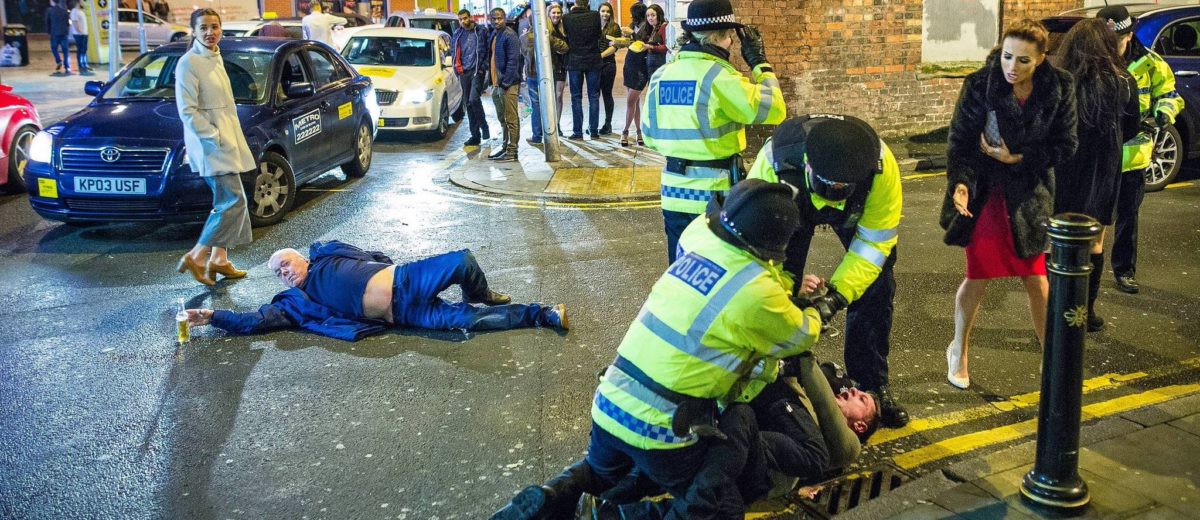
Ah, the liquor control system. Government stores controlling the marketplace and then pretending that it’s still a marketplace. The sort of system that announces growlers will be sold in Ontario and then builds one growler stand in just one Toronto store to serve the entire population of 13 million or so. Once in a while, however, it comes up with a great idea:
Several LCBO stores, including the location at Wonderland and Oxford in London, have moved oodles of Ontario craft beer by refusing to tell customers what exactly they are buying. The store puts random cans in plain brown bags and prices the mystery bags for about $12, give or take, depending on what’s inside. An LCBO store in Waterloo recently claimed credit for starting the surprise suds marketing phenomenon, fuelled by young adults seeking to recapture some birthday party-style grab bag excitement.
Planning a career in branding? Maybe you should switch to marketing instead. Because sometimes covering up what’s in the package sometimes is an improvement. Think about it. Folk seem to be unhappy about this year’s new beer brand, America. For the life of me, I don’t see the issue. But I am Canadian so maybe I wouldn’t.
Maybe it’s going to be OK. Maybe it’s this summer’s new thing. Beats the hell outta X-treme, crafty v craft or treating buy-outs like identity theft. Could 2016 be the year that we just want a beer?
What a great ad. It basically sums up everything about American brewing for the last four hundred years. It’s so absorbing you hardly notice how weird the music is. Part movie soundtrack when Gene Hackman smashes the Mopar though downtown. Part Eminem run through the graphic equalizer. It sounds like it starts at a point about a minute, fifteen seconds into the crescendo that started in last fall’s “Choices Have Consequences” ad. And the message builds, too. Poor widdle cwaft thinks that it is all about the big bad brewer running scared but it’s not. It’s gleeful assertion meeting commercial reality. The upstretched middle finger to some. The assertion of tribe to many others. An umbrella for those who buy the 80% or more of beer that is still light, inexpensive and easy to drain. It’s lovely. The greatest part of the loveliness is, however, not just its in the design elements of the presentation but that it addresses the same set of themes which have consistently sprung from or imposed upon brewing on this continent ever since warmed water was poured over cracked grain by our first founders around four hundred years ago.
=> Beer creates aggregation. Obviously the ad is about might. Brewing in North America has always been about the generation of might. A powerful place within the industry. Leveraging the wealth it generates out into society. It took a few generations of the pre-industrial pre-Revolutionary Dutch brewers of New York state to achieve it. It took brewers like John Taylor a lifetime in Albany of the mid-1800s. It took E.P. Taylor about a few decades in the mid-1900s. And it took a decade for microbrewing to spawn millionaire and billionaire big craft from 2005-15. Through co-operation, collusion and control brewing creates the opportunity to generate wealth, independence and even power. This is good as it is success. Sipping is not so good for success.
=> Beer is a means to an end. Not only does brewing aggregate but it does so in a repeated similar pattern. If you follow Michigan brewer Larry Bell on Facebook you will notice he spends a lot of time not brewing in Michigan. He in on a boat in the Gulf of Mexico or some such place. Interestingly, members of the mid-1750s Dutch brewing dynasties did the same thing. Anthony Rutgers IV was a privateer and lived on Curacao tending to the Hudson valley Dutch plantation trade that extended well past the British invasion as well as the American Revolution. Beer actually appears to dislike folk not improving their station in life. It attracts money too readily. Big craft branch plants on the east coast or in Europe are just another form of expansive market control that beer has always undertaken.
=> Beer is cyclical. Just as Mr Bell is retracing the wake in the warm water Mr Rutgers sailed in the 1700s, brewing repeats itself in overlapping cycles. Anything that imposes on the production of grain seems to restart the clock. The Hessian fly causing the deprivations and hardships of 1788-90 are not unlike the relationship between the Civil War and, as with the standard rules of baseball, the development of a homogenized taste for premium lager… not to mention the later dominance of industrial light lager after World War II. It also takes on and defeats – or at least holds down – the challenges of traditional brewsters’ beer houses, self-sufficient estate brewing, temperance drinks, imports, brew-your-own operations, micros, home brewing and now new nanos as they come forward each in their turn. These things come in waves but brewing continues. It knows it needn’t back down.
=> Beer is responsive. It needs to react to external forces. The overlapping cycles are not determined by brewing. It is the natural response of brewing to reassert itself in the face of crisis to maintain production and profit. It also reflects simple cultural change. It’s not by chance that micro brewing takes off in the 1980s concurrent with factors like the variety of cable TV and androgyny in pop music. It’s the decade that the range of choice explodes. Micro brewing follows that greater trend. Had the pioneers of micro not come forward rest assured other pioneers of micro would have come forward in the same cities in pretty much the same way. Beer responds in the late 1700s and early 1800s to scientific advances in agriculture in the same way. The Agricultural societies which arose after the end of the War of 1812 gave stability to the new farming lands and spread the news about scientific brewing just like cable TV informed consumers that they wanted the new beer because they wanted new cheese. Beer is responsive because it is one man – the ancient everyman – now carrying the keg, now armed with stainless steel at scale. He (or she) is fighting ocean going container ships stacked with uniformly Heineken green cargo boxes.
=> Beer is pervasive. Because brewing has transitioned in response to societal change over and over it has earned its place. Unlike, say, the mustards on the grocery shelf the aggregating tendency of beer needs a team. It asks for loyalty and gets it. Why would inexpensive joy juice not? It’s the mild affordable anesthetic that gets you through life. Tribal affinities are natural whether they are constructed of the cult of craft or light lager in the NASCAR stands. It’s heavy metal and new country. Craft and social media. Trains in the late 1800s sent out the message of better cheaper beer than the local brewer was making or charging. Trains from places like St. Louis and London, Ontario carrying casks branded with names like Anheuser-Busch and Carling reaching out from larger and larger breweries placed near those other train tracks which reach out into the grain fields. Beer informs you about both progress and legacy. It’s where you’ve been and where you are going. Get in line.
=> Beer resists. Because beer wants to keeps its rewards it pushes back and fights. If the fluid in the Bud ad up there was Sierra Nevada Pale Ale you would not have to change out many of the other elements. The boosters would just have to swap places. It does not like to hear other points of view. Big craft – including its co-opted communicators – is as much in lock step as the Bud ad as much as the 1600s to 1700s Dutch then 1800s to 1900s German brewing dynasties, each taking care to include all the cousins in the benefits. The business formula is too certain, too successful to do otherwise. No wonder we have identatext book after identatext book. Beer likes puff. We already see discussion in craft like this has fallen away. Disagreement is now disagreeable. It’s all the Borg. Bud is truly not backing down. No beer backs down. Because? America.
I love it. I had a Bud on Thursday night. I have one a couple of times a year. About as often as I have mashed turnip. They are both unpleasantly bitter and they are both cultural touchstones. Neeps are the ultimate statement of Scots cuisine. Bud is America. I get four clear phases: sweet rice, lumber, dirty bitter hop and a stale finish which more of that sweet rice quickly remedies. You are not supposed to like it. Turnip? It’s not yummy either. You are supposed to accept it like the other realities of life and be grateful for the comfort it brings. Bud tells you about North American life, too. It’s not fussy. Lemon flick. It meets you on the level. Given the existing kit that’s long paid off, it’s easy to make following instructions out of readily available resources – even as it tells you it’s difficult to make. You need to rely upon its word on that point even though you can make an acceptable substitute for less in your own kitchen. You can actually make good beer easily in your own home. But you don’t. Because you are part of something bigger. Something that works. The same way. Every. Time.
The All About Beercolumn by John Holl posted today begins “[h]ard cider continues to climb in popularity and now the largest producer in the country, Angry Orchard, has its own place to welcome customers….” This is odd because of the following news as reported by The Motley Fool a few weeks ago:
Similar to last quarter, Boston Beer’s founding chairman, Jim Koch, opted to be the bearer of bad news: “Our total company depletion trends of 6% in the third quarter of 2015 matched our year to date trends, but represent a slowing from our expectations, primarily as a result of weakness in our Samuel Adams brand due to increased competition and a slowing in the cider category”… Boston Beer CEO Martin Roper elaborated: “During the third quarter, we […] saw a slowing of the cider category, but believe Angry Orchard maintained its share even as competitors continue to enter or increase investment. We remain positive about the long term cider category potential, but short term growth is less certain. We are planning continued investments in advertising, promotional and selling expenses, as well as in innovation, commensurate with the opportunities and the increased competition that we see.”
I’ve heard a bit about cider in the lead up to American Thanksgiving like this piece on NPR’s Science Friday that focuses on Albany’s Nine Pin Cider. Like the All About Beer column, however, there was nothing indicating that the market for hard cider is softening in the way that Boston Beer has admitted. While most stories last year were all about theboom in cider, The Motley Fool saw clouds on the horizon as early as in May of 2014. That concern continues:
Total U.S. cider sales were down 3.4 percent in the 13 weeks ended Nov. 7, and the rate of decline accelerated to about 7 percent over the past four weeks, according to Nielsen. Four and five years ago, the rate of growth was in the heady triple-digits. Even a year back, the pace of growth was nearly 50 percent. “It’s been getting a lot of attention, because of all the huge growth rates in the past three to five years,” said Danelle Kosmal, vice president of the beverage alcohol practice at Nielsen. “It’s obviously difficult to sustain those triple-digit growth rates.”
So is it a case as I tweeted earlier today just that, “basically, Sam Adams bought a pretendy farm to suggest their cider-like product isn’t industrial” or is it worse? Is the farm one form of “the new packaging and advertising expenses taken on in the second half of 2015” in an effort to retain sales in a shrinking cider market? We get no guidance from the All About Beer column other than the oblique observation that the “vast majority of the company’s main brands will be produced at the Boston Beer facility in Ohio, with the focus of the new location being experimentation and small-batch only recipes.” As Jeff found in June 2014, getting a straight answer about Angry Orchard can be difficult. But at least he asked the questions. If the market for cider continues to shrink, it’ll be interesting to see how long it takes for the farm to be re-purposed or even sold off.
Adjectives from another time. How irritating. I mentioned this the other day somewhere folk were discussing steam beer. One theory of the meaning is it’s a reference to the vapor from opening the bottle. Another says something else. Me, I think it’s the trendy word of the year of some point in the latter half of the 1800s. Don’t believe me? Just as there were steam trains and steamships, there were steam publishers. In 1870 there was a steam printer in New Bedford, Massachusetts. A steam printer was progress. Steam for a while there just meant “technologically advanced” or “the latest thing” in the Gilded Age. So steam beer is just neato beer. At a point in time. In a place. And the name stuck. That’s my theory.
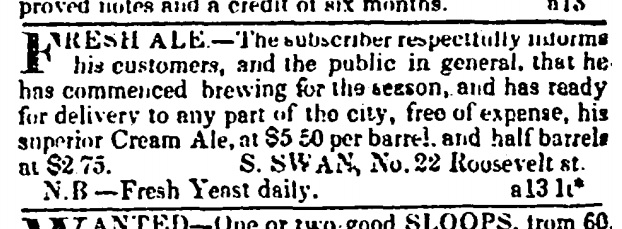
Cream is like that. Folk think it has a specific meaning. Static in time. The general theory is that cream ales started as top-fermented ales that receive an extended period of cold-conditioning or lagering. Another source closer to the ground tells me that cream ales are now just blends of basic pale ales and basic light lagers. Could be. But that up there is an ad from 1830. It’s from New York Evening Post from 13 August 1830, well before lager was a twinkle in an Empire State brewer’s eye. Mr. Swan of Roosevelt Street had some for sale. So other than the seemingly odd juxtaposition of street name and date – what does it mean? There are two obvious first choice. Cream is rich and it also rises to the top. Hmm.
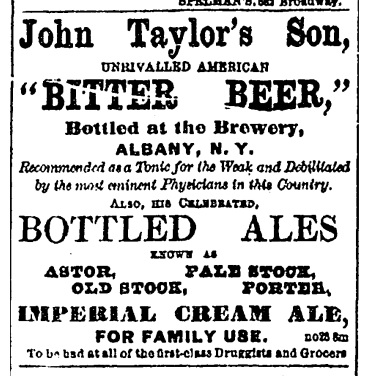
Six years later, the first or perhaps just leading American brewing industrialist John Taylor was placing ads for his Albany Cream Ale. Here is an ad that was placed in The Ulster Republican of Poughkeepsie, New York from 25 May 1836. Three years later, Taylor is advertising his Imperial Cream Ale and add the tag line “No mistake as to its superior quality.” Here is an example from the Albany Evening Journal of 4 April 1839. Which is interesting. Not a call to strength. A call to finesse. Ten years later, in an article about a new sarsaparilla works, Taylor’s Cream Ale is mentioned in the 21 July 1849 edition of the Plattsburgh Republican as an example of something the new sarsaparilla maker exceeds in production. It’s become common parlance for quantity as well as quality. Half a decade after John passes away, his sons are still prominently advertising their Imperial Cream Ale, now fit “for family use” as you can see was stated in the Albany Argus of 20 January 1869.
These are just snippets but they do show something of either an arc of meaning or perhaps a versatility. A claim more than a descriptor. Superior stuff. Was it creamy? I have no idea. I hate records.
Stan linked to this story a few days ago. It got me thinking… but not fast, “get me to the keyboard” thinking. It was this bit at the beginning that got me mulling:
I was watching a video online when it was interrupted by a commercial for Budweiser. The name of the spot was “Do You Know Where Your Beer Is Brewed?” Soft guitar music played while clips of idyllic landscapes and sunrises peaking over breweries slid across the screen. Nothing out of the ordinary there. The gentle voice of the narrator says, “With 12 breweries spread all across the United States, your next Budweiser is closer than you think.” Budweiser hangs its hat on the fact that it can produce the same beer at 12 facilities and it will always taste exactly the same no matter where you drink it. No small feat, to be sure. But then the voice adds, “You might even say we’re America’s largest local brewer.” My eyes narrowed and my brow furrowed. ‘What in the heck is this?” I exclaimed. “That is our word!”
Our word? There’s a lot of weird words in there. Not the least of which is “our” – whose the hecks is that referring to? Don’t get me wrong. I like the work of the author Jeff Baker just fine. He’s the manager of the Farmhouse Bar and Grill in Vermont. Nice place. Real nice. Just not my local. Because “local” can mean that, too. The distance of the drinker from the drink.
But that’s not his point. It sorta illustrates mine but that’s not really the goal of where I am going. He is asking about local ingredients. If you want that world, go back 200 years and have a look at the Vassar day book with local beer being made of local grain and hops being sold back in small batches to the farmers and tavern keepers of the central Hudson Valley just getting back to some sort of normal after the devastation cause by the Revolution. This is the mid-1830s book but in the 1808-11 book the economies of beer are clearly still defined by the cart horse. That is actual local brewing. Are we willing to go there? Doubt it. You don’t really want local. You want some local. Now and then. But you want the global economy beer made with the best ingredients brewed on the newest, bestest equipment. Right?
Craft beer and macro are not all that far apart in this respect. Brewed on computerized stainless steel to a scale and upon a recipe that meets the needs and budgets of their respective clients. The only actual local thing that is reliably present at the brewery is the staff. Hard to be a brewer who lives over 45 miles from the brewery. There’s a hint by the way. If the person discussing the beer in your glass doesn’t live about that close, not a brewer. Sales guy, likely… owner, sure… but that’s all. Both use good foreign malt and distant, shipped in hops. Both tweek their water and yeast to match those found elsewhere. Don’t get me wrong. I like “local” just fine. It just means, for me, the bok choi and beets I have growing out there in the yard. Not beer.
When anyone in beer – whether Bud or craft – claims a word like “local” or “small” or “real” there is marketing going on – even if only to a small circle. Even if only to the speaker. It’s all unnecessary. When I think of Bud, I think of the brewery at Baldwinsville, New York to my south where local people earn a decent wage. If I have a decent hoppy IPA, I think of the three nations and seven generations needed to make the beer exist. Beer is global and has been since at least the 1400s when the Hanseatic League was beginning to ship Baltic brewed hoppy beer to the Low Countries. Except for odd examples like postwar agricultural collapses like Vassar faced in 1808. Except for that, it’s been beer or large parts of it hauled out from the hold as often as not since the Dark Ages. Good non-local beer.
It is probably fair to say that my prediction of the demise of craft due to the stupid craft v. crafty mess was not entirely correct – unless we consider the health of its moral core. Could it be the smell back in late 2012 was the sign of things to come? Jeff may be getting his suspicions:
Ezra’s comments about the new Stone launch follow an interesting article Stan linked to yesterday, by an Atlantic writer wondering if craft beer has gone too far. They have a point. Stone’s corporate identity has always threatened to bleed over the thin line separating satire and self-importance, so maybe it’s not the best example of craft beer’s direction. The Atlantic piece drives the point home more pointedly: “So is this the future of U.S. beer consumption – a country that stumbles over itself to buy beer made with wild-carrot seed, bee balm, chanterelle mushrooms , and aged in whiskey barrels?” It go me thinking. If the craft beer market has become a contest over the most outrageous, has craft beer finally grown up and become its nemesis, mass market beer?
Now, this may all sound like the sky is falling but these things do happen. I was writing about Ontario’s brew on premises fad of the late 80s and early 90s and read how they held 3% of the retail market for all beer by 1996. Then they went away. Mostly. People didn’t want to pay the taxes once applied but, also, it smacked of recession in a decade of increasing prosperity when imports and micros became more and more the thing. Maybe the point is not that good beer will go away. After all, its not like beer is going out of style as the saying goes. But craft can over extend itself, can make itself a joke. People will move on to the next thing, the next good beer.
Somethings just won’t make the book on Ontario’s beery history that I am writing with Jordan. I am working my way these days through the period after our version of prohibition ends in 1927 until, roughly, the beginning of microbrews in 1985. Jordan is back there somewhere untangling the Victorians.
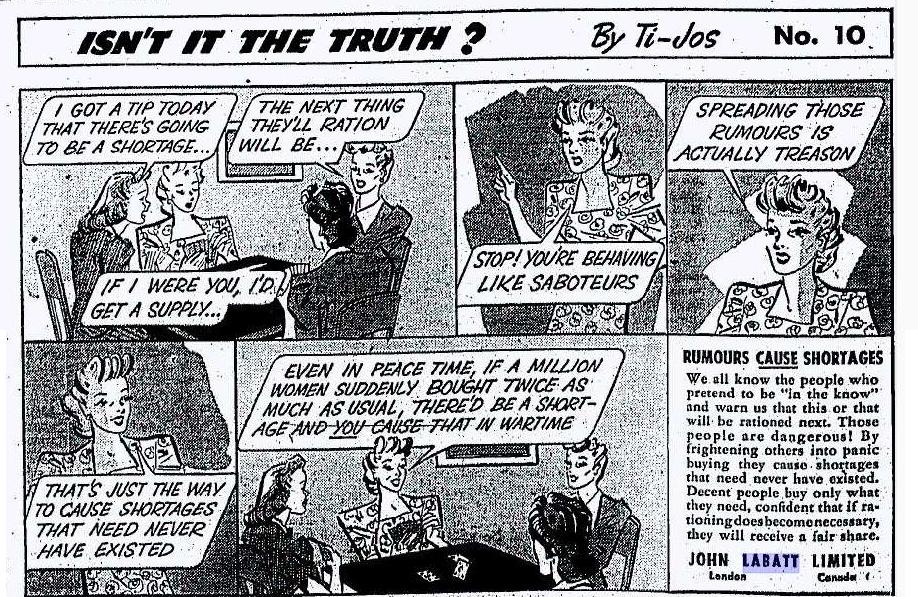
This image is one from a regular series of serial cartoons placed in Ontario newspapers by Labatt during WWII under the pen name Ti-Jos. They are obviously patriotic but there is a theme of moral economics that flows through the set. They are set largely in the home or shops but the message is about what citizens need to do on the home front to aid the war effort. In this edition, you better damn well not be spreading rumours if you don’t want shortages.
Interesting piece on the impending decisions to be made in relation to Federal excise taxation for beer in the US over at MSN Money today:
…The Brewer’s Employment and Excise Relief (BEER) Act, which is promoted by Washington-based beer industry group The Beer Institute, is expected to be introduced later this year and would reduce excise taxes on beer produced by brewers large and small. Past versions of the bill recommended cutting the tax from $18 per barrel to $9 for large brewers while also cutting the tax for small brewers from $7 per barrel to $3.50.
The competing Small Brewer Reinvestment and Expanding Workforce, or Small BREW Act, promoted by craft beer industry group The Brewers Association would cut the federal excise tax on beer from $7 a barrel to $3.50, which is placed on a small brewer’s first 60,000 barrels produced per year. After that initial 60,000 barrels, small brewers must pay $18 per barrel, which would be lowered to $16 under the bill. More importantly, it would expand the tax code definition for a “small brewer” from one that produces 2 million barrels or less to one that produces 6 million or less.
See, this is how relationships end. As the article describes, brewers like Boston Beer Co and Sierra Nevada are active members of both the Beer Institute and the Brewers Association which are lobbying for distinct and conflicting tax regimes. Not sure that this in itself is enough to create “a rift in the beer industry that could signal last call for the ‘craft’ title” as the author suggests but the implications are interesting. First, the government has to decide the matter one way or another. There cannot be two systems of the one excise tax. Second, the actual small craft brewers who make up the majority of the Brewers Association may soon have to decide whether being led by big craft brewers who look a lot like big macro brewers makes any sense. Either way, it won’t be controlled by big craft.
It would be comforting to know that this question was actually being discussed at the Craft Brewers Conference but the Twitter feed for #CBC13 has all the diversity of first night at summer cult camp. Crazy kids. They just can’t stop marketing – even to each other! One can hope that Congress’s governing leaders will have the sense to reject the idea of including the expansion of 2 to 6 million barrel definition of “small”. It is all fun and stuff but, given the state of the nation’s finances, buying into that sort of belief system isn’t very helpful especially given the clear focus offered by the Beer Institute’s characterization of the implications as “a giveaway to a handful of brewers that each are worth more than a billion dollars.” A billion? That’s a large number.
I find this beer “created civilization” line going around funny. Sure, it is an easy cut and paste story for bloggers needing to fill space. And, sure, it is an easy story for a newspaper to run. But really?
Hayden told Postmedia News that “there are lots of implications” of the team’s findings, and that “brewing was just part of the picture” during humanity’s pivotal shift to settled, stable communities with enough food supplies to foster more complex cultural developments. But beer-making, he added, was one factor “that we think was important in making feasts such powerful tools for attracting people and getting them committed to producing surpluses.”
Attracting people? Getting them committed to producing surpluses? Such verbs we choose for such things. How about rounding them up, enslaving them and forcing them into labour to provide an oligarchical hierarchy based on grain monoculture with the rich rewards of being the enslavers going entirely to the enslavers. How about the slaves were perfectly happy in their outlying tribal hunter gatherer lives beyond the fields of horror filled with barley they will never taste and certainly never chose to grow. It is lovely to hope and wish and, sure, springtime is upon us giving us thoughts of baseball and everything but is there any evidence that the step towards brewing-focused agriculture in any way formed the basis what we value today as “civilized”? Maybe it just occurred as a crop contemporaneous with, say, turnips.
Did turnips found civilization? Could well be. Like mostly anything could well be. Like shackles and whips.
Interesting if light-ish article from the publication The Drinks Business on the question of labeling beer with their caloric content:
According to public health minister Anna Soubry, officials have been in talks with the drinks industry about the possible inclusion of calorie content on labels. Ministers are hoping that displaying the calorie content in beers, wines and spirits could encourage those who are watching their weight to drink less. Most manufacturers already include information on units of alcohol on labels in a voluntary agreement with the Government. A recent study by the Drink Aware Trust has linked the large amount of calories in alcoholic drinks to people being overweight and obese.
Makes perfect sense to me. Every box of crackers in the cupboard tells me how many calories are in a handful already. I can look up the calories in meats and other ingredients because they are fairly standard measure as these things go. But a beer is not a beer is not a beer. Who knows what people are sticking in there and what it means over the long term? Some of the big bombs out there might as well be mugs of piping hot icing and should be handled with great care. And the drive to have more proper sessionable low alcohol beers might get a kick if the truth about stronger stuff were wildly known. Makes sense.
And why stop there? One thing that drives me a bit nutty are abstract standards like the UK’s absolutely silly use of “units” as a measure of alcoholic strength. What we need on a bottle is the actual ml of pure alcohol. A 500 ml can of 7% of semi-DIPA has 35 ml. Two of these innocent pals are well within the ball park of a 750 ml corked top bottle of that swell 10% beer but far less, err, red flaggy. Is it too much to ask for a universal standard based on a standard that is basically universal?
Is there pressure to keep this sort of information away from the beer buying public? Or do you actually just not want to know. Are they, like price, things of no interest to the… umm… passionate?