More References To That Shadowy Taunton Ale

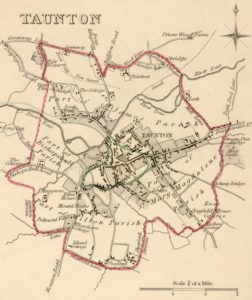
tauntonmapAttentive readers will recall that I have a slow side project in figuring out what I can about Taunton ale. It was a bit of a by-catch to the whole Albany ale thing with references to it showing up in central New York around the time of the American Revolution. When I got to the New York State Library in Albany in 2012, I found a mass of references to it being sold in New York in the 1750s and 1760s. And then it pretty much fell off the table. I couldn’t find anything more online. But three more years means three more years of people throwing everything they can find onto the Information Super Highway. So what is there to add to the story now?

First, it was being exported to other parts of the British empire than just pre-Revolutionary New York. In 1774, Taunton ale is described as being one of Bristol’s exports to Jamaica along with products like West country cyder, cheese, leather, slate, grindstones, lead, lime for temper and Bristol water. Another record shows a ship for Jamaica in 1776 being loaded with Taunton ale, household goods as well as “volumes of entertaining history.” Taunton also is mentioned a number of time in The Bright-Meyler Papers: A Bristol-West India Connection, 1732-1837. In the entirely uncomfortably titled “Letters on the Cultivation of the Otaheite Cane: The Manufacture of Sugar and Rum; the Saving of Molasses; the Care and Preservation of Stock; with the Attention and Anxiety which is Due to Negroes and a Speech on the Slave Trade …”, what appears to be an 1801 guide to running a slave sugar plantation again in Jamaica, a warning is given on being too generous with one’s manager:

A very injudicious mode of remuneration, established by folly, and imitated by thoughtlessness, is that of fixed and stated presents. Such are, on many West Indian estates, invariably ordered for a manager, whether he is deserving of them or not; whether he makes fifty hogsheads, or five hundred; whether his Negroes increase or diminish; without regard to the situation of the stock, or to the improvement or neglect of any article entrusted to his care. These annual compliments consist sometimes of provision; as beef, butter, hams, and other articles of domestic consumption. But they are not judicious, even if they are merited. For their cost would invariably be turned to greater advantage, by an industrious economical manager, than the presents which are bestowed on him. Some of these acknowledgments, too, are pernicious in their nature: operate, though not intended, as an incentive to vice, and a seduction of the manager from his business. Such is the cask of Madeira before alluded to; and such are casks of porter and Taunton ale, with cases of claret. All these idle substitutes for judicious remuneration should be abolished, and proprietors should constantly reward their managers, in proportion to the services which they render, and the prosperity which they bestow, on whatever is entrusted to their care.

In 1808, a gazetteer states that large quantities of malt liquor called Taunton ale was also being sent to Bristol for exportation. Around the early 1820s, Taunton ale was selling in Bristol for 9s 6d a dozen quarts compared to 10s for Burton and 7s for porter.

Next, there is clearly a lifestyle aspect to Taunton ale in the beginning of the 1800s. It’s a beer for the destination traveling poet. Volume 30 of The Scots Magazine from 1777 included The Poem “In Praise of Tobacco” which included the lines “Say, Muse, how I regale, / How chearfully the minutes pass, / When with my bottle, friend, and glass, / Clean pipes and Taunton ale.” Yikes. In a 1797 letter, the clearly better poets Coleridge, Lamb and Southey are described as drinking Taunton along with a meal of bread and cheese. In the 1804 annual of Sporting Magazine, Taunton is described as most famous for that best of human beverage, good ale; though the author have I have before quoted thus mentions the attachment of the natives to it with some regret: “Hail Taunton! thou with cheerful plenty bless’d, / Of numerous lands and thriving trade possess’d, / Whose poor might live from biting want secure, / Did not their resistless ALE their hearts allure.” More bad poetry. Not sure how that reflects on the quality of Taunton ale.

What was it? The 1824 booklet “The Spirit, Wine Dealer’s and Publican’s Directory” gives some sense of the beer in its treatise on “the art of making vinegar, cider, perry and brewing malt liquors – and particularly Taunton strong beer and ale.” We are told the strong ale takes eight or nine bushels of the best pale malt to the hogshead as well as six pounds of Farnham hops – but use east Kent hops if the beer is meant to be kept for two or more years. Strike at 160F, cover the lot with dry malt or sweet bran and let it sit for three and a half hours. Strain off and boil the wort with the hops of an hour. A half hogshead of strong ale results from the first running with ale and table ale the second and third. Its an odd sort of set of instructions for something written 191 years ago. It all reads a lot like a 1960s Amateur Winemaker home brewing article. The short guide recommends spirit dealers lower the proof of their rum by adding a mix of two-thirds water and one third Taunton strong for softness. It is a soft water zone so they may have had a point.

Also, Taunton seems to become the drink of a certain sort of well placed gent, especially when from one particular brewer. In Benjamin Disraeli’s letters from the mid-1830s, he tells a correspondent that Eales White would send a barrel of Taunton ale which he describes as “something marvelous.” The 1851 annual of Sporting Review describes the morning of a hunt and the reception in one great house:

The merry young sportsmen returned to the house, not however till they had been gratified by the safe arrival of the jumper, who, led by Thomas, was placed in a stall perfectly fresh and fit to go; by which time things were looking more cheerful. A bright fire blazed on the dining-room hearth; breakfast was prepared, the sideboard groaning with good substantial cheer; and even the somewhat flamingo-faced butler had contrived—knowing the squire’s peculiarity, or, I should rather say, punctuality on hunting mornings—to rouse himself from a most agreeable nap, and honour the lower dominions with his portly presence. In fact, as far as I can recollect, he was decidedly the most substantial, if not the most important, person of the Hall or neighbourhood – et pourquoi non? Excuse a French term, for he was certainly most useful in his special department; added to which, he brewed without exception the best ale I ever tasted: and if-so-be it precisely suited his own palate—what then? all the country round pronounced it undeniable. Stogumber beer was, or rather is, mere wish-wash in comparison, though vastly agreeable; and White’s Taunton ale alone could bear it any comparison.

Martyn cleared up the Stogumber question in 2011, but it is White which is clearly the name which appears associated with the best Taunton ale in mid-1800s English society. The report of Crimean Army Fund Committee of 1855 also mentions Eales White, Esq. of the Taunton Ale Brewery as a contributor to the cause among those who gave presents of wine, spirits or beer. Probate of the will of Eales White, Brewer of Taunton, Somerset was before the court in 1855. He has a rather splendid headstone.

And that is it. A beer for the bastardly late 1700s Jamaica slave plantation manager, for the great and crap poets of the turn of the century as well as for the gentry of the mid-1800s. Three dislocated bits of society, no? Well, they do sorta all have the well placed slacker theme going for them. Is that what the beer represented? The lazy entitled bastards’ reward?
Legal Customs In Three Sorts Of Brewing Cases

guildhall


More law. And why not? Beer is largely a function of law being a rich source of revenue for the crowd and a rich source of discord within the community. And with 178 volumes of court rulings in the English Reports covering the years from 1220 to 1866, there’s likely years’ worth of content to be examined. I am trying to wrap my head around it all. The court dealing with claims of ancient or at least established custom appear as a recurring theme. Two of the hops cases in the post from a couple of weeks ago were about a form of custom, the tithe to be paid to the church by the hop growers in a parish. Local rules. There are other customs to be identified as set out in cases like these:

• In the 1817 case Gard v. Callard [1817] EngR 255; (1817) 6 M & S 69; 105 ER 1169, the following claim was brought to the court in Devon.

… the plaintiff declared upon the custom that all the inhabitants within the borough of Modbury brewing in their houses there any ale or beer for sale, ought to grind at his mills in the parish of Modbury, all the malt used or spent ground by them in their said houses, in the brewing of ale or beer for sale, and to pay him a certain toll for the grinding thereof ; and alleged that the defendant was an inhabitant, &e. and that on the 1st January 1803, and on divers other days between that and the day of exhibiting the bill, he ground at other mills.

See the odd thing? The case is heard fourteen years after the wrong is alleged to have started occurring. The defendant, Callard, had not gotten his malt processed at Gard’s mill in all that time. The fee to be paid for the grinding was ” a toll of six quarts and a pint out of every bag of twenty gallons.” If there are four quarts in a gallon I make the fee 6.5 quarts out of every 80 or 8.125% of the malt. That is a hell of a toll for just milling the malt. No wonder they wanted to go elsewhere. But the toll was upheld. The lord of the manor was to be paid because “doubtless long usage and acquiescence in one uniform payment was cogent evidence that it was reasonable.” Because the internet is wonderful, here is more information on the manorial charter as well as the mills of Modbury. I wonder how much later it was until modernity hit, how long it was before beer was being brought in by train from somewhere else, undermining the manorial toll.

• Another sort of custom was claimed in Bosworth (Chamberlain of London) against Hearne [1791] EngR 130; (1791) Andr 91; 95 ER 312:

…that anno 1663 order was made by the mayor, aldermen and commonalty reciting, that the streets of the said city were much annoyed by brewers carts and drays, and therefore it was ordained thereby, that no brewer, drayman or brewers servants, shall work or be abroad in the streets with any cart or dray from Michaelmas to Lady-Day after one of the clock in the afternoon, or from Lady-Day to Michaelmas after eleven in the morning, upon the pain of forfeiting 20 s. for every time…

I am not sure why the annoyance of the City could be put up with for two hours more from Michaelmas to Lady-Day than in the rest of the year. For those of you who do not know, Lady Day is 25 March while Michaelmas falls on 29 September. The “Lady” is the Virgin Mary and the date on the calendar goes back to before the English Church split away from Roman Catholicism. Like the long standing civic holiday, the City of London’s order of 1663 was upheld as still good law in 1791. The fine for late deliveries was still good local law.

• The next case, Greene versus Cole, is harder to follow but it is laced with references to “custom” and “brew” which in itself qualifies it. The dispute relates to a will. A lot of these cases about breweries relate to a dispute in a will. But this one has a particularly spicy aspect – a charge of waste (perhaps as against the custom of the City of London) as set out in the ruling:

… the said Henry did make waste, sale, and destruction in the said house and messuage, that is to say, by prostrating a brew-house parcel of the said messuage of the price of 1000 [pounds], and taking away and selling the timber and roof thereof; and also by pulling down, pulling oft, and carrying away four ale-tuns fixed to the said brew-house, each of them of the price of 5 [pounds], a copper of brass covered with lead likewise fixed to the said brew-house, of the price of 200 [pounds], a mash-tun likewise fixed to the said brew-house, of the price of 20 [pounds], a pump erected in the said brewhouse, of the price of 5 [pounds], six brewing vessels called coolers made of timber likewise fixed to the said brew-house, each of them of the price of 6 [pounds], a malt-mill with a small millstone belonging to the said mill fixed in the ground in the said brew-house, of the price of 20 [pounds], and a cistern made of a cement called plaster of Paris, and fixed in the ground in the said brew-house, of the price of 10 [pounds], to the disinheriting of the said William, and against the form of the provision in such case provided ; wherefore he says that he is injured, and has damage to the value of 1000 [pounds] and therefore he brings suit…

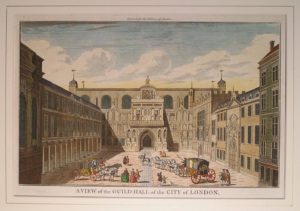
Short version: the tenant (of a sort) tore down the brewery. The owner (of a sort) got upset. The brewery itself was “commonly called or known by the name or sign of the Flower de Luce” and was on Golding Lane (later Golden Lane) in the parish of St. Giles without Cripplegate, London. [See more about the brewery here.] There are two versions of the case that I see: Greene versus Cole [1845] EngR 97; (1845) 2 Wms Saund 228; 85 ER 1022 as well as Greene versus Cole [1845] EngR 98; (1845) 2 Wms Saund 252; 85 ER 1037. As you can see, the two cases were published in the same year, the second appearing to be a form of appeal. The passage set out above is from the first of the two. The second one explains what is going on a bit better. The first court hearing is before the “hustings,” a court of the city of London, held before the Lord Mayor, the sheriffs and aldermen. It handled matters related to land, common pleas, appeals from sheriffs and probate – or disputes over wills like in this case. Beadles are called in. Jurors are rounded up from the wards around the location of the brewery to advise what they think was going on. The hearing was held in the still standing Guildhall, illustrated above in the 1750s. The custom in this case is all about local municipal process. But the cases are not from 1845. They are from the 20th year of Charlies II, republished to illustrate the point being made in law. As a result, they also illustrate the value and the elements of a brewery from the 1680s. It had a cement cistern. Who knew? Again… neato.

That is enough for today. This ain’t easy reading.

The British Ale Brewery, A Joint Stock Company In 1807

bab1807In 1807, a correspondent who went by the name “The Plain Dealer” wrote a letter to the editor of The Morning Chronicle on the topic of joint stock companies:
SINCE my last letter a number of new projects have been announced to the public, and some of them of great magnitude…. Let us begin with the Breweries. No fewer than five companies have been established, to rescue the public from bad beer at an increased price. This was a most tempting proposal. There was, after the series of unfavourable harvests, which we suffered at the beginning of the new century, an universal complaint against the beer. It was not merely lowered in quality, but composed of substitutes for hops and malt, which were thought to be pernicious; and to add to the evil, it was said to be the practice of all the great brewers, both in town and country, to buy up the leases of ale-houses, so as to deprive the publican of the freedom of going to the best brewery for his liquor. If this statement be true, it was a crying evil; but it was, and is, capable of an easy remedy. It depends entirely on the Magistrates; for if, instead of the reluctance which they now feel at the licensing of new houses, they would make it a rule, whenever a public tap was known to be the property of a brewer, and that bad beer was the consequence, to license a free house, in the immediate neighbourhood; the competition would be renewed, and the people would be served with a wholesome, palatable, and strengthening beverage. We know that the worthy Chief Magistrate of a city in the county of Kent has announced this to be his determination, and the inhabitants have already reason to be grateful to him for his device.

Competition. That was the promise of the joint stock companies. Too much wealth had gravitated into too few hands through the reactionary period after the loss of thirteen of the fifteen American colonies and then the French Revolution. The quality of beer crashed as prices climbed. But this new cure by joint stock companies was not trusted. In the string of letters to the editor in which this one is found, complaints about “sleeping partners” and “middle men” are set out. The sorts of things that people who distrust big faceless corporations floating mid-air in the stock markets still raise today. Yet there was an argument that these were tools to break the monopolies of the fantastically well connected and landed, the means to introduce competition into a status based economy. Competition was a new idea. Distrust hovered.

There is another reason folk were concerned other than the shock of the new. 1720. Ever since 1720, the joint stock idea was cursed. See, from the mid-1500s to 1720 there was a system of chartered companies approved and given blessing by the Crown. The most famous in Canada is the Hudson Bay Company that continues today. In our book Ontario Beer, Jordan and I describe how in the 1670s beer was being brewed in Ontario’s Arctic north by staff of the HBC over-wintering in trading posts set up to supply the firm with furs and other goods from the exotic north. A number of these were set up to encourage trade with lands as far away as Russia and Turkey… and then in the first quarter of the 1700s the South Seas. Careful readers will recall a few days ago when in the 1760 case Hunter v. Sheppard the Court described the hop buying fraudulent scheme in this way: “…trade was at that time very particularly circumstanced, hops being in 1764, like South Sea stock in 1720, or India stock in 1767…” Frauds. Bubbles. Money going in but never a hope of return coming out. The disastrous South Sea Company was the last of these companies to be chartered. And for a hundred years they remained highly suspect.

By the new century, new problems with the economy demanded a return to the concept.Unincorporated and unlisted subscription joint stock companies were forming when large groups of people subscribed into what essentially was a extremely large partnership. Described as “associations of gentlemen” they formed to break the grip of the established and wealthy in the context of the new commercial liberties and the new industrial era. One of these new enterprises was the British Ale Brewery. In an 1809 edition of The Monthly Magazine in the listings of commodity prices, one aspect of the British Ale Brewery is described: you can purchase a share in the firm for a 4 pound premium. Trading in company shares was an innovation and one that caused distrust.

But what was the British Ale Brewery? Apparently, it operated. The formation of the company was described in the 1815 court case Davies v. Hawkins:

…in 1807 a number of persons, about 600, associated together as a company, and made subscriptions, which subscriptions were divided into shares of 50 pounds each, for the purpose of establishing a brewery for ale, &c. under the name of the British Brewery. The subscribers entered into a deed which contained, among others, these provisions: that the shares should be transferable, &c. the purchaser executing the deed, and binding himself to observe the regulations, etc. contained therein; that a committee to be appointed should have power to make rules, orders, and bye-laws, subject to confirmation by a majority of the proprietors at a general meeting; that the conduct of the business of the brewery should be confided to two persons who should be styled brewers, and the trade should be carried on in their names…

The two assigned to act as brewers 1807 were Begbie and Murray. Their British Ale Brewery along with the Golden Lane Brewery were the only two breweries to complete their share subscriptions and enter trading in Britain’s early 1800s stock markets. How did it fair? In the 1808 ruling in Buck v. Buck, counsel for the firm pleaded that the intentions of the brewing enterprise were the purest:

The object of The British Ale Brewery was to carry on a lawful trade in a lawful manner, and to furnish to the public at a cheap rate, and of a good quality, an article of the first necessity It was a public benefit, therefore, instead of a nuisance, and was no more illegal than any other partnership comprehending a great many members.

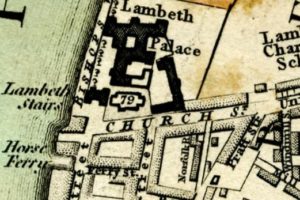
The court was not moved. It held the business to be outside the law. The brewery was supposedly located in 1810 on Church Street just south of Lambeth Palace in London between Pratt Street and Norfolk Row as shown in that 1818 map up there. Bits of those streets by those names still seem to exist near the Thames. Its twin, the Golden Lane, died off as a joint stock company in 1826. Hmm. In 1808, the same Begbie and Murray appear to take out an insurance policy for the Caledonian Brewery on Church Street in Lambeth. The equipment and the lease for the Caledonian Brewery of Lambeth are auctioned in 1824 and in 1831, one Thomas Begbie testifies before a committee on the state of the brewing trade. By 1844, the law of Britain required all joint stock companies to be incorporated and listed. Whatever happened, the brewery and the era appear to have been wound up by then.

Three 1700s English Court Cases About Hops

hops1700-1

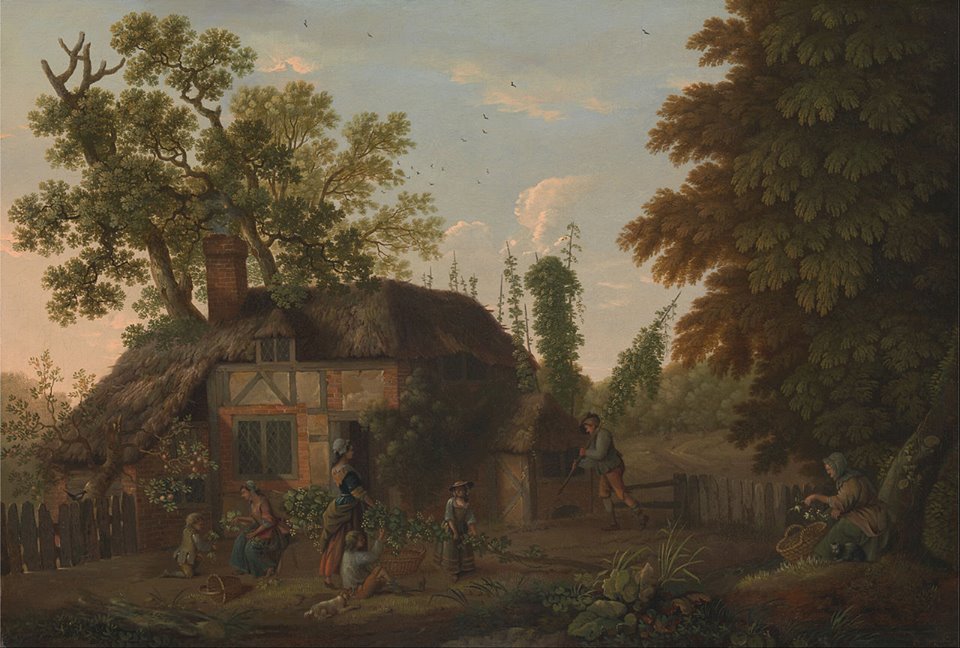
Have you even noticed I particularly like beer related stuff from before 1800. Have you noticed I like beer related stuff related to the law? Imagine then my joy when I came across a searchable database for the English Reports, the law reports series from the Magna Carta in 1215 to the Judicature Act of the 1870s… or so. The first word I put in the database was “hops” and then “hoppes” just like I did when I cam across this early modern print aggregator tool a few months back. Why hops? Something of value worth arguing over, something with a relatively clear entry point into English culture. Plunk it into the English Reports and, right off the top, three court cases pooped up from the second half of the 1700s. A perfect moment to pull out the image I tucked away for just this situation, the mid-1700s hop picking scene “Hop Pickers Outside a Cottage” by George Smith (1714 – 1776). Notice how in the image, the hop polls are brought into the yard and then are picked by hand there. It’s not without relevance.

The first case has the best narrative. In the ruling in Tyers v. Walton T. 1753. 7 Bro. P.C. 18, there is a dispute between Rev. Walton, rector of Mickleham in Surrey and vicar of Dorking, and Mr Tyers who had a certain acreage of hops within those parishes. The dispute arose because the good vicar had the right to be paid a tithe of the hops in all these two parishes. In 1745, Tyers paid the tithe in the form of 20 guineas. from 1746 to 1750, he provided a tenth of the crop after the hops were picked. 1751, however, was a bumper year and great quantities of hops grew upon the 28 acres that Tyers controlled. Tyers got greedy. He offered a maximum of 20 shillings an acre. This was refused. In response, Tyers seems to have cut the bines on every tenth hill, did not pick the hops and told the vicar to gather them himself. The law was not amused. At trial the court held that “that hops ought to be picked and gathered from the binds before they are titheable” meaning, pick ’em then divide out the 1/10th share. At the appeal hearing, the court held “the appellant had not made the least proof that the tithe of hops were ever set out before they were picked from the bind or stem.” Not the sort of thing an appellant like to hear. 1-0 vicar.

In the second case, Hunter v. Sheppard and others 1769 IV Brown 210, there is no vicar. Just a hop merchant and his purchasing agent. London-based James Hunter is described as being “one of the one of the most considerable dealers in hops in England.” His agent, named Rye, worked in the Cantebury area for years had been well known as Hunter’s man. But in 1764… there was another good year with hops bearing top price. Rye set out to make deals as an independent – without telling Hunter or anyone else. The case gets quite involved. There is much unraveling of what each landowner knew, which agent was working for which buyer and what the prices were. The Court took the matter seriously as Hunter’s purchases for that one autumn in just the Canterbury area were worth a total of 30,000 pounds. In current UK currency, that is worth £394,200,000! Money. At trial, Mr Hunter did not win the day. The judge ordered an elaborate sharing of the proceeds among a number of parties. Hunter appealed and at the appeal the Court made a wonderful observation on the nature of Hunter’s business:

The trade was at that time very particularly circumstanced, hops being in 1764, like South Sea stock in 1720, or India stock in 1767, and it required great precaution to deal in them with safety and advantage; in all which cases, the great art is to conceal the real intention; and the appellant being the most considerable dealer in England, was not obliged to let into the secret every man who pleased to speak to him on the subject, whether upon the road or elsewhere.

The panel hearing the appeal was not impressed with Hunter. One is never encouraged in court when being compared to the South Sea Bubble. The Court held Hunter sought to seriously play the Canterbury hops market and “to support these propositions he had entangled himself in a series of contradictions; and the assertions in both the answers were in many respects falsified by the evidence for the respondents.” The word fraud is then used. Too bad for you, Mr. Hunter.

In the final case, Knight v. Halsey 1797 7 T.R. 88, we find ourselves thirty years in the future but back to the question of tithes. Unlike the previous two cases, the interesting thing is not the narrative tale like something of a distant backstory employed by a Victorian novelist to establish why two families in the 1860s hate each other. The interesting thing is the recitation of the law. Knight is described as “the occupier of a certain close in the parish and rectory of Farnham” while Halsey grew hops. The dispute arose in the manner in which the hops were to be picked and divided. The Court considered the 1753 case of Tyers v. Walton discussed above but reached back farther in time to a case called Chitty v. Reeves in the Court of Exchequer, from Michaermas term 1686 brought by Ann Chitty, the widow and executrix of C. Chitty, against Reeves of the parish of Farnham. It quickly gets even better as in that case, the Court relied on even earlier evidence and held:

It fully appearing to the Court that the custom, usage, or practice of paying tithe hops in the parish of Farnham, in the county of Surrey, for above sixty years past, hath been that the impropriator or his lessee hath had for their tithe the tenth row when equal, or else the tenth hill; that the same have been left standing with the hop binds uncut, and that the impropriators, &c. have always had convenient time to come and cut the said binds the hops upon the grounds…

Fabulous. This means that in the 1797 case, the court is relying on a finding of fact based on evidence from the 1620s that people, like those in the painting above, could take their time to gather the hops owed to the church when it suited them. Boom! That is law as good clean fun. The court reviews a heck of a lot of tithe law but keeps coming back to dear widow Chitty from the time of Charles I. It also points out, conversely, that a custom which is against reason cannot prevail and is, accordingly, legally void. We gotta move on. At a time of transition into the next century’s looming industrial era, it is quite extraordinary – and Lord Kenyon, the Chief Justice admits as such when he states “[w]hether tithes be or be not a proper mode of providing for a numerous class of persons of great respectability, the clergy, I will not presume to say…” In the end, Kenyon throws up his hands at all the information before him and, I understand, orders a new trial to get to the bottom of this claim of a long standing custom versus commercial common sense.

Wow. Such drama. The good widow Chitty and the mercenary Mr. Hunter all jump out off the page, all in the name of their share of the value of the hops crop as England is balancing its rural traditional past and its modern commercial future. Neato!

“Selling Beer and Keeping Houses of Rendezvous”

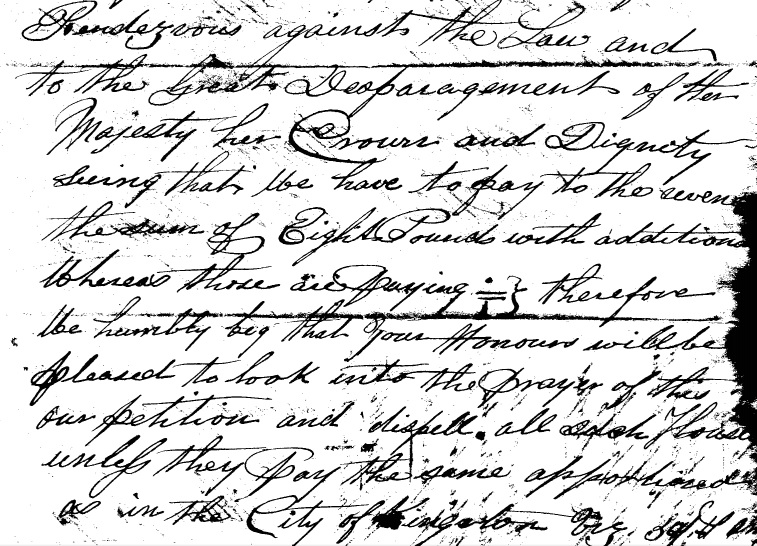
barrie2One of the good things about being in my job is the records one comes across or co-workers with an interest in history share with you. I got this tidbit below in my email last week. That’s from the first document I came across in a larger scanned file called “Tavern Inspectors Records 1849-1853“.

To the Honourable the Municipal Council of the Township of Pittsburgh in Session aforementioned, We the Undersigned Tavern Keepers of the Village of Barriefield humbly and respectfully sheweth – whereas that there are persons residing in the said Village or premises adjoining Selling Beer and Keeping Houses of Rendezvous against the Law and to the great Desparagement of Her Majesty her [maybe “Crown”?] and Dignity seeing that we have to pay to the [?] the sum of Eight pounds with additions whereas these are paying [odd symbol for “zippo”] therefore we humbly beg your Honours will be pleased to look into the prayer of this our petition and dispell all such Houses unless they pay the same apportioned as in the City of Kingston vis [?] and we humbly beg that if such is granted that this shall be [?] for seeing that if such is not stopped we Your Petitioners will not be able to pay the Monies apportioned. But trusting that Your Honours will be pleased to looking into the prayer of this Petition and as In duty bound.

Barriefield is a small village in a largely rural township that was amalgamated into the City of Kingston in 1998. It was originally set up in the War of 1812 as an officer’s residence area associated with nearby Fort Henry. The document seems to be dated from 18 April 1850. It’s title on the back page is blurry and ink blot messy but seems to state Petition of [blah, blob, blur] for Beer Shops. It looks like the Tavern Keepers of Barriefield were not happy with the informal competition. I like the suggested threat, too: shut them down or we will maybe not pay our fees. That is the “zippo” emoticon circa 165 years ago in question up there, by the way. Click on it for a bigger bit of the document. I would also attach the whole file but it’s an 80 page pdf. Oh, what the hell. Have a look. By the way, a notation in the petition states that the matter was referred to the next Session and a bylaw was to be prepared… in case you are keeping track.

The beginning of the well regulated marketplace. What follows in those 80 pages is the licensing of all sorts of establishments in the community over the next few years. Afrirmations that the applicant is an honest, steady and sober man. The Township of Pittsburgh hadn’t been long in existence on the date of that first petition of April 1850. In the emails I was sent, there was also another file with the Minutes of the Midland District Municipal Council, a larger regional jurisdiction that was only abolished in 1849. So, one of the first things the new government has to deal with is the standardizing of licensing of the taverns and beer shops. Maybe it was just the fact of a thirsty British military base down the road. Or maybe it was the need to provide regulation as the Georgian ways of the century’s first have gave way to new Victorian expectations.

Is The Data Overload Becoming An Issue?

It was a bit of a revelation. Well, a joke and a revelation. I have a brother who is a bookman who sends rare finds for birthdays and holidays. This year for my 52nd I got this book on cheese. Published in 1960, it is a simple thing. More like a long magazine article than a full book. The author describes one trip taken in a car traveling from farmhouse cheese maker to farmhouse cheese maker. Cheeses are gathered in the back seat and the trunk… sorry, boot… and the taken back to London where they are eaten at dinners and parties with guests like Dame Margot Fonteyn and Stirling Moss. It’s all very light and comforting. It’s not all that unlike Everyday Drinking – The Distilled Kingsley Amis which I reviewed six years ago now. Yes, a voice from another era and one imbued with class and cultural distinctions which don’t matter anymore. Yet it is filled with discovery:

Mrs. Roberts DOES still make Caerphilly but not in her cool dairy, which I had foolishly asked to see. That is only used for storing milk and cream! Her cheeses are made in the kitchen, with vats and presses a hundred years old, and they mature in the bedroom. As these ancient, heavy wooden vats are irreplaceable, she may soon have to give up her cheesemaking.

OK, like Amis perhaps without the ever present danger of arrest for driving whilst intoxicated. Perhaps. There are still bottles consumed as she goes about. But there is nothing snobbish about any of it. In the second paragraph, snobbery is the word used for the one who sniffs contemptuously at the mere mention of the cheeses of ones own country. It’s an essay about the pursuit of the real in a world where imports and processes have become the norm. Sound familiar?

This is a voice like the one in my head when I became interested in beer. Not a voice I hear very much of anymore, sadly. Between the quantity chasing tickers and the off-flavour seminarians and the worshipers of the next ever so slightly different hop strain, there seems to be little being left to individual discovery. Too much expertise in the beer to be assimilated from above. Not enough simple pleasure in the experience of it. The current bleat about poor quality in new craft is just the latest twist. The hand of industrial process now reaches down as one’s betters warn that if you eat that cheese matured in the bedroom you might encounter something unexpected, unplanned.

This is not to suggest all was better. The second half of the book is filled with recipes which range from the traditional – like that very attractive cheddar biscuit – to the weirdly experimental. I will not, for example, take up the recommendation to wrap eight bananas in ham and bake them in a sauce made with a whacking pile of grated Lancashire cheese. But there is a joyfulness about it all which big craft seems to be drumming out of me, drumming out of good beer. I don’t care. The errors and trials and surprises of all these new actual small brewers are too interesting to care about their elders and betters, the self-appointed senex with the standard operating procedures, marketing staff and strategic plans for the annual trade show.

Beer And Art: Bruegel’s “Return From The Inn”

image275

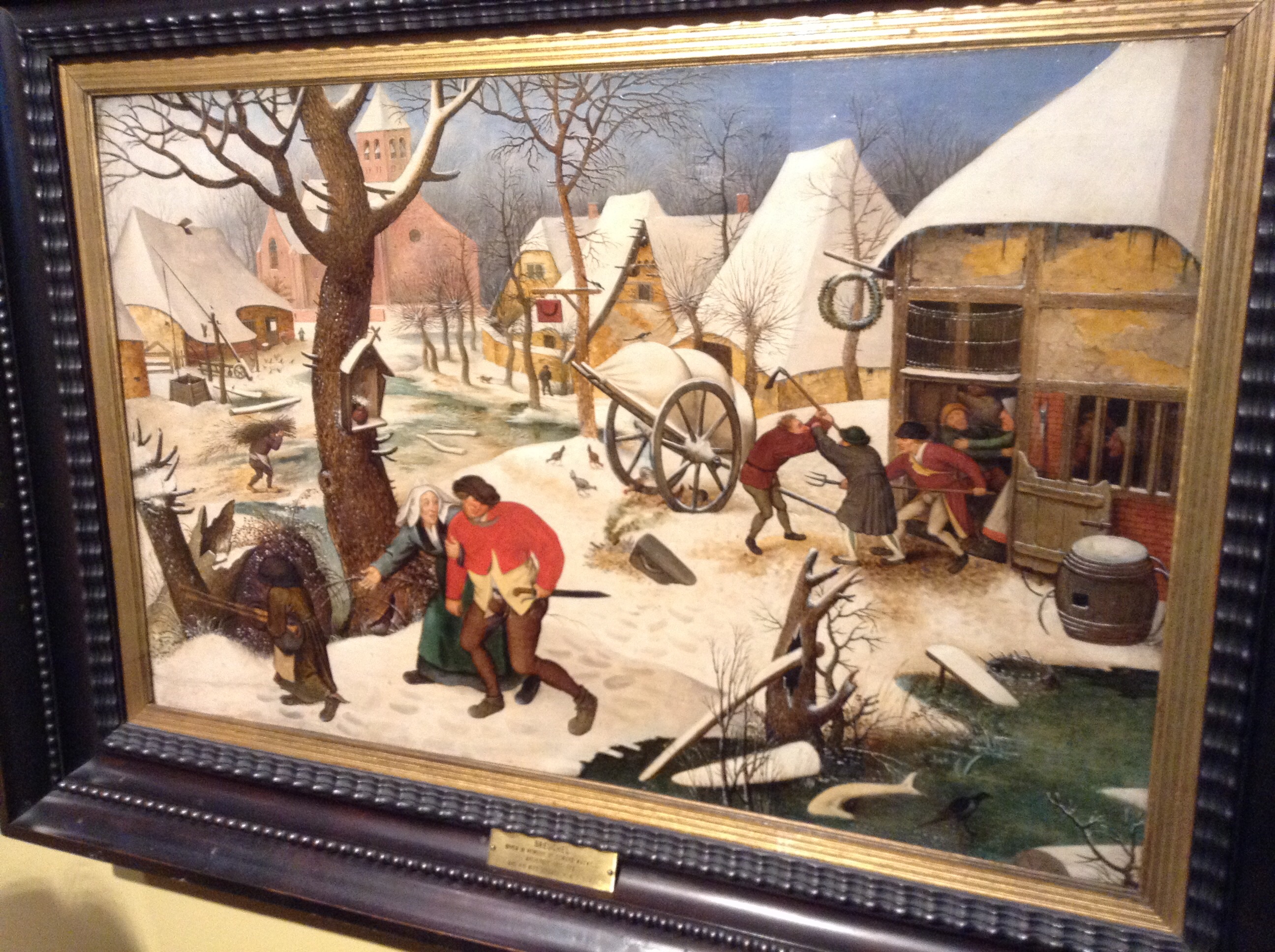
A couple nights in Montreal leads to a lot of good things. A number of forced marches for the family through an alarmingly frigid city to this meal or that shop. Buying beer in a grocery store. Five new pairs of Converse sneakers for distribution across the clan. And a stop at the Montreal Museum of Fine Arts where I saw this, “Return from the Inn” by Pieter Bruegel the Younger (again with the PBtY) … or is it Return from the Inn? Such things elude me. It’s not the greatest image in terms of sharpness but a larger scale image is clickably before you if you want a closer look.

Aside from all the allegorical stuff, I noticed the two items related to brewing right away: the massive sacks of grain on the untended cart as well as the sign of the wreath indicating, I understand, that strong drink is on offer within. I would expect the birds pecking away at the spilled grain which has fallen to the ground would be a sign of decadent waste to someone 400 years ago. Not sure if the load has been left by carters now inside filling their bellies with ale or whethers it’s the inn’s own supply. Lot of snow on those wheel spokes.

I suggest you ignore all the brawling gifts swinging agricultural tools and the steamy suggestions of sexual faithless. Reminds me too much of the final half hour of a craft beer fest. A rather snazzy explanation of the whole thing can be found here. The image is from around 1620 or just when various European nations are setting up colonies in what are now Quebec, New York, Delaware and Boston. This would be what normal would look like to those earliest colonists, the way they would have approached – or avoided – this sort of inn if out looking for a beer of an afternoon.

Did Father Duplessis Brew Quebec’s First Beer?

1608habitation_de_quebecYou may recall that a couple of months ago I wrote a post about the first brewing of beer in New France describing how in 1617 Louis Hébert became the colony’s first private land owner, farmer and a brewer. He is generally accepted as the first brewer. But what’s been tickling at the back of my head has been the footnote that I quoted. It’s from a bit of writing about life in the earliest years of New France. The footnote included this tidbit from 10 August 1620:

Nous avon du grain suffisamment pour faire du pain and de la bière

The sentence to which that footnote is attached goes on to suggests the Recollet missionaries themselves were brewing at Quebec before 1620. How many years before 1620? The interesting thing about the early bits of anything is how little data there is to work with. This is admittedly compounded by reliance on (i) my crappy French and (ii) the internet. Yet… I think I like where I am going. One of the reasons there is only a little data to work with is there were only a few Recollets in North America at the key point in time. In 1615, four show up with Champlain: Father Denis Jamet the first superior along with Fathers Le Caron and Jean Dolbeau and Brother Pacifique Duplessis. Jamet appears to have written first impressions of life in New France that was sent to New France in July 1615. Haven’t seen that record yet. Some are just not on the internet. And some don’t last. Le Caron’s records were destroyed likely around 1632 when his possessions were burned due to him catching a bad case of the plague. The earliest fullish record of the Recollets in New France I can lay my hands on appears to be that of Brother Gabriel Sagard who only showed up in 1623.

From what I can see, La Caron spends the first winter far to the west in what is now central Ontario with the Huron people. After he returns to the settlement at Quebec, he and Jamet then leave New France in the summer of 1616, returning in 1617. Dolbeau stays from 1615 to 1617, spends the winter of 1615-16 to the northeast down river among the Montagnais, and returns as well after a year away. Brother Duplessis lives in New France from 1615 to 1618 and seems to be the one who sticks closest to home. Before becoming a priest in 1598, Duplessis was a practising apothecary and he seems to continue using that skill as a Recollet. He stays at Quebec from the spring of 1615 to 1617 which is when Louis Hébert, also an apothecary, shows up. Which means, unlike what is generally understood, Hébert was not the first apothocary at Quebec.

So, what is an apothecary in New France at that time? Mainly a pharmacist but with a good dose of gardener and herbalist along with amateur scientist. Part of the work of Duplessis from 1615 to 1618 includes tending to the sick. Alcohol is generously available – pervasive even – in New France and is used to treat infection and other medical purposes. Could it be that for two years when Quebec is being established that Duplessis might have turned his hand to brewing before Hébert arrives as part of his work as an apothecary? While the colony seems to be awash with imported wine and cider, brewing beer still seems to fit in the overall plan. By 1623, as Sagard describes, the colony has its own orchards and is making efforts to have a diversity of local crops, to attain as much self-sufficiency as possible. The Recollets had their own building at Quebec from the date their arrival in 1615 and Duplessis seems to be working there for much of his two years there. They farm the land. Which means Hébert was not the first farmer, either. And a few years earlier, Champlain specifically noted the presence of hops in the St. Lawrence valley. Just the sort of thing an adventurer apothecary farmer missionary might notice, too, over the course of a two year stay.

That’s all I know. It’s speculation so far even if plausible. But with local hops on hand, using a few pounds of grain to make a fresh ale is not the most absurd thing someone might turn their hand to to pass the time. Maybe.

Update: The next day I found this document which includes a quotation from Jamet’s report presented to the French King dated 15 August 1621… or 1620. Google Translate and I have tag-teamed of translate the description of the first Recollet building in Quebec in this way:

When we arrived, we learned that the Sieur du Pontgravé, captain for merchants in the community, had started to build us a house, which since our arrival we have completed… The main building is well made, strong frame and between a wall of large pieces 8 to 9 inches (20 to 23 cm ) to its coverage; it has a length of thirty-four feet (10.3 m), width of twenty-two feet (6.7 m); it has two stories. We divided the first floor into two – one the half we made our chapel until something better; the other a beautiful large room, which will serve as a kitchen and which will house our people (ie workers ). The second floor has a nice big room and four smaller ones, two of which we have built slightly larger than the other [with] chimneys to place the diseased so that they are alone. The wall is made of good stone, sand and good lime – better than that which is done in France. Below is a cellar twenty feet square and seven deep.

Workers, a kitchen and a cellar. Hmm. As a bit of background if only for Bailey as to where I am going with this, I am comparing the Recollets with their lack of records who were in New France from the mid-1610s to the late 1620s with their replacements, the Jesuits, who were very good record keepers. The roles of beer with the latter group is well illustrated in their reports of life into New France for 1636, in the form of reports back to France describing the life, work and needs of the young agricultural community:

Twenty men will clear in one year thirty arpents of land, so clean that the plow can pass through it; if they had an interest in the matter, perhaps they would do more. There are some places which are much easier than others. The usual task for each man is an arpent and a half a year, if he is not engaged in other work. As rations, each one is given two loaves of bread, of about six or seven pounds, a week,—that is, a puncheon of flour a year; two pounds of lard, two ounces of butter, a little measure of oil and of vinegar; a little dried codfish, that is, about a pound; a bowlful of peas, which is about a chopine [pint],—and all this for one week. As to their drinks, they are given a chopine of cider per day, or a quart of beer, and occasionally a drink of wine, as on great fête-days. In the winter they are given a drop of brandy in the morning, if one has any.

In the next decade, skilled brewing becomes established in the colony. In 1646 the Jesuit records state: “Our brother Ambroise was employed, from the 1st of May till the 20th, in preparing barley at notre dame des Anges, and the beer.” So if the Jesuits were splashing around the beer and other drink in the second quarter of the 1600s, should it not be reasonable to assume the Recollets were doing so in the first quarter, too?

Ontario Loves Its Large Profit-Making Aggregations

ontbeer1930b-1

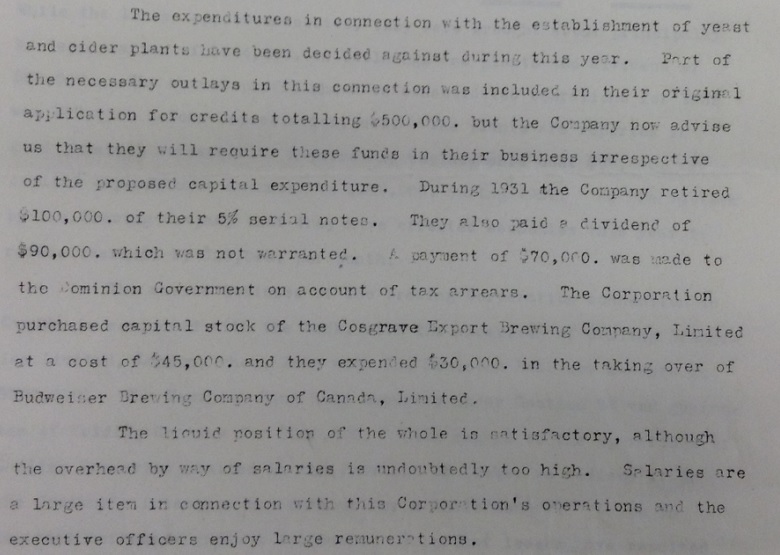
This is likely the least exciting picture visually I have posted around these parts. But its content may place it among the most interesting. Click on it for the larger version. That’s a couple paragraphs from a 1931 financial statement for E.P. Taylor’s nine month old firm, the Brewing Corporation of Canada. Taylor played a greater role in restructuring Ontario’s brewing industry from the 1930s to the 1970s than anyone else. We discussed him last December but it is worth reminding ourselves about one of his governing principles. We face, as Jordan notes, a supposed renewal of our retail trade in beer, a brave new future with beer being sold in a few grocery stores. We may, however, be facing the prospect of not obeying only some little discussed cultural factors but baggage left behind after the old man made his billions, moved on and died.

You see a few references to payouts. We are told that the executive officers enjoy large remuneration. Also a dividend of $90,000 was paid but unwarranted ensuring the shareholders were happy even as, we learn elsewhere, the firm suffered total losses on $496,000. The financial statements disclose these decisions because they are submissions to the bank lending Taylor and his firm money to raise the overdraft from $80,000 to $130,000. This bet on Taylor’s future was backed by his access to English investors but still was quite extraordinary given this passage in the financial statements which we quoted in Ontario Beer:

He is a very young man but quite capable,although probably not thoroughly experienced in the manufacture of beer. However, we think he has good organizing ability and is capable with lots of self confidence in the eventual success of this organization.

What all this illustrates for me is something I think was given to Ontario at its birth in the 1780s and lingers on today. We love a controlled aggregation. Ontario was established after the American Revolution as something of a utopian Tory colony which was supposed to prove that prosperity followed when a well conceived plan was followed through by a compliant populace obedient to their governing betters who ensured, in return, a supply of good things including beer. With the coming of the madcap liberties under the Victorian era, commercial opportunity in brewing expanded but it was soon stalked by another set of betters in the form of the temperance movement. This guiding principle of the growing God-fearing middle class made gains on economic liberty through the latter end of the 1800s to the point it were the most powerful political force by the First World War. The imposition of Ontario’s tepid form of prohibition during the conflict lasted until 1927 when the concurrent stink of corruption brought in liquor control system we live with today with its abiding interest in ensuring the many are, again, guided by the benevolent hand of the few. The few now being semi-bureaucrats heading heading up semi-governmental agencies.

What does that have to do with E.P. Taylor? Well, like others well situated at various points in Ontario’s history – from Richard Cartwright Jr in the 1790s enjoying the liquid rewards of his riches to the international conglomerates which own The Beer Store today – Taylor knew that Ontario and its beer buying population was too valuable a resource to let it have its own way without the application of a little profit making control. See, he may have carried the baggage for a large chunk of the 1900s he did not pack the bags. And because of the cultural acceptance of this sort of thing, because that is part of what makes Ontario Ontario… I do not expect this to change. So, when I read that out betters are planning to add a whole 300 extra retail licenses for a population of over 13 million, well, I do not expect great change. I do expect great financial reward for those granted the power to sell. And I do expect existing interests will likely be respected. No one will suffer the undoubted societal confusion caused by imposing the broad-based forms of beer retailing common in all our neighbouring US and Canadian jurisdictions. We shall be saved from all that. Anything else would be unOntarian.

Oh, What A Loverly Word Usage Graphing Tool…

hoppes

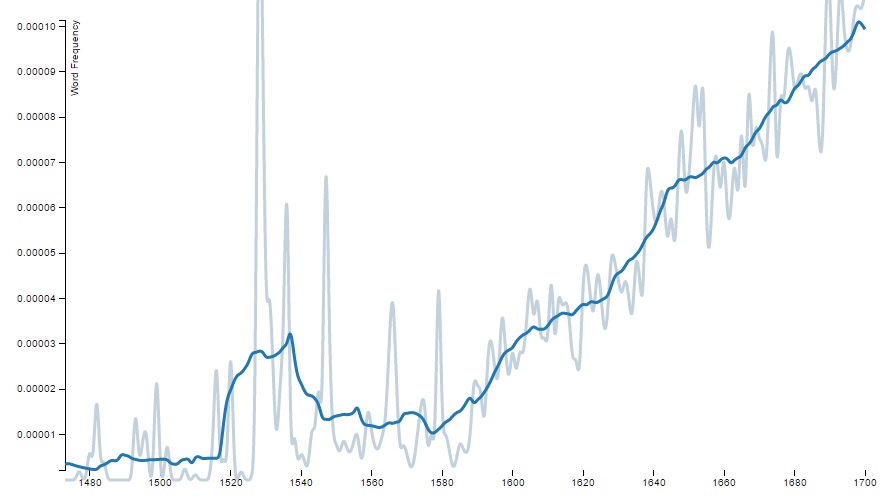
See that? Click on the image and you will see it better. That is a word search for the word hop[pe]s in English language texts from a site called Early Modern Print: Text Mining Early Printed English which explains itself as follows:

Early Print offers a range of tools for the computational exploration and analysis of English print culture before 1700. Early Print offers a range of tools for the computational exploration and analysis of English print culture before 1700. The site was designed to help scholars make sense of the incomparable textual archive produced by the EEBO Text Creation Partnership, consisting of a set of transcriptions of the first two centuries of English print. While EEBO-TCP provides access to a massive collection of texts that promises to transform the way scholars approach this period, it also presents significant technical and conceptual challenges. The relative accuracy (given its scale) of the EEBO-TCP corpus that makes it such a valuable resource for scholars also makes it complex for computational analysis.

Got it? Yikes. It appears to be a far more complex version of the New York Times search tool that is so useful in confirming how late “craft” beer came into accepted usage. Except, this fun widget focuses on texts from 1480 to 1700. I am still having some problem figuring out how to properly run searches given all the swell code that can be used to run searches. But when you do, you get wonderful – even if possibly misleading – results like this one confirming that “hops” or “hoppes” came into far more common use on a very particular date roughly around 1518. Look at “ale“! I am sure folk more clever than I may make more interesting use of it so let me know what you find. Be careful. Remember that around 1577 “biere” was a common spelling. Have a go. Meanwhile, I wonder if anyone mentioned “craft beer” during that era…